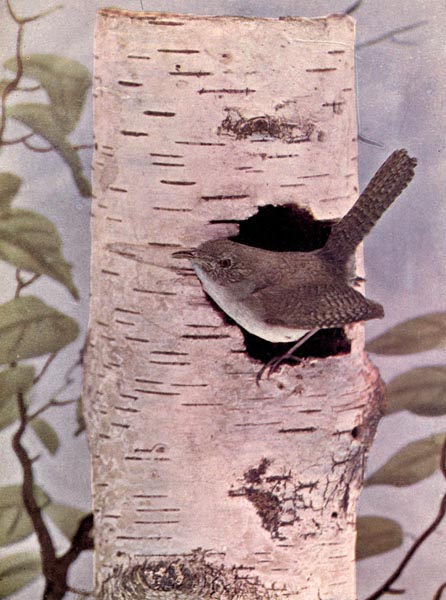
The House Wren for Birds Illustrated by Color Photography, 1897
From col. F. M. Woodruff. Copyrighted by
Nature Study Pub. Co., 1897, Chicago.
THE HOUSE WREN.
(RELOCATED – CLICK HERE)
The House Wren for Birds Illustrated by Color Photography, 1897
From col. F. M. Woodruff. Copyrighted by
Nature Study Pub. Co., 1897, Chicago.

Osprey Family by Phillip Simmons
And God blessed them, saying, “Be fruitful and multiply, and fill the waters in the seas, and let birds multiply on the earth.”
(Genesis 1:22 NKJV)And God H430 blessed H1288 them, saying, H559 Be fruitful, H6509 and multiply, H7235 and fill H4390 (H853) the waters H4325 in the seas, H3220 and let fowl H5775 multiply H7235 in the earth. H776 (Genesis 1:22 KJV+)
I have written before on this verse, but really never looked into this aspect of it. I knew He had told them to multiply and be fruitful, but I missed the “blessing” part. The Lord didn’t just create the birds and then leave them on their own. He cared about them and “blessed” them. Below is the definition of Strong’s Hebrew word and then Thayer’s Greek word for Blessing or Blessed.
Strong – H1288
בּרך
bârak
baw-rak’
A primitive root; to kneel; by implication to bless God (as an act of adoration), and (vice-versa) man (as a benefit); also (by euphemism) to curse (God or the king, as treason): – X abundantly, X altogether, X at all, blaspheme, bless, congratulate, curse, X greatly, X indeed, kneel (down), praise, salute, X still, thank.
Thayer – G2127
εὐλογέω
eulogeō
Thayer Definition:
1) to praise, celebrate with praises
2) to invoke blessings
3) to consecrate a thing with solemn prayers
3a) to ask God’s blessing on a thing
3b) pray God to bless it to one’s use
3c) pronounce a consecratory blessing on
4) of God
4a) to cause to prosper, to make happy, to bestow blessings on
4b) favoured of God, blessed
Part of Speech: verb
Let’s see what some of the commentaries have to say about the birds being blessed by God:
(Chuck Smith) – “But we get the more complex life forms that sort of are a little independent. They’re not rooted, they’re not grounded, they are mobile, and the various cycles that God has created, the whole process is just so marvelous indeed. The water, teeming with life, and then the air, and the many, many kinds of birds and the variety of birds that God has created. And those instinctive abilities in the birds!

American Golden Plover (Pluvialis dominica) at National Aviary by Lee
I’m always fascinated by that little bird in Hawaii that goes up into the Aleutian chain in order to mate. During the summer, they take off from Hawaii and they fly all the way up into Alaska where they mate. They build their nests, they lay the eggs, they hatch their young. And then with the coming of winter, they don’t want to spend winter in Alaska — and who can blame them. And you have to almost envy them, spending their winters in Hawaii. They take off over the thousands of miles without suitcases, without spare gas tanks, without compasses or navigational equipment. And they come and fly right into Hawaii, sometimes they get into severe storms, one-hundred, two-hundred mile an hour winds that blow them off course, but somehow they find their way right in. You say, “oh, they remember the way they flew out.”
How do they reckon? Some think they have some kind of device that tunes on the magnetic field of the earth. I don’t know. But, really, they’re not following the same path, so that argument’s sort of shot down, because, really, the parents decide to leave for Hawaii before the kids are able to fly that far. So, the parents fly off to Hawaii, leaving their kids in Alaska! But, it doesn’t seem to matter, cause a couple of weeks later, their kids take off and they fly right to Hawaii. Never been there before, yet somehow, God has built into this little bird that kind of instinct; and that’s a bird brain. And it’s not a very big kind of a computer. Talk about microsystems!
Oh, the wisdom of God, the wisdom of God. How thrilling to be able to see the design in nature, all testifying of the wisdom of the God that I serve. I’m so glad that I serve Him. I’m so glad that I know Him. Such a glorious God, so wise; all of these created life forms. Now, He created also the mammals, the great whales. He created the animals, the domesticated-type animals, all after their own kind.
And the evening and the morning were the fifth day.”
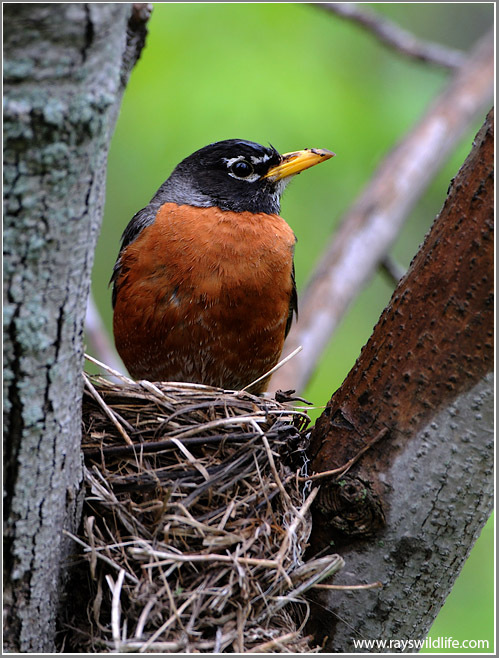
American Robin (Turdus migratorius) in nest by Ray
(John Gill) – “Genesis 1:22
And God blessed them,…. With a power to procreate their kind, and continue their species, as it is interpreted in the next clause, saying, be fruitful, and multiply, and fill the waters in the seas: and these creatures do multiply exceedingly, and vast quantities there are of them in the mighty waters, though the consumption of some sorts of them is very great. Our English word “fish” is derived from the Hebrew word פוש, “fush”, which signifies to multiply and increase:
and let fowl multiply in the earth; as they did, and continue to do to this day.”
(Matthew Henry) – “2. The blessing of them, in order to their continuance. Life is a wasting thing. Its strength is not the strength of stones. It is a candle that will burn out, if it be not first blown out; and therefore the wise Creator not only made the individuals, but provided for the propagation of the several kinds; God blessed them, saying, Be fruitful and multiply, Gen_1:22. God will bless his own works, and not forsake them; and what he does shall be for a perpetuity, Ecc_3:14. The power of God’s providence preserves all things, as at first his creating power produced them. Fruitfulness is the effect of God’s blessing and must be ascribed to it; the multiplying of the fish and fowl, from year to year, is still the fruit of this blessing. Well, let us give to God the glory of the continuance of these creatures to this day for the benefit of man. See Job_12:7, Job_12:9. It is a pity that fishing and fowling, recreations innocent in themselves, should ever be abused to divert any from God and their duty, while they are capable of being improved to lead us to the contemplation of the wisdom, power, and goodness, of him that made all these things, and to engage us to stand in awe of him, as the fish and fowl do of us.”
(Haydock Commentary) – “Genesis 1:22
Blessed them, or enabled them to produce others. — Multiply: the immense numbers and variety of fishes and fowls is truly astonishing.”
(K & D) – “As animated beings, the water animals and fowls are endowed, through the divine blessing, with the power to be fruitful and multiply. The word of blessing was the actual communication of the capacity to propagate and increase in numbers.”
(John Wesley) – “Observe, 2, The blessing of them in order to their continuance. Life is a wasting thing, its strength is not the strength of stones; therefore the wise Creator not only made the individuals, but provided for the propagating of the several species, Gen_1:22. God blessed them, saying, Be fruitful, and multiply – Fruitfullness is the effect of God’s blessing, and must be ascribed to it; the multiplying of the fish and fowl from year to year, is still the fruit of this blessing here.”

Painted Bunting (Passerina ciris) ©©Flickr
Oh that men would praise the LORD for his goodness, and for his wonderful works to the children of men! (Psalms 107:31 KJV)
The Lord not only blessed the birds, but provided them with the instinct and DNA to be able to reproduce and adapt to the changing conditions. Those that have not been able or suffered disasters be they natural or man-made have become extinct. The “kinds” have produced great varieties (over 10,400 species) that we enjoy as we study and view the different families. While He blessed the birds, in turn, we are blessed because we are able to enjoy the vast variety of these avian creations. Praise the Lord!
*

The Ruby-throated Humming Bird or Birds Illustrated by Color Photography, 1897

Common Redshank (Tringa totanus) by Ian 1
Ian’s Bird of the Week – Common Redshank ~ by Ian Montgomery
Newsletter – 11-1-12
Here’s one for the wader enthusiasts: the Common Redshank, well ‘common’ in Eurasia and rather rare in Australia. It occurred to me when I was photographing these birds in Ireland in September, that, for birders, the appeal of a particular species is very dependent on location. Common Redshanks are noteworthy in Australia (I remember looking quite hard before finding one in Broome) but perhaps a nuisance in Ireland because they’re ubiquitous, nervous and noisy and often put more unusual waders to flight when you least want them to.
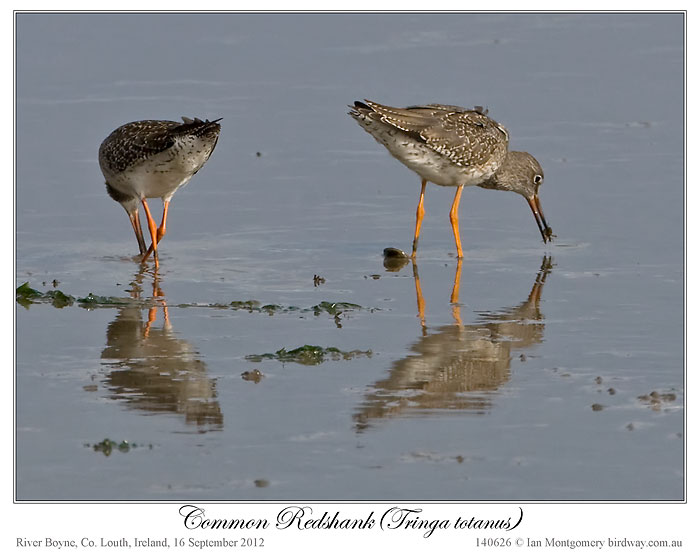
The one in the first photo is foraging at low tide in the harbour at Carlingford Lough, an attractive bay between the Republic and Northern Ireland on the east coast and overlooked on the northern side by the Mourne Mountains. The two in the second photo are feeding in the mudflats in the estuary of the River Boyne some distance downstream from where the famous Battle of the Boyne took place in 1690. The bird on the right has just taken a tiny crab.
Common Redshank (Tringa totanus) by Ian 2
The birds in the first two photos are in non-breeding plumage. Some wader species undergo spectacular colour changes when breeding, but in the Common Redshank the markings just become more pronounced, as in the third photo, taken in Portugal in the month of June some years ago.

Common Redshank (Tringa totanus) by Ian 3
The bright red legs, or shanks, make this a relatively easy wader to identify. It’s ringing call is also distinctive and it shows a characteristic wing pattern in flight with white panels on the rear edge of the wing, as in the fourth photo, quite different from the wing bar or plain wing of most waders.

Common Redshank (Tringa totanus) by Ian 4
The generic name Tringa is from the ancient Greek trungas ‘a thrush-sized bird mentioned by Aristotle, not further identified, but taken by later authors to be a sandpiper, a wagtail or a dipper‘. That’s equivalent to saying that this fruit is either an orange, a pineapple or a banana. And totanus comes from the Italian name totano for a Redshank. Sometimes the derivation of scientific names is informative, sometimes less so.
Best wishes
Ian
**************************************************
Ian Montgomery, Birdway Pty Ltd,
454 Forestry Road, Bluewater, Qld 4818
Tel 0411 602 737 ian@birdway.com.au
Check the latest website updates:
http://www.birdway.com.au/#updates
Lee’s Addition:
The birds of the air, And the fish of the sea That pass through the paths of the seas. (Psalms 8:8 NKJV)
What a neat little bird. I especially like the 3rd photo showing the red, hence, Redshank. Thanks again, Ian.
Redshanks do belong to the Scolopacidae – Sandpipers, Snipes Family. See his Scolopacidae family photos also.
Common Redshanks in breeding plumage are a marbled brown color, slightly lighter below. In winter plumage they become somewhat lighter-toned and less patterned, being rather plain greyish-brown above and whitish below. They have red legs and a black-tipped red bill, and show white up the back and on the wings in flight.
(Sound from xeno-canto.org)
See Also:
Ian’s Bird of the Week Newsletters
Common Redshank – Tringa – ARKive
Common Redshank – Naturia
Common Redshank (Tringa totanus) – Ocean Wanderers Guide
Scolopacidae – Sandpipers, Snipes Family
Scolopacidae – Birdway (Ian’s)

Under His Wings – ( Male Pink-necked Green Pigeon by Rik Seet)
Be merciful to me, O God, be merciful to me! For my soul trusts in You; And in the shadow of Your wings I will make my refuge, Until these calamities have passed by. (Psalms 57:1 NKJV)
In our devotions this morning, we read Psalm 57. The first verse caught my attention because of the shelter from the wings of a bird. Also, I just received again the above picture in an e-mail. Only about the 30th time I have received it. Apparently it is as precious to others as it is to me.
With the Hurricane – Superstorm Sandy just passing by the last few days, this is a good time to remember to put and keep our trust in the Lord.
The beginning of that verse has this title attached: “To the Chief Musician. Set to “Do Not Destroy.” a Michtam of David When He Fled from Saul into the Cave.” David was trying to hide from Saul, just as those up north have been trying to hide from that storm.
“David took refuge under the shelter of God’s wings. He stood “steadfast,” a term indicating firmness, certainty, and determination (v.7). His faith was not blown about by the wind. He clung tenaciously to God. That is why today’s psalm spends more time on the character off God than on the writer’s circumstances.’ (Today in the Word, Day 16, Psalms)
My heart is steadfast, O God, my heart is steadfast; I will sing and give praise. (Psalms 57:7 NKJV)
Another quote, “the prayer (vv 1-4) emphasizes God’s character. He is merciful, protecting, caring, just, and faithful. The enemy may be “ravenous beasts,” but the psalmist can hide beneath His wings as a chick hides beneath a mother bird.”
Be merciful to me, O God, be merciful to me! For my soul trusts in You; And in the shadow of Your wings I will make my refuge, Until these calamities have passed by. I will cry out to God Most High, To God who performs all things for me. He shall send from heaven and save me; He reproaches the one who would swallow me up. Selah. God shall send forth His mercy and His truth. My soul is among lions; I lie among the sons of men Who are set on fire, Whose teeth are spears and arrows, And their tongue a sharp sword. (Psalms 57:1-4 NKJV)
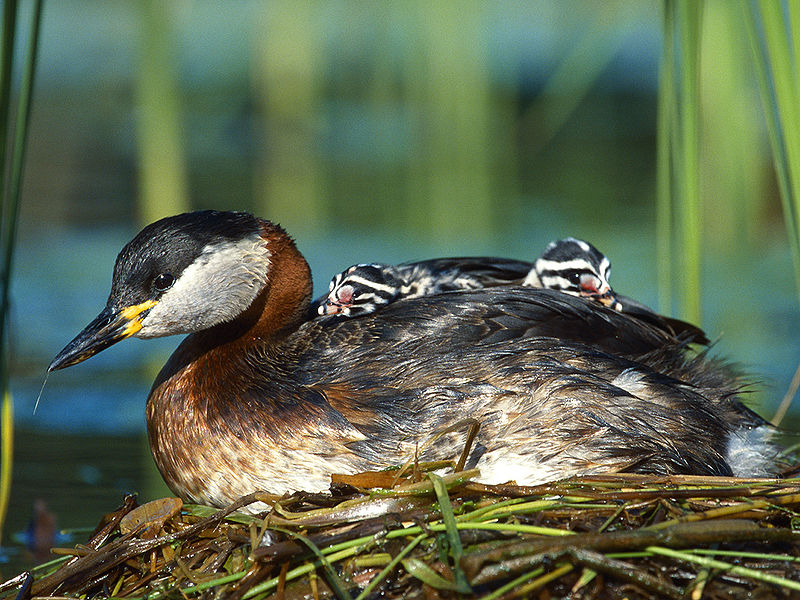
Great Crested Grebe (Podiceps cristatus) babies ©WikiC (Lukasz_Lukasik)
Verses 5 and 11 “focuses our attention on God’s chief attribute–His glory and worthiness to be worshiped”
Be exalted, O God, above the heavens; Let Your glory be above all the earth. (Psalms 57:5 NKJV)
Our prayers and thoughts are with those going through this storm. We have been there in the midst of hurricanes before (Andrew, Charlie, Jean, Frances and those that passed near) and we know it is hard, but there is always a peace that only the Lord can give to get you through. Look to Him.
*
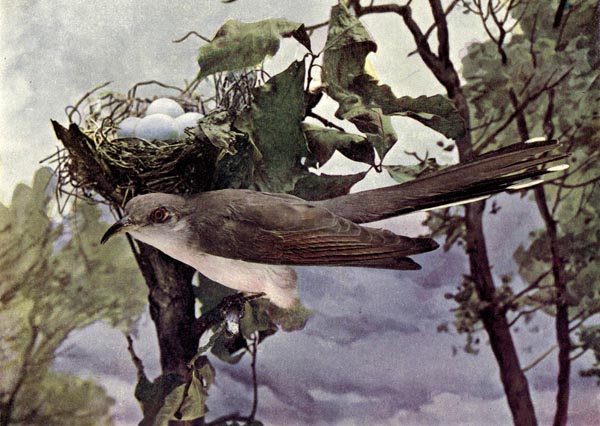
Yellow-billed Cuckoo for Birds Illustrated by Color Photography, 1897
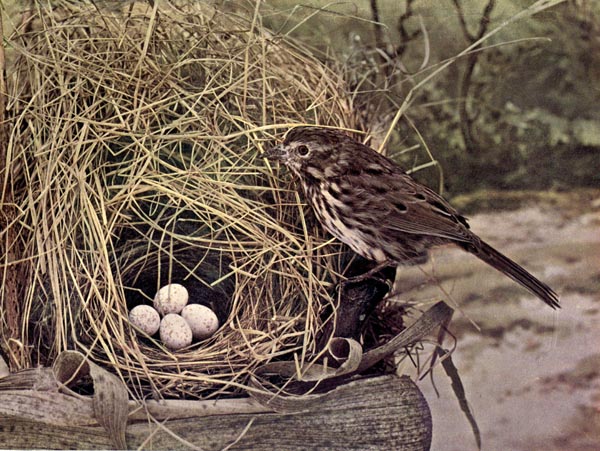
The Song Sparrow for Birds Illustrated by Color Photography, 1897

Rose-Crowned Fruit-Dove by Birdway
Then the LORD saw that the wickedness of man was great in the earth, and that every intent of the thoughts of his heart was only evil continually. And the LORD was sorry that He had made man on the earth, and He was grieved in His heart. So the LORD said, “I will destroy man whom I have created from the face of the earth, both man and beast, creeping thing and birds of the air, for I am sorry that I have made them.” But Noah found grace in the eyes of the LORD. (Genesis 6:5-8 NKJV)
Now that is an interesting passage from Scripture. Does God change His Mind? I don’t believe He does, but let’s look see what some of the Commentary writers have to say. The bolding mine.

White-fronted Bee-eater (Merops bullockoides) by Africaddict
(Believer’s Bible Commentary) – “6:6, 7 The Lord’s sorrow does not indicate an arbitrary change of mind, though it seems that way to man. Rather, it indicates a different attitude on God’s part in response to some change in man’s behavior. Because He is holy, He must react against sin.”
(Barnes – this is long but interesting) – Gen_6:7 – I will wipe away man from the face of the soil. – The resolve is made to sweep away the existing race of man. Heretofore, individuals had departed this life. Adam himself had long since paid the debt of nature. These solemn testimonies to the universal doom had not made any salutary or lasting impression on the survivors. But now a general and violent destruction is to overtake the whole race – a standing monument of the divine wrath against sin, to all future generations of the only family saved.
From man to cattle, creeper and fowl of the sky. – These classes of animated nature being mingled up with man are involved in the same ruin with him. This is of a piece with the curse laid upon the serpent, which was the unconscious organ of the tempter. It is an instance of a law which runs through the whole course of nature, as we observe that it is the method of the divine government to allow for the time the suffering inflicted on an inferior animal, or even on a fellow-creature, by selfish passion. It has an appearance to some minds of harshness and unfairness. But we must remember that these animated creatures are not moral, and, therefore, the violent termination of their organic life is not a punishment; that the pain incidental to this, being apart from guilt, is in itself a beneficial provision for the conservation of life; and that it was not intended that the life of animals should be perpetual. The return of the land to a state of desolation by the destruction of animal and vegetable life, however, has its lesson for man, for whom ultimately all of this beauty and fertility were designed, and from whom it is now withdrawn, along with all the glories it foreshadows, as part of the punishment of his guilt. The tenant has become unworthy of the tabernacle, and accordingly he is dispossessed, and it is taken down and removed.

Anna’s Hummingbird (Calypte anna) by S Slayton
(Jamieson, Fausset, & Brown) – Genesis 6:5-6 – God saw it … repented … grieved — God cannot change (Malachi_3:6; James_1:17); but, by language suited to our nature and experience, He is described as about to alter His visible procedure towards mankind – from being merciful and long-suffering, He was about to show Himself a God of judgment; and, as that impious race had filled up the measure of their iniquities, He was about to introduce a terrible display of His justice (Ecc_8:11).
(Matthew Henry) – 4. Even the brute-creatures were to be involved in this destruction – Beasts, and creeping things, and the fowls of the air. These were made for man, and therefore must be destroyed with man; for it follows: It repenteth me that I have made them; for the end of their creation also was frustrated. They were made that man might serve and honour God with them; and therefore were destroyed because he had served his lusts with them, and made them subject to vanity. 5. God took up this resolution concerning man after his Spirit had been long striving with him in vain. None are ruined by the justice of God but those that hate to be reformed by the grace of God.

Lilac-breasted Roller (Coracias caudatus) by Africaddict
(Guzik) – “b. The Lord was sorry that He had made man . . . He was grieved in His heart: God’s sorrow at man, and the grief in His heart, are striking. This does not mean that creation was out of control, nor does it mean that God hoped for something better but was unable to achieve it. God knew all along that this was how things would turn out, but our text tells us loud and clear that as God sees His plan for the ages unfold, it affects Him. God is not unfeeling in the face of human sin and rebellion.”
(Wesley) – “Genesis 6:7 – I will destroy man – The original word is very significant. I will wipe off man from off the earth; as dirt is wiped off from a place which should be clean, and thrown to the dunghill. Or, I will blot out man from the earth, as those lines are blotted out of a book which displease the author, or as the name of a citizen is blotted out of the rolls of the freemen when he is disfranchised. Both man and beast the creeping thing, and the fowls of the air – These were made for man, and therefore must be destroyed with man. It repenteth me that I have made them – For the end of their creation also was frustrated: they were made that man might serve and honour God with them and therefore were destroyed, because he had served his lusts with them, and made them subject to vanity.

Horned Grebe (Podiceps auritus) w young ©USFWS
These are just some of the remarks from the Commentaries that I have on my e-Sword program, which I use often. My understanding is that God had created both man and beasts/birds. They were suppose to serve Him and use the birds in His service also. After the fall, (Genesis 3) that is when things changed. Man continued sinned more and more until it was continually night and day – “24/7”. Apparently, they even used the creatures and birds in evil ways. Enough was enough and God had reached the end of his long suffering and had to use justice. Because of His Love, he could not let things continue. Gospel Presentation
Now we see such beautiful birds and wonder how much impressive were they like in their unfallen state. I am so thankful that God saved Noah’s family and at least 2 of each animal and 7 pairs of each of the birds. We see some glimpse of what they must have been like. We also, unfortunately, see the results of the curse on many of our avian friends.
More Birds of the Bible
*
Bluebird Fathers – Protective and Teachers ~ From Creation Moments (Re-post)

Eastern Bluebird (Sialia sialis) by S Slayton
PROTECTIVE, TEACHING FATHERS
And, ye fathers, provoke not your children to wrath: but bring them up in the nurture and admonition of the Lord. (Ephesians 6:4)
The first scientific studies that showed essential differences between males and females were not well received by some. Many Christians have resisted the teachings that men and women are by nature the same. Christians have traditionally understood the Bible to teach that males and females each have essential, honorable, but different roles to play.
Unfortunately, many Christians have been unsure how to describe those roles. As we study the scriptural portrayal of the family, especially in Ephesians chapter 5, a picture begins to emerge. All the scriptural examples of motherhood and fatherhood can be distilled into one basic idea. What we call a healthy maternal instinct and a healthy desire on the part of the male to protect and prevent danger are only two sides of the same coin.
An example of what this means was recently discovered in bluebirds. Scientists have found that bluebird fathers offer their nestling daughters twice as much food as their sons. Of course, the sons are never allowed to go hungry. Scientists were puzzled by this until someone suggested that by doing this, father bluebird was teaching his daughters, by example, how to select a mate. Female bluebirds are very fussy about selecting a mate. One of the most important things they look for in a mate is the ability to provide plenty of food for the next generation.
In an age of declining parenting skills, it’s good to be reminded that our Creator has given human parents instruction in His Word.
Prayer:
Dear Father, I thank You that You are a perfect Father. Fill Christian parents among us with love and patience. Most of all, fill them with the instruction of Your Word so that they may teach their children about You in both word and deed. In Jesus’ Name. Amen.
Notes:
K.A. Facklemann. 1992. “Bluebird Fathers Favor Pink Over Blue.” Science News, Jan. 4, p. 7.
*
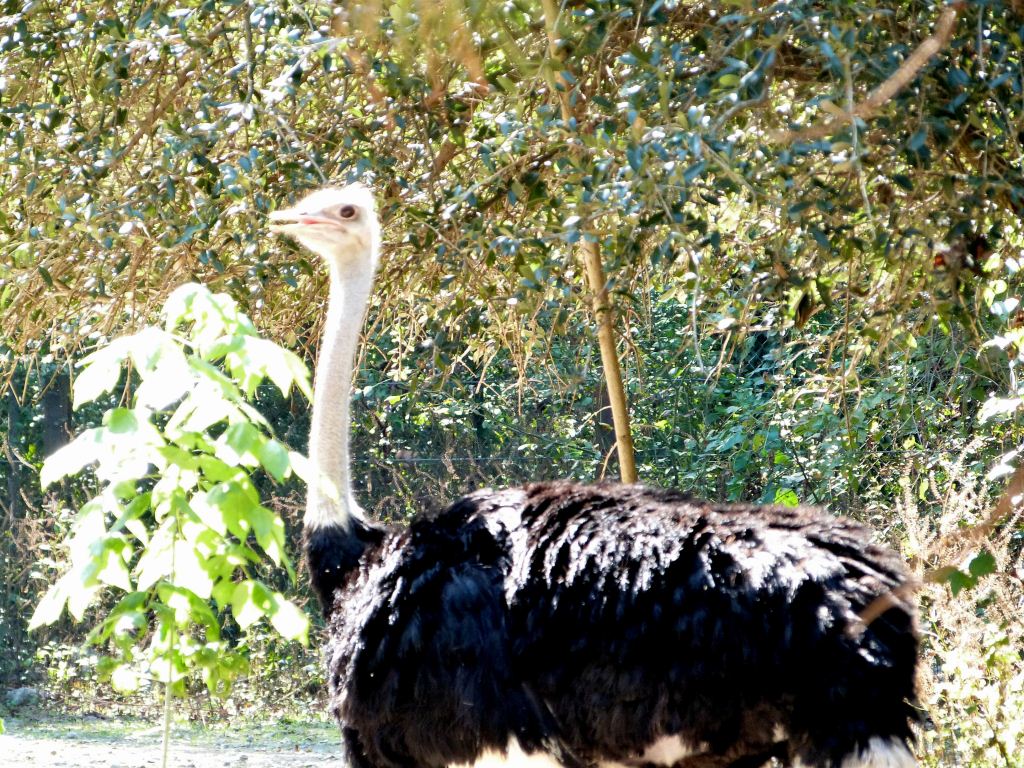
Common Ostrich (Struthio camelus) at Riverbanks Zoo SC by Lee
Dan and I just recently were on vacation and stopped by the Riverbanks Zoo and Gardens in Columbia, SC. I have see Ostriches before, but it has been awhile. We see the Emus at Zoo Tampa often, but they are not nearly as tall as the Ostrich. I had forgotten that the Lord had created such a huge bird.
The wings of the ostrich wave proudly, But are her wings and pinions like the kindly stork’s? For she leaves her eggs on the ground, And warms them in the dust; She forgets that a foot may crush them, Or that a wild beast may break them. She treats her young harshly, as though they were not hers; Her labor is in vain, without concern, Because God deprived her of wisdom, And did not endow her with understanding. When she lifts herself on high, She scorns the horse and its rider. (Job 39:13-18 NKJV)
The Ostrich does belong to the Struthionidae Family. Currently there are two; the Common Ostrich (Struthio camelus) and the Somali Ostrich (Struthio molybdophanes). The one we saw was the Common. The Ostrich is the largest bird in the world! They are omnivorous flightless birds but make up for their inability to fly with the powerful legs they possess. These birds were built for speed. That is why the reference to the horse and rider. Ostriches can give a horse competition for at least a burst of speed.

Common Ostrich (Struthio camelus) Foot back at Riverbanks Zoo SC by Lee
“Ostriches usually weigh from 140–320 lb (63 to 145 kilograms), Ostriches of the East African race (S. c. massaicus) averaged 250 lb (115 kg) in males and 220 lb (100 kg) in females, while the nominate subspecies was found to average 240 lb (111 kg) in unsexed adults. At sexual maturity (two to four years), male ostriches can be from 6 ft 11 in to 9 ft 2 in (2.1 to 2.8 m) in height, while female ostriches range from 5 ft 7 in to 6 ft 7 in (1.7 to 2 m) tall. New chicks are fawn with dark brown spots. During the first year of life, chicks grow about 10 in (25 cm) per month. At one year of age, ostriches weigh around 100 lb (45 kilograms). Their lifespan is up to 40 or 45 years.” (Wikipedia with editing)

Common Ostrich (Struthio camelus) Foot front at Riverbanks Zoo SC by Lee
I am not sure how tall these were, but they had to be close to 8 feet. As I was observing them, I was trying to remember all that the verses said about them. That is one reason I took pictures of their feet. I knew that their feet and legs helped them run, but also that those same feet were a danger to their young ones. They do have big feet and with an interesting shape as you can see from the photos.
If you notice the size of their head to their body, maybe that is how the Lord “did not endow her with understanding.” The head is interesting though because they are one of the few birds that have eyelashes. They have acute eyesight and hearing, the long neck and legs keep their head up to 9 ft (2.8 m) above the ground, and their eyes are said to be the largest of any land vertebrate – 2.0 in (50 mm) in diameter; they can therefore perceive predators at a great distance. The eyes are shaded from sun light falling from above. However, the head and bill are relatively small for the birds’ huge size”
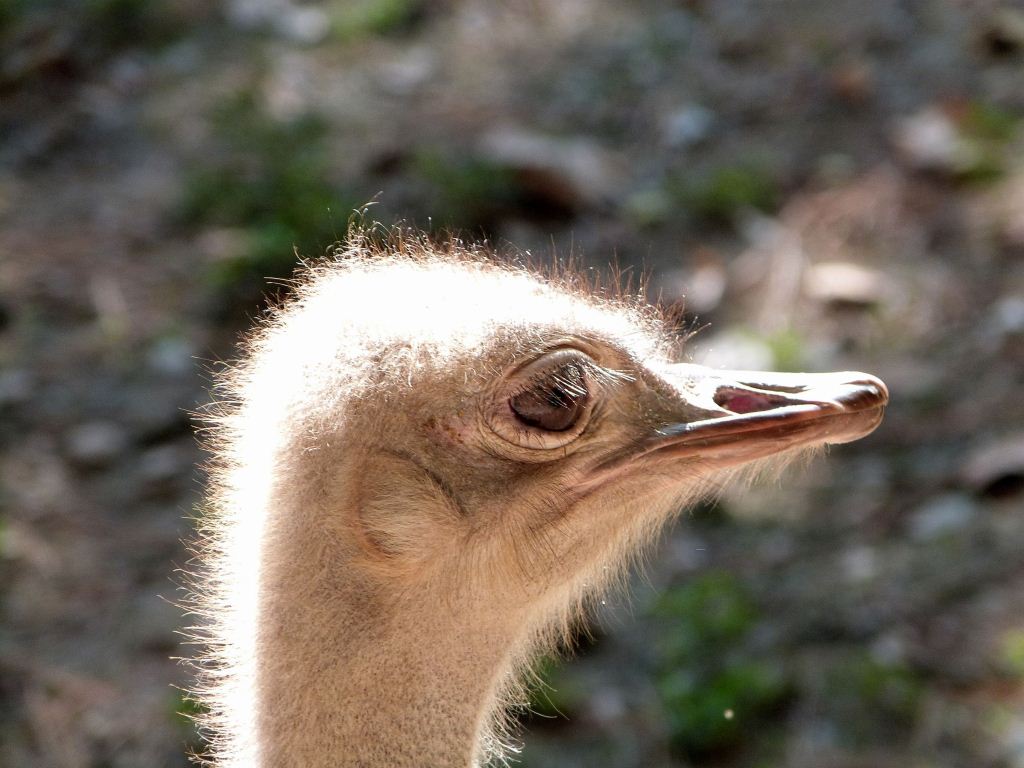
Common Ostrich (Struthio camelus) Head at Riverbanks Zoo SC by Lee
Oh, sing to the LORD a new song! Sing to the LORD, all the earth. Sing to the LORD, bless His name; Proclaim the good news of His salvation from day to day. Declare His glory among the nations, His wonders among all peoples. For the LORD is great and greatly to be praised; He is to be feared above all gods. (Psalms 96:1-4 NKJV)
Links:
Ostrich – Creation Wiki
Ostrich – Wikipedia
Ostrich – The Largest Bird with the Biggest Eyes
*
Dan and I have been off on a trip to the mountains of Tennessee and made some interesting stops along the way. Haven’t always had an internet connection to be able to post new articles. Put the blog on “auto-pilot” before we left. (PS – We just got home and I thought I released this 2 days ago.)
We stopped at the Jacksonville Zoo in Florida to do some birdwatching. Have lots of photos to go through, but thought I would share a video I took of the Cape Thick-knee, as they call it. One reason I enjoyed these birds is because of the size of their eyes to their heads. They were so friendly and quite vocal. This is just one of the times they were “sounding off.”
Checked with Wikipedia to see what they say about the Thick-knee. It is actually the Double-striped Thick-knee (Burhinus bistriatus). They are related to the stone-curlews. They are in the Burhinidae Family which has ten species of Thick-knees and Stone-curlews. According to the Chicago Zoo, their Cape Thick-knee is the Double-striped and Wikipedia says it is the Striped Thick-knee. I am not sure if what we saw is the one or two striped bird, so we will call it the Cape.
It is a resident breeder in Central and South America from southern Mexico south to Colombia, Venezuela and northern Brazil. It also occurs on Hispaniola and some of the Venezuelan islands, and is a very rare vagrant to Trinidad, Curaçao and the USA.
This is a largely nocturnal and crepuscular species of arid grassland, savanna, and other dry, open habitats. The nest is a bare scrape into which two olive-brown eggs are laid and incubated by both adults for 25–27 days to hatching. The downy young are precocial and soon leave the nest.
The Double-striped Thick-knee is a medium-large wader with a strong black and yellow bill, large yellow eyes, which give it a reptilian appearance, and cryptic plumage. The scientific genus name refers to the prominent joints in the long greenish-grey legs, and bistriatus to the two stripes of the head pattern.
The adult is about 46–50 cm long and weighs about 780-785 g. It has finely streaked grey-brown upperparts, and a paler brown neck and breast merging into the white belly. The head has a strong white supercilium bordered above by a black stripe. Juveniles are similar to adults, but have slightly darker brown upperparts and a whitish nape.
Double-striped Thick-knee is striking in flight, with a white patch on the dark upperwing, and a white underwing with a black rear edge. However, it avoids flying, relying on crouching and camouflage for concealment. The song, given at night, is a loud kee-kee-kee.
There are four subspecies, differing in size and plumage tone, but individual variation makes identification of races difficult.
The Double-striped Thick-knee eats large insects and other small vertebrate and invertebrate prey. It is sometimes semi-domestcated because of its useful function in controlling insects, and has benefited from the clearing of woodlands to create pasture.
See also:
Burhinidae – Stone-curlews, Thick-knees
Spotted Thick-knee – Wikipedia
Double-striped Thick-knee – Wikipedia
Cape Thick-knee – Chicago’s Brookfield Zoo
*
 Lee's Birdwatching Adventures Plus