American Yellow Warbler (Dendroica aestiva) singing by J Fenton
And the angel said unto them, Fear not: for, behold, I bring you good tidings of great joy, which shall be to all people. For unto you is born this day in the city of David a Saviour, which is Christ the Lord. (Luke 2:10-11)
Written as – El Cant Dels Ocells – Traditional Catalonian Carol
Translator Unknown
Carol of the Birds
1. Upon this holy night,
When God’s great star appears,
And floods the earth with brightness Birds’ voices rise in song
And warbling all night long
Express their glad heart’s lightness Birds’ voices rise in song
And warbling all night long
Express their glad heart’s lightness
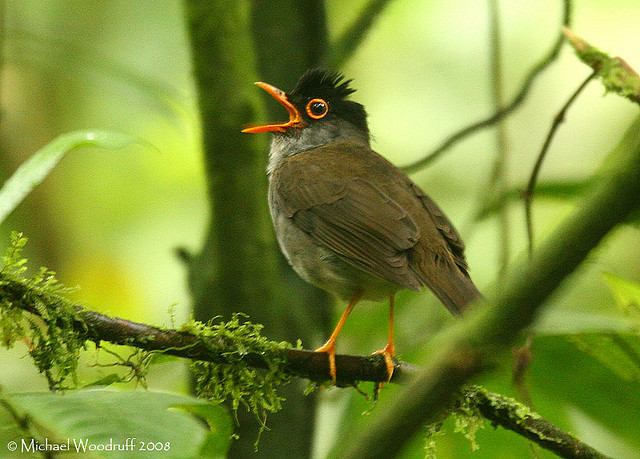
Black-headed Nightingale-Thrush (Catharus mexicanus) by Michael Woodruff
2. The Nightingale is first
To bring his song of cheer,
And tell us of His glad – ness:
Jesus, our Lord, is born
To free us from all sin
And banish ev’ry sadness!
Jesus, our Lord is born
To free us from all sin
And banish ev’ry sadness!
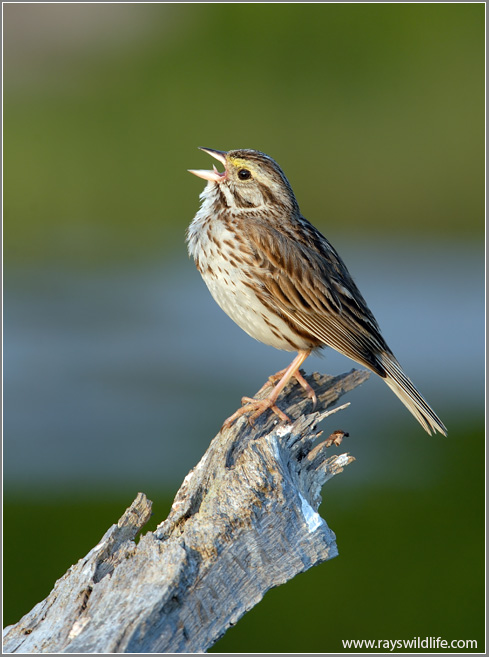
Savannah Sparrow singing by Ray
3. The answ’ring Sparrow cries:
“God comes to earth this day
Amid the angels flying.”
Trilling in sweetest tones,
The Finch his Lord now owns:
“To Him be all thanksgiving.”
Trilling in sweetest tones,
The Finch his Lord now owns:
“To Him be all thanksgiving.”
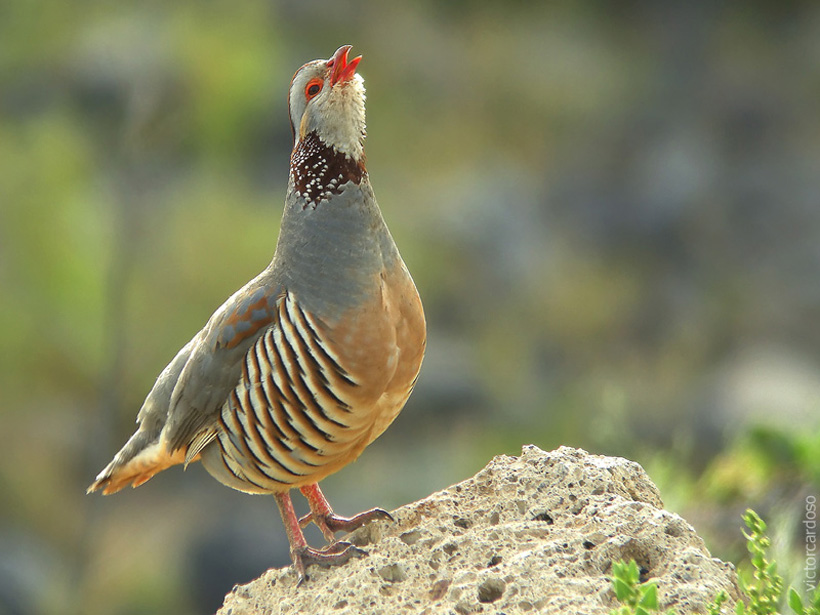
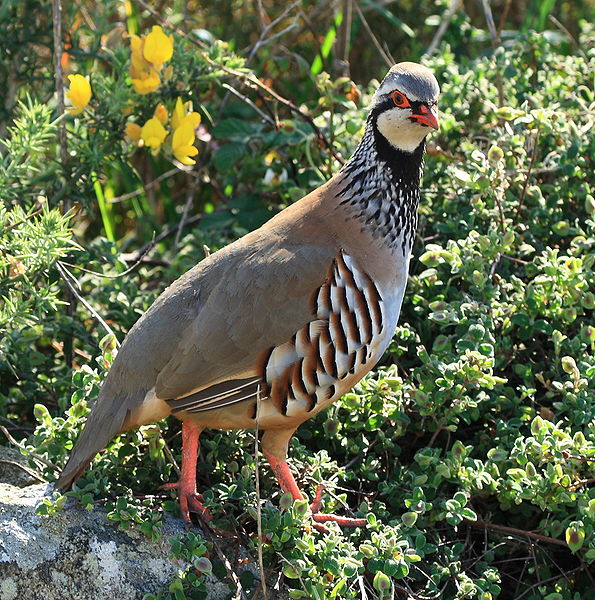
Barbary Partridge (Alectoris barbara koenigi) Pixdaus
4. The Partridge adds his note:
“To Bethlehem I’ll fly,
Where in the stall He’s lying.
There, near the manger blest,
I’ll build myself a nest,
And sing my love undying.
There, near the manger blest,
I’ll build myself a nest,
And sing my love undying.
Photo
*
Found another version of the Carol of the Birds and it appears to be Australian Birds.
The Carol of the Birds
(Wheeler/James)
Brolga (Grus rubicunda) by Ian
Out on the plains the brolgas are dancing
Lifting their feet like warhorses prancing
Up to the sun the woodlarks go winging
Faint in the dawn light echoes their singing
Crana! Orana! Orana to Christmas Day.
Crested Bellbird (Oreoica gutturalis) by Ian
Down where the tree ferns grow by the river
There where the waters sparkle and quiver
Deep in the gullies bell-birds are chiming
Softly and sweetly their lyric notes rhyming
Orana! Orana! Orana to Christmas Day.
Silver-crowned Friarbird (Philemon argenticeps) by Ian
Friar birds sip the nectar of flowers Currawongs chant in wattle tree bowers
In the blue ranges lorikeets calling
Carols of bush birds rising and falling
Orana! Orana! Orana to Christmas Day.
*
Cockatiel (Nymphicus hollandicus) Brevard Zoo by Lee
I am sure many of us have been near a Parrot or one of that family and have tried to talk to it. Right? We say “Hello!” or whistle, hoping that the bird will repeat us. There are plenty of bird species that will mimic words and sounds. (one example – Repeating Birds) How many times in Scripture are the birds spoken to and by whom? Let’s find out.
Pulling out my e-Sword Bible program and using the search feature, here is what I discovered.
1. God spoke to the birds or fowls
2. Man was told to speak to them twice
3. An Angel will speak to them
Protection at the nest by Anthony
God said for the birds to come into being (He Created or Formed them) in Genesis 1:20-21. Then in verse 22 we read:
And God blessed them, saying, Be fruitful, and multiply, and fill the waters in the seas, and let fowl multiply in the earth. (Genesis 1:22 KJV)
or
God blessed all the living things in the sea and told them to have many babies and fill the seas. And he blessed the birds on land and told them to have many more babies. (Genesis 1:22 ERV)
In all the translations I have loaded (around 30) it is either “saying” or “told.” After the Lord God created them then He told them to be frutful and multiply. They listened. Today there are 10,466 species (IOC) in the world living. Many more have become extinct.
Red-bellied Woodpecker (Melanerpes carolinus) by J Fenton
In Job 12:7 They (men) were told by God to ask beasts and birds and they would instruct them.
But ask now the beasts, and they shall teach thee; and the fowls of the air, and they shall tell thee: (Job 12:7 KJV)
or
“But ask the beasts, and they will teach you; the birds of the heavens, and they will tell you;
(Job 12:7 ESV)
John Wesley’s Elanatory Notes – “Job 12:7
But – If thou observest the beasts, and their properties and actions, and events, from them thou mayst learn this lesson: that which Zophar had uttered with so much pomp and gravity, (Job 11:7-9), concerning God’s infinite wisdom, saith Job, thou needest not go into heaven or hell to know. but thou mayst learn it even from the beasts.”
Peregrine Falcon (Falco peregrinus) by Ray
Again in Ezekiel 39 you can read of Ezekiel being told by the Lord GOD to “Speak to the birds” and give them a message.
“As for you, son of man, thus says the Lord GOD: Speak to the birds of every sort and to all beasts of the field, ‘Assemble and come, gather from all around to the sacrificial feast that I am preparing for you, a great sacrificial feast on the mountains of Israel, and you shall eat flesh and drink blood. You shall eat the flesh of the mighty, and drink the blood of the princes of the earth–of rams, of lambs, and of he-goats, of bulls, all of them fat beasts of Bashan. And you shall eat fat till you are filled, and drink blood till you are drunk, at the sacrificial feast that I am preparing for you. And you shall be filled at my table with horses and charioteers, with mighty men and all kinds of warriors,’ declares the Lord GOD. (Ezekiel 39:17-20 ESV)
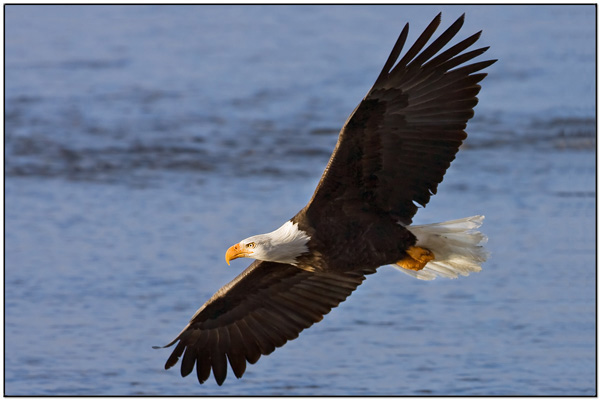
Bald Eagle flying by Dave’s BirdingPix
The third incident of birds being spoken to happens in Revelations 19. John is describing what he sees in heaven (future). Again they are being invited to a feast. Both times it is not the kind of feast we would desire to be attending. Both times the “feast” is part of judgment from God.
And I saw an angel standing in the sun; and he cried with a loud voice, saying to all the fowls that fly in the midst of heaven, Come and gather yourselves together unto the supper of the great God; That ye may eat the flesh of kings, and the flesh of captains, and the flesh of mighty men, and the flesh of horses, and of them that sit on them, and the flesh of all men, both free and bond, both small and great. (Revelation 19:17-18 KJV)
Heaven here is referring to where the birds fly now. Not heaven as in our future home. The different version say this:
birds flying in mid-heaven (midheaven) (ACV, ABP, ASV, Darby,LITV, MKJV, NASB, RV, YLT)
fly in the middle of heaven (AKJV, KJV)
birds flying in midair (GNB)
fly through the midst of heaven (DRB, EMTV, ERV, NKJV, Webster)
birds that fly(or flying) across the sky (AMP, CEV, WNT)
the birds in flight in the heavens (BBE)
birds that fly directly overhead (ESV,GW, ISV, LEB)
There may be other times when someone spoke to birds, but for now, it wasn’t found by me.
And the angel said unto them, Fear not: for, behold, I bring you good tidings of great joy, which shall be to all people. (Luke 2:10 KJV)
Words: Birdie Bell (1877-?), 1886.
Music: Boxelder, Asa Hull, 1886
Birds in Christmas Hymns
Welcome To Christmas
Beautiful anthem the first Christmas wakened
Ages ago over Bethlehem’s plain;
Greeting the shepherds with magical accents,
Bringing deliverance from sin’s deep stain.
Refrain
Ring out a welcome to Christmas’ fair morning, Herald its coming, each fresh, youthful voice; Ring out a welcome, a bright cheery welcome! Christmas is dawning, let earth rejoice!
Peerless the singers, and wondrous their singing;
Glorious theme: Lo, a Savior is born!
Royal Deliverer, His praises are ringing,
Hailing with joy the auspicious morn!
Refrain
Ring out a welcome to Christmas’ fair morning, Herald its coming, each fresh, youthful voice; Ring out a welcome, a bright cheery welcome! Christmas is dawning, let earth rejoice!
Shall we not join in the loud, swelling chorus
Sending the message from mountain to sea;
Let fairest Peace spread her dove-like wings o’er us,
Making our hearts His fit home to be.
Refrain
Ring out a welcome to Christmas’ fair morning, Herald its coming, each fresh, youthful voice; Ring out a welcome, a bright cheery welcome! Christmas is dawning, let earth rejoice!
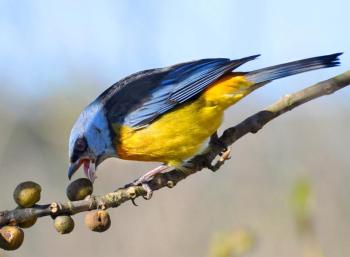
Blue-naped Chlorophonia (Chlorophonia cyanea) by Dario Sanches
And she brought forth her firstborn son, and wrapped him in swaddling clothes, and laid him in a manger; because there was no room for them in the inn. And there were in the same country shepherds abiding in the field, keeping watch over their flock by night. And, lo, the angel of the Lord came upon them, and the glory of the Lord shone round about them: and they were sore afraid. And the angel said unto them, Fear not: for, behold, I bring you good tidings of great joy, which shall be to all people. For unto you is born this day in the city of David a Saviour, which is Christ the Lord. (Luke 2:7-11 KJV)
Tomorrow, December 15th, a new mini series will begin. From the 15th until Christmas Day, a different Birds in Christmas Hymns will be posted daily. All of these are in the public domain, so they will be some of the older hymns. (There will be other articles added also.)
It is amazing how many times when you are singing that “birds” appear in songs and hymns. These all relate to the birth of Jesus and the nativity. As Christians, this is one of our greatest holidays, with only Easter and the resurrection of our Savior as the Greatest. Without the virgin born birth of the Lord Jesus as the Christ Child, we wouldn’t have a sinless Savior to die and shed His blood for our salvation at Calvary.
May you enjoy this upcoming season and this little mini series. Below is the video of our pastor telling about the birds at Christmas time. This was from our Christmas Cantata a few years ago.
“The Twelve Days of Christmas” is a cumulative song, meaning that each verse is built on top of the previous verses. There are twelve verses, each describing a gift given by “my true love” on one of the twelve days of Christmas. (I took a few liberties with the photos)
A gift is as a precious stone in the eyes of him that hath it: whithersoever it turneth, it prospereth. (Proverbs 17:8 KJV)
In the day of prosperity be joyful, but in the day of adversity consider: God also hath set the one over against the other, to the end that man should find nothing after him. (Ecclesiastes 7:14 KJV)
The Twelve Days of Christmas (12 Days of Christmas)
On the third day of Christmas,
my true love sent to me
Three French hens,
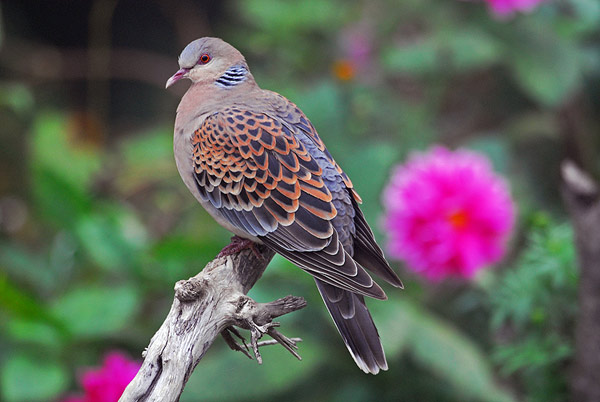
Two turtle doves,
And a partridge in a pear tree.
Common Blackbird (Turdus merula) by Ian
On the fourth day of Christmas,
my true love sent to me
Four (Cully) calling birds,
Three French hens,
Two turtle doves,
And a partridge in a pear tree.
On the fifth day of Christmas,
my true love sent to me
Five golden rings,
Four (Culley) calling birds,
Three French hens,
Two turtle doves,
And a partridge in a pear tree.
On the sixth day of Christmas,
my true love sent to me
Six geese a-laying,
Five golden rings,
Four (Cully) calling birds,
Three French hens,
Two turtle doves,
And a partridge in a pear tree.
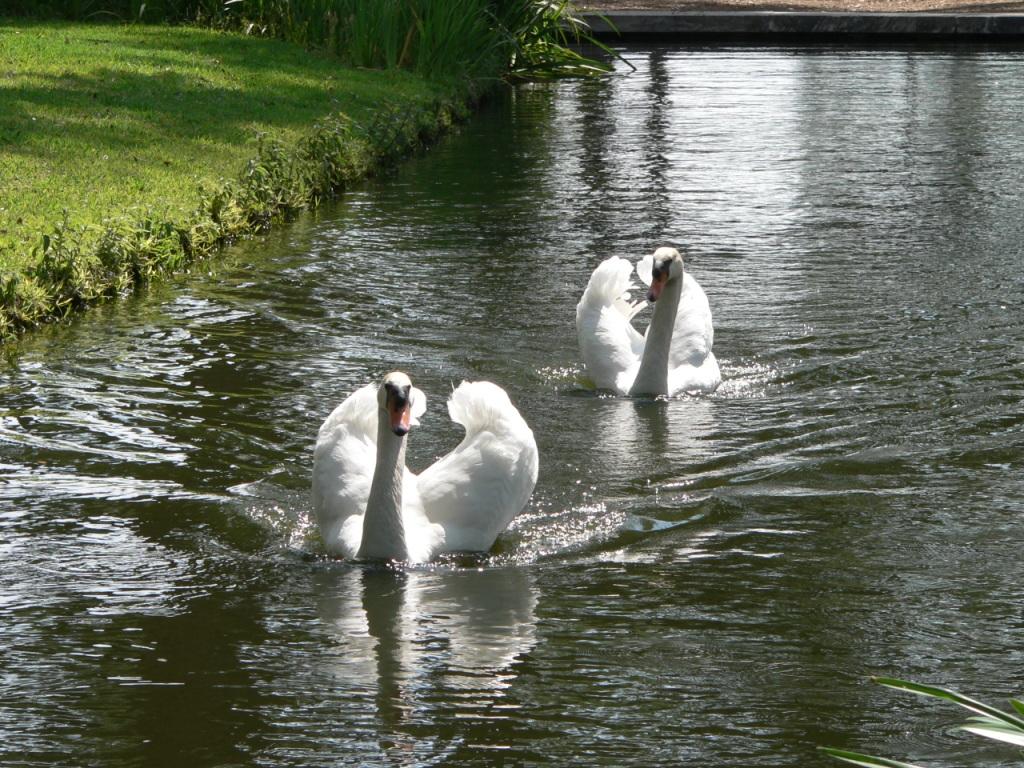
Swans at Bok Tower by Dan
On the seventh day of Christmas,
my true love sent to me
Seven swans a-swimming,
Six geese a-laying,
Five golden rings,
Four (Cully) calling birds,
Three French hens,
Two turtle doves,
And a partridge in a pear tree.
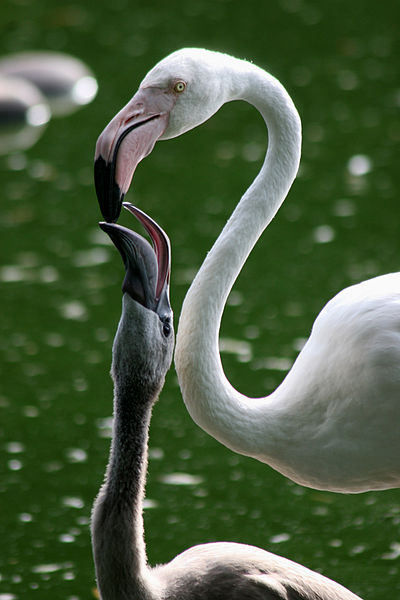
Greater Flamingo (Phoenicopterus roseus) - chick in Zoo Basel is fed on crop milk.
On the eighth day of Christmas,
my true love sent to me
Eight maids a-milking,
Seven swans a-swimming,
Six geese a-laying,
Five golden rings,
Four (Cully) calling birds,
Three French hens,
Two turtle doves,
And a partridge in a pear tree.
On the ninth day of Christmas,
my true love sent to me
Nine ladies dancing,
Eight maids a-milking,
Seven swans a-swimming,
Six geese a-laying,
Five golden rings,
Four (Cully) calling birds,
Three French hens,
Two turtle doves,
And a partridge in a pear tree.
On the tenth day of Christmas,
my true love sent to me
Ten lords a-leaping,
Nine ladies dancing,
Eight maids a-milking,
Seven swans a-swimming,
Six geese a-laying,
Five golden rings,
Four (Cully) calling birds,
Three French hens,
Two turtle doves,
And a partridge in a pear tree.
Upland Sandpiper (Bartramia longicauda) by Ray
On the eleventh day of Christmas,
my true love sent to me
Eleven pipers piping,
Ten lords a-leaping,
Nine ladies dancing,
Eight maids a-milking,
Seven swans a-swimming,
Six geese a-laying,
Five golden rings,
Four (Cully) calling birds,
Three French hens,
Two turtle doves,
And a partridge in a pear tree.
On the twelfth day of Christmas,
my true love sent to me
Twelve drummers drumming,
Eleven pipers piping,
Ten lords a-leaping,
Nine ladies dancing,
Eight maids a-milking,
Seven swans a-swimming,
Six geese a-laying,
Five golden rings,
Four (Cully) calling birds,
Three French hens,
Two turtle doves,
And a partridge in a pear tree!
*
Below is some of the information about how the song came about and some of the different interpretations of it. I especially like the idea that the 12 days represent different aspects of Christianity. The fact that it was a code is not verifiable, does not diminish its relationship to twelve things. I took a few liberties with the photos, but was trying to use birds for the days. Pushed a few of them, but trust you enjoy my efforts.
“Meaning
The lyrics of The Twelve Days of Christmas may have no meaning at all. Its meaning, if it has any, has yet to be satisfactorily explained.
According to The Oxford Dictionary of Nursery Rhymes, “Suggestions have been made that the gifts have significance, as representing the food or sport for each month of the year. Importance [certainly has] long been attached to the Twelve Days, when, for instance, the weather on each day was carefully observed to see what it would be in the corresponding month of the coming year. Nevertheless, whatever the ultimate origin of the chant, it seems probable [that] the lines that survive today both in England and France are merely an irreligious travesty.”
A bit of modern folklore claims that the song’s lyrics were written as a “catechism song” to help young Catholics learn their faith, at a time when practising Catholicism was criminalized in England (1558 until 1829). There is no primary evidence supporting this claim, and no evidence that the claim is historical, or “anything but a fanciful modern day speculation.” The theory is of relatively recent origin. It was first suggested by Canadian English teacher and hymnologist Hugh D. McKellar in a short article, “How to Decode the Twelve Days of Christmas,” published in 1979. In a later article published in the music journal The Hymn, he reiterates that the associations are his. The idea was further popularized by a Catholic priest, Fr. Hal Stockert, in an article he wrote in 1982 and posted online in 1995.
Variations in lyrics provide further evidence against the “catechism song” origin. For example, the four Gospels are often described as the “four calling birds,” when in fact the phrase “calling birds” is a modern (probably 20th century) phonetic misunderstanding of “colly birds” (blackbirds).
Regardless of the origin of this idea, a number of Christians give the following meanings to the gifts:
“The Twelve Days of Christmas” as a Catechism Song
Gift
Interpretation
A partridge in a pear tree
Jesus
Two turtle doves
The Old and New Testaments
Three French hens
The three kings bearing gifts
Four calling [sic] birds
The four Gospels
Five gold rings
The Torah or Pentateuch, the first five books of the Old Testament
Christmas was only a few days away when this was posted, but this Gospel Presentation is appropriate year round. We just had our third “free shopping day” yesterday at our church, Faith Baptist Church in Winter Haven. This is the 3rd year this presentation has been given before the “free shopping” and meal begins. We, as a church, buy and collect new toys and games and provide a meal for those less fortunate.
This year there were 6 adults and 9 children who accepted the Lord Jesus Christ as their Savior. Praise the Lord!
Have you put your faith and trust in the Lord and accepted Him?
*
*
Jesus saith unto him, I am the way, the truth, and the life: no man cometh unto the Father, but by me. (John 14:6 KJV)
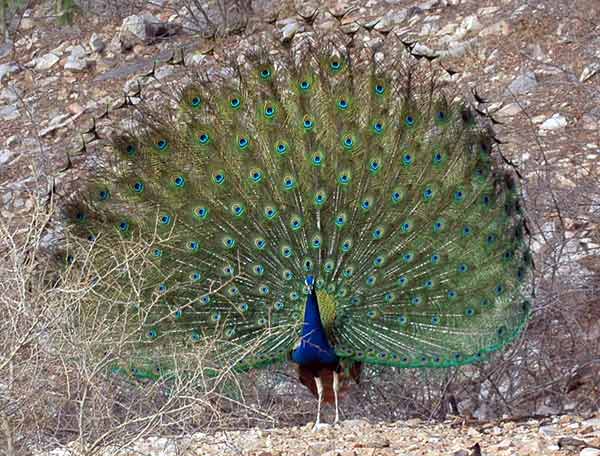
We wrote about Peacocks before in Birds of the Bible – Peacocks, dated April of 2008. This is about the Pied Peacock which is from the jungles of India and Sri Lanka. When Solomon sent for them to be delivered, they were brought by a joint navy of Hiram and the navy of Tharshish.
For the king had at sea a navy of Tharshish with the navy of Hiram: once in three years came the navy of Tharshish, bringing gold, and silver, ivory, and apes, and peacocks. (1 Kings 10:22 KJV) For the king’s ships went to Tarshish with the servants of Huram: every three years once came the ships of Tarshish bringing gold, and silver, ivory, and apes, and peacocks. (2 Chronicles 9:21 KJV)
I received a notice by “bellamoonnature” of a video he made of the Pied Peacock. Decided to share it and bring the peacock article a little more up to date. It is about a Pied Peacock. For more information on how that comes about see India Blue Pied. It is a mutation, but still it is a neat looking Peacock or Peafowl.
Here is his video:
I love the little immature male trying to practice his tail display. He has a way to go before his tail reaches the beauty of the mature male. This peacocks beautiful display goes right along with God’s question to Job.
Gavest thou the goodly wings unto the peacocks? or wings and feathers unto the ostrich? (Job 39:13 KJV)
Peacocks and Peafowls are part of the Phasianidae – Pheasants, Fowls & Allies Family which are in the Galliformes Order. There are three Genus in the Pheasants, Fowls & Allies Family that have what we refer to as “Peacocks.”
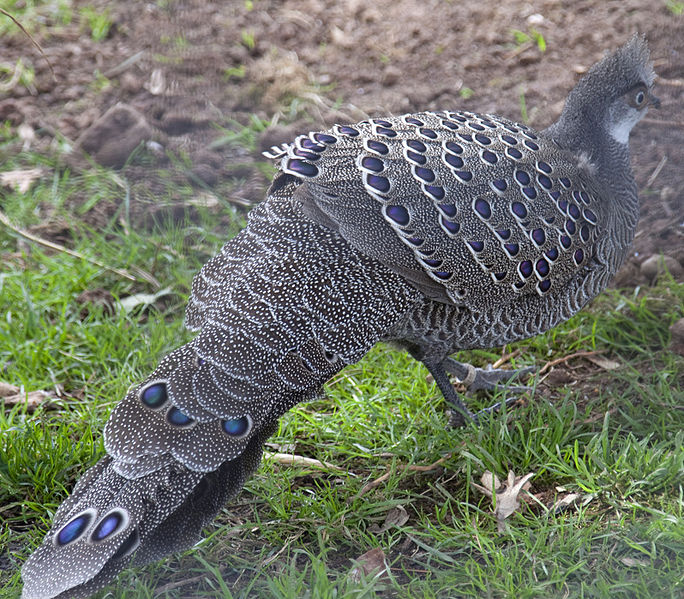
The Polyplectron genus is the peacock-pheasants. “The peacock-pheasants are a bird genus, Polyplectron, of the family Phasianidae, consisting of eight species. They are colored inconspicuously, relying on heavily on crypsis to avoid detection. When threatened, peacock-pheasants will alter their shapes utilising specialised plumage that when expanded reveals numerous iridescent orbs. The birds also vibrate their plume quills further accentuating their aposematism (Warning colourataton or signal). Peacock-pheasants exhibit well developed metatarsal spurs. Older individuals may have multiple spurs on each leg. These kicking thorns are used in self-defense.” (Wikipedia)
“Peafowl are two Asiatic species of flying birds in the genus Pavo of the pheasant family, Phasianidae, best known for the male’s extravagant eye-spotted tail, which it displays as part of courtship. The male is called a peacock, the female a peahen, and the offspring peachicks. The adult female peafowl is grey and/or brown. Peachicks can be between yellow and a tawny colour with darker brown patches. The male (peacock) Indian Peafowl has iridescent blue-green or green coloured plumage.
The peacock tail (“train”) is not the tail quill feathers but the highly elongated upper tail coverts. The “eyes” are best seen when the peacock fans its tail. Like a cupped hand behind the ear the erect tail-fan of the male helps direct sound to the ears. Both species have a crest atop the head.
The female (peahen) Indian Peafowl has a mixture of dull green, brown, and grey in her plumage. She lacks the long upper tail coverts of the male but has a crest. The female can also display her plumage to ward off female competition or signal danger to her young.
Green Peafowl (Pavo muticus) by Ian
A male Green Peafowl The Green Peafowl appears different from the Indian Peafowl. The male has green and gold plumage and has an erect crest. The wings are black with a sheen of blue. Unlike the Indian Peafowl, the Green Peahen is similar to the male, only having shorter upper tail coverts and less iridescence. It is difficult to tell a juvenile male from an adult female.
As with many birds, vibrant plumage colours are not primarily pigments, but optical interference Bragg reflections, based on regular, periodic nanostructures of the barbules (fiber-like components) of the feathers. Slight changes to the spacing result in different colours. Brown feathers are a mixture of red and blue: one colour is created by the periodic structure, and the other is a created by a Fabry–Pérot interference peak from reflections from the outer and inner boundaries. Such interference-based structural colour is important for the peacock’s iridescent hues that change and shimmer with viewing angle, since unlike pigments, interference effects depend on light angle. Colour mutations exist through selective breeding, such as the leucistic White Peafowl and the Black-Shouldered Peafowl.”(Wikipedia)
“The Congo Peafowl (Afropavo congensis) is a species of peafowl. It is the only member of the monotypic genus Afropavo. The male is a large bird of up to 70 cm (28 in) in length. Its feathers are deep blue with a metallic green and violet tinge. It has bare red neck skin, grey feet, and a black tail with fourteen feathers. Its head is adorned with vertical white elongated hair-like feathers on its crown. The female is generally a chestnut brown bird with a black abdomen, metallic green back, and a short chestnut brown crest. Both sexes resemble immature Asian Peafowl, with early stuffed birds being erroneously classified as such before they were officially discovered as a unique species. It inhabits and is endemic to lowland rainforests of Congo River Basin in the central part of the Democratic Republic of the Congo.
The diet consists mainly of fruits and invertebrates. The male has a similar display to other peacocks, fanning its tail in this case, while other peacocks fan their upper tail coverts. The male Congo Peafowl is monogamous, though information from the wild is needed. Very little is known about this species.” (Wikipedia)
Grass-green Tanager (Chlorornis riefferii) by Michael Woodruff
But now ask the beasts, and they will teach you; And the birds of the air, and they will tell you; (Job 12:7 NKJV)
I have been busy trying to find photos for the Thraupidae – Tanagers and Allies Family page. The Tanagers are one of Passeriformes (Song Bird) Order. Working on this page and an upcoming series has kept me from writing as many articles.
But, Wow! Tanagers are some very neat birds that are found throughout the Americas; North, Central, and South (60% of them). Some are plain, but many are very colorful. At the present time with the IOC’s Version 2.10 of the Birds of the World list, there are 388 species in the Traupidae family. Needless to say, that is taking me some time to find the photos and then to load them to the site or provide links for the ones that I do not have permission for. I have gotten down to the Diglossa genus of Flowerpiercers. (which is a little past half way) I am trying to find as many of the supspecies also and that is where a lot of time is getting spent.
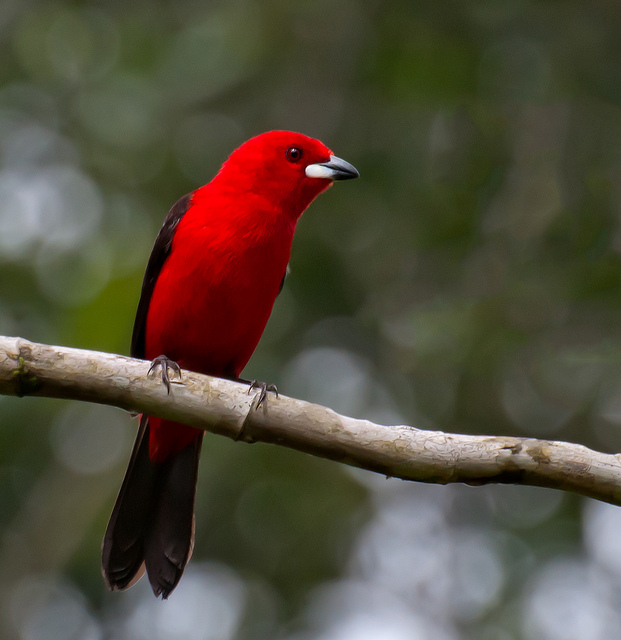
Brazilian Tanager (Ramphocelus bresilius) by Dario Sanches
The Internet Bird Collection has one of the best collections that list the supspecies. It is a tremendous site that I use quite frequently. As of today, 12/6/2011, they have 56,387 videos, 51,697 photos and 6859 sounds of birds. That represents about 88.67% of all species. When I have problems finding a photo, this place will have it most likely.
Known to God from eternity are all His works. (Acts 15:18 NKJV)
Back to the tanagers. The family is in flux and some members have been moved to other families, but most are still in the Thraupidae family which has not only Tanagers, but also Hemispingus, Shrike-Tanagers, Mountain Tanagers, Dacnis, Honeycreepers, Conebills, Flowerpiercers, Bush Tanagers, Finches, Reed Finch, Island Finch, Diuca Finch, Inca Finch, Warbling Finch, Grassquit and Orangequits, Seedeaters, Seed Finch, Bullfinch, Ground Finch, Ant Tanagers, Chat-Tanagers, Spindalis and a Plushcap.
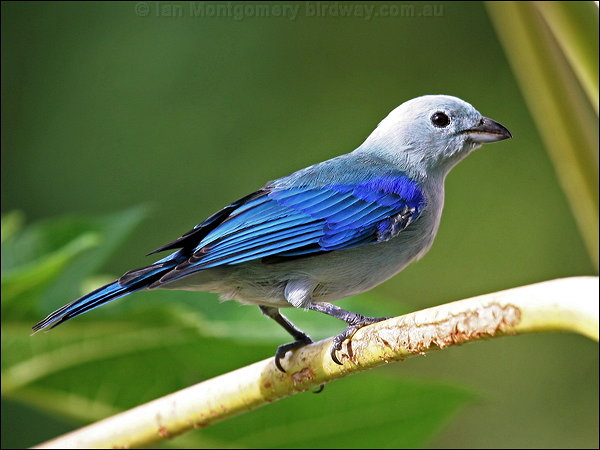
Blue-grey Tanager (Thraupis episcopus) by Ian
Tanagers are small to medium-sized birds. The shortest-bodied species, the White-eared Conebill, is 9 cm (3.8 in) long and weighs 7 grams, barely smaller than the Short-billed Honeycreeper. The longest, the Magpie Tanager is 28 cm (11 in) and weighs 76 grams (2.7 oz). The heaviest is the White-capped Tanager which weighs 114 grams (4 oz) and measures about 24 cm (9.5 in). Both sexes are usually the same size and weight. Tanagers are often brightly colored, but some species are black and white. Birds in their first year are often duller or a different color altogether. Males are typically more brightly coloured than females.
Most tanagers have short, rounded wings. The shape of the bill seems to be linked to the species’ foraging habits, which shows forethought and design by their Creator.
Most tanagers live in pairs or in small groups of 3-5 individuals. These groups may consist simply of parents and their offspring. Birds may also be seen in single species or mixed flocks. Many tanagers are thought to have dull songs, though some are elaborate.
Tanagers are omnivorous, and their diet varies from genus to genus. They have been seen eating fruits, seeds, nectar, flower parts and insects. Many pick insects off branches. Other species look for insects on the underside of leaves. Yet others wait on branches until they see a flying insect and catch it in the air. Many of these particular species inhabit the same areas, but these specializations alleviate competition.
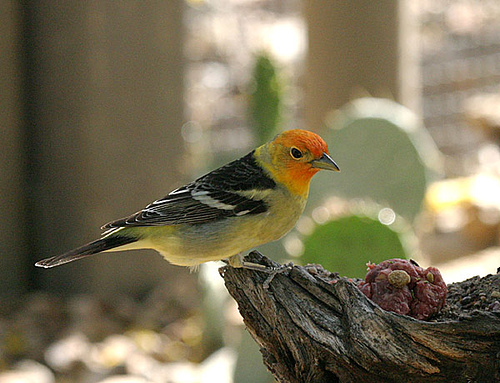
Western Tanager (Piranga ludoviciana) by Kent Nickell
The breeding season begin in March through until June in temperate areas and in September through October in South America. Some species are territorial while others build their nests closer together. There is little information on tanager breeding behavior or whether they are monogamous or polygamous. Males show off their brightest feathers to potential mates and rival males. Some species’ courtship rituals involve bowing and tail lifting.
Most tanagers build cup nests on branches in trees. Some nests are almost globular. Entrances are usually built on the side of the nest. The nests can be shallow or deep. The species of the tree they choose to build their nest in and the nest’s position varies among genera. Most species nest in an area hidden by very dense vegetation. There is still no information on the nests of some species.
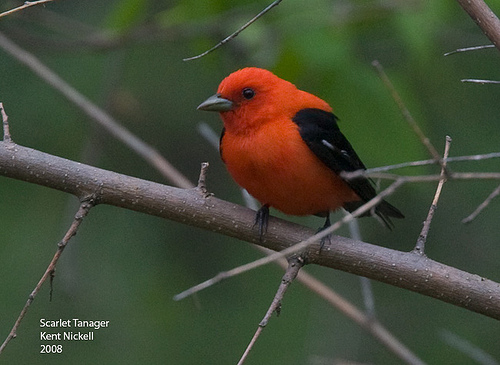
Scarlet Tanager (Piranga olivacea) by Kent Nickell
The clutch size is 3–5 eggs. The female incubates the eggs and builds the nest, but the male may feed the female while she incubates. Both sexes feed the young. Five species have helpers assist in feeding the young. These helpers are thought to be the previous year’s nestlings.
The Genus I am working on right now is the Diglossa. The Flowerpiercers, The common name refers to their habit of piercing the base of flowers to access nectar that otherwise would be out of reach. This is done with their highly designed bills, although this is greatly reduced in the Bluish Flowerpiercer, which has an almost “normal” bill. Most flowerpiercers are restricted to highlands, especially the Andes, in South America, but two species occur in Central America. See the article – Formed By Him – “Sword and Piercer” Birds
O the depth of the riches both of the wisdom and knowledge of God! how unsearchable are his judgments, and his ways past finding out! (Romans 11:33 KJV)
Well, guess I better get back to work behind the scenes again. Keep checking the page as I work to the bottom. Not sure how many more beautiful birds I’ll find, but it is fun to birdwatch through the cameras of others who go places I’ll never get to. I stay amazed at the paint brush and designs from our Creator.
Dippers are small, stout, short-tailed, short-winged, strong-legged birds. The different species are generally dark brown (sometimes nearly black), or brown and white in colour, apart from the Rufous-throated Dipper which is brown with a reddish-brown throat patch. Sizes range from 14–22 cm in length and 40-90 g in weight, with males larger than females. Their short wings give them a distinctive whirring flight. They have a characteristic bobbing motion when perched beside the water, giving them their name.
Dippers are found in suitable freshwater habitats in the highlands of the Americas, Europe and Asia. In Africa they are only found in the Atlas Mountains of Morocco. They inhabit the banks of fast-moving upland rivers with cold, clear waters, though, outside the breeding season, they may visit lake shores and sea coasts.
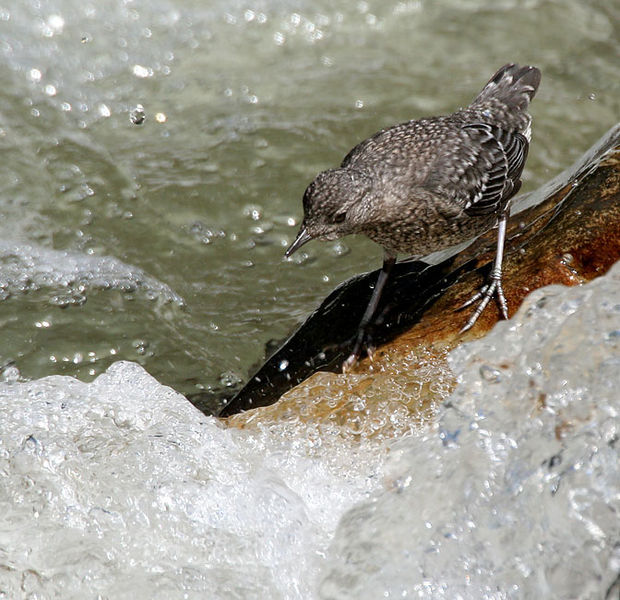
The Lord created them unlike many water birds, dippers are generally similar in form to many terrestrial birds (for example they do not have webbed feet), but they were designed with some morphological and physiological adaptations to their aquatic habits. Their wings are relatively short but strongly muscled, enabling them to be used as flippers underwater. They have dense plumage with a large preen gland for waterproofing their feathers. Relatively long legs and sharp claws enable them to hold onto rocks in swift water. Their eyes have well-developed focus muscles that can change the curvature of the lens to enhance underwater vision. They have nasal flaps to prevent water entering their nostrils. Their blood has a high haemoglobin concentration, allowing a greater capacity to store oxygen than terrestrial birds, and allowing them to remain underwater for up to at least 30 seconds.
Let them praise the name of the LORD: for he commanded, and they were created. (Psalms 148:5 KJV)
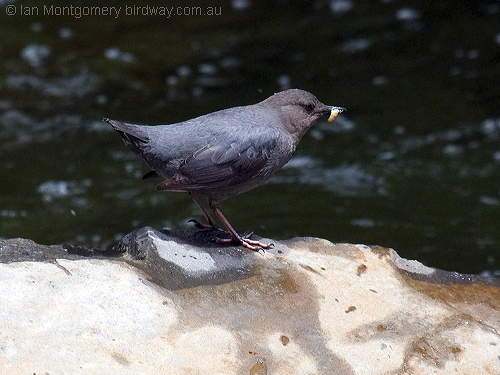
American Dipper (Cinclus mexicanus) by Ian
Dippers forage for small animal prey in and along the margins of fast-flowing freshwater streams and rivers. They perch on rocks and feed at the edge of the water, but they often also grip the rocks firmly and walk down them beneath the water until partly or wholly submerged. They then search underwater for prey between and beneath stones and debris; they can also swim with their wings. The two South American species swim and dive less often than the three northern ones.Their prey consists primarily of invertebrates such as the nymphs or larvae of mayflies, blackflies, stoneflies and caddisflies, as well as small fish and fish eggs. Molluscs and crustaceans are also consumed, especially in winter when insect larvae are less available.
There are five members of the Dipper – Cinclidae Family in the Passeriformes Order. They all are of the Cinclus genus. The Dippers are:
White-throated Dipper (Cinclus cinclus) – Widespread, also nw Africa
Brown Dipper (Cinclus pallasii) – Europe
American Dipper (Cinclus mexicanus) – w Canada to Panama
White-capped Dipper (Cinclus leucocephalus) – Colombia to Bolivia
Rufous-throated Dipper (Cinclus schulzii) – nw Argentina, se Bolivia
Several things have been dipped in blood in Scripture:
And they took Joseph’s coat, and killed a kid of the goats, and dipped the coat in the blood; (Genesis 37:31 KJV)
Hyssop was dipped in blood in Exodus 12:22 and put on doorposts; Lev. 4:6,16 and 9:9, 14:16 dipped finger in blood and sprinkled it while at the altar; dipped a bird in blood in Lev. 14:6 (See Birds of the Bible – Purifying Bird); then when Christ is seen in heaven, His vesture is dipped in blood.
And he was clothed with a vesture dipped in blood: and his name is called The Word of God. (Revelation 19:13 KJV)
The one time someone dipped himself in a river, was when Naaman, who had leprosy, finally believed enough to go dip seven times in the Jordan and was healed.
Then went he down, and dipped himself seven times in Jordan, according to the saying of the man of God: and his flesh came again like unto the flesh of a little child, and he was clean. (2 Kings 5:14 KJV)
Doth the hawk fly by thy wisdom, [and] stretch her wings toward the south? (Job 39:26)
When I Consider – “Designed for Flight” by Creation Moments
“Many textbooks tell young people today that birds are modified reptiles. Suppose, they say, that millions of years ago the scales on some reptiles began to fray along the edges. In time, they say, the frayed scales turned into feathers and birds were born.
Formed By Him
The elegance and beauty of the feather make this story hard to believe. Can sticking a feather on a lizard produce a peacock? The bird’s feather is only a small part of the complete flying system of the bird. Even with very careful planning and redesigning, a reptile doesn’t have what it takes.
A bird needs massive breast muscles for flight. In some birds, 30 percent of the body weight of the bird is breast muscle. By comparison, in humans, breast muscles are only about 1 percent of body weight. A bird also needs an extremely high metabolism and blood pressure to deliver the energy those muscles need for flight. Birds have a higher metabolism than any other creature; they also have the necessary high blood pressure. Finally, as is well known, birds need light skeletons. The man-o’-war has a wingspan of seven feet. But its entire skeleton weighs only a few ounces – less than its feathers!
Even the most clever rebuilding of a reptile cannot produce a bird. In fact, birds have very little in common with reptiles. The entire being of the bird, from body to brain, has been specially designed for flight by a Creator who clearly knows everything there is to know about flight.
Prayer:
Father in heaven, the beauty, grace and huge variety of birds You have created are some of the most beautiful creatures on earth. As I thank You for them, fill me with new wonder over the wonderful work of Your hands. Amen.
Notes:
Vandeman, George. 1991. “The miracle of flight.” Signs of the Times, May. p. 25.”
*
All things were made by him; and without him was not any thing made that was made. (John 1:3 KJV)
“Evolutionary ‘Game Changer’ Doesn’t Change” by Brian Thomas, M.S. is an interesting article that is in this month’s Acts and Facts.
It is typical of how hard the evolutionist want to believe in their theory of evolution. Now it is a “creature, called Australopithecus sediba, “could be a key link in the process of evolution that led to modern human beings.”1 One headline read, “Rethinking Human Origins: Fossils Reveal a New Ancestor on the Family Tree.”2 But none of these claims is true, and it’s relatively easy to understand why.”
They also have a daily devotional called – Days of Praise, which I use along with my Bible reading.
O Timothy, keep that which is committed to thy trust, avoiding profane and vain babblings, and oppositions of science falsely so called: (1 Timothy 6:20 KJV)
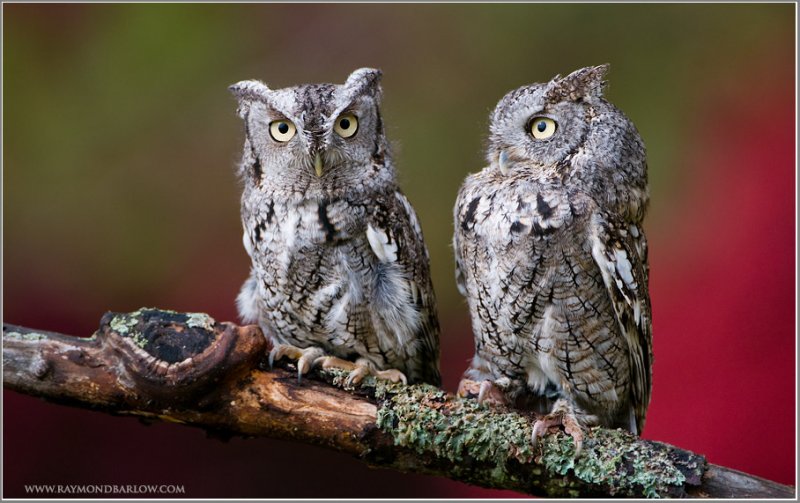
Eastern Screech Owl (Megascops asio) (captive) by Raymond Barlow
A Prayer of the afflicted, when he is overwhelmed, and poureth out his complaint before the LORD. Hear my prayer, O LORD, and let my cry come unto thee. Hide not thy face from me in the day when I am in trouble; incline thine ear unto me: in the day when I call answer me speedily. (Psalms 102:1-2 KJV)
Words by Isaac Watts (1674-1748), The Psalms of David, 1719.
Music: St. Matthew, William Croft (1678-1727), 1708
As a boy, Croft was a chorister at the Chapel Royal. From 1700-1712, he was organist at St. Anne, Soho, London. From 1704 on, he was, jointly with Jeremiah Clarke, organist of the Chapel Royal. In 1708 he became Master of the Children at Chapel Royal and organist at Westminster Abbey. In 1713 he received a Doctor of Music degree from Oxford University. In 1726, the Academy of Vocal Music (later the Academy of Ancient Music) was founded by 13 musicians, including Croft, Pepusch, Bononcini, and Geminiani.
Croft was composer to Queen Anne and was recognized as the foremost church musician of his time. Croft also wrote instrumental works (e.g., cembalo and sonatas for flute (recorder).























 Lee's Birdwatching Adventures Plus