“When Mount St. Helens erupted on May 18, 1980, the resulting blast cloud snapped off huge trees for 150 square miles around the mountain. At the same time an avalanche of mud sped down from the top of the mountain into Spirit Lake, causing a wave almost 900 feet high which scraped trees from the slopes adjacent to the lake. Many of these trees ended up in Spirit Lake buried at various levels on the bottom as they slowly sank in an upright position after becoming water-logged. Scuba investigations and side-scanning sonar have identified up to 100,000 upright deposited tree stumps buried a various levels of ash and peat deposits at the bottom of Spirit Lake.
Mount St. Helens Eruption by USGS
Since Mount St. Helens continues to be active (depositing more material in the lake with time) these trees will be buried in what looks like separate geological layers, even though they all came from the same forest.
Years from now if sediment were to fill the lake and bury the trees in such a way that they became petrified in their present positions, these trees would look like multiple forest buried on top of each other over tens of thousand years. This is exactly what was assumed to be the origin of the petrified forest at Yellowstone National Park’s Specimen Ridge. Many geologists now acknowledge that the Yellowstone petrified trees were from the same standing forest, transported into their current position by a massive flood catastrophe.”
The Young Earth, p. 115-116 and Search for the Truth, II-9
So He destroyed all living things which were on the face of the ground: both man and cattle, creeping thing and bird of the air. They were destroyed from the earth. Only Noah and those who were with him in the ark remained alive. And the waters prevailed on the earth one hundred and fifty days. (Genesis 7:23-24)
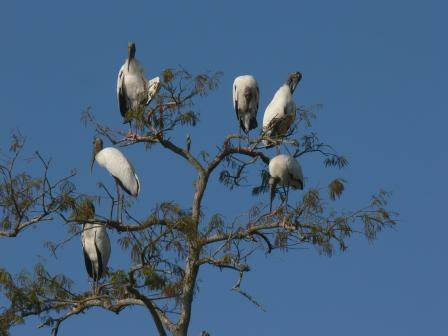
Yesterday, Dan and I went out to the Circle B Bar Reserve for some birdwatchng. I think I would have to call it, “Stork Day.” From our photos, I have counted well over 100 Wood Storks and that doesn’t count the ones we didn’t photograph. It is time to find out some more about the stork.
From the first Birds of the Bible – Stork article,we found out that the stork is on the unclean list of birds that were not to be eaten by the Israelites. (Leviticus 11:19 and Deuteronomy 14:18). Jeremiah 8:7, tells of “her appointed times” (migration) and Zechariah 5:9 mentions the “wings of a stork.”
Psalms is going to provide our thoughts for today.
The trees of the LORD are full of sap; the cedars of Lebanon, which he hath planted; Where the birds make their nests: as for the stork, the fir trees are her house. (Psalms 104:16-17)
The Whole Tree
As you can tell from the photos, the storks like to hang out in the trees. The trees were loaded with them. We were out there recently (September 18th) and I did not see any on that visit. Jeremiah was correct, “Yea, the stork in the heaven knoweth her appointed times;” Migration has been underway and these are either resting while on their trip or they are going to be here for the winter.
“Storks (family Ciconiidae) make their nests of sticks, reeds and grass, in tall trees. When the chicks hatch, their thin, featherless skin is extremely vulnerable to the direct rays of the sun. The parent bird has two responses to the high temperature problem — if water is nearby, the stork fills its large beak, returns to the nest, and douses the tiny chicks with cooling water. If this is not sufficient, the parent then performs a most remarkable feat — it stands over the young and spreads its large wings over the entire nest, thus shading the chicks from the sun’s rays! Often it will do this for hours at a time.” from “Birdbrains?” at Answers in Genesis
Storks Shadowing Baby in Lakeland by Dan
When the Lord created the Stork, the knowledge to protect their babies was put in them. Our God and Savior has promised to meet our needs. If He cares about the birds, how much more does he care about us?
“Storks are large, long-legged, long-necked wading birds with long stout bills, belonging to the family Ciconiidae. They occur in most of the warmer regions of the world and tend to live in drier habitats than the related herons, spoonbills and ibises; they also lack the powder down that those groups use to clean off fish slime. Storks have no syrinx and are mute, giving no bird call; bill-clattering is an important mode of stork communication at the nest. Many species are migratory. Most storks eat frogs, fish, insects, earthworms, and small birds or mammals. There are 19 living species of storks in six genera.
Storks tend to use soaring, gliding flight, which conserves energy. Soaring requires thermal air currents. Ottomar Ansch??tz’s famous 1884 album of photographs of storks inspired the design of Otto Lilienthal’s experimental gliders of the late 19th century. Storks are heavy with wide wingspans, and the Marabou Stork, with a wingspan of 3.2 m (10.5 feet), shares the distinction of “longest wingspan of any land bird” with the Andean Condor.
Their nests are often very large and may be used for many years. Some have been known to grow to over 2 m (6 feet) in diameter and about 3 m (10 feet) in depth. Storks were once thought to be monogamous, but this is only true to a limited extent. They may change mates after migrations, and migrate without them. They tend to be attached to nests as much as partners.
Storks’ size, serial monogamy, and faithfulness to an established nesting site contribute to their prominence in mythology and culture.
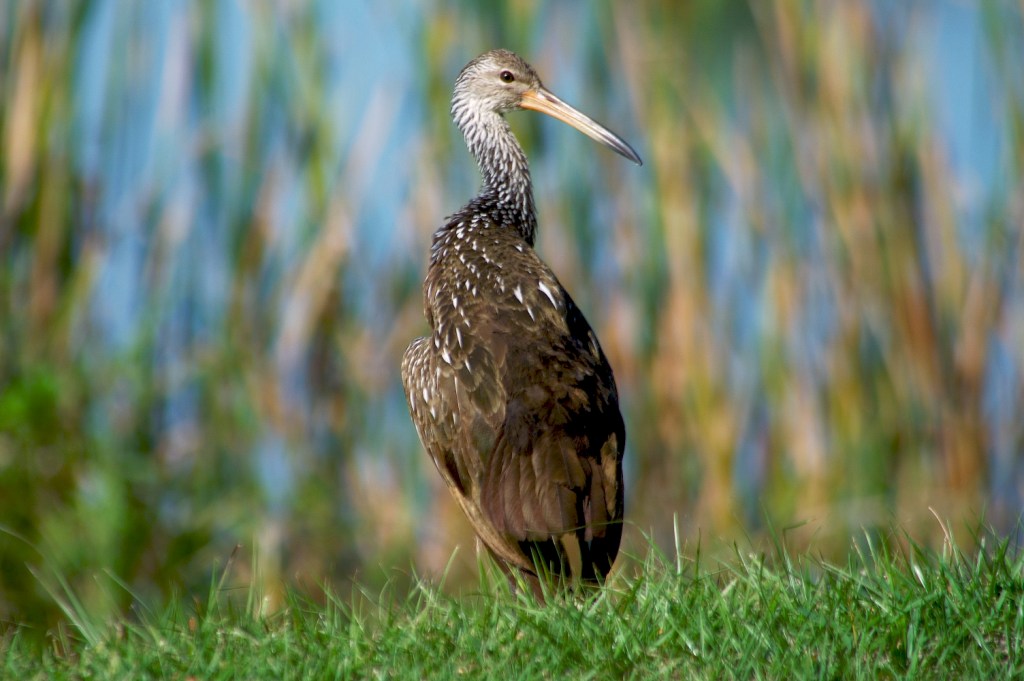
Finding Photos for Limpkins was not a problem for us. That is one of the birds we see very frequently in this area.
*
This slideshow requires JavaScript.
Information from Wikipedia with editing
“The Limpkin (also called “carrao”, “courlan”, “crying bird”), Aramus guarauna, is a bird that looks like a large rail but is skeletally closer to cranes. They are in the GRUIFORMES family. It is found mostly in wetlands in warm parts of the Americas, where it feeds primarily on apple snails of the genus Pomacea. Its name derives from its seeming limp when it walks.”
Range and habitat
The Limpkin occurs from peninsular Florida (and formerly the Okefenokee Swamp in southern Georgia) and southern Mexico through the Caribbean and Central America to northern Argentina. In South America it occurs widely east of the Andes; west of them its range extends only to the Equator.
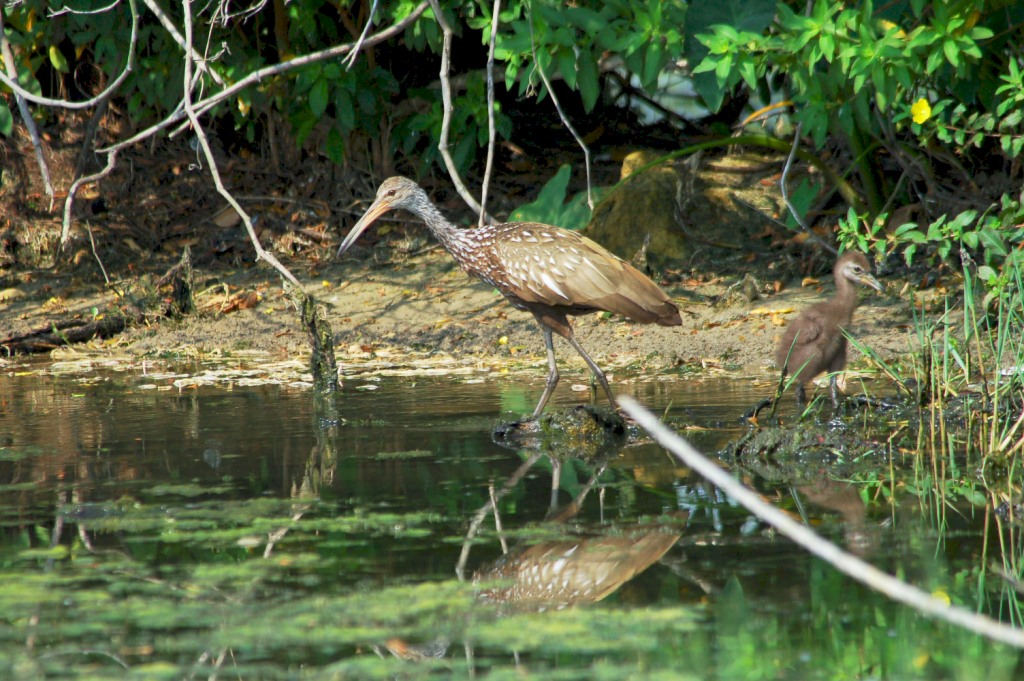
Limpkin & Baby at Saddle Creek By Dan'sPix
It inhabits freshwater marshes and swamps, often with tall reeds, as well as mangroves. In the Caribbean, it also inhabits dry brushland. In Mexico and northern Central America, it occurs at altitudes up to 1,500 m (4,900 ft).
Description
The Limpkin is a somewhat large bird, 66 cm (26 in) long, with a wingspan of about 102 cm (40 in) and a weight of about 1.1 kg (2.4 lb). Its plumage is drab—dark brown with an olive luster above. The feathers of the head, neck, wing coverts, and much of the back and underparts (except the rear) are marked with white, making the body look streaked and the head and neck light gray. It has long, dark-gray legs and a long neck. Its bill is long, heavy, and downcurved, yellowish bill with a darker tip. The bill is slightly open near but not at the end to give it a tweezers-like action in removing snails from their shells, and in many individuals the tip curves slightly to the right, like the apple snails’ shells. The white markings are slightly less conspicuous in first-year birds. Its wings are broad and rounded and its tail is short. It is often confused with the immature White Ibis.
This bird is easier to hear than see. Its common vocalization is a loud wild wail or scream[4][5] with some rattling quality, represented as “kwEEEeeer or klAAAar.” This call is most often given at night[4] and at dawn and dusk. It has been used for jungle sound effects in Tarzan films and for the hippogriff in the film Harry Potter and the Prisoner of Azkaban. Other calls include “wooden clicking”, clucks, and in alarm, a “piercing bihk, bihk…”.
Sound provided by xeno-canto.org Behavior and feeding
Limpkins are largely nocturnal and crepuscular, except that in Florida refuges, where they do not fear people, they are active during the day. Even so, they are usually found near cover.
Because of their long toes, they can stand on floating water plants; they also swim well. They fly strongly, the neck projecting forward and the legs backward, the wings beating shallowly and stiffly, with a jerky upstroke, above the horizontal most of the time.
Snail remains at Lake Hollingsworth by Lee
forage primarily in shallow water and on floating vegetation such as water hyacinth and water lettuce They walk slowly with a gait described as “slightly undulating” and “giving the impression of lameness or limping”, “high-stepping”, or “strolling”, looking for food if the water is clear or probing with the bill. They feed on small aquatic life, principally apple snails. The availability of this one mollusk has a significant effect on the local distribution of the Limpkin. When a Limpkin finds an apple snail, it carries it to land or very shallow water and places it in mud, the opening facing up. It deftly removes the operculum or “lid” and extracts the snail, seldom breaking the shell. The extraction takes 10 to 20 seconds. It often leaves piles of empty shells at favored spots.
Freshwater mussels are a secondary food source. Less important prey items are land snails, insects, frogs, and lizards.
Reproduction
Males have territories of several hectares, where they call loudly and chase other males away. Nests are built on the ground, in dense floating vegetation, in bushes, or at any height in trees. They are bulky structures of rushes, sticks or other materials. The clutch consists of 5 to 7 eggs, averaging 6, which measure 6.0 cm × 4.4 cm (2.4 in × 1.7 in). Their background color ranges from gray-white through buff to deep olive, and they are marked with light-brown and sometimes purplish-gray blotches and speckles. Both parents incubate for about 27 days. The young hatch covered with down, capable of walking, running, and swimming. They follow their parents to a platform of aquatic vegetation where they will be brooded. They are fed by both parents; they reach adult size at 7 weeks and leave their parents at about 16 weeks.
King Solomon also built a fleet of ships at Ezion Geber, which is near Elath on the shore of the Red Sea, in the land of Edom. (1 Kings 9:26)
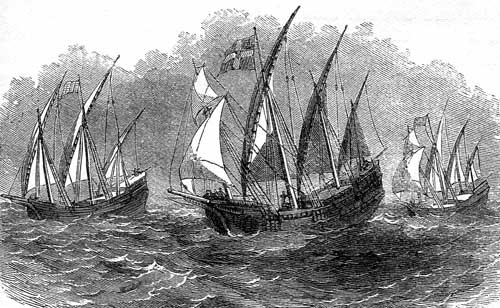
Columbus’ ships
Normally, it would not be unusual to find a stone with engraving on it in South America. But a stone found in 1872 in Brazil is unusual, since Aztec, Mayan and Incan civilizations never lived in that region. Besides, the engraving on the stone was in Phoenician. Its discoverer, who did not know Phoenician, sent it to authorities who gave it to the head of the national museum. He recognized the ancient language and translated it. It reads, “We are the Sons of Canaan from Sidon, the city of the King. Commerce has cast us on this distant shore, a land of mountains.”
Could 7th century B.C. Phoenicians have sailed as far as South America in search of commerce? In the ancient world, Phoenicians were known as the greatest commercial sailors of their day. But there is a modern bias against seeing ancient peoples as being as smart and resourceful as we are today, so the inscription has generally been considered a hoax. Then, in the 1960s, the original rubbing made of the inscription turned up at a scholarly auction in the United States. A modern expert on ancient languages studied the rubbing and concluded that the inscription must be authentic. It contains quirks of the Phoenician language that were unknown even to scholars in the 19th century.
While we today may know more facts, the ancients were no less intelligent and resourceful than we are today. That’s consistent with the Bible’s picture of man as God’s highest visible creation, rather than evolution’s gradually improving creature.
Prayer: I glorify Your Name, O Lord, for making us the way You have. Amen.
References: Archeology, “Before Columbus or the Vikings,” Science, May 1968.
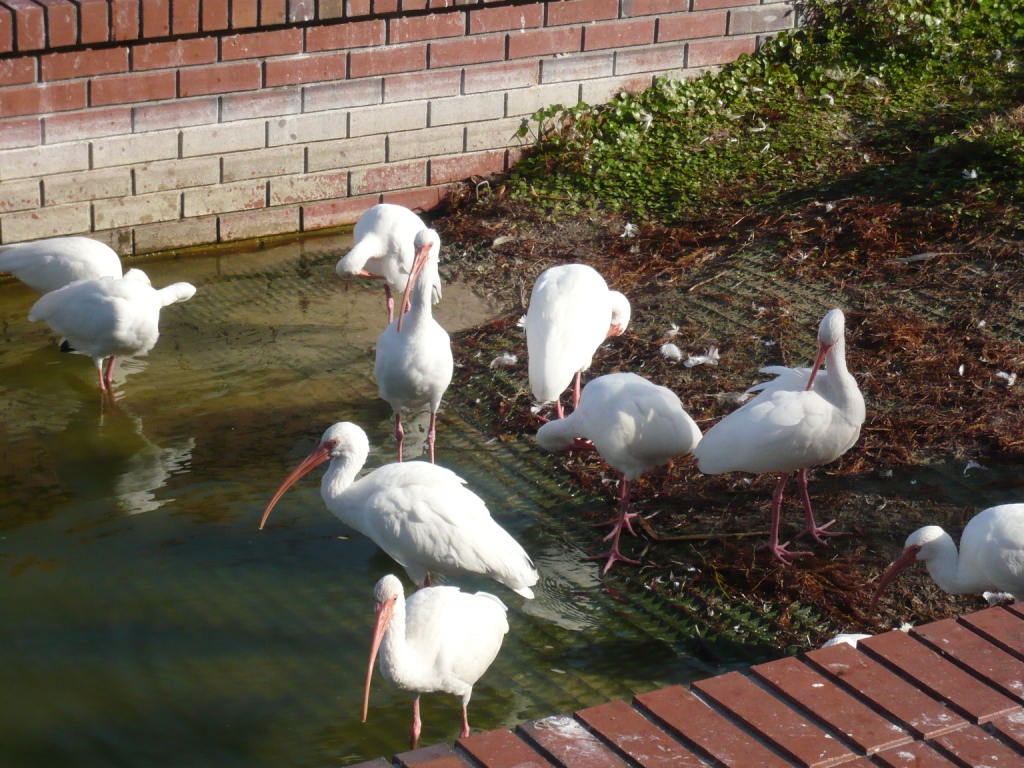
Last week while reading by the window that overlooks our small backyard, my eye caught movement. When I looked out, under the tree in the shade stood a Sandhill Crane surrounded by 8 or 9 White Ibises. The Ibises walked toward my way and were digging and checking out our lawn. The group kept moving and digging around as Ibises will do. They exited left of my view and the Sandhill was still standing in the same spot. Soon, from the left of view the Ibises came back and this time there were 11 of them. They walked back toward the crane and exited right. Crane still standing. Then a few minutes later, back they came right to left and this time there were 13 of them. The Crane was still standing there. Off they went to the left of my view. You got it, the crane was still standing there. Then, here they came the last time, left to right, and there were 14 of them this time. My stately Sandhill Crane was still standing there. All of this took place in about a 30 minute time span.
White Ibises at Lake Morton by Dan
Needless to say, my reading was slowed down by all this activity. The ibises were digging around and yet they kept on the move. They put their beaks in the ground and pound up and down about 5 or 6 times and then move on and repeat the process over again. One or two of them will find something good to eat and will stay in the same spot to continue to dig. When they look up and see that the group has moved on, they immediately scurry off to catch up with the others. They have a funny little way of walking. This was repeated many times as they looked up and then followed the crowd.
I can come up with several applications for what was going on, but I will only choose one of them, for now.
God has given us His Word, the Bible, and in it we learn the truths about God the Father, Jesus Christ the Son, and the Holy Spirit who are one and are the great I AM. The Word reveals truths about creation, salvation, sin, God’s attributes such as love, mercy, grace, judgment, justice, long-suffering, etc. As the Sandhill Crane stood, so should we stand firm in the truths taught in the Bible. We should not waver or try to change what has been written. Jesus has provided salvation, through His death on the cross, and invites us to accept His gift of salvation.
Jesus said to him, “I am the way, the truth, and the life. No one comes to the Father except through Me. (John 14:6)
Many people know the truth about Jesus, the Cross, God, creation, heaven, hell, etc., but do not apply it to their heart or soul. They either think, there is some other way and are always searching for some new “angle” of belief. Be it different religions, non-religion, atheism, or what ever.
Off on another search - American White Ibis by Bob-Nan
Others who do accept the Lord Jesus Christ as their Savior, want to find some new “angle” to what the Bible teaches, by perverting it, or trying to twist it to where their “sin” is justified. Maybe are just not really “walking with the Lord” and want to live in sin or they become false teachers.
Both groups, unbelievers or believers, are like the Ibises who go away from the truth (crane), and try new things, then almost come back, sort of, and then scurry off to find something different. Even those who settle down, look up and see the crowd going a certain way, and run after that new thing.
Enter by the narrow gate; for wide is the gate and broad is the way that leads to destruction, and there are many who go in by it. Because narrow is the gate and difficult is the way which leads to life, and there are few who find it. (Matthew 7:13-14)
May we all seek the truth of God, accept the Lord’s salvation, and then live our lives according to God’s Word.
Great is the LORD, and greatly to be praised; And His greatness is unsearchable. (Psalms 145:3)
Author: Carl Boberg, 1859-1940
Tr. By Stuart K. Hine, 1899-
Musician: Swedish Melody
Arr. By Stuart K. Hine, 1899-
(by Sean Fielder)
How Great Thou Art
American Yellow Warbler (Dendroica aestiva) by J Fenton
O Lord my God! When I in awesome wonder
Consider all the worlds Thy hands have made,
I see the stars, I hear the rolling thunder,
Thy power throughout the universe displayed,
Refrain: Then sings my soul, my Saviour God to Thee;
How great Thou art, how great Thou art!
Then sings my soul, my Saviour God to Thee;
How great Thou art, how great Thou art!
When through the woods and forest glades I wander And hear the birds sing sweetly in the trees;
When I look down from lofty mountain grandeur
And hear the brook and feel the gentle breeze;
And when I think that God, His Son not sparing
Sent Him to die, I scarce can take it in;
That on the cross, my burden gladly bearing,
He bled and died to take away my sin;
When Christ shall come with shout of acclamation
And take me home, what joy shall fill my heart!
Then I shall bow in humble adoration
And there proclaim, my God, how great Thou art!
——————————————————————————–
HYMN HISTORY:
Northern Parula (Parula americana) by Reinier Munguia
Boberg wrote the poem “O Store Gud” (O Great God) in 1885 with nine verses.
The inspiration for the poem came when Boberg was walking home from church near Kronobäck, Sweden, and listening to church bells. A sudden awe-inspiring storm gripped Boberg’s attention, and then just as suddenly as it had made its violent entrance, it subsided to a peaceful calm which Boberg observed over Mönsterås Bay. According to J. Irving Erickson:
Carl Boberg and some friends were returning home to Mönsterås from Kronobäck, where they had participated in an afternoon service. Nature was at its peak that radiant afternoon. Presently a thundercloud appeared on the horizon, and soon sharp lightning flashed across the sky. Strong winds swept over the meadows and billowing fields of grain. The thunder pealed in loud claps. Then rain came in cool fresh showers. In a little while the storm was over, and a rainbow appeared.
When Boberg arrived home, he opened the window and saw the bay of Mönsterås like a mirror before him… From the woods on the other side of the bay, he heard the song of a thrush…the church bells were tolling in the quiet evening. It was this series of sights, sounds, and experiences that inspired the writing of the song.[7]
According to Boberg’s great-nephew, Bud Boberg, “My dad’s story of its origin was that it was a paraphrase of Psalm 8 and was used in the ‘underground church’ in Sweden in the late 1800s when the Baptists and Mission Friends were persecuted.” The author, Carl Boberg himself gave the following information about the inspiration behind his poem:
“It was that time of year when everything seemed to be in its richest colouring; the birds were singing in trees and everywhere. It was very warm; a thunderstorm appeared on the horizon and soon thunder and lightning. We had to hurry to shelter. But the storm was soon over and the clear sky appeared.
“When I came home I opened my window toward the sea. There evidently had been a funeral and the bells were playing the tune of ‘When eternity’s clock calling my saved soul to its Sabbath rest.’ That evening, I wrote the song, ‘O Store Gud.'”
[edit] Publication
Boberg first published “O Store Gud” in the Mönsterås Tidningen (Mönsterås News) on 1886 March 13.
The poem became matched to an old Swedish folk tune. and sung in public for the first known occasion in a church in the Swedish province of Värmland in 1888. Eight verses appeared with the music in the 1890 Sions Harpan.
In 1890 Boberg became the editor of Sanningsvittnet (The Witness for the Truth). The words and music were published for the first time in the 16 April 1891 edition of Sanningsvittnet. Instrumentation for both piano and guitar was provided by Adolph Edgren (born 1858; died 1921 in Washington D.C.), a music teacher and organist, who later migrated to the United States.
Boberg later sold the rights to the Svenska Missionsförbundet (Mission Covenant Church of Sweden). In 1891 all nine verses were published in the 1891 Covenant songbook, Sanningsvittnet. These versions were all in 3/4 time. In 1894 the Svenska Missionsförbundet sångbok published “O Store Gud” in 4/4 time as it has been sung ever since (cf. Time signature).
——————————————————————————– Wikipedia – How Great Thou Art – History SermonAudio – How Great Thou Art – Audio
The Gospel Message is that Jesus Christ, the Creator, came to earth and died for us. It is up to us to accept, by faith, what He has done for us. He loves us, and wants to be our Savior, Lord, and King.
Please read the basic message of the whole gospel below and seriously consider that your eternal soul is very important to God, the Lord Jesus Christ, the Holy Spirit.
A. God
He exists (Hebrews 11:6)
He is holy (1 Peter 1:15)
Man must be perfect to reach God ( Matthew 5:48)
The measure of God’s holiness is the law ( Romans 2:12, 13, 14, 15, 16)
He has judged sin (Romans 6:23)
B. Man
He is a sinner (Romans 3:23)
He cannot save himself (Ephesians 2:8,9)
C. Jesus Christ
He died because of our sins (1 Corinthians 15:3)
He rose again (1 Corinthians 15:14)
He is the only Messiah (Savior) (John 14:6), (1 Timothy 2:5)
He paid the price for our sins (1 Corinthians 6:19 – 20), (Hebrews 7:27)
That He is Lord, that is the right ruler of all, including us (Romans 10:9, 10)
D. Grace
Salvation is a free gift. (Ephesians 2:8,9)
We can’t earn it (Ephesians 2:8,9)
E. Faith
We must totally yield ourselves to Christ (Acts 16:31)
We accept what God has done (John 13:20)
We trust in Christ alone for salvation (John 14:6), (Ephesians 2:8,9, 10)
Repentance is inherent in Biblical Faith (Acts 2:36)
F. Commitment
We must be willing to turn from our sins and follow Christ (2 Corinthians 5:15)
(The verses will pop up when mouse is placed over them)
If you have any further questions or would like assistance accepting Christ as your personal Savior, please contact me at Lee@Leesbird.com or contact my pastor, Rev. Nathan Osborne III.
(Pastor Osborne provided the above outline)
As much as we enjoy bird watching and enjoy seeing how many we can see or how many we can count on a list, remember the following verses:
For what will it profit a man if he gains the whole world, and loses his own soul? Or what will a man give in exchange for his soul? (Mark 8:36-37)
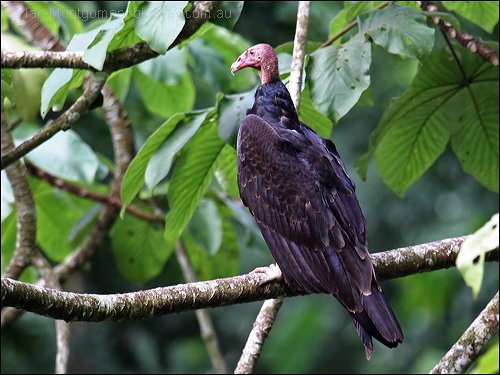
We get to see lots of Turkey Vultures in this area. I have seen trees just loaded with them. They are ugly to look at, but are very useful.
The following is the October 6th’s “Evidence from Biology” article from A Closer Look at the Evidence, by Richard and Tina Kleis:
“The Turkey Vulture has incredible farsighted vision capable of seeing dead or dying objects several miles beyond what the human eye can detect. Yet it is designed with dull, weak, talons and a thin beak, forcing it to eek out an existence eating rotting flesh or decaying vegetables. Since the vulture eats the remains of animals that have died of disease, it has a digestive tract designed to destroy deadly bacteria (including anthrax!). The Turkey Vulture also has the ability to sanitize itself and its surroundings using a special disinfectant found in its own excrement. The same chemicals which kill the deadly bacteria in its stomach continue to kill the germs outside its body!
Turkey Vulture by Ian Montgomery
Because the vulture’s head is usually covered in blood, pieces of rotten flesh, and bacteria, it is especially vulnerable to disease. Therefore, this particular bird was created without feathers from the neck up. As the turkey vulture stands in the sun, the ultraviolet radiation kills any remaining bacteria.
By removing the carcasses of decaying animals, the turkey vulture serves an important purpose of limiting the spread of disease and preventing potential epidemics among both man and beast. One wonders how the turkey vulture could have evolved all of the specialized characteristics. The creation solution is that they were created with the original vulture-type bird. The survival characteristics needed for our fallen world were either given after the Fall or developed from originally created abilities.”
Character Sketches, Vol. III, p. 121-124
The LORD is righteous in all his ways, and holy in all his works. (Psalms 145:17 KJV)
Lee’s Extras:
We have mentioned the Vulture many times on the blog and especially in the places below. After all, they are one of the unclean birds that the Jewish people were not allowed to eat. After reading the above article, you can understand why they were off the “menu.”
There is a path which no fowl knoweth, and which the vulture’s eye hath not seen: (Job 28:7 KJV)
Ian Juby just sent out his latest newsletter and it is also available at his blog. The article features the new “Ardi” that is suppose to prove our ancestors were related to this fossil. Personally, I believe it will become another hoax like “Luci,” but time will tell.
So God created man in his own image, in the image of God created he him; male and female created he them. (Genesis 1:27 KJV)
“1) Ardi ar arrr…
Artist’s best guess as to what Ardipithecus ramidus may have looked like.
Okay, so maybe it didn’t stand upright like that, and maybe it didn’t have human eyes like that, and maybe it was a male and not a female, and maybe it….well, it’s close at least!
Drawing by J.H. Matternes
The propaganda machine goes into overdrive:
Got a barrage of emails this week from my honourable news watch team regarding a supposed “Missing link” found this week which “proves” our ancestral relationship to the apes.
In fact, Science magazine even ran a special issue just on this fossil, CBC’s “Quirks and Quarks” devoted a segment of their program to it (downloadable as a 22 meg MP3), National Geographic had a spread on it as well.
Seeing as how there’s been so much fuss over this fossil, I thought I’d devote a newsletter in response.
As is typical, this “missing link” is presented with impressive pomp and circumstance before the emporer comes out wearing no clothes. We’ve seen this before time and again with Ida, Puijila, and even Archaeoraptor – the fraudulent fossil that was brazenly heralded with many bold claims as “proof of evolution” before it was quietly sidelined after it was discovered to be a fake. I still,to this day,occasionally have people bring up Archaeoraptor as proof of evolution. This is the power of propaganda.
Same old, same old.
Before proceeding, it’s probably a good idea to point you to my previous response to the SciAm write up on our supposed “hominid” fossil lineage. In this article, I dealt with dozens of these supposed “half-ape/half-human” fossils that evolutionists often hurl at us: “The Human Pedigree”
As you can see, the whole “science” behind these “hominid” fossils is so speculative and subjective it isn’t funny! 1) Start with the assumption that evolution is true. 2) Interpret the fossil within an evolutionary paradigm 3) Use the interpretation as proof that evolution is true. 4) Return to step #1.
The New Old Find The “new” find (actually found back in ‘92) is attributed to Ardipithecus ramidus. The famous ‘flintstone fossil’ “Ardipithecus ramidus kadaba-daba-doooooo!” (thanks Teno Groppi), Ardipithecus has now been divided into two fossils, Ardipithecus ramidus, and Ardipithecus kadaba. Good grief – there was barely enough fossil fragments for one fossil reconstruction, let alone two! See my response to SciAm for more details.
So with the unveiling of more of the fossils this week, once again … To see the rest of the article – CLICK HERE
Dinosaur Protein Sequences and the Dino-to-Bird Model by Jeffrey Tomkins, Ph.D. is in this months Acts and Fact.
Here is an excerpt from it:
“Evolutionists have maintained that the fossil record supports a long-ages history for earth, but material extracted from dinosaur bones is providing an interesting challenge to that theory. The recent discoveries of soft dinosaur tissues, defined cell matrices, elastic blood vessels, and clearly observable cell microstructures such as cell nuclei have been a source of both shock and excitement to the paleontology community.
Dinosaurs
The shock comes from the fact that degradative processes somehow did not completely destroy all evidence of tissue from the supposedly millions-of-years-old fossils. The excitement comes from the fact that, given the pristine state of these tissues, scientists should be able to extract macromolecules. These would then be used in studies of molecular evolution to bolster the evolutionary ideas that are competing for supremacy in the scientific community, such as the currently touted “dinosaur to bird” transition model.
In fact, soft tissues from the bones of a Tyrannosaurus rex and a Brachylophosaurus canadensis (duck-billed hadrosaur) did yield protein fragments that were subjected to amino acid sequence analysis and then used in theoretical computational analyses.1, 2 But did the data demonstrate a dinosaur to bird transition, or was it possibly manipulated in the spirit of academic politics?” Click here to read the rest of a very interesting article.













 Lee's Birdwatching Adventures Plus