Birds of the Bible – Hawks

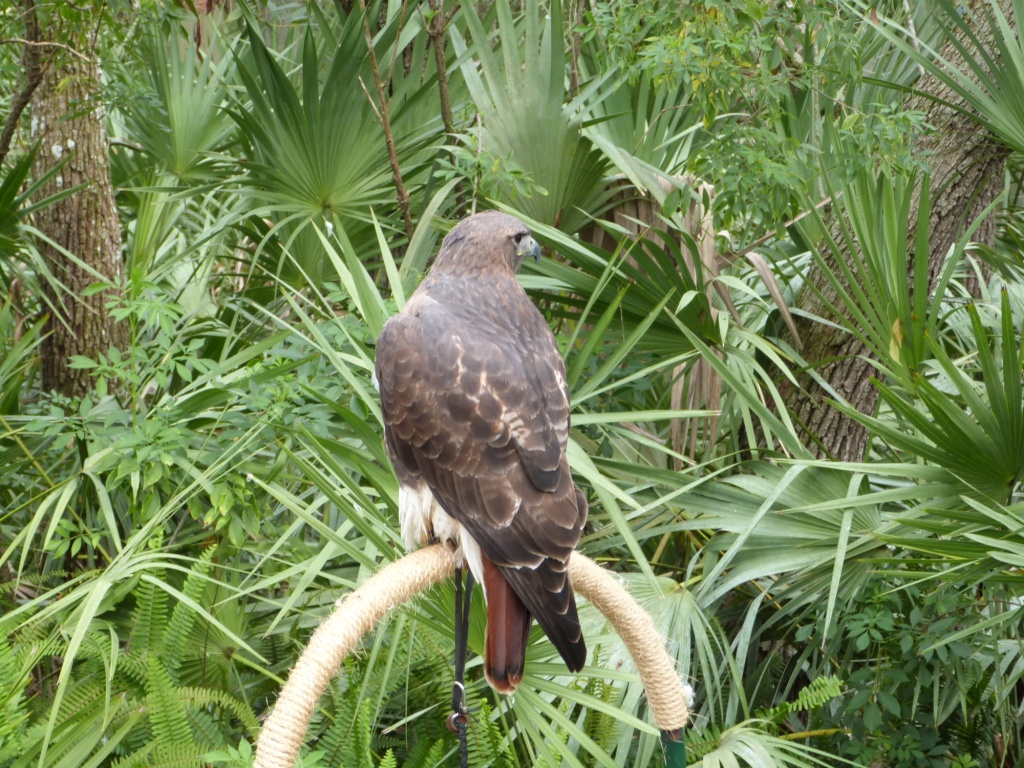
Red-tailed Hawk (Buteo jamaicensis) Brevard Zoo by Lee

Red-tailed Hawk (Buteo jamaicensis) Brevard Zoo by Lee

“Does the hawk fly by your wisdom, And spread its wings toward the south? (Job 39:26 NKJV)

In Birds of the Bible – Hawk Migration we covered Job 38:1-3 which talks about birds knowing when to head South. After taking nice pictures of the Red-shouldered and Red-tailed Hawks at the Brevard Zoo, I decided to do another Birds of the Bible about Hawks. Just discovered that I never really did an initial one on Hawks like I did for the other Birds of the Bible articles.

According to the King James Version of Scripture, the other two verses with hawk in them are:

the ostrich, the short-eared owl, the sea gull, and the hawk after its kind; (Leviticus 11:16 NKJV)

and

the ostrich, the short-eared owl, the sea gull, and the hawk after their kinds; (Deuteronomy 14:15 NKJV)

Both of these references to the Hawk are in the list of unclean birds the Israelites were not suppose to eat. The list of Clean and Unclean birds were covered in Birds of the Bible – Clean vs. Unclean,  Birds of the Bible – The Law Of The Birds and Deuteronomy 14:11-18 Visualized.

The CEV (Contemporary English Version) combines all of the birds together in one verse in Leviticus and then again in Deuteronomy.

Eagles, vultures, buzzards, crows, ostriches, hawks, sea gulls, owls, pelicans, storks, herons, hoopoes, and bats are also disgusting, and you are forbidden to eat any of them. (Leviticus 11:13 CEV)

But don’t eat the meat of any of the following birds: eagles, vultures, falcons, kites, ravens, ostriches, owls, sea gulls, hawks, pelicans, ospreys, cormorants, storks, herons, and hoopoes. You must not eat bats. (Deuteronomy 14:12 CEV)

The GNB (Good News Bible) does basically the same with Leviticus and Deuteronomy:

You must not eat any of the following birds: eagles, owls, hawks, falcons; buzzards, vultures, crows; ostriches; seagulls, storks, herons, pelicans, cormorants; hoopoes; or bats. (Leviticus 11:13 GNB)

But these are the kinds of birds you are not to eat: eagles, owls, hawks, falcons; buzzards, vultures, crows; ostriches; seagulls, storks, herons, pelicans, cormorants; hoopoes; and bats. (Deuteronomy 14:12 GNB)
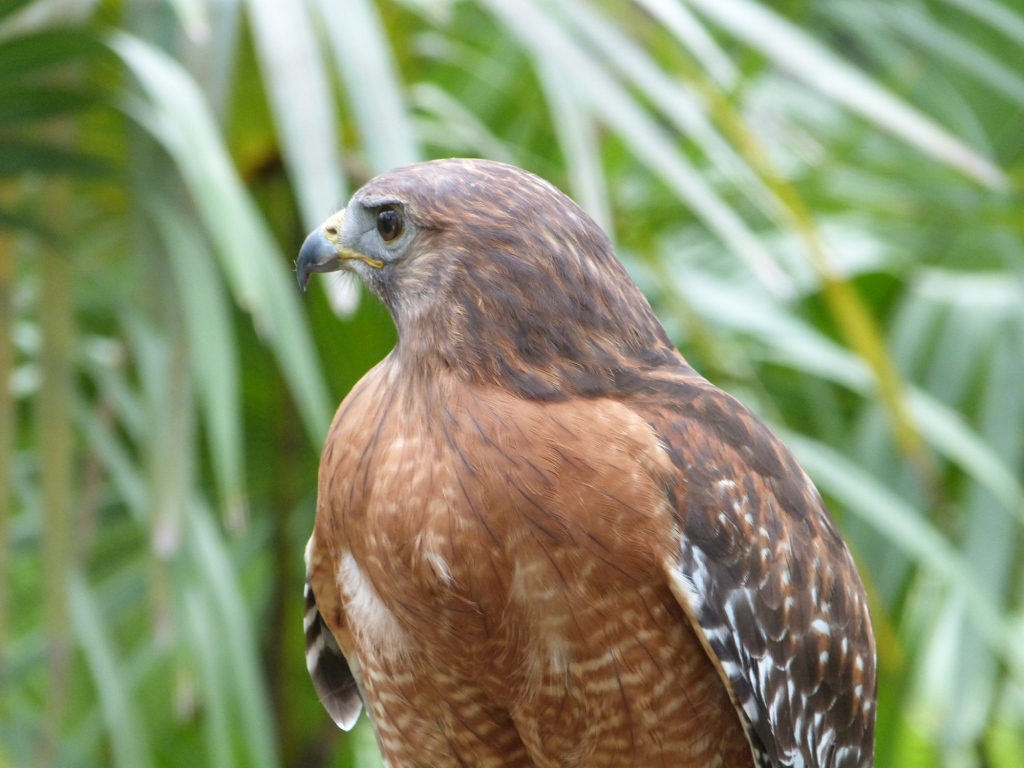
Red-shouldered Hawk (Buteo lineatus) Brevard Zoo by Lee

Red-shouldered Hawk (Buteo lineatus) Brevard Zoo by Lee

Let’s see what other references to the Hawk can be found in other version of the Bible.

Job 28:7 talks about the vulture’s or hawk’s eye and it’s vision. The KJV and some of the others translate Job 28:7 with a “vulture’s eye”, where as the BBE, CEV, GNB, MSG, translate it as the “hawk’s eye” or the hawk. Yet others translate it as a falcon or kite.

No bird has knowledge of it, and the hawk’s eye has never seen it. (Job 28:7 BBE)

Miners go to places unseen by the eyes of hawks; (Job 28:7 CEV)

No hawk sees the roads to the mines, And no vulture ever flies over them. (Job 28:7 GNB)

Vultures are blind to its riches, hawks never lay eyes on it. (Job 28:7 MSG)

J Vernon McGee says this about the verse – “The birds fly over the earth and its mountains. There are veins of minerals down in the earth that the birds fly over and know nothing about, neither can the vulture see them. There must be precious stones and veins of riches and wealth which are completely unknown and untapped.”

Adam Clarke’s Commentary -“There is a path which no fowl knoweth – The instinct of birds is most surprising. They traverse vast forests, etc., in search of food, at a great distance from the place which they have chosen for their general residence; and return in all weathers, never missing their track: they also find their own nest without ever mistaking another of the same kind for it. Birds of passage, also, after tarrying in a foreign clime for six or seven months, return to their original abode over kingdoms and oceans, without missing their way, or deviating in the least from the proper direction; not having a single object of sight to direct their peregrinations. In such cases even the keen scent of the vulture, and the quick, piercing sight of the eagle, would be of no use. It is possible that Job may here refer to undiscovered mines and minerals; that notwithstanding man had already discovered much, yet much remained undiscovered, especially in the internal structure and contents of the earth. Since his time innumerable discoveries have been made; and yet how little do we know!”
____

The only Bible to translate Psalms 74:19 as a “hawk” is the BBE, while most of the rest make it “wild beast” or “wild animal”.

O give not the soul of your dove to the hawk; let not the life of the poor go out of your memory for ever. (Psalms 74:19 BBE)

____

The DRB (Douay-Reimes Bible) totally misinterprets this verse in my opinion. Check out other translations and you will see the difference.

The wing of the ostrich is like the wings of the heron, and of the hawk. (Job 39:13 DRB)
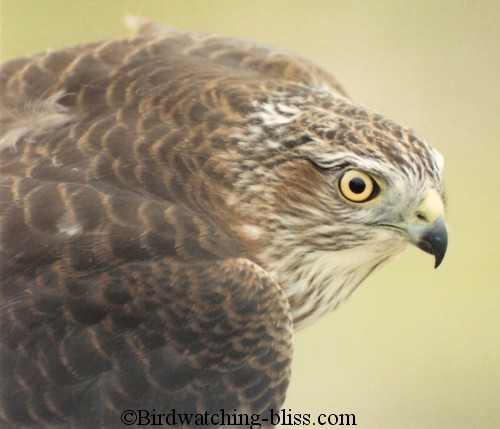
Sharp-shinned Hawk (Accipiter striatus)

Sharp-shinned Hawk (Accipiter striatus) ©BirdwatchingBliss

Isaiah has several verses mentioning the hawk. Isaiah 34 talks about a gathering of birds and these verses mention the hawk:

Owls, hawks, and wild animals will make it their home. God will leave it in ruins, merely a pile of rocks. (Isaiah 34:11 CEV)

Horned owl and hawk will possess it, screech owl and raven will live there; he will stretch over it the measuring line of confusion and the plumbline of the empty void. (Isaiah 34:11 CJB)

But the hawk and the porcupine shall possess it, the owl and the raven shall dwell in it. He shall stretch the line of confusion over it, and the plumb line of emptiness. (Isaiah 34:11 ESV)

The arrowsnake will make her hole and put her eggs there, and get her young together under her shade: there the hawks will come together by twos. (Isaiah 34:15 BBE)

There the owl nests and lays and hatches and gathers her young in her shadow; indeed, there the hawks are gathered, each one with her mate. (Isaiah 34:15 ESV)

The tree snake will make its nest and lay eggs there, And it will hatch and gather them under its protection. Yes, the hawks will be gathered there, Every one with its kind. (Isaiah 34:15 NASB)

The tree snake shall make its nest and lay eggs there, And it will hatch and gather them under its protection. Yes, the hawks shall be gathered there, Every one with its kind. (Isaiah 34:15 NAS77)

There the arrow snake shall make her nest and lay eggs And hatch, and gather them under her shadow; There also shall the hawks be gathered, Every one with her mate. (Isaiah 34:15 NKJV)
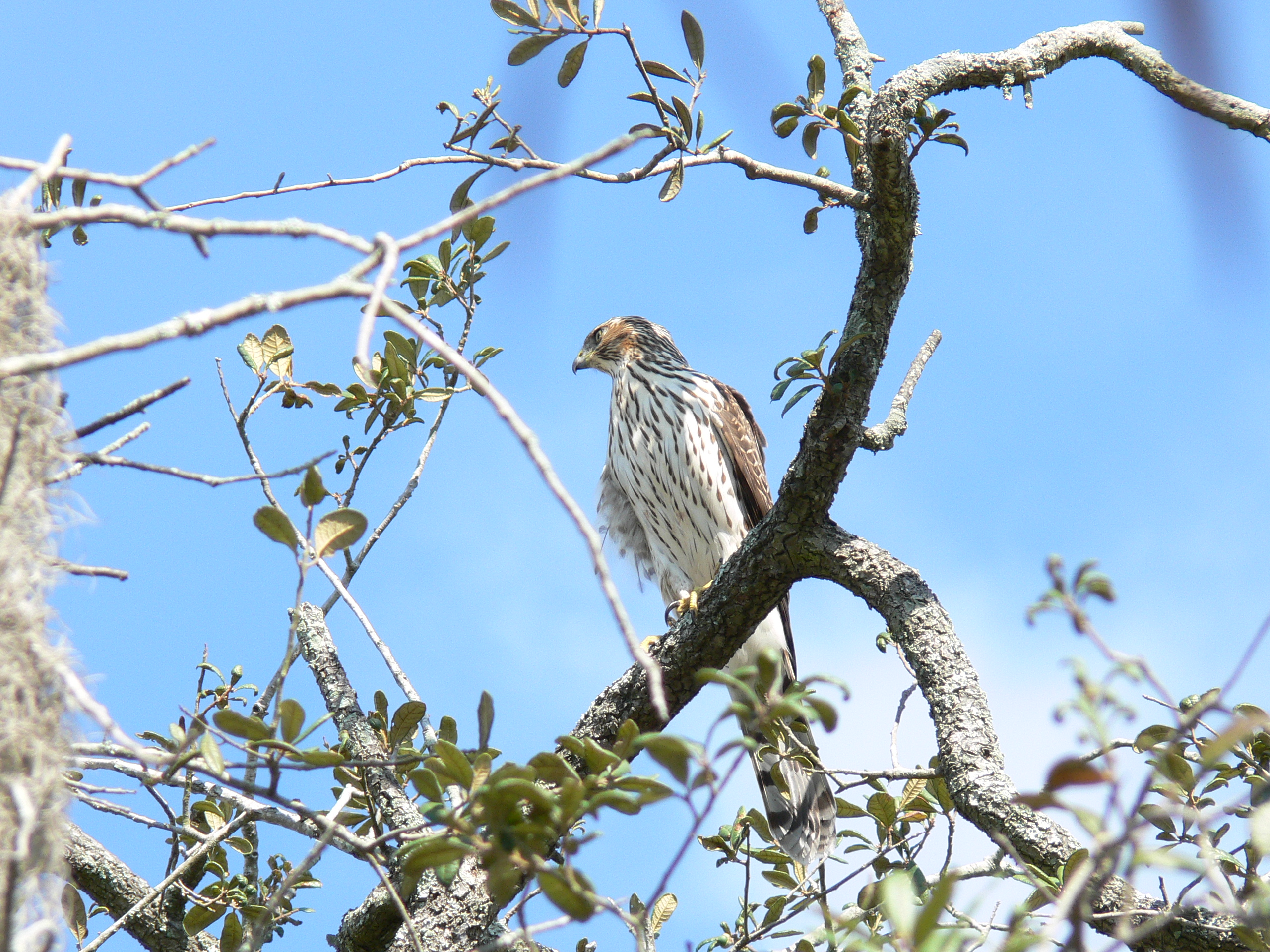
Cooper's Hawk Wild at Lowry Pk Zoo

Cooper’s Hawk Wild at Lowry Pk Zoo

Isaiah again in Chapter 46 verse 11 has been translated by some to contain a hawk:

and brought someone from a distant land to do what I wanted. He attacked from the east, like a hawk swooping down. Now I will keep my promise and do what I planned. (Isaiah 46:11 CEV)

I am calling a man to come from the east; he will swoop down like a hawk and accomplish what I have planned. I have spoken, and it will be done. (Isaiah 46:11 GNB)

____

Here are just various verses that mention hawks:

My people are like a hawk surrounded and attacked by other hawks. Tell the wild animals to come and eat their fill. (Jeremiah 12:9 CEV)

My chosen people are like a bird attacked from all sides by hawks. Call the wild animals to come and join in the feast! (Jeremiah 12:9 GNB)

It happened at once. Nebuchadnezzar was driven out of human company, ate grass like an ox, and was soaked in heaven’s dew. His hair grew like the feathers of an eagle and his nails like the claws of a hawk. (Daniel 4:33 MSG)

___

Then there are a couple of verse that use “hawk” not as a bird “per se,” but a verb:

They don’t seem to realize that this comprehensive setting-things-right that is salvation is God’s business, and a most flourishing business it is. Right across the street they set up their own salvation shops and noisily hawk their wares. After all these years of refusing to really deal with God on his terms, insisting instead on making their own deals, they have nothing to show for it. (Romans 10:3 MSG)

For we are not as many, hawking the Word of God; but as of sincerity, but as of God, we speak in Christ in the sight of God. (2 Corinthians 2:17 MKJV)

Hawks are in the Accipitridae Family of Kites, Hawks & Eagles and can be read about in the Birds of the Bible – Hawk section.

The term hawk can be used in several ways: (from Wikipedia)

  • In strict usage in Australia and Africa, to mean any of the species in the subfamily Accipitrinae, which comprises the genera Accipiter, Micronisus, Melierax, Urotriorchis and Megatriorchis. The large and widespread Accipiter genus includes goshawks, sparrowhawks, the Sharp-shinned Hawk and others. These are mainly woodland birds with long tails and high visual acuity, hunting by sudden dashes from a concealed perch.
  • More generally (especially in North America) to mean falcons or small to medium-sized members of the Accipitridae—the family which includes the “true hawks” as well as eagles, kites, harriers and buzzards.
  • Loosely, to mean almost any bird of prey outside of the order Strigiformes (owls).

The common names of birds in various parts of the world often use hawk in the second sense. For example, the Osprey or “fish hawk”; or, in North America, the various Buteo species (e.g., the Red-tailed Hawk, B. jamaicensis).

In February 2005, the Canadian ornithologist Louis Lefebvre announced a method of measuring avian “IQ” in terms of their innovation in feeding habits. Hawks were named among the most intelligent birds based on his scale. Hawks are widely reputed to have visual acuity several times that of a normal human being. This is due to the many photoreceptors in the retina (up to 1,000,000 per square mm for Buteo, against 200,000 for humans), an exceptional number of nerves connecting these receptors to the brain, and an indented fovea, which magnifies the central portion of the visual field.

See also:

Birds of the Bible

Birds of the Bible – Hawk Migration
Ian’s Bird of the Week – Spotted Harrier
Raptor ID
Raptor Overview

Nave’s Topical Bible – Hawk
Accipitriformes – Order, Accipitridae – Family (Kites, Hawks & Eagles

Wordless Birds
*

Birds Of The Bible – Gull With A Broken Wing

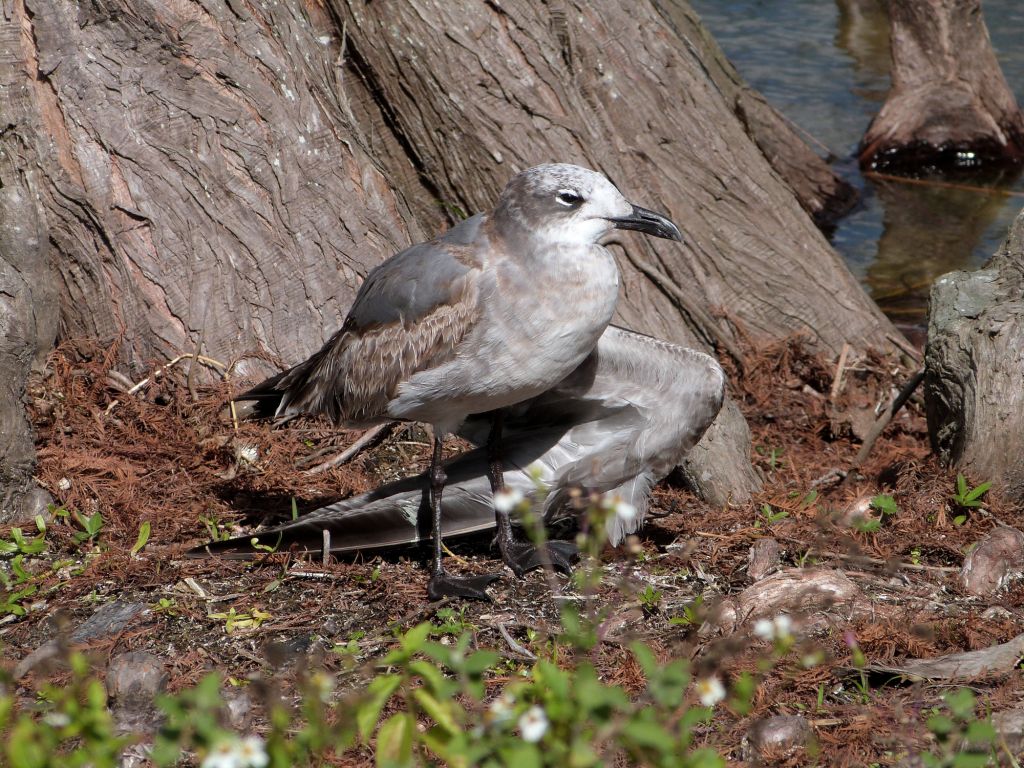
Laughing Gull Imm injured wing

Laughing Gull Imm injured wing

Are not two sparrows sold for a farthing? and one of them shall not fall on the ground without your Father. (Matthew 10:29 KJV)

Yesterday, Dan and I went to Lake Hollingsworth in Lakeland, FL for a little birdwatching and to just enjoy the day. It was around 77 degrees and a few clouds were hanging out. Just another beautiful day from the Lord. After walking as far as I could, we turned around and retraced our steps back along the southern shore of the lake.

My legs are doing much better, praise the Lord, but I still have issues. I stopped to rest a minute and spotted a Laughing Gull along the shore. Something in its appearance didn’t seem right, so I got up to investigate. (They have benchs along the way.) What I found was that the Gull had a wing hanging down and I assume it was broken. It appears to be an immature Laughing.

Laughing Gull Imm injured wing

Laughing Gull Imm injured wing

The bird walked up by the tree and kept dragging it’s wing as you can see in the third photo.

Laughing Gull Imm injured wing

Laughing Gull Imm injured wing

I know that verse has been many used times here with the Birds of the Bible articles, but it still applies so well. That verse popped into my thoughts while observing the Gull’s situation. The verse mentions the Sparrow, but all birds were created by the Lord and it applies to them as well. I do not believe that He is only aware of just Sparrows that fall. God is ever-present, all-knowing, and all-powerful, so how could God NOT KNOW?

We know that verse was used to encourage those being persecuted (v.23) to not fear, knowing that the Father is aware of what they were experiencing. They did not need to worry about someone who could destroy their soul. (v.28) The passage goes on to reassure them that they are more valuable than sparrows or birds.

Fear ye not therefore, ye are of more value than many sparrows. (Matthew 10:31 KJV)

Not sure if Gulls “worry.” but that immature bird was in a very precarious situation. Without that wing he (or she) was very vulnerable to what could happen to it. There was a Red-shouldered Hawk flying by and I believe that that might be the tree it landed in when we went by the first time. I was trying to get its photo, but it flew off. I didn’t notice the Gull then. When we noticed the bird on the way back, the Hawk was still flying in the area.

The Bible Knowledge Commentary says this about verse 31: “for their (the persecuted) Father was truly concerned for them and aware of their circumstances. He is aware of the death of a sparrow which is worth so little. Two sparrows were sold for a mere penny (assarion, a Gr. copper coin worth about 1/16 of a Roman denarius, a day’s wages). God the Father also knows the number of hairs on a person’s head (Mat_10:30). The apostles were instructed not to fear for they, being far more valuable to God than sparrows, were seen and known by Him. ”

Believer’s Bible Commentary: “10:30, 31 The same God who takes a personal interest in the tiny sparrow keeps an accurate count of the hairs of the head of each of His children. A strand of hair is of considerably less value than a sparrow. This shows that His people are of more value to Him than many sparrows, so why should they fear?”

Whosoever therefore shall confess me before men, him will I confess also before my Father which is in heaven. But whosoever shall deny me before men, him will I also deny before my Father which is in heaven. (Matthew 10:32-33 KJV)

We should not be afraid to tell others about the Saving Grace of the Lord Jesus Christ, nor that we believe that God is the Self-Existent, All-Knowing, All-Powerful, Ever-Present, Loving (He gave His Son to die for our sins.), Creator of the world and all these birds, critters, and us.

What will be the fate of the Laughing Gull? I have no clue, but God already knows all about its situation, but better yet, He knows all out us and our situations and circumstances. He cares and wants us to put our trust in Him.

Sharing The Gospel

And wisdom and knowledge shall be the stability of thy times, and strength of salvation: the fear of the LORD is his treasure. (Isaiah 33:6 KJV)

See more Birds of the Bible

*

Birds of the Bible – Robbing The Nest

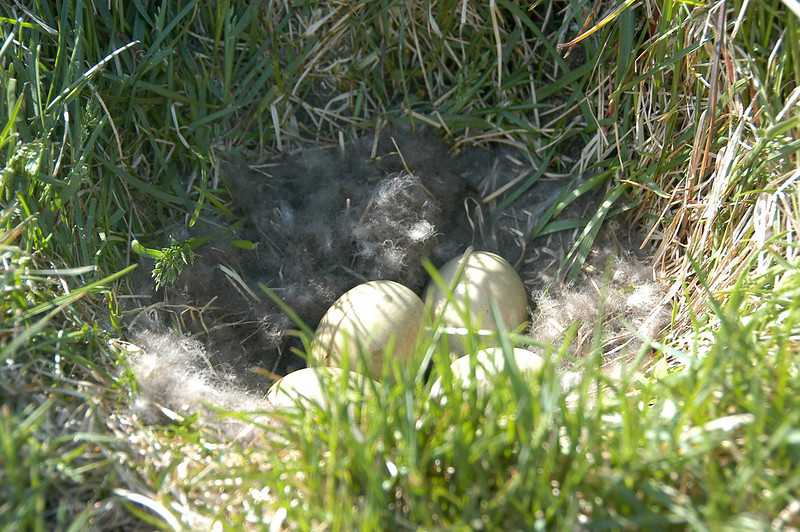
Common Eider (Somateria mollissima) nest by Bob-Nan

Common Eider (Somateria mollissima) nest by Bob-Nan

My hand has found like a nest the wealth of the peoples; and as one gathers eggs that have been forsaken, so I have gathered all the earth; and there was none that moved a wing or opened the mouth or chirped.” (Isaiah 10:14 ESV)

Now here is an interesting passage in Scripture. Came across it the other day in my reading. Hadn’t found it in my Bible searches with my e-Sword because no actual bird is mentioned.

Chapter 10 of Isaiah tells, by way of prophesy, how God was punishing Israel for their sins by using Assyria’s wrath as a tool.

Ah, Assyria, the rod of my anger; the staff in their hands is my fury! Against a godless nation I send him, and against the people of my wrath I command him, to take spoil and seize plunder, and to tread them down like the mire of the streets. (Isaiah 10:5-6 ESV)

Also stated “Are not my commanders all kings?” in verse 8 and “As my hand has reached to the kingdoms of the idols, whose carved images were greater than those of Jerusalem and Samaria, shall I not do to Jerusalem and her idols as I have done to Samaria and her images?” in 10 and 11.

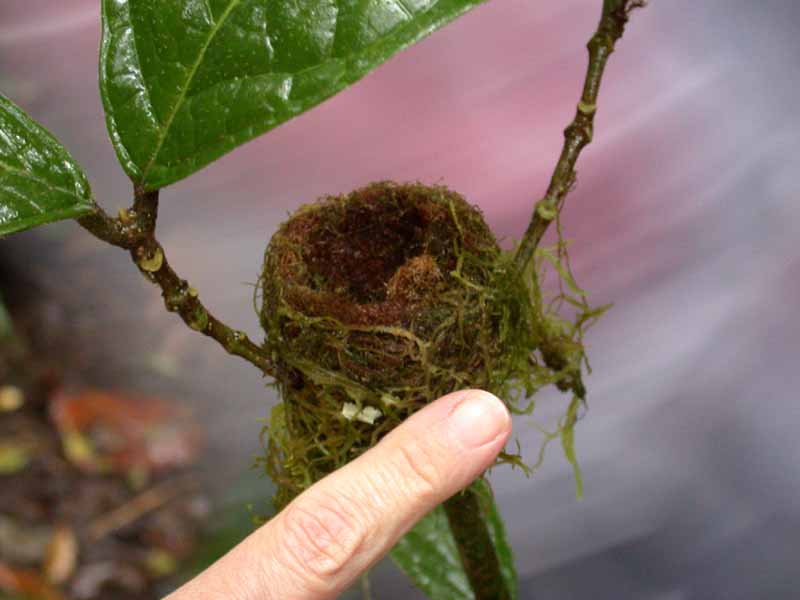
Hummingbird nest by Bob-Nan

So the Lord uses Assyria to punish Jerusalem, but the King becomes boastful and full of pride. He, the king of Assyria, states that he has done it, by his strength, and his wisdom, and plunders their treasures. (Isaiah 10-12-13)

Then the king makes the remark about robbing the nest of it’s eggs (the wealth and riches of the captured people) as easy as from a nest where the bird is not there to protect it.

“and there was none that moved a wing” is referring to how normally a bird would defend its nest and be flying about attacking the egg thief.

“opened the mouth or chirped.” Under normal conditions, the birds would be quite vocal if their nest was being robbed.

And I have put my hands on the wealth of the peoples, as on the place where a bird has put her eggs; and as a man may take the eggs from which a bird has gone, so I have taken all the earth for myself: and not a wing was moved, and not a mouth gave out a sound. (Isaiah 10:14 BBE)

Those two phrases would be like today if a country was attacked and no army came out to defend or the news media and governmental officials were not there making a vocal condemnation or complaints.

But the chapter goes on to state that the king, country, servant, or whomever, should not think they are the one doing the work, but realize they are being used by some power greater than their self.

Will the axe say high-sounding words against him who is using it, or the blade be full of pride against him who is cutting with it? As if a rod had the power of shaking him who is using it, or as if a stick might take up him who is not wood. (Isaiah 10:15 BBE)

The LORD had to punish the people of Jerusalem because if He didn’t get rid of the sin and idolatry, then the whole nation would have to be destroyed. Thankfully, there was a remnant that was to be saved. That remnant would eventually bring forth the Lord Jesus Christ, through the Davidic line when He came in bodily form.

Horned Lark (Eremophila alpestris) nest w eggs by Nikhil Devasar

Horned Lark (Eremophila alpestris) nest w eggs by Nikhil Devasar

What’s to be learned? Birds shouldn’t desert their nest? I think it goes deeper than that.

We should be careful of pride, arrogance, thinking more highly of our self than we should, etc. What we have and are comes from God. When things in our current history are not going the way we think it should, we have to realize that God is in control. Sometimes He uses bad things and people to accomplish His Will.

*

Birds of the Bible – Demoiselle Crane

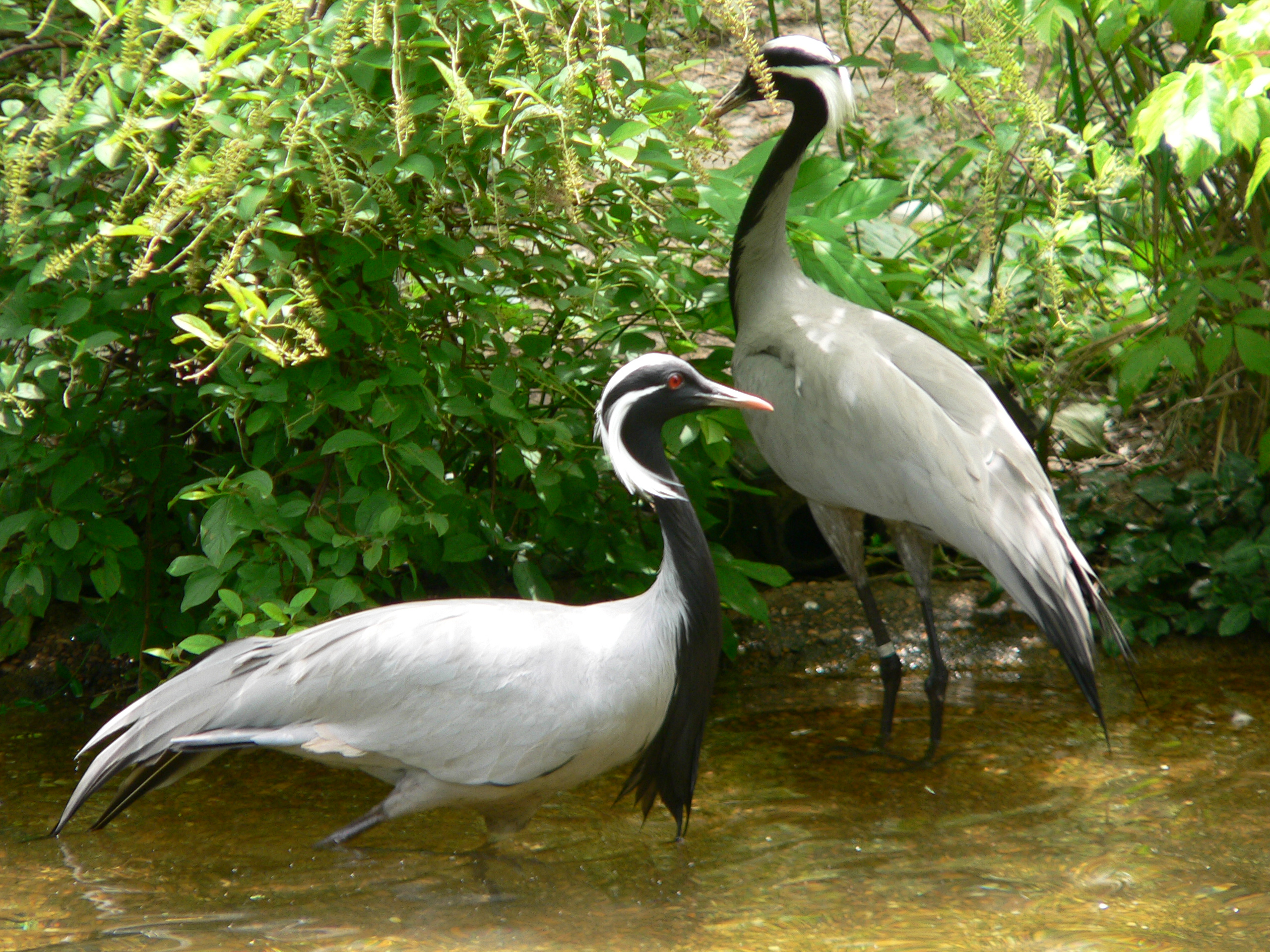
Demoiselle Crane (Grus virgo) by Lee LPZoo 12-28-2011

Demoiselle Crane (Grus virgo) by Lee LPZoo 12-28-2011

“The Demoiselle Crane (Anthropoides virgo), is a species of crane that breeds in Central Asia and winters in India, with a few found in Cyprus and eastern Turkey as well. The crane annually migrates to Africa and South Asia in winter. The bird is symbolically significant in the culture of North India and Pakistan, where it is known as the koonj.

It has a loud trumpeting call, higher-pitched than the Common Crane. Like other cranes it has a dancing display, more balletic than the Common Crane, with less leaping, but with calling, bowing and head-bobbing.

Call – Demoiselle Crane (Grus virgo) from Xeno-canto.org

Like a crane or a swallow, so did I chatter: I did mourn as a dove: mine eyes fail with looking upward: O LORD, I am oppressed; undertake for me. (Isaiah 38:14 KJV)

*

*
Demoiselle Cranes have to take one of the toughest migrations in the world. In late August through September, they gather in flocks of up to 400 individuals and prepare for their flight to their winter range. During their migratory flight south, Demoiselles fly like all cranes, with their head and neck straight forward and their feet and legs straight behind, reaching altitudes of 16,000-26,000 feet (4,875-7,925 m). Along their arduous journey they have to cross the Himalayan mountains to get to their over-wintering grounds in India, many die from fatigue, hunger and predation from birds such as eagles. Simpler, lower routes are possible, such as crossing the range via the Khyber Pass. However, their presently preferred route has been hard-wired by countless cycles of migration (placed in them by their creator). At their wintering grounds, Demoiselles have been observed flocking with Common Cranes, their combined totals reaching up to 20,000 individuals. Demoiselles maintain separate social groups within the larger flock. In March and April, they begin their long spring journey back to their northern nesting grounds.

In Khichan, Rajasthan in India, villagers feed the Cranes on their migration and these large congregations have become an annual spectacle.

Yea, the stork in the heaven knoweth her appointed times; and the turtle and the crane and the swallow observe the time of their coming; but my people know not the judgment of the LORD. (Jeremiah 8:7 KJV)

Watch this amazing video of them crossing the Himalayan mountains by AZPanorama:

*

When the Lord created the Crane kind, they were programmed for future variations like this Demoiselle Crane. They act like many other birds that pretend they are injured. This helps them lead the preying bird or animal away to protect their young. The Demoiselles also are the smallest cranes.  They have shorter toes and bills than other cranes which allows them to travel on ground that is hard and dry. The shorter bills aid in their choice of food. Their survival is being provided by their Designer and Creator.

Our verses:

Isaiah 38:14

Geneva Bible Translation Notes – I was so oppressed with sorrow, that I was not able to utter my words, but only to groan and sigh.

CC Commentary – 14.) – As a crane, or a swallow. Hezekiah cannot satisfy himself in explaining the severity of his anguish. He now says that he was reduced so low that he could not utter an articulate voice, but muttered some confused sound, like persons who are almost at the point of death. Hence it is evident that his distress was excruciating; for the severity of the pain took away his voice, and his voice, he says, stuck in his throat; nothing was heard but indistinct groans.
Such is the import of these metaphors of “the crane and the swallow,” which the Prophet employs. Still it is certain that this indistinct sound of the voice is nevertheless heard by God; though all our senses are oppressed by pain, and our throat is choked by grief, still God beholds our hearts and listens to godly sighs, which will be even more powerful than plain and direct words, provided that the Spirit is present, who produces in us those “groanings that cannot be uttered,” of which Paul speaks. (Rom_8:26.) There is no believer who does not feel that in prayer, when his heart is oppressed by any heavy sorrow, he either stammers or is almost dumb.

Bible Knowledge Commentary – b. Hezekiah’s song of thanksgiving (Isa_38:9-20)
(1) Hezekiah’s statement about his condition.
After he was healed Hezekiah wrote a song to express his thanks to God. His illness came, he said, in the prime of his life. Death was referred to figuratively as having gates through which a person entered (cf. Job_38:17; Psa_9:13; Psa_107:18). His statement that in death he would not… see the Lord does not mean he had no hope of heaven. It probably means that he would no longer have the benefit of enjoying God’s blessings in this life. He would be without friends (Isa_38:11) as his house (his body) was dismantled. By death he would be cut… off like a cloth being cut from a weaver’s loom. He had hoped he would get well (Isa_38:13) but he got worse (Isa_38:13-14). His illness was as if God were a lion breaking all his bones, a figure of speech depicting his deep inner anguish. In some way his cries of pain were like the sound of a bird and his mourning like the doleful sound of a dove (cf. Isa_59:11; Nah_2:7). Hezekiah realized that this experience should humble him because God had brought on this illness.

Demoiselle Crane (Grus virgo) Memphis Zoo by Dan

Demoiselle Crane (Grus virgo) Memphis Zoo by Dan

Jeremiah 8:7

Bible Believer’s Commentary – 8:1-7 – …Unlike those who fall and rise again, who sin and repent, Judah refused to return to Jehovah. As far as the law was concerned, the people compared unfavorably with the stork, the turtledove, the swift, and the swallow, which are obedient to their appointed laws of migration.

CC Commentary – Here again Jeremiah condemns the shameful insensibility of the people, — that they had less wisdom than birds, not endued with reason and understanding. He then says, that the Jews were more foolish than cranes, swallows, and storks. He no doubt deeply wounded the feelings of the people by so severe a reproof; but it was necessary thus sharply to reprehend the despisers of God; for it appears evident by these words, that they were become exceedingly hardened in their vices. No wonder, then, that the Prophet declares that they were more silly than cranes and swallows.

Kelly Commentary – Moreover, the prophet was to remonstrate with the people of Jerusalem on their perpetual and unrepentant backsliding (Ver. 4-6), more heedless than familiar birds, great or small, which attend to their fit times, yet with all assumption of wisdom. (Ver. 7, 8.) But what wisdom is in those who reject the word of the Lord? Their covetousness and perfidious neglect of the true interests of Israel must meet with due retribution at His hands.

Geneva Bible Translation Notes – He accuses them in that they are more ignorant of God’s judgments, than these birds are of their appointed seasons to discern the cold and heat.

Adam Clarke’s Commentary – The stork in the heaven – The birds of passage know the times of their going and return, and punctually observe them; they obey the dictates of nature, but my people do not obey my law.

P.S. I have to share an incident that happened while I was teaching 4th grade in a Christian School. On a Friday, I had forgotten to write up the weekly Bible Quiz so I quickly put 5 Essay Questions on the board. We had been discussing King Hezekiah that week so one of the questions was “Tell me about King Hezekiah.” Well, while grading the papers, I almost fell out of my chair laughing. One of my students had told all about how he had been sick and that the Lord had – (here’s the verse – “Isaiah 38:8 Behold, I will bring again the shadow of the degrees, which is gone down in the sun dial of Ahaz, ten degrees backward. So the sun returned ten degrees, by which degrees it was gone down.”). My student went on to say that because the sun dial went back an hour, “that is why we now have Daylight Savings time.” Oh, the pleasures of teaching!

The Crane Family, Gruidaes, has 15 species. They are one of 6 families in the Gruiformes (Cranes, Rails, Coots and allies) Order.

See:

Birds of the Bible – Cranes

Birds of the Bible – Cranes I

Birds of the Bible – Cranes II

Gruidae – Cranes

Sharing the Gospel

*


Birds of the Bible – Eagles and Riches

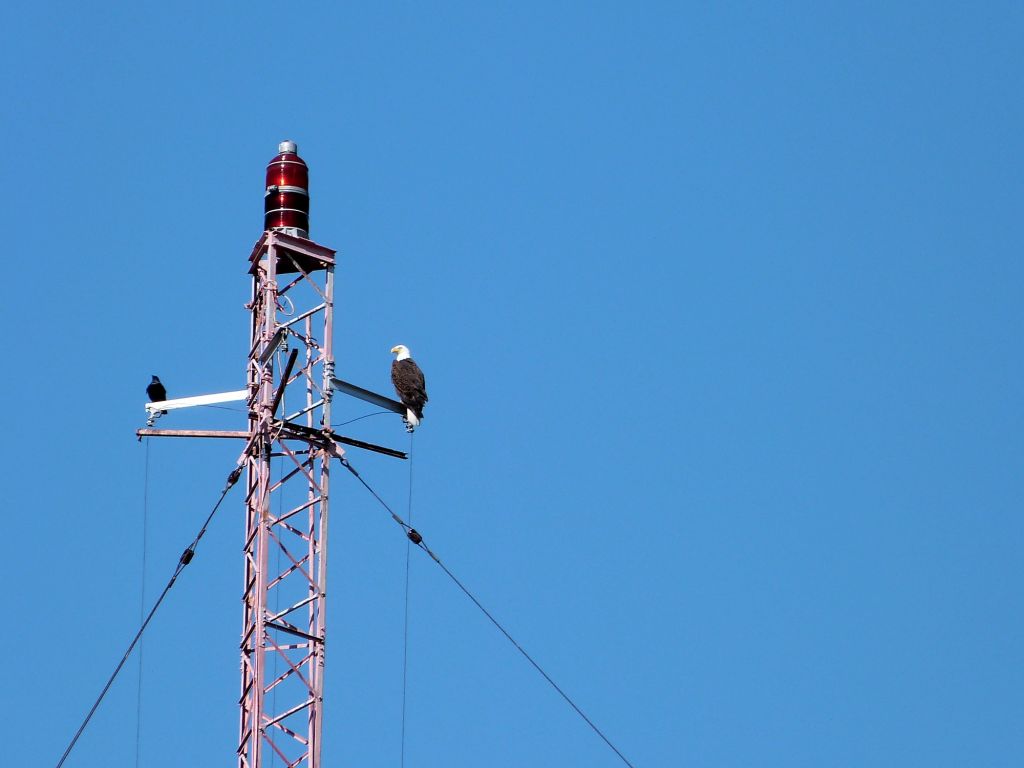
Bald Eagle on tower at S Lake Howard NPk 1 by Lee

Bald Eagle on tower at S Lake Howard NPk 1 by Lee

Labour not to be rich: cease from thine own wisdom. Wilt thou set thine eyes upon that which is not? for riches certainly make themselves wings; they fly away as an eagle toward heaven. (Proverbs 23:4-5 KJV)

While reading in Proverbs today, I came across this interesting verse in Chapter 23. As I have been reading through Proverbs, the terms “wisdom,” “fear” and “knowledge” are mentioned quite often. Verses like “The fear of the LORD is the beginning of knowledge: but fools despise wisdom and instruction. (Proverbs 1:7); For that they hated knowledge, and did not choose the fear of the LORD: (Proverbs 1:29); The fear of the LORD is the beginning of wisdom: and the knowledge of the holy is understanding. (Proverbs 9:10); By humility and the fear of the LORD are riches, and honour, and life.” (Proverbs 22:4 ); Receive my instruction, and not silver; and knowledge rather than choice gold. (Proverbs 8:10); For wisdom is better than rubies; and all the things that may be desired are not to be compared to it. (Proverbs 8:11) and many others.

Bald Eagle on tower at S Lake Howard NPk 2 by Lee

Bald Eagle on tower at S Lake Howard NPk 2 by Lee (See him?)

So when I came across this verse and the Eagle was mentioned, I decided to see what I could find out about it and share it here. Plus, we were out birdwatching a little this week as I checked out my new Christmas gift of a camera. Captured the Bald Eagle sitting on the tower at South Lake Howard Nature Park. He was a long way away, but you can tell it is an Eagle. Also, it appears for this verse that is exactly what happens to riches when they are not received properly and with the right attitude. They end up like that Eagle, way out of reach. There is nothing wrong with being rich, if it is obtained in the proper manner. If the Lord chooses to let your wealth increase, Praise the Lord, if not, be content with the blessings He gives you.

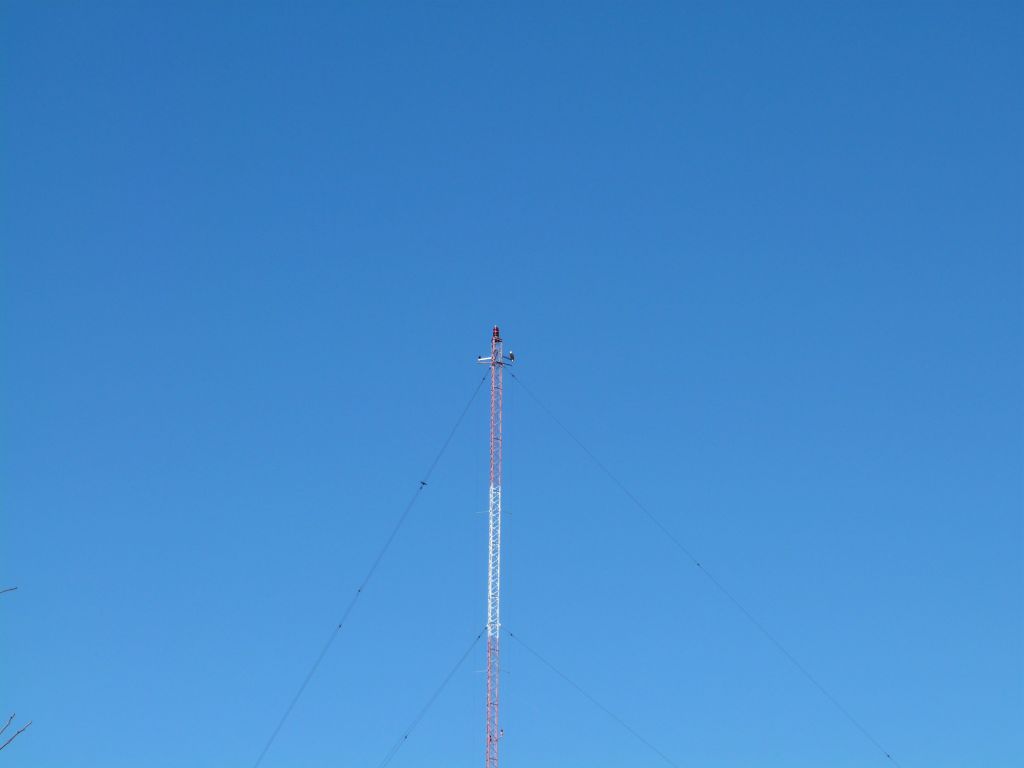
Bald Eagle on tower at S Lake Howard NPk 3 by Lee

Bald Eagle on tower at S Lake Howard NPk 3 by Lee (How about now?)

Here are some of the comments from various commentaries:

Bible Knowledge Commentary – “The 7th saying. These verses warn against overwork for the sake of gaining riches. This speaks not against being industrious but against consuming oneself for money. Wise restraint in this area (as well as in what one eats at a banquet, Pro_23:1-2) is needed, especially in the present day when materialism drives many people to excessive work loads in order to accumulate more money. The reason for this advice is that riches are temporary and unstable (cf. Pro_27:24). The first part of Pro_23:5 is literally, “If you cause your eyes to fly after it” (i.e., wealth). Ironically, flying after wealth results in wealth flying away like an eagle.”

Matthew Poole’s Commentary – “They fly away as an eagle, swiftly, strongly, and irrevocably. We quickly lose the sight and possession of them. Their flying away from us is elegantly opposed to our eyes being set, or, as it is in the Hebrew, flying upon them, in the beginning of the verse.”

Believer’s Bible Commentary – “23:4, 5 The ceaseless struggle to be rich is a form of “wisdom” to be avoided. It means that you are spending your life pursuing false values and putting your trust in what doesn’t last. Riches have a way of sprouting wings and flying away like an eagle.”

John Gill’s Exposition– “for riches certainly make themselves wings; or, “it in making makes itself wings” (x); even that which is not, on which men cause their eyes to fly; no sooner are their eyes upon that, but that flies away from them like a bird with wings; see Hos_9:11. Either men are taken from that, or that from them, and sometimes very swiftly and suddenly;

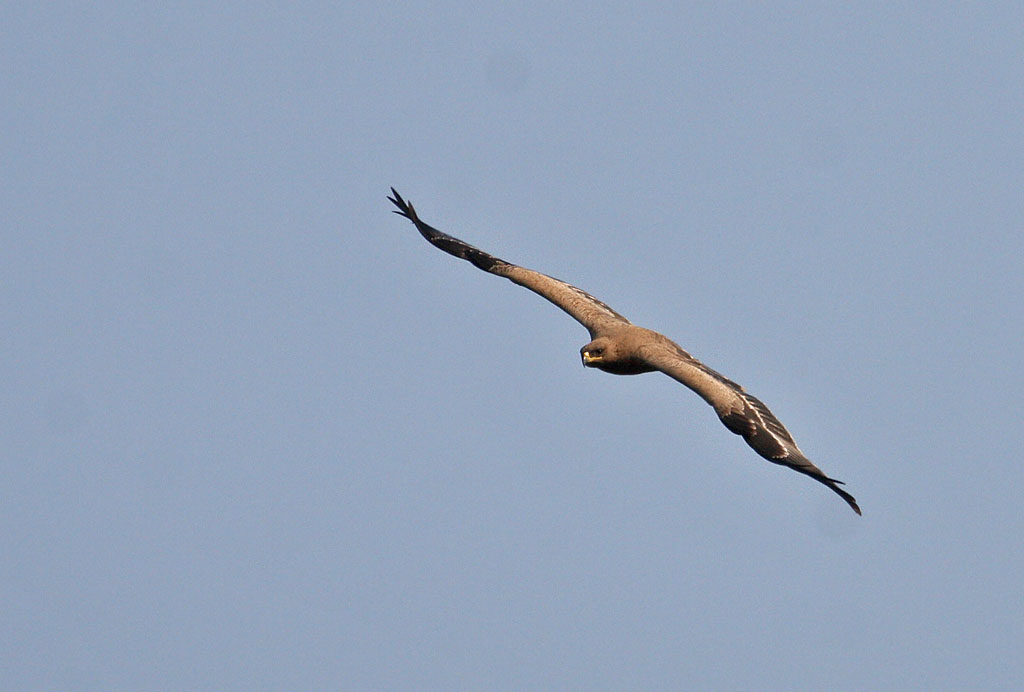
Steppe Eagle (Aquila nipalensis) by Peter Ericsson

Steppe Eagle (Aquila nipalensis) by Peter Ericsson

they fly away as an eagle towards heaven; the eagle flies very swiftly, none more swiftly; it flies towards heaven, out of sight, and out of reach, and out of call; so riches flee away to God, the original giver of them, from whence they came, and who is the sole disposer of them; they own him as the proprietor and distributor of them; and they flee to heaven as it were for fresh orders where they should be, and into whose hands they should come next; they flee away, so as not to be seen any more, and be recovered by those who have formerly enjoyed them.”

Through the Bible with J Vernon McGee – Proverbs 23:4-5 – “You have probably noticed that the United States dollar has an eagle on it. Believe me, that eagle will fly away if you’re not careful with it. I find that the eagles on my dollars take off all the time. We cannot depend on riches.
The whole thought here is this: There is nothing wrong in being rich. There is nothing wrong in working to be rich. However, don’t make that the goal in life. Wealth should not be the very object of our hearts. Some men have a lust, a thirst, a covetousness to make the almighty dollar, and the dollar becomes their god. A child of God is not to do that.
A wealthy man told me, “I do not make money for the sake of money. I make money for what it can do. At first I made money for what it could do for me. Now I make money for what it can do for God.” There is nothing wrong in a man becoming wealthy. The wrong comes when there is the overweening desire of the heart for money. That is covetousness; actually it is modern idolatry.
In the United States we do not find people bowing down to worship idols. However, we do find people busily engaging their whole lives in the worship of the almighty dollar. When I pastored a church in the downtown financial district of Los Angeles, I found that men, even including some Christian men, were far more zealous in coming down early on a Monday morning to watch the stock market open than they were on Sunday morning to attend church service. I met such a man rushing to the stock market display at the brokerage on a Monday morning. He met me, greeted me cordially, and told me what he was going to do. I mentioned to him that we had been missing him at church. He said, “Well, you know, I haven’t been feeling very well.” That is interesting. He didn’t feel well enough to come to church, but he was well enough to worship his god very early on a Monday morning. That’s covetousness, and that is what the proverb is talking about. That is a false god, and that false god is an eagle that will fly away at any moment.”

P.S. I really like my new camera and the 24X zoom. I had no idea that Dan was getting me a camera for Christmas. Thanks, Dan! (He is still the photographer, I still use a point-and-shoot on program mode.) All photos can be clicked on to enlarge them. I kept zooming in so you could see how far away the Eagle really was.

*

Birds of the Bible – Who Speaks To Birds?

Cockatiel (Nymphicus hollandicus) Brevard Zoo by Lee

Cockatiel (Nymphicus hollandicus) Brevard Zoo by Lee

I am sure many of us have been near a Parrot or one of that family and have tried to talk to it. Right? We say “Hello!” or whistle, hoping that the bird will repeat us. There are plenty of bird species that will mimic words and sounds. (one example – Repeating Birds) How many times in Scripture are the birds spoken to and by whom? Let’s find out.

Pulling out my e-Sword Bible program and using the search feature, here is what I discovered.

1. God spoke to the birds or fowls
2. Man was told to speak to them twice
3. An Angel will speak to them

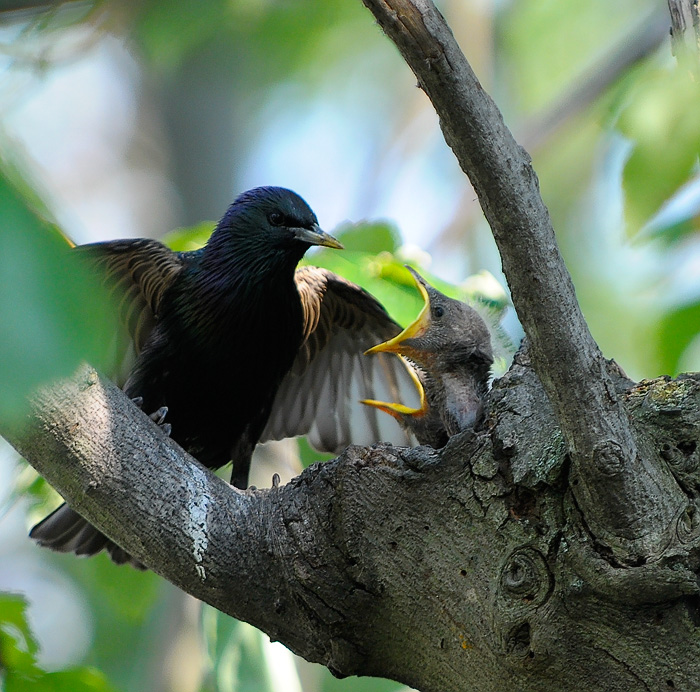
Starling feeding chicks

Protection at the nest by Anthony

God said for the birds to come into being (He Created or Formed them) in Genesis 1:20-21. Then in verse 22 we read:

And God blessed them, saying, Be fruitful, and multiply, and fill the waters in the seas, and let fowl multiply in the earth. (Genesis 1:22 KJV)

or

God blessed all the living things in the sea and told them to have many babies and fill the seas. And he blessed the birds on land and told them to have many more babies. (Genesis 1:22 ERV)

In all the translations I have loaded (around 30) it is either “saying” or “told.” After the Lord God created them then He told them to be frutful and multiply. They listened. Today there are 10,466 species (IOC) in the world living. Many more have become extinct.

Red-bellied Woodpecker (Melanerpes carolinus) by J Fenton

Red-bellied Woodpecker (Melanerpes carolinus) by J Fenton

In Job 12:7 They (men) were told by God to ask beasts and birds and they would instruct them.

But ask now the beasts, and they shall teach thee; and the fowls of the air, and they shall tell thee: (Job 12:7 KJV)

or

“But ask the beasts, and they will teach you; the birds of the heavens, and they will tell you;
(Job 12:7 ESV)

John Wesley’s Elanatory Notes – “Job 12:7
But – If thou observest the beasts, and their properties and actions, and events, from them thou mayst learn this lesson: that which Zophar had uttered with so much pomp and gravity, (Job 11:7-9), concerning God’s infinite wisdom, saith Job, thou needest not go into heaven or hell to know. but thou mayst learn it even from the beasts.”

Peregrine Falcon (Falco peregrinus) by Ray

Peregrine Falcon (Falco peregrinus) by Ray

Again in Ezekiel 39 you can read of Ezekiel being told by the Lord GOD to “Speak to the birds” and give them a message.

“As for you, son of man, thus says the Lord GOD: Speak to the birds of every sort and to all beasts of the field, ‘Assemble and come, gather from all around to the sacrificial feast that I am preparing for you, a great sacrificial feast on the mountains of Israel, and you shall eat flesh and drink blood. You shall eat the flesh of the mighty, and drink the blood of the princes of the earth–of rams, of lambs, and of he-goats, of bulls, all of them fat beasts of Bashan. And you shall eat fat till you are filled, and drink blood till you are drunk, at the sacrificial feast that I am preparing for you. And you shall be filled at my table with horses and charioteers, with mighty men and all kinds of warriors,’ declares the Lord GOD. (Ezekiel 39:17-20 ESV)

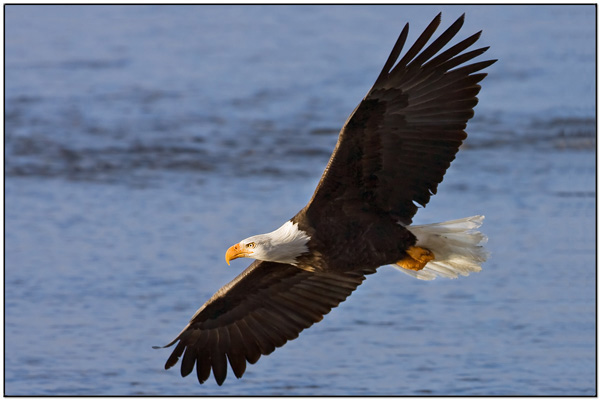
Bald Eagle flying by Dave's BirdingPix

Bald Eagle flying by Dave’s BirdingPix

The third incident of birds being spoken to happens in Revelations 19. John is describing what he sees in heaven (future). Again they are being invited to a feast. Both times it is not the kind of feast we would desire to be attending. Both times the “feast” is part of judgment from God.

And I saw an angel standing in the sun; and he cried with a loud voice, saying to all the fowls that fly in the midst of heaven, Come and gather yourselves together unto the supper of the great God; That ye may eat the flesh of kings, and the flesh of captains, and the flesh of mighty men, and the flesh of horses, and of them that sit on them, and the flesh of all men, both free and bond, both small and great. (Revelation 19:17-18 KJV)

Heaven here is referring to where the birds fly now. Not heaven as in our future home. The different version say this:

birds flying in mid-heaven (midheaven) (ACV, ABP, ASV, Darby,LITV, MKJV, NASB, RV, YLT)
fly in the middle of heaven (AKJV, KJV)
birds flying in midair (GNB)
fly through the midst of heaven (DRB, EMTV, ERV, NKJV, Webster)
birds that fly(or flying) across the sky (AMP, CEV, WNT)
the birds in flight in the heavens (BBE)
birds that fly directly overhead (ESV,GW, ISV, LEB)

There may be other times when someone spoke to birds, but for now, it wasn’t found by me.

See also:

Birds of the Bible – Repeating Birds

Birds of the Bible – Birds of Every Sort

Interesting Things – Lyre Bird

Gospel Message

*

Birds of the Bible – Pied Peacock and Allies

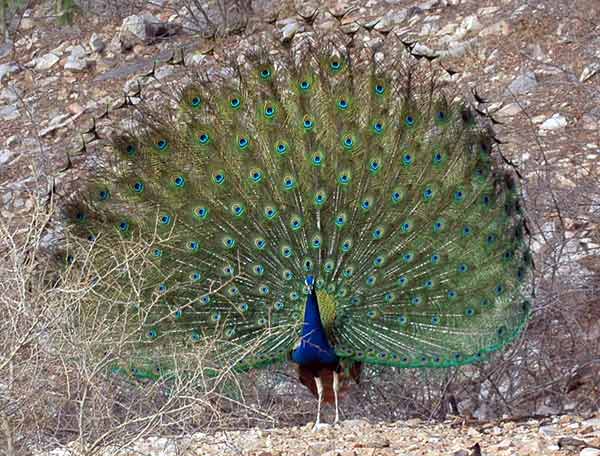
Indian Peafowl (Pavo cristatus) by Nikhil Devasar

Indian Peafowl (Pavo cristatus) by Nikhil

We wrote about Peacocks before in Birds of the Bible – Peacocks, dated April of 2008. This is about the Pied Peacock which is from the jungles of India and Sri Lanka. When Solomon sent for them to be delivered, they were brought by a joint navy of Hiram and the navy of Tharshish.

For the king had at sea a navy of Tharshish with the navy of Hiram: once in three years came the navy of Tharshish, bringing gold, and silver, ivory, and apes, and peacocks. (1 Kings 10:22 KJV) For the king’s ships went to Tarshish with the servants of Huram: every three years once came the ships of Tarshish bringing gold, and silver, ivory, and apes, and peacocks. (2 Chronicles 9:21 KJV)

I received a notice by “bellamoonnature” of a video he made of the Pied Peacock. Decided to share it and bring the peacock article a little more up to date. It is about a Pied Peacock. For more information on how that comes about see India Blue Pied. It is a mutation, but still it is a neat looking Peacock or Peafowl.

Here is his video:

I love the little immature male trying to practice his tail display. He has a way to go before his tail reaches the beauty of the mature male. This peacocks beautiful display goes right along with God’s question to Job.

Gavest thou the goodly wings unto the peacocks? or wings and feathers unto the ostrich? (Job 39:13 KJV)

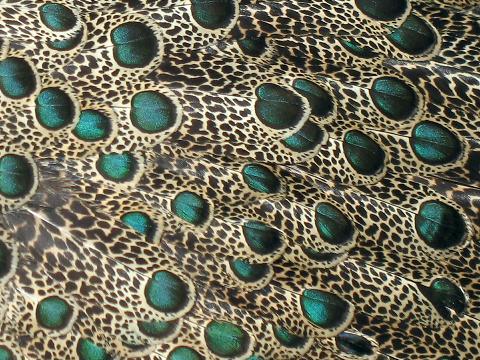
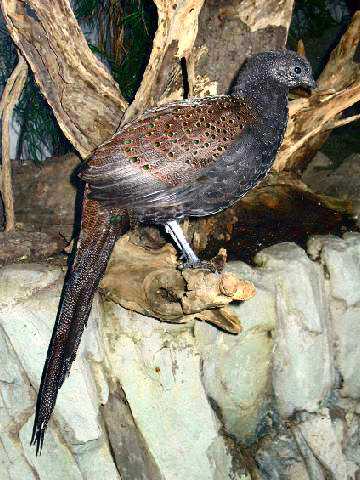
Malayan Peacock-Pheasant (Polyplectron malacense) Feathers ©WikiC

Malayan Peacock-Pheasant (Polyplectron malacense) Feathers ©WikiC

Peacocks and Peafowls are part of the Phasianidae – Pheasants, Fowls & Allies Family which are in the Galliformes Order. There are three Genus in the Pheasants, Fowls & Allies Family that have what we refer to as “Peacocks.”

Palawan Peacock-Pheasant (Polyplectron napoleonis) M ©WikiC

Palawan Peacock-Pheasant (Polyplectron napoleonis) M ©WikiC

The Polyplectron genus is the peacock-pheasants. “The peacock-pheasants are a bird genus, Polyplectron, of the family Phasianidae, consisting of eight species. They are colored inconspicuously, relying on heavily on crypsis to avoid detection. When threatened, peacock-pheasants will alter their shapes utilising specialised plumage that when expanded reveals numerous iridescent orbs. The birds also vibrate their plume quills further accentuating their aposematism (Warning colourataton or signal). Peacock-pheasants exhibit well developed metatarsal spurs. Older individuals may have multiple spurs on each leg. These kicking thorns are used in self-defense.” (Wikipedia)

Polyplectron

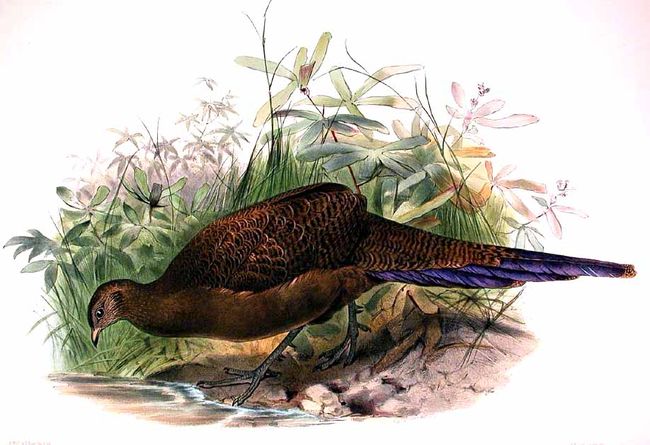
Bronze-tailed Peacock-Pheasant (Polyplectron chalcurum) Drawing ©WikiC – Photo
____ (Polyplectron chalcurum scutulatum)
____ (Polyplectron chalcurum chalcurum)
Mountain Peacock-Pheasant (Polyplectron inopinatum) ©WikiC
Germain’s Peacock-Pheasant (Polyplectron germaini) ©WikiC
Grey Peacock-Pheasant (Polyplectron bicalcaratum) ©WikiC
____ (Polyplectron bicalcaratum bakeri)
____ (Polyplectron bicalcaratum bicalcaratum)
____ (Polyplectron bicalcaratum ghigii)
Hainan Peacock-Pheasant (Polyplectron katsumatae)
Malayan Peacock-Pheasant (Polyplectron malacense) ©WikiC
Bornean Peacock-Pheasant (Polyplectron schleiermacheri) Video IBC
Palawan Peacock-Pheasant (Polyplectron napoleonis) ©WikiC

Indian Peafowl (Pavocristatus) by Nikhil Devasar

Indian Peafowl (Pavocristatus) by Nikhil Devasar

“Peafowl are two Asiatic species of flying birds in the genus Pavo of the pheasant family, Phasianidae, best known for the male’s extravagant eye-spotted tail, which it displays as part of courtship. The male is called a peacock, the female a peahen, and the offspring peachicks. The adult female peafowl is grey and/or brown. Peachicks can be between yellow and a tawny colour with darker brown patches. The male (peacock) Indian Peafowl has iridescent blue-green or green coloured plumage.

The peacock tail (“train”) is not the tail quill feathers but the highly elongated upper tail coverts. The “eyes” are best seen when the peacock fans its tail. Like a cupped hand behind the ear the erect tail-fan of the male helps direct sound to the ears. Both species have a crest atop the head.

The female (peahen) Indian Peafowl has a mixture of dull green, brown, and grey in her plumage. She lacks the long upper tail coverts of the male but has a crest. The female can also display her plumage to ward off female competition or signal danger to her young.

Green Peafowl (Pavo muticus) by Ian

Green Peafowl (Pavo muticus) by Ian

A male Green Peafowl The Green Peafowl appears different from the Indian Peafowl. The male has green and gold plumage and has an erect crest. The wings are black with a sheen of blue. Unlike the Indian Peafowl, the Green Peahen is similar to the male, only having shorter upper tail coverts and less iridescence. It is difficult to tell a juvenile male from an adult female.

As with many birds, vibrant plumage colours are not primarily pigments, but optical interference Bragg reflections, based on regular, periodic nanostructures of the barbules (fiber-like components) of the feathers. Slight changes to the spacing result in different colours. Brown feathers are a mixture of red and blue: one colour is created by the periodic structure, and the other is a created by a Fabry–Pérot interference peak from reflections from the outer and inner boundaries. Such interference-based structural colour is important for the peacock’s iridescent hues that change and shimmer with viewing angle, since unlike pigments, interference effects depend on light angle. Colour mutations exist through selective breeding, such as the leucistic White Peafowl and the Black-Shouldered Peafowl.”(Wikipedia)

Pavo

Indian Peafowl (Pavo cristatus) by Nikhil Devasar
Green Peafowl (Pavo muticus) by Ian
____ (Pavo muticus spicifer)
____ (Pavo muticus imperator) IBC
____ (Pavo muticus muticus) IBC

Congo Peacock (Afropavo congensis) Head ©WikiC

Congo Peacock (Afropavo congensis) Head ©WikiC

“The Congo Peafowl (Afropavo congensis) is a species of peafowl. It is the only member of the monotypic genus Afropavo. The male is a large bird of up to 70 cm (28 in) in length. Its feathers are deep blue with a metallic green and violet tinge. It has bare red neck skin, grey feet, and a black tail with fourteen feathers. Its head is adorned with vertical white elongated hair-like feathers on its crown. The female is generally a chestnut brown bird with a black abdomen, metallic green back, and a short chestnut brown crest. Both sexes resemble immature Asian Peafowl, with early stuffed birds being erroneously classified as such before they were officially discovered as a unique species. It inhabits and is endemic to lowland rainforests of Congo River Basin in the central part of the Democratic Republic of the Congo.

The diet consists mainly of fruits and invertebrates. The male has a similar display to other peacocks, fanning its tail in this case, while other peacocks fan their upper tail coverts. The male Congo Peafowl is monogamous, though information from the wild is needed. Very little is known about this species.” (Wikipedia)

Afropavo

Congo Peacock (Afropavo congensis) ©WikiC

See Also:

Birds of the Bible

Birds of the Bible – Peacocks

Birds of the World 

Phasianidae – Pheasants, Fowl & Allies

*

Birds of the Bible – Griffon Vulture

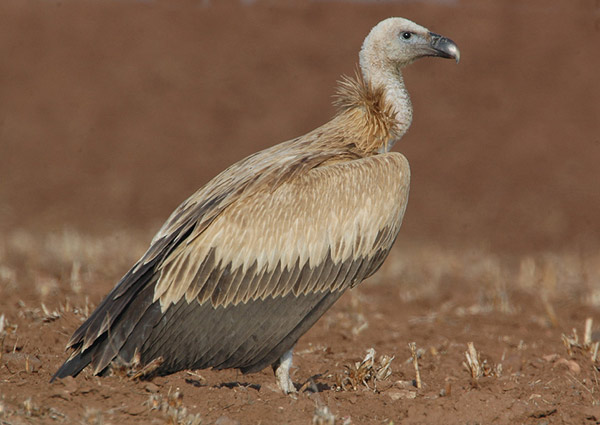
Griffon Vulture (Gyps fulvus) by Nikhil Devasar

Griffon Vulture (Gyps fulvus) by Nikhil Devasar

Of birds these are they which you must not eat, and which are to be avoided by you: The eagle, and the griffon, and the osprey. (Leviticus 11:13 DRB)

The unclean eat not: to wit, the eagle, and the grype, and the osprey, (Deuteronomy 14:12 DRB)

While looking through the list of clean and unclean birds in Leviticus 11 and Deuteronomy 14 to see if I could find a bird to write about, I found the two verses above in the DRB (1899 Douay-Rheims Bible). It is not a Bible I use other than comparing verses. Most of the other versions call it a vulture, ossifrage, gier-eagle, bearded or black vulture, buzzard and a few other things. The KJV calls it the ossifrage and the NKJV the vulture. What caught my eye was the grype. When I looked it up, the Griffon and the “gyps” genus were tied together. So, here is a little about the Griffon Vulture and the Gyps genus.

The Griffon Vulture (Gyps fulvus) is a large Old World vulture in the bird of prey family Accipitridae.

The Griffon Vulture is 93–110 cm (37–43 in) long with a 2.3–2.8 m (7.5–9.2 ft) wingspan. In the nominate race the males weigh 6.2 to 10.5 kg (14 to 23 lb) and females typically weigh 6.5 to 11.3 kg (14 to 25 lb), while in the Indian subspecies (G. f. fulvescens) the vultures average 7.1 kg (16 lb). Extreme adult weights have been reported from 4.5 to 15 kg (9.9 to 33 lb), the latter likely a weight attained in captivity. Hatched naked, it is a typical Old World vulture in appearance, with a very white head, very broad wings and short tail feathers. It has a white neck ruff and yellow bill. The buff body and wing coverts contrast with the dark flight feathers.

Griffon Vulture (Gyps fulvus) Dieren Park Amersfoort -adult and chick WikiC

Griffon Vulture (Gyps fulvus) Dieren Park Amersfoort -adult and chick WikiC

Like other vultures, it is a scavenger, feeding mostly from carcasses of dead animals which it finds by soaring over open areas, often moving in flocks. It grunts and hisses at roosts or when feeding on carrion.

The maximum lifespan recorded for the Griffon Vulture is 41.4 years, for a specimen in captivity. It breeds on crags in mountains in southern Europe, north Africa, and Asia, laying one egg. Griffon Vultures may form loose colonies. The population is mostly resident.

White-backed Vulture (Gyps africanus) by Bob-Nan

White-backed Vulture (Gyps africanus) by Bob-Nan

There are 8 species in the Gyps genus. The Griffon being one of them. They are Old World vultures in the bird family Accipitridae, which also includes eagles, kites, buzzards and hawks.

These are the typical vultures, with bald head, broad wings and mainly dark plumage. They are large scavenging birds, feeding mostly from carcasses of dead animals. Old World vultures find carcasses exclusively by sight. Representatives of this group are found throughout warmer parts of the Old World.

The characteristic featherless head is because a feathered head would become spattered with blood and other fluids, and thus be difficult to keep clean.

These are the members of the Gyps genus:

Gyps

White-backed Vulture (Gyps africanus) by Africaddict – Video
White-rumped Vulture (Gyps bengalensis) by Nikhil Devasar – Video
Indian Vulture (Gyps indicus) by Nikhil – Video
Slender-billed Vulture (Gyps tenuirostris) Drawing ©WikiC
Rüppell’s Vulture (Gyps rueppellii) ©WikiC – Video IBC
____ (Gyps rueppellii rueppellii) IBC
____ (Gyps rueppellii erlangeri)
Himalayan Vulture (Gyps himalayensis) Imm by Nikhil
Griffon Vulture (Gyps fulvus) by Nikhil – Video IBC
____ (Gyps fulvus fulvus) IBC
____ (Gyps fulvus fulvescens) OBI
Cape Vulture (Gyps coprotheres) ©WikiC

Vultures are of course mentioned several times throughout Scripture:

There shall the great owl make her nest, and lay, and hatch, and gather under her shadow: there shall the vultures also be gathered, every one with her mate. (Isaiah 34:15 KJV)

There is a path which no fowl knoweth, and which the vulture’s eye hath not seen: (Job 28:7 KJV)

See other Birds of the Bible Pages:

Birds of the Bible – Vulture

Birds of the Bible

(Various internet sources including Wikipedia)

*

Birds of the Bible – As the Bird…So Are We

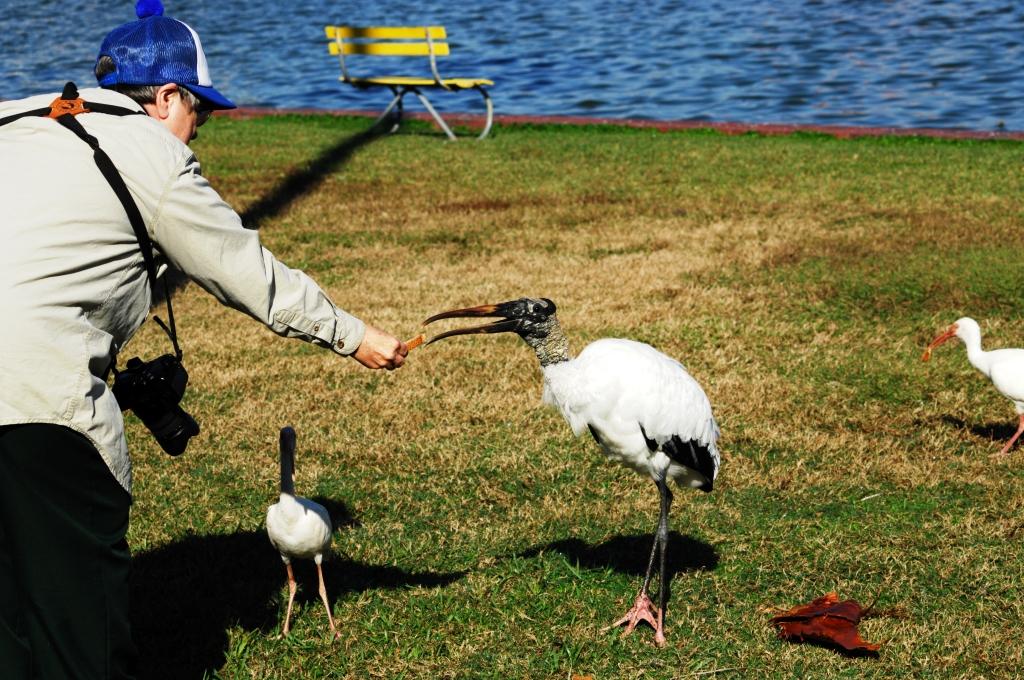
Lee feeding Wood Stork at Lake Morton by Dan Jan 2011

Lee feeding Wood Stork at Lake Morton by Dan Jan 2011

While watching the birds at my feeders and reflecting on what I had just read in my devotions, I started thinking about how the truths of God’s Word applies to the birds and to me. There are differences of course, but there are many similarities. Those are the ones this article is about.

To begin, we are both created. The Lord created the birds and He created humans. We both have bodies and spirits, but humans were given a soul and were created in His Image.

So God created great sea creatures and every living thing that moves, with which the waters abounded, according to their kind, and every winged bird according to its kind. And God saw that it was good. (Genesis 1:21 NKJV)

Then God said, “Let Us make man in Our image, according to Our likeness; let them have dominion over the fish of the sea, over the birds of the air, and over the cattle, over all the earth and over every creeping thing that creeps on the earth.” So God created man in His own image; in the image of God He created him; male and female He created them. (Genesis 1:26-27 NKJV)

There is a difference between us:

All flesh is not the same flesh, but there is one kind of flesh of men, another flesh of animals, another of fish, and another of birds. (1 Corinthians 15:39 NKJV)

Bush Stone-curlew (Burhinus grallarius) with young by Ian

Bush Stone-curlew (Burhinus grallarius) with young by Ian

Then the Lord commanded them to be “Be fruitful and multiply, and fill.” Both were told to reproduce with the difference being that man was given dominion over the critters.

And God blessed them, saying, “Be fruitful and multiply, and fill the waters in the seas, and let birds multiply on the earth.” So the evening and the morning were the fifth day. …And God saw that it was good.(Genesis 1:22-23, 25 NKJV)

Then God blessed them, and God said to them, “Be fruitful and multiply; fill the earth and subdue it; have dominion over the fish of the sea, over the birds of the air, and over every living thing that moves on the earth.” (Genesis 1:28 NKJV)

Cedar Waxwing Eating by Steve Slayton

Cedar Waxwing Eating by Steve Slayton

God gave both the birds and man (humans) every green herb to eat.

And God said, “See, I have given you every herb that yields seed which is on the face of all the earth, and every tree whose fruit yields seed; to you it shall be for food. Also, to every beast of the earth, to every bird of the air, and to everything that creeps on the earth, in which there is life, I have given every green herb for food“; and it was so. (Genesis 1:29-30 NKJV)

Swallow Tanager (Tersina viridis) by Dario Sanches

Swallow Tanager (Tersina viridis) by Dario Sanches

We were both created “very good.”

Then God saw everything that He had made, and indeed it was very good. So the evening and the morning were the sixth day. (Genesis 1:31 NKJV)

Then Adam and Eve disobeyed God and both the birds and myself were placed under a curse. Neither of us enjoy the fellowship and peace that was there in the Garden of Eden. My personal belief is that the animals and birds were very tame, that Adam could call or speak to them and they would come without hesitation. But now, they are afraid of us, and we (humans) need a Savior. (The Gospel Message)

And the fear of you and the dread of you shall be on every beast of the earth, on every bird of the air, on all that move on the earth, and on all the fish of the sea. They are given into your hand. (Genesis 9:2 NKJV)

We all belong to the Lord:

I know all the birds of the mountains, And the wild beasts of the field are Mine. “If I were hungry, I would not tell you; For the world is Mine, and all its fullness. (Psalms 50:11-12 NKJV)

Western Great Egret (Ardea alba) With Fish by AestheticPhotos

Western Great Egret (Ardea alba) With Fish by AestheticPhotos

We and the birds are provided for:

“Therefore I say to you, do not worry about your life, what you will eat or what you will drink; nor about your body, what you will put on. Is not life more than food and the body more than clothing? Look at the birds of the air, for they neither sow nor reap nor gather into barns; yet your heavenly Father feeds them. Are you not of more value than they? (Matthew 6:25-26 NKJV)

God has given each kind of bird different beaks, feet, appetites, habitats, and places to dwell. The Lord has given those of us who have accepted Him as Savior different abilities, gifts, talents, places to live (like missionaries) and jobs to do. He has given both a variety that makes them and us very interesting to behold.

There are more things that could be mentioned, but for now, Praise the Lord that He cares about both the birds and us!

*

Birds of the Bible – Bird Egg Facts

Common Ostrich (Struthio camelus) by Bob-Nan

Common Ostrich (Struthio camelus) by Bob-Nan

Eggs

Gavest thou the goodly wings unto the peacocks? or wings and feathers unto the ostrich? Which leaveth her eggs in the earth, and warmeth them in dust, And forgetteth that the foot may crush them, or that the wild beast may break them. (Job 39:13-15 KJV)

The largest bird egg is from the Ostrich Sturthio camelus. The egg measures 15 – 20 cm long, 10 – 15 cm in diameter and weighs 1 – 1.78 kg.
Largest egg ~ Ostrich  ~ measuring 17.8 by 14 cm (7 by 4.5 in)
Smallest egg laid relative to body weight ~ Ostrich egg ~ at 1.5%

Ostrich Egg ©WikiC

Ostrich Egg ©WikiC

An ostrich egg needs to be boiled for 2 hours to get a hard-boiled egg.

Can that which is unsavoury be eaten without salt? or is there any taste in the white of an egg? (Job 6:6 KJV)

Thinking

Largest Egg – living ~ Ostrich
Largest Egg – ever ~ Elephant Bird Aepyornis maximus From Madagascar 39cm/15.4in long = 12 litres/2.6 gallons, 220 chicken eggs, egg weighed 27 pounds.

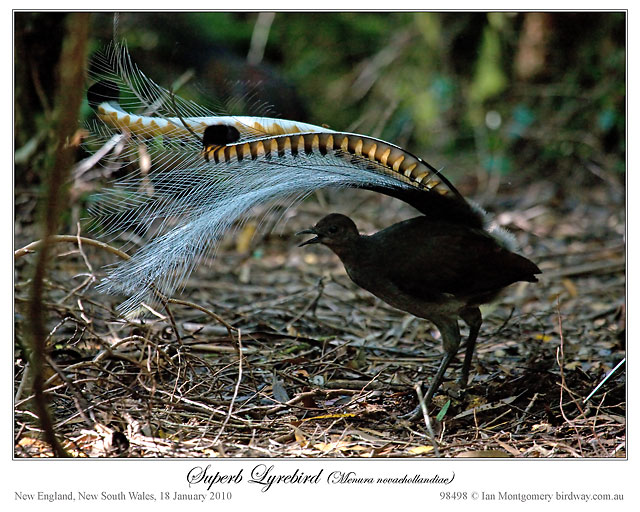
Superb Lyrebird (Menura novaehollandiae) by Ian

Superb Lyrebird (Menura novaehollandiae) by Ian

Largest egg laid by a passerine ~ 5 7 g (2 oz) by Australian Lyrebirds
Largest egg laid relative to body weight ~ Little Spotted Kiwi at 26%

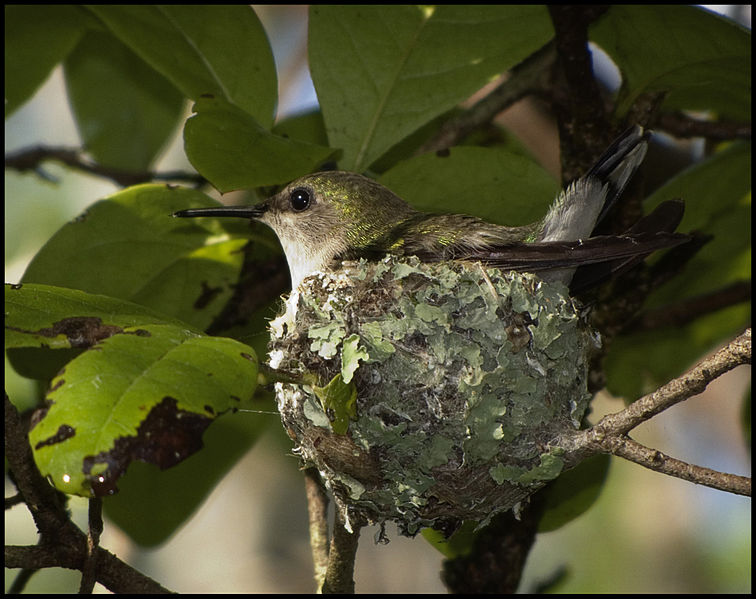
Vervain Hummingbird (Mellisuga minima) ©WikiC

Vervain Hummingbird (Mellisuga minima) ©WikiC

Smallest known egg ~ the Vervain Hummingbird Mellisuga minima of Jamacia and nearby islets. The egg is barely the size of a pea and measures less than 10 mm in length and weighs 0.356 g.
You could put 4700 bee hummingbird eggs inside one ostrich egg. The Bee Hummingbird egg is the size of a small pea and weighs .02 ounces. World’s Smallest Bird
Smallest egg ~ West Indian Vervain Hummingbird ~ at 10 mm (0.39 in) in length and 0.375 g (0.0132 oz)
Smallest Egg – living ~ Vervain Hummingbird Mellisuga minima ~ the size of pea

Or if he shall ask an egg, will he offer him a scorpion? If ye then, being evil, know how to give good gifts unto your children: how much more shall your heavenly Father give the Holy Spirit to them that ask him? (Luke 11:12-13 KJV)

Shape

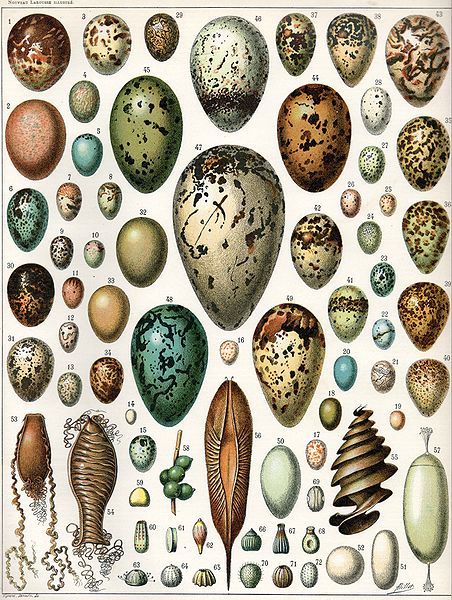
Different Eggs- Birds and Others - from Wikipedia

Different Eggs- Birds and Others – from Wikipedia

The majority of avian eggs match the shape of chicken eggs, but there are some exceptions.

  • Budgies, for instance, tend to lay very round eggs.
  • Fast-flying, stream-lined birds like swifts and swallows lay long, elliptical eggs.
  • Owls tend to lay very spherical eggs.
  • Roundest eggs ~ Owls, Tinamous
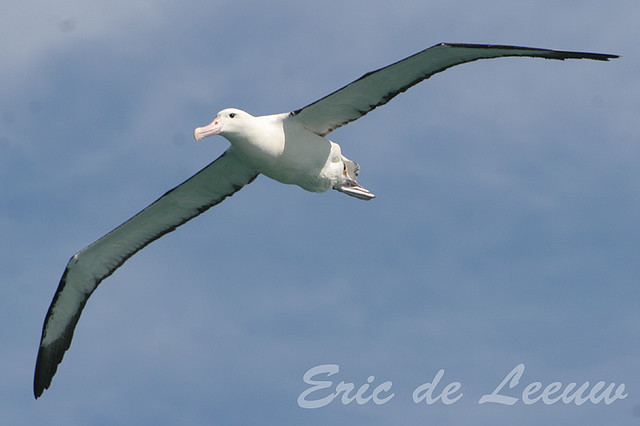
Northern Royal Albatross (Diomedea sanfordi) ©©Flickr

Northern Royal Albatross (Diomedea sanfordi) ©©Flickr

The Royal Albatross’ eggs take 79 days to hatch.
Precocial birds like chickens, ostriches, ducks, and seagulls hatch ready to move around. They come from eggs with bigger yolks than altricial birds like owls, woodpeckers, and most small songbirds that need a lot of care from parents in order to survive.

Maleo (Macrocephalon maleo) egg ©©Wong Dermayu

Maleo (Macrocephalon maleo) egg ©©Wong Dermayu

Longest interval between eggs laid ~ Maleo ~ at 1012 day intervals

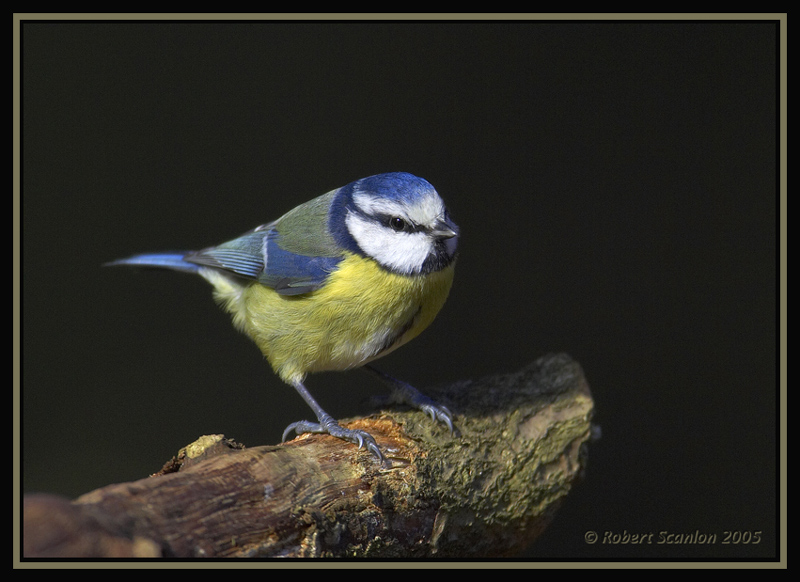
Eurasian Blue Tit (Cyanistes caeruleus) by Robert Scanlon by Robert Scanlon

Eurasian Blue Tit (Cyanistes caeruleus) by Robert Scanlon by Robert Scanlon

Largest clutch laid by a nidicolous species ~ 19 eggs laid by a European Blue Tit
Largest clutch laid by a nidifugous species ~ 28 by a Bobwhite Quail
Largest average clutch size ~ 15-19 by a Gray Partridge
Smallest clutch size ~ 1 egg laid every 2 years by Albatrosses

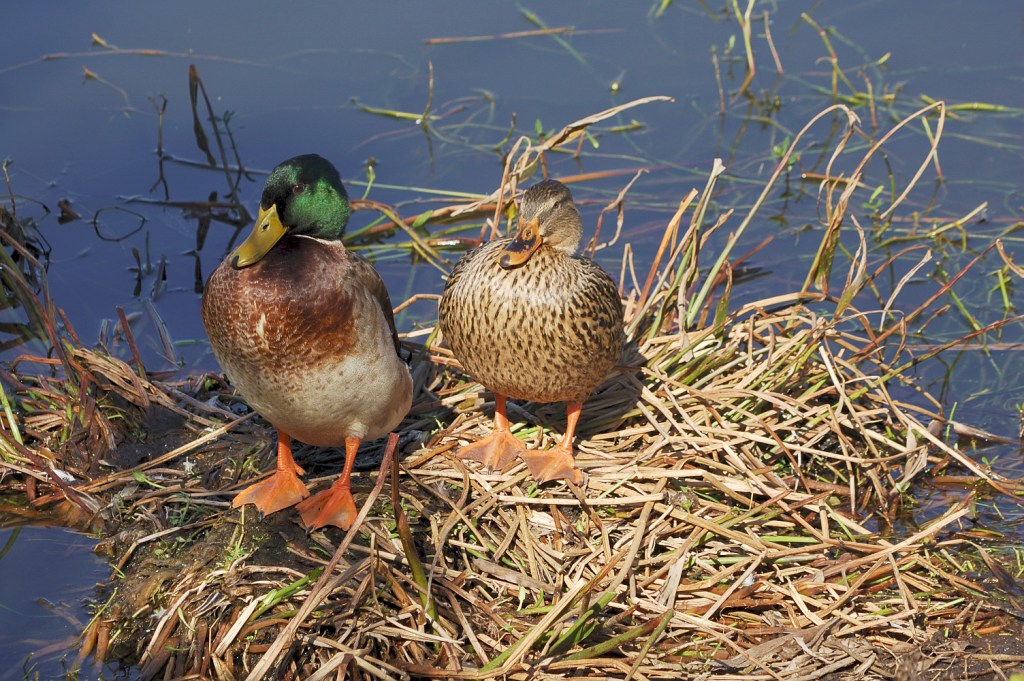
Mallard (Anas platyrhynchos) By Dan'sPix

Mallard (Anas platyrhynchos) By Dan’sPix at Lake Hollingsworth

Greatest number of eggs laid consecutively ~ 146 by a Mallard
Most valuable bird ~ 8 billion domestic chickens ~ produce 562 billion eggs annually
Highest price paid for an egg ~ 1,000 British pounds for an egg of extinct Aepyornis maximus

And my hand hath found as a nest the riches of the people: and as one gathereth eggs that are left, have I gathered all the earth; and there was none that moved the wing, or opened the mouth, or peeped. (Isaiah 10:14 KJV)

Shell

Bird eggshells are diverse. For example:

  • Cormorant eggs are rough and chalky
  • Tinamou eggs are shiny
  • Duck eggs are oily and waterproof
  • Cassowary eggs are heavily pitted

Tiny pores in bird eggshells allow the embryo to breathe. The domestic hen’s egg has around 7500 pores.

The most yolks ever found in a single chicken’s egg is nine.

Nests

Mallee Fowl Mound ©©

Largest individual nest ~ Mallee Fowl Australia Leipoa ocellata ~ builds a mound 5 m (16.5ft) high and 11 metres (36ft) wide. A mound this size means the bird moved 250 cubic metres of vegetation and 300 tons of soil.
Smallest nest ~

  • many seabirds do not make a nest at all, nest on ground or
  • in case of Fairy Tern on a branch of a tree
  • The prize goes to the Hummingbirds for their thimble sized (1cm squared) nests.

The largest nest was built by a pair of Bald Eagles Haliaeetus leucocephalus was 2.9 m wide and 6 m deep.

Rhinoceros Auklet (Cerorhinca monocerata) ©WikiC

Rhinoceros Auklet (Cerorhinca monocerata) ©WikiC

The Rhinoceros Auklet Cerorhinca monocerata which measures 35 cm and nests on islands in the North Pacific excavates a burrow of 2 – 3 m in length. Burrows up to 6 m are not uncommon and 8 m burrows have also been found.

The only species of parrot that builds a nest is the Quaker Parrot. The Quakers link their nests together to form structures akin to “bird condominiums”. These nests can reach weights greater than 200 lbs.

Largest recorded nesting bird colony: 136 million Passenger Pigeon nesting in an area in Wisconsin covering 1,942 sq km (750 sq mi)

Isn’t it amazing how the Lord created each bird’s egg to help it survive and for it to do His command to:

And God blessed them, saying, “Be fruitful and multiply, and fill the waters in the seas, and let birds multiply on the earth.” (Genesis 1:22 NKJV)

(Various internet resources used and Wikipedia)

See Also:

Formed By Him – Bird Eggs
Macrocephalon Maleo – The Mute Missionary…
When I Consider – Guillemot
Egg And Nest Identification
Bird Eggs Photo Search
Hummingbird Nest & Eggs

*

Birds of the Bible – Peregrine Falcon and Goshawk

Peregrine Falcon (Falco peregrinus) by Ray

Peregrine Falcon (Falco peregrinus) by Ray

And these you shall regard as an abomination among the birds; they shall not be eaten, they are an abomination: the eagle, the vulture, the buzzard, the kite, and the falcon after its kind; every raven after its kind, the ostrich, the short-eared owl, the sea gull, and the hawk after its kind; (Leviticus 11:13-16 NKJV)

Here is a short video about the Peregrine Falcon and the Goshawk. It shows the speed and maneuverability of these fantastic birds. Thought you might enjoy watching it.

“Tiny spy cameras allow you to see some of the world’s most magnificent birds in flight. Watch this video to learn how the fastest bird on the planet, the peregrine falcon, keeps control at mind-numbing speeds, and take a flight with the master of manoeuvrability, the Gos Hawk, as it flies through dense woodland. Great animal video from BBC wildlife show Animal Camera, with music by Gregory Paul. By 
*

*
The Peregrine belongs to the Falconiformes Order. “The Peregrine Falcon (Falco peregrinus), also known as the Peregrine, and historically as the Duck Hawk in North America, is a widespread bird of prey in the family Falconidae. A large, crow-sized falcon, it has a blue-gray back, barred white underparts, and a black head and “moustache”. Typical of bird-eating raptors, Peregrine Falcons are sexually dimorphic, with females being considerably larger than males. The Peregrine is renowned for its speed, reaching over 325 km/h (210 mph) during its characteristic hunting stoop, making it the fastest member of the animal kingdom.
The Peregrine’s breeding range includes land regions from the Arctic tundra to the tropics. It can be found nearly everywhere on Earth, except extreme polar regions, very high mountains, and most tropical rainforests; the only major ice-free landmass from which it is entirely absent is New Zealand. This makes it the world’s most widespread bird of prey.
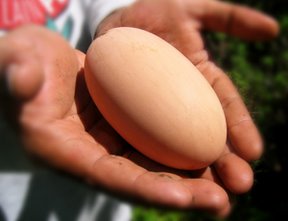
While its diet consists almost exclusively of medium-sized birds, the Peregrine will occasionally hunt small mammals, small reptiles, or even insects. Reaching sexual maturity at one year, it mates for life and nests in a scrape, normally on cliff edges or, in recent times, on tall human-made structures.” (Wikipedia)

Northern Goshawk (Accipiter gentilis) ©USFWS

Northern Goshawk (Accipiter gentilis) ©USFWS

and the red kite, the falcon, and the kite in their kinds, and every raven in its kind, and the ostrich, the owl, the sea gull, and the hawk in their kinds, (Deuteronomy 14:13-15 NASB)

The Goshawk belongs to the Accipitriformes Order of Kites, Hawks and Eagles. “The Northern Goshawk (Accipiter gentilis), /ˈɡɒs.hɔːk/ (Old English: gōsheafoc, “goose-hawk”), is a medium-large bird of prey in the family Accipitridae, which also includes other diurnal raptors, such as eagles, buzzards and harriers.

It is a widespread species that inhabits the temperate parts of the northern hemisphere. In Europe and North America, where there is only one goshawk, it is often referred to (officially and unofficially, respectively) as simply the “Goshawk”. It is mainly resident, but birds from colder regions migrate south for the winter. In North America, migratory goshawks are often seen migrating south along mountain ridge tops in September and October.

This species hunts birds and mammals in a variety of woodland habitats, often utilizing a combination of speed and obstructing cover to ambush birds and mammals. Goshawks are often seen flying along adjoining habitat types, such as the edge of a forest and meadow; flying low and fast hoping to surprise unsuspecting prey. They are usually opportunistic predators, as are most birds of prey.” (Wikipedia)

These are just two of the birds of prey that the Lord created. What speed and agility He gave them. Unfortunately, because of the curse, they use those traits to attack and eat other birds and small mammals.

See Birds of the Bible

Birds of the Bible – Falcons

Birds of the Bible – Hawks

Wordless Birds

*

Birds of the Bible – Repeating Birds

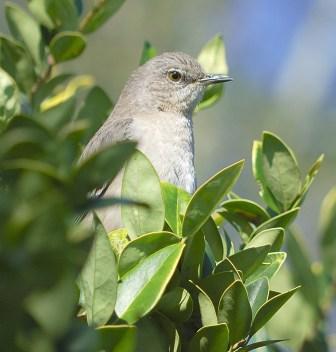
Northern Mockingbird (Mimus polyglottos) by Dan

Northern Mockingbird (Mimus polyglottos) by Dan

Curse not the king, no not in thy thought; and curse not the rich in thy bedchamber: for a bird of the air shall carry the voice, and that which hath wings shall tell the matter. (Ecclesiastes 10:20 KJV)

Talking birds! Is it possible? Solomon wrote about it in Ecclesiastes while telling people not to curse the king, even in your bedroom. Are there birds who could tell your words? First lets look at the words of Scripture in just that part of the verse. Again, I have used my e-Sword Bible program and a few other printed versions.

(ACV) For a bird of the heavens shall carry the voice, and that which has wings shall tell the matter.
(ABP+) For a winged creature of heaven shall carry your voice, and the one having the wings shall report your word.
(AKJV) for a bird of the air shall carry the voice, and that which has wings shall tell the matter.
(AMP) for a bird of the air will carry the voice, and a wing creature will tell the matter.
(ASV) for a bird of the heavens shall carry the voice, and that which hath wings shall tell the matter.
(BBE)  because a bird of the air will take the voice, and that which has wings will give news of it.
(Bishops) (10:19)  for a byrde of the ayre shall betray thy voyce, and with her fethers shall she bewray thy wordes.
(Brenton)  for a bird of the air shall carry thy voice, and that which has wings shall report thy speech.
(CEV) A little bird might hear and tell everything.
(Darby)  for the bird of the air will carry the voice, and that which hath wings will tell the matter.
(DRB)  because even the birds of the air will carry thy voice, and he that hath wings will tell what thou hast said.
(ERV) A little bird might fly and tell them everything you said.
(ESV)  for a bird of the air will carry your voice, or some winged creature tell the matter.

Superb Lyrebird (Menura novaehollandiae) by Ian

Superb Lyrebird (Menura novaehollandiae) by Ian

(Geneva)  for the foule of the heauen shall carie the voice, & that which hath wings, shall declare the matter.
(GNB) A bird might carry the message and tell them what you said.
(GW)  A bird may carry your words, or some winged creature may repeat what you say.
(ISV) For a bird will fly by and tell what you say, or something with wings may talk about it.
(JPS) for a bird of the air shall carry the voice, and that which hath wings shall tell the matter.
(KJV)for a bird of the air shall carry the voice, and that which hath wings shall tell the matter.
(KJV-1611) for a bird of the aire shall carry the voyce, and that which hath wings shall tell the matter.
(LITV)  for a bird of the heavens may carry the voice; yea, the lord of wings may tell the matter.
(MKJV) for a bird of the air shall carry the voice, and that which has wings shall tell the matter.
(NASB)  for a bird of the heavens will carry the sound and the winged creature will make the matter known.
(NIV) because a bird of the air may carry your words, and a bird on the wing may report what you say.
(NKJV) For a bird of the air may carry your voice, And a bird in flight may tell the matter.
(RV) for a bird of the air shall carry the voice, and that which hath wings shall tell the matter.
(Webster)for a bird of the air will carry the voice, and that which hath wings will tell the matter.
(YLT) For a fowl of the heavens causeth the voice to go, And a possessor of wings declareth the word.

Talking birds are birds that can mimic human speech. Talking birds have varying degrees of intelligence and communication capabilities: some, like the crow, a highly intelligent bird, are only able to mimic a few words and phrases, whilst some budgerigars have been observed to have a vocabulary of almost two thousand words. The Hill Myna is a commonly kept pet, well known for its talking ability – whilst its relative, the European Starling, is also adept at mimicry. Wild cockatoos in Australia have been reported to have learned human speech from ex-captive birds that have integrated into the flock. (See the Article – Wikipedia)

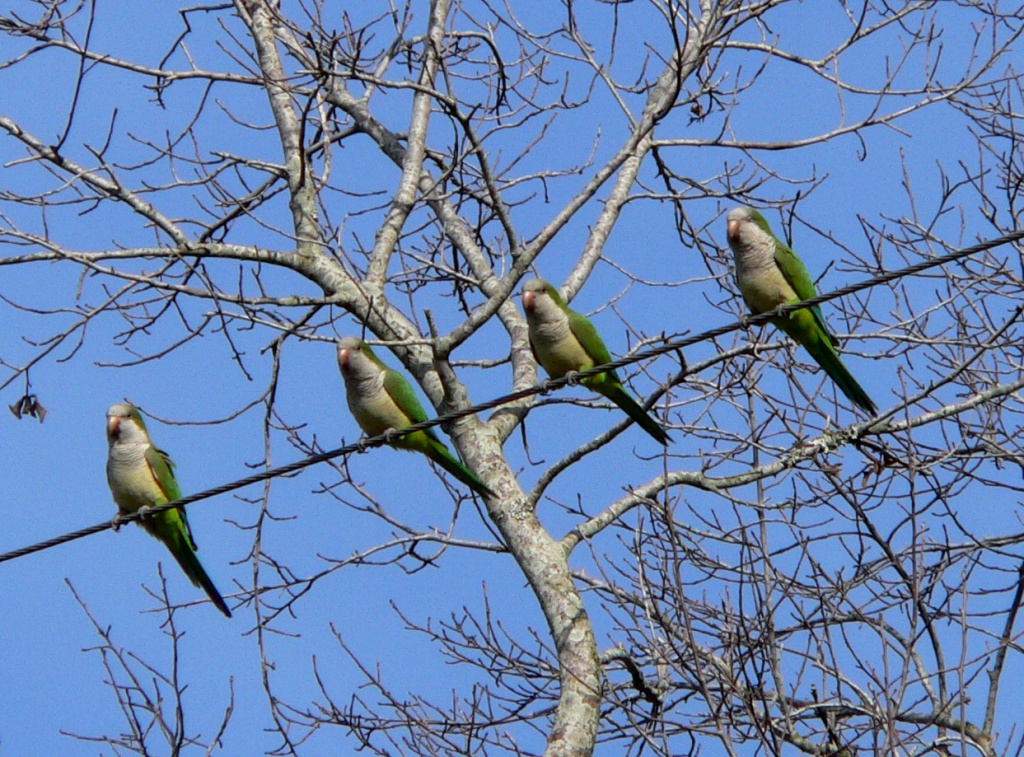
Monk Parakeets at S Lake Howard Nature Park by Lee

Monk Parakeets at S Lake Howard Nature Park by Lee

Dan and I had a Monk Parakeet that talked. Once Hoppi began to talk, he picked up everything you said. He even learned to call our dog, having heard us calling for him. Our dog would even look his way and head toward Hoppi when he called. Praise the Lord we are Christians, because that bird would repeat our conversations. I doubt he knew what he was saying, other than associating words with actions, but Hoppi did repeat what you had said.

*

From the article in Wikipedia:

In 1995 a budgerigar named Puck was credited by Guinness World Records as having the largest vocabulary of any bird, at 1,728 words.

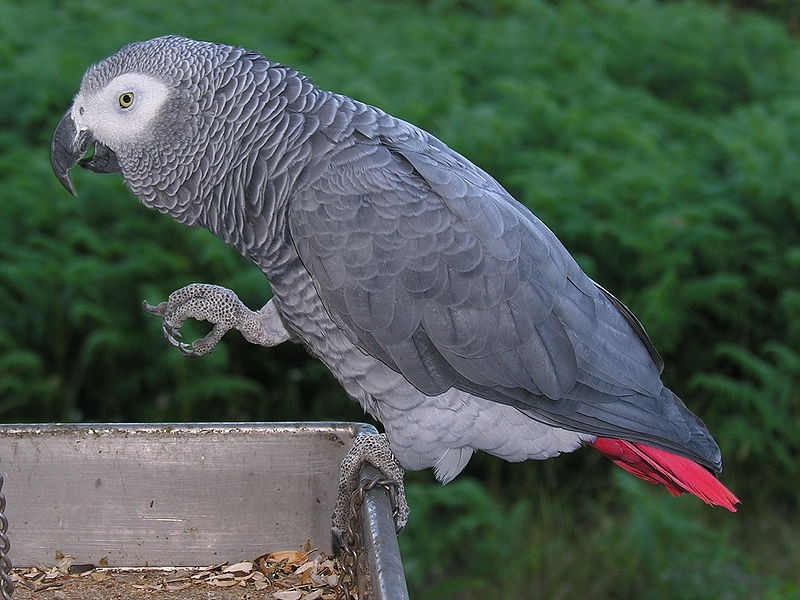
Grey Parrot (Psittacus erithacus) ©WikiC

Grey Parrot (Psittacus erithacus) ©WikiC

The African Grey Parrots are particularly noted for their cognitive abilities. Some of the most notable African Grey Parrots are Alex, Prudle, N’kisi and a new rising star, Einstein.
Alex had a vocabulary of about 100 words, but he was one of the most famous birds because of his cognitive abilities. In 2005, World Science reported that Alex understood the concept of zero. Alex died on September 6, 2007.
Prudle held the Guinness world record for bird with biggest vocabulary for many years with a documented vocabulary of 800 words.
N’kisi is noted for his impressive English usage skills and other abilities. As of January 2004, he had a documented vocabulary of 950 words and shows signs of a sense of humor. N’kisi is believed to be one of the most advanced users of human language in the animal world.
Einstein appeared on many television shows and became famous for her ability to recreate sounds as well as voice. Video clips show her making the sound of a laser beam and an evil laugh. She has been trained by Stephanie White.
African Grey Sparky is popular on YouTube for copying one liners from the sitcom Still Game in a broad Scottish accent.
Bibi, a Congo African Grey Parrot, is best known for her ability to use greetings from 20 different languages, earning her the nickname “The Polyglot Parrot.” At only three years of age, Bibi has already developed a vocabulary of about 300 words, and she understands the concepts of color and shape.

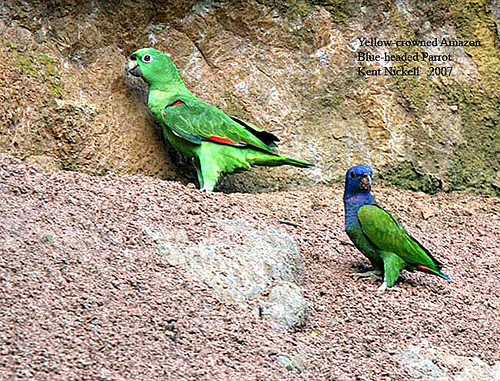
Yellow-crowned Amazon, Blue-headed Parrot by Kent Nickell

Yellow-crowned Amazon, Blue-headed Parrot by Kent Nickell

Amazon parrots – Many species of Amazona (particularly the yellow-head variety) are outstanding talkers. Yellow-napes, Double Yellow-headed, Yellow-crowned, and Panama Amazons are highly regarded as talking parrots.
Other parrots – Most parrot species are capable of imitating human words. Many can learn to use phrases in context; they can also be trained to imitate any words. Monk Parakeets (also known as Quaker parrots) are also reputed to be skilled talkers.
Hill Mynas – Hill Mynas are renowned for their ability to mimic the human voice. Many have claimed that the Hill Myna is the best talking bird and the best mimic in the world.
Lyrebird, ability to mimic natural and artificial sounds from their environment
Mockingbird, ability to mimic natural and artificial sounds from their environment
Passerine – Songbirds

Sounds like we need to watch what we say, not only about the king, but everyone. Even if the birds don’t hear us, the Lord hears our words and our thoughts.

Let the words of my mouth, and the meditation of my heart, be acceptable in thy sight, O LORD, my strength, and my redeemer. (Psalms 19:14 KJV)

Fish Crow (Corvus ossifragus) at Lake Morton By Dan'sPix

Fish Crow (Corvus ossifragus) at Lake Morton By Dan'sPix

Here are some “one liners” about gossip from Zingers by Croft M. Pentz:

  • Blessed are the hard of hearing, for they shall miss much small talk.
  • Trying to squash a rumor is like trying to unring a bell
  • A rumor is about as hard to unspread as butter.
  • Can you imagine anyone as unhappy as a person with a live secret and a dead telephone.
  • Busy souls have no time to be busybodies.
  • When a little bird has told you something, be sure that bird was not a cuckoo.

There is another verse in Scripture that mentions the birds telling something, but it is used in a different context. We will save that for another Birds of the Bible article.

But ask now the beasts, and they shall teach thee; and the fowls of the air, and they shall tell thee: (Job 12:7 KJV)
Job 12:7

*
More Birds of the Bible

Wordless Birds

*