Yesterday, in My Mom and Me – Photos, you saw many photos of Mother Animals and Mother Birds with their young ones. Does the Bible mention mother birds and their young or eggs. Yes, it does.
“If a bird’s nest happens to be before you along the way, in any tree or on the ground, with young ones or eggs, with the mother sitting on the young or on the eggs, you shall not take the mother with the young;
you shall surely let the mother go, and take the young for yourself, that it may be well with you and that you may prolong your days. (Deuteronomy 22:6-7 NKJV)
That is very interesting verse. It tells us not to take both the mother and the young or eggs. Do you know why? Look at the last verse; it says “may be well with you and you will prolong your days (live longer). Do you know another reason not to take both? The Lord commanded the animals and birds to have babies and fill the earth. If you kill them both, then none of that family will be able to have more baby birds or the young will not get to grow up and have baby birds. Soon, there wouldn’t be any more of those kinds of birds and they would become “extinct.”
The Lord told us from the very beginning of the Bible to have “dominion” over the birds and animals. That does not mean to be mean to them, but more like to watch over them and care for them. That is what our verse above is telling us. Not to destroy all of them, but to leave some of the family alive to carry on.
Gather the people–men, women, children, and foreigners living within your gates–so that they may listen and learn to fear the LORD your God and be careful to follow all the words of this law. (Deuteronomy 31:12 HCSB)
Even the stork in the sky Knows her seasons; And the turtledove and the swift and the thrush Observe the time of their migration; But My people do not know The ordinance of the LORD. (Jeremiah 8:7 NASB)
The Thrush only appears once in the Bible. Not all versions of the Scripture translates or says that it is a Thrush. The New American Standard Bible (NASB) is one of the ones that does. Also the CEV, ERV, GNB, HRB, LITV and the NIV use the word “Thrush”.
Here is a little Greek study for you:
The Greek word (the OT was written mostly in Greek) gives the word (H5693) עגוּר -or –‛âgûr (aw-goor’)
An unused root meaning to twitter; probably the swallow: – swallow.
Many of the different Bibles use the word Swallow, and some of those above use both the Swallow and the Thrush.
White-necked Thrush (Turdus albicollis) by Dario Sanches
Both birds migrate and both “twitter.”
Listen to the song of the Wood Thrush and see if you can detect a “twitter” in its voice:
Wood Thrush (Hylocichla mustelina) by Daves BirdingPix
Thrushes are plump, soft-plumaged, small to medium-sized birds, inhabiting wooded areas, and are grey or brown in colour, often with speckled underparts.
They often feed on the ground or eat small fruit, but most species also eat worms, land snails, and fruit. Many species are permanently resident in warm climes, while others migrate to higher latitudes during summer, often over considerable distances.
The songs of some species, including members of the genera Catharus, Myadestes, and Turdus, are considered to be among the most beautiful in the avian world. (Wikipedia and other internet sources)
Our verse above mentions the birds and how they KNOW when it is time to migrate, but what about the end of the verse? The Lord uses birds and other critters as an example, BUT He is mainly trying to teach us something.
Let’s see what some of the different versions say about what we are supposed to learn from these birds.
(HCSB) “are aware of their migration, but My people do not know the requirements of the LORD.”
(MSG) …know when it’s time to move south for winter… know when it’s time to come back again. But my people? My people know nothing, not the first thing of GOD and his rule.
(NET) …knows when it is time to move on…recognize the normal times for their migration. But my people pay no attention to what I, the LORD, require of them.
Do you know what the Lord wants you to do? Do you know Him as your Savior? If you do, are you doing what the Bible tells us we should do? Are you obeying your parents? And many other things.
The Lord loves us, just as your parents do. When you obey them aren’t you more pleased and blessed than when you don’t obey? The same is true with obeying the Word that the Lord has given us through His Word, the Bible.
Even the stork in the sky Knows her seasons; And the turtledove and the swift and the thrush Observe the time of their migration; But My people do not know The ordinance of the LORD. (Jeremiah 8:7 NASB)
Cranes know when it’s time to move south for winter. And robins, warblers, and bluebirds know when it’s time to come back again. But my people? My people know nothing, not the first thing of GOD and his rule. (Jeremiah 8:7 MSG)
The Cranepage of the Bible Birds has been updated. I added a Gallery of most of the Cranes and some other information. Cranes are interesting and we get to see them quite often. We have two that walk through the yard almost daily. They are Sandhill Cranes. When they have young, they have been known to parade them through the yard to “show them off.”
The tallest Crane I have seen were the two Sarus Cranes which we encountered at the Wings of Asia Aviary at Zoo Miami. They came strolling down the walkway in the aviary right past me. I am only 4′ 10″ and they are 5′ 6″. Needless to say, I had to look up to them. I also gave them some space.
Isn’t the Creator fantastic in the variety of critters, especially the birds, that He has made and for us to enjoy.
Sarus Crane (Grus antigone) by Lee at Wings of Asia
As many of you know I have just gone through eye surgery this last Thursday. (Prayer for Eye Surgery) Today, Monday, I am getting clearer vision daily, but my activities are still limited. I was able to attend church last evening and even went out afterwards with our friends. The Doctor said it was “his easiest surgery of the day and every thing went just like it should.” (I was his last patient) also told me I was his “best patient of the day.” When he walk out I told the nurses that were with me that he probably tell all his patients that. They told me that they had never heard him say that to anyone.
I told you all of that to thank you for your prayers for my Doctor and for my nervousness. Both were answered mightily. The Lord helped direct his hand and since I had to be awake, helped me stay still. They can’t put you out because you must have your eyes open. My eye was numbed, but I saw part of what was going on.
Well, guess where my mind went yesterday? I started wondering how many times “eye” and some “bird” showed up in the same verse. With enlarged type, my search found around 20 verses. Some of my upcoming Bible Bird blogs will investigate these verses. Have you ever searched your Bible to find out about a certain word or words? There are over 600 verses which have “Eye” in it. I enjoy using my “e-Sword” search and compare modes. Makes for some interesting topics to study from God’s Word.
In fact, some articles that have already been written on the main blog. (These are just a few of them)
Wilt thou set thine eyes upon that which is not? for riches certainly make themselves wings; they fly away as an eagle toward heaven. (Proverbs 23:5 KJV)
There are more and will be covered later.
Keep me as the apple of the eye, hide me under the shadow of thy wings, (Psalms 17:8 KJV)
Interesting verses, but not directly related to birds:
He that planted the ear, shall he not hear? he that formed the eye, shall he not see? (Psalms 94:9 KJV) (Our Creator)
The hearing ear, and the seeing eye, the LORD hath made even both of them. (Proverbs 20:12 KJV)
Open thou mine eyes, that I may behold wondrous things out of thy law. (Psalms 119:18 KJV)
I will instruct thee and teach thee in the way which thou shalt go: I will guide thee with mine eye. (Psalms 32:8 KJV) (How?)
Again, thank you for your prayers. I still have several weeks of recovery ahead of me, so please remember me in your prayers as you think about it. Prayer is felt when it is being answered.
They are walking birds, feeding both on the ground and in trees; bill slender, grooved, nostrils opening in a fleshy membrane; tail variable, short and square, or long and pointed; feet stout, often reddish. Color usually grayish brown. Call-notes a characteristic cooing.
Mourning Dove (Zenaida macroura) 2 Neal Addy Gallery
Family Columbidae includes some 310 species. In general the terms “dove” and “pigeon” are used somewhat interchangeably. In ornithological practice, there is a tendency for “dove” to be used for smaller species and “pigeon” for larger ones, but this is in no way consistently applied, and historically the common names for these birds involve a great deal of variation between the terms “dove” and “pigeon.” This family occurs worldwide, but the greatest variety is in Indomalaya and Australasia. Young doves and pigeons are called “squabs.”
Pigeons and doves are stout-bodied birds with short necks, and have short slender bills with a fleshy cere. The species commonly referred to just as “pigeon” is the Feral Rock Pigeon, common in many cities.
Doves and pigeons build relatively flimsy nests from sticks and other debris, which may be placed in trees, on ledges or on the ground, depending on species. They lay one or two eggs, and both parents care for the young, which leave the nest after 7 to 28 days. Doves feed on seeds, fruit and plants. Unlike most other birds, the doves and pigeons produce “crop milk”, which is secreted by a sloughing of fluid-filled cells from the lining of the crop. Both parents produce this highly nutritious substance to feed to the young.
Victoria Crowned Pigeon (Goura victoria) by Lee at Zoo Miami
Pigeons and doves exhibit considerable variations in size. The largest species is the crowned pigeon of New Guinea, which is nearly turkey-sized, at a weight of 4.4-8.8 lb (2-4 kg) The smallest is the New World ground-dove of the genus Columbina, which is the same size as a House Sparrow and weighs as little as 22 g. With a total length of more than 19 in (50 cm) and weight of almost 2 lb (1 kg), the largest arboreal species is the Marquesan Imperial Pigeon, while the Dwarf Fruit Dove, which may measure as little as 5.1 in (13 cm), has a marginally smaller total length than any other species from this family. Smaller species tend to be known as doves, while larger species as pigeons.
Overall, the Columbidae tend to have short bills and legs, and small heads on large compact bodies. They have a habit of head bobbing was shown to be due to their natural desire to keep their vision constant. The wings are large and have low wing loadings; pigeons have strong wing muscles (wing muscles comprise 31–44% of their body weight) and are amongst the strongest fliers of all birds. They are also highly maneuverable in flight.
Superb Fruit Dove (Ptilinopus superbus) by Ian
The plumage (feathers and colors) of the family is variable. Granivorous (seed eater) species tend to have dull plumage, with a few exceptions, whereas the frugivorous (fruit eater) species have brightly-coloured plumage. The Ptilinopus fruit doves are some of the brightest coloured pigeons, with the three endemic species of Fiji and the Indian Ocean Alectroenas being amongst the brightest coloured. In addition to bright colours pigeons may sport crests or other ornamentation.
Seeds and fruit form the major component of the diet of pigeons and doves. In fact, the family can be divided into the seed-eating or granivorous species (subfamily Columbinae) and the fruit-eating or frugivorous species (the other four subfamilies). The granivorous typically feed on seed found on the ground, whereas the species that feed on fruit and mast tend to feed in trees.
Now when the days of her purification according to the law of Moses were completed, they brought Him to Jerusalem to present Him to the Lord (as it is written in the law of the Lord, “EVERY MALE WHO OPENS THE WOMB SHALL BE CALLED HOLY TO THE LORD” ), and to offer a sacrifice according to what is said in the law of the Lord, “A PAIR OF TURTLEDOVES OR TWO YOUNG PIGEONS.” (Luke 2:22-24 NKJV)
In the Bible (Old Testament), doves or young pigeons were acceptable burnt offerings for those who couldn’t afford a more expensive animal. In the book of Genesis, Noah sent out a dove after the great flood in order to determine how far the floodwaters had receded. Dove is also a term of endearment in the Song of Songs and elsewhere.
When He had been baptized, Jesus came up immediately from the water; and behold, the heavens were opened to Him, and He saw the Spirit of God descending like a dove and alighting upon Him. (Matthew 3:16 NKJV)
Jesus’ parents sacrificed doves on his behalf after his circumcision (Luke 2:24). Later the Holy Spirit descended upon Jesus at his baptism like a dove (Matthew 3:16), and subsequently, the “peace dove” became a common Christian symbol of the Holy Spirit.
(Information from Wikipedia and other internet sources.)
And it came to pass at the end of forty days, that Noah opened the window of the ark which he had made: And he sent forth a raven, which went forth to and fro, until the waters were dried up from off the earth.
(Genesis 8:6-7 KJV)
Did you know that is the first bird in the Bible that we are told its name. In Genesis 1 and 2 we are told that the LORD created the birds or fowls, but we don’t know what their names were. Adam gave them names in Genesis 1, but their names are not mentioned.
Ravens are in 11 verses in the Bible (KJV). We will be telling you about them.
The Raven is the largest bird in the Passerine order (Perching and songbirds), able to grow up to 27.1 inches (69 cm) in length. Males are not much different from the females, though the female might be a bit smaller. Both genders are known for their iridescent (shiny) black feathers covering their bodies, with a bluish hint in the light. Ravens are distinguished from other birds in the Corvus Genus (such as the crows) by their wedge-like tail, large beak, hackles (shaggy neck feathers), and their tendency to soar in flight.
Did you know that the Ravens fed a prophet? God told them to feed him and they obeyed. I Kings 17 tells us about it. We tell you about it in another article.
How about Ravens not building barns? Luke 12:24
The Lord used the Ravens to do errands for Him. Do you do the errands your parents ask you to do?
Children, obey your parents in all things, for this is well pleasing to the Lord. (Colossians 3:20 NKJV)
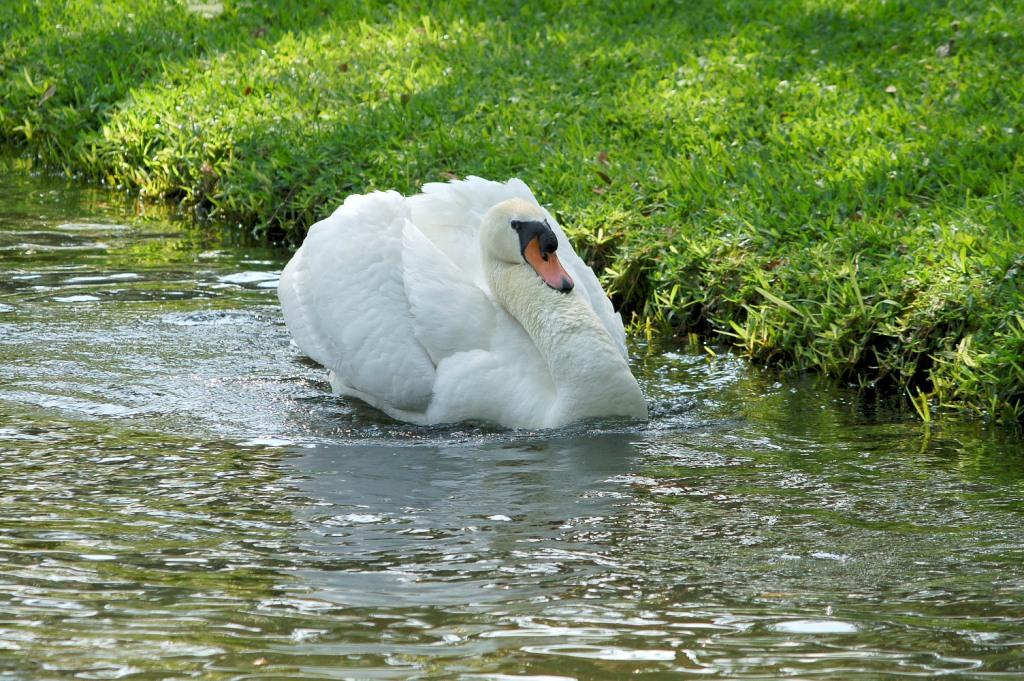
Mute Swan (Cygnus olor)II at Bok Tower By Dan’sPix
Swans are birds of the family Anatidae, which also includes geese and ducks. Swans usually mate for life. The number of eggs in each clutch ranges from three to eight.In North America we have at least four swans: Mute (60”), Trumpeter (60”), Tundra (52”), and Whooper (60”). There is also a Black Swan of Australia and a Black-necked Swan in South America. Swans are large, long-necked waterbirds that have a short duck-like bill and short legs. Many are seen on ponds, lakes, reservoirs and coastal bays. The Mute Swans are semi-domesticated. The Tundra Swan is sometime split into two species, Bewick’s and Whistling Swans.
Mute Swan (Cygnus olor) at Bok Sanctuary By Dan’sPix
The Swan is listed in Leviticus and Deuteronomy in the list of “unclean” birds.
And the swan, and the pelican, and the gier-eagle, (Leviticus 11:18 KJV)
The little owl, and the great owl, and the swan, (Deuteronomy 14:16 KJV)
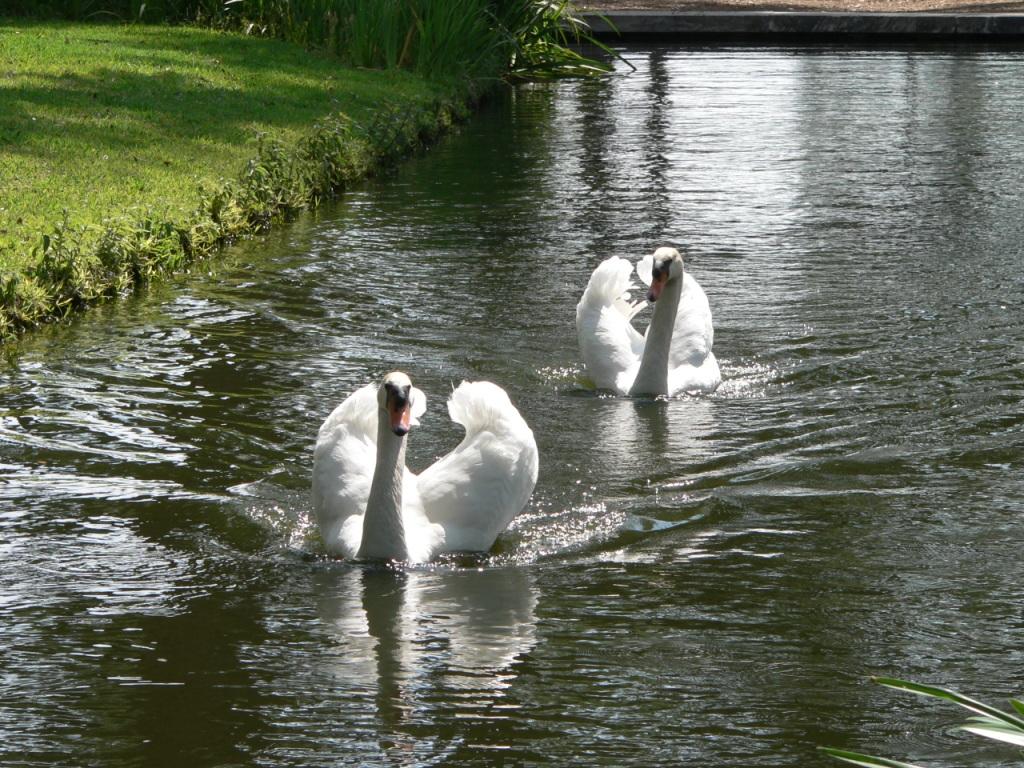
Swans at Bok Tower by Dan
Mute Swan pictures (click on for larger view) taken at Bok Sanctuary in Lake Wales. They were irritated because the worker was mowing the grass beside the water and they kept following him back and forth. They had their wings arched back in frustration, but we thought they were beautiful like what I think “angel’s wings” might look like.
They are all finished. Hope you enjoy reading them.
********
Today, instead of doing my regular Birds of the Bible article, I am going to try to finish the Scripture Alphabet of Animals series. I have all the birds finished and am working hard to finish the rest of the animals today. All throughout the day, new articles will be posted as they are completed. I will be updating the index to the article (below) as I finish each one.
I trust you have enjoyed reading them as much as I have as the articles are being “modernized.” Harriet N Cook was a very good writer and trust she would have approved of the way that they are being handled here.




 Lee's Birdwatching Adventures Plus
