When I Consider! – Complexity

When I Consider!

When I Consider!

Evidence From Biology – October 15

The more we learn about life, the greater the complexity we find. There were no sophisticated microscopes 150 years ago. Consequently, the leap of complexity from single-to-multiple-call organisms was greatly underestimated. The development of the computer has given us an even greater appreciation for the enormous complexity, extreme miniaturization, and vast storage capabilities of the brain. Consider a few other giant leaps that evolutionists must accept in order to hold onto their faith in evolution:

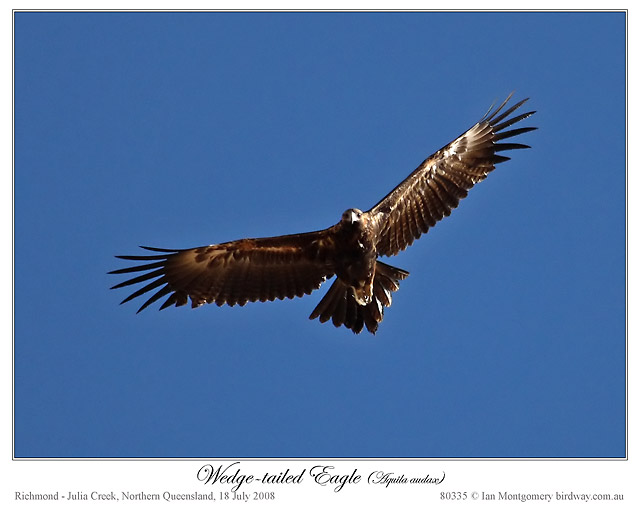
Wedge-tailed Eagles (Aquila audax) by Ian

Wedge-tailed Eagles (Aquila audax) by Ian

1. Flight somehow evolved on at least four different occasions (birds, insects, reptiles, mammals).

2. Photosynthesis somehow developed.

3. Cold-blooded animals somehow turned into warm-blooded animals.

4. Floating marine plants somehow changed into complex plants with roots, stems, and leaf systems.

5. Placental animals (the off-spring develop inside of their mother) somehow turned into marsupial animals (their off-spring develop within a pouch).

6. Egg-laying animals somehow developed the ability to give live births.

7. Insects somehow learned to totally rearrange themselves and change form in a process called metamorphosis (such as a caterpillar transforming into a butterfly).

8. Land mammals and reptiles such as whales, seals, dolphins, ichthyosaurs, and plesiosaurs somehow crawled back into the sea and developed all of the specialized organs needed for sea survival.

In the Beginning, 7th ED., p.17

Blessed is he…whose hope is in the LORD his God, the Maker of heaven and earth, the sea and everything in them… (Psalm 146:5-6)

(Article typed by Phyllis)

See the following articles at Creation Moments:

25 Reasons to Doubt the Theory of Evolution
The Miracle of Photosynthesis
The Insect with Two Brains
The God of Science

When I Consider! – Skunk Cabbage

When I Consider!

When I Consider!

Evidence From Botany – August 16

The skunk cabbage is a uniquely designed plant. It generates enough heat to melt the snow around itself so that it can begin to grow and flower. Even if the air temperature drops as low as 10oF, the skunk cabbage produces the heat it needs to maintain a temperature of between 72°F and 74°F. However, if the temperature stays extremely low for more than 24 hours, the hooded blower exhausts its heating ability and the flower dies. The skunk cabbage then prepares more flowers and repeats the process.

Western Skunk Cabbage from Wikipedia

Western Skunk Cabbage from Wikipedia

This amazing plant also has a built-in thermostat. If the flower becomes too cold more heat is summoned. If the flower becomes too warm, the heat is withdrawn. Because of its amazing abilities, the skunk cabbage is one of the first plants to break through the snow in early spring. Normally, honeybees are unable to fly in temperatures below 65°F. However, when the skunk cabbages are in bloom, honeybees can fly when temperatures drop as low as 45°F. Inside the flower’s hood, the bees warm up enough to travel to the next cabbage flower. In cold weather the bees fly from one skunk cabbage to another, warming themselves as they travel back to their hive. Could this intricately designed flower be the result of random-chance mutational changes?

Character Sketches, Vol.III, P.209-212

I will ponder all your work, and meditate on your mighty deeds. Your way, O God, is holy. What god is great like our God? (Psalms 77:12-13 ESV)

(Article typed by Phyllis)

Very interesting article from The Nature Institute, Skunk Cabbage (Symplocarpus foetidus)
Skunk Cabbage by Fairfax County Public Schools

When I Consider! – Turkey Vulture

Turkey Vulture Tree at Saddle Creek by Lee

Turkey Vulture Tree at Saddle Creek by Lee

We get to see lots of Turkey Vultures in this area. I have seen trees just loaded with them. They are ugly to look at, but are very useful.

The following is the October 6th’s “Evidence from Biology” article from A Closer Look at the Evidence, by Richard and Tina Kleis:

“The Turkey Vulture has incredible farsighted vision capable of seeing dead or dying objects several miles beyond what the human eye can detect. Yet it is designed with dull, weak, talons and a thin beak, forcing it to eek out an existence eating rotting flesh or decaying vegetables. Since the vulture eats the remains of animals that have died of disease, it has a digestive tract designed to destroy deadly bacteria (including anthrax!). The Turkey Vulture also has the ability to sanitize itself and its surroundings using a special disinfectant found in its own excrement. The same chemicals which kill the deadly bacteria in its stomach continue to kill the germs outside its body!

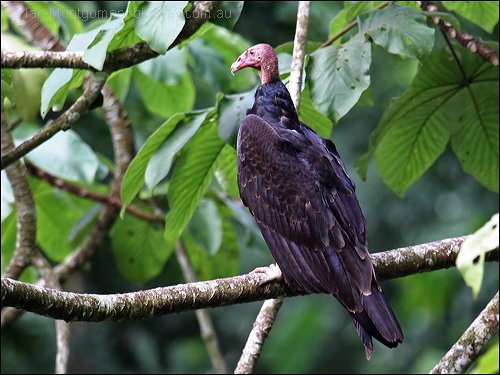
Turkey Vulture by Ian Montgomery

Turkey Vulture by Ian Montgomery

Because the vulture’s head is usually covered in blood, pieces of rotten flesh, and bacteria, it is especially vulnerable to disease. Therefore, this particular bird was created without feathers from the neck up. As the turkey vulture stands in the sun, the ultraviolet radiation kills any remaining bacteria.

By removing the carcasses of decaying animals, the turkey vulture serves an important purpose of limiting the spread of disease and preventing potential epidemics among both man and beast. One wonders how the turkey vulture could have evolved all of the specialized characteristics. The creation solution is that they were created with the original vulture-type bird. The survival characteristics needed for our fallen world were either given after the Fall or developed from originally created abilities.”

Character Sketches, Vol. III, p. 121-124

The LORD is righteous in all his ways, and holy in all his works. (Psalms 145:17 KJV)


Lee’s Extras:
We have mentioned the Vulture many times on the blog and especially in the places below. After all, they are one of the unclean birds that the Jewish people were not allowed to eat. After reading the above article, you can understand why they were off the “menu.”

There is a path which no fowl knoweth, and which the vulture’s eye hath not seen: (Job 28:7 KJV)

Birds of the Bible – Vulture
Vulture
Vulture Photos
Vulture Videos
Accipitridae – Kites, Hawks & Eagles

More When I Consider! articles

When I Consider! – Loon

When I Consider!

When I Consider!

“Evidence From Biology”

The loon is designed quite differently than almost all other birds. While the bodies of most birds are designed as light and aerodynamic as possible, the loon’s body is heavier, allowing it to sink until only its head is above water. It controls its ability to float by inflating or deflating tiny air sacs under its skin. When flying at high altitude, where the air is thin, the loon can conserve oxygen by limiting the flow of blood to its massive leg muscles.

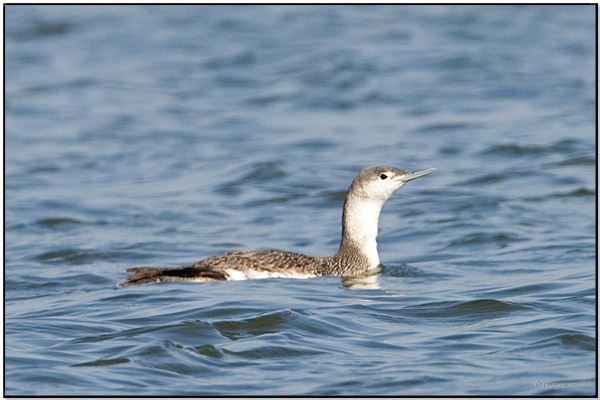
Red-throated Loon (Gavia stellata) by Daves BirdingPix

Red-throated Loon (Gavia stellata) by Daves BirdingPix

The loon also has a perfectly developed reflex which limits the flow of blood to its wings and digestive tract during underwater dives. This allows the loon to hold its breath for long periods of time. Although an average dive lasts about 40 seconds, three-minute dives that cover 300-400 yards are quite common. Astounding dives have been documented where loons have held their breath for as long as 15 minutes while swimming underwater for over 2 miles.

Both common sense and the laws of probability tell us that these many unique abilities could not have evolved by chance processes such as random mutations. The loon could not have developed its unique diving ability in some step-at-a-time manner. It would have starved to death long before it caught its first fish. The system had to work perfectly from the beginning.”

Great Northern Loon (Gavia immer) by J Fenton

Great Northern Loon (Gavia immer) by J Fenton

Character Sketches, Vol III. p.49

For thou art great, and doest wondrous things: thou art God alone. (Psalms 86:10 KJV)

From September 18, A Closer Look at the Evidence, by Richard and Tina Kleiss
More – “When I Consider!


Lee’s Additions:

“any of five species of diving birds constituting the genus Gavia, family Gaviidae. Loons were formerly included, along with the grebes, to which they bear a superficial resemblance, in the order Colymbiformes, but they are considered to constitute their own separate order. Loons range in length from 60 to 90 cm (2 to 3 feet). Characteristics include a strong tapered bill, small pointed wings, webs between the front three toes, and legs placed far back on the body, which makes walking awkward. Loons have thick plumage that is mainly black or gray above and white below. During the breeding season the dorsal plumage is patterned with white markings, except in the red-throated loon (Gavia stellata), which during the summer is distinguished by a reddish brown throat patch. In winter the red-throated loon develops white speckling on the back, while the other species lose these markings.” (Britannica Online)
“Loons are excellent swimmers, using their feet to propel themselves above and under water and their wings for assistance. Because their feet are far back on the body, loons are poorly adapted to moving on land. They usually avoid going onto land, except when nesting.
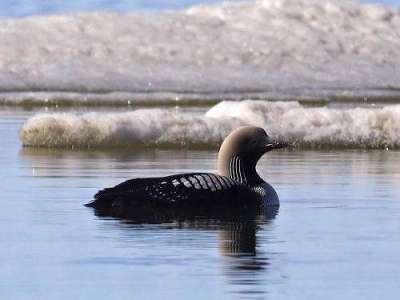
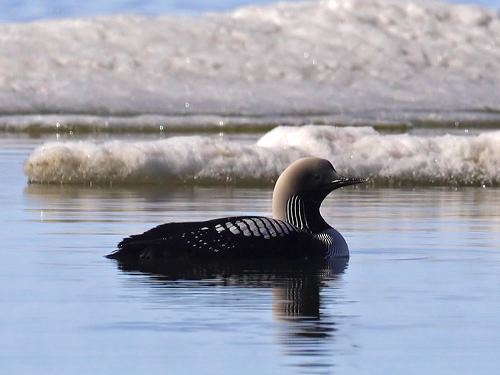
Pacific Loon (Gavia pacifica) by Ian

Pacific Loon (Gavia pacifica) by Ian

All loons are decent fliers, though the larger species have some difficulty taking off and thus must swim into the wind to pick up enough velocity to become airborne. Only the Red-throated Diver (G. stellata) can take off from land. Once airborne, their considerable stamina allows them to migrate long distances southwards in winter, where they reside in coastal waters. Loons can live as long as 30 years.”

“The loons are the size of a large duck or small goose, which they somewhat resemble in shape when swimming. Like in these but unlike in coots (which are Rallidae) and grebes (Colymbiformes), their toes are connected by webbing. They may be confused even more readily with cormorants (Phalacrocoracidae), which are not too distant relatives of divers and like them are heaviset birds whose bellies – unlike those of ducks and geese – are submerged when swimming. Flying loons resemble a plump goose with a seagull’s wings, which seem quite small in proportion to the bulky body. They hold their head slightly pointing upwards during swimming, less so than cormorants do, and in flight they let the head decidedly droop down compared to all other aquatic birds of comparable habitus.

Males and females do not differ in plumage. Males are a bit larger on average, but usually this is only conspicuous when directly comparing the two parents. Their plumage is largely patterned black-and-white in summer, with grey on the head and neck in some species, and a white belly in all of them. This resembles many sea-ducks (Merginae) a lot – notably the smaller goldeneyes (Bucephala) – but is distinct from most cormorants which rarely have white feathers, and if so usually as large rounded patches rather than delicate patterns. All species of divers have a spear-shaped bill.”(Wikipedia)

See Also:
Peterson’s Field Guide Video Series on the Common Loon (Now the Great Northern Loon)
Gaviidae – Loons
Loon from Wikipedia
An interesting article in The Wilson Bulletin dated September 1947 – “The Deep Diving of the Loon and Old-Squaw and its Mechanism

When I Consider! – Elephant Ears and Scarab Beetles

When I Consider!

When I Consider!

Evidence From Biology – September 12

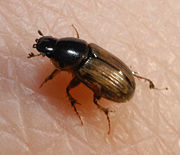
180px-Aphodius_specThere is an amazing relationship between certain types of elephant ear and the scarab beetle. It has only been recently learned that many elephant ear plants depend completely on the scarab beetle for pollination. Elephant ears make a flower stalk, called a spadix, which has three different kinds of flowers: male, female, and sterile. The beetles are drawn to help in the pollination process of crawling around on the spadix to get to the sterile flowers, which they love to eat. In the process of crawling around on the spadix to get to the sterile flowers, the beetles also pick up pollen from the male flowers and pollinate the female flowers.

Elephant-Ear-Plant

Elephant-Ear-Plant

It is amazing that none of the male or female flowers are ever eaten though they look exactly like the sterile flowers! The plant has produced a sacrificial look-alike in order to attract a specific pollinating insect which has no interest in its productive flowers. How could the plant have known to do this? Why would it ever produce a flower useless except for the actions of another creature? This miraculous interdependency had to have been specifically designed.

Letting God Create Your Day, Vol. 4, p29

O Lord GOD, You have begun to show Your servant Your greatness and Your mighty hand, for what god is there in heaven or on earth who can do anything like Your works and Your mighty deeds? (Deuteronomy 3:24 NKJV)

From A Closer Look at the Evidence, September 12, by Richard and Tina Kleiss

See Also:
Mystery of the Elephant Ears at ©Creation Moments

Elephant Ear Story from Cloudbridge Nature Reserve
Miniature Elephant Ear Surprise by A Neotropical Savanna
Xanthosoma Giant Elephant Ear Plants by Central Florida Farms

More  “When I Consider!”  articles.

When I Consider! – Woodpecker and Bones

When I Consider!

When I Consider!

“Evidence from Biology”

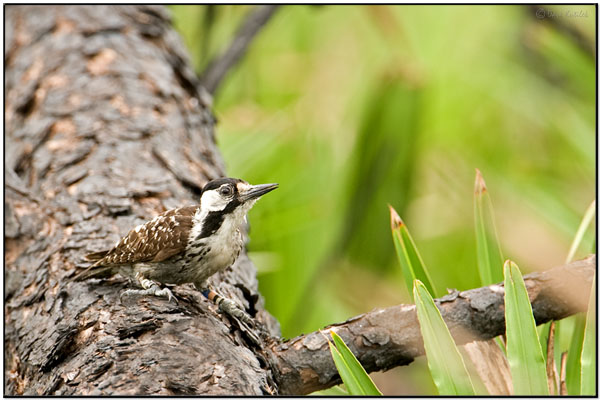
“In His Word, God tells us that He cares for His creatures. One can observe repeated examples of this in nature. Every creature on Earth has been programmed to take care of itself. An example is the female Red-Cockaded Woodpecker, which changes her diet to include more calcium at egg-laying time. Scientist have found that the woodpecker starts gathering, storing, and eating bone fragments a few days before laying her eggs. Bones contain an extremely high concentration of calcium, which is needed for the shells of the woodpecker’s eggs. After her eggs are laid and her body requires less calcium, the woodpecker shows little interest in pieces of bone.

Red-cockaded Woodpecker (Picoides borealis) by Daves BirdingPix

Red-cockaded Woodpecker (Picoides borealis) by Daves BirdingPix

Where did this instinct to eat bones originate? How does the woodpecker know when she can stop eating bone fragments? Would this process have taken place before the Fall, when the world was a perfect paradise? No one knows, but it is apparent that this instinct had to be programmed into the woodpecker for it to survive in the current fallen world. What a leap of faith to believe that the woodpecker’s ability to meet her need for increased calcium just “evolved” by chance!

Letting God Create Your Day, Vol.3, p.22″

Look at the birds of the air, for they neither sow nor reap nor gather into barns; yet your heavenly Father feeds them. Are you not of more value than they? (Matthew 6:26 NKJV)

A Closer Look at the Evidence, Aug 5, by Richard and Tina Kleiss


An excerpt from U.S. Fish & Wildlife Service, “Red-cockaded Woodpecker Picoides borealis

“Red-cockaded woodpeckers rarely come to the ground. They even bathe in water-filled depressions on tree limbs. Recent research notes that female red-cockaded woodpeckers search for bone bits on the forest floor and stuff them in tree crevices. Zoologists say it is the first known instance of a bird hoarding something for its mineral, rather than caloric, content. Calcium-rich bone is not rare, but the birds probably seek it to ensure stronger eggshells. They stash it in a tree so they won’t have to eat on the ground where they are vulnerable to predators.”

When I Consider! – Platypus

When I Consider!

When I Consider!

Evidence from Biology

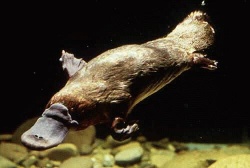
Some animals, such as the duckbilled platypus, have organs that completely confound evolutionary explanation. The platypus has a mixture of features from animals completely unrelated to its supposed ancestry. For instance:

  1. The warm-blooded platypus feeds its babies milk like other mammals.
  2. It lays leathery eggs, has a single ventral opening (for eliminating its waste, mating, and birth), and has claws and a shoulder girdle like most reptiles.
  3. It can detect electrical currents like some fish.
  4. It has webbed feet like an otter, a flat tail like a beaver, and the male can inject poison into its predator like a snake.
  5. It has a bill like a duck.
Platypus From Creation Wiki

Platypus From Creation Wiki

It would seem that animals such as the platypus are God’s reminder of His unfathomable creativity. These animals combine features from many unrelated creatures and have no logical place on the evolutionary tree.” There is no direct evidence that any major group of animals (or plants) arose from any other group. Completely different types of animals are only observed going out of existence (extinctions), never coming into existence.”

In the Beginning, 7th Ed., p.7

Great is the LORD, and greatly to be praised; And His greatness is unsearchable. One generation shall praise Your works to another, And shall declare Your mighty acts. I will meditate on the glorious splendor of Your majesty, And on Your wondrous works. Men shall speak of the might of Your awesome acts, And I will declare Your greatness. (Psalms 145:3-6 NKJV)

From A Closer Look at the Evidence, Richard and Tina Kleiss, Aug 3


Interesting Things – The Platypus more information and a great song about it by Buddy Davis.

More – When I Consider! articles

Photos of Platypus by Ian of Birdway.

When I Consider! – DNA in Dinosaurs

When I Consider!

When I Consider!

Evidence from the Fossil Record – from A Closer Look at the Evidence, August 8.

“As soon as a plant or animal dies, its DNA begins to decompose. The oldest accurately known DNA samples are from a 4000-year old mummy. Based on the deterioration of the molecule from samples of this age. it is estimated that essentially no DNA could survive longer than 10,000 years. However, DNA segments have been found in magnolia leaves (dated by evolutionists at 17 million years), dinosaur bones (dated at 80 million years), scales of a fossilized fish (dated at 200 million years) Evolutionary scientists should be asking how DNA could still be contained in samples this old when more recent samples indicate that the DNA molecule is far too sensitive to have lasted this long. Perhaps there is something wrong with the old-earth dating methods and these fossils still contain DNA fragments simply because they are not as old as believed. These samples have been simply dated wrong due to faulty assumptions of radiometric dating methods.

Dinosaur Fossil from OCR.org

Dinosaur Fossil from OCR.org

Evolutionists have a similar problem with protein preserved in dinosaur bones. As with DNA, no protein should last 75 to 150 million years; yet protein has been found in dinosaur bones. These plant and animal remains are simply not as old as evolutionists believe.”

In the Beginning, 7th Ed., p29-30

Listen to Me, O Jacob, And Israel, My called: I am He, I am the First, I am also the Last. Indeed My hand has laid the foundation of the earth, And My right hand has stretched out the heavens; When I call to them, They stand up together. (Isaiah 48:12-13 NKJV)


More When I Consider! articles

See Also:
A Scientist Says He Has Isolated Dinosaur DNA
The Devastating Issue of Dinosaur Tissue, from ICR
Dinosaur Mania and Our Children, by Paul S. Taylor
They’re seeing it by not believing it – Williams: Is science cracking code of dinosaur DNA?
Scientists recover T. rex soft tissue

When I Consider! – Hummingbirds

When I Consider!

When I Consider!

“One of the fascinating and unique creatures of all creation is the common hummingbird. What is the probability that all of the unique characteristics of the Ruby-throated Hummingbird, each of which are needed for its survival, developed by some step-by-step process? A few of the hummingbird’s incredible abilities are listed below:

  1. The unique ability to fly forward, backward, upside-down, and straight up like a helicopter as no other bird can.
  2. The use of a special fringed tongue to sweep insects out from the inside of flowers. It cannot survive on nectar alone, but also needs the protein from eating insects. Without its special tongue it could never catch the insects.
  3. The ability to fly 500 miles nonstop over the gulf waters to Mexico. The hummingbird can conserve its strength for long flights by taking a prolonged rest just  prior to the flight and making every motion count in flight.
  4. The ability to go into a “torpid” condition at night by almost shutting down its metabolism. Because of its incredibly high energy activity, gram for gram the hummingbird has the greatest energy output of any warm-blooded animal. Yet at night it uses only about one fifth of its normal energy.
Ruby-throated Hummingbird by Ray's Wildlife

Ruby-throated Hummingbird by Ray’s Wildlife

The hummingbird is truly a marvel of God’s creativity.

Character Sketches, Vol.II, p.42-48″

Seek the LORD and his strength; seek his presence continually! Remember the wondrous works that he has done, his miracles, and the judgments he uttered, (Psalms 105:4-5 ESV)

A Closer Look at the Evidence, July 13, by Richard and Tina Kleiss

Error
This video doesn’t exist

To see more about Hummingbirds See:

Birds of the Bible – Bird Feeder I

Hummingbirds – Peterson Field Guide Series

Hummingbird Videos

When I Consider! – Cheetah

When I Consider!

When I Consider!

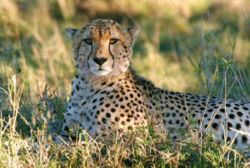
The cheetah is truly a remarkable creature. It is the world’s fastest land animal, capable of accelerating from 0 to 40 miles per hour in 2 seconds. The cheetah can reach a speed of 70 miles per hour. How does the cheetah reach these phenomenal speeds? It is designed with a high-performance body containing a uniquely powerful heart, strong large-diameter arteries, and extra-large nostrils for breathing large volumes of air. The cheeta also has hip and shoulder girdles that swivel on its spine. As it runs, the cheetah’s spine curves up and down as its legs contract and extend. When moving at high speeds, the cheetah may only touch the ground once every 23 feet.

Cheetah

Cheetah

Evolutionist would claim that some unknown pre-cheetah creature turned into the cheetah by chance mutations of its heart, liver, arteries, nostrils, hips, shoulders, spinal column, and muscles. Yet the oldest known cheetah fossils reveal an animal that is essentially identical to the cheetahs alive today. Once again, the actual physical evidence supports creation, rather than evolution. The cheetah’s unique characteristics are a result of design. All of the information necessary for the cheetah’s speed was programmed into the first large “cat-type” creature. No series of random modifications could have produced this fast, sleek animal.

The LORD is righteous in all His ways, Gracious in all His works. (Psalms 145:17 NKJV)

“Evidence From Biology”, July 27, from A Closer Look at the Evidence, Richard and Tina Kleiss – Taken from Letting God Create Your Day, Vol.4, p.19


From Creation Wiki:
“The word Cheetah actually originates from a Hindi word, which means “spotted one.” Cheetahs are carnivorous cats that are best know for their spots and their speed. They are found mainly in Southern Africa. They rely on speed for hunting, and not stealth, unlike most cats. Females tend to be solitary, while the males spend their whole lives together. They have smaller teeth than most cats, which helps improve the cat’s respiratory system. A cheetah’s life span in the wild is about 12 years. Ancient Egyptians sometimes kept cheetahs as pets, and used them for hunting.”

Cheethah have small teeth which help it get air in while running at those high speeds mentioned above. They weigh between 80-140 lbs. and are about 32 tall and 48-56 inches long. “Almost every part of a cheetah’s body is built, in some way, to help it run faster. They have semi-retractable claws, as well as special paw pads on their feet to give the cat good traction. As mentioned before, large nostril and a clear intake help get air in and out quickly and smoothly. The cheetah’s spine acts as a spring for its back legs. Their tail is much like a rudder, it gives the cat added agility, enabling it to turn quickly. The cheetah’s top speed is an amazing 71 miles per hour. This speed can only be held out for about 200-300 yards. The cheetah can accelerate from 0-60 mph in 3.5 seconds, faster than many sports cars.”

See also:
Cheetah – Creation Wiki
Cheetah – Wikipedia

When I Consider! – Only Two Possible Explanations For Life:

When I Consider!

When I Consider!

There are only two possible explanations for life:

  1. Evolution-which states that life has evolved from simple forms of plants and animals into the more complex forms we find today.
  2. Creation-Which states that God created the entire universe and all of the creatures on Earth fully formed and completely functional.

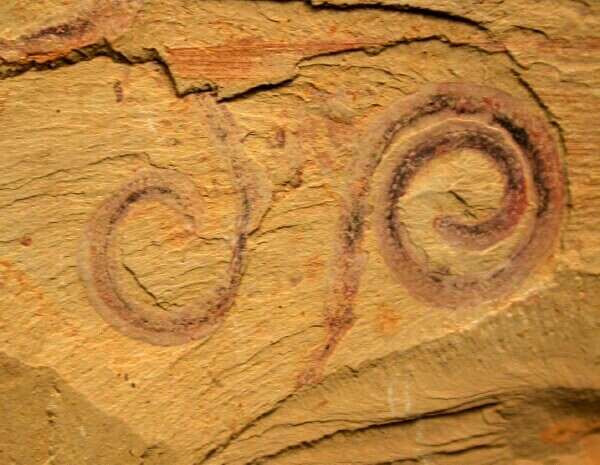
Paleontologists have found a greater variety of creatures in the fossil record than now exists, including soft-bodied creatures such as worms and jellyfish. However, even in the lowest rock layers, these worms and jellyfish are fully formed and easily categorized into the same kinds of animals alive today.

Maotianshania cylindrica found in China

Maotianshania cylindrica found in China

If evolution is the correct explanation, then there should be thousands of intermediate forms as one type of creature slowly turned into another type.  If creation is true, then the classifications of distinctly different types of animals, both living and in the fossil record, should remain essentially the same.

The fossil evidence clearly supports creation. True science progresses when all the evidence is presented.

Letting God Create Your Day, Vol.3, P.247

Casting down imaginations, and every high thing that exalteth itself against the knowledge of God, and bringing into captivity every thought to the obedience of Christ; (2Co 10:5 KJV)

“Evidence From The Fossil Record”, July 5, from A Closer Look at the Evidence, Richard and Tina Kleiss

Interesting related articles:

Fossil of Extinct Armored Worm Discovered from Live Science
Here is an interesting quote from the article:

It’s very rare to find the soft parts of the body preserved, Briggs said. “It has to be buried quickly,” he told LiveScience. “You have to get minerals forming and preserving the outline before the animal decays completely.”

That is exactly what a global flood would do.

Living Fossil, from Creation Wiki, has a great list of “Examples of Living Fossils.”

More When I Consider! Blogs

A Closer Look at the Evidence – Kleiss

A Closer Look at the Evidence by Richard & Tina Kleiss is a devotional book that has bite size information about incredible evidence about creation.

Here is a part of the review of the book by Timberdoodle.com

We have never seen such a unique and fascinating devotional book. It is one of a very few that we have used that tempts us to read on ahead! A Closer Look at the Evidence presents straightforward evidence, primarily scientific, for the existence of our Creator.

This book is organized into twenty-six different subject areas and draws from over fifty expert sources. Each of the 400+ pages highlights knowledge from a Biblical perspective. Each day’s devotion is a full page of concise, well-researched, factual information with reference material noted if you desire more specifics.

The authors, Rich and Tina Kleiss, former public school science teachers, discovered that scientific evidence overwhelmingly supports creation. But evolution continues to be presented as fact in the media and textbooks, even as the evidence for creation is being systematically excluded.

By daily using and discussing A Closer Look at the Evidence, your family should not only learn the credible reasons for your belief in the Creator but also be equipped to share this truth with others. Each page ends with a related Bible verse…..

magnify_2748cDan and I use it daily after our regular devotions. I have been wanting to share these articles for some time and have decided to do so in a series called, “When I Consider!” A quote from the book’s Dedication has encouraged me decide to do this.

God’s desire is that the knowledge of what He has done through both the cross and creation is for everyone. We must not keep this knowledge to ourselves. The evidence that He is our Creator is so overwhelming and encouraging that it is desperately needs to be shared in the world today. A Closer Look at the Evidence is designed to be an affordable resource to both reinforce our individual faith and facilitate sharing the reasons for this faith. Consider praying about how God could use you to utilize the truths found in these pages.

The book is available at not only Timberdoodle, but also at Answers in Genesis Bookstore  and Creation Moments and many other fine places.

The first in the “When I Consider!” will be posted below or Click Here.