Ian’s Bird of the Week – Oriental Plover

Ian’s Bird of the Week – Oriental Plover by Ian Montgomery

 Newsletter – 12/10/14
_
You may remember that we had Oriental Pratincole as bird of the week early last month as I couldn’t fulfil a request from a local birder for Oriental Plover. Since then, Rex Whitehead, a bird photographer in Mt Isa, 900km west of Townsville as sent me some lovely Oriental Plover photos that he took very recently on Lake Moondarra, a reservoir just outside Mt Isa.
The first two photos are of adult birds in non-breeding plumage. These are elegant mid-sized plovers slightly smaller than Golden Plovers with a length 22-25cm/8.5-10in. The second photo shows the slim profile well. The third photo is of a juvenile bird, and like many plover species it has buff fringes to the dorsal feathers.
The entire population of about 70,000 birds breeds in Mongolia and adjacent areas of southern Siberia and northwestern China and migrates to northern Australia for the northern winter. In both regions it is a bird of dry arid areas and in Australia it visits the coast less frequently and in response to severe drought inland. Some birds reach the southern states, but it’s main range is north of the Tropic of Capricorn. On migration in both directions it appears in large numbers in the Yangtze Valley but records are rare both in more northerly parts of China and in Indonesia. So it is assumed that it is a long distant migrant and does the entire journey in two hops.
In breeding plumage it has a chestnut breast-band with a dark lower edge which forms a sharp border to the white breast. With some reluctance I’ve included a poor distant shot of mine taken at Norfolk Island airport in March 2012 to illustrate the breeding plumage and do a size comparison with the Pacific Golden Plover. if you look carefully you can see the chestnut breast-band on the Oriental Plover and the Pacific Golden Plover is also coming into breeding plumage. Oriental Plovers can run swiftly and the specific name veredus is the Latin for a swift horse.
I’ve been busy working on the website to make it ‘mobile friendly’ so Christmas has approached stealthily and more-or-less unnoticed. I did see in my calendar program yesterday that there is a full moon on Christmas Day and the same program reminded me today that there is a New Moon tomorrow. That gave me a shock as it means Christmas only a couple of weeks away. So, don’t forget the gift giving facilities on the Apple Store and Kobo Books and the ebooks Where to Find Birds in Northern Queensland and Diary of a Bird Photographer! Use the Gifting Gifts section in the Publications Page for links and instructions. Both the thumbnails below are linked to their newly mobile friendly pages on the website.
    
I released the new mobile friendly home page a few days ago. This involved breaking it up into smaller parts to make it more manageable – it had grown to become a monster over the years. The home page now has links to all its erstwhile components like thumbnails to bird families (‘Visual Links’ in the menus), the bird of the week index page, and recent additions. The alphabetic and taxonomic indices are collectively called Text Links, and like the Visual Links are all inter-connected. The move to a mobile world has provided an opportunity for a complete redesign to make the website more consistent and easier to use but, given its size, it will be many months before all the family and species pages get updated but I’ll keep you posted.
Greetings
Ian

Lee’s Addition:

[Even the migratory birds are punctual to their seasons.] Yes, the stork [excelling in the great height of her flight] in the heavens knows her appointed times [of migration], and the turtledove, the swallow, and the crane observe the time of their return. But My people do not know the law of the Lord [which the lower animals instinctively recognize in so far as it applies to them]. (Jeremiah 8:7 AMP)

Wow! If you looked at all the links Ian shared, he has really been busy updating his Birdway website. I’m impressed! The Oriental Plover is also very interesting.

*

Ian’s Bird of the Week

Charadriidae – Plovers  Family

Wordless Birds

*


Ian’s Bird of the Week – Crimson Rosella

Ian’s Bird of the Week – Crimson Rosella ~ by Ian Montgomery

Newsletter – 11/20/15

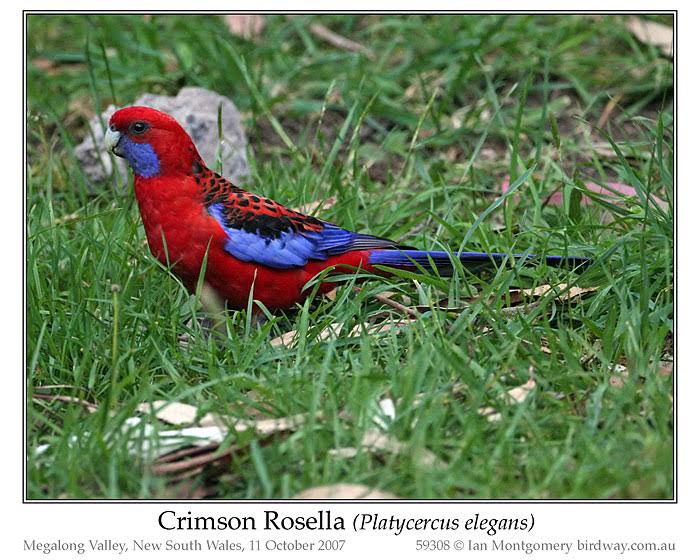
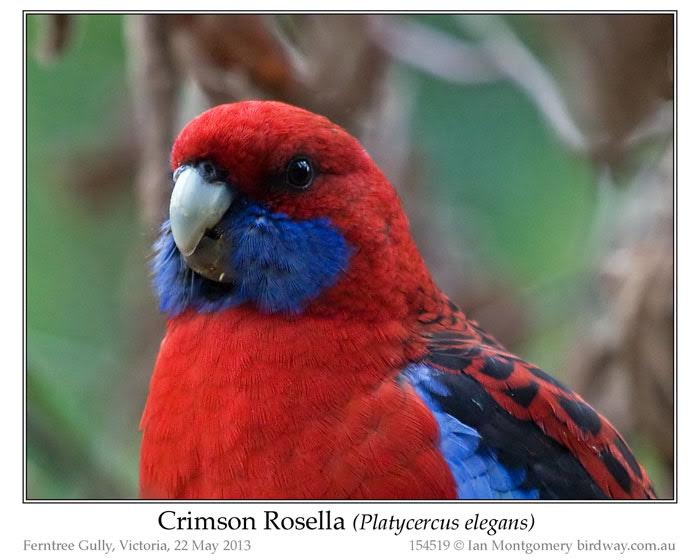
Some birds are very obvious choices for bird of the week because they are beautiful and popular. Ironically, I can overlook them for exactly that reason as I assume they’ve featured previously. Here is one such, the Crimson Rosella, an iconic and popular bird of the forests of eastern and southeastern Australia.

Crimson Rosella (Platycercus elegans) by Ian

Normally rather shy in its natural habitat and can become quite tame in parks and gardens. It’s popularity is reflected in the fact that it has been introduced to New Zealand and Norfolk Island and (unsuccessfully) to Lord Howe Island. It nests in tree hollows and is regarded by conservationists as a pest on Norfolk Island as it competes with the smaller, endangered Norfolk Parakeet for nest sites.

Crimson Rosella (Platycercus elegans) by Ian

It feeds mainly on the seeds and fruit of trees and will forage on the ground for the grass seed, like the bird in the third photo. It’s a very vocal species and its ringing calls are a characteristic sound of forests in eastern Australia. Out of the breeding season, it is found in small flocks but it is territorial when breeding and the pair bond is though to persist for several years or longer.

Crimson Rosella (Platycercus elegans) by Ian

Juvenile birds of the eastern nominate race are mainly olive green with blue cheeks and patches of red on the head, breast and undertail-coverts. The nominate race extends from Cooroy in Southeastern Queensland to about Kingston in eastern South Australia.

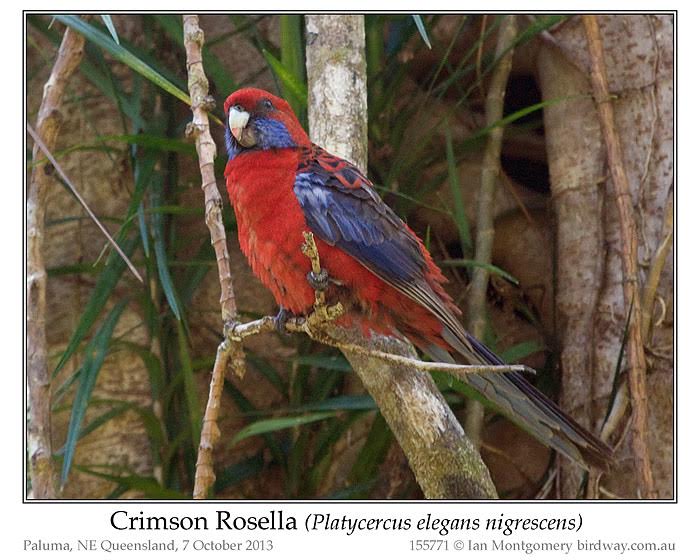
Crimson Rosella (Platycercus elegans) by Ian

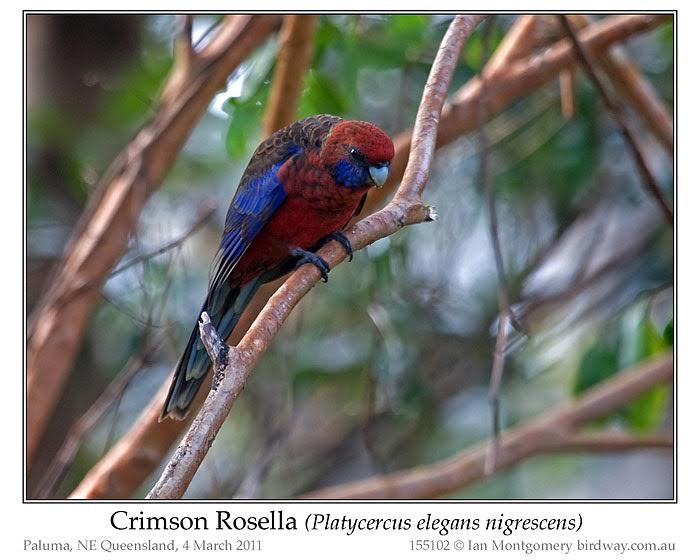
Farther north, an isolated population of the race nigrescens (‘blackish’) occurs from Eungella near Mackay north to the Atherton Tableland. This is smaller and darker than the nominate race, fifth photo, and is mainly a bird of highland rainforest.

Crimson Rosella (Platycercus elegans) by Ian

Juveniles of this northern race are much more like the adults than their southern relatives and have brownish-black feathers on the back instead of green (sixth photo).

Crimson Rosella (Platycercus elegans) by Ian

Crimson Rosella (Platycercus elegans) by Ian

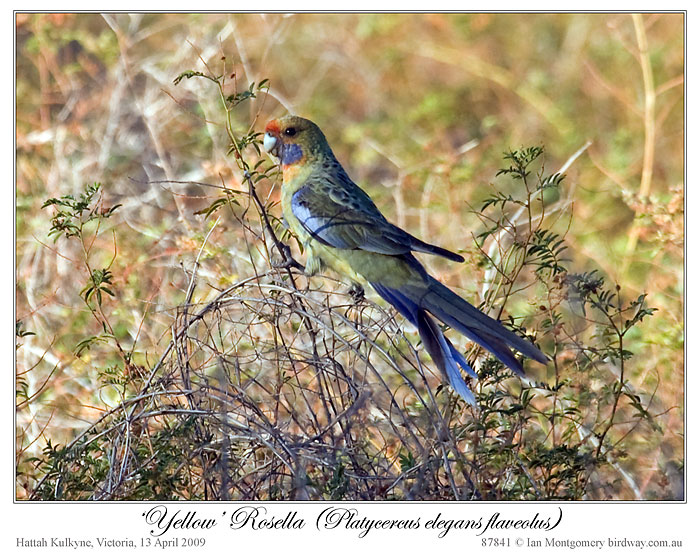
In southeastern Australia the populations of blue-cheeked Rosellas look very different and were for a long time treated as two different species, the Yellow Rosella, seventh photo, of the river systems of southern New South Wales and northern Victoria, and the orange-plumaged Adelaide Rosella of South Australia from the Flinders Ranges in the north to the Fleurieu Peninsula south of Adelaide (no photo). Yellow and Adelaide Rosellas interbreed where their ranges meet along the Murray River in South Australia. The two are now treated as races of the Crimson Rosella, flaveolus and adelaidae respectively.

Yellow Rosella (Platycercus elegans flaveolus) by Ian 4

Yellow Rosella (Platycercus elegans flaveolus) by Ian 4

The Yellow Rosella looks very like the other blue-cheeked Rosella, the Green Rosella of Tasmania. It is, however, retained as a separate species. I included this photo of the Yellow Rosella when the Green Rosella was bird of the week in March 2013.

Christmas is looming ever closer, so this wouldn’t be complete without the obligatory commercial. What do you give to the digitally-competent birder or nature-lover who has everything? An electronic book of course and both Apple and Kobo have facilities in their ebook stores for giving gifts. I’ve included a Giving Gifts section on the Publications page with help on how these stores let you give gifts. Google has facilities only for giving the equivalent of a gift token and not specific items. These book images are linked to the corresponding web pages:

Where To Find Birds - Ian

Ian's Book 2

Greetings
Ian

**************************************************
Ian Montgomery, Birdway Pty Ltd,
454 Forestry Road, Bluewater, Qld 4818
Tel 0411 602 737 ian@birdway.com.au
Bird Photos http://www.birdway.com.au/
Recorder Society  iTunes; Google Play Kobo Books


Lee’s Addition:

For the LORD God is a sun and shield; The LORD will give grace and glory; No good thing will He withhold From those who walk uprightly. (Psalms 84:11 NKJV)

Thanks again, Ian, for sharing some more avian wonders. I especially like the second photos. That little guy looks like he is walking with an attitude. :)

Cause me to hear Your lovingkindness in the morning, For in You do I trust; Cause me to know the way in which I should walk, For I lift up my soul to You. (Psalms 143:8 NKJV)

*

More Ian’s Bird of the Week

Ian’s Psittacidae – Parrots Family

Pale-headed Rosella ~ 8-24-14

Psittaculidae – Old World Parrots (Here)

Wordless Birds – Hummers

*

Ian’s Bird of the Week – Oriental Pratincole

Ian’s Bird of the Week – Oriental Pratincole ~ by Ian Montgomery

Newsletter ~ 11/12/156

This post is a bit late, so you get two species by way of amends!

I was at the opening of an excellent exhibition of North Queensland ‘breeding birds and their dream homes’ called Nestled at the Museum of Tropical Queensland in Townsville on Tuesday and got talking to one of the local members of BirdLife Townsville about the bird of the week. He requested something unusual of local interest that might occur here at this time of the year and mentioned Oriental Cuckoo and Oriental Plover. Oriental Cuckoo was bird of the week in December 2007 and I don’t have any good photos of Oriental Plover. I’ve only ever seen it in airports (Lockhart River and Norfolk Island) and I’ve never risked the wrath of airport security to get close to the birds. So the best I could come up with, Bill, is Oriental Pratincole photographed at the Townsville Town Common where a flock appeared nine years ago. I can’t get more local than that!

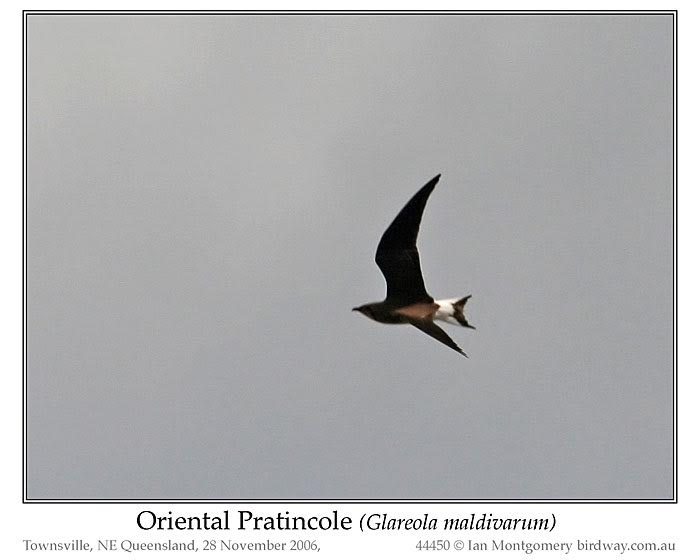
Oriental Pratincole (Glareola maldivarum) by Ian
Oriental Pratincoles breed in Asia with a patchy distribution from India to eastern Siberia, Mongolia and NE China. In the northern winter they migrate to Indonesia, Malaysia, New Guinea and northern Australia with perhaps 50,000 reaching our shores. They are late migrants arriving in the Top End of the Northern Territory during the build-up to the wet season (November) and their main Australian range is from the Gulf of Carpentaria in NW Queensland west to the north coast of Western Australia. They show a preference for dry inland plains with available water and feed mainly on insects such as grasshoppers. 2006 was, like this one, a very dry year in Townsville and these photos were taken on the dry bed of one of the wildlife observation ‘wetlands’ at the Common. They also turn up sometimes on the Atherton Tableland.

Oriental Pratincole (Glareola maldivarum) by Ian

Pratincoles are unusual birds somewhere between plovers and terns in appearance and morphology. They belong to a small family, the Glareolidae, which consists of 8 species of pratincoles in Eurasia, Africa and Australia and 9 species of mainly African Coursers. The odd name pratincole means ‘inhabitant of meadows’ with the ‘prat’ bit having the same root as ‘pratensis’ in the European Meadow Pipit (Anthus pratensis). The family name comes from the Latin for gravel, and that’s actually closer to the mark when it comes to preferred habitat.

Oriental Pratincole (Glareola maldivarum) by Ian

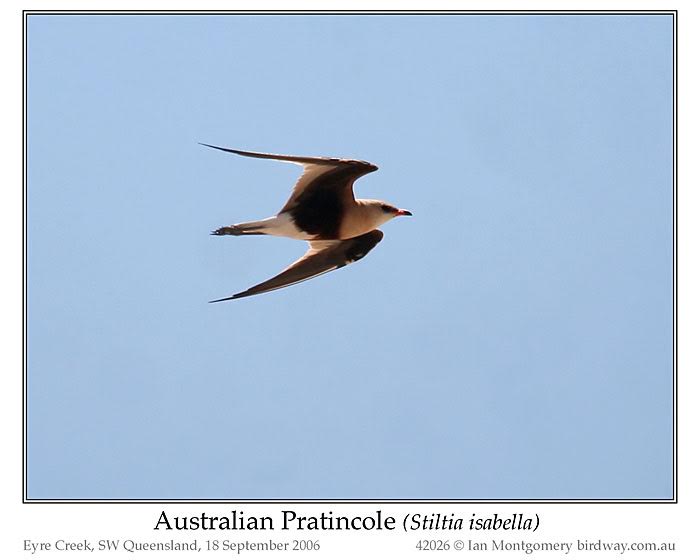
The Oriental Pratincole is distinguishable from the Australian Pratincole by its dumpier, shorter-tailed appearance, greyish-olive rather than buffish-brown plumage and by a black margin to the throat giving the appearance of a necklace. The Oriental Pratincole is normally in non-breeding plumage when in Australia, but both species have black-tipped bills with red bases when breeding. The Australian Pratincole has chestnut flanks and belly when breeding and the dark flanks are retained in non-breeding plumage.

AustralianPratincole (Stiltia isabella) by Ian

Pratincoles look very tern-like in flight with their long pointed wings. Both the local species have white rumps and black-tipped tails, but the tail of the Australian Pratincole is square, while that of the Oriental is forked.

Oriental Pratincole (Glareola maldivarum) by Ian

If you belonged to the bird of the week club a year ago, you may remember that the Cream-coloured Courser was, after the Crab Plover was my second most wanted bird in Dubai. Courser means ‘runner’, something they do very well and it was very appropriate to find them at the Polo Club and at the Al Asifa Endurance Stables. Incidentally, the bird of the week club currently has 981 members and you know I like milestones. Please encourage your friends to join so we can reach 1,000 either by signing up on the bird of the week page (recently redesigned for mobile devices) or by emailing me at ian@birdway.com.au.

Cream-colored Courser (Cursorius cursor) by Ian

Cream-colored Courser (Cursorius cursor) by Ian

Christmas is looming ever closer, so this wouldn’t be complete without the obligatory commercial. What do you give to the digitally-competent birder or nature-lover who has everything? An electronic book of course and both Apple and Kobo have facilities in their ebook stores for giving gifts. I’ve included a Giving Gifts section on the Publications page with help on how these stores let you give gifts. Google has facilities only for giving the equivalent of a gift token and not specific items. These book images are linked to their web pages:

And don’t forget Nestled at the Museum of Tropical Queensland if you are in, near or visiting Townsville.

Where To Find Birds - Ian

Ian's Book 2

Greetings
Ian

**************************************************
Ian Montgomery, Birdway Pty Ltd,
454 Forestry Road, Bluewater, Qld 4818
Tel 0411 602 737 ian@birdway.com.au
Bird Photos http://www.birdway.com.au/
Recorder Society http://www.nqrs.org.au


Lee’s Addition:

Bread gained by deceit is sweet to a man, But afterward his mouth will be filled with gravel. (Proverbs 20:17 NKJV)

Thanks, Ian, for another interesting bird to introduce us to. Also glad you help distinguish several apart. Most of us that have never seen these birds could mix them up. Thanks for sharing these neat birds with us.

Now that Ian is a published writer, his book might well be a prized gift for yourself or others.

*

Ian’s Bird of the Week

Glareolidae – Coursers, Pratincoles

Cream-coloured Courser ~ 9-27-14

Crab Plover ~ 9-22-14

Who Paints The Leaves?

*

Ian’s Bird of the Week – Fuscous Honeyeater

Ian’s Bird of the Week – Fuscous Honeyeater ~ by Ian Montgomery

Newsletter ~ 10-14-15

Townsville is experiencing one of its driest years on record, with only 258mm/10.2in of rain so far this year, with most of that in January. Farmers feel the effects of the dry the most of course from a human perspective, but the wildlife is suffering too. Any remaining open water whether on farms or in gardens is very popular. My bird bath and pond are visible from the window of my study so I have been watching the variety and abundance of visiting wild- (and feral-) life and keeping an eye out for unusual birds. These include some which here are mainly restricted to highland rainforest such as Macleay’s and Lewin’s Honeyeaters and other dry country species such as the Fuscous Honeyeater, normally found west of the coastal range in North Queensland.

Fuscous Honeyeater (Lichenostomus fuscus) by Ian

This one, here ten days ago on the edge of my bird bath, is the northern race subgermanus. This race has a yellow wash on the face which makes it look rather like the closely related Yellow-tinted Honeyeater, a species I’ll say a bit more about shortly. This northern race occurs between Bowen/Mackay and the Atherton Tableland. Further south the nominate race ranges through the remainder of eastern Queensland, eastern New South Wales and through Victoria as far as about Adelaide in South Australia. The second photo shows an example of the nominate race west of Sydney. Fuscous Honeyeaters have different bill and eye-ring colour in breeding and non-breeding plumage. Non-breeding (and juvenile) birds have yellow bases to the bill and a yellow eye-ring (first photo) while breeding birds have dark bills and dark eye-rings (second photo) – unusual for the breeding plumage to be less colourful.

Fuscous Honeyeater (Lichenostomus fuscus) by IanThe third photo shows a non-breeding (or juvenile) nominate-race individual in Victoria and both the yellow eye-ring and yellow base to the bill show up well. ‘Fuscous’ comes from the Latin for ‘dusky’ while the generic name ‘Lichenostomus’ means ‘lichen-mouth’ or ‘moss-mouth’ in Greek and refers to the brush-like tongues of members of this genus, adapted for feeding on nectar. Compare that with ‘Trichoglossus’ – ‘hair tongue’ – a similar adaptation in Lorikeets of that genus, such as the Rainbow Lorikeet.

Fuscous Honeyeater (Lichenostomus fuscus) by IanThere are five closely related species of Lichenostomus, referred to as a ‘super-species’ which, although they overlap in some places, effectively carve up mainland Australia. The Fuscous as we’ve seen is an eastern and southeastern species; the Yellow-plumed (L. ornatus) occurs along the south coast from Victoria to SW Western Australia; the Grey-fronted (L. plumulus) is an inland and western-coastal species; the White-plumed (L. penicillatus) has a similar range to the Grey-fronted but extends to the coast in Victoria and New South Wales (e.g. suburban Sydney); while the Yellow-tinted (L. flavescens) occurs across northern Australia from NW Western Australia through the Northern Territory to western Cape York in Queensland (fourth photo). There is also an isolated population in south-eastern Papua New Guinea.

In case you’re wondering, subgermanus, the name for the northern race of the Fuscous doesn’t refer to Germany or a taxonomist called Germain. ‘Germanus’ means something like ‘sibling’ in Latin (literally ‘having the same parents’) and is the origin of ‘hermano/hermana’ in Spanish (brother/sister). ‘Sub’ is often used to indicate closeness in taxonomic matters, so subgermanus means something like ‘almost siblings’ and presumably refers to its similarity to the Yellow-tinted. That’s my guess, anyway, as my usual source of such gems, A Dictionary of Scientific Bird Names, OUP, doesn’t delve into races.

Yellow-tufted Honeyeater (Lichenostomus melanops) by IanThe range of the Yellow-tinted comes within about 100km of that of the yellowish northern Fuscous Honeyeater and the two species were formerly lumped into one. Recent studies have shown that although they look similar they don’t intergrade, so treating them as separate species seems justified. In the Yellow-tinted, the yellow base to the bill is a feature of just juvenile birds. All have yellow eye-rings, so there is no difference in appearance between breeding and non-breeding adults.

Fire Chopper by Ian

Fire Chopper by Ian

The dry season is an anxious time in bushland areas of North Queensland and this year particularly so. Last week a fire started beside the Bruce Highway on Saturday 3rd October and travelled the seven kilometres to my place over the next three days and then burned along the dry bed of Bluewater Creek near my house for three days. The last photo shows the bottom of my yard being water bombed on Thursday morning as I was heading down there yet again with a rake. The hill in the background is black all over. All is quiet now and we have the biggest firebreak in the country (at least 11km long covering 24 square kilometres) so I hope we’re probably relatively safe now until the wet season which should start in a couple of months, El Nino permitting. The firemen had some funny stories to tell about their arrival at a nudist colony in a secluded area about 4km west of my place.

Greetings
Ian

**************************************************
Ian Montgomery, Birdway Pty Ltd,
454 Forestry Road, Bluewater, Qld 4818
Tel 0411 602 737 ian@birdway.com.au
Bird Photos http://www.birdway.com.au/
Recorder Society http://www.nqrs.org.au


Lee’s Addition:

My son, eat thou honey, because it is good; and the honeycomb, which is sweet to thy taste:  (Pro 24:13)

Thanks, Ian, for telling more about your amazing Honeyeaters, especially the Fuscous ones. Sound like a bird I would like landing on my bird bath. Though he would have to fly a loooooong way to get here. :)

*

Ian’s Bird of the Week

Ian’s Honeyeaters

Meliphagidae – Honeyeaters

Who Paints The Leaves?

*

Ian’s Bird of the Week – Silvereye

Ian’s Bird of the Week – Silvereye ~ by Ian Montgomery

Newsletter – 9/18/15

Two weeks ago we had the obscure Small Lifou White-eye as bird of the week. This week we have what is probably its best known relative – at least in Australasia – the Silvereye. I mentioned that the members of the White-eye family are expert colonisers of small islands in the Indian and western Pacific Oceans. The Silvereye is no exception and provides a particularly interesting case-study in bio-geography that is unusual in that some of its range expansion is both historically recent and well documented.

Silvereye (Zosterops lateralis) by Ian

I’ll return to that later after looking at its range and variation in Australia. Here it occurs in coastal and sub-coastal regions from the tip of Cape York clockwise around Australia to Shark Bay in Western Australia, including Tasmania. Between Shark Bay and western Cape York it is replaced by the Australian Yellow White-eye. Currently, about nine races are recognised. The nominate race, lateralis, is Tasmanian and visually the most distinctive having cinnamon-coloured flanks, which is presumably what John Latham was referring to when he described the species in 1801 only 13 years after European settlement.

Silvereye (Zosterops lateralis) by Ian

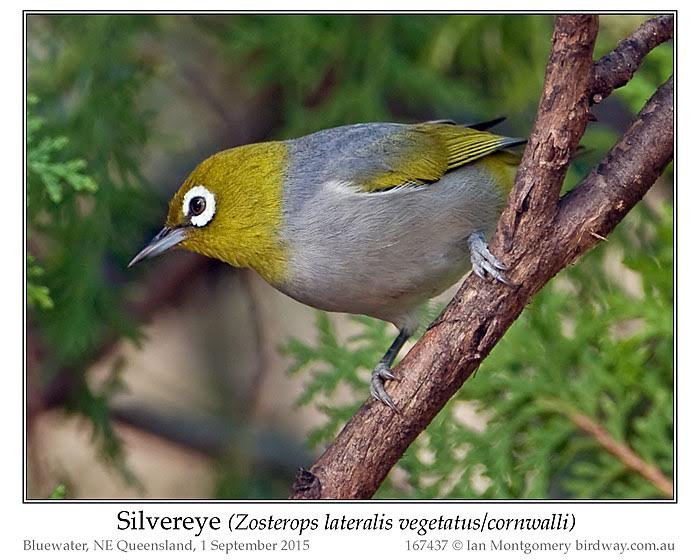
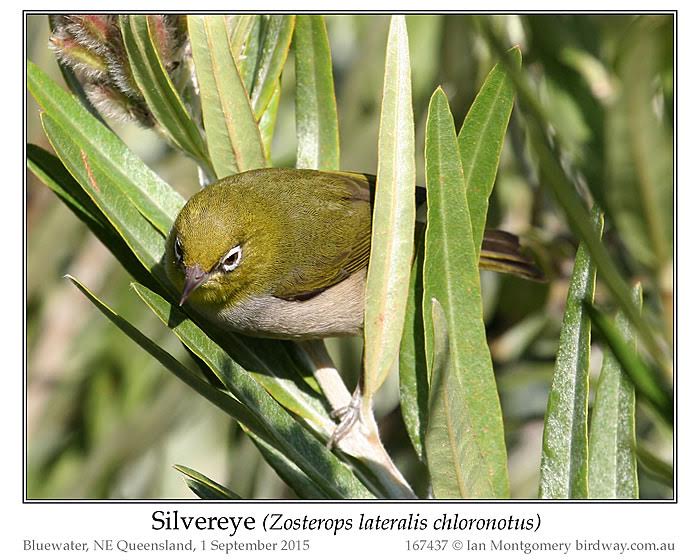
There are five mainland races ranging northeastern Queensland to Western Australia. The differences between these are subtle and the race grade into one another. Townsville, second photo, is in the zone of intergradation between the Cape York race (vegetus) and the eastern Australian one (cornwalli). Note the lack of the cinnamon flanks and the clear demarcation between the yellowish-green head and the grey back and compare that with the Western Australian race ,third photo, which has a green back and to which its sub-specific name chloronotus refers. (I’m using the words race and subspecies interchangeably here).

Silvereye (Zosterops lateralis) by Ian

There are three island races in addition to the Tasmanian one and they occur on King Island in Bass Strait; the islands of the Barrier Reef notably Heron Island; and on Lord Howe Island. The Lord Howe one, aptly name robusta, is larger and stronger than the nominate race and survived the introduction of mice and rats. That’s an interesting little story in its own right as it became very rare, was thought to have become extinct like other Lord Howe Island species and the nominate race was deliberately introduced to replace it. To everyone’s surprise the indigenous race survived, adapted to the presence of the rodents, recovered and the introduction of the nominate race was unsuccessful.

Silvereye (Zosterops lateralis) by Ian

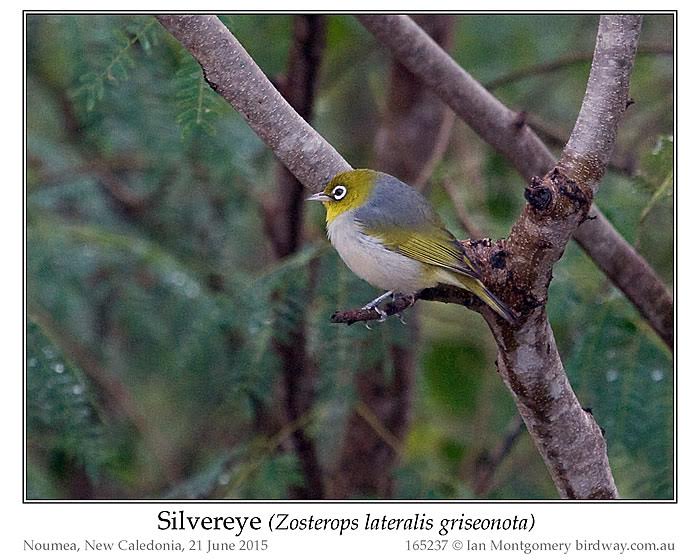
If you go farther afield to Norfolk Island expecting to find a distinctive looking local Silvereye, you’d be in for a surprise, fourth photo, as the locals, complete with cinnamon flanks, are indistinguishable from the nominate race, which it in fact is. If you went to New Zealand, the same thing would happen and you would find the nominate race on both main islands, Stewart Island, Chatham Island and the sub-Antarctic islands such as Snares, the Aucklands and Chatham. What happens if you head north and end up in New Caledonia? On the main island, you’d find this race, fifth photo, called griseonota, meaning, of course, ‘grey-backed’. Apart from the black smudge on the face, it looks to me very like the Cape York race.

Silvereye (Zosterops lateralis) by Ian

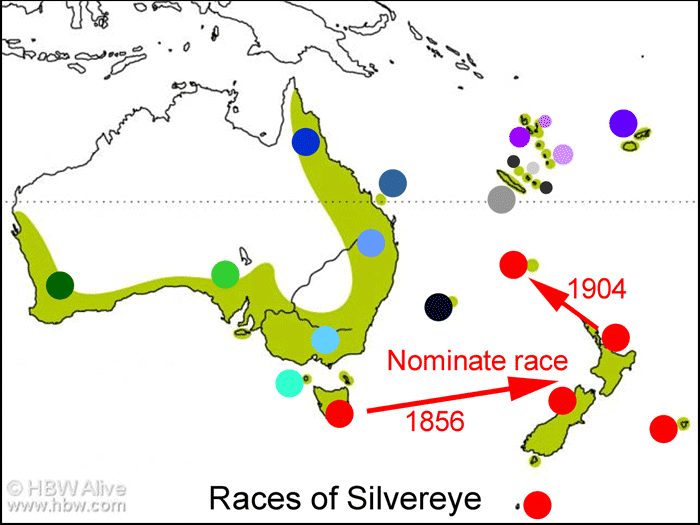
So what, you may ask, is happening? The proliferation of race suggests a sedentary species with little genetic mixing between neighbouring populations but this is contradicted by the widespread range of the Tasmanian race which suggests genetic flow between Tasmanian, Norfolk Island and New Zealand. In fact both are true to some extent, and this is where history comes to the rescue. Here is a map that I’ve drawn up showing the different races of the Silvereye using the basic range map from Handbook of Birds of the World (HBW) as a template. The different colours represent races. The red one is the nominate race; the other Australian races are shown in varying shades of blue and green and black; the New Caledonian races (three) in grey, the Vanuatu races (three) in purple and the Fiji race in indigo.

Silvereye (Zosterops lateralis) by Ian Map

The Tasmanian race isn’t completely sedentary. At least part of the population, probably mainly young birds, disperse in autumn and move Victoria and New South Wales for the winter. The Victorian ornithologist Alfred North noticed the change in plumage and ascribed it to winter and summer plumages. It was only later that it was realised that the change in appearance didn’t coincide with moulting in the mainland birds and the truth emerged. Incidentally, Latham’s original specimen came from ‘Port Jackson’ (Sydney) and must have been a Tasmanian bird.

As any blue-water sailor will tell you, the weather in Bass Strait between Tasmania and Victoria is notorious and a pleasant sail, or flight, in calm conditions can suddenly become a nightmare when a low pressure system and its associated cold front can arrive from the southwest. Powerful weather systems move continuously in an easterly direction between Tasmania and New Zealand. Have a look at the current four-day weather chart: http://www.bom.gov.au/australia/charts/4day_col.shtml. Another clue comes from the Maori name for the Silvereye: ‘tauhou’ meaning ‘stranger’. Silvereyes were rare vagrants to New Zealand until 1856 when large numbers appeared in the Welllington district, became established and spread to other parts of New Zealand. Similarly, Silvereyes first appeared in Norfolk Island in 1904 and it as assumed that these came from New Zealand rather than Tasmania. Silvereyes have benefitted from European settlement in Australia and it may be that is also a factor in their recent colonisation of New Zealand and Norfolk Island.

I wonder how the Silvereyes got to New Caledonia, Vanuatu and Fiji? These all look more like the Cape York race than the nominate one. Tropical cyclones in the Coral Sea are famously erratic and often head from Queensland to New Caledonia, so it looks as if the weather could play the main role here.

I’m going to stop here. I was going to talk about names and languages as well, but you can work that out for yourselves. We’ve already had cloronotus and griseonota for Australian races. Combine that with the French for Silvereye ‘Lunette a dos gris’ and the New Caledonian endemic Green-backed White-eye: ‘Lunette a dos vert’. Globally, there are almost 100 species of White-eye, not to mention races, and they nearly all look much the same, so pity any unfortunate taxonomists trying to be original.

And here’s a paper that I found interesting: http://aviculturalsocietynsw.org/_PDFs/Silvereye.pdf. You can check out photos of various White-eyes here: http://www.birdway.com.au/zosteropidae/index.htm.

Greetings

**************************************************
Ian Montgomery, Birdway Pty Ltd,
454 Forestry Road, Bluewater, Qld 4818
Tel 0411 602 737 ian@birdway.com.au
Bird Photos http://www.birdway.com.au/

And God blessed them, saying, “Be fruitful and multiply and fill the waters in the seas, and let birds multiply on the earth.” And there was evening and there was morning, the fifth day. (Genesis 1:22-23 ESV)

Lee’s Addition:

Well, Ian really got informative on these Silvereyes. Very interesting, at least to me. When the Lord commanded the birds to cover the earth and reproduce, these little avian wonders with beautiful silver eye rings seem to have obeyed.

*

Ian’s Bird of the Week

Ian’s Zosteropidae Family

Wordless Hummers

*

Diary of a Bird Photographer!

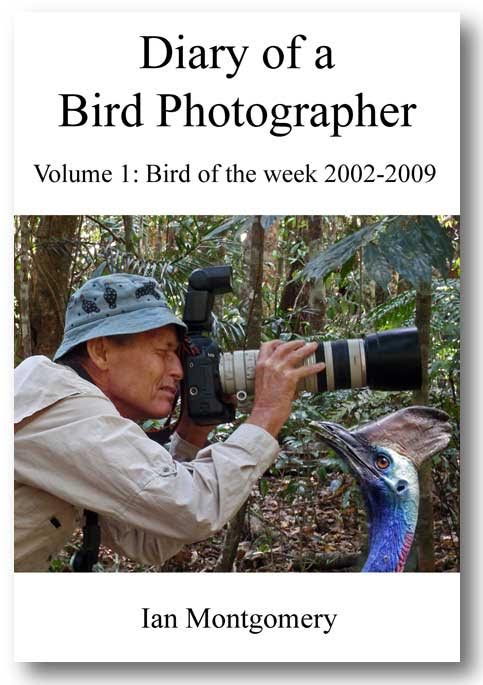
y electronic book Diary of a Bird Photographer has been released worldwide today, 31 August, on Apple iTunes BooksGoogle Books and Kobo Books! Find out more about it including availability, pricing, compatible devices and screenshots on the BIrdway website: http://www.birdway.com.au/birdphotographersdiary01.htm.

Ian's Book

Ian’s Book

With the increasing abundance of excellent bird photos on the internet, I am finding it more difficult to sell photos so moving into publishing is important for the future of my Birdway website and the Bird of the Week newsletter. Diary of a Bird Photographer contains the first 341 Bird of the Week postings spanning the period 2002-2009, contains more than 500 photos and 80,000 words – the length of an average novel. Depending on sales, l plan to publish 2010-2014 as another book.

With a recommended retail price of 8.00AUD, 7USD, 6EUR or the equivalent in your local currency it represents great value. By buying it for yourself and/or your friends or family and recommending it to others, you’ll earn my gratitude and show your appreciation for the bird of the week! Maybe you could forward this email to anyone who you think might be interested: that would be wonderful.

Greetings
Ian

PS Next bird of the week, a special parrot and the random bird of the week, should be out later today.

**************************************************
Ian Montgomery, Birdway Pty Ltd,
454 Forestry Road, Bluewater, Qld 4818
Tel 0411 602 737 ian@birdway.com.au
Bird Photos http://www.birdway.com.au/
Recorder Society http://www.nqrs.org.au


Lee’s Addition:

Seem’s as though Ian has written a book. Here is his newsletter telling about his “Diary of a Bird Photographer!”

His regular weekly newsletter – Ian’s Bird of the Week – will be published tomorrow.

“Flag That Bird!” (Part 5)

Black Swan ©WikiC
“Flag That Bird!”  (Part 5)

by James J. S. Johnson

Better is the end of a thing than the beginning thereof: and the patient in spirit is better than the proud in spirit.  (Ecclesiastes 7:8)

This is the fifth and last article in this “Flag that bird!” series, on various birds that appear on national flags.  (In other words, this is this mini-series’ “swan song”.)

All of us know enthusiasm-fueled folks who proudly launch into a new project – yet they soon falter, when the initial excitement fizzles, and they somehow fail to employ the prolonged patience to follow a long-term project through to completion.  (But, as we all know, “a job half-done is a job undone”.)  Thankfully, this blogsite mini-series, on “flag birds”, has now reached its proper closure!  Of course, there are other flags (such as state and provincial flags) that depict birds, but this set of articles has predominantly focused on birds portrayed on national flags.  Accordingly, as promised before, this final sequel features two huge birds, a swan and a crane, plus another bird whose identity is less than fully certain.

For a quick review, these vexillology-related birds were previously featured, as follows:

Part 1, posted at Flag That Bird – Part 1  — Belgium’s Wallonian Chicken (Gallus gallus domesticus); Portugal’s Northern Goshawk (Accipiter gentilis); Burma’s Green Peafowl (Pavo muticus); and Dominica’s Sisserou Parrot (Amazona imperialis);

Part 2, posted at Flag That Bird – Part 2  — the British Antarctic Territory’s Emperor Penguin (Aptenodytes forsteri), and the Saint Helena Plover, a/k/a Saint Helena’s skinny-legged “Wirebird” (Charadrius sanctaehelenae);

Part 3, posted at Flag That Bird – Part 3  — Kiribati’s Great Frigatebird Emperor Penguin (Fregata minor); and

Part 4, posted at Flag That Bird – Part 4  — Papua New Guinea’s Raggiana Bird-of-Paradise (Paradisaea raggiana, f/k/a Gerrus paradisaea), and the ubiquitous Dove, best illustrated by the common pigeon, a/k/a Rock Dove (Columbia livia).

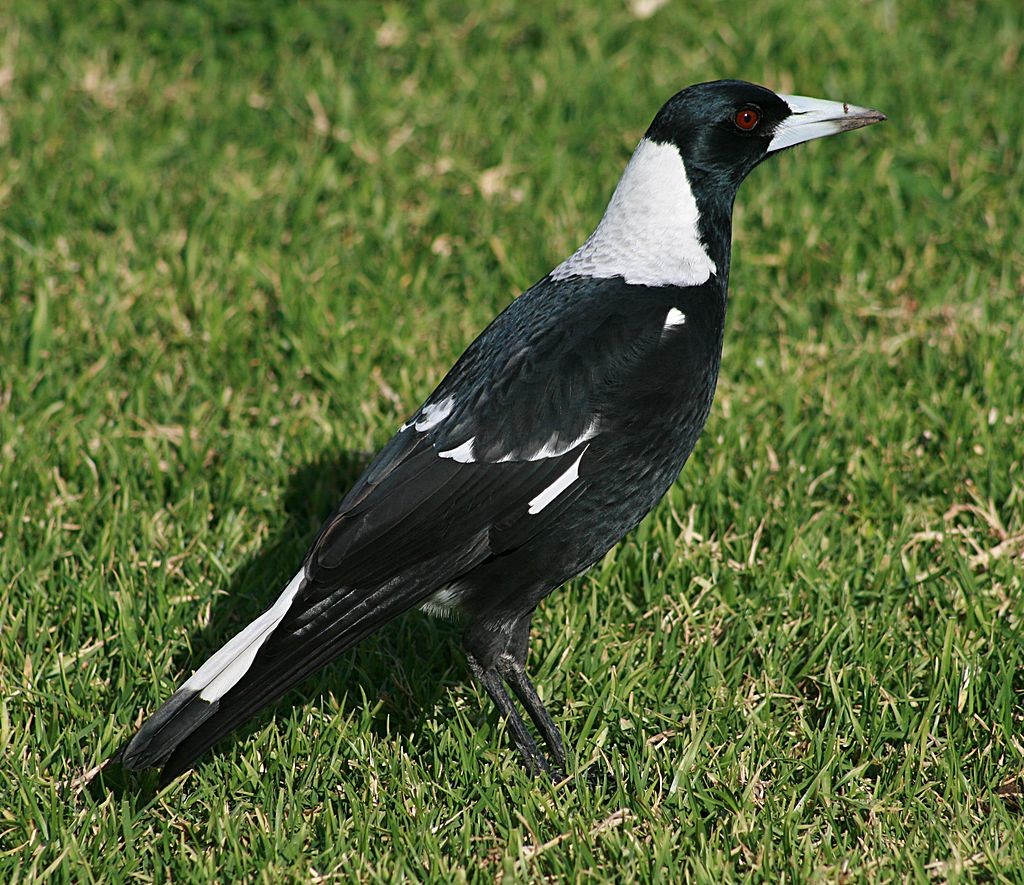
In this article, three remaining birds will be introduced:  (1) the black swan of Western Australia (Cygnus atratus); (2) the black and white “piping shrike” of South Australia, the exact identity of which is questionable, although this article will assume it is the same bird as the Australian magpie, perhaps more particularly the subspecies known as Cracticus tibicen telonocua, f/k/a Gymnorhina tibicen leuconota (e.g., by explorer Charles Sturt); and (3) Uganda’s crested crane (Balearica regulorum gibbericeps).

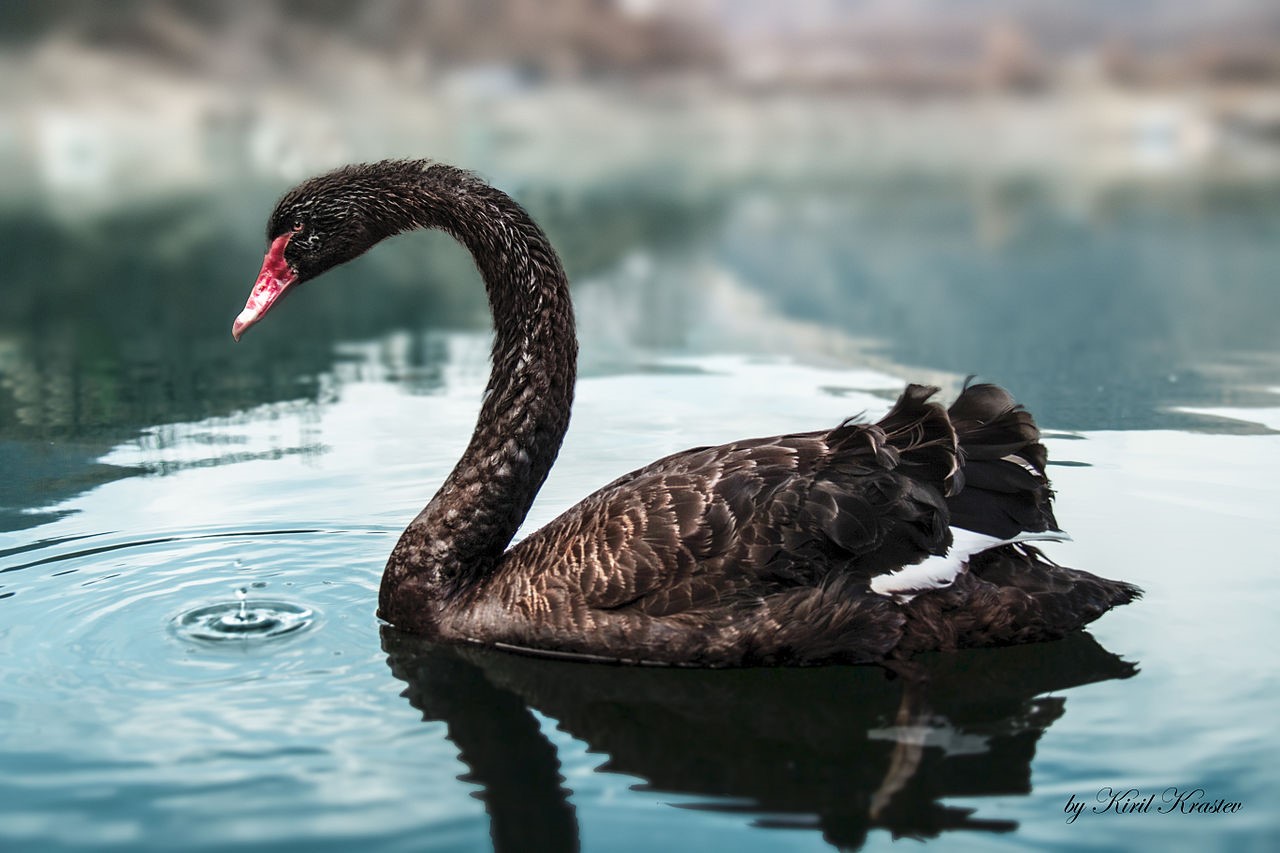
Black  Swan (Cygnus atratus).
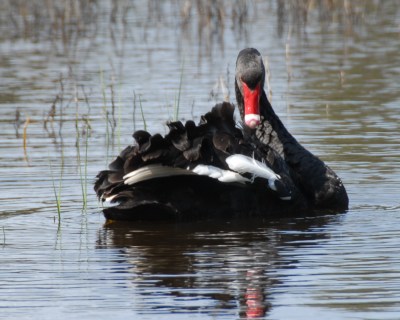
Black Swan (Cygnus atratus) Ruffled ©WikiC

Black Swan (Cygnus atratus) Ruffled ©WikiC

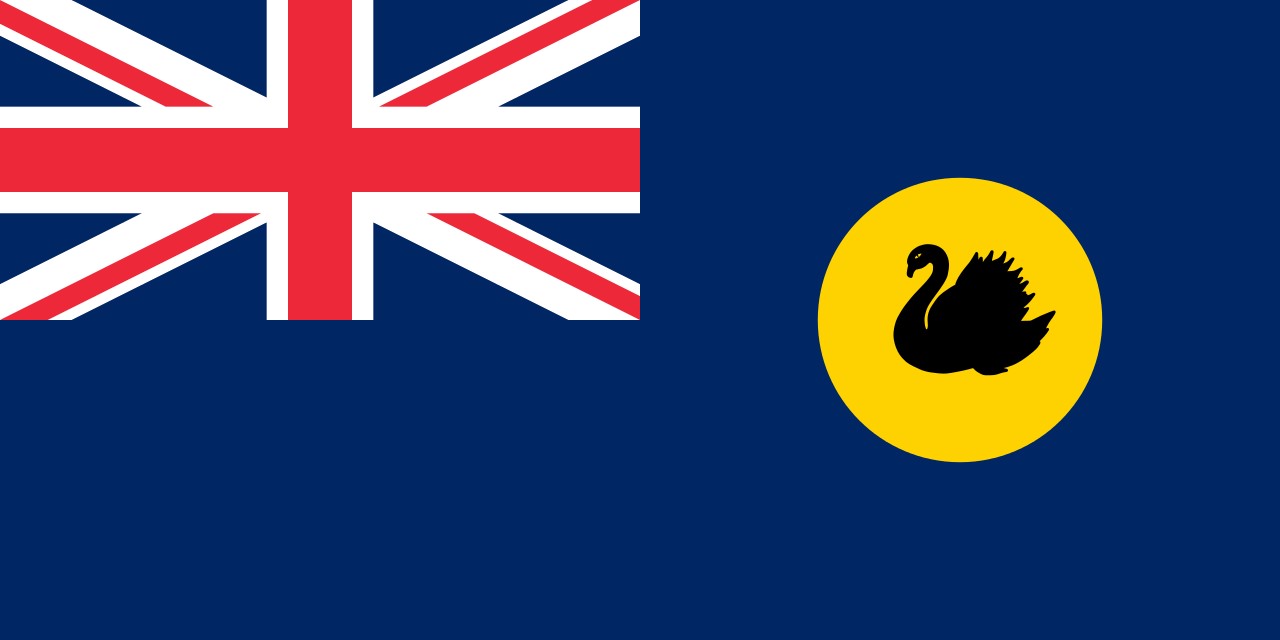
Western Australia’s Black Swan (Cygnus atratus) appears on the official state flag of Western Australia (sometimes contracted as “Westralia”), which occupies the western third (i.e., almost a million square miles) of that island-continent country.  The Black Swan also presents prominently on Western Australia’s official coat-of-arms, flanked by two kangaroos.
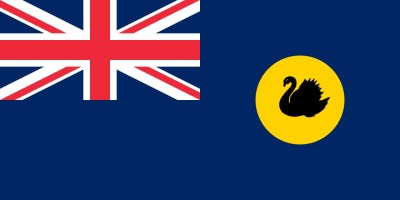
Flag that bird - Flag of Western Australia

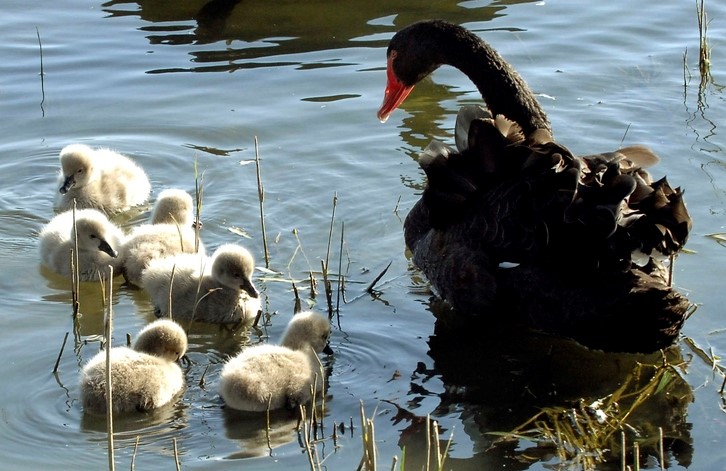
The Black Swan is well-named – their feathers are black (or black-grey, depending on how the sun shines on them), with a few white flight feathers.  Their bills are mostly bright scarlet, with a whitish bar near the tip.  And they are huge birds – adults can weigh between 8 to almost 20 pounds!  The wingspan breadth is between 5 to 6½ feet, like the length of a human lying down!  Their babies (called “cygnets”), however, are fuzzy white chicks, with dark bills, cute as they can be.

Black Swan (Cygnus atratus) with Cygnets ©WashPost

Black Swan (Cygnus atratus) with Cygnets ©WashPost

The first time that I ever saw Black Swans, excluding the confined context of a zoo’s aviary, was at The Broadmoor hotel complex in Colorado (located at the edge of Colorado Springs and Manitou Springs, within view of Pike’s Peak – an area perfect for viewing magpies).  But the Black Swan is not native to North America – it is an Aussie native.

Black Swan (Cygnus atratus) with Cygnets ©Broadmoor

Black Swan (Cygnus atratus) with Cygnets ©Broadmoor

Like other swans (e.g., the Trumpeter Swan, described at Trumpeting A Wildlife Conservation Comeback, its neck is S-curved and very long – in fact, the Black Swan has the longest neck of any swan.

Australian Magpie (Cracticus tibicen, a/k/a Gymnorhina tibicen).

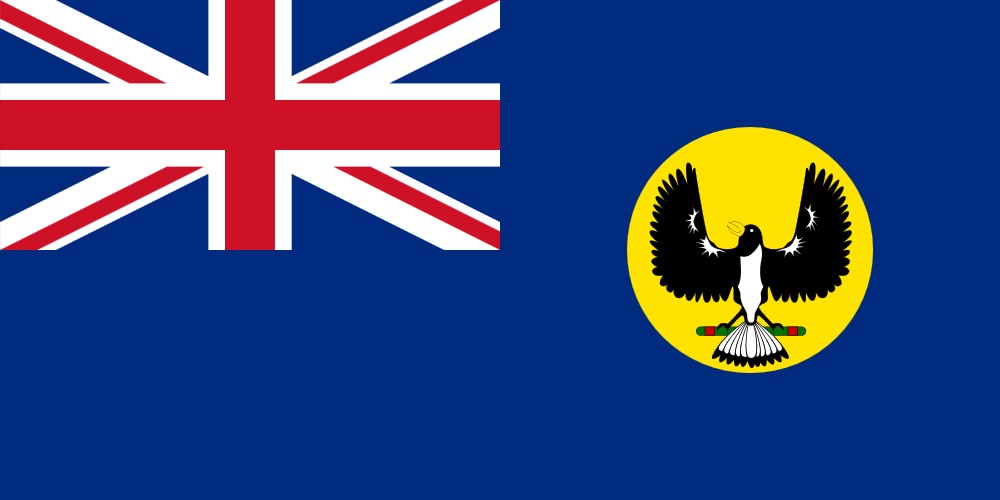
The official state flag of South Australia features a bird called a “piping shrike”, but what bird is that?  Many have analytically identified it as the species now called the Australian Magpie, (Cracticus tibicen), perhaps more particularly the subspecies once called the “White-backed Crow Shrike”, which his now called the white-backed magpie (Cracticus tibicen telonocua, f/k/a Gymnorhina tibicen leuconota).
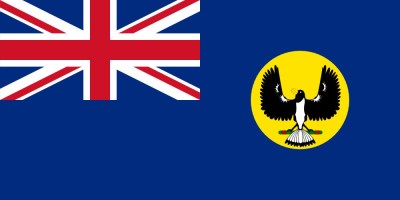
Flag that bird - Flag of Western Australia - Magpie

The Australian Magpie has several subspecies nowadays, nine according to some taxonomists – although ornithologists know that such lump-or-split classifications are vulnerable to slippery subjectivities.  [For an insight into the arbitrary subjectivity of “lumper”-versus-“splitter” taxonomy, see Footnote #2 within http://www.icr.org/article/valuing-gods-variety .]
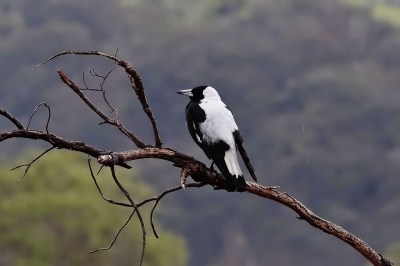
Australia Magpie on Dead Branch ©WikiC

Australia Magpie on Dead Branch ©WikiC

The Australian Magpie is deemed a type of “butcherbird” as opposed to the “corvid” category that includes the “magpies” of Europe and America.  The Australian Magpie is famous for its singing, entertaining (those with ears to hear) with a complex repertoire of vocalizations.  The black-and-white opportunist has habituated to human-dominated habitats, such as the agricultural fields of farms, gardens, and even wooded parklands.

Australia Magpie ©WikiC

Australia Magpie ©WikiC

The Australian Magpie is not a picky eater – its diet includes both plants and animals.  Its preferred diet, however, is dominated by a variety of larval and adult invertebrates, such as insects (like ants, moths, beetles, bees, wasps, cockroaches) and arachnids (like spiders, scorpions), as well as earthworms, millipedes.  The Australian Magpie is also known to eat some small vertebrates, such as rodents (like mice), lizards (like skinks), and/or amphibians (like frogs and toads).

Some compare the problem-solving resourcefulness and the brash cockiness – of this bird – to the national “reputation” displayed by many Aussie ex-patriots.  (Maybe Ken Ham should set the record straight on that topic!)  The Australian Magpie is quite a clever problem-solver  — it has been observed breaking off the stingers of bees and wasps, before swallowing such otherwise-dangerous bugs!  The Australian Magpie is not timid – it will defend its territory against raptors trespassing therein, such as Brown Goshawks.

Crested Crane (Balearica regulorum gibbericeps).

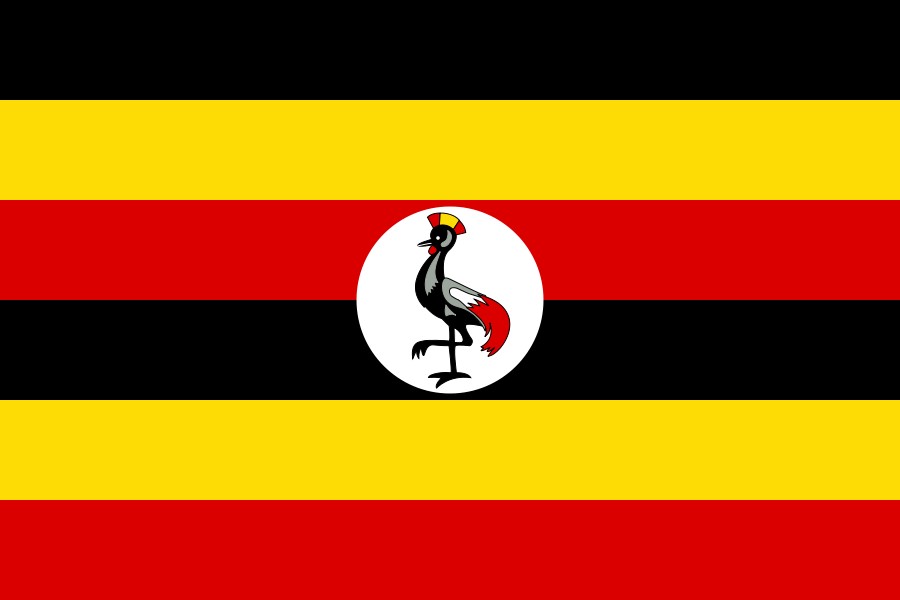
The official flag of Uganda sports a stylized depiction of a Crested Crane, a/k/a “East African Crowned Crane” (Balearica regulorum gibbericeps), which is a subspecies of the Grey Crowned Crane (Balearica regulorum).  The same crane appears on the Ugandan coat-of-arms.

The Ugandan coat-of-arms provides a more realistic picture of a Crested Crane.

Ugandan coat-of-arms Crested Crane

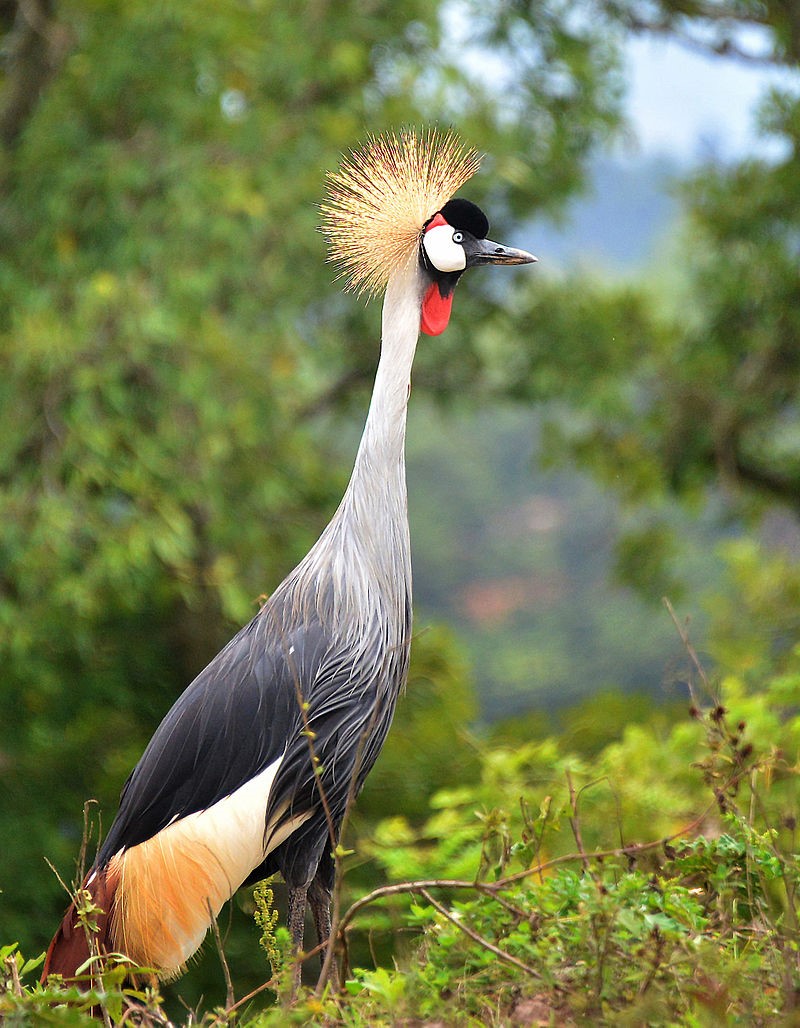
The East African Crowned Crane (a/k/a Crested Crane) is a tall bird, standing up to 4 feet tall!  It can weigh 6 to 8 pounds, while sporting a wingspan breadth of 6½ feet.  The plumage is dominated by slate-grey feathers, with wing feathers of white and chestnut orange.  The Crested Crane’s black head is adorned by white cheeks (accented with red) and a showy 3D “fan” crest, of golden top feathers, somewhat resembling fireworks.
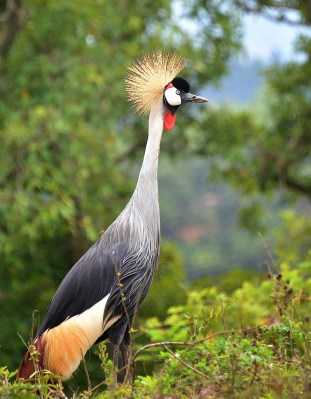
Grey Crowned Crane ©WikiC

Grey Crowned Crane ©WikiC

Cranes – of various species – are famous for their long necks and long thin legs. Unlike herons (which fly with their necks “pulled back”), the Crested Crane (like other cranes) flies with its neck straightened and outstretched.  Like other cranes, the Crested Crane is gregarious – their aggregate nesting territories may host a flock of up to 200 residents.  These cranes are typically monogamous and territorial.  These socially stable birds are known to live as long as 20 to even 40 years of age.

In the wild, the Created Crane eats a mix of seeds (such as grains), other plant materials, insects, and worms.  Other foods eaten include eggs and fish, and even small lizards and frogs.  This diet is similar to the diet of other cranes (e.g., Sandhill Crane, Whooping Crane, Common Crane, etc.) around the world.  Cranes routinely eat whatever is available and convenient, so cranes are classified as “opportunist” feeders – consuming small mammals (like rodents), fish, snails, amphibians (like frogs), worms, insects, seeds (like grains, nuts, acorns), berries, root vegetables, and other plant materials (such as leaves.  As a matter of biome ecology, most cranes prefer wetlands, such as mudflats and other shorelands, or in wide open fields, such as prairies.
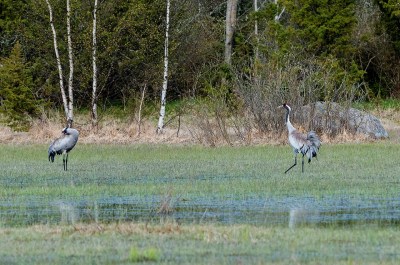
Common Crane in Estonia ©WikiC

Common Crane in Estonia Wetland ©WikiC

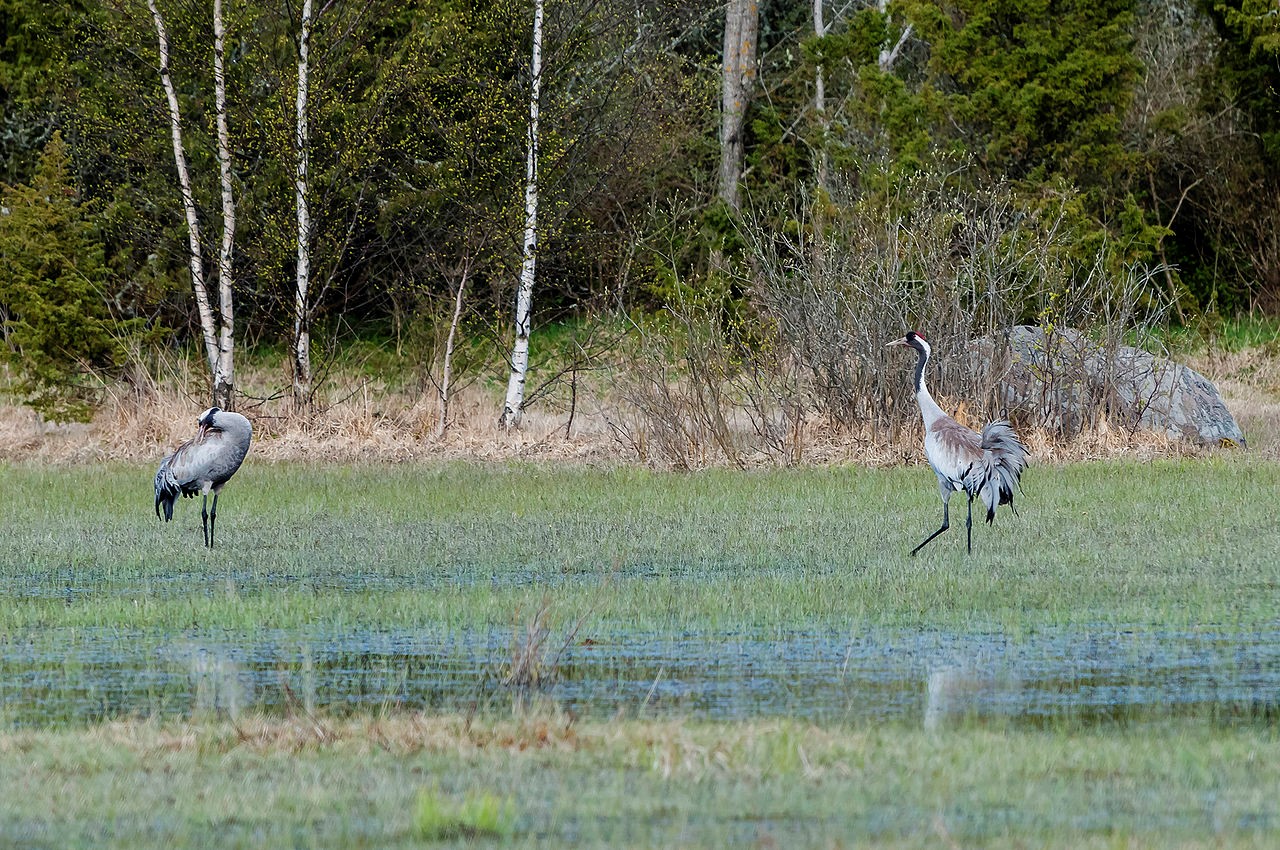
The “Common Crane” (Grus grus) is a cousin the these African cranes.  The Common Crane has a summer range, typically boreal forests (called taiga in Russia) that covered most of the top half of Eurasia, with blotches of winter ranges in Europe (Spain), Asia (e.g., China), and parts of Africa.

The zoologist George Cansdale [see his ALL THE ANIMALS OF THE BIBLE LANDS, pages 158-159] – after analyzing the mix of Biblical, ornithological, and biogeographical evidence – concludes that the Hebrew noun ‘agûr (e.g., in Jeremiah 8:7 & Isaiah 38:14) refers to the noisy Common Crane (Grus grus), an identification that the learned Hebrew scholar John Joseph Owens concurs with [see his ANALYTICAL KEY TO THE OLD TESTAMENT, volume 4, pages 116 & 242].  Matching the ‘agûr of Isaiah 38:14, the Common Crane is clamorously noisy, especially when agitated.  Cranes are also phenological migrants, a trait that accords with Jeremiah 8:7.

A review of our introductory verse provides another insight, the contrast between patience and pride:

Better is the end of a thing than the beginning thereof: and the patient in spirit is better than the proud in spirit.  (Ecclesiastes 7:8)

In Ecclesiastes 7:8 the Hebrew adjective translated “patient” is ’erek – it denotes someone or something that is prolonged, drawn out, slow, longsuffering.  Accordingly, to be “patient in spirit” is to be willing to wait one’s turn, according to God’s providential line-up (and timing).  A humble person doesn’t butt in line; he or she patiently waits in the queue, for his or her turn.

In Ecclesiastes 7:8 the Hebrew adjective translated “proud” is gabah  — it denotes someone or something that is high, haughty, or high-minded, in some contexts what we sometimes call “uppity”.  Accordingly, to be “proud in spirit” is to regard one’s self as higher that one should, which is the opposite of what God (through Paul) commands us to be:

Let nothing be done through strife or vainglory; but in lowliness of mind let each [i.e., all of us] esteem others better than themselves.  Look not every man on his own things, but every man also on the things of others.  (Philippians 2:3-4)

Interestingly, humility and patience go well together, because accomplishing a long-term project often requires interacting successfully with other people, and getting other people to coöperate with you (so that your goals can be furthered) routinely requires you to serve their needs and goals.  This is called mutual symbiosis when we see it in birds; we call it “win-win” coöperation when humans do it.  In win-win situations the coöperating parties both further their respective goals, so their interactive relationship is not one-sided. (Contrast this with “parasite”-like people, who habitually take, but won’t give).

Unsurprisingly those who are haughty-minded, being selfish, are slow to appreciate this life principle, because “uppity” people cannot understand or accept the law of Acts 20:35, that “it is more blessed to give than to receive” (quoting the Lord Jesus Christ Himself).  Consequently, many who could help them, with their project checklists, may shy away  –  why host a parasite?   And so it is that many who are haughty are proud to assertively start – yet don’t finish – complex projects that require prolonged patience.   Why?  Part of the cost of succeeding was the cost of benefiting others who contribute to the project.  The end is predictable:  failure and shame.

For which of you, intending to build a tower, sitteth not down first, and counteth the cost, whether he have sufficient to finish it?  (Luke 14:28)

A sober lesson for long-term projects (including long-term relationships)!  Yet, this is a lesson much needed in America, nowadays, where impatient and high-minded “get-rich-quick” tactics all-too-often end in disappointment and discord.  (This author has seen many illustrations of this in business bankruptcy cases and in employment law contexts.)

In sum, thankfully, this “flags” the end of this mini-series on national vexillology-related birds.

*

“Flag That Bird!”(Part 1)(Part 2)(Part 3)(Part 4) 

Orni-Theology

James J. S. Johnson’s Articles

*
Ian’s Bird of the Week – Diamond Dove

Before I get to the Diamond Dove, I have an appeal to any members who have been on the Bird of the Week list since 2003 and who have kept copies of the postings. It’s a long shot I know, but I lost the text of some of the early ones in a hard disk crash and I’ve nearly finished compiling the first volume covering 2002 to 2009 of the ebook Diary of a Bird Photographer. I have all the photos but not the descriptions of: Red-capped Plover 9 March 2003, Bank Myna 1 June 2003, Spinifex Pigeon 2 July 2003, Leaden Flycatcher 29 July 2003, Australian Pelican 7 July 2003 and Noisy Pitta 15 February 2004. If you have them, I’d be very grateful if you’d let me have the text by email and the first six respondents who can provide each of the missing ones will get a free copy of the ebook when it’s published.

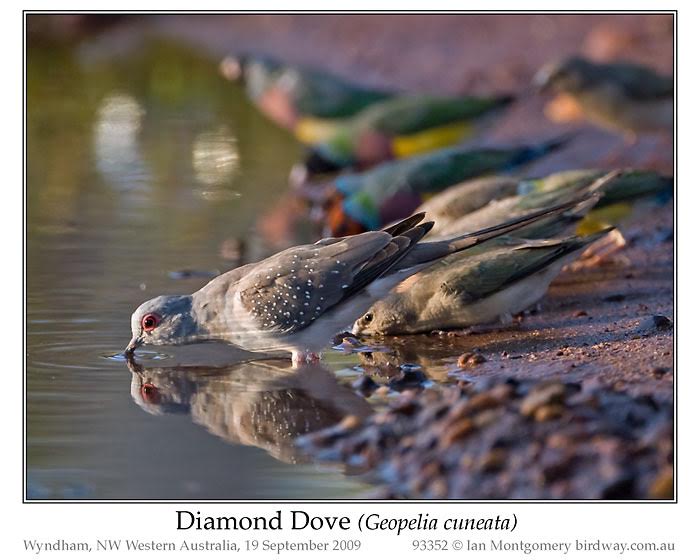
Diamond Dove (Geopelia cuneata) by Ian 1Back to the Diamond Dove. Having cut the recent camping trip short, I didn’t come back with the anticipated collection of photos of dry country birds, but here is one such species from earlier trips as compensation. This delightful, tiny dove is found in arid country throughout mainland Australia. It depends on the availability of water and moves long distances in time of drought. It’s comparable in length to its close relative the Peaceful Dove (both about 19-24cm/7.5-9.5in) but has a relatively much longer tail and smaller body. So it tips the scales at a mere 28-43g/1-1.5 compared with 41-66g/1.5-2.3 for the Peaceful Dove.

Diamond Dove (Geopelia cuneata) by Ian

You can see how small it is in the second photo where it is drinking with finches just after dawn – being a late riser I can’t help boasting when I get up early. There are two points of interest in this photo. The finches in question are Gouldian – there had to be a good reason for me to get up in the dark at 5:30am in Kununurra and drive 100km to Wyndham. There are more photos of the Gouldians here. The other point is that the dove is demonstrating the drinking skill of members of the Pigeon and Dove family, the Columbidae. They drink by sucking and swallowing and don’t have to first sip and then tip their heads back like almost all other birds do. Apparently, they can drink six times faster in this way, maybe a useful survival strategy in a very vulnerable situation. Incidentally, I also photographed drinking Crested Dove at the same spot 15 minutes later, by which time the finches had left.

Diamond Dove (Geopelia cuneata) by Ian

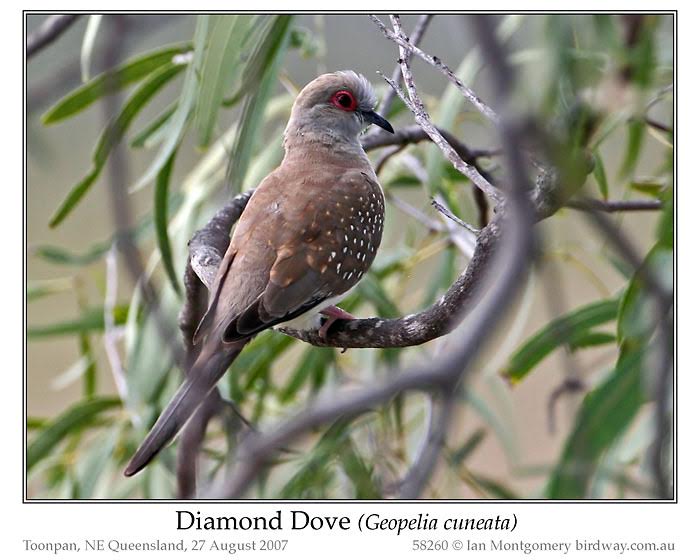
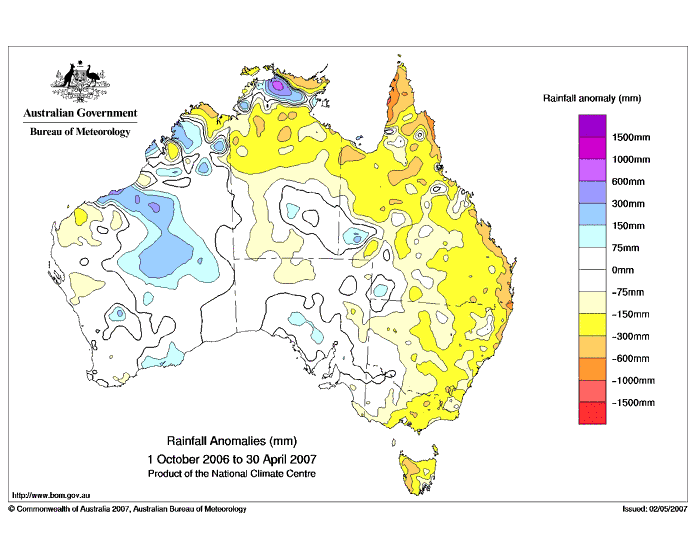
Diamond Doves have strikingly red eye-rings, quite unlike the blue-grey ones of Peaceful Doves, and small white spots on the wing coverts which give them their common name. The eye-rings are red in adults, and although those of males are supposed to be larger and brighter than those of females, and females are supposed to have browner plumage, I can’t find any consistent differences. The one in the third photo has a brownish wash on the wings and a very striking eye-ring, which would make it trans-gender according to those criteria. That photo was taken just south of Townsville. 2007 was a very dry year in eastern Australia (see below) and at such times, Diamond Doves may show up quite close to the coast.

Diamond Dove (Geopelia cuneata) by Ian
The bird in the fourth photo is a juvenile and has not yet developed the red eye-ring and red legs of the adult. The barring on the head and breast reveals its close relationship to the Peaceful Dove, but note that it has the diagnostic white spots of the Diamond Dove on the wing coverts.

Diamond Dove (Geopelia cuneata) by Ian

Regarding the Scientific name, Geopelia means ‘ground dove’ in Greek and refers to the feeding habits of member of this genus. Diamond Doves feed predominantly on grass seeds and usually very small ones at that. The specific name cuneata means ‘wedge-shaped’, coming from the Latin cuneus meaning a ‘wedge’. I suppose it must refer to the pointed tail, but it isn’t what I usually think of as a wedge-shaped tail, compared with the wedge-tailed eagle and shearwater.

Diamond Dove (Geopelia cuneata) by Ian

“cuneiform ground dove”

Needless to say, I couldn’t resist Googling deeper into the related word ‘cuneiform’, which refers to the wedge-shaped characters used mainly on clay tablets in ancient Mesopotamia and Persia. This led me to the website of the Pennsylvanian Museum which gives you the opportunity to write your initials as a monogram ‘like a Babylonian’. The above image shows the result for ‘DOVE’, clearly not just any dove of course but a cuneiform ground dove.

Greetings
Ian

**************************************************
Ian Montgomery, Birdway Pty Ltd,
454 Forestry Road, Bluewater, Qld 4818
Tel 0411 602 737 ian@birdway.com.au
Bird Photos http://www.birdway.com.au/
Where to Find Birds in Northern Queensland: iTunesGoogle Play Kobo Books
Recorder Society http://www.nqrs.org.au


Lee’s Addition:

Behold, I send you forth as sheep in the midst of wolves: be ye therefore wise as serpents, and harmless as doves. (Matthew 10:16 KJV)

These doves are quite small in comparison to other members of the Columbidae family. During our trip we saw the Western (Blue) Crowned and Victoria Crowned Pigeons, which are some of the larger members of the family.

The way they drink, by sucking is very interesting. I am sure the Lord had a reason for creating them this way. May have to research that some day.

*

Ian’s Bird of the Week – Galah

Galah (Eolophus roseicapilla) by Ian at Birdway
Ian’s Bird of the Week – Galah ~ by Ian Montgomery

Newsletter – 6/6/15

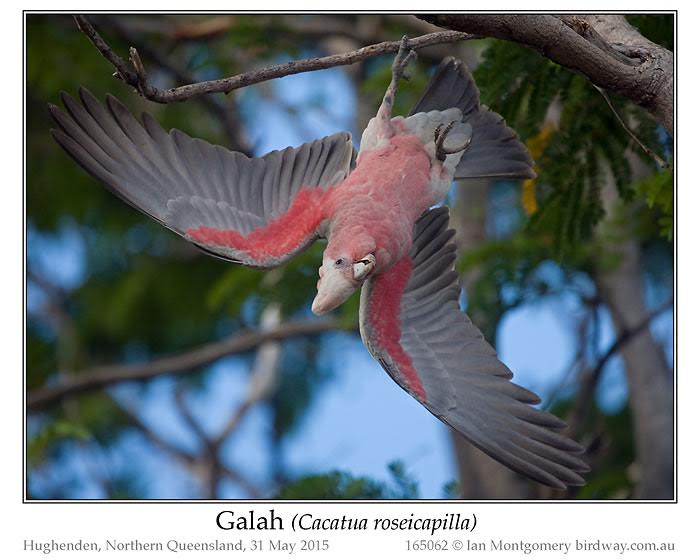
I’m back home after cutting short the camping trip in Western Queensland owing to a foot problem which made both camping and walking difficult. The foot is responding well to treatment at home in preparation for the New Caledonian trip in two weeks time. So I didn’t return with lots photos of dry country species for you but I did get treated to a fine display by an extrovert male Galah who came along to distract me while I was putting up my tent in Hughenden.

He wasn’t the only distractor; the camp site know-all gave me a lecture on the order in which to assemble my tent. The Galah was more welcome and I encouraged him, unlike the human, verbally. You can imagine the conversation going a bit like this.
‘I’ve heard that you bring birds fame and fortune with your Bird of the Week email. Can I be your bird of the week?’

‘Sorry Galah was BotW in 2006 (below). I like to have a different species each time.’

‘Ah, pleeeease!!!’ (below)

Galah (Eolophus roseicapilla) by Ian at Birdway

‘Well, okay, we’ll see. But you’ll have to do something spectacular to make it worth my while.’

‘How about this? I’ll look cute and demented at the same time.’

Galah (Eolophus roseicapilla) by Ian at Birdway

‘Mmmmh. Not bad but the juvenile Galah did that in 2006 and simultaneously begged for food.’

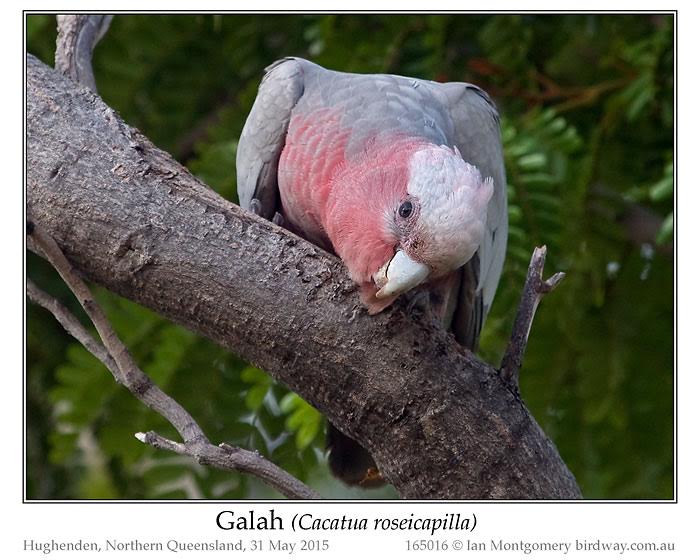
‘I can hang upside-down and look at you at the same time without losing my grip.’

Galah (Eolophus roseicapilla) by Ian at Birdway

‘That’s better! Anything else?’

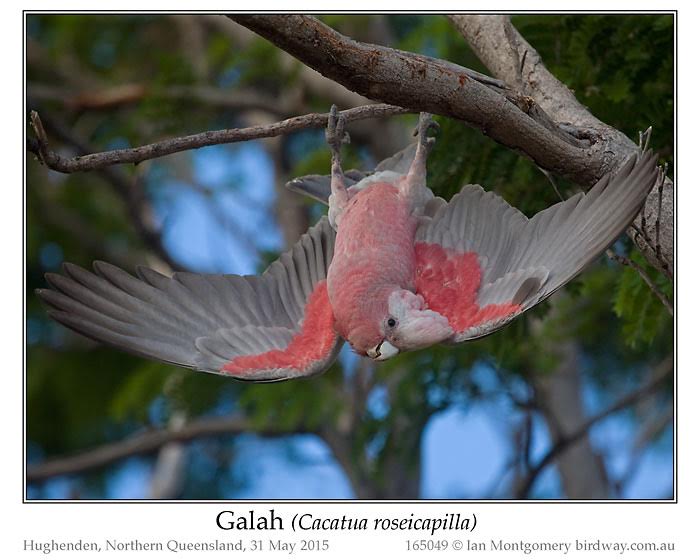
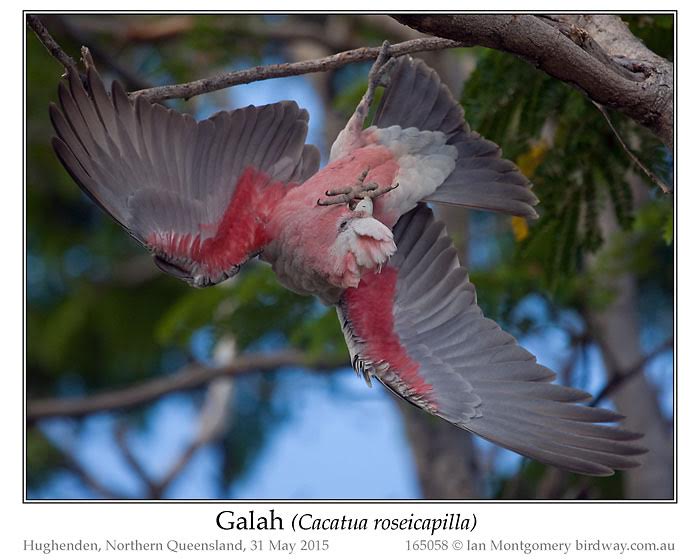
‘I can hang upside-down with just one claw, no safety net, raise my crest and nibble my other foot simultaneously without falling off.’

Galah (Eolophus roseicapilla) by Ian at Birdway

‘Now that’s impressive: you win. You can be the next bird of the week.’
‘Whoopee, thank you!!! Happy camping!’

Galah (Eolophus roseicapilla) by Ian at Birdway

At that point the camp-site know-all came along.

The Galah said: ‘Oh no! I’m out of here!’ and flew away. Despite their name, Galahs aren’t stupid.

Galah (Eolophus roseicapilla) by Ian at Birdway

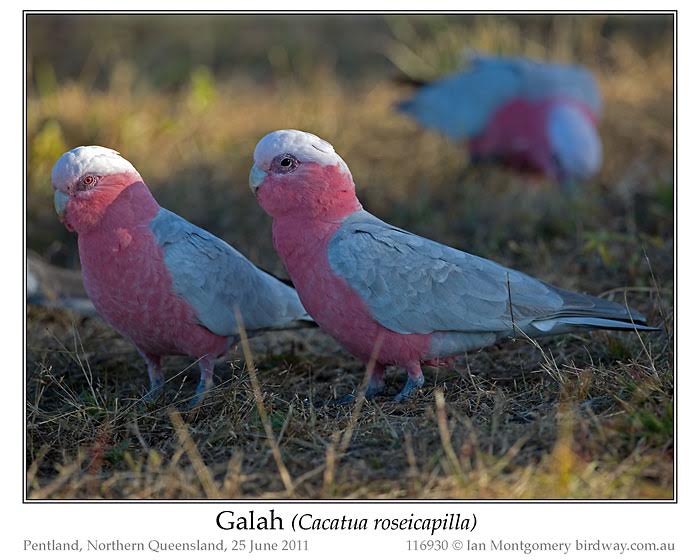
Just in case you are wondering why I said the bird was a male, it’s all in the eyes. Males have dark brown irises, females have red ones as in the photo above taken on a different occasion at Pentland not that far from Hugenden. This is also the case in Major Mitchell’s Cockatoo.

Greetings

Ian
**************************************************
Ian Montgomery, Birdway Pty Ltd,
454 Forestry Road, Bluewater, Qld 4818
Tel 0411 602 737 ian@birdway.com.au
Bird Photos http://www.birdway.com.au/

Where to Find Birds in Northern QueenslandiTunesGoogle Play Kobo Books
Recorder Society http://www.nqrs.org.au


Lee’s Addition:

The works of the LORD are great, sought out of all them that have pleasure therein. (Psalms 111:2 KJV)

What a delightful newsletter. Sorry about your foot though, Ian. We will be praying that you heal quickly so you can make that next trip. Who knows what adventure you will come back to tell us about?

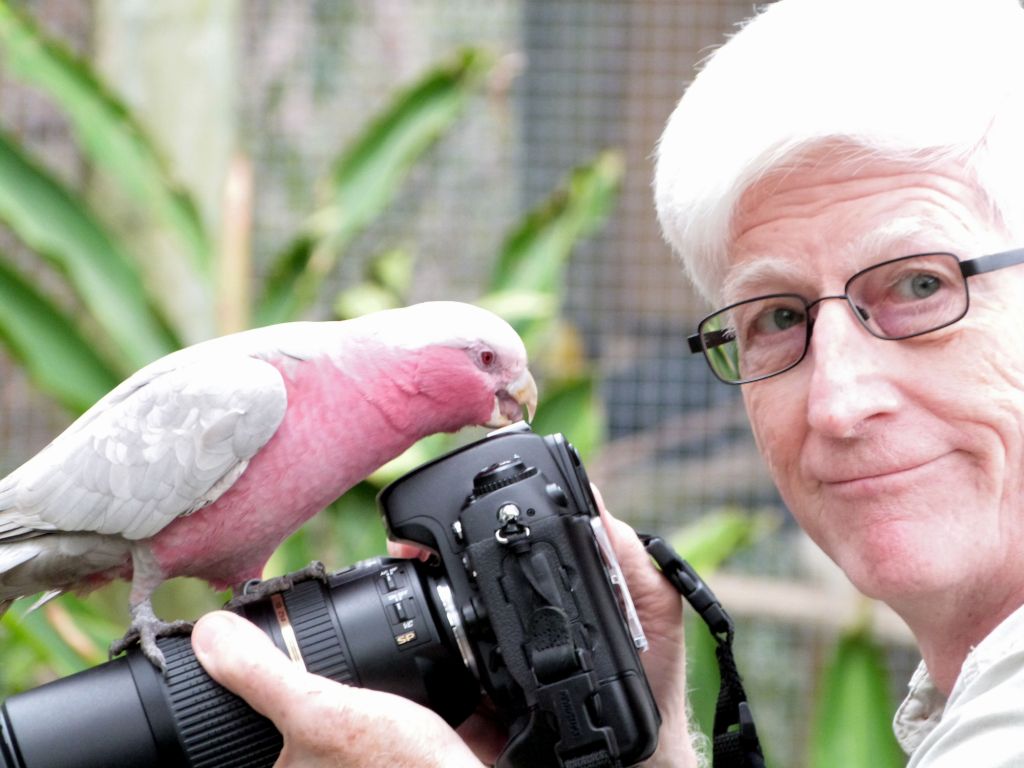
As many of my readers know, the Galah has become on of my favorite birds. Every since our encounter with the Galah at Brevard Zoo, when this photo was taken.

Galah (Eolophus roseicapilla) and Dan

Galah (Eolophus roseicapilla) and Dan

*

*

Ian’s Bird of the Week – White-browed Scrubwren

Ian’s Bird of the Week – White-browed Scrubwren ~ by Ian Montgomery

Newsletter – 5/28/15

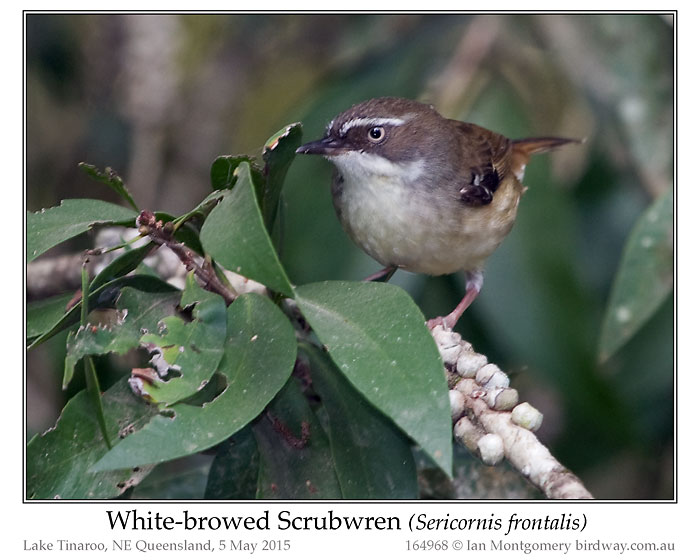
I said in the last bird of the week that the Atherton Scrubwren was ‘probably the least distinctive of the Wet Tropics Endemics’. By that I meant it was hard to identify with certainty owing to lack of distinguishing field marks and I didn’t intend to imply that it was otherwise undistinguished. I’m actually very fond of scrubwrens. They are assertive little birds with lots of character, so here is the most widespread one, the White-browed Scrubwren by way of amends! It occurs right along the coasts of eastern, southern and western Australia from Mossman – not far north of where we were at Lake Tinaburra a few weeks ago – in far north Queensland (FNQ) to just north of Carnarvon in Western Australia. The one in the first photo was in the company of the Atherton Scrubwrens near the ‘amenities’ block in the campground.

White-browed Scrubwren (Sericornis frontalis) by Ian

White-browed Scrubwrens vary in plumage by location and there has been considerable disagreement among avian taxonomists over the centuries over how to divide them into species and sub-species or races. Schodde and Mason described 12 races in their authoritative Directory of Australian Birds (1999). However, the various races grade into each other and are often only distinguishable in the hand or museum. Criteria such as “feet pale flesh, drying consistently pale brownish cream, lower mandible drying variously bone to sometimes rather dusky” is not something even the most patient field worker would use.

White-browed Scrubwren (Sericornis frontalis) by Ian

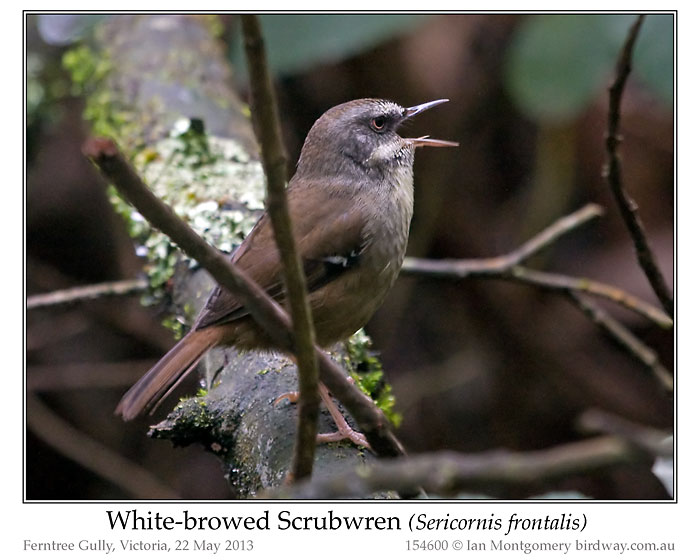
So, it’s more usual now to lump these races into 3 mainland groups and the treat the Tasmanian ones as a separate species. We’ll take a clockwise trip from Tinaburra in FNQ to Cheynes Beach in southwest Western Australia to look at these, and then come back to the Tasmanian species. The females are paler, less-contrasty versions of the males, so we’ll just consider males, once we’ve looked at the two sexes in the distinctive Queensland race, laevigaster. The one in the first photo is a female, while the one in the second is a male. Both sexes have pale underparts that look pale yellow or buff, strong white eyebrow extending well behind the eyes and no white line just under the eye (suborbital). The male has a strikingly black mask extending over the ear-coverts, and is, in my opinion, the smartest of the White-browed Scrubwrens and looks somewhat like a pale Yellow-throated Scrubwren.

White-browed Scrubwren (Sericornis frontalis) by Ian

South of the Queensland border we encounter the nominate race group, frontalis. This group extends all the way through New South Wales and Victoria into eastern South Australia. The one in the third photo, taken in the Blue Mountains west of Sydney, is more rufous on the back and flanks than the Queensland race, the black on the face is limited to the lores in front of the eye (the ear coverts are grey), the eyebrow fizzles out behind the eye and the there is a faint suborbital white line.

White-browed Scrubwren (Sericornis frontalis) by Ian

The birding singing lustily in the fourth photo near Melbourne is also of the nominate group, though it looks darker overall and has even less of an eyebrow.

White-browed Scrubwren (Sericornis frontalis) by Ian

When we get to Western Australia, we encounter the ‘spotted Scrubwren’, race maculatus with dark spots on the throat and breast, buffish underparts, a long eyebrow, a clear suborbital line and, like the nominate group, the black face mask limited to in front of the eye.

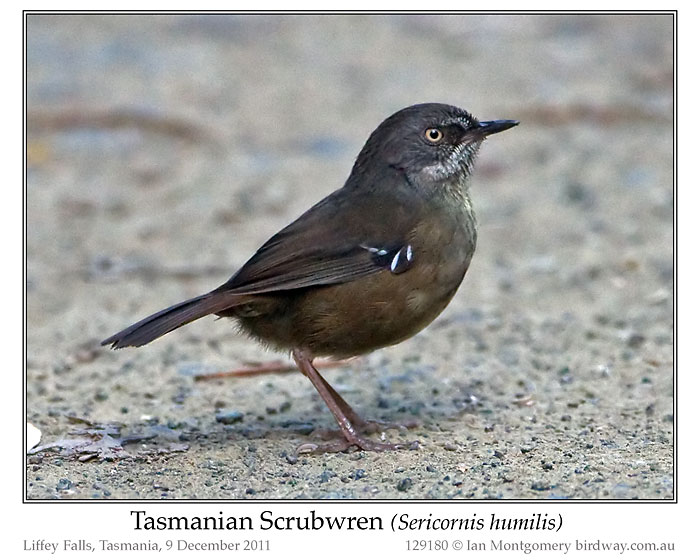
The sixth photo shows the Tasmanian one It was first described as a separate species by Gould in 1838; lumped in with the other White-browed Scrubwrens in the 20th century and now restored to the grand status of a full species in the 21st century. In taxonomy, plus ça change, plus c’est la même chose, a quote from 1849, though Jean-Baptiste Alphonse Karr probably wasn’t thinking of taxonomy at the time. He did, however, have two varieties of Dahlia and a bamboo named after him. Anyway, The Tasmanian one is very dark, though in other ways such as its faint white markings on the head it looks quite like the Victorian one in the fourth photo, though the white epaulettes are very distinct. It’s also quite large by Scrubwren standards (12-14cm/4-5in in length).

Tasmanian Scrubwren (Sericornis humilis) by Ian

Scrubwrens inhabit dense undergrowth, but as long as that is provided they occur in wide variety of habitats from rainforest to scrubby heaths and are quite common. They are both vocal and curious, responding well to ‘pishing’ noises, so they are easier to find than their choice of habitat would suggest. They’re very active, foraging near the ground, often in leaf litter for insects or other invertebrates. The breed in pairs or groups consisting of a breeding pair and helper birds, an arrangement that seems remarkably widespread across Australian bird families.

I’m off the western Queensland on Saturday. Hopefully, I’ll have some interesting dry country birds for you but don’t expect anything for another couple of weeks.

Greetings
Ian

**************************************************
Ian Montgomery, Birdway Pty Ltd,
454 Forestry Road, Bluewater, Qld 4818
Tel 0411 602 737 ian@birdway.com.au
Bird Photos http://www.birdway.com.au/
Where to Find Birds in Northern Queensland: iTunesGoogle Play Kobo Books
Recorder Society http://www.nqrs.org.au


Lee’s Addition:

Then God said, “Let the waters abound with an abundance of living creatures, and let birds fly above the earth across the face of the firmament of the heavens.” (Gen 1:20)

I find these Scrubwrens that Ian has been introducing very cute and interesting. Last week’s Atherton Scrubwren and now these two species are the little bird types that drive me crazy trying to photograph. Ian has a knack for getting great photos. Thanks, Ian, for sharing these with us. Happy hunting on you new quest.

*

Ian’s Bird of the Week

Ian’s Whole Acanthizidae Family

Acanthizidae – Australasian Warblers

*

Ian’s Bird of the Week – Atherton Scrubwren

Ian’s Bird of the Week – Atherton Scrubwren ~ by Ian Montgomery

Newsletter – 05-18-15

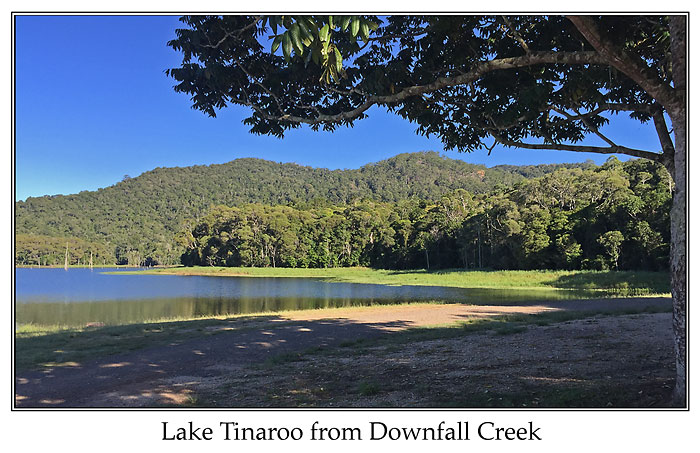
I’ve just spent a few relaxing days camping with friends on the shores of Lake Tinaroo on the Atherton Tableland west of Cairns, so here is the eponymous Atherton Scrubwren a pair of which were foraging in the undergrowth on the edge of the rainforest behind the toilet block. You do of course take your camera with you everywhere, don’t you?
Lake Tinaroo by Ian

This is one of about a dozen bird species that are endemic to the Wet Tropics of Northeastern Queensland. Like several others, e.g. the Golden Bowerbird and the Mountain Thornbill, it is a bird of the highland rainforest, usually found about 600m/2000ft, occasionally down to 400m/1300ft. Lake Tinaroo is at an altitude of 670m/2200ft and be reached by the Gillies Highway from Gordonvale. This highway follows an extraordinary and interminably windy route up the escarpment from the coast, and is the only route on which I suffer from motion sickness even when I’m doing the driving. It is very scenic with spectacular views over the Goldsborough Valley, if you are feeling well enough to appreciate them.

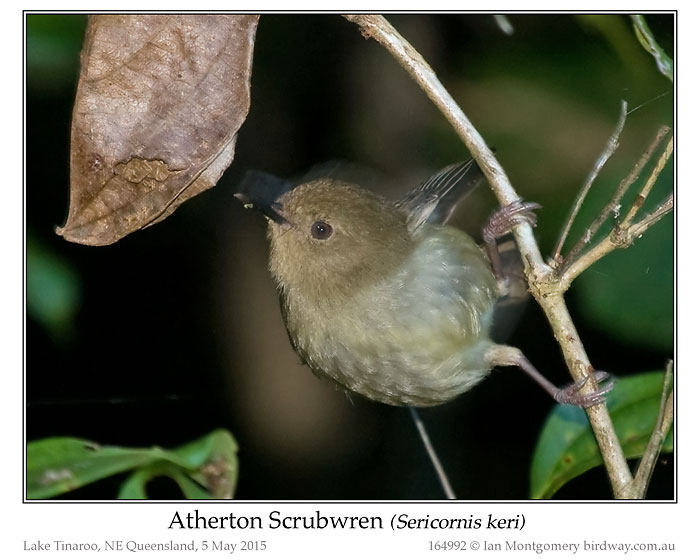
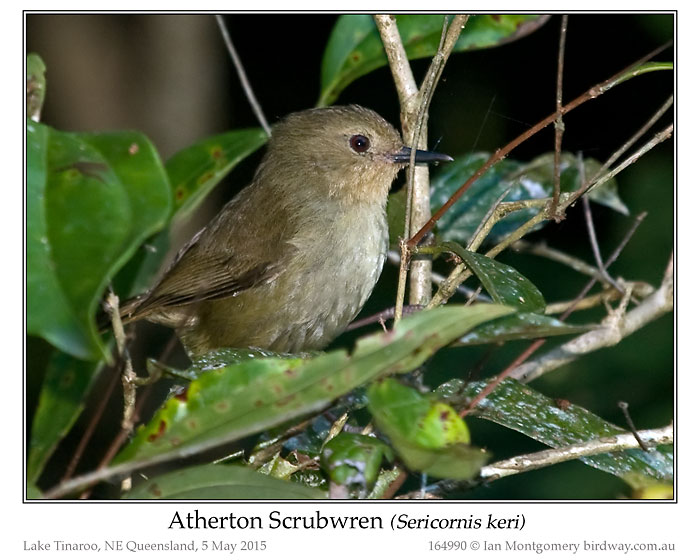
Atherton Scrubwren (Sericornis keri) by Ian

The Atherton Scrubwren is probably the least distinctive of the Wet Tropics endemics, being small (13.5cm/5.3in long), brown and unobtrusive and very similar to the more widespread, slightly smaller Large-billed Scrubwren (third photo) found in rainforests along the east coast of Australia from Cooktown in NE Queensland almost to Melbourne. Their ranges overlap in the Wet Tropics below 750m/2500ft, the usual upper limit of the Large-billed, and the species differ in subtle differences in colour and facial pattern and foraging behaviour.

Atherton Scrubwren (Sericornis keri) by IanThe best field-marks are the difference in angle of the bill: straight in the Atherton (second photo) and bent slightly upwards in the Large-billed (third photo). The Atherton forages on or closes to the ground (the one in photos 1 and 2 was about 30cm/12in above the ground), while the Large-billed is arboreal and forages on the branches and in the foliage of trees. The Atherton has a buff eye-stripe which merges with the lower part of the face and throat, has dark flanks and under-tail coverts and a yellowish wash on the breast and underside. The Large-billed is supposed to have a beady eye, but that’s getting even more subtle.

Large-bill Scrubwren by IanDespite the similarities between these two species, genetic studies indicate that the Atherton Scrubwren is probably more closely related to the well-known – and easier to identify – White-browed Scrubwren which occurs in eastern, southern and western Australia and was also present near where we were camping.

Greetings
Ian

**************************************************
Ian Montgomery, Birdway Pty Ltd,
454 Forestry Road, Bluewater, Qld 4818
Tel 0411 602 737 ian@birdway.com.au
Check the latest website updates:
http://www.birdway.com.au/#updates/


Lee’s Addition:

Another parable He put forth to them, saying: “The kingdom of heaven is like a mustard seed, which a man took and sowed in his field, which indeed is the least of all the seeds; but when it is grown it is greater than the herbs and becomes a tree, so that the birds of the air come and nest in its branches.” (Mat 13:31-32)

Ian has introduced us to some more of his Australian Scrubwrens, plus a tip to always carry your camera. They seem to be such tiny birds. Glad they posed for Ian at that beautiful lake.

Ian’s Whole Acanthizidae Family

Acanthizidae – Australasian Warblers

*
Ian’s Bird of the Week – White-necked Heron

White-faced Heron (Ardea Pacifica) by IanIan’s Bird of the Week – White-necked Heron ~ by Ian Montgomery

Newsletter – 5/29/15

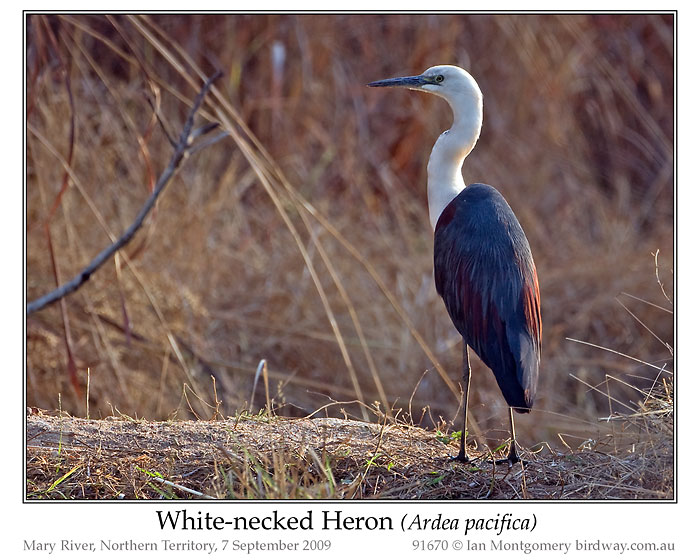
Continuing last week’s theme (White-faced Heron) of common – but in these pages neglected – Australian herons here is the other very widespread species, the White-necked or Pacific. It’s not as abundant or as well-known as the White-faced, but much bigger and a striking bird with its white head and neck and slate-grey back and wings. In length it varies from 76-106cm/30-42in with wingspan to 160cm/63in.

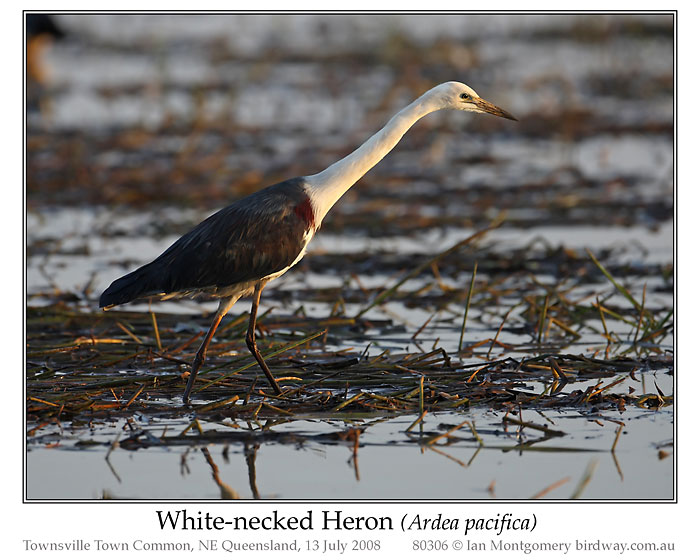
In breeding plumage, it develops plum-coloured plumes on the back (first photo at sunrise) and shoulders (second photo at sunset). It’s predominantly a bird of freshwater and is only rarely seen in estuaries. It’s quite partial to small shallow ponds and is widespread in inland Australia when water is available, moving to more coastal areas in dry seasons. So it can turn up almost anywhere in the country. In southern Australia it breeds in Spring and Summer; in northern Australia it can breed at any time of the year depending on rainfall – the one in the second photo was photographed in mid-winter in Townsville, but the first half of 2008 was very wet in northern Australia.

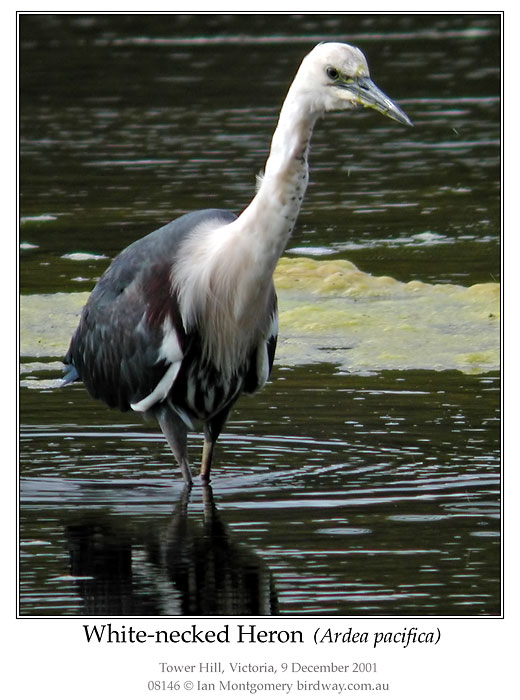
White-faced Heron (Ardea Pacifica) by IanAccording to the field guides, non-breeding birds have rows of grey spots on the front of the neck, like the one in the third photo. The neck is supposedly completely white in breeding plumage, but it is not unusual to see birds with both purple plumes and grey neck spots. Both the second and third photos show the white patches on the leading edge of the wing. These are obvious (and diagnostic) in flight when they look like the landing lights of a passenger aircraft.

White-faced Heron (Ardea Pacifica) by IanThe bird in the fourth photo was in Boulia, in far western Queensland north of Birdsville. The field guides and HBW (Handbook of Birds of the World) are vague about juvenile plumage but are supposed to have more spots on the neck than non-breeding adults and may have greyish head and neck. the one in the Boulia bird has a white head and neck with grey spots on the sides of the neck, while the bird in the fifth photo has a grey head and neck.

White-faced Heron (Ardea Pacifica) by IanI assume that both of these are juveniles. Both have pale spots on the wings, but I can’t find are reference to that in the field guides. I haven’t got HANZAB (Handbook of Australian, New Zealand and Antarctic Birds) so if anyone reading this does, I’d be grateful for any illuminating feedback on juvenile plumage.

White-faced Heron (Ardea Pacifica) by IanThe White-necked Heron breeds only on mainland Australia. It does, however, turn up regularly in Tasmania and southern New Guinea and has been recorded as a vagrant on Norfolk Island and in New Zealand.

Greetings
Ian

**************************************************
Ian Montgomery, Birdway Pty Ltd,
454 Forestry Road, Bluewater, Qld 4818
Tel 0411 602 737 ian@birdway.com.au
Bird Photos http://www.birdway.com.au/
Where to Find Birds in Northern Queensland:: iTunesGoogle Play Kobo Books
Recorder Society http://www.nqrs.org.au


Lee’s Addition:

the stork, the heron of any kind; the hoopoe and the bat. (Deuteronomy 14:18 ESV)

Thanks again, Ian. I really like that reflection in that fourth photo. Also, those spots on the non-breeding heron are very noticeable. We don’t have those here in the US of course, since they are native to your area. They sort of look like our Great Egret on the top part and our Great Blue Heron on the body part.

What you might consider common, we would consider it a delight to see and the other way around. Our common birds would by your delight to see.

*

Ian’s Birds of the Week

Ian’s Heron Family

Ardeidae – Herons, Bitterns

Ian’s Home Page

*