Ian’s Bird of the Week – Eastern Spinebill

Eastern Spinebill (Acanthorhynchus tenuirostris) male by Ian

Eastern Spinebill (Acanthorhynchus tenuirostris) male by Ian

Ian’s Bird of the Week – Eastern Spinebill by Ian Montgomery

Newsletter 07-21-10

The Spinebills, Eastern and Western, are in my opinion the most elegant of the Honeyeaters so here is the Eastern Spinebill – I haven’t yet managed to photograph the Western Spinebill of SW Western Australia – with the winning combination of tasteful colours and long, fine, curved bill. The bill is adapted to probing for nectar in the flowers of Bottlebrushes, as in the first photo, or Grevilleas and they also feed on insects.
Eastern Spinebill (Acanthorhynchus tenuirostris) female by Ian

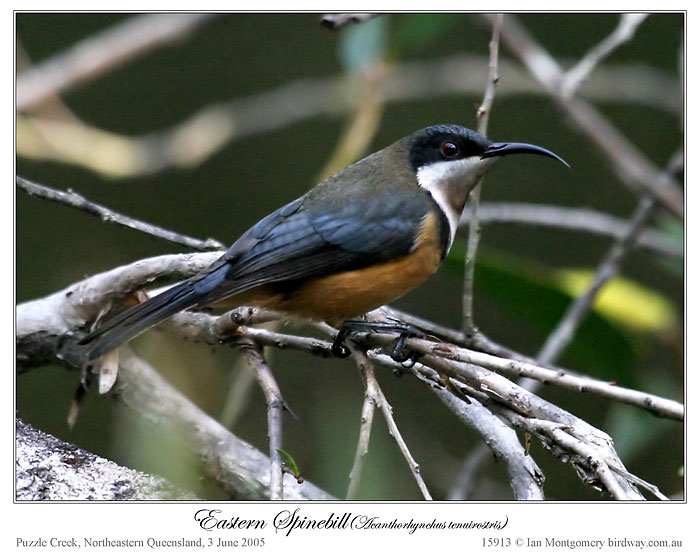
Eastern Spinebill (Acanthorhynchus tenuirostris) female by Ian

Males and females are subtly different as the male has a black crown with a sharp transition to the rufous nape while the female has a greyish crown with a gradual transition to the rufous nape. The bird in the first photo is a male, while the one in the second, coming down to drink in a creek, is a female.

Both these birds were photographed in the highlands around Paluma, not far from Townsville. The Eastern Spinebill is found in Tasmania and coastal southeastern and eastern Australia from the Mount Lofty Ranges in South Australia to Fraser Island in SE Queensland and there is an isolated population in the highlands of northeastern Queensland from Eungella near Mackay to Cooktown north of Cairns. This is perhaps a separate race, named cairnsensis.

I am keen to get feedback on recent changes to the website from visitors with slower, e.g. dial-up, connections. The inclusion of thumbnails to all the 142 bird families represented in the site means that the homepage – http://birdway.com.au/index.htm – has a lot of stuff on it to download. If you have found this a problem, please let me know ian@birdway.com.au as I can easily move the ‘Instant Guide to Bird Families’ to a separate page. This would make the homepage faster and make viewing all the thumbnails optional with a link from the homepage.

Best wishes,
Ian

Ian Montgomery, Birdway Pty Ltd,
454 Forestry Road, Bluewater, Qld 4818
Phone: +61-7 4751 3115
Preferred Email: ian@birdway.com.au
Website: http://birdway.com.au


Lee’s Addition:

I don’t know about going to Ian’s site with a slow connection, but I sure do enjoy his new layout. I can jump right to the family I am looking for. I really appreciate your hard work on the front page, Ian. Click to see more of Ian’s photos of Eastern Spinebills.

Spinebills are in the Meliphagidae – Honeyeaters Family which 182 species and is in the Passeriformes Order.

13–16 cm (5–6 in) long, the male Eastern Spinebill has a long thin downcurved black bill with a black head, white throat with a reddish patch and red iris. It has a brownish-red nape, a grey brown back and pale cinnamon underparts. The dark tail is tipped with white laterally. Females and juveniles are smaller and duller. The call is a rapid piping.

The Eastern Spinebill feeds on nectar from many plants, including the blooms of gum trees, mistletoes Amyema spp., Epacris longiflora, Epacris impressa(common heath), Correa reflexa, and various members of the Proteaceae such as Banksia ericifolia, Banksia integrifolia, Lambertia formosa and Grevillea speciosa, as well as small insects and other invertebrates. A 1982 study in the New England National Park in North-eastern New South Wales found that there was a large influx of birds coinciding with the start of flowering of Banksia spinulosa there. They have been known to feed from exotic plants such as Fuchsias.

My son, eat honey because it is good, And the honeycomb which is sweet to your taste; So shall the knowledge of wisdom be to your soul; If you have found it, there is a prospect, And your hope will not be cut off. (Proverbs 24:13-14 NKJV)

Birds in Hymns – God Speaks To Us In Bird And Song

To him that rideth upon the heavens of heavens, which were of old; lo, he doth send out his voice, and that a mighty voice. (Psalms 68:33 KJV)

Words: Jo­seph John­son, Dibs: A Sto­ry of Young Lon­don Life (at the be­gin­ning of chap­ter 4: ‘Pro­mot­ed to the Choir’), 1888. The hymn was pub­lished in School Hymns in 1891.

Music: Child­hood – by Hen­ry W. Da­vies (1869-1941)

God Speaks to us in Bird and Song

Crested Bunting (Emberiza lathami) by Nikhil Devasar

Crested Bunting (Emberiza lathami) by Nikhi lDevasar

God speaks to us in bird and song,
In winds that drift the clouds along,
Above the din and toil of wrong,
A melody of love.

God speaks to us in far and near,
In peace of home and friends most dear,
From the dim past and present clear,
A melody of love.

God speaks to us in darkest night,
By quiet ways through mornings bright,
When shadows fall with evening light,
A melody of love.

O Voice divine, speak Thou to me,
Beyond the earth, beyond the sea,
First let me hear, then sing to Thee,
A melody of love.


Most information from The Cyber Hymnal

See ~ Wordless Birds

More ~ Birds in Hymns

*

Birds in Hymns – He Waters The Hills

He sendeth the springs into the valleys, which run among the hills. They give drink to every beast of the field: the wild asses quench their thirst. (Psalm 104:10-11)

Johann M. Haydn (1737-1806)

Words: From The Psal­ter (Pitts­burgh, Penn­syl­van­ia: The Unit­ed Pres­by­ter­i­an Board of Pub­li­ca­tion, 1912), num­ber 286.

Music: Ly­ons, at­trib­ut­ed to Jo­hann M. Hay­dn (1737-1806); ar­ranged by Wil­liam Gar­din­er, Sac­red Mel­odies (Lon­don: 1815)

HE WATERS THE HILLS

Pileated and Red-bellied on same tree - turkey point by Ray

Pileated and Red-bellied on same tree - turkey point by Ray

He waters the hills with rain from the skies,
And plentiful grass and herbs He supplies,
Supplying the cattle, and blessing man’s toil
With bread in abundance, with wine and with oil.

The trees which the Lord has planted are fed,
And over the earth their branches are spread;
They keep in their shelter the birds of the air,
The life of each creature the Lord makes His care.

The seasons are fixed by wisdom divine,
The slow changing moon show forth God’s design;
The sun in his circuit his Maker obeys,
And running his journey hastes not nor delays.

The Lord makes the night, when leaving their lair,
The lions creep forth, God’s bounty to share;
The Lord makes the morning, when beasts steal away
And men are beginning the work of the day.

How many and wise Thy works are, O Lord!
The earth with the wealth of wisdom is stored;
The sea bears in safety the ships to and fro,
And creatures unnumbered it shelters below.

The creatures all look to Thee for their food;
Thy hands open wide, they gather the good;
Thy face Thou concealest, in anguish they yearn;
Their breath Thou withholdest, to dust they return.


Another parable put he forth unto them, saying, The kingdom of heaven is like to a grain of mustard seed, which a man took, and sowed in his field: Which indeed is the least of all seeds: but when it is grown, it is the greatest among herbs, and becometh a tree, so that the birds of the air come and lodge in the branches thereof. (Matthew 13:31-32 KJV)

Sing to the LORD with thanksgiving; Sing praises on the harp to our God, Who covers the heavens with clouds, Who prepares rain for the earth, Who makes grass to grow on the mountains. He gives to the beast its food, And to the young ravens that cry. (Psalms 147:7-9 NKJV)

Most information from The Cyber Hymnal

See ~ Wordless Birds

More ~ Birds in Hymns

*

Wattled Jacana – The Perfect Partner

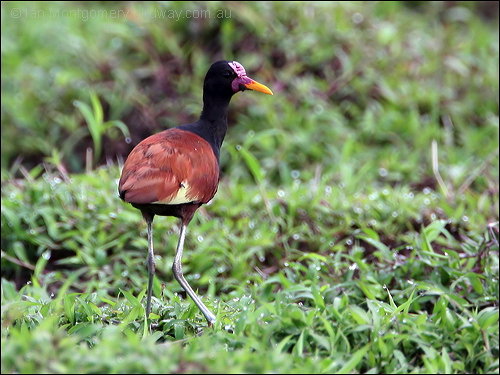
Wattled Jacana (Jacana jacana) by Ian's Birdway

Wattled Jacana (Jacana jacana) by Ian's Birdway

The Wattled Jacana is a wader which is a resident breeder from western Panama and Trinidad south through most of South America east of the Andes. Common in lowlands from Panama to northern Argentina mainly east of the Andes in southern part of range.

Frequents freshwater marshes, lakes and slow-flowing rivers where it wades in damp vegetation or walks on floating water plants, foraging for fish and insects to eat and to build their nests. Lily pads and other floating vegetation in swamps and marshes are home to jacanas.

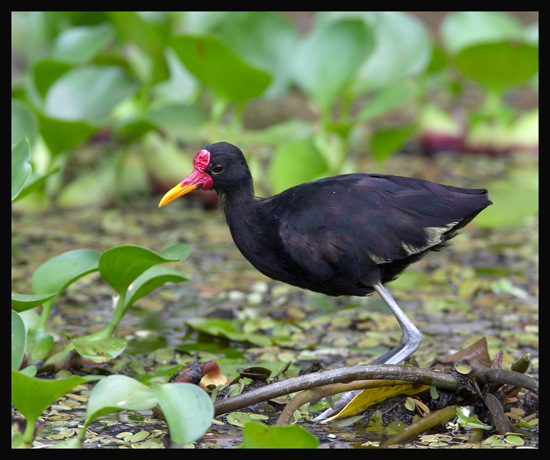
The Wattled Jacana (Jacana jacana) is unmistakable with its exaggerated feet that are fit for a fairy tale and red, turkey like wattles. Also called the lily-trotter, its toes and toenails distribute its weight over large areas to help it sprint across aquatic vegetation as if defying gravity.

People may pass discouraging comments on your height, color, status and so on.. Remember, that our God is not a respecter of person…

The survival of these birds hinges on their exaggerated legs and toes…

  • God had created everything in us for a specific plan, so that His name maybe glorified…
  • What people see in you as weakness is in fact, your God made tool for survival…
  • Brothers saw Joseph as a dreamer, but, God saw him as a redeemer..
  • People saw Moses as a slow of speech , but God saw him as a leader..
  • King Saul saw David as a small boy, but, God saw him as a King…

…: for the LORD seeth not as man seeth; for man looketh on the outward appearance, but the LORD looketh on the heart. (1 Samuel 16:7)

Wattled Jacana (Jacana jacana) by Robert Scanlon

Wattled Jacana (Jacana jacana) by Robert Scanlon

The jacana (zhah-suh-NAH) is a skilled swimmer and diver—fitting adaptations for life on the Amazon River. Flooded meadows offer a floating feast of small fishes, insects, snails and vegetation. With its long, thin beak it can pluck bugs and other goodies from the tangles of floating vegetation and even turn plants over to see what’s hiding beneath. During the dry season, jacanas wade along rivers, oxbow lakes and irrigation ditches scavenging for leftovers. If threatened, young chicks, as well as adults, stay underwater for long periods of time with only the tips of their bills above water. They can also swim underwater to avoid predators.

  • When life threatens, the best chance of survival comes from staying under the Living Water…
  • We sure can learn this 100% survival technique from these birds…
  • There is not only 24×7 protection, but also, abundance under the Living Water …

And there shall be a tabernacle for a shadow in the daytime from the heat, and for a place of refuge, and for a covert from storm and from rain. (Isaiah 4:6)

Jacana eggs are true works of art. They are a deep tan color, with very dark markings that look like dribbled lines of paint, crisscrossing the entire egg in an abstract design that is different on each egg. The eggs are very glossy and shiny and look as though they have been highly polished. This “wet” appearance is nature’s camaflouge, helping the eggs resemble the glossy surface of surrounding vegetation.

Males are the primary nest builders, incubators and caretakers. Jacana nests are built on mostly submerged plants. If the nest starts to sink, or the eggs are otherwise endangered, the male may pick them up and carry them under his wings to a new site. It is the male incubates the eggs, with two eggs held between each wing and the breast, and looks after the chicks…

  • Our God, the nest builder, has built an eternal nest for us in heaven..
  • Our God, the incubator, incubates our future…
  • Our God, the caretaker, is the one who takes care of even our smallest need…
  • He is the one who not only carries us but also our dreams under His wings..
  • He is the one who holds us close to His bosom..

What an awesome God we have!!!!!

He shall cover thee with his feathers, and under his wings shalt thou trust: his truth shall be thy shield and buckler. (Psalm91:4)

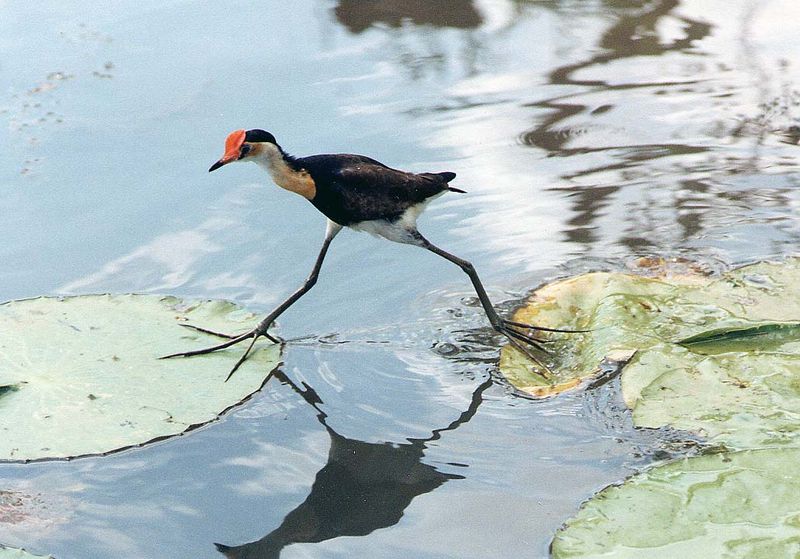
Comb-crested Jacana (Irediparra gallinacea) by Wiki

Comb-crested Jacana (Irediparra gallinacea)©Wiki on Pads

Meanwhile, the female has left the male to find more males to breed with. She does not participate in raising chicks. After the female lays her first nest of four or so eggs, she is freed to find more mates—up to five simultaneously—and lay more eggs. She will aggressively fight with marauding female competitors to both protect her male partners and ensure that she can keep laying eggs. If, however, the eggs or chicks die, she will reunite with the first male and lay another clutch of eggs. These behaviors are a matter of survival, not a lapse of fidelity.

  • Eve preferred to see the garden all by herself…
  • If she hadn’t gone out alone, she wouldn’t have fallen into satan’s trap…
  • Most of us have gone away from His presence only to be battered and bruised..
  • Like these birds, we come back to God only after dreams die, spirit broken, left alone and feel defeated…
  • God is still waiting like the father of the prodigal son, arms stretched to embrace us back into His presence…

Are we willing to get back to the basics before The King returns? Note, He will return without prior notice…

Come unto me, all ye that labour and are heavy laden, and I will give you rest.
Take my yoke upon you, and learn of me; for I am meek and lowly in heart: and ye shall find rest unto your souls. For my yoke is easy, and my burden is light. (Matthew 11:28 to 30)

Have a blessed day!

Your’s in YESHUA,
a j mithra

Please visit us at:  Crosstree


Lee’s Addition:

Jacanas are in the Jacanidae Family of eight species. The Jacanidae family is only one of nineteen families in the Charadriiformes Order known as Shorebirds and Allies.

To give an idea of how they walk around on leaves, here is a Comb-crested Jacana (Irediparra gallinacea) by Keith B – A bird walking across water lily leaves.

Birds in Hymns – Jesus, Lover Of My Soul

Blessed be God, even the Father of our Lord Jesus Christ, the Father of mercies, and the God of all comfort; Who comforteth us in all our tribulation, that we may be able to comfort them which are in any trouble, by the comfort wherewith we ourselves are comforted of God. For as the sufferings of Christ abound in us, so our consolation also aboundeth by Christ. (2 Corinthians 1:3-5 KJV)

Words: Charles Wes­ley, Hymns and Sac­red Po­ems, 1740. Some have called this the fin­est hymn in the Eng­lish lang­uage.

Music: Aberystwyth (Parry), Jo­seph Par­ry, in Ste­phens’ Ail Lyfr To­nau ac Emy­nau, 1879

Quotes below from Wholesome Words Christian Biography Resources

“The circumstance of the writing of this hymn is interesting. The story goes that Charles Wesley was roused from his sleep one night by a terrible storm. Being unable to rest he got up, put on his dressing-gown, and, opening his casement window stood looking out upon the stormy scene. Suddenly a bird, exhausted by the wind, and hotly pursued by a hawk, flew through the open window right into Charles Wesley’s breast for protection. Having saved the bird and placed it in security, he turned to his desk and wrote this immortal hymn, so realistic and descriptive of the fear and intense longing of the anxious soul to find safety and rest.

For our soul needs shelter; and the Only One Who can be a refuge for the soul is Jesus. He is our Hiding-place, our Haven of Rest. Listen to these words of the prophet Isaiah (32:2):

“A man shall be as an hiding place from the wind, and a covert from the tempest . . . as the shadow of a great rock in a weary land.”

We have no time to say anything about this wonderful hymn in detail, but I would have you notice one point about it. I have spoken of this in the case of other hymns, but the thought will bear repeating. Notice in it the personal and persistent use of me, and my, and I, in it:

“Let me to Thy bosom fly.”

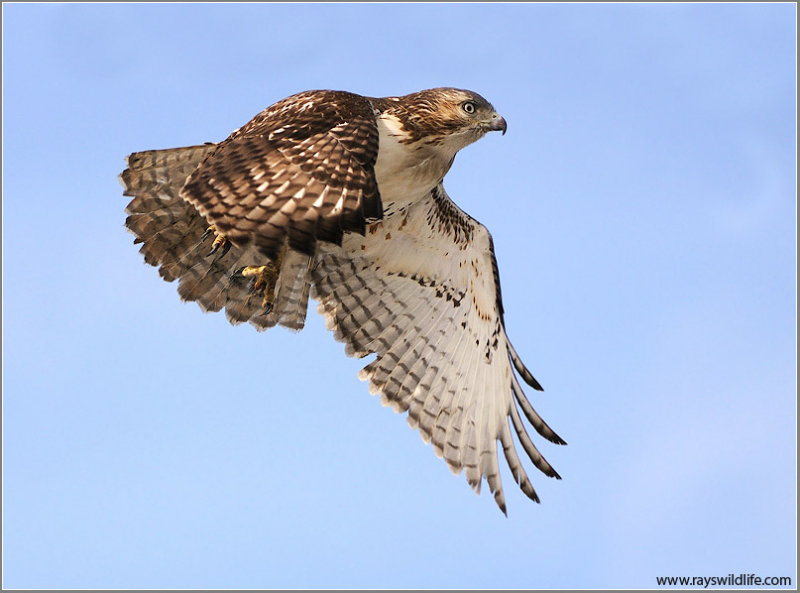
Red-Tailed Hawk by Ray

Red-Tailed Hawk by Ray

It is the prayer of the individual soul for succour, to the Saviour Himself; the call, as of a drowning man, that insists on being heard, and that can take no refusal; the cry of the terrified, and frail, and helpless bird, pursued by the cruel hawk, that is eager for its life.

Dear friends, are you “Safe in the arms of Jesus”? Have you “hidden” yourselves in Him?

Oh that these questions may go straight home to your hearts. If you are not in Christ, Oh, may God the Holy Spirit awaken you to see your danger. I will read the hymn to you, and then we will sing it together, on our knees, as our closing prayer.”

Jesus, Lover Of My Soul by Charles Wesley


Jesus, lover of my soul, let me to Thy bosom fly,
While the nearer waters roll, while the tempest still is high.
Hide me, O my Savior, hide, till the storm of life is past;
Safe into the haven guide; O receive my soul at last.

Other refuge have I none, hangs my helpless soul on Thee;
Leave, ah! leave me not alone, still support and comfort me.
All my trust on Thee is stayed, all my help from Thee I bring;
Cover my defenseless head with the shadow of Thy wing.

Wilt Thou not regard my call? Wilt Thou not accept my prayer?
Lo! I sink, I faint, I fall—Lo! on Thee I cast my care;
Reach me out Thy gracious hand! While I of Thy strength receive,
Hoping against hope I stand, dying, and behold, I live.

Thou, O Christ, art all I want, more than all in Thee I find;
Raise the fallen, cheer the faint, heal the sick, and lead the blind.
Just and holy is Thy Name, I am all unrighteousness;
False and full of sin I am; Thou art full of truth and grace.

Plenteous grace with Thee is found, grace to cover all my sin;
Let the healing streams abound; make and keep me pure within.
Thou of life the fountain art, freely let me take of Thee;
Spring Thou up within my heart; rise to all eternity.


Copyright ©2010 Wholesome Words and Info from Cyberhymnal

See ~ Wordless Birds

More ~ Birds in Hymns

*

Birds of the Bible – Barn Owls

Western Barn Owls (Family Tytonidae) by Bob-Nan

Western Barn Owl (Family Tytonidae) by Bob-Nan

the little owl, the cormorant, the short-eared owl, the barn owl, the tawny owl, the carrion vulture, (Leviticus 11:17-18 ESV)
and the little owl, and the cormorant, and the eared owl; and the barn owl, and the pelican, and the owl-vulture; (Leviticus 11:17-18 MKJV)

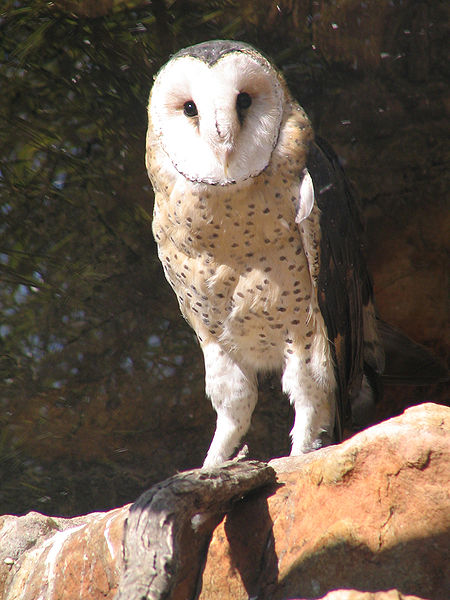
Australian Masked Owl (Tyto novaehollandiae) by Wiki

Australian Masked Owl (Tyto novaehollandiae) by Wiki

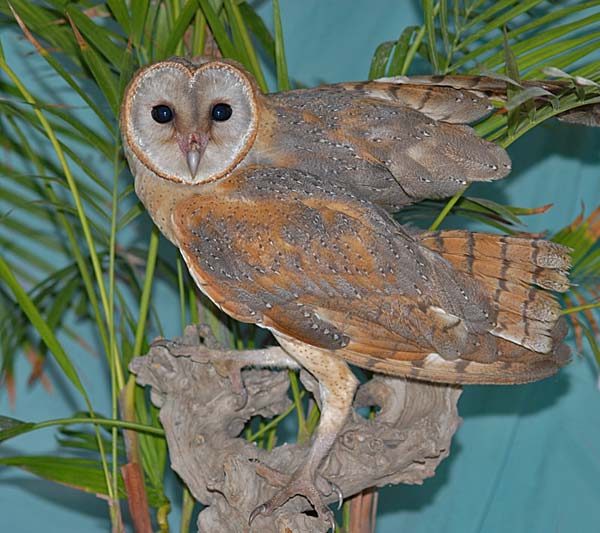
The Lord has created another interesting and fantastic bird, the Barn Owl. The Owls are mentioned in the list of unclean birds the Israelites were not to eat. The Bible mentions several different kinds of owls and that is possibly why the taxonomists today divide them at least into two different families. Within those families, especially the larger one, Strigidae, the are different groupings. The Barn Owl family, Tytonidae, all seem to have this heart-shaped face you will read about and see. Some of the other Bible versions call it the “white owl.” Most of the ones I found photos of do have a white face or almost white face.

Barn-owls (family Tytonidae) are one of the two families of owls, the other being the true owls, Strigidae. Barn Owls are medium to large sized owls with large heads and characteristic heart-shaped faces. They have long, strong legs with powerful talons. They also differ from Strigidae in structural details relating in particular to the sternum and feet.

Sulawesi Masked Owl (Tyto rosenbergii) by Wiki

Sulawesi Masked Owl (Tyto rosenbergii) by Wiki

The Barn Owl is a pale, long-winged, long-legged owl with a short squarish tail. Depending on subspecies, it measures about 25–45 cm (9.8–18 in) in overall length, with a wingspan of some 75–110 cm (30–43 in). Tail shape is a way of distinguishing the Barn Owl from true owls when seen in flight, as are the wavering motions and the open dangling feathered legs. The light face with its heart shape and the black eyes give the flying bird an odd and startling appearance, like a flat mask with oversized oblique black eyeslits, the ridge of feathers above the bill somewhat resembling a nose.[Wikipedia]

The barn-owls’ main characteristic is the heart-shaped facial disc, formed by stiff feathers which serve to amplify and locate the source of sounds when hunting. (See Calculating Owls below) Further adaptations in the wing feathers eliminate sound caused by flying, aiding both the hearing of the owl listening for hidden prey and keeping the prey unaware of the owl. Barn-owls overall are darker on the back than the front, usually an orange-brown colour, the front being a paler version of the back or mottled, although there is considerable variation even amongst species. The bay-owls closely resemble the Tyto owls but have a divided facial disc, ear tufts, and tend to be smaller.

On average, within any one population males tend to be less spotted on the underside than females. The latter are also larger, as is common for owls. A strong female Western Barn Owl of a large subspecies may weigh over 550 g (19.4 oz), while males are typically about 10% lighter. Nestlings are covered in white down all over, but the heart-shaped facial disk is visible soon after hatching.

the little owl and the short-eared owl, the barn owl (Deuteronomy 14:16 ESV)

Western Barn Owl (Tyto alba) by Nikhil Devassar

Western Barn Owl (Tyto alba) by Nikhil Devassar

Its head and upperparts are a mixture of buff and grey (especially on the forehead and back) feathers in most subspecies. Some are purer richer brown instead, and all have fine black-and-white speckles except on the remiges and rectrices, which are light brown with darker bands. The heart-shaped face is usually bright white, but in some subspecies it is browner. The underparts vary from white to reddish buff among the subspecies, and are either mostly unpatterned or bear a varying amount of tiny blackish-brown speckles. It was found that at least in the continental European populations, females with more spotting are healthier on average. This does not hold true for European males by contrast, where the spotting varies according to subspecies. The bill varies from pale horn to dark buff, corresponding to the general plumage hue. The iris is blackish brown. The toes, as the bill, vary in color; their color ranges from pinkish to dark pinkish-grey. The talons are black.

African Grass Owl (Tyto capensis) by Wiki

African Grass Owl (Tyto capensis) by Wiki

The barn owls are a wide ranging family, absent only from northern North America, Saharan Africa and large areas of Asia. They live in a wide range of habitats from deserts to forests, and from temperate latitudes to the tropics. The majority of the 16 living species of barn owls are poorly known. Some, like the (Madagascar) Red Owl, have barely been seen or studied since their discovery, in contrast to the Common Barn Owl, which is one of the best known owl species in the world. However, some sub-species of the Common Barn Owl possibly deserve to be a separate species, but are very poorly known.

Contrary to popular belief, it does not hoot (such calls are made by typical owls, like the Tawny Owl or other Strix). It instead produces the characteristic shree scream, ear-shattering at close range. Males in courtship give a shrill twitter. It can hiss like a snake to scare away intruders, and when captured or cornered, it throws itself on its back and flails with sharp-taloned feet, making for an effective defence. Also given in such situations is a rasp and a clicking snap, produced by the bill or possibly the tongue.

Barn Owl clicks and call from xeno.canto.org

Couldn’t pass up the opportunity for some verse of the “heart.”

I will praise thee, O LORD, with my whole heart; I will shew forth all thy marvellous works. (Psalms 9:1 KJV)
LORD, thou hast heard the desire of the humble: thou wilt prepare their heart, thou wilt cause thine ear to hear: (Psalms 10:17 KJV)
Let the words of my mouth, and the meditation of my heart, be acceptable in thy sight, O LORD, my strength, and my redeemer. (Psalms 19:14 KJV)
Wait on the LORD: be of good courage, and he shall strengthen thine heart: wait, I say, on the LORD.
(Psalms 27:14 KJV)

See Also:

Owls – Birds of the Bible
Calculating Owls – Find out how the Barn Owl finds things.

STRIGIFORMES (Owls) Order

Some information from Wikipedia

*

Andean Cock-of-the-rock – The Changer…

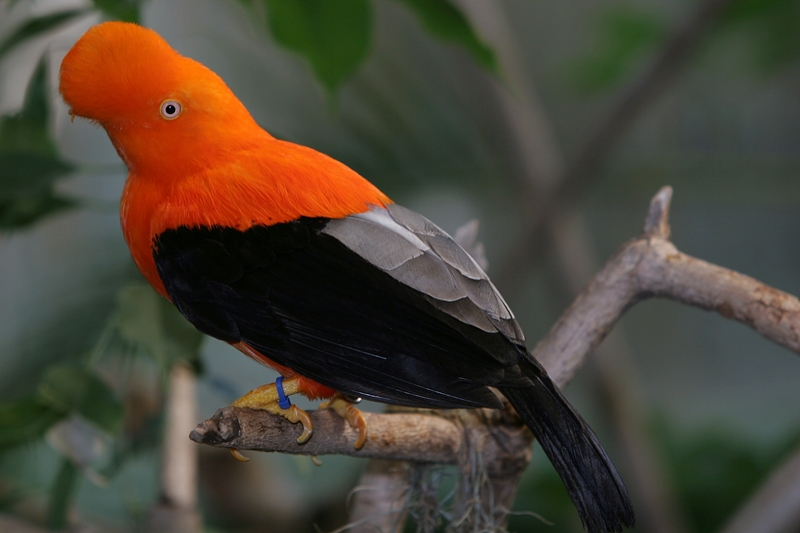
Andean Cock-of-the-rock (Rupicola peruvianus) by SanDiegoZoo

Andean Cock-of-the-rock (Rupicola peruvianus) by SanDiegoZoo

The Andean Cock-of-the-rock – The Changer… ~ by a j mithra

The Andean Cock-of-the-rock is a medium sized bird, living in the Andes, from Venezuela South to Bolivia. It’s one of the most spectacular birds, with strikingly bright colours. Spotting this beautiful bird is not very common, though, as they’re extremely shy and don’t usually fly near humans.

Males displaying by ibirdcollection

Mature males spend much of their time in leks, which are communal courtship sites, where many males gather and practice their “mating dance”. This ritual consists of challenging a rival male for displaying their force, by flapping wings, jumping, running around, nodding and giving off a variety of squawking and grunting calls. When females visit the lek, these “mating dances” become even more intense, more loud and often turn into a display of bright colours and loud, strange sounds. After this, the female chooses the most impressive male to mate with. It is also notable, that due to defecation of seeds by the males, leks are often rich in vegetation.

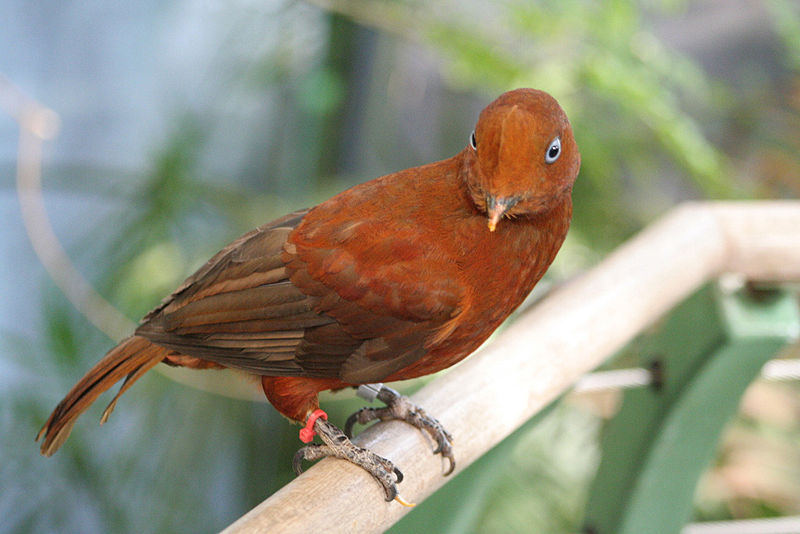
Andean Cock-of-the-rock (Rupicola peruvianus) female by SanDiegoZoo

Andean Cock-of-the-rock (Rupicola peruvianus) female by SanDiegoZoo

While the females incubate the Andean Cock-of-the-rock males have gone back to the lek, in search of another female partner. Most of the males’ life revolves around activities in the lek, challenging rivals, practicing their “mating dances” and attracting females, while most of the females’ life concentrates upon nesting and incubating the eggs.

God expects the Church, His the bride, to just concentrate on expanding His kingdom..

His reason for choosing us is not to just warm the church benches, but, to go in search of His lost sheep…

But go rather to the lost sheep of the house of Israel. (Matthew 10:6)

The Cock-of-the Rock is one of the world’s most spectacular birds. It’s fantastic plumage and colorful courtship display equal those of any bird of paradise. It is the national bird of Peru for it’s beautiful plumage, resembling a bird from the paradise. Being one of the most beautiful birds, the Andean Cock-of-the-rock is one of the nature’s wonders.

The Andean Cock-of-the-Rock is distributed in the Andes from Venezuela south to Bolivia, while the Guianan Cock-of-the Rock is found in the more ancient, and highly eroded mountains that lie east of the Andes and north of the Amazon River….

When Moses came down from Mount Sinai after forty days, His face shone radiantly…

These beautiful birds are found in highly eroded mountains…  Is that the reason they look so beautiful?

When we dwell on THE ROCK, we sure would turn beautiful like Him… Remember that He had created us in His image…

Arise, shine; for thy light is come, and the glory of the LORD is risen upon thee. (Isaiah 60:1)

When the Cock-of-the-Rock eats fruit, it swallows many of the seeds whole and most of these are not damaged when they pass through its digestive system. Thus, many seeds remain capable of germinating when the Cock-of-the-Rock defecates or regurgitates them at considerable distances from the parent trees. In this way, the Cock-of-the-Rock plays an important role in dispersing seeds of many different species of forest trees. When the Cock-of-the-Rock eats fruit, it swallows many of the seeds whole and most of these are not damaged when they pass through its digestive system.

Since the adult male Cock-of-the-Rock concentrates his time and activities around the lek, and the adult female concentrates her time and activities around cliff nest sites where several females may build nests in close proximity to each other, seeds are deposited more frequently at leks and at nest sites. Once, seeds of 21 species of plants under the perches of males. All were believed to have been defecated or regurgitated by the males.

Likewise, collected droppings under a nest of the Guianan Cock-of-the-Rock in French Guiana, was found to have the seeds of 52 plant species. In an earlier study, collected droppings under 7 nests of the Andean Cock-of-the-Rock at a site west of Cali, Colombia, had the seeds of at least 35 plant species.

Andean Cock-of-the-rock (Rupicola peruvianus) by Wiki

Andean Cock-of-the-rock (Rupicola peruvianus) by Wiki

When high densities of seeds are deposited in this way at Cock-of-the-Rock leks or nest sites,and when  environmental conditions are favorable for their germination and growth, the abundance and diversity of plant species growing from these seeds can be greatly increased at leks and nests, making the plant communities at these sites different from that of the surrounding forest.

The lek was located on the ridge of a steep granite hill, and its vegetation differed markedly from that of the surrounding forest and nearby ridge tops. While most of the flora at these other sites was fairly homogeneous, the vegetation at the Cock-of-the-Rock lek was a mosaic of plant species typical of many different communities. After analyzing the lek vegetation more thoroughly, researchers concluded that the greater part of it resulted from long-term seed dispersal by Cock-of-the-Rock males.

If the feeding habit of these birds can change the whole environment, our feeding habit on the word of God should have changed everyone around us…

If these birds can change a steep granite hill in to a mosaic of plant species typical of many different communities, so can we with a little help from God change, all stony hearts in to a garden of the Lilly of the valley and the Rose of Sharon…

It all depends on how many seeds we sow and how long we sow without looking at how many had sprouted…

Our job is to just sow and water…

So then neither is he that planteth any thing, neither he that watereth; but God that giveth the increase. (1 Corinthians 3:7)

Have a blessed day!

Your’s in YESHUA,
a j mithra

Please visit us at: Crosstree


Lee’s Addition:

Andean Cock-of-the-Rock has a close cousin in the Guianan Cock-of-the-rock. They are both in the Cotingidae – Cotinga Family which is part of the Passeriformes Order. The Cotingidae not only has those 2 birds, but 62 others including the Cotingas, Plantcutters, Berryeaters and Fruiteaters, Bellbirds, Pihas, Fruitcrows, a Capuchinbird and 3 Umbrellabirds.

Ian’s Bird of the Week – Magpie Goose

Magpie Goose (Anseranas semipalmata) by Ian

Magpie Goose (Anseranas semipalmata) by Ian

Ian’s Bird of the Week – Magpie Goose by Ian Montgomery

Newsletter 7-14-10

Here’s another large species characteristic of northern Australia, particular northern Queensland and the top-end of the Northern Territory, that had so far avoided the Bird of the Week net. It is found in quite large numbers around Townsville in wetland such as the Town Common, where the first photo was taken, and grazing in the stubble left after harvesting sugar cane. It’s a sedentary species and nests here in the wet season during the first four months of the year.

Magpie Goose (Anseranas semipalmata) by Ian

Magpie Goose (Anseranas semipalmata) by Ian

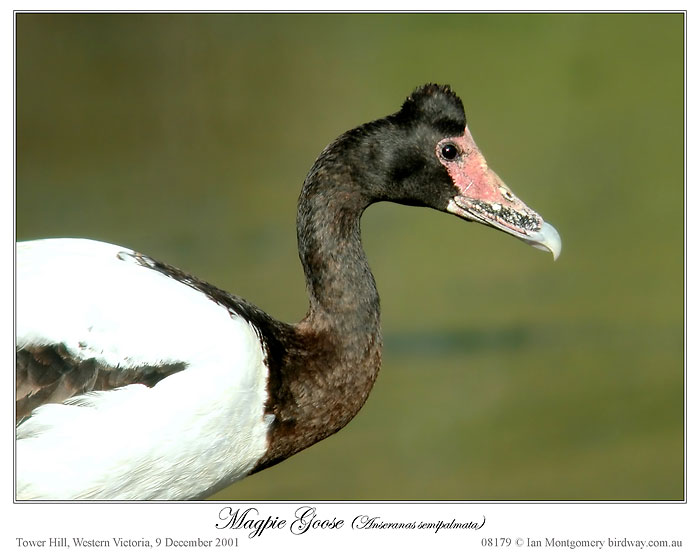
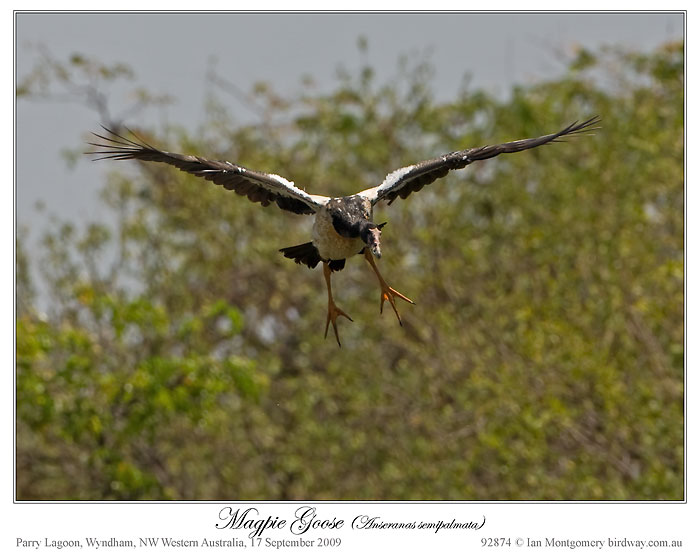
They have a pre-historic look about them and have some unusual features for a goose, or more correctly, goose-like bird. Not only the knobbed head, larger in males like the bird in the foreground in the first photo, but also the hooked beak. Both these features are more visible in the second photo. The third photo of the bird landing shows yet another oddity: the feet are only partially webbed and hence the specific name of semipalmata.

You’d be right in deducing that the Magpie Goose is only distantly related to other ducks and geese (family Anatidae) and is in fact the sole surviving member of a different lineage the family Anserantidae. These two families, along with another odd lineage the three species of Screamer in South America (Anhimidae), comprise the waterfowl order, the Anseriformes.

Magpie Goose (Anseranas semipalmata) by Ian

Magpie Goose (Anseranas semipalmata) by Ian

Magpie Geese were once common and widespread throughout northern, eastern and southeastern Australia but were hunted to extinction in the southeast and occur naturally now only from Broome in northern Western Australia to about Brisbane in southeast Queensland. Following reintroduction it is now getting re-established in some parts of New South Wales such as the Hunter Valley and of Victoria. The second photo was taken at Tower Hill in Western Victoria. It also occurs in southern PNG.

Best wishes,
Ian

Links:
Magpie Goose
Anatidae
Recent Additions (to 14 species)
Ian’s Picks:
Australian (a different Pitta)
New World (it only looks like a Glossy Ibis)
Old World (just in case you dismiss starlings)
Other Wildlife (this one isn’t red)

Ian Montgomery, Birdway Pty Ltd,
454 Forestry Road, Bluewater, Qld 4818
Phone: +61-7 4751 3115
Preferred Email: ian@birdway.com.au
Website: http://birdway.com.au


Lee’s Addition:

The three families Ian mentioned above are the Anhimidae – Screamers, the Anseranitidae – Magpie Goose and the Anatidae – Ducks, Geese & Swans. These are all in the Anseriformes Order

Geese are not mentioned by name in the Bible, but watching out for their eggs and hatchlings are mentioned:

If a bird’s nest chance to be before thee in the way in any tree, or on the ground, whether they be young ones, or eggs, and the dam sitting upon the young, or upon the eggs, thou shalt not take the dam with the young: But thou shalt in any wise let the dam go, and take the young to thee; that it may be well with thee, and that thou mayest prolong thy days.
(Deuteronomy 22:6-7 KJV)

*

Birdwatching and Updated Indexes for I.O.C. 2.5 Version

Limpkin at Lake Morton

Limpkin at Lake Morton

It took me awhile, but I finally got all the links up for the newest version (2.5) of the I.O.C. Now you should be able to find any bird on the lists.

Anhinga (Anhinga anhinga) scrawny by Lee

Anhinga (Anhinga anhinga) scrawny by Lee

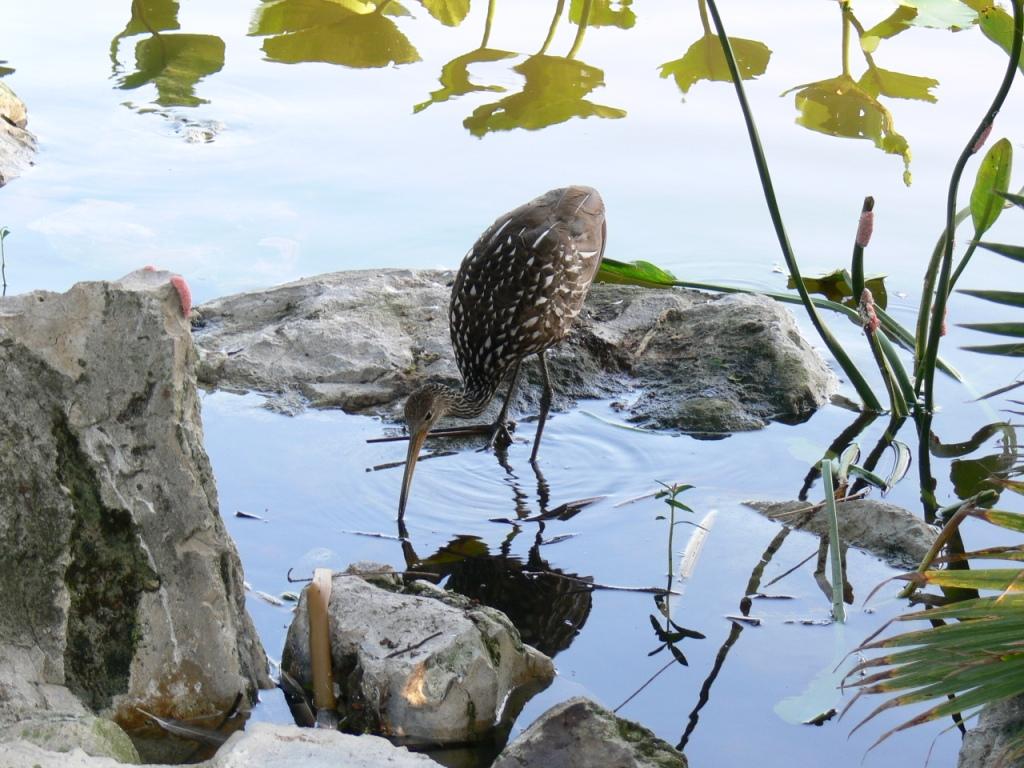
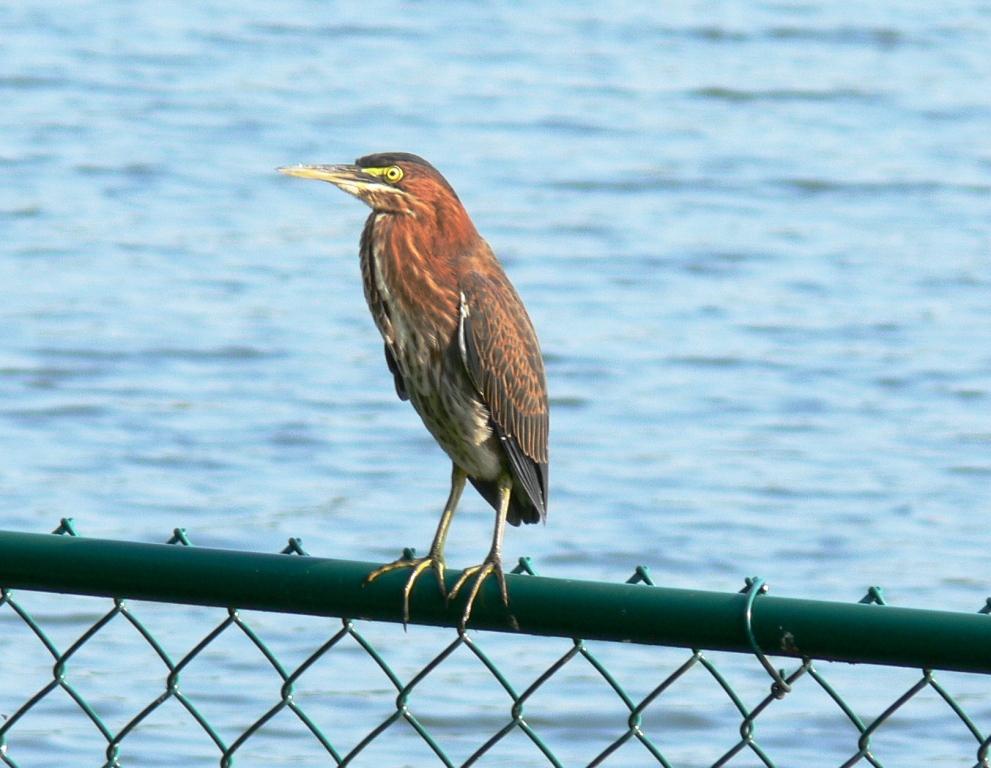
Dan and I managed to get in a little birdwatching Friday at Lake Morton. We saw several weird things take place. At least I hadn’ t seen it before. Watched a Great Egret with what I thought was a fish, a scrawy Anhinga, and a one footed White Ibis.

The Anhinga that we saw was “scrawny.” It must have been in a molting stage, because it sure didn’t have many complete feathers. Also fed a one-footed White Ibis. Did manage to get some nice photos of a Limpkin and a Green Heron. There were some gulls around and I think it is a Laughing Gull I photographed. Haven’t seen one there before, at least not with that black hood.

Great Egret at Lake Morton

Great Egret at Lake Morton

The Great Egret that was eating something, well, trying to, turned out to be a baby Mallard. I was photographing it from a distance and didn’t realize what it had until we got home and viewed the photos. Never did see it swallow it. The Egret flew off with it and when I spotted it later, there was no baby Mallard around. Hope he dropped it when he flew off. I was sad when I realized what had been going on.

Sunday, at church, our pastor was preaching on the death of Christ on the cross. He gave the following quote by Dorothy Sayers and it reminded me of what I had seen on Friday.

It is a curious fact that people who are filled with horror when a cat kills a sparrow can hear the true story of how people killed the Lord Jesus Christ told Sunday after Sunday and not experience any Shock whatsoever! Dorothy L. Sayers

The Lord loved us so much He was willing to lay His life down and pay for our sins. He has “finished” the payment and has raised Himself up and is in heaven with the Father. Do we hear that week after week and not acknowledge the truth? I trust you know the Savior.

For God so loved the world, that he gave his only begotten Son, that whosoever believeth in him should not perish, but have everlasting life. For God sent not his Son into the world to condemn the world; but that the world through him might be saved. (John 3:16-17 KJV)

Wordless Birds and Gospel Message

Laughing Gull (Leucophaeus atricilla) by Lee

Laughing Gull (Leucophaeus atricilla) by Lee

Green Heron (Butorides virescens) by Lee

Green Heron (Butorides virescens) by Lee

Ian’s Bird of the Week – Australian Bustard

Australian Bustard (Ardeotis australis) by Ian

Australian Bustard (Ardeotis australis) by Ian

I’ve been slow to produce the bird of the week this week as, not having taken many photos recently, I had trouble choosing a suitable candidate. In the end, I did what I have been meaning to do for ages and extended my bird database to include records of all the birds of the week. Now I can easily see what I’ve missed and I’ve found many surprising omissions, including the Australian Bustard. Surprising because it’s a spectacular bird, one of my favourite, fairly easy to find around Townsville and one that I’d never seen before I moved up here in 2002.

Australian Bustard (Ardeotis australis) by Ian

Australian Bustard (Ardeotis australis) by Ian

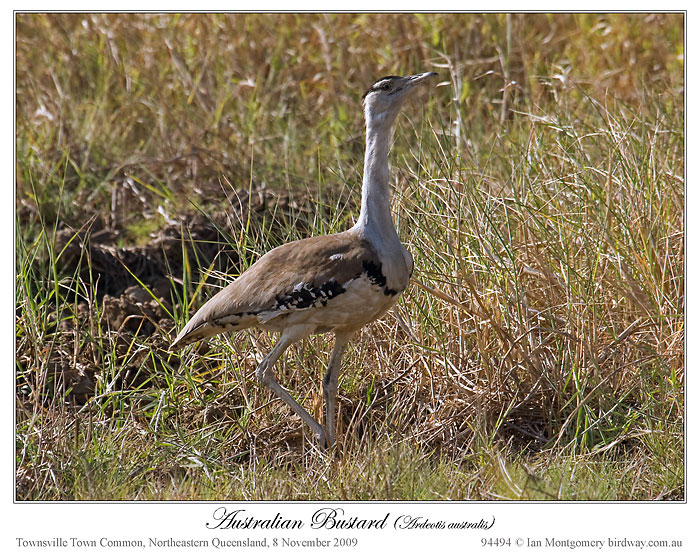
The first photo, taken at the Townsville Town Common, shows a bird in a typical pose, bill held high and looking very dignified. Graham Pizzey uses the appropriate adjectives ‘lordly’ and ‘stately’. When disturbed they walk away at a steady pace, and take flight reluctantly, not surprising given their size and weight: the larger males average 120cm/48in in length and 8kg/18lbs in weight. When airborne, they fly strongly and look unstoppable, like the one in the second photo taken at Toonpan at the southern end of Ross River Dam near Townsville.

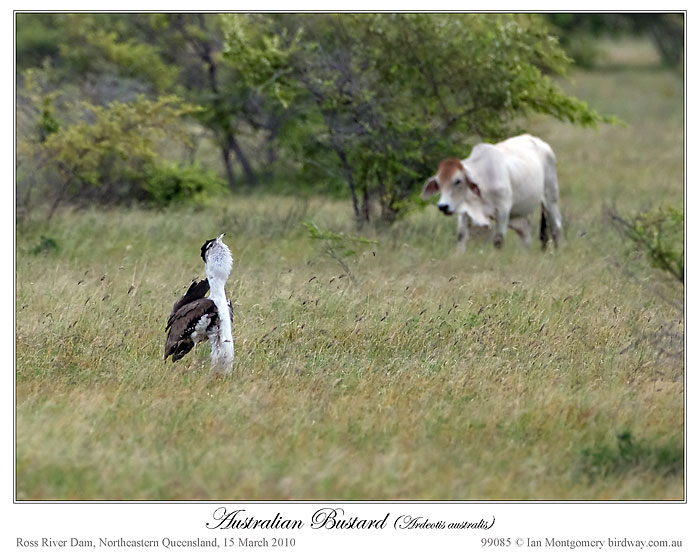
The land around the dam provides good, undisturbed bustard habitat and it is possible to see as many as 30 Bustards together, both at Toonpan and near the dam wall itself. The third photo, taken near the dam wall, shows a male displaying to the understandable astonishment of an unsuspecting cow. The display is quite extraordinary, with the bird extending the breast sac to the ground, drooping the wings, holding the tail erect against the back of the neck and puffing out the feathers of the neck. The bird walks slowly around making the sac swing, and, for a final touch, makes a roaring sound.

Australian Bustard (Ardeotis australis) by Ian

Australian Bustard (Ardeotis australis) by Ian

Bustards, apparently, make very good eating, reflected in the common name ‘Plains-Turkey’. So, worldwide (there are about 25 species) they have suffered seriously from hunting, loss of habitat and land use changes. The Australian Bustard is now rare in or absent from settled areas but still holds on in more remote areas. Most of the 25 or so species are smaller African ones, but there are 5 large species including the Great Bustard of Eurasia, the Arabian, the Kori Bustard of Africa and the endangered Great Indian Bustard. The latter two are closely related to the Australian Bustard and the three have in the past been treated as a single species.

On the website, I’ve finished updating the family thumbnail pages, so all now have the same format, the common background colours to distinguish regional thumbnails (Australian, New World, Old World), and labeled previous and next family buttons in the regional as well as the global pages. On the home page, I’ve added 4 ‘Ian’s Picks’ (Australian, New World, Old World and Other Wildlife) to share interesting photos which will be changed regularly. Currently, they are:

Red-tailed Tropicbird
Western Meadowlark
Buffy Fish-Owl
Black Flying-fox

Best wishes,
Ian

Other links:
Australian Bustard
Kori Bustard

Ian Montgomery, Birdway Pty Ltd,
454 Forestry Road, Bluewater, Qld 4818
Phone: +61-7 4751 3115
Preferred Email: ian@birdway.com.au
Website: http://birdway.com.au


Lee’s Addition:

The Australian Bustard is in the Otididae Family which has 27 members and they are the only family in the Otidiformes Order. The family includes Bustards, 7 Korhaans and 2 Floricans. The Bustards like to “move with a slow, deliberate, sedate walk, holding their head high and gently rocking backward and forward.” (National Geographic) After watching several videos of the different species, that is a very good description.

Nothing wrong with being stately or having a good bearing, but we should never act proud or think we are better than others. These birds are behaving the way the Lord created them to act and part of their behavior is to attract a mate.

For all that is in the world, the lust of the flesh, and the lust of the eyes, and the pride of life, is not of the Father, but is of the world. (1 John 2:16 KJV)

Keith has a video of two Australian Bustards walking.

Birds of the Bible – Quail II


Brown Quail (Coturnix ypsilophora) by Ian

Brown Quail (Coturnix ypsilophora) by Ian

It has been almost two years since the Quail have been written about. Birds of the Bible – Quail was early in this blogs history, so decided to write more about them.

The Bible has four references to quail and they are all found in the Old Testament. They refer to the time that the Israelites were in the desert after they had left Egypt by way of the Red Sea. They had been complaining about their lack of food, so the LORD answered them with:

And the LORD spake unto Moses, saying, I have heard the murmurings of the children of Israel: speak unto them, saying, At even ye shall eat flesh, and in the morning ye shall be filled with bread; and ye shall know that I am the LORD your God. And it came to pass, that at even the quails came up, and covered the camp: and in the morning the dew lay round about the host. (Exodus 16:11-13 KJV)

So, their request was taken care of every morning and evening. Just as today, we have a promise:

But my God shall supply all your need according to his riches in glory by Christ Jesus. (Philippians 4:19 KJV)

That incident took place on the 15th day of the second month after coming out of Egypt. Then right around the 20th day of the second month of the second year, they started complaining again about not having flesh to eat.

We remember the fish, which we did eat in Egypt freely; the cucumbers, and the melons, and the leeks, and the onions, and the garlick: But now our soul is dried away: there is nothing at all, beside this manna, before our eyes. (Numbers 11:5-6 KJV)

“Poor me! All we have to eat is manna, manna, manna.” Can you hear them? God wanted them to trust Him. God promises to meet our needs, not necessarily our wants. This is where the incident written about in the first article came about. They were well taken care of, even their shoes did not wear out in the 40 years they spent in the wilderness. Read Psalm 105 where it tells about all the LORD did for them. In Psalm 105:40 it says, “The people asked, and he brought quails, and satisfied them with the bread of heaven.”

Are we satisfied with what the Lord has provided or do we go around with a protruding lower lip saying, “Poor me!” I trust your lip is normal and that you can say along with Paul:

Not that I speak in respect of want: for I have learned, in whatsoever state I am, therewith to be content. (Philippians 4:11 KJV)

King Quail (Excalfactoria chinensis) Asian Blue by Kent Nickell

King Quail (Excalfactoria chinensis) by Kent Nickell

The Quail are numerous around the world and they are found in several families of birds. The Odontophoridae – New World Quail Family (34 members) includes not only Quails, but also 4 Bobwhites, 1 Francolin, and 4 Partridges. The Phasianidae – Pheasants, Fowl & Allies Family has 181 members. That is probably where the Quails mentioned in the wilderness came from because they are of the Old World area. That family has 13 Quail and a mix of other related birds including Turkeys, Pheasants and Peacocks. Both of these families are in the Galliformes Order.

Old World quail are the smallest birds in their family and are about 5 in (12-13 cm). The New World ones are 7-15 in (17-37 cm) long. They are very similar but are placed in the two families by ornithologists. They have short thick beaks with chunky bodies. Most do not make long flights and mainly fly when flushed. They are mostly seed and vegetation eaters, but some do eat insects.

Here in the U.S., the Northern Bobwhite’s call is very familiar.

*

Updated Family Pages to IOC Ver. 2.5

California (Western) Scrub Jay (Aphelocoma californica) by Daves BirdingPix

California Scrub Jay (Aphelocoma californica ) was Western by Daves BirdingPix

The IOC World Bird List Version 2.5 was just released on July 4th. I have been busy updating the Family pages and just finished.

They have made 19 changes to the English Names, added 13 new birds and deleted 1. They also made 93 changes to the Taxonomy, and made 12 changes to the Ranges. Now they will get busy and start planning the changes to the 2.6 list, but that will give me a 3-4 month rest before they release that one.

With all the DNA studies going on and other proposals, the number of birds and where they come from, stay in a constant flux. Here, we know where they came from, the Lord created them, but as to how they have “multiplied and plenished the earth” is what keeps the ornithologists busy. All this changing gives me something to do every few months.

So God created great sea creatures and every living thing that moves, with which the waters abounded, according to their kind, and every winged bird according to its kind. And God saw that it was good. (Genesis 1:21 NKJV)

I still have to update the indexes, but for now the Family pages are up to date.

To see the Family Pages – Click Here.

*