Is the Bride Ready? – A. J. Mithra

Is the Bride Ready? – A. J. Mithra

Migration the most amazing
natural phenomena on earth..
The longest migrations
of all are those of birds.
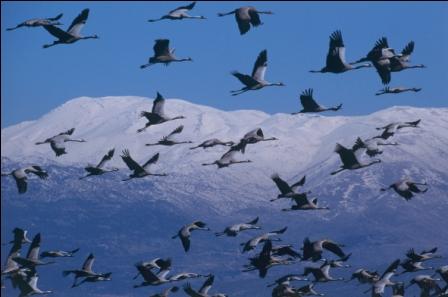
Crane Migration over Israel

Crane Migration over Israel

Israel, which is located
right at the junction
of three continents,
is crossed by migrating birds
of 300 different species,
on a scale unparalleled
anywhere in the world…

Studies over the past decade
shows that about
500 million birds cross
Israel’s narrow airspace
twice every year
in the course of their migrations…
Between one to two million raptors
migrate through Eilat,
in Israel each spring.

Is this large scale
migration and breeding in Israel,
a trial run for the feast
which GOD has planned
for these birds
when JESUS returns
as THE KING?

The Birds are
preparing themselves
for the biggest
marriage feast ever…

The BRIDE-GROOM is on HIS way,
Is the bride ready?

And thou, son of man, thus saith the Lord Jehovah: Speak unto the birds of every sort, and to every beast of the field, Assemble yourselves, and come; gather yourselves on every side to my sacrifice that I do sacrifice for you, even a great sacrifice upon the mountains of Israel, that ye may eat flesh and drink blood. (Ezekiel 39:17)

Your’s in YESHUA,
A. J. Mithra at Crosstree

Updated 5/29/10: Changed name from Migration over Israel to present. I missed aj’s updated changes – (corrected by editor).

Click to see more of A. J.’s articles


Palestine-Israel: A Crossroad for Bird Migration

Cassowary Seed Spreaders – A. J. Mithra

Cassowary Seed Spreaders

Cassowaries eat mainly
large colorful fruits,
and they are considered
as the vital “keystone” species
cos they eat,
and therefore distribute
so many large tropical rain forest fruits.

SouthernCassowary(Casuariuscasuarius) from Wikipedia

SouthernCassowary(Casuariuscasuarius) from Wikipedia

In fact, the Southern Cassowary
is probably the single most important
seed disperser of the
Australian tropical rain forest.
So far, over 200
Australian tropical rain forest plants
have been recorded
to be eaten by cassowaries

Though the bird is hard to be seen,
their scat can be quite
common and conspicuous,
and can contain up to
1 kilogram of seeds….

The survival of the rain forests
of Australia depends upon
the survival of these birds…

Have we ever realized that
the extension of God’s kingdom
depends upon how far and wide
we sow JESUS, THE SEED?

How dare we expect to reap
goodness and mercy to follow us
all the days of our lives
when we haven’t sowed
JESUS, THE SEED??

If a bird can sow
hundreds of seeds,
in how many lives
have we sown,
JESUS,THE SEED?

He that goeth forth and weepeth, bearing precious seed, shall doubtless come again with rejoicing, bringing his sheaves with him.” Psalms 126:6 (KJV)

Have a blessed day!

Yours in YESHUA,
A J Mithra

His website is CROSSTREE
More of A. J.’s articles here.


Cassowaries are in the Casuariidae Family of the Casuariiformes Order

**

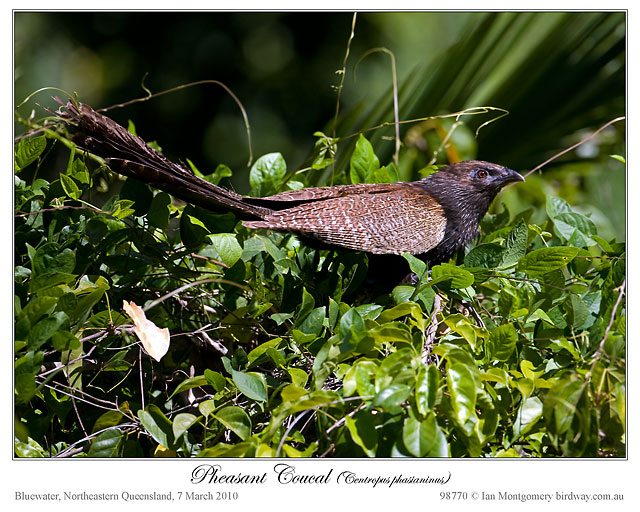
Ian’s Bird of the Week – Pheasant Coucal

Pheasant Coucal(Centropus phasianinus) by Ian

Pheasant Coucal(Centropus phasianinus) by Ian

Newsletter – 3-6-2010

White I was making a cup of coffee this morning and pondering what to choose as Bird of the Week, this Pheasant Coucal supplied the answer by posing on a small tree, having just had a drink in the pond below. Coucals, like other cuckoos, are shy birds so I photographed it through the window – first photo – before carefully opening the French door onto the verandah to try to get a clearer view. I got the door open all right, but it spotted me raising the camera and large lens and took off before I had managed to take more than a couple of shots – second photo.

Pheasant Coucal(Centropus phasianinus) by Ian.jpg

Pheasant Coucal(Centropus phasianinus) by Ian.jpg

Pheasant Coucals are splendid birds: large (to 70cm/28in in length), red-eyed with richly patterned short wings and a long tail. In breeding plumage, the head and body is blackish with shiny feather shafts and the bill is black. In non-breeding plumage the black, of both the plumage and the bill, fades to buff.

Their usual call is a wonderful “deep, hollow, descending, descending ‘coop-coop-coop-coop-coop’, like liquid glugging from bottle” to quote Pizzey and Knight. They also have a sharp alarm call that sounds coarse paper being torn suddenly. There are several territories near my place, mostly along the creek, so the sound of their ‘bottle’ call is very characteristic of summer and I realise how much I’ve missed it when they start calling in the spring.

The range of the Pheasant Coucal includes coastal north western, northern and eastern Australia from the Pilbara to the Sydney region. It is generally common, but less so at the edge of its range in central New South Wales. It also occurs in New Guinea and related species, such as the Greater Coucal, are found in the warmer parts of Asia and in Africa.

Unlike other cuckoos, Coucals build their own nest and were until recently placed in their own family (the Centropidae). Genetic studies have shown that they close affinities with other cuckoos, and it is now usual to treat them as a subfamily of the cuckoos (Centropodinae within Cuculidae).

The Pheasant Coucals fly very poorly. The usual strategy is to climb to the top of a tree and glide with a few wing-beats to the destination. Sadly, they lack traffic sense and are frequently casualties on highways. Here in North Queensland, they are called ‘pheasants’ in the same way Bush Stone-Curlews are called ‘curlews’.

Links:
Pheasant Coucal
Greater Coucal

Recent additions to the website:
Photos of Brown Goshawk and Collared Sparrowhawk in flight
Diamond, Brown Cuckoo– and Bar-shouldered Doves .
Little Corellas in flight
Double-barred Finch
Southern Cassowary and Emu and
Rainbow Lorikeet (including Orange-collared race)

Best wishes,
Ian

Ian Montgomery, Birdway Pty Ltd,
454 Forestry Road, Bluewater, Qld 4818
Phone: +61-7 4751 3115
Preferred Email: ian@birdway.com.au
Website: http://birdway.com.au


Lee’s Addition:
Here is the sound of a Pheasant Coucal (duet from a pair in undergrowth) by Vicki Powys from xeno-canto:

What a neat bird. From the pictures, the bird seems sort of plain, but very beautiful. Since they are closely related to the Cuckoos, they are in the Cuculidae family, which is in Cuculiformes order.

and the owl, and the night-hawk, and the cuckoo, and the hawk after its kind, (Leviticus 11:16 YLT)

See the Cuckoo page

Birds in Hymns – Mighty God, While Angels Bless Thee

For God is the King of all the earth: sing ye praises with understanding. (Psalms 47:7 KJV)

Words: Ro­bert Ro­bin­son, 1774.
Music: Autumn by Fran­çois H. Bar­thé­lé­mon, 1785
Al­ter­nate tune: Wellesley by Liz­zie S. Es­ta­brook, 1878

Mighty God, While Angels Bless Thee

Mighty God, while angels bless Thee,
May a mortal sing Thy Name?
Lord of men as well as angels,
Thou art every creature’s theme.
Lord of every land and nation,
Ancient of eternal days.
Sounded through the wide creation
Be Thy just and endless praise.

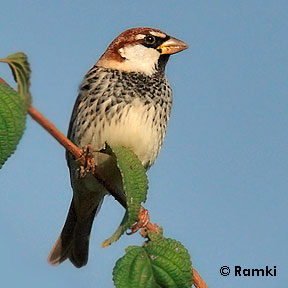
Spanish Sparrow (Passer hispaniolensis) by Nikhil Devasar

Spanish Sparrow (Passer hispaniolensis) by Nikhil Devasar

For the grandeur of Thy nature,
Grand beyond a seraph’s thought;
For the wonders of creation,
Works with skill and kindness wrought.
For Thy providence, that governs,
Through Thine empire’s wide domain,
Wings an angel, guides a sparrow,
Blessèd be Thy gentle reign.

For Thy rich, Thy free redemption,
Bright, though veiled in darkness long,
Thought is poor, and poor expression;
Who can sing that wondrous song?
Brightness of the Father’s glory,
Shall Thy praise unuttered lie?
Break, my tongue, such guilty silence!
Sing the Lord Who came to die.

From the highest throne of glory
To the cross of deepest woe,
All to ransom guilty captives;
Flow my praise, forever flow!
Reascend, immortal Savior;
Leave Thy footstool, take Thy throne;
Thence return, and reign forever,
Be the kingdom all Thine own!


See Video of Hymn by pipeorgan8

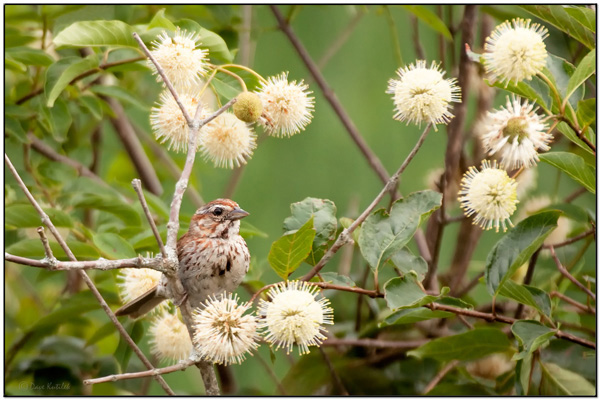
Song Sparrow in white flowers by Daves BirdingPix

Song Sparrow in white flowers by Daves BirdingPix

Ro­bert Ro­bin­son, (1735-1790)

“Robinson’s wi­dowed mo­ther sent him at age 14 to Lon­don, to learn the trade of bar­ber and hair dress­er. How­ev­er, his mas­ter found he en­joyed read­ing more than work. Con­vert­ed to Christ at age 17, Ro­bin­son be­came a Meth­od­ist min­is­ter. He lat­er moved to the Bapt­ist church and pas­tored in Cam­bridge, Eng­land. He wrote a num­ber of hymns, as well as on the sub­ject of the­ol­o­gy. His lat­er life was ev­i­dent­ly not an ea­sy one, judg­ing from a well known sto­ry about his hymn Come, Thou Fount of Ev­ery Bless­ing. One day, he en­count­ered a wo­man who was stu­dy­ing a hymn­al, and she asked how he liked the hymn she was hum­ming. In tears, he re­plied, Madam, I am the poor un­hap­py man who wrote that hymn ma­ny years ago, and I would give a thou­sand worlds, if I had them, to en­joy the feel­ings I had then.” (CyberHymnal)

*

More Birds in Hymns

See ~ Wordless Birds
Most information from The Cyber Hymnal – Mighty God, While Angels Bless Thee

*

What Would God Say of Us? by A. J. Mithra

What Would God Say of Us?

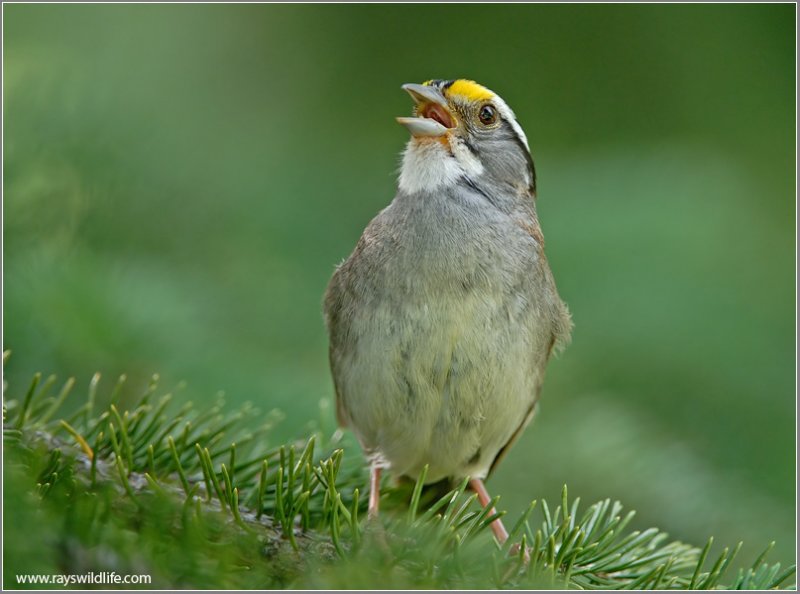
Birds choose to mate
only with those birds
which sing the most
complicated songs…

White-throated Sparrow by Ray

For,
they believe that
only those birds
which sing different songs,
are good at raising
and taking care of the family
and the territory…

He worshiped
and
sang for the LORD at all times…

Is that the reason why
GOD certifies David
as the one who pleases
HIS heart?

Would GOD say of us
like how HE said of David?
Most of us have complicated
Our lives.
Instead of singing,
when life turns
too complicated to handle..

If GOD chooses only those
Who sing for HIM at all times,
How many of us would
GOD select?

Yours in YESHUA,
A. J. Mithra at Crosstree

Click to see more of A. J.’s articles

Birds in Hymns – I Am His, and He Is Mine

The LORD hath appeared of old unto me, saying, Yea, I have loved thee with an everlasting love: therefore with lovingkindness have I drawn thee. (Jeremiah 31:3 KJV)

Author: George Wade Robinson, 1838-1877 – Its melody is lively and upbeat. Born in Ireland, Robinson was educated at Dublin’s Trinity College, and later at New College in London. Later he became a pastor in Dudley.

Music: Everlasting Love, James Mountain, 1843-1933 – The melody of “I am His, and He is Mine” was written under the name “Everlasting Love” by James Mountain in 1876. The melody of this hymn was written because the composer was about to publish a first edition of his hymnal, Hymns of Con­se­cra­tion and Faith. He took the words of Robinson’s hymn.

I Am His, and He Is Mine

Loved with everlasting love, Led by grace that love to know;
Spirit, breathing from above, Thou hast taught me it is so!
Oh, this full and perfect peace! Oh, this transport all divine!
In a love which cannot cease, I am His, and He is mine;
In a love which cannot cease, I am His, and He is mine.

Carolina Wren (Thryothorus ludovicianus) by Quy Tran

Carolina Wren (Thryothorus ludovicianus) by Quy Tran

Heav’n above is softer blue, Earth around is sweeter green!
Something lives in ev’ry hue Christless eyes have never seen:
Birds with gladder songs o’erflow, Flow’rs with deeper beauties shine,
Since I know, as now I know, I am His, and He is mine;
Since I know, as now I know, I am His, and He is mine.

Things that once were wild alarms Cannot now disturb my rest;
Closed in everlasting arms, Pillowed on the loving breast.
Oh, to lie forever here, Doubt, and care, and self resign,
While He whispers in my ear, I am His, and He is mine;
While He whispers in my ear, I am His, and He is mine.

His forever, only His; Who the Lord and me shall part?
Ah, with what a rest of bliss Christ can fill the loving heart!
Heav’n and earth may fade and flee, Firstborn light in gloom decline;
But while God and I shall be, I am His, and He is mine;
But while God and I shall be, I am His, and He is mine.

ICR Devotionals just covered this song.
Stanza 1 – Everlasting Love
Stanza 2 – Appreciating God’s Creation
Stanza 3 – His Everlasting Arms
Stanza 4 – While God and I Shall Be

Updated 3/13/2010

Most information from The Cyber Hymnal

See ~ Wordless Birds

More ~ Birds in Hymns

*

Bar-tailed Godwits – Self Control

Bar-tailed Godwits – Self Control  –  by a j mithra

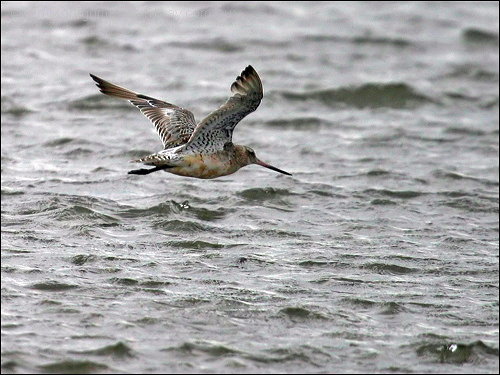
Bar-tailed Godwit (Limosa lapponica) by Nikhil Devasar

Bar-tailed Godwit (Limosa lapponica) by Nikhil Devasar

With the help of
satellite tracking,
researchers found that,
Bar-tailed Godwits made
the longest non-stop flight
of any bird…
A female Bar-Tailed Godwit,
flew nonstop for eight days
and covered 7,242 miles
from Alaska to New Zealand….
These birds use
the air’s low pressure
to help them migrate
and they take advantage
of the 500 to 800 miles
of strong tailwinds
of the low pressure..
Many a time,
when we face low pressure
in life,
we feel down and out,
weak and weary,
distracted and disturbed
all along our life’s journey….

Bar-tailed Godwit (Limosa lapponica) by Ian

Bar-tailed Godwit (Limosa lapponica) by Ian

All because,
we don’t have the
fruit of self control..
We also fail to realize that
the low pressure
is the launching pad
on our quest to top…
Look at the price
this little bird had paid
to do what no one else
could do!
She didn’t eat or drink,
she didn’t shop or sleep
during her journey..
GOD paid a priceless price
for all our sins..
But,
what price are we
going to pay
to reach our destiny?
This bird neither slept
nor supped for eight long days..
Do we have that self control,
to fast at least once a week?
Do we have that self control
to keep wake all night
and pray for at least once a month?
GOD IS IN NEED OF PEOPLE
TO STAND AT THE GAP
AND PLEAD FOR ALL THOSE
DYING SOULS..
HELLOOOOO….
IS ANYONE LISTENING?

And every man that striveth in the games exerciseth self-control in all things. Now they [do it] to receive a corruptible crown; but we an incorruptible. 1Corinthians 9:25 (A S V)

Have a blessed day!

Yours in YESHUA,
A. J. Mithra at Crosstree

Click to see more of A. J.’s articles

Godwits are in the Scolopacidae Family of the Charadriiformes Order

See also:
Great Travelers Have Great Stories to Tell

Clark’s Nutcracker by A J Mithra

Clark’s Nutcracker

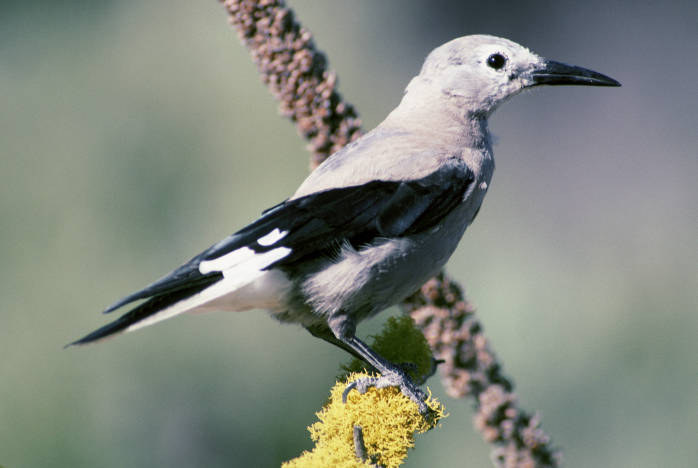
Clark's Nutcracker (Nucifraga columbiana) ©USFWS

Clark's Nutcracker (Nucifraga columbiana) ©USFWS

Clark’s Nutcracker
is a small shy bird,
stores around
22,000 to 33,000 seeds
during the growing months
in 2,500 different locations,
sometimes at a distance of
nearly 10 miles apart..

If this small little bird
can prepare so well
for the winter months,
how prepared are we to meet
THE SEED – THE WORD?

The amazing part is.
this small little bird
can still remember
the locations
where it hid the seeds..
Such is its remarkable
memory power..

Do we at least remember that
we are fearfully
and wonderfully made
by GOD and that
HE gave HIS precious life
for you and me?

I will praise thee; for I am fearfully and wonderfully made: marvellous are thy works; and that my soul knoweth right well. (Psalms 139:14 KJV)

Have a blessed day!

Your’s in YESHUA,
A. J. Mithra at Crosstree

Click to see more of A. J.’s articles

Lee’s Addition:
Nutcrackers are in the Corvidae – Crows, Jays family of the Passeriformes order

Bird brained-it could be a compliment! (Oct 9, 2009 by Ken Ham)

Nice Video of a Clark’s Nutcracker

Birds of the Bible – Pleasant to the Sight

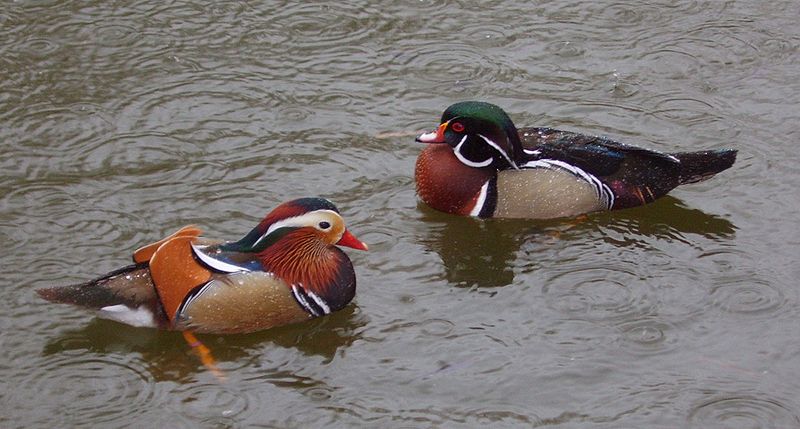
ANS-Anat Wood Duck and Mandarin Duck

And out of the ground made the LORD God to grow every tree that is pleasant to the sight, and good for food; the tree of life also in the midst of the garden, and the tree of knowledge of good and evil. (Genesis 2:9 KJV)

While searching for articles about birds I came across this article. The quote below is also appropriate for birds. I believe many of them definitely qualify as “pleasant to the sight.”

“The answer that came to my mind was suggested by Genesis 2:9, where we read that God created fruit trees not only good for food but also “pleasant to the sight.” We normally expect to find aspects of beauty as well as utility in the artifacts of human creation; how much more should we expect beauty to abound in the handiwork of God! Even creationists seem to forget that God is not only the Great Engineer, but the Great Artist as well.

Unfortunately, just like the engineering marvels of God have been corrupted by mutations and other effects of the bondage to corruption occasioned by our sin (Romans 8:18-20), so its beauty has been marred. The God whose faithful care daily sustains what He has made will not leave it so. But with the creation that “groaneth in travail,” we also wait for that time when “they shall not hurt nor destroy in all my holy mountain, but the earth shall be full of the knowledge of the Lord as the waters cover the sea” (Isaiah 6:11).” (From, Nature’s Challenge to Evolutionary Theory, by Gary Parker, Ed.D., ICR)

Thought you might enjoy seeing some “Pleasant to the Sight” birds. It was hard to narrow the choices down. These are from the Non-Passerines. Used the Passerines last week.

*

This slideshow requires JavaScript.

*

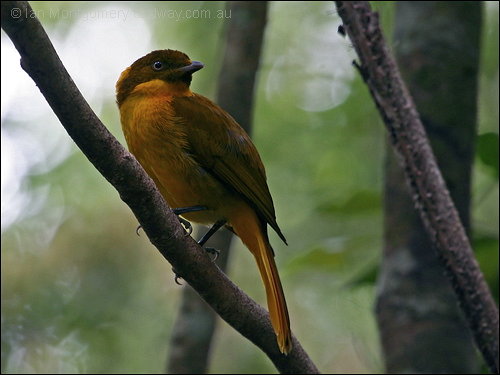
Golden Bowerbird by A. J. Mithra

Golden Bowerbird

Though the Golden Bowerbird
is the smallest
of all the bower species,
it builds a bower,
consisting of at least
two columns,
each consisting of sticks
arranged around a sapling.
This can be up to
3m/10ft in height,
to attract its female..
The female builds its nest
only above 900m/3,000ft..

Golden Bowerbird (Prionodura newtoniana) by Ian

Golden Bowerbird (Prionodura newtoniana) by Ian

God used a small girl
to bring healing
in to Naaman’s life..
God used
David the Shepherd boy
to bring down the giant…

God used
a little boy
to feed the multitudes…

God always uses
small people
to bring great revival..

He turns the smallest
into the greatest..

Why?
Cos, their hopes n(r)ests
in the Lord who dwells
high above in the heaven…

Who is like unto the LORD our God, who dwelleth on high, (Psalms 113:5 KJV)

Have a blessed day!

Your’s in YESHUA,
A. J. Mithra at Crosstree

Click to see more of A. J.’s articles

See Also:

Bowerbird (Malaconotidae – Bushshrikes) Family of the Passeriformes Order
Ian’s Bird of the Week – Golden Bowerbird
Birds in Hymns – Go Out, My Heart, and Seek Delight


Family#126 – Ptilonorhynchidae
*

Ian’s Bird of the Week – Golden Bowerbird

Golden Bowerbird (Prionodura newtoniana) by Ian

Golden Bowerbird (Prionodura newtoniana) by Ian

Newsletter – 02-28-2010

Searching for a suitable Bird of the Week, I found that the Golden Bowerbird hasn’t, I don’t think, featured as BOW before. That’s a serious omission which we’ll now rectify. It’s serious because all bowerbirds are special, the Golden Bowerbird is particularly gorgeous, its a local specialty and it’s survival is of real concern in the case of global warming.

The adult male Golden Bowerbird is golden-yellow below and glossy golden-olive above, with a yellow erectile patches on the nape and crown. The rarely-seen female is, in comparison, a rather drab olive-brown (there’s a photo of one on the Birdway website, link below). With a length of 23-25cm/9-10 in, it’s the smallest of the Australian Bowerbirds but, as compensation, it builds the biggest bower. It is found only in highland rainforest in the wet tropics of northeastern Queensland from Mount Elliott near Townsville north to Mount Cook near Cooktown. It nest only above 900m/3,000ft, but moves lower in winter. A good place to see them is near Paluma, about one hour’s drive from where I live.

Golden Bowerbird (Prionodura newtoniana) at bower by Ian

Golden Bowerbird (Prionodura newtoniana) at bower by Ian

Most Australian Bowerbirds, such as the Satin Bowerbird, build ‘avenue’ bowers consisting of two parallel walls of twigs on a display platform. The Golden Bowerbird builds a ‘maypole’ bower, consisting of at least two columns, each consisting of sticks arranged around a sapling. This can be up to 3m/10ft in height but more typically is about 1m high like the one in the photo. Between the saplings is a branch used as a display perch and the male bird decorates this with lichens and rainforest flowers, often orchids. The bowers are often incorrectly referred to as ‘nests’, but the bowers are built and maintained by the males to attract females for mating and the females build their own nests. If the male bowerbird disappears, the bower will be taken over by another male so a particular site remains in use used decades.

The concern about global warming arises because their habitat consists of islands of highland rainforest in a sea of coastal lowlands. If warming eventuates, the boundaries of the highland rainforest may rise in altitude and the islands may ultimately disappear. The Golden Bowerbird has iconic status here, but other species would be affected too, such as the Mountain Thornbill. Consequently, Paluma Range has been classified as an Important Bird Area (IBA) and monitoring of the bowers of Golden Bowerbirds is undertaken by Birds Australia North Queensland.

Best wishes,
Ian

Links:
Golden Bowerbird
Satin Bowerbird
Mountain Thornbill
Birds Australia North Queensland

Recent additions to Website include photos of:
Spotted Bowerbird
Superb Fruit-Dove
Little Bronze-Cuckoo
Australian Brush-Turkey
Australian Bustard
Long-tailed Finch

Ian Montgomery, Birdway Pty Ltd,
454 Forestry Road, Bluewater, Qld 4818
Phone: +61-7 4751 3115
Preferred Email: ian@birdway.com.au
Website: http://birdway.com.au


Lee’s Addition:

Bowerbirds are in the Ptilonorhynchidae family of the Passeriformes order.

Who teaches us more than the beasts of the earth And makes us wiser than the birds of the heavens?’ (Job 35:11 NASB)


Ptilonorhynchidae
*