First Family Page Completed – Ardeidae

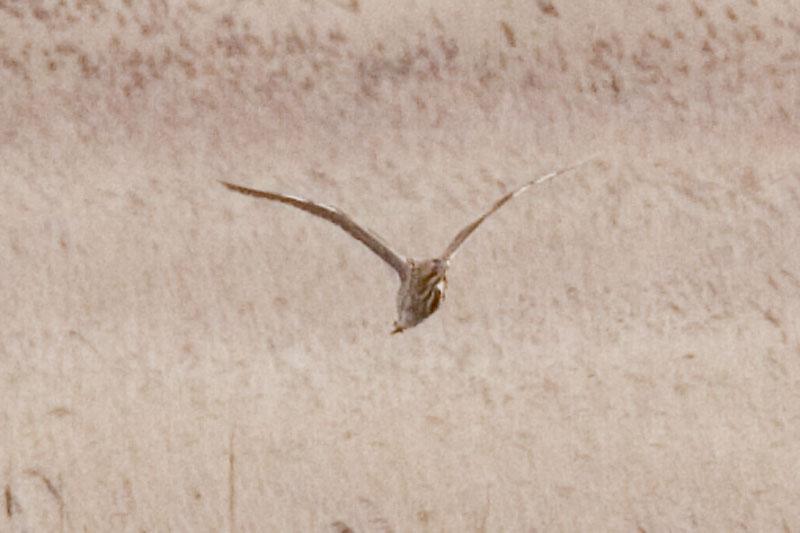
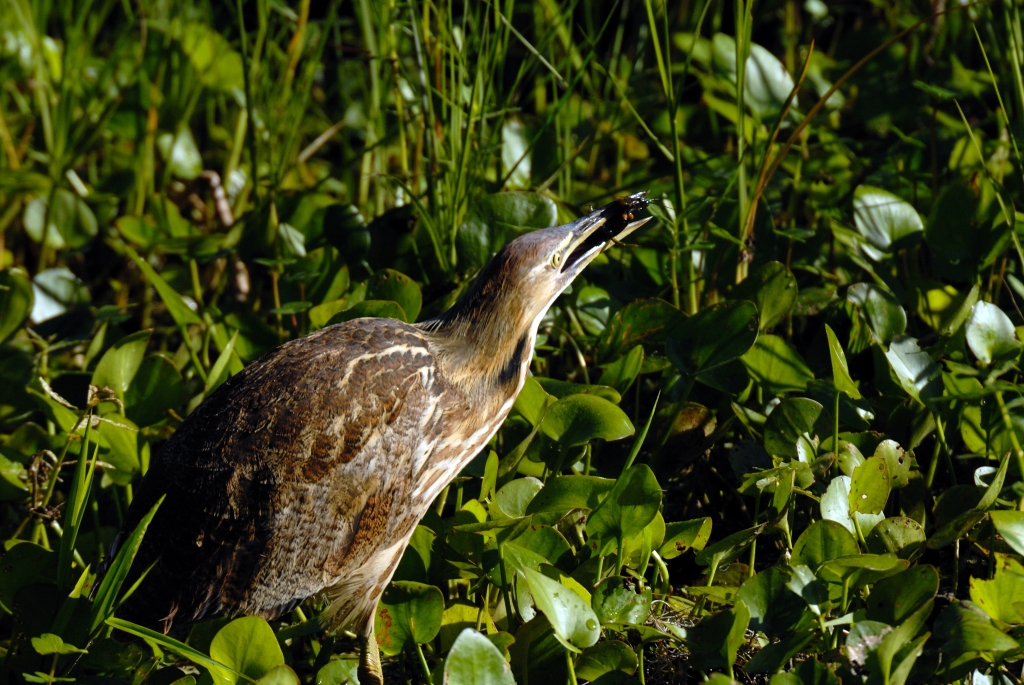
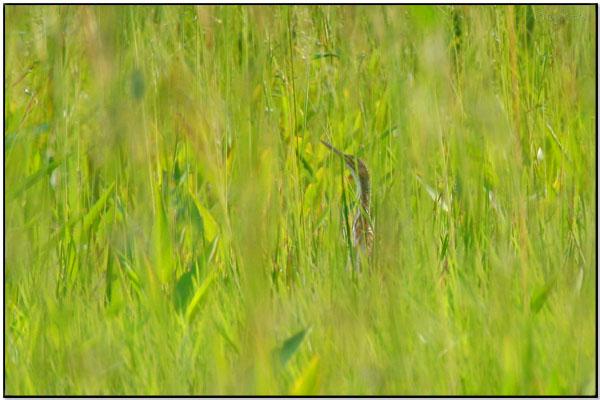
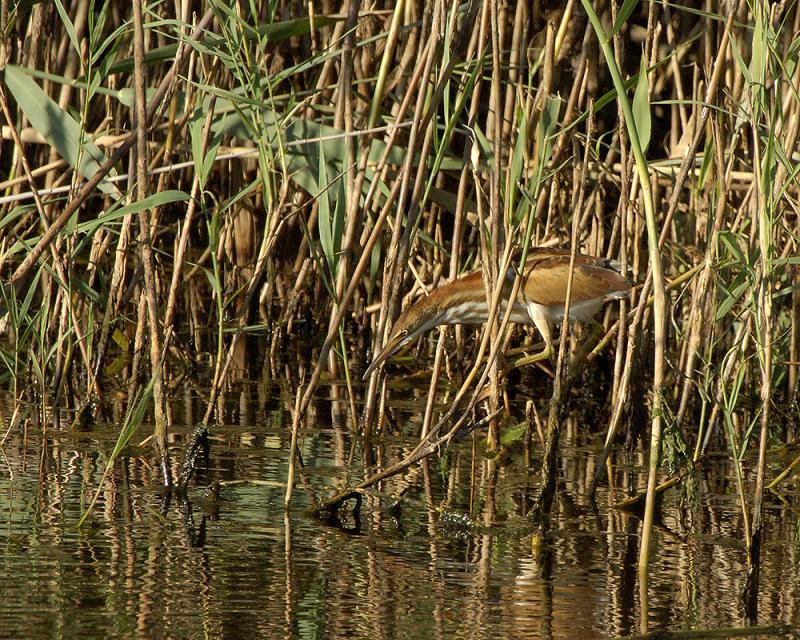
Great-billed Heron (Ardea sumatrana) by Ian

Great-billed Heron (Ardea sumatrana) by Ian

I just completed the first Birds of the World Family page. Well, at least as far as I can find photos for it. I now only have 223 more family pages to go.

Check it out at Family – Ardeidae It is part of the PELECANIFORMES Order. At least according to the latest IOC 2.1 version. I hope you enjoy the photos of the different Bitterns, Egrets and Herons.

Update: 08/09/09

Finished the Family – Struthionidae (Ostriches) page today. It is in the Order – STRUTHIONIFORMES Now at 2 down and 222 to go. Plus 37 partial ones – no photos yet.

Updated: 08/13/09

I finished all 229 (I found some birds that had flown from my original lists)  Bird Family pages as far as the list of each species within the families. Now I am going to make some  indexes to help find the different birds in either taxonomic or alphabetical order. Then I will be adding various photos to each family.

The Birds, the Economy, and My Provider – by April Lorier

There I was, snoozing in my lazyboy when I was awakened by such a clatter, I rose from my chair to see what was the matter! I felt like Tippi Hedren and it was The Birds all over again. Just outside my window were dozens of sparrows fighting over a snippet of orange peel! I mean fierce terrorist fighting!

I watched in amazement as one of those little sparrows actually made off with the orange peel, unnoticed, and the rest of the birds were still doing battle. I thought, “Isn’t that the way it goes? Anger got the best of them.”

No one has to tell you the economy is pinching your style. As more and more people enter the survival mode we will see anger rising in more people. Fear does terrible things to people. It’s not displayed as fear, but as anger. And as the economy gets worse, we will see more and more vigilante behavior.

People tend to forget that God said He watched over the sparrows and I am worth far more to Him than a sparrow. That fear takes over and we lose sight of our Provider who is far greater than any recession or depression.

I’m so thankful for the reminder from Him of His Sovereignty over all things. Were it not for these birds, I might have forgotten Who’s actually in control.

(c) 2009 April Lorier

You are worthy, our Lord and God, to receive glory and honor and power, for you created all things, and by your will they were created and have their being. Revelation 4:11

Supplied by and reprinted with permission of April Lorier.

See more of April’s articles.

*

Sparrows and God Care – by April Lorier

April Lorier writes great articles on her “Christian Nature” blog and has agreed to be a guest author. She is allowing us to reproduce some of her very thoughtful and inspiring challenges about birds and the Creator. I trust you will be as blessed by her writings as I am. This is the first one.


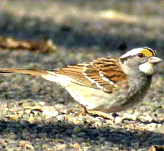
Sparrows and God Caresparrow-whiteThroat1 I have written about sparrows before and feel a need to revisit the subject. There are just so many sparrows flying around!Ethel Waters made “His Eye Is On The Sparrow” famous many years ago, and it’s still a master piece. It serves to remind us that if God values sparrows and cares for them, then certainly He does the same for us. He created human beings for companionship, and through Christ we can have that relationship.

One Sunday morning at church, we sang “His Eye Is on the Sparrow” as a congregational hymn. It was a rare opportunity to give voice to a song usually performed by a soloist.

During the first chorus, I noticed a friend who was weeping so hard that he couldn’t sing. Knowing a bit of what he had been through recently, I recognized his tears as ones of joy at realizing that, no matter what our situation, God sees, knows, and cares for us.

Jesus said, “Are not two sparrows sold for a copper coin? And not one of them falls to the ground apart from your Father’s will. But the very hairs of your head are all numbered. Do not fear therefore; you are of more value than many sparrows” (Matt. 10:29-31). The Lord spoke these words to His 12 disciples as He sent them out to teach, heal, and bear witness of Him to “the lost sheep of the house of Israel” (v.6). He told them that even though they would face persecution for His sake, they should not be afraid, even of death (vv.22-26).

When threatening circumstances press us to lose hope, we can find encouragement in the words of this song: “I sing because I’m happy, I sing because I’m free. For His eye is on the sparrow, and I know He watches me.” We are under His watchful care.

If God sees the sparrow’s fall,
Paints the lilies short and tall,
Gives the skies their azure hue,
Will He not then care for you? —Anon.

When you put your cares in God’s hands, He puts His peace in your heart.

2009 April Lorier

Ask the animals, and they will teach you, or the birds of the air, and they will tell you; or speak to the earth, and it will teach you, or let the fish of the sea inform you. Which of these does not know that the hand of the Lord has done this? –
Job 12

Supplied by and reprinted with permission of April Lorier

Ian’s Bird of the Week – Australian Hobby

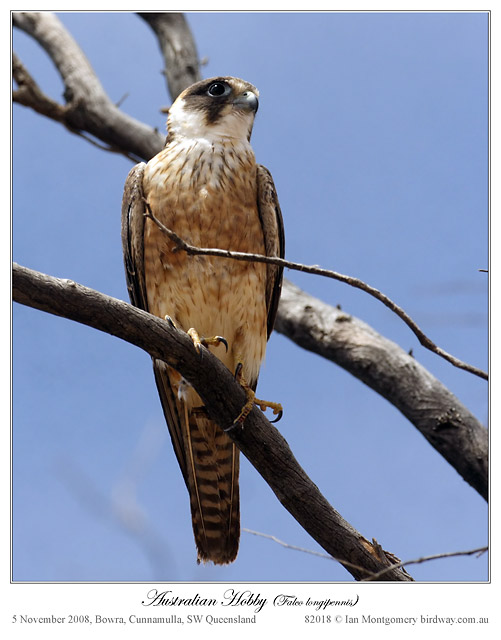
Australian Hobby by Ian

Australian Hobby by Ian

Bird of the Week: Australian Hobby by Ian Montgomery

“This, as you’ll see could also be titled the Birder and the Bird or, if you’re into puns, His Hobby and the Hobby.

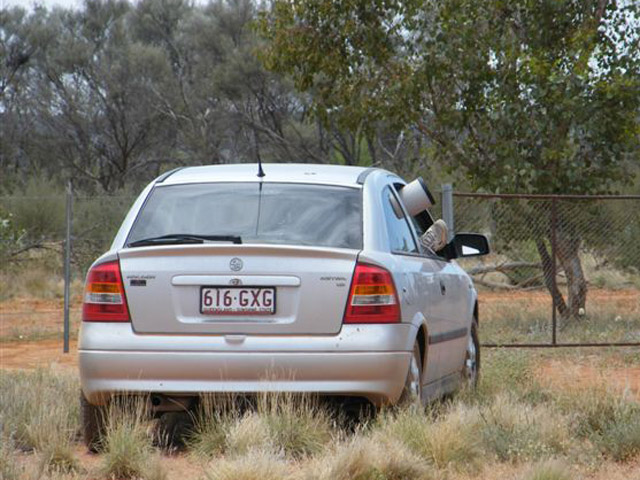
Cars can make good hides, or blinds, as some birds take much less notice of them than of people on foot. This Australian Hobby, or Little Falcon as the species is sometimes called, proved to be quite approachable by car and I was able to park below the tree in which it was perched and take lots of photos through the car window. This was when we were at wonderful Bowra property in SW Queensland last November and, little did I know I was being photographed by my friends in the car behind.
Maybe I should qualify the comment and say that large, spacious cars make good hides for photographers with large lenses.  You can guess from seeing my right foot on the window frame, that I had to indulge in spine-threatening contortions to get the camera at the right angle. There are no half-measures when it comes to taking photos for the Bird of the Week.
Australian Hobbies are widespread throughout Australia but not particularly common, so it’s always good to see one. They’re very dashing, like a small (to 35cm/14in in lenght) Peregrine Falcon and relentlessly pursue small birds and, at dusk, large insects. They occur in a wide variety of habitats with trees, so you are just as like to see them in leafy suburbs as in the drier forests of the outback.
Ian using car as blind

Ian using car as blind

I’m getting close to finishing re-working the website with the new gallery layouts and Next and Previous Family links on the global family index pages. Soon it will be possible to browse through the entire site in taxonomic order and I’m planning other ways to make the site easier to navigate around. The wet season seems to be ending here, so I’m planning some birding trips in the next couple of months, concentrating on Australian birds. I have now finished putting up all the American species from my trip last year.

Recent updates include:
Best wishes,
Ian

Ian Montgomery, Birdway Pty Ltd,
454 Forestry Road, Bluewater, Qld 4818
Phone: +61-7 4751 3115
Preferred Email: ian@birdway.com.au
Website: http://birdway.com.au

Newsletter supplied by and used with Ian’s Permission.

To see more Ian’s Bird of the Week newsletters – CLICK HERE


Lee’s Additions:


The Australian Hobby is in the Falconiformes Order and the Falconadae family which includes Falcons, Caracaras, Hobbies, Falconets and Kestrels. Falcons are one of the Birds of the Bible and you can check some information at my Falcons page to see links to articles, photos, and videos of the Falcon family. Most of the Falcon Family Photos are by Ray’s Wildlife Photography who shoots mostly North American birds. Both he and Ian are fantastic photographers.

As for the earth, from it comes bread, But underneath it is turned up as by fire; Its stones are the source of sapphires, And it contains gold dust. That path no bird knows, Nor has the falcon’s eye seen it. (Job 28:5-7 NKJV)

See Also:
Australian Hobby – Wikipedia
Falconidae by Wikipedia
Falcons Falconadae by List of Bird Families of the World, 9th ed.

Birds of the Bible – Bitterns II

I will also make it a possession for the bittern, and pools of water: and I will sweep it with the besom of destruction, saith the LORD of hosts. (Isaiah 14:23 KJV)

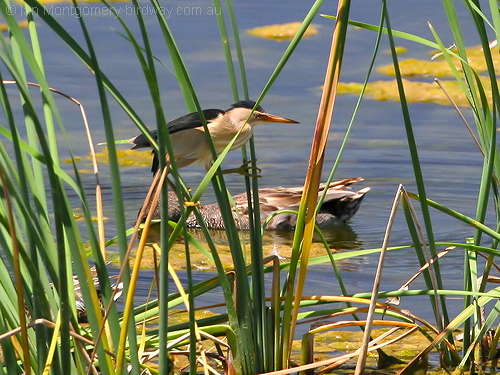
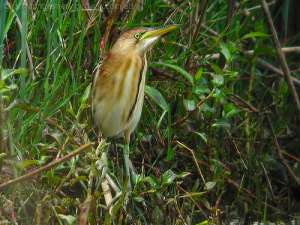
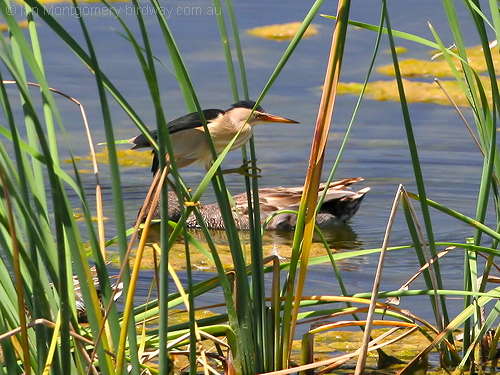
Little Bittern (Ixobrychus minutus) by Ian

Little Bittern (Ixobrychus minutus) by Ian

I introduced the Bittern in the first Birds of the Bible – Bittern and now I want to add some more information about them. The Bitterns belong to the Order called Pelecaniformes which includes Ibises, Spoonbills, Herons, Bitterns, Frigatebirds, Hamerkop, Shoebills, Pelicans, Gannets, Boobies, Cormorants, Anhingas, and Darters. All of these birds like to hang out around watery places and are related. Within the Pelecaniformes order, there are different families. The Bittern is in the Ardeidae family. Below is a list of the Bitterns within this family.

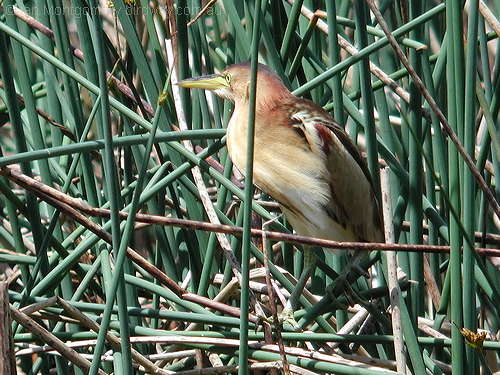
Belonging to the Ardeidae family, they also have the usual long legs, long necks, and are wading birds. They are associated with water, especially in breeding season. Whereas the herons and egret stand out in the open, the bitterns like to conceal themselves in cattail and sedge marshes, bulrushes, etc. They also have shorter legs and a heavier body. Their “cryptic plumage and upright poses helps to merge with the brown upright reeds…” I’ve had the privilege to see a few of them, and they are hard to find. God has provided them with this protection and it helps them in finding their food. Fish is their favorite food, but they will also consume frogs, small snakes, and other things that pass by.

Here in North America, we only have the American and Least Bitterns. I sometimes confuse them with the smaller herons, like a Green Heron. You can tell they are in the same family (ardeidae).

Here is the sounds of an American Bittern and a Least Bittern from Stokes Bird Songs

But the cormorant and the bittern shall possess it; the owl also and the raven shall dwell in it: and he shall stretch out upon it the line of confusion, and the stones of emptiness. (Isaiah 34:11)


CLASS – AVES, Order –PELECANIFORMES, Family – ArdeidaeHerons, Bitterns

Australian Little Bittern (Ixobrychus dubius) by Ian

Australian Little Bittern (Ixobrychus dubius) by Ian

Herons, Bitterns – Ardeidae Family
Zonerodius
Forest Bittern (Zonerodius heliosylus)
Botaurus
Eurasian Bittern (Botaurus stellaris) – Video
Australasian Bittern (Botaurus poiciloptilus) by Ian
American Bittern (Botaurus lentiginosus) – Video – Video2
Pinnated Bittern (Botaurus pinnatus) by Daves BirdingPix  – Video
Ixobrychus
Stripe-backed Bittern (Ixobrychus involucris)
Least Bittern (Ixobrychus exilis) by Jim Fenton – Video
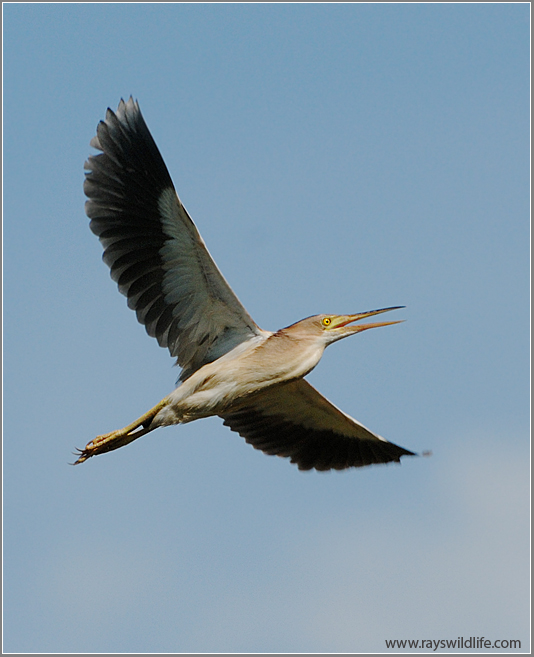
Little Bittern (Ixobrychus minutus) by Ian
Black-backed Bittern (Ixobrychus dubius)
New Zealand Bittern (Ixobrychus novaezelandiae †)
Yellow Bittern (Ixobrychus sinensis) by Ray Barlow – Video
Von Schrenck’s Bittern (Ixobrychus eurhythmus)
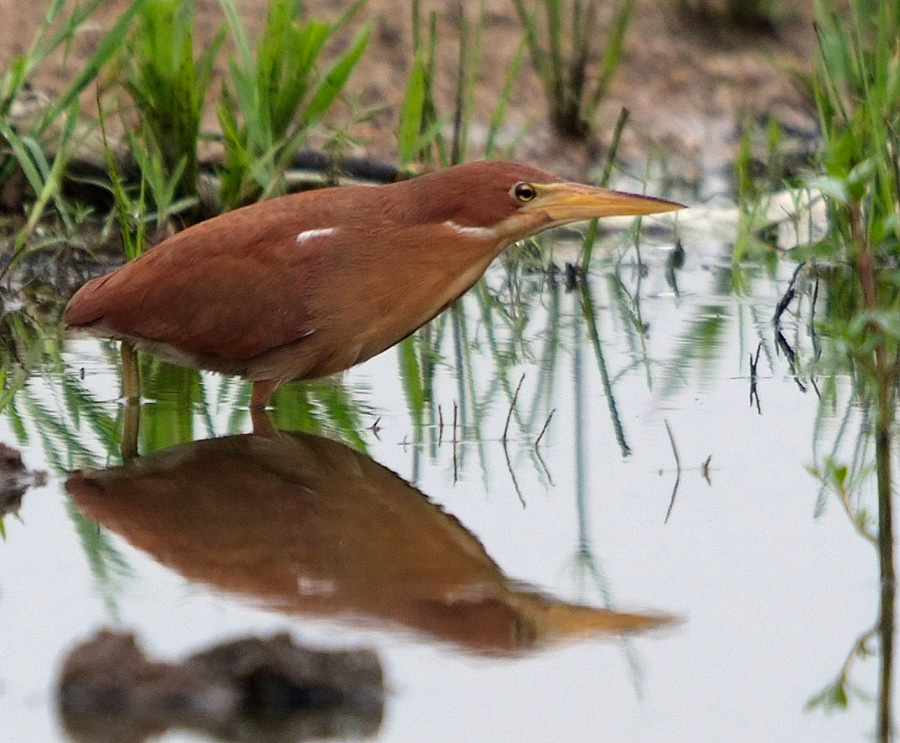
Cinnamon Bittern (Ixobrychus cinnamomeus) by Phil Kwong – Video
Dwarf Bittern (Ixobrychus sturmii)
Dupetor
Black Bittern (Dupetor flavicollis) by Nikhil Devasar – Video

Different Family
Sunbittern – Eurypygidae Family
Eurypyga
Sunbittern (Eurypyga helias) – Video – Video2

“Recent DNA evidence suggests that this family may in fact belong to the Pelecaniformes.5, From Wikipedia  They used to be in the Ciconiformes family, where most older guide books still have them. My list are from the IOC’s World Lists, 3.1 version.


Family#26 – Ardeidae

*

Ian’s Bird of the Week – Chowchilla

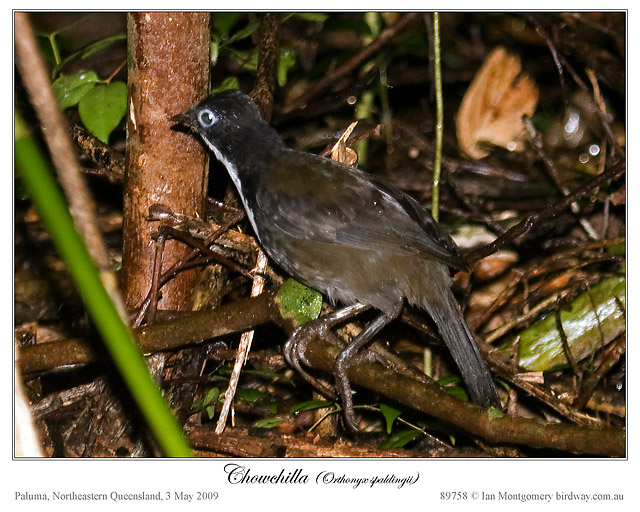
This week’s photo wouldn’t win any photographic competitions, but the Chowchilla – http://www.birdway.com.au/orthonychidae/chowchilla/index.htm – is an interesting bird and there’s a story to go with the photo.

Chowchilla - Orthonychidae family - by Ian

Chowchilla – Orthonychidae family – by Ian

The Chowchilla is one of two Australian members of a rather obscure family, Orthonychidae, or Logrunners. The Chowchilla, which used to be called the Northern Logrunner, is a wet tropics endemic and is reasonably common in dense rainforest between Paluma, north of Townsville – where this photo of a male was taken – and Cooktown, north of Cairns. They’re best known for their loud, ringing calls – ‘chow, chowchilla, etc’ – made by family groups at dawn and dusk to maintain their territories. It’s one of the great sounds of the wet tropics rainforest.

When they aren’t loudly proclaiming their sovereignty, they use their very strong legs to rummage around in leaf litter looking for food. If you’re lucky, you can hear them scratching around and you may seem them dart across the path in front of you. They are reasonably approachable, but usually stay well hidden in the tangled undergrowth of the rainforest which – in combination with the poor light – makes them very hard to photograph. The females, incidentally, are brighter than the males and have a rufous breast and white belly, though in the gloom of the rainforest, rufous is perhaps less conspicuous than white.

On this occasion, I was waiting – flash at the ready not long before sunset – in the hope that one or other of a small group of Chowchillas would cross the path, when I felt a faint wriggling sensation on my lip and then on my upper gum. ‘Yuk, leech!!!’ I thought and was then faced with the dilemma of whether I should remain still in the hope of getting some photos or try to get rid of the leech. Clearly, the photo opportunity won the tussle and I then had the problem of extracting the leech. It’s hard enough to grab hold of one at the best of times, but quite impossible when its covered in saliva and out of sight. In the end, I had to make my way back to the car, half a kilometer away so I could use the mirror to find and get rid of it.

Anyway, back to the Ornthonychidae. The other Australian species is the (Southern) Logrunner – http://www.birdway.com.au/orthonychidae/logrunner/index.htm – which has a limited distribution in coastal forests in southeast Queensland and New South Wales as far south as the Illawarra – common in SE Queensland, much rarer in NSW. There is a third species in New Guinea, the New Guinea Logrunner, which looks like the Southern Logrunner. There are also a few other little known species in New Guinea – the Greater and Lesser Melampittas and the Blue-capped Ifrita – which may belong to this family too, but little is known about them.
I’m at last reasonably up-to-date in posting birds to the website, so I’ve now started adding photos of other wildlife, starting with Australian mammals. This doesn’t mark any great change in emphasis, but I do photograph other wildlife when I stumble across them and I do get requests for photos of things other than birds. So far, I’ve added Platypus and Echidna and Antechinus (marsupial mouse) – http://www.birdway.com.au/dasyuridae/index.htm – and will soon add more marsupials. The new section is accessible via a new navigation button called ‘Other Wildlife’ that replaces the old ‘Contact Details’, now combined with the ‘About Ian’ section. Watch this space, as they say.
Best wishes,
IanPreferred Email: ian@birdway.com.au

Website: http://birdway.com.au


Lee’s additions:


To Hear a Chowchilla – Click Here

Several nice videos  from Internet Bird Collection: Chowchilla (Orthonyx spaldingii) especially the first one “A male removing dry leaves and feeding”

LOGRUNNERS Orthonychidae from Bird Families of the World, 9th ed.

New Species?

While working on the Orders of the Birds and finding so many species of birds worldwide, I went looking for more information about them. I came across this interesting article at the ICR.org website. The bolding is mine. I trust you will find it worth the reading.

Cormorant Tree by Dan

Cormorant Tree by Dan

Do ‘New Species’ Demonstrate Darwinism?
by Various Authors
Frank Sherwin, M.A., and Brian Thomas, M.S.*

“That species undergo change in this grand system called earth is apparent, but those changes do not occur the way Charles Darwin envisioned. Living things do shift behaviors and physiologies in response to environmental (and other) pressures, but can these minor changes completely rework a creature’s essential form (a concept referred to as “macroevolution”)? Decades of research emphatically say no.

Often, small changes within a kind are referred to as “microevolution,” which has been defined as “evolution resulting from a succession of relatively small genetic variations that often cause the formation of new subspecies.”1 Creation scientists agree that small variations occur, both because they can be observed, and because it is reasonable that a wise Creator would equip His creatures with survival-enhancing capabilities. But these variations do not lead to large-scale changes between kinds. Indeed, “there is no agreement [among evolutionists] as to whether macroevolution results from the accumulation of small changes due to microevolution, or whether macroevolution is uncoupled from microevolution.”2

The confusing array of definitions for the word “species” can obscure deficiencies in Darwinian evolution. As leading scientists have admitted, “The very term ‘species’ is deeply ambiguous.”3 Harvard’s Steven Palumbi said in 1994 that “the formation of species has long represented one of the most central, yet also one of the most elusive, subjects in evolutionary biology.”4

If different species are described as essentially those forms which cannot interbreed, then new species do arise, a process called “speciation.” They do so, however, because of a loss of information–the opposite direction to what Darwinian evolution requires. “…..

To see the complete article – CLICK HERE

World Bird Lists on the Internet

There is plenty of data about the birds of the world on the internet. This site is not competing with them, but just trying to use the pages here to introduce the birds and have links to our articles and links to great pages about them on the internet.

Our emphasis is “Birdwatching from a Christian Perspective”, so, we may see things a little different from time to time. When I read so many of the articles, they tell of the birds evolving, whereas, I believe God created them and told them to go multiply and cover the earth. There has been lots of variation going on, but no “evolution” from one kind to another. So, I just read around their remarks about evolution and enjoy the information about the actual birds.

Here are some links for information on the birds of the world.

IOC World Bird List ver 2.1 – Where I got the data for my list.

Bird Families of the World, 9th edition – Used many times for references

Bird Families of the World, Allen Chartier’s photographs – Newly found

Birdingonthe.net – Lots of links for birding the internet

Checklist of the World – Many interesting links

Avibase -“Avibase is an extensive database information system about all birds of the world”

Handbook of the Birds of the World – Wikipedia’s extensive information on the birds.

Eye of the Beholder – Bird Names

Mom and Baby at Lake Hollingsworth

Mom and Baby at Lake Hollingsworth

Last week, Dan and I went to Lake Hollingsworth in Lakeland, our favorite place to go birding when we don’t have a lot of time, my legs aren’t working well, or Dan has a new, used camera to check out. That was the case, I was just checking out the normal birds for this time of the year and photographed this female mallard and her chick. In other words, there aren’t many. Most of them have gone back north to do what God commanded them to do when they came off the ark.

Then God spoke to Noah, saying, “Go out of the ark, you and your wife, and your sons and your sons’ wives with you. Bring out with you every living thing of all flesh that is with you: birds and cattle and every creeping thing that creeps on the earth, so that they may abound on the earth, and be fruitful and multiply on the earth.” So Noah went out, and his sons and his wife and his sons’ wives with him. Every animal, every creeping thing, every bird, and whatever creeps on the earth, according to their families, went out of the ark. (Genesis 8:15-19 NKJV)

So, the birds have been reproducing and reproducing and reproducing. I have been working on a project for this blog behind the scenes and it has to do with the bird families of the world. The numbers keep changing, but the count is over 10,000 species (living) worldwide. All the Birding committees work hard on putting them into Order, Families, Genus, and then giving them a  Scientific name and an English name. As I have been working on this project, I couldn’t help but think about how well the birds have obeyed.

What amazes me, is how they (Birding committees) decide how to classify them. I have a hard enough time, getting some birds just into the right family, let alone figuring them all out. Warblers being the hardest for me. Here is my idea of this whole process, from a human classification.

Smith Family:
Dad – Black hair, blue eyes, normal ears, round eyes
Mom – blond hair, green eyes, normal ears, slant eyes
Child #1 – Black hair, green eyes, ears stick out, round eyes
Child #2 – Blond hair, blue eyes, long ear lobes, slant eyes
Child #3 – Brown hair, blue eyes, normal ears, beady eyes
Child #4 – Red hair, black eyes, pointed ears, bushy eyebrows
The children grow up and each find a mate with similar characteristics, they move away and continue to have children with their same characteristics and some more variations show up. Etc, etc.

Now along come the classifying committees! Can you imagine how they would try to classify the human race?
I’ll leave that to your imagination.

To get a glimpse of my project, click List of ORDERS of the Birds in Taxonomic Order Just realize, this is a work in progress.

Ian’s Bird of the Week – Red-capped Robin

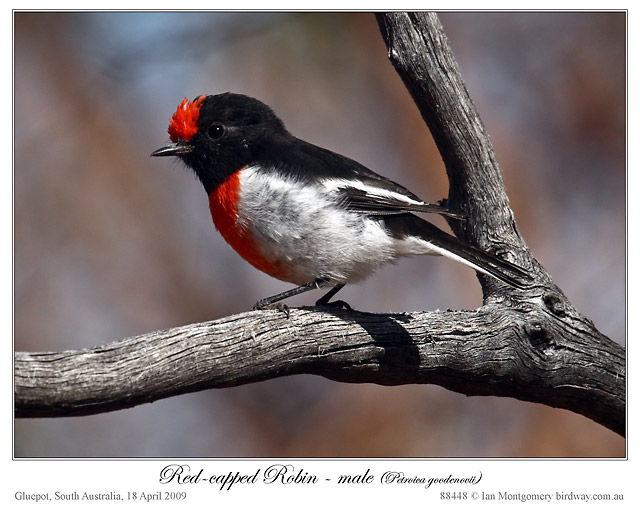
Red-capped Robin by Ian

Red-capped Robin by Ian

Ian’s Newsletter:

“The Red-capped Robin is the most widespread of the 5 red-breasted Robins that occur in mainland Australia. It prefers drier habitats and is found across Australia west of the Great Dividing Range and south of the Tropic of Capricornia but does not occur in Tasmania.

The red cap of the male is both distinctive and diagnostic (first photo) and even the brown female has a reddish cap (second photo) making her easier to identify than the other female Robins. With a length of 11 – 12 cm./4.3 – 4.7 in., it is the smallest of the Robins. Typically, it perches in low branches and flies down onto the ground to pick up insect prey.

Flame Robin by Ian

Flame Robin by Ian

In the early days of European settlement of the colonies, any small bird with a red breast was likely to be called a Robin after the familiar European Robin so it isn’t surprising to find that such birds are not necessarily closely related. The European Robin is a member of the Old World Flycatchers, The American Robin is a Thrush, while all the Australasian Robins belong to a separate family the Australo-Papuan Robins (Petroicidae ).

On the website, I’ve recently reorganized the galleries for:
Petrels & Shearwaters;
Bee-eaters;
and added night-time photos of:
Australian Owlet-Nightjar;
Tawny Frogmouth;
and – just for the record – Stubble Quail.

Best wishes,
Ian


Lee’s Additions:

Red-capped Robin female by Ian

Red-capped Robin female by Ian

What a cute and beautiful bird. You will have to visit Ian’s site and see all his Red-capped Robin Photos. From what I have read about them, they may be small, but they stay on the move or are defending their turf. This from Wikipedia:

“The Red-capped Robin typically perches in a prominent location low to the ground, often flicking its wings and tail. It is very active and does not stay still for long.[27] The female has been reported as being fairly tame, while the male is more wary of human contact.[28]

The Red-capped Robin is territorial during the breeding season; the area occupied has been measured between 0.25 and 1.2 ha (0.6–3 acres).[16] A pair lives and forages within their territory before dispersing in autumn.[16] The male proclaims ownership by singing loudly from a suitable perch at the territory boundary, and confronts other males with a harsh scolding call should they make an incursion.[29] Two males have been seen to face off one another 30 cm to 1 m (12–40 in) apart, flicking wings and maneuvering for position in a threat display while the female is actually incubating her eggs.”

He sends the springs into the valleys; They flow among the hills. They give drink to every beast of the field; The wild donkeys quench their thirst. By them the birds of the heavens have their home; They sing among the branches. (Psalms 104:10-12 NKJV)

There favorite food (96%) is beetles with ants most of the remainder. They do like locust, butterflies, dragon and damselflies, etc. It likes to pounce on it prey on the ground. It catches some flying, but is a specialist for ground attacks.

The sad part about this bird is the treat from loss of habitat. They used to be common in the western suburbs of Sydney, but now has almost disappeared for the there and the Sydney Basin. Other places are noticing declines of this neat Red-capped Robin. Two other threats are the feral cats and other birds raiding the nest and young.

This is of a Red-capped Robin taking on a mirror. Ignore the last part. By jezau2

See:
Ian’s Bird of the Week for more of these articles.

Ian’s Birdway Website

Birdway Images of  Global Australo-Papaun Robins – Family: Petroicidae

Australo-Papaun Robins Petroicidae by Bird Families of the World

Red-capped Robin at Wikipedia


Birds of the Bible – Eagles III

This year I have been reading through the Bible in chronological order. In Jeremiah this week, the eagle showed up in three of the verses I was reading. If you know me by now, that calls for a blog about one of my favorite “Birds of the Bible” birds.

Jeremiah, the prophet, has been warning the people of Judah and Jerusalem that they were going to be punished by God because of their worship of other gods and turning from Him. Jeremiah was always in problems because; 1) few if any believed him, 2) the false prophets were telling the people that “all was well and that they would not be punished.” 3) they tried to kill him several times, 4) when confronted with the truth, knowing they would be killed or taken captive, they still refused to give up their false religions or turn to the LORD. So by chapter 48:28 he warns them – “You who dwell in Moab, Leave the cities and dwell in the rock, And be like the dove which makes her nest In the sides of the cave’s mouth.” (NKJV) (oops! the dove is for another blog) He is telling them to “leave town.”

Jeremiah 48:40-42 says:

For thus says the LORD: “Behold, one shall fly like an eagle, And spread his wings over Moab. Kerioth is taken, And the strongholds are surprised; The mighty men’s hearts in Moab on that day shall be Like the heart of a woman in birth pangs. And Moab shall be destroyed as a people, Because he exalted himself against the LORD.

Watch the following video and decide whether you think the fish was surprised.

In Jeremiah 49:16 and 22, the eagle is mentioned again. Eagles are known to make their nest as high up as they can and these people thought by being high up in the hills, that the enemy would not get them. Then in verse 22, it refers to flying like an eagle and spreads its wings. So the enemy (Nebuchadnezzar king of Babylon and his army) was going to come over them. Now the people are finally afraid.

Your fierceness has deceived you, The pride of your heart, O you who dwell in the clefts of the rock, Who hold the height of the hill! Though you make your nest as high as the eagle, I will bring you down from there,” says the LORD. (Jeremiah 49:16 NKJV)
Behold, He shall come up and fly like the eagle, And spread His wings over Bozrah; The heart of the mighty men of Edom in that day shall be Like the heart of a woman in birth pangs. (Jeremiah 49:22 NKJV)

Another of my favorite eagle videos of the eagles wings being spread:

Even though I used my favorite videos, this was not a enjoyable experience for these people. I trust we will heed the warnings of the Bible. God loves his chosen people, Israel (and all of us), but God cannot tolerate sin or denial of Himself.

He who is often rebuked, and hardens his neck, Will suddenly be destroyed, and that without remedy. (Proverbs 29:1 NKJV)
“Come now, and let us reason together,” Says the LORD, “Though your sins are like scarlet, They shall be as white as snow; Though they are red like crimson, They shall be as wool. If you are willing and obedient, You shall eat the good of the land; But if you refuse and rebel, You shall be devoured by the sword”; For the mouth of the LORD has spoken. (Isaiah 1:18-20 NKJV)

The people of Noah’s day had over 100 years of warning, but also refused to accept God, and were devoured, not by sword, but by a flood.


See Also:
Eagles for more articles, photos, and videos
Wordless Birds

*

Cockatiel Bird Brain Wisdom – by April Lorier

Cockatiel Bird Brain Wisdom

cockatielsm1 It is pretty bad when God has to use Bird Brain Wisdom to get through to His daughter, but He did. I tried my best to avoid Dave at every church function. Most people did. His inordinate need for attention and his obvious emotional and spiritual immaturity embarrassed me. I went out of my way to not be associated with him. Intellectually, I understood people are often needy because they had been damaged in some way, so I would have moments of guilt for acting as I did. Then he would say something totally inappropriate and I’d be right back where I began – embarrassed for him.

At the same time I was hand feeding baby cockatiels every two hours, and one of them who I affectionately called Ernie, just couldn’t eat enough to make him grow. I tried everything, but to no avail.One night, still bleary-eyed from little sleep, I prayed, God, please help me! Ernie isn’t going to make it if You don’t help us out. He’s just too weak. And into my spirit, clear as a bell, came the thought, Ernie is the weakest of your birds, and yet you love him the most. Why doesn’t his weakness embarrass you?
Who are you to judge someone else’s servant? To his own master he stands or falls. And he will stand, for the Lord is able to make him stand. (Romans 14:4 NIV)

The comparison was too obvious, and I hung my head in shame. God loved Dave the same way I loved Ernie! His heart broke with tenderness over this man’s weakness the same way my heart broke over my baby bird. He would persist with Dave just as I had with Ernie, spending extra time with him. And God didn’t need a judgmental child getting in the way of Dave’s growth.

I went to bed that night wiser, but much sadder with the knowledge that I had, in my arrogance, dared to pass judgment on another human being that I really didn’t know. By judging Dave, I had positioned myself to be judged by God.I realized God wasn’t half as embarrassed by Dave’s spiritual and emotional immaturity as He was by my arrogance. And worse was my underestimation of God’s power to work in Dave’s life and make him stand strong. I had, with my attitude, questioned the sovereignty of Almighty God!

O Father, forgive my arrogance. Thank You for the wisdom You taught me through my precious little “bird brain!” Let me never lose sight of Your sovereignty and Your compassion towards Your weaker children. I, too, am one of your weak ones. (c)1996-2009 April Lorier

For since the creation of the world God’s invisible qualities—his eternal power and divine nature—have been clearly seen, being understood from what has been made, so that men are without excuse. Romans 1:20

Supplied by and reprinted with permission of April Lorier.


See more of April’s articles.

*

When I Consider! – Hummingbirds

When I Consider!

When I Consider!

“One of the fascinating and unique creatures of all creation is the common hummingbird. What is the probability that all of the unique characteristics of the Ruby-throated Hummingbird, each of which are needed for its survival, developed by some step-by-step process? A few of the hummingbird’s incredible abilities are listed below:

  1. The unique ability to fly forward, backward, upside-down, and straight up like a helicopter as no other bird can.
  2. The use of a special fringed tongue to sweep insects out from the inside of flowers. It cannot survive on nectar alone, but also needs the protein from eating insects. Without its special tongue it could never catch the insects.
  3. The ability to fly 500 miles nonstop over the gulf waters to Mexico. The hummingbird can conserve its strength for long flights by taking a prolonged rest just  prior to the flight and making every motion count in flight.
  4. The ability to go into a “torpid” condition at night by almost shutting down its metabolism. Because of its incredibly high energy activity, gram for gram the hummingbird has the greatest energy output of any warm-blooded animal. Yet at night it uses only about one fifth of its normal energy.
Ruby-throated Hummingbird by Ray's Wildlife

Ruby-throated Hummingbird by Ray’s Wildlife

The hummingbird is truly a marvel of God’s creativity.

Character Sketches, Vol.II, p.42-48″

Seek the LORD and his strength; seek his presence continually! Remember the wondrous works that he has done, his miracles, and the judgments he uttered, (Psalms 105:4-5 ESV)

A Closer Look at the Evidence, July 13, by Richard and Tina Kleiss

Error
This video doesn’t exist

To see more about Hummingbirds See:

Birds of the Bible – Bird Feeder I

Hummingbirds – Peterson Field Guide Series

Hummingbird Videos