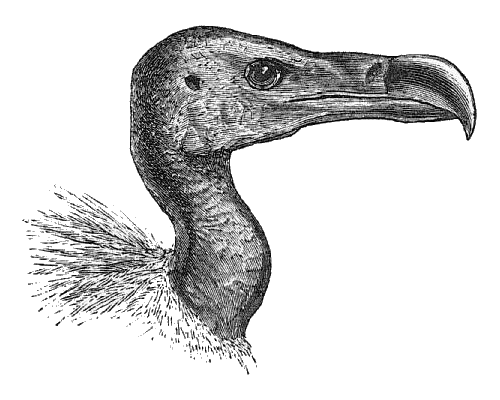
Of birds these are they which you must not eat, and which are to be avoided by you: The eagle, and the griffon, and the osprey. (Leviticus 11:13 DRB)
The unclean eat not: to wit, the eagle, and the grype, and the osprey, (Deuteronomy 14:12 DRB)
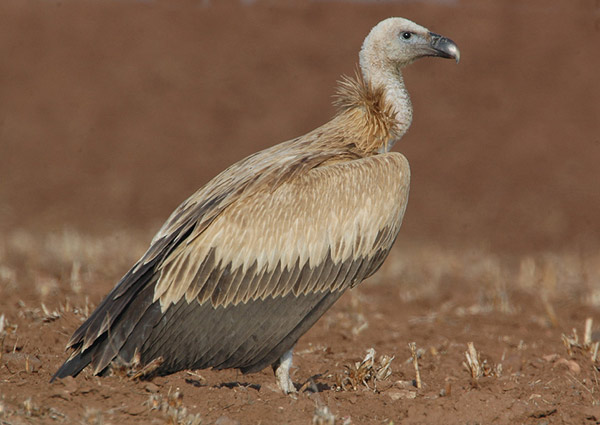
While looking through the list of clean and unclean birds in Leviticus 11 and Deuteronomy 14 to see if I could find a bird to write about, I found the two verses above in the DRB (1899 Douay-Rheims Bible). It is not a Bible I use other than comparing verses. Most of the other versions call it a vulture, ossifrage, gier-eagle, bearded or black vulture, buzzard and a few other things. The KJV calls it the ossifrage and the NKJV the vulture. What caught my eye was the grype. When I looked it up, the Griffon and the “gyps” genus were tied together. So, here is a little about the Griffon Vulture and the Gyps genus.
The Griffon Vulture (Gyps fulvus) is a large Old World vulture in the bird of prey family Accipitridae.
The Griffon Vulture is 93–110 cm (37–43 in) long with a 2.3–2.8 m (7.5–9.2 ft) wingspan. In the nominate race the males weigh 6.2 to 10.5 kg (14 to 23 lb) and females typically weigh 6.5 to 11.3 kg (14 to 25 lb), while in the Indian subspecies (G. f. fulvescens) the vultures average 7.1 kg (16 lb). Extreme adult weights have been reported from 4.5 to 15 kg (9.9 to 33 lb), the latter likely a weight attained in captivity. Hatched naked, it is a typical Old World vulture in appearance, with a very white head, very broad wings and short tail feathers. It has a white neck ruff and yellow bill. The buff body and wing coverts contrast with the dark flight feathers.
Griffon Vulture (Gyps fulvus) Dieren Park Amersfoort -adult and chick WikiC
Like other vultures, it is a scavenger, feeding mostly from carcasses of dead animals which it finds by soaring over open areas, often moving in flocks. It grunts and hisses at roosts or when feeding on carrion.
The maximum lifespan recorded for the Griffon Vulture is 41.4 years, for a specimen in captivity. It breeds on crags in mountains in southern Europe, north Africa, and Asia, laying one egg. Griffon Vultures may form loose colonies. The population is mostly resident.
White-backed Vulture (Gyps africanus) by Bob-Nan
There are 8 species in the Gyps genus. The Griffon being one of them. They are Old World vultures in the bird family Accipitridae, which also includes eagles, kites, buzzards and hawks.
These are the typical vultures, with bald head, broad wings and mainly dark plumage. They are large scavenging birds, feeding mostly from carcasses of dead animals. Old World vultures find carcasses exclusively by sight. Representatives of this group are found throughout warmer parts of the Old World.
The characteristic featherless head is because a feathered head would become spattered with blood and other fluids, and thus be difficult to keep clean.
Vultures are of course mentioned several times throughout Scripture:
There shall the great owl make her nest, and lay, and hatch, and gather under her shadow: there shall the vultures also be gathered, every one with her mate. (Isaiah 34:15 KJV)
There is a path which no fowl knoweth, and which the vulture’s eye hath not seen: (Job 28:7 KJV)
With all the preparations for Thanksgiving and having company here for the holiday, I am re-posting an article that I wrote for our church blog, The Fountain. We were asked to write about only one thing we are thankful for, so, myself and several other writers posted articles of Thanksgiving.
In view of the Thanksgiving season, I have asked our blog authors to write about one thing they are thankful for. Lee is up first.
Give thanks unto the LORD, call upon his name, make known his deeds among the people. (1 Chronicles 16:8 KJV)
One thing is all Stephen will let us be thankful for. So I won’t mention the other 9,000 things I am thankful for.
The Lord has given me an interest in our avian friends, the birds, and it has brought so many blessings from it. When observing them, their colors, behavior, the variety, and just the wonder of them, I can’t help but be THANKFUL!
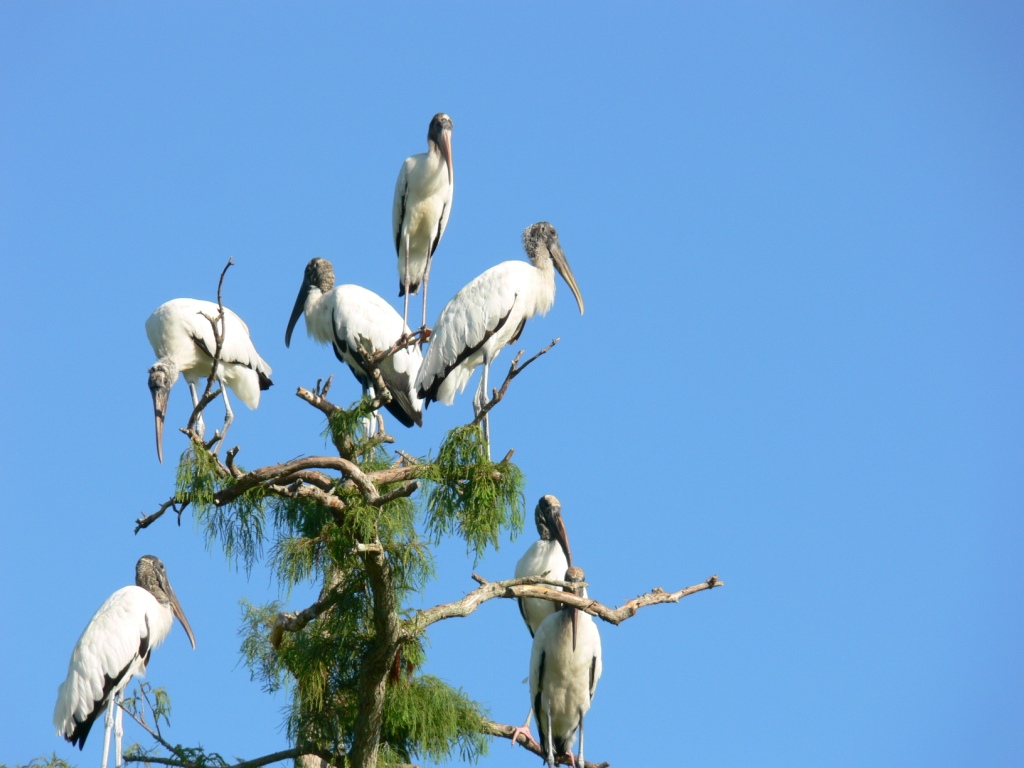
Woodstorks on top of tree at Circle B -7-22-11 by Lee
The Lord and I have a running conversation when birdwatching or looking for photos of birds for my blog. Here are some of my thought and talks with Him:
“Amazing! How did you think of so many different designs and colors?”
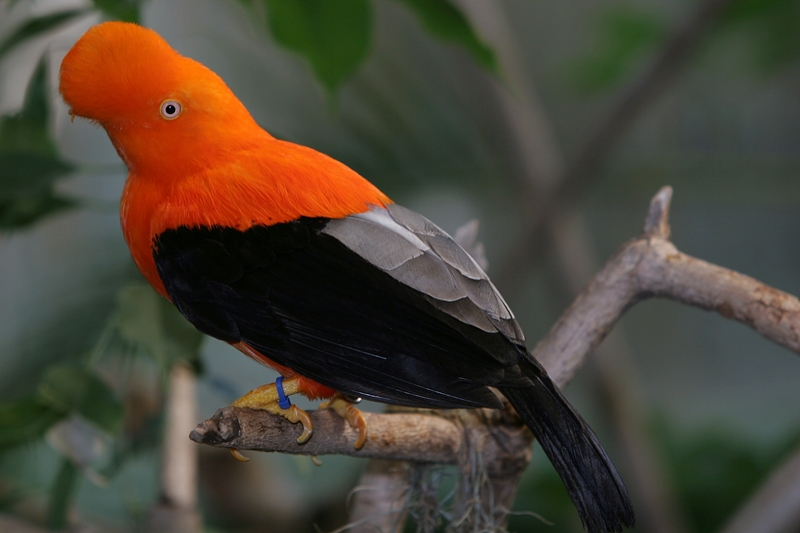
Andean Cock-of-the-rock (Rupicola peruvianus) by SanDiegoZoo
“(Chuckle) Lord you sure have a sense of humor on some of these birds!”
“Lord, you caused the donkey to talk, could you bring that bird out where I can see it.?” (Thankfully, it has worked several times. Thank You Lord.)
On and on the conversations go. I love the Lord and I am so thankful to Him for that interest and the love He has put in me for His Creation, especially the birds.
Giving thanks always for all things unto God and the Father in the name of our Lord Jesus Christ; (Ephesians 5:20 KJV)
Since this is my blog and it is Thanksgiving today, I can add more things I am thankful for. Of course the thing I am most thankful for is my salvation provided through the shed blood of Jesus Christ on the cross.
Caught Dan on the Boardwalk trying to find a bird
Next I am thankful for my husband, Dan, who is the other love of my life. I am thankful for the 48 years the Lord has allowed us to spend together. We are both thankful that we share our love for the Lord and enjoy being allowed to serve Him in various ways.
I am thankful for Faith Baptist Church, here in Winter Haven, FL and the others we have attended over the years. What a blessing it is to attend, listen to great preaching, singing, and have great friends. Serving the Lord here is great. As we lived in other places over the years, we have had great blessings and friends there also.
I am thankful for this blog and all of you who stop by and read the articles that are produced. I am very thankful for the writers like ajmithra, Ian Montgomery, Dottie Malcolm, Stephen Simpson, April Lorier and others who have contributed their talents. All the photographers and videographers who have allowed their photos and videos to be used.
Then our families and friends, who could not be thankful for them. On and on I could go for the many blessings in my life, but I will stop there for now. Just the 10, 466 birds in the world would put me past the 9,000 things I am thankful for.
Look around you today and count your many blessings. There are many.
Lord Bless your day and Happy Thanksgiving.
A Psalm of praise. Make a joyful noise unto the LORD, all ye lands. Serve the LORD with gladness: come before his presence with singing. Know ye that the LORD he is God: it is he that hath made us, and not we ourselves; we are his people, and the sheep of his pasture. Enter into his gates with thanksgiving, and into his courts with praise: be thankful unto him, and bless his name. For the LORD is good; his mercy is everlasting; and his truth endureth to all generations. (Psalms 100:1-5 KJV)
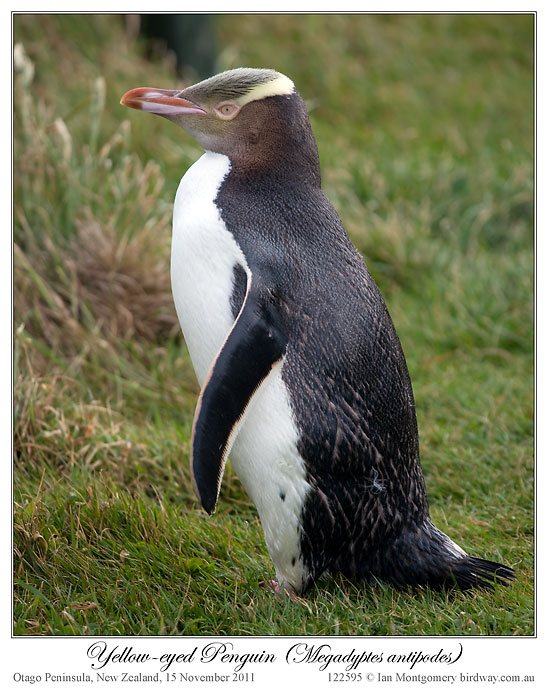
Yellow-eyed Penguin (Megadyptes antipodes) by Ian 1
Ian’s Bird of the Week – Yellow-eyed Penguin ~ by Ian Montgomery
Newsletter – 11/22/11
I had intended the Fiordland Crested Penguin at Milford Sound to be the next bird of the week, but since then I have photographed the unusual and rarer Yellow-eyed Penguin at the well-known colony on the Otago Peninsula near Dunedin and chosen it instead.
I went there in the evening as this is the time when the fishing member of the breeding pairs returns to relieve the incubating or baby-sitting member. The bird in the first photo is an adult that has just returned to the colony. The adults are distinguishable by having the yellow band joining the eyes around the nape of the head.
Yellow-eyed Penguin (Megadyptes antipodes) by Ian 2
The bird in the second photo is another adult. Yellow-eyed Penguins are quite large, up to 79cm/31in in length and weighing up to 8kg. The males are larger than the females and penguins in general have heavy bones by bird standards to help them dive. When the pairs are reunited they typically perform mutual preening as in the third photo.
Yellow-eyed Penguin (Megadyptes antipodes) by Ian 3
The total population of the species is about 2,000 pairs, mainly on Auckland and Campbell Islands, with about 150 pairs on Stewart Island and about 500 on the South Island. It has suffered from loss of coastal forest and still suffers from predation by introduced mammals such as feral cats. It is classified as endangered, but the population has been relatively stable over the last 30 years.
Yellow-eyed Penguin (Megadyptes antipodes) by Ian 4 juvenile
The bird in the fourth photo is a juvenile (they don’t breed until they are 3 or 4 years old) and lacks the yellow band on the back of the head.
More than 20 years ago, when on Stewart Island, I booked to go on a boat trip to an island that had both Yellow-eyed Penguins and Wekas, a large flightless rail. The weather was so bad that the trip was cancelled and both these species had represented unfinished business. On this trip I encountered Wekas at Milford Sound.
I’m in Dunedin for a second time now, having needed to drive to Christchurch to return the camper and then flown back. This produced a strangely disorientating feeling of deja-vu, as you quite reasonably expect to end up somewhere else after a flight, not where you’ve just been the day before. I have met up with my 3 travelling companions from Victoria and we are all excited at the prospect of sailing for the Sub-Antarctic Islands tomorrow. So, don’t expect another bird of the week or any communication for that matter until we reach Hobart where we are due on 1 December. I hope that by then I’ll have many more photos to share with you.
Ian has been putting out his newsletters close together lately. Most likely since he knows he will be away from an internet connection for awhile. This newsletter was received several days ago, but decided to space it to fill the gap of time before his next one arrives. I am looking forward to what this next part of his trip produces.
Penguins are in the Sphenisciformes Order. The family, Spheniscidae, is the only one in the order. The 18 Penguins are in 5 genera; Aptenodytes, Pygoscelis, Eudyptes, Megadyptes and Spheniscus. Check out Ian’s Penguins and the the complete Spheniscidae family here.
Let heaven and earth praise Him, The seas and everything that moves in them. (Psalms 69:34 NKJV)
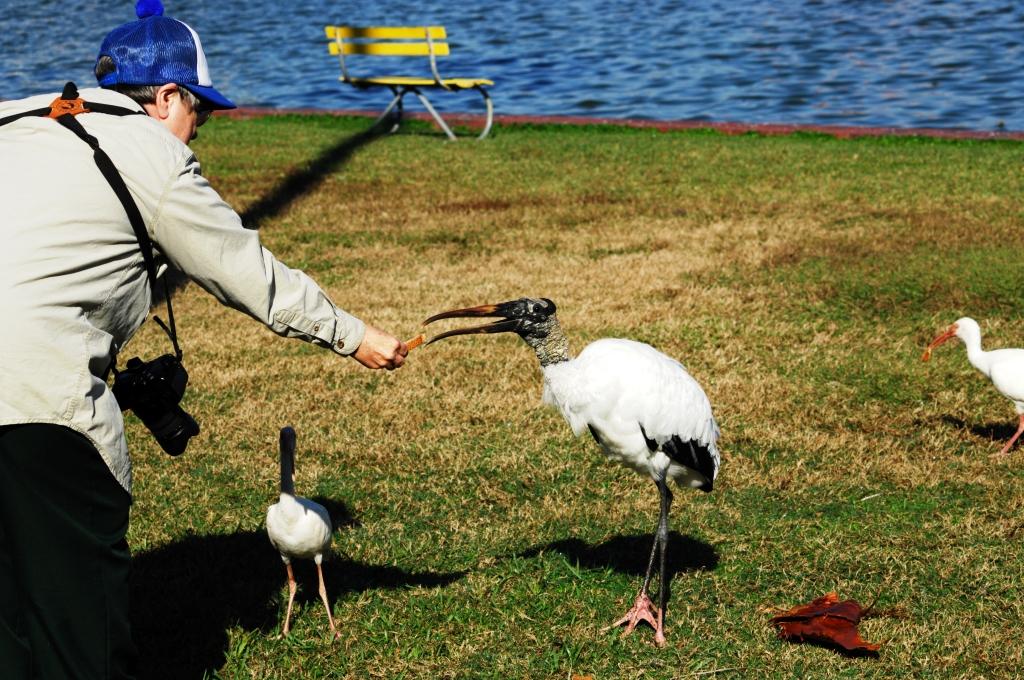
Lee feeding Wood Stork at Lake Morton by Dan Jan 2011
While watching the birds at my feeders and reflecting on what I had just read in my devotions, I started thinking about how the truths of God’s Word applies to the birds and to me. There are differences of course, but there are many similarities. Those are the ones this article is about.
To begin, we are both created. The Lord created the birds and He created humans. We both have bodies and spirits, but humans were given a soul and were created in His Image.
So God created great sea creatures and every living thing that moves, with which the waters abounded, according to their kind, and every winged bird according to its kind. And God saw that it was good. (Genesis 1:21 NKJV)
Then God said, “Let Us make man in Our image, according to Our likeness; let them have dominion over the fish of the sea, over the birds of the air, and over the cattle, over all the earth and over every creeping thing that creeps on the earth.” So God created man inHis own image; in the image of God He created him; male and female He created them. (Genesis 1:26-27 NKJV)
There is a difference between us:
All flesh is not the same flesh, but there is one kind of flesh of men, another flesh of animals, another of fish, and another of birds. (1 Corinthians 15:39 NKJV)
Bush Stone-curlew (Burhinus grallarius) with young by Ian
Then the Lord commanded them to be “Be fruitful and multiply, and fill.” Both were told to reproduce with the difference being that man was given dominion over the critters.
And God blessed them, saying, “Be fruitful and multiply, and fill the waters in the seas, and let birds multiply on the earth.” So the evening and the morning were the fifth day. …And God saw that it was good.(Genesis 1:22-23, 25 NKJV)
Then God blessed them, and God said to them, “Be fruitful and multiply; fill the earth and subdue it; have dominion over the fish of the sea, over the birds of the air, and over every living thing that moves on the earth.” (Genesis 1:28 NKJV)
Cedar Waxwing Eating by Steve Slayton
God gave both the birds and man (humans) every green herb to eat.
And God said, “See, I have given you every herb that yields seed which is on the face of all the earth, and every tree whose fruit yields seed; to you it shall be for food. Also, to every beast of the earth, to every bird of the air, and to everything that creeps on the earth, in which there is life, I have given every green herb for food“; and it was so. (Genesis 1:29-30 NKJV)
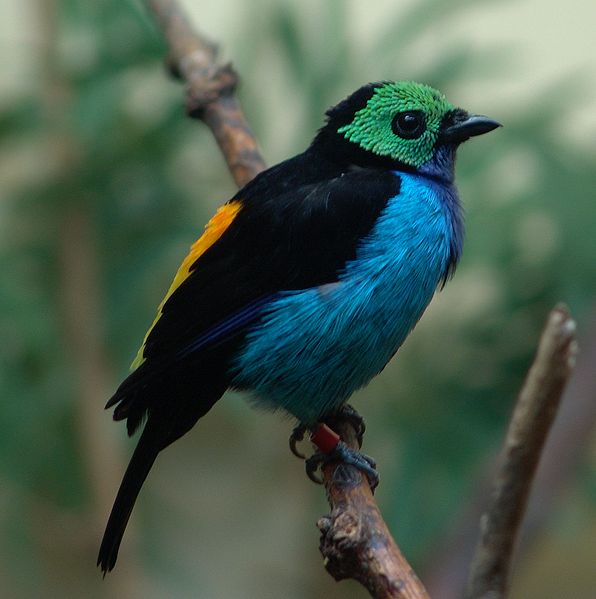
Swallow Tanager (Tersina viridis) by Dario Sanches
We were both created “very good.”
Then God saw everything that He had made, and indeed it was very good. So the evening and the morning were the sixth day. (Genesis 1:31 NKJV)
Then Adam and Eve disobeyed God and both the birds and myself were placed under a curse. Neither of us enjoy the fellowship and peace that was there in the Garden of Eden. My personal belief is that the animals and birds were very tame, that Adam could call or speak to them and they would come without hesitation. But now, they are afraid of us, and we (humans) need a Savior. (The Gospel Message)
And the fear of you and the dread of you shall be on every beast of the earth, on every bird of the air, on all that move on the earth, and on all the fish of the sea. They are given into your hand. (Genesis 9:2 NKJV)
We all belong to the Lord:
I know all the birds of the mountains, And the wild beasts of the field are Mine. “If I were hungry, I would not tell you; For the world is Mine, and all its fullness. (Psalms 50:11-12 NKJV)
Western Great Egret (Ardea alba) With Fish by AestheticPhotos
We and the birds are provided for:
“Therefore I say to you, do not worry about your life, what you will eat or what you will drink; nor about your body, what you will put on. Is not life more than food and the body more than clothing? Look at the birds of the air, for they neither sow nor reap nor gather into barns; yet your heavenly Father feeds them. Are you not of more value than they? (Matthew 6:25-26 NKJV)
God has given each kind of bird different beaks, feet, appetites, habitats, and places to dwell. The Lord has given those of us who have accepted Him as Savior different abilities, gifts, talents, places to live (like missionaries) and jobs to do. He has given both a variety that makes them and us very interesting to behold.
There are more things that could be mentioned, but for now, Praise the Lord that He cares about both the birds and us!
Gavest thou the goodly wings unto the peacocks? or wings and feathers unto the ostrich? Which leaveth her eggs in the earth, and warmeth them in dust, And forgetteth that the foot may crush them, or that the wild beast may break them. (Job 39:13-15 KJV)
The largest bird egg is from the Ostrich Sturthio camelus. The egg measures 15 – 20 cm long, 10 – 15 cm in diameter and weighs 1 – 1.78 kg.
Largest egg ~ Ostrich ~ measuring 17.8 by 14 cm (7 by 4.5 in)
Smallest egg laid relative to body weight ~ Ostrich egg ~ at 1.5%
An ostrich egg needs to be boiled for 2 hours to get a hard-boiled egg.
Can that which is unsavoury be eaten without salt? or is there any taste in the white of an egg? (Job 6:6 KJV)
Largest Egg – living ~ Ostrich
Largest Egg – ever ~ Elephant Bird Aepyornis maximus From Madagascar 39cm/15.4in long = 12 litres/2.6 gallons, 220 chicken eggs, egg weighed 27 pounds.
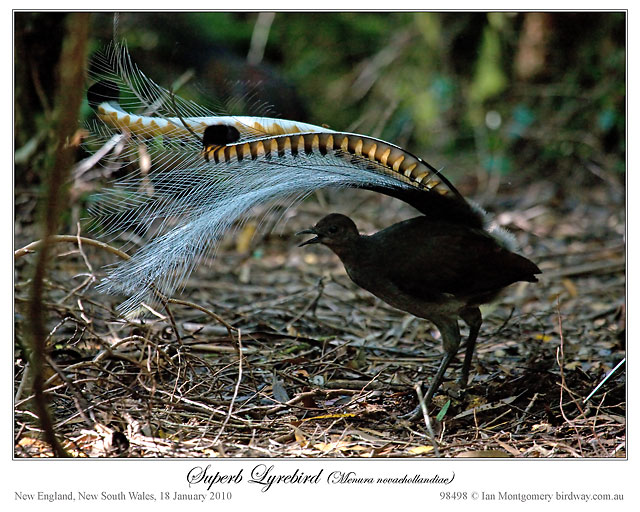
Superb Lyrebird (Menura novaehollandiae) by Ian
Largest egg laid by a passerine ~ 5 7 g (2 oz) by Australian Lyrebirds
Largest egg laid relative to body weight ~ Little Spotted Kiwi at 26%
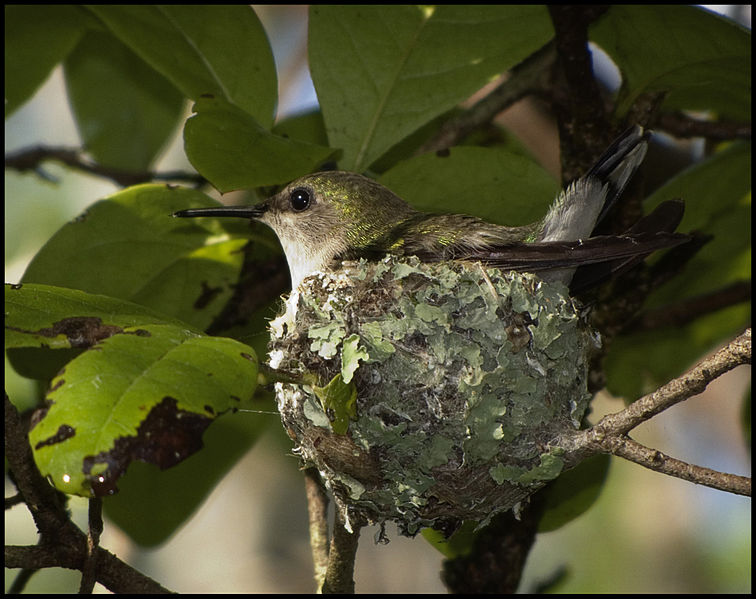
Smallest known egg ~ the Vervain Hummingbird Mellisuga minima of Jamacia and nearby islets. The egg is barely the size of a pea and measures less than 10 mm in length and weighs 0.356 g.
You could put 4700 bee hummingbird eggs inside one ostrich egg. The Bee Hummingbird egg is the size of a small pea and weighs .02 ounces. World’s Smallest Bird
Smallest egg ~ West Indian Vervain Hummingbird ~ at 10 mm (0.39 in) in length and 0.375 g (0.0132 oz)
Smallest Egg – living ~ Vervain Hummingbird Mellisuga minima ~ the size of pea
Or if he shall ask an egg, will he offer him a scorpion? If ye then, being evil, know how to give good gifts unto your children: how much more shall your heavenly Father give the Holy Spirit to them that ask him? (Luke 11:12-13 KJV)
Shape
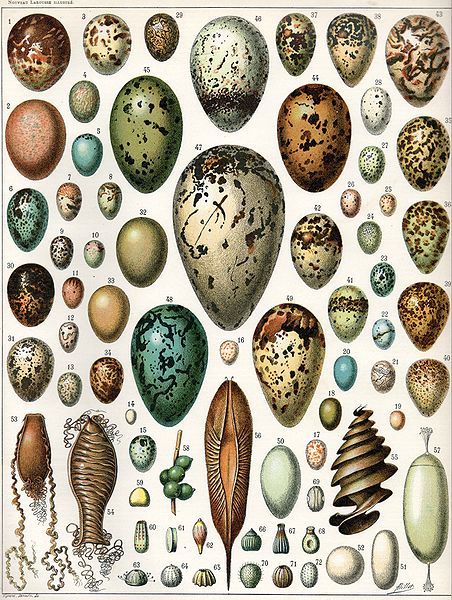
Different Eggs- Birds and Others – from Wikipedia
The majority of avian eggs match the shape of chicken eggs, but there are some exceptions.
Budgies, for instance, tend to lay very round eggs.
Fast-flying, stream-lined birds like swifts and swallows lay long, elliptical eggs.
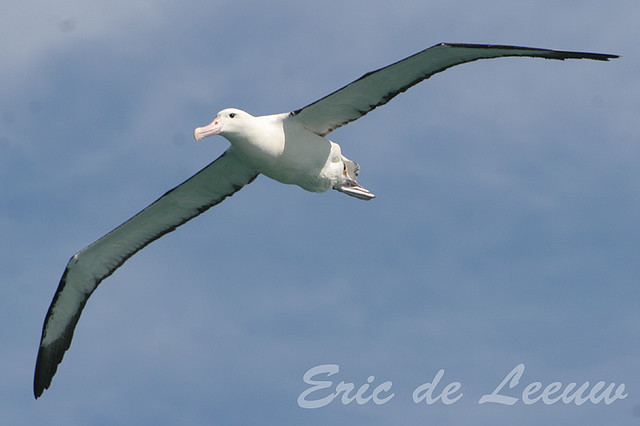
The Royal Albatross’ eggs take 79 days to hatch.
Precocial birds like chickens, ostriches, ducks, and seagulls hatch ready to move around. They come from eggs with bigger yolks than altricial birds like owls, woodpeckers, and most small songbirds that need a lot of care from parents in order to survive.
Longest interval between eggs laid ~ Maleo ~ at 1012 day intervals
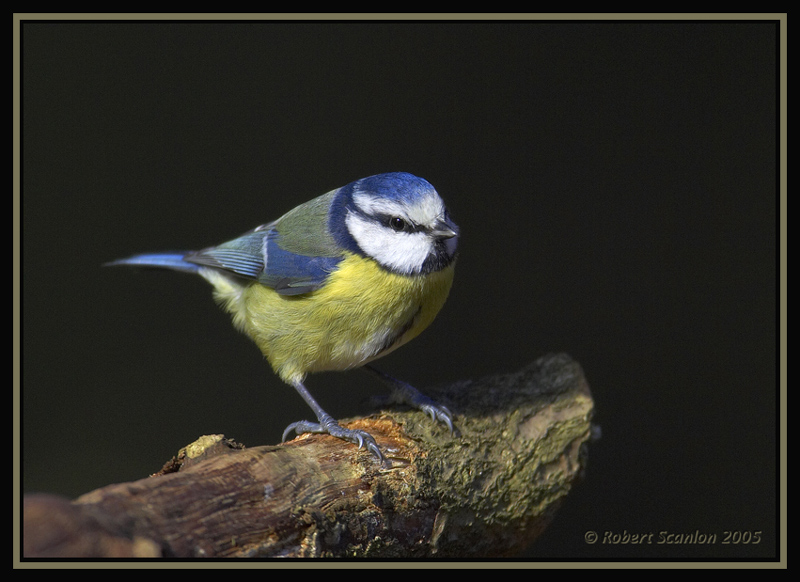
Eurasian Blue Tit (Cyanistes caeruleus) by Robert Scanlon by Robert Scanlon
Largest clutch laid by a nidicolous species ~ 19 eggs laid by a European Blue Tit
Largest clutch laid by a nidifugous species ~ 28 by a Bobwhite Quail
Largest average clutch size ~ 15-19 by a Gray Partridge
Smallest clutch size ~ 1 egg laid every 2 years by Albatrosses
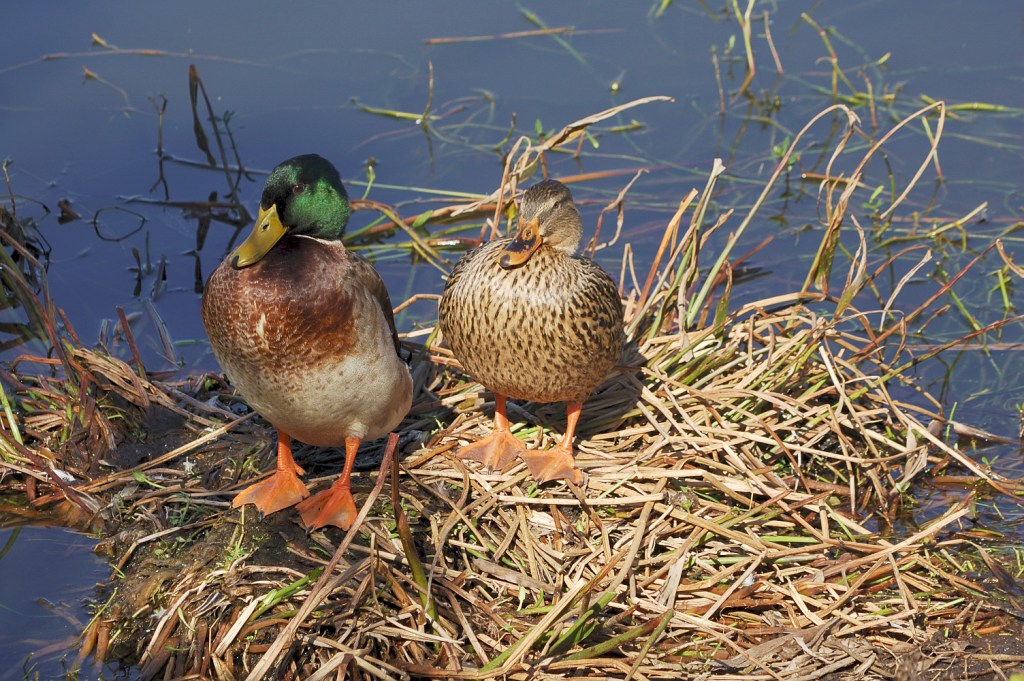
Mallard (Anas platyrhynchos) By Dan’sPix at Lake Hollingsworth
Greatest number of eggs laid consecutively ~ 146 by a Mallard
Most valuable bird ~ 8 billion domestic chickens ~ produce 562 billion eggs annually
Highest price paid for an egg ~ 1,000 British pounds for an egg of extinct Aepyornis maximus
And my hand hath found as a nest the riches of the people: and as one gathereth eggs that are left, have I gathered all the earth; and there was none that moved the wing, or opened the mouth, or peeped. (Isaiah 10:14 KJV)
Shell
Bird eggshells are diverse. For example:
Cormorant eggs are rough and chalky
Tinamou eggs are shiny
Duck eggs are oily and waterproof
Cassowary eggs are heavily pitted
Tiny pores in bird eggshells allow the embryo to breathe. The domestic hen’s egg has around 7500 pores.
The most yolks ever found in a single chicken’s egg is nine.
Largest individual nest ~ Mallee Fowl Australia Leipoa ocellata ~ builds a mound 5 m (16.5ft) high and 11 metres (36ft) wide. A mound this size means the bird moved 250 cubic metres of vegetation and 300 tons of soil.
Smallest nest ~
many seabirds do not make a nest at all, nest on ground or
in case of Fairy Tern on a branch of a tree
The prize goes to the Hummingbirds for their thimble sized (1cm squared) nests.
The largest nest was built by a pair of Bald Eagles Haliaeetus leucocephalus was 2.9 m wide and 6 m deep.
The Rhinoceros Auklet Cerorhinca monocerata which measures 35 cm and nests on islands in the North Pacific excavates a burrow of 2 – 3 m in length. Burrows up to 6 m are not uncommon and 8 m burrows have also been found.
The only species of parrot that builds a nest is the Quaker Parrot. The Quakers link their nests together to form structures akin to “bird condominiums”. These nests can reach weights greater than 200 lbs.
Largest recorded nesting bird colony: 136 million Passenger Pigeon nesting in an area in Wisconsin covering 1,942 sq km (750 sq mi)
Isn’t it amazing how the Lord created each bird’s egg to help it survive and for it to do His command to:
And God blessed them, saying, “Be fruitful and multiply, and fill the waters in the seas, and let birds multiply on the earth.” (Genesis 1:22 NKJV)
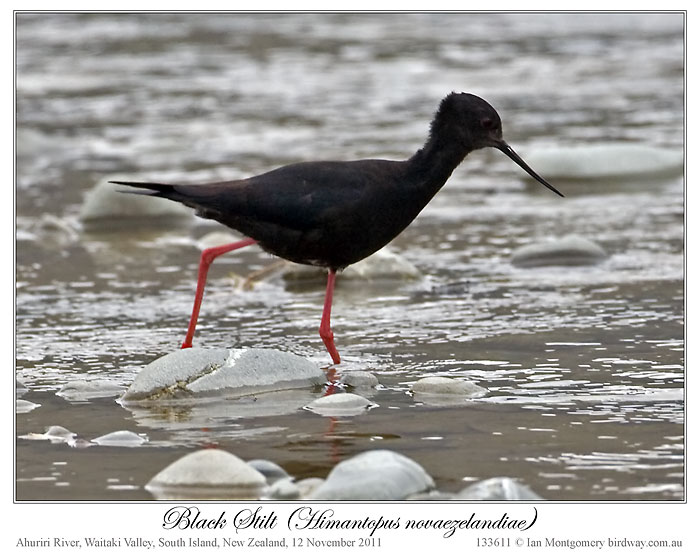
Ian’s Bird of the Week – Black Stilt ~ by Ian Montgomery
Newsletter – 11/15/11
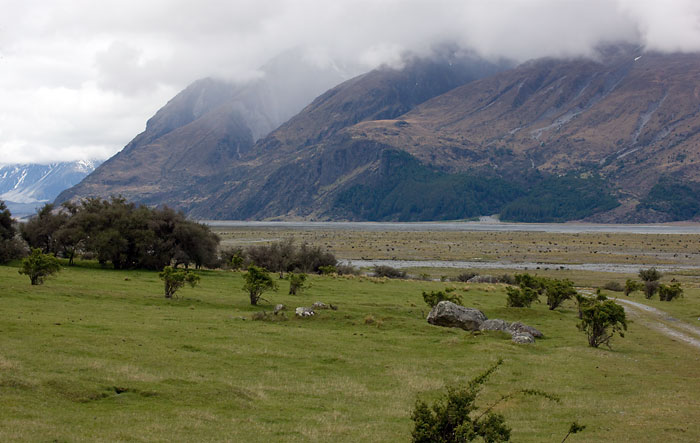
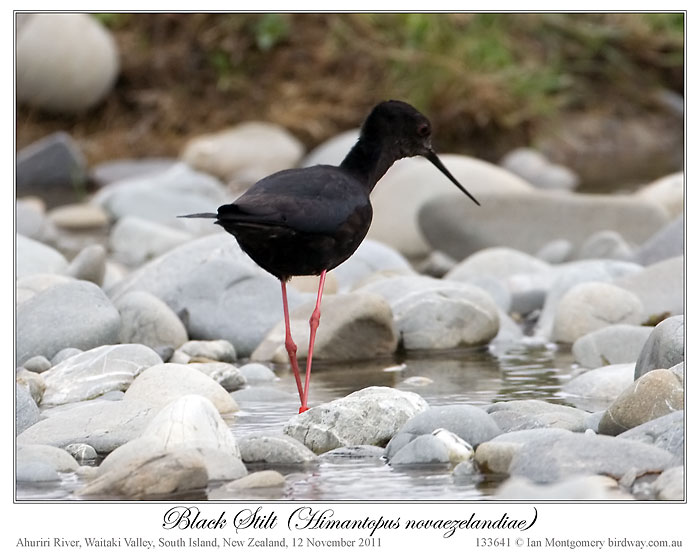
You’ve done it again! Your collective goodwill and spiritual energy have provided yet another special, this time very special bird, the critically endangered and recently saved from extinction Black Stilt. I did have to do a little work as well to find a couple in their favoured habitat of often inaccessible, so-called braided rivers of the South Island. At the second potential site, see photo, the task seemed impossible – that’s all river bed between the foreground and the mountains – and I almost gave up.
Tasman River by Ian
The third site wasn’t any better, but the fourth and last was a bridge over another river and you could have knocked me over with a feather when, having just stepped onto the bridge, I spotted two Black Stilts feeding a couple of hundred meters away close to the river bank.
One flew away when I approached but the other was much more cooperative and continued feeding.
Black Stilt (Himantopus novaezelandiae) 2 by Ian
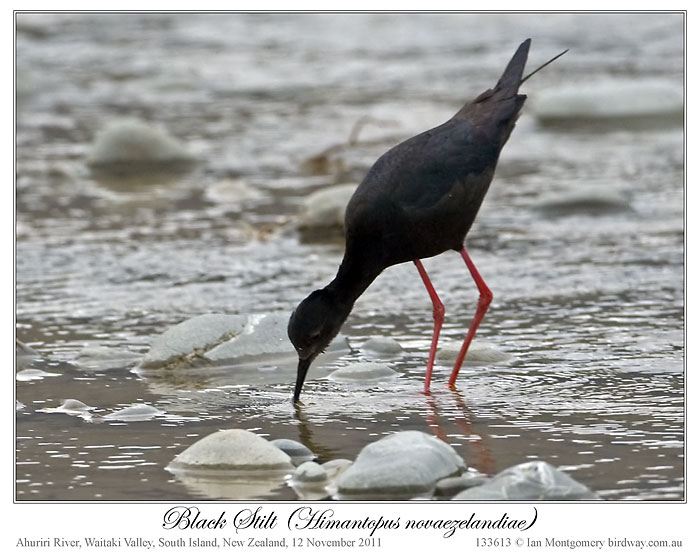
Eventually it flew off too, but it landed not far away, close to a breeding colony of 3 or 4 pairs of Black-fronted Terns, another species on my wanted list.
Black Stilt (Himantopus novaezelandiae) 3 by Ian
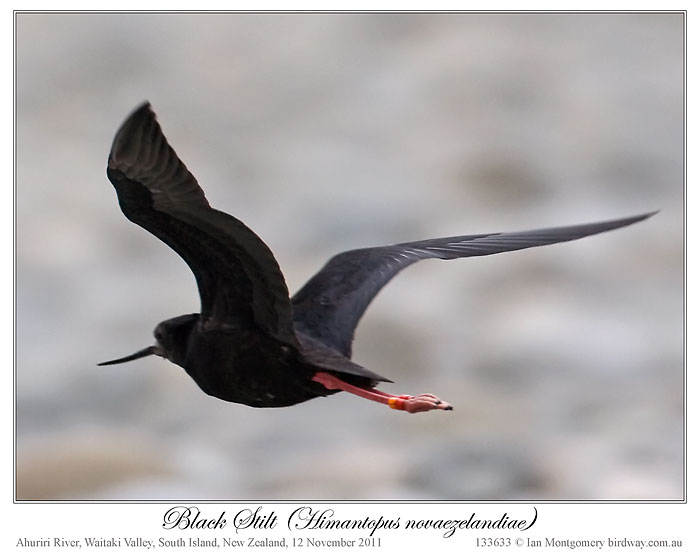
It stayed for a little while longer, until the terns chased it off. If you look carefully in the last photo, you can see a coloured band on the right leg and bird is presumably one of the captive-bred and released birds.
Black Stilt (Himantopus novaezelandiae) 4 by Ian
The population of Black Stilts in the wild reached a low of 23 adults in 1981 when the program started, making it the rarest wading bird in the world. There are now probably 200 birds in the wild and the program continues. Lets keep our fingers crossed!
I’ve had a great time so far in New Zealand and yesterday I went on a successful boat trip on Milford Sound in lovely weather for another wanted species, another potential bird of the week. I’m now on my way back to Christchurch to return my splendid campervan – I shall be reluctant to return it.
Glad to see the Lord answers prayers. (See Addition – NZ/Australasian Shoveler) What a neat bird, glad you found it and didn’t give up. With them so few in numbers, that is a Great Catch!
I love them that love me; and those that seek me early shall find me. (Proverbs 8:17 KJV)
The Black Stilt is in the Recurviostridae Family of the Charadriiformes Order. There are 6 Stilts and 4 Avocets. Check out Ian’s Recurviostridae photos.
“Avocets and stilts range in length from 30 to 46 centimetres (12 to 18 in) and in weight from 140 to 435 grams (4.9 to 15.3 oz); males are usually slightly bigger than females.[1] All possess long, thin legs, necks, and bills. The bills of avocets are curved upwards, and are swept from side to side when the bird is feeding in the brackish or saline wetlands they prefer. The bills of stilts, in contrast, are straight. The front toes are webbed, partially in most stilts, fully in avocets and the Banded Stilt, which swim more. The majority of species’ plumage has contrasting areas of black and white, with some species having patches of buff or brown on the head or chest. The sexes are similar.” (Wikipedia)
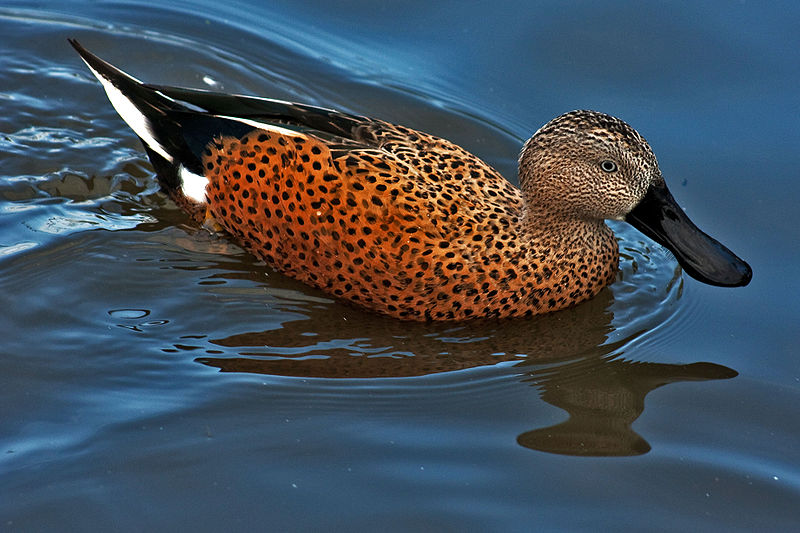
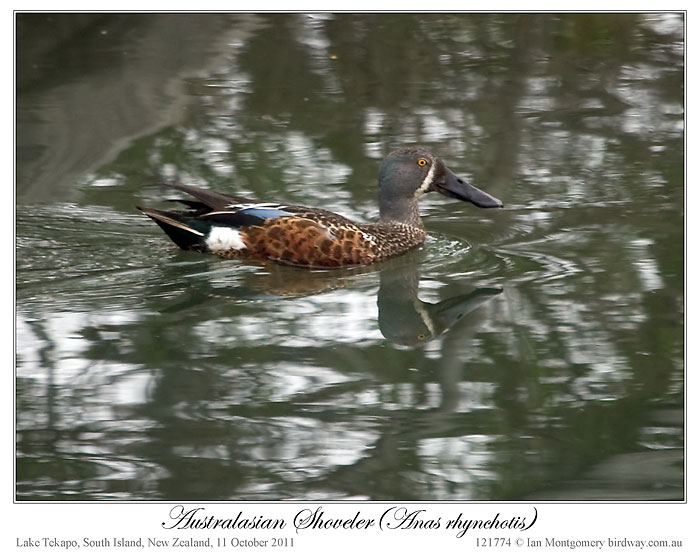
Australasian Shoveler (Anas rhynchotis) by Ian Montgomery
Ian’s Bird of the Week – Australian Shoveler
Newsletter – 11/11/11
This is really just a token bird of the week as an apology for being late, having been busy preparing, packing and travelling. I’m now on the South Island of New Zealand and surrounded by introduced birds such as Eurasian Chaffinches and Blackbirds. I had a look for Black Stilt yesterday without success so here’s a male New Zealand Shoveler instead. At least that’s what they’re called here, even though they are the same species as the Australasian Shoveler. What ever, they’re gorgeous ducks.
Australasian Shoveler (Anas rhynchotis) by Ian
I’m going to have another try at the Black Stilt today so wish me luck: your collective goodwill has worked in the past! After that, I plan to head south towards Fiordland to see what I can find there.
Since Ian wrote a short note, I added a second one of his Australasian Shovelers to the newsletter. Click see his other Australasian Shoveler photos. Ian, will be praying you find your birds and for your safety. Trust you find your Black Stilts so we can have a look at them also.
Even though these birds could be eaten, many people like duck, I prefer to watch them instead. They are protected by:
If a bird’s nest happens to be before you along the way, in any tree or on the ground, with young ones or eggs, with the mother sitting on the young or on the eggs, you shall not take the mother with the young; you shall surely let the mother go, and take the young for yourself, that it may be well with you and that you may prolong your days. (Deuteronomy 22:6-7 NKJV)
Out of the ground the LORD God formed every beast of the field and every bird of the sky, and brought them to the man to see what he would call them; and whatever the man called a living creature, that was its name. (Genesis 2:19 NASB)
While working on the new updates for the IOC 2.10 Version, I kept noticing the word “color” in the scientific names as I sorted and resorted the Excel spreadsheet. This is a third of the “color” articles. There are concolor, discolor, bicolor, tricolor, unicolor, quadricolor, quinticolor, multicolor, versicolor, nocticolor, coelicolor, decolor, fumicolor, niscolor, schisticolor, subunicolor, sitticolor.
In the subspecies (ssp.) there are a few additional “colors” that show up – arenicolor, caelicolor, caerebicolor, cervinicolor, deserticolor, ruficolor, terricolor. For now, let’s see what the subspecies “color” birds are. Most have just only one or two birds with that “color” name. Where a photo of the subspecies could not be found, the nominate bird is shown.
arenicolor = aren, sand + color
Bar-tailed Lark (Ammomanes cinctura arenicolor) by Keith Blomerley
The Bar-tailed Lark (Ammomanes cinctura) is a species of lark in the Alaudidae family. It is found in Afghanistan, Algeria, Cape Verde, Chad, Egypt, Iran, Iraq, Israel and Palestine, Italy, Jordan, Kuwait, Lebanon, Libya, Mali, Malta, Mauritania, Morocco, Niger, Oman, Pakistan, Saudi Arabia, Sudan, Syria, Tunisia,and Yemen. Its natural habitat is hot deserts.
I do not know Latin, nor what Scientific words mean, but I have a copy of the Latin Vulgate on my e-Sword Program. I decided to look up these words and see what I might find. While searching for “aren” I found the word “harenam” which translates to “sand.”
How precious also are thy thoughts unto me, O God! how great is the sum of them! If I should count them, they are more in number than the sand: when I awake, I am still with thee. (Psalms 139:17-18 KJV)
caelicolor = sky blue + color
“caeli” translates to “heaven” in most verses.
The heavens are thine, the earth also is thine: as for the world and the fulness thereof, thou hast founded them. (Psalms 89:11 KJV)
caerebicolor = caer (blue) + bicolor (Having two colors)
(Couldn’t figure this one out in Latin)
Blue Dacnis (Dacnis cayana, ssp caerebicolor)
Blue Dacnis (Dacnis cayana) by Dario Sanches
Velvet Flycatcher (Myiagra hebetior) also known as Dull or Lesser Shining Flycatcher
The Dull Flycatcher (Myiagra hebetior) is a species of bird in the Monarchidae family. It is endemic to Papua New Guinea. Its natural habitats are subtropical or tropical moist lowland forests and subtropical or tropical moist montanes.
cervinicolor = cervix (neck) + color
“cervi” translates to “neck” in most verses. (cervis = stiff-necked)
He who is often rebuked, and hardens his neck, Will suddenly be destroyed, and that without remedy. (Proverbs 29:1 NKJV)
Shining Flycatcher (Myiagra alecto) by Ian (closest to Velvet I could find)
Velvet Flycatcher (Myiagra hebetior cervinicolor)
deserticolor = desert + color
“deserti” translates to “desert” or “wilderness“.
Indian Scops Owl (Otus bakkamoena) pair by Nikhil Devasar
Indian Scops Owl (Otus bakkamoena deserticolor) – Video IBC
“A medium (smaller than the Collared) sized scops owl with large conspicuous ear-tufts. Sandy grey-brown, spotted and mottled dark brown and black. There is also a rufous phase. Underparts light grey-buff. Has a distinct nuchal collar and also a second collar on nape. Eyes are dark brown.” (Delhibird)
“The Common Miner (Geositta cunicularia) is a passerine bird of South America, belonging to the ovenbird family. It is a ground-dwelling bird which feeds on insects and seeds. It has about 9 different subspecies, some of which may be better treated as separate species.
It is 14 to 16 cm long with a fairly long, slightly downcurved bill. The plumage varies geographically but is basically brown above and pale below with a streaked breast, pale stripe over the eye, dark edge to the ear-coverts and pale rufous bar across the wing. The tail is dark with a buff base and variable amounts of buff on the outer feathers. The trilling song is often given in flight and also varies geographically.” (Wikipedia)
Chinese White-browed Rosefinch (Carpodacus dubius deserticolor) Video by Keith Blomerley
The Chinese White-browed Rosefinch (Carpodacus dubius) is a true finch species (family Fringillidae). It is one of the rosefinches that might belong in the genus Propasser.
It is found in China and Tibet. Its natural habitats are temperate forests and temperate shrubland.
ruficolor = rufilata (Latin), rufus, reddish + color
“rufi” translates to “red” or “Rufus“-a name.
In the first chariot were red horses; and in the second chariot black horses; (Zechariah 6:2 KJV)
in quadriga prima equi rufi et in quadriga secunda equi nigri (Zechariah 6:2 Vulgate)
“The Thekla Lark, Galerida theklae, breeds in Iberia, northern Africa, and sub-Saharan Africa from Senegal to Somalia. It is a sedentary species. This is a common bird of dry open country, often at some altitude. It nests on the ground, laying two to six eggs. Its food is weed seeds and insects, the latter especially in the breeding season.
This is a smallish lark, slightly smaller than Skylark. It has a long spiky erectile crest. It is greyer than Skylark, and lacks the white wing and tail edged of that species.” (Wikipedia)
terricolor = terr- (dry land) or (land, earth, ground) + color
“terr+” brought up “3,147 verses found, 3547 matches” (Needless to say, I did not check them all out.) “terra” translates as above, “earth”, “land”, “ground.”
In the beginning God created the heaven and the earth. (Genesis 1:1 KJV)
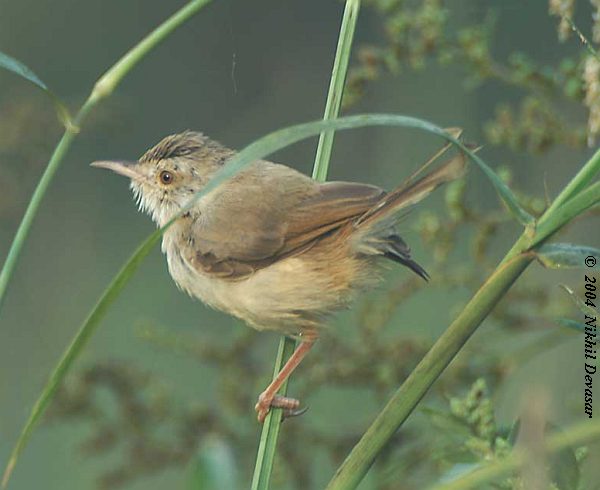
“The Plain Prinia, or the Plain, or White-browed, Wren-Warbler[2] (Prinia inornata) is a small warbler in the cisticola family. It is a resident breeder from Pakistan and India to south China and southeast Asia. It was formerly included in the Tawny-flanked Prinia, Prinia subflava (Gmelin, 1789), resident in Africa south of the Sahara. The two are now usually considered to be separate species.
This skulking passerine bird is typically found in wet lowland grassland, open woodland, scrub and sometimes gardens. The Plain Prinia builds its nest in a shrub or tall grass and lays 3-6 eggs.”
The White-browed Sparrow-Weaver (Plocepasser mahali; Afrikaans: Koringvoël) is a predominantly brown, sparrow-sized weaver found throughout central and northcentral southern Africa. It is found in groups of two to eleven individuals consisting of one breeding pair and nonreproductive individuals. P. m. terricolor is found towards the center of the White-Browed Sparrow-Weaver’s range, occurring predominantly in eastern Botswana.
I trust that you were not bored, but enjoyed the Latin lesson thrown in. I am always curious as to how they come up with these Scientific Names. It was interesting to find out some of these meanings. In the mean time we have seen some birds that the Lord created that we probably have never seen before. I love that Paradise Tanager the most, but the others are great also.
And these you shall regard as an abomination among the birds; they shall not be eaten, they are an abomination: the eagle, the vulture, the buzzard, the kite, and the falcon after its kind; every raven after its kind, the ostrich, the short-eared owl, the sea gull, and the hawk after its kind; (Leviticus 11:13-16 NKJV)
Here is a short video about the Peregrine Falcon and the Goshawk. It shows the speed and maneuverability of these fantastic birds. Thought you might enjoy watching it.
“Tiny spy cameras allow you to see some of the world’s most magnificent birds in flight. Watch this video to learn how the fastest bird on the planet, the peregrine falcon, keeps control at mind-numbing speeds, and take a flight with the master of manoeuvrability, the Gos Hawk, as it flies through dense woodland. Great animal video from BBC wildlife show Animal Camera, with music by Gregory Paul. By BBCWorldwide”
*
*
The Peregrine belongs to the Falconiformes Order. “The Peregrine Falcon (Falco peregrinus), also known as the Peregrine, and historically as the Duck Hawk in North America, is a widespread bird of prey in the family Falconidae. A large, crow-sized falcon, it has a blue-gray back, barred white underparts, and a black head and “moustache”. Typical of bird-eating raptors, Peregrine Falcons are sexually dimorphic, with females being considerably larger than males. The Peregrine is renowned for its speed, reaching over 325 km/h (210 mph) during its characteristic hunting stoop, making it the fastest member of the animal kingdom.
The Peregrine’s breeding range includes land regions from the Arctic tundra to the tropics. It can be found nearly everywhere on Earth, except extreme polar regions, very high mountains, and most tropical rainforests; the only major ice-free landmass from which it is entirely absent is New Zealand. This makes it the world’s most widespread bird of prey.
While its diet consists almost exclusively of medium-sized birds, the Peregrine will occasionally hunt small mammals, small reptiles, or even insects. Reaching sexual maturity at one year, it mates for life and nests in a scrape, normally on cliff edges or, in recent times, on tall human-made structures.” (Wikipedia)
and the red kite, the falcon, and the kite in their kinds, and every raven in its kind, and the ostrich, the owl, the sea gull, and the hawk in their kinds, (Deuteronomy 14:13-15 NASB)
The Goshawk belongs to the Accipitriformes Order of Kites, Hawks and Eagles. “The Northern Goshawk (Accipiter gentilis), /ˈɡɒs.hɔːk/ (Old English: gōsheafoc, “goose-hawk”), is a medium-large bird of prey in the family Accipitridae, which also includes other diurnal raptors, such as eagles, buzzards and harriers.
It is a widespread species that inhabits the temperate parts of the northern hemisphere. In Europe and North America, where there is only one goshawk, it is often referred to (officially and unofficially, respectively) as simply the “Goshawk”. It is mainly resident, but birds from colder regions migrate south for the winter. In North America, migratory goshawks are often seen migrating south along mountain ridge tops in September and October.
This species hunts birds and mammals in a variety of woodland habitats, often utilizing a combination of speed and obstructing cover to ambush birds and mammals. Goshawks are often seen flying along adjoining habitat types, such as the edge of a forest and meadow; flying low and fast hoping to surprise unsuspecting prey. They are usually opportunistic predators, as are most birds of prey.” (Wikipedia)
These are just two of the birds of prey that the Lord created. What speed and agility He gave them. Unfortunately, because of the curse, they use those traits to attack and eat other birds and small mammals.
Curse not the king, no not in thy thought; and curse not the rich in thy bedchamber: for a bird of the air shall carry the voice, and that which hath wings shall tell the matter. (Ecclesiastes 10:20 KJV)
Talking birds! Is it possible? Solomon wrote about it in Ecclesiastes while telling people not to curse the king, even in your bedroom. Are there birds who could tell your words? First lets look at the words of Scripture in just that part of the verse. Again, I have used my e-Sword Bible program and a few other printed versions.
(ACV) For a bird of the heavens shall carry the voice, and that which has wings shall tell the matter.
(ABP+) For a winged creature of heaven shall carry your voice, and the one having the wings shall report your word.
(AKJV) for a bird of the air shall carry the voice, and that which has wings shall tell the matter.
(AMP) for a bird of the air will carry the voice, and a wing creature will tell the matter.
(ASV) for a bird of the heavens shall carry the voice, and that which hath wings shall tell the matter.
(BBE) because a bird of the air will take the voice, and that which has wings will give news of it.
(Bishops) (10:19) for a byrde of the ayre shall betray thy voyce, and with her fethers shall she bewray thy wordes.
(Brenton) for a bird of the air shall carry thy voice, and that which has wings shall report thy speech.
(CEV) A little bird might hear and tell everything.
(Darby) for the bird of the air will carry the voice, and that which hath wings will tell the matter.
(DRB) because even the birds of the air will carry thy voice, and he that hath wings will tell what thou hast said.
(ERV) A little bird might fly and tell them everything you said.
(ESV) for a bird of the air will carry your voice, or some winged creature tell the matter.
Superb Lyrebird (Menura novaehollandiae) by Ian
(Geneva) for the foule of the heauen shall carie the voice, & that which hath wings, shall declare the matter.
(GNB) A bird might carry the message and tell them what you said.
(GW) A bird may carry your words, or some winged creature may repeat what you say.
(ISV) For a bird will fly by and tell what you say, or something with wings may talk about it.
(JPS) for a bird of the air shall carry the voice, and that which hath wings shall tell the matter.
(KJV)for a bird of the air shall carry the voice, and that which hath wings shall tell the matter.
(KJV-1611) for a bird of the aire shall carry the voyce, and that which hath wings shall tell the matter.
(LITV) for a bird of the heavens may carry the voice; yea, the lord of wings may tell the matter.
(MKJV) for a bird of the air shall carry the voice, and that which has wings shall tell the matter.
(NASB) for a bird of the heavens will carry the sound and the winged creature will make the matter known.
(NIV) because a bird of the air may carry your words, and a bird on the wing may report what you say.
(NKJV) For a bird of the air may carry your voice, And a bird in flight may tell the matter.
(RV) for a bird of the air shall carry the voice, and that which hath wings shall tell the matter.
(Webster)for a bird of the air will carry the voice, and that which hath wings will tell the matter.
(YLT) For a fowl of the heavens causeth the voice to go, And a possessor of wings declareth the word.
Talking birds are birds that can mimic human speech. Talking birds have varying degrees of intelligence and communication capabilities: some, like the crow, a highly intelligent bird, are only able to mimic a few words and phrases, whilst some budgerigars have been observed to have a vocabulary of almost two thousand words. The Hill Myna is a commonly kept pet, well known for its talking ability – whilst its relative, the European Starling, is also adept at mimicry. Wild cockatoos in Australia have been reported to have learned human speech from ex-captive birds that have integrated into the flock. (See the Article – Wikipedia)
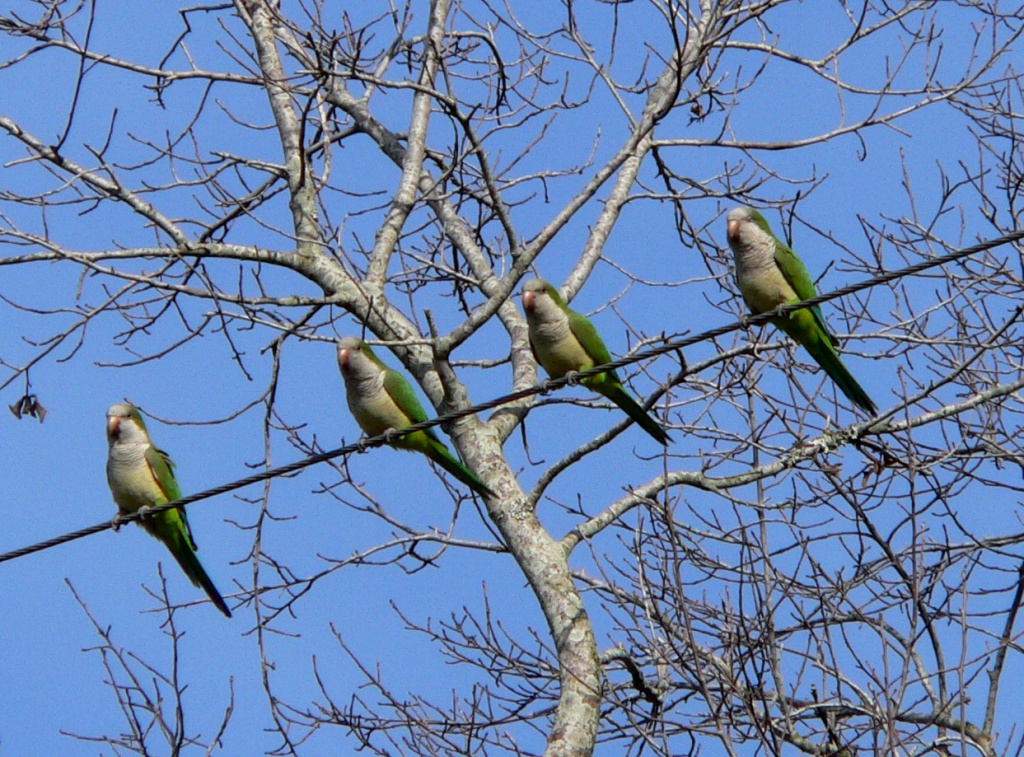
Monk Parakeets at S Lake Howard Nature Park by Lee
Dan and I had a Monk Parakeet that talked. Once Hoppi began to talk, he picked up everything you said. He even learned to call our dog, having heard us calling for him. Our dog would even look his way and head toward Hoppi when he called. Praise the Lord we are Christians, because that bird would repeat our conversations. I doubt he knew what he was saying, other than associating words with actions, but Hoppi did repeat what you had said.
*
From the article in Wikipedia:
In 1995 a budgerigar named Puck was credited by Guinness World Records as having the largest vocabulary of any bird, at 1,728 words.
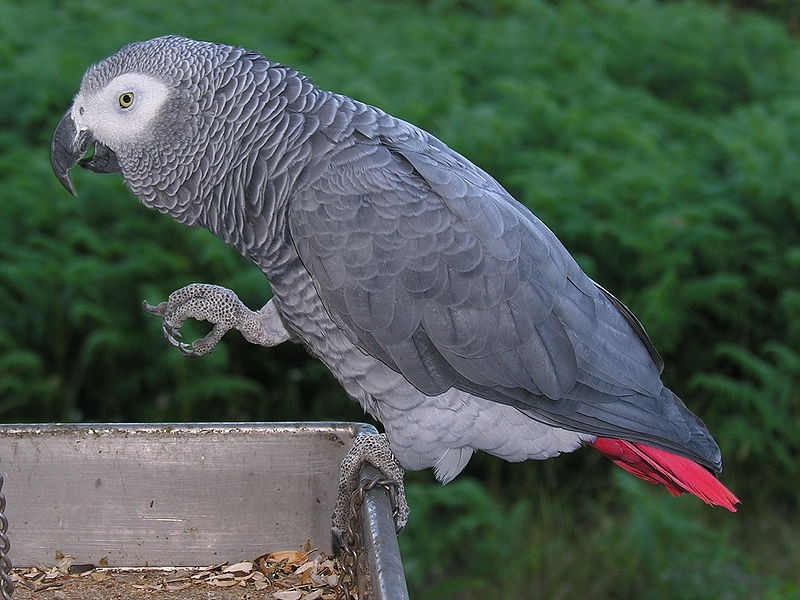
The African Grey Parrots are particularly noted for their cognitive abilities. Some of the most notable African Grey Parrots are Alex, Prudle, N’kisi and a new rising star, Einstein. Alex had a vocabulary of about 100 words, but he was one of the most famous birds because of his cognitive abilities. In 2005, World Science reported that Alex understood the concept of zero. Alex died on September 6, 2007. Prudle held the Guinness world record for bird with biggest vocabulary for many years with a documented vocabulary of 800 words. N’kisi is noted for his impressive English usage skills and other abilities. As of January 2004, he had a documented vocabulary of 950 words and shows signs of a sense of humor. N’kisi is believed to be one of the most advanced users of human language in the animal world. Einstein appeared on many television shows and became famous for her ability to recreate sounds as well as voice. Video clips show her making the sound of a laser beam and an evil laugh. She has been trained by Stephanie White. African Grey Sparky is popular on YouTube for copying one liners from the sitcom Still Game in a broad Scottish accent. Bibi, a Congo African Grey Parrot, is best known for her ability to use greetings from 20 different languages, earning her the nickname “The Polyglot Parrot.” At only three years of age, Bibi has already developed a vocabulary of about 300 words, and she understands the concepts of color and shape.
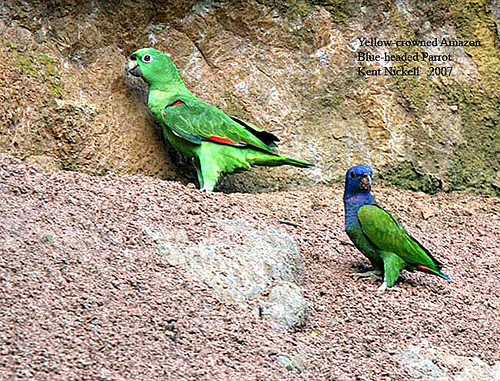
Yellow-crowned Amazon, Blue-headed Parrot by Kent Nickell
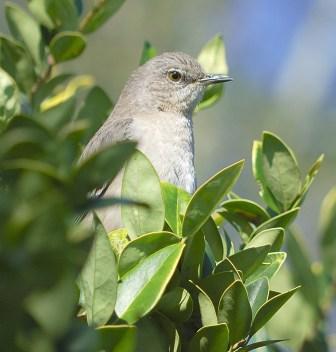
Amazon parrots – Many species of Amazona (particularly the yellow-head variety) are outstanding talkers. Yellow-napes, Double Yellow-headed, Yellow-crowned, and Panama Amazons are highly regarded as talking parrots. Other parrots – Most parrot species are capable of imitating human words. Many can learn to use phrases in context; they can also be trained to imitate any words. Monk Parakeets (also known as Quaker parrots) are also reputed to be skilled talkers. Hill Mynas – Hill Mynas are renowned for their ability to mimic the human voice. Many have claimed that the Hill Myna is the best talking bird and the best mimic in the world. Lyrebird, ability to mimic natural and artificial sounds from their environment Mockingbird, ability to mimic natural and artificial sounds from their environment
Passerine – Songbirds
Sounds like we need to watch what we say, not only about the king, but everyone. Even if the birds don’t hear us, the Lord hears our words and our thoughts.
Let the words of my mouth, and the meditation of my heart, be acceptable in thy sight, O LORD, my strength, and my redeemer. (Psalms 19:14 KJV)
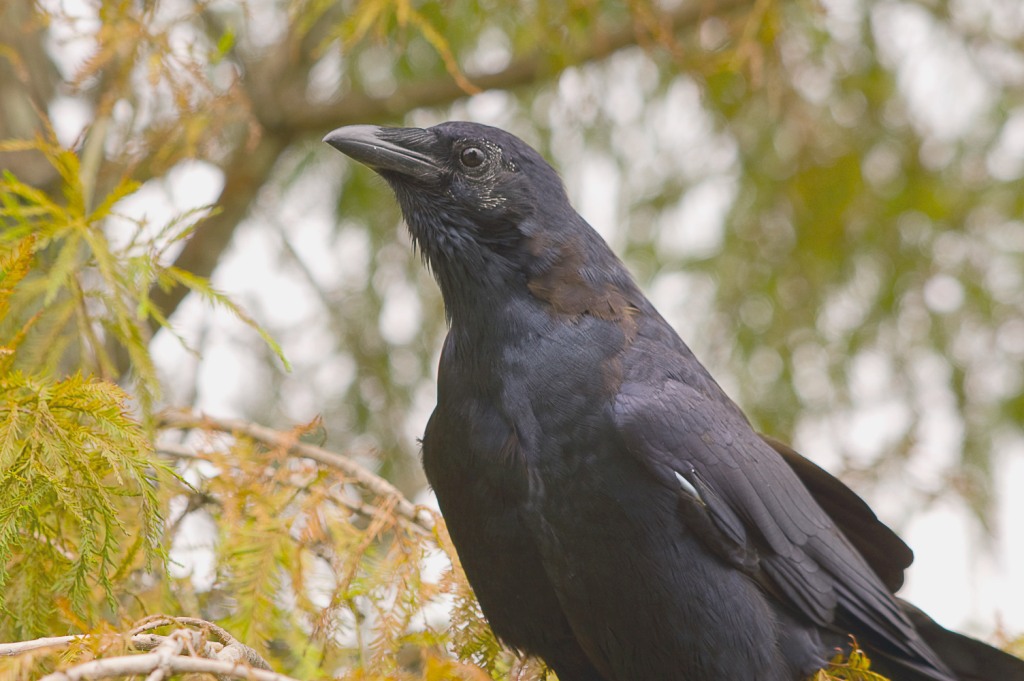
Fish Crow (Corvus ossifragus) at Lake Morton By Dan'sPix
Here are some “one liners” about gossip from Zingers by Croft M. Pentz:
Blessed are the hard of hearing, for they shall miss much small talk.
Trying to squash a rumor is like trying to unring a bell
A rumor is about as hard to unspread as butter.
Can you imagine anyone as unhappy as a person with a live secret and a dead telephone.
Busy souls have no time to be busybodies.
When a little bird has told you something, be sure that bird was not a cuckoo.
There is another verse in Scripture that mentions the birds telling something, but it is used in a different context. We will save that for another Birds of the Bible article.
But ask now the beasts, and they shall teach thee; and the fowls of the air, and they shall tell thee: (Job 12:7 KJV)
Job 12:7
Spirit of God, that moved of old
Upon the waters’ darkened face,
Come, when our faithless hearts are cold,
And stir them with an inward grace.
Thou that art power and peace combined,
All highest strength, all purest love,
The rushing of the mighty wind,
The brooding of the gentle dove.
Come, give us still Thy powerful aid,
And urge us on, and make us Thine;
Nor leave the hearts that once were made
Fit temples for Thy grace divine.
Nor let us quench Thy sev’nfold light;
But still with softest breathings stir
Our wayward souls, and lead us right,
O Holy Ghost, the Comforter.
And I will bring the blind by a way that they knew not; I will lead them in paths that they have not known: I will make darkness light before them, and crooked things straight. These things will I do unto them, and not forsake them. (Isaiah 42:16 KJV)
Cecil F. Alexander Born-Early April 1818 in Redcross, County Wicklow, Ireland. Died on October 12, 1895 in Londonderry, Northern Ireland. She was Buried at the City Cemetery, Londonderry, Northern Ireland.
Alexander’s husband was William Alexander, bishop of Derry and Raphoe, and later the Anglican primate for Ireland. Cecil and her sister founded a school for the deaf, and she set up the Girls’ Friendly Society in Londonderry. Cecil Alexander wrote about 400 hymns in her lifetime.
Geystliche Gesangk Buchleyn (actually a hymn book, maybe)- No information
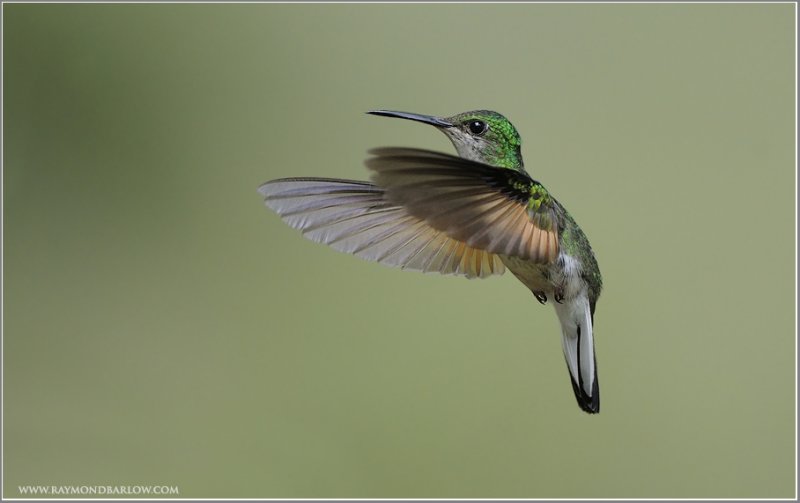
Stripe-tailed Hummingbird (Eupherusa eximia) Female by Raymond Barlow
The heavens declare the glory of God; and the firmament sheweth his handywork. (Psalms 19:1 KJV)
Words by Henry Ware Jr. (1794-1843), 1822
Music – Bethlehem by Gottfried W. Fink (1783-1846)
All Nature’s Works His Praise Declare
All nature’s works His praise declare, to whom they all belong;
There is a voice in every star, in every breeze a song.
Sweet music fills the world abroad with strains of love and power;
The stormy sea sings praise to God, the thunder and the shower.
To God the tribes of ocean cry, and birds upon the wing;
To God the powers that dwell on high their tuneful tribute bring.
Like them, let us the throne surround, with them loud chorus raise,
While instruments of loftier sound assist our feeble praise.
Great God, to Thee we consecrate our voices and our skill;
We bid the pealing organ wait to speak alone Thy will.
Lord, while the music round us floats may earth born passions die;
O grant its rich and swelling notes may lift our souls on high!
Praise ye the LORD. Praise ye the LORD from the heavens: praise him in the heights. (Psalms 148:1 KJV)
Henry Ware, Jr was born April 21, 1794 in Hingham, Massachusetts, Died on September 25, 1843 in Framingham, Massachusetts and was buried in Mount Auburn Cemetery, Cambridge, Massachusetts.
Son of a Unitarian minister, Ware attended Harvard and became an assistant teacher at Exeter Academy in New Hampshire. In 1815, the Boston Unitarian Association licensed him to preach, and in 1817, he was ordained and became pastor of the Second Church in Boston, Massachusetts. He was Professor of Pulpit Eloquence and Pastoral Care at the Harvard Divinity School, 1829-1842. He also edited the Christian Disciple (later renamed the Christian Examiner), and ran the Society for Religious Improvement at Harvard University (his father was on the faculty there, as well). A two volume Memoir and a four volume Works were published three years after his death. Ware wrote this hymn for a service dedicating a new organ (see the last stanza).
Gottfried W. Fink was born onMarch 8, 1783, Sulza on the Ilm, Thuringia and died on August 27, 1846, Leipzig, Germany.
Fink sang as a chorister at Naumburg, and studied theology at Leipzig (1804-8). He became a Professor of Music at Leipzig in 1842. He is remembered for his writings on music history and theory, and his collections of secular and religious songs.















 Lee's Birdwatching Adventures Plus