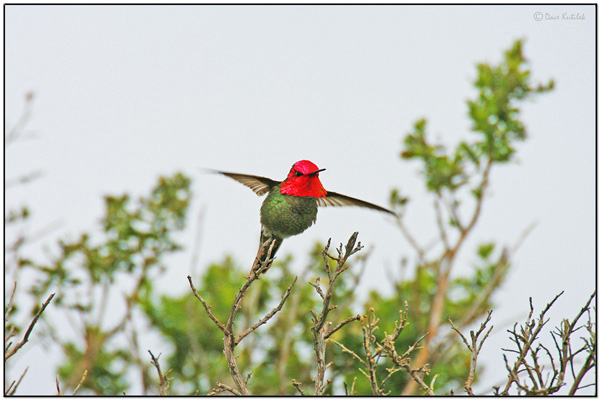
Interesting Things – Anna’s Hummingbird

SmileyCentral.com

New Avian Speed Champion Discovered

Which doeth great things past finding out; yea, and wonders without number. (Job 9:10)

“A peregrine falcon diving toward its prey reaches a relative speed of 200 body- lengths per second. This is close to the 207 body-lengths that the space shuttle travels as it enters our atmosphere. Thus, the peregrine falcon was thought to easily be the fastest dare-devil bird on Earth.

Anna's Hummingbird by Dave's BirdingPix

Anna's Hummingbird by Dave's BirdingPix

Scientists have now discovered that a little pink male hummingbird called Anna’s Hummingbird is the real Top Gun among the birds. As part of its mating ritual, a male hummingbird will try to impress a female with his speed and acrobatics. First, the male will fly up to about 90 feet above the ground. Then, he begins a power dive. As he nears the female, he pulls up, ascending again. During that near-miss pull-up he experiences more than nine times the force of gravity. His relative speed during descent is 385 body-lengths per second. That’s almost twice the peregrine falcon’s relative speed, it’s faster than the space shuttle entering the Earth’s atmosphere and is more than twice the relative speed of a jet fighter running with afterburners!

The wonders of God’s creation are still being discovered, and Creation Moments still loves to make them known to our listeners. But God’s greatest wonder is His love for us though His Son, Jesus Christ. We are thankful that this wonder is revealed to us in the Bible.

Prayer: Father, I give You thanks for the wonders You create, but I especially give You thanks for the wonder of salvation. Amen.

References: Science News, 7/4/09, p. 7, Susan Millius, “Hummingbird pulls Top Gun stunts.”

From Creation Moments ©March 24, 2010

Hermit Warbler – The worshiper.. by A. J. Mithra

Hermit Warbler – The worshiper..

The Hermit Warbler lives in the tops
of some of the tallest trees on the planet…
It is more easily heard than seen while they forage for hidden insects,
or as they pluck berries from a dense grove of evergreen holly trees.

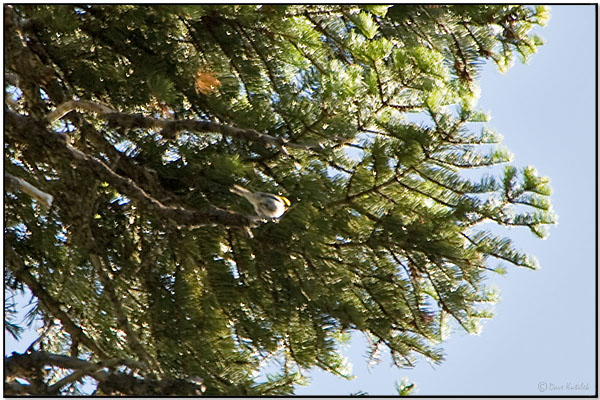
Hermit Warbler (Dendroica occidentalis) by Daves BirdingPix

Hermit Warbler (Dendroica occidentalis) by Daves BirdingPix

Here again we have another bird who loves
to dwell among the holly trees like the Azores Bullfinch
They are heard but not seen, cos, they dwell in high places…

Adam and Eve chose a different hiding place after they sinned..
GOD could hear them but cannot see..
If JESUS comes in search of us, where will he find us?
Where is your hiding place?
Can we boldly proclaim like Psalmist?

Thou art my hiding place and my shield: I hope in thy word. (Psalm 119:114)

Where have we set our affections?
Do we beseech JESUS who was lifted high for our sins?

If ye then be risen with Christ, seek those things which are above, where Christ sitteth on the right hand of God.

Hermit Warblers are most often found in mature coniferous forests,
from sea level to the mountains.
During breeding season,
they are most common in stands over 30 years old,
and are generally absent from stands under 20 years old.
They are generally found in the interior of large forests,
high in the canopy…

How do they know the age of stands?
From where did they receive this wisdom?
Do you feel that you lack in wisdom?
Here is a secret,

But seek ye first the kingdom of God, and his righteousness; and all these things shall be added unto you. (Matthew 6:33)

During migration and post-breeding,
Hermit Warblers are commonly found in mixed flocks.
When foraging they hop about the foliage,
moving from the trunk outward to branch tips
and then starting back at the trunk.
They also glean items from the foliage
while hovering, and will fly out to catch aerial prey.
Hermit Warblers can hang upside-down
to glean from the undersides of leaves and twigs.
Their preference for high, dense foliage
makes them difficult to spot,
but they can be heard singing regularly during the breeding season.
Males arrive on the breeding grounds before females.
They establish and defend territories by singing…

These birds know the secret of defense…
Our praise is the greatest defense against any attack
that satan may plan..
GOD loves to dwell among our praises,
and that is why Prophet Nehemiah appointed singers to
guard the walls of the city; you can read that in
the book of Nehemiah chapter 7…

I am the LORD thy God, which brought thee out of the land of Egypt: open thy mouth wide, and I will fill it. (Psalm 81:10)

Have a blessed day!

Yours in YESHUA,
A. J. Mithra

Please visit us at: Crosstree

See more of A. J.’s articles.

Azores Bullfinch and the Holly Tree… – by A. J. Mithra

Azores Bullfinch and the Holly Tree…

The diet of the Azores Bullfinch
comprises of at least 37 different plants..
Their diet presents marked seasonal variations,
from invertebrates and herbaceous
and fleshy-fruit seeds in summer
and autumn to fern sporangia, tree seeds,
fern fronds and flower buds in winter and spring.
The bird needs a mosaic of vegetation types,
and seems heavily dependent on flower buds
of Ilex perado, Holly, at a time of food scarcity..

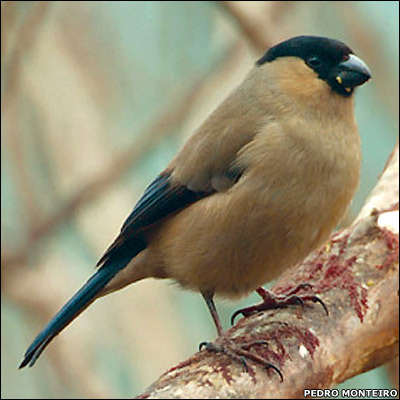
Azores bullfinch - BBC 2008-03-20@Pedro Monteiro

GOD has provided us with different food
for different seasons, so that,
we may stay healthy and fit..
These birds provide excellent example
of how we should use the food resources
provided by GOD for mankind…
GOD has even provided us with a menu
for our dining table in Leviticus chapter 11…

Found from 300 to 800 meters above sea level, This bird is confined to part of the native cloud forest in eastern S. Miguel
Exotic vegetation such as plantations
of Japanese Red Cedar (Cryptomeria japonica),,,

These birds seems to remind us about
how GOD went with HIS people in their journey
through the wilderness as a pillar of cloud….

“And the LORD went before them by day in a pillar of cloud, to lead them the way,and by night in a pillar of fire, to give them light,to go by day and might.” Exodus 13:21

During winter storms these birds often take refuge in hollies,
which provide shelter, protection from predators and food…

These birds seem to remind us about how
we always have to praise the LORD
like the leaves of these trees which always point skyward..
These evergreen trees provides
perfect protection and its flowers and fruits
provide food for these birds..
JESUS, the ever green tree is not only
our protector but also our provider…
The holly fruit reminds us of the drops of blood
which JESUS poured from the garden of Gethsemane
till HE was pierced in HIS side…
When JESUS becomes our everything
we lack nothing…

“The young lions do lack, and suffer hunger: but they that seek the LORD shall not want any good thing.” Psalm 34:10

Have a blessed day!

Your’s in YESHUA,
A. J. Mithra

please visit us at: Crosstree

Interesting Things – Birds’ Unique Leg Structure Says No Evolution

SmileyCentral.com

“Birds’ Unique Leg Structure Says No Evolution

And God created great whales, and every living creature that moveth, which the waters brought forth abundantly, after their kind, and every winged fowl after his kind: and God saw that it was good. (Genesis 1:21 KJV)

Countless television programs, museums, textbooks, and popular articles tell us that the birds evolved from dinosaurs. It now appears that this claim is even less credible!

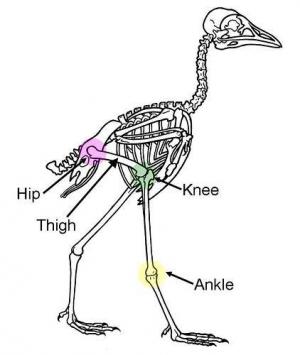
Bird Structure

Bird Structure

Researchers at Oregon State University have made a fundamental discovery about how birds breathe. Unlike other land animals, birds have immovable thigh bones, and they walk and run by bending their knees. All other land creatures can move both their thigh bone as well as bend their knees to walk and run. This included the dinosaurs and other theropods from which birds supposedly evolved. Birds need twenty times as much oxygen as cold-blooded animals. To supply this need, birds are designed with unique lungs and supporting musculature. Researchers found that if birds had the usual muscle structures and could move their thighs, their high-performance lungs would collapse. Even the evolutionists at Oregon State University said that this makes it unlikely that birds evolved from dinosaurs, and they added that birds appear earlier in the fossil record than the theropods from which they supposedly evolved!

There are other transition problems associated with bird evolution that are seldom mentioned. For example, reptiles are cold-blooded and birds are warm blooded; yet, this major transition has seemingly been overlooked.

Of course, the Bible has always taught that birds were specially made by God and did not evolve from any other creature.

Prayer: Lord, You have designed all things well. Do not let Your people be fooled by those who deny Your works. Amen.

References: Oregon State University (2009, June 9), “Discovery Raises New Doubts About Dinosaur -Bird Links. Science Daily. Retrieved June 16, 2009, from http://www.sciencedaily.com/ releases/2009/06/090609092055.htm.”

From Creation Moments ©March 22, 2010

To see more interesting things – CLICK HERE

Ian’s Bird of the Week – Banded Honeyeater

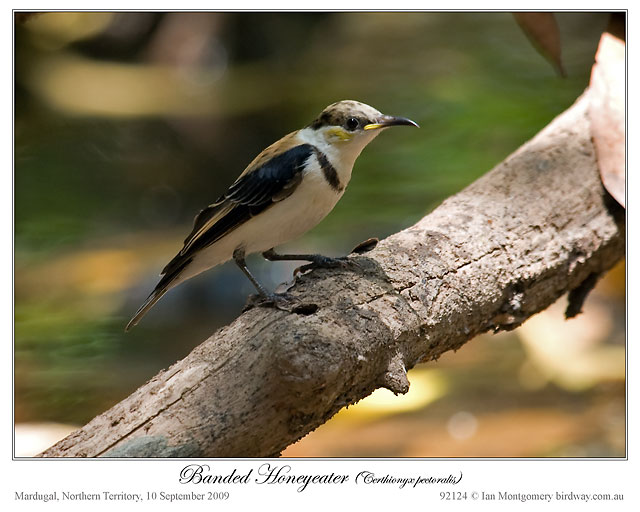
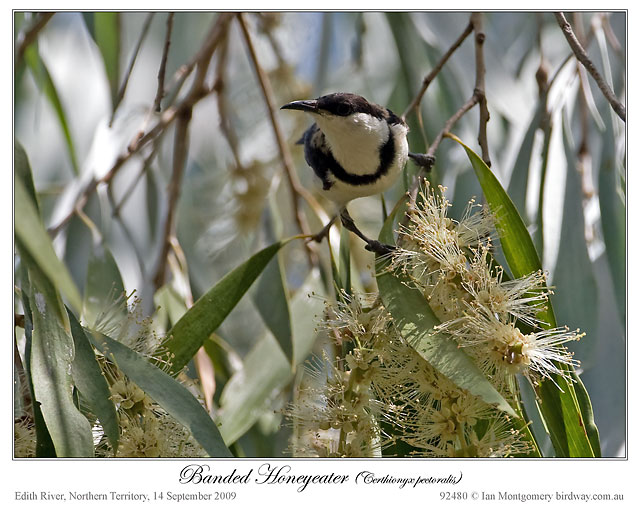
Banded Honeyeater(Cissomela pectoralis) by Ian

Banded Honeyeater(Cissomela pectoralis) by Ian

Newsletter – 03-21-10

I’ve continued updating some of the Honeyeater galleries on the website. Last week, we had one of the largest, the Helmeted Friarbird, but here is one of the smaller ones, the Banded Honeyeater with a length of about 12cm/5in. Fledgling Banded Honeyeaters have fudge-coloured upper parts, wings, tail and breast-band which change to black in adult birds (of both sexes), contrasting smartly with white underparts, throat and rump.

Banded Honeyeater(Cissomela pectoralis) by Ian

Banded Honeyeater(Cissomela pectoralis) by Ian

At least that’s what they are supposed to do. In practice, most of the birds one sees are in transitional plumage varying between that shown in the first photo at a waterhole, which has the brownish back and head and yellow cheeks of the juvenile, but the black wings and tail of the adult. The bird in the second photo feeding on melaleuca blossom, has got almost fully black and white plumage but still has a few brownish feathers on the back. On the trip to the Top End of the Northern Territory last year where Banded Honeyeaters are fairly common, I deliberately searched for a completely black and white bird without success, and this was the best I could find. I’d be interested to hear whether others have noticed this too.

The Banded Honeyeater has a northern distribution from the Kimberley region of Western Australia to North Queensland, where it is uncommon south of Cooktown. These birds are ‘blossom nomads’ and and in recent years have been seen regularly at White Mountains National Park, between Charters Towers and Hughenden and south of Townsville, when the grevilleas are in bloom in early winter.

Taxonomically, the Banded Honeyeater has traditionally been lumped in the same genus (Certhionyx) as the superficially similar Black and Pied Honeyeaters. Recently studies have indicated that the three species are not closely related and each has been relegated to its own (monotypic) genus, Cissomela in the case of the Banded. It is apparently closer to the White-cheeked Honeyeater and allies (Phylidonyris) while the Black is closer to the Scarlet Honeyeater and relatives (Myzomela). I’ve recently updated the galleries of all these species, including some colourful photos of Scarlet and White-cheeked feeding in red and yellow blossom respectively in Paluma last Friday. (Both these have featured as Bird of the Week previously, disqualifying them from, or at least handicapping them in, selection this week).

Links:
Banded Honeyeater
Black Honeyeater
Pied Honeyeater
White-cheeked Honeyeater
Scarlet Honeyeater

Best wishes,
Ian

Ian Montgomery, Birdway Pty Ltd,
454 Forestry Road, Bluewater, Qld 4818
Phone: +61-7 4751 3115
Preferred Email: ian@birdway.com.au
Website: http://birdway.com.au


Lee’s Addition:
The neat looking Banded Honeyeater is in the Meliphagidae – Honeyeaters Family of the Passeriformes Order. Ian has also written about the Rufous-banded Honeyeater and the Bar-breasted Honeyeater.

The IOC 2.4 Version list these birds as:
Banded Honeyeater (Cissomela pectoralis) as is
Black Honeyeater (Sugomel niger)
Pied Honeyeater (Certhionyx variegatus)
White-cheeked Honeyeater (Phylidonyris)
Scarlet Honeyeater now the Scarlet Myzomela (Myzomela sanguinolenta)

You will be well pleased visiting the Ian’s links above. All of those birds are very neat looking birds. The Lord has created the honeyeaters with a remarkable tongue that is “partially tubelike and split, with a brushlike tip superbly adapted for extracting nectar. Honeyeaters also have specially adapted kidneys that allow them to process maximum nutritional benefit from this food source.” (Complete Birds of the World, National Geographic)

More to be desired are they than gold, yea, than much fine gold: sweeter also than honey and the honeycomb. (Psalms 19:10 KJV)

World Sparrow Days – by A. J. Mithra

March 20th is declared as the “WORLD SPARROW’S DAYS”, hence this article…

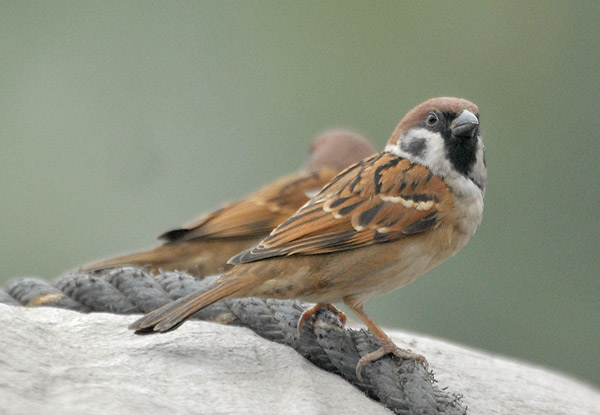
Eurasian Tree Sparrow (Passer montanus) by Nikhil

Eurasian Tree Sparrow (Passer montanus) by Nikhil


Sparrows are loosely monogamous.
Both the female and the male take care of the young ones,
though the female does most of the brooding

JESUS too expects us to be monogamous,
loyal and faithful to HIM as HE is to us..

No man can serve two masters: for either he will hate the one, and love the other; or else he will hold to the one, and despise the other. Ye cannot serve God and mammon. (Mathew 6:24 KJV)

They can swim to escape from predators,
although they are not considered to be water birds.
You maybe wondering how to get out of a tough situation,
Remember that we too have an escape route from predators,
and that JESUS, the LIVING WATER…
GOD has designed you to do what others can’t do…
If a sparrow can do what a water bird can,
we too can…

I can do all things through Christ which strengtheneth me. (Philippians 4:13)

House Sparrow (Passer domesticus) by Nikhil Devasar

House Sparrow (Passer domesticus) by Nikhil Devasar


The difference between a male and a female sparrow
is that the former has a reddish back and a black bib,
whereas the female has brown back with eye stripe.
Do we remember how JESUS was broken for us on the cross?
How HIS back turned BLOODY RED so that we maybe healed?
Do we really deserve to be loved so?

But he was wounded for our transgressions, he was bruised for our iniquities: the chastisement of our peace was upon him; and with his stripes we are healed.  (Isaiah 53:5)

The nest building is initiated by an unmated male,
who begins the construction while displaying it to the females.
The females do assist in nest building, but are less active than the male.

JESUS is busy building a mansion from gold and silver,
to take back the church, HIS BRIDE for HIS wedding…
Are we preparing for our wedding with HIM
as HE is busy preparing for the bride?

And the building of the wall of it was of jasper: and the city was pure gold, like unto clear glass.  (Revelation 21:18)

If a sparrow can exhibit the qualities of its Creator,
how much more will our Creator expects of us whom HE has created in HIS own image?

Happy Sparrow’s day….

Yours in YESHUA,
A J Mithra

Please visit us at: Crosstree

Birds of the Bible – Fowl (Birds) of Every Wing

In the mountain of the height of Israel will I plant it: and it shall bring forth boughs, and bear fruit, and be a goodly cedar: and under it shall dwell all fowl of every wing; in the shadow of the branches thereof shall they dwell. (Ezekiel 17:23 KJV)

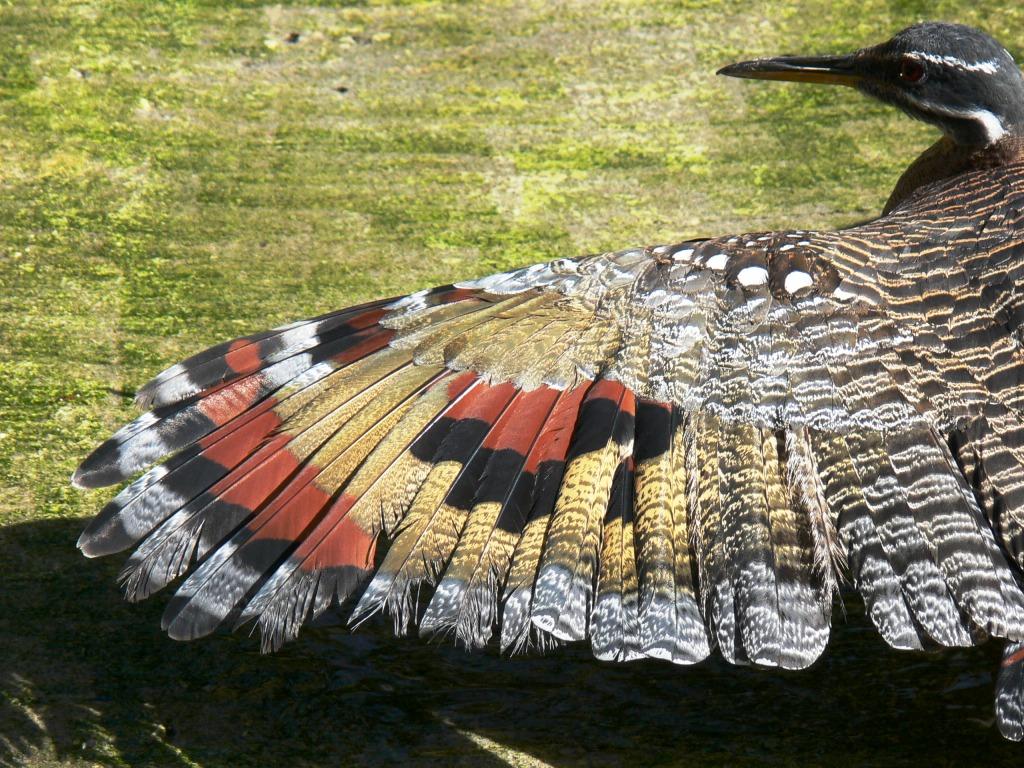
Sunbittern (Eurypyga helias) Left Wing by Lee at Lowry Park Zoo

Sunbittern (Eurypyga helias) Left Wing by Lee at Lowry Park Zoo

The phrase “Fowl (or Birds) of Every Wing” caught my interest. Remembering the article I recently wrote about the Sunbittern with it’s beautiful wings, I thought that might be neat to show some of the other bird’s fancy wings. Also, since I have been busy updating the Birds of the World pages, I thought that showing different birds from around the world would be interesting for you. But, first, what is that verse referring to anyway?

Adam Clarke’s Commentary on the Bible summarized Ezekiel 17:23 as a future prophecy referring to Christ,
“In the mountain of the height of Israel – He shall make his appearance at the temple, and found his Church at Jerusalem.
Shalt bring forth boughs – Apostles, evangelists, and their successors in the Gospel ministry.
And bear fruit – Multitudes of souls shall be converted by their preaching.
And under it shall dwell all fowl of every wing – All the nations of the earth shall receive his Gospel.
In the shadow of the branches thereof shall they dwell – Trust in him alone for salvation, and be saved in their trusting.”
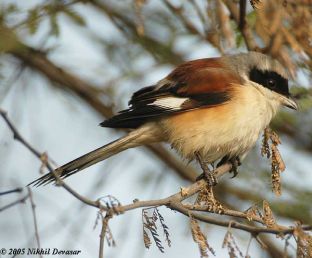
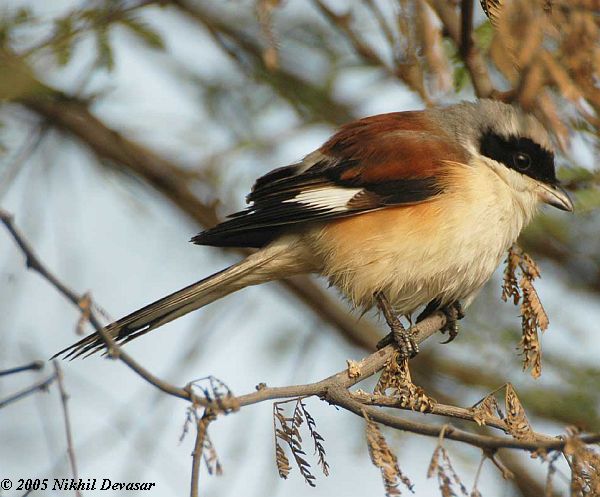
Bay-backed Shrike (Lanius vittatus) by Nikhil Devasa

Bay-backed Shrike (Lanius vittatus) by Nikhil Devasa

“But it left room for the sovereignty of God, who would bring down the high tree and exalt the low tree, who would dry up the green tree and make the dry tree to flourish. His grace would take the little forgotten branch of the house of David and raise it up in Israel upon the mountain of His power, where He would cause it to become a goodly cedar, bearing fruit, and sheltering all that would seek the protection of its shadow. All the powers of the earth should know the word and the works of Jehovah.” (John Darby’ Synopsis)

“Both the Jews and Gentiles will be gathered into it.” (Geneva Bible Translation Notes)

and under it shall dwell all fowl of every wing; in the shadow of the branches thereof shall they dwell; by whom are designed converted sinners of all sorts, and of all nations, Jews and Gentiles; compared to birds, because weak, defenceless, and timorous; exposed to danger; and wonderfully delivered; are subject to wander and go astray; and for their chirping and warbling notes: now these may be said to “dwell” under the “shadow” of the “branches” of this “goodly cedar”, Christ and his church; that is, under the ministration of the word and ordinances, which is a very delightful and refreshing shadow, a very safe and fruitful one, Son_2:3; and here saints choose to dwell, and determine to abide and continue, as it is their interest and happiness so to do; and what a flocking and tabernacling of these birds here will there be in the latter day, where they will chirp and sing in the height of Zion? Isa_66:4; compare with this Mat_13:32; where our Lord is thought by some to allude to this passage.” (John Gill’s Exposition)
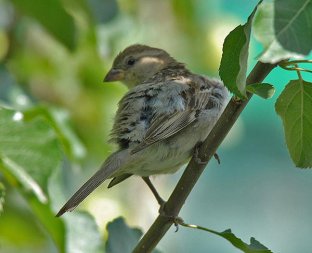
House Sparrow (Passer domesticus) Female by Nikhil

House Sparrow (Passer domesticus) Female by Nikhil

under it … all fowl — the Gospel “mustard tree,” small at first, but at length receiving all under its covert (Mat_13:32); the antithesis to Antichrist, symbolized by Assyria, of which the same is said (Eze_31:6), and Babylon (Dan_4:12). Antichrist assumes in mimicry the universal power really belonging to Christ.” (Jamieson, Fausset, and Brown)

“under it … all fowl — the Gospel “mustard tree,” small at first, but at length receiving all under its covert (Mat_13:32); the antithesis to Antichrist, symbolized by Assyria, of which the same is said (Eze_31:6), and Babylon (Dan_4:12). Antichrist assumes in mimicry the universal power really belonging to Christ.” (Life Application Study Bible)

There are other commentaries I could quote, but these are sufficient to understand that these “fowl of every wing” represent those who from around the world have accepted or will accept Christ the Lord as their Savior. (Gospel Message) We have shelter and refuge under this tree. There was a tree of life in the Garden of Eden, but access to it was forbidden because of sin, but two verses in Revelation speak of future access to that tree.

He that hath an ear, let him hear what the Spirit saith unto the churches; To him that overcometh will I give to eat of the tree of life, which is in the midst of the paradise of God. (Revelation 2:7 KJV)
Blessed are they that do his commandments, that they may have right to the tree of life, and may enter in through the gates into the city. (Revelation 22:14 KJV)

All commentary quotes are from e-Sword which is a free Bible program. More of the “Fowl of Every Wing” will be covered in future Birds of the Bible.

The Feet – by A. J. Mithra

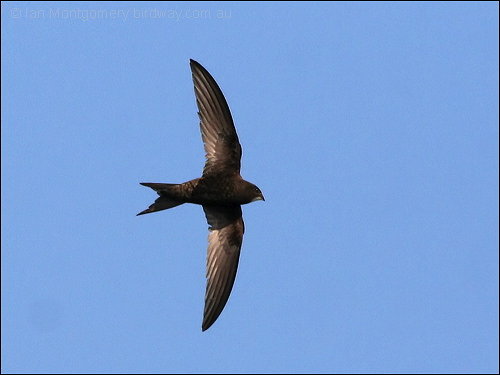
Common Swift (Apus apus) by Ian

Common Swift (Apus apus) by Ian

The foot shares the duties of locomotion with the wing.

Birds with highly developed wings have poor feet.
The swallow, an aerial bird, is an example.

The chimney swift has a tiny foot, but enormously developed wings,
and if placed on a flat surface is unable even to support itself.

All aquatic and terrestrial birds have excellently developed feet.
The loon is so thoroughly aquatic that it cannot walk on land
without the support of its breast and wings.

The sea snipe has a foot especially fitted for swimming,
and can be found a few hundred miles
off the Atlantic coast in flocks of hundreds of thousands,
perfectly at home in the water.

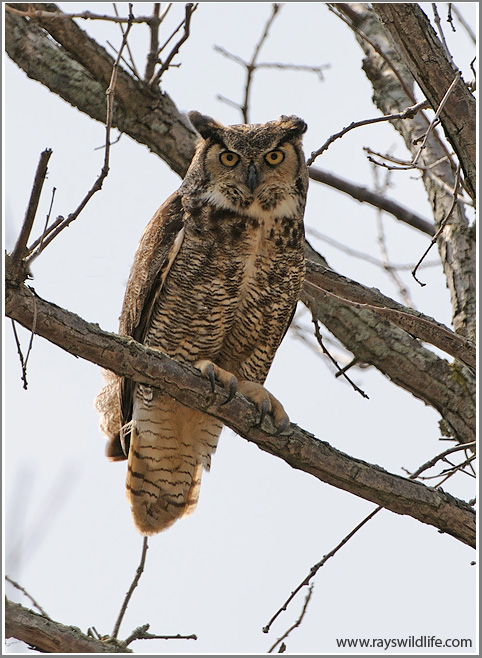
Great Horned Owl (Bubo virginianus) by Ray

Great Horned Owl (Bubo virginianus) by Ray

The foot is generally related to the length of the neck.
In securing prey the foot also plays an important part.

The great horned owl and the duck hawk
have enormous grasping power in their claws.

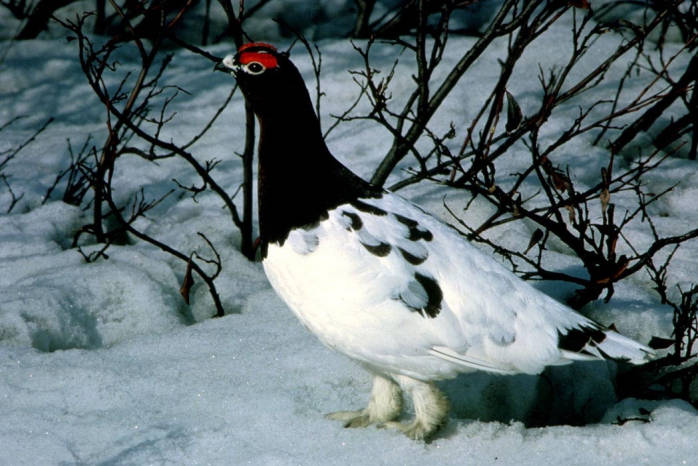
In grouse or partridge a horny,
fringe-like growth appears on the toes late in the fall,
serving as a sort of snowshoe during the winter,
by which the bird is enabled
to walk on the surface of the snow.
This growth is shed in the spring….

Your feet may feel weak and weary,
but, still GOD wants our feet to stand high…
That is why the Bible says,

He maketh his feet like hinds` [feet], And setteth me upon my high places. (2 Samuel 22:34 KJV)

And HE also says,

Thou shalt tread upon the lion and adder: The young lion and the serpent shalt thou trample under foot. (Psalm 91:13)

WillowPtarmigan(Lagopuslagopus)©USFWS

WillowPtarmigan(Lagopuslagopus)

God takes care of our feet even in our
going out and coming in…

They shall bear thee up in their hands, Lest thou dash thy foot against a stone. (Psalm91:12)..

No mater how big or small,
GOD says.

How beautiful are thy FEET in sandals, (Song of Solomon 7:1 KJV)

Well,
does HE means to say that, our feet look beautiful only with sandals?
What sort of sandals are we wearing?
Do we have the sandal of preparation of the gospel of peace?

and having shod your feet with the preparation of the gospel of peace; (Ephesians 6:15)

Our feet can’t be more beautiful or more purpose full
without the sandal of preparation..
GOD has given us feet for a divine purpose..

Where are our feet planted?
JESUS is returning soon and HE is in need of feet
that can take the Gospel to the ends of the earth..
Are you ready?

How beautiful upon the mountains are the feet of him that bringeth good tidings, that publisheth peace, that bringeth good tidings of good, that publisheth salvation, that saith unto Zion, Thy God reigneth! (Isaiah 52:7)

Have a blessed day!

Your’s in YESHUA,
A. J. Mithra

Please visit us at: Crosstree

Sandhill Crane “Colt” Birdwatching

Sandhill Crane "colts"

Sandhill Crane "colts"

Our neighbor called 4 or 5 days before telling us that the Sandhill Cranes here in the community were sitting on a nest. Then Sunday afternoon (3/14/10) she called again to tell us that they were walking with the babies (born that morning). So these little Sandhill Crane “colts” are only a day old.

“Sandhill breeding habitat is marshes and bogs in central and northern Canada, Alaska, part of the midwestern and southeastern United States, Siberia and Cuba. They nest in marsh vegetation or on the ground close to water. The female lays two eggs on a mound of vegetation, but it is rare that both chicks hatch and grow to independence. Cranes mate for life; both parents feed the young, calledcolts“, who are soon able to feed themselves. The colts are taught to fly over many weeks when they run and dance with their parents. Dancing is a significant component in the education of young cranes. The Sandhill Crane does not breed until it is two to seven years old, and the average generation time is 12.5 years. It can live up to 25 years in the wild; in captivity it has been known to live more than twice that span. Mated pairs stay together year-round and migrate south as a group with their offspring.” (Wikipedia) This pair is here year-round. Been in our backyard many times.

I know all the birds of the hills, and all that moves in the field is mine. (Psalms 50:11 ESV)

Thought you might enjoy seeing them. Dan walked over and took these photos.

This slideshow requires JavaScript.

*

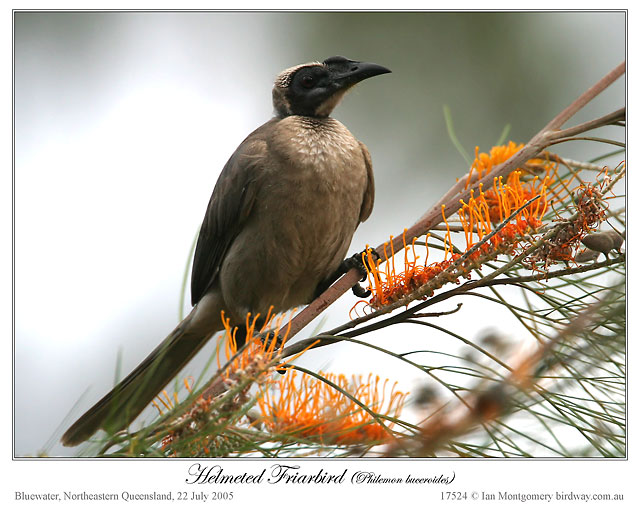
Ian’s Bird of the Week – Helmeted Friarbird

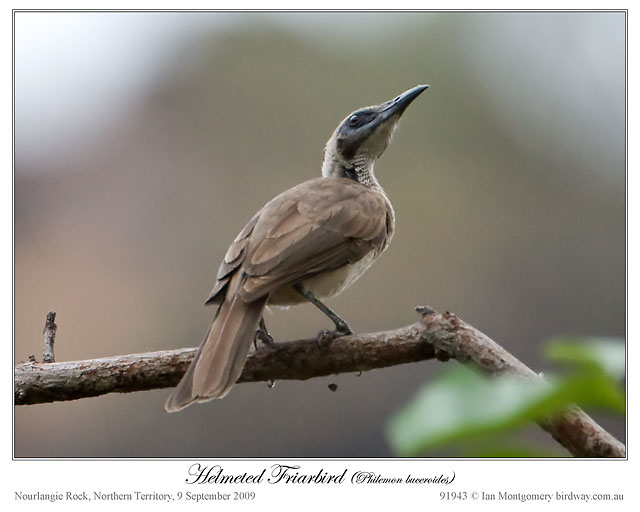
Helmeted Friarbird (Philemon buceroides) by Ian

Helmeted Friarbird (Philemon buceroides) by Ian

Newsletter 03-10-2010

As with the Pheasant Coucal last week, I didn’t have to leave the house to photograph the Helmeted Friarbird in the first photo on the red flowers of a nearby Umbrella Tree. This tree has been flowering profusely for weeks and attracting a noisy variety of Honeyeaters and Lorikeets. The Helmeted Friarbird – length to 37cm/15in is the largest of the 4 species of Friarbirds found in Australia. Friarbirds get their name from the colour of the plumage, like the brown habits worn by friars and Helmeted refers to the feathered crown, in contrast to the naked crown of the more widespread Noisy Friarbird.

Helmeted Friarbird (Philemon buceroides) by Ian

Helmeted Friarbird (Philemon buceroides) by Ian

This particular individual is sub-adult; it has pale fringes to the feathers of the back and neck which marks it as an immature bird, but it has the red eye and knobbed bill of the adult – very young birds have brown eyes and lack the knob. The second photo shows an adult bird feeding on an orange Grevillea and you can see that the plumage is more evenly coloured.

The Helmeted Friarbird is a northern species and, in Australia, it occurs only in Queensland and the Northern Territory. The Queensland race of the Helmeted Friarbird (yorki) has a silvery crown and is best distinguished from the rather similar Silver-crowned Friarbird by the shape of the rear edge of the facial skin – curved in the Helmeted, but with a backward-pointing spur in the Silver-crowned – and by its calls. In the Top End of the Northern Territory, another race of the Helmeted Friarbird (ammitophila) lacks the knob on the bill – see the third photo – and has different calls. This race is often called the Sandstone Friarbird and is a characteristic bird of the escarpments of Kakadu and Arnhem Land.

Helmeted Friarbird (Philemon buceroides) by Ian

Helmeted Friarbird (Philemon buceroides) by Ian

Friarbirds are large Honeyeaters and the Helmeted Friarbird is only in exceeded in size among Australian Honeyeaters by the Yellow Wattlebird, a Tasmanian endemic. Only the Silver-crowned is an Australian endemic, the other 3 species also occur in New Guinea, where another 12 species of Friarbird occur.
Noisy Friarbird
Little Friarbird

On the subject of Honeyeaters, I’ve added new photos of Banded Honeyeaters and Yellow-tinted Honeyeaters to the website:

Best wishes,
Ian

Ian Montgomery, Birdway Pty Ltd,
454 Forestry Road, Bluewater, Qld 4818
Phone: +61-7 4751 3115
Preferred Email: ian@birdway.com.au
Website: http://birdway.com.au


Lee’s Addition:

Friarbirds and Honeyeaters are both in the Meliphagidae Family of the Passeriformes Order.

“The friarbirds (also called leatherheads) are about 15 species of relatively large honeyeaters in the genus Philemon. Additionally, the single member of the genus Melitograis is called the White-streaked Friarbird. Friarbirds are found in Australia, Papua New Guinea, eastern Indonesia and New Caledonia. They eat nectar, insects and other invertebrates, flowers, fruit and seeds.

The friarbirds generally have drab plumage. In many instances their plumage is mimicked by smaller orioles, which use the aggressive nature of the friarbirds to avoid aggression themselves.

And to every beast of the earth and to every bird of the heavens and to everything that creeps on the earth, everything that has the breath of life, I have given every green plant for food.” And it was so. (Genesis 1:30 ESV)

Updating to the IOC World Bird List 2.4 version

Yellow-rumped Warbler (Dendroica coronata) by Anthony747

Yellow-rumped Warbler (Dendroica coronata) by Anthony747

For the last week, I have been working on updating the Birds of the World section to the new IOC World Bird List 2.4 version, which came out on March 7th. Not knowing that they update about every three to four months, the list was getting way behind. I had started updating to 2.3 when 2.4 came out. So, to get every thing straight, I am changing all pages to the new version without any comments of what specifically changed.

Here is an overview of the changes:

Version 2.4 (March 7, 2010) – The IOC World Bird List 2.4 contains 10,384 species classified in 39 Orders, 222 Families (+7 Incertae Sedis) and 2202 Genera.

Updates include:
SPECIES:
ADDED to Master List: 25, including 4 splits of Yellow-rumped Warbler complex (Myrtle Warbler, Audubon’s Warbler, Black-fronted Warbler, Goldman’s Warbler)
DELETED from Master List: 7

English Names: 23 changes
Ranges: 28 changes
Taxonomy: 46 changes including 9 changes of Genera including 5 overdue ones for African greenbuls following Johansson et al (2007), and 1 change of Family (African stone partridges Ptilopachus to Odontophoridae).

So far my Indexes and the Order pages are complete, and I am working on the Family pages. “I’m on it!”

Updated 3/20/10: Just finished updating all the pages to the new 2.4 Version, I think. If you find an error, please leave a comment. Thanks.

Interesting Things – Ark, No Meat, Creator, Plus

SmileyCentral.com

While checking out Answers with Ken Ham, I found these interesting articles. Hope you find them informative.

Animals on the Ark–here Kitty, Kitty? (Jan 11, 2010)

Animals–no sin . . . no meat? (Mar 10, 2010)

Creator–where did He come from? (Jan 13, 2010)

Green-crowned Brilliant (Heliodoxa jacula) Reinier Munguia

The hummingbird-God’s Tiny Miracle! (Apr 5, 2007)

Bird brained-it could be a compliment! (Oct 9, 2009)

It’s a transition–NO, it’s a bird! (Aug 31, 2006)