Red-winged Blackbirds: marsh-loving icterids

RED-WINGED BLACKBIRDS: MARSH-LOVING ICTERIDS

Dr. James J. S. Johnson

Can the rush grow up without mire? can the flag grow without water?

(Job 8:11)

Speaking of birdwatching in Texas, ornithologist Stan Tekiela says, “It’s a sure sign of spring when [migratory] Red-winged Blackbirds return to the marshes.” [Quoting from Tekiela’s BIRDS OF TEXAS FIELD GUIDE (Cambridge, MN: Adventure Publications, Inc., 2004), page 9.] 
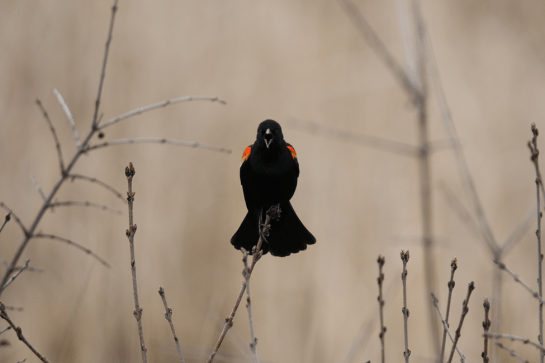
RED-WINGED BLACKBIRD MALE, front view, on budding plants
(photo credit: Bryce Gaudian)

Of course, Minnesota hosts Redwinged Blackbirds in early springtime, weeks before the last snowdrifts melt away with warming spring temperatures.

“CLOUD” of RED-WINGED BLACKBIRDS, Minnesota
(photo credit: Bryce Gaudian)

Of course, what could be a more iconic marshland plants than cattails, which Redwings love to perch upon, all over America’s Lower 48 states (as well as much of Mexico and Canada)?
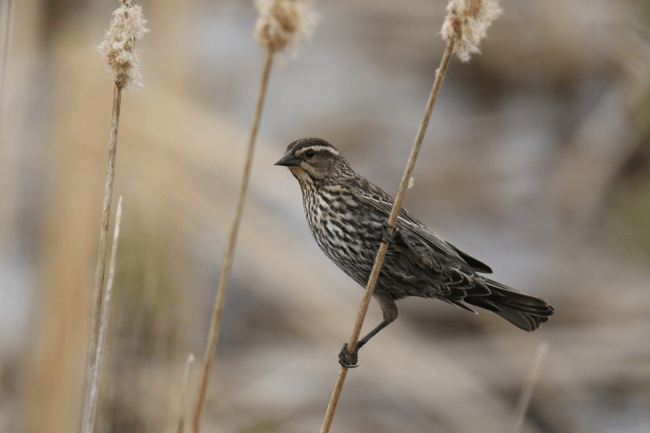
RED-WINGED BLACKBIRD FEMALE perching on cattail stalk
(photo credit: Bryce Gaudian)

Cattails are wetland plants, often growing on pondshore’s or along drainage ditches. 
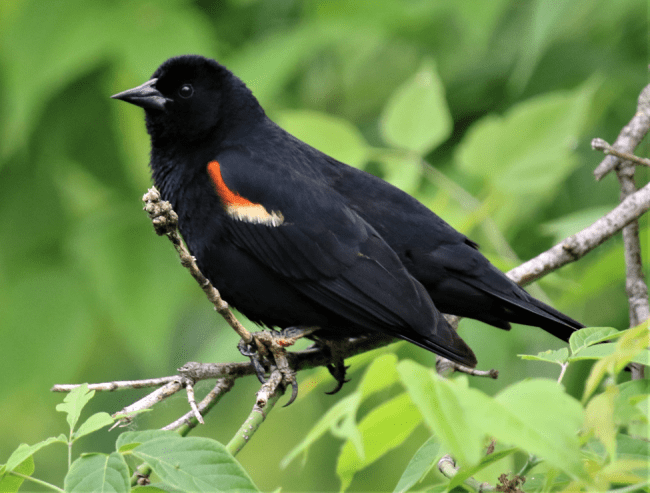
RED-WINGED BLACKBIRD MALE, profile, showing red-&-yellowish epaulet
(photo credit: Bryce Gaudian)

And where you have cattails, you often have Red-winged Blackbirds, known to ornithologists as Agelaius phoeniceus, sometimes nicknamed “Redwings” (but not to be confused with the Eurasia’s thrush that is also nicknamed “redwing”), , as was noted in a previous blogpost “Redwing Pond”, posted at https://leesbird.com/2019/11/04/redwing-pond/.

The most successful way to observe the behavior of Red-winged Blackbirds is to locate a marshy area where a number of them can be regularly found, pick one or two of the more active birds, and follow their movements for about a half hour.  A characteristic of Redwings is that they alternate periods of active displaying with periods of quiet and feeding, so you cannot just show up at a marsh and expect immediately to see all of their marvelous displays.

Donald Stokes, A GUIDE TO BIRD BEHAVIOR, Vol. I (Boston: Little, Brown & Company / Stokes Nature Guides, 1979), page 275.
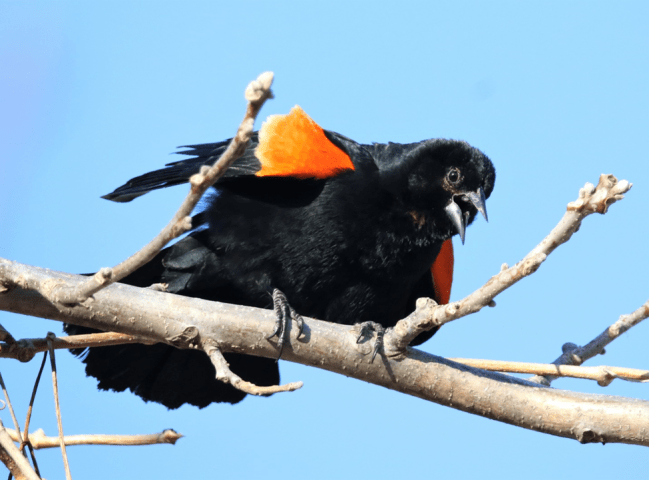
RED-WINGED BLACKBIRD MALE, close-up
(photo credit: Bryce Gaudian)

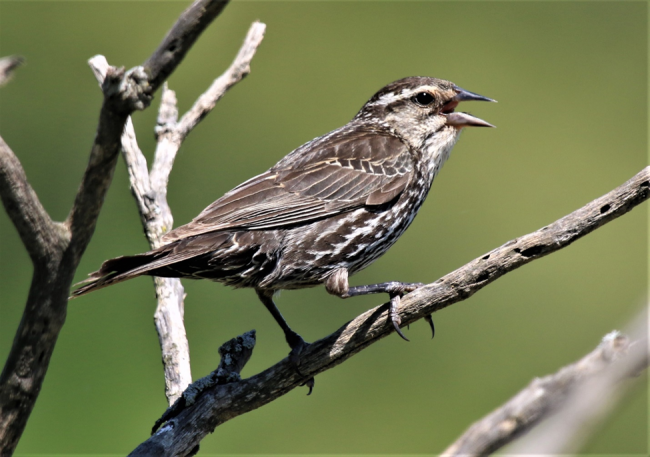
Red-winged Blackbirds are one of my favorite icterid (blackbird family) birds.  The males sport colorful epaulets (i.e., shoulder-wing feather “bars”) of pale yellow and red stripes, which contrast strikingly against their otherwise glossy black plumage.  The females have a more camouflage-hued brownish plumage, accenting the brown feathers with ivory-white mottling and outlining (and “eyebrows”). 

Above and below are some splendid photographs taken by Christian/creationist wildlife photographer (in Minnesota), showing how beautiful (and plentiful) these Red-winged Blackbirds can be.
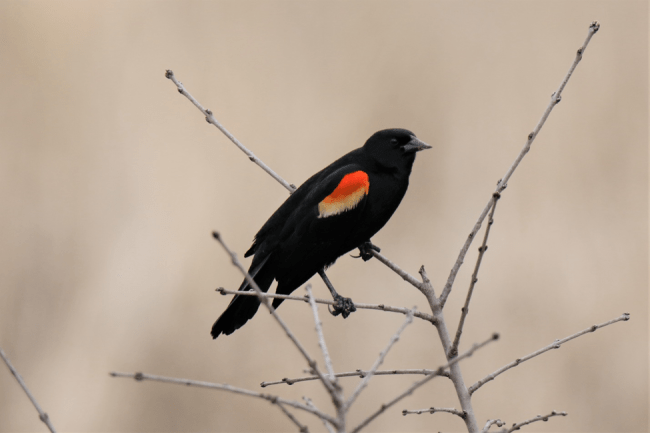
RED-WINGED BLACKBIRD MALE, sporting red-and-yellowish epaulet
(photo credit: Bryce Gaudian)
RED-WINGED BLACKBIRD FEMALE, Minnesota
(photo credit: Bryce Gaudian)

Red-winged blackbirds are not picky eaters — although they mostly eat plant material, such as seeds (including seeds from various weeds, from birdfeeders, as well as from rice or other grain seeds) and available berries (including blackberries and blueberries). Redwings also eat a mix of small animals, especially insect adults and larvae (including flies, moths, butterflies, dragonflies), spiders, earthworms, periodical cicadas, and even snails.
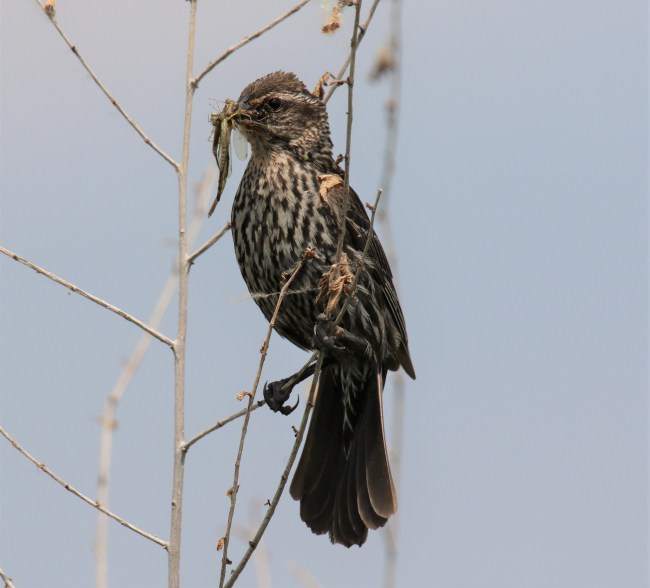
RED-WINGED BLACKBIRD FEMALE, perching with prey
(photo credit: BRYCE GAUDIAN)

How nice it would be to see Red-winged Blackbirds perching upon cattails that constitute a fence-like edge along a pond-shore or a drainage ditch!

Thank You, Lord, for making these marsh-loving icterids.

Avian And Attributes – Cloud

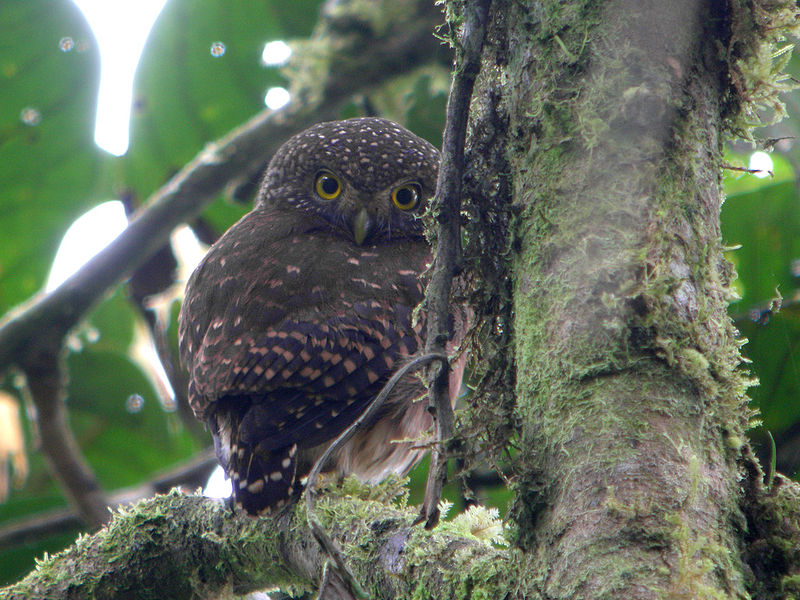
Cloud-forest Pygmy Owl (Glaucidium nubicola) ©WikiC

“And then shall they see the Son of man coming in a cloud with power and great glory. And when these things begin to come to pass, then look up, and lift up your heads; for your redemption draweth nigh.” (Luke 21:27-28 KJV)

“And the cloud of the LORD was upon them by day, when they went out of the camp.” (Numbers 10:34 KJV)

Where wast thou when I laid the foundations of the earth? declare, if thou hast understanding.” When I made the cloud the garment thereof, and thick darkness a swaddlingband for it,” (Job 38:4, 9 KJV)


Avian and Attributes – Cloud

Cloud
(1): (n.) A dark vein or spot on a lighter material, as in marble; hence, a blemish or defect; as, a cloud upon one’s reputation; a cloud on a title.
(2): (v. i.) To grow cloudy; to become obscure with clouds; — often used with up.
(3): (n.) That which has a dark, lowering, or threatening aspect; that which temporarily overshadows, obscures, or depresses; as, a cloud of sorrow; a cloud of war; a cloud upon the intellect.
(6): (v. t.) To overspread or hide with a cloud or clouds; as, the sky is clouded.

“And the LORD went before them by day in a pillar of a cloud, to lead them the way; and by night in a pillar of fire, to give them light; to go by day and night:” (Exodus 13:21 KJV)

(8): (n.) A collection of visible vapor, or watery particles, suspended in the upper atmosphere.
(9): (n.) A mass or volume of smoke, or flying dust, resembling vapor.
(10): (v. t.) To blacken; to sully; to stain; to tarnish; to damage; — esp. used of reputation or character.
(11): (n.) A great crowd or multitude; a vast collection.

“Wherefore seeing we also are compassed about with so great a cloud of witnesses, let us lay aside every weight, and the sin which doth so easily beset us, and let us run with patience the race that is set before us, Looking unto Jesus the author and finisher of our faith; who for the joy that was set before him endured the cross, despising the shame, and is set down at the right hand of the throne of God.” (Hebrews 12:1-2 KJV)


Cloud Birds – Cloud Cisticola, Cloud-forest Pygmy Owl, Cloud-forest Screech Owl

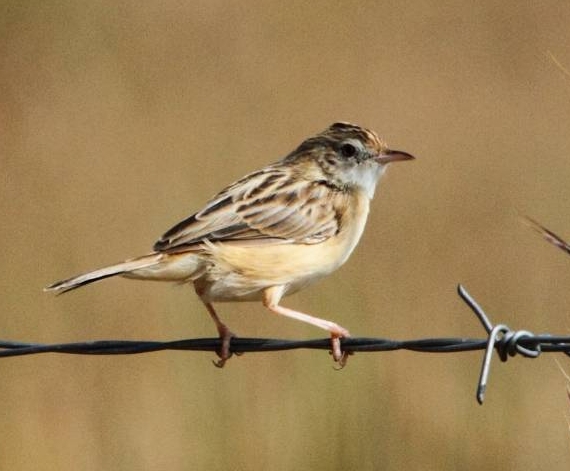
Cloud Cisticola (Cisticola textrix) ©WikiC

The Cloud Cisticola or tink-tink cisticola (Cisticola textrix) is a species of bird in the Cisticolidae – Cisticolas and allies Family. It is found in Angola, Lesotho, Mozambique, South Africa, Swaziland, and Zambia, and its natural habitat is subtropical or tropical dry lowland grassland.

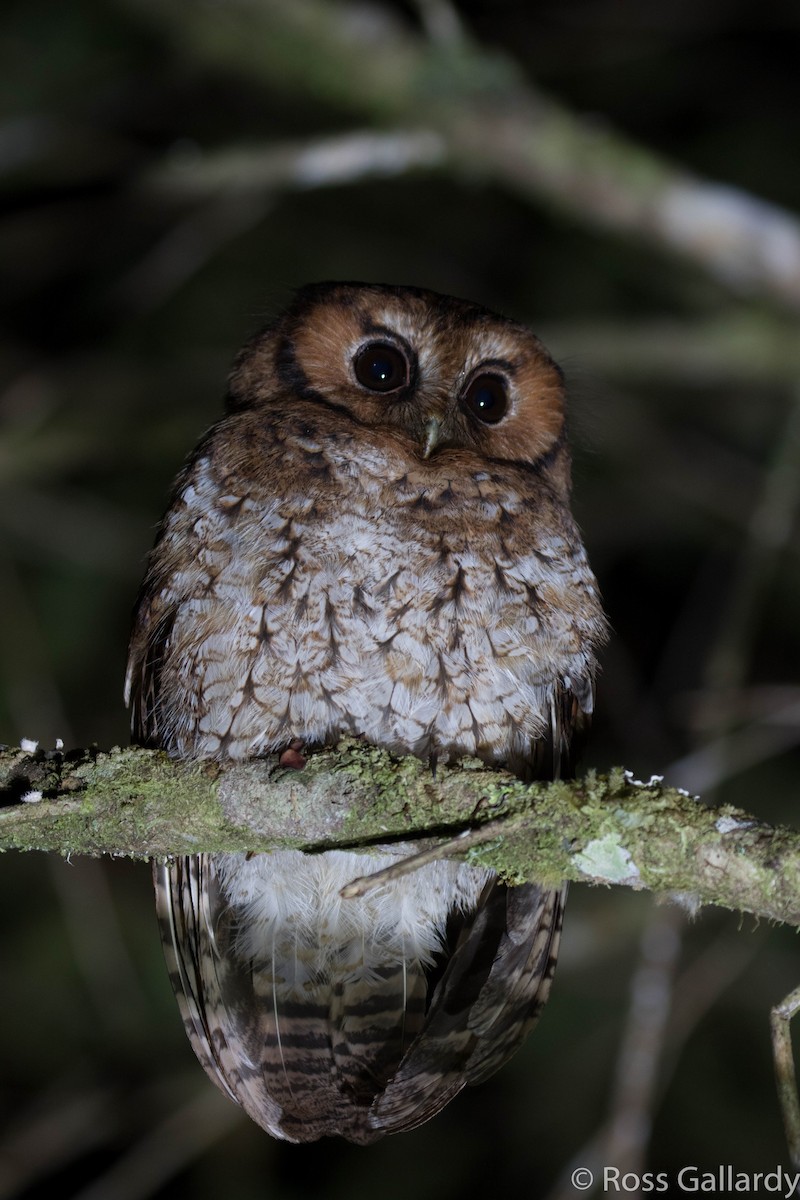
Cloud-forest Pygmy Owl (Glaucidium nubicola) ©WikiC

The Cloud-forest Pygmy Owl (Glaucidium nubicola) is a short, muscular, small-sized species of owl found throughout the Andes of western Colombia and north-western Ecuador, being confined to cloud forests between 900–2000 m a.s.l. Below this altitudinal range the Central American pygmy owl (Glaucidium griseiceps) occurs; above the Andean pygmy owl (Glaucidium jardinii) occurs. It is in the Strigidae – Owls Family.

Its epithet nubicola means in Latin “cloud inhabiting”, because this species is restricted to very humid cloud forests.

Cloud-forest Screech-Owl (Megascops marshalli)©Neotropical Birds Online

The Cloud-forest Screech Owl (Megascops marshalli) is a species of owl in the Strigidae – Owls Family. It is found in Bolivia and Peru. Its natural habitat is subtropical or tropical moist montane forests. It is threatened by habitat loss.


More Avian and Attributes

Birds whose first or last name start with “C”

Good News

*
[Definitions from Webster’s Dictionary of American English (1828), unless noted. Bird info from Wikipedia plus.]