Ian’s Bird of the Week – Crimson Rosella

Ian’s Bird of the Week – Crimson Rosella ~ by Ian Montgomery

Newsletter – 11/20/15

Some birds are very obvious choices for bird of the week because they are beautiful and popular. Ironically, I can overlook them for exactly that reason as I assume they’ve featured previously. Here is one such, the Crimson Rosella, an iconic and popular bird of the forests of eastern and southeastern Australia.
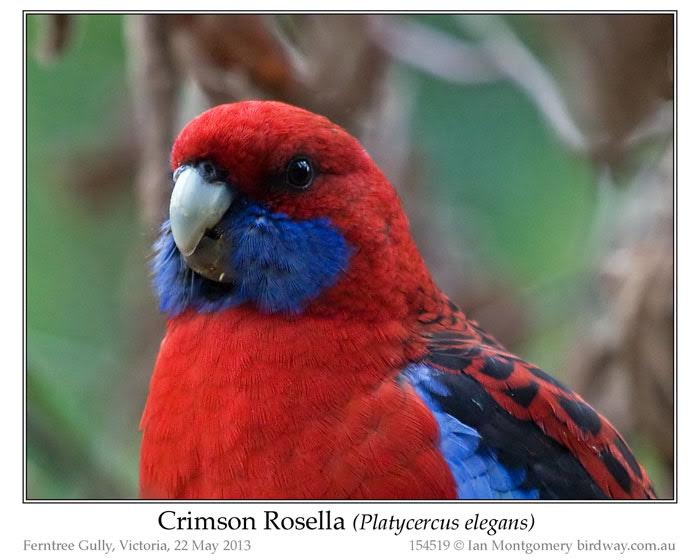
Crimson Rosella (Platycercus elegans) by Ian

Normally rather shy in its natural habitat and can become quite tame in parks and gardens. It’s popularity is reflected in the fact that it has been introduced to New Zealand and Norfolk Island and (unsuccessfully) to Lord Howe Island. It nests in tree hollows and is regarded by conservationists as a pest on Norfolk Island as it competes with the smaller, endangered Norfolk Parakeet for nest sites.

Crimson Rosella (Platycercus elegans) by Ian

It feeds mainly on the seeds and fruit of trees and will forage on the ground for the grass seed, like the bird in the third photo. It’s a very vocal species and its ringing calls are a characteristic sound of forests in eastern Australia. Out of the breeding season, it is found in small flocks but it is territorial when breeding and the pair bond is though to persist for several years or longer.
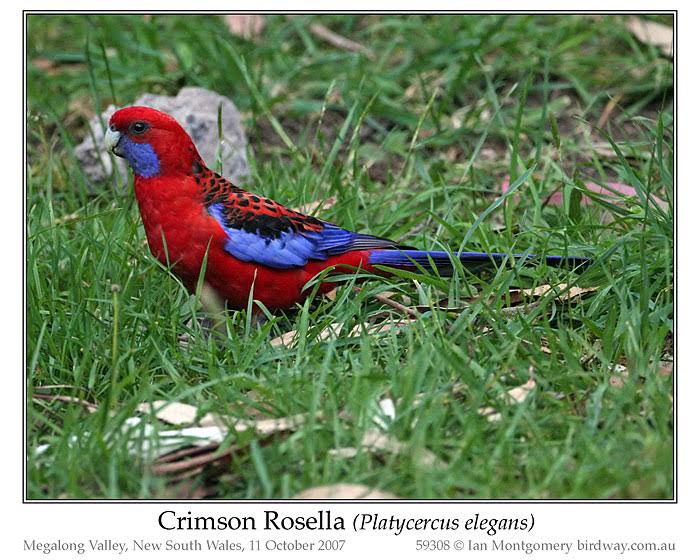
Crimson Rosella (Platycercus elegans) by Ian

Juvenile birds of the eastern nominate race are mainly olive green with blue cheeks and patches of red on the head, breast and undertail-coverts. The nominate race extends from Cooroy in Southeastern Queensland to about Kingston in eastern South Australia.

Crimson Rosella (Platycercus elegans) by Ian

Farther north, an isolated population of the race nigrescens (‘blackish’) occurs from Eungella near Mackay north to the Atherton Tableland. This is smaller and darker than the nominate race, fifth photo, and is mainly a bird of highland rainforest.
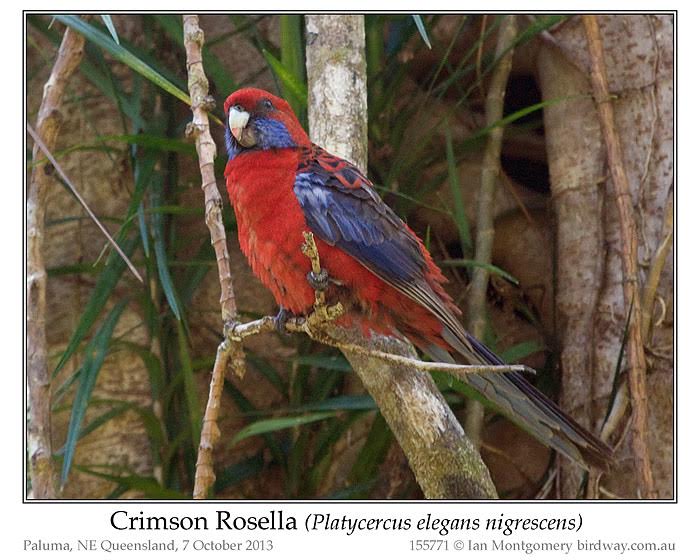
Crimson Rosella (Platycercus elegans) by Ian

Juveniles of this northern race are much more like the adults than their southern relatives and have brownish-black feathers on the back instead of green (sixth photo).
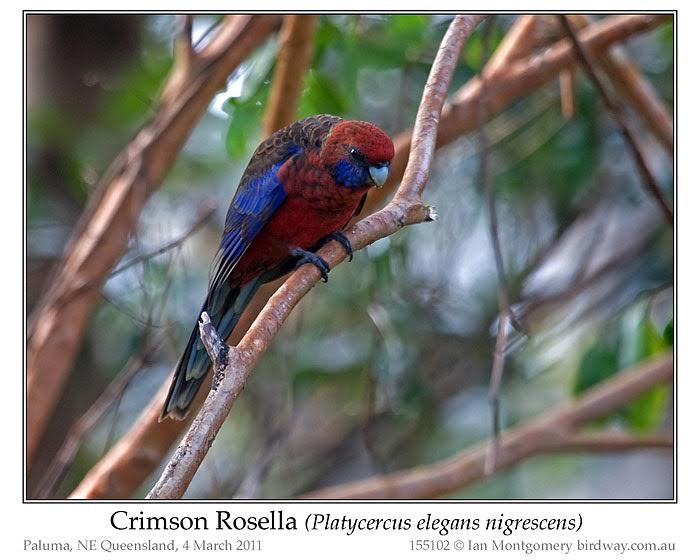
Crimson Rosella (Platycercus elegans) by Ian

Crimson Rosella (Platycercus elegans) by Ian

In southeastern Australia the populations of blue-cheeked Rosellas look very different and were for a long time treated as two different species, the Yellow Rosella, seventh photo, of the river systems of southern New South Wales and northern Victoria, and the orange-plumaged Adelaide Rosella of South Australia from the Flinders Ranges in the north to the Fleurieu Peninsula south of Adelaide (no photo). Yellow and Adelaide Rosellas interbreed where their ranges meet along the Murray River in South Australia. The two are now treated as races of the Crimson Rosella, flaveolus and adelaidae respectively.
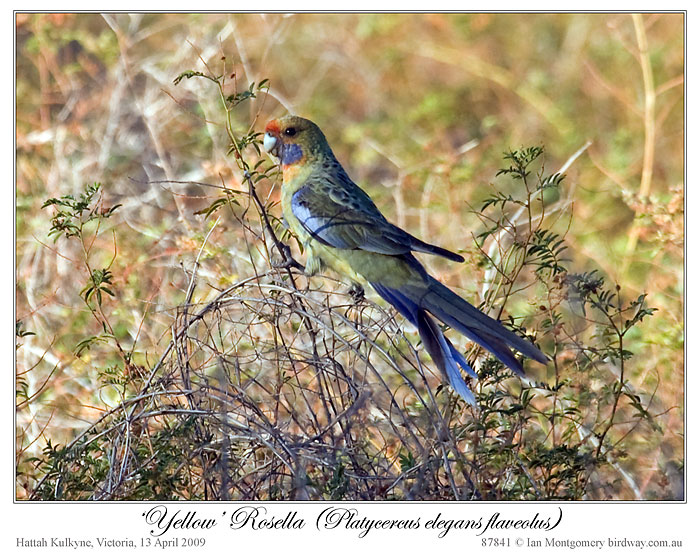
Yellow Rosella (Platycercus elegans flaveolus) by Ian 4

Yellow Rosella (Platycercus elegans flaveolus) by Ian 4

The Yellow Rosella looks very like the other blue-cheeked Rosella, the Green Rosella of Tasmania. It is, however, retained as a separate species. I included this photo of the Yellow Rosella when the Green Rosella was bird of the week in March 2013.

Christmas is looming ever closer, so this wouldn’t be complete without the obligatory commercial. What do you give to the digitally-competent birder or nature-lover who has everything? An electronic book of course and both Apple and Kobo have facilities in their ebook stores for giving gifts. I’ve included a Giving Gifts section on the Publications page with help on how these stores let you give gifts. Google has facilities only for giving the equivalent of a gift token and not specific items. These book images are linked to the corresponding web pages:
Where To Find Birds - Ian

Ian's Book 2

Greetings
Ian

**************************************************
Ian Montgomery, Birdway Pty Ltd,
454 Forestry Road, Bluewater, Qld 4818
Tel 0411 602 737 ian@birdway.com.au
Bird Photos http://www.birdway.com.au/
Recorder Society  iTunes; Google Play Kobo Books


Lee’s Addition:

For the LORD God is a sun and shield; The LORD will give grace and glory; No good thing will He withhold From those who walk uprightly. (Psalms 84:11 NKJV)

Thanks again, Ian, for sharing some more avian wonders. I especially like the second photos. That little guy looks like he is walking with an attitude. :)

Cause me to hear Your lovingkindness in the morning, For in You do I trust; Cause me to know the way in which I should walk, For I lift up my soul to You. (Psalms 143:8 NKJV)

*
More Ian’s Bird of the Week

Ian’s Psittacidae – Parrots Family

Pale-headed Rosella ~ 8-24-14

Psittaculidae – Old World Parrots (Here)

Wordless Birds – Hummers

*
Ian’s Bird of the Week – Oriental Pratincole

Ian’s Bird of the Week – Oriental Pratincole ~ by Ian Montgomery

Newsletter ~ 11/12/156

This post is a bit late, so you get two species by way of amends!

I was at the opening of an excellent exhibition of North Queensland ‘breeding birds and their dream homes’ called Nestled at the Museum of Tropical Queensland in Townsville on Tuesday and got talking to one of the local members of BirdLife Townsville about the bird of the week. He requested something unusual of local interest that might occur here at this time of the year and mentioned Oriental Cuckoo and Oriental Plover. Oriental Cuckoo was bird of the week in December 2007 and I don’t have any good photos of Oriental Plover. I’ve only ever seen it in airports (Lockhart River and Norfolk Island) and I’ve never risked the wrath of airport security to get close to the birds. So the best I could come up with, Bill, is Oriental Pratincole photographed at the Townsville Town Common where a flock appeared nine years ago. I can’t get more local than that!

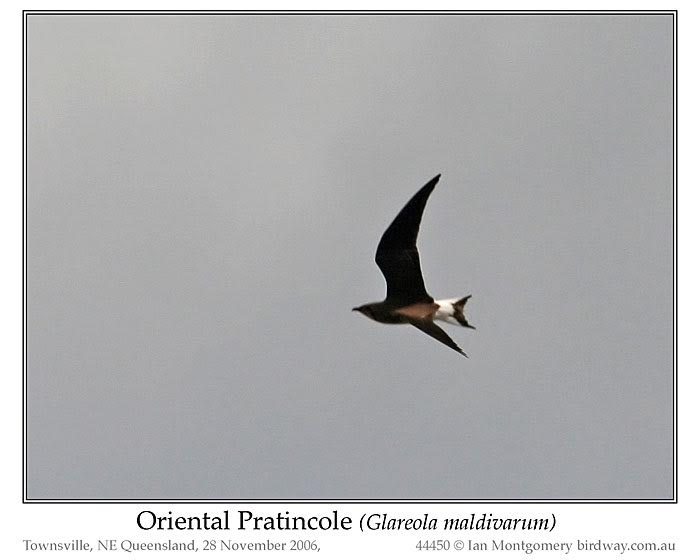
Oriental Pratincole (Glareola maldivarum) by Ian
Oriental Pratincoles breed in Asia with a patchy distribution from India to eastern Siberia, Mongolia and NE China. In the northern winter they migrate to Indonesia, Malaysia, New Guinea and northern Australia with perhaps 50,000 reaching our shores. They are late migrants arriving in the Top End of the Northern Territory during the build-up to the wet season (November) and their main Australian range is from the Gulf of Carpentaria in NW Queensland west to the north coast of Western Australia. They show a preference for dry inland plains with available water and feed mainly on insects such as grasshoppers. 2006 was, like this one, a very dry year in Townsville and these photos were taken on the dry bed of one of the wildlife observation ‘wetlands’ at the Common. They also turn up sometimes on the Atherton Tableland.

Oriental Pratincole (Glareola maldivarum) by Ian

Pratincoles are unusual birds somewhere between plovers and terns in appearance and morphology. They belong to a small family, the Glareolidae, which consists of 8 species of pratincoles in Eurasia, Africa and Australia and 9 species of mainly African Coursers. The odd name pratincole means ‘inhabitant of meadows’ with the ‘prat’ bit having the same root as ‘pratensis’ in the European Meadow Pipit (Anthus pratensis). The family name comes from the Latin for gravel, and that’s actually closer to the mark when it comes to preferred habitat.

Oriental Pratincole (Glareola maldivarum) by Ian

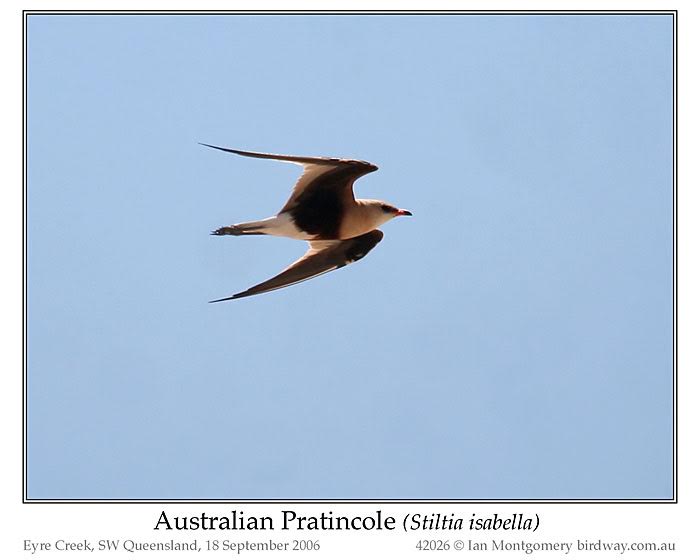
The Oriental Pratincole is distinguishable from the Australian Pratincole by its dumpier, shorter-tailed appearance, greyish-olive rather than buffish-brown plumage and by a black margin to the throat giving the appearance of a necklace. The Oriental Pratincole is normally in non-breeding plumage when in Australia, but both species have black-tipped bills with red bases when breeding. The Australian Pratincole has chestnut flanks and belly when breeding and the dark flanks are retained in non-breeding plumage.

AustralianPratincole (Stiltia isabella) by Ian

Pratincoles look very tern-like in flight with their long pointed wings. Both the local species have white rumps and black-tipped tails, but the tail of the Australian Pratincole is square, while that of the Oriental is forked.

Oriental Pratincole (Glareola maldivarum) by Ian

If you belonged to the bird of the week club a year ago, you may remember that the Cream-coloured Courser was, after the Crab Plover was my second most wanted bird in Dubai. Courser means ‘runner’, something they do very well and it was very appropriate to find them at the Polo Club and at the Al Asifa Endurance Stables. Incidentally, the bird of the week club currently has 981 members and you know I like milestones. Please encourage your friends to join so we can reach 1,000 either by signing up on the bird of the week page (recently redesigned for mobile devices) or by emailing me at ian@birdway.com.au.

Cream-colored Courser (Cursorius cursor) by Ian

Cream-colored Courser (Cursorius cursor) by Ian

Christmas is looming ever closer, so this wouldn’t be complete without the obligatory commercial. What do you give to the digitally-competent birder or nature-lover who has everything? An electronic book of course and both Apple and Kobo have facilities in their ebook stores for giving gifts. I’ve included a Giving Gifts section on the Publications page with help on how these stores let you give gifts. Google has facilities only for giving the equivalent of a gift token and not specific items. These book images are linked to their web pages:

And don’t forget Nestled at the Museum of Tropical Queensland if you are in, near or visiting Townsville.

Where To Find Birds - Ian

Ian's Book 2

Greetings
Ian

**************************************************
Ian Montgomery, Birdway Pty Ltd,
454 Forestry Road, Bluewater, Qld 4818
Tel 0411 602 737 ian@birdway.com.au
Bird Photos http://www.birdway.com.au/
Recorder Society http://www.nqrs.org.au


Lee’s Addition:

Bread gained by deceit is sweet to a man, But afterward his mouth will be filled with gravel. (Proverbs 20:17 NKJV)

Thanks, Ian, for another interesting bird to introduce us to. Also glad you help distinguish several apart. Most of us that have never seen these birds could mix them up. Thanks for sharing these neat birds with us.

Now that Ian is a published writer, his book might well be a prized gift for yourself or others.

*

Ian’s Bird of the Week

Glareolidae – Coursers, Pratincoles

Cream-coloured Courser ~ 9-27-14

Crab Plover ~ 9-22-14

Who Paints The Leaves?

*

Ian’s Bird of the Week – Tomtit

Tomtit (Petroica macrocephala) by IanIan’s Bird of the Week – Tomtit ~ by Ian Montgomery

Newsletter – 10/30/15

Last week we had the Snares Penguin and I made a passing reference to the locally endemic race of the Tomtit, so here is it and two of the other four New Zealand races of the Tomtit as this week’s choice. It’s called a Tit after the European Tits family Paridae which includes the North American Chicadees) but it’s not one of these but an Australasian Robin (Petroicidae), which in turn were named after the European Robin but don’t belong to its family either (Muscicapidae). The Tomtit’s closest relative is the Pacific Robin (Petroica multicolor) which in turn is very close related the Scarlet Robin of Australia.

A friend of mine who is a member of the bird of the week club but not a birdwatcher as such expressed confusion over subspecies (or races) and species, so I Googled a couple of references which might be useful: 1. a simple explanation2. Wikipedia and 3. a more scholarly one. I talk about them a lot as I’m interested in the classification of birds (taxonomy) and their evolution and biogeography (how they got to where they are) so here is a brief description.

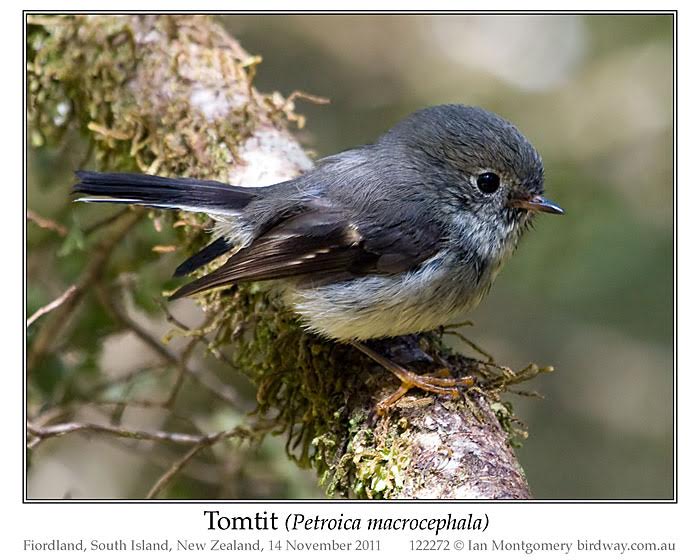
Tomtit (Petroica macrocephala) by Ian

A (biological) species is the fundamental unit (‘taxon’) of the classification of organisms, both plants and animals. It’s fundamental in the sense that it is considered reproductively isolated (genetic differences are supposed to be such that interbreeding across species boundaries isn’t possible or at least doesn’t produce fertile offspring). From a bird-watching point of view, a species is what you add to lists, whether your life list, your national list, your annual list, your yard list, or your annual bird list… The possibilities are endless but in the competitive world of ‘twitching’, a species is as important as a referees decision about a goal or score in football or tennis.

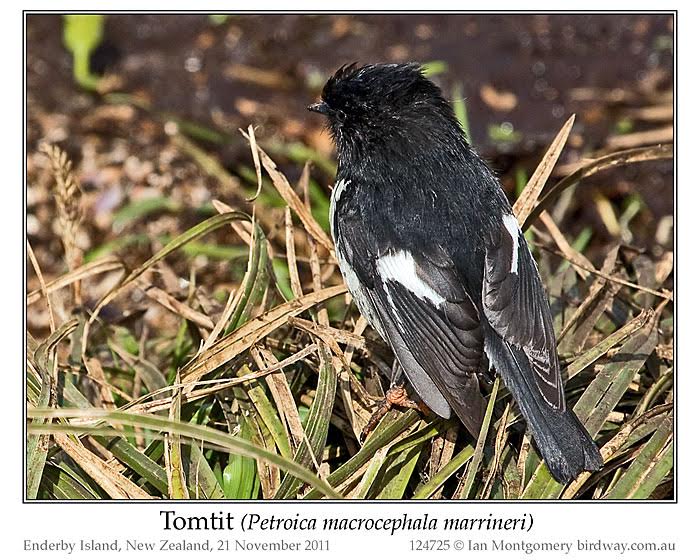
Tomtit (Petroica macrocephala marrineri) by IanNothing in biology is ever quite so simple, so the differences between various taxonomic levels (species, genus, family, order … going up and species, subspecies going down) are really part of a continuum. At the lower levels – genus, species and sub-species – the degree of genetic separation and therefore reproductive isolation varies a lot. Some groups are particularly troublesome as apparently quite different ‘species’ have a taxonomically irritating tendency to hybridise. Among birds, the diving ducks of the genus Aythya come to mind and among plants the orchids are notorious for spreading their genes around. Subspecies or races (using the terms interchangeably) are usually geographically isolated so they don’t get the chance to interbreed and are usually sufficiently different to be identifiable in the field. That means if you’re a birdwatcher, you can make lists of them too…

Tomtit (Petroica macrocephala marrineri) by Ian

The eighteen century Swedish scientist and physician Carl Linnaeus is regarded as the father of modern taxonomy as he invented the binomial – double-name – system that is still in use today. This was a century before Darwin, so Linnaeus was concerned, lucky man, with only degree of similarity. He classified types of organisms as belonging to a genus (‘family’ in Latin) represented by the first name, e.g. Anas (Latin for ‘duck’) and a species, e.g. platyrhychos (Greek for ‘broad-billed’) to name the Mallard and distinguish it from say the similar Gadwall, Anas strepera, where ‘strepera’ is derived from the Latin for ‘noisy’. There is no linguistic rule to prevent mixing of languages but adjectival species names usually agree in gender with the genus, something of a challenge when one name comes from Greek and the other from Latin.

Tomtit (Petroica macrocephala dannefaerdi) by IanNeedless to say, taxonomists have added many levels since, but orders, families, genera and species are the most important. To accommodate races or subspecies a third name was added the binomial system making it trinomial. The first race of a species to be named is called the nominate race, and the name of the race, if any, must be the same as the name of the species. So the nominate race of the Tomtit Petroica macrocephala is Petroica macrocephala macrocephala(Petroica is Greek for ‘rock-dwelling’ and macrocephala is Greek for ‘big-headed’). Any additional subspecies described later will be called Petroica macrocephala somethingelse.

Tomtit (Petroica macrocephala dannefaerdi) by Ian

Sorry, that was supposed to be a brief description so let’s get back to Tomtits. The first two photos show the nominate race which occurs on the South Island of New Zealand. The male is black and white with a yellow breast; the female is grey-brown with a white belly. This pair was in an Antarctic Beech forest – quite Lord of the Rings – near Cascade Creek in Fiordland and both birds were busy feeding nestlings. The male has a juicy green caterpillar and a large mosquito in his bill.

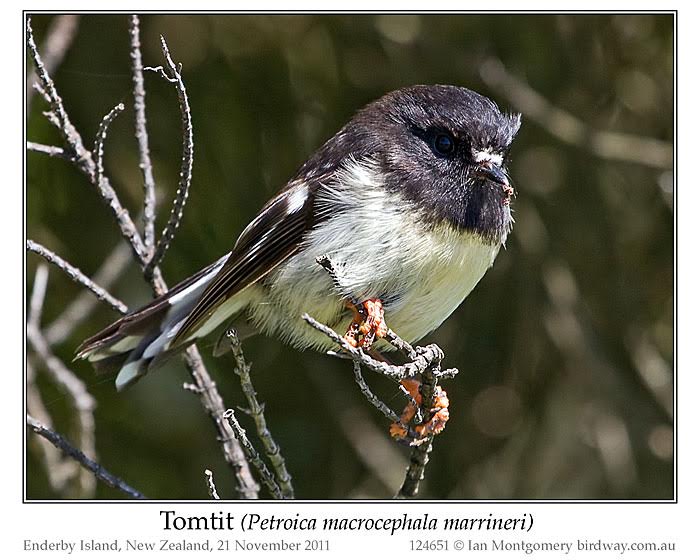
The third and fourth photos are male and female examples of the Auckland Islands race marrineri on Enderby Island one of the Auckland Islands group. Both males are females are mainly black and white, the male being glossier with only a trace of yellow on the breast. The race is named after New Zealand biologist George Marriner who took part in the 1907 Sub-Antarctic Islands Scientific Expedition.

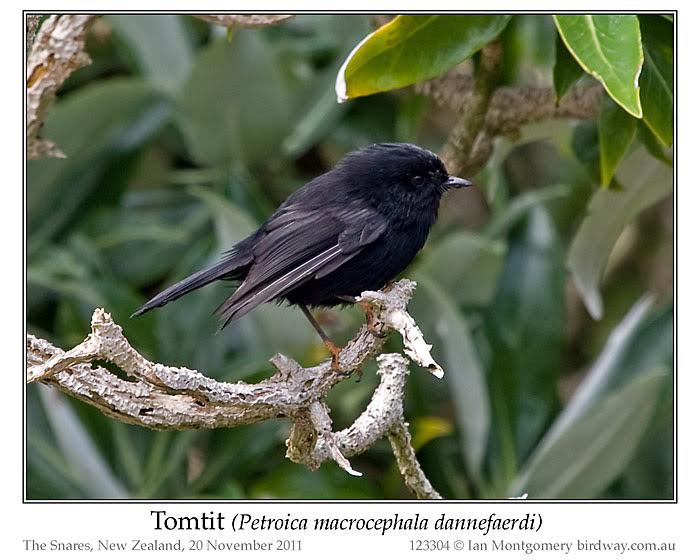
The Snares race dannefaerdi is the most distinctive, photos 5 and 6, with both sexes being completely black, the male again being glossier than the female. It is named after Sigvard Dannefaerd who was a Danish collector and photographer based in New Zealand and the original specimen was from his collection but ended up with the second Baron Rothschild who described it.

Back at the Birdway website, I’m continuing to redevelop it for mobile devices and the latest changes include the Bird of the Week page and I am gradually working my way through the various families in taxonomic sequence (that word again!): MegapodesChachalacas and GuansGuineafowlNew World Quails and, in progress, the Ducks, Geese and Swans.

Greetings

Ian
**************************************************
Ian Montgomery, Birdway Pty Ltd,
454 Forestry Road, Bluewater, Qld 4818
Tel 0411 602 737 ian@birdway.com.au
Bird Photos http://www.birdway.com.au/

Recorder Society http://www.nqrs.org.au


Lee’s Addition:

The little birds (sparrows) have places for themselves, where they may put their young, even your altars, O Lord of armies, my King and my God. (Psalms 84:3 BBE)

What cute little birds. I am glad the Lord saw fit to create birds in so many different sizes. Looks like Ian has been busy working on his website. I am sure he would appreciate you looking around again for his improvements.

Ian’s Bird of the Week

Ian’s Petroicidae Family

Petroicidae – Australasian Robins Family

Gideon

*

Ian’s Bird of the Week – Snares Penguin

Ian’s Bird of the Week – Snares Penguin ~ by Ian Montgomery

Newsletter – 10/23/15

Before we get on to this week’s bird – the Snares Penguin – here is a postscript on last week’s discussion on the boundary between Fuscous and Yellow-tinted Honeyeaters on the Atherton Tableland west of Cairns. Keith Fisher sent me this photo of a bird taken at Springvale Road in the Kaban area between Herberton and Ravenshoe in the western drier part of the Tableland (Chapter 14 in Where to Find Birds in Northern Queensland, hint, hint). He also sent me information from Lloyd Nielsen who has been studying these birds. It would be a brave person who would identify this bird on appearance alone and it seems that the matter will remain unresolved until someone does some DNA analysis. Thank you Keith.

Fuscous Honeyeater (Lichenostomus fuscus) by Ian at Birdway

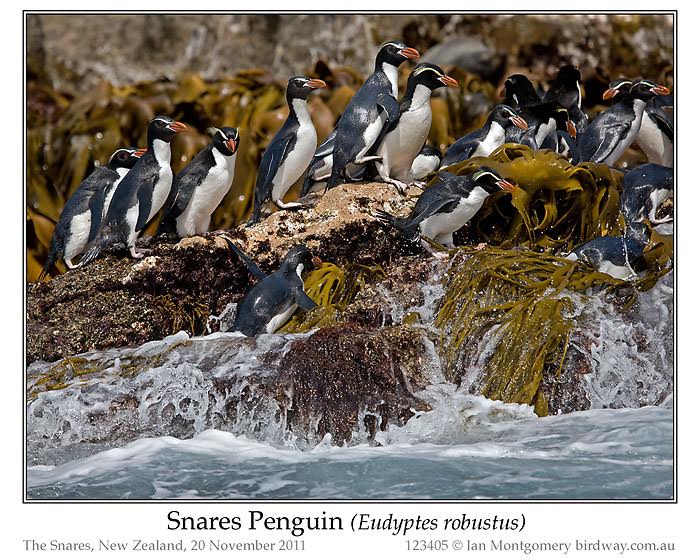
Now for something completely different and for no other reason than I like penguins and so do most people. We saw various penguin species on the Sub-Antarctic Islands trip that we did in 2011 and here is one of two that hasn’t featured as bird of the week. The first island group that we reached after leaving Dunedin on the South Island of New Zealand was the Snares, an isolated group of islands with a total area of 340ha/840acres about 200km/125miles south of the South Island.

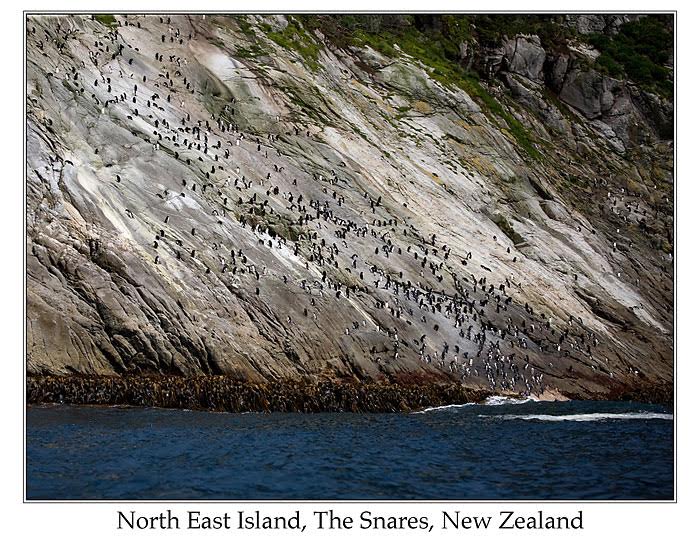
Snares Penguin (Eudyptes robustus) by IanThe Snares are of particular scientific and conservation value as, unlike other similar islands in the Southern Pacific they were left largely untouched by sealing and whaling and survive, vegetation intact in a fairly pristine state and have no mammalian predators. The Snares Penguin and the Snares Snipe are endemic species and there is an endemic race of the Fernbird and an all black-race of the Tomtit. The islands are of huge importance for nesting seabirds with 2 million pairs of Sooty Shearwaters and large numbers of Common Diving Petrels. Because of its conservation status – ‘minimum impact’ – we weren’t allowed to land but we cruised close by in Zodiacs in ideal weather conditions and saw all the bird species of interest except the Snipe.

Snares Penguin (Eudyptes robustus) by IanThere are about 25,000 pairs of Snares Penguins. The species is closely related to the Fiordland Penguin of the South Island of New Zealand and the Erect-crested of Bounty and Antipodes Islands, but has a much heavier bill (hence the name robustus) and pink skin between the bill and the cheek and throat so it usual now to treat all three as full species. Like all penguins, they are delightful to watch and be watched by and they are quite curious and popped up beside the Zodiac to have a good look.

Snares Penguin (Eudyptes robustus) by IanThey nest in colonies of up to 1,000 pairs mainly usually under trees or bushes, but sometimes in the open. There is continual traffic between the ocean and colonies which scours away any vegetation.

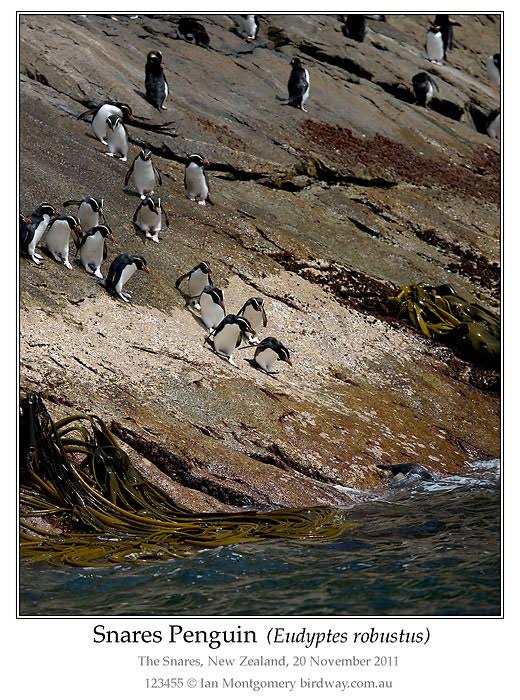
Snares Penguin (Eudyptes robustus) by IanAt the colony we visited, there was a favoured spot for launching into the water and all the seaweed had been worn away. The penguins would wait for a calm period between ocean swells and then dash after the most intrepid into the water.

Snares Penguin (Eudyptes robustus) by IanLanding seemed to be done on a hope and a prayer and the birds would get washed up on the rocks and then scramble to safety. There were several landing spots and these still had seaweed, which presumably cushioned the birds from hard landings.

Snares Penguin (Eudyptes robustus) by IanSnares Penguins lay a clutch of 2 eggs, and breeding success is about 40%. The population is thought to be increasing, though the species is classified as Vulnerable because it depends on a single location. After breeding the bird disperse in the ocean and are recorded as vagrants in mainland New Zealand and Tasmania. The birds take about 4 years to mature and live for about 20 years.

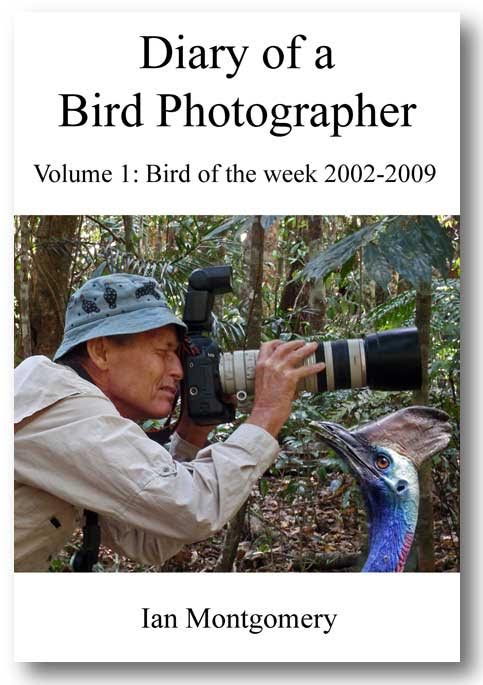
This bird of the week is a bit late as I’ve been busy this week finishing reformatting the ebook Diary of a Bird Photographer. I’ve made each bird of the week section start on a new page to prevent the separation of caption and content. The new version has now been uploaded to the Apple, Google and Kobo bookstores and is recognisable by a re-designed cover. If you have already purchased it, you should be able to upload the latest version from the store. The following cover image links to the Diary page on the Birdway website.

Ian's Book 2

I’ve also been redesigning the website templates to make them more suitable for viewing on smart phones or tablets. The original design was for monitors a width of 1200 pixels, but we live in a more fluid world now. I’ve applied the new design to two families, and I’d be grateful if you could check them your devices and see if they behave: Stilts and Avocets and Barn Owls. I’ve tested them on iPhone and iPad using the browsers Safari and Chrome.

Greetings
Ian

**************************************************
Ian Montgomery, Birdway Pty Ltd,
454 Forestry Road, Bluewater, Qld 4818
Tel 0411 602 737 ian@birdway.com.au
Bird Photos http://www.birdway.com.au/
Recorder Society http://www.nqrs.org.au


Lee’s Addition:

In the fear of the LORD there is strong confidence, And His children will have a place of refuge. The fear of the LORD is a fountain of life, To turn one away from the snares of death. (Proverbs 14:26-27 NKJV)

Sounds like Ian has been quite busy, but I am thankful he took time to share those Snares Penguins with us. I didn’t pick up how they got their name, but this from Wikipedia explains it further.

“The Snares penguin (Eudyptes robustus), also known as the Snares crested penguin and the Snares Islands penguin, is a penguin from New Zealand. The species breeds on The Snares, a group of islands off the southern coast of the South Island.”

*

Ian’s Bird of the Week

Snares Penguin – Ian’s Birdway

Snare Penguin – Wikipedia

Spheniscidae – Penguin Family

Ian’s Bird of the Week – Fuscous Honeyeater

Story of the Wordless Book

*

Ian’s Bird of the Week – Fuscous Honeyeater

Ian’s Bird of the Week – Fuscous Honeyeater ~ by Ian Montgomery

Newsletter ~ 10-14-15

Townsville is experiencing one of its driest years on record, with only 258mm/10.2in of rain so far this year, with most of that in January. Farmers feel the effects of the dry the most of course from a human perspective, but the wildlife is suffering too. Any remaining open water whether on farms or in gardens is very popular. My bird bath and pond are visible from the window of my study so I have been watching the variety and abundance of visiting wild- (and feral-) life and keeping an eye out for unusual birds. These include some which here are mainly restricted to highland rainforest such as Macleay’s and Lewin’s Honeyeaters and other dry country species such as the Fuscous Honeyeater, normally found west of the coastal range in North Queensland.

Fuscous Honeyeater (Lichenostomus fuscus) by Ian

This one, here ten days ago on the edge of my bird bath, is the northern race subgermanus. This race has a yellow wash on the face which makes it look rather like the closely related Yellow-tinted Honeyeater, a species I’ll say a bit more about shortly. This northern race occurs between Bowen/Mackay and the Atherton Tableland. Further south the nominate race ranges through the remainder of eastern Queensland, eastern New South Wales and through Victoria as far as about Adelaide in South Australia. The second photo shows an example of the nominate race west of Sydney. Fuscous Honeyeaters have different bill and eye-ring colour in breeding and non-breeding plumage. Non-breeding (and juvenile) birds have yellow bases to the bill and a yellow eye-ring (first photo) while breeding birds have dark bills and dark eye-rings (second photo) – unusual for the breeding plumage to be less colourful.

Fuscous Honeyeater (Lichenostomus fuscus) by IanThe third photo shows a non-breeding (or juvenile) nominate-race individual in Victoria and both the yellow eye-ring and yellow base to the bill show up well. ‘Fuscous’ comes from the Latin for ‘dusky’ while the generic name ‘Lichenostomus’ means ‘lichen-mouth’ or ‘moss-mouth’ in Greek and refers to the brush-like tongues of members of this genus, adapted for feeding on nectar. Compare that with ‘Trichoglossus’ – ‘hair tongue’ – a similar adaptation in Lorikeets of that genus, such as the Rainbow Lorikeet.

Fuscous Honeyeater (Lichenostomus fuscus) by IanThere are five closely related species of Lichenostomus, referred to as a ‘super-species’ which, although they overlap in some places, effectively carve up mainland Australia. The Fuscous as we’ve seen is an eastern and southeastern species; the Yellow-plumed (L. ornatus) occurs along the south coast from Victoria to SW Western Australia; the Grey-fronted (L. plumulus) is an inland and western-coastal species; the White-plumed (L. penicillatus) has a similar range to the Grey-fronted but extends to the coast in Victoria and New South Wales (e.g. suburban Sydney); while the Yellow-tinted (L. flavescens) occurs across northern Australia from NW Western Australia through the Northern Territory to western Cape York in Queensland (fourth photo). There is also an isolated population in south-eastern Papua New Guinea.

In case you’re wondering, subgermanus, the name for the northern race of the Fuscous doesn’t refer to Germany or a taxonomist called Germain. ‘Germanus’ means something like ‘sibling’ in Latin (literally ‘having the same parents’) and is the origin of ‘hermano/hermana’ in Spanish (brother/sister). ‘Sub’ is often used to indicate closeness in taxonomic matters, so subgermanus means something like ‘almost siblings’ and presumably refers to its similarity to the Yellow-tinted. That’s my guess, anyway, as my usual source of such gems, A Dictionary of Scientific Bird Names, OUP, doesn’t delve into races.

Yellow-tufted Honeyeater (Lichenostomus melanops) by IanThe range of the Yellow-tinted comes within about 100km of that of the yellowish northern Fuscous Honeyeater and the two species were formerly lumped into one. Recent studies have shown that although they look similar they don’t intergrade, so treating them as separate species seems justified. In the Yellow-tinted, the yellow base to the bill is a feature of just juvenile birds. All have yellow eye-rings, so there is no difference in appearance between breeding and non-breeding adults.

Fire Chopper by Ian

Fire Chopper by Ian

The dry season is an anxious time in bushland areas of North Queensland and this year particularly so. Last week a fire started beside the Bruce Highway on Saturday 3rd October and travelled the seven kilometres to my place over the next three days and then burned along the dry bed of Bluewater Creek near my house for three days. The last photo shows the bottom of my yard being water bombed on Thursday morning as I was heading down there yet again with a rake. The hill in the background is black all over. All is quiet now and we have the biggest firebreak in the country (at least 11km long covering 24 square kilometres) so I hope we’re probably relatively safe now until the wet season which should start in a couple of months, El Nino permitting. The firemen had some funny stories to tell about their arrival at a nudist colony in a secluded area about 4km west of my place.

Greetings
Ian

**************************************************
Ian Montgomery, Birdway Pty Ltd,
454 Forestry Road, Bluewater, Qld 4818
Tel 0411 602 737 ian@birdway.com.au
Bird Photos http://www.birdway.com.au/
Recorder Society http://www.nqrs.org.au


Lee’s Addition:

My son, eat thou honey, because it is good; and the honeycomb, which is sweet to thy taste:  (Pro 24:13)

Thanks, Ian, for telling more about your amazing Honeyeaters, especially the Fuscous ones. Sound like a bird I would like landing on my bird bath. Though he would have to fly a loooooong way to get here. :)

*

Ian’s Bird of the Week

Ian’s Honeyeaters

Meliphagidae – Honeyeaters

Who Paints The Leaves?

*

Ian’s Bird of the Week – Princess Parrot – Reworked

Ian’s Bird of the Week – Princess Parrot ~ by Ian Montgomery
Newsletter ~ 10/1/15

Lee’s Update:  Not sure what happened because I was seeing it okay on PC and smartphone. Anyway, it is now back to the way I normally add the photos back in.

A late bird of the week I regret, but I’ve been planning and designing a major overhaul to the website to the exclusion of almost everything else. The website is showing its age as I designed it in a pre-smart phone and pre-tablet era – seems like a long time ago now – for fixed, landscape screens. About 30% of the birdway website traffic comes from such devices now, so it’s an issue I can no longer ignore. Anyway, I’ll say a bit more about that later and provide an example of the new layout.

The other revision taking place is that until now I’ve only included my own photos, so Birdway has been synonymous with Ian Montgomery. The rationale was that it was a showcase for my work – some would say a monument to my ego, smile. Maybe I’m satisfied at having reached 1500 species globally and 700 Australian ones so it’s time to change. Birdway will now aim to provide the best range of publishable quality bird photos. Initially the emphasis will be on Australian ones, but later I may extend this to Australasian one. For manageability, I’m starting by invitation only but feel free to register your interest by email ian@birdway.com.au.

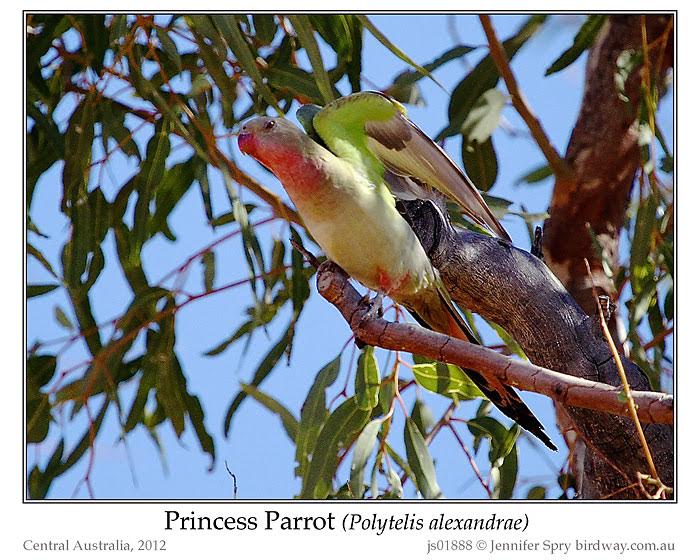
So, here is a landmark bird of the week: these lovely photos of the gorgeous and elusive Princess Parrot were taken by my friend Jenny Spry, a birder and photographer well-known in Australian birding circles. She leaves no stone unturned and no bush or remote island unchecked in a passionate search for the unusual and has one of the longest Australian life lists (aiming for 800!).Princess Parrot (Polytelis alexandrae) by Jenny Spry The Princess Parrot is elusive for at least two reason. The first is that it’s a bird of very remote parts of arid Australia accessible only with considerable difficulty, e.g. the Canning Stock Route. The other is that its population and range varies greatly with rainfall. In poor seasons it is almost impossible to find, but in good season the population irrupts and it can appear in more accessible locations, perhaps I should say slightly less inaccessible ones, in inland eastern Western Australia, the southwestern Northern Territory and northwestern South Australia. The core breeding range is thought to be around Tobin Lake and in the Great Victoria Desert, both in eastern Western Australia.

Princess Parrot (Polytelis alexandrae) by Jenny Spry It is one of three beautiful, long-tailed, medium sized (length 34-46cm/13-18in) parrots belonging to the endemic Australian genus. Polytelis. The others are the Superb Parrot of New South Wales and northern Victoria and the Regent Parrot  which occurs in two separate populations, one in southwestern New South Wales, northeastern Victoria and eastern South Australia and the other in southern Western Australia. All three species are uncommon: the Princess is classed as Near-Threatenedand the Superb as Vulnerable, while the Regent is uncommon in the east and declining in the west. Male Princess Parrots, first two photos, have longer tails and brighter colours than females (third photo).

Princess Parrot (Polytelis alexandrae) © Jenny Spry

Princess Parrot (Polytelis alexandrae) © Jenny Spry

Returning to the subject of website design in a mobile world, I’ve used the Princess Parrot as the first species in the new design and it was posted to the birdway website this morning. The changes will be more obvious on smart phones and tablets, but on computers you’ll notice that the thumbnails have moved from a vertical column on the left to a horizontal row on the bottom and the information about the photo has moved from left to right. You’ll also see a button at top right which reveals – and hides – the main navigation menu as vertical column which slides the rest of the page to the right. Previous, this menu didn’t appear on the pages of individual species, only – as a row of horizontal buttons at the top – on the family pages and the ten main topic pages to which these button link.
Princess Parrot (Polytelis alexandrae) by IanThe fourth and fifth images are screen shots from my iPhone. The fourth shows a page in landscape orientation. The image shrinks to fit the screen width and you can see the rest of the page by scrolling up and down. Note that the photo information is still on the left. The fifth, shows the page in vertical orientation with the navigation menu showing as a grey column on the left. The photo information has dropped below the image and both the menu column and the main window are scrollable independently.
Princess Parrot (Polytelis alexandrae) by Ian
These pages are, of course, still prototypes and there will be more changes before I apply it more generally. I’ve tested it only using the Apple browser Safari on a Mac, an iPad and an iPhone. I’d be very grateful if you could try it out on different platforms (Windows and Android particularly) and in different browsers (Safari, Windows Explorer, Chrome, Opera, Firefox and Mozilla are the most important) and report back to me with any problems: http://birdway.com.au/psittacidae/princess_parrot/index.htm.

I’ve needed to use JavaScript to show and hide the side menu, so you won’t be able to see if yet if JavaScript isn’t available. If it isn’t you’ll get a message in orange instead of the script generated ian@birdway.com.au email address to tell you that and to write to ‘ian’ (at symbol) ‘birdway.com.au’ instead. I will be adding code so that the side menu is permanently visible if JavaScript isn’t enabled, but it is something of an internet standard these day and I want to be able to hide it to make more space available on small screens.

On the subject of books, the Diary of a Bird Photographer has sold about 50 copies in the first month, and review are beginning to appear (below on the Apple store) I’m hugely grateful to those who have done reviews and would love it if some of you would. I think there were problems posting review to the Apple store, but these seem to have been fixed. If that is your experience let me know ian@birdway.com.au and if your very patient, try again. Thank you.
Princess Parrot (Polytelis alexandrae) by Ian
These images should link to the relevant pages on the Birdway site.

Ian's Book

Ian’s Book

Where To Find Birds - Ian

Greetings
Ian
**************************************************

Ian Montgomery, Birdway Pty Ltd,
454 Forestry Road, Bluewater, Qld 4818
Tel 0411 602 737 ian@birdway.com.au
Bird Photos http://www.birdway.com.au/
Where to Find Birds in Northern Queensland: iTunes; Google Play Kobo Books
Recorder Society http://www.nqrs.org.au
*******************************


Lee’s Addition:

And he said unto them, Come ye yourselves apart into a desert place, and rest a while: for there were many coming and going, and they had no leisure so much as to eat. (Mark 6:31 KJV)

Very interesting Parrot and apparently quite a change to Ian’s Site at Birdway. I’ll be checking on permission for further usage of his guest photographer. For now, I trust using this latest newsletter of his is under his permission to use.

What a beauty this parrot reveals. Subtle in colors, but very attractive.

See:

Ian’s Bird of the Week
Ian’s Birdway Website
His Parrot Family
Psittacidae – African and New World Parrots
Psittaculidae – Old World Parrots

*

Pulled Ian’s Bird of the Week

Princess Parrot (Polytelis alexandrae) © Jenny Spry

Princess Parrot (Polytelis alexandrae) © Jenny Spry

Sorry!  I just pulled Ian’s Bird of the Week – Princess Parrot

Give me about a half an hour and I will re-post it. Many have mentioned not seeing the photos.

Stay Tuned!!!

Ian’s Bird of the Week – Silvereye

Ian’s Bird of the Week – Silvereye ~ by Ian Montgomery

Newsletter – 9/18/15

Two weeks ago we had the obscure Small Lifou White-eye as bird of the week. This week we have what is probably its best known relative – at least in Australasia – the Silvereye. I mentioned that the members of the White-eye family are expert colonisers of small islands in the Indian and western Pacific Oceans. The Silvereye is no exception and provides a particularly interesting case-study in bio-geography that is unusual in that some of its range expansion is both historically recent and well documented.

Silvereye (Zosterops lateralis) by Ian

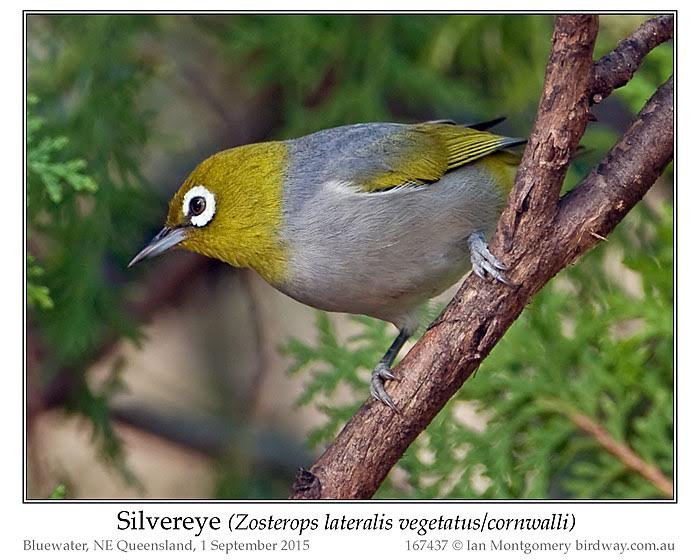
I’ll return to that later after looking at its range and variation in Australia. Here it occurs in coastal and sub-coastal regions from the tip of Cape York clockwise around Australia to Shark Bay in Western Australia, including Tasmania. Between Shark Bay and western Cape York it is replaced by the Australian Yellow White-eye. Currently, about nine races are recognised. The nominate race, lateralis, is Tasmanian and visually the most distinctive having cinnamon-coloured flanks, which is presumably what John Latham was referring to when he described the species in 1801 only 13 years after European settlement.

Silvereye (Zosterops lateralis) by Ian

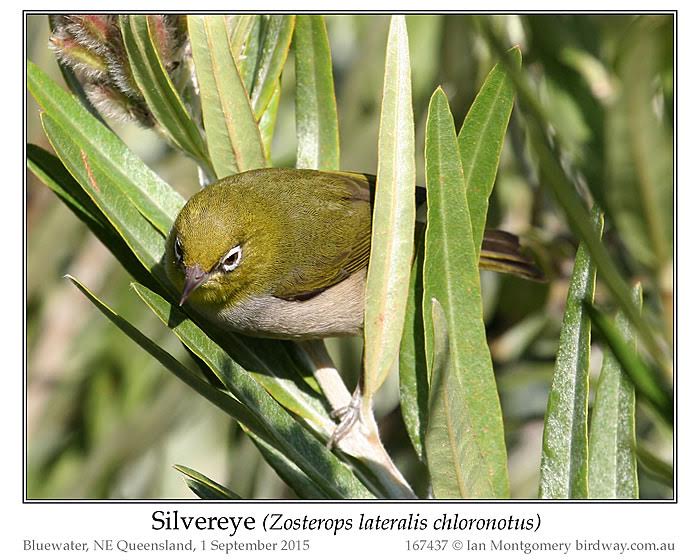
There are five mainland races ranging northeastern Queensland to Western Australia. The differences between these are subtle and the race grade into one another. Townsville, second photo, is in the zone of intergradation between the Cape York race (vegetus) and the eastern Australian one (cornwalli). Note the lack of the cinnamon flanks and the clear demarcation between the yellowish-green head and the grey back and compare that with the Western Australian race ,third photo, which has a green back and to which its sub-specific name chloronotus refers. (I’m using the words race and subspecies interchangeably here).

Silvereye (Zosterops lateralis) by Ian

There are three island races in addition to the Tasmanian one and they occur on King Island in Bass Strait; the islands of the Barrier Reef notably Heron Island; and on Lord Howe Island. The Lord Howe one, aptly name robusta, is larger and stronger than the nominate race and survived the introduction of mice and rats. That’s an interesting little story in its own right as it became very rare, was thought to have become extinct like other Lord Howe Island species and the nominate race was deliberately introduced to replace it. To everyone’s surprise the indigenous race survived, adapted to the presence of the rodents, recovered and the introduction of the nominate race was unsuccessful.

Silvereye (Zosterops lateralis) by Ian

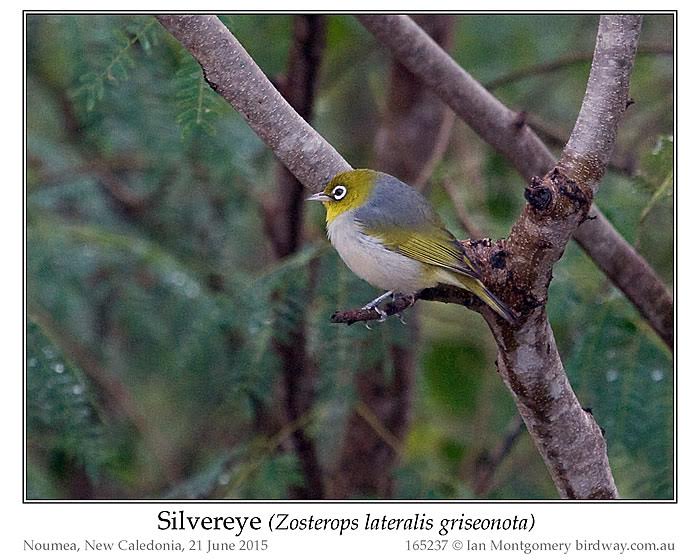
If you go farther afield to Norfolk Island expecting to find a distinctive looking local Silvereye, you’d be in for a surprise, fourth photo, as the locals, complete with cinnamon flanks, are indistinguishable from the nominate race, which it in fact is. If you went to New Zealand, the same thing would happen and you would find the nominate race on both main islands, Stewart Island, Chatham Island and the sub-Antarctic islands such as Snares, the Aucklands and Chatham. What happens if you head north and end up in New Caledonia? On the main island, you’d find this race, fifth photo, called griseonota, meaning, of course, ‘grey-backed’. Apart from the black smudge on the face, it looks to me very like the Cape York race.

Silvereye (Zosterops lateralis) by Ian

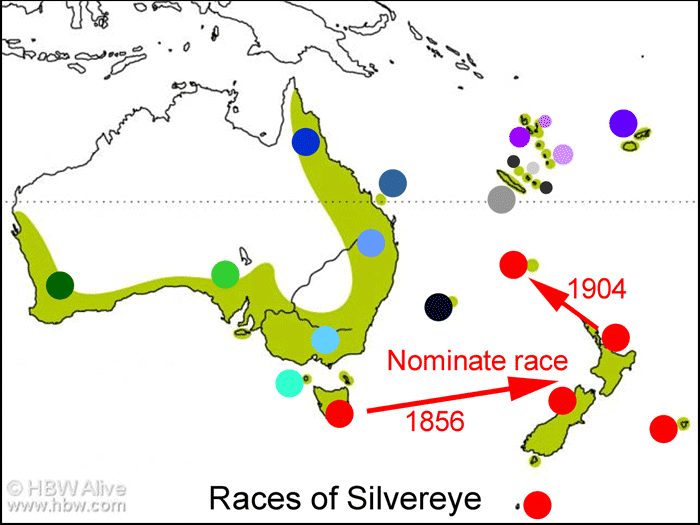
So what, you may ask, is happening? The proliferation of race suggests a sedentary species with little genetic mixing between neighbouring populations but this is contradicted by the widespread range of the Tasmanian race which suggests genetic flow between Tasmanian, Norfolk Island and New Zealand. In fact both are true to some extent, and this is where history comes to the rescue. Here is a map that I’ve drawn up showing the different races of the Silvereye using the basic range map from Handbook of Birds of the World (HBW) as a template. The different colours represent races. The red one is the nominate race; the other Australian races are shown in varying shades of blue and green and black; the New Caledonian races (three) in grey, the Vanuatu races (three) in purple and the Fiji race in indigo.

Silvereye (Zosterops lateralis) by Ian Map

The Tasmanian race isn’t completely sedentary. At least part of the population, probably mainly young birds, disperse in autumn and move Victoria and New South Wales for the winter. The Victorian ornithologist Alfred North noticed the change in plumage and ascribed it to winter and summer plumages. It was only later that it was realised that the change in appearance didn’t coincide with moulting in the mainland birds and the truth emerged. Incidentally, Latham’s original specimen came from ‘Port Jackson’ (Sydney) and must have been a Tasmanian bird.

As any blue-water sailor will tell you, the weather in Bass Strait between Tasmania and Victoria is notorious and a pleasant sail, or flight, in calm conditions can suddenly become a nightmare when a low pressure system and its associated cold front can arrive from the southwest. Powerful weather systems move continuously in an easterly direction between Tasmania and New Zealand. Have a look at the current four-day weather chart: http://www.bom.gov.au/australia/charts/4day_col.shtml. Another clue comes from the Maori name for the Silvereye: ‘tauhou’ meaning ‘stranger’. Silvereyes were rare vagrants to New Zealand until 1856 when large numbers appeared in the Welllington district, became established and spread to other parts of New Zealand. Similarly, Silvereyes first appeared in Norfolk Island in 1904 and it as assumed that these came from New Zealand rather than Tasmania. Silvereyes have benefitted from European settlement in Australia and it may be that is also a factor in their recent colonisation of New Zealand and Norfolk Island.

I wonder how the Silvereyes got to New Caledonia, Vanuatu and Fiji? These all look more like the Cape York race than the nominate one. Tropical cyclones in the Coral Sea are famously erratic and often head from Queensland to New Caledonia, so it looks as if the weather could play the main role here.

I’m going to stop here. I was going to talk about names and languages as well, but you can work that out for yourselves. We’ve already had cloronotus and griseonota for Australian races. Combine that with the French for Silvereye ‘Lunette a dos gris’ and the New Caledonian endemic Green-backed White-eye: ‘Lunette a dos vert’. Globally, there are almost 100 species of White-eye, not to mention races, and they nearly all look much the same, so pity any unfortunate taxonomists trying to be original.

And here’s a paper that I found interesting: http://aviculturalsocietynsw.org/_PDFs/Silvereye.pdf. You can check out photos of various White-eyes here: http://www.birdway.com.au/zosteropidae/index.htm.

Greetings

**************************************************
Ian Montgomery, Birdway Pty Ltd,
454 Forestry Road, Bluewater, Qld 4818
Tel 0411 602 737 ian@birdway.com.au
Bird Photos http://www.birdway.com.au/

And God blessed them, saying, “Be fruitful and multiply and fill the waters in the seas, and let birds multiply on the earth.” And there was evening and there was morning, the fifth day. (Genesis 1:22-23 ESV)

Lee’s Addition:

Well, Ian really got informative on these Silvereyes. Very interesting, at least to me. When the Lord commanded the birds to cover the earth and reproduce, these little avian wonders with beautiful silver eye rings seem to have obeyed.

*

Ian’s Bird of the Week

Ian’s Zosteropidae Family

Wordless Hummers

*

Ian’s Bird of the Week – Lesser Sooty Owl

Ian’s Bird of the Week – Lesser Sooty Owl ~ by Ian Montgomery

Newsletter – 9/7/15

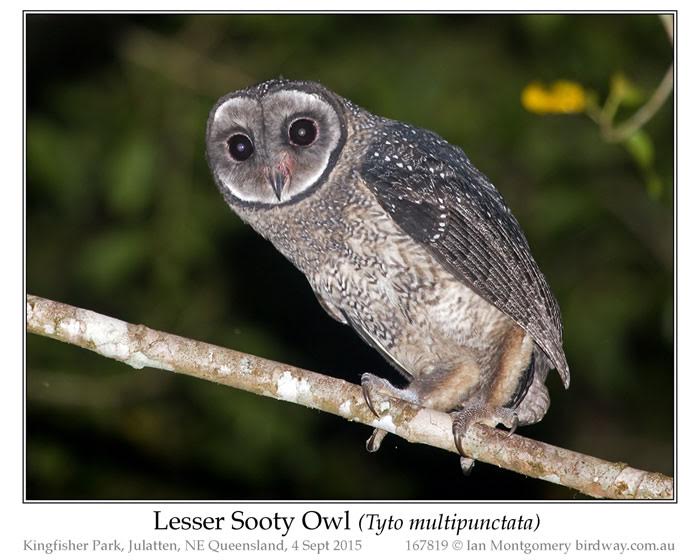
You may remember that in March of this year Greater Sooty Owl featured as Bird of the Week when I visited East Gippsland east of Melbourne with my Victorian birding pals Barb, Jen and Joy. Last Thursday I met up with the trio again, this time at Kingfisher Park west of Cairns, Far North Queensland. The main target was, naturally, Lesser Sooty Owl , another member of the Barn Owl family and a species as elusive as its larger cousin. I’d seen one at Kingfisher Park in 2002 but hadn’t photographed it and none of the trio had seen it before.

Lesser Sooty Owl (Tyto multipunctata) by Ian

It’s a Wet Tropics endemic ranging from Paluma – and perhaps Bluewater Forest near me – in the south to Cedar Bay in the north, with an estimated population of 2000 pairs. I’ve searched for it many time since without success so I’d agree with the field guides that say: “seldom seen” (Morcombe) and “until field studies in recent decades … among our least-known birds” (Pizzey and Knight). On Wednesday night I’d searched for it along some dreadful tracks in Tumoulin Forest Reserve near Ravenshoe and on Thursday night we spotlighted the 10km length of the Mount Lewis road near Kingfisher Park with the usual result.

Lesser Sooty Owl (Tyto multipunctata) by Ian

It does occur at Kingfisher Park and Andrew Isles told us to listen for it in the evening “after the barn owls” which live in adjacent Geraghty Park. Barn and Sooty Owls make chirruping calls and both species of Sooty Owl have a characteristic descending whistle like a falling bomb. Sure enough at 6:55pm an owl chirruped maybe 50 metres from the trio’s apartment and we raced around the corner to find this bird had come to visit us and was perched in full view in a tree at a photography-friendly height. Later, I agreed with Joy that it was an OMG moment on a par with encountering the Kagu family on a forest track in New Caledonia.

Lesser Sooty Owl (Tyto multipunctata) by Ian

In the past, the Greater and Lesser have been treated as a single species, but the species split is now generally accepted. They are genetically close, but there is a big difference in sizes – Lesser 31-38cm/12-15in , Greater 37-51cm/14.5-20 (females of both are larger than the males) – and differences in appearance, call and behaviour. Their ranges are disjoint with the Greater found from near Melbourne (Strzelecki and Dandenong Ranges) along the east coast to Eungella National Park near Mackay in Central Queensland. There is also a Sooty Owl in New Guinea. It’s still lumped with the Greater, which is biogeographically unlikely, but has been placed with the Lesser and may even be a different species.

Lesser Sooty Owl (Tyto multipunctata) by Ian

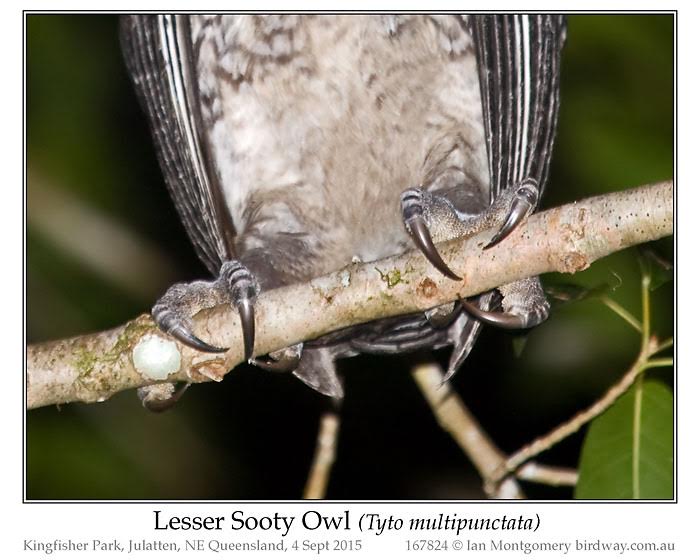
The behaviour of the Lesser differs in that it uses lower perches for hunting, good for photographers, and is known to cling to the side of tree trunks like the Eastern Yellow and Pale-yellow Robins. The last photo shows its impressive talons: these would be able to cling on to anything.

Lesser Sooty Owl (Tyto multipunctata) by Ian

If you’re into benchmarks, last week’s bird, the Ouvea Parakeet, was the 1500th global species on the Birday website (15% of all bird species) but the Australian total was stuck at 699 waiting for something special of course. The Lesser Sooty Owl will be a fitting 700th – I haven’t put it up yet, you get to see if first – that’s 700 out of the 898 ever recorded or 78%.

I’m back home now planning my next project now that the Diary of a Bird Photographer Volume 1 has been published. So far, 27 copies have been purchased and favourable comments are coming in from all over the place including California, UK, Italy and Dubai. The Fat Birder has published a review in which he said:

“I hope anyone who enjoys fine photography and fantastic birds will go to iTunes and download the book… I for one can’t wait for volume 2”

Happily, the remaining 940 members of the bird of the week list don’t have to wait that long for Volume 1!

Greetings
Ian

**************************************************
Ian Montgomery, Birdway Pty Ltd,
454 Forestry Road, Bluewater, Qld 4818
Tel 0411 602 737 ian@birdway.com.au
Check the latest website updates:
http://www.birdway.com.au/#updates


Lee’s Addition:

The beast of the field shall honour me, the dragons and the owls: because I give waters in the wilderness, and rivers in the desert, to give drink to my people, my chosen. (Isaiah 43:20 KJV)

I am impressed with this neat Lesser Sooty Owl from our Creator and also with Ian’s number of Global and Australian birds he has on his birding list.

Now that he is producing these books, I hope he will continue to give permission to reproduce his Bird of the Week Newsletters.

*

Ian’s Bird of the Week 

Ian’s Birdway

Barn Owls – Tytonidae

Wordless Birds

*

Ian’s Bird of the Week – Ouvéa Parakeet

Ian’s Bird of the Week – Ouvéa Parakeet ~ by Ian Montgomery

Newsletter ~ 9/2/15

I was half-way through preparing this bird of the week this afternoon when my 2008 iMac died, or at least got terribly ill, so I’ve delivered it to the Mac Doctors and am now working on my laptop. Thank goodness for automatic backups, as I lost only the email itself and the map below that I was in the middle of preparing. I want to get the email out today so that i can delivery 4 birds of the week this month – my level of enthusiasm for doing the bird of the week has risen considerably since I started preparing the first volume of the Diary of a Bird Photographer.

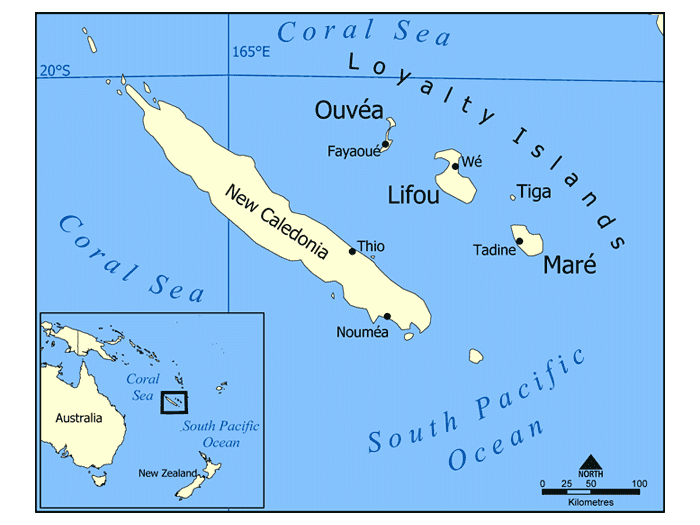
Anyway, back to the Loyalty Islands off the west coast of the main island of New Caledonia. After spending the morning in Lifou, we flew to the neighbouring island, Ouvéa, home to the endemic Ouvéa Parakeet. Ouvéa is a long thin island, thinnest in the middle in a way that reminded me of both Bribie Island in Tasmania and Lord Howe Island. Like Lord Howe, it has a coral lagoon on one side and an ocean beach on the other but the resemblance largely ends there, as Ouvéa is a coral atoll and very flat, while Lord Howe is volcanic in origin and spectacularly mountainous.

Map of where Ouvéa Parakeet Found, by Ian

Map of where Ouvéa Parakeet Found, by Ian

The parakeet occurs mainly on the northern end of the island so its geographical range is tiny – see the scale on the map above, courtesy of Google Earth. The airport is on the southern end and we decided not to emulate some energetic birders who wrote a trip report and travelled from the airport to the north end of the island by bicycle. Instead, we had booked a rental car at the airport and booked accommodation in a tribal village called Gossanah in parakeet territory near where our bird guide Benoit lived. I’ll say a bit more about both our guide and accommodation later, but first the parakeet.

Ouvéa Parakeet (Eunymphicus uvaeensis) by Ian

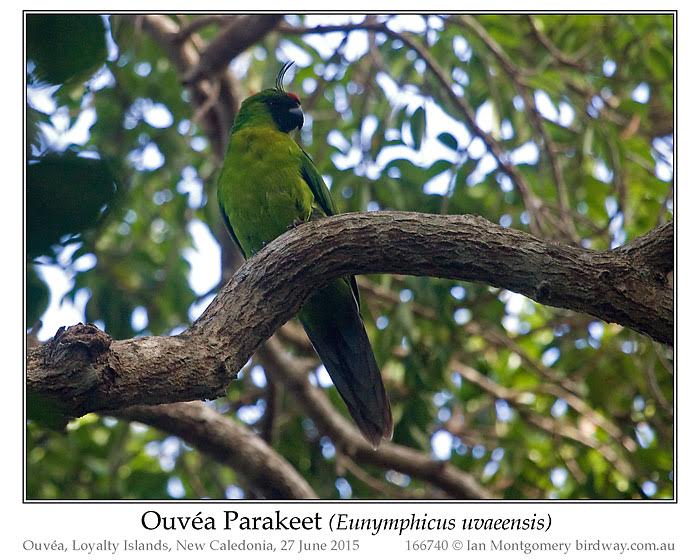
It was dark by the time we reached Gossanah, so parakeet hunting had to wait until the morning. I was woken up by early-riser Joy with the exciting news that there were parakeets in the grounds of where we were staying. I stumbled out bleary-eyed (remember we had got up at 4:30am the morning before to get our flight to Lihou) camera in hand and sure enough there they were, or there it was, first photo. Later we joined Benoit and he took us around his garden and though an area of adjacent rainforest. There we found some more parakeets, including the one in the second photo.

Ouvéa Parakeet (Eunymphicus uvaeensis) by Ian

They aren’t as brightly coloured as the Horned Parakeet of the main island, Grand Terre, and the crest is different, containing more than two feathers and lacking red tips. The Ouvéa Parakeet used to be treated as a race of the Horned, but has now been given full species status.

Ouvéa Parakeet (Eunymphicus uvaeensis) Nesting Hollow by Ian

Benoit showed us an active nesting hollow, third photo. We saw a parakeet flying into it and waited for it to reappear, but it had either settled down for the morning or had more patience than we had. The parakeets are very partial to the seeds of Papaya. They don’t wait for the fruit to ripen before they chew their way into the centre to get at the seeds.

Papaya

Papaya

The parakeets are protected and the population has increased in recent years. We got the impression that the islanders are rather ambivalent about the birds. They are proud to have such an unusual endemic bird – its iconic status is actively promoted by the authorities – but are concerned about its effect on their largely subsistent way of life.

Ouvéa Parakeet (Eunymphicus uvaeensis) by Ian

Ouvéa Parakeet (Eunymphicus uvaeensis) by Ian

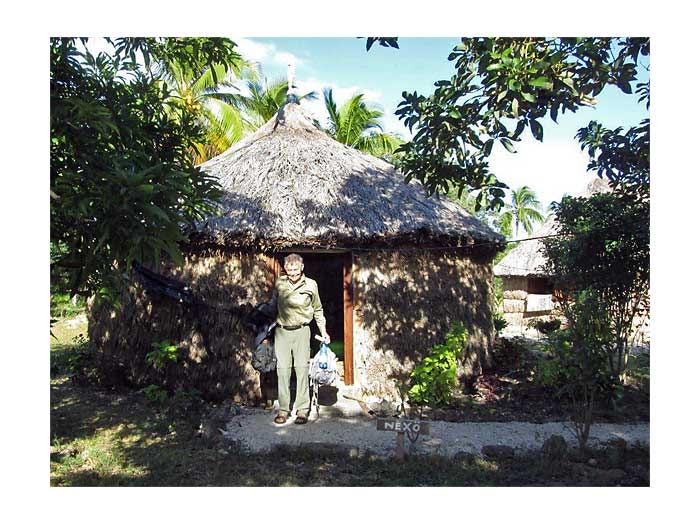
We stayed at a tribal home stay called Beauvoisin – ‘good neighbour’ run by Marc and his wife (see http://www.iles-loyaute.com/en/Prestataire/Fiche/1374/beauvoisin). They provided dinner in the evening, accommodation in a circular hut and breakfast – Joy took the photo above of me emerging from the hut in the morning. We enjoyed it very much and Marc and his family were delightful and looked after us very well. They spoke some English and have a Facebook page. Benoit Tangopi our guide was great too and we saw a variety of other interesting birds on the walk through the rainforest. We contacted him by phone +687 800549, but you might need to brush up your French as he doesn’t speak much English.

Greetings
Ian

**************************************************
Ian Montgomery, Birdway Pty Ltd,
454 Forestry Road, Bluewater, Qld 4818
Tel 0411 602 737 ian@birdway.com.au
Check the latest website updates:
http://www.birdway.com.au/#updates


Lee’s Addition:


If a bird’s nest should chance to be before you in the way, in any tree or on the ground, with young ones or eggs, and the mother bird is sitting on the young or on the eggs, you shall not take the mother bird with the young. You shall surely let the mother bird go, and take only the young, that it may be well with you and that you may prolong your days. (Deuteronomy 22:6-7 AMP)

Thanks, Ian, for taking us along on another birdwatching adventure. I don’t speak French, so we are glad you did the talking and photographing. Another neat creation you have found for us to enjoy.

*

Ian’s Bird of the Week Newsletters

Ian’s Ouvéa Parakeet Photos

Psittaculidae – Old World Parrots

Wordless Birds

*

Diary of a Bird Photographer!

y electronic book Diary of a Bird Photographer has been released worldwide today, 31 August, on Apple iTunes BooksGoogle Books and Kobo Books! Find out more about it including availability, pricing, compatible devices and screenshots on the BIrdway website: http://www.birdway.com.au/birdphotographersdiary01.htm.

Ian's Book

Ian’s Book

With the increasing abundance of excellent bird photos on the internet, I am finding it more difficult to sell photos so moving into publishing is important for the future of my Birdway website and the Bird of the Week newsletter. Diary of a Bird Photographer contains the first 341 Bird of the Week postings spanning the period 2002-2009, contains more than 500 photos and 80,000 words – the length of an average novel. Depending on sales, l plan to publish 2010-2014 as another book.

With a recommended retail price of 8.00AUD, 7USD, 6EUR or the equivalent in your local currency it represents great value. By buying it for yourself and/or your friends or family and recommending it to others, you’ll earn my gratitude and show your appreciation for the bird of the week! Maybe you could forward this email to anyone who you think might be interested: that would be wonderful.

Greetings
Ian

PS Next bird of the week, a special parrot and the random bird of the week, should be out later today.

**************************************************
Ian Montgomery, Birdway Pty Ltd,
454 Forestry Road, Bluewater, Qld 4818
Tel 0411 602 737 ian@birdway.com.au
Bird Photos http://www.birdway.com.au/
Recorder Society http://www.nqrs.org.au


Lee’s Addition:

Seem’s as though Ian has written a book. Here is his newsletter telling about his “Diary of a Bird Photographer!”

His regular weekly newsletter – Ian’s Bird of the Week – will be published tomorrow.

Ian’s Bird of the Week – Small Lifou White-eye

Ian’s Bird of the Week – Small Lifou White-eye (and random Sacred Kingfisher) ~ by Ian Montgomery

Newsletter – 8/27/15

I’m a night-owl, as you may know already, so here is a photo of a noteworthy event: boarding a flight to the Loyalty Islands in complete darkness at 6:00am at Magenta, the domestic airport in Noumea. The goal was to check out several endemic species of birds that occur on two of the Loyalty Islands, Lifou and Ouvéa. The Lifou endemics were supposed to be easy to find near the airport, so we spent a morning there looking for them on foot before flying on to Ouvéa where we had booked a rental car and accommodation for the night (more about Ouvéa next time).

Magenta, the domestic airport in Noumea by Ian

Magenta, the domestic airport in Noumea by Ian

The Loyalty Islands, part of the French Territory of New Caledonia, are supposedly named after an obscure whaling ship called Loyalty or Loyalist built in Nova Scotia in 1788 that is thought to have come across them in 1790. The first recorded Western contact was three years later when another whaler, the Britannia, found them on a voyage from Norfolk Island to Batavia. Melanesians settled the islands about 3000 years ago and the French annexed them in the mid-nineteenth century.

Map of Lifou - New Caledonia

Map of Lifou – New Caledonia

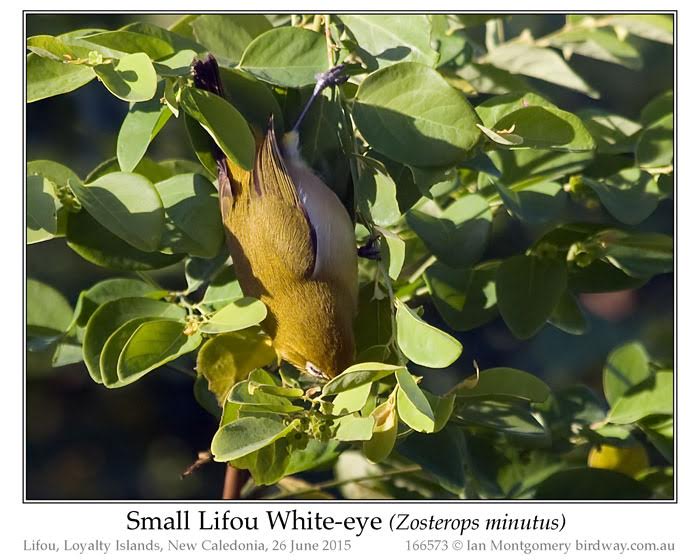
Lifou has two endemic White-eyes, cousins of the Silvereye which also occurs there. The endemic ones are called, accurately but unimaginatively, the Small and Large Lifou White-eyes. The small one we found without difficulty and it is indeed small with a length of 10-11cm/4-4-4.3in and weighting 7.5-9g/0.26-0.31g. Its diagnostic feature is the white flanks, most obvious in the third of its photos.

Small Lifou White-eye (Zosterops minutus) by Ian

We search quite hard but unsuccessfully for the Large Lifou White-eye. It’s very large for a White-eye (15cm/6in) making it even larger than the Giant White-eye (Megazosterops palauensis) of Palau. Interestingly both of these large species lack the white eye-rings that gives them, and the Silvereye, their common names. The Small Lifou White-eye feeds mainly on insects while the large one shows a preference for fruit. This specialisation in diet and divergence in size is to expected in similar species occupying the same habitat, but these two seem to have taken it to extremes.

Small Lifou White-eye (Zosterops minutus) by Ian

The Small Lifou White-eye is close related to the slightly larger Green-backed White-eye (fourth White-eye photo). It occurs on the main island of Grande Terre, the Isle of Pines (south of Grande Terre) and on Maré southwest of Lifou. Meanwhile there are three local races of the Silvereye, one on Grande Terre and the Isle of Pines, another on Maré and Ouvéa and the third on Lifou.

Small Lifou White-eye (Zosterops minutus) by Ian

This complex pattern of colonisation and speciation is typical of members of the family, the Zosteropidae. This is a very successful Old World family with almost 100 species in Africa, Asia and Australasia. They seem to be experts at colonizing out of the way islands, occurring on many islands in the Indian and eastern Pacific Oceans, where they settle down and develop new races and species. White-eyes are very sociable, so it is easy to imagine flocks being blown around by storms or cyclones and making landfall in sufficient numbers to colonise new places.

Green-backed White-eye (Zosterops xanthochroa) by Ian

For the random bird of the week, here’s another species that is good at island hopping, the Sacred Kingfisher. Well known throughout all but the driest parts of mainland Australia it also occurs on some southwest Pacific islands including those of New Zealand and New Caledonia. It has one race on Grande Terre and the Isle of Pines and, you guessed it, another one on the Loyalty Islands, below. This race has very buff underparts and a shorter, slightly flattened bill.

Sacred Kingfisher (Todiramphus sanctus) by Ian

Finishing on a quite unrelated matter, you may have come across recent news, if you live in Australia, about the ultimate in elusive birds , the Night Parrot and the work that Steve Murphy has been doing since its rediscovery by John Young. Bush Heritage Australia is raising money to create a sanctuary to protect this population in southwest Queensland. I’ve already made my (modest) donation and I’d ask you to do so too using this link to make a very practical contribution (yours doesn’t need to be modest) to conserving a very special bird.

Greetings
Ian
**************************************************
Ian Montgomery, Birdway Pty Ltd,
454 Forestry Road, Bluewater, Qld 4818
Tel 0411 602 737 ian@birdway.com.au
Bird Photos http://www.birdway.com.au/
Recorder Society http://www.nqrs.org.au


Lee’s Addition:

Do you not say, ‘There are still four months and then comes the harvest’? Behold, I say to you, lift up your eyes and look at the fields, for they are already white for harvest! (John 4:35 NKJV)

I love those EYES! Every since learning about the White-eyes, they have become one of my favorite species. Thanks, Ian for sharing these adorable birds with us. Kingfishers are also a favorite.

My problem is that when I use my “eyes” to view the Lord’s fantastic birds, how can I not have a problem figuring out which ones are my “most” favorites. I love all of the Lord’s Avian Wonders. I trust you do also.

*

Ian’s Bird of the Week

Ian’s Birdway Zosteropidae Family

Zosteropidae – White-eyes

Wordless Birds

*