Interesting Things – Cuckoo Deceit

SmileyCentral.com

Deceit Is Cuckoo

Listen to this from Creation Moment

Bread gained by deceit is sweet to a man, but afterward his mouth will be filled with gravel. Proverbs 20:17

Fan-tailed Cuckoo (Cacomantis flabelliformis) by Ian

Fan-tailed Cuckoo (Cacomantis flabelliformis) by Ian

You may be aware that the common cuckoo does not feed or raise its own young. Instead, it lays its eggs in the nests of other birds. The adoptive parents feed and raise the young cuckoo as their own until the cuckoo gets larger than the foster parents and flies away without so much as a “thank you.”

One common adoptive parent for the young cuckoos is the reed warbler, whose behavior pattern is quite different from the cuckoos. For example, reed warbler parents recognize hungry baby birds by their persistent calling. Cuckoos typically lay but one egg in an adoptive nest. Once this egg hatches, the young cuckoo throws the reed warbler eggs out of the nest. So how does one little baby cuckoo manage to convince the parent reed warbler that it is half a dozen reed warbler babies to be fed? Researchers have finally learned the amazing answer to that question. They say that the baby cuckoo fools its adoptive parents by sounding like as many as eight baby reed warblers. The act is so convincing that it gets all the food it wants.

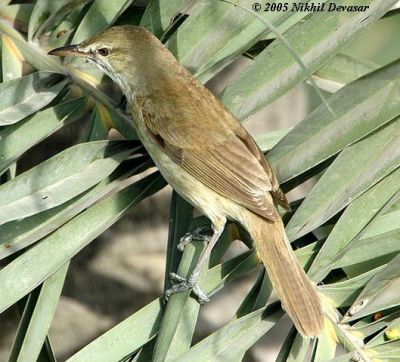
Clamorous Reed Warbler (Acrocephalus stentoreus) by Nikhil

Clamorous Reed Warbler (Acrocephalus stentoreus) by Nikhil

Who teaches the baby cuckoos this trick? Certainly not the mother cuckoo who, incidentally, misses out on all the fulfillment of family life. The cuckoo reminds us that deceit robs us of good experiences in our lives. That ‘s why it is comforting when our perfect God of truth tells us that He never changes.

Prayer: Forgive me, dear Father, for any deceit in my life, and help me to live a life of truth and honesty. InJ esus’ Name. Amen.

References: L.H., Cuckoos beg doggedly to trick hosts, Science News, v.155, p.158, March 6, 1999
Copyright © 2009 Creation Moments, Inc., PO Box 839, Foley, MN 56329, www.creationmoments.com.

To learn more about the Cuckoo – Click Here

Creation Moments – Columbus Day article

B. C. – Before Columbus

King Solomon also built a fleet of ships at Ezion Geber, which is near Elath on the shore of the Red Sea, in the land of Edom. (1 Kings 9:26)

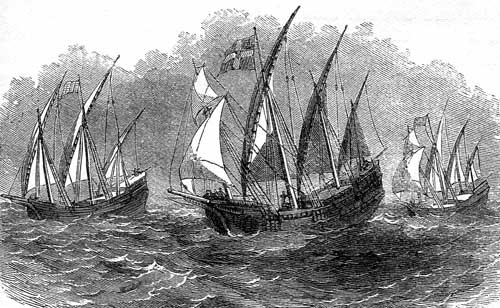
Columbus' ships

Columbus’ ships

Normally, it would not be unusual to find a stone with engraving on it in South America. But a stone found in 1872 in Brazil is unusual, since Aztec, Mayan and Incan civilizations never lived in that region. Besides, the engraving on the stone was in Phoenician. Its discoverer, who did not know Phoenician, sent it to authorities who gave it to the head of the national museum. He recognized the ancient language and translated it. It reads, “We are the Sons of Canaan from Sidon, the city of the King. Commerce has cast us on this distant shore, a land of mountains.”

Could 7th century B.C. Phoenicians have sailed as far as South America in search of commerce? In the ancient world, Phoenicians were known as the greatest commercial sailors of their day. But there is a modern bias against seeing ancient peoples as being as smart and resourceful as we are today, so the inscription has generally been considered a hoax. Then, in the 1960s, the original rubbing made of the inscription turned up at a scholarly auction in the United States. A modern expert on ancient languages studied the rubbing and concluded that the inscription must be authentic. It contains quirks of the Phoenician language that were unknown even to scholars in the 19th century.

While we today may know more facts, the ancients were no less intelligent and resourceful than we are today. That’s consistent with the Bible’s picture of man as God’s highest visible creation, rather than evolution’s gradually improving creature.

Prayer: I glorify Your Name, O Lord, for making us the way You have. Amen.

References: Archeology, “Before Columbus or the Vikings,” Science, May 1968.

©2009 Creation Moments

See Also:
Phoenicians in Brazil
Archeology: Before Columbus or the Vikings,” Time, Friday, May. 24, 1968

Interesting Things – Reshaped Wings, Forest Birds, Evolution?

I came across an interesting article in Science News, September 12, 2009, called, “Rapid evolution may be reshaping forest birds’ wings,” by Susan Millius. Subtitle – “Trend for pointier appendages in heavily logged boreal forests, with blunter, rounder ones in reforested parts of New England.”

Boreal Chickadee (Poecile hudsonicus) by Daves BirdingPix

Boreal Chickadee (Poecile hudsonicus) by Daves BirdingPix

Records have been kept on birds that live in the boreal forest of Canada and parts of New England for the past centrury. These areas were heavily logged and left bare or reforested as in parts of New England.

When the records were analyzed, a trend developed. Wings of forest birds where the trees were logged and left bare were longer (approximately by 2 cm) and more pointed, whereas, the forest birds that had the trees replanted and the forest renewed, had shorter (by 2 cm) and rounder wings. They are comparing the same species of birds in both places.

“Mature-woodland species showed the clearest change in pointiness regardless of body size, Desrochers said. During the past century, their long wing feathers, or primary feathers, overall gained about 2.23 millimeters on average. That uptick roughly matches the magnitude of differences between sexes. For example, a female boreal chickadee’s wing today is about the length of a male’s in 1900, he said.

Desrochers also included more southerly species on his list, such as the scarlet tanager and hooded warbler. These birds had experienced a very different century. The landscape of New England, deforested during previous years, rebounded into green woodland again. And here, Desrochers found a trend back toward rounder wing tips. The eight mature-woodland species he studied typically had lost, on average, some 2.37 millimeters on those long primary feathers.

These species aren’t passive victims of environmental change, Desrochers said. As bird species face new challenges, they respond to the extent they can. “Birds are not like sitting ducks,” he said.”

David Winkler said, “It’s surprising that there’s so much change so fast.” He also noted, “doesn’t explicitly address whether the wings change by evolution or by some other process. Winkler said that in observing changes and invoking evolution, “we need to be careful.”

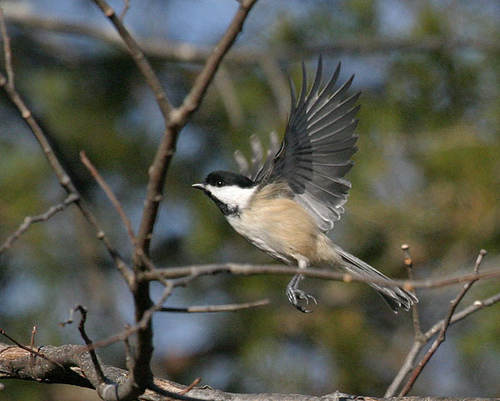
Black-capped Chickadee (Poecile atricapillus) by Kent Nickell

Black-capped Chickadee (Poecile atricapillus) by Kent Nickell

Well, of course, those statements caught my interest. I believe in a Creator who supplies his creation with tremendous capability to adapt and have their needs supplied. I believe in natural selection and variation, but not something turning into something else or “macro-evolution.” I think the bird changed “by some other process,” namely, God’s protective watch-care.

Reading through the comments left, several were of note:

“I wonder what the “evolution might be directed by the species itself” refers to. It’s obvious here that the evolutionary selection of birds with appropriately shaped wings is caused by external forces, nothing the bird is doing. Those birds in areas that are opened up which have slightly longer wings are able to raise more chicks, while those in areas that are being reforested that have more rounded wings are able to raise more chicks. The reason is that distance flying is done more efficiently with longer (and therefore pointier) wings, while maneuverability is required in heavily branched areas and is done with shorter wings.

As for whether the wings are being worn out by contact with branches, this would be evident because the wear at the tip would be obvious. Feather shafts don’t go the whole way to the end of the feather, so if the tips were worn off, it would be noticed”  by DM (very good comment)

“Could the shorter wings of birds in denser forests be due to greater feather wear from brushing against branches and foliage? Maybe all wing feathers start out pointy and simply wear into a rounded shape.” by KC

More searching on the internet turned up a remark about this article at Answers in Genesis with this very interesting statement:  “The report notes that “as bird species face new challenges, they respond to the extent they can.” This comports with the creationist view: God included a range of genetic information and adaptability in organisms to allow them to live properly in a range of habitats.

The scientists aren’t certain how significant a role genes play in the wing tip changes. Still, Cornell University ornithologist David Winkler noted, “It’s surprising that there’s so much change so fast,” and Desrochers calls “rapid evolution” the most direct explanation. The speed of the changes indicates how the created kinds could have speciated rapidly after the Flood. Centuries of accumulated changes between some populations from the same created kinds resulted in sexual incompatibility. However, in other kinds (such as canids; see above), populations retain the ability even if interbreeding is uncommon.”

Consider the ravens: they neither sow nor reap, they have neither storehouse nor barn, and yet God feeds them. Of how much more value are you than the birds! (Luke 12:24 ESV)

God is providing for the birds and we know He will provide for us, especially if we belong to Him.

Bolding is by Lee.

Early Bird by GeHof

Here’s an interesting video of tribute to birds, especially Those Early Birds Getting The Worm. From GeHof who posted it at YouTube.
What else was I to do today while we are having stormy weather here in Central Florida? I have been “Birdwatching” the internet.

Interesting Things – Dragonflies II

Thinking

Globe-Skimmer

Globe-Skimmer

Interesting Things – Dragonfly gave a lot of detail about the Dragonflies. Now the researchers have produced some very interesting details about their migration.  According to the “Mail Online”, they have longest migration by insects. They “fly 11,000 mile round-trip over ocean.” and the “BCC-Earth News” also has an article about their incredible journey.

From the BBC Earth News: “Every year, millions of dragonflies fly thousands of kilometres (11,000 miles) across the sea from southern India to Africa.

So says a biologist in the Maldives, who claims to have discovered the longest migration of any insect.

If confirmed, the mass exodus would be the first known insect migration across open ocean water.”

They go on to mention the Monarch Butterfly’s migration is much less lengthy, only traveling around 8,600 miles round-trip.

Round-trip of Dragonfly

Round-trip of Dragonfly from Mail Online

What an amazing feat these dragonflies perform. Below are the links to the articles, but what a fantastic Creator we have. As you read the articles, you cannot but be amazed by the way they were programmed to sense the weather patterns, knowing when the rains would be there, etc. There is no way this just happened without a designer.

O LORD, how many are Your works! In wisdom You have made them all; The earth is full of Your possessions. (Psalms 104:24 NASB)


Longest insect migration revealed by BBC Earth News”

Longest insect migration ever as dragonflies fly 11,000-mile round-trip over ocean” by Mail Online

Other Interesting Things

Interesting – “Animals Can Tell Right From Wrong”

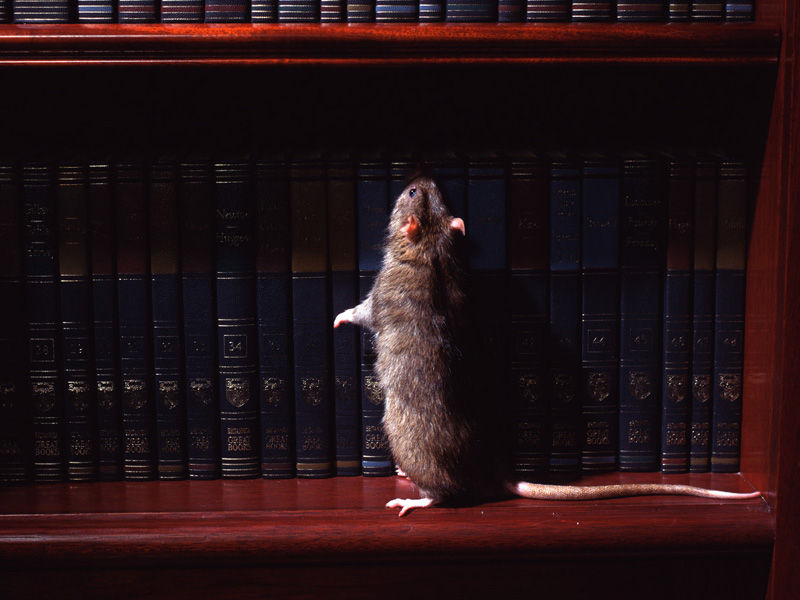
Rodent - Mouse

Rodent - Mouse

But now ask the beasts, and they will teach you; And the birds of the air, and they will tell you; (Job 12:7 NKJV)
The ox knows its owner And the donkey its master’s crib; But Israel does not know, My people do not consider. (Isaiah 1:3 NKJV)

Here is an interesting article, “Animals Can Tell Right From Wrong.” This was in the Telegraph.co.uk and is by Richard Gray. “Animals possess a sense of morality that allows them to tell the difference between right and wrong,…”

The scientist have been studying animal behavior and are finding that a variety of species are “governed by moral codes of conduct in the same way as humans.” They thought that only humans could have “complex emotions and have a sense of morality.”

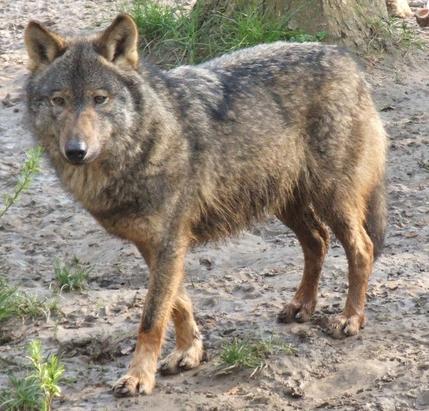
Wolf from Wikipedia

Wolf from Wikipedia

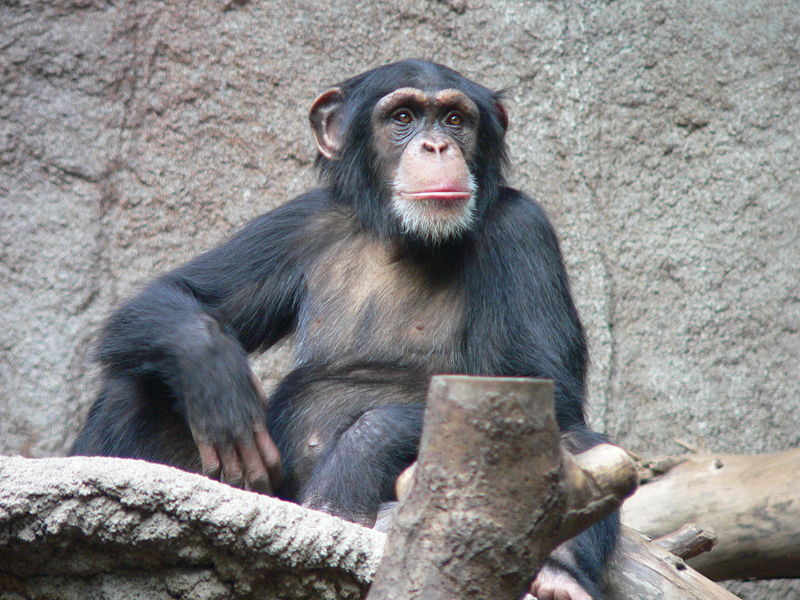
What they are finding out is that various animals have a built-in (instinct) for fairness, can feel empathy, and help other animals that are having difficulties, have a social responsibility, and moral codes – depending on the species. They go on to give examples from wolves (have strict rules), coyotes (a sense of fairness), elephants (help another when it’s sick and sadness if it dies), Diana monkeys (doing a task for another), chimpanzees (sense of justice and treating an ill one less agressively), rodents (not causing another pain), bats  (sharing and teaching) and whales (“empathy and understanding the feelings of others”).

They concluded with this remark, “This finding has suggested that complex emotional judgements such as empathy may have evolved considerably earlier in history than previously thought and could be widespread in the animal kingdom.”

Chimpanze

Chimpanzee

As you know, I believe that God created animals with instincts that He put there. The verses above reminds us that we can learn from the animals and birds. Many today, as Israel did then, do not know nor do they consider things that even the critters know. Again, we have the evidence of how these animals behave, but it depends on whether you believe in God or not, as to how you interpret these findings.

To see the whole article, see: “Animals Can Tell Right From Wrong.”

To see more Interesting Things

Interesting Things – Ants

Thinking

 Go to the ant, you sluggard! Consider her ways and be wise, Which, having no captain, Overseer or ruler, Provides her supplies in the summer, And gathers her food in the harvest. How long will you slumber, O sluggard? When will you rise from your sleep? A little sleep, a little slumber, A little folding of the hands to sleep So shall your poverty come on you like a prowler, And your need like an armed man.  (Proverbs 6:6-11)
There are four things which are little on the earth, But they are exceedingly wise: The ants are a people not strong, Yet they prepare their food in the summer; (Proverbs 30:24-25)

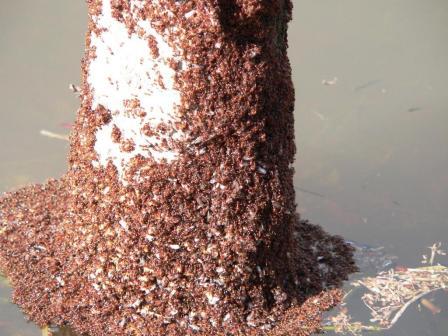
Ants on Tree after heavy rain

Ants on Tree after heavy rain

While reading in Proverbs the other day, I came again across the above verses. I remembered some pictures we had taken while birdwatching at South Lake Howard Nature Preserve. We had had an extreme amount of rain (not this year) and the ants were hugging a tree and many had sacrificed themself for the sake of getting the rest to safety. Below are some of the Creation Moments articles about the Ants. I trust you find them informative and inspirational.
 

Harvesting Ants 

Groceries, Ant Style

Real Ant Farms

Ant Antics

Ant Genius

Wise Raider Ants 

An Ant from CreationWikiAn interesting article about Ants from CreationWiki.Org

Copyright ©2008 by Creation Moments, Inc., P.O. 839, Foley, MN 56329