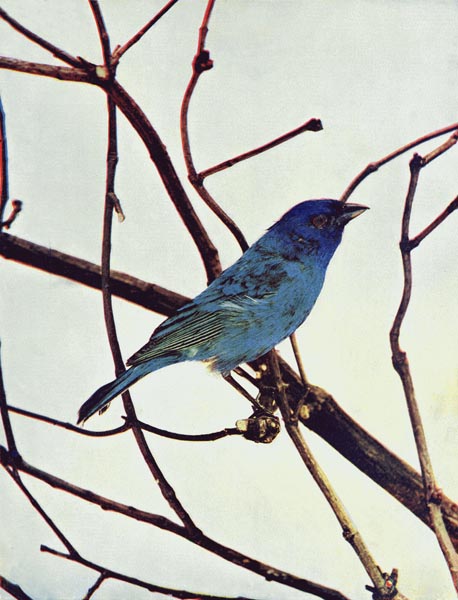
Birds Vol 1 #5 – The Indigo Bunting

Indigo Bunting by Birds Illustrated by Color Photography, 1897

Indigo Bunting by Birds Illustrated by Color Photography, 1897

Birds Illustrated by Color Photography – Revisited

Vol 1. May, 1897 No. 5

*

THE INDIGO BUNTING.

imgt

HE Indigo Bunting’s arrival at its summer home is usually in the early part of May, where it remains until about the middle of September. It is numerous in the eastern and middle states, inhabiting the continent and seacoast islands from Mexico, where they winter, to Nova Scotia. It is one of the very smallest of our birds, and also one of the most attractive. Its favorite haunts are gardens, fields of deep clover, the borders of woods, and roadsides, where, like the Woodpecker, it is frequently seen perched on the fences.

It is extremely active and neat in its manners and an untiring singer, morning, noon, and night his rapid chanting being heard, sometimes loud and sometimes hardly audible, as if he were becoming quite exhausted by his musical efforts. He mounts the highest tops of a large tree and sings for half an hour together. The song is not one uninterrupted strain, but a repetition of short notes, “commencing loud, and rapid, and full, and by almost imperceptible gradations for six or eight seconds until they seem hardly articulated, as if the little minstrel were unable to stop, and, after a short pause, beginning again as before.” Baskett says that in cases of serenade and wooing he may mount the tip sprays of tall trees as he sings and abandon all else to melody till the engrossing business is over.

The Indigo Bird sings with equal animation whether it be May or August, the vertical sun of the dog days having no diminishing effect upon his enthusiasm. It is well known that in certain lights his plumage appears of a rich sky blue, varying to a tint of vivid verdigris green, so that the bird, flitting from one place to another, appears to undergo an entire change of color.

The Indigo Bunting fixes his nest in a low bush, long rank grass, grain, or clover, suspended by two twigs, flax being the material used, lined with fine dry grass. It had been known, however, to build in the hollow of an apple tree. The eggs, generally five, are bluish or pure white. The same nest is often occupied season after season. One which had been used for five successive summers, was repaired each year with the same material, matting that the birds had evidently taken from the covering of grape vines. The nest was very neatly and thoroughly lined with hair.

The Indigo feeds upon the ground, his food consisting mainly of the seed of small grasses and herbs. The male while moulting assumes very nearly the color of the female, a dull brown, the rich plumage not returning for two or three months. Mrs. Osgood Wright says of this tiny creature: “Like all the bright-hued birds he is beset by enemies both of earth and sky, but his sparrow instinct, which has a love for mother earth, bids him build near the ground. The dangers of the nesting-time fall mostly to his share, for his dull brown mate is easily overlooked as an insignificant sparrow. Nature always gives a plain coat to the wives of these gayly dressed cavaliers, for her primal thought is the safety of the home and its young life.”

Indigo Bunting female at fountain in yard through window
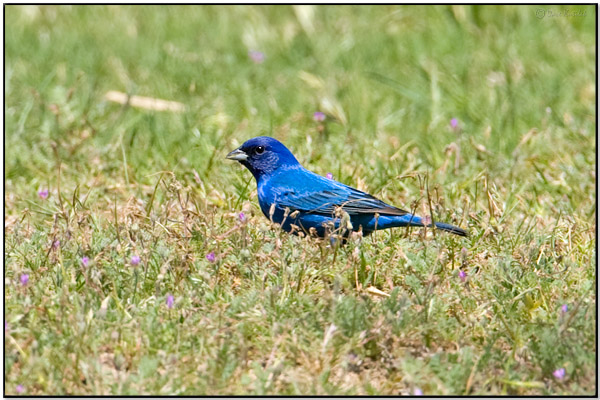
Indigo Bunting female at fountain in yard through window


Indigo Bunting (Passerina cyanea) by Daves BirdingPix

Indigo Bunting (Passerina cyanea) by Daves BirdingPix

Lee’s Addition:

Indigo Buntings are in the Grosbeaks, Saltators & Allies – Cardinalidae Family. What a difference between the two as the article said. The Lord gives protection to the female by her coloration so she can sit on the nest and not be noticed. Praise the Lord for His care for the critters and us.

Do not fear therefore; you are of more value than many sparrows (or Buntings). (Matthew 10:31 NKJV)

They are small seed-eating bird. It is migratory, ranging from southern Canada to northern Florida during the breeding season, and from southern Florida to northern South America during the winter. It often migrates by night, using the stars to navigate. Its habitat is farmland, brush areas, and open woodland. The Indigo Bunting is closely related to the Lazuli Bunting, and interbreeds with the latter species where their ranges overlap. (Not sure how the female ended up in our yard, but must have had to land for a drink. Glad it did.)
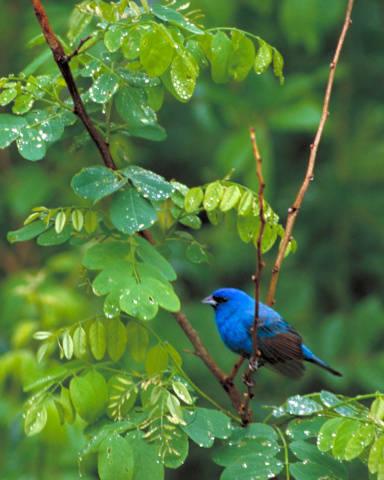
Indigo Bunting (Passerina cyanea) ©USFWS

The Indigo Bunting communicates through vocalizations and visual cues. A sharp chip! call is used by both sexes, and is used as an alarm call if a nest or chick is threatened. A high-pitched, buzzed zeeep is used as a contact call when the Indigo Bunting is in flight. The song of the male bird is a high-pitched buzzed sweet-sweet chew-chew sweet-sweet, lasting two to four seconds, sung to mark his territory to other males and to attract females. Each male has a single complex song, which he sings while perched on elevated objects, such as posts, wires, and bush-tops. In areas where the ranges of the Lazuli Bunting and the Indigo Bunting overlap, the males defend territories from each another. Migration takes place in April and May and then again in September and October. The Indigo Bunting often migrates during the night, using the stars to direct itself. In captivity, since it cannot migrate, it experiences disorientation in April and May and in September and October if it cannot see the stars from its enclosure.

From xeno-canto.org by Doug Knapp

These birds are generally monogamous but not always faithful to their partner. In the western part of their range, they often hybridize with the Lazuli Bunting. Nesting sites are located in dense shrub or a low tree, generally 0.3–1 m (1–3 ft) above the ground, but rarely up to 9 m (30 ft). The nest itself is constructed of leaves, coarse grasses, stems, and strips of bark, lined with soft grass or deer hair and is bound with spider web. It is constructed by the female, who cares for the eggs alone. The clutch consists of one to four eggs, but usually contains three to four. The eggs are white and usually unmarked, though some may be marked with brownish spots, averaging 18.7 × 13.7 mm (0.7 × 0.5 in) in size. The eggs are incubated for 12 to 13 days and the chicks are altricial at hatching. Chicks fledge 10 to 12 days after hatching. Most pairs raise two broods per year, and the male may feed newly fledged young while the females incubate the next clutch of eggs.

The Brown-headed Cowbird may parasitize this species. Indigo Buntings abandon their nest if a cowbird egg appears before they lay any of their own eggs, but accept the egg after that point. Pairs with parasitized nests have less reproductive success. The bunting chicks hatch, but have lower survival rates as they must compete with the cowbird chick for food.
Birds Illustrated by Color Photograhy Vol 1 May, 1897 No 5 - Cover

Birds Illustrated by Color Photograhy Vol 1 May, 1897 No 5 – Cover

Birds Illustrated by Color Photography – Revisited – Introduction

The above article is the first article in the monthly serial that was started in January 1897 “designed to promote Knowledge of Bird-Live.” These include Color Photography, as they call them, today they are drawings. There are at least three Volumes that have been digitized by Project Gutenberg.

To see the whole series of – Birds Illustrated by Color Photography – Revisited

*

(Information from Wikipedia and other internet sources)

Next Article – The Night Hawk

Previous Article –The Prothonotary Yellow Warblers

Wordless Birds – Toucan

Links:

Indigo Bunting – Wikipedia

Sounds of Indigo Bunting – xeno-canto.org

Grosbeaks, Saltators & Allies – Cardinalidae Family
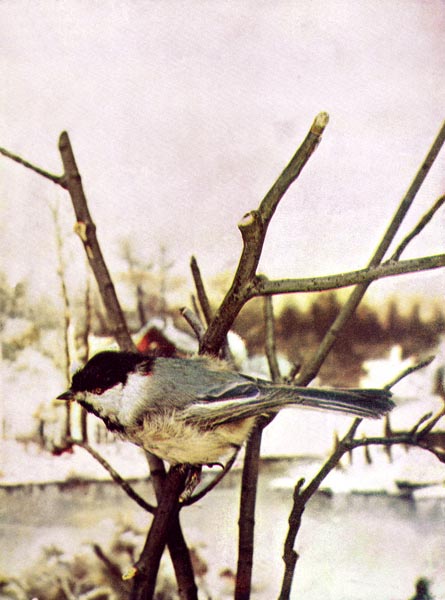
 

Birds Vol 1 #5 – The Black-capped Chickadee

Chickadee by.Birds Illustrated by Color Photography, 1897

Chickadee by.Birds Illustrated by Color Photography, 1897

Birds Illustrated by Color Photography – Revisited

Vol 1. May, 1897 No. 5

*

CHICKADEE.

Bird of the Merry Heart.Here is a picture of a bird that is always merry. He is a bold, saucy little fellow, too, but we all love him for it. Don’t you think he looks some like the Canada Jay that you saw in April “Birds?” I think most of you must have seen him, for he stays with us all the year, summer and winter. If you ever heard him, you surely noticed how plainly he tells you his name. Listen—“Chick-a-dee-dee; Chick-a-dee; Hear, hear me”—That’s what he says as he hops about from twig to twig in search of insects’ eggs and other bits for food. No matter how bitter the wind or how deep the snow, he is always around—the same jolly, careless little fellow, chirping and twittering his notes of good cheer.

Like the Yellow Warblers, Chickadees like best to make their home in an old stump or hole in a tree—not very high from the ground. Sometimes they dig for themselves a new hole, but this is only when they cannot find one that suits them. The Chickadee is also called Black-capped Titmouse. If you look at his picture you will see his black cap. You’ll have to ask someone why he is called Titmouse. I think Chickadee is the prettier name, don’t you? If you want to get well acquainted with this saucy little bird, you want to watch for him next winter, when most of the birds have gone south. Throw him crumbs of bread and he will soon be so tame as to come right up to the door step.

THE BLACK-CAPPED CHICKADEE.

“Chic-chickadee dee!” I saucily say; My heart it is sound, my throat it is gay! Every one that I meet I merrily greet With a chickadee dee, chickadee dee! To cheer and to cherish, on roadside and street, My cap was made jaunty, my note was made sweet.

Chickadeedee, Chickadeedee! No bird of the winter so merry and free; Yet sad is my heart, though my song one of glee, For my mate ne’er shall hear my chickadeedee.

I “chickadeedee” in forest and glade, “Day, day, day!” to the sweet country maid; From autumn to spring time I utter my song Of chickadeedee all the day long! The silence of winter my note breaks in twain, And I “chickadeedee” in sunshine and rain.

Chickadeedee Chickadeedee! No bird of the winter so merry and free; Yet sad is my heart, though my song one of glee, For my mate ne’er shall hear my chickadeedee.—C. C. M.

imga1

SAUCY little bird, so active and familiar, the Black-Capped Chickadee, is also recognized as the Black Capped Titmouse, Eastern Chickadee, and Northern Chickadee. He is found in the southern half of the eastern United States, north to or beyond forty degrees, west to eastern Texas and Indian Territory. The favorite resorts of the Chickadee are timbered districts, especially in the bottom lands, and where there are red bud trees, in the soft wood of which it excavates with ease a hollow for its nest. It is often wise enough, however, to select a cavity already made, as the deserted hole of the Downy Woodpecker, a knot hole, or a hollow fence rail.

In the winter season it is very familiar, and is seen about door yards and orchards, even in towns, gleaning its food from the kitchen remnants, where the table cloth is shaken, and wherever it may chance to find a kindly hospitality. In an article on “Birds as Protectors of Orchards,” Mr. E. H. Forbush says of the Chickadee: “There is no bird that compares with it in destroying the female canker-worm moths and their eggs.” He calculated that one Chickadee in one day would destroy 5,550 eggs, and in the twenty-five days in which the canker-worm moths run or crawl up the trees 138,750 eggs. Mr. Forbush attracted Chickadees to one orchard by feeding them in winter, and he says that in the following summer it was noticed that while trees in neighboring orchards were seriously damaged by canker-worms, and to a less degree by tent caterpillars, those in the orchard which had been frequented by the Chickadee during the winter and spring were not seriously infested, and that comparatively few of the worms and caterpillars were to be found there. His conclusion is that birds that eat eggs of insects are of the greatest value to the farmer, as they feed almost entirely on injurious insects and their eggs, and are present all winter, where other birds are absent.

The tiny nest of the Chickadee is made of all sorts of soft materials, such as wool, fur, feathers, and hair placed in holes in stumps of trees. Six to eight eggs are laid, which are white, thickly sprinkled with warm brown. Mrs. Osgood Wright tells a pretty incident of the Chickadees, thus: “In the winter of 1891-2, when the cold was severe, the snow deep, and the tree trunks often covered with ice, the Chickadees repaired in flocks daily to the kennel of our old dog Colin and fed from his dish, hopping over his back and calling Chickadee, dee, dee, in his face, a proceeding that he never in the least resented, but seemed rather to enjoy it.”

Black-capped Chickadee (Poecile atricapillus) by Kent Nickell

Black-capped Chickadee (Poecile atricapillus) by Kent Nickell


Lee’s Addition:

A merry heart makes a cheerful countenance, But by sorrow of the heart the spirit is broken. The heart of him who has understanding seeks knowledge, But the mouth of fools feeds on foolishness. All the days of the afflicted are evil, But he who is of a merry heart has a continual feast. Better is a little with the fear of the LORD, Than great treasure with trouble. (Proverbs 15:13-16 NKJV)

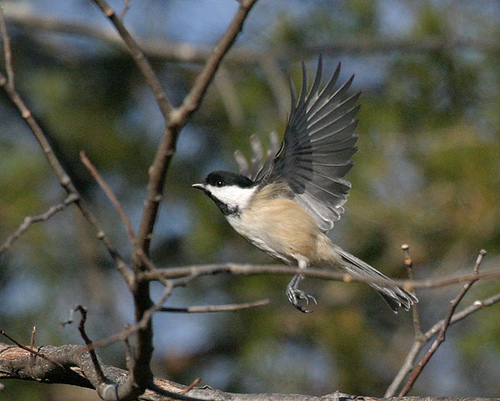
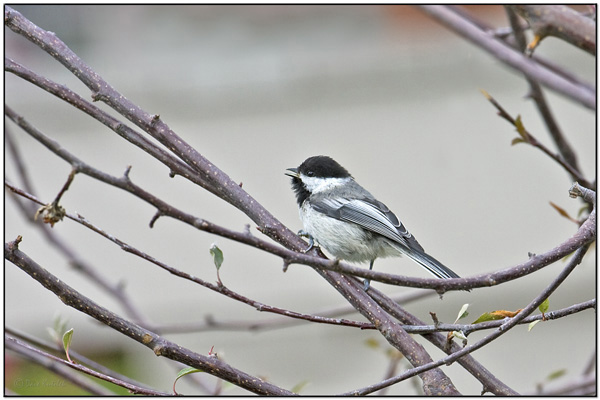
The Black-capped Chickadee (Poecile atricapillus) is a small, North American songbird, a passerine bird in the Tit, Chickadee – Paridae Family. It is the state bird of both Maine and Massachusetts in the United States, and the provincial bird of New Brunswick in Canada. It is notable for its capacity to lower its body temperature during cold winter nights, its good spatial memory to relocate the caches where it stores food, and its boldness near humans (they can feed from the hand).

On cold winter nights, these birds reduce their body temperature by up to 10–12 °C (from their normal temperature of about 42 °C) to conserve energy.[8] Such a capacity for torpor is rare in birds (or at least, rarely studied). Other bird species capable of torpor include the Common Swift Apus apus, the Common Poor-will Phalaenoptilus nuttallii, the Lesser Nighthawk Chordeiles acutipennis, and various species of hummingbirds.

Black-capped Chickadee by Dave's BirdingPix

Black-capped Chickadee by Dave’s BirdingPix

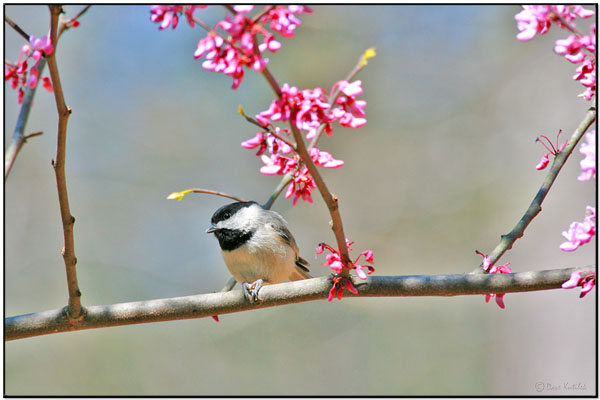
The Black-capped Chickadee has a black cap and bib with white sides to the face. Its underparts are white with rusty brown on the flanks. Its back is gray and the tail is normally slate-gray. This bird has a short dark bill (8.0-9.5 mm), short rounded wings (63.5-67.5 mm) and a long tail (58–63 mm). Total body length is 12–15 cm (4.7–5.9 in), wingspan is 16–21 cm (6.3–8.3 in) and body mass is 9–14 g (0.32–0.49 oz). Sexes look alike, but males are slightly larger and longer than females.

Although range can generally be used to separate them, the Black-capped Chickadee is very similar in appearance to the Carolina Chickadee. The Black-capped is larger on average but this cannot be used reliably for identification. The most obvious difference between the two is in the wing feathers. In the Black-capped Chickadee, the wing feathers have white edges that are larger and more conspicuous than those of the Carolina Chickadee.

Carolina Chickadee (Poecile carolinensis) by Daves BirdingPix

Carolina Chickadee (Poecile carolinensis) by Daves BirdingPix

A merry heart does good, like medicine, But a broken spirit dries the bones. (Proverbs 17:22 NKJV)

*

Birds Illustrated by Color Photograhy Vol 1 May, 1897 No 5 - Cover

Birds Illustrated by Color Photograhy Vol 1 May, 1897 No 5 – Cover

Birds Illustrated by Color Photography – Revisited – Introduction

The above article is the first article in the monthly serial that was started in January 1897 “designed to promote Knowledge of Bird-Live.” These include Color Photography, as they call them, today they are drawings. There are at least three Volumes that have been digitized by Project Gutenberg.

To see the whole series of – Birds Illustrated by Color Photography – Revisited

*

(Information from Wikipedia and other internet sources)

Next Article – The Scissor-Tailed Flycatcher

Previous Article – The Marsh Hawk

Links:

Black-capped Chickadee All About Birds

All About Black-capped Chickadee – Sialis

Black-capped Chickadee – National Geographic

Tit, Chickadee – Paridae Family

Black-capped Chickadee – Wikipedia

*


Ian’s Bird of the Week – Black-winged Petrel

Black-winged Petrel (Pterodroma nigripennis) by Ian Montgomery 1

Black-winged Petrel (Pterodroma nigripennis) by Ian Montgomery 1

Ian’s Bird of the Week – Black-winged Petrel ~ by Ian Montgomery

Newsletter – 5/14/12

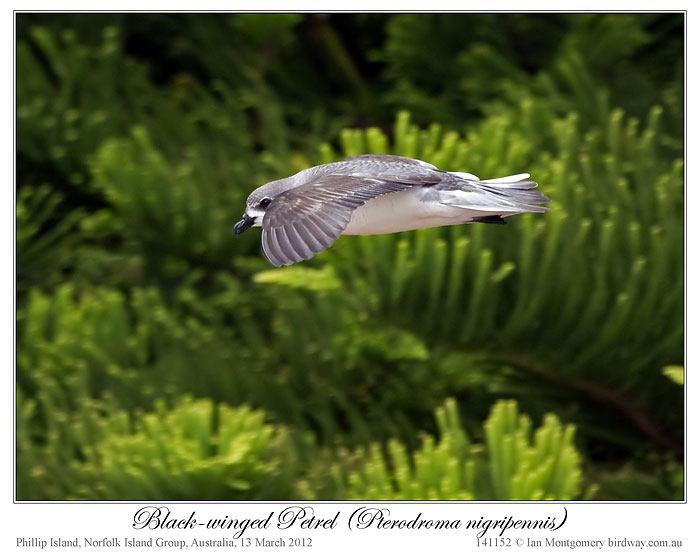
Three weeks ago we had the Cape Petrel. Here is the Black-winged Petrel, another species, like the White Tern and Grey Ternlet, that I had seen twenty years ago on Lord Howe Island and was keen to photograph on Norfolk Island. With a length of 28-30cm/11-12in and a wingspan of 67cm/26in, this is quite a small species with elegant black, grey and white markings and a stubby, hooked bill, visible in the first photo.

It nests on both the main island and Phillip Island – where it was quite abundant – and was easy to find as, unlike most petrels and shearwaters, it is active around the breeding colonies in daylight. Most petrels and shearwaters come ashore under cover of darkness to reduce the risk of avian predators such as raptors and gulls, but the Black-winged has historically nested on predator-free islands. ‘Historically’ here means before human settlers introduced predators such as feral cats.

Black-winged Petrel (Pterodroma nigripennis) by Ian Montgomery 2

Black-winged Petrel (Pterodroma nigripennis) by Ian Montgomery 2

Black-winged Petrels are accomplished fliers and spent much time in aerial acrobatics around and over cliffs. The generic name Pterodroma means ‘winged runner’ and refers to their aerial agility. The one in the second photo is coming in to land near its nesting burrow and passing some Norfolk Island Pines. All petrels and shearwater, except the Giant Petrels, have very weak legs and once on the ground are barely mobile using their wings to drag themselves along on their bellies.

Black-winged Petrel (Pterodroma nigripennis) by Ian Montgomery 3

Black-winged Petrel (Pterodroma nigripennis) by Ian Montgomery 3

Like many island birds, they seemed unafraid and didn’t appear agitated when approached closely to have their photos taken. The fourth photo shows the tubular nostrils characteristic of this family of birds and their close relatives the albatrosses and storm-petrels. All these ‘tube-nosed’ birds are thought to have a strong sense of smell – very unusual for birds – that helps them find both marine prey and their nesting burrows on dark nights, and the birds themselves apparently have a strong musty odour during the breeding season.

Black-winged Petrel (Pterodroma nigripennis) by Ian Montgomery 4

Black-winged Petrel (Pterodroma nigripennis) by Ian Montgomery 4

The hooked bill helps the birds grasp slippery prey – mainly squid and small fish – and the bills have sharp cutting edges. The Black-winged is one of about 36 global species of Pterodroma petrels collectively and, I think unfairly, called Gadfly Petrels, in reference to their erratic flight. As I’m sure you know, Gadflies are nasty blood-sucking insects such as Horse and March Flies, and there must be other more congenial erratic fliers after which they could been named. Anyway, Gadfly Petrels feed on the wing by snatching prey from the surface of the water and rarely alight on the water or dive.

The Black-winged Petrel breeds on islands in the south Pacific including Lord Howe, Norfolk, various islands around New Zealand and on several in French Polynesia. Helped by protection and the removal of predators such as feral cats, its population is increasing and it has bred on Lord Howe only since the 1960s. There are unproven recent reports of it breeding on some islands on the east coast of Australia, where it is generally rare. Outside the breeding season, it is highly pelagic and ranges widely over the Pacific as far as southern Japan and Mexico.

Best wishes
Ian
**************************************************

Ian Montgomery, Birdway Pty Ltd,
454 Forestry Road, Bluewater, Qld 4818
Tel 0411 602 737 ian@birdway.com.au
Check the latest website updates:
http://www.birdway.com.au/#updates
**************************************************


Lee’s Addition:

Thanks, Ian, for another interesting Newsletter. Trust you all are enjoying Ian’s Bird of the Week newsletters as well as I do. They are so informative and he introduces us to such a variety of birds. His photograph is outstanding.

The Black-winged Petrel is a member of the Procellariidae – Petrels, Shearwaters Family which has 87 species. They are in the Procellariiformes Order. The order has 3 other families, the Storm Petrels, Diving Petrels and the Albatrosses.

And God said, “…and let birds fly above the earth across the expanse of the heavens.” (Genesis 1:20 ESV)

See Bird of the Week for more articles by Ian.

*

Ian’s Bird of the Week – (Norfolk Island) Golden Whistler

Ian’s Bird of the Week – (Norfolk Island) Golden Whistler ~ by Ian Montgomery

Newsletter: 5-4-12

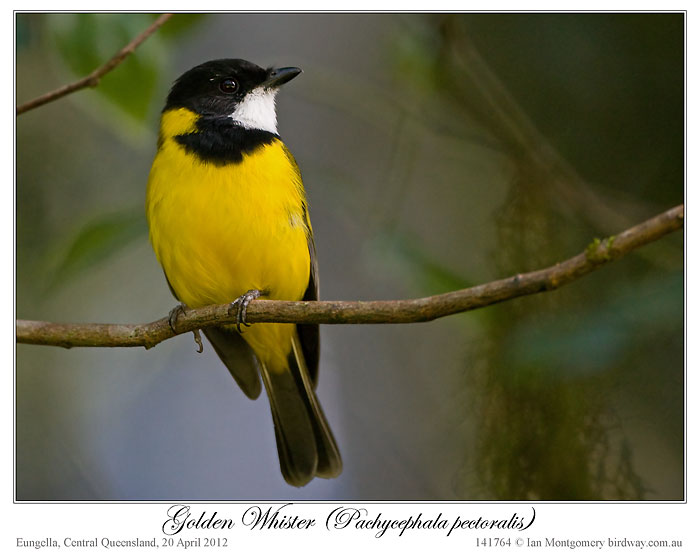
My apologies for a belated bird of the week. When I was in Eungella recently chasing the so-named Honeyeater, I encountered a very obliging male Golden Whistler, below, so I’ve chosen it to introduce this week’s subject.

Australian Golden Whistler (Pachycephala pectoralis) by Ian

It’s one of the most gorgeous of the woodland birds of eastern and southern Australia and one of those unusual birds that, unlike Rainbow Lorikeets for example, both look and sound strikingly beautiful. It featured as bird of the week in January 2005, but I don’t suppose you’ll mind me repeating it and I want to share with you the interestingly different Norfolk Island equivalent.

Australian Golden Whistler (Norfolk Island) (Pachycephala pectoralis xanthoprocta) by Ian

Australian Golden Whistler (Norfolk Island) (Pachycephala pectoralis xanthoprocta) by Ian

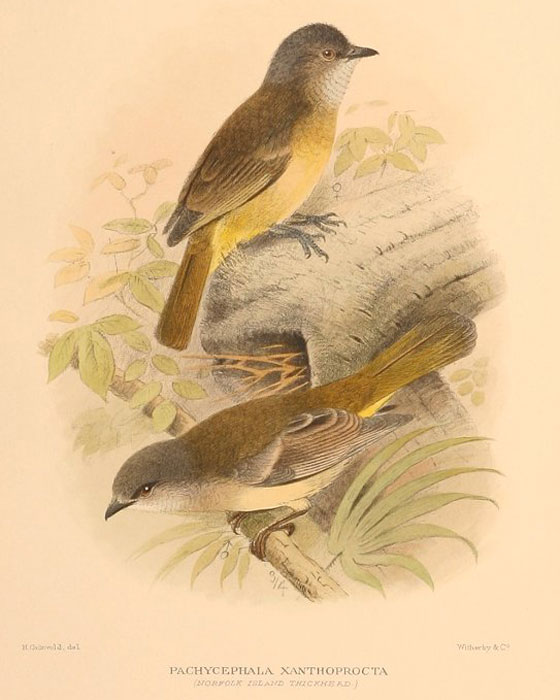
The bird in the second photo, one of a pair we encountered, is, or could be, an adult male Norfolk Island Golden Whistler. I say ‘could be’ because there, the adult males do not develop the striking yellow and black plumage of the mainland races and remain ‘hen-plumaged’, to quote Schodde and Mason. This was recognised early on in the settlement of the island and it was original described as a separate species, the Norfolk Island Thickhead (Pachycephala means ‘thick-head’) P. xanthoprocta, where xanthoprocta refers to the yellow vent. Here is a painting of a pair by John Gould.

Australian Golden Whistler (Norfolk Island) (Pachycephala pectoralis xanthoprocta) by Ian Drawing

Australian Golden Whistler (Norfolk Island) (Pachycephala pectoralis xanthoprocta) by Ian Drawing

He has labelled the bird in the foreground as a male, and the one in the background as a female. There are subtle differences in plumage, with the female being more lemon-yellow underneath and the male being more buffish yellow and. having darker dark lores. I haven’t been able to find whether these differences are consistent, but it seemed to me that the bird in photo above (141464) looks more like the Gouldian male than its partner below (141440).

 Australian Golden Whistler (Norfolk Island) (Pachycephala pectoralis xanthoprocta) by Ian

Australian Golden Whistler (Norfolk Island) (Pachycephala pectoralis xanthoprocta) by Ian

Mainland juvenile Golden Whistlers have rusty margins on the wing feathers and this is the case with the Norfolk Island birds, as shown in the next photo taken on a different occasion when we were hanging around waiting for the Norfolk Island Parakeets to show up.

Australian Golden Whistler (Norfolk Island) (Pachycephala pectoralis xanthoprocta) Juv by Ian

Australian Golden Whistler (Norfolk Island) (Pachycephala pectoralis xanthoprocta) Juv by Ian

To this day, the taxonomic status of the Golden Whistler ‘complex’ remains unresolved. There are different races on the mainland and in neighbouring locations such as New Guinea, New Britain and Fiji. The mangrove-inhabiting Golden Whistler of northern and western Australia has been elevated to specific status but the others have remained in the too-hard basket and are still lumped together as a single species. It seems to me unusual for avian taxonomists to be stumped by a problem like this, but maybe they’ve met their match.

Best wishes

Ian

**************************************************
Ian Montgomery, Birdway Pty Ltd,
454 Forestry Road, Bluewater, Qld 4818
Tel 0411 602 737 ian@birdway.com.au
Check the latest website updates:
http://www.birdway.com.au/#updates
**************************************************
*


Lee’s Addition:

Very interesting and a beautiful bird. I couldn’t resist finding out what this “whistler” sounds like. It is very pretty sounding. Take a listen.

Sound of Golden Whistler

In that day the LORD will whistle for the fly that is at the end of the streams of Egypt, and for the bee that is in the land of Assyria. (Isaiah 7:18 ESV)

The Whistlers are found in the Pachycephalidae – Whistlers and Allies. There are 58 members of the family. This Australian Golden Whistler (Pachycephala pectoralis xanthoprocta) is one of those subspecies; there are at least 7 subspecies. The “Norfolks” are found on the Norfolk Island, as Ian mentioned.

The Norfolk Golden Whistler (P. p. xanthoprocta) declined for many years due to habitat loss and fragmentation and possible due to introduced predators such as the Black Rat. Most of the population is now restricted to the Norfolk Island National Park. This has resulted in it being listed as vulnerable by the Australian Government.

Links:

Check out Ian’s other Whistlers

Australian Golden Whistler – Wikipedia

Pachycephalidae – Whistlers and Allies

*

Birds Vol 1 #5 – Nesting Time

Mute Swan on Nest at Lake Morton

Mute Swan on Nest at Lake Morton

Birds Illustrated by Color Photography – Revisited

Vol 1. May, 1897 No. 5

*

NESTING TIME

“There swims no goose so gray, but soon or late, She takes some honest gander for a mate;” There live no birds, however bright or plain, But rear a brood to take their place again. —C. C. M.

imgq

UITE the jolliest season of the year, with the birds, is when they begin to require a home, either as a shelter from the weather, a defence against their enemies, or a place to rear and protect their young. May is not the only month in which they build their nests, some of our favorites, indeed, waiting till June, and even July; but as it is the time of the year when a general awakening to life and activity is felt in all nature, and the early migrants have come back, not to re-visit, but to re-establish their temporarily deserted homes, we naturally fix upon the first real spring month as the one in which their little hearts are filled with titillations of joy and anticipation. In May, when the trees have put on their fullest dress of green, and the little nests are hidden from all curious eyes, if we could look quite through the waving branches and rustling leaves, we should behold the little mothers sitting upon their tiny eggs in patient happiness, or feeding their young broods, not yet able to flutter away; while in the leafy month of June, when Nature is perfect in mature beauty, the young may everywhere be seen gracefully imitating the parent birds, whose sole purpose in life seems to be the fulfillment of the admonition to care well for one’s own.

Iceland Gull (Larus glaucoides) chick-egg nest ©USFWS

Iceland Gull (Larus glaucoides) chick-egg nest ©USFWS

There can hardly be a higher pleasure than to watch the nest-building of birds. See the Wren looking for a convenient cavity in ivy-covered walls, under eaves, or among the thickly growing branches of fir trees, the tiny creature singing with cheerful voice all day long. Observe the Woodpecker tunneling his nest in the limb of a lofty tree, his pickax-like beak finding no difficulty in making its way through the decayed wood, the sound of his pounding, however, accompanied by his shrill whistle, echoing through the grove. But the nest of the Jay: Who can find it? Although a constant prowler about the nests of other birds, he is so wary and secretive that his little home is usually found only by accident. And the Swallow: “He is the bird of return,” Michelet prettily says of him. If you will only treat him kindly, says Ruskin, year after year, he comes back to the same niche, and to the same hearth, for his nest. To the same niche! Think of this a little, as if you heard of it for the first time. But nesting-time with the birds is one of sentiment as well as of industry The amount of affectation in lovemaking they are capable of is simply ludicrous.

The British Sparrow which, like the poor, we have with us always, is a much more interesting bird in this and other respects than we commonly give him credit for. It is because we see him every day, at the back door, under the eaves, in the street, in the parks, that we are indifferent to him. Were he of brighter plumage, brilliant as the Bobolink or the Oriole, he would be a welcome, though a perpetual, guest, and we would not, perhaps, seek legislative action for his extermination. If he did not drive away Bluebirds, whose nesting-time and nesting-place are quite the same as his own, we might not discourage his nesting proclivity, although we cannot help recognizing his cheerful chirp with generous crumbs when the snow has covered all the earth and left him desolate. C. C. Marble.

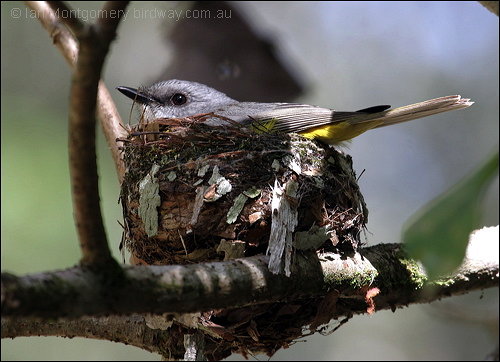
Eastern Yellow Robin (Eopsaltria australis) on nest by Ian

Eastern Yellow Robin (Eopsaltria australis) on nest by Ian


Lee’s Addition:

I think I will just let the Scriptures tell about the nests.

If a bird’s nest happens to be before you along the way, in any tree or on the ground, with young ones or eggs, with the mother sitting on the young or on the eggs, you shall not take the mother with the young; you shall surely let the mother go, and take the young for yourself, that it may be well with you and that you may prolong your days. (Deuteronomy 22:6-7 NKJV)

All the birds of the heavens made their nests in its boughs; Under its branches all the beasts of the field brought forth their young; And in its shadow all great nations made their home. (Ezekiel 31:6 NKJV)

Even the sparrow has found a home, And the swallow a nest for herself, Where she may lay her young— Even Your altars, O LORD of hosts, My King and my God. Blessed are those who dwell in Your house; They will still be praising You. Selah (Psalms 84:3-4 NKJV)

As an eagle stirs up its nest, Hovers over its young, Spreading out its wings, taking them up, Carrying them on its wings, (Deuteronomy 32:11 NKJV)

You who dwell in Moab, Leave the cities and dwell in the rock, And be like the dove which makes her nest In the sides of the cave’s mouth. (Jeremiah 48:28 NKJV)

Another parable He put forth to them, saying: “The kingdom of heaven is like a mustard seed, which a man took and sowed in his field, which indeed is the least of all the seeds; but when it is grown it is greater than the herbs and becomes a tree, so that the birds of the air come and nest in its branches.” (Matthew 13:31-32 NKJV)

Where the birds make their nests; The stork has her home in the fir trees. (Psalms 104:17 NKJV)

And Jesus said to him, “Foxes have holes and birds of the air have nests, but the Son of Man has nowhere to lay His head.” (Luke 9:58 NKJV)

See also – Birds of the Bible – Bird Egg Facts

Birds Illustrated by Color Photograhy Vol 1 May, 1897 No 5 - Cover

Birds Illustrated by Color Photograhy Vol 1 May, 1897 No 5 – Cover

Birds Illustrated by Color Photography – Revisited – Introduction

The above article is the first article in the monthly serial that was started in January 1897 “designed to promote Knowledge of Bird-Live.” These include Color Photography, as they call them, today they are drawings. There are at least three Volumes that have been digitized by Project Gutenberg.

To see the whole series of – Birds Illustrated by Color Photography – Revisited

*

(Information from Wikipedia and other internet sources)

Next Article – National Council of Women

Previous Article – Amateur Photography

*

Ad for Birds Illustrated by Color Photography, 1897

Ad for Birds Illustrated by Color Photography, 1897

Birds Vol 1 #4 – Amateur Photography

Flash Light Picture made with “Dexter” Camera

Flash Light Picture made with “Dexter” Camera

Birds Illustrated by Color Photography – Revisited

Vol 1. April, 1897 No. 4

*

Amateur Photography.


imga1
MATEUR PHOTOGRAPHY is the most delightful pastime one can indulge in. Aside from the pleasure and amusement derived, it cultivates the artistic taste, the love of nature, is a source of instruction, and may be made to serve many useful purposes. The “Dexter” is small, neat and compact. Makes pictures 312×312inches square and will produce portraits, landscapes, groups, interiors or flashlights equally as well as many higher priced cameras. Will carry three double plate holders with a capacity of six dry plates. Each camera is covered with black morocco grain leather, also provided with a brilliant finder for snap shot work. Has a Bausch & Lomb single acromatic lens of wonderful depth and definition and a compound time and instantaneous shutter which is a marvel of ingenuity. A separate button is provided for time and instantaneous work so that a twist of a button or pulling of a lever is not necessary as in most cameras. A tripod socket is also provided so that it can be used for hand or tripod work as desired. All complicated adjustments have been dispensed with so that the instrument can be manipulated with ease by the youngest amateur. Full and explicit instructions are sent with each camera. Send 5c stamps for sample picture and descriptive circulars.

Dexter Camera

Dexter Camera, 1897


Lee’s Addition:

Look how far we have come since 1897! What a difference between the Dexter and our Digital Cameras of today. I have added some links that give some of this history.

Dexter Camera – Historic Camera – History Librarium

Ted’s Photographics about old cameras

Could we not get the same reaction as the verse below if we look at a photo of ourselves and then put it away?

But be ye doers of the word, and not hearers only, deceiving your own selves. For if any be a hearer of the word, and not a doer, he is like unto a man beholding his natural face in a glass: For he beholdeth himself, and goeth his way, and straightway forgetteth what manner of man he was. (James 1:22-24 KJV)


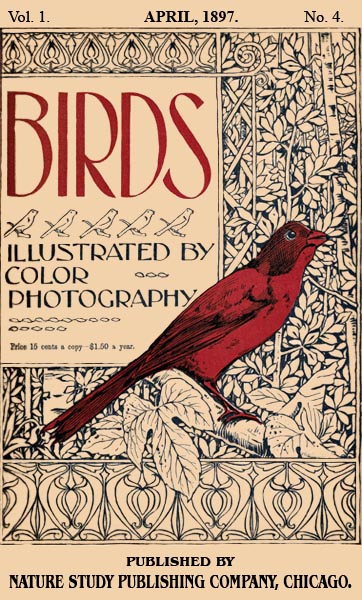
Birds Illustrated by Color Photograhy Vol 1 April 1897 No 4 – Cover

Birds Illustrated by Color Photography – Revisited – Introduction

The above article is the first article in the monthly serial for February 1897 “designed to promote Knowledge of Bird-Live.” These include Color Photography, as they call them, today they are drawings. There are at least three Volumes that have been digitized by Project Gutenberg.

To see the whole series of – Birds Illustrated by Color Photography – Revisited

*

(Information from Wikipedia and other internet sources)

Next Article – Nesting Time

Previous Article – The Arizona Green Jay

Wordless Birds

Links:

Dexter Camera – Historic Camera – History Librarium

Ted’s Photographics about old cameras


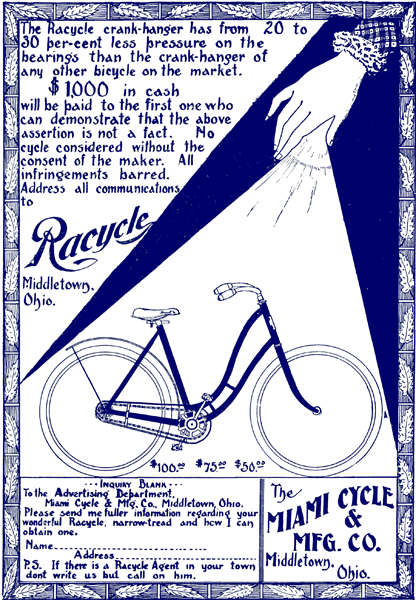
Ad for Birds Illustrated by Color Photography

Ad for Birds Illustrated by Color Photography

*

Birds Vol 1 #4 – The Piedbill Grebe

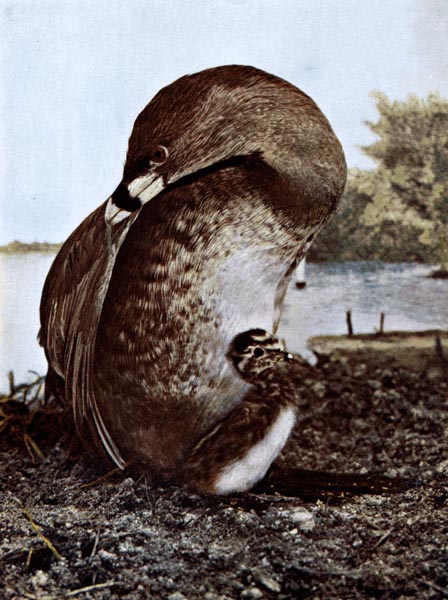
Pied-billed Grebe from Col F. M. Woodruff.for Birds Illustrated by Color Photography

Pied-billed Grebe from Col F. M. Woodruff.for Birds Illustrated by Color Photography

Birds Illustrated by Color Photography – Revisited

Vol 1. April, 1897 No. 4

*

THE PIEDBILL GREBE.

Boys and Girls:

This is the first time I’ve been on land for several weeks. I am sure you can’t think of any other kind of bird who can say that.

Sometimes I don’t go on land for months, but stay in the water all of the time—eat and sleep there, floating around.

My little chick wanted me to go on land so we could have our pictures taken.

If he were not sitting so close to me you could see better what paddles I have for feet.

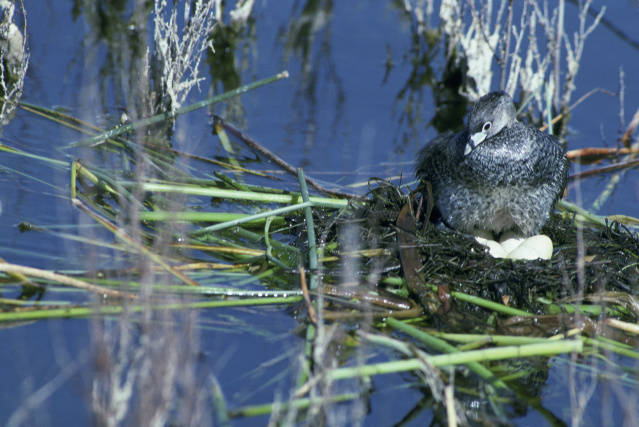
I build my nest of weeds, grass, sticks, and anything I can find floating around. I most always fasten it to some reeds or tall grass that grow up out of the water.

In this I lay the eggs and just as soon as the chicks come out of the shell they can swim. Of course they can’t swim as well as I and they soon get tired. Do you know how I rest them?

Well, it’s very funny, but I just help them up on my back and there they rest while I swim around and get them food. When they get rested they slide off into the water.

Are you wondering if I can fly? Well, I can fly a little but not very well. I can get along very fast swimming, and as I do not go on land often, why should I care to fly.

Should any one try to harm me I can dive, and swim under water out of reach.

Well, chick, let us go back to our home in the water.

Pied-billed Grebe (Podilymbus podiceps) nest ©USFWS

Pied-billed Grebe (Podilymbus podiceps) nest ©USFWS


THE PIEDBILL GREBE.

imgm

EMBERS of the family of Grebes are to be found in the temperate zones of both hemispheres, beyond which they do not extend very far either to the north or south. They are usually found on ponds or large sheets of stagnant water, sometimes on deep, slow-moving streams; but always where sedges and rushes are abundant. Probably there are no birds better entitled to the name of water fowl than the Grebes—at least, observers state that they know of no others that do not on some occasions appear on dry land. It is only under the most urgent circumstances, as, for instance, when wounded, that they approach the shore, and even then they keep so close to the brink that on the slightest alarm they can at once plunge into the water. Whatever they do must be done in the water; they cannot even rise upon the wing without a preliminary rush over the surface of the lake. From dry land they cannot begin their flight. Their whole life is spent in swimming and diving. They even repose floating upon the water, and when thus asleep float as buoyantly as if they were made of cork, the legs raised to the edges of the wings, and the head comfortably buried among the feathers between the back and shoulder. Should a storm arise, they at once turn to face the blast, and are usually able, with their paddle-like feet, to maintain themselves in the same place. They dive with great facility, and make their way more swiftly when under water than when swimming at the top. When flying the long neck is stretched out straight forwards and the feet backwards. In the absence of any tail, they steer their course by means of their feet. When alarmed they instantly dive.

Their food consists of small fishes, insects, frogs, and tadpoles. Grebes are peculiar in their manner of breeding. They live in pairs, and are very affectionate, keeping in each other’s company during their migrations, and always returning together to the same pond. The nest is a floating one, a mass of wet weeds, in which the eggs are not only kept damp, but in the water. The weeds used in building the nests are procured by diving, and put together so as to resemble a floating heap of rubbish, and fastened to some old upright reeds. The eggs are from three to six, at first greenish white in color, but soon become dirty, and are then of a yellowish red or olive-brown tint, sometimes marbled.

The male and female both sit upon the nest, and the young are hatched in three weeks. From the first moment they are able to swim, and in a few days to dive. Having once quitted the nest they seldom return to it, a comfortable resting and sleeping place being afforded them on the backs of their parents. “It is a treat to watch the little family as now one, now another of the young brood, tired with the exertion of swimming or of struggling against the rippling water, mount as to a resting place on their mother’s back; to see how gently, when they have recovered their strength, she returns them to the water; to hear the anxious, plaintive notes of the little warblers when they have ventured too far from the nest; to see their food laid before them by the old birds; or to witness the tenderness with which they are taught to dive.”

Pied-Billed Grebe at Lake Hollingsworth, Lakeland, FL by Dan

Pied-Billed Grebe at Lake Hollingsworth, Lakeland Young by Dan


Lee’s Addition:

So God created great sea creatures and every living thing that moves, with which the waters abounded, according to their kind, and every winged bird according to its kind. And God saw that it was good. (Genesis 1:21 NKJV)

Here is another of the Lord’s neat little birds that He has created and designed to live most of the time in water. I always enjoy watching the Grebes. They dive down and then pop up who-knows-where. They stay down awhile and travel underwater, as the article mentioned. Pied-billed Grebes are here in this area, central Flordia, year round.

The Pied-billed Grebe is small, stocky, and short-necked. It is 31–38 centimeters (12–15 in) in length, it has a wingspan of 45–62 cm (18–24 in) and weighs 253–568 grams (8.9–20.0 oz). It is usually brown or gray in color. It has a short, blunt chicken-like bill, which in summer is encircled by a broad black band (hence the name). It is the only grebe that does not show a white wing patch in flight. The sexes are monomorphic (meaning no sexual dimorphism). (Wikipedia)

They belong to the Grebes – Podicipedidae Family. It has 22 members. The ones in North America are:

Clark’s Grebe
Eared Grebe (Black-Necked) by Dave’s Birding Pix
Horned Grebe
Least Grebe
Pied-billed Grebe
Red-necked Grebe
Western Grebe

Birds Illustrated by Color Photograhy Vol 1 April 1897 No 4 – Cover


Birds Illustrated by Color Photography – Revisited – Introduction

The above article is the first article in the monthly serial for February 1897 “designed to promote Knowledge of Bird-Live.” These include Color Photography, as they call them, today they are drawings. There are at least three Volumes that have been digitized by Project Gutenberg.

To see the whole series of – Birds Illustrated by Color Photography – Revisited

*

(Information from Wikipedia and other internet sources)

Next Article – The Bohemian Wax-Wing

Previous Article – The California Woodpecker

Wordless Birds

Links:

Pied-billed Grebe – What Bird

Pied-billed Grebe – All About Birds

Pied-billed Grebe – Wikipedia

Ad for Birds Illustrated by Color Photography, 1897

Ad for Birds Illustrated by Color Photography, 1897

*

Birds Vol 1 #4 – The California Woodpecker

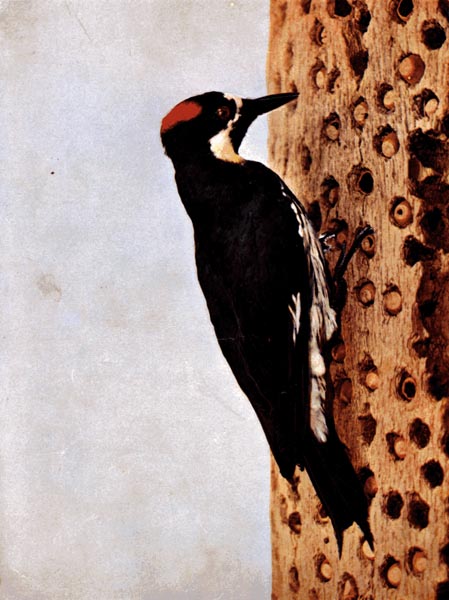
California Woodpecker for Birds Illustrated by Color Photography, 1897

California Woodpecker for Birds Illustrated by Color Photography, 1897

Birds Illustrated by Color Photography – Revisited

Vol 1. April, 1897 No. 4

*

THE CALIFORNIA WOODPECKER.

I may not be as pretty a bird as my red-headed cousin but I’m just as busy. My home is in the west among the pines on the mountains. I do not visit the east at all.

Of course I like insects and fruits just as my relations do, but I like best to eat acorns. You know, if I left the acorns on the trees and just got enough to eat at one time, after a while I would have a hard time finding any. They would drop off and roll away and get lost among the leaves and grasses. What would you do if you were I?

I have a very sharp bill, you see. So I can peck and peck at the tree until I have made a hole which will hold an acorn. Sometimes I fill my store house quite full in this way. You can see how they look in the picture. When I want to get at the meat in the acorn I drive the nut into a crack and split the shell. Then I have my breakfast easily enough.

Some of the other birds like acorns too—but I think they should find and store away their own and not try to take mine. I do not like to quarrel and so have many friends.

Then I have my nest to look after. I make it as my cousin does, by digging into a tree, first a passage way or hall—then a living-room. There are the four or five white eggs and there too soon are the little baby-birds to be taken care of. Now, have I not a great deal of work? Do you not think I am quite as busy as my cousin?

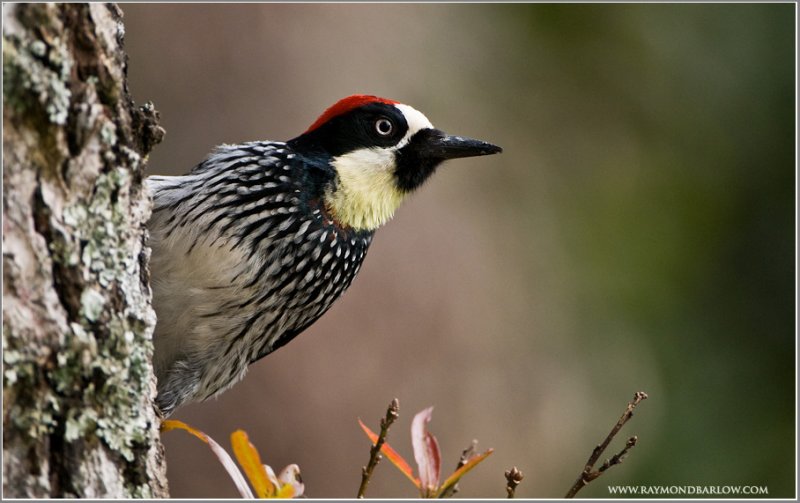
Acorn Woodpecker (Melanerpes formicivorus) by Raymond Barlow

Acorn Woodpecker (Melanerpes formicivorus) by Raymond Barlow


THE CALIFORNIA WOODPECKER.

imgt

HIS fine specimen of the Woodpecker is by far the most sociable representative of the family in the United States, and it is no unusual occurrence to see half a dozen or more in a single tree. It is also a well disposed bird, and seldom quarrels or fights with its own kind, or with smaller birds, but it attacks intruders on its winter stores with such vigor and persistence that they are compelled to vacate the premises in a hurry. Its manner of flight and call notes closely resemble those of the Red-Headed Woodpecker, and, like it, it loves to cling to some dead limb near the top of a tree and drum for hours at a time. It is one of the most restless of birds, and never appears to be at a loss for amusement, and no other bird belonging to this family could possibly be more industrious.

During the Spring and Summer its food consists, to some extent, of insects, including grasshoppers, ants, beetles, and flies—varied with cherries, apples, figs, berries and green corn. Acorns form its principal food during the greater portion of the year. Of these it stores away large numbers in the thick bark of pines, in partly rotten limbs of oak trees, telegraph poles, and fence posts. A writer in the “Auk” says of its habits: “It is essentially a bird of the pines, only occasionally descending to the cotton woods of low valleys. The oaks, which are scattered through the lower pine zone, supply a large share of its food. Its habit of hoarding food is well known, and these stores are the source of unending quarrels with its numerous feathered enemies. I have laid its supplies under contribution myself, when short of provisions and lost from the command on which I had been traveling, by filling my saddlebags with half-dried acorns from under the loose bark of a dead pine.”

The California Woodpecker is found in western Mexico, northern Lower California, and north through California into western Oregon. So far as is known the eastern limit of its range is the Santa Fe Mountains.

Its nest is usually from fifteen to twenty-five feet from the ground, excavated on the side of a branch of a good sized oak or sycamore. Breeding commences in April or May, according to locality. Both sexes assist in the excavation. The entrance hole is about one and three-fourths inches in diameter, perfectly circular, and is sometimes chiseled through two or three inches of solid wood before the softer and decayed core is reached. The inner cavity is greatly enlarged as it descends, and varies from eight to twenty-four inches in depth. The eggs rarely exceed four or five, and are pure white in color.

The most remarkable fact concerning this species is the peculiar manner in which it stores acorns. The thick bark of large sugar and other pines has been seen completely riddled with small holes. A section of a partly decayed oak limb, three feet two inches long and five and one-half inches in diameter, contained 255 holes. Each hole is intended to hold a single acorn. The acorns fit quite accurately, are driven in point foremost, and are not readily extracted. Sweet acorns are selected. To get at their contents the acorns are carried to a convenient tree where a limb has been broken off, driven into a suitable crevice, split open, and the outer hull removed. Truly the California Woodpecker is no idler or bungler, nor is he a free-booter, like the noisy, roystering Jay. He makes an honest living, and provides for the evil day which comes alike to man and beast.

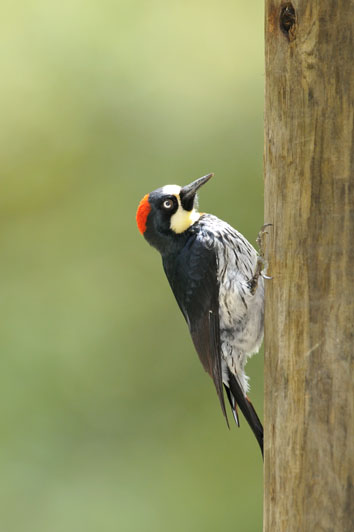
Acorn Woodpecker (Melanerpes formicivorus) by Reinier Munguia

Acorn Woodpecker (Melanerpes formicivorus) by Reinier Munguia


Lee’s Addition:

Look at the birds of the air, for they neither sow nor reap nor gather into barns; yet your heavenly Father feeds them. Are you not of more value than they? (Matthew 6:26 NKJV)

Go to the ant, you sluggard! Consider her ways and be wise, Which, having no captain, Overseer or ruler, Provides her supplies in the summer, And gathers her food in the harvest. (Proverbs 6:6-8 NKJV)

Wise people store up knowledge, But the mouth of the foolish is near destruction. The rich man’s wealth is his strong city; The destruction of the poor is their poverty. The labor of the righteous leads to life, The wages of the wicked to sin. (Proverbs 10:14-16 NKJV)

The adult Acorn Woodpecker  (Melanerpes formicivorus) is a medium-sized woodpecker and has a brownish-black head, back, wings and tail, white forehead, throat, belly and rump. The eyes are white.There is a small part on the small of their backs were there are some green feathers. The adult male has a red cap starting at the forehead, whereas females have a black area between the forehead and the cap. The white neck, throat and forehead patches are distinctive identifiers.When flying,they take a few flaps of their wings and drop a foot or so.You can see white circles on the wings while flying. Acorn woodpeckers have a call that is almost like they are laughing.

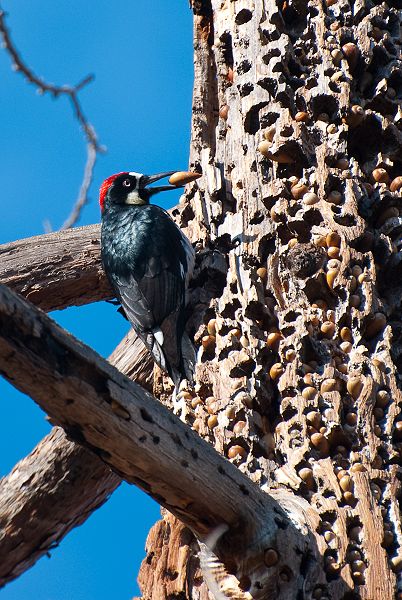
The breeding habitat is forested areas with oaks in the hills of coastal areas and foothills of California and the southwestern United States south to Colombia. Acorn woodpeckers, as their name implies, depend heavily on acorns for food. In some parts of their range (e.g., California), the woodpeckers create granaries or “acorn trees” by drilling holes in dead trees, dead branches, telephone poles and wooden buildings. The woodpeckers then collect acorns and find a hole that is just the right size for the acorn. As acorns dry out, they are moved to smaller holes and granary maintenance requires a significant amount of the bird’s time. They also feed on insects, sap, and fruit.

Acorn Woodpecker (Melanerpes formicivorus) with Hoard or Grainary WikiC

Acorn Woodpecker (Melanerpes formicivorus) with Hoard or Grainary WikiC

This bird is a permanent resident throughout its range. They may relocate to another area if acorns are not readily available. It is sedentary and very sociable. Acorn Woodpeckers like many other species are threatened by habitat loss and degradation. Competition for nest cavities by non-native species is an ongoing threat in urbanized areas. These include mature forests with oaks capable of producing large mast crops and places for the woodpeckers to nest, roost, and store mast. Residents are encouraged to preserve mature oak and pine-oak stands of trees and to provide dead limbs and snags for nesting,roosting and granary sites to help preserve the Acorn Woodpeckers population.

Walter Lantz is believed to have patterned the call of his cartoon character Woody Woodpecker on that of the acorn woodpecker, while patterning his appearance on that of the Pileated Woodpecker which has a prominent crest.

Woodpeckers belong to the Picidae Family which includes  woodpeckers, piculets, wrynecks, and sapsuckers. The family has about 200 species.

Birds Illustrated by Color Photograhy Vol 1 April 1897 No 4 – Cover

Birds Illustrated by Color Photography – Revisited – Introduction

The above article is the first article in the monthly serial for February 1897 “designed to promote Knowledge of Bird-Live.” These include Color Photography, as they call them, today they are drawings. There are at least three Volumes that have been digitized by Project Gutenberg.

To see the whole series of – Birds Illustrated by Color Photography – Revisited

*

(Information from Wikipedia and other internet sources)

Next Article – The Piedbill Grebe

Previous Article – Bird Day In The Schools

ABC’s Of The Gospel

Links:

Picidae – Woodpeckers Family

Piciformes Order

Acorn WoodpeckerWhat Bird

WoodpeckerWikipedia

*

Ian’s Bird of the Week – Eungella Honeyeater

Ian’s Bird of the Week – Eungella Honeyeater ~ by Ian Montgomery

Newsletter – 4/22/12

Well, team, many thanks, your moral and spiritual support have done it again: here is the Eungella Honeyeater, photographed last Friday after some diligent searching. The field guides say: ‘noisy, wary, elusive’ and that I would agree is a good description. I heard several at the first location (Chelmans Road, Upper Dalrymple) but got only a brief glimpse of one in the rather dense rainforest regrowth. The second location, Digging’s Road near Eungella, proved more productive and, as I walked back to the car, I eventually encountered a flock of ten or so crossing the road and got photos of a couple of them.

Were it not for its distinctive song, rather scratchy like a very loud gerygone I thought, it would be easy to overlook, given its rainforest habitat, and, dare one say, rather drab colours even if tastefully highlighted by blue eyes.

And overlooked it was until 1976. Or more accurately, any earlier records, such as one collected in 1959, of this bird from the little studied Eungella/Clarke Range area were mistakenly assumed to be the closely related wet-tropics endemic, the Bridled Honeyeater, see the third photo.
The Bridled Honeyeater is much larger – 20-22cm/8-8.7in versus 16-18cm/6.3-7.1in – has a yellow base to the bill and rather different head markings. Their songs are quite different, sufficiently so for someone rather deaf like me to distinguish them easily. Early field guides, such as the 1974 Slater’s, shows the range of the Bridled Honeyeater extending the 300km or so from the wet tropics down to the Clarke Range west of Mackay.
In 1975, during a survey by the Australian and Queensland Museums, another specimen was collected and labelled as a Bridled Honeyeater. The following year, Wayne Longmore was working on the Honeyeater collection at the Australian Museum and realised that not only was this bird not a Bridled Honeyeater – based on the colour of the bill – but that it didn’t correspond to any known species. He organised further field trips to the Clarke Range in 1978 and 1980 in search of the mystery bird and found that the species was relatively common in a restricted area of upland rainforest. It was described in 1983 by him and Walter Boles and named Meliphaga hindwoodi (now Lichenstomus hindwoodi) in honour of  Keith Hindwood, ornithologist and Wayne’s mentor. You can read the full story here. The fourth image shows the records from the BirdLife Australia Atlas Project.
So you don’t have to go to the wilds of Irian Jaya to discover new species of birds! What would you like next week?
Best wishes
Ian
**************************************************
Ian Montgomery, Birdway Pty Ltd,
454 Forestry Road, Bluewater, Qld 4818
Tel 0411 602 737 ian@birdway.com.au
Check the latest website updates:
http://www.birdway.com.au/#updates
**************************************************

Lee’s Addition:

I decided to produce this addition of Ian’s Bird of the Week in the exact format that I receive it. I am also happy that our collective prayers were answered for Ian’s latest adventure. The two Honeyeaters do look similar, but there is a difference. Thanks again, Ian, for letting us share in your birdwatching trips.

Then you will call upon Me and go and pray to Me, and I will listen to you. And you will seek Me and find Me, when you search for Me with all your heart. (Jeremiah 29:12-13 NKJV)

See Ian’s other Birds of the Week

*

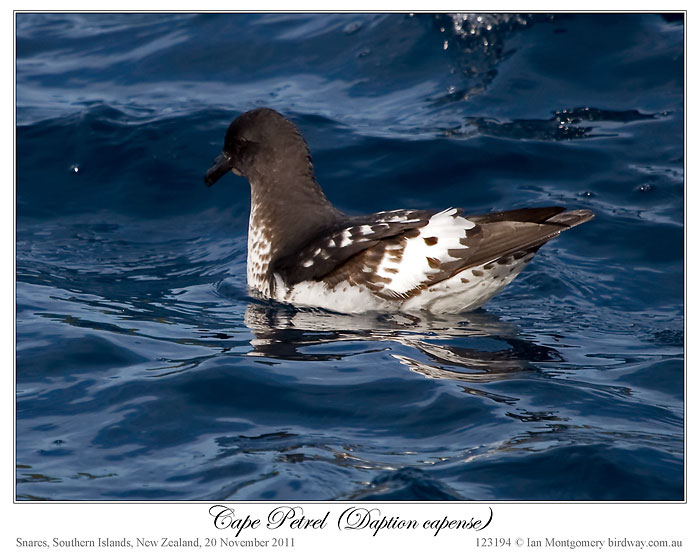
Ian’s Bird of the Week – Cape Petrel

Cape Petrel (Daption capense) by Ian 1

Cape Petrel (Daption capense) by Ian 1

Ian’s Bird of the Week – Cape Petrel ~ by Ian Montgomery

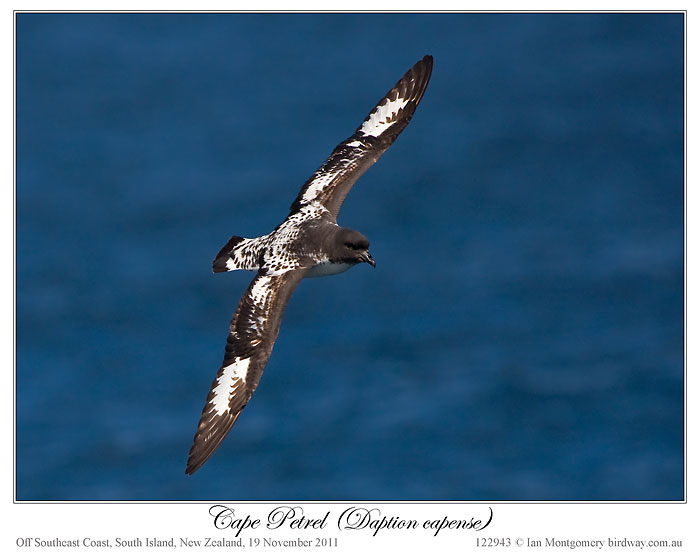
My records show that no Petrel and only one Shearwater (Buller’s) has ever featured as bird of the week. That’s partly because, until recently, I didn’t have many photos of members of this family of seabirds (Procellaridae) but that has been largely corrected by recent trips to the Sub-Antarctic and Norfolk Island. Petrels and Shearwaters are often challenging birds to identify, so I’m going to start with an easy and attractive one that featured prominently on the Sub-Antarctic Islands trip last November.

The striking chequered black and white pattern on the back and wings is unique. The white patches on the primary and secondary flight feathers are translucent and appears as ‘windows’ when seen from below in bright light, as in the second photo. We encountered Cape Petrels soon after leaving Dunedin, and as they follow ships, they were almost constant companions for most of the voyage.
Cape Petrel (Daption capense) by Ian 2

Cape Petrel (Daption capense) by Ian 2

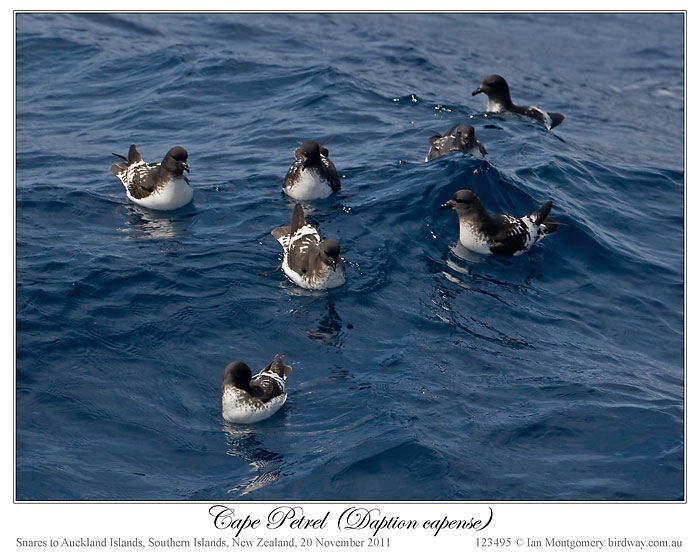
With a length of 35-40cm/14-16in, they’re comparable in size to a domestic pigeon, though with much longer wings, and are often called Cape Pigeons. They feed on krill, small fish, etc., either by swimming buoyantly on the surface and pecking in a rather pigeon-like fashion or by snatching morsels in flight. They’ll readily feed on marine scraps left by others and often follow whales.
Cape Petrel (Daption capense) by Ian 3

Cape Petrel (Daption capense) by Ian 3

As you can guess from the name, the species was originally named from a specimen collected at the Cape of Good Hope and described by the father of taxonomy, Linnaeus, in 1758. Cape Petrels are very characteristic bird of the southern oceans right around the planet and range from the coast of Antarctica to the Tropic of Capricorn, and even reach the equator in the cold Humboldt current on the western side of South America. They occur around Australia in the southern winter but are mainly an offshore bird, unless beach-wrecked by storms. The global population is in the millions, and they can occur in large flocks, though we encountered them mainly in small numbers.
Cape Petrel (Daption capense) by Ian 4

Cape Petrel (Daption capense) by Ian 4

The nest on most of the sub-Antartic Islands around the world and on islands along the coast of Antarctica itself. There is a small colony on Macquarie Island and larger colonies on the Southern Islands of New Zealand (Snares, Auckland, Campbell, Bounty, Antipodes and Chatham). These belong to a separate race, australe, smaller than the nominate race.
Cape Petrel (Daption capense) by Ian 5

Cape Petrel (Daption capense) by Ian 5

I loved watching them soaring and wheeling around the ship, and they looked as if they enjoyed it too. I got very used to their attendance and found their familiar presence reassuring in the vast and sometimes alien and stormy remoteness of the Southern Ocean.
I have another request for moral and spiritual support (and so far you’ve never failed me :-})! I’m planning to go to Eungella National Park west of Mackay next weekend in search of the Eungella Honeyeater. I’ve never seen it before, and we need photos for the Pizzey and Knight digital project.
Best wishes
Ian

*************************************************
Ian Montgomery, Birdway Pty Ltd,
454 Forestry Road, Bluewater, Qld 4818B
Tel 0411 602 737 ian@birdway.com.au
Check the latest website updates:
http://www.birdway.com.au/#updates
**************************************************


Lee’s Addition:

And unto one he gave five talents, to another two, and to another one; to every man according to his several ability; and straightway took his journey. (Matthew 25:15 KJV)

Looks like the Petrel flew under some dropping white paint. I am sure that it helped in IDing it. Ian is correct about that unique pattern. I am amazed at how unique all the birds were created. Each has its own patterns, food requirements and places to live. Just like all of us. We each have a unique niche to find and enjoy. Thankfully, Ian has found one of his niches. He is an adventurous and fantastic photographer.

Yes, Ian, we will be praying for you as you take this next adventure to find the Eungella Honeyeater and whatever else pops up in front of your lens. Also for your safe journey.

Check out Ian’s Procellaridae family and the article about the Buller’s Shearwater.

The Procellariidae – Petrels, Shearwaters Family here.

Ian’s Bird of the Week

*

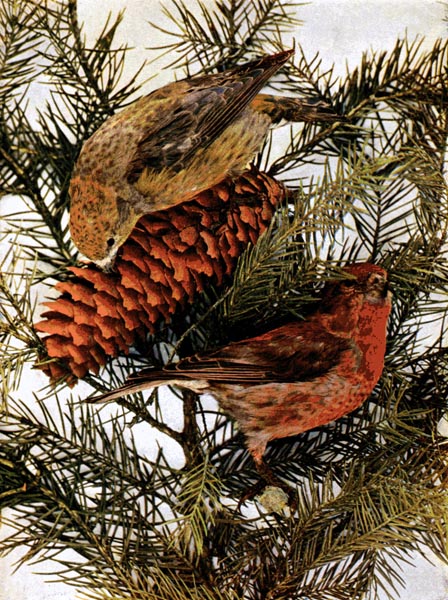
Birds Vol 1 #4 – The American Cross Bill and Legend

American Red Crossbill for Birds Illustrated by Color Photography, 1897

American Red Crossbill for Birds Illustrated by Color Photography, 1897

From Col. F. M. Woodruff

Birds Illustrated by Color Photography – Revisited

Vol 1. April, 1897 No. 4

*

THE AMERICAN CROSS BILL.

imga1

MERICAN CROSSBILLS are notable for their small size, being considered and described as dwarfs of the family. Their food consists exclusively of pine, fir, and larch, which accounts for the fact that they are more numerous in Northern latitudes where these trees abound. When the cones are abundant they visit in great numbers many places where they have not been for years, appearing at irregular intervals, and not confining themselves to particular localities. They are very social even during the nesting season. Their nests are built among the branches of the fir trees, and there they disport themselves gaily, climbing nimbly, and assisting their movements, as parrots do, with their beaks. They will hang downward for minutes clinging to a twig or cone, seeming to enjoy this apparently uncomfortable position. They fly rapidly, but never to a great distance. “The pleasure they experience in the society of their mates is often displayed by fluttering over the tops of the trees as they sing, after which they hover for a time, and then sink slowly to their perch. In the day time they are generally in motion, with the exception of a short time at noon. During the spring, summer and autumn they pass their time in flying from one plantation to another.”

The Crossbill troubles itself but little about the other inhabitants of the woods, and is said to be almost fearless of man. Should the male lose his mate, he will remain sorrowfully perched upon the branch from which his little companion has fallen; again and again visit the spot in the hope of finding her; indeed it is only after repeated proofs that she will never return that he begins to show any symptoms of shyness. In feeding the Crossbill perches upon a cone with its head downwards, or lays the cone upon a branch and stands upon it, holding it fast with his sharp, strong pointed claws. Sometimes it will bite off a cone and carry it to a neighboring bough, or to another tree where it can be opened, for a suitable spot is not to be found on every branch. The nest is formed of pine twigs, lined with feathers, soft grass, and the needle-like leaves of the fir tree. Three or four eggs of a grayish or bluish white color, streaked with faint blood red, reddish brown, or bluish brown spots, are generally laid. The following poem is quite a favorite among bird lovers, and is one of those quaint legends that will never die.


THE LEGEND OF THE CROSSBILL.

(From the German of Julius Mosen, by Longfellow)

On the cross the dying Saviour
Heavenward lifts his eyelids calm,
Feels, but scarcely feels, a trembling
In his pierced and bleeding palm.

And by all the world forsaken,
Sees he how with zealous care
At the ruthless nail of iron
A little bird is striving there.
Stained with blood and never tiring,
With its beak it doth not cease,
From the cross it would free the Saviour,
Its Creator’s son release.

And the Saviour speaks in mildness:
“Blest be thou of all the good!
Bear, as token of this moment,
Marks of blood and holy rood!”

And that bird is called the Crossbill,
Covered all with blood so clear,
In the groves of pine it singeth,
Songs, like legends, strange to hear.

But what saith it? The word is nigh thee, even in thy mouth, and in thy heart: that is, the word of faith, which we preach; That if thou shalt confess with thy mouth the Lord Jesus, and shalt believe in thine heart that God hath raised him from the dead, thou shalt be saved. For with the heart man believeth unto righteousness; and with the mouth confession is made unto salvation. (Romans 10:8-10 KJV)

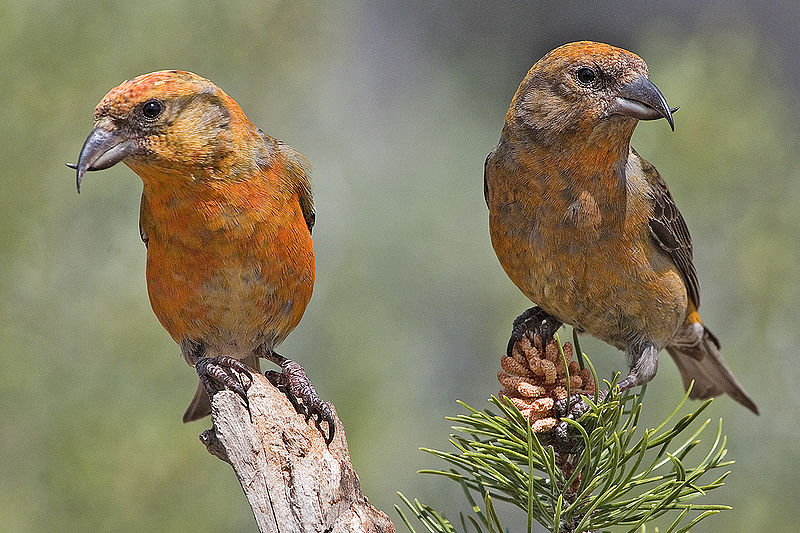
Red Crossbill (Loxia curvirostra) ©WikiC

Red Crossbill (Loxia curvirostra) ©WikiC


Lee’s Addition:

Also, to every beast of the earth, to every bird of the air, and to everything that creeps on the earth, in which there is life, I have given every green herb for food”; and it was so. (Genesis 1:30 NKJV)

The Lord has created another neat bird and provided it with a unique way to feed. This bird belongs to the Finch – Fringillidae Family and are characterised by the mandibles crossing at their tips, which gives the group its English name. Adult males tend to be red or orange in colour, and females green or yellow, but there is much variation. They have a length of 5.5-7.9 in (14-20 cm) and a wingspan of 9.8-10.6 in (25-27 cm) and they weigh .8-1.6 oz (24-45 g).

These are specialist feeders on conifer cones, and the unusual bill shape is an adaptation to assist the extraction of the seeds from the cone. These birds are typically found in higher northern hemisphere latitudes, where their food sources grows. They will erupt out of the breeding range when the cone crop fails. Crossbills breed very early in the year, often in winter months, to take advantage of maximum cone supplies.

Red Crossbill (Loxia curvirostra) Female ©WikiC

Red Crossbill (Loxia curvirostra) Female ©WikiC

Rather than a defect, as some claim, “the crossed bill is a wonderful adaption to the habits of these birds.  This design makes it possible for the seeds of fir cones from coniferous trees to be picked out with very little difficulty.  These seeds represent the Crossbill’s main food although apple pips are also a favoured treat.  These birds will also feed happily on insects and other fruit seeds in the winter, at which time they will travel in any direction on the compass to visit deciduous forests, gardens, flat plains and groves in search of food.” (Wonder of Birds)

“A crossbill’s odd bill shape helps it get into tightly closed cones. A bird’s biting muscles are stronger than the muscles used to open the bill, so the Red Crossbill places the tips of its slightly open bill under a cone scale and bites down. The crossed tips of the bill push the scale up, exposing the seed inside.” (All About Birds)

Birds Illustrated by Color Photograhy Vol 1 April 1897 No 4 – Cover


Birds Illustrated by Color Photography – Revisited – Introduction

The above article is the first article in the monthly serial for February 1897 “designed to promote Knowledge of Bird-Live.” These include Color Photography, as they call them, today they are drawings. There are at least three Volumes that have been digitized by Project Gutenberg.

To see the whole series of – Birds Illustrated by Color Photography – Revisited

*

(Information from Wikipedia and other internet sources)

Next Article – Bird Day In The Schools

Previous Article – Smith’s Painted Longspur

Wordless Birds

Links:

Crossbill – The Bird and its Unusual Bill by Wonder of Birds

Legend of the Crossbills

Fringillidae – Finches

Red Crossbill – All About Birds

Crossbill~ Common Crossbill ~ Two-barred Crossbill by Wikipedia

*

Birds Vol 1 #4 – Smith’s Painted Longspur

Smith's Longspur

Smith’s Longspur for Birds Illustrated by Col F. M. Woodruff

Birds Illustrated by Color Photography – Revisited

Vol 1. April, 1897 No. 4

*

SMITH’S PAINTED LONGSPUR.

imgs

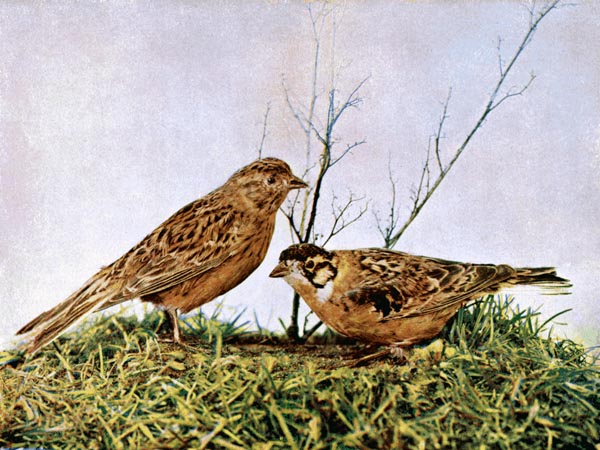
MITH’S Painted Longspur is usually considered a rare bird in the middle west, but a recent observer found it very common in the fields. He saw twenty-five on October 3rd of last year. They were associated with a large flock of Lapland Longspurs. On account of its general resemblance to the latter species it is often overlooked. It is found in the interior of North America from the Arctic coast to Illinois and Texas, breeding far north, where it has a thick, fur-lined, grass nest, set in moss on the ground. Like the Lapland Longspur, it is only a winter visitor. It is not so generally distributed as that species, the migrations being wholly confined to the open prairie districts. Painted Longspurs are generally found in large flocks, and when once on the ground begin to sport. They run very nimbly, and when they arise utter a sharp click, repeated several times in quick succession, and move with an easy undulating motion for a short distance, when they alight very suddenly, seeming to fall perpendicularly several feet to the ground. They prefer the roots where the grass is shortest. When in the air they fly in circles, to and fro, for a few minutes, and then alight, keeping up a constant chirping or call. They seem to prefer the wet portions of the prairie. In the breeding seasons the Longspur’s song has much of charm, and is uttered like the Skylark’s while soaring. The Longspur is a ground feeder, and the mark of his long hind claw, or spur, can often be seen in the new snow. In 1888 the writer saw a considerable flock of Painted Longspurs feeding along the Niagara river near Fort Erie, Canada.

The usual number of eggs found in a nest is four or five, and the nests, for the most part, are built of fine dry grasses, carefully arranged and lined with down, feathers, or finer materials similar to those of the outer portions. They are sometimes sunk in an excavation made by the birds, or in a tuft of grass, and in one instance, placed in the midst of a bed of Labrador tea. When the nest is approached, the female quietly slips off, while the male bird may be seen hopping or flying from tree to tree in the neighborhood of the nest and doing all he can to induce intruders to withdraw from the neighborhood. The eggs have a light clay-colored ground, marked with obscure blotches of lavender and darker lines, dots, and blotches of purplish brown. The Longspur is a strong flier, and seems to delight in breasting the strongest gales, when all the other birds appear to move with difficulty, and to keep themselves concealed among the grass. While the colors of adult males are very different in the Longspur family, the females have a decided resemblance. The markings of the male are faintly indicated, but the black and buff are wanting.


Smith's Longspur (Calcarius pictus) ©USFWS

Smith’s Longspur (Calcarius pictus) ©USFWS

Lee’s Addition:

Behold the fowls of the air: for they sow not, neither do they reap, nor gather into barns; yet your heavenly Father feedeth them. Are ye not much better than they? (Matthew 6:26 KJV)

“If you come across a bird’s nest in any tree or on the ground, with young ones or eggs and the mother sitting on the young or on the eggs, you shall not take the mother with the young. (Deuteronomy 22:6 ESV)

The Smith’s Longspur, Calcarius pictus, is a small ground-feeding bird from the family Calcariidae, which also contains the longspurs.
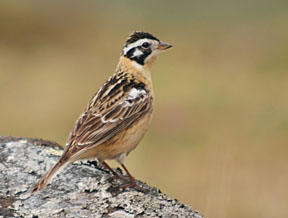
These birds have short cone-shaped bills, streaked backs, and dark tails with white outer retrices. In breeding state plumage (mostly formed by worn basic plumage), the male has pumpkin orange throat, nape, and underparts contrasting with an intricate black-and-white face pattern. The white lesser coverts are quite pronounced on a male in spring and early summer. Females and immatures have lightly streaked buffy underparts, dark crowns, brown wings with less obvious white lesser coverts, and a light-colored face. The tail is identical at all ages.
This bird breeds in open grassy areas near the tree line in northern Canada and Alaska. The female lays 3 to 5 eggs in a grass cup nest on the ground. These birds nest in small colonies; males do not defend territory. Both males and females may have more than one mate. The parents, one female and possibly more than one male, feed the young birds.

In winter, they congregate in open fields, including airports, in the south-central United States.

Migration is elliptical, with northbound birds staging in Illinois in the spring and southbound birds flying over the Great Plains in the fall.

These birds forage on the ground, gathering in flocks outside of the nesting season. They mainly eat seeds, also eating insects in summer. Young birds are mainly fed insects.
The song is a sweet warble that’s inflected at the end, somewhat reminiscent of Chestnut-sided Warbler. The call is a dry rattle, like a shorterned version of the call of a female Brown-headed Cowbird. It is noticebaly drier than that of Lapland Longspur.

Audubon named this bird after his friend Gideon B. Smith.

Birds Illustrated by Color Photograhy Vol 1 April 1897 No 4 – Cover

Birds Illustrated by Color Photography – Revisited – Introduction

The above article is the first article in the monthly serial for February 1897 “designed to promote Knowledge of Bird-Live.” These include Color Photography, as they call them, today they are drawings. There are at least three Volumes that have been digitized by Project Gutenberg.

To see the whole series of – Birds Illustrated by Color Photography – Revisited

*

(Information from Wikipedia and other internet sources)

Next Article – The American Cross Bill and The Legend 

Previous Article – The Purple Gallinule

ABC’s Of The Gospel

Links:

Smith’s Longspur – All About Birds

Smith’s Longspur– Wikipedia

Ad for Vol #4 - Birds Illustrated by Color Photography, 1897

Ad for Vol #4 – Birds Illustrated by Color Photography, 1897

*