We are introducing “Nuggets Plus” to our articles by ajmithra. We were chatting the other day, via Yahoo, and decided to use some of aj’s short little Nuggets of Truth that he has already written. He said that they were not all about birds and I reminded him that the Last Word of this blog’s name is “PLUS.” It was named that way so that other articles of interest could be added like creation or other animals, flowers, sunsets, etc.
A J Mithra, ajmithra as he prefers, lives in India and has been a regular contributor for several years. He has about 150 of these already written and will start posting them regularly. They are short, but have a “nugget of God’s Truth” tucked away in each of them. We may have our other writers add to them. Who knows the future, other than our Lord?
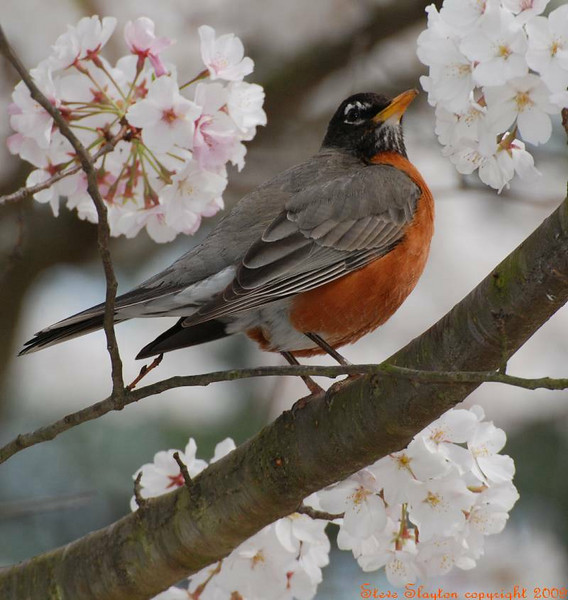
American Robin (Turdus migratorius) by S Slayton
American Robin – Singing Slayer..
American Robin
is the first among birds
to sing at dawn
and
the last in the evening
and
they band together
to drive the predator away!
Wanna drive the devil?
Worship at dawn
and at dusk
and together in trouble…
Worship the LORD your God, and his blessing will be on your food and water. I will take away sickness from among you, (Exodus 23:25)
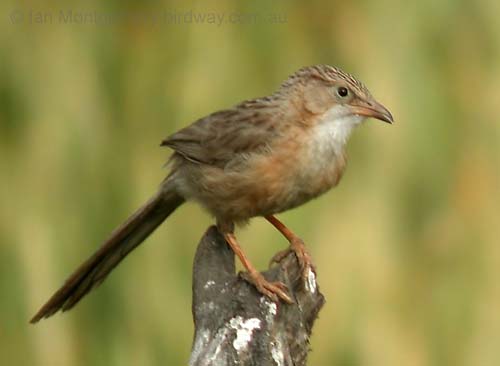
Rockrunner (Achaetops pycnopygius) by Keith Blomerley
By them shall the fowls of the heaven have their habitation, which sing among the branches. (Psalms 104:12 KJV)
From the verses below, you will see that the birds will be either:
in the trees
among the branches or foliage
between or in the midst of the rocks
Now that we have them placed, lets see how they are producing sound:
sing or singing
giving out a sound
utter or give forth a voice
chirp a song
lift up their voices
Psalms 104:12
(ABP+) by them the winged creatures of the heaven shall encamp; from between the rocks they shall give out a sound;
(ASV) By them the birds of the heavens have their habitation; They sing among the branches.
(BBE) The birds of the air have their resting-places by them, and make their song among the branches.
(Brenton) By them shall the birds of the sky lodge: they shall utter a voice out of the midst of the rocks.
(CEV) Birds build their nests nearby and sing in the trees.
(Darby) The birds of heaven dwell by them; they give forth their voice from among the branches.
(DRB) Over them the birds of the air shall dwell: from the midst of the rocks they shall give forth their voices.
(ERV) Wild birds come to live by the pools; they sing in the branches of nearby trees.
(ESV) Beside them the birds of the heavens dwell; they sing among the branches.
(GNB) In the trees near by, the birds make their nests and sing.
(GW) The birds live by the streams. They sing among the branches.
(ISV) Birds of the sky live beside them and chirp a song among the foliage.
(JPS) Beside them dwell the fowl of the heaven, from among the branches they sing.
(KJV) By them shall the fowls of the heaven have their habitation, which sing among the branches.
(KJV-1611) By them shall the foules of the heauen haue their habitation: which sing among the branches.
(LITV) over them the birds of the heavens dwell; they give voice from between the branches.
(MKJV) By them the birds of the heavens will have their place of rest; they sing among the branches.
(NAS77) Beside them the birds of the heavens dwell; They lift up their voices among the branches.
(NASB) Beside them the birds of the heavens dwell; They lift up their voices among the branches.
(NKJV) By them the birds of the heavens have their home; They sing among the branches.
(RV) By them the fowl of the heaven have their habitation, they sing among the branches.
(Webster) By them shall the fowls of the heaven have their habitation, which sing among the branches.
(YLT) By them the fowl of the heavens doth dwell, From between the branches They give forth the voice.
How do birds produce a song? Why are they singing?
“The distinction between songs and calls is based upon complexity, length, and context. Songs are longer and more complex and are associated with courtship and mating, while calls tend to serve such functions as alarms or keeping members of a flock in contact. Other authorities such as Howell and Webb (1995) make the distinction based on function, so that short vocalizations such as those of pigeons and even non-vocal sounds such as the drumming of woodpeckers and the “winnowing” of snipes’ wings in display flight are considered songs. Still others require song to have syllabic diversity and temporal regularity akin to the repetitive and transformative patterns which define music. It is generally agreed upon in birding and ornithology which sounds are songs and which are calls, and a good field guide will differentiate between the two.
Bird song is best developed in the order Passeriformes. Most song is emitted by male rather than female birds. Song is usually delivered from prominent perches although some species may sing when flying. Some groups are nearly voiceless, producing only percussive and rhythmic sounds, such as the storks, which clatter their bills. In some manakins (Pipridae), the males have several mechanisms for mechanical sound production, including mechanisms for stridulation not unlike those found in some insects.”
Anatomy – The avian vocal organ is called the syrinx; it is a bony structure at the bottom of the trachea (unlike the larynx at the top of the mammalian trachea). The syrinx and sometimes a surrounding air sac resonate to sound waves that are made by membranes past which the bird forces air. The bird controls the pitch by changing the tension on the membranes and controls both pitch and volume by changing the force of exhalation. It can control the two sides of the trachea independently, which is how some species can produce two notes at once.” (Wikipedia)
Why are they singing in the verse?
Psalm 104 is about blessing the Lord for all the things He has created and it describes different aspects of that creation. Light, water, clouds, foundations, the deep, mountains, springs, trees, grass, etc. The birds are singing after the springs are described in verse 10 and it gives drink to all. The trees are producing fruit, and the birds are making nest or resting in the trees. Then in verse 12 they are content and are singing. If your read the whole 104th Psalm, you just might find great cause to do your own singing and praising.
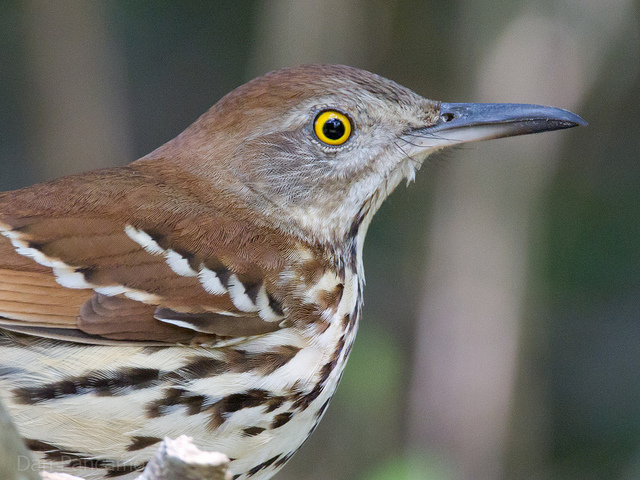
Brown Thrasher – The Singing Assasin.. ~ by a j mithra
The Brown Thrasher (Toxostoma rufum), sometimes erroneously called the Brown Thrush, is a bird in the Mimidae family, a group that also includes the New World catbirds and mockingbirds.
The Brown Thrasher is bright reddish-brown above with thin, dark streaks on its buffy underparts. Its long rufous tail is rounded with paler corners. Eyes are a brilliant gold.
God had created gold colored eyes for these birds but sadly most church goers have set their eyes on gold…
Achan set his eyes on gold and was stoned to death…
If the church had followed the same law, there would have been more requisition letters for death certificates than for birth certificates…
Let us set our eyes on our glorious God…
Set your affection on things above, not on things on the earth. (Colossians 3:2)
Adults average about 11.5 in (29 cm) long with a wingspan of 13 in (33 cm), and have an average mass of 2.4 oz (68 g). It is found in thickets and dense brush, often searching for food in dry leaves on the ground. Thrashers also enjoy the convergence of mowed to unmowed lawns, particularly if there are ample shrubs or shrubby trees, i.e., fruit orchards that the undergrowth is left undisturbed. It also enjoys perennial gardens and can be seen jumping from the ground to catch insects on flowers and foliage.
It is a partial migrant, with northern birds wintering in the southern USA, where it occurs throughout the year. The Brown Thrasher is considered a short-distance migrant, but two individuals have been recorded of this unlikely transatlantic vagrant in Europe: one in England and another in Germany.
This bird is omnivorous, eating insects, berries, nuts and seeds, as well as earthworms, snails, and sometimes lizards.
The Brown Thrasher is the official state bird of Georgia, and the inspiration for the name of Atlanta’s National Hockey League team, the Atlanta Thrashers
We are the official worshippers of the God who created heaven and earth….
This people have I formed for myself; they shall shew forth my praise. (Isaiah 43:21)
Brown Thrasher (Toxostoma rufum) by Judd Patterson
Its breeding range includes the United States and Canada east of the Rocky Mountains. The female lays 3 to 5 eggs in a twiggy nest lined with grass. The nest is built in a dense shrub or low in a tree. Both parents incubate and feed the young. These birds raise two or three broods in a year. Brown Thrashers leave the nest at only 9 to 13 days old, earlier than either of its smaller relatives, the Northern Mockingbird or Gray Catbird. Brown Thrasher likes to bath in the water and in the sand of the roads. It bathes in small paddles during the heat of the sun, and removes to the sandy paths to roll it, for drying its plumage and freeing it of insects.
They are able to call in up to 3000 distinct songs. The male sings a series of short repeated melodious phrases from an open perch to defend his territory and an aggressive defender of its nest, the Brown Thrasher is known to strike people and dogs hard enough to draw blood.
These birds exercise their singing talent to defend its territories..
God has created us to sing for His glory….
How, when and why do we exercise our singing?
It hurts to see Christian names use this talent to make money than to please God..
If not for their singing talent, they would’ve been discarded even by their own house hold…
If only the church could learn from these tiny birds to defend their territory, there would be more people singing for God than for money…
Remember, these birds sing about 3000 song…
Is it not a shame that we, whom God created to worship Him, don’t even sing a dozen a day?
But, still God chose to die for us and not for these birds,
I will extol the Lord at all times; his praise will always be on my lips. My soul will boast in the Lord; let the afflicted hear and rejoice. Glorify the Lord with me; let us exalt his name together. (Psalm 34:1-3)
Well, at least from now on rain or shine let us just sing, sing and sing all through our lives for the One who gave His life..
We don’t even have to strike the predator like how these birds do. Instead, just keep singing, as our singing has the power to bring God down from His throne and His presence would turn satan, the predator into a prey…
Hallelujah!
Submit yourselves therefore to God. Resist the devil, and he will flee from you. (James 4:7)
The Bible says,” But ask now the beasts, and they shall teach thee; And the birds of the heavens, and they shall tell thee” Job 12:6
Birds are the most beautiful of all creations… Aren’t they? Of course they are.. If we have the heart to learn, there is indeed so much that we can learn from them; from living an organized lifestyle with what little they have and the way they take themselves and their homes and kids in times of adversities… Above all, we can learn a lot about music, about music and the most important part played by music in its life….
Birds have never been to a university. But the fact is that, most of the universities around the world are behind birds, learning new things everyday about them.
Out of all that we can learn from birds, the most amazing habit is their singing, what the birders call as bird calls of bird songs. Singing is their habit and way of living, but for us, singing is a hobby and we try to earn a living out of it… Remember God had created us to worship..
Birds are the only creations which start their day with singing and end their day with singing… You know why birds sing at dawn? It is just that they want to advertise to this world that they are still alive..
We call ourselves as Christians.. But do we really have Christ in us? How many mornings did we advertise to this world that JESUS – THE LIFE dwells in us? If we don’t sing praises in the morning, we should definitely scan our heart and soul to see if we are dead or alive. For the Bible says,
The dead praise not the LORD, neither any that go down into silence. (Psalms 115:17)
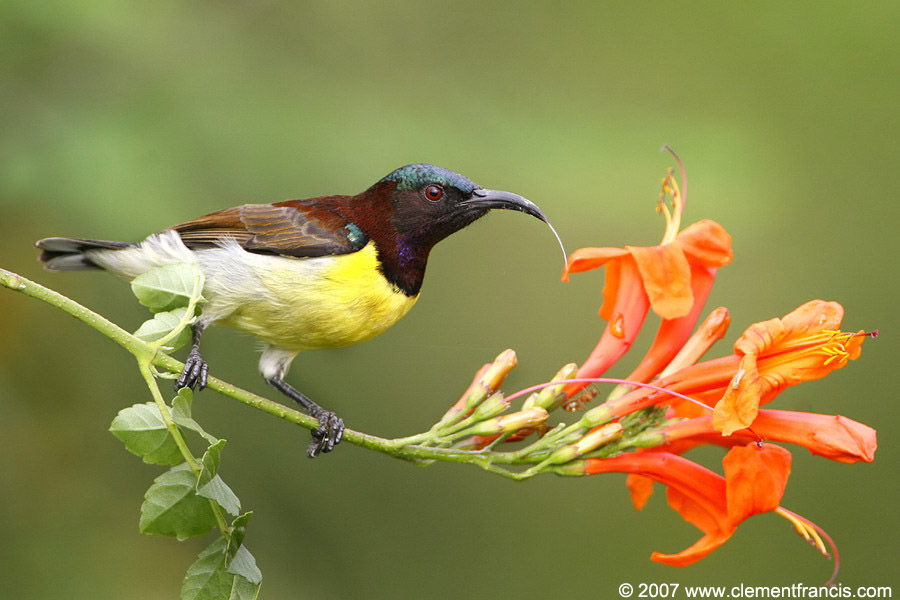
Oh! What joy they should have in their life to do so? A small Sun bird’s call can be heard as far as 300 to 400 meters. If a bird is as big as a human and if it sings,
Purple-rumped Sunbird (Leptocoma zeylonica) by Clement Francis
(PURPLE-RUMPED SUNBIRD)
its song can be heard as far as 3 to 4 kilometers… Well, that is what Ornithologists say… To sing that powerful, birds need lots of energy. Hence, they need to eat very often, because birds burn lot of calories on singing…
How loud do we sing in Church? Or do we sing at all in our personal prayer? Or do we act as if we are worshiping the Lord will all our heart in Church? Bible says, “Make a joyful noise,” it did not say voice, it says NOISE. Joshua and his men made NOISE and the fort of Jericho crumbled. Let us do it the Joshua way.
Maybe their early morning singing is the reason that they are able to fly hundreds of miles every day in search of food and water and yet returns home with so much of energy to end their day with another open-air concert … There is a saying which goes like this “Laughter is the best medicine.” Birds can’t laugh… Is that why they sing to show their joy? Where there is joy, there is strength… Prophet Nehemiah knew that secret that is why he says,
….: for the joy of the Lord is your strength (Nehemiah 8:10)
Is that the reason why the birds are so strong that they can fly and we can’t? Birds never go to a doctor because they know that their music can heal them… Music has the power to heal you know?
Kind David’s music healed King Saul isn’t it? Your worship can heal people’s body, mind and soul. After all, GOD has kept life and death in our tongue. Let us use it for HIS glory..
Well, how many of us start or dare to start our day with singing? Where there is singing there is joy and where there is joy there is strength… It sounds so simple isn’t it? And it’s not just simple but, it’s powerful too… Birds know this secret and that’s why they bring so much joy through their singing…
No matter what the situation is, it is time for us to start our day with singing, for the KING is returning very soon. If we do not have the practice of singing here, we would never be able to sing in heaven along with the angels.
Birds sing in perfect pitch and perfect rhythm… Musicians use a software called “NEUNDO” for recording and the default set for the Tempo is 120 BPM (beats per minute)… The rhythm of the song of most birds is set to the tempo of 120 BPM… It sounds as if they had invented NEUNDO…Isn’t it quite astonishing or amazing or whatever you may call it? The syncopation of bird songs has intricate patterns and most of them are new to men… They sing very short phrases compared to human singing, but, their syncopation has complicated but complete rhythmic patterns…
Once as I was birding, I saw a Chestnut-headed Bee-eater
Chestnut-headed Bee-eater (Merops leschenaulti) by Nikhil Devasar
(CHESTNUT-HEADED BEE-EATER)
perched on a dry tree. Suddenly the bird flew as far as about 50 meters and flew back to the same place where it was perched with a dragon-fly stuffed into its beak.. The dragon-fly was still alive. So, the little bird whacked its beak. Tak, tak, tak, tak, tak, five times on either side on the branch where it was perched to kill the dragon-fly all in one motion… Was just wondering, why it whacked five times… Then I found that, in music a rhythmic phrase always ends on the first beat of the next bar… Don’t we sing in a funeral? That’s what the Bee-eater did? Hm
they spontaneously sing complicated rhythmic patterns like a seasoned jazz player… Most composers avoid composing on 5/8 rhythm because of its limitation and the complications involved in the execution of a song in this rhythm…
from the Macaulay’s Library of Cornell’s lab of ornithology, sing in 5/8 rhythmic pattern… I felt so small in front of this small little bird when I heard that song… How it is possible for this little bird to sing in this one of the most complicated rhythmic pattern so spontaneously?
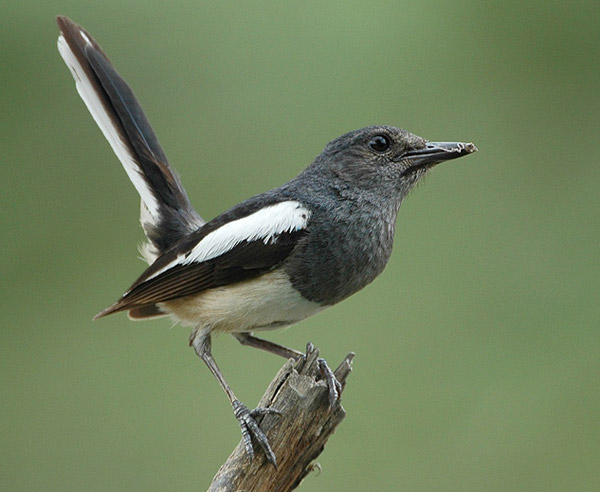
Each individual of Oriental Magpie Robin
Oriental Magpie-Robin (Copsychus saularis) by Nikhil Devasar
(ORIENTAL MAGPIE ROBIN)
can sing more than fifteen songs per individual and each one is different… Just imagine how much competition would be there to impress upon the females?
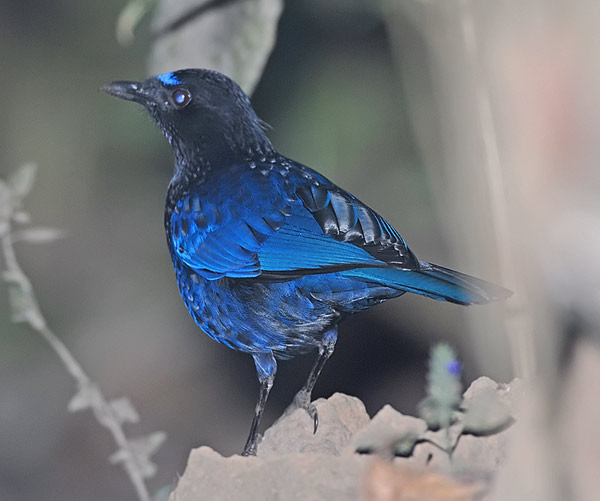
There are birds like the Malabar Whistling Thrush,
Malabar Whistling Thrush (Myophonus horsfieldii) by Nikhil Devasar
(MALABAR WHISTLING THRUSH)
which is considered as one of the best singers of the bird community… Bird call specialists say that you would mistake its singing for a human whistling a song… But, I personally feel that, that statement shows human ego… If I sound arrogant, please forgive me for that, because, I personally feel that the song of the Malabar Whistling Thrush or any other bird on planet earth is ORIGINAL… NO COMPARISONS PLEASE… Each bird’s songs are special and they know that too.. That is why birds never get jealous of each other’s singing… Do they?
Researchers say that, if a bird doesn’t learn to sing early, the percentage of survival is minimized… This means Birds sings for survival… The mother bird feeds the chick which shouts the most first… So, the louder you sing the more you eat…
God said,
I am the LORD thy God, which brought thee out of the land of Egypt: open thy mouth wide, and I will fill it. (Psalms 81:10)
Imagine if the same rule applies for mankind, how many of us would still be alive? Most would’ve starved to death and Churches would be empty isn’t it? How long are we going to zip our mouth in the presence of the Lord? Let us open our mouth and He shall open the windows of heaven and fill us and we shall over flow..
Birds sing to attract their mate… A bird which sings the best gets the most attractive mate… If again, the same rule applies to us, scores of us would still be bachelors isn’t it? If again, we don’t sing, our eternal bridegroom would never come near us. Because, our GOD dwells among our praises..
But thou art holy, O thou that inhabitest the praises of Israel. (Psalms 22:3)
Remember, most of us prefer to sing in the bathroom rather than in the church! We sing for applause, name, fame and money. If we start applauding, each time a bird sings, I wonder if any bird could live near us, for they will fly away and never venture to sing before a man again… But, Birds sing for the sheer joy of singing… When would we learn to live like them?
has a sound which resembles the wood block, a percussion instrument, which originated from Africa… Maybe the Africans were inspired by the bird’s call… There are tales after tales that say how man was inspired by nightingales and sparrows and cuckoos for their inspiring songs…
Birds never keep singing the same old songs all through their lives… To impress upon their mates they try to outwit their male subordinates by improvising their songs time and again… After all, female birds feel that, the males which sing the most complicated songs are the ones which are capable of taking care of their families better… Is that why, great teachers like Socrates and Pythagoras taught music first before they taught mathematics and astronomy?
King David knew God’s heart that is why he says,
I will sing a new song unto thee, O God: upon a psaltery and an instrument of ten strings will I sing praises unto thee. (Psalms 144:9)
We stop teaching our kids with rhymes than music; and that too only till the kindergarten level… If only we had been singing all through our lives, this world would’ve been rid of jealousy, ego, hatred, terrorism and the list may go on and on… If Osama Bin Laden had practiced music, he would’ve been a carrying a 4-stringed Oudh – an Arabian stringed instrument plucked with the Quill of an Eagle’s feather, instead of an AK47…
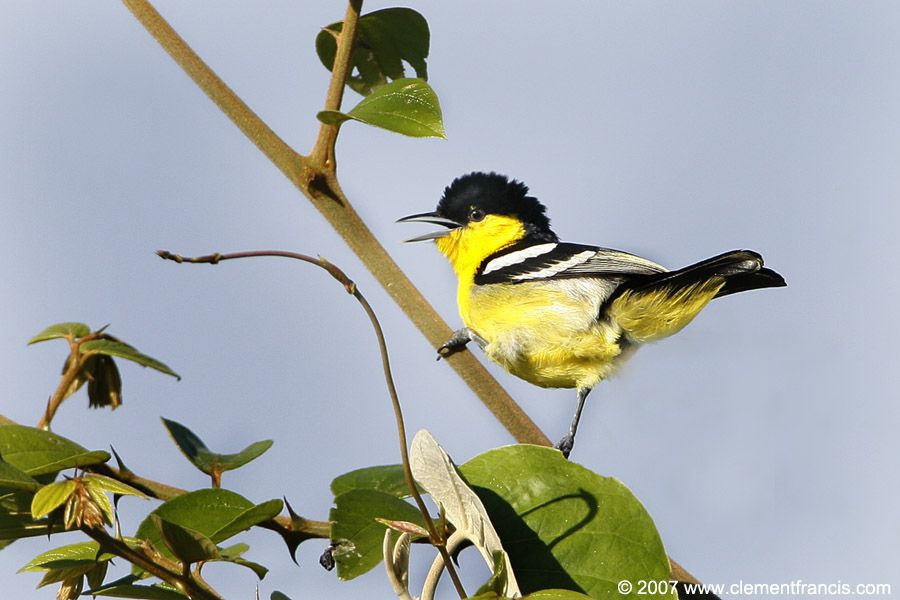
Birds live in perfect harmony not only among themselves but also with the flow of nature… Once I heard a territorial call of an Indian bird called Common Iora.
Common Iora (Aegithina tiphia) by Clement Francis
(COMMON IORA)
Each one was answering one another’s territorial calls. They both were singing similar phrase. Slowly, the calls turned a bit aggressive I thought; because, one was answering before the other could finish singing its phrase. At one particular point when one overlapped the other’s call, like what we call singing cannon in music, it turned into a harmony. As a musician, I know it was perfect harmony. But, I don’t know if it was intentional or accident. All that I heard was perfect harmony. They are in harmony with time and season. Rain or shine, no matter what happens around them the birds are able to sing.
Do we find harmony at home, in school, in our office, in our church? If only we knew the power of harmony, we Christians will not have thousands of denominations. If we knew the effect of harmony, by this time every soul would have accepted Christ as their savior… If we had learned to live in harmony, this world would be a better place to live.
A home or a street or a town or a city or a state or a country which encourages and practices music will live in PERFECT HARMONY… After all music is all about harmony and perfection of body, mind and soul… Most Christian families do not have family prayer and worship.. We think that Sunday worship in Church is suffice. Unless we live in perfect harmony at home, would it be possible to have harmony in the places where we go. Well, ministry starts at home.
It is because of us trying to move against the flow of nature that the world is facing severe biological catastrophe. If only we could learn to live in harmony with nature? This world would be the same as it was in the beginning. It may be too late and too hard to live in harmony with nature right now. But, we can surely postpone the inevitable to a certain extent. This can happen only when we unite together in harmony and save earth so that they Birds can sing and sing and sing forever and ever… Come on, rain or shine, let us all learn to sing like birds at all times and live in PERFECT HARMONY with GOD and HIS creations..…
(a j mithra wrote the article and Lee supplied some photos, videos and the sounds-not all recordings match his descriptions)
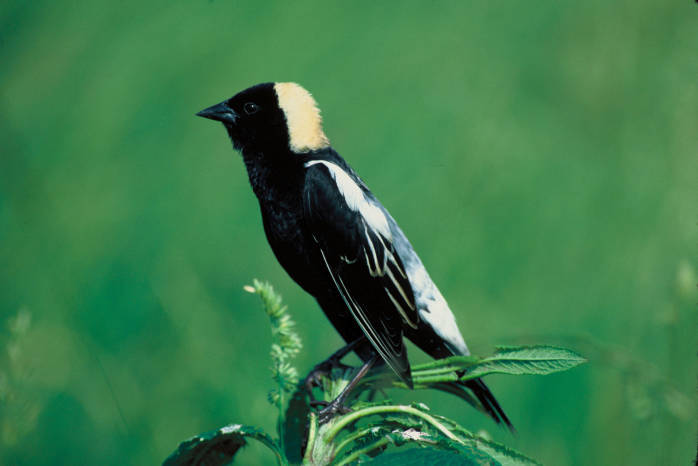
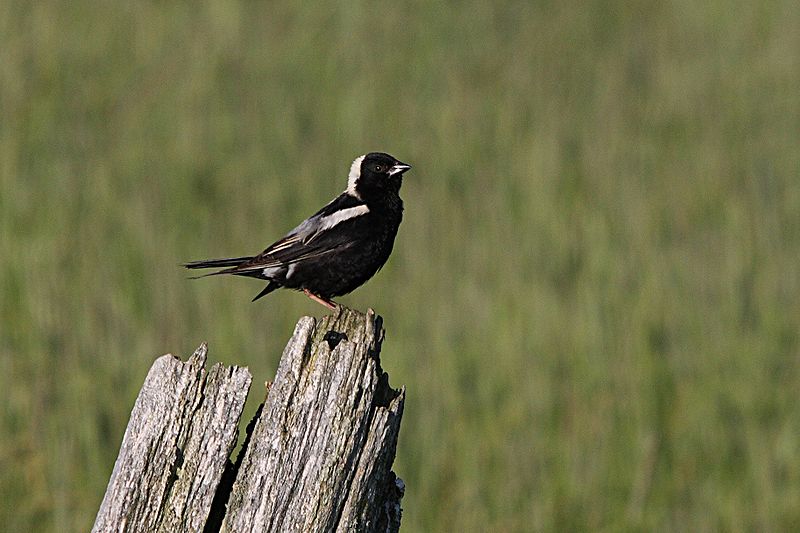
Rice bird, meadow-wink, skunk blackbird, reed bird, butter bird—these various names for the member of the blackbird family most commonly known as the Bobolink reflect the diversity of ways in which humans have looked upon this gregarious songbird.
Nesting in the prairies and cultivated land of south Canada and the northern United States and wintering in the grasslands and marshes of Argentina, the Bobolink migrates at least 5,000 miles each way.
The Bobolink is an extraordinary migrant, traveling to south of the equator each autumn and making a round-trip of approximately 20,000 kilometers (12,500 mi). One female, known to be at least 9 years old, presumably made this trip annually, a total distance equal to traveling 4.5 times around the earth at the equator! These birds migrate to Argentina, Bolivia and Paraguay. One bird was tracked flying 12,000 miles (19,000 km) over the course of the year, and up to 1,100 miles (1,800 km) in one day. The vast distance is more impressive in relation to the Bobolink’s diminutive size, averaging 7 inches in length, 11.5 inches in wingspan, and 1.5 ounces. in weight.
Feeling small?
Get ready to do greater things for God…
You know, God does not use boulders to stop the waves of the sea from entering the land..
But, He uses tiny grains of sand to do it..
God has designed this bird to travel long distances to encourage us that we too can do great and mighty things for God..
A little one shall become a thousand, and a small one a strong nation: I the LORD will hasten it in his time. (Isaiah 6:21)
God seems to have a liking to use small things to fulfill great missions..
He chose the small Miriam to find a way to take care of Moses..
He chose a small slave girl to bring healing to a Commander of an army..
He chose a little shepherd boy David to bring down a mighty giant..
He chose a small boy to feed the multitudes…
Here again, this small bird He uses to inspire us to do great things for God..
If this small bird can travel 4.5 times around the world at the equator in its life time, how much more God will expect from us? Most of rely on our strength that is the reason we find it so difficult to travel next door to share the gospel isn’t it?
What sense does it make to say, I can do all things through Christ who strengthens me when we find it so difficult to stand for God?
But be ye doers of the word, and not hearers only, deceiving your own selves. For if any be a hearer of the word, and not a doer, he is like unto a man beholding his natural face in a glass: For he beholdeth himself, and goeth his way, and straightway forgetteth what manner of man he was. But whoso looketh into the perfect law of liberty, and continueth therein, he being not a forgetful hearer, but a doer of the work, this man shall be blessed in his deed. (James 1:22-25)
Bobolinks begin their journey northward in South America in early March, reaching Colombia and Venezuela in late April. From there, most take a route over the Caribbean Sea to the Florida peninsula, although some will cross the Gulf of Mexico from the Yucatan Peninsula to Louisiana and Texas. From there they fan northward and westward, arriving on the breeding grounds in May. These Birds breed in open grasslands and hay fields.
Bobolinks migrate at night. The distinctive “clink” notes of these nocturnal travelers can be heard as they pass overhead in large flocks, apparently using the earth’s magnetic field as a compass and the locations of the stars as a map.
Human race boasts about technology, innovation and inventions…
We feel great pride in finding unknown routes with the help of satellites and compass…
But, these birds use the earth’s magnetic field as compass and locations of the stars as a map…
How difficult it is for us to tread on unknown path?
When we worship in church we feel so good to call Jesus as the Brightest Morning Star…
Do we really turn towards this Morning Star to seek direction in life?
Who is our inspiration in life?
If God be with us who can be against us? But the million dollar question is, are we with God?
Great in counsel, and mighty in work: for thine eyes are open upon all the ways of the sons of men: to give every one according to his ways, and according to the fruit of his doings: (Jeremiah 32:19)
In summer, Bobolinks feed primarily on insects switching to grain crops as they migrate south. In migration and in winter uses freshwater marshes, grasslands, rice and sorghum fields.
Although the Bobolink typically feeds during the day, in migration, while building fat reserves for its long over water flight, it has been observed feeding in rice fields after dark on bright nights.
We all know that we are on the verge of migrating once and for all to heaven..
Have we stored reserves to migrate that long?
His words has the power to heal the broken and strengthen the weak…
His words shall never return empty…
My son, forget not my law; but let thine heart keep my commandments: For length of days, and long life, and peace, shall they add to thee. Let not mercy and truth forsake thee: bind them about thy neck; write them upon the table of thine heart: So shalt thou find favour and good understanding in the sight of God and man.
Trust in the LORD with all thine heart; and lean not unto thine own understanding. In all thy ways acknowledge him, and he shall direct thy paths. Be not wise in thine own eyes: fear the LORD, and depart from evil. It shall be health to thy navel, and marrow to thy bones. (Proverbs 3:1-8)
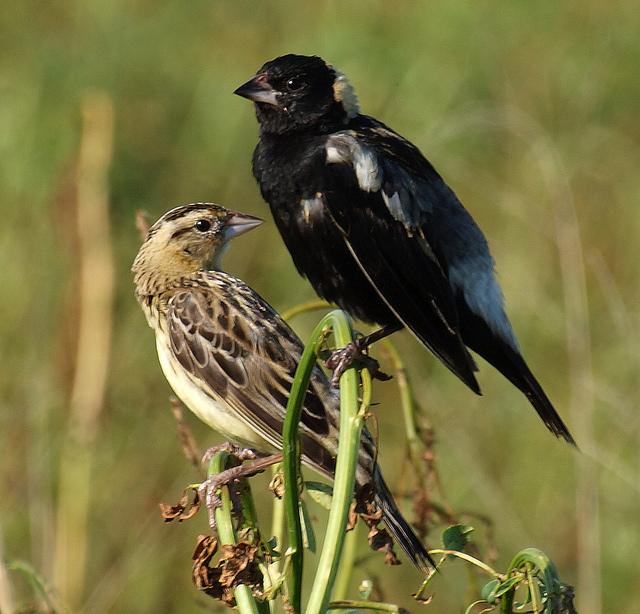
Bobolink (Dolichonyx oryzivorus) by J Fenton
How many times do we read His words in a day? Maybe we should learn from these birds to eat His words even during our dark hours.
Thy word is a lamp unto my feet, and a light unto my path. (Psalm 119:105)
Judging by sight or sound, the Bobolink is a bird of distinction. Their song has been vividly described as
“a bubbling delirium of ecstatic music that flows from the gifted throat of the bird like sparkling champagne,”
“a mad, reckless song-fantasia, and outbreak of pent-up, irrepressible glee,” and as
“a tinkle of fairy music, like the strains of an old Greek harp.”
We may not be a good singer, yet, God loves to hear us sing. The reason for creating us is to sing, glorify and thank Him. But, we seem to do every other thing except thanking Him… Many of our prayers are unanswered, because, we have failed to thank when we pray..
Be careful for nothing; but in every thing by prayer and supplication with thanksgiving let your requests be made known unto God. (Philippians 4:6)
Graceful Prinia (Prinia gracilis) by Nikhil Devasar
If they
do not eat well
the night before,
they would surely die…That’s why,
the birds sing
at dawn,
to advertise to the world
that,
they are still alive
and that,
they are ready to face
another tough day ahead
in life…
Did you sing
for the LORD
this morning?
Why I ask you this
is cos,
those who are dead
never sing..
Do they?
Wilt thou show wonders to the dead? shall the dead arise and praise thee? Selah. (Psalm 88:10)
Using bird songs to find the population of birds,
according to the team conducting the study of a
more accurate estimate of bird population numbers
is reached when using this technique.
The bird song used in the study that employed
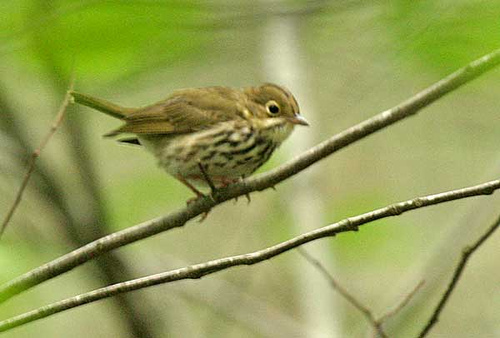
this latest technique is the Ovenbird, a small warbler found in North America.
Researchers gathered their data by recording the bird’s chirping.
Four microphones were used to record the birdsong
and the team combined the sound information and then
employed a computational method in which to convert
the recordings to give a more accurate estimate of the density
of the birds in certain areas..
If the same method is used in church, i am sure,
researchers would be fooled, cos,
we have more of silent churches than of singing churches..
But, Bible says,
O clap your hands, all ye people; shout unto God with the voice of triumph. (Psalm 41:1)
Most of us fail to understand that GOD loves our noise and not our voice..
JESUS did ground level ministry…
HE asked Zachaeus to come down from the tree
before offering to go with him to his house…
People feel proud to sing in the choir seated high above the ground..
Jonah praised from the whale’s belly and GOD delivered him.. (Jonah chapter 2)
Nebuchadnezzar praised from his lowly place
and GOD delivered him.. (Daniel chapter 4)
Don’t we need to learn to sing praises even from a lowly place
like these Oven birds?
Let us learn to sing not only from the ground
but also sing when we are aground…
A small, inconspicuous bird of the forest floor,
the Ovenbird is one of the most characteristic birds of the eastern forests.
Its loud song, “teacher, teacher, teacher,” rings through the summer forest,
but the bird itself is hard to see
Neighboring male Ovenbirds sing together.
When one male starts singing, the second will join in immediately after.
They pause, and then sing one after the other again, for up to 40 songs.
The second joins in so quickly that they may sound from a distance
as if only one bird is singing.
Ovenbirds rarely overlap the song of their neighbors…
Joshua and his men were silent for six days in unison
And they shouted together in unison…
Their oneness brought them victory…
Your silence at the presence of the LORD is worship you know?
Paul and Silas sang in unison and their praise shook the prison and broke their chains…
We have been singing in church for ages but still nothing of this sort
has happened..Why?
Is it because, we still overlap our neighbors’ song?
Is it because, we still haven’t learned to sing together as one like these birds?
For it is written, As I live, saith the Lord, every knee shall bow to me, and every tongue shall confess to God. (Romans 14:11)








 Lee's Birdwatching Adventures Plus