Instruct those who are rich in this present world not to be conceited or to fix their hope on the uncertainty of riches, but on God, who richly supplies us with all things to enjoy. (1 Timothy 6:17 NASB)
Well, today we finally got to go birdwatching for the first time in almost two months. With me being sick for almost a month and having rain for the last two weeks, we made a short visit today to Lake Hollingsworth in Lakeland. I am definitely not complaining about the rain. We have been in drought conditions here in central Florida. We have had 9 1/2 inches in our yard in the last two weeks. Our grass is finally green. The rain has refilled the lakes around here also. The picture I use at the top of the blog was taken at South Lake Howard Nature Park. Until the rains began, that stream was about 2 feet wide. It now looks like the picture again. Praise the Lord for the rain.
Here is a list of the birds we spotted today. On the drive to the lake we saw Ospreys, Cattle Egrets, 4 Wood Storks, a duck (mallard I think) with at least 10 babies in tow, a Great Egret, 10 Rock Pigeons and some Starlings.
Baby Geese by Dan
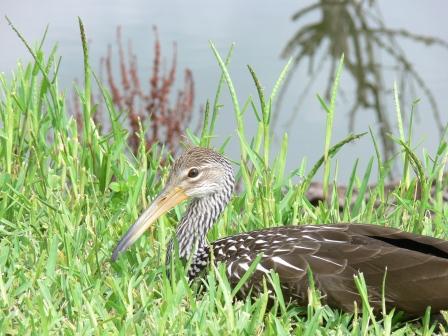
At the lake, I had to feed the local beggars, which I enjoy doing. And then I checked out the local birds which included – White Ibises, Osprey, Wood Ducks, Great Egret, Great Blue Heron, Anhingas, 5 Limpkins, Boat-tailed Grackles, Geese and their babies, Mallards and their babies, Common Moorhens and their babies, Fish Crow, Muscovys, Purple Gallinule and a Pied-billed Grebe. As we knew, all our winter visiting birds have all gone back north to raise their young and enjoy their summer. Lord willing, I’ll be awaiting them in the fall.
This video is of an Anhinga and then I zoomed in on the Limpkin. Just testing out the video part of my camera.
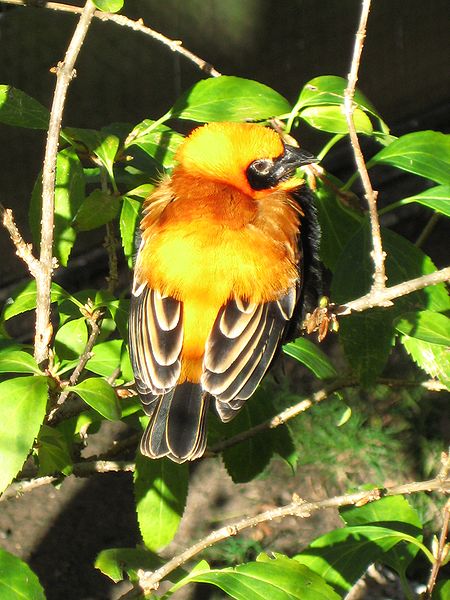
Weaver bird name for the Ploceidae, a family of Old World seed-eating birds closely resembling finches (hence the alternate name weaver finch). It includes a number of so-called goldfinches and waxbill finches that are actually weaver birds, rather than true finches of the family Fringillidae. The weavers are named for the highly complex woven nests built by many species, though others build only crude nests, and the parasitic widow weavers build no nests at all. Most weavers are sedentary, noisy, gregarious, and polygynous, with elaborate courtship rituals. Most weavers use grasses for the weaving of the nests which have an entry at the bottom.
The weaver group is divided into the buffalo, sparrow, typical, and widow weavers.
Sparrow-weavers – Of the 35 sparrow weavers the best known, and in fact one of the most widely distributed and familiar small birds in the world, is the English sparrow native to Europe, W Asia, and N Africa. It is the most successful town and city dweller among birds, and has followed European civilization wherever it has gone; it was introduced to North America in 1852. As common in Asia is the Eurasian tree sparrow (also introduced in the United States), a nuisance in rice fields and sold in great quantities for food. These birds build untidy domed nests with side entrances. Most specialized of the sparrow weavers is the White-browed Sparrow-weaver Chestnet-crowned Sparrow-weaver Chestnut-backed Sparrow-weaver Donaldson-Smith’s Sparrow-weaver
Social-weaver of Africa, famous for its apartment-house nest, in which 100 to 300 pairs have separate flask-shaped chambers entered by tubes at the bottom. They build these structures, which may be 10 ft (3 m) high and 15 ft (4.5 m) across, high in a sturdy tree, beginning with a roof of straw thatch. Of the 100 or more African and Asian typical weavers, the small quelea, only 5 in. (12.7 cm) long, sometimes causes huge crop losses in Africa by feeding on grain in flocks numbering as many as one million birds. Grey-headed Social-weaver Black-capped Social-weaver
Widow-weavers – The African widow weavers (named for the long, drooping black tail plumes of the breeding male), or whydahs, are notable for their selective parasitic nesting habits; they lay their eggs in the nests of waxbills, and their eggs are white, as are those of the waxbill, rather than spotted, as are those of all other weavers.
Many of the weaver family are kept as cage birds, especially the colorful waxbills (e.g., the Java sparrow, mannikin, munia, grenadier, cutthroat, and cordon-bleu, locust, parrot, Gouldian, and fire finches). Weaver birds are classified in the phylum Chordata , subphylum Vertebrata, class Aves, order Passeriformes.
Which doeth great things and unsearchable; marvelous things without number: (Job 5:9)
Evidence From Biology
“The largest known cooperative community of mammals spend their summers together inside Bracken Cave near San Antonio, Texas. During the day 20 million Mexican free-tailed bats raise their 20 million pups, while each night they gulp down an estimated 150 tons of insects! The bats winter in Mexico and mate in the spring. Then, for a reason unknown to scientists, only the females fly to Texas.
During their migration, the bats fly at 40 miles per hour at an altitude of eight to ten thousand feet. Once settled in at Bracken Cave, they become pregnant from the sperm of male bats which they have carried on the journey with them! Four month later each has a single pup. Although the cave’s one-room nursery has 20 million noisy pups, a mother bat released anywhere within the cave can find her own baby in as little as twelve seconds.
How marvelous is our God who created such wonders!”
From April 21 in “A Closer Look at the Evidence,” Kleiss – “Letting God Create Your Day,” Vol. 3, p.91
And they shall go into the holes of the rocks, and into the caves of the earth, for fear of the LORD, and for the glory of his majesty, when he ariseth to shake terribly the earth. In that day a man shall cast his idols of silver, and his idols of gold, which they made each one for himself to worship, to the moles and to the bats; To go into the clefts of the rocks, and into the tops of the ragged rocks, for fear of the LORD, and for the glory of his majesty, when he ariseth to shake terribly the earth.
(Isaiah 2:19-21 KJV)
The Comedy Barn in Tennessee has a comedian who brings people on stage from the audience. On this day, things did not go exactly as planned. The middle man begins laughing, and it goes from there. This is posted just for your enjoyment.
A merry heart doeth good like a medicine: but a broken spirit drieth the bones. (Proverbs 17:22)
I received this in an e-mail, and felt compelled to reproduce it here. It is worth viewing. It is on YouTube.
“Read the narrative before viewing.
If this does not give you goose bumps, you had better see a doctor.
This is an awesome music video… Featuring a special free-flying Bald Eagle named ‘Challenger’ (in honor of the lost space shuttle crew) cared for by the non-profit American Eagle Foundation (AEF).
He’s a ‘human socialized’ bird accidentally raised by the people who rescued him – after being blown from a wild Louisiana nest in a storm as a baby in the late 1980s. Declared ‘non-releasable’ by federal and state wildlife authorities, he was trained by the AEF to perform educational free-flight demonstrations at high profile public events.
He’s the first Bald Eagle in U.S. History that learned to free-fly into stadiums, arenas and ballrooms during the singing of the Star Spangled Banner. The celebrity eagle has appeared at numerous major sporting events… Like the World Series, Pro-Bowl, All-Star game, BCS National Championship, Fiesta Bowl and Men’s Final Four, etc.
Challenger has also flown before 4 U.S. Presidents! His life story is told in a children’s storybook titled ‘Challenger, America ‘s Favorite Eagle.’




 Lee's Birdwatching Adventures Plus