WHEN DOES GOD MAKE A COVENANT?
Hosea 2:14 says, “Therefore, behold, I will allure her, and bring her into the wilderness, and speak comfortably unto her” Did He not allure us and bring us from the wilderness of sin? He has been so kind to us that He still comforts us with His words, songs and above all with His presence and peace that passeth all understanding. What does this verse got to with the covenant? Hosea 2:16 has the answer to it. “And I will give her vineyards from there, and the valley of Achor for a door of hope: and she shall sing there, as in the days of her youth, and as in the day when she came up out of the land of Egypt.”
So? Does it not mean that we need to sing as in the days of our youth and as we sang when we came out of Egypt? Do we sing and worship the way we used to when we first met Jesus? Who would forget the day of salvation! The day when our hearts overflowed with the joy and peace that had never been experienced ever before! Do we have the same joy over the years?
Life has not been too kind for most of us. Battered and bruised we still are trying to come to terms with living a life that is pleasing unto God. During times of trouble, murmuring and self-pity takes our priority above singing and worshipping God. Look at the fowls of the air. Rain or shine they still keep singing like preset robots. No matter what kind of weather it is, the birds never stop their concert. Is God expecting this bird-kind of worship from us? Some of us may not know this bird-kinda worship. Here is how the birds sing.
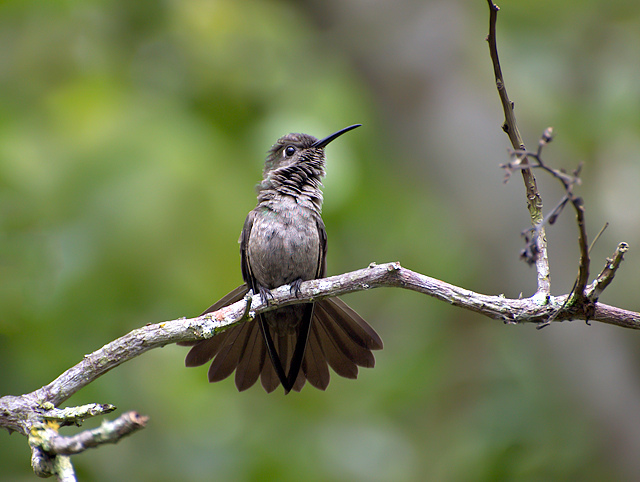
Sombre Hummingbird (Aphantochroa cirrochloris) By Dario Sanches
“Early Singer”
Dawn Chorus is part of every bird’s daily routine. They never venture out in search of food before they finish their dawn chorus. Do we dawn chorus everyday or just the morn-chorus every Sunday? Do we know why birds dawn chorus?
Since they use most of their energy in singing and flying, birds have to eat once in every ten minutes like the hummingbirds, to once in couple of hours like raptors, depending upon the species,. How much energy do we use in singing for God is another question which we may have to ponder a little late! Coming back to where we left, birds do not eat from dusk to dawn, which can be called as an everyday hibernation period. If birds don’t eat well the previous evening, the chances of staying alive to deliver the dawn chorus the next morn is very minimal. So they need to eat well to stay fit to render their dawn chorus so as to advertise that they are still alive.We boast that we worship Jesus – The Life, the way and the truth. But, do we advertise every dawn that we are still alive? God says, “I love those who love me; And those who seek me early shall find me” Proverbs 8:17.
“Those who seek me early shall find me”, which means those who don’t seek early shall not find isn’t it? How early do we seek Him? The Israelites had to collect the dew wrapped manna before sunrise, else manna would melt and they may have to starve for the day. “In the beginning was the Word, and the Word was with God, and the Word was God…… And the Word was made flesh, and dwelt among us, full of grace and truth.” John 1:1 & 14. The word of God is our daily manna. In other words, Jesus is our manna. Well, how many of us collect our daily manna before sunrise? Most of us are starving in spirit, is it because we seek God when the sun is over our heads? “Seek ye the LORD while he may be found, call ye upon him while he is near:” Isaiah 55:6
God expects a dawn chorus from us and not a morn chorus. Each new morn would be a great blessing, when we kneel before God before our feet touches the ground. And it would be even more blessing when we open our mouth wide to praise and worship our eternal Father before we actually utter the first word for the day. Light is better seen in the dark. Remember, that Jesus is the Light. He expects us to seek Him early and not yearly. May be God will make a covenant with us if we too start singing not just the Sunday morn chorus but the dawn chorus like birds,.
“Awake, psaltery and harp: I myself will awake early.” Psalm 108:2

Spectacled Spiderhunter (Arachnothera flavigaster) by Peter Ericsson
“High voltage Singer”
Coming back to the question, “How much energy do we use in singing for God?” posted in the previous paragraph; it isn’t fair, yet, there is no other choice but to compare our singing with the singing of the birds. The song of a 5-gram Black-bellied Sunbird or that of a 45-gram Spectacled Spiderhunter can be heard as far as 300 to 400 meters. If they are as big as the Homo sapiens, their songs can be heard as far as 3 to 4 kilometers. If at all we sing, how loud do we sing for God? Paul and Silas sang and the earth shook inside the jail. But, these days, the singing inside a church doesn’t seem to even reach the roof of the church.
The secret lies in the noise that we make for God. All those who shouted for the Lord found immense favour from the Him. The noise of Joshua and his men tore down the walls of Jericho. We should know the size of the walls of this mighty for, to comprehend the real power of praise. The Archeologists who excavated the burnt city, explain the walls of Jericho like this,
The fortifications of Jericho were massive.
These walls were structured on a three-tiered plan. The walls started with an earthen rampart, or embankment, which ran from ground level, upwards on an incline to a stone retaining wall. The stone retaining wall stood 12 to 15 feet in height (4-5m).
On top of the stone wall, stood another wall made of mud-bricks, 6 feet (2m) thick, and 20 to 26 feet (6-8m) high. Together, these two walls combined to form a fortification 32 to 41 feet high.
To put this into perspective, envision a 4 story tall building. Such was the height of the walls of Jericho.
On the other side of the double wall, the embankment continued to climb upwards. At the summit of the embankment, another mud-brick wall stood.
At their base, the walls of Jericho stood 46 feet (14m) above ground level outside the retaining wall. To the Israelites below, Jericho seemed impenetrable.
The illusion created by the two walls on the bottom, and the large wall at the crest of the embankment, seemed to stand nearly 10 stories in height from ground level! From this height, the Israelites must have seemed like ants, and surely were deemed no threat whatsoever.”
None of us would have faced an enemy as big as this fort of Jericho in all our life. In other words, our trials and tribulations would look much smaller compared to the walls of Jericho. If a mighty fort can buckle under the power of praise, will not our shouts of praise melt away our miseries and misfortunes? Sadly we don’t seem to use it to good effect: but birds do it with what little energy they have and that maybe the reason God chose to make covenant with them,
Maybe God will make a covenant with us if we too start singing loud like these little avian singers.
Shout to the Lord, all the earth. Psalm 100:1
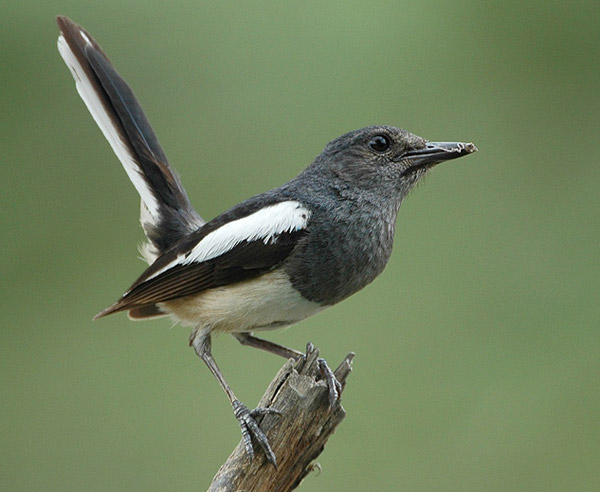
Oriental Magpie-Robin (Copsychus saularis) by Nikhil Devasar
“LP (Long Play) Singer”
There are birds that sing for long durations. Birds like grasshopper warbler’s solo may last for over two minutes, nightjars may “chur” nonstop for eight minutes, a skylark may belt an unbroken heartfelt song for 18 minutes and an Oriental Magpie Robins would practice singing for more than half an hour to woo a potential female. To establish territories and to court females there is a bird called Dickcissels that would spend about 70 percent of the day singing while establishing territories and courting females. How long do we sing and worship every day to woo God’s presence. For God loves to dwell among our praises and the Bible says it too.
But thou art holy, O thou that inhabitest the praises of Israel. Psalm22:3
From dawn to dusk to summer to winter, every little movement of the planets and the billions of stars, the blooming of the flowers and the fruiting of the trees, every tiny creation under the sky are set in perfect motion each following different rhythmic patterns ensuing perfect harmony. There can be no better musician that God Himself. He orchestrates the whole universe like only He alone can. And that is the reason God assigned Moses to do something which he has never done before.
Before bidding goodbye for the last time to the people whom he led from Egypt through the wilderness, Moses was entrusted the job of teaching a song to the Israelites that God had personally composed.
Now therefore write ye this song for you, and teach it the children of Israel: put it in their mouths, that this song may be a witness for me against the children of Israel.
For when I shall have brought them into the land which I swore unto their fathers, that floweth with milk and honey; and they shall have eaten and filled themselves, and waxen fat; then will they turn unto other gods, and serve them, and provoke me, and break my covenant.
And it shall come to pass, when many evils and troubles are befallen them, that this song shall testify against them as a witness; for it shall not be forgotten out of the mouths of their seed: for I know their imagination which they go about, even now, before I have brought them into the land which I swore.
Moses therefore wrote this song the same day, and taught it the children of Israel. Deuteronomy 31:19-22
Moses did teach God’s real big song immediately to his people and that can be found in Deuteronomy 32. How would our church respond if our pastor taught us that same big song? Faces frown when worship session extends beyond the stipulated time by a few minutes and if still continues for another few more minutes, worship turn to murmur. That is ‘cause most people find themselves so restless when it comes to spending that extra few minutes in the presence of God. We measure our praise and worship but we want immeasurable blessings from God.
Maybe God wants us to sing for longer durations like our flying friends so as to make a covenant with us…
“I will bless the Lord at all times: his praise shall continually be in my mouth.”Psalm 34:1
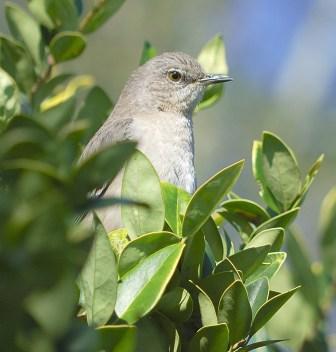
Northern Mockingbird (Mimus polyglottos) by Dan
“All Season Singer”
“Above it stood the seraphims: each one had six wings; with twain he covered his face, and with twain he covered his feet, and with twain he did fly.
And one cried unto another, and said, Holy, holy, holy, is the LORD of hosts: the whole earth is full of his glory” Isaiah 6:2-3
Since creation the Cherubs and Seraphs had been singing Holy, Holy, Holy, non-stop 24×7. I wonder how they don’t get bored singing the same song for thousands of years. Most birds sing the same family song generation after generation after generation. The Northern Mocking birds sing all through the day and many a time can be heard even during the night. These slender birds never seem to get bored with singing. They also continue to add new sounds to their repertoires all through their lives. Don’t be surprised if someone says that a male Northern Mocking bird would learn more than 200 songs in its lifetime. That is their lifestyle, singing new songs all through the day and even during nights. A single male would sing longer than a male that has a family.
We prefer to worship only when life is on a rollercoaster. Do we sing and praise God at all times, during dark times in particular? May be that is the reason why God had not made a covenant with us yet is it? The Catholic Bible says that Shadrach, Meshach and Abednego worshipped right inside the fiery furnace that was set to heat seven times more than normal. And our God who loves to dwell among praises descended down and took the three young men for a stroll right in the middle of the furnace. Wear on the garment of Praise and worship, for it is fire-proof you know! Think of Paul and Silas, who were battered and bruised for no fault and was thrown into the prison. Undeterred, they preferred to sing and praise God at the darkest hour. That’s when God shook the foundation of the prison, broke their bondage and also of the other inmates of the prison. Wear the garment of Praise and Worship and you will find that no chain can bind you or jail you…Hundreds of years passed between these two significant incidents. Sandwiched between those two incidents is another great worshipper is King David, who knew the secret of Praise and Worship and that is the reason he says, “I will bless the Lord at all times: his praise shall continually be in my mouth.” Psalm 34:1
Maybe God is waiting to hear us sing at all times to make a covenant with us..
“In every thing give thanks: for this is the will of God in Christ Jesus concerning you.” 1 Thessalonians 5:18

Brown Thrasher (Toxostoma rufum) By Dan’sPix
“New Song Singer”
Some birds sing just one song all through their lives. But there are birds that have vast repertoires of over thousands songs too… Brown thrasher can sing 2,000 songs while an Red-eyed Vireo had been recorded to have sung 20.000 songs in a day. Northern mocking birds often learn new songs. Sometimes it may end up learning about 200 new songs every year, during adulthood the male needs to improvise its singing capabilities by practicing for hours together to impress upon its probable mate. The male that sings the most complex songs are in demand among the eligible females. Most female prefer to mate with the male which sings the most complex songs since, she thinks that the male that sings the most complex songs is best suited to raise and look after the family.
Male Black-throated blue warblers that had bred and reproduced successfully would sing to its offspring to influence their vocal development. If young birds fail to learn songs from their fathers, they would starve to death. Bird vocalization is absolutely necessary for the young birds to grow into a successful adult.
How many parents take time to teach new songs to their children? How many parents feel that children should go to Sunday school regularly? Raising a child is not about feeding clothing and sheltering alone . It is about teaching them survival traits which would help them rise into a successful parent in future. Those survival traits include worship, prayer, tithing, knowledge in the word of God and so on. Do we teach them to sing for God? If we as parents fail to teach them the power of worship and how it can change any bad situation, who else would? We don’t have to be musically trained to teach them new songs. The least could be family prayer both at dawn and dusk. Wherein we have the habit of singing hymns and choruses that would help parents expose their children to new songs. If a father smokes in front of his children, he is sure to see one of them smoke in the near future. And if a mother gossips in front of her child, she would surely end up seeing her child gossip too. Do we want to define machismo and femininity by smoking and gossiping? What we are is what our children are going to be. The ones who learn to worship God singing new songs even in times of trouble are the ones who are capable of overcoming any situation, bad or worse.
God doesn’t expect us to sing the same song over and over again; we have a better choice to sing new songs every day. Our God says, “Behold, I will do a new thing; now it shall spring forth; shall ye not know it? I will even make a way in the wilderness, and rivers in the desert.” Isaiah 43:19. David knew the secret of touching God’s heart. Maybe that is the reason he made it a point to sing new songs for God. We may not sing thousands of song, do but do we have the habit of singing a few new songs for God? Is that the reason why God chose to make a covenant with birds instead?
“O sing unto the Lord a new song: sing unto the Lord, all the earth.” Psalm 96:1

Indian Scimitar Babbler (Pomatorhinus horsfieldii) ©WikiC
“Corporate Singer”
Birds neither have a worship leader nor a worship team to lead them in singing. They know God’s plan in their lives. They also know that God had created them to sing and so they sing. No matter what, rain or shine, they never cease to sing. They sing on time, the time that God had set for each one of them. They do not overlap their singing instead they share space even in their singing. Homo Sapiens love to talk, talk and talk 24×7. We talk about our family and finance, sports and corruption, love and sex, marriage and divorce. At the end of the day most of all that we spoke through the day is found to be just rubbish. But birds always talk about global warming, climate change and natural disaster.
Duetting among birds not only help them stay close to each other but also to locate each other in dense foliage. Initially this behavior was thought be a battle of sexes, where duetting behavior reflects the struggle between bonding pair. But recent studies show that duetting is not about singing romantic duets but it is all about aggressive audio warfare, where it bonds a potential pair in defending territorial invasion by other bonding pairs.
Jesus said, “For where two or three are gathered together in my name, there am I in the midst of them” Mathew 18:20. When two are three gather in His name do they fill the air with “gossip” or “worship?”
This people have I formed for myself; they shall shew forth my praise.” Isaiah 43:21
God created man to just worship. But, we do every other thing except worshipping. Worse still, man’s priorities shifted from worshipping the One to be worshipped to worshipping the worship or the worship leader or the choir or the musician. Most churches feel that it’s the talent of the worship leader or the worship team or the selection of songs that is crucial in pulling off a successful worship session. It is time for us to switch on the search lights and check on how we worship God. Do we worship God in truth and in spirit? Don’t we prefer this worship leader than that worship leader? Don’t we feel that this worship team is better than the other worship team? Did we not say that the presence of God is mightier when that guy sings or plays the keyboard? Are we spiritual Christians or emotional Christians? Most believers treat church as a concert hall rather than a place of worship. That must be the reason why they prefer to listen to worship rather than to participate in worship. The reason they give, “I don’t have a good voice” God doesn’t look for a good voice but for a joyful noise.
“Make a joyful noise unto the LORD, all the earth: make a loud noise, and rejoice, and sing praise.” Psalm 98:4
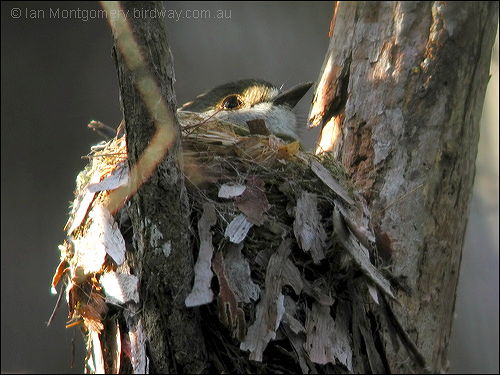
Pale-yellow Robin (Tregellasia capito) in nest by Ian
“Silent Singer”
Most birds do not sing all through the day. As told earlier, they have a set time for their everyday concert, what researchers call as “Bird clock”. They know when to sing and when to stay silent. Do we know when to stay still and when to worship? The Bible calls us as the “Royal Priesthood”. Bible explains the robe of the Royal Priest like this.
“Make the robe of the ephod entirely of blue cloth,
with an opening for the head in its center. There shall be a woven edge like a collar around this opening, so that it will not tear.
Make pomegranates of blue, purple and scarlet yarn around the hem of the robe, with gold bells between them.
The gold bells and the pomegranates are to alternate around the hem of the robe.” Exodus 28:31-34
The gold bells and the pomegranates that alternate around the hem of the robe show us how to live the life of a true worshipper. Bells make noise and pomegranates stay quite. In other words the alternate arrangement of gold bells and pomegranates seems to say that we need to know when to make a joyful noise and when to keep quite. Music is also an amalgamation of notes and pause. In other words music is not complete without pause. The birds know it well and help them sync so well with the bird clock. A royal priest also ought to know when to make noise and when to give a pause.
“And it shall be upon Aaron to minister: and his sound shall be heard when he goeth in unto the holy place before the Lord, and when he cometh out, that he die not.” Exodus 28:35
The sound of the bell should keep ringing while the priest is inside the holy place before the Lord. The sounds of the bells would die only if God slays the priest only after having found him to have sinned. This only substantiates the fact that we, the so-called royal priesthood need to make a joyful noise in His presence and if we don’t, it sounds like we are dead. We need to remember that, “The dead praise not the LORD, neither any that go down into silence.” Psalm 115:17.
Of all the languages, silence is the most powerful language on the face of the earth. Now that we know when to make noise, we also need to know when to pause too. The life of Jesus itself shows us importance of being still in silence. On more than one occasion Jesus did show us what silence can do. Jesus echoed the language of silence in the most profound mode on the cross of Calvary. If not for His silence, we would still be waiting for redemption. It was His silence that broke the shackles of sin to set us free from the clutches of satan. How silent are we in His presence? Do we take time to listen to Him or just go blah-blah in His presence?
Birds know when to sing their mating songs and when not to. They have a specific season for mating; unlike human beings whose birthday fall on every single day from January through December and that includes February 29th, the leap day too. Romancing for birds is seasonal, purposeful and decisive: whereas for Homo sapiens, it is more of lust than of commitment, a commitment to God’s eternal plans, per se. There is a season for everything. Do we adhere to God’s timing? In His time He makes all things beautiful and not in our time. Birds must be intrinsic to God’s time. That must be the reason for God to make a covenant with these feathered singers isn’t it?
“a time to tear and a time to mend, a time to be silent and a time to speak,” Ecclesiastes 3:7
*
Birds of the Bible – The Hidden Covenant ~ by AJ Mithra
(Written by A J – layout, photos, and sounds added by Lee)
See:
Birds of the Bible – The Hidden Covenant – Intro
Birds of the Bible – The Hidden Covenant – Part 3
*
Yours in YESHUA,
a j mithra
Please visit us at:
*








 Lee's Birdwatching Adventures Plus