Ian’s Bird of the Week – Slaty Flowerpiercers (and Hummingbirds)

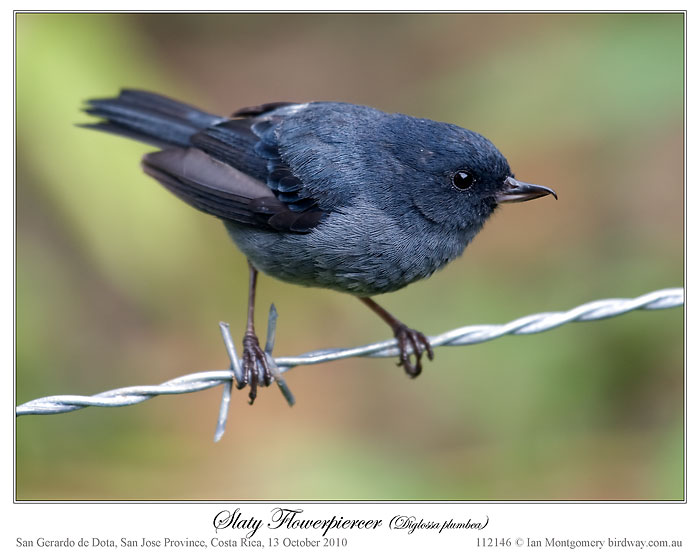
Slaty Flowerpiercer (Diglossa plumbea) by Ian

Slaty Flowerpiercer (Diglossa plumbea) by Ian

Ian’s Bird of the Week – Slaty Flowerpiercers (and Hummingbirds) ~ by Ian Montgomery

Newsletter ~ 12/02/10

Last week’s hummingbirds were popular so here, in a roundabout way, are some more. Flowers often have complex relationships with the animals (eg birds, moths) with which they interact and use them for pollination and distribution of seeds. Mutually beneficial (symbiotic) relationships may develop, such as exchange of nectar for pollination, that result in structural correspondences between species of flowers and animals, in particular the length of flower tubes and the length of the bills of hummingbirds and the probosces of months.

Slaty Flowerpiercer (Diglossa plumbea) by Ian

Slaty Flowerpiercer (Diglossa plumbea) by Ian

These relationships may exclude other species and this leads to cheating in various ways, either directly or indirectly. Flowerpiercers, such as the Slaty Flowerpiercer found in Costa Rica and named after the male of the species, first photo, cheat by using their specially adapted bills to bite through the flower tube to get at the nectar without helping with pollination. The female in the second photo shows how its done with the flower of a ginger plant.
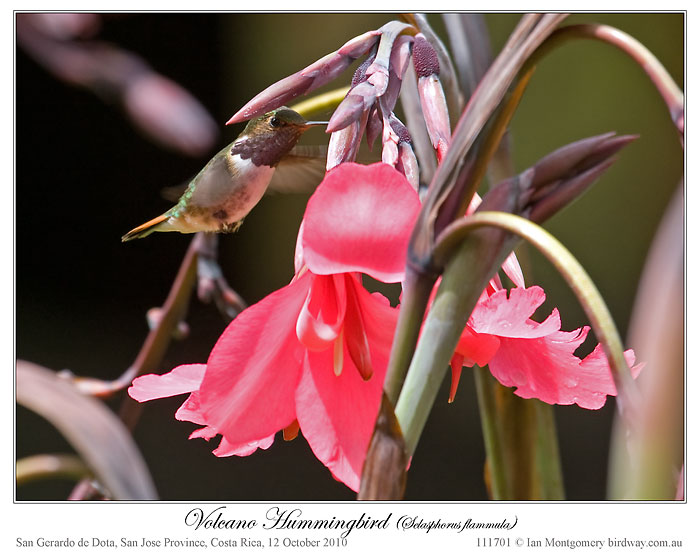
Volcano Hummingbird (Selasphorus flammula) by Ian

Volcano Hummingbird (Selasphorus flammula) by Ian

Some short-billed Hummingbirds do the same thing and stab the flower tube. Others, however, cheat indirectly and take advantage of the holes left by the flowerpiercers to sip the nectar. The tiny male Volcano Hummingbird (8cm/3.1in 2.5g) in the third photo is doing just that. Totally dwarfed by the ginger flower, it is hovering nearby and hasn’t had to land on the flower to stab it. The Volcano Hummingbird, incidentally, is a very close relative of the Scintillant Hummingbird of last week but has a violet rather than an orange gorget and is found, as its name suggests, at much higher altitudes. The vertical ranges of the two species just overlap at the 2,200m/7,200ft altitude of San Gerardo de Dota, the valley of the Quetzals.
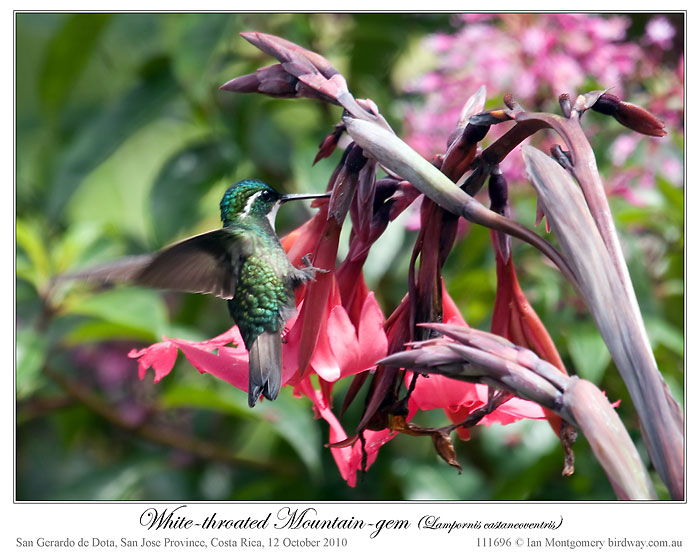
White-throated Mountaingem (Lampornis castaneoventris) by Ian

White-throated Mountaingem (Lampornis castaneoventris) by Ian

The much larger male White-throated Mountain-gem (11cm/4in 6.2g) in the fourth photo has actually landed on the ginger flower, so whether it has stabbed the flower or is also taking advantage of the Flowerpiercers isn’t obvious. They’re clearly versatile: the fifth photo shows another male feeding on an alien, almost petal-less, Bottlebrush in San Gerardo de Dota, the closest one is likely to get to an Australian Hummingbird!
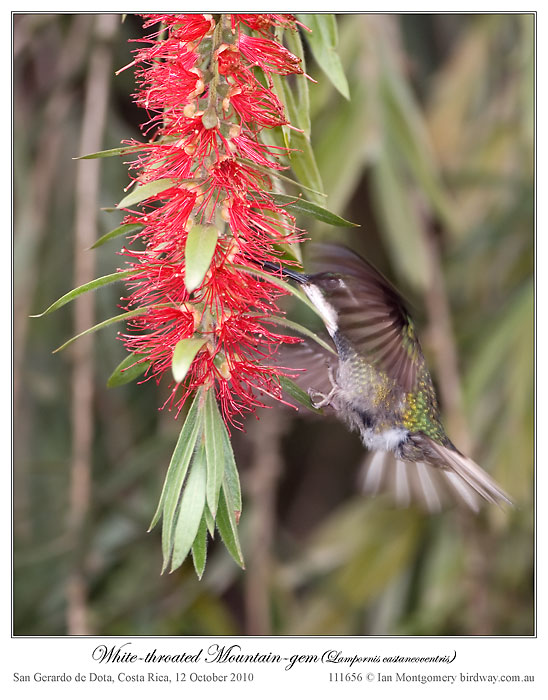
White-throated Mountaingem (Lampornis castaneoventris) by Ian

White-throated Mountaingem (Lampornis castaneoventris) by Ian

Links:
Flowerpiercers (members of the Tanager family)
Volcano Hummingbird
White-throated Mountain-gem

On the website, I’m getting towards the end of adding Costa Rican birds and have added quite a variety. You might like to check out Recent Additions: http://www.birdway.com.au/index.htm#updates .

Best wishes,
Ian


Ian Montgomery, Birdway Pty Ltd,
454 Forestry Road, Bluewater, Qld 4818
Phone: +61-7 4751 3115
Preferred Email: ian@birdway.com.au
Website: http://birdway.com.au


Lee’s Addition:

Now, Ian, how did you know I was just reading about the Flowerpiercers this week? Thanks for the beautiful photos and article about these birds.

Could it be that the flowerpiercers are not cheating, but just doing as they were designed to do. By poking those holes they are not only getting a drink but allowing the little guys to have access also to a meal of nectar. Such forethought!

All things were made by him; and without him was not any thing made that was made. (John 1:3 KJV)

While working on the Hummingbird and the Tanager pages, the Flowerpiercer again caught my eye like the Sword-billed Hummingbird had from Michael Woodruff photos. If too many of the hummers had those long beaks, there would be a lot of sore necks. So by having the flowerpiercers pierce a hole nearer to the nectar, there are many hummers that get to have shorter beaks and less neck aches!

The common name refers to their habit of piercing the base of flowers to access nectar that otherwise would be out of reach. This is done with their highly modified bills, although this is greatly reduced in the Bluish Flowerpiercer, which has an almost “normal” bill. Most flowerpiercers are restricted to highlands, especially the Andes, in South America, but two species occur in Central America.

There are 18 flowerpiercers in the Diglossa genus in the Tanagers & Allies – Thraupidae Family of the Passeriformes Order.

*
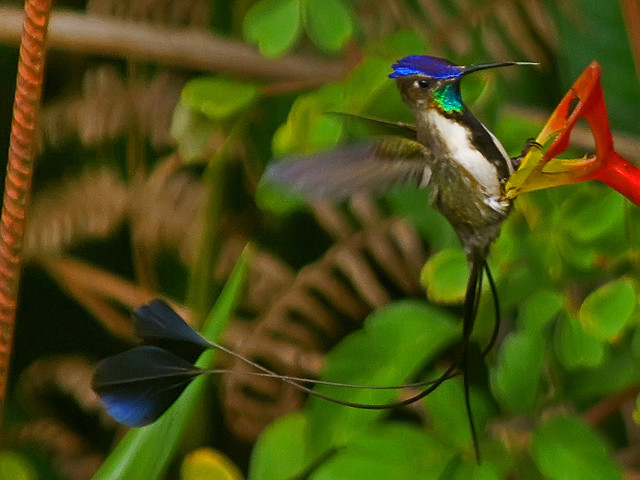
Marvelous Spatuletail from Peru

Marvelous Spatuletail (Loddigesia mirabilis)©©

Marvelous Spatuletail (Loddigesia mirabilis)©©

“Peru’s Marvellous Hummingbird

(from Creation Moments)

In that day the LORD of hosts will be for a crown of glory and a diadem of beauty to the remnant of His people. (Isaiah 28:5)

In 1835, when scientists first saw Peru’s most unusual hummingbird, they were so overcome with its beauty that they gave it the name “Marvellous.” This little bird treats the eye to iridescent green, yellow, orange, and purple feathers. But its most unusual feature is its tail. While most birds have eight to twelve tail feathers, the Marvellous hummingbird has only four. Two of these are long, pointed, thorn-like feathers that don’t seem to help much in flying or landing. The other two feathers are truly marvellous. They are six inches long, three times the length of the bird’s two-inch body. On the end of these two long narrow feathers are large feather fans that nearly equal the surface area of its wings.

Marvelous Spatuletail (Loddigesia mirabilis) ©©

Marvelous Spatuletail (Loddigesia mirabilis) ©©

Astonishingly, the Marvelous hummingbird has complete control of these feathers. At rest, the bird perches with these two feathers hanging down an inch or so from its body, and then crossing them until they are horizontal. In flight and landing they provide remarkable maneuverability. During mating, the hummingbird moves them as semaphores. Interestingly enough, evolutionists admit that they are stumped as to why these unusual feathers should have evolved.

One look at our creation clearly shows that our Creator appreciates beauty. But even the beautiful Marvelous hummingbird is but a poor and cloudy hint of the beauty of our Creator Himself.

Prayer:
Dear Father, help me treat the beauty You have created as You would have me to do. Let me be filled with thanksgiving to You for it, and let it remind me that You are the source of all that is truly beautiful. In Jesus’ Name. Amen.
Notes:
Crawford H. Greenewalt. The Marvelous Hummingbird Rediscovered. National Geographic, Vol. 130, No. 1. P. 98-101.”

©Creation Moments 2010


Lee’s Addition:

The Marvellous Hummingbird is now the Marvelous Spatuletail (Loddigesia mirabilis). It is in the Hummingbird Family (Trochilidae) and is part of the Apodiformes Order.

Marvelous Spatuletail (Loddigesia mirabilis) ©WikiC-Gould_Troch._pl._161

Marvelous Spatuletail (Loddigesia mirabilis) ©WikiC-Gould_Troch._pl._161

The Marvelous (also Marvellous) Spatuletail (hummingbird), Loddigesia mirabilis, is a medium-sized (up to 5.9 in/15 cm long) white, green and bronze hummingbird adorned with blue crest feathers, a brilliant turquoise gorget, and a black line on its white underparts. It is the only member of the monotypic genus Loddigesia.

A Peruvian endemic, this species is found in the forest edge of the Río Utcubamba region. It was first reported in 1835 by the bird collector Andrew Matthews for George Loddiges. The Marvellous Spatuletail is unique among birds, for it has just four feathers in its tail. Its most remarkable feature is the male’s two long racquet-shaped outer tail feathers that cross each other and end in large violet-blue discs or “spatules”. He can move them independently.

Information gathered from Creation Moments, Wikipedia, and YouTube.

Wordless Birds

*

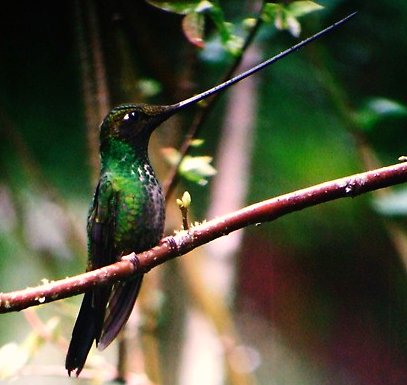
Formed By Him – Sword-billed Hummingbird

Sword-billed Hummingbird (Ensifera ensifera) by Michael Woodruff

Sword-billed Hummingbird (Ensifera ensifera) by Michael Woodruff

He loves righteousness and justice; The earth is full of the goodness of the LORD. (Psalms 33:5 NKJV)

The Lord has graciously outfitted a small, but unique hummingbird. The Sword-billed Hummingbird has an unusually long bill.

I came across this bird today while checking out photographs of our newest Photographer to give permission to use his fantastic photos. Michael Woodruff’s Photostream has some shots that have just taken my breath away today. Thanks, Michael, for the permission to use the great images that you have captured through your lenses.

When I first saw the Sword-billed Hummingbird, my first thought was why did God make it like that. There has to be a reason for that beak being so long. After investigating some, here are a few facts about this bird:

What is so unique about the Sword-billed Hummer is that it is noted as the only species of bird to have a bill longer than the rest of its body. This beak is used to feed on flowers with long corollas such as Passiflora mixta. The tongue is therefore also unusually long. God had a long flower that needed pollination and so He created a long billed hummingbird to get in that long tube. The bird gets the nectar, carries away pollen and the bird and flower both have their needs provided.

Passiflora mixta galupa - Suncrest Nurseries

Passiflora mixta galupa – Suncrest Nurseries

(From Suncrest Nurserises) “Passiflora mixta – A cool growing species with long tubed flowers that face outward and upward at a 45 degree angle. The color is a vibrant pink with white highlights. It is a large and vigorous grower and puts on an amazing show. The variety ‘Galupa’ has flowers that face outward and downward at a 45 degree angle and are a bit larger in overall aspect. A very beautiful species”

Because it’s beak is so long, it has to groom itself with it’s feet. The Sword-billed Hummingbird was created by an Omniscient Creator that knew it needed the long bill for the flowers, but also had to have a way to keep well groomed.

Keith Blomerley, one of our videographers, captured a Sword-billed Hummingbird perched on a tree and looking around. Another bird flies by.


Sword-billed Hummingbird (Ensifera ensifera)©WikiC

Sword-billed Hummingbird (Ensifera ensifera) is a species of hummingbird from South America and the sole member of the genus Ensifera. It is found in Bolivia, Colombia, Ecuador, Peru and Venezuela.

The total length can be 15 cm (6 in) and the bird can weigh 12 grams, making it one of the largest hummingbirds.

What an amazing hummingbird. The Hummingbirds are in the Apodiformes Order which includes not only the hummers (Trochilidae), but also Owlet-nightjars (Aegothelidae), Treeswifts (Hemiprocnidae) and Swifts (Apodidae).

For by Him all things were created that are in heaven and that are on earth, visible and invisible, whether thrones or dominions or principalities or powers. All things were created through Him and for Him. (Colossians 1:16 NKJV)

Updated 11/30/10:

Just received this note from Michael Woodruff about this article and thought I would attach it.

The Sword-billed Hummingbird is quite a bird. We saw two or three of them at the Yanacocha Reserve in the Andes of Ecuador. They were crazy to watch as they knew right where the end of their beak was, feeding out of the hummingbird feeders. It looked like quite a feat to balance that bill, but they were good at it!

Glad you’re enjoying the photos and it would be cool to hear which ones you end up using at some point. I think it’s great how you’re incorporating scripture verses on the pages. Awesome stuff.

Have a great week and hope you’re getting to feeling better.

Michael

*

Birds of the Bible – God’s Providence To His Creatures

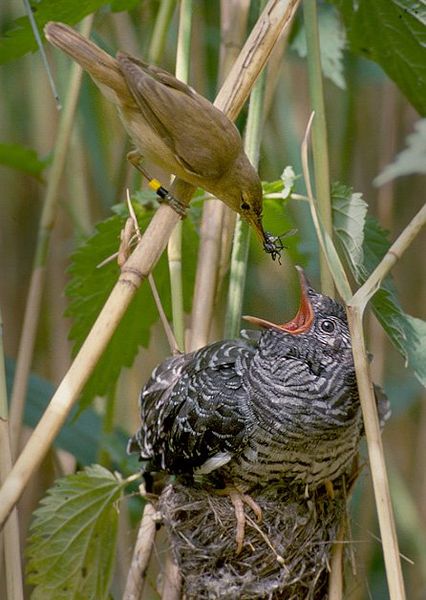
Common Cuckoo (Cuculus canorus) being raised by a Reed Warbler©WikiC

Common Cuckoo (Cuculus canorus) being raised by a Reed Warbler©WikiC

The LORD is good to all, And His tender mercies are over all His works. (Psalms 145:9 NKJV)

The following thoughts and verses are from R. A.Torrey’s Topical Textbook under the category of The Providence of God.

Preserving His creatures:

Lilian's Lovebird (Agapornis lilianae) by Africaddict

Lilian's Lovebird (Agapornis lilianae) by Africaddict

You alone are the LORD; You have made heaven, The heaven of heavens, with all their host, The earth and everything on it, The seas and all that is in them, And You preserve them all. The host of heaven worships You. (Nehemiah 9:6 NKJV)

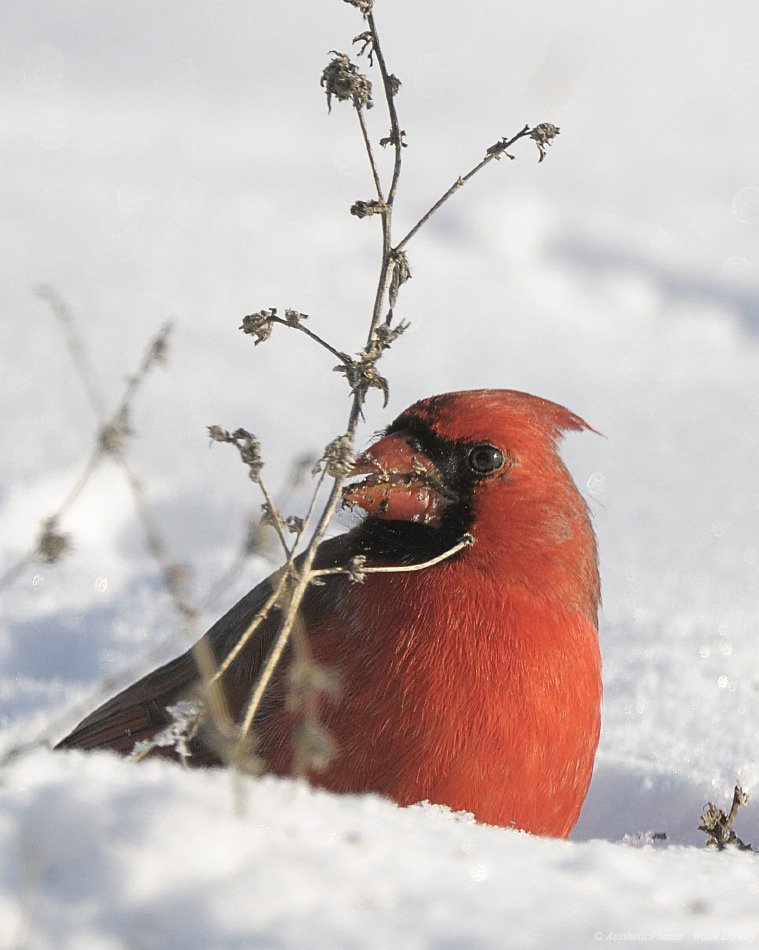
Northern Cardinal by Aestheticphotos

Northern Cardinal by Aestheticphotos

Your righteousness is like the great mountains; Your judgments are a great deep; O LORD, You preserve man and beast. (Psalms 36:6 NKJV)

House Sparrow (Passer domesticus) by Nikhil Devasar

House Sparrow (Passer domesticus) by Nikhil Devasar

Are not two sparrows sold for a copper coin? And not one of them falls to the ground apart from your Father’s will. (Matthew 10:29 NKJV)

Providing for His creatures:

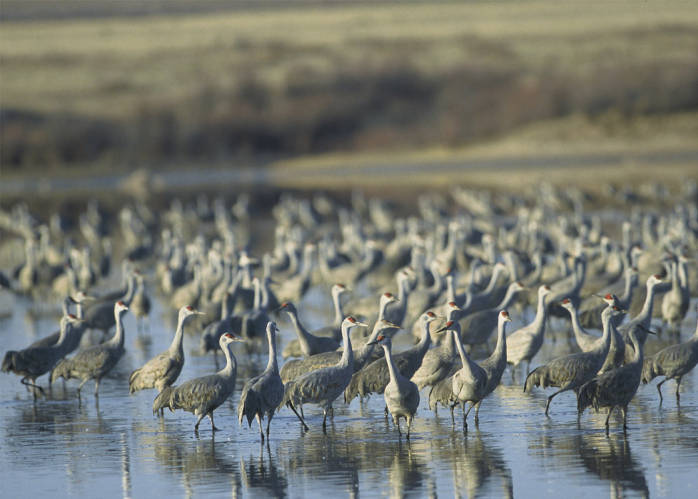
Sandhill Crane (Grus canadensis) flock ©USFWS

Sandhill Crane (Grus canadensis) flock ©USFWS

These all wait for You, That You may give them their food in due season. What You give them they gather in; You open Your hand, they are filled with good. (Psalms 104:27-28 NKJV)

Western Great Egret (Ardea alba) With Fish by AestheticPhotos

Western Great Egret (Ardea alba) With Fish by AestheticPhotos

Who giveth food to all flesh: for his mercy endureth for ever. (Psalms 136:25 KJV)

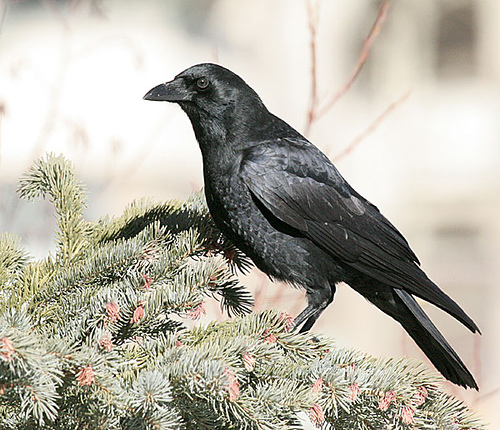
Northern Raven (Corvus corax) by Ray

Northern Raven (Corvus corax) by Ray

He giveth to the beast his food, and to the young ravens which cry. (Psalms 147:9 KJV)

Seashore at MacDill AFB by Lee

Seashore at MacDill AFB by Lee

Look at the birds of the air, for they neither sow nor reap nor gather into barns; yet your heavenly Father feeds them. Are you not of more value than they? (Matthew 6:26 NKJV)

Lee’s addition:

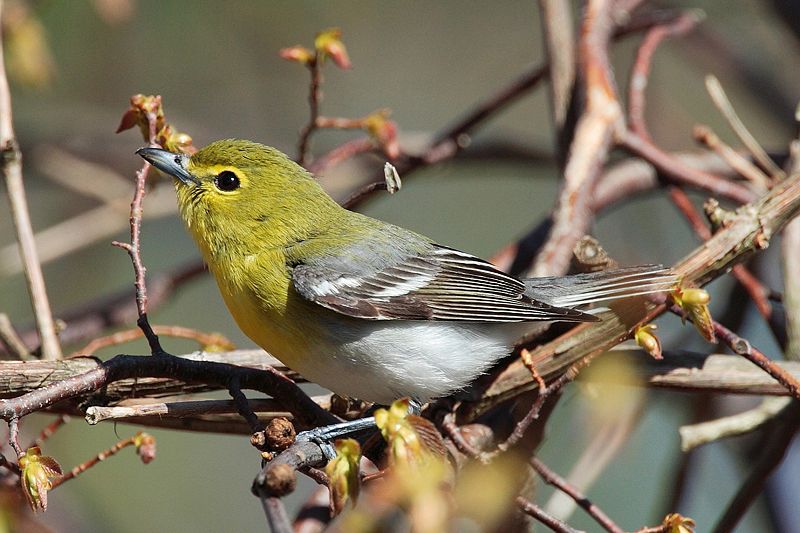
Yellow-throated Vireo (Vireo flavifrons) ©WikiC

Yellow-throated Vireo (Vireo flavifrons) ©WikiC

But seek first the kingdom of God and His righteousness, and all these things shall be added to you. Therefore do not worry about tomorrow, for tomorrow will worry about its own things. Sufficient for the day is its own trouble. (Matthew 6:33-34 NKJV)

Yellow-rumped Warbler Split

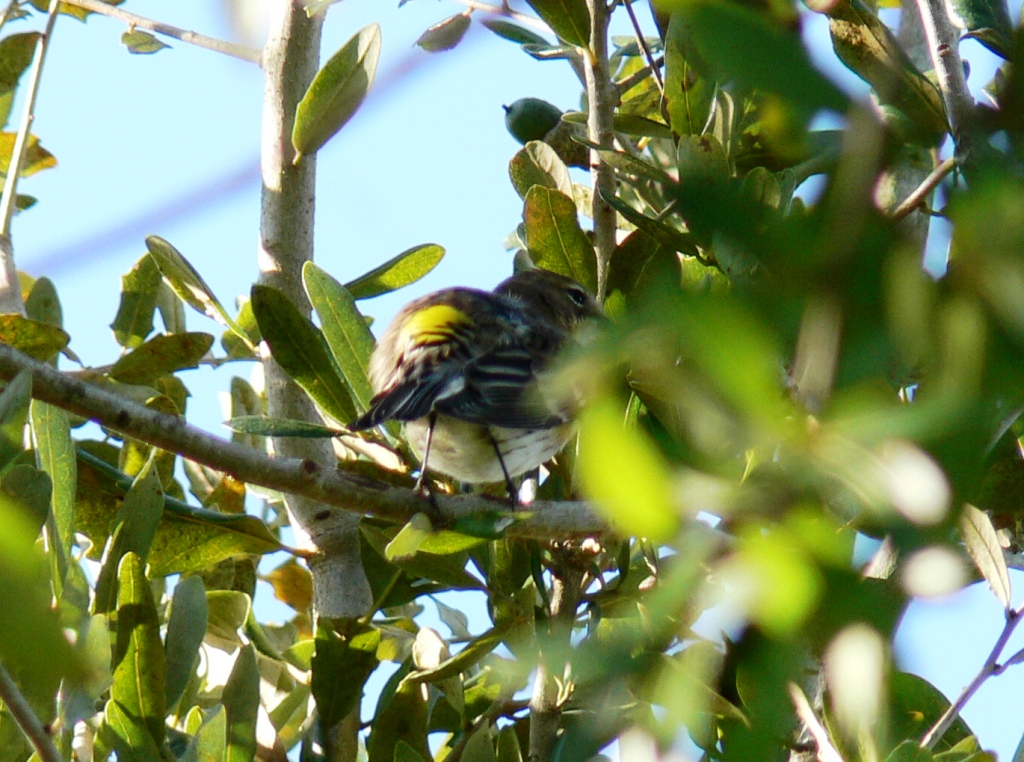
Myrtle Warbler (Dendroica coronata)

Myrtle Warbler (Dendroica coronata)

Out of the ground the LORD God formed every beast of the field and every bird of the air, and brought them to Adam to see what he would call them. And whatever Adam called each living creature, that was its name. (Genesis 2:19 NKJV)

When I wrote the article about our trip to S. Lake Howard Nature Park this week, I was not exactly sure which of the Old Yellow-rumped Warblers I had seen. Since the 2.4 Version of the I.O.C. (International Ornithologist Congress) list, they split the “Butterbutt” into four species. Hadn’t looked into it too much, but now is the time to try to figure out which one is which.

The four birds are the:
Myrtle Warbler (Dendroica coronata) – Eastern U.S. Mostly
Audubon’s Warbler (Dendroica auduboni) – Western U.S. Mostly
Black-fronted Warbler (Dendroica nigrifrons)
Goldman’s Warbler (Dendroica goldmani)

After doing quite a bit of research, I was wrong about the Audubon Warbler. Not only do I not live in the west, but after studying lots of photos, it is the Myrtle Warbler not the Audubon’s Warbler, as I first thought, that we saw.

Here are some of the traits of the Myrtle Warbler (from USGS about the Myrtle and Audubon’s Warblers):

Bright yellow rump (nicknamed “butterbutts”)

Myrtle Warbler (Dendroica coronata) Bright yellow rump

Myrtle Warbler (Dendroica coronata) Bright yellow rump

White spots in tail

Myrtle Warbler (Dendroica coronata) White spots in tail

Myrtle Warbler (Dendroica coronata) White spots in tail

White supercilium and broken eye ring

Myrtle Warbler (Dendroica coronata) White supercilium and broken eye

Myrtle Warbler (Dendroica coronata) White supercilium and broken eye

Here are some links to read to help with the split:
Myrtle Warbler by Wikipedia
Audubon’s Warbler by Wikipedia
Welcome back Myrtle Warbler? from the Drinking Bird
Goodbye Yellow-rumped Warbler, welcome back Myrtle Warbler and Audubon’s Warbler . . . by flickr discussion

At any rate, while I was sitting there, the little warbler preened and did not spook as I kept taking its photo.

These warblers belong to the Parulidae Family of the Passeriformes Order.

This is not an extensive listing of the birds, as the above articles covered much of it. These photos were taken by me (Lee).

The Slide show is of the Myrtle Warbler in the time sequence they were taken.

*
This slideshow requires JavaScript.

*

Birdwatching at South Lake Howard Nature Pk 11-24-10

Reflective View at South Lake Howard Nature Park

Reflective View at South Lake Howard Nature Park

Today we finally had a chance to go birdwatching for a little while. We drove to South Lake Howard Nature Park here in Winter Haven, FL. With all that has been going on, it has been almost a month since we have had a chance to bird watch (A little in Tennessee, come to think of it). I didn’t walk very far because of back and leg pains, but Dan was doing his photography while I just walked slow or sat and just enjoyed birdwatching. Not bad for about an hour and a half of watching. We counted 25 birds at the park or on the lake and a House Sparrow in the bush at the grocery store. There weren’t many groups of birds. Most of the birds were by themselves or with just one other member of their species. The water was very reflective this morning.

SLkHwd-Anhinga (Anhinga anhinga) by Lee

Anhinga (Anhinga anhinga) by Lee

Here is a list of the birds spotted, most having their picture taken:

At the Park

  • Anhinga – Sitting on a tree facing us. Normally you only get photos of their backs.
  • Wood Storks – 3 adults and 1 immature
  • White Ibises – 4
  • Wilson’s Snipe-1
  • Snowy Egret – 1
  • Yellow-rumped Warbler (need to figure which kind) “Butterbutts” – 7
  • Limpkin – 1 sitting on a Wood Duck’s house, another flew by
  • Fish Crows – 5 flying by making their racket
  • Redwing Blackbird – 1 on a treetop
  • Palm Warblers – 4 or so
  • Great Egret – 2
  • Little Blue Heron – 4
  • Tricolored Heron – 1
  • Cattle Egret – 2
  • Blue Jay – 1 heard carrying on about something
  • Osprey – 3 – 1 being chased by a Bald Eagle, 1 sitting on the tower with the moon sitting behind it.
  • Bald Eagle – 1
Wood Stork (Mycteria americana) Immature by Lee

Wood Stork (Mycteria americana) Immature by Lee

By the Lake (Howard)

  • Pied-billed Grebe – 2
  • Purple Gallinule – 6
  • Common Gallinule (Moorhen) – 5
  • Rock Pigeon – 4
  • American Coot – 6
  • Great Blue Heron – 2
  • Boat-tailed Grackle – 10
  • Muscovy Duck – 8
  • White Ibis – 30+

Publix

  • House Sparrow – 1

Look at the birds of the air, for they neither sow nor reap nor gather into barns; yet your heavenly Father feeds them. Are you not of more value than they? (Matthew 6:26 NKJV)

All in all it was a great morning for birdwatching here in Florida.

*
I.O.C. World Bird List Version 2.6 Update Complete

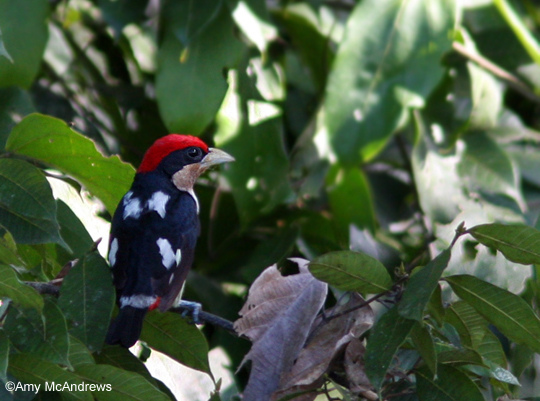
Black-girdled Barbet (Capito dayi) ©CC

Black-girdled Barbet (Capito dayi) ©CC

Finally got the site updated to the I.O.C. World Bird List Version 2.6. Fell behind because of our trip to Indiana. Now it is up to date. (I think!)

With the IOC adding a new Order:

Suliformes which pulled the Frigatebirds, Gannets, Cormorants and Anhingas out of the Pelecaniformes Order

and adding new Families:

Capitonidae-New World Barbets

Semnornithidae-Toucan Barbets

Pnoepygidae-Wren-babblers

Macrosphenidae-Crombecs and African Warblers

Pellorneidae-Fulvettas & Ground Babblers

Leiothrichidae-Laughingthrushes

With all those changes and the others they made, I trust this site is functioning with out too many errors. Had to add new pages and rearrange lots of  others. Tried to be cautious, but if you find any errors on the links, please leave a comment so it can be fixed.

Thanks for any understanding of mistakes. Haven’t arrived yet to perfection.

But thanks be to God, which giveth us the victory through our Lord Jesus Christ. Therefore, my beloved brethren, be ye stedfast, unmoveable, always abounding in the work of the Lord, forasmuch as ye know that your labour is not in vain in the Lord. (1 Corinthians 15:57-58 KJV)

Birds of the Bible – Thanksgiving

When Stephen, at our church, asked me to write about 10 (+ or -) things we are thankful for on our church blog, I am sure he knew that I would write about the birds. Here is what I am posting on that blog.

How can we be thankful for the birds?

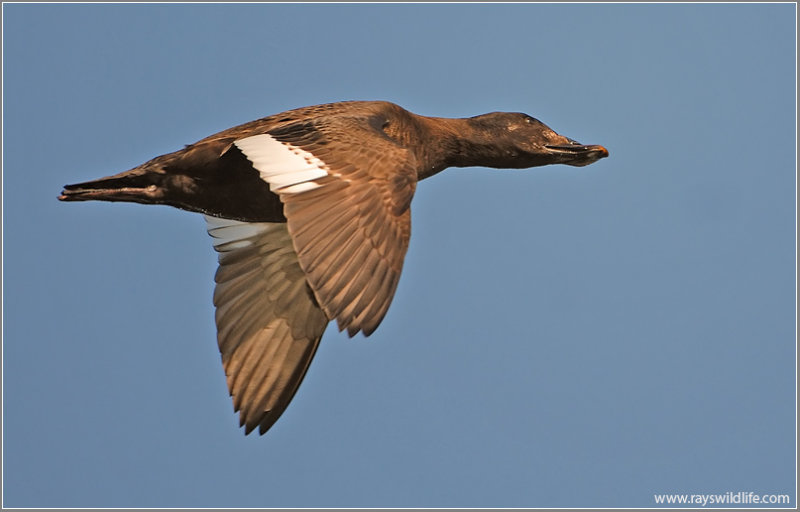
White-winged Scoter (Melanitta deglandi) by Ray

White-winged Scoter (Melanitta deglandi) by Ray

So God created the great sea creatures and every living creature that moves, with which the waters swarm, according to their kinds, and every winged bird according to its kind. And God saw that it was good. (Genesis 1:21 ESV)

I am thankful for a Creator God, the Lord, who made not only the birds, but all of us as well. “Know ye that the LORD he is God: it is he that hath made us, and not we ourselves; we are his people, and the sheep of his pasture. ” (Psa 100:3)

Channel-billed Toucan (Ramphastos vitellinus) by Ian

Channel-billed Toucan (Ramphastos vitellinus) by Ian

Now out of the ground the LORD God had formed every beast of the field and every bird of the heavens and brought them to the man to see what he would call them. And whatever the man called every living creature, that was its name. (Genesis 2:19 ESV)

I am thankful that the LORD God gave Adam the privilege and the knowledge to name the birds. We were created with intellect and didn’t have to progress up through evolution to finally get “smart enough” to name the birds. Adam wasn’t even a week old.

The fear of you and the dread of you shall be upon every beast of the earth and upon every bird of the heavens, upon everything that creeps on the ground and all the fish of the sea. Into your hand they are delivered. Every moving thing that lives shall be food for you. And as I gave you the green plants, I give you everything. (Genesis 9:2-3 ESV)

Wild Turkey (Meleagris gallopavo) by Daves BirdingPix

Wild Turkey (Meleagris gallopavo) by Daves BirdingPix

I am thankful for the food the Lord has allowed us to eat. Many of us will be eating Turkey this Thanksgiving Day. (Even if it is sometimes sad to think about.)

I know all the birds of the hills, and all that moves in the field is mine. (Psalms 50:11 ESV)

I am thankful that just as God knows all the birds, He knows us. “Because he hath set his love upon me, therefore will I deliver him: I will set him on high, because he hath known my name.” (Psalms 91:14 KJV)

Greater Painted Snipe (Rostratula benghalensis) by W Kwong

Greater Painted Snipe (Rostratula benghalensis) by W Kwong

Therefore I tell you, do not be anxious about your life, what you will eat or what you will drink, nor about your body, what you will put on. Is not life more than food, and the body more than clothing? Look at the birds of the air: they neither sow nor reap nor gather into barns, and yet your heavenly Father feeds them. Are you not of more value than they? And which of you by being anxious can add a single hour to his span of life? And why are you anxious about clothing? Consider the lilies of the field, how they grow: they neither toil nor spin, (Matthew 6:25-28 ESV)

Chihuahuan Raven (Corvus cryptoleucus)Raven (Corvus corax) by Kent Nickell

Chihuahuan Raven (Corvus cryptoleucus)Raven (Corvus corax) by Kent Nickell

For life is more than food, and the body more than clothing. Consider the ravens: they neither sow nor reap, they have neither storehouse nor barn, and yet God feeds them. Of how much more value are you than the birds! And which of you by being anxious can add a single hour to his span of life? If then you are not able to do as small a thing as that, why are you anxious about the rest? (Luke 12:23-26 ESV)

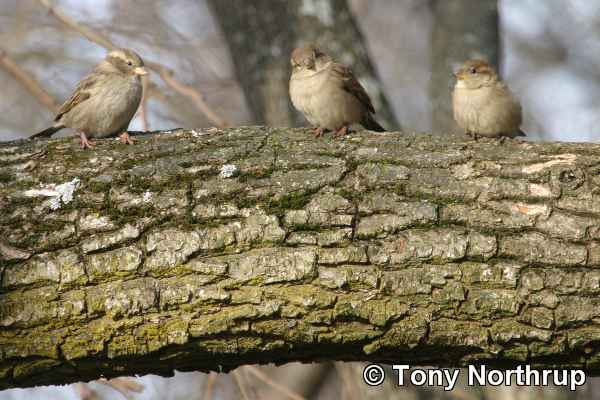
Three Sparrows

Are not two sparrows sold for a penny? And not one of them will fall to the ground apart from your Father. But even the hairs of your head are all numbered. Fear not, therefore; you are of more value than many sparrows.
(Matthew 10:29-31 ESV)

I am thankful for these three parallel verses that remind us that God cares about not only every need of the birds, but also for ours. We are more valuable than them and He provides everything for them and knows all about them. Why do we need to be anxious?

Common Starling (Sturnus vulgaris) at Nest by Anthony747

Common Starling (Sturnus vulgaris) at Nest by Anthony747

And Jesus said to him, “Foxes have holes, and birds of the air have nests, but the Son of Man has nowhere to lay his head.” (Matthew 8:20 ESV)

I am very thankful that the Lord Jesus Christ, became my Savior.

Who, being in the form of God, thought it not robbery to be equal with God: But made himself of no reputation, and took upon him the form of a servant, and was made in the likeness of men: And being found in fashion as a man, he humbled himself, and became obedient unto death, even the death of the cross. (Philippians 2:6-8 KJV)

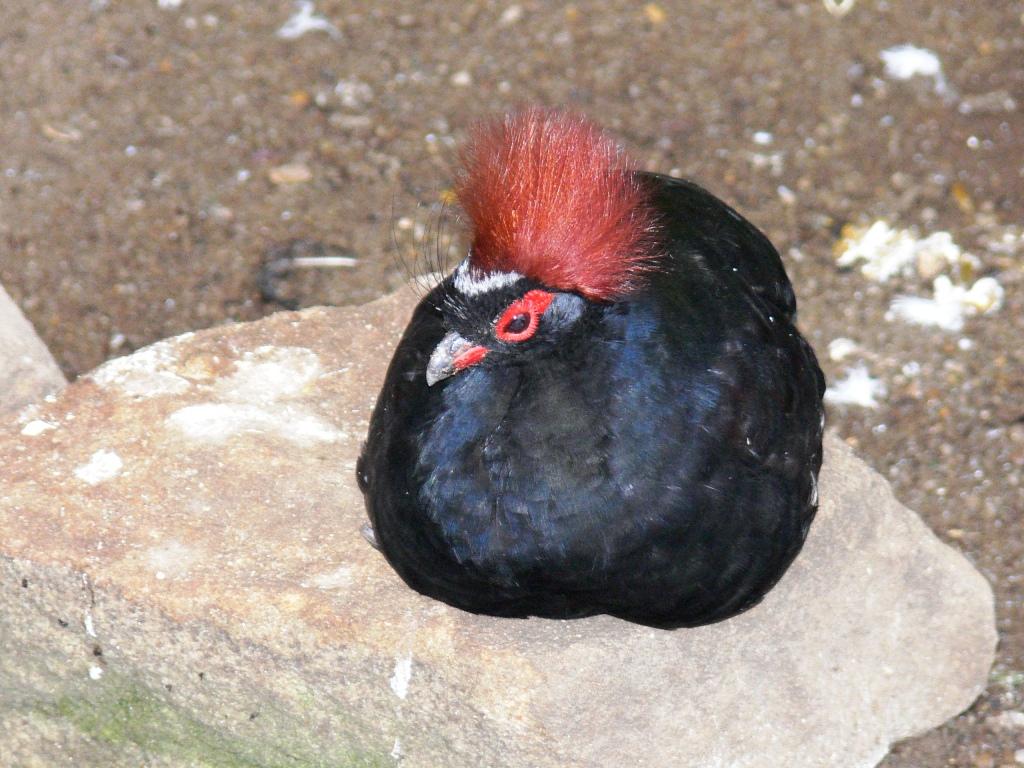
Crested Partridge (Rollulus rouloul) at NA by Lee

Crested Partridge (Rollulus rouloul) at National Aviary by Lee

The heart is deceitful above all things, and desperately wicked: who can know it? I the LORD search the heart, I try the reins, even to give every man according to his ways, and according to the fruit of his doings. As the partridge sitteth on eggs, and hatcheth them not; so he that getteth riches, and not by right, shall leave them in the midst of his days, and at his end shall be a fool. (Jeremiah 17:9-11 KJV)

I am thankful for the partridge that reminds me not to seek earthly riches unjustly.

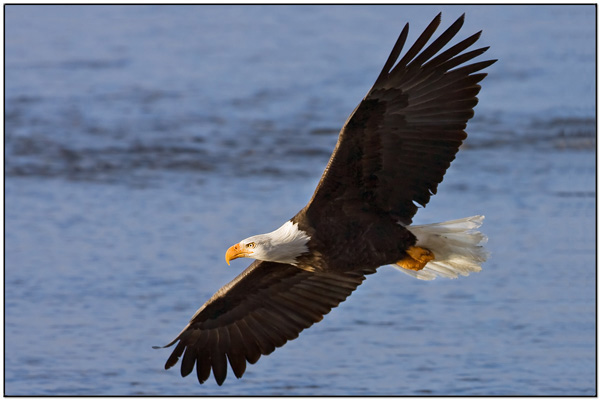
Bald Eagle flying by Dave's BirdingPix

Bald Eagle flying by Dave’s BirdingPix

Have you not known? Have you not heard? The LORD is the everlasting God, the Creator of the ends of the earth. He does not faint or grow weary; his understanding is unsearchable. He gives power to the faint, and to him who has no might he increases strength. Even youths shall faint and be weary, and young men shall fall exhausted; but they who wait for the LORD shall renew their strength; they shall mount up with wings like eagles; they shall run and not be weary; they shall walk and not faint. (Isaiah 40:28-31 ESV)

I am thankful for the wings of the Eagle to remind me of all the promises in this passage. Our God is the everlasting God, doesn’t faint or grow weary, omniscient, omnipotent, omnipresent and the Creator. Awesome!

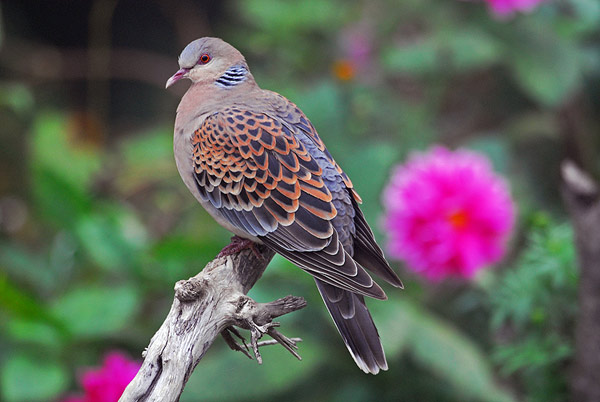
Oriental Turtle Dove (Streptopelia orientalis) by Nikhil

Oriental Turtle Dove (Streptopelia orientalis) by Nikhil

But if he cannot afford two turtledoves or two pigeons, then he shall bring as his offering for the sin that he has committed a tenth of an ephah of fine flour for a sin offering. He shall put no oil on it and shall put no frankincense on it, for it is a sin offering. (Leviticus 5:11 ESV)

I am thankful for doves and pigeons because they remind me that in the Old Testament they were innocently sacrificed for a person’s sin. That was looking forward to the death of Christ on the cross. I am thankful for my salvation in Jesus Christ.

We know that Christ, being raised from the dead, will never die again; death no longer has dominion over him. For the death he died he died to sin, once for all, but the life he lives he lives to God. (Romans 6:9-10 ESV)

My little children, these things write I unto you, that ye sin not. And if any man sin, we have an advocate with the Father, Jesus Christ the righteous: And he is the propitiation for our sins: and not for ours only, but also for the sins of the whole world. (1 John 2:1-2 KJV)

Beloved, let us love one another: for love is of God; and every one that loveth is born of God, and knoweth God. He that loveth not knoweth not God; for God is love. In this was manifested the love of God toward us, because that God sent his only begotten Son into the world, that we might live through him. Herein is love, not that we loved God, but that he loved us, and sent his Son to be the propitiation for our sins. Beloved, if God so loved us, we ought also to love one another.
(1 John 4:7-11 KJV)

The Gospel Message

*

Not By Chance

Not a Chance by Creation Moments – 11/17/10

Psalm 148:7-8 “Praise the LORD from the earth, You great sea creatures and all the depths; fire and hail, snow and clouds; stormy wind, fulfilling His word…”

Is there any such thing as chance or luck? Does anything ever happen randomly? Many people don’t realize that the Bible speaks to these questions.

In late August 1992, a tornado swept through a small Wisconsin town and caused a great deal of destruction. That made it newsworthy enough. However, the destruction it wrought on one church in town received special notice on some national newscasts. Pictures showed the church in ruins. But the altar still stood, barely visible in the rubble. Most astonishing was the fact that the Bible still stood on its stand in its customary place on the altar. The undamaged Bible was open to where Psalm 77 reads,

The clouds poured out water, the skies sent out a sound; your arrows also flashed about. The voice of your thunder was in the whirlwind; the lightnings lit up the world; the earth trembled and shook.

Does that sound like chance?

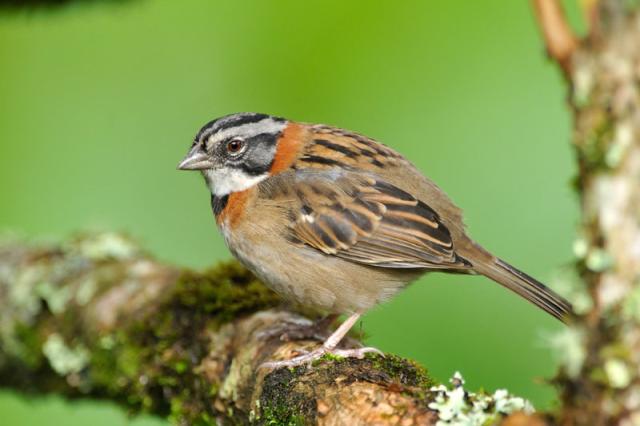
Rufous-collared Sparrow (Zonotrichia capensis) Reinier Munguia

Rufous-collared Sparrow (Zonotrichia capensis) Reinier Munguia

In Matthew 10, Jesus tells us that God is so involved in His creation that not one of the billions of sparrows in the world falls to the ground without His knowledge. Psalm 148 tells us that the entire creation praises God in everything that happens. God is so personally involved in the creation that He even instructs each wind about the speed and direction to take.

Was it simply luck that the altar was spared and the Bible was open to Psalm 77? God is involved in every detail of the creation. Let’s praise God that there is no such thing as luck!

Prayer:
Dear Father, I thank You that there is no such thing as luck because You are so intimately involved in the creation. Help me to cleanse my mind and speech of the pagan ideas of chance and luck. In Jesus’ Name. Amen.

Birds in Hymns – Speed For Thy Life

Birds in Hymns – Speed For Thy Life by Fanny Crosby

Based on Psalm 11:1

In the LORD I put my trust; How can you say to my soul, “Flee as a bird to your mountain”? (Psalm 11:1 NKJV)

Words: Fan­ny Cros­by, 1903.

Music: W. How­ard Doane

https://leesbird.com/wp-content/uploads/2008/11/speed_for_thy_life-fanny-crosby.mp3%20
Indian Cormorant (Phalacrocorax fuscicollis) on nest by Nikhil

Indian Cormorant (Phalacrocorax fuscicollis) on nest by Nikhil

Speed for thy life to the mountain,
Slight not the message divine,
Danger and death are before thee,
Haste, while the hours are thine.

Refrain

Speed thee, speed thee;
Shadows around thee are falling;
Speed thee, speed thee;
Come while the Savior is calling.

Speed for thy life to the mountain,
List to the warning again;
Forward, and look not behind thee,
Stay not in all the plain.

Refrain

Speed, for the day is declining,
Soon its bright moments will fade;
What if a storm should o’ertake thee,
Where would thou turn for aid?

Refrain

Common Starling (Sturnus vulgaris) at Nest by Anthony747

Common Starling (Sturnus vulgaris) at Nest by Anthony747

Speed for thy life to the mountain,
Fly like a bird to its nest,
Fly to the arms of the Savior:
There is thy only rest.

Refrain

___

What a great encouragement for us to make
sure we speed to the Savior.

Most information from The Cyber Hymnal

See ~ Wordless Birds

More ~ Birds in Hymns

*

Birds in Hymns – A Living Stream, As Crystal Clear

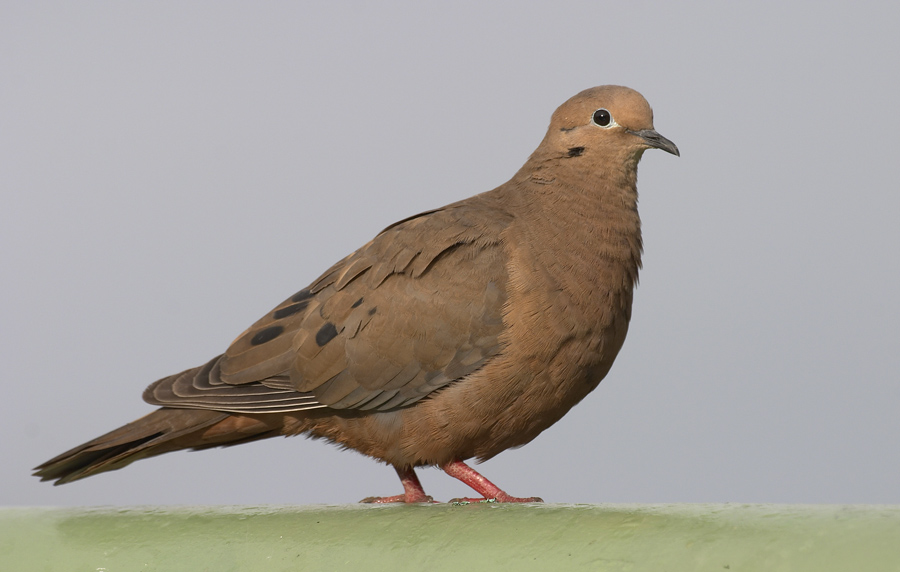
Eared Dove (Zenaida auriculata) by Robert Scanlon

Eared Dove (Zenaida auriculata) by Robert Scanlon

Based on:

…proceeding out of the throne of God and of the Lamb. (Revelation 22:1)

Words: John Ma­son, Songs of Praise, 1683; adapt­ed by John Ke­ble.
Music: Stock­ton (Wright), Thom­as Wright (1763-1829)

A Living Stream, As Crystal Clear

A living stream, as crystal clear,
Welling from out the throne,
Of God and of the Lamb on high,
The Lord to man hath shown.

This stream doth water Paradise,
It makes the angels sing:
One precious drop within the heart
Is of all joy the spring:

Joy past all speech, of glory full,
But stored where none may know,
As manna hid in dewy heaven,
As pearls in ocean low.

Eye hath not seen, nor ear hath heard,
Nor to man’s heart hath come
What for those loving Thee in truth
Thou hast in love’s own home.

But by His Spirit He to us
The secret doth reveal:
Faith sees and hears: but O for wings
That we might taste, and feel;

Wings like a dove to waft us on
High o’er the flood of sin!
Lord of the Ark, put forth Thine hand,
And take Thy wanderers in.

O praise the Father, praise the Son,
The Lamb for sinners given,
And Holy Ghost, through Whom alone
Our hearts are raised to Heav’n.

Most information from The Cyber Hymnal

See ~ Wordless Birds

More ~ Birds in Hymns

*

Birds of the Bible – A Gull?

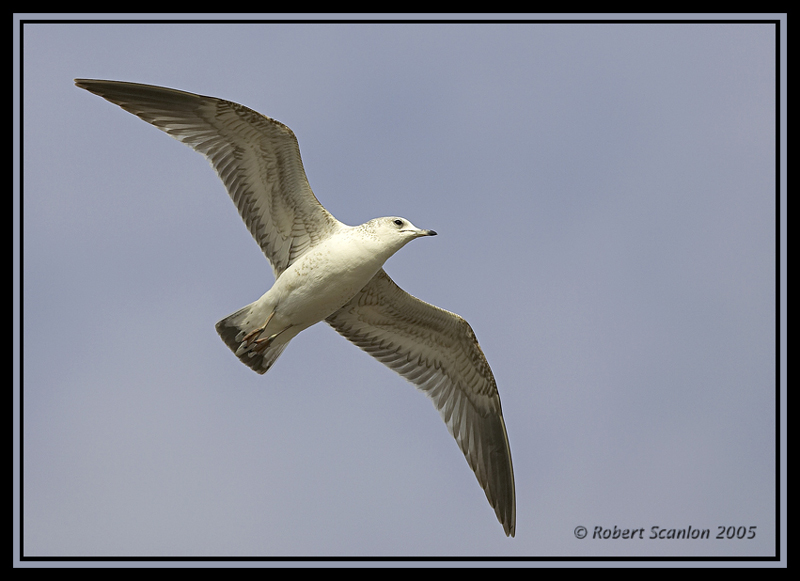
Common Gull (Larus canus) by Robert Scanlon

Common Gull (Larus canus) by Robert Scanlon

The following two verses have been used several times in the Birds of the Bible articles. It is interesting in how one of the birds is translated in the various versions.

the ostrich, the nighthawk, the sea gull, the hawk of any kind, (Leviticus 11:16 ESV)
the ostrich, the nighthawk, the sea gull, the hawk of any kind; (Deuteronomy 14:15 ESV)

I have been reading through the English Standard Version and found the “sea gull” listed in those verses. Those verses are in the list of the birds the Israelites were not to eat. Previously, I had used the KJV which translates  “שׁחף” as “the cuckoo: Shachpaph, probably the sea-gull or mew”(H7828).

See Birds of the Bible – Cuckoo and Cuckoo II where the Cuckoo is considered as the bird mentioned. But, what if it is one of the other options? Those options would be the sea-hawk, seamew, seagull or gull. Only one mentions the sea-hawk, so for now that will be ignored until another time.

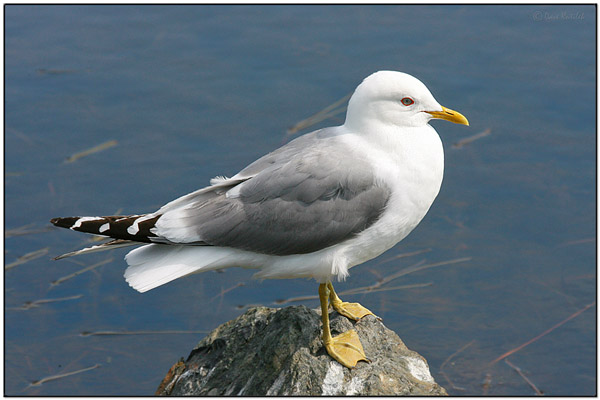
Mew Gull (Larus canus) by Ian

Mew Gull (Larus canus) by Ian

A Seamew according to Wikipedia is the Common Gull (European and Asian subspecies; see below) or Mew Gull (North American subspecies) Larus canus which is a medium-sized gull which breeds in northern Asia, northern Europe and northwestern North America. It migrates further south in winter. Its name does not indicate that it is an abundant species, but that during the winter it feeds on common land, short pasture used for grazing.

Mew Gull (Larus canus) by Daves BirdingPix

Mew Gull (Larus canus) by Daves BirdingPix

Adults are 15.7-18.1 in (40-46 cm) long, obviously smaller than the Herring Gull, and slightly smaller than the Ring-billed Gull, also differing from this in its shorter, more tapered bill with a more greenish shade of yellow, as well as being unmarked during the breeding season. The body is grey above and white below. The legs are greenish-yellow. In winter, the head is streaked grey, and the bill often has a poorly-defined blackish band near the tip (sometimes sufficiently obvious to cause confusion with Ring-billed Gull). They have black wingtips with large white “mirrors”. Young birds have scaly black-brown upperparts and a neat wing pattern, and grey legs. They take two to three years to reach maturity. The call is a high-pitched “laughing” cry.

Mew Gull (Larus canus) chicks ©USFWS

Mew Gull (Larus canus) chicks ©USFWS

Both Common and Mew Gulls breed colonially near water or in marshes, making a lined nest on the ground or in a small tree; colony size varies from 2 to 320 or even more pairs. Usually three eggs are laid (sometimes just one or two); they hatch after 24–26 days, with the chicks fledging after a further 30–35 days. Like most gulls, they are omnivores and will scavenge as well as hunt small prey. The global population is estimated to be about one million pairs; they are most numerous in Europe, with over half (possibly as much as 80-90%) of the world population. By contrast, the Alaskan population is only about 10,000 pairs.

Some of the commentaries have this to say about the bird:
Jamieson, Faussett, and Brown – “the cuckoo — Evidently some other bird is meant by the original term, from its being ranged among rapacious birds. Dr. Shaw thinks it is the safsaf; but that, being a graminivorous and gregarious bird, is equally objectionable. Others think that the sea mew, or some of the small sea fowl, is intended.”
K & D – “slender gull
Barnes – “Lev_11:16 – And the owl … – Rather, “and the ostrich, and the owl, and the gull, and the hawk,” etc.
John Gill’s – “and the cuckoo; a bird well known by its voice at least: some have thought it to be the same with the hawk, changing its figure and voice; but this has been refuted by naturalists (a): but though it is here forbidden to be eaten, yet its young, when fat, are said to be of a grateful savour by Aristotle: and Pliny (b) says, no bird is to be compared to it for the sweetness of its flesh, though perhaps it may not be here intended: the word is by the Septuagint rendered asea gull”, and so it is by Ainsworth, and which is approved of by Bochart (c):”

Laughing Gull (Leucophaeus atricilla) by Lee

Laughing Gull (Leucophaeus atricilla) by Lee

Will the mystery be solved? Not by me. I still find it amazing that the different versions use the different meaning for words, but then again, that is just like today. Our language is constantly changing the definitions of words or making other things mean the same.

Just keeping up with the names of birds today is a challenge. Every 3-4 months the I.O.C. make changes. Names of birds come and go. One bird can have many names and the different countries name them different. That is the reason they use the scientific names so they can talk about the same bird. Problem to that is that they even change the scientific name occasionally. The birds mentioned in Scripture were named in those verses several thousand years ago.

One thing is certain, there is one thing that remains the same:

Jesus Christ the same yesterday, and to day, and for ever. (Hebrews 13:8 KJV)
Jesus Christ is the same yesterday and today and forever. (Hebrews 13:8 ESV)
Jesus Christ is the same yesterday and to-day, yea and for ever. (Hebrews 13:8 ASV)
Jesus Christ yesterday and to-day the same, and to the ages; (Hebrews 13:8 YLT)

See:

Birds of the Bible – Sea Gulls

*