Birds in Hymns – How Great Thou Art

Great is the LORD, and greatly to be praised; And His greatness is unsearchable. (Psalms 145:3)

Author: Carl Boberg, 1859-1940
Tr. By Stuart K. Hine, 1899-
Musician: Swedish Melody
Arr. By Stuart K. Hine, 1899-

(by Sean Fielder)

How Great Thou Art

American Yellow Warbler (Dendroica aestiva) by J Fenton

American Yellow Warbler (Dendroica aestiva) by J Fenton

O Lord my God! When I in awesome wonder
Consider all the worlds Thy hands have made,
I see the stars, I hear the rolling thunder,
Thy power throughout the universe displayed,

Refrain:
Then sings my soul, my Saviour God to Thee;
How great Thou art, how great Thou art!
Then sings my soul, my Saviour God to Thee;
How great Thou art, how great Thou art!

When through the woods and forest glades I wander
And hear the birds sing sweetly in the trees;
When I look down from lofty mountain grandeur
And hear the brook and feel the gentle breeze;

And when I think that God, His Son not sparing
Sent Him to die, I scarce can take it in;
That on the cross, my burden gladly bearing,
He bled and died to take away my sin;

When Christ shall come with shout of acclamation
And take me home, what joy shall fill my heart!
Then I shall bow in humble adoration
And there proclaim, my God, how great Thou art!

——————————————————————————–

HYMN HISTORY:

Northern Parula (Parula americana) by Reinier Munguia

Northern Parula (Parula americana) by Reinier Munguia

Boberg wrote the poem “O Store Gud” (O Great God) in 1885 with nine verses.

The inspiration for the poem came when Boberg was walking home from church near Kronobäck, Sweden, and listening to church bells. A sudden awe-inspiring storm gripped Boberg’s attention, and then just as suddenly as it had made its violent entrance, it subsided to a peaceful calm which Boberg observed over Mönsterås Bay. According to J. Irving Erickson:

Carl Boberg and some friends were returning home to Mönsterås from Kronobäck, where they had participated in an afternoon service. Nature was at its peak that radiant afternoon. Presently a thundercloud appeared on the horizon, and soon sharp lightning flashed across the sky. Strong winds swept over the meadows and billowing fields of grain. The thunder pealed in loud claps. Then rain came in cool fresh showers. In a little while the storm was over, and a rainbow appeared.

When Boberg arrived home, he opened the window and saw the bay of Mönsterås like a mirror before him… From the woods on the other side of the bay, he heard the song of a thrush…the church bells were tolling in the quiet evening. It was this series of sights, sounds, and experiences that inspired the writing of the song.[7]

According to Boberg’s great-nephew, Bud Boberg, “My dad’s story of its origin was that it was a paraphrase of Psalm 8 and was used in the ‘underground church’ in Sweden in the late 1800s when the Baptists and Mission Friends were persecuted.”  The author, Carl Boberg himself gave the following information about the inspiration behind his poem:

“It was that time of year when everything seemed to be in its richest colouring; the birds were singing in trees and everywhere. It was very warm; a thunderstorm appeared on the horizon and soon thunder and lightning. We had to hurry to shelter. But the storm was soon over and the clear sky appeared.

“When I came home I opened my window toward the sea. There evidently had been a funeral and the bells were playing the tune of ‘When eternity’s clock calling my saved soul to its Sabbath rest.’ That evening, I wrote the song, ‘O Store Gud.'”

[edit] Publication

Boberg first published “O Store Gud” in the Mönsterås Tidningen (Mönsterås News) on 1886 March 13.

The poem became matched to an old Swedish folk tune. and sung in public for the first known occasion in a church in the Swedish province of Värmland in 1888. Eight verses appeared with the music in the 1890 Sions Harpan.

In 1890 Boberg became the editor of Sanningsvittnet (The Witness for the Truth). The words and music were published for the first time in the 16 April 1891 edition of Sanningsvittnet. Instrumentation for both piano and guitar was provided by Adolph Edgren (born 1858; died 1921 in Washington D.C.), a music teacher and organist, who later migrated to the United States.

Boberg later sold the rights to the Svenska Missionsförbundet (Mission Covenant Church of Sweden). In 1891 all nine verses were published in the 1891 Covenant songbook, Sanningsvittnet.  These versions were all in 3/4 time. In 1894 the Svenska Missionsförbundet sångbok  published “O Store Gud” in 4/4 time as it has been sung ever since (cf. Time signature).
——————————————————————————–
Wikipedia – How Great Thou Art – History
SermonAudio – How Great Thou Art – Audio

See ~ Wordless Birds

More ~ Birds in Hymns

*
The Gospel Message

The Gospel Message is that Jesus Christ, the Creator, came to earth and died for us. It is up to us to accept, by faith, what He has done for us. He loves us, and wants to be our Savior, Lord, and King.

Please read the basic message of the whole gospel below and seriously consider that your eternal soul is very important to God, the Lord Jesus Christ, the Holy Spirit.

A.  God

  • He exists  (Hebrews 11:6)
  • He is holy  (1 Peter 1:15)
  • Man must be perfect to reach God  ( Matthew 5:48)
  • The measure of God’s holiness is the law  ( Romans 2:12, 13, 14, 15, 16)
  • He has judged sin  (Romans 6:23)

B.  Man

  • He is a sinner  (Romans 3:23)
  • He cannot save himself  (Ephesians 2:8,9)

C.  Jesus Christ

  • He died because of our sins  (1 Corinthians 15:3)
  • He rose again  (1 Corinthians 15:14)
  • He is the only Messiah (Savior)  (John 14:6), (1 Timothy 2:5)
  • He paid the price for our sins  (1 Corinthians 6:1920), (Hebrews 7:27)
  • That He is Lord, that is the right ruler of all, including us  (Romans 10:9, 10)

D.  Grace

  • Salvation is a free gift.  (Ephesians 2:8,9)
  • We can’t earn it  (Ephesians 2:8,9)

E.  Faith

  • We must totally yield ourselves to Christ  (Acts 16:31)
  • We accept what God has done  (John 13:20)
  • We trust in Christ alone for salvation  (John 14:6), (Ephesians 2:8,9, 10)
  • Repentance is inherent in Biblical Faith  (Acts 2:36)

F.  Commitment

  • We must be willing to turn from our sins and follow Christ  (2 Corinthians 5:15)

(The verses will pop up when mouse is placed over them)

If you have any further questions or would like assistance accepting Christ as your personal Savior, please contact me at Lee@Leesbird.com or contact my pastor, Rev. Nathan Osborne III.

wsbirdsbirdhouse(Pastor Osborne provided the above outline)

As much as we enjoy bird watching and enjoy seeing how many we can see or how many we can count on a list, remember the following verses:

For what will it profit a man if he gains the whole world, and loses his own soul? Or what will a man give in exchange for his soul? (Mark 8:36-37)

When I Consider! – Turkey Vulture

Turkey Vulture Tree at Saddle Creek by Lee

Turkey Vulture Tree at Saddle Creek by Lee

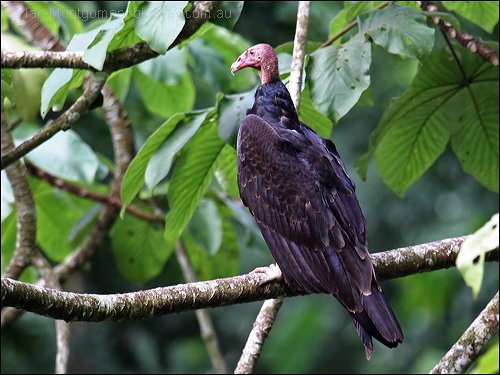
We get to see lots of Turkey Vultures in this area. I have seen trees just loaded with them. They are ugly to look at, but are very useful.

The following is the October 6th’s “Evidence from Biology” article from A Closer Look at the Evidence, by Richard and Tina Kleis:

“The Turkey Vulture has incredible farsighted vision capable of seeing dead or dying objects several miles beyond what the human eye can detect. Yet it is designed with dull, weak, talons and a thin beak, forcing it to eek out an existence eating rotting flesh or decaying vegetables. Since the vulture eats the remains of animals that have died of disease, it has a digestive tract designed to destroy deadly bacteria (including anthrax!). The Turkey Vulture also has the ability to sanitize itself and its surroundings using a special disinfectant found in its own excrement. The same chemicals which kill the deadly bacteria in its stomach continue to kill the germs outside its body!

Turkey Vulture by Ian Montgomery

Turkey Vulture by Ian Montgomery

Because the vulture’s head is usually covered in blood, pieces of rotten flesh, and bacteria, it is especially vulnerable to disease. Therefore, this particular bird was created without feathers from the neck up. As the turkey vulture stands in the sun, the ultraviolet radiation kills any remaining bacteria.

By removing the carcasses of decaying animals, the turkey vulture serves an important purpose of limiting the spread of disease and preventing potential epidemics among both man and beast. One wonders how the turkey vulture could have evolved all of the specialized characteristics. The creation solution is that they were created with the original vulture-type bird. The survival characteristics needed for our fallen world were either given after the Fall or developed from originally created abilities.”

Character Sketches, Vol. III, p. 121-124

The LORD is righteous in all his ways, and holy in all his works. (Psalms 145:17 KJV)


Lee’s Extras:
We have mentioned the Vulture many times on the blog and especially in the places below. After all, they are one of the unclean birds that the Jewish people were not allowed to eat. After reading the above article, you can understand why they were off the “menu.”

There is a path which no fowl knoweth, and which the vulture’s eye hath not seen: (Job 28:7 KJV)

Birds of the Bible – Vulture
Vulture
Vulture Photos
Vulture Videos
Accipitridae – Kites, Hawks & Eagles

More When I Consider! articles

Ian Juby’s Newsletter – Oct 2009

Ian Juby just sent out his latest newsletter and it is also available at his blog. The article features the new “Ardi” that is suppose to prove our ancestors were related to this fossil. Personally, I believe it will become another hoax like “Luci,” but time will tell.

So God created man in his own image, in the image of God created he him; male and female created he them. (Genesis 1:27 KJV)

1) Ardi ar arrr…


Artist’s best guess as to what Ardipithecus ramidus may have looked like.
Okay, so maybe it didn’t stand upright like that, and maybe it didn’t have human eyes like that, and maybe it was a male and not a female, and maybe it….well, it’s close at least!
Drawing by J.H. Matternes

The propaganda machine goes into overdrive:
Got a barrage of emails this week from my honourable news watch team regarding a supposed “Missing link” found this week which “proves” our ancestral relationship to the apes.
In fact, Science magazine even ran a special issue just on this fossil, CBC’s “Quirks and Quarks” devoted a segment of their program to it (downloadable as a 22 meg MP3), National Geographic had a spread on it as well.
Seeing as how there’s been so much fuss over this fossil, I thought I’d devote a newsletter in response.

As is typical, this “missing link” is presented with impressive pomp and circumstance before the emporer comes out wearing no clothes. We’ve seen this before time and again with Ida, Puijila, and even Archaeoraptor – the fraudulent fossil that was brazenly heralded with many bold claims as “proof of evolution” before it was quietly sidelined after it was discovered to be a fake.  I still, to this day, occasionally have people bring up Archaeoraptor as proof of evolution.  This is the power of propaganda.

Same old, same old.
Before proceeding, it’s probably a good idea to point you to my previous response to the SciAm write up on our supposed “hominid” fossil lineage.  In this article, I dealt with dozens of these supposed “half-ape/half-human” fossils that evolutionists often hurl at us:  “The Human Pedigree”

As you can see, the whole “science” behind these “hominid” fossils is so speculative and subjective it isn’t funny!
1) Start with the assumption that evolution is true.
2) Interpret the fossil within an evolutionary paradigm
3) Use the interpretation as proof that evolution is true.
4) Return to step #1.

The New Old Find
The “new” find (actually found back in ‘92) is attributed to Ardipithecus ramidus.  The famous ‘flintstone fossil’ “Ardipithecus ramidus kadaba-daba-doooooo!” (thanks Teno Groppi), Ardipithecus has now been divided into two fossils, Ardipithecus ramidus, and Ardipithecus kadaba.  Good grief – there was barely enough fossil fragments for one fossil reconstruction, let alone two!  See my response to SciAm for more details.

So with the unveiling of  more of the fossils this week, once again … To see the rest of the article –  CLICK HERE

To see more here by Ian Juby – CLICK HERE

Blog Updates – 10-05-09

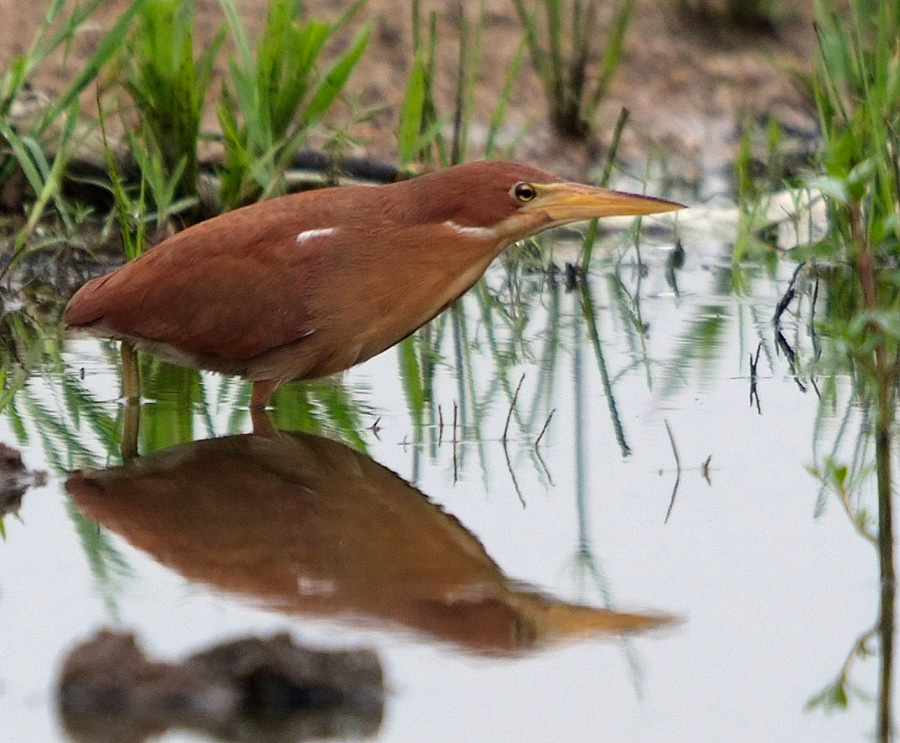
Cinnamon Bittern by Phil Kwong

Cinnamon Bittern by Phil Kwong

I have been working behind the scenes to make some changes and additions:

Some Updates today on the blogs:

Bittern

Bittern Photos

Sunbittern

Torrey’s Topical Textbook – Birds

Bird Song Quiz from Birds and Bloom

Beside them the birds of the heavens dwell; they sing among the branches. (Psalms 104:12 ESV)

Play the Video from Birds and Bloom Magazine and see how many you get right. I did not get 100% because I do not see some of them in this area.

Visit their videos page at http://www.youtube.com/user/birdsandblooms

Dinosaur Protein Sequences & Dino-to-Bird Model – Tomkins

Dinosaur Protein Sequences and the Dino-to-Bird Model by Jeffrey Tomkins, Ph.D. is in this months Acts and Fact.

Here is an excerpt from it:

“Evolutionists have maintained that the fossil record supports a long-ages history for earth, but material extracted from dinosaur bones is providing an interesting challenge to that theory. The recent discoveries of soft dinosaur tissues, defined cell matrices, elastic blood vessels, and clearly observable cell microstructures such as cell nuclei have been a source of both shock and excitement to the paleontology community.

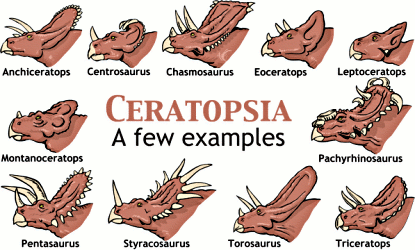
Dinosaurs

Dinosaurs

The shock comes from the fact that degradative processes somehow did not completely destroy all evidence of tissue from the supposedly millions-of-years-old fossils. The excitement comes from the fact that, given the pristine state of these tissues, scientists should be able to extract macromolecules. These would then be used in studies of molecular evolution to bolster the evolutionary ideas that are competing for supremacy in the scientific community, such as the currently touted “dinosaur to bird” transition model.

In fact, soft tissues from the bones of a Tyrannosaurus rex and a Brachylophosaurus canadensis (duck-billed hadrosaur) did yield protein fragments that were subjected to amino acid sequence analysis and then used in theoretical computational analyses.1, 2 But did the data demonstrate a dinosaur to bird transition, or was it possibly manipulated in the spirit of academic politics?”
Click here to read the rest of a very interesting article.

More from the Institute of Creation Research

The Flight of Migratory Birds by Werner Gitt

Pectoral Sandpiper (Calidris melanotos) by J Fenton

Pectoral Sandpiper (Calidris melanotos) by J Fenton

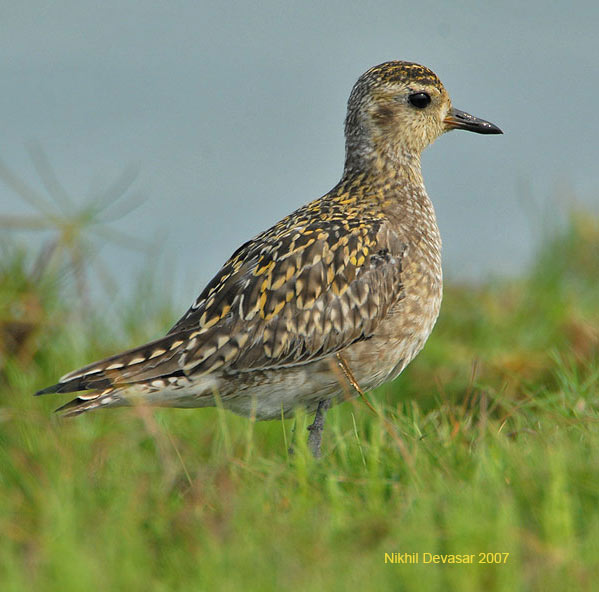
The Flight of Migratory Birds by Werner Gitt is a fairly technical, but very interesting article about the migration of birds. While thinking about yesterday’s Birds of the Bible – Migration September 2009, I came across this article. He mentions the Pacific Golden Plover in detail and some other long fliers, like:

“The following equally incredible flight performances are recorded for:

  • the Japanese snipe (Capella hardtwickii): 5,000 km flight from Japan to Tasmania
  • the needle-tailed swift of Eastern Siberia (Chaetura caudacuta): flight from Siberia to Tasmania
  • the American sandpipers (e.g. Calidris melanotos = pectoral sandpiper): 16,000 km flight from Alaska to Tierra del Fuego.”

Another excerpt from the article:

Pacific Golden Plover (Pluvialis fulva) by Nikhil Devasar

Pacific Golden Plover (Pluvialis fulva) by Nikhil Devasar

“The birds’ capabilities extend beyond the bounds of our imagination. They can determine their homeward course over long distances, even when all possible aids to orientation have been removed during the disorientation journey. They possess the extraordinary faculty of being able, wherever they are, to determine their position relative to their home territory from their immediate surroundings. And this method of determining location, itself not understood even today, is only the beginning; then comes the real problem, namely flight navigation: mere sense of direction is not enough for this.

During flight over wide, windswept stretches of ocean, a tendency to drift off course cannot be avoided. Such drift must be continually compensated for, as in a feedback system in control technology, in order to avoid losing energy by flying a longer route. The Creator equipped the birds with a precise ‘autopilot,’ which apparently is constantly measuring its geographical position and comparing the data with its individually “programmed” destination. In this way an economical, energy-saving and direct flight is guaranteed. Just where this vital system is to be found and how this operating information is coded is known by no one today except the Creator, who made it.”
To see the whole article – CLICK HERE


Birds of the Bible – Migration September 2009

Radar 9-30-09 image at 12:30 AM Eastern Daylight savings time.

Radar 9-30-09 image at 12:30 AM Eastern Daylight savings time.

I know that I have written about the migration of the birds before, but this is really interesting. They have been posting radar images of the Florida peninsula on BRDBRAIN, a bird-listing service. Here are the images for September 28th and 30th. The dark spots are the birds in migration being picked up on radar. It is amazing. I have been reading the updates for about a week and the birds are ON THE MOVE!

Even the stork in the sky Knows her seasons; And the turtledove and the swift and the thrush Observe the time of their migration; But My people do not know The ordinance of the LORD. (Jeremiah 8:7 NASB)

9-28-2009 Bird Radar

9-28-2009 Bird Radar

When the Lord created the birds, he put within them the instinct to migrate. They go for various reasons, but that desire is there and off they go. Some do not make it across the open waters, but most do. As you can see by the radar, they know to fly around the bad weather and go where it is clear. I know here in Polk county, Florida, that the Bald Eagles have been arriving back. I have seen a Bald Eagle on 7 of the last 9 days. I was in different places in the county when they were spotted. Prior to that, I had not spotted any eagles since they left on their spring northern migration other than the few resident ones.

Does the hawk fly by your wisdom, And spread its wings toward the south? (Job 39:26 NKJV)

“Stretch her wings toward the south? – Most of the falcon tribe pass their spring and summer in cold climates; and wing their way toward warmer regions on the approach of winter. This is what is here meant by stretching her wings toward the south. Is it through thy teaching that this or any other bird of passage knows the precise time for taking flight, and the direction in which she is to go in order to come to a warmer climate? There is much of the wisdom and providence of God to be seen in the migration of birds of passage. This has been remarked before. There is a beautiful passage in Jeremiah, Jer_8:7, on the same subject:” From the Adam Clarke’s Commentary.

A few links to check out are:

http://badbirdz2.wordpress.com/
http://badbirdz2.wordpress.com/2009/09/30/more-migration-over-florida-2/
http://badbirdz2.wordpress.com/2009/09/30/more-migrants-on-their-way/
http://badbirdz2.wordpress.com/2009/09/29/major-migrant-movement-last-night/

See Also:
Birds of the Bible – Migration
Bird Migration Mistakes
Interesting – Migration and Mechanics of Flight
Interesting Things – Amazing Bird Migration
Birds of the Bible – Hawk Migration
Interesting Thing – Lesson from the Stork

Meliphagidae – Honeyeaters

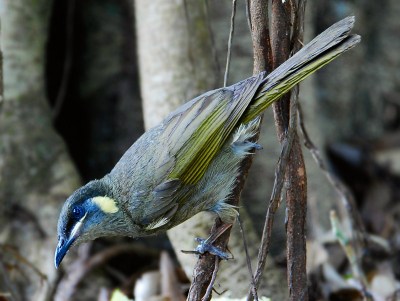
White-eared Honeyeater (Lichenostomus leucotis) by Ian at Birdway

White-eared Honeyeater (Lichenostomus leucotis) by Ian at Birdway

Meliphagidae – Honeyeaters Family Information

Pleasant words are as an honeycomb, sweet to the soul, and health to the bones. (Proverbs 16:24 KJV)

The honeyeaters are a large and diverse family of small to medium sized birds most common in Australia and New Guinea, but also found in New Zealand, the Pacific islands as far east as Hawaii, and the islands to the north and west of New Guinea known as Wallacea. Bali, on the other side of the Wallace Line, has a single species.

Honeyeaters and the closely related Australian chats make up the family Meliphagidae. In total there are 182 species in 42 genera, roughly half of them native to Australia, many of the remainder occupying New Guinea. Like their closest relatives, the Maluridae (Australian wrens), Pardalotidae (pardalotes and thornbills), and Petroicidae (Australian robins), they originated as part of the great corvid radiation in Australia-New Guinea (which were joined in a single landmass until quite recent geological times).

Although honeyeaters look and behave very much like other nectar-feeding passerines around the world (such as the sunbirds and flowerpeckers), they are unrelated, and the similarities are the consequence of variation.

Unlike the hummingbirds of America, honeyeaters do not have extensive adaptations for hovering flight, though smaller members of the family do hover hummingbird-style to collect nectar from time to time. In general, honeyeaters prefer to flit quickly from perch to perch in the outer foliage, stretching up or sideways or hanging upside down at need. All genera have a highly developed brush-tipped tongue, longer in some species than others, frayed and fringed with bristles which soak up liquids readily. The tongue is flicked rapidly and repeatedly into a flower, the upper mandible then compressing any liquid out when the bill is closed.

Bridled Honeyeater (Lichenostomus frenatus) by Ian at Birdway

Bridled Honeyeater (Lichenostomus frenatus) by Ian at Birdway

The extent of the partnership between honeyeaters and Australasian flowering plants is unknown, but probably substantial. A great many Australian plants are fertilised by honeyeaters, particularly the Proteacae, Myrtaceae, and Epacridacae. It is known that the honeyeaters are important in New Zealand as well, and assumed that the same applies in other areas.

In addition to nectar, all or nearly all honeyeaters take insects and other small creatures, usually by hawking, sometimes by gleaning. A few of the larger species, notably the White-eared Honeyeater, and the Strong-billed Honeyeater of Tasmania, probe under bark for insects and other morsels. Many species supplement their diets with a little fruit, and a small number eat considerable amounts of fruit, particularly in tropical rainforests and, oddly, in semi-arid scrubland. The Painted Honeyeater is a mistletoe specialist. Most, however, exist on a diet of nectar supplemented by varing quantities of insects. In general, the honeyeaters with long, fine bills are more nectarivous, the shorter-billed species less so, but even specialised nectar eaters like the spinebills take extra insects to add protein to their diet when they are breeding.

Lewin's Honeyeater (Meliphaga lewinii) by W Kwong

Lewin’s Honeyeater (Meliphaga lewinii) by W Kwong

The movements of honeyeaters are poorly understood. Most are at least partially mobile but many movements seem to be local, possibly between favorite haunts as the conditions change. Fluctuations in local abundance are common, but the small number of definitely migratory honeyeater species aside, the reasons are yet to be discovered. Many follow the flowering of favorable food plants. Arid zone species appear to travel further and less predictably than those of the more fertile areas. It seems probable that no single explanation will emerge: the general rule for honeyeater movements is that there is no general rule.

The genus Apalopteron (Bonin Honeyeater), formerly treated in the Meliphagidae, has recently been transferred to the Zosteropidae on genetic evidence.

A new taxon of honeyeater, not yet described but apparently close to the Smoky Honeyeater, has been discovered in December 2005 in the Foja Mountains of Papua, Indonesia.

From Wikipedia, the free encyclopedia with editing


See also:

Meliphagidae – Honeyeaters page

HONEYEATERS Meliphagidae by Bird Families of the World

*

Updates – 09-27-2009

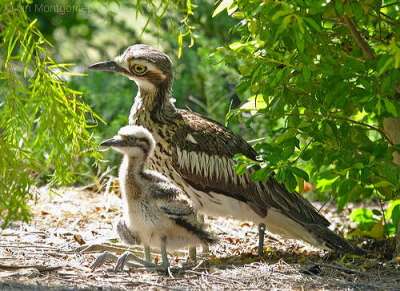
Bush Stone-curlew (Burhinus grallarius) with young by Ian

Bush Stone-curlew (Burhinus grallarius) with young by Ian

Some more bird family pages have been updated:

Burhinidae –  Stone-curlews, Thick-knees

Diomedeidae – Albatrosses

Megapodiidae – Megapodes

Anseranatidae – Magpie Goose

Anhimidae – Screamers

Birdwatching – 09-25-2009

Wood Duck (Aix sponsa) by Dan

Wood Duck (Aix sponsa) by Dan

Today we went birdwatching and ended up at three different places. Our intention was to go to Lake Hollingsworth, one of our favorite places to bird watch. I started my list as we were riding and saw about 20 Muscovy ducks (they are very prolific here), Morning Dove, Osprey, Black and Turkey Vultures, and a pair of Northern Harrier sitting on one of the light arms along the toll road.

It was clear today and about  79° when we arrived at Lake Hollingsworth at 8:35 am. We have been having some rain lately and the lake was really up. I spotted a Great Blue Heron, White Ibises, Mallards, some more vultures, and a Great Egret. What I didn’t spot were very many birds or a parking spot. So, we decided to go to Lake Morton instead. Good choice.

We were there by about 8:50 am and saw lots of birds being fed by a little girl and here father. She was the center of attention of the local clientele. I attempted to take her picture and the birds, but we had had our cameras and our eyeglasses in the car with the air conditioner running. After my glasses un-fogged, I looked through my lens and it was foggy. Needless to say, it was humid! Next time the camera will be in the trunk.

Mr and Mrs Wood Duck by Lee

Mr and Mrs Wood Duck by Lee

Anyway, it was a great day for pictures and I even took several videos (with my regular camera), fed the critters, and here is what we observed:  Wood Ducks (12+), Mallards, Wood Storks (I practically hand fed them), White Ibises, Black Swans, Mute Swans, Geese, Double-crested Cormorants, Laughing Gull, Anhinga, Muscovy Ducks, Bald Eagle (3rd one I’ve seen this week-there coming back!), Unknown terns, Limpkin, Rock Pigeons, Green Heron, Snowy Egret and a Great Blue Heron.

My highlight of being there was getting so close to the Wood Storks. I have never seen them that friendly before. Had I been brave enough to hold the bread (I know, you are not to feed wildlife, but everyone does at that lake and Hollingsworth), they would have ate right out of my hand. I tossed it to them and they were catching it and making a loud snap as that big beak closed. (The reason I didn’t hand feed. I need those fingers to snap photos with.) Also, the storks were sitting different than I had seen. Got a video of that also. The other highlight was I was videoing when a Bald Eagle flew over. I swung the camera up and caught him as he was flying off. You can hear my excitement in the video. I love eagles and had just wrote about them on yesterday’s blog.

We left there and had a small bite to eat and then on the way home decided to stop in at Circle B Bar Reserve to see what might be up near the entrance. By now it was 10:45 and most of the birds were resting somewhere, but not in sight. We heard a Blue Jay, Carolina Wren, Red-bellied Woodpecker, Tufted Titmouse and Blue-grey Gnatcatchers. Overhead we saw more Turkey Vultures and Black Vultures, and Wood Storks and then a Wood Stork flew low past us. Knowing bird sounds helps tremendously when you are in the woods and don’t always get to see the birds. I need to practice up much more myself. It counts when you are making list if they are heard.

The Lord provided a beautiful morning to watch His critters and just enjoy being out and about.

This is the LORD’S doing; it is marvellous in our eyes. This is the day which the LORD hath made; we will rejoice and be glad in it. (Psalms 118:23-24 KJV)

This first video is just looking around at the ducks and then spotting an eagle flying by.

The second video is of the stork bending its legs and sitting down.

Error
This video doesn’t exist

*

This slideshow requires JavaScript.

*

For other birdwatching trips to the Circle B Bar Reserve

*