Birds in Hymns – Awake, Glad Soul

Birds in Hymns – Awake, Glad Soul by John S. B. Monsell

Based on I Corinthians 15:20

But now Christ is risen from the dead, and has become the firstfruits of those who have fallen asleep. (NKJV)

Words: John S. B. Mon­sell, 1857. Music: St. Ste­phen, Wil­liam Jones, 1789 Al­ter­nate tunes: Awake, Glad Soul

Awake, glad soul! awake! awake!
Thy Lord has risen long;
Go to His grave, and with thee take
Both tuneful heart and song.

Bok Sanctuary Flower by Dan

Bok Sanctuary Flower by Dan

Where life is waking all around,
Where love’s sweet voices sing,
The first bright blossom may be found
Of an eternal spring.

The shade and gloom of life are fled
This resurrection day;
Henceforth in Christ are no more dead,
The grave hath no more prey.

In Christ we live, in Christ we sleep,
In Christ we wake and rise,
And the sad tears death makes us weep,
He wipes from all our eyes.

Eurasian Collard Dove by Reinier Munguia

Eurasian Collard Dove by Reinier Munguia

And every bird and every tree,
And every opening flower,
Proclaim His glorious victory,
His resurrection power.

The folds are glad, the fields rejoice,
With vernal verdure spread,
The little hills lift up their voice
And shout that death is dead.

Then wake, glad heart! awake! awake
And seek Thy risen Lord;
Joy in His resurrection take,
And comfort in His Word.

And let thy life, through all its ways,
One long thanksgiving be:
Its theme of joy, its song of praise—
Christ died, and rose for me.

Most information from The Cyber Hymnal

See ~ Wordless Birds

More ~ Birds in Hymns

*

Interesting Things – Dragonflies

Thinking

Here is an interesting video fromYouTube.com -Exploration Films about the Dragonflies. It is very interesting.

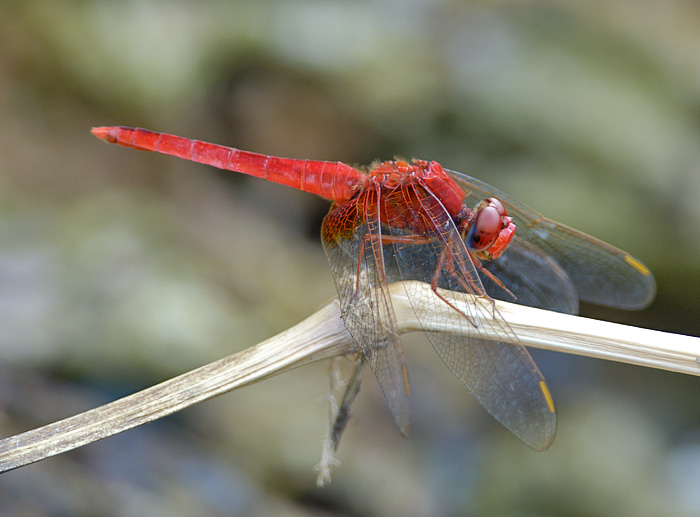
Dragonfly by Phil Kwong

Dragonfly by Phil Kwong

Learning from the Dragonfly by Creation Moments

“Scientists studying the dragonfly are learning even more secrets of flight. Our best high-performance aircraft can barely lift themselves off the ground. However, the dragonfly can lift 15 times his own weight into the air.”

The Amazing Mosquito Hawk by Creation Moments

But ask now the beasts, and they shall teach thee; and the fowls of the air, and they shall tell thee: Or speak to the earth, and it shall teach thee: and the fishes of the sea shall declare unto thee. Who knoweth not in all these that the hand of the LORD hath wrought this?
(Job 12:7-9 KJV)

More articles from Creation Moments:

100 Foot Ferns “dragonflies had wingspans of six feet”

The Pre-Flood Atmosphere “dragonflies were the size of hawks”

From Creation Ministries International:

“Dragonflies

Dragonflies are probably the most beautiful of the flying insects. There are about 4,500 different varieties. They begin their life in water, where eggs hatch into rather ugly brown nymphs. The time spent living in water varies from a few weeks to several years, but for all the varieties the day comes when the nymph suddenly has the urge to climb out of the water. It sits for a while at the top of a piece of grass until its skin splits open and out comes a dragonfly! After waiting for its wings to become firm and dry, the dragonfly flies away, its lovely colours glinting in the sunshine.

Although they are very small, dragonflies are wonderfully designed for flying. Their two pairs of wings are very light, but strengthened by a network of tiny veins, which not only carry blood fluid to keep the wings stiff, but also nerves and oxygen. Some dragonflies beat their wings 40 times in one second! Dragonflies are like tiny helicopters—they can even fly backwards! In fact, Igor Sikorsky, who first designed helicopters, for the idea from watching dragonflies.

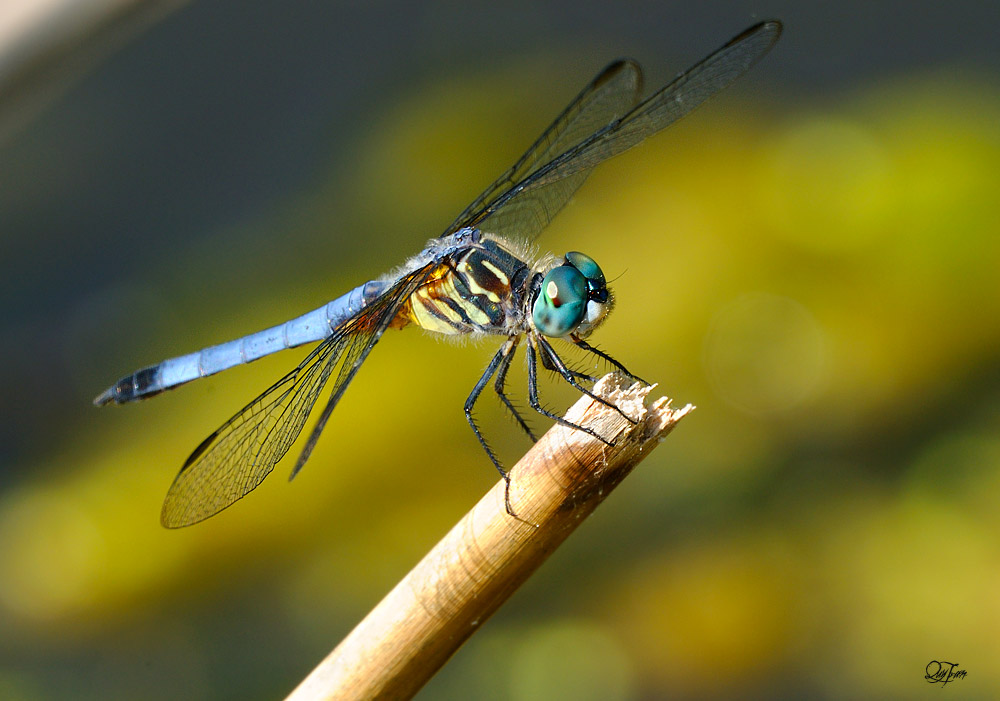
Dragonfly by QuyTran

Dragonfly by QuyTran

Another wonderful thing about dragonflies is their eyes. Each pair of eyes is actually made up of as many as 30,000 separate eyes, each with its own lens! This enables the insect to see what is happening over a wide area, and spot every tiny movement without moving its head.

The supposedly oldest fossil dragonflies are just like dragonflies are now, except that they were much larger—75 centimeters (2.5 feet) from wing-tip to wing-tip! So there is no evidence that they evolved from ancestors without wings. And surely those amazing eyes did not evolve? Dragonflies are another of the many wonders of God’s creation!” From Our World (Answers for Kids.)

Astonishing acrobatics – dragonflies – by Johathan Sarfati

(Updated 4/29/09)

Dragonflies and fighter pilots – what can we learn? by Ken Ham

Birds of the Bible – Osprey II

Osprey by Anthony

Osprey by Anthony

The Osprey or Ospray (depending on which version of Bible) listed in Leviticus 11:13 or Deuteronomy 14:12, gives an interesting challenge. According to my e-Sword Bible Program, an Osprey or ospray is listed in the ASV, BBE, Bishops, CEV, Geneva, JPS, KJV,  MKJV, RV, WEB, Webster, and YLT versions. Yet, the Darby calls it a sea-eagle. The ESV, GW, LITV, MSG, NASB, and the NKJV versions call it a type of Vulture. I am not sure why the different versions do that, but most of them call it the Osprey or sea-eagle which is another name used for it. The WhatBird article had this to say about it, “The Osprey, Pandion haliaetus–whose species name is derived from the Greek ‘hals’ (salt or sea) and ‘aetos,’ or eagle–is the only bird of prey that feeds exclusively on live fish.”
Smith’s Bible Dictionary says, “Osprey. The Hebrew word occurs in, Lev_11:13 and Deu_14:12, as the name of some unclean bird. It’s probably either the osprey, (Pandion haliaetus), or the white-tailed eagle, (Haliaetus albicella).”
Faussett Bible Dictionary says, “Ospray

Osprey with Fish by Jim Fenton

Osprey with Fish by Jim Fenton

ozniah (Lev_11:13; Deu_14:12). The sea eagle or fish hawk, Pandion haliaetus, the Septuagint. Or the short-toed eagle that feeds upon reptiles. The ossifrage (peres, means “the bone-breaker,” the lamergeyer, Gypaetus (eagle and vulture combined) barbatus, “the bearded vulture.” “Ospray” is a corruption of “ossifrage.” It flies in easy curving lines, and then pounces perpendicularly with unerring aim on a fish.”
International Standard BibleEncyclopedia says, “Ospray
os´prā́ (עזניּה, ‛oznīyāh; ἁλιάετος, haliáetos; Latin Pandion haliaetus): A large hawk preferring a diet of fish. The word is found in the list of abominations only. See Lev_11:13; Deu_14:12. The osprey was quite similar in appearance to some of the smaller eagles, and by some it is thought that the short-toed eagle is intended. But the eagle and the gier-eagle had been specified, and on account of the osprey plunging into water for food and having feet bare to the lower leg-joint and plumage of brighter and more distinctive marking, it seems very probable that it was recognized as a distinctive species, and so named separately. Moreover, the osprey was not numerous as were other hawks and eagles. It was a bird that lived almost wholly on fish, and these were not plentiful in the waters of Palestine. This would tend to make it a marked bird, so no doubt the translation is correct as it stands, as any hawk that lived on fish would have been barred as an article of diet (see Tristram, Natural History of the Bible, 182; also Studers, Birds of North America, p. 16).”
Webster says, Ospray
“OS’PRAY, n. [L. ossifraga; as, a bone, and frango, to break; the bone-breaker.]
The sea-eagle, a fowl of the genus Falco or hawk, of the size of a peacock. This is our fish hawk. It feeds on fish which it takes by suddenly darting upon them, when near the surface of the water.”

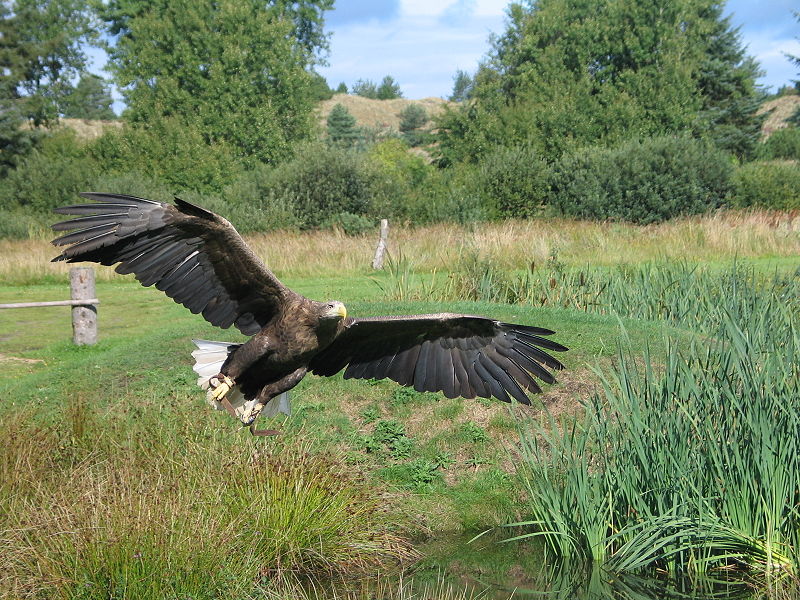
White-tailed Eagle in Flight - Wikipedia

White-tailed Eagle in Flight – Wikipedia

One thing most of them seem to be in agreement about, is that the bird is a fish eater. The Osprey’s diet consists almost exclusively of fish and God has created them with specialized feet and behaviors to assist them in their search for food. One of their biggest problems is the thievery of their catch by Bald Eagles. Dan and I have had the privilege twice to witness this event. Once years ago in Punta Gorda, Florida and just last month here in Winter Haven. Needless to say, the Osprey gets very upset, but both times, they lost. Do you think the Eagle knows the truth of Ephesians 4:28? (Replace hands with feet). Let’s make sure we don’t copy this improper behavior of the Eagle.

Let him who stole steal no longer, but rather let him labor, working with his hands what is good, that he may have something to give him who has need. (Eph 4:28 NKJV)

Original blog about the Osprey was Birds of the Bible – Osprey

See the Osprey Page for more information on the Osprey including Photos and Videos.

For more sources of information about Ospreys see:
Osprey – WhatBird.com
Osprey – Wikipedia
Osprey – BirdLife Species Factsheet
USGS – Osprey
Osprey Videos from the Internet Bird Connection

First Bird and Birding Trip of 2009

Here we are in 2009 and it’s time to start listing the birds we see this year. I hope last year was very

1st photo of 2009 - Female Ring-necked Duck 1st photo of 2009

1st photo of 2009 - Female Ring-necked Duck

productive in the bird listing area. I am still checking my counts, due to a software glitch that knocked some of the lists out. With the year only three days old, I trust you have been spotting birds already. On “BRDBRAIN”, a listing service here in Florida, they have all been listing the first bird they saw this year.

The first birds all saw when I looked out at my feeders on New Year’s Day were two Mourning Doves. What was the first bird you saw? Post a comment to this blog and let’s find out what everyone saw.

Today, we took our first Birding Trip for the year and went to Lakes Morton and Hollingsworth in Lakeland, FL. That is about a 20 minute ride from our home. We were not disappointed. On the way we counted a Blue Jay, Boat-tailed Grackles, a Wood Stork flying by, 11 Cattle Egrets, Great Egret, 15 Fish Crows, Mourning Doves and Eurasian-collared Dove, Mallards and a Great Blue Heron.

When we got to Lake Morton we were overwhelmed by the number of Ring-necked Ducks (150+) that are down for their winter vacation. There was also 27 Ruddy Ducks, Ring-billed Gulls (lots), 15 White Pelicans with Double-crested Cormorants swimming right along with them, Mallards, 2 Great Blue Herons, Great Egret, White Swans and Black Swans, Geese, Pied-bill Grebe, Muscovy Ducks, Coots (lots), and 2 Rock Doves, and an Anhinga or two.

Then off to Lake Hollingsworth, but this time we were on the north side of the lake at a walkway they have at a small wetlands. Here is what we saw there: 50+ Fish Crows, 7 Double-crested Cormorants, Mallards, White Ibises, Anhinga, Yellow-rumped Warbler, Palm Warbler, 2 Limpkins, Great Blue Heron, 2 Coots, Boat-tailed Grackles, Common Grackles, 2 Common Moorhens, White Pelican, Ospreys, 2 Red-bellied Woodpecker, Eastern Phoebe and some unknowns that we are trying to ID from photos.

All in all, it was a gorgeous day and the Lord provided lots to look at and enjoy. I trust your year will be loaded with much viewing of the beautiful birds and critters that have been created for ours and the Lords pleasure. Don’t forget to leave a comment as to what was the first bird you saw this year and where.

The photos have not really been touch up yet. Just wanted to get some posted to show what we saw today.

*

This slideshow requires JavaScript.

*

Birds of the Bible – Falcons II

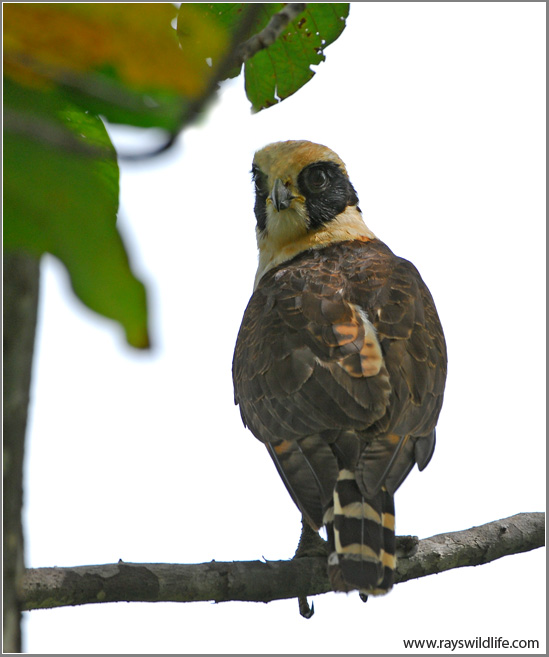
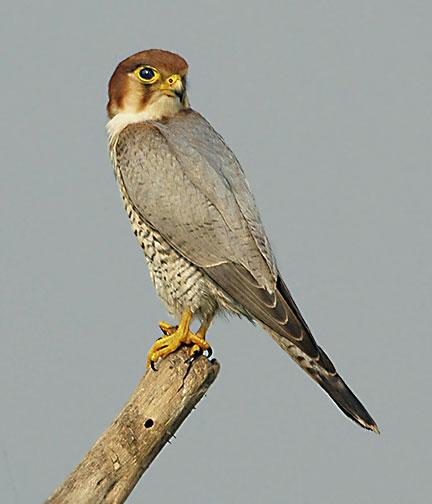
Laughing Falcon in Palo Verde National Park, Costa Rica by Ray

Laughing Falcon in Palo Verde National Park, Costa Rica by Ray

I have noticed that many come to my blog looking for information and photos of Falcons. The Birds of the Bible – Falcons introduced the Falcons. This week we will give some more on the Falcons around the world. The Falcon is on the “unclean list” of birds and was not to be eaten. Deuteronomy 14:13 and Leviticus 11:14 provides their name in that list.

the red kite, the falcon, and the kite after their kinds; (Deu 14:13 NKJV)
the kite, and the falcon after its kind; (Lev 11:14 NKJV)

The other reference in Scripture is found in Job 28:7 which refers to it’s eye.

That path no bird knows, Nor has the falcon’s eye seen it.

The Lord has created the Falcon with another fantastic ability which helps it catch its prey. Notice as you watch these videos, no matter what else they are doing, their eye’s are constantly watching for prey. A quote from Steiner Birding about the Peregrine Falcon says, “Sight is developed to a marvelous degree:
They are equipped with full-color vision and with eyes specially adapted to permit rapid adjustment of focus while moving at speed, and from four to eight times the resolving power of the human eye. Hovering may be compared to looking into a field from a car moving at twenty miles an hour or from one which comes to a standstill every few yards. It would be possible for a human being to see an individual rabbit or large game bird at a range of 600-700-yards; a bird of prey, with about four times the resolving power of the human eye, should therefore be able to see it at a range of nearly two miles.”

Here is a list of the Falcon’s listed at Internet Bird Collection (IBC) (a total of 34) The ones with the * were mentioned in the first blog:

Laughing Falcon – Videos of a Laughing Falcon on a tree and a Laughing Falcon calling continuously
Barred Forest-Falcon
Plumbeous Forest-Falcon
Lined Forest-Falcon
Slaty-backed Forest-Falcon
Collared Forest-Falcon

Red-necked Falcon

Red-necked Falcon from Wikipedia

Buckley’s Forest-Falcon
Spot-winged Falconet  – Video
African Pygmy Falcon – Video
White-rumped Pygmy-Falcon P
Collared Falconet – Video
Black-thighed Falconet
White-fronted Falconet
Philippine Falconet – Video
Pied Falconet – Video
Red-necked Falcon
Red-footed Falcon – Video
Amur Falcon – Video
Eleonora’s Falcon – Video
Sooty Falcon
Aplomado Falcon – Video
Bat Falcon – Video
Orange-breasted Falcon
New Zealand Falcon
Brown Falcon – Video
Grey Falcon
Black Falcon
Lanner Falcon – Video
Laggar Falcon
Saker Falcon – Video
Gyrfalcon
Prairie Falcon – Video
Taita Falcon – Video
Peregrine Falcon – Video

See also:

Falcon Pages
Falconidae – Caracaras, Falcons – Family
Peregrine Falcon – Peterson Field Guide

*

Birds in Hymns – In The Garden

Based on John 20:18

Mary Magdalene came and told the disciples that she had seen the Lord, and that he had spoken these things unto her.

Words & Music: C. Aus­tin Miles, March 1912:

In 1912 the music publisher Dr. Adam Geible wanted author and composer C. Austin Miles to write something that was “sympathetic in tone, breathng tenderness in every line; one that would bring tenderness in every line; one that would bring hope to the hopeless, rest for the weary, and downy pillows to dying beds.”

I read…the sto­ry of the great­est morn in his­to­ry: ‘The first day of the week com­eth Ma­ry Mag­da­lene ear­ly, while it was yet ve­ry dark, unto the se­pul­cher.’ In­stant­ly, com­plet­ely, there un­fold­ed in my mind the scenes of the gar­den of Jo­seph….Out of the mists of the gar­den comes a form, halt­ing, he­si­tat­ing, tear­ful, seek­ing, turn­ing from side to side in be­wil­der­ing amaze­ment. Fal­ter­ing­ly, bear­ing grief in ev­e­ry ac­cent, with tear-dimmed eyes, she whis­pers, ‘If thou hast borne him hence’… ‘He speaks, and the sound of His voice is so sweet the birds hush their sing­ing.’ Je­sus said to her, ‘Mary!’ Just one word from his lips, and for­got­ten the heart­aches, the long drea­ry hours….all the past blot­ted out in the pre­sence of the Liv­ing Pre­sent and the Eter­nal Fu­ture.’

This hymn was sung in the mo­vie Plac­es in the Heart, which won two Acad­e­my Awards in 1984.
C. Austin Miles (1868-1946)

I come to the garden alone
While the dew is still on the roses
And the voice I hear falling on my ear
The Son of God discloses.

Refrain

And He walks with me, and He talks with me,
And He tells me I am His own;
And the joy we share as we tarry there,
other has ever known.

He speaks, and the sound of His voice,
Is so sweet the birds hush their singing,
And the melody that He gave to me
Within my heart is ringing.

Refrain

I’d stay in the garden with Him
Though the night around me be falling,
But He bids me go; through the voice of woe
His voice to me is calling.

Refrain


References: In The Garden
Amazing Grace by Kenneth W. Osbeck, p. 116

Most information from The Cyber Hymnal

See ~ Wordless Birds

More ~ Birds in Hymns

*


Singing “In The Garden” by mercy2us

Musical Only by ilovetrains63

Another by gorgrel

Merry Christmas

Christmas of 2008 is here and those of us at Lee’s Birdwatching Adventures; Lee and Dan would like to wish you a very Merry Christmas. We are busy doing things for the special day when we celebrate the birth of the Lord Jesus Christ. We are enjoying the warmth of Florida, but are busy, none the less (but not shoveling snow!). We are off to Tampa to visit relatives tomorrow and try not to eat “too” much. We hope your Christmas Day is just as enjoyable as ours will be.

During all the festivities, pause to reflect on the true meaning of Christmas. We enjoy our birdwatching adventures throughout the year, and try to write and photograph our friends the birds, but our main goal is to show God’s magnificent creation and point you to Him. We do not worship nature, but we do worship the Lord who created it all.

Please watch the video of my pastor, Nathan Osborne, III, as he gave an excellent illustration about birds out in the cold and snow. It helps to explain the true meaning of Christmas. (Part of our Christmas cantata, “From the Manger to the Cross”)

If you have any questions about this, please leave a comment, or email me at:  lee@leesbird.com

Birdwatching on 12/18/08

We went birdwatching last Thursday, the 18th of December, on a very foggy morning. We were at Circle B Bar Reserve at 7:10am. When we started it was 59 degrees F. We parked up by the new Nature Center and walked out to the “Heron Hideout” path. Here is a list of the birds observed there in the order we spotted them:
White Ibis 6+, Great Blue Herons, Killdeer, Carolina Wren, Wood Storks 75+, Palm Warblers, Yellow-rumped Warbler, Cormorants 15+, Kingfisher, Great Egrets 10+, Glossy Ibis 4+, Tricolored Herons, Eastern Phoebe, Sandhill Cranes 2, Limpkin, Pileated Woodpecker, (an Otter), Coots 10+, Pied-billed Grebe 2, Northern Harrier 1, Common Moorhens 10+, Blue-gray Gnatchatcher, Osprey 3, Roseate Spoonbills 4, Downy Woodpecker, Little Blue Herons, Tree Swallow, Green-Winged Teal, Black-bellied Whistling-Ducks, Muscovy, Red-shoulder Hawk, (what I think is a Hooded Warbler), Red-bellied Woodpecker, Redwing Blackbirds, Boat-tailed Grackles, Blue Jay, Morning Doves 5, (36 species) plus several unknowns. Not a bad 2 hours of birding.

Me, feeding the beggars!

Me, feeding the beggars!

We left there at 9:00 am and drove over to Lake Hollingsworth in Lakeland. At 9:10 most of the fog had cleared and it was up to 66 already. With bread in hand, I was attacked again by the local beggars (see photo). After the Geese, Mallards, White Ibises, Ring-billed Gulls, Boat-tailed Grackles, Common Moorhens and Purple Gallinules got my offerings, I proceeded to go see what else was around. The rest of the adventure turned up Anhingas, Cormorants, Great Blue Herons, Mottled Ducks, Great Egrets, Muscovy, Limpkins 4, Osprey 10+, Tricolored Heron 2, Pied-billed Grebes, Coots, American White Pelicans 11, Brown Pelicans 5, Little Blue Heron, Wood Storks, Black-crowned Night-Heron, Eastern Phoebe, Common Grackles, Caspian Tern. (26) Not bad for an hour of viewing.
Putting the 36 plus the 8 different ones together, gives 44 bird species and a one Otter morning. Again, I am thankful for the opportunity to view and enjoy God’s critters and see His handiwork.

Here are a few photos:

*

This slideshow requires JavaScript.

*

For other birdwatching trips to the Circle B Bar Reserve

*

Birds of the Bible – Pelicans II

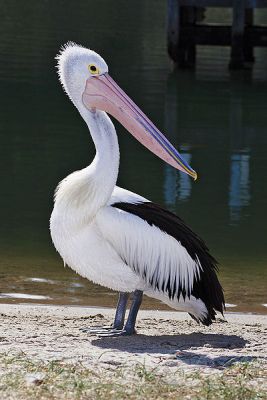
Australian Pelican

Australian Pelican

We were birdwatching at Lake Hollingsworth this week and spotted 11 American White Pelicans on the lake and also 5 Brown Pelicans hanging out with them. Over them were at least 10 or so Osprey circling hoping for some leftovers or fish to be scared up. So, this week we will revisit the “Birds of the Bible – Pelicans.”

In the first article we covered the American White Pelicans and the Brown Pelicans (our North American Pelicans), but there are six more around the world. They are  the:

Australian Pelican widespread on the inland and coastal waters of Australia and New Guinea, also in Fiji, parts of Indonesia and as a vagrant to New Zealand. Medium-sized by pelican standards: 5.3-6 ft long with a wingspan of 6–8.3 ft and weighing 9–29 lb). It is predominantly white with black along the primaries of the wings. The pale, pinkish bill is enormous, even by pelican standards, and is the largest bill in the avian world. The record-sized bill was 19.5 in long.

Dalmation Pelican It breeds from southeastern Europe through Asia to China in swamps and shallow lakes. The nest is a crude heap of vegetation. The largest of the pelicans, averaging 67 inches in length, 24-33 lbs in weight and just over 10 ft in wingspan. On average, it’s the world’s heaviest flying species. Peruvian Pelican The Peruvian birds are nearly twice the bulk of the Brown Pelican, averaging 15.4 lb in weight; they are also longer, measuring about 5 ft overall.

Great White Pelican Also known as the Eastern White Pelican or Great White Pelican, it breeds from southeastern Europe through Asia and in Africa in swamps and shallow lakes. The tree nest is a crude heap of vegetation. A large pelican, at 22 lbs, 63 in long and with a 110 inch wingspan. It differs from the Dalmatian Pelican, the only larger species of pelican, by its pure white, rather than greyish-white, plumage, a bare pink facial patch around the eye and pinkish legs.

Pink-Backed Pelicans

Pink-Backed Pelicans

Pink-backed Pelican A resident breeder in Africa, southern Arabia and Madagascar in swamps and shallow lakes. The nest is a large heap of sticks, into which 2-3 large white eggs are laid. The chicks feed by plunging their heads deep into the adult’s pouch and taking the partially digested regurgitated fish. A small pelican, but the wingspan is still around 7.9 ft with an average weight of 12 lbs. It is much smaller and duller than the Great White Pelican. The plumage is grey and white, with a pink back.

Spot-billed Pelican It breeds in southern Asia from southern Pakistan, Republic of India to Indonesia. It is a bird of large inland and coastal waters, especially shallow lakes. The nest is a heap of vegetation in a tree. A small pelican, at 49-60 in long and a weight of 9-13.2 lbs. It is mainly white, with a grey crest, hindneck and tail. Information taken from Wikipedia


The LORD will be awesome to them, For He will reduce to nothing all the gods of the earth; People shall worship Him, Each one from his place, Indeed all the shores of the nations. “You Ethiopians also, You shall be slain by My sword.” And He will stretch out His hand against the north, Destroy Assyria, And make Nineveh a desolation, As dry as the wilderness. The herds shall lie down in her midst, Every beast of the nation. Both the pelican and the bittern Shall lodge on the capitals of her pillars; Their voice shall sing in the windows; Desolation shall be at the threshold; For He will lay bare the cedar work. This is the rejoicing city That dwelt securely, That said in her heart, “I am it, and there is none besides me.” How has she become a desolation, A place for beasts to lie down! Everyone who passes by her Shall hiss and shake his fist. (Zep 2:11-15 NKJV)

“Judah had been taunted and mocked by the neighboring nations, Moab and Ammon, but God reminded them that he had “heard the taunts” (Zep_2:8), and that the taunters would be punished for their pride (Zep_2:10). At times the whole world seems to mock God and those who have faith in him. When you are ridiculed, remember that God hears and will answer. Eventually, in God’s timing, justice will be carried out. To predict the destruction of Nineveh 10 years before it happened would be equivalent to predicting the destruction of London, Tokyo, Paris, or New York. Nineveh was the ancient Near Eastern center for culture, technology, and beauty. It had great libraries, buildings, and a vast irrigation system that created lush gardens in the city. The city wall was 60 miles long, 100 feet high, and over 30 feet wide and was fortified with 1,500 towers. Yet the entire city was destroyed so completely that its very existence was questioned until it was discovered, with great difficulty, by 19th-century archaeologists. Nineveh had indeed become as desolate and dry as the desert.” (Notes from the Life Application Bible on Zephaniah 2:8-15)


See also these links:

Interesting link to Our Daily Bread about the Pathetic Pelican.

Birds of the Bible – Pelicans

Pelicans Page with Pictures and Videos

Interesting – “One in a Billion Shots”

SmileyCentral.com

I know these have been around for awhile, but they are still worth looking at.

Take therefore no thought for the morrow: for the morrow shall take thought for the things of itself. Sufficient unto the day is the evil thereof. (Mat 6:34 KJV)

Interesting Pictures from an E-mail

SmileyCentral.com

In the slideshow are some pictures from an e-mail I received today. I selected all the bird ones and a few of the others. Just wanted to share them with you.  I do not know the source of the photos, but thank you for taking such great shots. If not in the public domain, let me know and I will pull them.

*

This slideshow requires JavaScript.