BOBOLINKS: GRAIN-LOVING GRASSLANDERS

SEED-LOVING BOBOLINKS, GROUND-NESTING IN GRASSLANDS

Dr. James J. S. Johnson

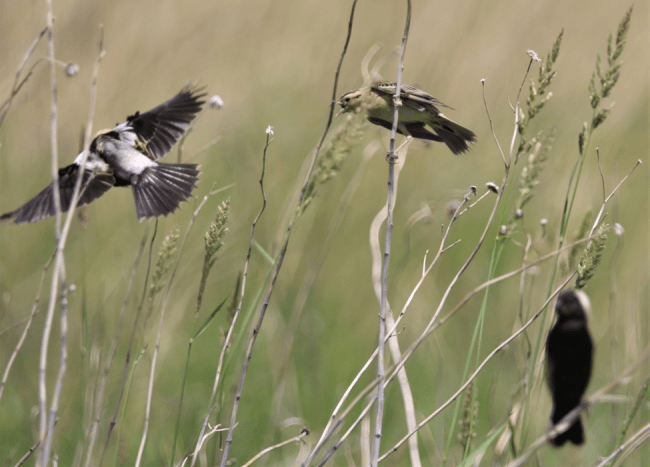
BOBOLINKS in grassland habitat, Minnesota 
(photo credit: Bryce Gaudian)

If a bird’s nest chance to be before thee in the way in any tree, or on the ground, whether they be young ones, or eggs, and the mother sitting upon the young, or upon the eggs, thou shalt not take the mother with the young. 

(Deuteronomy 22:6)

Moses noted that some wild birds build their nests upon the ground; Bobolinks do just that.

Years ago, I reported on the Black-capped Chickadee, noting that I first saw one at Gilsland Farm Sanctuary, while attending a wetland ecologists’ meeting: “Decades ago, I saw Black-capped Chickadees, for the first time, in Falmouth (near Portland), Maine – at the Gilsland Farm Sanctuary (now called “Gilsland Farm Audubon Center”), on May 31st of AD1995, while attending the annual national meeting of the Society of Wetlands Scientists.” [Quoting from “Tiny Yet Tough: Chickadees Hunker Down for Winter”, posted at https://leesbird.com/2016/11/18/tiny-yet-tough-chickadees-hunker-down-for-winter/ .]

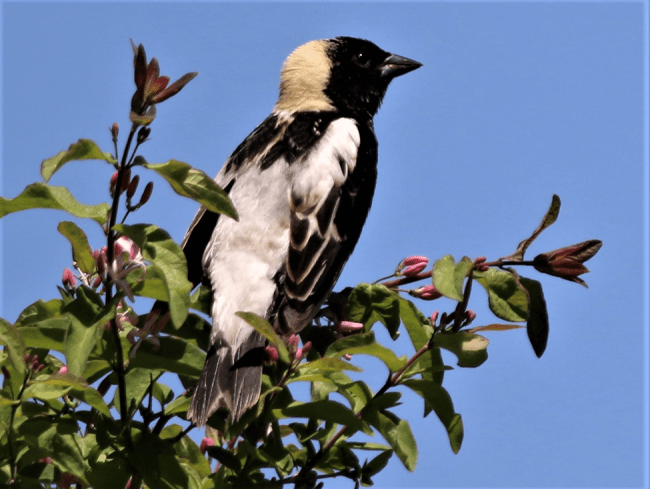
Another “lifer” that I then observed that day, at Gilsland Farm Sanctuary, was the BOBOLINK.  And what a striking plumage the male Bobolink has, during breeding season! 

BOBOLINK MALE in breeding plumage, Minnesota 
(photo credit: Bryce Gaudian)

Bobolinks (Dolichonyx oryzivorus) are icterids (blackbirds of the Western Hemisphere), dwelling in America’s prairie and pasture grasslands and marshy wetlands during the warm months of the year.  Bobolinks were nicknamed “rice birds” (which matches their species name, oryzivorus, meaning “rice-eating”), due to their dining habits, especially during autumn migrations.  

The Bobolink genus name, Dolichonyx, means “long claw”, matching its prehensile perching “fingers”.

BOBOLINK MALE, perching with “long claws”, Minnesota 
(photo credit: Bryce Gaudian)

During such migrations Bobolinks frequently feed in farmed fields of rice and other grains (such as oats, sorghum, maize corn, and hayseed), at energy-packing refueling stopovers (e.g., in South Carolina and the Gulf states), on their aerial journeys southward, via Caribbean islands, en route to South American over-wintering range destinations.

Bobolinks feed on (or near) the ground, eating various seeds, insects, spiders, and even snails—especially during breeding seasons.  Both larvae and adults of insects (especially armyworm moths) are protein-rich, much needed for growing Bobolink juveniles.

Also, during breeding seasons, Bobolinks depend upon available hay for nest-building, on the ground, in vegetated areas. 

Bobolinks are quite specific in their breeding habitat needs.  Open hay fields are a must, and so as farming is some regions of the country diminishes, so do populations of bobolinks.  Where colonies of bobolinks have traditionally bred, it is important to preserve their habitat with regular mowing practices.  Unfortunately, the right time to mow a field for hay is often just when the young are fledging[!].  Careful observation of the behavior of a [bobolink] colony and delaying of mowing until one or two weeks after fledging, a time when the young can fly fairly well, will keep a colony producing and ensure its [multi-generational] survival. 

[Quoting Donald W. Stokes & Lillian Q. Stokes, A GUIDE TO BIRD BEHAVIOR, Volume III (Boston: Little, Brown & Company/Stokes Nature Guides, 1989), pages 351-352.]
BOBOLINK MALE in grassland habitat, Minnesota 
(photo credit: Bryce Gaudian)

Consequently, Bobolinks are easier to find in habitats where their needs for food and nesting are plentiful.

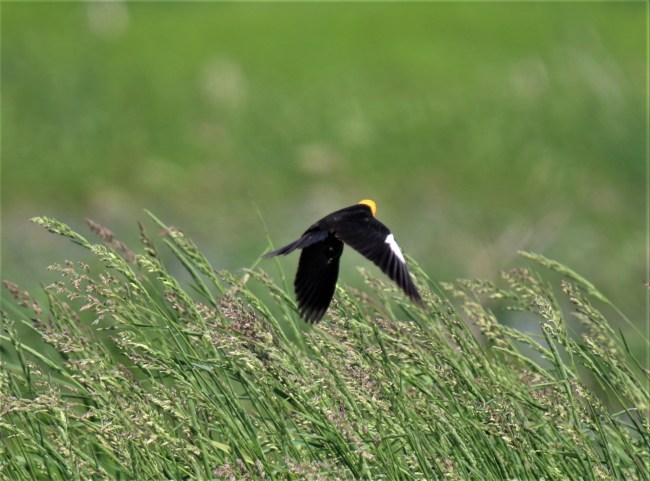
BOBOLINK male in flight, prairie habitat, Minnesota
(photo credit: Bryce Gaudian)

The males have easily seen plumages—like reverse tuxedos (white upon black) in spring and summer, during breeding months.

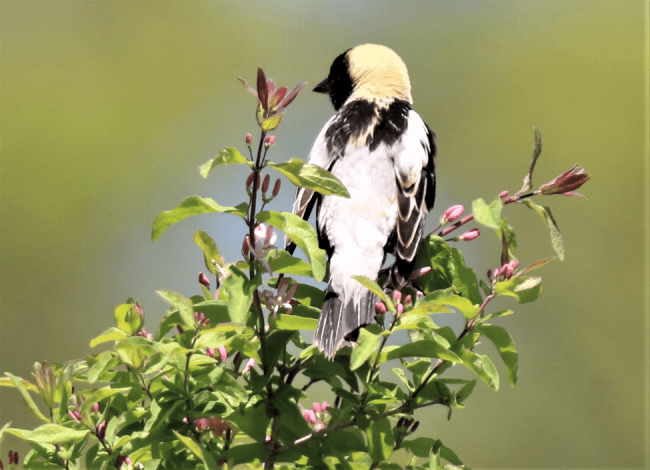
BOBOLINK male, displaying yellow nape-hood, Minnesota
(photo credit: Bryce Gaudian)

Male and female bobolinks are easily distinguished during the breeding season.  Males have a black head, belly, and wings, with a buff-gold nape and white patches on the back.  The female is buff [and brown] colored all over with dark streaks on her back, wings, and sides.

[Quoting Donald W. Stokes & Lillian Q. Stokes, A GUIDE TO BIRD BEHAVIOR, Volume III (Boston: Little, Brown & Company/Stokes Nature Guides, 1989), pages 364.]

During non-breeding months, however, Bobolink males shift to duller hues of dark and light browns, similar to the year-round plumage of Bobolink females and juveniles.

BOBOLINK female perching near prairie flower
(Mircea Costina / Shutterstock / ABCbirds.org photo credit)

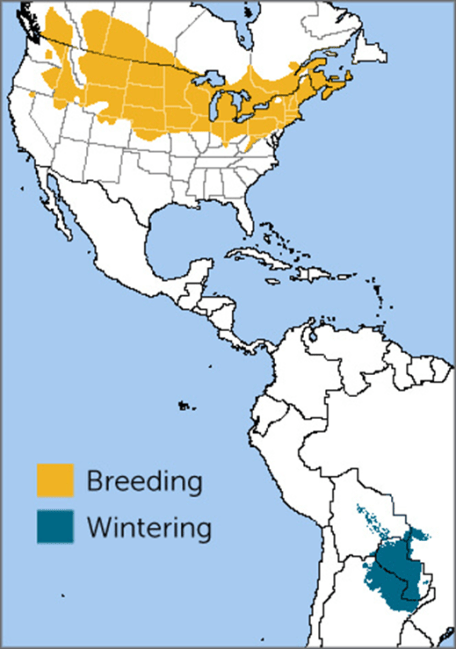
Of course, these tweety-chirpy icterids breed elsewhere in spring – in most of the upper half of America’s Lower 48, from the Northeast’s coastlines almost as far wet as the coasts of Washington and Oregon. Accordingly, the Bobolink migrates about 6,000 miles southward or northward, so it accrues about 12,000 miles per year, in air miles.

American Bird Conservancy range map

It was a privilege to see Bobolinks, back in AD1995, at the Gilsland Farm Sanctuary, as part of my time attending the Society of Wetlands Scientists’ meeting.

Likewise, it’s a privilege, now, to be permitted to share some of the wonderful Bobolink photographs taken in Minnesota, by Christian/creationist photographer BRYCE GAUDIAN — thanks, Bryce!

And now, it’s time for a limerick, about Bobolinks.

In Appreciation of the Bobolink, a/k/a Rice Bird

There’s an icterid feathered quite nice,

Whose fast-food oft includes rice;

It makes a chirp-sound,

As it nests on the ground,

And it’s photo’d quite well, by Bryce!


Scotland’s County Caithness Sports a Raven in its Flag

County Caithness Can Now Rave about their Raven Flag

Dr. James J. S. Johnson

CAITHNESS flag by roadside
(BBC photo credit)

Who provides for the raven his food? — when its young ones cry unto God, they wander for lack of meat.

( Job 38:41 )

Having a bird featured upon an official flag is nothing new, so the above flag of Scotland’s County Caithness, which became official (ceremonially celebrated January 26th of A.D.2016) is not a novel concept.

The official unveiling of Scotland’s County Caithness flag, during A.D.2016, was reported by the BBC [q.v., http://www.bbc.com/news/uk-scotland-highlands-islands-42094603 ].

Flag Institute unveiling of County Caithness flag
(BBC photo credit)

However, that vexillological event was and is worth noticing, especially to all of us who appreciate ravens — including Mrs. Lee Dusing, and the rest of us who appreciate her world-class bird-blog! (E.g., see one of Lee’s several blogposts, on ravens (and other corvids), at https://leesbird.com/2013/07/03/birds-of-the-bible-raven-iii/ .)

In fact, the first bird to be named (by its kind) within the Holy Bible was a raven. WOW! That’s quite an incomparable honor!

And he [i.e., Noah] sent forth the raven [‘ōrēb], which went forth to and fro, until the waters were dried up from off the earth.

( Genesis 8:7 )
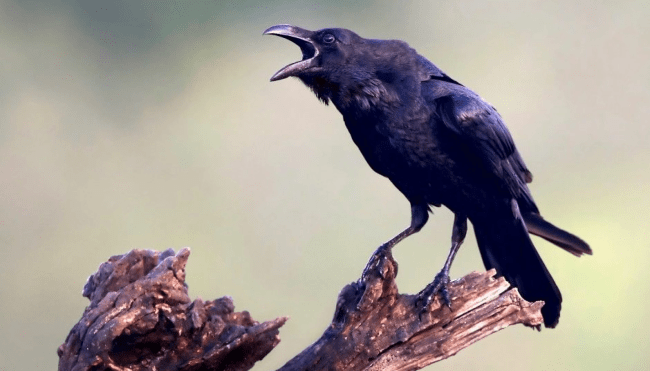
COMMON RAVEN of North America
(Wikipedia photo credit)

Likewise, the godly Bible translator and leading Reformer, Dr. Martin Luther, carefully observed and appreciated flocks of ravens (and jackdaws, their corvid cousins), during the adventurous times of the Protestant Reformation’s first generation in Germany. (See “A Diet of Jackdaws and Ravens”, posted at https://leesbird.com/2015/09/16/a-diet-of-jackdaws-and-ravens/ .)

Obviously, ravens are special birds, because God providentially cares for their kind — and tells us so in the Scriptures!

For example, in the Old Testament, within God’s creation sermon to the patriarch Job, Job was questioned about how God takes spare of ravens.

Who provides for the raven his food? — when its young ones cry unto God, they wander for lack of meat.

( Job 38:41 )

Likewise, in the New Testament, the Lord Jesus Christ refers to God’s provision for the physical needs of ravens.

Consider the ravens: for they neither sow nor reap; which neither have storehouse nor barn; and God feeds them; how much more are ye better than the fowls?

( Luke 12:24 )

Ravens are something to rave about!

RAVEN in Norway
( ScienceNorway.NO Dennis Jacobsen, Colourbox photo credit )

Ravens are also well known in antiquity, including Viking history, and consequently it is not unusual to see a raven depicted on an ancient banner, such as the flag of the Isle of Man (q.v., at “Northern Raven and Peregrine Falcon: Two Birds Supporting the Manx Coat of Arms”” — [posted at https://leesbird.com/2016/02/12/northern-raven-and-peregrine-falcon-two-birds-supporting-the-manx-coat-of-arms/ ).

ISLE OF MAN’s Coat of Arms, with Peregrine and Raven
(public domain)

In fact, this Christian birdwatching blog has previously blended ornithology (i.e., systematic study of birds) with vexillology (i.e., systematic study of flags). Specifically, years ago (during A.D.2015), this bird-blog features a mini-series captioned “FLAG THAT BIRD!” — about flags of the world that feature a bird.

To review that series, see Part 1 ( https://leesbird.com/2015/04/08/flag-that-bird-part-1/ ),

Part 2 ( https://leesbird.com/2015/04/13/flag-that-bird-part-2/ ),

Part 3 ( https://leesbird.com/2015/04/23/flag-that-bird-part-3/ ),

Part 4 ( https://leesbird.com/2015/04/29/flag-those-birds-part-4/ ), and

Part 5 ( https://leesbird.com/2015/08/25/flag-that-bird-part-5/ ).

So, this blogpost, celebrating the Caithness Raven, now succinctly supplements that ornithological-vexillological series.

Official flag of Scotland’s County CAITHNESS
(public domain image)

Caithness thus celebrates its Viking heritage, with a flag that contains a Nordic cross, plus the raven of antiquity, well known to Viking literature, along with a galley ship, reminiscent of ocean-faring adventures of northeastern Scotland’s Viking forebears, some who came as visitors, yet many who settled as immigrants, blending in with native Celts, providentially producing future generations of Count Caithness natives (Psalm 102:18).

Clarifying Confusion about Eagles’ Wings

Clarifying Confusion about Eagles’ Wings

Dr. James J. S. Johnson

“As an Eagle stirreth vp her nest, fluttereth ouer her yong, spreadeth abroad her wings, taketh them, beareth them on her wings:”

Deuteronomy 32:11 (KJV translation, with AD1611 spellings)
GOLDEN EAGLES nesting

Based upon a verse in Deuteronomy, 32:11, many expect that an eagle mother, in the wild, sometimes “carries” her young eaglets “on their wings”. Yet that behavior is not observed, in the wild (or in captivity), so Bible skeptics allege this discrepancy as a so-called Bible “error”—but is this a straw-man accusation, based upon a translation confusion? Yes, a less-than-literal translation (form Hebrew into English) has caused confusion with this verse.

To recognize what is true, careful observations are needed, both when studying God’s Word and when studying God’s world (Johnson, 2014).  So, when Scripture refers to the world of wildlife, as it often does, due diligence should be given to the Biblical exegesis and to the “science”.

QUESTIONDoes the text of Deuteronomy 32:11 actually say that an eagle mother “carries” young eaglets “upon her wings”?

ANSWERNo.  Many English translations and paraphrases confuse the literal meaning of this Biblical Hebrew text.

The first problem in the puzzle: English Bible translations (that are popularly available) do not clearly matched the singulars to the plurals, and other literal aspects of the Hebrew text of Deuteronomy 32:11. Also, even grammatical gender information is sometimes garbled in translation.

In particular, the literal Hebrew indicates that it is God Who carries on His wings, not the eagle parent. To a large degree, the confusion is rooted to imprecise translations of the English text of Deuteronomy 32:11, particularly where “her” is sometimes translated for “him”, as well as twice “them” for “him”.  This confusion-clearing clarification—by looking at the actual Hebrew text of Deuteronomy 32:11—was buttressed by the analysis of Hans-Georg Wünch (Wünch, 2016), which specially scrutinized the pertinent Hebrew nouns and verbs.  Details on this follow.

Although the King James Version of the English Bible is usefully very literal (and precise), in those very rare situations where the King James Version mistranslates the underlying Hebrew text’s words, it is likely to be with those KJV Bible verses that describe wildlife. In other words, in the English text of the KJV you are more likely to have imprecise/non-literal translations – perhaps due to the historical life experiences (and priorities) of the King James translators (working in the early A.D. 1600s, finishing in A.D.1611).

In short, the KJV text of Deuteronomy 32:11 is suggesting that eagle parents “carry” eaglets “upon their wings”. However, the Biblical Hebrew text (i.e., the Masoretic Text of Deuteronomy 32:11), interpreted within the immediate context of verses 9-13, is anthropomorphically recalling how God historically “took” and “carried” Jacob (i.e., both “Jacob” the man, as well as the Jewish nation that is ethnically descended from Jacob, i.e., “Israel”). This is comparable to how the Lord Jesus Christ compared His willingness to protect Jews to a mother hen’s protectiveness, in Matthew 23:37 and also in Luke 13:34.

However, the most important key (to solving the puzzle of this confusing-on-the-surface passage), to properly understanding this verse, is to recognize that the subject noun of most (if not all) of the contextual sentences, is God, not a mother bird — although you must look back to Deuteronomy 32:9 to see that Deuteronomy 32:11’s subject noun is “the LORD” [Hebrew YHWH], i.e., God. (Notice also the action verbs in the Biblical context – most of these verbs refer to God only.)

Also, the relevant bird (translated “eagle” in King James Version) is mentioned in a way that is best translated “like an eagle” (or “like a vulture”, depending on how you translate NESHER, which is Hebrew noun for the bird in question). Careful context reading is needed, to recognize how much of the verse applies to the simile phrase “like an eagle”, because not all of the activities that are part of Deuteronomy 32:9-13 correspond to eagle behavior comparison.

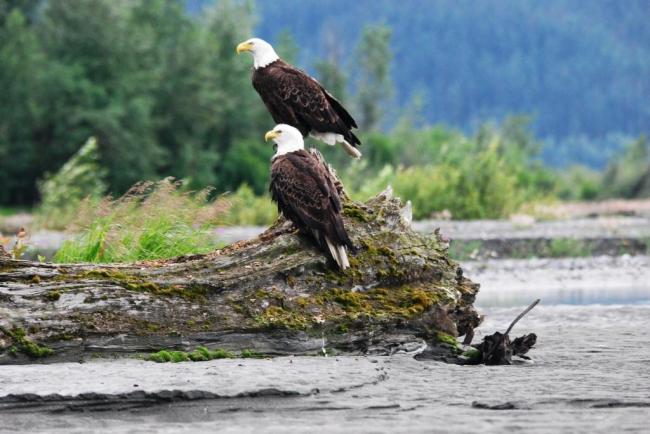
BALD EAGLES near Skagway, Alaska

Therefore, let us look at the overall context, i.e., Deuteronomy 32:9-13). Below I have inserted, using brackets, clarifying nouns (or pronouns), to match the literal meaning of the specific Scripture verbs and pronouns.

Also, keep in mind that “the LORD” [YHWH] is masculine, “Jacob” [Ya‘aqōb] is masculine, and “eagle” [nesher] is also masculine, so matching each pronoun to its proper noun requires some context-based interpretation. This is further complicated by a mistranslation in the English phrase “her nest” because the Hebrew literally says “his nest”, i.e., the Hebrew word for “nest” [qēn] has a masculine singular suffix.

In other words, Deuteronomy 32:11 is literally saying “his nest”. The same English mistranslation appears in the English phrase “her young” (which literally says “his young” in the Hebrew). Likewise, the same English mistranslation appears twice in the English phrase “her wings” (which twice literally says “his wings” in the Hebrew).

Confusingly, the Hebrew-to-English translation plot thickens.

In the English translation, of Deuteronomy 32:11, the plural pronoun “them” appears twice where it should say “him”, because the Hebrew pronominal suffix is a 3rd person singular, not a 3rd person plural.
This is, in my opinion, the most important clue, in conjunction with the plural noun “young”, for solving this puzzle, because the “taking” action – as well as the bearing action – has “him” as its (singular) direct object, yet the noun translated “young” is plural, so the taking and bearing action did not happen to young birds — rather, the taking and bearing action happened to “him”, which the overall context (of Deuteronomy 32:9-13) indicates is “Jacob”.

In other words, because a plurality of hatched birds would need a plural suffix, it is not the hatched young birds that were “taken” and “carried” in Deuteronomy 32:11. Rather, God is providing these caring actions (“taking” and “bearing”) to Jacob/Israel, because “Jacob” is a 3rd person singular masculine person, so “Jacob” can be the direct object “him”.

9 For the LORD’s portion is His [i.e., God’s] people; Jacob [whom God later re-named “Israel”, so this name refers to both the man Jacob and to his descendants who became the nation “Israel”] is the lot of His [i.e., God’s] inheritance.

10 He [God – notice that God is the subject noun of this Hebrew sentence, which is a sentence that actually continues beyond verse 10] found him [i.e., Jacob, a/k/a Israel] in a desert land, and in the waste howling wilderness; He [i.e., God] led him [i.e., Jacob, a/k/a Israel] about, He [i.e., God] instructed him [Jacob, a/k/a Israel], He [i.e., God] kept him [i.e., Jacob, a/k/a Israel] as the apple of His [i.e., God’s] eye.


11 As an eagle [some say this should be translated “hawk” or “vulture” – it means a large-winged carrion-eating bird], [“he” or “He”] stirs up her [actually the Hebrew says “his”, which might mean “His”] nest; [“he” or “He”] flutters over her [actually the Hebrew says “his”, which might mean “His”] young [i.e., “young ones”, since this noun is plural]; [“he” or “He”] spreads abroad her [actually the Hebrew says “his”] wings; [“he” or “He”] takes them [literally “him” — actually this is a 3rd person singular masculine suffix, functioning as a direct object of the action verb]; [“he” or “He”] bears them [literally “him” — actually this is a 3rd person singular masculine suffix, functioning as a direct object of the action verb] on her [actually the Hebrew says “his”] wings:

12 So the LORD alone did lead him [i.e., Jacob, a/k/a Israel], and there was no strange god with him [this “him” seems to mean “Jacob”, though it more likely refers to God, because it is “the LORD alone” Who accomplished this shepherding care over Jacob].

13 He [i.e., God] made him [i.e., Jacob, a/k/a Israel] ride on the high places of the earth, that he [i.e., Jacob, a/k/a Israel] might eat the increase of the fields; and He [i.e., God] made him [i.e., Jacob, a/k/a Israel] to suck honey out of the rock, and oil out of the flinty rock.

[Deuteronomy 32:9-13 (KJV, with JJSJ clarification inserts]

This is a confusing Hebrew mistranslation problem, so many readers of the Bible (using English translations or paraphrases) have stumbled in trying to discern its literal meaning. Because wildlife observers do not see mother eagles carrying young eaglets “on their wings”, it is no surprise that many folks have been puzzled by this verse (Lacey, 2019).

According to the literal Hebrew text, analyzed grammatically—with special attention to singular-vs.-plural and masculine-vs.-feminine details, this verse (i.e., Deuteronomy 32:11) is talking about God’s providential care of His people, with only some of God’s actions being comparable to an eagle/hawk/vulture.

Moreover, some of the other caring actions listed (in Deuteronomy 32:11) do not match bird behavior, regardless of whether the Hebrew noun nesher should be translated as “eagle”, or “hawk”, or “vulture” (Wigram, 1874).  So the complicated part (for interpreting Deuteronomy 32:11’s text) is accurately distinguishing:


(a) which phrases fit God only (even if those phrases are anthropomorphic, like Matthew 23:37 & Luke 13:34),
(b) which phrases apply to the nesher bird only, and
(c) which phrases apply to both God and the nesher bird.

In sum, here is my pronoun-interpreting understanding (and exegesis), of what I think the Hebrew text of Deuteronomy 32:9-13 is saying:

9 For the LORD’s portion is God’s people; Jacob/Israel is the lot of God’s inheritance.

10 God found Jacob/Israel in a desert land, and in the waste howling wilderness; God led Jacob/Israel about; God instructed him Jacob/Israel; God kept him Jacob/Israel as the apple of God’s eye.

11 Like an eagle, God stirs up God’s nest; God flutters over God’s young ones; God spreads abroad God’s wings; God takes/was taking Jacob/Israel; God bears/was bearing (i.e., carrying)  Jacob/Israel on God’s wings;

12 So the LORD alone led Jacob/Israel, and there was no strange god with Him.

13 God made-to-ride Jacob/Israel upon the high places of the earth, so that Jacob/Israel might eat the increase of the fields; and God caused-to-suck Jacob/Israel honey [from] out of the rock, and oil out of the flinty rock.

[Deuteronomy 32:9-13, with JJSJ’s inserted pronoun-clarifying interpretive nouns]

In sum, many interpreters have misidentified the subject noun of that verse, by stretching the comparative noun (nesher, which can/could be translated as “eagle”, “hawk”, or “vulture”, though it likely means “eagles” in Deuteronomy 32:11) in a way that causes the nesher bird to supplant God as the subject noun of the sentence.In other words, instead of the eagle (nesher bird) being comparable to some things that God does, many have interpreted the verse as if every action verb applies to the bird when actually that is not the case.

Having processed the precise parts of this puzzle, which parts should not be studied apart from the big-picture message of the passage, I conclude with a comparison to Psalm 23:1a, which says “the LORD is my shepherd”—that is the main message of Deuteronomy 32:9-13—i.e., it is God Himself Who carries us through all of life’s risks and challenges.

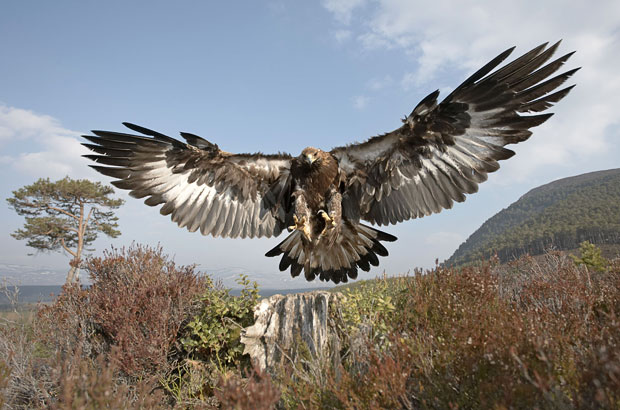
Golden Eagle (NET NS-WildlifeZone photo credit)

REFERENCES

Johnson, James J. S. 2014. A Hart for God. Acts & Facts. 43(7), posted at https://www.icr.org/article/hart-for-god .

Lacey, Troy. 2019. Does an Eagle Carry its Young on its Wings? Answers in Genesis (August 13, 2019), posted at https://answersingenesis.org/contradictions-in-the-bible/does-eagle-carry-young-on-wings/ .

Wigram, George V. 1874. The Englishman’s Hebrew Concordance of the Old Testament (Hendrickson reprint, 2001), pages 849-850.

Wünch, Hans-Georg. 2016. Like an Eagle Carries its Young. Hervormde Teologiese Studies/HTS Theological Studies. 72(3):a3249, posted (by African Online Scientific Information Systems) at https://hts.org.za/index.php/HTS/article/view/3249 .

SCISSOR-TAILED FLYCATCHER: the Texas Bird of Paradise

SCISSOR-TAILED FLYCATCHER: the Texas Bird of Paradise

Dr. James J. S. Johnson

And the LORD shall make thee the head, and not the tail [zânâb]; and thou shalt be above only, and thou shalt not be beneath; if that thou hearken unto the commandments of the LORD thy God, which I command thee this day, to observe and to do them.

(Deuteronomy 28:13)

Usually we think of “head” as being valuable and important, but “tail” not so much. Being a “head” is desirable; being a “tail” not so — as Moses indicated in Deuteronomy 28:13, quoted above. (See also, indicating likewise, Deuteronomy 28:44 & Isaiah 9:15.) However, when God made birds, on Day #5 of Creation Week (Genesis 1: 20-23), God made them with feathered tails that blend practical traits (such as aerodynamic rudder functionality) with beauty (such as the extravagant tail of a peacock).

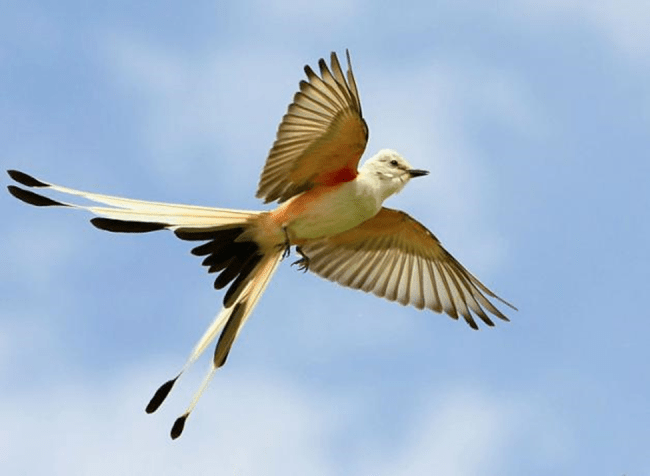
Among the “tyrant” flycatchers, certainly there is no better example of this blending, of beauty and bioengineering, than the Scissor-tailed Flycatcher, famous for eating flies on the fly.

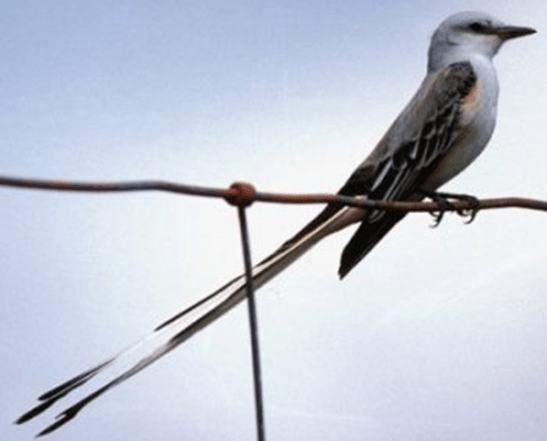
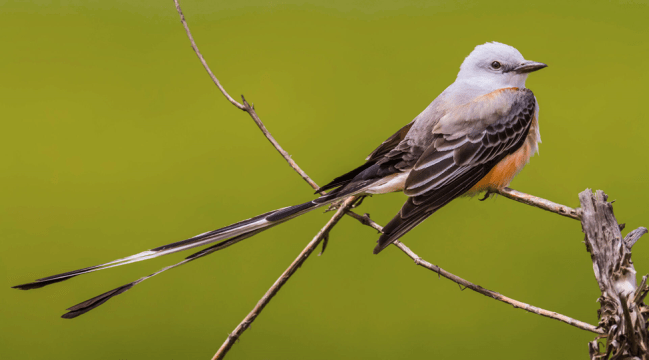
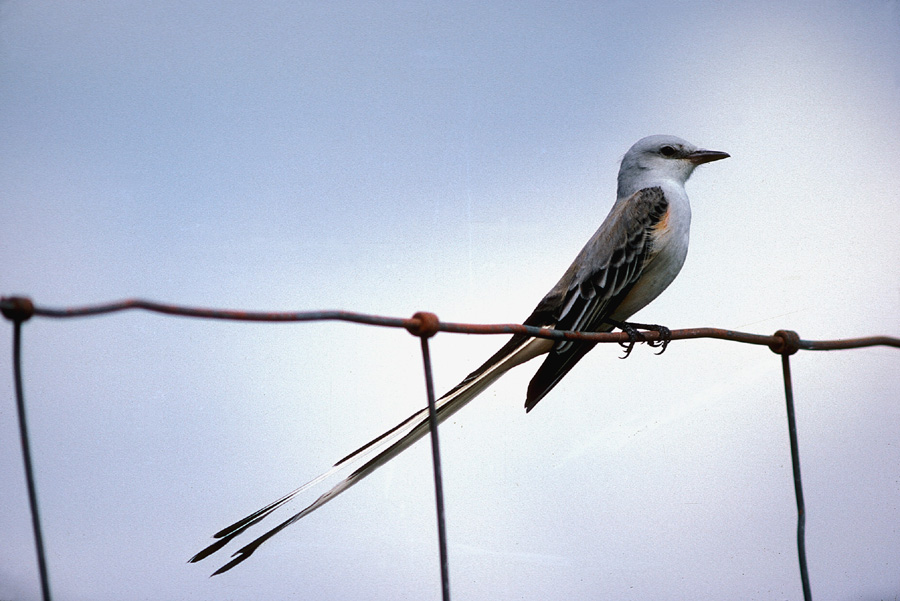
SCISSOR-TAILED FLYCATCHER perching on fence
Texas Parks & Wildlife Dep’t photo credit

Earlier this month [June A.D.2022], on 2 different occasions, I saw Scissor-tailed Flycatchers (Tyrannus forficatus) in my neighborhood.  One was larger than the other, so those must have been different Scissortails, because the size difference would not have occurred in just 3 days’ time! 

SCISSOR-TAILED FLYCATCHER flying
Ken Slade / BirdNote.org photo credit

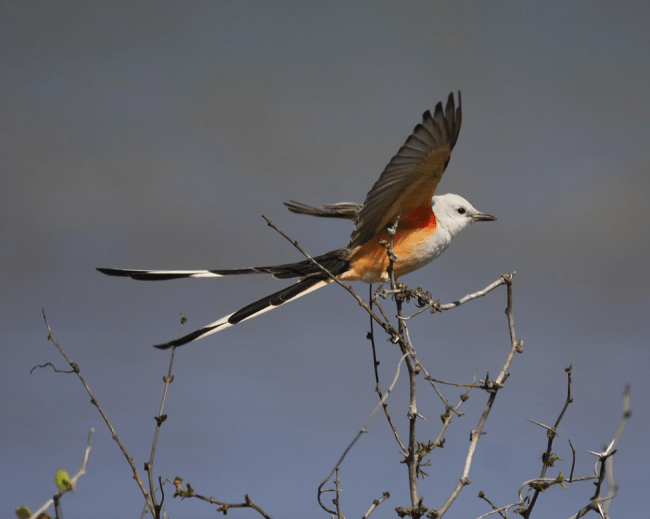
Scissor-tailed Flycatchers are beautiful squeaky-voiced birds with long-streaming split tail plumage that looks like long scissor blades. The Scissortail’s head and most of their plumage (neck, upper back, and breast) is soft-looking ivory-white (to very light grey), plus white-edged black on wings and tail feathers, with sides (flanks) and underwings that feature salmon-like orange-pink.

14” [long, including tail feathers.]  Very long split tail; pale gray body; pinkish wash on flanks.  In flight: Underwings bright pinkish orange.  …  Feeding: Flies from perch to catch insects on the ground [such as grasshoppers or beetles] or in the air [such as flies and dragonflies].

[Quoting from Donald Stokes & Lillian Stokes, “Scissor-tailed Flycatcher (Tyrannus forficatus)”, STOKES FIELD GUIDE TO BIRDS: WESTERN REGION (Boston: Little, Brown & Company, 1996), page 312.

This flycatcher (which also eats lots of grasshoppers) is well established throughout Texas, the Lone Star State, which is itself quite a range.  The Scissortail’s breeding range also includes Oklahoma (where it is the official state bird — a fact that I learned from Christian attorney Don Totusek!), as well as large parts of Kansas, Missouri, western Arkansas, western Louisiana, and small parts of eastern Colorado and Nebraska.  Probably the best places to see them during breeding season are Texas, Oklahoma, and Kansas.  As migrants, these kingbirds fly south of the USA for the winter, e.g., into Mexico—although some are observed over-wintering in southern Florida. [See, accord, Robert C. Tweit, “Scissor-tailed Flycatcher”, in Texas A&M AgriLife Research’s TEXAS BREEDING BIRD ATLAS, posted at https://txtbba.tamu.edu/species-accounts/scissor-tailed-flycatcher/ .]

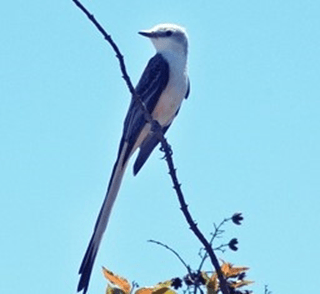
SCISSOR-TAILED FLYCATCHER perching
Texas A&G AgriLife.org photo credit

If you have ever seen a Scissor-tailed Flycatcher you won’t forget it—Scissortails are unlike any bird you have ever seen, unless you have seen their shorter-tailed cousin called Mexico’s Fork-tailed Flycatcher (Tyrannus savanna, known in French as le tyran á queue fourchue = “the tyrant of the fork-tail”), with whom Scissortails can mate.  In fact, Scissortails are also known to hybridize with Couch’s Kingbird (Tyrannus couchii), as well as with Western Kingbirds (Tyrannus verticalis), which themselves hybridize with Eastern Kingbirds (Tyrannus tyrannus) — so there are many “cousins” within the greater kind-family of aggressive insectivores we call “tyrant kingbirds”. [See Eugene M. McCarthy, HANDBOOK OF AVIAN HYBRIDS OF THE WORLD (Oxford, U.K.: Oxford University Press, 2006), pages 203-204; see also Alexander J. Worm, Diane V. Roeder, Michael S. Husak, Brook L. Fluker, & Than J. Boves, “Characterizing Patterns of Introgressive Hybridization Between Two Species of Tyrannus Following Concurrent Range Expansion”, IBIS (International Journal of Avian Science), 161(4):770-780 (October 2019).]

SCISSOR-TAILED FLYCATCHER flying
eBird.org photo credit

One Scissortail (that I saw recently) was flying between trees on the side of a golf course.  The other Scissortail was flying from a residential lawn, that had a few trees and bushes, to another residential lawn, that also had a few trees and bushes. 

No surprise there, because Scissortails prefer to hunt insects in areas that mix open fields with trees and shrub cover, such as the semi-open country of grassy prairies, farm fields, suburb clearings, and ranchlands sporadically dotted with honey mesquite (Prosopis glandulosa) trees.

Scissor-tailed Flycatchers (Tyrannus forficatus) are Neotropical migrants that breed throughout the south-central United States with the highest breeding densities in southern Oklahoma and northern Texas, corresponding to the core of the breeding range …  In their breeding range, they occupy open areas that provide adequate hunting perches and nesting sites including savannahs, prairies, brush patches, agricultural fields and pastures. … Scissor-tailed Flycatchers require trees for nesting and hunting perches to support their foraging strategy given that they are sit-and-scan foragers that utilize perches such as shrubs, trees, utility wires and fences, while they scan for insect prey …. Most prey are captured in the air [“hawking”] a short distance from the perch [citation omitted] which further indicates the need for open habitat to facilitate foraging.

[Quoting from Erin E. Feichtinger & Joseph A. Veech, “Association of Scissor-Tailed Flycatchers (Tyrannus forficatus) with Specific Land-Cover Types in South-Central Texas”, WILSON JOURNAL OF ORNITHOLOGY, 125(2):314-321 (2013), at page 314.]

In other words, Scissortails prefer habitats with ecotones where open-field and forest-cover micro-habitats overlap, i.e., preferring to nest and hunt “in landscapes (linear transects 0.8-40.2 km in length and 2.4 km wide) with a mix of “open country” and “closed forest” than in landscapes comprise mostly of either of these two general cover types.” [Quoting from Feichtinger & Veech, page 314.]

SCISSORTAILED FLYCATACHER perching
Bird-Sounds.net photo credit

Scissortails perch and wait, watching for their next prey to move into capture range. Their method of hunting, called “hawking”, involves an aerial dash (with a sudden spurt of speed) toward a soon-to-be-seized target.  In more casual flight, however, this beautiful kingbird is easier to see and to appreciate.

The scissor-tailed flycatcher, with its namesake long, forked tails, is one of the most recognizable bird species on the Katy Prairie and throughout southeast Texas’s coastal prairie ecosystem. The male’s tail can reach up to 15 inches long while the female’s tail can reach about 10.5 inches, making the scissor-tailed flycatcher a spectacular sight to see.  The species name forficata, not surprising, derives from the Latin word for ‘scissors’ (forfex). The scissortail is a member of the Tyrannus, or ‘tyrant-like’ genus. This genus earned its name because several of its species are extremely aggressive on their breeding territories, where they will attack larger birds such as crows, hawks, and owls.

During the reproduction season between April and August, the male [Scissortail] performs a spectacular aerial display during courtship, sharply rising and descending in flight, its long tail streamers opening and closing, while the bird gives sharp calls. He may even perform backwards somersaults in the air.

[Quoting from Andy Goerdel, “State of the Species: Scissor-tailed Flycatcher (Tyrannus forficatus)”, COASTAL PRAIRIE CONSERVANCY (January 31, A.D.2022), posted at www.coastalprairieconservancy.org/blog/state-of-the-species-scissor-tailed-flycatcher .]

“Somersaults in the air”?  That reminds me of when I did flips, in the air, on a neighbor’s trampoline, more than a half-century ago.  But those days are over.  (At least I hope they are!) 

Nowadays I’d be happy to see a Scissor-tailed Flycatcher do aerial somersaults, as I sit comfortably in an Adirondack chair.  A glass of iced tea would help the birdwatching experience. Maybe, too, I could better appreciate looking, at a Scissortail’s salmon-colored underwings and flanks, as I snack on some smoked salmon.

But I digress.

SCISSOR-TAILED FLYCATCHER perching
National Audubon Society photo credit


What An Honor – Top 100 Bird Blogs and Websites

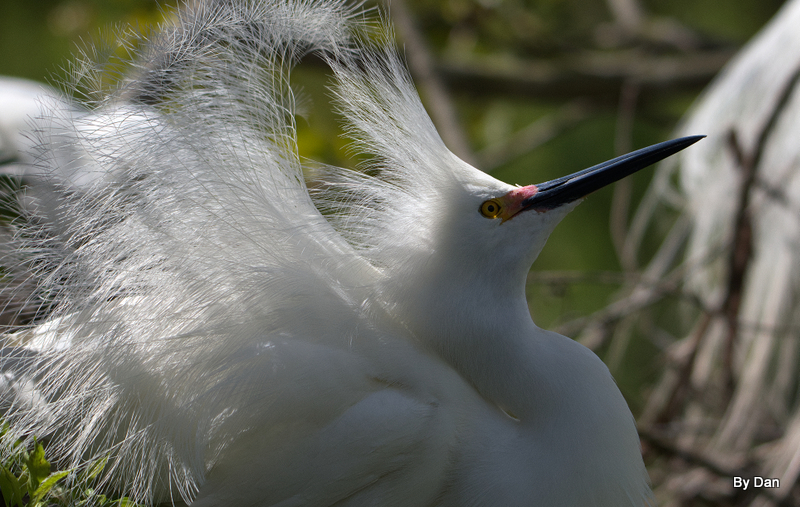
Snowy Egret in Mating Plumage by Dan at Gatorland

Top 100 Bird Blogs and Websites For Ornithologists and Bird Lovers

This blog has been selected “by our panelist as one of the Top 100 Bird Blogs on the web.” Wow! What an honor and totally unexpected.

I received an email from the Founder of this list, Anuj Agarwal.

“I personally give you a high-five and want to thank you for your contribution to this world. This is the most comprehensive list of Top 100 Bird Blogs on the internet, and I’m honored to have you as part of this!”

When I looked through the list, Lee’s Birdwatching Adventures Plus is #20! Wow!

Here is a list of the first 21 blogs or websites out of 100:

  1. Audubon

  2. The Cornell Lab of Ornithology – All About Birds

  3. BirdLife International News

  4. Surfbirds | The World Birding Website

  5. BirdWatching

  6. 10,000 Birds

  7. British Trust for Ornithology | BTO

  8. Bird Note Podcast

  9. Bird Watching HQ

  10. Wild Birds Unlimited

  11. World Birds

  12. Bird Feeder Hub

  13. BirdGuides

  14. Bird Watcher’s Digest | Out There With the Birds Blog

  15. Bird Spot

  16. International Bird Rescue

  17. FeederWatch Blog
  18. Ornithology – The Science of Birds

  19. Outside My Window

  20. Lee’s Birdwatching Adventures Plus

  21. Travels With Birds

  22. And the list goes on to 100

(P.S. This list seems to change. Sometimes it’s 19th or 20th. I’ve seen it change. Not sure how often it is updated.)

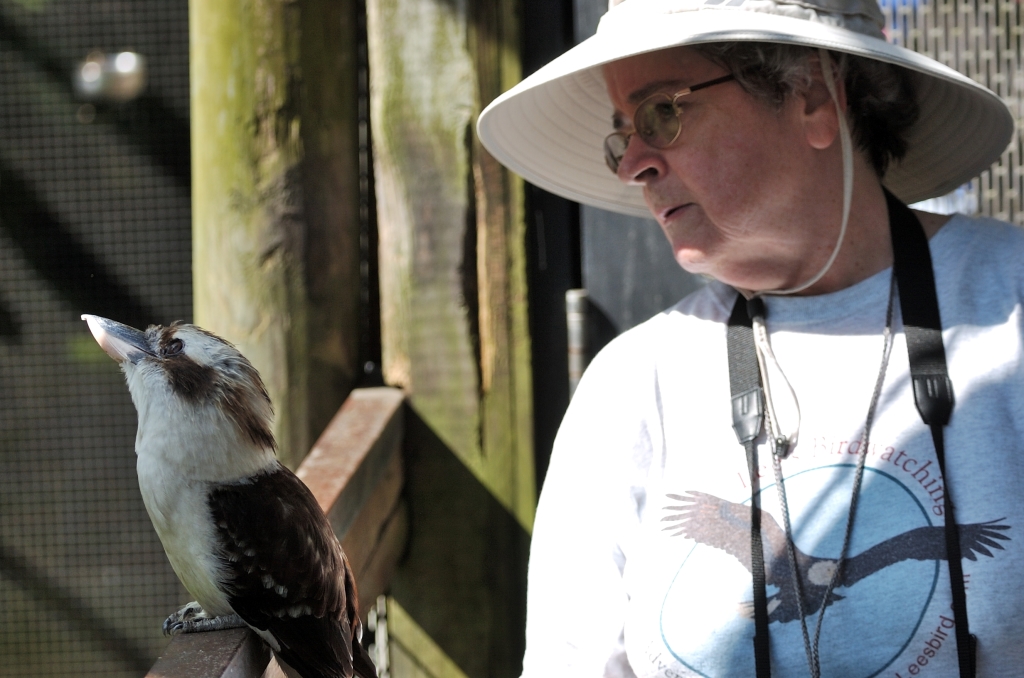
Lee with Laughing Kookabura at Brevard Zoo by Dan

Please check out this list of really great and interesting sites of information about our wonderful Avian Wonders!

Seems like I’ll be busy for awhile checking out some fantastic information on all sorts of birdwatching topics.

“But now ask the beasts, and let them teach you; And the birds of the heavens, and let them tell you.” (Job 12:7 NASB)

“Who teaches us more than the beasts of the earth And makes us wiser than the birds of the heavens?'” (Job 35:11 NASB)

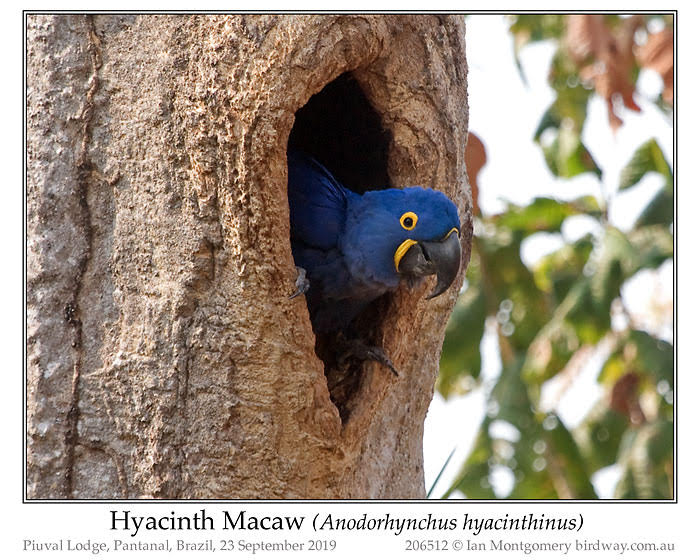
Hyacinth Macaw (Anodorhynchus hyacinthinus) ©Ian Montgomery

Hyacinth Macaw ©Ian Montgomery

Thank you, readers, for visiting this blog for all these 13+ years. Especially, thank you to all of those who have written articles for the blog.

Ian’s Bird of the Week

James J. S. Johnson

Bibleworld Adventures (Golden Eagle)

Emma’s Stories

William Wise

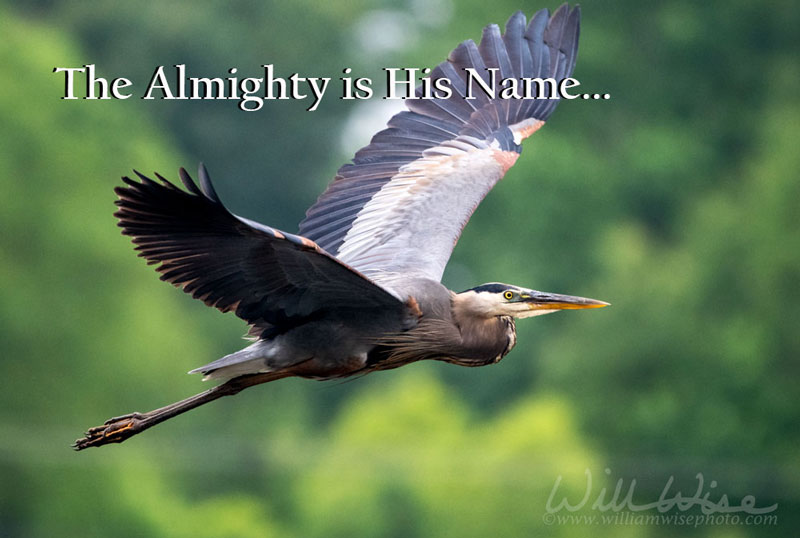
Great Blue Heron; Walton County, Georgia birding photogaphy blog by williamwisephoto.com

Plus, Thank you to our many previous writers like a j mithra, Dottie Malcolm, and others. Also, all the fantastic photographers who have given us permission to use their photos over the years. Especially, my husband, Dan.

The biggest Thanks and Praise goes to the Lord for giving me the idea and inspiration to begin this journey of writing about His Fantastic Avian Creations!

Hummingbirds See Colors Over (Beyond) the Rainbow

Hummingbirds See Colors Over (Beyond) the Rainbow

Dr. James J. S. Johnson

The hearing ear, and the seeing eye, the LORD hath made even both of them.  [ Proverbs 20:12 ]

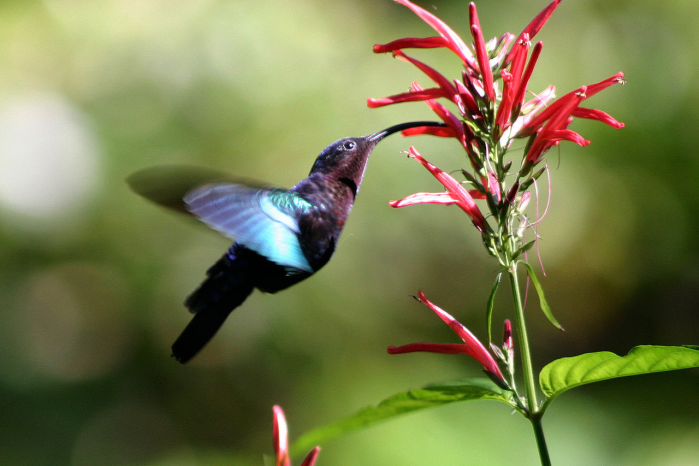
God has equipped hummingbirds with a range of color vision that exceeds that of humans, so it’s fair to say that hummingbirds see over—or beyond—the rainbow.

This “beyond-the-rainbow” vision helps birds to see food, predators, nectar-producing plants, potential mates, and 3D objects within their physical environment. Recent research corroborates this amazing fact.(1),(2)

Humans have three types of color-sensitive cones in their eyes—attuned to red, green and blue light—but birds have a fourth type, sensitive to ultraviolet light. “Not only does having a fourth color cone type extend the range of bird-visible colors into the UV, it potentially allows birds to perceive combination colors like ultraviolet+green and ultraviolet+red—but this has been hard to test,” said [Dr. Mary Caswell] Stoddard. …  Stoddard and her colleagues designed a series of experiments to test whether hummingbirds can see these nonspectral colors. Their results appear June 15 [2020] in the Proceedings of the National Academy of Sciences.(1)

[ see Princeton University citation below ]

Nonspectral colors are perceived when nonadjacent cone types (sensitive to widely separated parts of the light spectrum) are predominantly stimulated. For humans, purple (stimulation of blue- and red-sensitive cones) is a nonspectral color; birds’ fourth color cone type creates many more possibilities.(2)

[ see Stoddard , Eyster, et al. citation below ]

For years, literally, Dr. Stoddard and her team tested and quantified how wild hummingbirds see colors beyond the spectrum of white light that humans see.

To investigate how birds perceive their colorful world, Stoddard and her research team established a new field system for exploring bird color vision in a natural setting. Working at the Rocky Mountain Biological Laboratory (RMBL) in Gothic, Colorado, the researchers trained wild broad-tailed hummingbirds (Selasphorus platycercus) to participate in color vision experiments. … [using] a pair of custom “bird vision” LED tubes programmed to display a broad range of colors, including nonspectral colors like ultraviolet+green. Next they performed experiments in an alpine meadow frequently visited by local broad-tailed hummingbirds, which breed at the high-altitude site.(1)

[ see Princeton University citation below ]

The experiment was sweet, as one would expect with hummingbirds.(3)

Each morning, the researchers rose before dawn and set up two feeders: one containing sugar water and the other plain water. Beside each feeder, they placed an LED tube. The tube beside the sugar water emitted one color, while the one next to the plain water emitted a different color. The researchers periodically swapped the positions of the rewarding and unrewarding tubes, so the birds could not simply use location to pinpoint a sweet treat. … Over the course of several hours, wild hummingbirds learned to visit the rewarding color. Using this setup, the researchers recorded over 6,000 feeder visits in a series of 19 experiments.(1)

[ see Princeton University citation below ]
See the source image
The results were—one might say—colorful. Unlike human eyes that can see one “nonspectral” color, purple, hummingbird eyes apparently see five “nonspectral” colors.

Stoddard’s team was particularly interested in “nonspectral” color combinations, which involve hues from widely separated parts of the color spectrum, as opposed to blends of neighboring colors like teal (blue-green) or yellow (green-red). For humans, purple is the clearest example of a nonspectral color. Technically, purple is not in the rainbow: it arises when our blue (short-wave) and red (long-wave) cones are stimulated, but not green (medium-wave) cones. While humans have just one nonspectral color—purple, birds can theoretically see up to five: purple, ultraviolet+red, ultraviolet+green, ultraviolet+yellow and ultraviolet+purple.(1)

[ see Princeton University citation below ]

Birds have four color cone types in their eyes, compared to three in humans. In theory, this enables birds to discriminate a broad range of colors, including many nonspectral colors. … We trained wild hummingbirds to participate in color vision tests, which revealed that they can discriminate a variety of nonspectral colors, including UV+red, UV+green, purple, and UV+yellow. Additionally, based on an analysis of ∼3,300 plumage and plant colors, we estimate that birds perceive many natural colors as nonspectral.(2)

[ see Stoddard, Eyster, et al. citation below ]

Also, the research team studied minute differences in color, as they are featured in plant material and bird feathers—there is a lot more to color that is appreciated by most human eyes!

Finally, the research team analyzed a data set of 3,315 feather and plant colors. They discovered that birds likely perceive many of these colors as nonspectral, while humans do not … [due to the birds’] four color-cone visual system.(1)

[ see Princeton University citation below ]

How colorful the world must be to hummingbirds!

Dr. Stoddard’s team were not the first to study the beyond-the-rainbow vision of birds. Previous studies have been reported, using finches and sparrows, indicating that diet is important for avian eyesight.

The ability of finches, sparrows, and many other birds to see a visual world hidden to us is explained in a study published in the journal eLife. Birds can be divided into those that can see ultraviolet (UV) light and those that cannot. Those that can live in a sensory world apart, able to transmit and receive signals between each other in a way that is invisible to many other species. … The study reveals two essential adaptions that enable birds to expand their vision into the UV range: chemical changes in light-filtering pigments called carotenoids and the tuning of light-sensitive proteins called opsins. Birds acquire carotenoids through their diets and process them in a variety of ways to shift their light absorption toward longer or shorter wavelengths.(4)

[ see PhysOrg citation below ]

If that seems complicated and mathematically challenging, it is!(4),(5)

The researchers characterized the carotenoid pigments from birds with violet vision and from those with UV vision and used computational models to see how the pigments affect the number of colors they can see. … The study also revealed that sensitivity of the violet/UV cone and the blue cone in birds must move in sync to allow for optimum vision. Among bird species, there is a strong relationship between the light sensitivity of opsins within the violet/UV cone and mechanisms within the blue cone, which coordinate to ensure even UV vision.(4)

[ see PhysOrg citation below ]

The more-technical description of the research is even more challenging, to read, but the implications are “clearly seen”—God has given birds amazing eyesight.

Color vision in birds is mediated by four types of cone photoreceptors whose maximal sensitivities (λmax) are evenly spaced across the light spectrum. … SWS1 [shortwave-sensitive cone] opsin is accompanied by a corresponding short-wavelength shift in the spectrally adjacent SWS2 cone.(5)

[ see Toomey, Lind, et al. citation below ]

Hummingbird eyesight is facilitated by some really technical details!

Here, we show that SWS2 cone spectral tuning is mediated by modulating the ratio of two apocarotenoids, galloxanthin and 11’,12’-dihydrogalloxanthin, which act as intracellular spectral filters in this cell type. We propose an enzymatic pathway that mediates the differential production of these apocarotenoids in the avian retina, and we use color vision modeling to demonstrate how …  spectral tuning is necessary to achieve even sampling of the light spectrum and thereby maintain near-optimal color discrimination.(5)

[ see Toomey, Lind, et al. citation below ]

At the practical level, how can Christians benefit from knowing about avian eyesight? Or, what about other features—like wings, feathers, and motion-regulating software—that God has designed and installed into the world’s hummingbirds? Are we missing an opportunity to appreciate God if we ignore what He has done to enable hummingbirds to live as they do?

Hummingbird beaks, bones, and feathers differ from those of all other living or extinct bird kinds. Their wings don’t fold in the middle. Instead, they have a unique swivel joint where the wing attaches to the body so that the wings rotate in a figure-eight pattern. And they move fast! They have to beat their wings rapidly to hover, levitating with level heads as they extract nectar from flowers for hours per day. Scientists still need to discover the bird’s mental software that coordinates information about the location of a flower’s center with muscle motion that expertly stabilizes the hummingbird’s little head as it drinks.(6)

[ see Thomas citation below ]

Astonishing! What a stupendous and beauty-broadcasting imagination our God has—how can we see His busy, busy hummingbirds without admiring His technical genius and His bioengineering power?(7)

[ see Sherwin citation below ]

Yet every hummingbird alive today is a descendant from the originals made by God on Day 5 of Creation Week.

Their size, flight characteristics and patterns, metabolism, all point to our magnificent Creator who designed these amazing animals and created them on Day Five.(8)

References

  1. Staff writer, Princeton University. 2020. Spectacular bird’s-eye view? Hummingbirds see diverse colors humans can only imagine. PhysOrg (June 15, 2020), posted athttps://phys.org/news/2020-06-spectacular-bird-eye-view-hummingbirds-diverse.html .
  2. Stoddard, M. C., H. N. Eyster, et al. 2020. Wild Hummingbirds Discriminate Nonspectral Colors. Proceedings of the National Academy of Sciences (June 15, 2020), posted at  https://doi.org/10.1073/pnas.1919377117 .  
  3. Mitchell, E. 2014. Our Creator’s Sweet Design for Hummingbird Taste (Answers in Genesis: News to Know, September 6, 2014), posted https://answersingenesis.org/birds/our-creators-sweet-design-hummingbird-taste/ (with a link, in Footnote #1, to video footage of hummingbird sugar consumption).
  4. Staff writer, eLife. 2016. How Birds Unlock their Super-Sense, Ultraviolet Vision.PhysOrg (July 12, 2016), posted at https://phys.org/news/2016-07-birds-super-sense-ultraviolet-vision.html?utm_source=TrendMD&utm_medium=cpc&utm_campaign=Phys.org_TrendMD_1 .
  5. Toomey, M. B., O. Lind, et al. 2016. Complementary shifts in photoreceptor spectral tuning unlock the full adaptive potential of ultraviolet vision in birds. eLife Sciences / Biochemistry, Chemical Biology, Neuroscience (July 12, 2016), posted at https://elifesciences.org/articles/15675 ; doi: 10.7554/eLife.15675
  6. Thomas, B. 2016. Hummingbirds! Acts & Facts. 45(4), posted at https://www.icr.org/article/hummingbirds .
  7. Sherwin, F. 2006. Hummingbirds at ICR. Acts & Facts. 35(9), posted at https://www.icr.org/article/hummingbirds-at-icr .  
  8. Dreves, D. 1991. The Hummingbird: God’s Tiny Miracle. Creation Ex Nihilo Technical Journal. 14(1):10-12.  

Seabirds and Cetaceans Both Love Ocean-catch Fish! (Plus Some Information on Cetaceans’ Submarine Songfests)

SEABIRDS AND CETACEANS BOTH LOVE OCEAN-CATCH FISH!  

(With Extra Information about How Norwegians and Americans Scrutinize Saltwater Serenades)

Dr. James J. S. Johnson

Blue Whale in Red Sea (Novinite.com image)

HUMPBACK WHALE (The Bermudian Magazine)

 And God created great whales [tannînim], and every living creature that moveth, which the waters brought forth abundantly, after their kind, and every winged fowl after his kind; and God saw that it was good.   (Genesis 1:21)

SEABIRDS AND CETACEANS BOTH LOVE OCEAN-CATCH FISH!  

 Ocean-catch fish is enjoyed, daily at sea, by both whales and seabirds.  Accordingly, it is not surprising to find seabirds hovering over places where whales are feeding on oceanic fish.

Seabirds and whales share a special bond; they both love fish. Seabirds are often found at the top of the food web and can also function as indicators of ecosystem health. Seeing seabirds on the surface is a possible sign that whales are also feeding underneath. This is especially the case for humpback and North Atlantic Right whales, which are the baleen whales at the most risk in the Northern Atlantic. 

Researchers wanted to know how often seeing a specific kind of seabird known as great shearwaters  coincided with the presence of whales. To do this, they spent five years surveying both the Gulf of Maine and the Stellwagen Bank National Marine Sanctuary near Boston.

[Quoting Ashley Mickens, “Where There Are Birds … There Are Whales?”, OCEANBITES (September 30, 2022), posted at  https://oceanbites.org/where-there-are-birds-there-are-whales/#:~:text=Seabirds%20are%20often%20found%20at%20the%20top%20of,at%20the%20most%20risk%20in%20the%20Northern%20Atlantic  —  citing Tammy L. Silva, et al., “Exploring the Use of Seabirds as a Dynamic Ocean Management Tool to Mitigate Anthropogenic Risk to Large Whales”, FRONTIERS IN MARINE SCIENCE, 9:861 (2022).
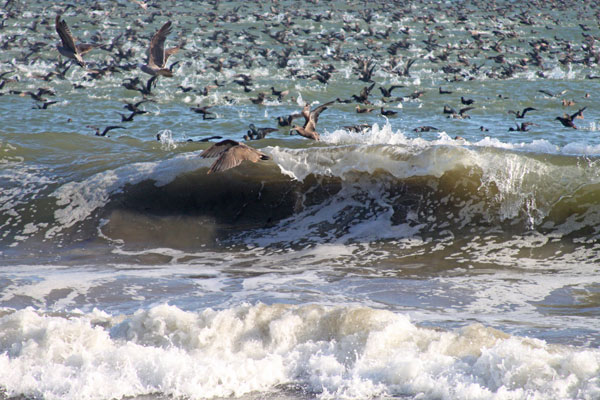
Sooty shearwaters feeding in the surf (everything eats) | Life in a ... 

SOOTY SHEARWATERS feeding on fish near shore (LifeinaSkillet.com photo credit)

In short, shearwaters tagged with GPS tags can be used to locate large whales feeding on fish, with such location information being useful for reducing the risks of collisions at sea between those whales and human-driven watercraft.

Based on their unique life-history characteristics, seabirds equipped with satellite tags could serve as valuable tools for implementing dynamic management. Procellariid seabirds are highly mobile, enabling them to respond quickly to changing environmental conditions over large spatial scales and their top position in food webs means their location may indicate areas of high forage fish abundance. Their role as ecological indicators (Velarde et al., 2019) position seabirds as attractive sentinels for monitoring changes in marine ecosystems, fluctuations in abundance and distribution of forage fishes, and for identifying areas of high productivity where top predators, including whales and ocean users may congregate. Further, tags applied to seabirds are less expensive, less invasive, and can last longer than tags on large whales.

Great shearwaters (Ardenna gravis; hereafter shearwaters) are one of the most common pelagic seabirds in the Gulf of Maine (GOM) (Powers, 1983), including in Stellwagen Bank National Marine Sanctuary (SBNMS), a 2180 km2 federal marine protected area (MPA) (SBNMS unpublished data). In the sanctuary, shearwaters overlap with humpback whales. Both species consistently overlap with sand lance (Ammodytes dubius), their preferred prey in this region (Payne et al., 1986Powers et al., 2020Silva et al., 2020) and shearwaters are often seen foraging with surface-feeding humpback whales. Sand lance are also found in specific, sandy substrates and previous work also shows that humpbacks and shearwaters use many of the same habitats throughout the GOM (Robbins, 2007Powers et al., 2017Powers et al., 2020). This suggests that satellite-tagged great shearwaters could indicate humpback whale locations at wider scales, and that some of these static locations may lend themselves to dynamic management. While the idea of investigating the use of tagged shearwaters to locate humpback whale aggregations is supported by previous work, considering tagged shearwaters as indicators of right whales is also of interest for two reasons:  (1) they are critically endangered and management tools to drastically reduce vessel strikes and entanglements is desperately needed; and ( 2) right whales and sand lance in the GOM feed primarily on copepods, including Calanus finmarchicus (Wishner et al., 1995Murison and Gaskin, 1989Mayo and Marx, 1990Suca et al., 2021), making it plausible that shearwaters feeding on sand lance may overlap with right whales.

[Quoting Tammy L. Silva, et al., “Exploring the Use of Seabirds as a Dynamic Ocean Management Tool to Mitigate Anthropogenic Risk to Large Whales”, FRONTIERS IN MARINE SCIENCE, 9:861 (2022).] 

This research buttresses earlier reports from the National Marine Sanctuaries, as noted during A.D.2020 by Anne Smrcina.


New Research Provides Insight Into Shearwaters, Humpbacks, Their Prey ...

NEW INSIGHTS ON SHEARWATERS’ WINTER RANGE

Humpback whales, great shearwaters (foreground), and gulls feasting on school of sand lance in Stellwagen Bank Nat’l Marine Sanctuary.

Photo: SBNMS/WCNE under NOAA Fisheries Permit #981-1707

In spring months, humpback whale mothers bring their calves to Stellwagen Bank to wean them as they teach them to hunt schools of fish. Stellwagen Bank National Marine Sanctuary serves as their summer nursery. Researchers now believe that the bank, as well as the greater Gulf of Maine, serves as a nursery for another important but very different species – the great shearwater, an abundant seabird locally, and a global traveler.

A sanctuary-led research team found that this seabird species, which “summers” on islands in the southern South Atlantic and along the Patagonian shelf off Argentina December-February, uses the Gulf of Maine as a “winter” nursery during the months of approximately July-November. More mature birds extend their range to the Scotian Shelf off Nova Scotia and the Grand Banks off Newfoundland.

[Quoting Anne Smrcina, “New Research Provides Insight into Shearwaters, Humpbacks, their Prey, and Future Management Implications”, NATIONAL MARINES SANCTUARIES NEWS (NOAA, November 2020), posted at  https://sanctuaries.noaa.gov/news/nov20/shearwaters-winter-range.html .]  Anne Smrcina’s research report, for NOAA (National Oceanic and Atmospheric Administration), cited the findings published in the MARINE ORNITHOLOGY journal, specifically K. D. Powers, et al., “Spatiotemporal Characterization of Non-breeding Great Shearwaters (Ardenna gravis) within their Wintering Range”, MARINE ORNITHOLOGY, 48:215-229 (2020).

shearwater preying on small fish

SHEARWATER tagged with GPS tracker (photo by Peter Flood / NOAA)

================================================================ 

Now that’s something to sing about!

(Extra Information about How Norwegians and Americans Scrutinize Saltwater Serenades)

Songs of the Humpback Whale - Digital Download – Ocean Alliance

What is “whale-song”?  Music-like whale talk!  Whales are cetaceans, a category of whales and whale-like marine mammals, e.g., porpoises and dolphins. Our English word “cetacean” derives from the Greek noun kêtos (κητος) which appears in Matthew 12:40 (as “whale”), so “whales” are mentioned in Scripture.

Consider Genesis 1:21, quoted above.  Consider also Job 7:12, Ezekiel 32:2, and Matthew 12:40, as well as the reference in Lamentations 4:3a (“Even the sea monsters draw out the breast, they give suck to their young ones:”).

For a short YouTube on humpback “songs” (by Oceania iWhales), check out https://www.bing.com/videos/search?q=whale+song&view=detail&mid=080AA0FA37A93E87AB44080AA0FA37A93E87AB44&FORM=VIRE (about 3 minutes long).

For a video (by NatGeoOceans) on researching Blue Whales, review this YouTube:  https://www.bing.com/videos/search?q=Blue+Whale+Sounds&&view=detail&mid=FA613CEC5B6570EB96A8FA613CEC5B6570EB96A8&&FORM=VRDGAR  (video is about 6 minutes, with information on how Blue Whales are observed and recorded).

How can you describe the variety of whale-song sounds?  Screeching, shrieking, grunting, wailing, moaning, groaning, rumbling, buzzing, rattling, sqeaking, squealing, clicking, whistling, whining, rumbling, sputtering, and some low-noted sounds that might be embarrassing if emitted by humans.
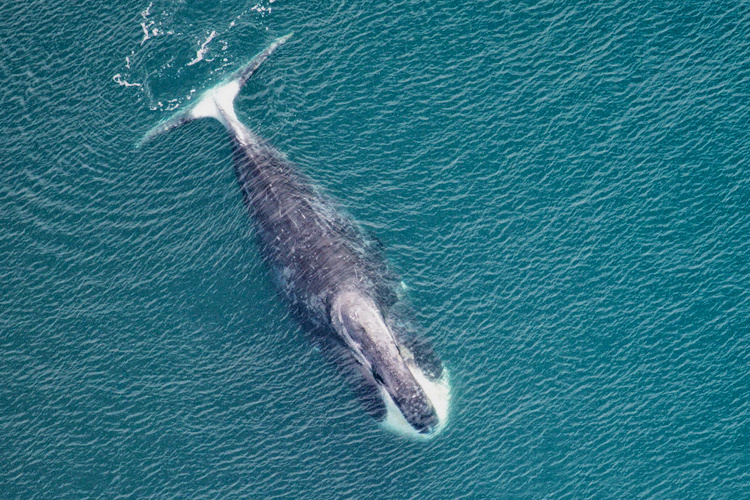
Bowhead-whale.NOAA-photo

BOWHEAD WHALE (NOAA Fisheries photo)

BOWHEAD WHALES

Three Norwegian biologists (Dr. Øystein Wiig, Dr. Kit M. Kovacs, and Dr. Christian Lydersen), with an American oceanographer (Dr. Kate M. Stafford), have been studying whale-song—specifically, the songs sung by Bowhead whales from the polar waters of Svalbard, an island territory of Norway.

Almost all mammals communicate using sound, but few species produce complex songs. Two baleen whales sing complex songs that change annually, though only the humpback whale (Megaptera novaeangliae) has received much research attention. This study focuses on the other baleen whale singer, the bowhead whale (Balaena mysticetus). Members of the Spitsbergen bowhead whale population produced 184 different song types over a 3-year period, based on duty-cycled recordings from a site in Fram Strait in the northeast Atlantic. Distinct song types were recorded over short periods, lasting at most some months. …

Complex ‘song’ in mammals is rare. While many mammalian taxa produce repetitive ‘calls’, sometimes called advertisement songs, few mammals produce vocal displays akin to bird song, which is defined by multiple frequencies and amplitude-modulated elements combined into phrases and organized in long bouts. Such songs have been documented in only a few mammalian species, including some bats (Chiroptera), gibbons (Hylobatidae), mice (Scotinomys spp.), rock hyraxes (Procavia capensis), and two great whales, humpback (Megaptera novaeangliae) and bowhead (Balaena mysticetus) whales [BLUE WHALES sing simplistic loud-and-rhythmic “rap music”, so they are excluded from this listing of “complex song” vocalists!]. With the exception of gibbons, in which males and females duet, complex songs in mammals are thought to be produced only by males. Male mammals are thought to sing to defend territories, advertise their quality, attract mates or some combination of these functions.

The song in baleen whales has been studied extensively only in humpback whales, which sing similar songs within a season across a whole population. The structure of that song gradually evolves [sic – erroneous terminology in original] over the season in unison and transfer of song types has been documented to occur directionally from one population to another over a period of years. Humpback whale songs are composed of a hierarchy from units to sub-phrases to phrases to themes.

Less is known about the songs of bowhead whales compared with humpback whales, but bowhead whale songs generally consist of a single phrase that includes amplitude- and frequency-modulated elements repeated in bouts, with two different sounds often produced simultaneously.

A pilot study from the Fram Strait in 2008 – 2009 provided the first indication that tens of song types were produced by bowhead whales in this region within a single overwinter period. No year-round studies of song diversity exist for other bowhead whale populations although multiple song types in a single year have been documented for two other populations. …

The diversity and interannual variability in songs of bowhead whales in this 3-year study are rivalled only by a few species of songbirds.

Among other mammalian singers, mice and gibbons tend to produce highly stereotyped and repetitive songs with few elements. Variation in rock hyrax and bat songs is primarily through changes in the arrangement of units.

Humpback whales produce complex songs that are similar within a year. Although the repertoire of any one individual bowhead whale in this study cannot be determined, the catalogue of song types (184) is remarkably varied.

It is not known whether individual bowhead whales sing multiple song types in a season, but some are known to share the same song type in the same period in the Bering– Chukchi–Beaufort (BCB) population. Nor is it known if individual bowhead whales maintain the same song throughout their lifetime or if they switch within and/or between years.

One explanation for the very high song diversity in the Spitsbergen bowhead whale population could be that the animals occupying this area in modern times include immigrants from both the BCB and the eastern Canada–western Greenland bowhead populations.

Until recently, these populations have been assumed to be isolated from each other due to extensive, impenetrable sea ice cover in the High Arctic.

However, in the past few decades, extreme declines in sea ice extent and thickness may have facilitated contact between these populations. However, even if this region contains bowhead whales from multiple populations, this does not fully explain the high numbers of different song types recorded in this study or the lack of recurrence of song types from year to year.

It is plausible that the bowhead whales in the Fram Strait are simply a remnant of the original Spitsbergen [Svalbard] population that survived the extreme historical levels of exploitation. The influence of small population size on song diversity is conflicted; some studies suggest song diversity increases in smaller populations, although others have found that reduced or isolated populations exhibit a reduction in song diversity and produce simpler songs.

In some species, females appear to prefer a diverse song repertoire, suggesting that increased complexity of singing might confer reproductive advantages. A recent study of howler monkeys (Alouatta spp.) documented tradeoffs in male reproductive characteristics based on (temporary) social structure: in groups with fewer males, or smaller social groups, males invested more in vocal displays as a reproductive tactic.  …

Bowhead whales are the only High Arctic resident baleen whale. Thus, interspecific identification via song may not confer the same selective [sic – should say “reproductive success”] advantage for bowheads that it might for other cetacean species. This could reduce selection pressure [sic mystical-magic jargon in original] on song stereotypy, allowing for greater variation in song types as a result of a long-term cultural mutation in songs, or song novelty itself might confer an advantage.

Because bowhead whales sing underwater, in heavy ice during the polar night, a nuanced understanding of the variable syntax of this species will be difficult to obtain.

Nevertheless, the singing behaviour of Spitsbergen bowhead whales, in which tens of distinct song types are produced annually, makes them remarkable among mammals.

[Quoting from Kate M. Stafford, Christian Lydersen, Øystein Wiig, & Kit M. Kovacs, “Extreme Diversity in the Songs of Spitsbergen’s Bowhead Whales”, BIOLOGY LETTERS, 14:20180056 (April 2018).]

But, before Bowhead Whale songs were scrutinized, it was the singing of Humpback Whales that was reported — surprisingly revealing a submarine world of sound communications that most folks would never have imagined.

Humpback-Whale.NWF

HUMPBACK WHALE (Nat’l Wildlife Federation photo)

HUMPBACK WHALES

One of the most unusual music recordings to sell into the “multi-platinum” sales level was an LP album produced in AD1970, called “Songs of the Humpback Whale”, recorded by bio-acoustician Dr. Roger Payne, who had (with Scott McVay) discovered humpback “whale-song” (i.e., complex sonic arrangements of sound, sent for communicative purposes) during the AD1967 breeding season.

Prior to AD1970 Dr. Payne had studied echolocation (i.e., “sonar”) in bats, as well as auditory localization in owls, so (biologically speaking) he had “ears to hear” how animals use vocalized sounds to send and receive information to others of their own kind. Some of Dr. Payne’s work was shared with his wife (married AD1960; divorced AD1985), Katharine Boynton Payne, who noticed the predictable patterns of humpback whale-song, such as “rhymes”.  Acoustical research included spectrograms of whale vocalizations, portraying sound peaks, valleys, and gaps—somewhat (according to her) like musical “melodies” and “rhythms”.

To this day, apparently, “Songs of the Humpback Whale” is the best-selling nature sound recording, commercially speaking. The sensation-causing album (“Songs of the Humpback Whale”) presented diverse whale vocalizations (i.e., “whale songs”) that surprised many, promptly selling more than 100,000 copies.

Some of Dr. Payne’s research on whale-song appeared early, published in SCIENCE magazine, as follows:

(1) Humpback whales ( Megaptera novaeangliae ) produce a series of beautiful and varied sounds for a period of 7 to 30 minutes and then repeat the same series with considerable precision. We call such a performance “singing” and each repeated series of sounds a “song.”

(2) All prolonged sound patterns (recorded so far) of this species are in song form, and each individual adheres to its own song type.

(3) There seem to be several song types around which whales construct their songs, but individual variations are pronounced (there is only a very rough species-specific song pattern).

(4) Songs are repeated without any obvious pause between them; thus song sessions may continue for several hours.

(5) The sequence of themes in successive songs by the same individual is the same. Although the number of phrases per theme varies, no theme is ever completely omitted in our sample.

(6) Loud sounds in the ocean, for example dynamite blasts, do not seem to affect the whale’s songs.

(7) The sex of the performer of any of the songs we have studied is unknown.

(8) The function of the songs is unknown.

[Quoting from Roger S. Payne & Scott McVay, “Songs of Humpback Whales”, SCIENCE, 173(3997):585-597 (August 13th 1971).]

humpback whales.ScienceAlert-photo

HUMPBACK WHALES (ScienceAlert photo)

Dr. Payne eventually suggested that both Blue Whales and “fin whales” (a category of baleen whales also called “finback whales” or “rorqual whales”, which include the Common Rorqual, a/k/a “herring whale” and “razorback whale”) could send communicative sounds, underwater, across an entire ocean, and this phenomenon has been since confirmed by research.

Payne later collaborated with IMAX to produce a unique movie, “Whales:  An Unforgettable Journey”.

Others, of course, have joined in the research, studying humpback whale-song in the Atlantic Ocean.

For example, Howard E. Winn and Lois King K. Winn, both at the University of Rhode Island, summarized some of their research as follows:

Songs of the humpback whale Megaptera novaeangliae were recorded and analyzed from Grand Turks in the Bahamas to Venezuela. …  The [humpback whale] song is produced only in the winter tropical calving grounds, just before the whales arrive on the banks.  Redundancy is high in that syllables, motifs, phrases and the entire song are repeated. Low, intermediate, and high-frequency sounds are scattered throughout the song. One sound is associated with blowing. The song appears to be partially different each year and there are some differences within a year between banks which may indicate that dialects are present. It is suggested that songs from other populations are quite different. The apparent yearly changes do not occur at one point in time. Only single individuals produce the song and they are hypothesized to be young, sexually mature males.  …

It has been known for 25 years that the humpback whale Megaptera novaeangliae produces a variety of sounds. However, it was not until 1971 that Payne and McVay (1971), using recordings of humpbacks from Bermuda, demonstrated that the sounds are produced in an ordered sequence. In 1970, Winnet al. verified their findings by showing that humpbacks in Mona Passage, Puerto Rico, also produce a highly patterned song which lasts from 6 to 35 min and is repeated after surfacing.

Variation in the song’s organization has been explained by a number of hypotheses. Winn (1974, 1975) hypothesized that various song types might rep resent geographic herd dialects. Recently, Payne and Payne (in press) studied additional songs from Bermuda and concluded that the song changes each year. The song’s social and behavioral context has also been studied.

Apparently the song is produced only by single, isolated individuals, primarily while they are in the tropics during the winter (Winn et al., 1970; and this paper). They calve and mate during this period, but generally do not feed (Tomilin, 1967).

The song of [humpback patterns include] … “moans and cries”; to “yups or ups and snores”; to “whos or wos and yups”; to “ees and oos”; to “cries and groans”; and finally to varied “snores and cries”. Snores, cries and other sounds can be found in different themes from year to year; yet, invariably one finds a set pattern of changing themes, in a fixed order. Several times humpbacks have breached in the middle of their song and then restarted the song from the beginning or at some different part of the song.

[Quoting from H. E. Winn & L. K. Winn, “The song of the humpback whale Megaptera novaeangliae in the West Indies”, MARINE BIOLOGY, 47(2):97-114 (January 1st 1978).]

Many years after their earliest research together, Dr. Roger Payne joined with his ex-wife (Katharine Payne) to describe their 19 years of studies of humpback whale-song, especially as observed in the Atlantic Ocean near Bermuda:

163 songs of humpback whales (Megaptera novaeangliae) recorded near Bermuda during April and May of 13 years between 1957 and 1975 have been analysed as continuous sound spectrograms and compared. In each year’s sample, all whales were singing basically the same song. However, the song was changing conspicuously and progressively with time so that songs separated by a number of years were very different in content. All the songs showed basic structural similarities so that it is possible to define a song form which characterizes songs from many years.  …

An analysis, of the songs sung by groups of whales, shows that normal singing continues even when whales are close enough, presumably, to hear each other. Such analysis demonstrates inter– and intra– individual variability, none of which is as great as the variation between songs of consecutive years. We do not understand the significance of changing songs.

We know of no other non-human animal for which such dramatic non-reversing changes appear in the display pattern of an entire population as part of their normal behavior.

[Quoting from Katharine Payne & Roger Payne, “Large Scale Changes over 19 Years in Songs of Humpback Whales in Bermuda”, ETHOLOGY, 68(2):89-114 (April 26th 2010).]

Blue-whale-vs.-elephant-Britannica-pic

BLUE WHALES

Recently Dr. Ana Širović, a Croatian-born oceanographer at University of California—San Diego’s Scripps Institution of Oceanography (based in La Jolla), reported observations of the Blue Whale—and its habit of underwater singing.  Some of these observations were published by Craig Welch, in NATIONAL GEOGRAPHIC, as follows:

By analyzing thousands of calls from more than 100 whales over 14 years, scientists are learning how these secretive beasts spend their time.

Blue-Whale.NaturalWorldSafaris-photo

BLUE WHALE (Natural World Safaris photo)

The biggest animal to ever live is also the loudest, and it likes to sing at sunset, babble into the night, talk quietly with those nearby, and shout to colleagues 60 miles away.

The blue whale, which can grow to 100 feet long and weigh more than a house, is a veritable chatterbox, especially males, vocalizing several different low-frequency sounds. And for years scientists had only the vaguest notion of when and why these giants of the sea make all those sounds. … In the first effort of its kind, Ana Širović, an oceanographer at Scripps Institution of Oceanography in La Jolla, California, and her team scoured a collection of more than 4,500 recordings of blue whale sounds taken from underwater microphones at over a dozen locations over 14 years, from 2002 to 2016, in southern California. The researchers then sync[h]ed the recordings with the movements of 121 whales that had been tagged with suction-cup trackers. What they learned challenged many assumptions about these noisy beasts.

Singing Males

Blue whales of both sexes produce several types of single-note calls, but only males sing. Males are also far noisier, and make different sounds for different reasons, but scientists aren’t always sure what those reasons are. For example, scientists had long assumed that one type of short call was used at meal time. But, instead, males and females frequently produced these vocalizations during dives that didn’t involve foraging at all. “It’s like the two behaviors are entirely separate,” says Širović.

The calls also change with the seasons and with time of day. Some single-note calls seem to occur more often when whales are returning from deep dives. Those may help with pair-bonding, scientists say. Much like birds, which often break into sound as day fades, male blue whales also tend to sing at the end of the day. In some species, such as European robins and nightingales, singing is often adjusted as a means of conserving energy, and energy may be a factor with blue whales as well. But unlike birds, Širović says, “blue whale songs propagate over tens of kilometers or even 100 kilometers.” And when they’re singing, male blues dive deeper. “I think what they are doing by regulating depth is changing the distance over which they’re calling, Širović says. “Individual calls are probably to animals nearby. They may be trying to reach much farther with singing. That’s kind of cool.” She assumes the singing—especially since it’s limited to just males—may somehow be linked to searching for mates. But no one has ever witnessed blue whale reproduction, so she can’t say for certain.

Songs of the Species

Širović has found there are similarities across many species, especially whales in the same family, such as blues, brydes, and sei whales. Males are the predominant singers and there seem to be peak calling seasons. But there are differences, too. Unlike blues, with their deep melodic songs, fin whales don’t really change notes. Their songs, instead, are produced using a single note, but with a rhythmic beat.

And unlike some dolphin species, such as killer whale, it’s not clear whether blues have distinctive voices. So far it appears they do not. “We can’t always tell whether there are 10 calls from 10 whales or one whale calling 10 times,” Širović says. “So far, we can’t really tell Joe Blue Whale from Betty Blue Whale.”

Quoting Craig Welch, “Elusive Blue Whale Behavior Revealed by Their Songs”, NATIONAL GEOGRAPHIC (February 15th, 2018), posted at https://news.nationalgeographic.com/2018/02/blue-whale-songs-behavior-decoded-spd/ .
Blue-Whale-breaching.ourmarinespecies.com-photo

BLUE WHALE breaching surface (oumarinespecies.com photo)

This Blue Whale vocalization research, by Dr. Širović, was summarized recently by creation scientist David Coppedge, as follows:

Blue whales—the largest animals in the ocean—are talented singers, too, but little has been known about the music of these secretive beasts.

NATIONAL GEOGRAPHIC reported on a 14-year effort by Scripps Institute in California to decode the vocalizations of 100 blue whales.

Since the sound travels for miles, they could pick up the sounds remotely with underwater microphones, but they also sync[h]ed the sounds with individual whales by outfitting them with suction-cup trackers.

The results were surprising, changing assumptions about blue whale behavior . . .  Both sexes vocalize, but only the males ‘sing’, the researchers found.  They’re also the loudest.  The reasons for all the noise are not well known, but the males seem to begin their ‘deep melodic songs’ around sunset, serenading into the night, probably to attract mates.  …  The more details you learn about living things, the less excuse you have to chalk it up to evolution.

[Quoting from David Coppedge, “Underwater Troubadours”, CREATION MATTERS, 23(2):8-11 (March-April 2018).]

===================================================================  


Dr. James J. S. Johnson has taught courses in biology, ecology, geography, limnology, and related topics (since the mid-AD1990s) for Dallas Christian College and other Texas colleges. A student (and traveler) of oceans and seashores, Jim has lectured as the onboard naturalist-historian (since the late AD1990s) aboard 9 different international cruise ships, including 4 visiting Alaska and the Inside Passage, with opportunities to see humpback whales, usually (but not always) from a safe distance.  Jim is also a certified specialist in Nordic History & Geography (CNHG), and also in Nordic Wildlife Ecology (CNWE), who frequently gives presentations to the Norwegian Society of Texas (and similar groups).  ><> JJSJ      profjjsj@aol.com


Move upMove downToggalyzing thousands of calls from more than 100 whales over 14 years, scientists are learning how these secretive beasts spend their time.
  •  
 

Not Deer or Bovine, So It Must Be An ‘Antelope’

Bibleworld Adventures has chosen to close down his website, due to a very busy schedule with work and his church ministries. We have decided to move his articles here. Baron has written articles here as Golden Eagle. This will preserve his and Dr. Johnson’s articles for us to enjoy. They are not about birds, but are all very interesting. Most are about a variety of our Creator’s amazing animals. [Will have a link to these pages in the sidebar as Bible World Adventures.]

Originally posted 2017/12/19

NOT DEER OR BOVINE, SO IT MUST BE AN ‘ANTELOPE’

Dr. James J. S. Johnson

The hart, and the roebuck, and the fallow deer, and the wild goat, and the pygarg [dîshōn], and the wild ox, and the chamois.   (Deuteronomy 14:5)

Addax-Morocco.Haytem93-photo

ADDAX male [photo credit: Haytem93]

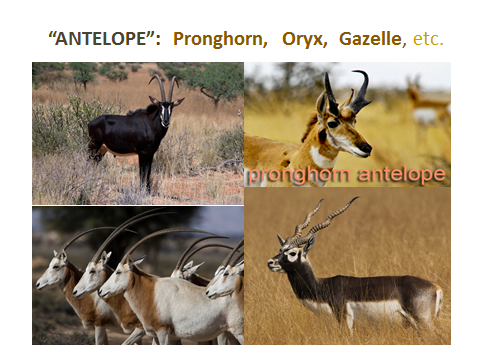
Most likely the “Pygarg” [dîshōn] is what today is called an ADDAX.  An ADDAX is a desert-dwelling member of the ANTELOPE family.  [See George Cansdale, ALL THE ANIMALS OF THE BIBLE LANDS (Zondervan, 1976), page 85, saying “Among several quaint animal names found only in the AV [i.e., KJV] is the Pygarg, from Heb. dishon; this is merely a transliteration of the [LXX] Gr. Word meaning ‘white-rumped’, by which [Greeks] had long ago described an antelope. … [The reference in Deuteronomy 14:5] between two animals that are probably desert species, coupled with a long-standing tradition, suggests that this is the Addax, Addax nasomaculatus, a desert antelope classified between the oryx and hartebeests”.]antelope-family.jjsj-PPTslide

But, what is an antelope?

Antelope, and antelope-like animals, live in many different parts of the world—except not in Australia or Antarctica. For examples, pronghorns live mostly in America’s Western prairie states. The oryx live in Israel and many of the Arabian deserts.  The Dorcas gazelle lives in the top half of Africa.  Impalas live in eastern and southern Africa.

Serengeti-migraton-wildebeest-zebra.ZambesiSafari-photo

Wildebeests and Zebras migrate through Serengeti  /  Zambesi Safari photo

The blue wildebeest (also called “gnu”) are famous for their huge migratory herds, that often mix with zebras, that seasonally travel through Tanzania’s Serengeti.  Tibetan antelope, of course, live in Tibet, as well as in neighboring parts of Asia.  The Indian antelope (also called “blackbuck”) lives in India, Pakistan, and Nepal.

GreatMigration-Serengeti.Pinterest

Great Migration (Serengeti & Masai Mara)  image credit: Pinterest

These plant-eating mammals (animals that give mother’s milk to their babies) are different from other four-legged mammals – such as deer, cattle, horses, camels, sheep, goats, pigs, cats, and dogs.

In many ways antelope (and antelope-like animals, like the pronghorns of America’s prairies) are like deer. But unlike deer, which have antlers (that grow and shed each year, then regrow the next year, and are later shed, etc.), antelopes have horns (like cattle, bison, sheep, and goats), which continue to slowly grow out from their heads, anchored to bony roots.

Impala-w-oxpecker.jjsj-PPTslide

Antelopes often live in flat grasslands (such as the grassy prairies of America’s West), where their plant-food is plentiful. However, in grasslands there are usually very few trees, so antelopes cannot hide in forests from other animals (such as mountain lions or wolves), so it is good that God made them to have great speed for running across flat land.  And that is what antelopes (and pronghorns, which are antelope-like animals) often do–with great speed!–when they run away from predators at high speeds—sometimes as fast as 55 miles/hour for a mile, or 42 miles/hour for 2 miles, or 35 miles/hour for 3 miles.Gazelle-foraging.jjsj-PPTslide

Dorcas is the Greek word for a gazelle, which is a member of the antelope family. Because gazelles are graceful and beautiful animals it is unsurprising that girl babies have been named Dorcas, including one who is mentioned in Scripture, in Acts chapter 9.Dorcas-philology.jjsj-PPTslide

Dorcas-Acts-chapter9.jjsj-PPTslide

In North America the primary antelope-like mammal is the PRONGHORN. To learn about this beautiful, graceful, and extremely speedy animals, see “Geography Matters, Illustrated by Pronghorns, Mountain Goats, and Old Testament Warfare”, posted at https://bibleworldadventures.com/2016/08/17/geography-matters-illustrated-by-pronghorns-mountain-goats-and-old-testament-warfare/ .

pronghorn-coming-fast.closeup-turning

When we see beauty, grace, strength, and speed — displayed in antelope (and antelope-like pronghorns) — we are reminded, by these living exhibits of God’s making, that God Himself is amazingly beautiful, graceful, strong, and quick, beyond our comprehension.

India’s Shrimp ‘Ranching’ Needs Re-set

India’s Shrimp ‘Ranching’ Needs Re-set

Dr. James J. S. Johnson

And God created great whales, and every living creature that moves, which the waters brought forth abundantly, after their kind … and God saw that it was good. (Genesis 1:21)

The Aquaculturists: 20/10/2017: Shrimp farming in India

India may be looking to America for a jump-start to revitalize its shrimp aquaculture industry, according to recent report (May 11, 2020) in the Hindu Business Line.

The report, which was issued by the Confederation of Indian Industry (CII) looks into a range of measures to improve the export potential of the aquaculture sector. Around 90 % of India’s aquaculture production is generally exported. And, although exports have plummeted since the COVID-19 pandemic, the report warns that producers may struggle to meet demand once the movement of goods and people returns to normal . . . (1)

India’s shrimp-farming operations have two major vulnerabilities—dependence on outside (i.e., outside of India, which now includes lockdown/shutdown facts not previously present in the global marketplace) sources for breeding shrimp and for the kind of food that shrimp larva need to eat, so that they can grow into mature shrimp of marketable size.

The Confederation of Indian Industry has recommended measures to improve the export potential of the aquaculture sector in order to capture a major share of the global market. …  The lion’s share of Indian aquaculture comprises shrimp, for which both broodstocks and larval feeds are imported. With the global lockdown situation, the supply of these has been stalled, which will have a significant impact on production, CII said in its report.(2)

But for restarting India’s shrimp-farming operations, some adjustments to “business-as-usual” will be necessary, both logistically and legally.

To reduce the lag time in the supply of broodstock, CII has recommended re-establishing import of broodstock by expediting air transportation from the US by arranging special cargo flights. It is pointed out that the RGCA [Rajiv Gandhi Centre for Aquaculture] quarantine facility in Chennai is shut and its holding capacity is not sufficient for large consignments. Hence, the imported broodstock should be allowed to be taken to hatcheries directly and thereafter sampling can be done by RGCA. On approval, hatchery owners can be allowed to use the broodstock.(2)

India-freshwater-shrimp-farming

What a huge undertaking—revitalizing this part of India’s fisheries/aquaculture industry is truly a “big deal”, in the global marketplace. As a fish/seafood exporter India has very serious competition—for almost 20 years China has been the world’s #1 producer of fish and seafood exports.(3)

India is the world’s second-largest [sic] fish producer with a total production of 13.7 million tonnes in 2018-19 of which 65 % was from inland fishing. Almost 50 % of inland fish production is from culture fisheries, which constitutes 6.5 % of global fish production. Shrimp accounts for a majority share of India’s aquaculture, which is growing at a CAGR [compound annual growth rate] of 17.4 % over the past 3 years.(2)

Providing affordable (and available) protein-rich food is a worldwide need.  Harvesting oceanic fish and shellfish—including shrimp—can contribute much to feeding peoples of the world.(4),(5)  Aquaculture (which is comparable to “ranching” sea creatures–like shrimp–as livestock), however, can supplement oceanic finfish and shellfish, for the benefit of many hungry humans.(6),(7)

May God bless America to recover its own economic health—and to do so with such strength that it can once again bless India, and other nations of the world, such as by helping India to jump-start their own now-vulnerable aquaculture industry.(8)

Farmers making a fortune in shrimp farming

References

  1. Staff writer. 2020. Why India’s Shrimp Sector Must Become More Self-Sufficient. The Fish Site. Posted (May 12, 2020) at https://thefishsite.com/articles/why-indias-shrimp-sector-must-become-more-self-sufficient – accessed may 15, 2020.
  2. Kumar, V. S. 2020. CII Chalks Out Steps to Boost Aquaculture Exports. Hindu Business Line. Posted (May 11, 2020) at https://www.thehindubusinessline.com/economy/agri-business/cii-chalks-out-steps-to-boost-aquaculture-exports/article31555206.ece# — accessed May 15, 2020.
  3. Nag, O. S. 2017. Top Fish and Seafood Exporting Countries. Posted (April 25, 2017) at https://www.worldatlas.com/articles/top-fish-and-seafood-exporting-countries.html —  accessed May 15, 2020.
  4. According to the Lord Jesus, fish are good food. Matthew 7:9-11; Luke 11:11-13..
  5. Incorporating actuarial biology insights (pioneered by marine biologist Johan Hjort) has enabled the world’s shrimp industry, including shrimp-farming, to economically maximize productivity. See Johnson, J. J. S. 2019. Northern Prawns, Baltic Prawns, and Brown Shrimp, Illustrating Genesis 1:22 (including Johan Hjort’s Actuarial Biology Research on Pandalus borealis). Nordic Legacy Series (Norwegian Society of Texas, Fort Worth, Texas, February 24, 2019), 15 pages.
  6. Aquaculture now faces new challenges from pandemic politics. See Johnson, J. J. S. 2020. Fish Farming Feeds Scots, But It’s Not Getting Easier.  COVID-19 News. Posted April 21, 2020) at https://www.icr.org/article/fish-farming-feeds-scots-but-not-getting-easier .
  7. Fish-farming, using managed coast water net-pens is one aquaculture method useful in fulfilling the Genesis Mandate. See Johnson, J. J. S. 2013. Fulfilling the Genesis Mandate while Helping the Poor. Acts & Facts. 42(12):19, posted at https://www.icr.org/article/fulfilling-genesis-mandate-while-helping .
  8. Acts 20:35.