Ian’s Bird of the Week – Eastern Rosella

Eastern Rosella (Platycercus eximius) by Ian

Eastern Rosella (Platycercus eximius) by Ian

Ian’s Bird of the Week – Eastern Rosella ~ by Ian Montgomery

Newsletter ~ 05-04-11

In the search for the rare, elusive and/or beautiful it is easy to take the common, familiar and beautiful for granted. This is especially true when something has been used as an advertising icon and an egregious example of this is the Eastern Rosella, used as an icon in Australia for Rosella tomato sauce, soup and chutney, first image. No doubt the brilliant red head and breast of the Eastern Rosella played a part in its selection, but the Rosella company is a bit coy on the subject and mentions that Rose and Ella were the daughters of the original owners when in 1895 they bought the trademark from the makers of a eucalyptus oil cure for rheumatism.

Eastern Rosella (Platycercus eximius) by Ian

Eastern Rosella (Platycercus eximius) by Ian

When we set up camp in Barradine, New South Wales, for Easter, a pair of Eastern Rosellas were feeding on grass seed close to our camp-site and using the fence of the old Barradine race track
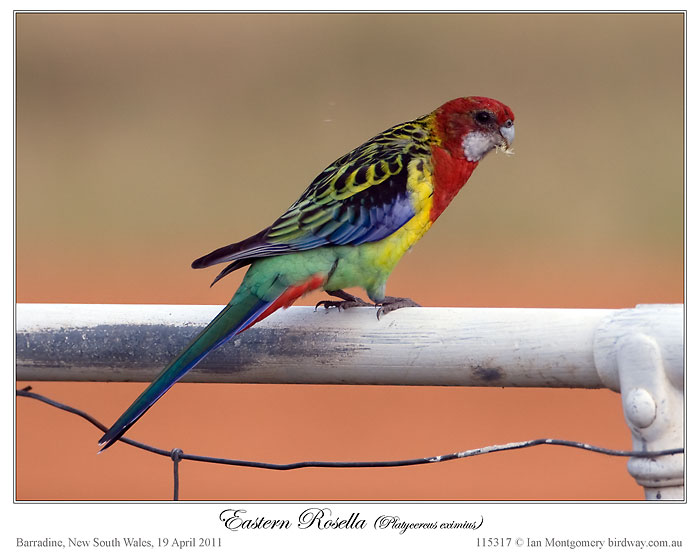
to reach the seed heads. The first photo shows the splendid male on the fence wire and the second photo shows the same bird on the grass. Rosellas are a bit shy usually keep their distance unless they have become used to people and I’ve had difficulty in photographing them, but this pair was fairly obliging.

Eastern Rosella (Platycercus eximius) by Ian

Eastern Rosella (Platycercus eximius) by Ian

The specific name eximius is Latin for ‘extraordinary, excellent, fine, superb’ so George Shaw, not George Bernard but keeper of the British Museum, was clearly impressed when he named it carefully in 1792. It takes Mother Nature to combine vivid primary colours without appearing garish, and I particularly like the luscious apple green of the rump, seen better in the second photo, an excellent field mark when you spot the birds flying away, as is often the case. The females are beautiful too, though not quite as bright as the males and the third photo shows the female of the pair walking along the top of the fence and the red colour of the head suffused with greenish-brown.

The Eastern Rosella is common within its relatively limited range comprising Victoria, Tasmania (where it is uncommon) most of New South Wales except the arid north-west, and extending into southeastern South Australia and southeastern Queensland. In the rest of coastal and central Queensland it is replaced by the closely related Pale-headed Rosella and the Northern Rosella, also a close relative, occurs in the Top End of the Northern Territory and northeastern Western Australia.
Eastern Rosella (Platycercus eximius) by Ian

Eastern Rosella (Platycercus eximius) by Ian

Rosella taxonomy is confused and there is uncertainty whether these three, or at least the two eastern one, should be treated as a single species as there is some cross-breeding between Eastern and Pale-headed where their ranges overlap in northern New South Wales and southeastern Queensland. At present they are retained as three species but are sometimes collectively called the white-cheeked Rosellas as distinct from the blue-cheeked Rosellas comprising the Crimson, Yellow and Adelaide Rosellas which are now generally regarded as a single species.

Links:
Pale-headed Rosella
Northern Rosella
Crimson Rosella
Yellow Rosella

Best wishes,
Ian


Ian Montgomery, Birdway Pty Ltd,
454 Forestry Road, Bluewater, Qld 4818
Phone: 0411 602 737 +61-411 602 737
Preferred Email: ian@birdway.com.au
Website: http://birdway.com.au


Lee’s Addition:

Wow! What a gorgeous bird of the Parrot – Psittacidae Family. Ian always seem to be in the right place at the right time to get many of his fantastic photos.

This bird reminds me of the coat that was made for Joseph, a coat of many colors. I wonder if the maker of the coat had looked at a Rosella or some other of creations very colorful birds to decide which colors to use.

Now Israel loved Joseph more than all his children, because he was the son of his old age: and he made him a coat of many colours. (Genesis 37:3 KJV)

*
Ian’s Bird of the Week – Turquoise Parrot

Turquoise Parrot (Neophema pulchella) by Ian

Turquoise Parrot (Neophema pulchella) by Ian

Ian’s Bird of the Week – Turquoise Parrot ~ by Ian Montgomery

Maybe I was tempting fate when last week I publicly declared my target species of the Pilliga trip to be the Turquoise Parrot, but fate was kind to me when I did the same thing with the Resplendent Quetzal on the eve of my visit to Costa Rica last year.

In truth I felt I needed a bit of help as I’ve been wanting to get reasonable photographs of these gorgeous birds since taking a very poor one of a female in the Warrumbungles in New South Wales in pre-digital days almost exactly eleven years ago. To that end I’d visited both the Warrumbungles and the Capertee Valley west of Sydney several times over the years, detoured via Warwick in Southern Queensland and camped the night in Chiltern in Northern Victoria, all places where this species has been reported.
Turquoise Parrot (Neophema pulchella) by Ian

Turquoise Parrot (Neophema pulchella) by Ian

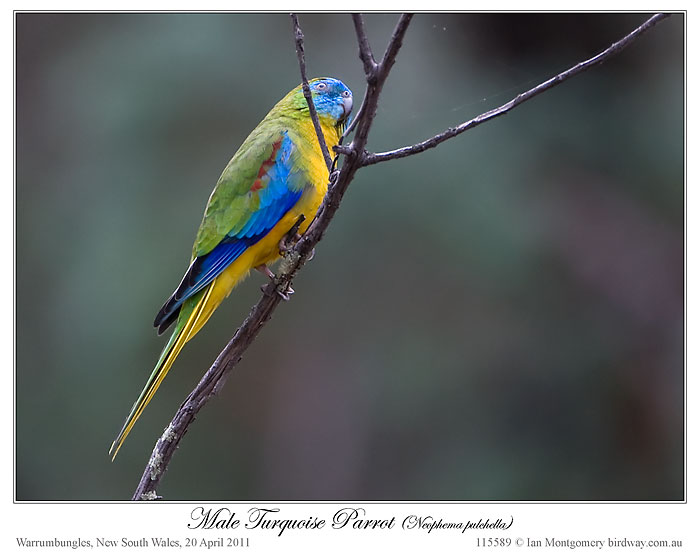
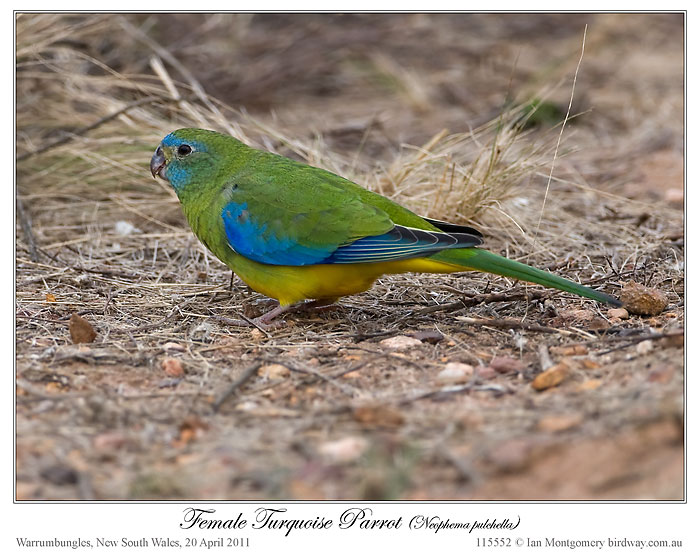
We went to the Warrumbungles last Wednesday and we were just about to leave the second site – the Woolshed – recommended by a helpful but not optimistic ranger (‘they haven’t been seen for a month or two’) when Ivor, one of my two sharp-eyed companions, spotted a female on exactly the same powerlines as eleven years ago, but this time she flew off towards the creek without waiting to have her photo taken. A careful search of the creek revealed nothing even vaguely turquoise but eventually we found about 20 birds feeding on the grassy track on the far side.

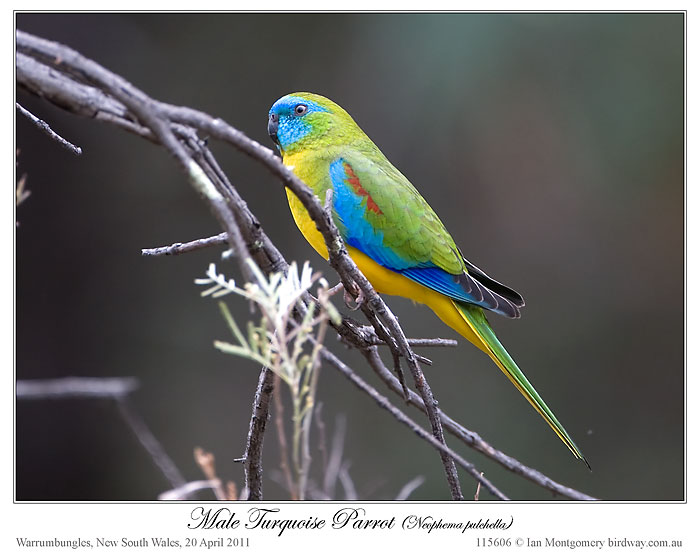
I spent about 20 minutes sidling up to these birds as gradually as possible. The first two photos are of adult male birds, distinguishable by the reddish shouldered patches, which flew up into a shrub as I approached. The second male seems to be eyeing me quizzically as if wondering what I’m up to. The third photo is of a female feeding on the path.
Turquoise Parrot (Neophema pulchella) by Ian

Turquoise Parrot (Neophema pulchella) by Ian

Misión completa, as they said in Costa Rica, and thank you, fate.
Best wishes,
Ian

Ian Montgomery, Birdway Pty Ltd,
454 Forestry Road, Bluewater, Qld 4818
Phone: 0411 602 737 +61-411 602 737
Preferred Email: ian@birdway.com.au
Website: http://birdway.com.au

Lee’s Addition:

What a gorgeous parrot. Wow!

Ask, and it shall be given you; seek, and ye shall find; knock, and it shall be opened unto you: (Matthew 7:7 KJV)

I know last week when Ian said he was off on an adventure to find that Turquoise Parrot, I prayed and asked that he find one. I was being a little selfish because I had never seen one and was trusting that his group would spot one. Whichever, fate or prayer, it is a choice we all make. I prefer the later.

The parrots are in the Psittacidae – Parrots Family of the Psittaciformes Order.

See all of Ian’s Bird of the Week articles.

*

Ian’s Bird of the Week – Canary (Yellow) White-eye

Canary (yellow) White-eye (Zosterops luteus) by Ian

Canary (yellow) White-eye (Zosterops luteus) by Ian

Ian’s Bird of the Week – Yellow White-eye ~ by Ian Montgomery

Newsletter – 4/15/11

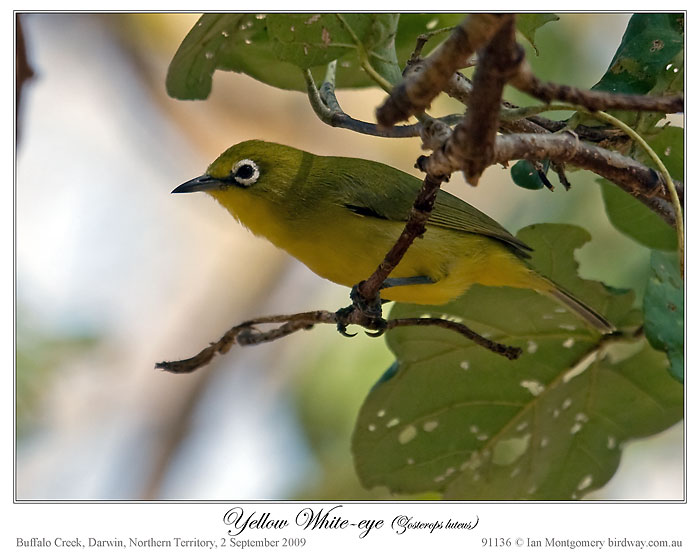
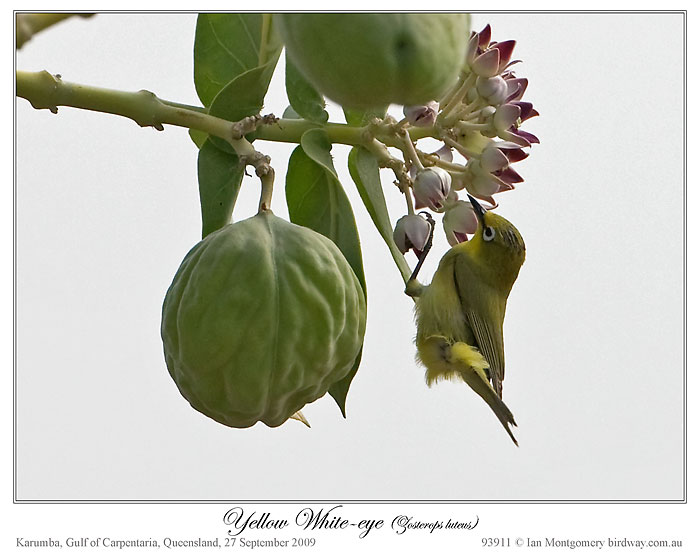
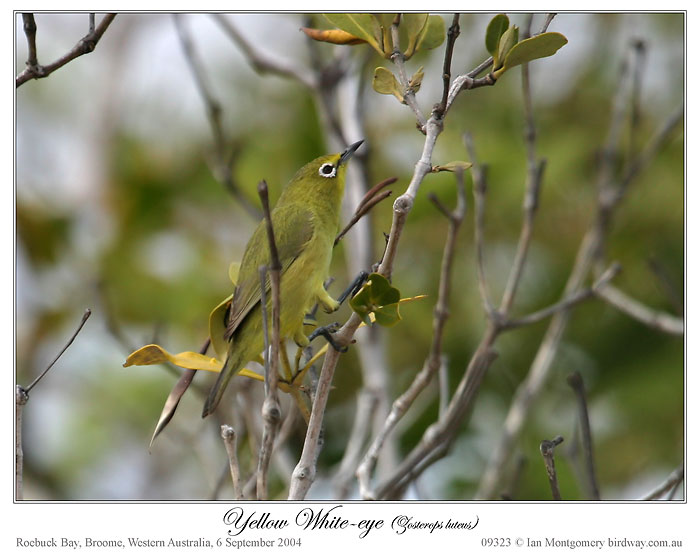
This week’s bird, the Yellow White-eye is a mangrove-dwelling relative of the widespread and familiar Silvereye. While the Silvereye is well-known in gardens and orchards of all the more densely populated areas of mainland Australia and Tasmania, the Yellow White-eye is confined to coastal areas of northern Western Australia, the Northern Territory and northwestern Queensland with one very isolated population near Ayr south of Townsville. So you have to go out of your way to find it, but it is quite common in suitable habitat within its range.

Canary (yellow) White-eye (Zosterops luteus luteus) by Ian

Canary (yellow) White-eye (Zosterops luteus luteus) by Ian

The first photo was taken at Buffalo Creek near Darwin and the second near Karumba on the southern end of the Gulf of Carpentaria. Incidentally, I’d be interested to hear from anyone who can identify the pink-flowered shrub with the White-eye-sized fruit (Yellow White-eyes are 11-12cm/4.3-4.7in). Birds from these regions are yellower than the Western Australian birds and some taxonomists split the species into two sub-species. These yellower northern and eastern birds belong to the nominate race luteus while the greener birds in Western Australia belong to the race balstoni.

The third photo was taken at Roebuck Bay near the Broome Bird Observatory and belongs to this greener race. The difference is subtle and I imagine you would need to compare birds directly to see the distinction. More striking is how well the plumage matches the colour of the leaves of the mangroves. Like Silvereyes, Yellow White-eyes are very lively and vocal so if they are around, they are not hard to find.

Canary (yellow) White-eye (Zosterops luteus balstoni) by Ian

Canary (yellow) White-eye (Zosterops luteus balstoni) by Ian

The apparently endless wet season has finally ended in North Queensland and this week we have all been enjoying lovely sunny days and moonlit nights. I’m making preparations to travel with friends to the Easter campout being organised by the Northern NSW group of Birds Australia in Baradine in the Pilliga Scrub/Forest between Coonabarabran and Narrabri. There are some interesting birds there (I have my sights set on Turquoise Parrot) and I hope I’ll be able to share some of them with you.

Best wishes,
Ian

Ian Montgomery, Birdway Pty Ltd,
454 Forestry Road, Bluewater, Qld 4818
Phone: 0411 602 737 +61-411 602 737
Preferred Email: ian@birdway.com.au
Website: http://birdway.com.au


Thanks for introducing us to another interesting bird. The I.O.C. World Bird List has this bird as the Canary White-eye. This is another example of why the Scientific names are important. No matter what the bird is called, the scientific name assures that the same bird is being described.

I am trusting Ian will be able to capture through his lens that Turquoise Parrot. That sounds like another neat bird.

Keep me as the apple of the eye, hide me under the shadow of thy wings, (Psalms 17:8 KJV)

After checking out Ian’s Zosteropidae Family photos, then check the Zosteropidae Family of the Passeriformes Order here.

Ian’s Bird of the Week – Little Egret

Little Egret (Egretta garzetta) by Ian

Little Egret (Egretta garzetta) by Ian

Ian’s Bird of the Week – Little Egret ~ by Ian Montgomery

Newsletter ~ 4/6/11

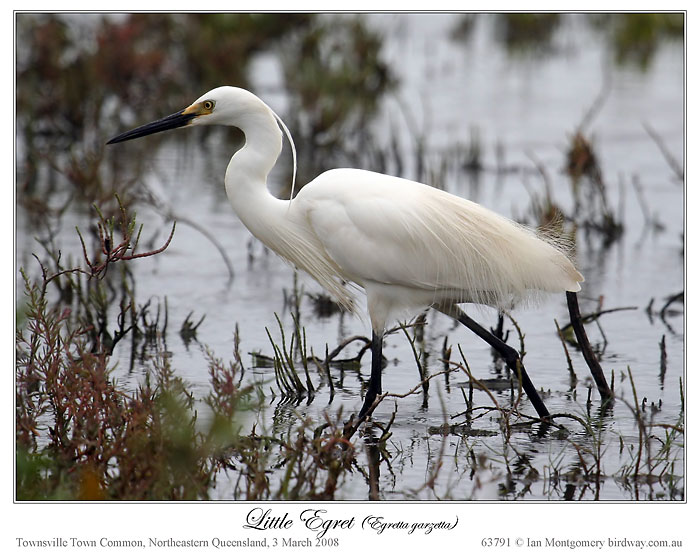
I’ve recently been updating the Heron and Egret galleries (Ardeidae) on the website and I noticed that the elegant Little Egret hadn’t yet featured as bird of the week. Its one of five species of egret resident in Australia and in breeding plumage it is easily distinguished by the only one to have a pair of head plumes – as in the first photo – in addition to breast and back plumes. The only other egrets globally with these head plumes are the closely related Snowy Egret of the Americas and the possibly conspecific Western Reef Egret, neither of which has been recorded in mainland Australia (there are records of the Western Reef Egret in the Cocos Islands).

Little Egret (Egretta garzetta) by Ian

Little Egret (Egretta garzetta) by Ian

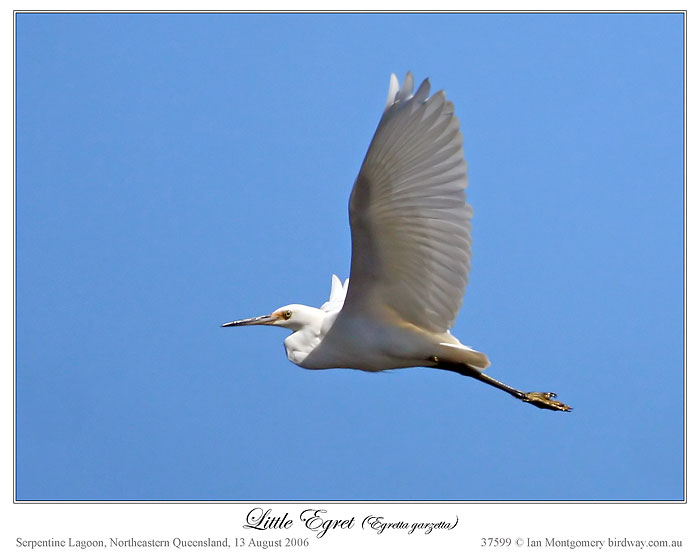
In non-breeding plumage, it lacks plumes and is most easily separated from the similarly-sized Intermediate Egret by having a dark bill rather than a yellow or orange one. It’s best and worst field mark is the yellowish feet – best because this feature is shared only with Snowy and Western Reef Egrets and worst because you usually can’t see the colour of the feet in their normal habitat – wetlands – though visible in flight as in the second photo.

Little Egret (Egretta garzetta) by Ian

Little Egret (Egretta garzetta) by Ian

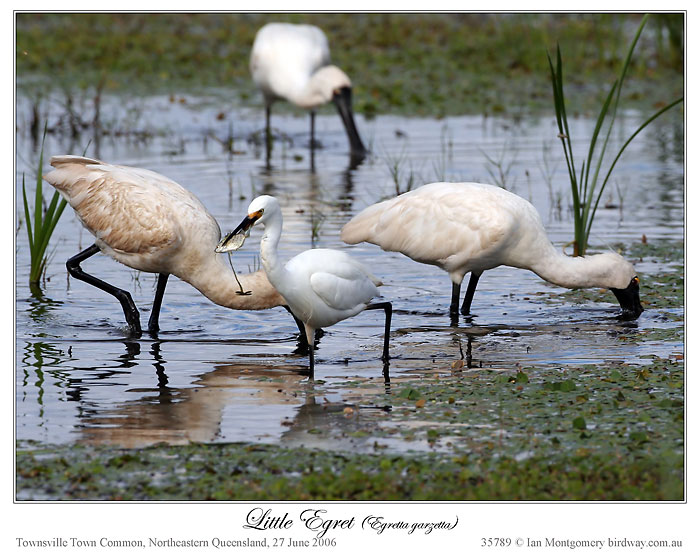
Little Egrets are versatile feeders and often dash frantically around in shallow water, Greenshank-like, in search of small vertebrates. They also feed by stirring up prey with their feet and will also take fish, as in the third photo. This one has just grabbed a fish and is rushing off to avoid the attention of the nearby Royal Spoonbills. Egrets and Spoonbills often try to steal each others food. For examples, have a look at http://www.birdway.com.au/threskiornithidae/royal_spoonbill/source/royal_spoonbill_c35816f.htm (spoonbill chasing spoonbill) and http://www.birdway.com.au/threskiornithidae/royal_spoonbill/source/royal_spoonbill_c35824f.htm (great egret chasing spoonbill).

Little Egret (Egretta garzetta) by Ian

Little Egret (Egretta garzetta) by Ian

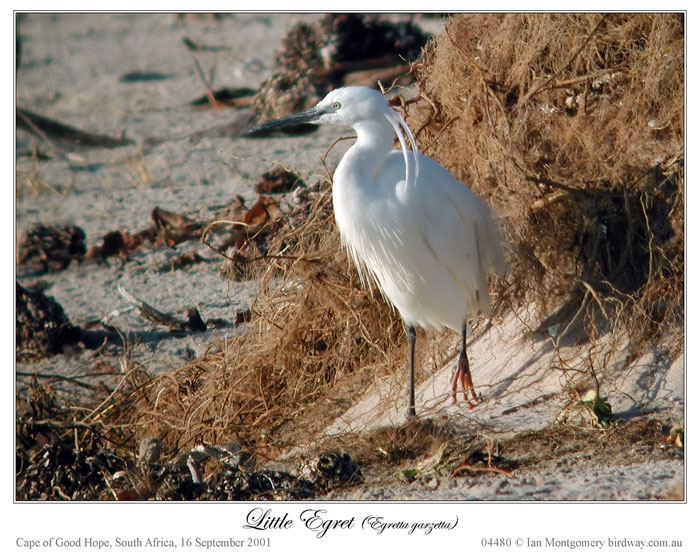
In Australia, the Little Egret is commonest in northern Australia, but also occurs in smaller numbers in eastern and southeastern Australia, in Tasmania in winter and in central and western Australia when conditions are suitable. It also extends widely through Eurasia and Africa. The Australian race has yellow lores between the bill and the eye, but that of the nominate Eurasian race normally has blue-grey lores as in the fourth photo of one on a beach at the Cape of Good Hope. Globally, Little Egrets are quite variable and their taxonomy is still poorly understood.

Like other egrets, the global population of Little Egrets suffered severely in the late 19th century because of the fashion trade in plumes. It was this trade in plumes that lead to the establishment of the RSPB in 1889, a silver lining if there was one, and populations have recovered since.
Links:
Best wishes,
Ian

Ian Montgomery, Birdway Pty Ltd,
454 Forestry Road, Bluewater, Qld 4818
Phone: 0411 602 737 +61-411 602 737
Preferred Email: ian@birdway.com.au
Website: http://birdway.com.au

Lee’s Addition:

the stork, the heron after its kind, and the hoopoe and the bat. (Deuteronomy 14:18 NKJV)

The Egrets keep company with Heron and Bitterns in the Ardeidea Family of the large Pelecaniformes Order which includes the Pelicans, Ibises, Spoonbills, Hamerkop and Shoebill.

The Heron is one of the birds mentioned in the Bible, so is found in our Birds of the Bible – Heron page.

*

Ian’s Bird Of The Week – White-bellied Cuckooshrike

White-bellied Cuckooshrike (Coracina papuensis robusta) by Ian

White-bellied Cuckooshrike (Coracina papuensis robusta) by Ian

Ian’s Bird Of The Week – White-bellied Cuckooshrike ~ by Ian Montgomery

Newsletter – 3/27/11

Not only colourful birds are beautiful. Take, for example, the monochrome Cuckooshrikes, such as the White-bellied. ‘Dapper’ comes to mind, though my dictionary defines it as meaning ‘up-to-date in dress and manners, and there is something timeless about the beauty of birds. I find the soft greys of Cuckooshrikes quite lovely and the contrasting white and black touches make them completely ready for the most formal occasion.

White-bellied Cuckooshrike (Coracina papuensis robusta) by Ian

White-bellied Cuckooshrike (Coracina papuensis robusta) by Ian

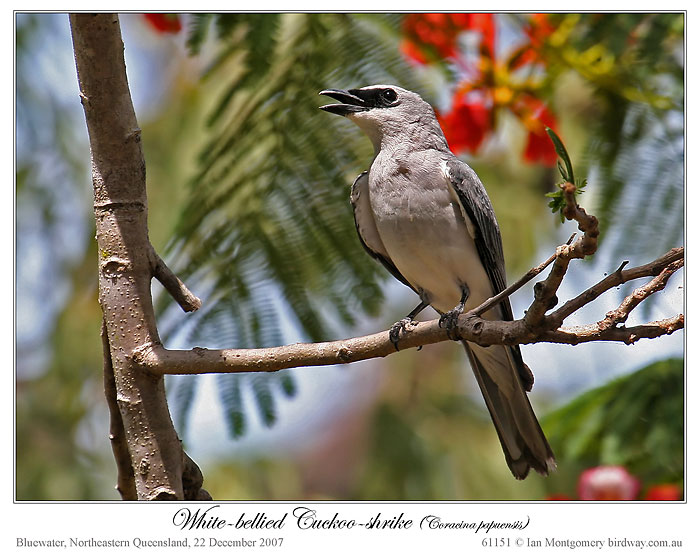
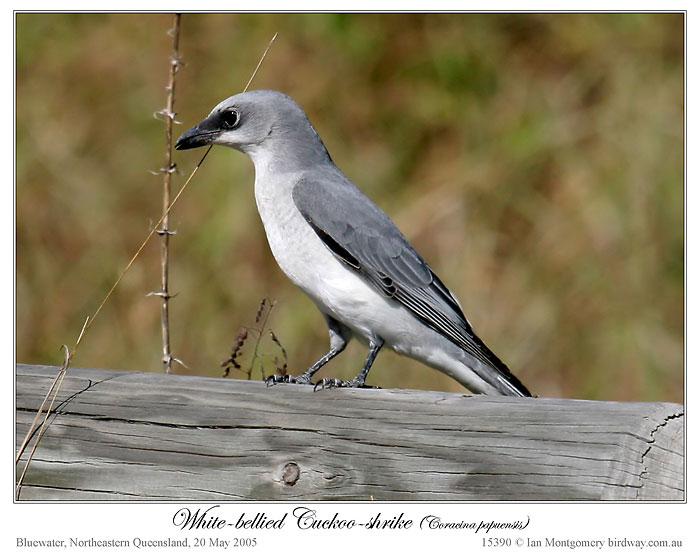
The best known Cuckooshrike in Australia is the very widespread Black-faced, but in North Queensland the smaller White-bellied is usually much commoner, though the migrant Black-faced can be numerous in the (winter) dry season. The first photo shows an adult of the eastern Australian race robusta perched in a red-flowering Poinsiana near my house. The second photo is of a juvenile bird, also in my garden, with the characteristic faintly barred breast and dark smudge behind the eye.

White-bellied Cuckooshrike (Coracina papuensis hypoleuca) by Ian

White-bellied Cuckooshrike (Coracina papuensis hypoleuca) by Ian

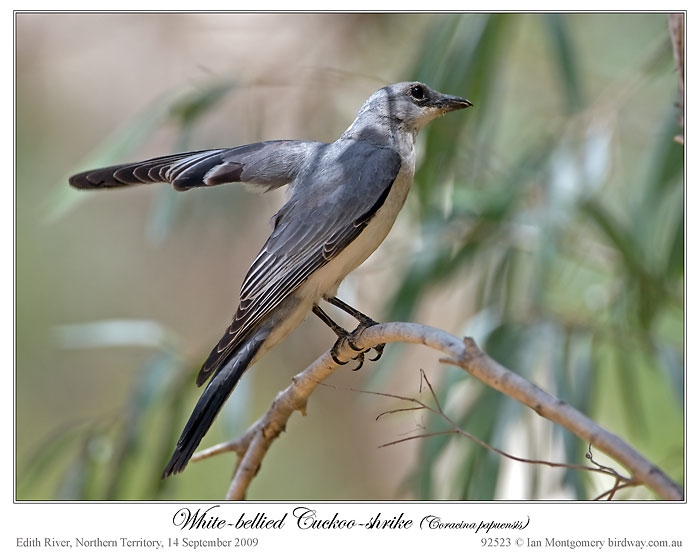
The third photo shows the paler, white-breasted, northern race hypoleuca, found in the Northern Territory and northern Western Australia. It merely looks like it’s got a broken wing: it’s actually in the middle of the wing shuffle performed both by this species and the Black-faced after landing and, apparently, during display. The shuffle is done very deliberately and the birds look as if they are having trouble folding their wings comfortably. The Black-faced is sometimes called the ‘Shufflewing’, arguably a much better name than ‘cuckooshrike’ as they are not related to either cuckoos or shrikes and shrikes are meaninglessly unknown in Australia, except as rare vagrants.

White-bellied Cuckooshrike (Coracina papuensis robusta) by Ian

White-bellied Cuckooshrike (Coracina papuensis robusta)dark morph by Ian

Interestingly, the White-bellied seems to have some black-faced genes lurking in its genome, as there is an uncommon dark morph of the race robusta, fourth photo, which could easily be confused with the larger Black-faced Cuckooshrike, though the dark morph of the White-bellied has black scallops between the breast and the belly. The species are distinguishable by call. Both are quite vocal, with the Black-faced having a musical ‘chereer’ while the White-bellied is a peevish ‘kissik’: if it sounds as if it’s complaining, it’s a White-bellied.

Links:
White-bellied Cuckooshrike
Black-faced Cuckooshrike
True Shrikes

Best wishes,
Ian


Ian Montgomery, Birdway Pty Ltd,
454 Forestry Road, Bluewater, Qld 4818
Phone: 0411 602 737 +61-411 602 737
Preferred Email: ian@birdway.com.au
Website: http://birdway.com.au


Lee’s Addition:

Thanks, Ian, for introducing us to another interesting bird. The Cuckoo is a Bird of the Bible, but I am not sure if the Cuckooshrike comes under that “kind” or not. The KJV spells it, “cuckow” and the MKJV “cuckoo.”

and the owl, and the night hawk, and the cuckoo, and the hawk after its kind, (Deuteronomy 14:15 MKJV)

The Cuckooshrikes are in the Campephagidae – Cuckooshrikes Family of the Passeriformes Order, whereas the Cuckoo is in the Cuculidae – Cuckoos Family of the Cuculiformes Order. So, I suspect that since they are two different Orders that they are totally different “kinds.”

Cuckoo is used with several other bird families:

Cuckoo-Hawks – Accipitridae Family
Cuckoo-Doves – Columbidae Family
Cuckoo Roller – Leptosomidae Family
Cuckoo Weaver – Viduidae Family

And some of you only thought the Cuckoo lived in a clock!

*

Ian’s Bird of the Week – Weebill

Weebill (Smicrornis brevirostris) by Ian Montgomery

Weebill (Smicrornis brevirostris) by Ian Montgomery

Ian’s Bird of the Week – Weebill ~ by Ian Montgomery

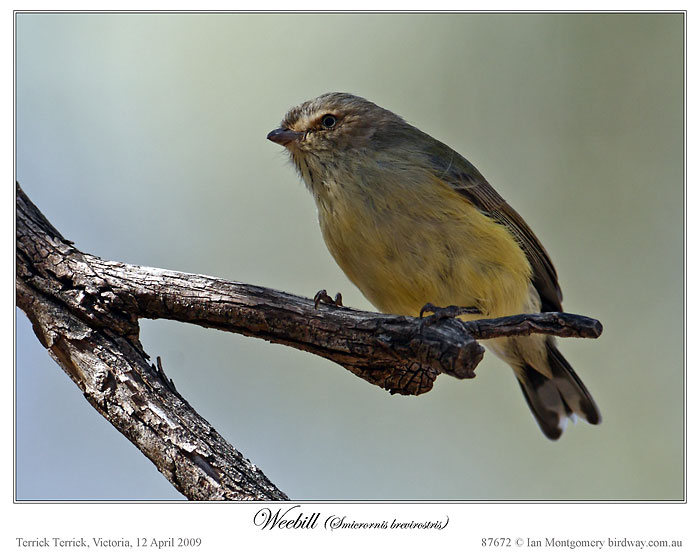
I’ve recently been reformatting the photo galleries of the Thornbills and Allies (Acanthizidae) on the website. This is a family of small, mostly insectivorous birds and here, with a length of 8-9cm/3.2-3.5in, is the diminutive Weebill. It is widespread in drier woodlands, including Mallee, across mainland Australia, but absent from Tasmania and is not found in wetter forests. It has a characteristic stubby horn-coloured bill, pale eyebrow and pale iris, as in the first photo, which distinguishes it from the rather similar Yellow Thornbill. This photo, taken in Victoria, shows the browner nominate race found Victoria, New South Wales, southern Queensland and eastern South Australia.

Weebill (Smicrornis brevirostris) by Ian Montgomery

Weebill (Smicrornis brevirostris) by Ian Montgomery

The northern race (flavescens), second photo, taken on Southern Cape York Peninsula, ranges across the most of the rest of northern and central Australia is much yellower in colour and slightly smaller, making it the smallest bird in Australia. They are often to be found in very harsh, dry habitats and I am frequently impressed that such small birds are so tough and such great survivors.

Weebill (Smicrornis brevirostris) by Ian Montgomery

Weebill (Smicrornis brevirostris) by Ian Montgomery

The third photo, taken in Northwestern Queensland, is also of this race but is, I think, an immature bird, less brightly coloured and a greyish rather than white iris. In southwestern Western Australia, the northern race grades into another race (occidentalis) with a greyish face with a rufous tinge, but I haven’t photographed it.

Weebills are lively, vocal little birds with a remarkably strong voice so you often hear them before you spot them busily feeding in the foliage of trees. The call is rendered something like ‘wee-willey-weet weet’ but I was told to remember ‘I’m a little Weebill’ and that works for me.
Links:
Best wishes
Ian
P. S. There was an error in last week’s Yellow-spotted Honeyeater. I said that the Yellow-spotted and the Graceful where North Queensland endemics when I should have said that in Australia, they occur only in North Queensland. They also occur in New Guinea. 


Ian Montgomery, Birdway Pty Ltd,
454 Forestry Road, Bluewater, Qld 4818
Phone: 0411 602 737 +61-411 602 737
Preferred Email: ian@birdway.com.au
Website: http://birdway.com.au

Lee’s Addition:
What a cute little bird. After you check out Ian’s links to the Acanthizidae he has photographed, see the Acanthizidae Family of the Passeriformes Order in our Birds of the World section.

And to every beast of the earth and to every bird of the heavens and to everything that creeps on the earth, everything that has the breath of life, I have given every green plant for food.” And it was so. (Genesis 1:30 ESV)

*

Ian’s Bird Of The Week – Yellow-spotted Honeyeater

Yellow-spotted Honeyeater (Meliphaga notata) by Ian

Yellow-spotted Honeyeater (Meliphaga notata) by Ian

Ian’s Bird Of The Week – Yellow-spotted Honeyeater ~ by Ian Montgomery

Newsletter – 03-13-11

I’ve been working on the Honeyeater galleries on the website recently and a Yellow-spotted Honeyeater showed up outside my house a few days ago, pushing this species into the foreground when I was contemplating the choice of this week’s bird. Bluewater is at the southern end of its range, so it turns up only occasionally and this one is presumably a cyclone Yasi refugee.

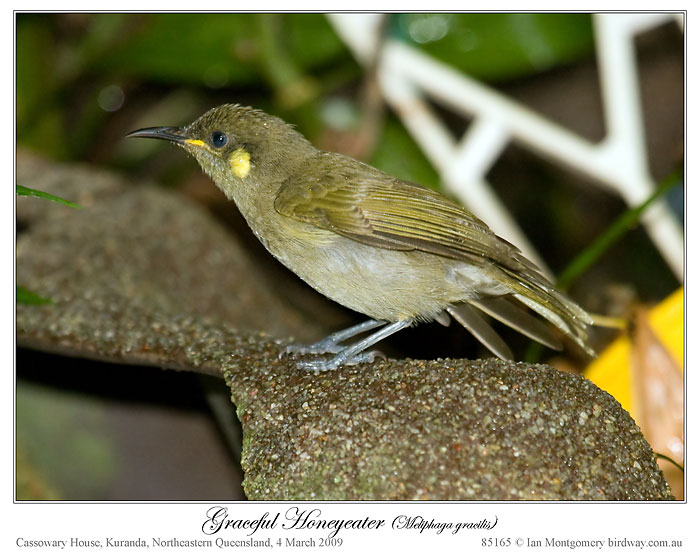
It’s very similar to the Graceful Honeyeater, which has an almost identical range from just north of Bluewater (Rollingstone) to Cape York, so they are both North Queensland endemics and, in turn, similar to Lewin’s Honeyeater, which occurs right along the east coast of Australia as far south as Melbourne. Both the Yellow-spotted and the Graceful are common in forest habitats in North Queensland and I had trouble separating them when I first moved up here until I learnt their calls – the easiest way to distinguish them – so a comparison of the three species might be of interest and I’ve selected photos taken under similar condition using flash in poor light, typical of forests.

Lewin's Honeyeater (Meliphaga lewinii) by Ian

Lewin's Honeyeater (Meliphaga lewinii) by Ian

The Yellow-spotted – first photo – is intermediate in size (17-19cm/6.7-7.5in) between the larger Lewin’s – second photo – (19-22cm/7.5-8.7) and the smaller Graceful – third photo – (14-17cm/5.5-6.7in), so perhaps the key is to separate it from the other two species. Lewin’s has a dark-grey face (in front of the ear-patch), a large half-moon-shaped ear patch and a heavier bill. Both have longish pale-yellow, almost whitish, gapes. The typical call of the Lewin’s is the familiar loud and regular ‘machine-gun’ rattle of the forest of eastern Australia; that of the Yellow-spotted is clearly related but different: slower and descending. Both also have harsh chattering calls, differing in tone and intensity in a similar way to the machine-gun calls – that of the Lewin’s is louder and harsher in a bigger-bird sort of way.

Both the Yellow-spotted and the Graceful have greenish faces and smallish ear-patches which look similar to me (though some field guides make distinctions such as ’rounded triangle, yellow’ versus ’rounded, cream’: huh?). The gapes, however, are quite different, that of the Yellow-spotted being long and pale like that Lewin’s while that of the Graceful is shorter and very yellow (chrome). The Graceful has a longer bill with a decurved lower edge (that of both Lewin’s and Yellow-spotted is almost straight), though I’ve found that a tricky field mark unless you get a good, exactly lateral view. Happily, the call of the Graceful is very different, a sharp ‘tuck’ or ‘pik’ repeated at intervals and very distinctive.

Graceful Honeyeater (Meliphaga gracilis) by Ian

Graceful Honeyeater (Meliphaga gracilis) by Ian

All three species are quite vocal and in the forest you normally hear them before you see them, so I find it best to use the visual field marks to confirm an auditory identification, particularly if you find the Graceful and the Yellow-spotted together, which happens sometimes. In the north, the Lewin’s is more of a highland species, though it does move down in winter, and it’s unusual to find it in the company of the other two.

We made a recent trip to Paluma to inspect the cyclone damage. The local birds, particularly the fruit-eaters seemed very hungry and responded well to feeding so I’ve added photos of these species:
Victoria’s Riflebird
Satin Bowerbird
Spotted Catbird
White-cheeked Honeyeater
Macleay’s Honeyeater

At home the good news is that my lone cyclone-surviving male Blue-winged Kookaburra seems to have attracted a mate, and there were plenty of Dollarbirds around yesterday.

Best wishes,
Ian

Ian Montgomery, Birdway Pty Ltd,
454 Forestry Road, Bluewater, Qld 4818
Phone: +61-7 4751 3115
Preferred Email: ian@birdway.com.au
Website: http://birdway.com.au


Lee’s Addition:
The Honeyeaters are part of the 183 species, 44 genera, in the Meliphagidae Family. This family is in the Passeriformes Order.

Eating too much honey can make you sick. (Proverbs 25:16 CEV)

To see more of Ian’s Bird of the Week articles – CLICK HERE

*

Ian’s Bird of the Week – Lesser Frigatebird


Lesser Frigatebird (Fregata ariel) male by Ian

Lesser Frigatebird (Fregata ariel) male by Ian

Ian’s Bird of the Week – Lesser Frigatebird ~ by Ian Montgomery

Newsletter – 3/2/11

This is the third of the post-cyclone Yasi birds of the week. The first dealt with survival of small birds; the second with birds like fruit-doves that move after the cyclone in search of food. Another category of birds greatly affected by cyclones are seabirds, particularly those that spend much time on the wing and these often appear in places where they are not usually seen or get blown inland, sometimes over great distances.

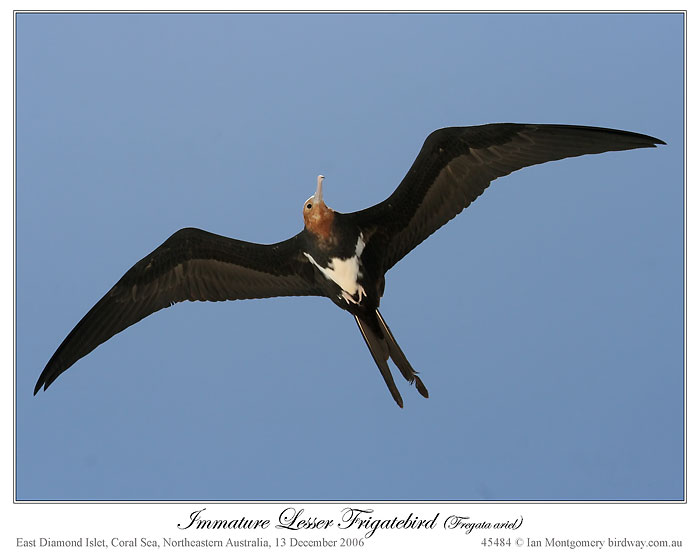
The Lesser Frigatebird is common in oceanic waters of northern Australia and breeds in colonies both on the northern mainland and on cays and islands. Adult birds are normally sedentary, remaining in the vicinity of the colonies, though immature birds may travel widely over the oceans. Frigatebirds not normally seen in places like Townsville, distant from breeding colonies, except after cyclones and cyclone Yasi was no exception with both Great and Lesser Frigatebirds being recorded along the coast. I was surprised to see a pair of Lesser Frigatebirds near my place at Bluewater, 11km from the coast and the birds looked quite out of place soaring over the hills south of the house.
Lesser Frigatebird (Fregata ariel) female by Ian

Lesser Frigatebird (Fregata ariel) female by Ian

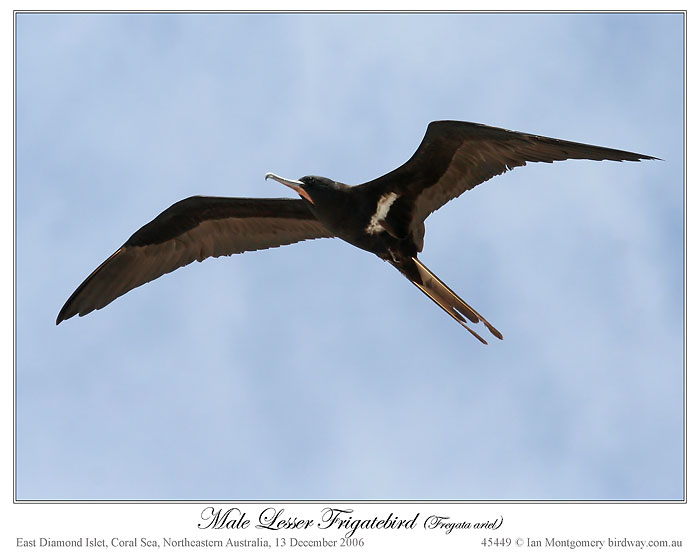
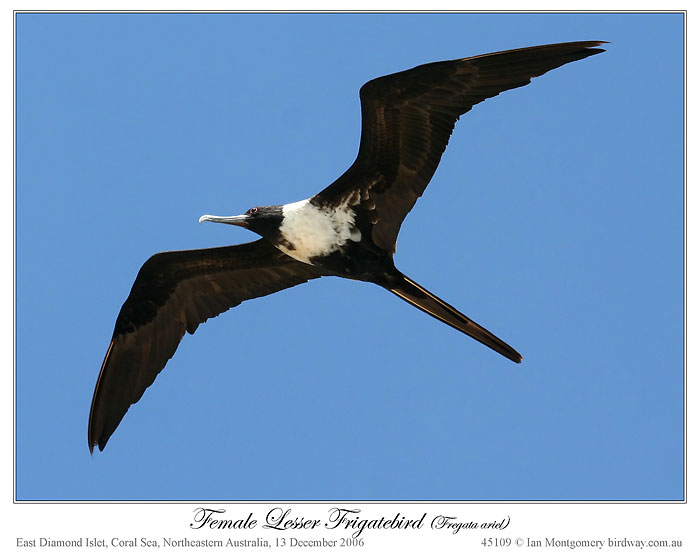
Lesser Frigatebirds are easily distinguished in all plumages from Great Frigatebirds by having white ‘armpits’ or spurs. The first photo shows a male bird, black except for these spurs and male Great Frigatebirds are entirely black. Male Frigatebirds have inflatable red throat pouches used to spectacular effect in displays (for example this male Magnificent Frigatebird in Ecuador: http://www.birdway.com.au/fregatidae/magnificent_frigatebird/source/magnif_frigatebird_27662.htm ). The second photo shows a female Lesser Frigatebird and the third an immature one.
Frigatebirds are huge. Even the Lesser, the smallest of the 5 global species, is 70-80cm/28-32in. in length with a wingspan of 1.8-1.9m/5.9-6.2 feet. They are very light for their size, having very light bones, and are adapted to soaring effortlessly in the trade winds where they are usually found. They are famous as pirates, forcing other seabirds, particularly boobies, to disgorge their prey ( http://www.birdway.com.au/fregatidae/greater_frigatebird/source/greater_frigatebird_39356.htm ), but they are also adept fishers in their own right, snatching flying fish in flight and other fish and cuttlefish from the surface of the water. They have tiny feet, useful only for perching in trees when nesting or roosting and quickly become water-logged if forced to land on water which they normally avoid. They will bathe and drink fresh water in flight ( http://www.birdway.com.au/fregatidae/greater_frigatebird/source/greater_frigatebird_40675.htm ).
Lesser Frigatebird (Fregata ariel) imm. by Ian

Lesser Frigatebird (Fregata ariel) imm. by Ian

11km from the coast is nothing to a frigatebird and it is likely that cyclone-distributed frigatebirds can find their way home (like swifts, they often take advantage of storm fronts). Less fortunate perhaps was the Petrel recorded post-Yasi on the Atherton Tableland by Alan Gillanders, though the record for Yasi goes to a Bridled Tern rescued ‘in bad shape’ in Alice Springs by Chris Watson, probably as far away from the ocean as you can get in Australia.

The latest addition to the website is a taxonomic index of Australian birds ( http://www.birdway.com.au/aus_taxonomic.htm ), showing Orders and Families and with links to the 97 of 103 families of Australian birds represented on the website. The 6 unrepresented families are also shown but lack links. Some of these missing families are merely rare vagrants such as Northern Storm-Petrels and Leaf Warblers (the Arctic Warbler) or introductions like the Ostrich but others such as Penguins (there are only photos of African Penguins) are to be regretted and I hope to rectify this before the year is out. The other two – Scrub-birds and Sheathbills – are in the very hard baskets, and I can’t make any promises. If classification is your thing, this page is for you and you can find it under the grey navigation button ‘Indices to Australian Birds’ formerly singular. There are also instructions on the home page: http://www.birdway.com.au/index.htm#news .
Best wishes,
Ian

Ian Montgomery, Birdway Pty Ltd,
454 Forestry Road, Bluewater, Qld 4818
Phone: +61-7 4751 3115
Preferred Email: ian@birdway.com.au
Website: http://birdway.com.au

Lee’s Addition:

The birds of the air, And the fish of the sea That pass through the paths of the seas. O LORD, our Lord, How excellent is Your name in all the earth! (Psalms 8:8-9 NKJV)

The frigatebirds are a family, Fregatidae, of seabirds. There are five species in the single genus Fregata. They are also sometimes called Man of War birds or Pirate birds. Since they are related to the pelicans, the term “frigate pelican” is also a name applied to them. They have long wings, tails and bills and the males have a red gular pouch that is inflated during the breeding season to attract a mate. They are part of the Suliformes Order.

Frigatebirds are pelagic piscivores which obtain most of their food on the wing. A small amount of their diet is obtained by robbing other seabirds, a behavior that has given the family its name, and by snatching seabird chicks. Frigatebirds are seasonally monogamous, and nest colonially. A rough nest is constructed in low trees or on the ground on remote islands. A single egg[citation needed] is laid each breeding season. The duration of parental care in frigatebirds is the longest of any bird.

Frigatebirds are found over tropical oceans and ride warm updrafts. Therefore, they can often be spotted riding weather fronts and can signal changing weather patterns.

These birds do not swim and cannot walk well, and cannot take off from a flat surface. Having the largest wingspan to body weight ratio of any bird, they are essentially aerial, able to stay aloft for more than a week, landing only to roost or breed on trees or cliffs. (Wikipedia)

Dan and I had the privilege of see a Magnificent Frigatebird flying over Ding Darling NWR.

Ian’s Bird of the Week – Superb Fruit-Dove

Superb Fruit Dove (Ptilinopus superbus) by Ian

Superb Fruit Dove (Ptilinopus superbus) by Ian

Ian’s Bird of the Week – Superb Fruit-Dove  ~ by Ian Montgomery

Newsletter ~ 02-20-11

One of the tragedies of severe tropical cyclones is the damage to vegetation, particularly fruiting trees, and the resulting avian refugees, many battered and exhausted, fleeing far and wide in search of food. Since cyclone Yasi, many Superb and Wompoo Fruit-Doves and some Brown Cuckoo-doves have been moving through areas such as Bluewater and Townsville. This happened after cyclone Larry in 2006 when many of these refugees stayed around for months, but they are even more numerous this time round.

Superb Fruit-Doves are among the most spectacularly beautiful of rainforest birds in eastern Australia, but despite their bright colours are usually heard rather than seen. Their distinctive, repeated ‘whoop, whoop’ calls – with a rising inflection delivered at a regular rhythm and easily distinguished from the similar but accelerating ‘whp-whoo’ of the related and equally gorgeous Rose-crowned Fruit-Dove – are a very characteristic sound of northeastern rainforests. Hearing is no guarantee of seeing, however, and these shy birds usually remain invisible in the thick foliage of rainforest trees. So, it is strange to see these wonderful little doves (length of both species to 24cm/9.5in) sitting in full-view on trees in open tropical savanna left leafless by the cyclone, too tired to fly away when approached.

Superb Fruit Dove (Ptilinopus superbus) by Ian

Superb Fruit Dove (Ptilinopus superbus) by Ian

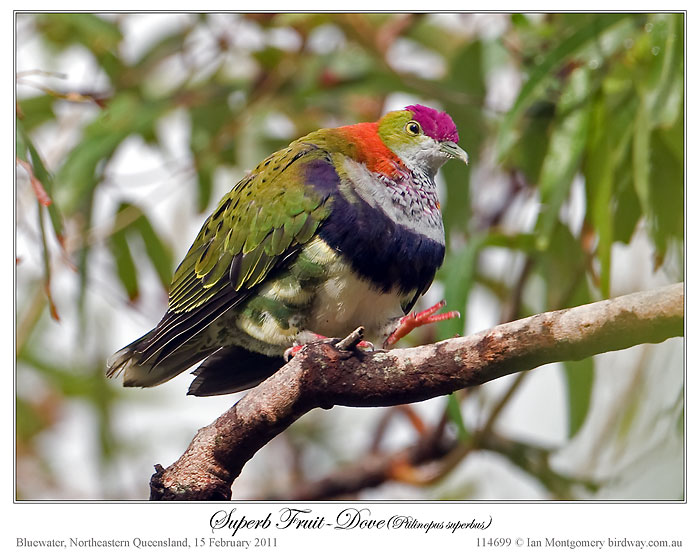
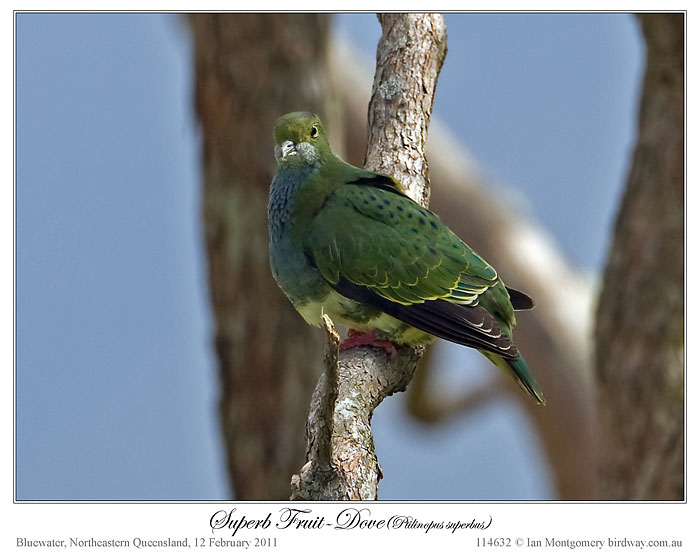
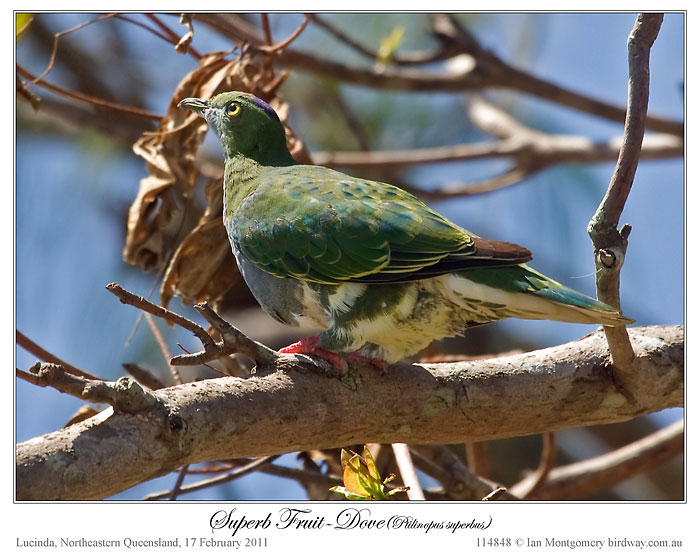
The first photo shows a male, the second the less-spectacular but still beautiful female photographed from the verandah of my house a week to ten days after the cyclone when this species was most numerous around here. The females have an indigo skull cap that, being on the back of the head, is often not visible but you can see it clearly in the bird in the third photo, taken in a battered but still fruiting tree at Dungeness where we lunched last Thursday, in a normally but no longer shady park near Lucinda on the coast east of Ingham, after doing the monthly wader survey. That area took quite a battering and the sand spit along which we used to walk to do the survey has largely been flattened and the sand dumped in the mud flat to its west.

The range of the Superb Fruit-Dove in Australia is the east coast from the tip of Cape York to south of Sydney. Its main breeding range is in tropical Queensland north of Prosperine on the Whitsunday Coast and it is relatively rare in New South Wales. It also occurs in New Guinea and eastern Indonesia and many Australian birds migrate to New Guinea in winter. Fruit-eating doves normally range widely in search of food, given the seasonal nature of its availability, so it is to be hoped that this ability serves them well in times such as this.

Links:
Superb Fruit-Dove
Rose-crowned Fruit-Dove
Wompoo Fruit-Dove
Brown Cuckoo-Dove

Superb Fruit Dove (Ptilinopus superbus) by Ian

Superb Fruit Dove (Ptilinopus superbus) by Ian

I’ve resumed work on the website still using the borrowed mobile modem and have at last finished updating all the next/previous family pointers of the Australian bird family thumbnail pages. This means that you can now view the website in a global context or an Australian one, depending on your focus. The global context – and the New World and Old World subsets – follows the taxonomic organization and sequence of Birdlife International both between and within families while the Australian one follows the organization and sequence of Christidis and Boles, 2008, the generally accepted authorities in Australia.

There are quite a few differences in the recognized families, the sequence of families and the order within families between the 2 schema, so I suggest that you stick to one or the other (at any one time) to avoid confusion. The Australian context is distinguished by green backgrounds for both arrows (to Australian thumbnails and to previous and next families) and for the pages of family thumbnails. I’ve documented differences in family structure on the family pages; have a look at this for a simple example: http://www.birdway.com.au/cacatuinae/index_aus.htm and this for a particularly divergent example: http://www.birdway.com.au/sylviidae/index_aus.htm .

Best wishes,

Ian

Ian Montgomery, Birdway Pty Ltd,
454 Forestry Road, Bluewater, Qld 4818
Phone: +61-7 4751 3115
Preferred Email: ian@birdway.com.au
Website: http://birdway.com.au


Lee’s Addition:

The Fruit-doves is one of the Birds of the Bible. Doves are mentioned over 40 times in Scripture. See also – Birds of the Bible – Doves and Pigeons

And I said, Oh that I had wings like a dove! for then would I fly away, and be at rest. (Psalms 55:6 KJV)

Superb Fruit Dove (Ptilinopus superbus) by xeno-canto-David Farrow

Rose-crowned Fruit Dove (Ptilinopus regina) by xeno-canto – Vicki Powys

Though ye have lien among the pots, yet shall ye be as the wings of a dove covered with silver, and her feathers with yellow gold. (Psalms 68:13 KJV)

This beautiful Superb Fruit-Dove or Fruit Dove, depending on whose list used, is in the Columbidae Family of the Columbiformes Order. There are 321 members of the family including the Doves, Fruit Doves, Collared Doves, Cuckoo-Doves, Wood Doves, Bronsewings, Ground and Quail Doves, Bleeding Hearts, plus all the different kinds of Pigeons.

*

Ian’s Bird of the Week – Olive-backed/Yellow-bellied Sunbird


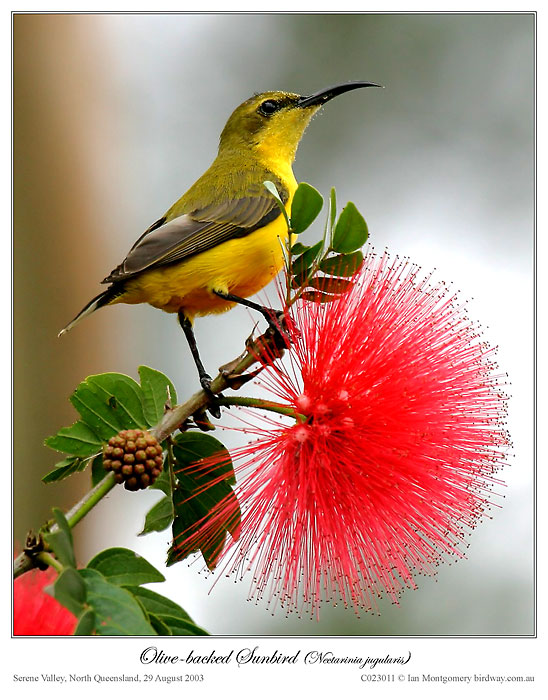
Olive-backed Sunbird (Cinnyris jugularis) by Ian


Ian’s Bird of the Week – Olive-backed/Yellow-bellied Sunbird ~ by Ian Montgomery

Newletter: 02-17-11

Well, my apologies for a very belated bird of the week. Life in and around Townsville has largely returned to normal post-Yasi, except for for my broadband connection so I’ve borrowed a mobile modem from my neighbour.

Olive-backed Sunbird (Cinnyris jugularis) by Ian

Olive-backed Sunbird (Cinnyris jugularis) by Ian

This week’s choice is the award for small bird cyclone survivor, jointly shared by around here by Red-backed Fairywren, Dusky Honeyeater and Olive-backed or Yellow-bellied Sunbird. The fairywren has been bird of the week before (July 2005), so I was going to choose the Dusky Honeyeater until I discovered that I have no record of the Sunbird being bird of the week before. That’s a potentially serious omission, so please forgive me if I’m mistaken: just nod sagely and put it down to old age and post-cyclone shock.

I suppose one shouldn’t be surprised at the Sunbird surviving cyclones as its range in Australia is restricted almost entirely to coastal tropical Queensland, extending just south of the Tropic of Capricorn to around Bundaberg. It also occurs in Torres Strait, New Guinea and southeast Asia but is regarded here as an iconic species and is immensely popular being very common around gardens, tame and often building its elegant hanging nest on verandahs. They feed mainly on the nectar of blossoms but will also take spiders.

The first two photos show the blue-chested male and yellow-breasted female respectively on Calliandra (Powder Puff) and were taken at the house that I rented when I first moved to Townsville. The third photo shows one of the local males perched in a Poinsiana tree near my current house.

Olive-backed Sunbird (Cinnyris jugularis) by Ian

Olive-backed Sunbird (Cinnyris jugularis) by Ian

This species is the only Sunbird found in Australia but it belongs to a large family with more than 100 species of Sunbird in Asia and Africa and leading a lifestyle similar to that of the exclusively American and unrelated Hummingbirds. The Sunbirds are closely related to the Flowerpeckers – which include the Mistletoebird – and there is disagreement as to whether they constitute one or two families.

Other cyclone related news is that the Peaceful Dove that I rescued had an injured rather than broken wing, has recovered well in the company of the budgies next door and is ready to be returned to the wild. Food is now the main issue for survivors and many of you have naturally expressed concern for the Southern Cassowaries, just recovering from cyclone Larry. You can find out what the Queensland Government is doing . Sue and Phil Gregory tell me that the Cassowaries at Cassowary House in Kuranda near Cairns have survived well, so keep that in mind if you are visiting North Queensland and want somewhere lovely to stay: http://www.cassowary-house.com.au/ .

Like cyclone Larry, Bluewater has been visited by some unusual avian visitors post-Yasi. I’ll say more about them in the next email and some photos of a special one for bird of the week #400 which will go out shortly as a catch-up.

Best wishes and thank you again for your kindness and support.
Ian

Ian Montgomery, Birdway Pty Ltd,
454 Forestry Road, Bluewater, Qld 4818
Phone: +61-7 4751 3115
Preferred Email: ian@birdway.com.au
Website: http://birdway.com.au


Lee’s Addition:

What a neat looking bird and your photography skills show through as usual, Ian. Not sure about the readers, but I enjoy seeing each of your Bird of the Week offerings.

The Sunbirds reside in the Nectariniidae Family of the Passeriformes Order. There are 136 of these beautiful Sunbirds which also include Double-collared Sunbirds and Spiderhunters.

Then I saw an angel standing in the sun; and he cried with a loud voice, saying to all the birds that fly in the midst of heaven, “Come and gather together for the supper of the great God, (Revelation 19:17 NKJV)

“The sunbirds and spiderhunters are a family, Nectariniidae, of very small passerine birds. The family is distributed throughout Africa, southern Asia and just reaches northern Australia. Most sunbirds feed largely on nectar, although they will also take insects, especially when feeding young. Fruit is also part of the diet of some species. Their flight is fast and direct on their short wings.

The sunbirds have counterparts in two very distantly related groups: the hummingbirds of the Americas and the honeyeaters of Australia. The resemblances are due to the similar nectar-feeding lifestyle. Some sunbird species can take nectar by hovering like a hummingbird, but usually perch to feed.

The family ranges in size from the 5-gram Black-bellied Sunbird to the Spectacled Spiderhunter, at about 45 grams. Like the hummingbirds, sunbirds are strongly sexually dimorphic, with the males usually brilliantly plumaged in metallic colours. In addition to this the tails of many species are longer in the males, and overall the males are larger. Sunbirds have long thin down-curved bills and brush-tipped tubular tongues, both adaptations to their nectar feeding. The spiderhunters, of the genus Arachnothera, are distinct in appearance from the other members of the family. They are typically larger than the other sunbirds, with drab brown plumage that is the same for both sexes and long down-curved beaks.

Species of sunbirds that live in high altitudes will enter torpor while roosting at night, lowering their body temperature and entering a state of low activity and responsiveness.” (Wikipedia)

For the LORD God is a sun and shield; The LORD will give grace and glory; No good thing will He withhold From those who walk uprightly. (Psalms 84:11 NKJV)

*
Ian’s Bird of the Week – Black-breasted Buttonquail

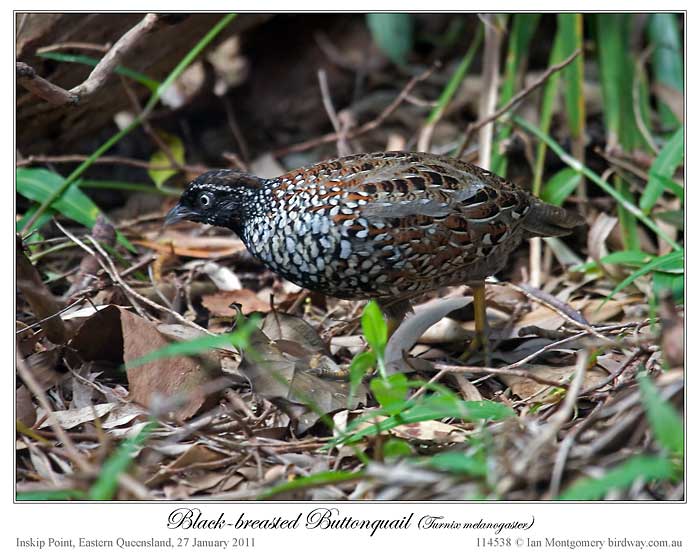
Black-breasted Buttonquail (Turnix melanogaster) by Ian

Black-breasted Buttonquail (Turnix melanogaster) by Ian

Ian’s Bird of the Week – Black-breasted Buttonquail ~ by Ian Montgomery

Newsletter – 01/30/11

I returned home from Armidale NSW by road bringing back a friend’s car that had been left at the Gold Coast south of Brisbane because of the flooding. I took the opportunity to make a detour to Inskip Point – near Rainbow Beach and Fraser Island – a known haunt of the rare Black-breasted Buttonquail, see the female in first photo.

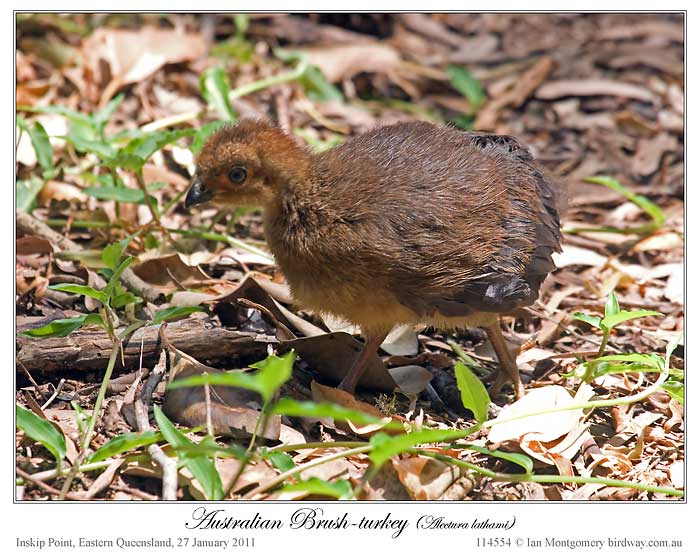
I found a pair relatively easily, though not before a few false alarms in the shape of some very young Australian Scrub-turkeys, as in the second photo, so young in fact that they were as small as the Buttonquails.
Australian Brushturkey (Alectura lathami) by Ian

Australian Brushturkey (Alectura lathami) by Ian

Buttonquails leave characteristic circular bare patches in leaf litter called ‘platelets’ and I had stopped to examine some of these when a female Black-breasted Buttonquail ambled across the path and walked right past me. At one stage she walked towards me and I don’t think she noticed my presence. Buttonquails, like certain other eclectic groups of birds including Phalaropes and Cassowaries, have reversed sex roles with the more colourful females courting the males and the males incubating and looking after the young, so I was pleased to see the female who has a black head and black breast with moon-shaped white spots on the sides, as in the third photo.
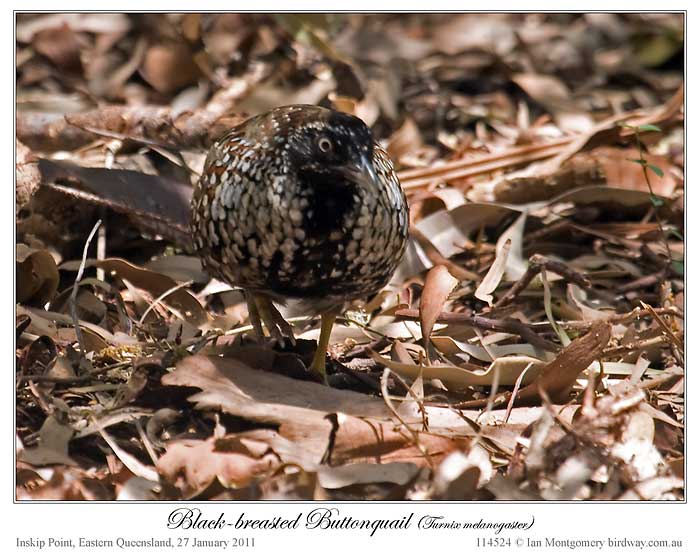
Black-breasted Buttonquail (Turnix melanogaster) by Ian

Black-breasted Buttonquail (Turnix melanogaster) by Ian

Buttonquails are not closely related to the true quails and are placed in their own family, the Turnicidae. The most obvious structural difference is the lack of a hind toe in Buttonquails, as you can see if you look carefully in the fourth photo and they are sometimes called ‘Hemipodes’, meaning half-foots. They feed on seed and invertebrates and the Black-breasted is particularly dependent on leaf litter and eats mainly invertebrates. They make the platelets by spinning around on one foot using the other to clear away the leaves; often they then reverse direction standing on the other foot so the size of the platelet matches the size of the bird. The Black-breasted is large by Buttonquail standards with the larger females being about 19cm/7.5in in length and the males 16.5cm/6.5in. I saw her drabber partner later but he didn’t want his photo taken.
Black-breasted Buttonquail (Turnix melanogaster) by Ian

Black-breasted Buttonquail (Turnix melanogaster) by Ian

There are about 16 species in total and are found in Africa, southern Spain, southern and southeastern Asia and Australia. Seven of these occur in Australia. The range of the Black-breasted is limited to coastal southeastern Queensland and northeastern NSW from Fraser Island to just north of Lismore. Its preferred habitat is open woodland and its population has suffered from habitat clearing and it is now classed as vulnerable.

I’ve put the Southern Boobooks, photographed in Armidale, on the website:
Southern Boobook
Links:
Best wishes,

Ian

Ian Montgomery, Birdway Pty Ltd,
454 Forestry Road, Bluewater, Qld 4818
Phone: +61-7 4751 3115
Preferred Email: ian@birdway.com.au
Website: http://birdway.com.au


Lee’s Additions:

As Ian said, the Buttonquails are in the Turnicidae – Buttonquail Family of the Charadriiformes Order. There are 17 members of this family. The Charadriiformes Order does not even include the New World Quail Family. Those quails are found in the Galliformes Order which also included the Brushturkeys.  The Brushturkeys are part of the Magapode – Medapodiidae Family in the Galliformes Order. It has 22 members in its family.

Quails are mentioned in the Bible in four verses; Exodus 16:13, Numbers 11:31-32 and Psalm 105:40. Which kind of quail, it is not clear, but they were complaining about not having enough to eat and the LORD sent them Quail.

The people asked, and he brought quails, and satisfied them with the bread of heaven. (Psalms 105:40 KJV)

To see more:

Ian’s Birds of the Week

Birds of the Bible – Quail

*
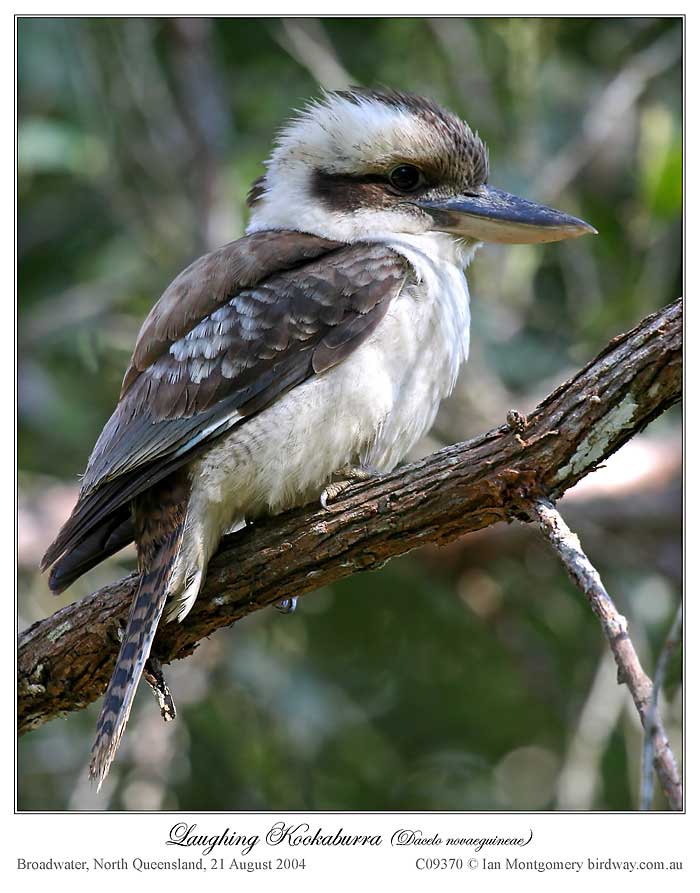
Ian’s Bird of the Week – Laughing Kookaburra

Laughing Kookaburra (Dacelo novaeguineae) by Ian

Laughing Kookaburra (Dacelo novaeguineae) by Ian

Ian’s Bird of the Week – Laughing Kookaburra ~ by Ian Montgomery

Newsletter  – 01/23/11

The Blue-winged Kookaburra has featured as bird of the week (twice) but, as far as I can detect, the iconic Laughing Kookaburra hasn’t, so let’s correct that using library photos. Bird photo opportunities were time-constrained during the wonderful recorder course in Armidale, NSW, though a family of roosting Southern Boobooks (which featured as bird of the week last year) gave the participants much pleasure and I’ll let you know when I’ve put the photos on the website.

Laughing Kookaburra (Dacelo novaeguineae) by Ian

Laughing Kookaburra (Dacelo novaeguineae) by Ian

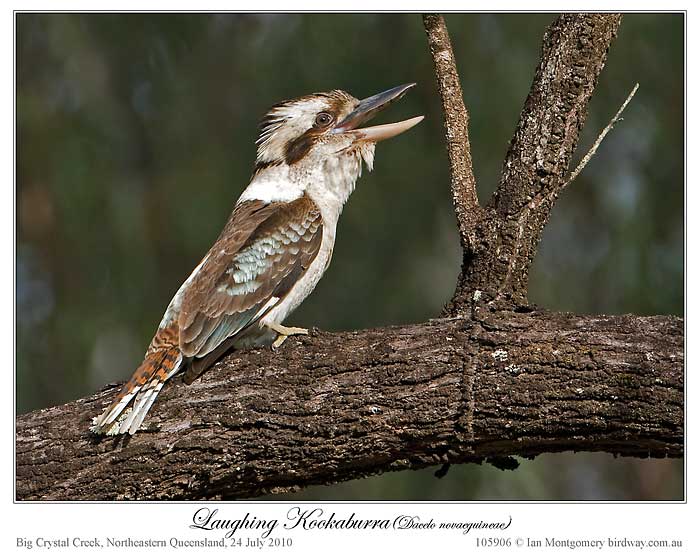
Its loud cackling call is a characteristic sound of the Australian landscape (and of the sound tracks of B-grade jungle movies not set in Australia) and it’s a familiar bird in southern and eastern Australia, first photo.

Laughing Kookaburra (Dacelo novaeguineae) by Ian

Laughing Kookaburra (Dacelo novaeguineae) by Ian

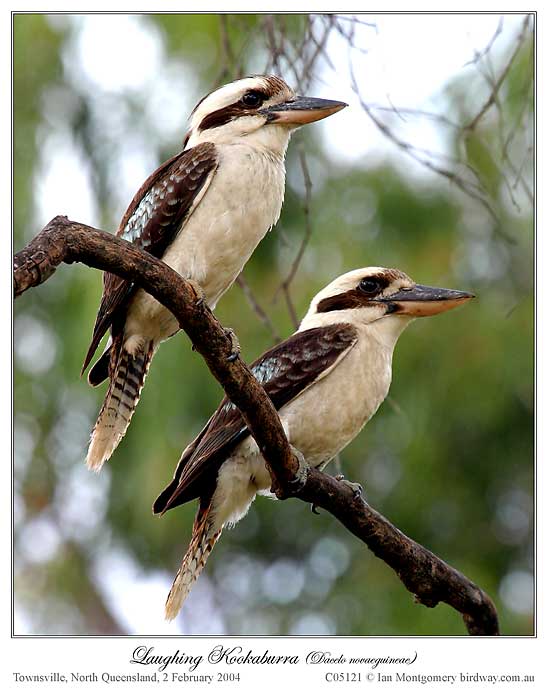
Up to 47cm/18.5in in length, it’s larger than its blue-winged cousin (length to 40cm) and by far the largest Australian Kingfisher. Unlike male blue-winged, birds of both sexes have brown tails and are not easily told apart. The third photo shows a breeding pair of Laughing Kookaburras, photographed near their nest site in a tree hollow in the botanic gardens (the Palmetum) in Townsville.

Older males can, however, be distinguished by having bluish rumps,  like one making his presence very audible in the third photo. Kookaburras are very territorial and defend their territories by having calling matches and by performing circular display flights as far as the boundary of the territory. A territorial group consists of either just a breeding pair or a dominant breeding pair and several ‘helper’ birds so the calling matches can be very noisy indeed when everyone takes part.
Laughing Kookaburra (Dacelo novaeguineae) by Ian

Laughing Kookaburra (Dacelo novaeguineae) by Ian

Juvenile birds are recognisable by the pale brownish scalloped edges to the plumage, most noticeable on the back like the right hand bird in the fourth photo. This bird is barely fledged and has a very short tail.

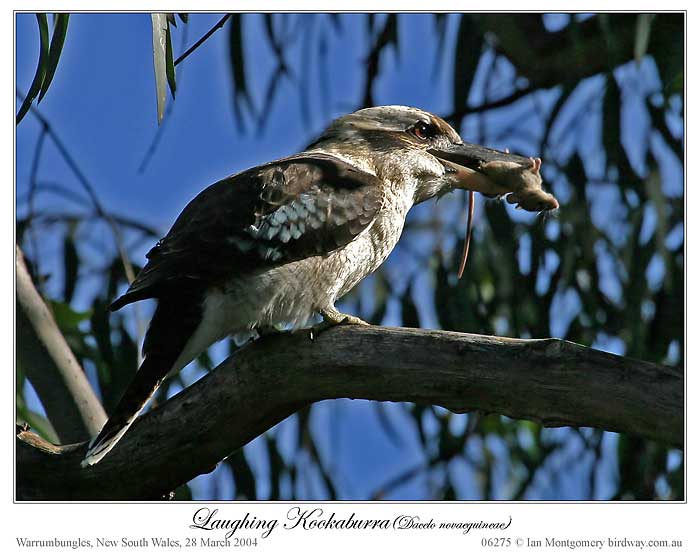
Kookaburras are carnivorous and they hunt from perches, doing long glides down to catch terrestrial prey, typically large insects and small mammals and reptiles. The bird in the fifth photo has just caught a mouse. They will immobilise their prey by beating it on the perch, and will automatically do this even when fed dead food such as strips of meat.
Laughing Kookaburra (Dacelo novaeguineae) by Ian

Laughing Kookaburra (Dacelo novaeguineae) by Ian

The original range of the Laughing Kookaburra comprised only mainland eastern Australia from the tip of Cape York in the north south to Victoria and as far west as eastern South Australia. Since european settlement it has been successfully introduced to southwestern Western Australia, Tasmania, the islands in Bass Strait and Kangaroo Island in South Australia. Unfortunately, in these areas it competes with the native wildlife for food and with species that nest in tree hollows such as Southern Boobooks.

Best wishes,

Ian


Ian Montgomery, Birdway Pty Ltd,
454 Forestry Road, Bluewater, Qld 4818
Phone: +61-7 4751 3115
Preferred Email: ian@birdway.com.au
Website: http://birdway.com.au


Lee’s Addition:

While we were at the National Aviary last summer, we had the privilege of seeing and hearing the Kookaburra in action. Below is the video I took up there. The Kookaburras are in the Alcedinidae – Kingfisher Family of the Coraciiformes Order.

The 5 Kookaburras are the Shovel-billed, Laughing, Blue-winged, Spangled and Rufous-bellied Kookaburra.

Blessed are you who hunger now, For you shall be filled.  Blessed are you who weep now, For you shall laugh. (Luke 6:21 NKJV)