Ian’s Bird of the Week – Ouvéa Parakeet

Ian’s Bird of the Week – Ouvéa Parakeet ~ by Ian Montgomery

Newsletter ~ 9/2/15

I was half-way through preparing this bird of the week this afternoon when my 2008 iMac died, or at least got terribly ill, so I’ve delivered it to the Mac Doctors and am now working on my laptop. Thank goodness for automatic backups, as I lost only the email itself and the map below that I was in the middle of preparing. I want to get the email out today so that i can delivery 4 birds of the week this month – my level of enthusiasm for doing the bird of the week has risen considerably since I started preparing the first volume of the Diary of a Bird Photographer.

Anyway, back to the Loyalty Islands off the west coast of the main island of New Caledonia. After spending the morning in Lifou, we flew to the neighbouring island, Ouvéa, home to the endemic Ouvéa Parakeet. Ouvéa is a long thin island, thinnest in the middle in a way that reminded me of both Bribie Island in Tasmania and Lord Howe Island. Like Lord Howe, it has a coral lagoon on one side and an ocean beach on the other but the resemblance largely ends there, as Ouvéa is a coral atoll and very flat, while Lord Howe is volcanic in origin and spectacularly mountainous.

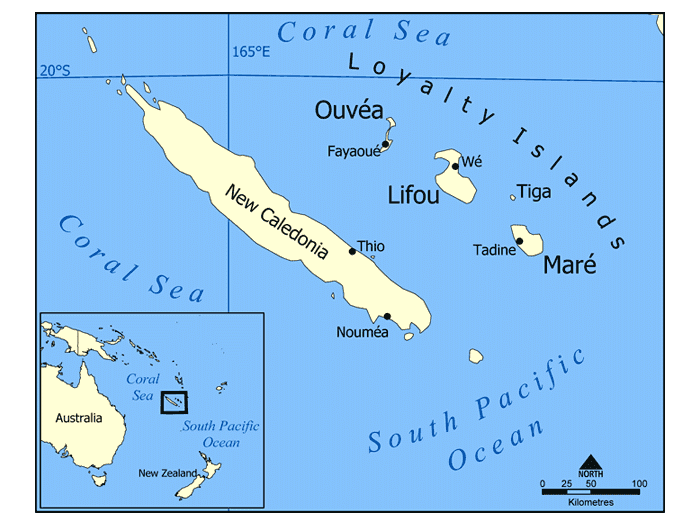
Map of where Ouvéa Parakeet Found, by Ian

Map of where Ouvéa Parakeet Found, by Ian

The parakeet occurs mainly on the northern end of the island so its geographical range is tiny – see the scale on the map above, courtesy of Google Earth. The airport is on the southern end and we decided not to emulate some energetic birders who wrote a trip report and travelled from the airport to the north end of the island by bicycle. Instead, we had booked a rental car at the airport and booked accommodation in a tribal village called Gossanah in parakeet territory near where our bird guide Benoit lived. I’ll say a bit more about both our guide and accommodation later, but first the parakeet.

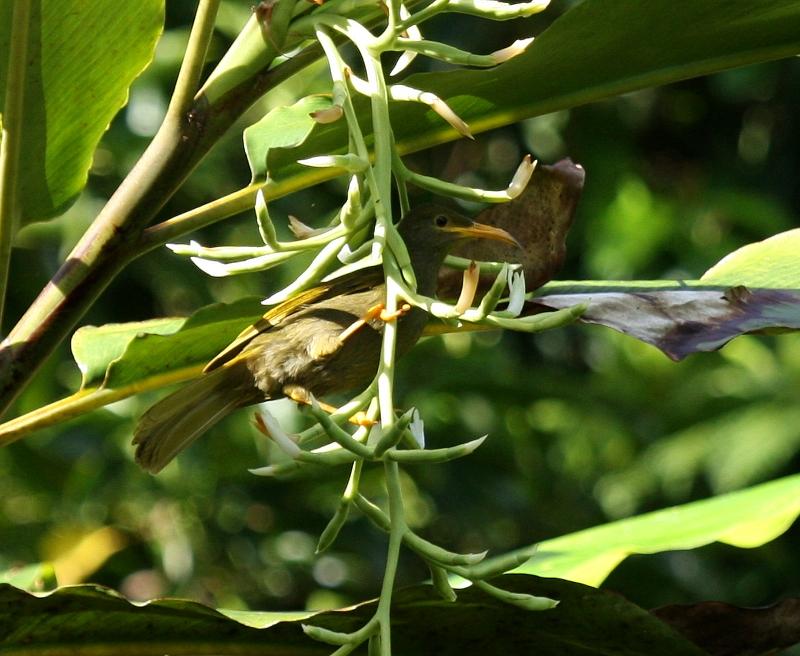
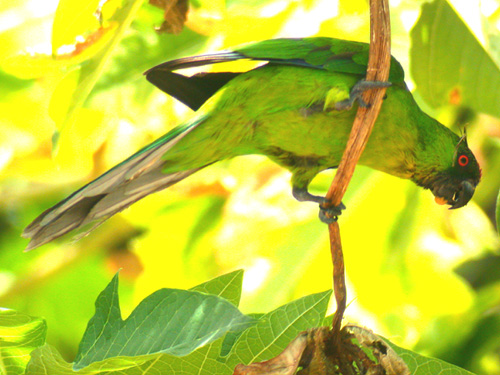
Ouvéa Parakeet (Eunymphicus uvaeensis) by Ian

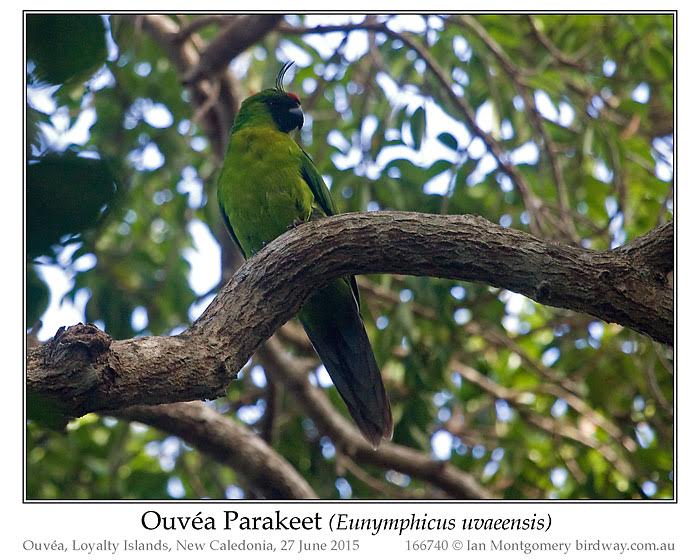
It was dark by the time we reached Gossanah, so parakeet hunting had to wait until the morning. I was woken up by early-riser Joy with the exciting news that there were parakeets in the grounds of where we were staying. I stumbled out bleary-eyed (remember we had got up at 4:30am the morning before to get our flight to Lihou) camera in hand and sure enough there they were, or there it was, first photo. Later we joined Benoit and he took us around his garden and though an area of adjacent rainforest. There we found some more parakeets, including the one in the second photo.
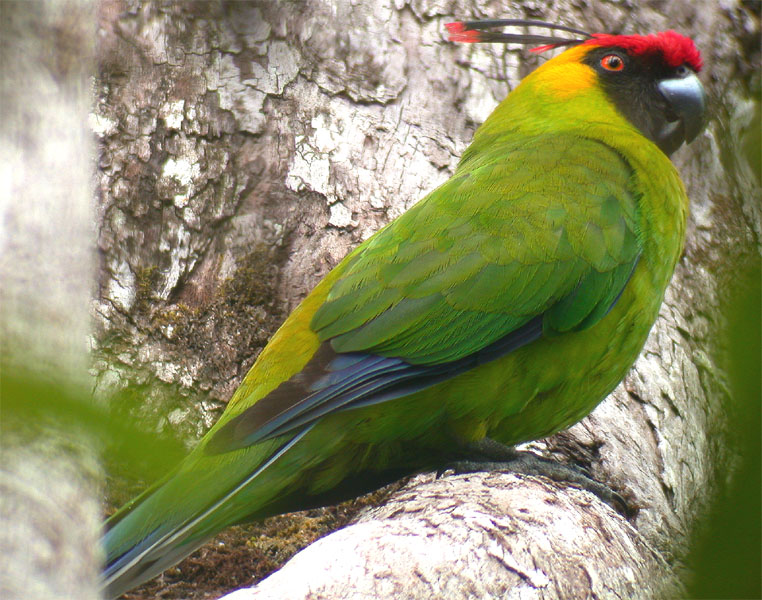
Ouvéa Parakeet (Eunymphicus uvaeensis) by Ian

They aren’t as brightly coloured as the Horned Parakeet of the main island, Grand Terre, and the crest is different, containing more than two feathers and lacking red tips. The Ouvéa Parakeet used to be treated as a race of the Horned, but has now been given full species status.

Ouvéa Parakeet (Eunymphicus uvaeensis) Nesting Hollow by Ian

Benoit showed us an active nesting hollow, third photo. We saw a parakeet flying into it and waited for it to reappear, but it had either settled down for the morning or had more patience than we had. The parakeets are very partial to the seeds of Papaya. They don’t wait for the fruit to ripen before they chew their way into the centre to get at the seeds.

Papaya

Papaya

The parakeets are protected and the population has increased in recent years. We got the impression that the islanders are rather ambivalent about the birds. They are proud to have such an unusual endemic bird – its iconic status is actively promoted by the authorities – but are concerned about its effect on their largely subsistent way of life.
Ouvéa Parakeet (Eunymphicus uvaeensis) by Ian

Ouvéa Parakeet (Eunymphicus uvaeensis) by Ian

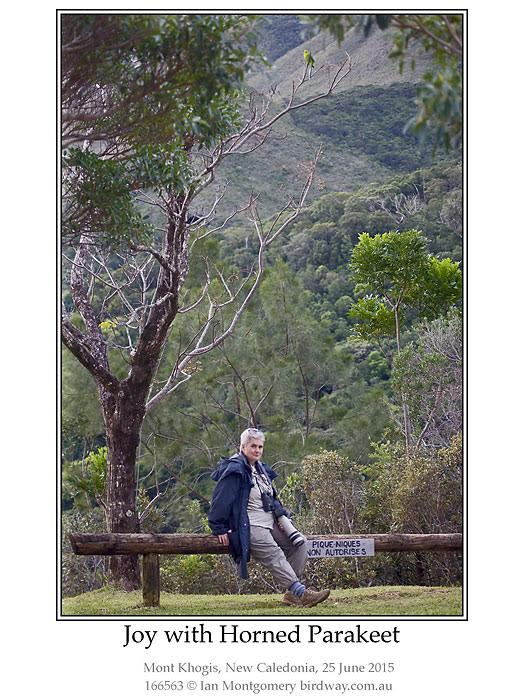
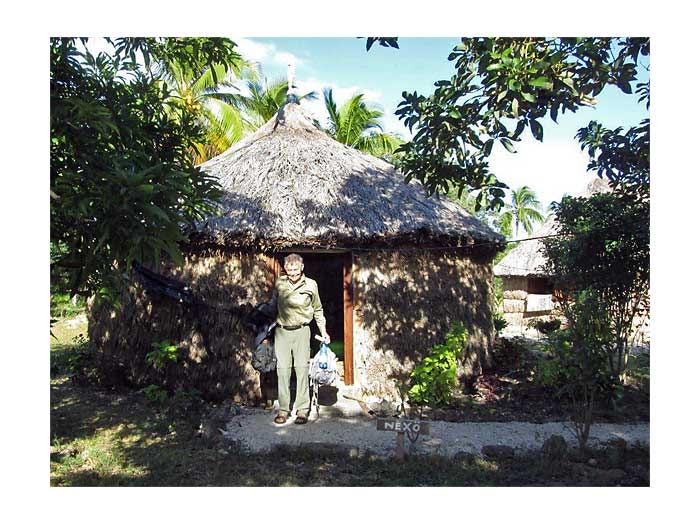
We stayed at a tribal home stay called Beauvoisin – ‘good neighbour’ run by Marc and his wife (see http://www.iles-loyaute.com/en/Prestataire/Fiche/1374/beauvoisin). They provided dinner in the evening, accommodation in a circular hut and breakfast – Joy took the photo above of me emerging from the hut in the morning. We enjoyed it very much and Marc and his family were delightful and looked after us very well. They spoke some English and have a Facebook page. Benoit Tangopi our guide was great too and we saw a variety of other interesting birds on the walk through the rainforest. We contacted him by phone +687 800549, but you might need to brush up your French as he doesn’t speak much English.

Greetings
Ian

**************************************************
Ian Montgomery, Birdway Pty Ltd,
454 Forestry Road, Bluewater, Qld 4818
Tel 0411 602 737 ian@birdway.com.au
Check the latest website updates:
http://www.birdway.com.au/#updates


Lee’s Addition:


If a bird’s nest should chance to be before you in the way, in any tree or on the ground, with young ones or eggs, and the mother bird is sitting on the young or on the eggs, you shall not take the mother bird with the young. You shall surely let the mother bird go, and take only the young, that it may be well with you and that you may prolong your days. (Deuteronomy 22:6-7 AMP)

Thanks, Ian, for taking us along on another birdwatching adventure. I don’t speak French, so we are glad you did the talking and photographing. Another neat creation you have found for us to enjoy.

*

Ian’s Bird of the Week Newsletters

Ian’s Ouvéa Parakeet Photos

Psittaculidae – Old World Parrots

Wordless Birds

*

Diary of a Bird Photographer!

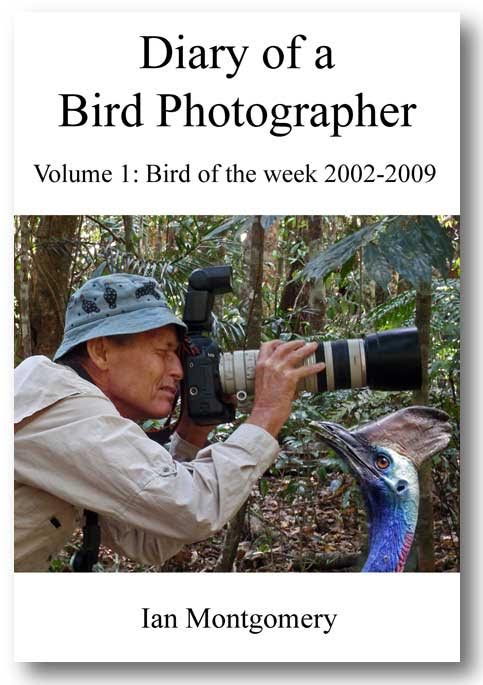
y electronic book Diary of a Bird Photographer has been released worldwide today, 31 August, on Apple iTunes BooksGoogle Books and Kobo Books! Find out more about it including availability, pricing, compatible devices and screenshots on the BIrdway website: http://www.birdway.com.au/birdphotographersdiary01.htm.

Ian's Book

Ian’s Book

With the increasing abundance of excellent bird photos on the internet, I am finding it more difficult to sell photos so moving into publishing is important for the future of my Birdway website and the Bird of the Week newsletter. Diary of a Bird Photographer contains the first 341 Bird of the Week postings spanning the period 2002-2009, contains more than 500 photos and 80,000 words – the length of an average novel. Depending on sales, l plan to publish 2010-2014 as another book.

With a recommended retail price of 8.00AUD, 7USD, 6EUR or the equivalent in your local currency it represents great value. By buying it for yourself and/or your friends or family and recommending it to others, you’ll earn my gratitude and show your appreciation for the bird of the week! Maybe you could forward this email to anyone who you think might be interested: that would be wonderful.

Greetings
Ian

PS Next bird of the week, a special parrot and the random bird of the week, should be out later today.

**************************************************
Ian Montgomery, Birdway Pty Ltd,
454 Forestry Road, Bluewater, Qld 4818
Tel 0411 602 737 ian@birdway.com.au
Bird Photos http://www.birdway.com.au/
Recorder Society http://www.nqrs.org.au


Lee’s Addition:

Seem’s as though Ian has written a book. Here is his newsletter telling about his “Diary of a Bird Photographer!”

His regular weekly newsletter – Ian’s Bird of the Week – will be published tomorrow.

Ian’s Bird of the Week – Small Lifou White-eye

Ian’s Bird of the Week – Small Lifou White-eye (and random Sacred Kingfisher) ~ by Ian Montgomery

Newsletter – 8/27/15

I’m a night-owl, as you may know already, so here is a photo of a noteworthy event: boarding a flight to the Loyalty Islands in complete darkness at 6:00am at Magenta, the domestic airport in Noumea. The goal was to check out several endemic species of birds that occur on two of the Loyalty Islands, Lifou and Ouvéa. The Lifou endemics were supposed to be easy to find near the airport, so we spent a morning there looking for them on foot before flying on to Ouvéa where we had booked a rental car and accommodation for the night (more about Ouvéa next time).

Magenta, the domestic airport in Noumea by Ian

Magenta, the domestic airport in Noumea by Ian

The Loyalty Islands, part of the French Territory of New Caledonia, are supposedly named after an obscure whaling ship called Loyalty or Loyalist built in Nova Scotia in 1788 that is thought to have come across them in 1790. The first recorded Western contact was three years later when another whaler, the Britannia, found them on a voyage from Norfolk Island to Batavia. Melanesians settled the islands about 3000 years ago and the French annexed them in the mid-nineteenth century.

Map of Lifou - New Caledonia

Map of Lifou – New Caledonia

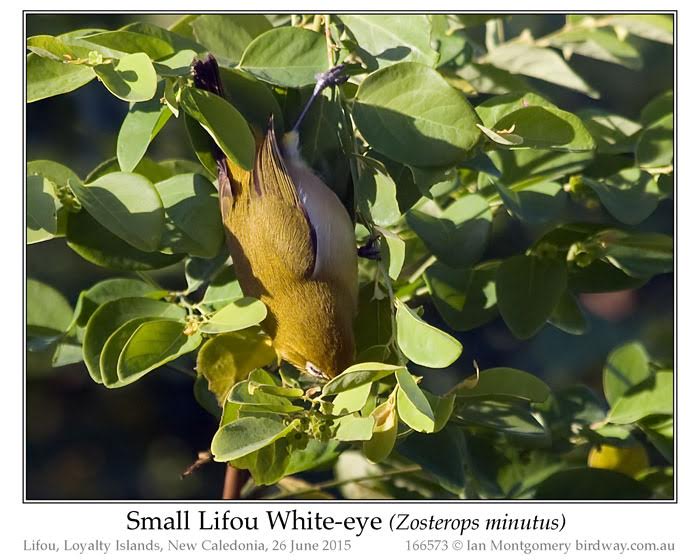
Lifou has two endemic White-eyes, cousins of the Silvereye which also occurs there. The endemic ones are called, accurately but unimaginatively, the Small and Large Lifou White-eyes. The small one we found without difficulty and it is indeed small with a length of 10-11cm/4-4-4.3in and weighting 7.5-9g/0.26-0.31g. Its diagnostic feature is the white flanks, most obvious in the third of its photos.

Small Lifou White-eye (Zosterops minutus) by Ian

We search quite hard but unsuccessfully for the Large Lifou White-eye. It’s very large for a White-eye (15cm/6in) making it even larger than the Giant White-eye (Megazosterops palauensis) of Palau. Interestingly both of these large species lack the white eye-rings that gives them, and the Silvereye, their common names. The Small Lifou White-eye feeds mainly on insects while the large one shows a preference for fruit. This specialisation in diet and divergence in size is to expected in similar species occupying the same habitat, but these two seem to have taken it to extremes.

Small Lifou White-eye (Zosterops minutus) by Ian

The Small Lifou White-eye is close related to the slightly larger Green-backed White-eye (fourth White-eye photo). It occurs on the main island of Grande Terre, the Isle of Pines (south of Grande Terre) and on Maré southwest of Lifou. Meanwhile there are three local races of the Silvereye, one on Grande Terre and the Isle of Pines, another on Maré and Ouvéa and the third on Lifou.

Small Lifou White-eye (Zosterops minutus) by Ian

This complex pattern of colonisation and speciation is typical of members of the family, the Zosteropidae. This is a very successful Old World family with almost 100 species in Africa, Asia and Australasia. They seem to be experts at colonizing out of the way islands, occurring on many islands in the Indian and eastern Pacific Oceans, where they settle down and develop new races and species. White-eyes are very sociable, so it is easy to imagine flocks being blown around by storms or cyclones and making landfall in sufficient numbers to colonise new places.

Green-backed White-eye (Zosterops xanthochroa) by Ian

For the random bird of the week, here’s another species that is good at island hopping, the Sacred Kingfisher. Well known throughout all but the driest parts of mainland Australia it also occurs on some southwest Pacific islands including those of New Zealand and New Caledonia. It has one race on Grande Terre and the Isle of Pines and, you guessed it, another one on the Loyalty Islands, below. This race has very buff underparts and a shorter, slightly flattened bill.

Sacred Kingfisher (Todiramphus sanctus) by Ian

Finishing on a quite unrelated matter, you may have come across recent news, if you live in Australia, about the ultimate in elusive birds , the Night Parrot and the work that Steve Murphy has been doing since its rediscovery by John Young. Bush Heritage Australia is raising money to create a sanctuary to protect this population in southwest Queensland. I’ve already made my (modest) donation and I’d ask you to do so too using this link to make a very practical contribution (yours doesn’t need to be modest) to conserving a very special bird.

Greetings
Ian
**************************************************
Ian Montgomery, Birdway Pty Ltd,
454 Forestry Road, Bluewater, Qld 4818
Tel 0411 602 737 ian@birdway.com.au
Bird Photos http://www.birdway.com.au/
Recorder Society http://www.nqrs.org.au


Lee’s Addition:

Do you not say, ‘There are still four months and then comes the harvest’? Behold, I say to you, lift up your eyes and look at the fields, for they are already white for harvest! (John 4:35 NKJV)

I love those EYES! Every since learning about the White-eyes, they have become one of my favorite species. Thanks, Ian for sharing these adorable birds with us. Kingfishers are also a favorite.

My problem is that when I use my “eyes” to view the Lord’s fantastic birds, how can I not have a problem figuring out which ones are my “most” favorites. I love all of the Lord’s Avian Wonders. I trust you do also.

*

Ian’s Bird of the Week

Ian’s Birdway Zosteropidae Family

Zosteropidae – White-eyes

Wordless Birds

*

Ian’s Bird of the Week – Goliath Imperial Pigeon

Ian’s Bird of the Week – Goliath Imperial Pigeon ~ by Ian Montgomery

Newsletter – 8/17/15

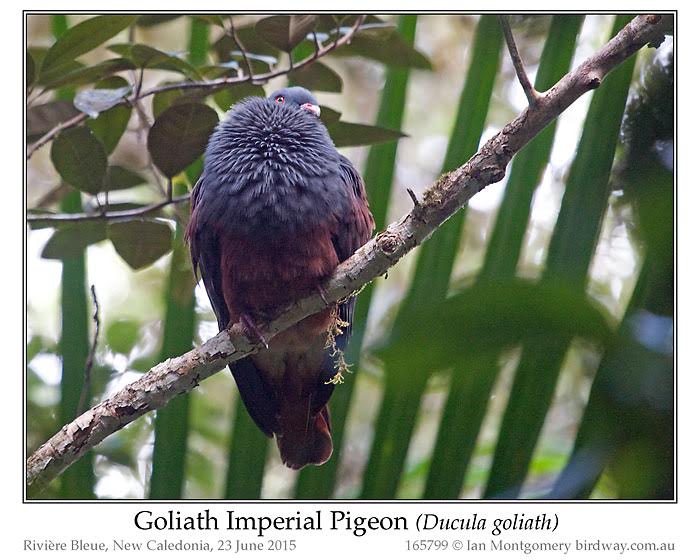
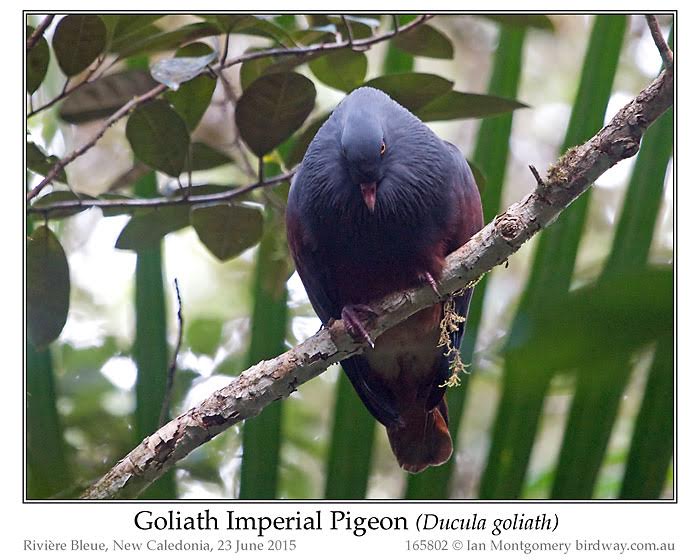
A characteristic sound of montane forests in New Caledonia is the far-carrying call of this splendid pigeon, the Goliath or New Caledonian Imperial Pigeon. The tone is similar to someone blowing in a (large) bottle but the rhythm accelerates like the sound of a table-tennis ball being dropped on a table. Needless to say, we started calling it the ping-pong pigeon. We first heard them in the dense forests of Rivière Bleue, but had trouble actually seeing any apart from one that flew off from feeding on Pandanus fruit. We eventually tracked this one through the forest and found it putting on a display.

Goliath Imperial Pigeon (Ducula goliath) by IanThe display is similar to that of the domestic pigeon, alternating between puffing out the crop to show the silvery-tipped bifurcated feathers to best advantage (first photo) and bowing (second photo). The head, upperparts and breast are a steely grey while the breast is a rich rufous colour and the vent pale. The iris is a vivid orange red. With a length of up to 51cm/20in and weighing up to 720g/1.6lb, this is a huge pigeon, which unfortunately makes it good to eat. For comparison the Torresian (Pied) Imperial Pigeon of northern and northeastern Australia measures up to 44cm in length and 550g in weight.

Goliath Imperial Pigeon (Ducula goliath) by Ian

It is endemic to the main island of New Caledonia (Grande Terre) and the Isle of Pines. The population has suffered from habitat loss and hunting, so it remains common only in protected areas and is currently listed as Near Threatened. After our hard work finding it in Rivière Bleue we were amused to find one on perched in the open on a power line beside the road to Mount Koghi two days later, third photo. We also heard several and photographed one at Les Grandes Fougères.

Goliath Imperial Pigeon (Ducula goliath) by Ian

The subject of each bird of the week is usually a species that hasn’t featured previously. This tends to mean that I don’t get to share with you new photos of previous subjects. So I’ve decided to include random photos from time to time, such as this one of a Noisy Pitta. I was contacted by a neighbour recently with a wonderful, well-watered garden in which this Pitta has recently taken up residence. Pittas are such beautiful birds and I like this photo because of the way the bird is framed by the leaves behind it.

Noisy Pitta (Pitta versicolor) by Ian

Greetings,
Ian

P.S. (Be warned: this is a commercial break!) Did you know that some ebook sellers provide facilities of giving book as gifts. Maybe you know someone who would enjoy Where to Find Birds in Northeastern Queensland ($13.20 to $22). Kobo books has ebook readers from most devices and computer so check out their page on gifts. With Kobo you go to this page first and then browse for the item you want to give. With Apple iPads and iPhones, you find the item first e.g. Where to Find Birds on Northeastern Queensland in the iTunes Store and then select the Share icon at top right and select Gift:

COL-Colu Goliath Imperial Pigeon (Ducula goliath) by Ian AD

I haven’t found a similar facility in the iTunes store accessed from an Apple computer (the share icon is peculiar to iOS). You can however give gift cards with suggestions from iTunes, Google Play and Kobo.

**************************************************
Ian Montgomery, Birdway Pty Ltd,
454 Forestry Road, Bluewater, Qld 4818
Tel 0411 602 737 ian@birdway.com.au
Bird Photos http://www.birdway.com.au/
Recorder Society http://www.nqrs.org.au


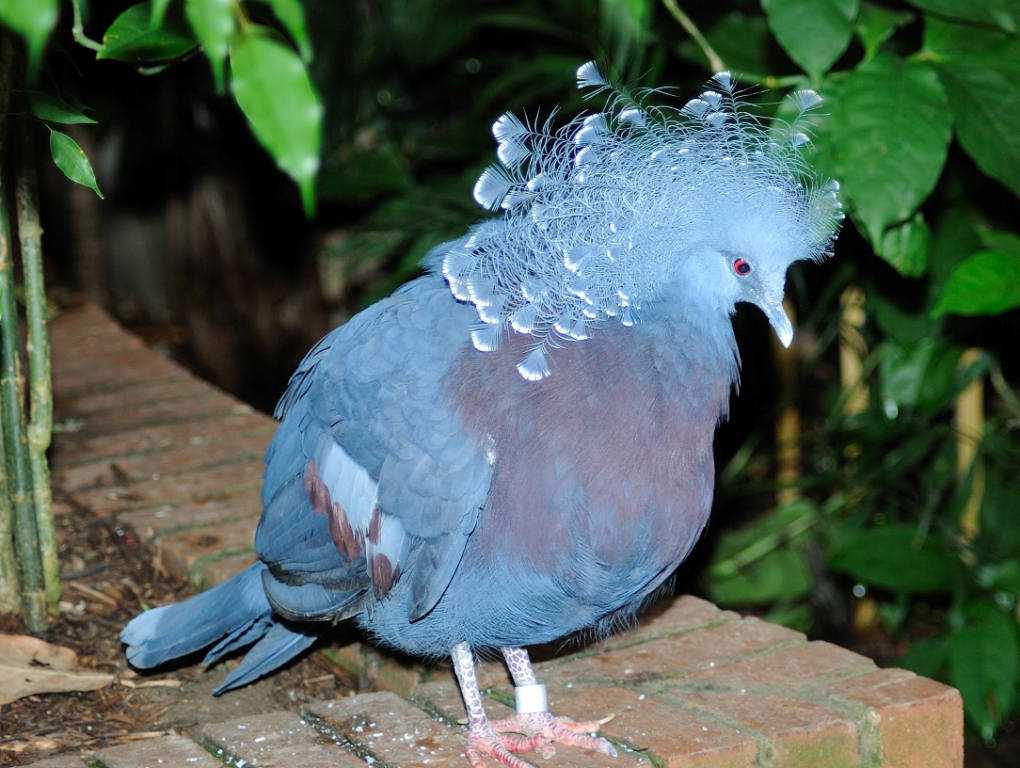
Victoria Crowned Pigeon by Dan at National Aviary

Victoria Crowned Pigeon by Dan at National Aviary

Lee’s Addition:

And a champion went out of the camp of the Philistines named Goliath of Gath, whose height was six cubits and a span [almost ten feet]. (1 Samuel 17:4 AMP)

We have seen the Victoria Crowned Pigeons at Zoos and they are typically 73 to 75 cm (29 to 30 in) long. Ian’s 51cm/20in Goliath Imperial Pigeon is not too far behind. The well-known rock dove is 29 to 37 cm (11 to 15 in) long, for comparison.  However you look at it, they are quite big. One source mentioned that the Goliaths are very strong flyers.

That is also a great photo of the Noisy Pitta. Thanks, Ian for sharing your photos with us each week (or whenever).

Ian’s Bird of the Week newsletters

Columbidae – Pigeons, Doves Family

Wordless Birds

*

Ian’s Bird of the Week – Yellow-bellied Robin/Flyrobin

Ian’s Bird of the Week – Yellow-bellied Robin ~ by Ian Montgomery

Newsletter – 8-7-15

If your familiar with Australian birds you might assume – initially – that this photo was taken in an Australian rainforest, though you might have trouble pinning down the actual species.

Yellow-bellied Flyrobin (Microeca or Eopsaltria flaviventis) by Ian

Its dumpy shape and short tail suggested strongly to me the Pale-yellow Robin (Tregellasio capito) of coastal eastern Australia, second photo, but the colour pattern on the breast is more like the Western Yellow Robin (Eopsaltria griseogularis) of coastal southwestern Australia (no photo, sorry). It’s behaviour was very like that of the Pale-yellow Robin, often perching at precipitous angles on steep branches on the vertical trunks of trees.

Pale-yellow Robin (Tregellasia capito) by Ian

In fact I assumed that it was in the same genus as the Pale-Yellow (Tregellasio) and was surprised the find later that it was either in the same genus as the Eastern and Western Yellow Robins (Eopsaltria) or in the process of being moved to Microeca, the genus that includes the Jacky Winter, the Lemon-bellied and Yellow-legged Flycatchers or Flyrobins as the purists would have, being Australasian Robins. The reason for the move is based on genetic studies (Loynes et al , 2007).

Yellow-bellied Flyrobin (Microeca or Eopsaltria flaviventis) by Ian

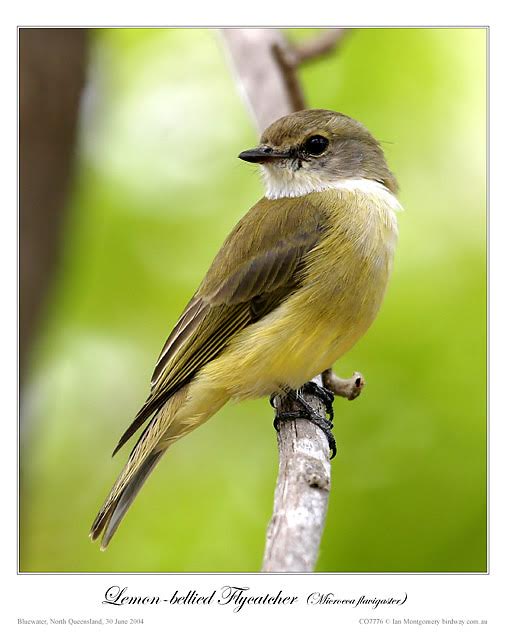
The fourth photo shows the Lemon-bellied Flycatcher/Flyrobin for comparison; it featured as bird of the week almost exactly ten years ago.

Lemon-bellied Flyrobin (Microeca flavigaster) by Ian

When we were in New Caledonia, I was intrigued by the call of the Yellow-bellied (Fly)robin. It didn’t sound like the Pale-yellow Robin or the any of the Yellow Robins, all of which have rather monotonous repeated calls. The Yellow-bellied sounded rather like the rhythmic ‘squeaky bicycle wheel’ songs of the unrelated Gerygones. It does, however, sound rather like that of the Lemon-bellied Flycatcher/Flyrobin, however, which supports the genetic analysis and the subsequent taxonomic switch. If you want to compare them, you can do so here http://www.xeno-canto.org/species/Microeca-flavigaster and http://www.xeno-canto.org/species/Microeca-flaviventris.

Both these web pages show distribution maps, so it would be interesting to speculate whether the ancestors of the Yellow-bellied got to New Caledonia from New Guinea or from Australia. Either way they’d either have had to do some island hopping or got carried across by one of the many cyclones that track from east to west across the southwestern Pacific.

Yellow-bellied Flyrobin (Microeca or Eopsaltria flaviventis) by Ian

Anyway, enough about taxonomy and back to the original point about similarities between the birds of Australia and those of New Caledonia. So far, the birds of the week have dealt with the more unusual ones that represent either families (the Kagu) or genera (Horned Parakeet, Crow Honeyeater) not found in Australia. Most of the other endemic species have counterparts in the same genus in Australia. That had its own fascination coming across familiar-looking but different species but we were left in no doubt that we were still in the Australasian ecozone. To handle this on the Birdway website, the original Australian section – which became Australia and New Zealand after 2012 – is now becoming the Australasian section and I’ve put a map of the ecozone on the home page to support this.

I’ve more or less finished putting the New Caledonian bird photos on the website: http://www.birdway.com.au/index.htm#updates. Here are links to some species with Australian counterparts that probably won’t feature as bird of the week that may be of interest:

Greetings
Ian

P.S. (Be warned: this is a commercial break!) If you’ve ever been to Northern Queensland, might ever go there or are interested in the region (who couldn’t be?) then your life isn’t complete without the ebook Where to Find Birds in Northeastern Queensland. The price ranges from AUD13.22 on Google Play to AUD22.00 in the Apple iTunes Store.

**************************************************
Ian Montgomery, Birdway Pty Ltd,
454 Forestry Road, Bluewater, Qld 4818
Tel 0411 602 737 ian@birdway.com.au
Bird Photos http://www.birdway.com.au/
Where to Find Birds in Northern QueenslandiTunes; Google Play Kobo Books
Recorder Society http://www.nqrs.org.au


Lee’s Addition:

What an adorable little Flyrobin. As Ian said, the name Robin or Flyrobin is in flux. When I check the I.O.C. list, which is what this blog uses, the Microeca flavivetris is called the Yellow-bellied Flyrobin.

Out of the ground the LORD God formed every beast of the field and every bird of the air, and brought them to Adam to see what he would call them. And whatever Adam called each living creature, that was its name. So Adam gave names to all cattle, to the birds of the air, and to every beast of the field. But for Adam there was not found a helper comparable to him. (Genesis 2:19-20 NKJV)

Wonder is Adam kept changing the names.? While checking out the I.O.C., I realized that the new 5.3 version is out. Guess I’ll have to start updating the site again. :) or maybe it is :(

*

Ian’s Bird of the Week

Ian’s Birdway Site

Good News

*

Ian’s Bird of the Week – Crow Honeyeater

Ian’s Bird of the Week – Crow Honeyeater ~ by Ian Montgomery

Newsletter – 7/31/15

I mentioned last week that the Horned Parakeet was second on my wanted list for New Caledonia but probably third on Joy’s. I knew that number two for Joy, after the Kagu, was this week’s species, the Crow Honeyeater, chosen by her for its scarcity as it is the rarest of the surviving New Caledonian endemics. I’m excluding the four critically endangered/probably extinct endemics: NC (New Caledonian) Rail (last definite record 1890), NC Lorikeet (1860), NC Nightjar (1939) and NC Owlet-Nightjar (possible sight record 1998).

Current estimates of the population of Crow Honeyeater are as low as 250 individuals, based on the density of 18 known pairs in a recent study in Rivière Bleue. Some think this is an overestimate and the population is thought to be continuing to decline. The reasons for this are uncertain with loss of habitat and introduced rats being proposed. It’s preferred habitat is primary rainforest but it is now absent from areas of apparently suitable habitat and its smaller Fijian relative, the Giant Honeyeater Gymnomyza viridis being apparently unaffected by rats. So there may be other factors involved that are not understood.

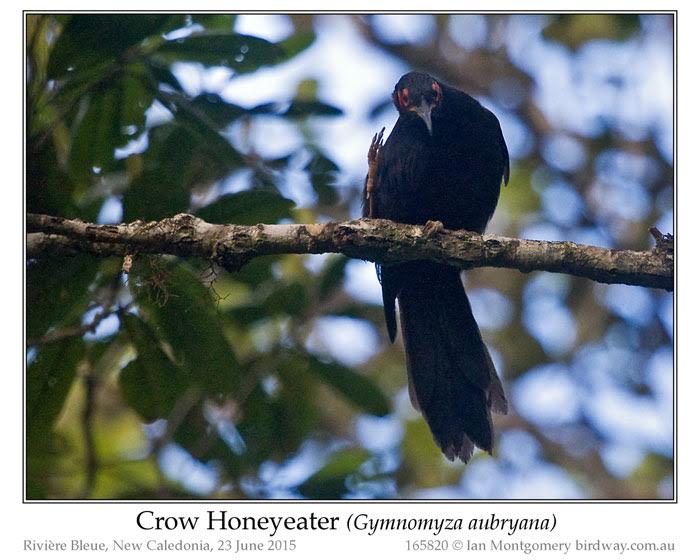
Crow Honeyeater (Gymnomyza aubryana) by Ian

In any case, I hadn’t really expected to see it so it didn’t make my seriously wanted list – I try to avoid unreasonable expectations to prevent disappointment. But our guide Jean Marc Meriot wasn’t going to be discouraged by such pessimism and, after we had had our fill of Kagus, worked very hard indeed to find one.

Crow Honeyeater (Gymnomyza aubryana) by Ian

Eventually, after lunch this very obliging bird appeared suddenly and perched in full view on an uncluttered perch near the road through the dense forest and posed for photographs. Unlike the Horned Parakeet, it was a brief encounter, but the bird displayed a number of poses in that time including a wing stretch, second photo, and an apparent wave, third photo.

Crow Honeyeater (Gymnomyza aubryana) by Ian

This is a huge honeyeater, and as far as I can ascertain vies with the Yellow Wattlebird of Tasmania as the world’s largest. Length varies from at 35-42.5cm/14-17in with males being larger and recorded at 211-284g/7.4-10oz and two females at 152g/5.4oz and 159g/5.6oz. This compares with the longer-tailed Yellow Wattlebird with males ranging from 44-50cm/17-20in and 135-260g/4.8-9.2oz and females 37-43cm/15-17in and 105-190g/3.7-6.7. So, I’d declare the Crow Honeyeater the winner as the heaviest, and the Yellow Wattlebird as the winner in the length stakes.

Incidentally, the ‘Giant’ Honeyeater of Fiji is a mere 25-31cm/10-12in and similar in size to the only other close relative of the Crow Honeyeater, the Mao of Samoa (Gymnomyza samoensis). Neither the Giant Honeyeater nor the Moa is black and neither has facial wattles, so the Crow Honeyeater is quite special. The bird we saw had red wattles, but they can be yellowish, while the feet are pinkish-yellow and juveniles lack wattles.

It makes me sad to write this as its future looks rather bleak. So, I hope the bird in the third photo is just pausing in mid-itch – it had been been itching its ear a moment earlier – and not waving goodbye on behalf of its kind. To end on a brighter note, there are about nearly 20 other New Caledonian endemics that are doing rather better, and several others that are endemic to New Caledonian and Vanuatu, so New Caledonia’s record is fairly good compared with many other islands in the Pacific. We got photos of nearly all of these, so I’ll have more to say about them in the future. I’ve been busy putting them up on the website and you can find them via the Recent Additions thumbnails on the website: http://www.birdway.com.au/index.htm#updates.

Greetings
Ian

**************************************************
Ian Montgomery, Birdway Pty Ltd,
454 Forestry Road, Bluewater, Qld 4818
Tel 0411 602 737 ian@birdway.com.au
Bird Photos http://www.birdway.com.au/
Where to Find Birds in Northern Queensland: iTunes; Google Play Kobo Books
Recorder Society http://www.nqrs.org.au


PAS-Meli Giant Honeyeater (Gymnomyza viridis) by Tom Tarrant

PAS-Meli Giant Honeyeater (Gymnomyza viridis) by Tom Tarrant

Lee’s Addition:

More to be desired are they than gold, yea, than much fine gold: sweeter also than honey and the honeycomb. (Psalms 19:10 KJV)

Added a photo of a Giant Honeyeater. When I first looked at the photos, I thought it was a Mynah, but as Ian explains, this is a different species. It was the eyes.

Common Myna (Acridotheres tristis) by Ian

Common Myna (Acridotheres tristis) by Ian

*
Ian’s Bird of the Week
*

Update to Ian’s Bird of the Week

Horned Parakeet (Eunymphicus cornutus) ©WikiC

Horned Parakeet (Eunymphicus cornutus) ©WikiC

O LORD, correct me, but with justice; Not in Your anger, lest You bring me to nothing. (Jeremiah 10:24 NKJV)

** Update to Ian’s Bird of the Week **

Just thought you might like to see a Hooded Parakeet with the two “horns”. Also, I assumed this was in Australia, but it was taken in New Caledonia.

Here is a drawing of the Horned parakeet, (Nymphicus cornutus) (above) and Ouvea Parakeet, (Nymphicus uvaensis) that Ian mentioned.

Horned Parakeet, (Nymphicus cornutus) (above) and Ouvea Parakeet, Nymphicus uvaensis) ©WikiC

Horned Parakeet, (Nymphicus cornutus) (above) and Ouvea Parakeet, Nymphicus uvaensis) ©WikiC

The Ouvea Parakeet is really similar:

Ouvea Parakeet (Eunymphicus uvaeensis) ©WikiC

Ouvea Parakeet (Eunymphicus uvaeensis) ©WikiC

This is a great link to compare the two birds.

Animal Photos

*


Ian’s Bird of the Week – Horned Parakeet

Ian’s Bird of the Week – Horned Parakeet ~ by Ian Montgomery

Newsletter – 7/27/15

The Kagu was naturally top of our target list in New Caledonia being the most bizarre in appearance, behaviour, taxonomy and general curiosity value. Second on my list and I think third on Joy’s were the horned parakeets of Grande Terre (the main island) and Ouvéa, one of the Loyalty Island off the east coast of Grande Terre. These birds used to be treated as a single species, but have recently been split into the Horned and Ouvéa Parakeets respectively. I mentioned in a previous post that the Kagu nearly got upstaged as bird of the trip by an individual Horned Parakeet at Mont Khogis near Noumea, so here is the bird in question and the interaction that we had with it, a memorable birding experience by any measure.

On an earlier visit to the Inn (Auberge) at Mont Khogis we’d had brief views of three Horned Parakeets flying across the road and we had been told by Serge, the owner of the Inn, that the parakeets came in the late afternoon to feed on the Lavender trees in front of the building. On our visit to Rivière Blue we also tried with little success to photograph a back-lit one feeding in dense foliage right above us, a good situation for chiropractic business but not much else. All was quiet at the Inn on our second visit, so we started on the nearby rainforest walk until Roman, one of the staff, came charging after us with the welcome news that a parakeet had arrived.

We set ourselves up very cautiously at an unobtrusive distance from the tree and started taking remote photos of the parakeet and very gradually working our way towards it. I mean gradually: I and Joy had each taken about a hundred more distant shots before the first one in this series, above. As you can see the bird was very aware of our presence and looked as if it could take off at any time.

We moved slowly closer and the bird started to look more relaxed. In the second photo it is showing its skill at perching on one foot, holding a little bunch of Lavender fruit in the other, munching on them and watching us at the same time. We started to get the impression that it was actually enjoying the attention and showing off for our benefit, third photo.

Eventually,we worked our way up to the tree and around the other side so that we could photograph it in the sunlight a little over an hour before sunset with the mountains in the background. The bird munched on regardless and seemed completely unworried by our approach. It seemed to have an extraordinary appetite. We reckoned that it ate about 700 of the fruit in the time that we were there. It wouldn’t take too long for a small flock to complete strip the tree.

They’re referred to as ‘horned’ rather than ‘crested’ as the feathers of the horn are permanent erect. There should be two horns, but one of this bird’s may have been broken off. They are probably more than just decorative as they nest in hollows in trees and the horns seem to be used to sense the space, or lack of it, above the head. That at least is the suggestion made for the similarly equipped but very different Crested Auklet. It nest in holes in coastal boulders and being able to avoid cracking your skull against rocks would seem to be very desirable.

We can become blasé about even the most riveting spectacles. Three hundred photos each later, here is Joy relaxing under the tree and the parakeet, top centre, looking in the opposite direction. It was still there when we decided it was time to leave but it called after us as if sorry to see us go. By the time we walked around to the car park below the inn, it had left too and joined a couple of other parakeets in another Lavender tree. Joy and I agreed that this was one of the most beautiful parrots that we had encountered.

The horned parakeets belong to the sub-family of Australasian parrots called broad-tailed parrots. The best known members of this group (Playtcercini) are the Australian Rosellas, Ringnecks and Mulga Parrot and its relatives. The group also includes the Shining Parrots of Fiji and the Cyanorhamphus Parakeets of various islands of the southwest Pacific including Norfolk Island, New Caledonia, New Zealand and its sub-Antarctic islands and, formerly, Lord Howe Island and Macquarie Island. Most parrots are fairly sedentary, but these island ones seem to be quite good at island hopping, maybe helped by the cyclones that move generally in an easterly or southeasterly direction in this part of the world.

The Horned Parakeet is listed as Vulnerable with an estimated population on Grande Terre of between 5000 and 10,000 individuals. The Ouvéa Parakeet has a limited distribution on the northern end of this small island (about 40km long) and is listed as Endangered. Recent estimates of the population are about 2000 individuals and it is thought to be increasing. We did, of course, go to Ouvéa later in our stay….

I had some interesting correspondence on giant tree ferns after the last Kagu bird of the week. The Guinness Book of Records has a Norfolk Island Cyathea brownii species as the tallest and I had photos of a very tall one in Vanuatu, and a carving made from another one.

Greetings
Ian

**************************************************
Ian Montgomery, Birdway Pty Ltd,
454 Forestry Road, Bluewater, Qld 4818
Tel 0411 602 737 ian@birdway.com.au
Bird Photos http://www.birdway.com.au/
Where to Find Birds in Northern Queensland: iTunes; Google Play Kobo Books
Recorder Society http://www.nqrs.org.au


Lee’s Addition:

And hath raised up an horn of salvation for us in the house of his servant David; (Luke 1:69 KJV)

What an amazing “horn”! As Ian said, it was supposed to have a second one. Sounds like the usefulness of their “horn” spares their head. I’ve raised up under things before and hit my head. Maybe I need one of those. :)

*

*

Ian’s Bird of the Week – Kagu, Episode 2

Ian’s Bird of the Week – Kagu, Episode 2 ~ by Ian Montgomery

Newsletter – 7/13/15

Before, I forget again, here is the email of our Jean-Marc our guide at Rivière Bleue that I meant to include last week: jean-marc.meriot@province-sud.nc. He works as a ranger in the park, is very knowledgeable, speaks good English and worked very hard to get us the birds we wanted. The fee was 2000 CFP per hour for both of us (about 24 AUD). We had great fun with him.

Another terrific national park that we visited was Les Grandes Fougères a huge national park that was established as recently as 2008. Les Grandes Fougéres means the Great Ferns and refers to the Giant Tree Fern, endemic to New Caledonia which can reach a height of 30m. It’s claimed to be the tallest tree fern in the world, despite its scientific name (above), though it may have a rival in the shape of another very tall one in Vanuatu, but I haven’t been able to track that one down.

Parc des Grandes Fougères is inland from La Foa, which is on the east coast highway about 70km north of the International Airport, which is itself about 45km north of the capital Nouméa. The road is good and the park is easy to find. There are well-signed walking tracks and you can get a map from the ticket office at the entrance. We saw a juvenile Kagu making a fast getaway on our first visit there and we returned for a second visit on our last full day in New Caledonia.

On that second visit, at lunchtime we got chatting to a local family who shared the only picnic table in the vicinity. They were showing the park to the grandparents visiting from France, and excitedly recounted their encounter with a pair of Kagus at the next spot on our itinerary, a Banyan tree were there was a T-junction on the walking track near a stream.

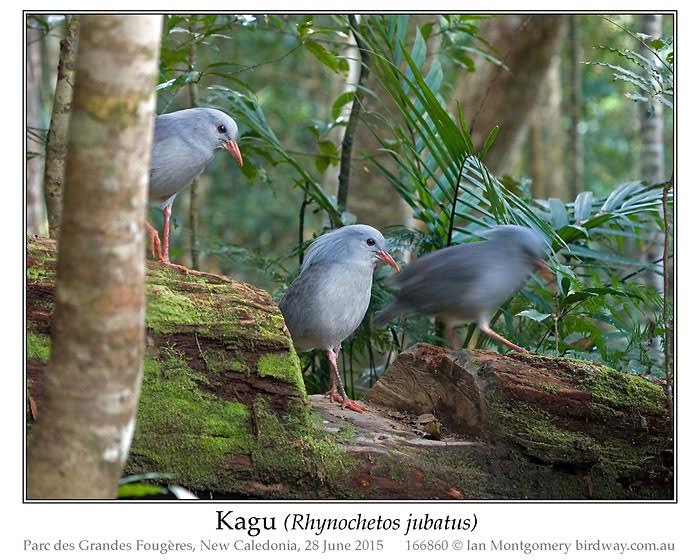
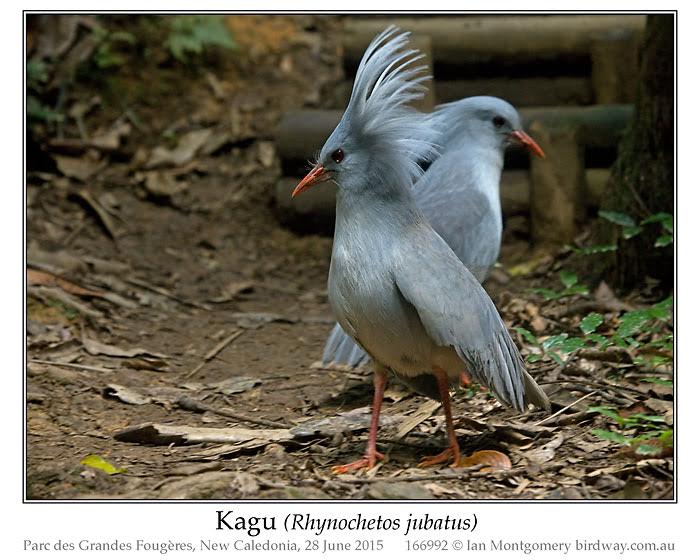
We knew by then that Kagus are territorial and that their territories are usually about 20 hectares. So we searched in the region of the Banyan along the three tracks. We were on the one not on our original itinerary approaching a cut-out log that had fallen across the track when a family of kagus going in the opposite direction jumped up onto the log and, seeing us, froze. The first kagu photo shows Ma on the cut out part, Pa on the left of the photo and Junior barely visible under Ma’s tail.

The second kagu photo shows, Pa and Ma still like statues and Junior, still unaware, leaping onto the log without a care in the world. I said ‘Oh my God!’, they looked as if they said “Oh mon Dieu!’ and we all just looked at each other. These photos are full frame using only 180mm of the 100-400mm zoom so you can imagine how close we were.

The next photo shows Ma, still otherwise motionless, turning to Pa and saying ‘Alors????!!!!”. The kagu consensus seemed to be to stick to plan A, more or less, and they eventually headed down the hill to the stream. We followed them there and both we and the kagus met up with some other hikers – be warned, the park is quite popular on Sundays.

Here is Pa, fourth kagu photo, contemplating crossing the stream while the fifth photo shows Junior (note the barring on the wings) crossing back across the stream and having a drink in the general confusion. I got the impression that while cats lick their fur to avoid looking indecisive, kagus drink.

More confusion was to follow, this time caused by another kagu. Pa tried to lead Junior past us to a quieter spot further down the stream away from the tracks, when he (Pa) got distracted by an intruder, abandoned Junior and confronted the other male. I just happened to be taking an iPhone video of Pa when this happened and I’ve posted it on Youtube. The last kagu photo shows Pa and the intruder doing their threat display which consists of the two birds circling each other at close quarters with their wings hanging loose and their crests erected.

After that, we decided it was time to leave them in peace. The whole encounter lasted about 40 minutes and it was a fitting climax to our visit to New Caledonia. The photo of the displaying kagus was one of the last photos that I took on the trip.

Kagus aren’t just great birds in their own right, they are also of great taxonomic and bio-geographical interest. The Kagu is the single member of its family, the Rhynochetidae. It’s only rather distant living relative appears to be the Sun Bittern of South America, also the member of a single-species family the Eurypigidae. These two families used to be included in a heterogenous collection of birds in the Crane order (Gruiformes), but recent DNA studies (Hackett et al 2008) have led to their elevation to their own two-species order the Eurypigiformes. This makes them very distinguished – the other 39 or so orders of birds contain about 10,000 species.

The traditional bio-geographical explanation for this is that both species had a Gondwana ancestor that existed on New Caledonia when it separated from Gondwana. Recent studies (see Grandcolas et al 2008) indicate that New Caledonia has probably been completely submerged since then and all terrestrial plants and animals have colonised since then. If this is correct, then either the simple Sun Bittern – Kagu relationship is incorrect or their ancestors found some other way to get to where they are now, such as island hopping with extinctions obliterating their tracks. The mystery remains…

Greetings
Ian

**************************************************
Ian Montgomery, Birdway Pty Ltd,
454 Forestry Road, Bluewater, Qld 4818
Tel 0411 602 737 ian@birdway.com.au
Bird Photos http://www.birdway.com.au/
Where to Find Birds in Northern Queensland: iTunesGoogle Play Kobo Books
Recorder Society http://www.nqrs.org.au


Lee’s Addition:

My heart is troubled and does not rest; days of affliction come to meet me. (Job 30:27 AMP)

I think the daddy Kagu went to afflict the other Kagu. :)

Thanks Ian, for another episode to your Kagu adventure. They are really pretty and amazed that they let you get so close. We enjoyed your first episode also: Ian’s Bird of the Week – Kagu

*

*

Ian’s Bird of the Week – Kagu

Ian’s Bird of the Week – Kagu ~ by Ian Montgomery

Newsletter ~ 7/5/15

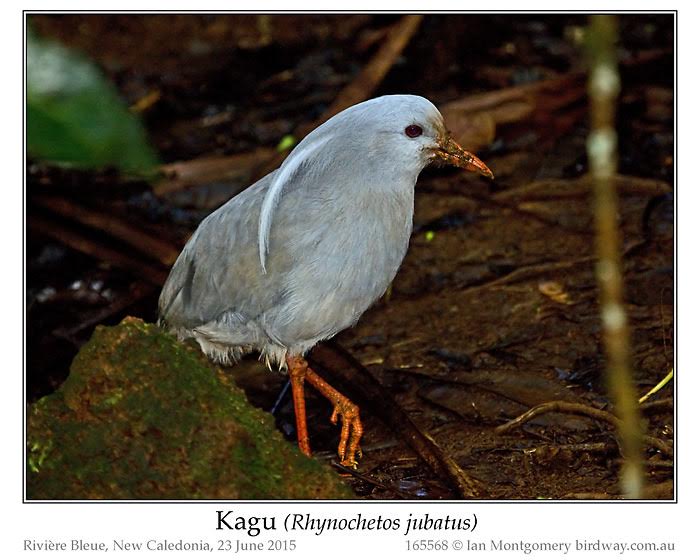
Well mission accomplie thanks to your moral and spiritual support, so here is the iconic Kagu of New Caledonia after a great trip there. We went to Rivière Bleue national park about 90min drive west of the capital Noumea, meeting our excellent guide Jean-Marc Meriot at the park entrance at 7:00am. He took us straight to a Kagu territory where we had a wonderful time with these strange and fascinating birds. They were bigger than I’d expected being 50-55cm/20-22in long.

Kagu (Rhynochetos jubatus) by Ian
The first one we saw was a very shy juvenile running away through the forest so Joy and I were a bit afraid that we might have difficulty getting decent photos. We needn’t have worried as we soon encountered a family party only too willing to join in the fun, though poor light in the rainforest was a bit of a problem. It had been very wet on the previous couple of days so it was very wet underfoot, or around beak and face perhaps if you’re a Kagu and probe in the earth for your food.

Adult Kagus have very long crests that droop down their back or over their wings. There’s some disagreement about differences between the sexes in the literature, but Guy Dutson in his Birds of Melanesia says that the females have fine barring on the upper wing. If that’s the case, the bird in the first photo would be a male and the one in the female in the second. Juveniles have barring too, but much more, which confuses the situation slightly.

Kagu (Rhynochetos jubatus) by IanKagus are flightless but still have fairly long wings used for balance when rushing around and in threat displays when they show the striking black, grey and white barring on the flight feathers. The best we could get out of them was a throaty hiss when we startled them and brief views of the wings when flapped in motion, but can you see the barring just showing in the bird in the second and third photos (same individual). The one in the third photo has just grabbed an earth worm. These form an important part of the diet when the soil is damp, but they also eat lots of other invertebrates and small vertebrates such as lizards and mice. Apparently they can consume the millipedes without ill effects that other birds avoid because of the noxious substances they exude.

Kagu (Rhynochetos jubatus) by Ian

Kagus form strong pair bonds that can last for years and vigorously defend territories of about 20 hectares or 50 acres in extent. They lay a single large egg in a rough nest on the ground and the young birds can stay in the parental territory for a year or two. Both adults share incubation and feeding of the young bird.

Kagu (Rhynochetos jubatus) by Ian

This family was so tame that eventually we gave up using our expensive Canon gear – the birds were often too close to focus with a telephoto lens – and resorted to our phones. Joy took the fourth photo of me taking the fifth photo with my iPhone and I was startled to discover that the quality was nearly as good as with the Canon and the iPhone performed better in poor light. Smart phones have come a long way. I even took some videos and I’ll share one with you in due course.

Kagu (Rhynochetos jubatus) by Ian

Kagus are rated as endangered, though recent conservation efforts have improved the situation. They suffer from predation by dogs, pigs and rats and Captain Cook started the rot in 1774 when he introduced dogs. They’ve also suffered from logging of rainforest and fragmentation of their habitat by clearing. The population reached a low of perhaps 600-700 birds in 1991 but has increased since and is thought to be about 1500 now as a result of predator control and captive breeding and reintroduction.

Kagu (Rhynochetos jubatus) by Ian

Conservation is helped by its iconic status and it is widely used as symbol of New Caledonia. Here it is on the 1000 French Pacific Franc note (about 12 AUD), which of course we called the Kagu. This image shows the threat display that we failed to see properly or photograph.

The bird to its left on the note is one of the Horned Parakeets and I’ll have more to say about them in the near future. In fact one of these nearly upstaged the Kagu as photographic bird of the trip and it was only a very delightful encounter with a Kagu family in a different national park on our last full day that restored the Kagu to #1 status. So I’m going to break with tradition and have the same species as bird of the week twice running so that I can give that final chance meeting due space. The Kagu was, after all, the main reason for our visit and I haven’t had time yet to touch on its very interesting taxonomy.

Greetings
Ian

**************************************************
Ian Montgomery, Birdway Pty Ltd,
454 Forestry Road, Bluewater, Qld 4818
Tel 0411 602 737 ian@birdway.com.au
Bird Photos http://www.birdway.com.au/
Where to Find Birds in Northern Queensland: iTunesGoogle Play Kobo Books
Recorder Society http://www.nqrs.org.au


Lee’s Addition:

Keep me as the apple of the eye, hide me under the shadow of thy wings, (Psalms 17:8 KJV)

Great photos as usual, Ian. We’re glad our prayers are helping you see more of the Lord’s great birds.

I had hoped to see a Kagu at either the Houston or San Diego Zoo on this last trip. Both places had their Kagus “off exhibit.” One of them was ill, but not sure why the other one was not being shown. At least Ian was able to find them, in the wild, which is actually better.

*

*

Ian’s Bird of the Week – Great Crested Grebe

Ian’s Bird of the Week – Great Crested Grebe ~ by Ian Montgomery

Newsletter ~ 6/20/15

I’m going to weave a tangled web of French connections around this bird of the week, but the first and most important is that in honour of Loïc, my great nephew and first child of my niece Jeannine and her husband Carlos who live in Strasbourg in Alsace. He was due today, but arrived safe and well four days early.

Clearly, a bird photographed in France was required but the choice was very limited: Carrion Crow, Common Coot or Great Crested Grebe. The latter was bird of the week in July 2007, so I toyed with the idea of Coot but, given that in the British Isles people say ‘you silly coot’ in the same tone that Australian say ‘you silly galah’ I decided that coot was better saved for a non-dedicated bird of the week.

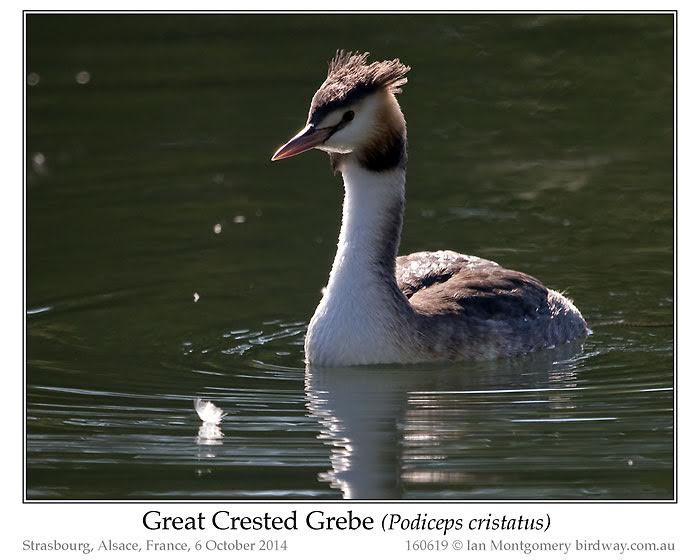
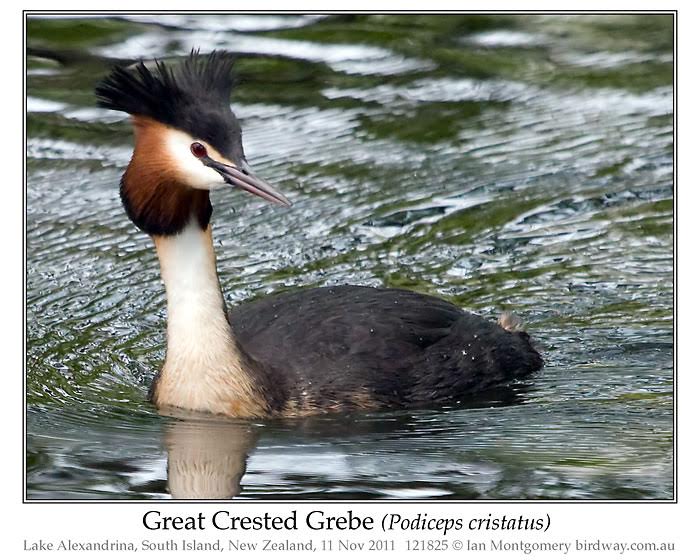
Great Crested Grebe (Podiceps cristatus) by Ian

So here is an elegant grebe in non-breeding plumage in a park near where my niece lives in Strasbourg last October. She took my sister Gillian and I there to look for some White Storks that had been nesting there, but they had already left for the winter so the grebes and coots attracted my attention instead. If my sums are correct in working back from today’s date, little Loïc would have been with us too, though probably not much older than the egg in the nest in the second photo. This egg was probably freshly laid, as Great Crested Grebes usually lay 3 or 4 eggs. Maybe it arrived early too, as the parent is busy adding nesting material to the structure.

Great Crested Grebe (Podiceps cristatus) by IanThis nest was on Lake Alexandrina on the South Island of New Zealand, so it’s apparent that this species has a huge range extending from Ireland in the West and all the way through Eurasia to Australasia and in northern and southern Africa. It is however absent from the tropical regions of Africa and various tropical areas of Asia such as Indonesia.

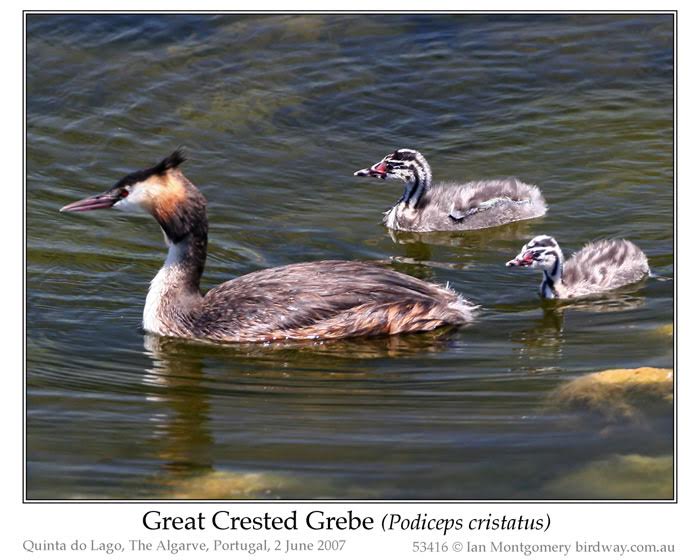
Great Crested Grebe (Podiceps cristatus) by IanThe third photo shows one of the New Zealand birds in full breeding plumage with the elongated crest and head plumes that give it scientific (cristatus), English and French name Grèbe Huppé. I’ll come back to huppé later. The 2007 bird of the week photos were of some breeding birds in Portugal and here is another one from that series: proud parent with two gorgeous striped youngsters. As this posting is celebrating a new family, I’d like to think that the photo is prophetic and that Loïc can look forward to a lovely sibling in due course.

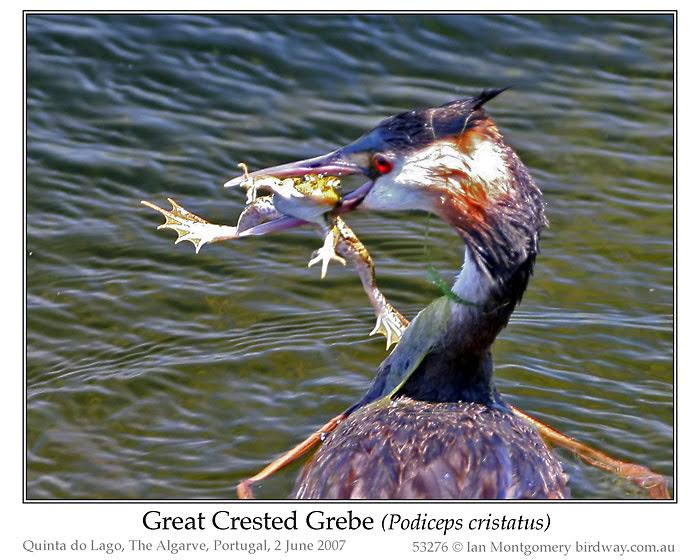
Great Crested Grebe (Podiceps cristatus) by IanGreat Crested Grebes mostly feed on fish, quite large ones at that, but this one Portugese one, fifth photo, has seized this hapless frog, whose expression seems a rather sad combination of pleading for help and accepting its fate.

Great Crested Grebe (Podiceps cristatus) by IanAnother French connection is that I’m on a flight to New Caledonia and had thought that I would be on French territory when Loïc arrived, but he decided not to wait but I will try and skype the happy trio from Noumea.

I mentioned a few weeks ago, that our primary target is the very special Kagu, a rare, crested pigeon-sized terrestrial species endemic to New Caledonia. It’s taxonomically special too, being the only member of its family (Rhynchochetidae) and belong to an order that has only one distant relative, the Sunbittern of South America (according to Birdlife International).

The Kagu is crested too, so it’s French name is – you’ve guessed it, go to the top of the class – Kagou huppé. Huppé is slang in French for upper crust, smart, posh which seems highly appropriate. So, as usual I’m relying on your spiritual and moral support to produce au autre oiseau huppé for the next bird of the week. Joy and I have booked a guide at Rivière Bleue National Park next Tuesday, its main breeding locality and pride and joy of the park.

Forty one minutes to go before we reach Noumea.
Greetings
Ian

**************************************************
Ian Montgomery, Birdway Pty Ltd,
454 Forestry Road, Bluewater, Qld 4818
Tel 0411 602 737 ian@birdway.com.au
Check the latest website updates:
http://www.birdway.com.au/#updates


Lee’s Addition:

Look at the birds of the air, for they neither sow nor reap nor gather into barns; yet your heavenly Father feeds them. Are you not of more value than they? (Matthew 6:26 NKJV)

That frog is in total shock. Yiiikess! He is thinking! What a great capture of all them, Ian. Thanks again for sharing these weekly birds of the week.

*

*

Ian’s Bird of the Week – Diamond Dove

Before I get to the Diamond Dove, I have an appeal to any members who have been on the Bird of the Week list since 2003 and who have kept copies of the postings. It’s a long shot I know, but I lost the text of some of the early ones in a hard disk crash and I’ve nearly finished compiling the first volume covering 2002 to 2009 of the ebook Diary of a Bird Photographer. I have all the photos but not the descriptions of: Red-capped Plover 9 March 2003, Bank Myna 1 June 2003, Spinifex Pigeon 2 July 2003, Leaden Flycatcher 29 July 2003, Australian Pelican 7 July 2003 and Noisy Pitta 15 February 2004. If you have them, I’d be very grateful if you’d let me have the text by email and the first six respondents who can provide each of the missing ones will get a free copy of the ebook when it’s published.

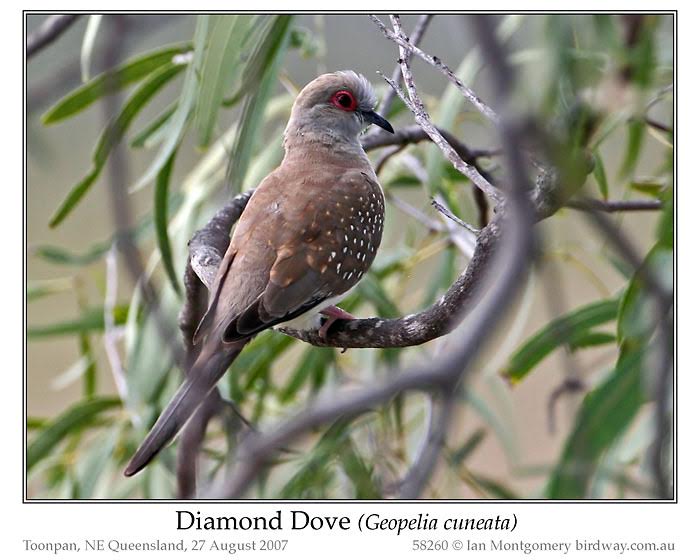
Diamond Dove (Geopelia cuneata) by Ian 1Back to the Diamond Dove. Having cut the recent camping trip short, I didn’t come back with the anticipated collection of photos of dry country birds, but here is one such species from earlier trips as compensation. This delightful, tiny dove is found in arid country throughout mainland Australia. It depends on the availability of water and moves long distances in time of drought. It’s comparable in length to its close relative the Peaceful Dove (both about 19-24cm/7.5-9.5in) but has a relatively much longer tail and smaller body. So it tips the scales at a mere 28-43g/1-1.5 compared with 41-66g/1.5-2.3 for the Peaceful Dove.

Diamond Dove (Geopelia cuneata) by Ian

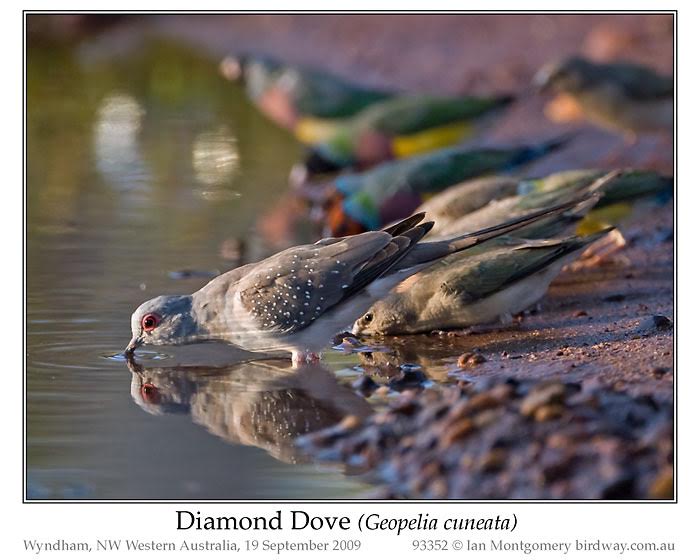
You can see how small it is in the second photo where it is drinking with finches just after dawn – being a late riser I can’t help boasting when I get up early. There are two points of interest in this photo. The finches in question are Gouldian – there had to be a good reason for me to get up in the dark at 5:30am in Kununurra and drive 100km to Wyndham. There are more photos of the Gouldians here. The other point is that the dove is demonstrating the drinking skill of members of the Pigeon and Dove family, the Columbidae. They drink by sucking and swallowing and don’t have to first sip and then tip their heads back like almost all other birds do. Apparently, they can drink six times faster in this way, maybe a useful survival strategy in a very vulnerable situation. Incidentally, I also photographed drinking Crested Dove at the same spot 15 minutes later, by which time the finches had left.

Diamond Dove (Geopelia cuneata) by Ian

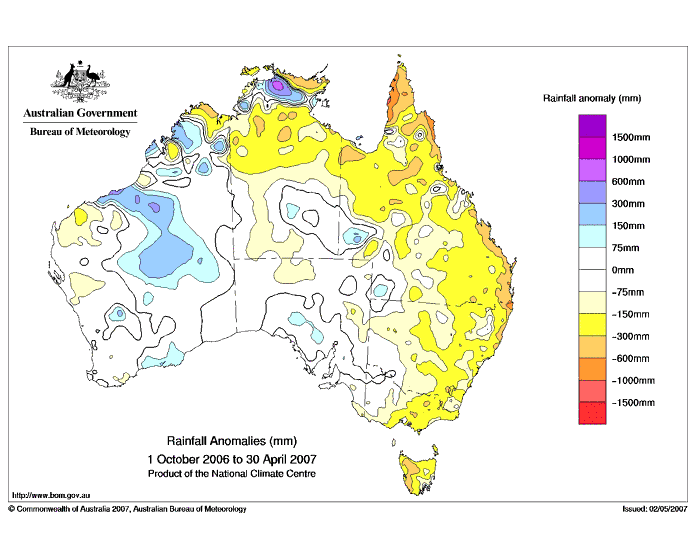
Diamond Doves have strikingly red eye-rings, quite unlike the blue-grey ones of Peaceful Doves, and small white spots on the wing coverts which give them their common name. The eye-rings are red in adults, and although those of males are supposed to be larger and brighter than those of females, and females are supposed to have browner plumage, I can’t find any consistent differences. The one in the third photo has a brownish wash on the wings and a very striking eye-ring, which would make it trans-gender according to those criteria. That photo was taken just south of Townsville. 2007 was a very dry year in eastern Australia (see below) and at such times, Diamond Doves may show up quite close to the coast.

Diamond Dove (Geopelia cuneata) by Ian
The bird in the fourth photo is a juvenile and has not yet developed the red eye-ring and red legs of the adult. The barring on the head and breast reveals its close relationship to the Peaceful Dove, but note that it has the diagnostic white spots of the Diamond Dove on the wing coverts.

Diamond Dove (Geopelia cuneata) by Ian

Regarding the Scientific name, Geopelia means ‘ground dove’ in Greek and refers to the feeding habits of member of this genus. Diamond Doves feed predominantly on grass seeds and usually very small ones at that. The specific name cuneata means ‘wedge-shaped’, coming from the Latin cuneus meaning a ‘wedge’. I suppose it must refer to the pointed tail, but it isn’t what I usually think of as a wedge-shaped tail, compared with the wedge-tailed eagle and shearwater.

Diamond Dove (Geopelia cuneata) by Ian

“cuneiform ground dove”

Needless to say, I couldn’t resist Googling deeper into the related word ‘cuneiform’, which refers to the wedge-shaped characters used mainly on clay tablets in ancient Mesopotamia and Persia. This led me to the website of the Pennsylvanian Museum which gives you the opportunity to write your initials as a monogram ‘like a Babylonian’. The above image shows the result for ‘DOVE’, clearly not just any dove of course but a cuneiform ground dove.

Greetings
Ian

**************************************************
Ian Montgomery, Birdway Pty Ltd,
454 Forestry Road, Bluewater, Qld 4818
Tel 0411 602 737 ian@birdway.com.au
Bird Photos http://www.birdway.com.au/
Where to Find Birds in Northern Queensland: iTunesGoogle Play Kobo Books
Recorder Society http://www.nqrs.org.au


Lee’s Addition:

Behold, I send you forth as sheep in the midst of wolves: be ye therefore wise as serpents, and harmless as doves. (Matthew 10:16 KJV)

These doves are quite small in comparison to other members of the Columbidae family. During our trip we saw the Western (Blue) Crowned and Victoria Crowned Pigeons, which are some of the larger members of the family.

The way they drink, by sucking is very interesting. I am sure the Lord had a reason for creating them this way. May have to research that some day.

*