Happy Anniversary!

Out birding and caught by the newspaper

Out birding and caught by the newspaper

Today, Dan and I are celebrating our 46th anniversary. It is hard to believe that it has been that long. We are very thankful for all the blessings the Lord has bestowed on us over the years. Are we perfect, no, but we love each other and have made a commitment to “hang in there” through good times or bad, ups or downs. The Bible tells us:

And the LORD God said, It is not good that the man should be alone; I will make him an help meet for him. (Genesis 2:18 KJV)

Me Feeding The Beggars!

Me Feeding The Beggars!

We have become a good team over the years. Even now as we go birdwatching. I love to do the birdwatching and he likes to take the photos. And that is only one of the ways we blend our personalities into one “togetherness.” Most important of all, we together and individually have “togetherness” with our Saviour, the Lord Jesus Christ.

Since this blog is about birdwatching, what can we learn from them about staying together. We find throughout the birding world and other critters, that many of the mates stick together for life.

But now ask the beasts, and they will teach you; And the birds of the air, and they will tell you; (Job 12:7 NKJV)

Dan at work-Tricolored and Stork

Dan at work-Tricolored and Stork

Here are some of the monogamous (mate for life)  birds that have been mentioned in our articles:
Birds of the Bible – Dove and Turtle-Dove
Osprey III
Swan
April Lorier’s:
Eagles and The Atmosphere of Grace
Ian’s Bird of the Week
White-browed Babbler

These are just a few I picked out, there are plenty more that mention mating for life.

Ian’s Bird of the Week – Brush and Common Bronzewings

Brush Bronzewing by Birdway

Brush Bronzewing by Birdway

I’ve just revised the Dove and Pigeon galleries on the website () and it set me thinking how many gorgeous members of this family occur in Australia. Some, like the Fruit-Doves, are spectacularly so, while others are more subtle. The subtler ones included the Bronzewings and their allies such as the Crested and Spinifex Pigeons, a group of several genera endemic to Australia and New Guinea.
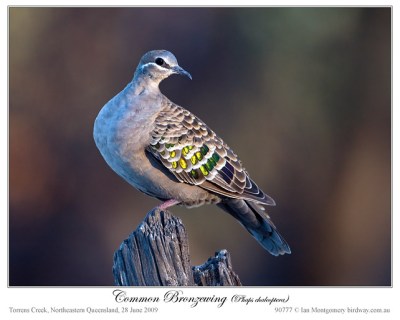
Common Bronzewing by Ian

Common Bronzewing by Ian

The Bronzewings get their name from iridescent feathers in their wing coverts. These are shown in display and at other times are not conspicuous unless the light is at the right angle, rather like the iridescent feathers of hummingbirds. The first photo shows a Brush Bronzewing which has two rows of iridescent feathers, one reddish and the other bluish green. The second photo shows a Common Bronzewing at sunset and it has several rows of bronze-green feathers and one dark blue row. This bird is a female; male Common Bronzewings have even brighter feathers.

The Brush Bronzewing occurs in scrub and forest in coastal southern Australia from Fraser Island in Queensland to Dongara in Western Australia, including Tasmania. The Common Bronzewing is widespread throughout Australia except in the driest areas such as eastern Western Australia. The Common Bronzewing in particular is wary and takes flight readily, so often the best way to observe it is at water holes. This one was photographed last Sunday while we were sitting quietly near a dam; at least 50 Common Bronzewings came in to drink and this one perched nervously on a post quite close to us before proceeding down to the water.

Best wishes, Ian

See Ian’s Bird of the Week for more of these articles.
See Ian’s Birdway Website


Lee’s additions:

Ian’s remark about the “Common Bronzewing in particular is wary and takes flight readily” caught my eye. Also Wikipedia says, “They tend to browse quietly until disturbed, then remain still, their earthy browns blending into the earth and leaf litter until the intruder approaches too closely, at which point the bronzewing takes off with an explosive burst of sudden wing clapping and feather noise, and disappears from sight within moments.” Both remarks reminded me of scripture.

They will walk after the LORD, He will roar like a lion; Indeed He will roar And His sons will come trembling from the west. They will come trembling like birds from Egypt And like doves from the land of Assyria; And I will settle them in their houses, declares the LORD. (Hosea 11:10-11 NASB)

Why do the birds tremble and seem wary of people. The reason is that God put in them the fear of man after the global flood in Noah’s day.

For since the creation of the world God’s invisible qualities—his eternal power and divine nature—have been clearly seen, being understood from what has been made, so that men are without excuse. Romans 1:20

The fact that they blend in to their surroundings is part of the Lord’s creative love for the birds. He provides for their protection.

Flock Bronzewing by Ian

Flock Bronzewing by Ian

Here is some more information about the “Bronzewing Pigeon” according to Wikipedia:
The dividing line between the bronzewings and the rock pigeons is arbitrary: essentially, rock pigeons are bronzewings without bronze on their wings. Members of the group include:

* The Common Bronzewing (Phaps calcoptera) is a large, bulky pigeon with a small head, found in all parts of Australia bar some of the deep desert, Cape York Peninsula, and urban areas. Its advertising call is an extraordinary mournful whooo repeated at metronomic intervals for an interminable length of time. Although rather wary by nature, birds in the urban fringes become quite used to humans.

* The Brush Bronzewing (Phaps elegans) is uncommon, probably threatened. Marginally smaller than the Common Bronzewing and rather secretive—except for its call, which is slightly faster and higher-pitched but maintained through the hottest days with equally monotonous determination. Brush Bronzewings nest low down, often on the ground, and are very vulnerable to feral cats and foxes.

Crested Pigeon by Ian

Crested Pigeon by Ian

* Flock Bronzewings (Phaps histrionica) roam the grasslands of the northern half of the continent. Once found in enormous flocks, they are still to be seen in their thousands. Pizzey’s description of their habits is memorable: “When locally abundant, at end of day, undulating, shearwater-like flocks fly to water, settle short distance away, and walk in. Thirsty latecomers may drop directly into water and drink while spreadeagled, before springing off.”

* Crested Pigeons (Ocyphaps lophotes) are distinctive, common, and widespread. Usually seen in small flocks in open woodlands or grasslands, it is always close to water. With the clearing of much forest and the provision of water in arid regions for cattle, Crested Pigeons have increased in number.
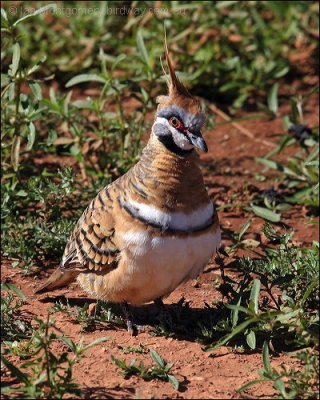
Spinifex Pigeon

Spinifex Pigeon

* The Spinifex Pigeon (Geophaps plumifera) is an unmistakable ground-dwelling small pigeon, reddish-bronze in colour and prominently crested, with a unique upright, military stance. When dirturbed it prefers to run erratically, breaking into rapid, noisy flight only if pressed. A desert specialist, it is found in the arid and semi-arid zones of the northern half of the continent.
* The Partridge Pigeon (Geophaps smithii) is a dull brown bird about 26 cm long found only in pairs or small flocks in the grasslands of northern Northern Territory and northern Western Australia.

* The Squatter Pigeon (Geophaps scripta), like the very similar Partridge Pidgeon, spends feeds, roosts, and nests on the ground, and prefers infertile sandy soils and gravel where the grass grows only thinly, allowing easy movement. Squatter Pigeons are restricted to the eastern half of Queensland and north-eastern New South Wales.

Some interesting articles about iridescent colors on birds and butterflies:

From Blue-t-ful Beetles, Birds, `n Butterflies, this quote:
“The strikingly iridescent blue seen in some butterfly, beetle, and bird feathers is well-known and enjoyed by scientists and laymen alike. This is due to creatures (and some plants) reflecting or absorbing certain frequencies of light due to the external chemical composition of their body. In past decades, it has been realized that although the color of these structures is clearly and unusually blue—no blue pigment can be found!
The South American butterfly, Morpho rhetenor, has wings composed of extremely tiny scales like all members of the Lepidoptera. Biologists magnified scales of the upper wing surface 20,000 times and saw “a regular grid of precisely constructed wedge-shaped ridges spaced at intervals of about 0.00022 mm. This pattern is repeated so accurately that the maximum deviation is only 0.00002 mm. No earthly workshop specializing in miniaturization [nanotechnology], would be able to make one single wing scale with this required precision.“1 Detailed investigation of other butterflies reveals iridescence due to “nanoscale structures that produce ultra-high reflectivity and narrow-band spectral purity.”

From God’s Rainbow in Living Color by Catherine Myers:
Unique Colors
Butterflies’ wings are covered with tiny scales that create their colors and patterns. Under a microscope, the tiny scales resemble roofing tiles that overlap in different patterns.
Wing colors originate from two sourcespigmentation (color in the scale itself) or iridescence (light from the sun that changes color as it bends within the scales). Earth tones (brown, orange, yellow, white, and black) come from pigments. Iridescent colors (blue, green, copper, silver, and gold) arise from special scales that bend light into different colors. Because the scales act like a prism and separate light into different wavelengths, some butterflies actually appear to change color during flight.

See:
Ian’s Bird of the Week for more of these articles.
Ian’s Birdway Website


Eagles and The Atmosphere of Grace – by April Lorier

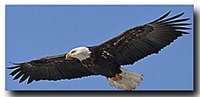
EagleFlySM1Today I am learning from the Eagle. This is appropriate since I have always been a bird watcher and even raised birds for several years. Eagles, in particular, have always fascinated me – especially the Bald Eagle. Did you know there are over a hundred species of eagles? But because our National Emblem has been the Bald Eagle since 1782, it has had more “face time” in the classroom. It is no longer on the endangered list since June of last year.

Every state in our Union has eagles except Hawaii, so people are constantly reporting “eagle sightings”. The Bald Eagle (Haliaeetus leucocephalus) is a member of the sea and fish eagle group, and once it mates, it mates for life! That’s right: no hanky panky in the bald eagle world!

Mama Eagle lays from one to three eggs and the pair share the 35 days of incubation. (No deadbeat fathers here!) The nesting cycle is about 20 weeks.

The female bald eagle is 35 to 37 inches, slightly larger than the male, and has a wingspan of 72 to 90 inches. She flies at altitudes of 10,000 feet, and during level flight, she can achieve speeds of about 30 to 35 mph. She weighs only 10-14 lbs, and her bones are light because they’re hollow. She is known for exceptional eyesight at far distances.

The most fascinating fact, I think, is that the eagle has the ability to adjust her body out of joint in order the ride the storm. Wow! What a lesson we humans can take away from that!

The eagle waits for a draft and rides it – no struggle, no wing-flapping! It’s sort of an “atmosphere of grace” similar to the Christian who “waits upon the Lord” and has less wing-flapping, less struggle. The eagle is definitely a “storm rider”!

As mothers go, the bald eagle is the best metaphor for human parenting and parenting by Father God that I can think of. Since the outside of the nest is made with sharp materials to withstand invasion from intruders, she and her mate lined the inside with fur from their prey. They made a big old feather bed!

When the time comes for those little ones to leave the nest and start fending for themselves – some where around 4 years of age — Mama Eagle starts pulling the soft material out of the nest to make it uncomfortable for them. Seems mean, but it is necessary to motivate the babies.

Then Mama Eagle starts pushing the babies towards the edge of the nest, ignoring their screams. As the babies flap their wings, they are strengthening them without knowing it. Eventually, she pushes them out of the nest, one by one. As each eaglet free-falls, screaming and squawking, Mama Eagle flies under him, spreading her massive 90-inch wingspan, and catches him before he hits ground.

Mama Eagle’s eyes are never off of her baby! She swoops up her baby and takes him back to that nest she and Daddy Eagle built out of touch from intruders. He’s safe for the time being. But tomorrow he’ll get another flight lesson from Mama Eagle. And finally, one day, he’ll figure out he can fly on his own! (Probably when there’s no more fur inside that thorn nest!)

God seems to parent me the same way. There are times when He allows this wounded child to feel safe in His feather bed. Then He knows it’s time for me to be forced out of my comfort zone. But always, His eye is on me and His protective wings are under me.

I actually felt Him lift me up on wings of eagles at my mother’s funeral after she had been killed. It was a visceral feeling, not just a spiritual one, and I floated through the day with total peace. So I know (experientially) the truth of this scripture.

They that wait upon the Lord shall renew their strength; they shall mount up with wings as eagles; they shall run, and not be weary; and they shall walk and not faint. Isaiah 40:31

(c) 2009 April Lorier

Genesis 1:1 says, “In the beginning, God created the heaven and the earth.” I have an obligation to God. I am twice His. First, I am His because of creation, and secondly, I am His because of redemption through Jesus Christ. He made me and He bought me.

Supplied by and reprinted with permission of April Lorier


See:
More of April’s Articles


Ian’s Bird of the Week – White-browed Babbler

White-Browed Babbler by Birdway

White-Browed Babbler by Birdway

“If you had a bird popularity poll with Australian birders, I imagine that Babblers would do well. I hope so anyway, as it would show that pretty colours aren’t everything and character still counts in an often superficial world!

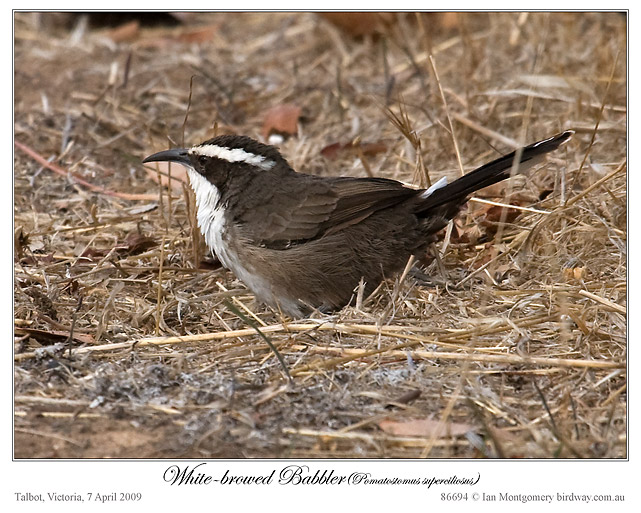
I photographed these White-browed Babblers when staying with friends in Talbot in rural Victoria northwest of Melbourne. This species is found in dry woodland in the southern half of the continent, mainly west of the Great Divide and south of the Tropic of Capricorn. Although wren-like in shape, they are much larger, the White-browed is 18-22cm./7-8.5in. in length and is the smallest of the four Australian species.

White-browed Babbler by Birdway

White-browed Babbler by Birdway

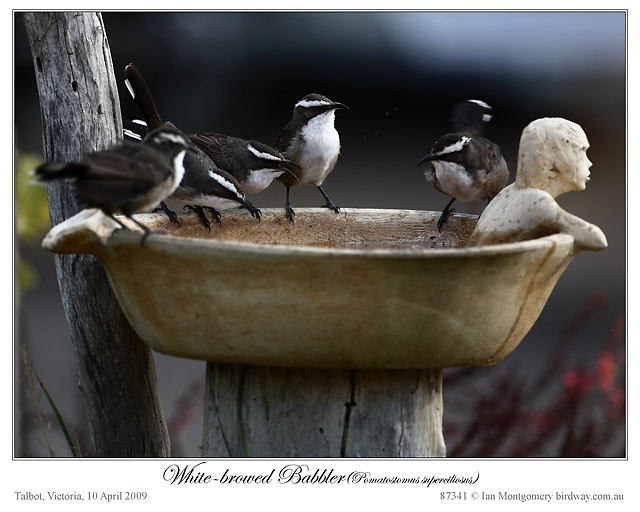
Babblers are highly social, noisy and exuberant. The live in groups of 3 to about a dozen and do everything together, including roosting, breeding and, as in the second photo, bathing. They build a number of domed nest in their territory; apparently only one of these is used for nesting, so the others are thought to be used for roosting. When disturbed by an observer, they chatter scoldingly, and move away, appearing to bounce rather than fly on their short wings. Their gregarious habits have earned them lots of common names such as Happy Family, Cackler, Go-aways, Twelve Apostles and Jumper, names applied rather indiscriminately to both this and the other widespread species, the Grey-crowned Babbler.

The four Australian species and a fifth found in PNG comprise the Australo-Papuan Babblers (family Pomatostomidae). These used to be included with the superficially similar Old World Babblers in the family Timaliidae http://www.birdway.com.au//timaliini/index.htm . It is now apparent that the two groups are not closely related.”

I’ve revised the Australo-Papuan Babblers on the website with new photos of 3 of the 4 species:
I’ve also added new photos to these waders:
Common Greenshank
Red-necked Stint
Bar-tailed Godwit
Black-tailed Godwit
Sooty Oystercatcher .
At the moment, I’m doing the ducks and have added photos, taken in Ireland, of:
Mute Swan
Tufted Duck
Eurasian Wigeon.

Please visit Ian Montgomery’s Birdway site for many interesting Birds of the World photography. He is a fantastic photographer. (Bolding by Lee)


Lee’s addition:
What an interesting bird and I love their common names – Happy Family, Cacker which bring to mind the following verses:

And my soul shall be joyful in the LORD; It shall rejoice in His salvation. (Psalms 35:9 NKJV)
Oh come, let us sing to the LORD! Let us shout joyfully to the Rock of our salvation. Let us come before His presence with thanksgiving; Let us shout joyfully to Him with psalms. For the LORD is the great God, And the great King above all gods. (Psalms 95:1-3 NKJV)”

“The Australo-Papuan or Australian babblers are endemic to Australia-New Guinea. The Australo-Papuan babblers are medium-sized terrestrial birds with sombre plumage and long decurved bills. The wings are short and round, and the tail is long and often held fanned which makes it look broad as well. The feet and legs are strong and adapted to a terrestrial existence. There is no sexual dimorphism in the plumage, which is composed of brown, russet and grey colours, often with striking white markings on the face and throat. The plumage of juvenile birds is similar to that of adults.
Five species in one genus are currently recognised, although the red-breasted subspecies rubeculus of the Grey-crowned Babbler may prove to be a separate species. Further investigation is required.

Chestnut-crowned Babbler by Birdway

Chestnut-crowned Babbler by Birdway

All five species are ground-feeding omnivores and highly social. Babblers live in family groups and small flocks of up to about 20 individuals and forage communally, calling loudly to one another all day long. They feed principally on insects and other invertebrates, but will also take seeds, fruits and small vertebrates. Most food is obtained on the ground, although they will also forage in low bushes; the Grey-crowned Babbler and New Guinea Babbler feed more extensively in vegetation than the other species. The long bill is used to probe and overturn large objects. They will also hold objects with one foot and hammer them with the bill in order to extract food.

Australo-Papuan babblers are monogamous breeders which defend territories. The breeding pair will be aided in breeding by a number of helpers from its group. A number of groups may have more than one breeding pair. Extra male helpers aid the male in his responsibilities whereas the females aid the main breeding male in hers. They have an extended breeding season. Australo-Papuan babblers construct large nests for communal roosting, and these nests may be used for breeding, or new nests may be constructed. There may be a lrage number of nests used by the group in a small area. When the female is breeding she alone uses the breeding nest. Nest construction, both of roosting and breeding nests, is undertaken by all birds in the group. Between one to six eggs are laid (the number and range varies by species) and are usually incubated by the breeding female alone (although a helper female may aid occasionally). The Breeding male and other helper males feed the breeding female during incubation. Incubation lasts between 19-25 days. The female broods the chicks until they are able to thermoregulate, and the chicks fledge after 16-23 days. After leaving the nest the chicks will continue to be fed by the adults for a number of months.”

The five species are the New Guinea Babbler, Grey-crowned Babbler, White-browed Babbler, Hall’s Babbler, and the Chestnut-crowned Babbler. (Photos are from Ian at Birdway)

*Information from Ian’s Bird of the Week newsletter, Wikipedia and other internet sources.

Check out the Bird of the Week – Introduction

See:
Ian’s Bird of the Week for more of these articles.
Ian’s Birdway Website


Ian’s Bird of the Week – Introduction

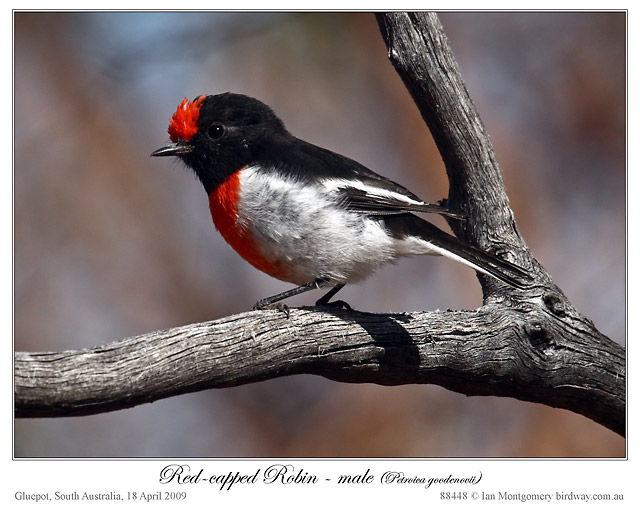
Red-capped Robin

Red-capped Robin by Birdway

Ian Montgomery of Birdway’s Birds of the World Website, who has been one of the photographers used throughout this blog, has given me permission for a new series of articles. Ian lives in Australia and is a fantastic photographer. On his website he “invites you to enjoy the beauty and fascination of wild birds with his photos of more than 1,200 species from Australia and around the World.” As of a few days ago, the “site contains more than 4,600 photos of 1,218 bird species in the wild; 581 of these are on the main Australian list of Christidis & Boles, 2008.” There is much to discover on the Birdway Website.

Every week Birdway sends out a newsletter with a Bird of the Week. The newsletters have interesting information about the bird being featured and several photos of that bird. With his permission, the Bird of the Week will be featured here, with some additions of my own at the bottom. We trust you will enjoy learning about and seeing some birds that many of us here in America do not have the privilege to see.

But now ask the beasts, and let them teach you; And the birds of the heavens, and let them tell you. (Job 12:7 NASB)

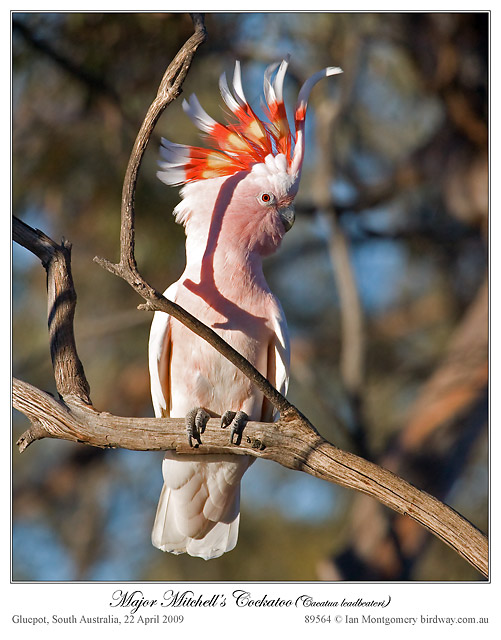
Major Mitchell's Cockatoo by Ian

Major Mitchell's Cockatoo by Ian

That is one of my favorite “bird verses.” I enjoy learning about the wonderful birds and critters that have been created. When I see their beauty and behavior, and their bad sides also, there are lessons to learn. Let’s see what we can learn through observing the different “Birds of the Week.”

I can’t say that I will only do one a week, because he has been producing the newsletter for some time. I will have a hard time picking from the past ones. I just may have to double-up.

Please visit his website – Birdway’s Birds of the World
Also, to sign up for his newsletter – CLICK HERE

Thanks you, Ian, for this privilege.

See the first Bird of the Week – White-browed Babbler

Birds in Hymns – Memories of Galilee

And Jesus went about all Galilee, teaching in their synagogues, and preaching the gospel of the kingdom, and healing all manner of sickness and all manner of disease among the people. (Matthew 4:23)

Words: Ro­bert Mor­ris, 1874.
Music: Ho­ra­tio R. Pal­mer
Robert Morris (1818-1888)

Memories of Galilee


Each cooing dove and sighing bough,
That makes the eve so blessed to me,
Has something far diviner now,
It bears me back to Galilee.

Refrain

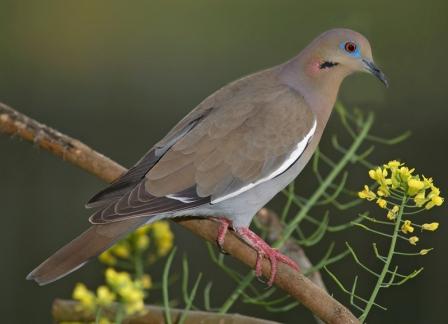
White-winged Dove by Reinier

White-winged Dove by Reinier

O Galilee, sweet Galilee,
Where Jesus loved so much to be,
O Galilee, blue Galilee,
Come sing thy song again to me.

Each flowery glen and mossy dell,
Where happy birds in song agree,
Through sunny morn the praises tell
Of sights and sounds in Galilee.

Refrain

And when I read the thrilling lore
Of Him Who walked upon the sea,
I long, oh, how I long once more
To follow Him in Galilee.

Refrain

__________

Updated 11/18/2017 Added YouTube

Most information from The Cyber Hymnal

See ~ Wordless Birds

More ~ Birds in Hymns

*

Birds of the Bible – Partridge II

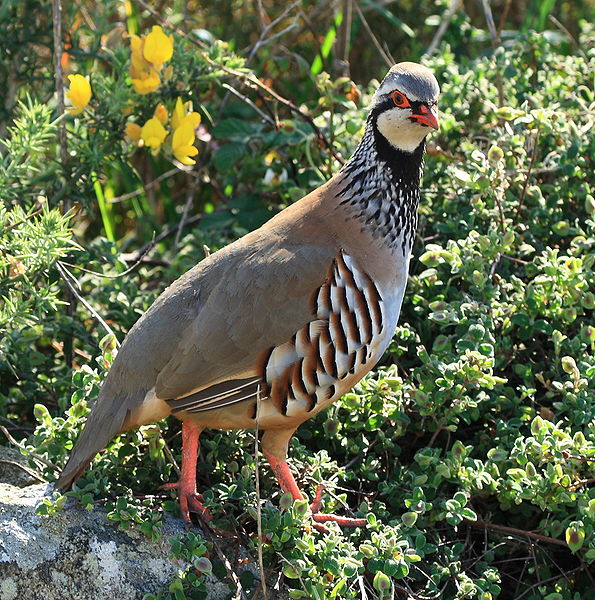
Red-legged Partridge

Red-legged Partridge

I made the following observation in the first Partridge article:
“The Partridge is only mentioned twice in Scripture. In Jeremiah, the fact is that other birds put their eggs in the nest of a partridge and then expect the nesting bird to do all the work, sitting, feeding, and fledging the chicks.”

I, the LORD, search the heart, I test the mind, Even to give every man according to his ways, According to the fruit of his doings. “As a partridge that broods but does not hatch, So is he who gets riches, but not by right; It will leave him in the midst of his days, And at his end he will be a fool.” (Jer 17:10-11)

Looking into this verse further, I would like to share some more information about it.

“3. RLP(Red-legged Partridge) will lay their own nest, but will also dump odd eggs in other species nests. Where this is a pheasant, the pheasant (as found in the UK), being probably the stupidest of all birds bar none, will hatch and “rear” the young quite happily. A grey partridge, on the other hand, will abandon the nest. Terminated. And … almost certainly does not attempt to lay again that season.”, A quote from a “Bird Forum

Curiosities: while brooding the female is very sensitive, and, if disturbed, may abandon the nest.”, about a Rock Partridge from Parco Nazionale…

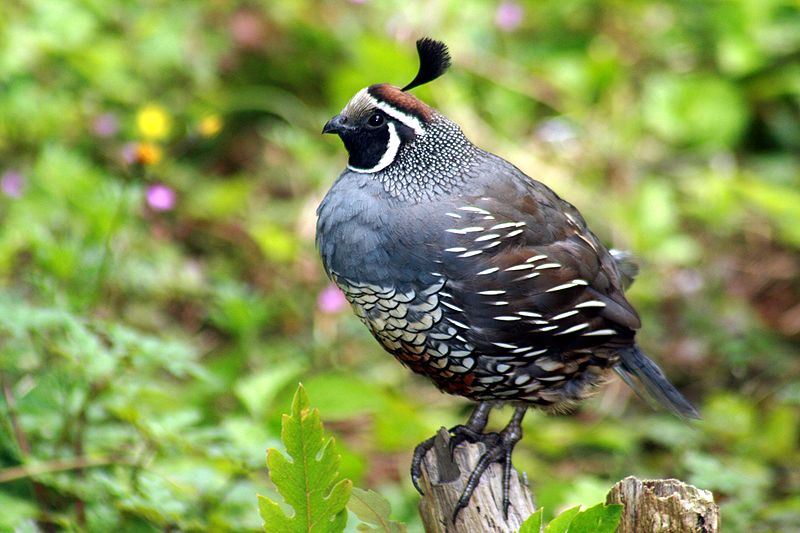
California Quail sometimes called California Partridge

California Quail sometimes called California Partridge

“In the deep woods where the California partridge nests, it is not unusual to find the eggs of that game bird in the nest of the Oregon Towhee. Mr. Cohen, of Ala- meda, records one Towhee nest four feet from the ground on a live-oak stub and containing four Towhee eggs and fifteen eggs of the partridge. Another recorded by him was on the ground, and contained three eggs of the Towhee and eighteen of the partridge. The Towhee abandoned the nest after six partridge eggs were laid, leaving the partridge to rear the brood. Inasmuch as the Towhee eggs hatch in two weeks, the young being very dark colored and naked, while the partridge eggs require three weeks and the young are lively little balls of down able to run about as soon as dry, the sacrifice of the Towhee’s brood is inevitable whenever the two are deposited in the same nest.” from Birds of California

I could give more examples, but it is obvious that the Partridges are leaving their eggs in other nests. “They are brooding but not hatching.” She is trying to raise her chicks, but not in the proper way. That is what the verse is saying, that the Lord searches the heart and tests a person’s thinking. It is then applied to making money the wrong way (crooked) and then having it disappear and then he is a “fool’ in the end.

The verses in Jeremiah 17:10-11 are in the middle of a great passage about trusting in the LORD.

(5) Thus says the LORD: “Cursed is the man who trusts in man And makes flesh his strength, Whose heart departs from the LORD.
(6) For he shall be like a shrub in the desert, And shall not see when good comes, But shall inhabit the parched places in the wilderness, In a salt land which is not inhabited.
(7) “Blessed is the man who trusts in the LORD, And whose hope is the LORD.
(8) For he shall be like a tree planted by the waters, Which spreads out its roots by the river, And will not fear when heat comes; But its leaf will be green, And will not be anxious in the year of drought, Nor will cease from yielding fruit.
(9) “The heart is deceitful above all things, And desperately wicked; Who can know it?
(10) I, the LORD, search the heart, I test the mind, Even to give every man according to his ways, According to the fruit of his doings.
(11) “As a partridge that broods but does not hatch, So is he who gets riches, but not by right; It will leave him in the midst of his days, And at his end he will be a fool.
(12) A glorious high throne from the beginning Is the place of our sanctuary.
(13) O LORD, the hope of Israel, All who forsake You shall be ashamed. “Those who depart from Me Shall be written in the earth, Because they have forsaken the LORD, The fountain of living waters.”
(14) Heal me, O LORD, and I shall be healed; Save me, and I shall be saved, For You are my praise. (Jeremiah 17:5-14 NKJV)


See:
Partridge

Birds of the Bible – Pelican Study

Great White Pelican by Birdway

Great White Pelican by Birdway

In Previous articles about the Pelicans; Birds of the Bible – Pelicans and Pelicans II they were introduced as being in the Pelecanidae family.  Here in the U.S. we have the American White Pelican and the Brown Pelican. They are listed as “unclean” in the Scriptures (Levitucus 11:18 and Deuteronomy 14:17), meaning they were not to be eaten by the Israelites.

Depending on which version of the Bible you use, “Pelican” is not always used in one, but shows up in another. That is what makes “birdwatching the Scriptures” so interesting. Take for instance Isaiah 34:11:

But the pelican and the porcupine shall possess it, Also the owl and the raven shall dwell in it. And He shall stretch out over it The line of confusion and the stones of emptiness. (NKJV)

Using e-Sword Free Bible Program’s” compare feature, observe these differences.
Pelican and porcupine – ASV, NKJV, RV
Pelican and hedgehog – NASB, NAS77, YLT
Pelican and bittern – Darby, JPS
Pelican and herons – GW
Cormorant and bittern – KJV, MKJV, Webster
Hawk and porcupine – ESV
Owls and ravens only mentioned – GNB
Owls, hawks, and wild animals – CEV
Birds of the waste land – BBE

Another interesting verse:

Flocks will lie down in her midst, All beasts which range in herds; Both the pelican and the hedgehog Will lodge in the tops of her pillars; Birds will sing in the window, Desolation will be on the threshold; For He has laid bare the cedar work. (Zephaniah 2:14 NASB)

This verse uses pelican, raven, hedgehog, owl, cormorant depending on the version.

When Nave’s Topical Bible‘s – Pelican and Torrey’s Topical Textbook‘s – Birds are referenced, it appears that they used the King James Version (KJV).

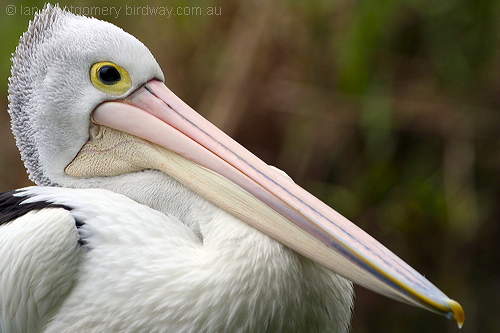
Australian Pelican by Birdway

Australian Pelican by Birdway

All of that said to help you realize as you study the Bible, looking for birds, be aware that just because it’s not found on the first search, try another version and the bird may appear. I personally prefer to use the KJV, NKJV, NASB, and ESV as my main versions. The others are fine, some better than others, but those mentioned, in my opinion, are closer to the originals. Why they vary, I am not sure. The Strong’s Hebrew and Greek Dictionaries in the KJV and NASB use H6893, which is kaw-ath’ , which means “probably the pelican (from vomiting): – cormorant.”

We do know that the Pelicans are mentioned in the Bible and I really enjoy watching them. We get to see the American White and the Brown Pelicans here in Florida. It would be neat to see the Austrailian, Dalmation, Great White, Pink-backed, Peruvian and Spot-billed Pelicans.

I also love to watch the pelicans skim over the water and also fly in formation like a squadron of bombers. I have included two videos of them skimming. Visit the Pelican Videos and Photos for more. See the Sidebar.

*All photos used with permission.


Pelican in flight in Cuba
*

*
Another by arlens47 that “Follows the flight of a pelican as he starts to go out to sea, then reverses course and lands in the water off the coast of Santa Cruz, California. Background music is Thorn Birds Theme by the Joe Reisman Orchestra.

Flight of the Pelican
*

*

A Song Greater Than The Nightingale’s Song – by April Lorier

A Song Greater Than The Nightingale’s Song

Nightingale

Nightingale

Who hasn’t heard Manhattan Transfer sing A Nightingale Sang In Berkeley Square? And did you know it was a Nightingale that inspired Tchaikovsky when he was composing his Humoresque opus 10-2? Even my grandson knows about the beauty of the Nightingale’s Song from Hans Christian Andersen’s story The Nightingale. In short, the Nightingale’s Song is a sound of pure beauty with quite a reputation. Ever heard a greater song?

Nightingales are named so because they frequently sing at night as well as during the day. The name means ‘night songstress’. As is usual, it is the male who sings, not the female. He does so with ulterior motives: to attract a mate.

The male nightingale is known for his singing, to the extent that human singers are sometimes admiringly referred to as nightingales; the song is loud, with an impressive range of whistles, trills and gurgles. Its song is particularly noticeable at night because few other birds are singing. This is why its name (in several languages) includes “night”.

Singing at dawn, during the hour before sunrise, is assumed to be important in defending the bird’s territory. Nightingales sing even more loudly in urban or near-urban environments, in order to overcome the background noise.

I know an even more beautiful song that helps me overcome the background noise of life. It’s God’s Song! Did you know God sings? The Bible says so!

In Zephaniah 3:17 it says:

The Lord your God is with you,
He is mighty to save.
He will take great delight in you,
He will quiet you with His love,
He will rejoice over you with singing.

Oh! What an awesome thought! The Creator of all nature thinks I’m so special, and takes such delight in me that He sings lullabies to quiet me with His love! It is an intimacy that surpasses the mother-child intimacy, and I depend upon it many nights. I even sing back to Him and drift off to a peaceful, natural sleep. During the most troubled times of my life, it’s been the only way I could sleep.

Me singing to my Heavenly Father is one thing; but knowing He rejoices over me with singing is just too awesome to comprehend. No wonder I love Him so much!

(c) 2009 April Lorier

For since the creation of the world God’s invisible qualities—his eternal power and divine nature—have been clearly seen, being understood from what has been made, so that men are without excuse. Romans 1:20

Supplied by and reprinted with permission of April Lorier.

More of April’s Articles

*


Birds of the Bible – Speckled Bird

Mine heritage is unto me as a speckled bird, the birds round about are against her; come ye, assemble all the beasts of the field, come to devour. (Jeremiah 12:9 KJV)

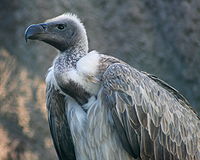
White-backed Vulture

White-backed Vulture

In Jeremiah chapter 12, the LORD was stating that because Israel had turned to other gods instead of the God of Israel (the LORD), that He was bringing  judgment. The people had bowed down to other gods and then brought some of that worship and intermingled it with the true worship of God. The House of God was “speckled” or of mixed beliefs.

John Wesley’s Explanatory Notes – “The birds round about – It is usual for other birds to flock about a strange coloured bird, such as they have not been used to see.”

Ruppell's Vulture

Ruppell's Vulture

Matthew Henry’s Concise Commentary – “God’s people had been the dearly-beloved of his soul, precious in his sight, but they acted so, that he gave them up to their enemies. Many professing churches become like speckled birds, presenting a mixture of religion and the world, with its vain fashions, pursuits, and pollutions. God’s people are as men wondered at, as a speckled bird; but this people had by their own folly made themselves so; and the beasts and birds are called to prey upon them. The whole land would be made desolate. But until the judgments were actually inflicted, none of the people would lay the warning to heart. When God’s hand is lifted up, and men will not see, they shall be made to feel. Silver and gold shall not profit in the day of the Lord’s anger. And the efforts of sinners to escape misery, without repentance and works answerable thereto, will end in confusion.”

Jamieson, Fausset, and Brown Commentary – “speckled bird — Many translate, “a ravenous beast, the hyena”; the corresponding Arabic word means hyena; so the Septuagint. But the Hebrew always elsewhere means “a bird of prey.” The Hebrew for “speckled” is from a root “to color”; answering to the Jewish blending together with paganism the altogether diverse Mosaic ritual. The neighboring nations, birds of prey like herself (for she had sinfully assimilated herself to them), were ready to pounce upon her.”

Hartlaub's Bustard

Hartlaub's Bustard

From Clarke -Dahler translates the whole verse thus: –
“Birds of prey! inundate with blood my heritage.
Birds of prey! come against her from all sides.
Run together in crowds, ye savage beasts!
Come to the carnage!”

According to those above, it seems that the bird must have been either spotted or multi-colored. The bird is a:
“speckled bird” in the KJV, MKJV, Webster
“speckled bird of prey” in the ASV, Darvy, NASB, RV
“speckled vulture” in the NKJV
“speckled fowl” in the YLT
“colorful bird of prey” in the GWV
“brightly colored bird” – BBE
“hawk” – CEV
“hyena’s lair” – ESV
All these variances make it hard to show a picture, but the ones shown are guesses.

Also, the application should give those today a stern warning about bringing the “worldly practices and beliefs” into our church services. I see it today in churches that do things that are clearly taught against in God’s Word, the Bible. Many things could be named, but one that disturbes this writer alot is the denial of God’s Creation of this world. More and more supposed Christian leaders are teaching different theories to “blend” the world’s theory of evolution with the Lord’s clear teaching in Genesis.

But there were also false prophets among the people, even as there will be false teachers among you, who will secretly bring in destructive heresies, even denying the Lord who bought them, and bring on themselves swift destruction. (2 Peter 2:1 NKJV)


See also:
Great Speckled Bird
The Great Speckled Bird (song) from Wikipedia

Maturing Cockatiels and Christians – by April Lorier

Maturing Cockatiels and Christians

Baby Cockatiels

Baby Cockatiels

There were years when I raised birds, hand-feeding them so they would grow up to be more easily trainable as pets. The fact that I was hand-feeding them meant they would be imprinted by me (a human being) instead of by the mother bird. They would bond to me, therefore, be easily trained by the human who purchased them. Imprinting is the key if birds or animals are to be sold as mature, trained birds.

I was reminiscing today about the clutches of eggs I incubated, then hand-fed after they were hatched. They looked like little aliens with almost no feathers, but soon they would grow into beautiful birds who were not afraid of humans, and it would be time to hand-train them.

Babies are born without a working immune system so they are more susceptible to getting bacterial or fungal infections from your hands, ordinary household objects and an environment that has been contaminated with disease causing organisms. And the job of feeding the formula to them is 24/7, so between the cleaning and the feeding, it’s more than a full-time job! Just making the formula (which must always be fresh) is a chore.

But there comes a time when I had to start weaning these babies from their mushy formula, throw away the syringe, and introduce them to seed/fruit mixtures. They had to switch from baby food to adult food incrementally.

Scripture teaches the same principle both through the mouth of the Apostle Paul, and of Peter. Peter said, in I Peter 2:1-3

1) Therefore, rid yourselves of all malice and all deceit, hypocrisy, envy, and slander of every kind. 2) Like newborn babies, crave pure spiritual milk, so that by it you may grow up in your salvation, 3) now that you have tasted that the Lord is good.

And then in Hebrews 5:11-14 we read:

Concerning him [Melchizedek, as a type of Christ] we have much to say, and it is hard to explain, since you have become dull of hearing.
12) For though by this time you ought to be teachers, you have need again for someone to teach you the elementary principles of the oracles of God, and you have come to need milk and not solid food.
13) For everyone who partakes only of milk is not accustomed to the word of righteousness, for he is a babe.
14) But solid food is for the mature, who because of practice have their senses trained to discern good and evil.

So what the message of my Bible Study, and also of my cockatiels is, baby food is for babies. And if I am growing in my faith, I need to be desiring the meat of the Word. Sometimes it feels ‘safe’ to run back to the milk, but it will stunt my spiritual growth. Just think how my body would look if I had never eaten anything but milk! Who knows if I would even be alive?

Once again, Father, You have used nature to teach me Your principles. Thank you for allowing my memories to make this Bible Study come to life! I want to be a mature Christian!

(c) 2009 April Lorier

Supplied by and reprinted with permission of April Lorier.


See:

More of April’s Articles

*

Sparrows and God Care – by April Lorier

April Lorier writes great articles on her “Christian Nature” blog and has agreed to be a guest author. She is allowing us to reproduce some of her very thoughtful and inspiring challenges about birds and the Creator. I trust you will be as blessed by her writings as I am. This is the first one.


Sparrows and God Care

sparrow-whiteThroat1 I have written about sparrows before and feel a need to revisit the subject. There are just so many sparrows flying around!

Ethel Waters made “His Eye Is On The Sparrow” famous many years ago, and it’s still a master piece. It serves to remind us that if God values sparrows and cares for them, then certainly He does the same for us. He created human beings for companionship, and through Christ we can have that relationship.

One Sunday morning at church, we sang “His Eye Is on the Sparrow” as a congregational hymn. It was a rare opportunity to give voice to a song usually performed by a soloist.

During the first chorus, I noticed a friend who was weeping so hard that he couldn’t sing. Knowing a bit of what he had been through recently, I recognized his tears as ones of joy at realizing that, no matter what our situation, God sees, knows, and cares for us.

Jesus said, “Are not two sparrows sold for a copper coin? And not one of them falls to the ground apart from your Father’s will. But the very hairs of your head are all numbered. Do not fear therefore; you are of more value than many sparrows” (Matt. 10:29-31). The Lord spoke these words to His 12 disciples as He sent them out to teach, heal, and bear witness of Him to “the lost sheep of the house of Israel” (v.6). He told them that even though they would face persecution for His sake, they should not be afraid, even of death (vv.22-26).

When threatening circumstances press us to lose hope, we can find encouragement in the words of this song: “I sing because I’m happy, I sing because I’m free. For His eye is on the sparrow, and I know He watches me.” We are under His watchful care.

If God sees the sparrow’s fall,
Paints the lilies short and tall,
Gives the skies their azure hue,
Will He not then care for you? —Anon.

When you put your cares in God’s hands, He puts His peace in your heart.

2009 April Lorier

Ask the animals, and they will teach you, or the birds of the air, and they will tell you; or speak to the earth, and it will teach you, or let the fish of the sea inform you. Which of these does not know that the hand of the Lord has done this? –
Job 12

Supplied by and reprinted with permission of April Lorier.


See:
More of April’s Articles
*