Worm eating birds like Blackbird, Song Thrush and Robin start singing from around 4.00 am up until about 6.30 am.
They are blessed with large eyes in relation to the size of its body. These birds forage at low light and are capable of finding worms close to the surface of the ground early in the morning.
God wants us to be early risers like these worm eating birds, to wait in His presence to get spiritual food and to get directions from the Lord.
Jesus often used to get up very early in the morning and go out to pray.
Is that the reason He chose fishermen to be His disciples?
Remember, fishermen always rise early to venture into the sea to fish.
How often do we rise early to seek His presence?
These early rising worm eating birds have large eyes.
Do you want eyes that can see those worms that devour your blessings?
Do you want eyes that can see even in the darkest time?
Just rise early and God shall open your spiritual eyes wide open to see the unseen.
I love them that love me; and those that seek me early shall find me. (Proverbs 8:17)
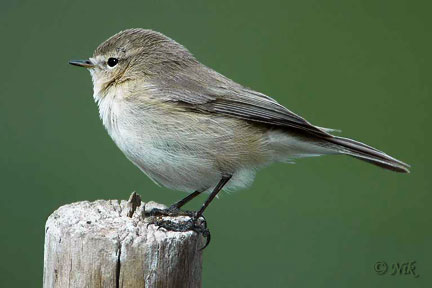
Mountain Chiffchaff (Phylloscopus sindianus) by Nikhil Devasar
Wren, Chiffchaff and Black Cap are Insect eaters and they start their concert anytime from about 5.30 am.
These birds have slightly smaller eyes than the worm eaters and are more sensitive to the available light. This allows them to find darting and flying insects and spiders.
Eat the insects before it eats you.
But, how?
Do you find it difficult to get rid of all those tiny insects that nibble at your finances and blessings and your health and happiness?
Rise early and seek His presence and He will show you how to get rid of them.
Jacob wrestled with God and said that he will not leave until He blessed him..
It was at the break of the day that God blessed Jacob.
Most of God’s judgments too fell on day break.
The judgment of Sodom happened after day break.. (Genesis 19:15)
The fort of Jericho fell after day break.. (Joshua 6:15)
The tree that gave shelter to Jonah was consumed by God sent worms at day break.. (Jonah 4:7)
Are you waiting for God’s blessings?
Rise up at least before day break and receive God’s blessings before the Day of Judgment.
Want to meet God face to face and get a new name from Him?
Seek God before day break. That’s when God gave a new name to Jacob and
that’s when Jacob saw God face to face..
It is of theLord‘s mercies that we are not consumed, because his compassions fail not.
They are new every morning: great is thy faithfulness. (Lamentations 3:22,23)
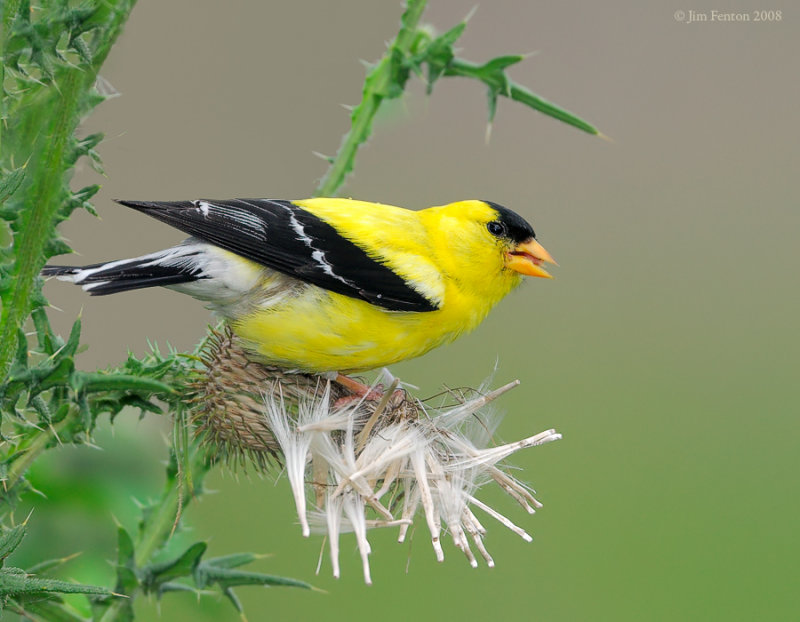
American Goldfinch (Carduelis tristis) on Thistle by Fenton
Seed eaters like Chaffinch, Goldfinch and Sparrow enter into the dawn chorus at around 6.00 am.
With smaller eyes they may need more light to look out for their food, especially when precision is required to extract small seeds.
Some of us are like these seed eaters. We need more light to look out for our food. Funny though, our God has called us to give light, but here, these seed eaters need more light to stay alive, since they have small eyes of faith.
They cannot see the unseen.
Someone should throw light to overcome the tight situation they are in, to show them the seed of faith.
What sort of seeds do we eat in the morning?
Do we eat seeds of doubt or seeds of faith?
Our fruits are determined by the seeds we eat..
And he that doubteth is damned if he eat, because he eateth not of faith: for whatsoever is not of faith is sin. (Romans 14:23)
Now the parable is this: The seed is the word of God. (Luke 8:11)
Whosoever is born of God doth not commit sin; for his seed remaineth in him: and he cannot sin, because he is born of God. (I John 3:9)
Let the seed of God remain in us now and forever more..
Our life is shaped not by what we eat but by when we eat..
Remember the Manna – the word of God melts after sunrise.
This week we have nothing short of a fashion parade, male Ruffs at a communal display ground or lek in eastern Finland. Finland is my second stop-over on the way to Ireland to visit my family and I am spending a week in the northern part of the country in search of some unusual northern European birds. I spent a couple of nights in Oulo on the west coast, a 1 hour flight north of Helsinki and then drove north west to Kuusamo near the Russian border where I am now.
In Oulu, the birding and wildlife tour company Finnature put me very early in the morning in a hide that they had set up near the lek. I settled down to watch a rather unpromising-looking piece of raised ground in a meadow, having been assured that, though it was late in the season, a couple of birds had been seen at the lek on the previous morning.
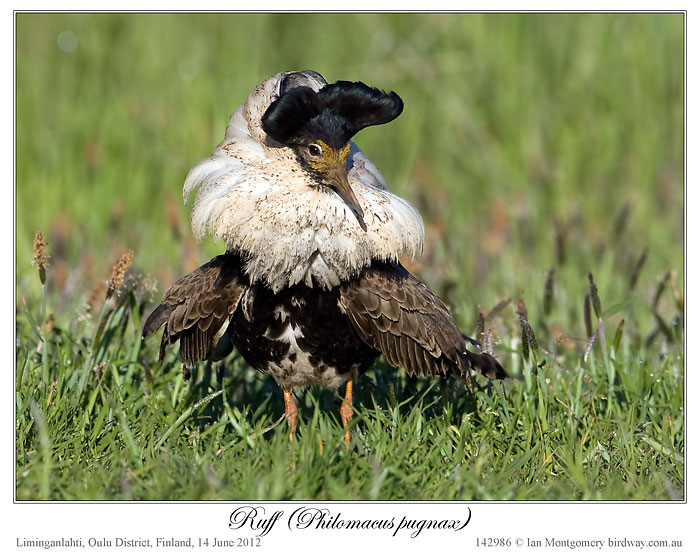
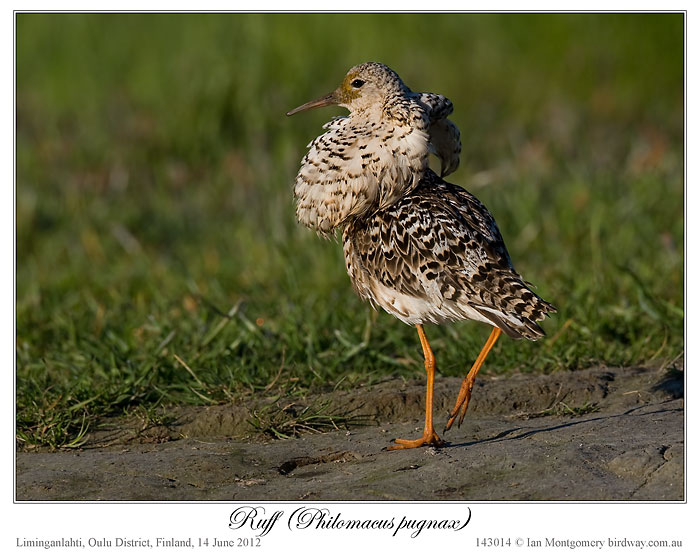
Ruff (Philomachus pugnax) by Ian 2
After about half an hour and shortly before 4:00am the black-ruffed bird in the second photo arrived but flew off when I moved the camera. Happily, it soon returned and this time the second white-ruffed bird arrived too and the pair started their extraordinary display, spreading their ruffs and wings apparently to make themselves appear as intimidating as possible. Sometimes, they jumped vertically in the air and at other times they crouched low on the ground in submissive looking postures.
Ruff (Philomachus pugnax) by Ian 3
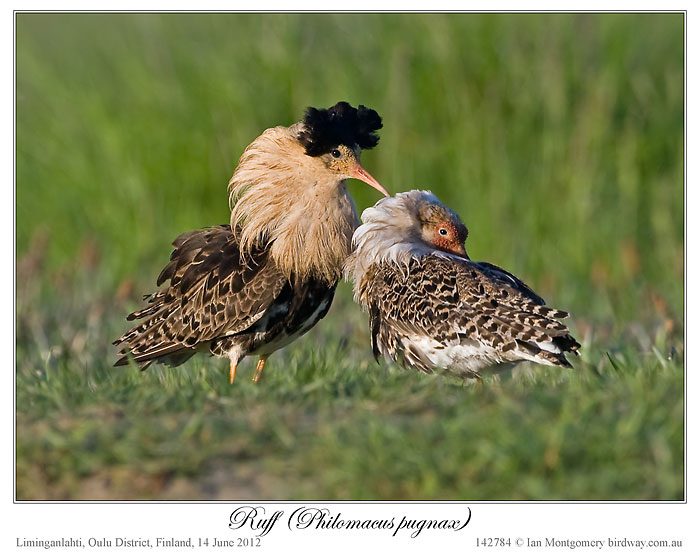
Although the birds often came into close physical contact, there was no actual fighting and no physical damage. These black- and white-ruffed birds were the main performers during the 4 hours that I remained in the hide, but other birds joined in and at one stage there were about 10 birds on the lek. The colours of the ruffs and the erectile feathers on the head were varied. Here is a buff and black one with the white bird.
Ruff (Philomachus pugnax) by Ian 4
The colour of the bare wattled skin on the face varied too, being sometimes yellow and sometimes red, though it was my impression that this colour wan’t permanent and the red flush was associated with more intense display. This non-displaying one with a chestnut cap, piebald ruff has yellow facial skin.
Ruff (Philomachus pugnax) by Ian 5
This one is mainly chestnut.
Ruff (Philomachus pugnax) by Ian 6
While this one with an ermine ruff look suitably regal.
Ruff (Philomachus pugnax) by Ian 7
Ruffs are unusual among lekking birds in that the display is aimed mainly at other males to establish dominance, rather than at attracting females. Females may mate with multiple males producing young with different fathers and homosexual mating also occurs. The different ruff colours are apparently significant and white-ruffed males are smaller and less dominant and called satellite males.
Ruff (Philomachus pugnax) by Ian 8
The females, called Reeves, are quite plain and look rather like other sandpipers such as Sharp-tailed and Pectoral. In non-breeding plumage, the males resemble the females but are larger and longer-necked. Ruffs breed across northern Eurasia from Scandinavia to Siberia and winter in Africa, Asia and, in small numbers, Australia. You can see a female and ruff-less male, photographed in India, here: http://www.birdway.com.au/scolopacidae/ruff/index.htm.
Who said waders are plain and boring? I had a wonderful time at this lek. The Ruffs wasn’t one of my target species in Finland but an unexpected bonus, thank you Finnature. My main target was the largest Woodpecker in Europe, the Black Woodpecker, but that’s another story.
Best wishes
Ian
**************************************************
Ian Montgomery, Birdway Pty Ltd,
454 Forestry Road, Bluewater, Qld 4818
Tel 0411 602 737 ian@birdway.com.au
Check the latest website updates: http://www.birdway.com.au/#updates
**************************************************
Lee’s Addition:
What a group of “show offs.” I find these birds amazing. Never thought of this family as having leks like the pheasants and those in that order. Just goes to show you that the birds are doing what they are suppose to and that is reproducing. What a show for the females to get to watch.
Bring out with you every living thing of all flesh that is with you: birds and cattle and every creeping thing that creeps on the earth, so that they may abound on the earth, and be fruitful and multiply on the earth.”
(Genesis 8:17 NKJV)
Loggerhead Shrike for Birds Illustrated by Color Photography, 1897
Birds Illustrated by Color Photography – Revisited
Vol 1. June, 1897 No. 6
*
THE LOGGERHEAD SHRIKE.
RAMBLER in the fields and woodlands during early spring or the latter part of autumn is often surprised at finding insects, grasshoppers, dragon flies, beetles of all kinds, and even larger game, mice, and small birds, impaled on twigs and thorns. This is apparently cruel sport, he observes, if he is unacquainted with the Butcher Bird and his habits, and he at once attributes it to the wanton sport of idle children who have not been led to say,
With hearts to love, with eyes to see,
With ears to hear their minstrelsy;
Through us no harm, by deed or word,
Shall ever come to any bird.
If he will look about him, however, the real author of this mischief will soon be detected as he appears with other unfortunate little creatures, which he requires to sustain his own life and that of his nestlings. The offender he finds to be the Shrike of the northern United States, most properly named the Butcher Bird. Like all tyrants he is fierce and brave only in the presence of creatures weaker than himself, and cowers and screams with terror if he sees a falcon. And yet, despite this cruel proceeding, which is an implanted instinct like that of the dog which buries bones he never seeks again, there are few more useful birds than the Shrike. In the summer he lives on insects, ninety-eight per cent. of his food for July and August consisting of insects, mainly grasshoppers; and in winter, when insects are scarce, mice form a very large proportion of his food.
The Butcher Bird has a very agreeable song, which is soft and musical, and he often shows cleverness as a mocker of other birds. He has been taught to whistle parts of tunes, and is as readily tamed as any of our domestic songsters.
The nest is usually found on the outer limbs of trees, often from fifteen to thirty feet from the ground. It is made of long strips of the inner bark of bass-wood, strengthened on the sides with a few dry twigs, stems, and roots, and lined with fine grasses. The eggs are often six in number, of a yellowish or clayey-white, blotched and marbled with dashes of purple, light brown, and purplish gray. Pretty eggs to study.
Readers of Birds who are interested in eggs do not need to disturb the mothers on their nests in order to see and study them. In all the great museums specimens of the eggs of nearly all birds are displayed in cases, and accurately colored plates have been made and published by the Smithsonian Institution and others. The Chicago Academy of Sciences has a fine collection of eggs. Many persons imagine that these institutions engage in cruel slaughter of birds in order to collect eggs and nests. This, of course, is not true, only the fewest number being taken, and with the exclusive object of placing before the people, not for their amusement but rather for their instruction, specimens of birds and animals which shall serve for their identification in forest and field.
The Loggerhead Shrike and nest shown in this number were taken under the direction of Mr. F. M. Woodruff, at Worth, Ill., about fourteen miles from Chicago. The nest was in a corner of an old hedge of Osage Orange, and about eight feet from the ground. He says in the Osprey that it took considerable time and patience to build up a platform of fence boards and old boxes to enable the photographer to do his work. The half-eaten body of a young garter snake was found about midway between the upper surface of the nest and the limb above, where it had been hung up for future use.
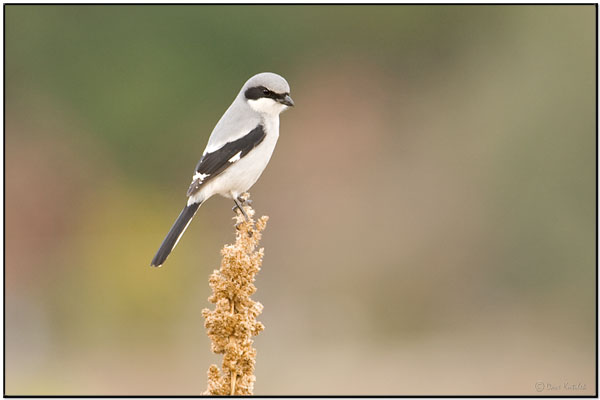
Loggerhead Shrike (Lanius ludovicianus) by Daves BirdingPix
Lee’s Addition:
“That path no bird of prey knows, and the falcon’s eye has not seen it. (Job 28:7 ESV)
What a surprise about a week or so ago when I looked out at my feeders/fountain area. There were 4 Loggerhead Shrikes around the fountain and chasing each other around the tree. That is the first time they have visited our yard. Saw my first Loggerhead out in Louisiana years ago. They can confuse you at first look with a Northern Mockingbird, which is what I thought I was looking at at the fountain.
Loggerhead Shrikes are in the Laniidae – ShrikesFamily which at the time has 33 members. The family name, and that of the largest genus, Lanius, is derived from the Latin word for “butcher”, and some shrikes were also known as “butcher birds” because of their feeding habits. Note that the Australasian butcherbirds (Artamidae family) are not shrikes.
Most shrike species have a Eurasian and African distribution, with just two breeding in North America (the Loggerhead and Great Grey shrikes). There are no members of this family in South America or Australia, although one species reaches New Guinea. The shrikes vary in the extent of their ranges, with some species like the Great Grey Shrike ranging across the northern hemisphere to the Newton’s Fiscal which is restricted to the island of São Tomé.
They inhabit open habitats, especially steppe and savannah. A few species of shrike are forest dwellers, seldom occurring in open habitats. Some species breed in northern latitudes during the summer, then migrate to warmer climes for the winter.
The Loggerhead Shrike (Lanius ludovicianus) is a passerine bird. It is the only member of the shrike family endemic to North America; the related Northern Shrike (L. excubitor) occurs north of its range but also in the Palearctic.
The bird has a large hooked bill; the head and back are grey and the underparts white. The wings and tail are black, with white patches on the wings and white on the outer tail feather. The black face mask extends over the bill, unlike that of the similar but slightly larger Northern Shrike.
The bird breeds in semi-open areas in southern Ontario, Quebec and the Canadian prairie provinces, south to Mexico. It nests in dense trees and shrubs. The female lays 4 to 8 eggs in a bulky cup made of twigs and grass. There is an increase in average clutch size as latitude increases.
The shrike is a permanent resident in the southern part of the range; northern birds migrate further south. They are considered a bird of prey even though they have weak legs and feet. The bird waits on a perch with open lines of sight and swoops down to capture prey. Its food is large insects and lizards . Known in many parts as the “Butcher Bird,” it impales its prey on thorns or barbed wire before eating it, because it does not have the talons of the larger birds of prey.
The population of this species has declined in the northeastern parts of its range, possibly due to loss of suitable habitat and pesticide use.
“Loggerhead” refers to the relatively large head as compared to the rest of the body.
*
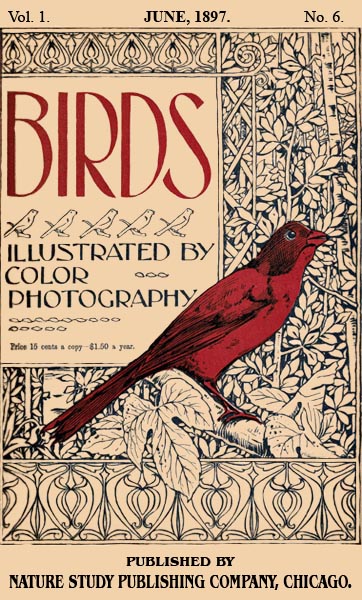
Birds Illustrated by Color Photograhy Vol 1 June, 1897 No 6 – Cover
The above article is the first article in the monthly serial that was started in January 1897 “designed to promote Knowledge of Bird-Live.” These include Color Photography, as they call them, today they are drawings. There are at least three Volumes that have been digitized by Project Gutenberg.
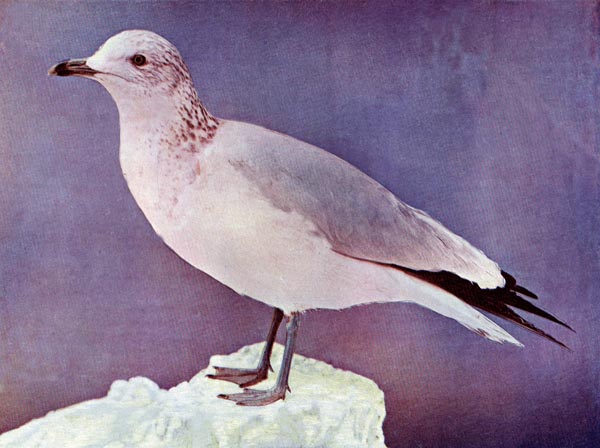
Ring-billed Gull for Birds Illustrated by Color Photography, 1897, From col. Chi. Acad. Sciences.
Birds Illustrated by Color Photography – Revisited
Vol 1. June, 1897 No. 6
*
THE RING-BILLED GULL.
HE Ring-billed Gull is a common species throughout eastern North America, breeding throughout the northern tier of the United States, whose northern border is the limit of its summer home. As a rule in winter it is found in Illinois and south to the Gulf of Mexico. It is an exceedingly voracious bird, continually skimming over the surface of the water in search of its finny prey, and often following shoals of fish to great distances. The birds congregate in large numbers at their breeding places, which are rocky islands or headlands in the ocean. Most of the families of Gulls are somewhat migratory, visiting northern regions in summer to rear their young. The following lines give with remarkable fidelity the wing habits and movements of this tireless bird:
“On nimble wing the gull
Sweeps booming by, intent to cull
Voracious, from the billows’ breast,
Marked far away, his destined feast.
Behold him now, deep plunging, dip
His sunny pinion’s sable tip
In the green wave; now highly skim
With wheeling flight the water’s brim;
Wave in blue sky his silver sail
Aloft, and frolic with the gale,
Or sink again his breast to lave,
And float upon the foaming wave.
Oft o’er his form your eyes may roam,
Nor know him from the feathery foam,
Nor ’mid the rolling waves, your ear
On yelling blast his clamor hear.”
This Gull lives principally on fish, but also greedily devours insects. He also picks up small animals or animal substances with which he meets, and, like the vulture, devours them even in a putrid condition. He walks well and quickly, swims bouyantly, lying in the water like an air bubble, and dives with facility, but to no great depth.
As the breeding time approaches the Gulls begin to assemble in flocks, uniting to form a numerous host. Even upon our own shores their nesting places are often occupied by many hundred pairs, whilst further north they congregate in countless multitudes. They literally cover the rocks on which their nests are placed, the brooding parents pressing against each other.
Wilson says that the Gull, when riding bouyantly upon the waves and weaving a sportive dance, is employed by the poets as an emblem of purity, or as an accessory to the horrors of a storm, by his shrieks and wild piercing cries. In his habits he is the vulture of the ocean, while in grace of motion and beauty of plumage he is one of the most attractive of the splendid denizens of the ocean and lakes.
The Ring-billed Gull’s nest varies with localities. Where there is grass and sea weed, these are carefully heaped together, but where these fail the nest is of scanty material. Two to four large oval eggs of brownish green or greenish brown, spotted with grey and brown, are hatched in three or four weeks, the young appearing in a thick covering of speckled down. If born on the ledge of a high rock, the chicks remain there until their wings enable them to leave it, but if they come from the shell on the sand of the beach they trot about like little chickens. During the first few days they are fed with half-digested food from the parents’ crops, and then with freshly caught fish.
The Gull rarely flies alone, though occasionally one is seen far away from the water soaring in majestic solitude above the tall buildings of the city.
Ring-billed Gull (Larus delawarensis) Lk Hollingsworth by Lee
Lee’s Addition:
The Ring-billed Gull is a member of the Laridae Family in the Charadriiformes Order. They are mentioned in Bible’s New King James Version as one of the birds not to eat.
the ostrich, the short-eared owl, the sea gull, and the hawk after their kinds; (Deuteronomy 14:15 NKJV)
We see them on a frequent basis here in Central Florida. They not only like the many lakes here in Polk County, but also many of the parking lots. Of course as you head to either of our shores, Gulf or Atlantic, many more are seen.
The above article is the first article in the monthly serial that was started in January 1897 “designed to promote Knowledge of Bird-Live.” These include Color Photography, as they call them, today they are drawings. There are at least three Volumes that have been digitized by Project Gutenberg.
Ian’s Bird of the Week – Chinese Pond Heron ~ by Ian Montgomery
Newsletter ~ 6-11-12
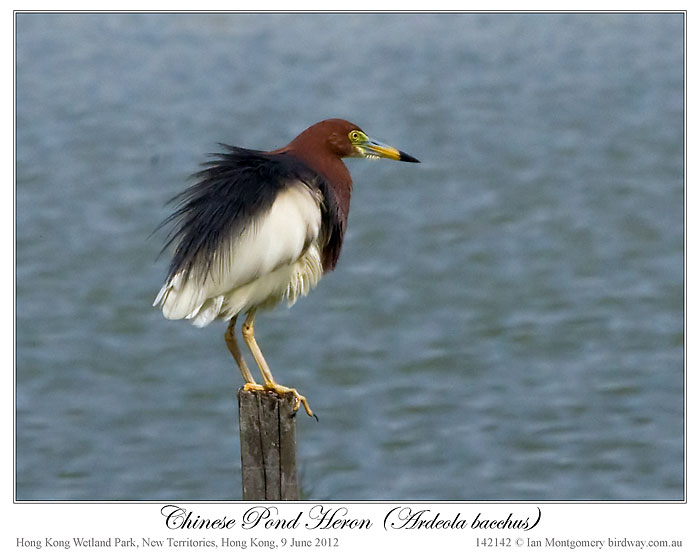
I’m stopping over for a few days in Hong Kong. It’s not the best time of the year for birding here – the northern spring and autumn/fall are good for migrants and the northern winter is good for waders and waterbirds – but we did go out to the Hong Kong Wetland Park near Mai Po reserve in the New Territories on Saturday. One of the species I was keen to see was the Chinese Pond Heron and this one in breeding plumage landed on a post near the hide/blind we were in.
This was of interest to me as it’s on the Australian list as a rare vagrant and I’d seen only non-breeding birds before (in Malaysia). The non-breeding plumage is streaky brown and white and not very distinguished, but when breeding the birds acquire striking black, white and chestnut plumage with a multi-coloured bill. This bird fluffed out its feathers, preened itself a bit and settled down for a few seconds, second photo.
Chinese Pond Heron (Ardeola bacchus) by Ian 2
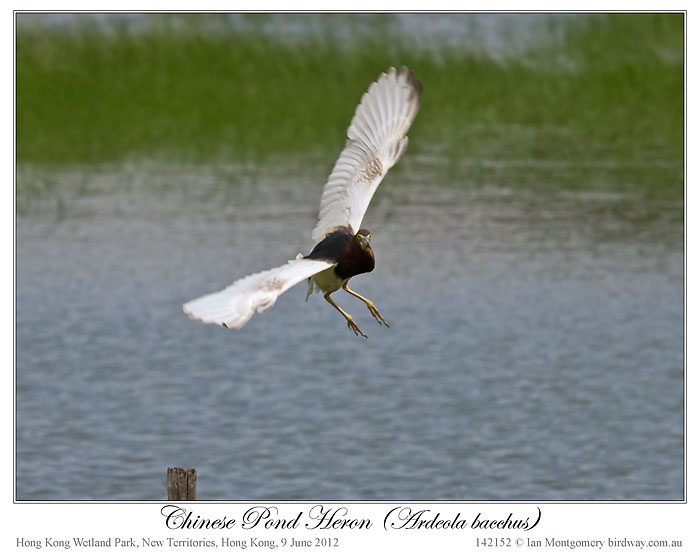
These are stocky, mid-sized (47cm/19in in length) herons that feed on fish and invertebrates. Their breeding range includes China and northern Japan. In the northern winter some migrate south to Malaysia and Indonesia, including Java, and sometimes they overshoot and end up in the Australian territories of Christmas and Cocos (Keeling) Islands and on the Australian mainland. This particular one hung around for thirty seconds and then took off, third photo, showing how high they can jump when taking off – they need to be able to do this to take off from reed beds.
Chinese Pond Heron (Ardeola bacchus) by Ian 3
In flight, fourth photo, the bird displays the striking white wing characteristic of all six species of Pond Herons (genus Ardeola). These are mainly Asian and African species, though the Squacco Heron occurs in southern Europe. The Chinese Pond Heron is closely related to the rather similar Indian Pond Heron (this one was photographed behind the Taj Mahal.
Chinese Pond Heron (Ardeola bacchus) by Ian 4
Only 30 seconds elapsed between the first and last photos, so we were lucky to have this encounter and it was the only one we saw. The Hong Kong Government is making admirable efforts, through Mai Po Reserved and the restored Hong Kong Wetland Park, to conserve wildlife, but the area is very close to the densely populated and heavily industrialised areas of southern China and the local population of Chinese Pond Herons is suffering from the effects of water pollution on their prey (mud skippers and crustaceans).
Best wishes
Ian
**************************************************
Ian Montgomery, Birdway Pty Ltd,
454 Forestry Road, Bluewater, Qld 4818
Tel 0411 602 737 ian@birdway.com.au
Check the latest website updates: http://www.birdway.com.au/#updates
**************************************************
Lee’s Addition:
Ian, you sure get around. What a beautiful bird all decked out to “woo” its mate.
Birds Illustrated by Color Photography – Revisited
Vol 1. June, 1897 No. 6
*
black-crowned night heron. From col. Chi. Acad. Sciences.
THE BLACK-CROWNED NIGHT HERON.
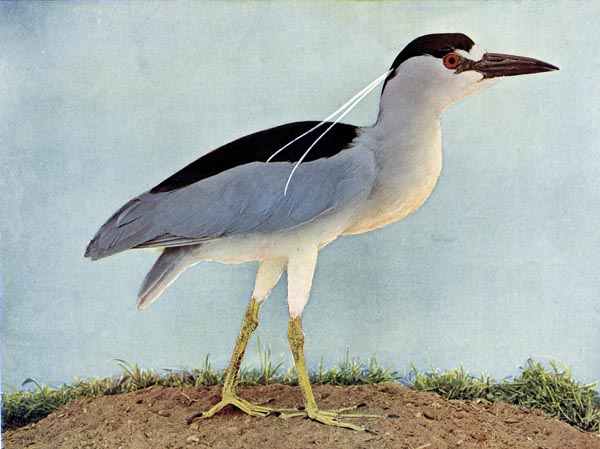
HAT a beautiful creature this is! A mounted specimen requires, like the Snowy Owl, the greatest care and a dust tight glass case to preserve its beauty. Dr. Coues’ account of it should be read by those who are interested in the science of ornithology. It is a common bird in the United States and British Provinces, being migratory and resident in the south. Heronries, sometimes of vast extent, to which they return year after year, are their breeding places. Each nest contains three or four eggs of a pale, sea-green color. Observe the peculiar plumes, sometimes two, in this case three, which spring from the back of the head. These usually lie close together in one bundle, but are often blown apart by the wind in the form of streamers. This Heron derives its name from its habits, as it is usually seen flying at night, or in the early evening, when it utters a sonorous cry of quaw or quawk. It is often called Quawk or Qua-Bird.
On the return of the Black-Crowned Night Heron in April, he promptly takes possession of his former home, which is likely to be the most solitary and deeply shaded part of a cedar swamp. Groves of swamp oak in retired and water covered places, are also sometimes chosen, and the males often select tall trees on the bank of the river to roost upon during the day. About the beginning of twilight they direct their flight toward the marshes, uttering in a hoarse and hollow tone, the sound qua. At this hour all the nurseries in the swamps are emptied of their occupants, who disperse about the marshes along the ditches and river shore in search of food. Some of these nesting places have been occupied every spring and summer for many years by nearly a hundred pair of Herons. In places where the cedars have been cut down and removed the Herons merely move to another part of the swamp, not seeming greatly disturbed thereby; but when attacked and plundered they have been known to remove from an ancient home in a body to some unknown place.
The Heron’s nest is plain enough, being built of sticks. On entering the swamp in the neighborhood of one of the heronries the noise of the old and young birds equals that made by a band of Indians in conflict. The instant an intruder is discovered, the entire flock silently rises in the air and removes to the tops of the trees in another part of the woods, while sentries of eight or ten birds make occasional circuits of inspection.
The young Herons climb to the tops of the highest trees, but do not attempt to fly. While it is probable these birds do not see well by day, they possess an exquisite facility of hearing, which renders it almost impossible to approach their nesting places without discovery. Hawks hover over the nests, making an occasional sweep among the young, and the Bald Eagle has been seen to cast a hungry eye upon them.
The male and female can hardly be distinguished. Both have the plumes, but there is a slight difference in size.
The food of the Night Heron, or Qua-Bird, is chiefly fish, and his two interesting traits are tireless watchfulness and great appetite. He digests his food with such rapidity that however much he may eat, he is always ready to eat again; hence he is little benefited by what he does eat, and is ever in appearance in the same half-starved state, whether food is abundant or scarce.
Black-crowned Night Heron at Lake Hollingsworth By Dan
Lee’s Addition:
Black-crowned Night Heron (Nycticorax nycticorax nævius) Crown and back greenish black lower back, wings and tail ashy; head with two or three rounded white plumes, except just after breeding season. Young. Grayish brown streaked with white; below white streaked with blackish; outer webs of primaries, pale rufous. Notes. An explosive qûawk.
Range.—Western hemisphere; breeds in North America north to New Brunswick, Quebec, Manitoba, and Oregon; winters from California and Gulf States southward.
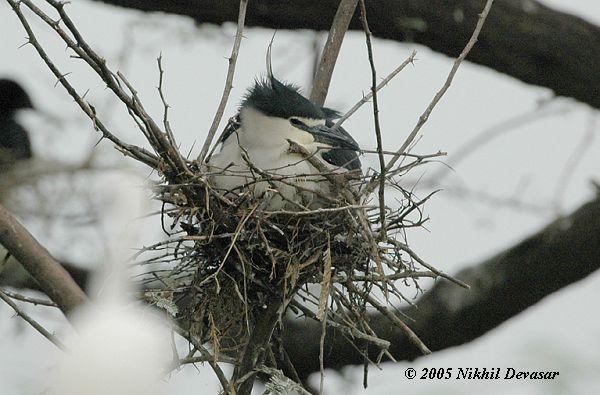
Frequently several nests will be found in the same tree, and I have counted as many as fifty nests in view at the same time. In large swamps in the south they generally nest at a low elevation, while in the marshes of Wisconsin and Minnesota, large colonies of them nest on the ground, making their nest of rushes. Like all Heronries, those of this species have a nauseating odor, from the remains of decayed fish, etc., which are strewn around the bases of the trees. Their eggs number from three to five and are of a pale bluish green color. Size 2.00 × 1.40. 4 eggs. Nest of sticks, about thirty feet up in a pine tree. Many other nests (From the Bird Book)
Adults are approximately 64 cm (25 in) long and weigh 800 g (28 oz). They have a black crown and back with the remainder of the body white or grey, red eyes, and short yellow legs. They have pale grey wings and white under parts. Two or three long white plumes, erected in greeting and courtship displays, extend from the back of the head. The sexes are similar in appearance although the males are slightly larger. Black-crowned Night Herons do not fit the typical body form of the heron family. They are relatively stocky and about 25 in tall (63 cm) with shorter bills, legs, and necks than their more familiar cousins the egrets and “day” herons. Their resting posture is normally somewhat hunched but when hunting they extend their necks and look more like other wading birds.
Black-crowned Night Heron (Nycticorax nycticorax) on nest by Nikhil Devasar
These birds stand still at the water’s edge and wait to ambush prey, mainly at night or early morning. They primarily eat small fish, crustaceans, frogs, aquatic insects, small mammals and small birds. During the day they rest in trees or bushes. N. n. hoactli is more gregarious outside the breeding season than the nominate race. (Wikipedia)
The above article is the first article in the monthly serial that was started in January 1897 “designed to promote Knowledge of Bird-Live.” These include Color Photography, as they call them, today they are drawings. There are at least three Volumes that have been digitized by Project Gutenberg.
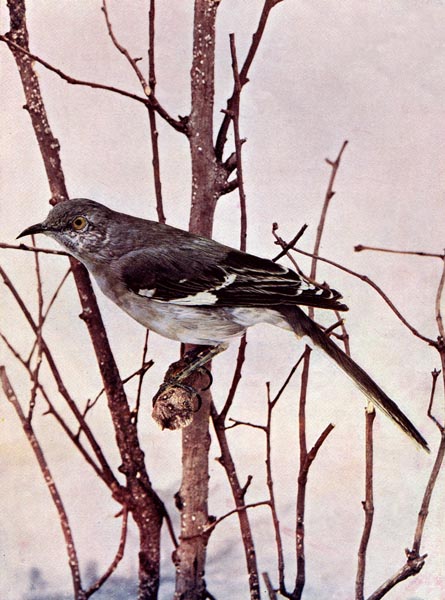
Mockingbird for Birds Illustrated by Color Photography, 1897, From col. F. M. Woodruff.
Birds Illustrated by Color Photography – Revisited
Vol 1. June, 1897 No. 6
*
THE MOCKING BIRD.
Some bright morning this month, you may hear a Robin’s song from a large tree near by. A Red Bird answers him and then the Oriole chimes in. I can see you looking around to find the birds that sing so sweetly. All this time a gay bird sits among the green leaves and laughs at you as you try to find three birds when only one is there.
It is the Mocking Bird or Mocker, and it is he who has been fooling you with his song. Nature has given him lots of music and gifted him with the power of imitating the songs of other birds and sounds of other animals.
He is certainly the sweetest of our song birds. The English Nightingale alone is his rival. I think, however, if our Mocker could hear the Nightingale’s song, he could learn it.
The Mocking Bird is another of our Thrushes. By this time you have surely made up your minds that the Thrushes are sweet singers.
The Mocker seems to take delight in fooling people. One gentleman while sitting on his porch heard what he thought to be a young bird in distress. He went in the direction of the sound and soon heard the same cry behind him. He turned and went back toward the porch, when he heard it in another direction. Soon he found out that Mr. Mocking Bird had been fooling him, and was flying about from shrub to shrub making that sound.
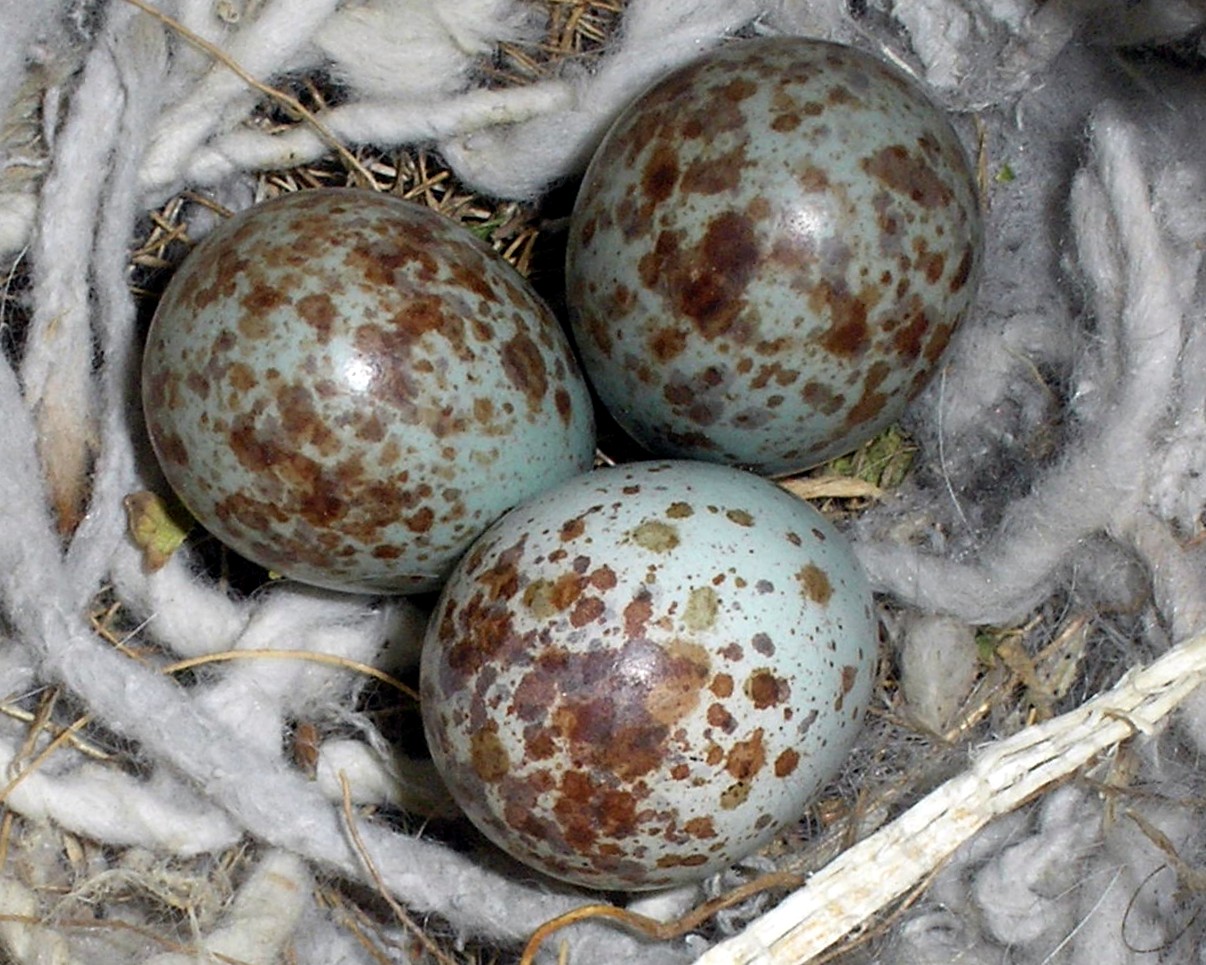
His nest is carelessly made of almost anything he can find. The small, bluish-green eggs are much like the Catbird’s eggs.
Little Mocking Birds look very much like the young of other Thrushes, and do not become Mockers like their parents, until they are full grown.
Which one of the other Thrushes that you have seen in Birds does the Mocking Bird resemble?
He is the only Thrush that sings while on the wing. All of the others sing only while perching.
THE MOCKING BIRD.
HE Mocking Bird is regarded as the chief of songsters, for in addition to his remarkable powers of imitation, he is without a rival in variety of notes. The Brown Thrasher is thought by many to have a sweeter song, and one equally vigorous, but there is a bold brilliancy in the performance of the Mocker that is peculiarly his own, and which has made him par excellence the forest extemporizer of vocal melody. About this of course there will always be a difference of opinion, as in the case of the human melodists.
So well known are the habits and characteristics of the Mocking Bird that nearly all that could be written about him would be but a repetition of what has been previously said. In Illinois, as in many other states, its distribution is very irregular, its absence from some localities which seem in every way suited being very difficult to account for. Thus, according to “Birds of Illinois,” while one or two pairs breed in the outskirts of Mount Carmel nearly every season, it is nowhere in that vicinity a common bird. A few miles further north, however, it has been found almost abundant. On one occasion, during a three mile drive from town, six males were seen and heard singing along the roadside. Mr. H. K. Coale says that he saw a mocking bird in Stark county, Indiana, sixty miles southeast of Chicago, January 1, 1884; that Mr. Green Smith had met with it at Kensington Station, Illinois, and that several have been observed in the parks and door-yards of Chicago. In the extreme southern portion of the state the species is abundant, and is resident through the year.
The Mocking Bird does not properly belong among the birds of the middle or eastern states, but as there are many records of its nesting in these latitudes it is thought to be safe to include it. Mrs. Osgood Wright states that individuals have often been seen in the city parks of the east, one having lived in Central Park, New York city, late into the winter, throughout a cold and extreme season. They have reared their young as far north as Arlington, near Boston, where they are noted, however, as rare summer residents. Dr. J. A. Allen, editor of The Auk, notes that they occasionally nest in the Connecticut Valley.
The Mocking Bird has a habit of singing and fluttering in the middle of the night, and in different individuals the song varies, as is noted of many birds, particularly canaries. The song is a natural love song, a rich dreamy melody. The mocking song is imitative of the notes of all the birds of field, forest, and garden, broken into fragments.
The Mocker’s nest is loosely made of leaves and grass, rags, feathers, etc., plain and comfortable. It is never far from the ground. The eggs are four to six, bluish green, spattered with shades of brown.
Wilson’s description of the Mocking Bird’s song will probably never be surpassed: “With expanded wings and tail glistening with white, and the bouyant gayety of his action arresting the eye, as his song does most irresistably the ear, he sweeps around with enthusiastic ecstasy, and mounts and descends as his song swells or dies away. And he often deceives the sportsman, and sends him in search of birds that are not perhaps within miles of him, but whose notes he exactly imitates.”
Very useful is he, eating large spiders and grasshoppers, and the destructive cottonworm.
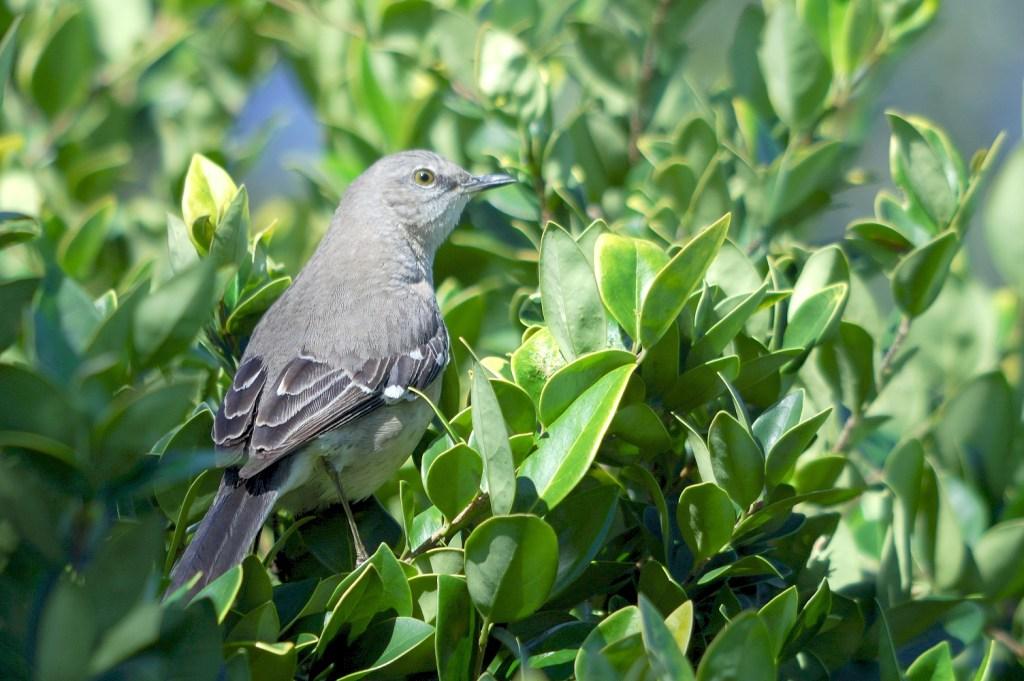
Northern Mockingbird (Mimus polyglottos) By Dan’sPix
Lee’s Addition:
Even in your thoughts, do not curse the king, nor in your bedroom curse the rich, for a bird of the air will carry your voice, or some winged creature tell the matter. (Ecclesiastes 10:20 ESV)
Be not deceived; God is not mocked: for whatsoever a man soweth, that shall he also reap. (Galatians 6:7 KJV)
Mockingbirds belong to the Mimidae – Mockingbirds, ThrashersFamily and are a passerine or perching bird. The name says alot about the bird because it is known to copy or mimic other birds and sounds. Up to 200 songs have been learned by some. They can also drive you crazy when they sing outside your bedroom window at 3 AM. When they have young, they love to sing. At least the one outside our window did. It is our State Bird here in Florida. Other states, Arkansas, Mississippi, Tennessee and Texas also claim them as their State Bird.
Mockingbirds are medium sized and have “Mockingbirds have small heads, a long, thin bill with a hint of a downward curve, and long legs. Their wings are short, rounded, and broad, making the tail seem particularly long in flight.” (All About Birds)
Northern Mockingbird males establish a nesting territory in early February. If a female enters his territory, the male will pursue the female with initial aggressive calls and, if she becomes interested, with softer calls. Once the pair is established, their song becomes more gentle. Northern Mockingbirds tend to be monogamous, and the female may return to the same male from the previous season.
Both the male and female are involved in the nest building. The male does most of the work, while the female perches on the shrub or tree where the nest is being built to watch for predators. The nest is built approximately three to 10 feet above the ground. The outer part of the nest is composed of twigs, while the inner part is lined with grasses, dead leaves, moss or artificial fibers. The eggs are a light blue or greenish color and speckled with dots.] Three to five eggs are laid by the female, and she incubates them for nearly two weeks. Once the eggs are hatched, both the male and female feed the chicks.
The birds aggressively defend their nest and surrounding area against other birds and animals. When a predator is persistent, mockingbirds from neighboring territories, summoned by a distinct call, may join the attack. Other birds may gather to watch as the mockingbirds harass the intruder. In addition to harassing domestic cats and dogs they consider a threat, it is not unheard of for mockingbirds to target humans. They are absolutely unafraid and will attack much larger birds, even hawks. One famous incident in Tulsa, Oklahoma involving a postal carrier resulted in the distribution of a warning letter to residents.
Birds Illustrated by Color Photograhy Vol 1 June, 1897 No 6 – Cover
The above article is the first article in the monthly serial that was started in January 1897 “designed to promote Knowledge of Bird-Live.” These include Color Photography, as they call them, today they are drawings. There are at least three Volumes that have been digitized by Project Gutenberg.
Today while I was doing my reading of Scripture in the ESV (English Standard Version), I came across this portion:
So, if they say to you, ‘Look, he is in the wilderness,’ do not go out. If they say, ‘Look, he is in the inner rooms,’ do not believe it. For as the lightning comes from the east and shines as far as the west, so will be the coming of the Son of Man. Wherever the corpse is, there the vultures will gather. “Immediately after the tribulation of those days the sun will be darkened, and the moon will not give its light, and the stars will fall from heaven, and the powers of the heavens will be shaken. Then will appear in heaven the sign of the Son of Man, and then all the tribes of the earth will mourn, and they will see the Son of Man coming on the clouds of heaven with power and great glory. And he will send out his angels with a loud trumpet call, and they will gather his elect from the four winds, from one end of heaven to the other. (Matthew 24:26-31 ESV)
In verse 3 of chapter 24, the disciples had asked the Lord to “Tell us, when will these things be, and what will be the sign of your coming and of the end of the age?” He was telling of future events in answer to that question, when right in the middle of that dialog, He said, “Wherever the corpse is, there the vultures will gather.” What? Where did that come from? So, here we are trying to figure out that saying.
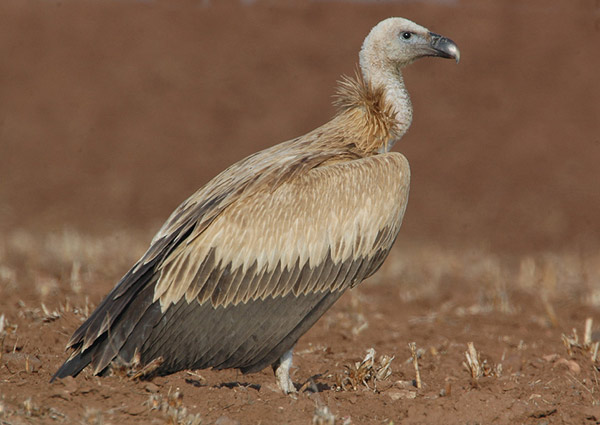
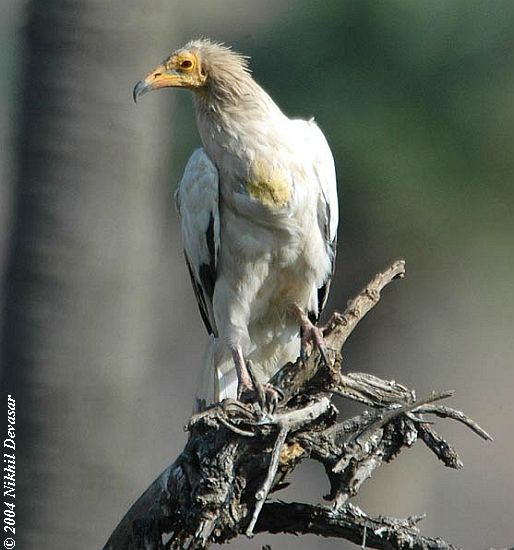
Egyptian Vulture (Neophron percnopterus) by Nikhil
Using my e-Sword program and searching for “vulture” in the ESV, the search shows that verse and Luke 17:37 saying the same thing.
And they said to him, “Where, Lord?” He said to them, “Where the corpse is, there the vultures will gather.” (Luke 17:37 ESV)
This time the vulture statement is preceded by this:
Whoever seeks to preserve his life will lose it, but whoever loses his life will keep it. I tell you, in that night there will be two in one bed. One will be taken and the other left. There will be two women grinding together. One will be taken and the other left.” And they said to him, “Where, Lord?” He said to them, “Where the corpse is, there the vultures will gather.” (Luke 17:33-37 ESV)
Using the Compare mode, the verses have either Eagles, Vultures, or Buzzards showing up. Reading the MSG’s version, it is starting to make some sense even before the commentaries are used.
The Arrival of the Son of Man isn’t something you go to see. He comes like swift lightning to you! Whenever you see crowds gathering, think of carrion vultures circling, moving in, hovering over a rotting carcass. You can be quite sure that it’s not the living Son of Man pulling in those crowds. (Matthew 24:27-28 MSG)
Believer’s Bible Commentary – 24:27 Christ’s Advent will be un mistakable—it will be sudden, public, universal, and glorious. Like the lightning, it will be instantly and clearly visible to all.
24:28 And no moral corruption will escape its fury and judgment. “For wherever the carcass is, there the eagles will be gathered together.” The carcass pictures apostate Judaism, Christendom, and the whole world system that is leagued against God and His Christ. The eagles or vultures typify the judgments of God which will be unleashed in connection with the Messiah’s appearing.
Life Application Study Bible – Matthew 24:24-28 – In times of persecution even strong believers will find it difficult to be loyal. To keep from being deceived by false messiahs, we must understand that Jesus’ return will be unmistakable (Mar_13:26); no one will doubt that it is he. If you have to be told that the Messiah has come, then he hasn’t (Mat_24:27). Christ’s coming will be obvious to everyone.
Matthew Poole’s Commentary – That phrase, Wheresoever the carcass is, there will the eagles be gathered together, is a proverbial speech, signifying that it will need no great labour to bring things together which are naturally joined by an innate desire either of them to the other; so that it is applicable in more cases than one.
Matthew Henry – Christ foretells the rapid spreading of the gospel in the world. It is plainly seen as the lightning. Christ preached his gospel openly. The Romans were like an eagle, and the ensign of their armies was an eagle. When a people, by their sin, make themselves as loathsome carcasses, nothing can be expected but that God should send enemies to destroy them. It is very applicable to the day of judgment, the coming of our Lord Jesus Christ in that day, 2Th_2:1. Let us give diligence to make our calling and election sure; then may we know that no enemy or deceiver shall ever prevail against us.
F B Meyer – It is a matter of literal fact that there was compressed into the period of the Jewish War an amount of suffering perhaps unparalleled. Josephus’ history of the period abounds in references to these false Christs who professed themselves to be the Messiah.
J Vernon McGee – Matthew 24:28 – This is the most difficult verse to understand in the entire Olivet Discourse. After speaking of His coming in glory like lightning out of heaven, then to speak of carrion-eating birds seems strange indeed. But I believe it refers to Christ’s coming in judgment, because Revelation 19 tells us about an invitation that went out to the birds to come together for a great banquet, “And I saw an angel standing in the sun; and he cried with a loud voice, saying to all the fowls that fly in the midst of heaven, Come and gather yourselves together unto the supper of the great God; That ye may eat the flesh of kings, and the flesh of captains, and the flesh of mighty men, and the flesh of horses, and of them that sit on them, and the flesh of all men, both free and bond, both small and great. And I saw the beast, and the kings of the earth, and their armies, gathered together to make war against him that sat on the horse, and against his army” (Rev_19:17-19). The birds that feed on carrion seem to be agents of divine judgment. When the Lord comes again, He will come in judgment.
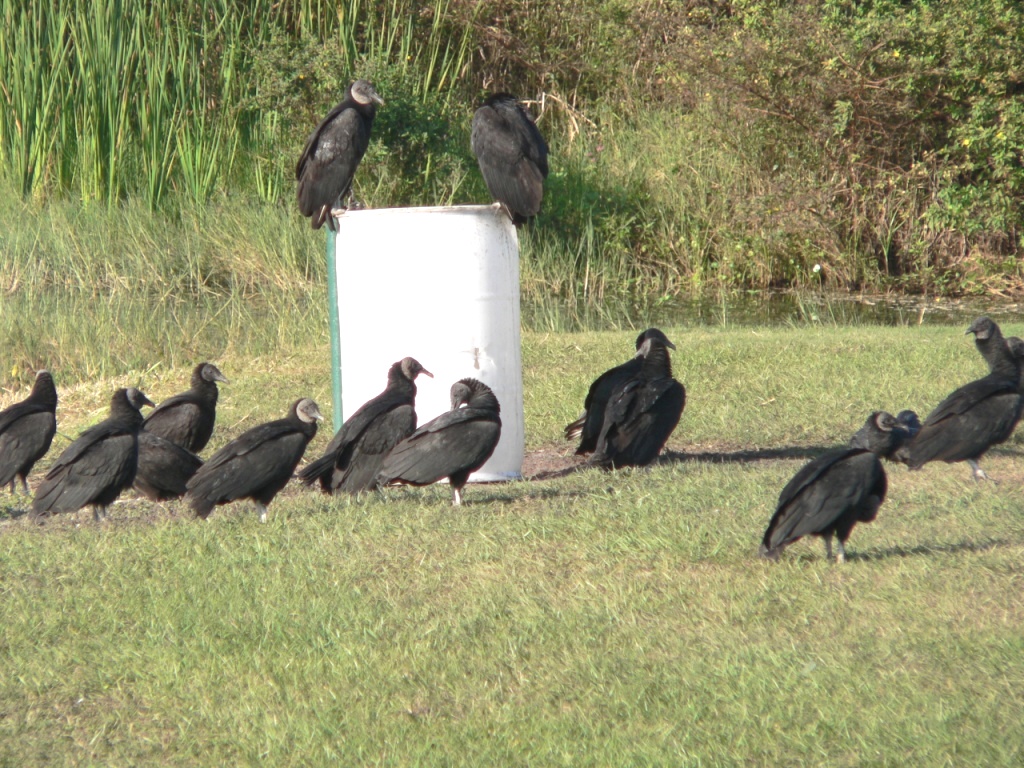
Black Vultures at Saddle Creek by Lee
This is only a few of the remarks. There are all kinds of interpretations of this verse and those surrounding it. Only a few were chosen to give a variety of the meaning. Whatever it is, apparently birds of prey will be there at the judgment. Maybe this will make you curious and encourage you to dig into the commentaries and do a little study. e-Sword is a very handy free Bible study tool.
The Vulture is of course a scavenger bird along with the Eagles and the Buzzards. There are other references to the Vulture in the Bible and therefore it is a Bird of the Bible.
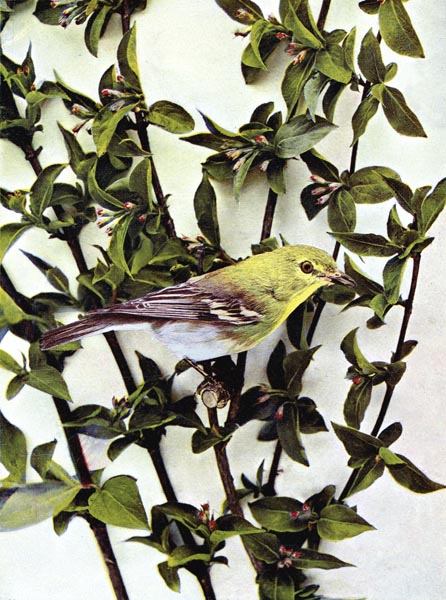
Yellow-throated Vireo for Birds Illustrated by Color Photography, 1897 – From col. F. M. Woodruff.
Birds Illustrated by Color Photography – Revisited
Vol 1. June, 1897 No. 6
*
The Yellow-throated Vireo
HE popular name of this species of an attractive family is Yellow Throated Greenlet, and our young readers will find much pleasure in watching its pretty movements and listening to its really delightful song whenever they visit the places where it loves to spend the happy hours of summer. In some respects it is the most remarkable of all the species of the family found in the United States. “The Birds of Illinois,” a book that may be profitably studied by the young naturalist, states that it is decidedly the finest singer, has the loudest notes of admonition and reproof, and is the handsomest in plumage, and hence the more attractive to the student.
A recognized observer says he has found it only in the woods, and mostly in the luxuriant forests of the bottom lands. The writer’s experience accords with that of Audubon and Wilson, the best authorities in their day, but the habits of birds vary greatly with locality, and in other parts of the country, notably in New England, it is very familiar, delighting in the companionship of man. It breeds in eastern North America, and winters in Florida, Cuba and Central America.
The Vireo makes a very deep nest, suspended by its upper edge, between the forks of a horizontal branch. The eggs are white, generally with a few reddish brown blotches. All authorities agree as to the great beauty of the nest, though they differ as to its exact location. It is a woodland bird, loving tall trees and running water, “haunting the same places as the Solitary Vireo.” During migration the Yellow-throat is seen in orchards and in the trees along side-walks and lawns, mingling his golden colors with the rich green of June leaves.
The Vireos, or Greenlets, are like the Warblers in appearance and habits. We have no birds, says Torrey, that are more unsparing of their music; they sing from morning till night, and—some of them, at least—continue theirs till the very end of the season. The song of the Yellow-throat is rather too monotonous and persistent. It is hard sometimes not to get out of patience with its ceasless and noisy iteration of its simple tune; especially if you are doing your utmost to catch the notes of some rarer and more refined songster. This is true also of some other birds, whose occasional silence would add much to their attractiveness.
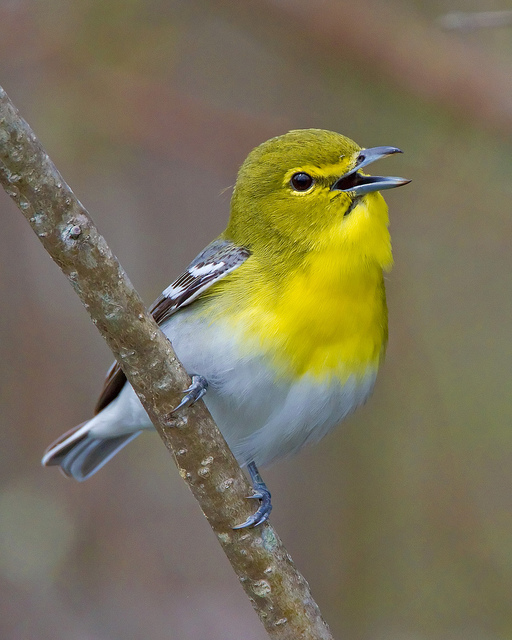
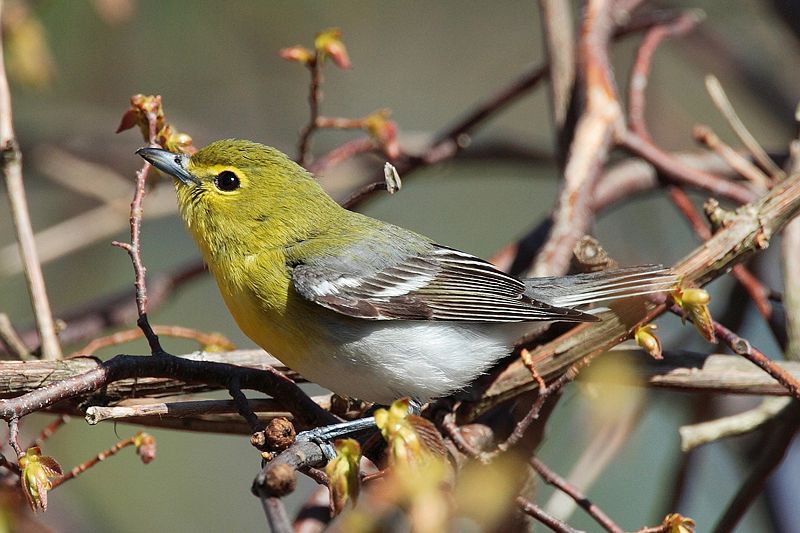
Yellow-throated Vireo (Vireo flavifrons) by Anthony 747
Lee’s Addition:
And in the morning, rising up a great while before day, he went out, and departed into a solitary place, and there prayed. (Mark 1:35 KJV)
The Yellow-throated Vireo (Vireo flavifrons) is a small American songbird.
Adults are mainly olive on the head and upperparts with a yellow throat and white belly; they have dark eyes with yellow “spectacles”. The tail and wings are dark with two white wing bars. They have thick blue-grey legs and a stout bill that is hooked. The sexes are similar and juveniles are similar to adults. They are 5-5.5 in. long.
Their breeding habitat is open deciduous woods in southern Canada and the eastern United States. They make a thick cup nest attached to a fork in a tree branch. They usually lay 3-5 creamy white eggs with a few spots. Other than breeding times, they are mostly solitary birds.
They wandered in the wilderness in a solitary way; they found no city to dwell in. (Psalms 107:4 KJV)
These birds migrate to the deep southern United States, Mexico and Central America. They are very rare vagrants to western Europe. There is one record from Britain in Kenidjack Valley Cornwall September 20-27 1990. There is also a sight report from Germany.
They forage for insects high in trees. They also eat berries, especially before migration and in winter when they are occasionally seen feeding on Gumbo-limbo (Bursera simaruba) fruit.
The Yellow-throated Vireo is part of the Vireonidae – Vireos, Greenlets Family which has 63 species in 6 genus. They are in the Vireo genus which 31 species. There are no subspecies of this bird.
***
Birds Illustrated by Color Photograhy Vol 1 June, 1897 No 6 – Cover
The above article is the first article in the monthly serial that was started in January 1897 “designed to promote Knowledge of Bird-Live.” These include Color Photography, as they call them, today they are drawings. There are at least three Volumes that have been digitized by Project Gutenberg.
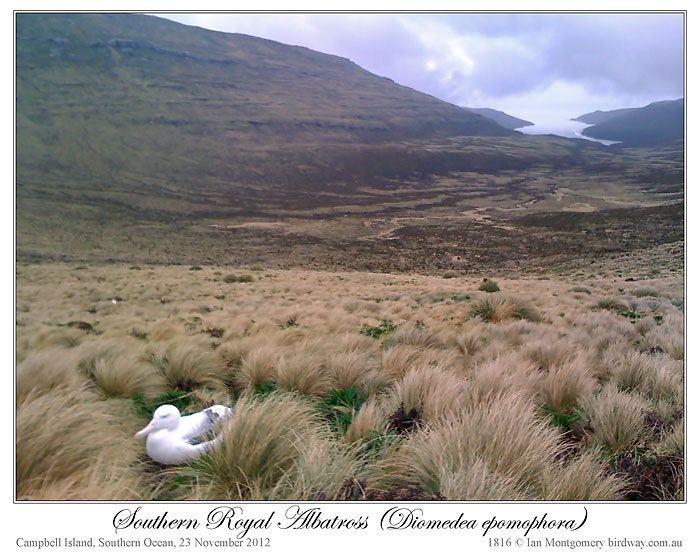
Southern Royal Albatross (Diomedea epomophora) by Ian 1
Ian’s Bird of the Week – Royal Albatross ~ by Ian Montgomery
Newsletter ~ 6-3-12
It seems only fitting to celebrate the Diamond Jubilee of Queen Elizabeth with something appropriate, so here is the Royal Albatross, or Royal Albatrosses if you accept, as most now do, the split into Northern and Southern species. Apart from just the Royal title, these birds are also very long lived (up to 60 years) and travel huge distances, routinely circumnavigating Antarctica. It has been estimated that a 50 year old Albatross has travelled 2.8 million miles which compares quite well with the Queen’s 261 official overseas visits and 96 state visits to 116 countries.
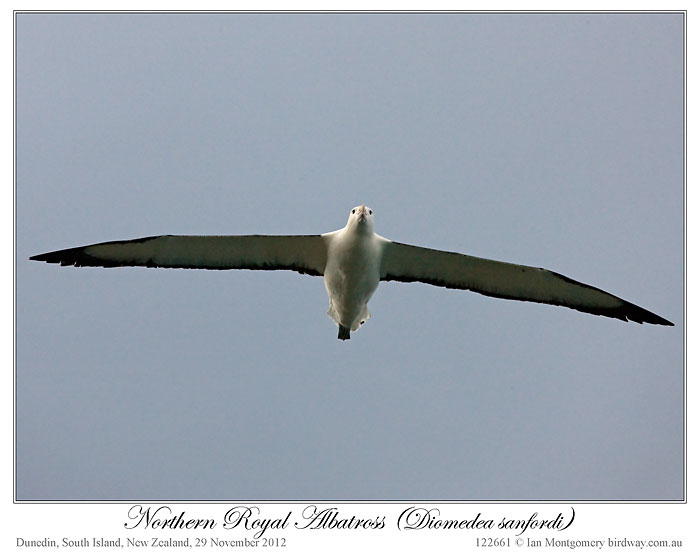
On the Sub-Antarctic trip last November, Royal Albatrosses, mainly Southern like the one in the first photo, were regular and very welcome companions in the Southern Ocean. It was always a thrill to see these huge birds completely at home in the wildest weather that the Ocean could throw at them and soaring apparently effortlessly in gale-force winds. If you look carefully at the first photo, you can see the dark (bluish) line along the upper mandible which distinguishes it from the similar Wandering Albatrosses. The other feature of note is the white leading edge to the dorsal surface of the wing. As Southern Royal Albatrosses age, the amount of leading white increases and this distinguishes it from both the Wandering Albatrosses, where the amount of white increases along the centre of the wing, and the Northern Royal Albatross where the wings remain black, as shown in the second photo.
Northern Royal Albatross (Diomedea sanfordi) by Ian 2
With a little practice, it wasn’t too difficult to distinguish between Northern and Southern birds. What helped was the fact that Royal Albatrosses do not have a confusing array of juvenile plumages, unlike their cousins the Wandering Albatrosses. The juveniles have black tips to the tale and blackish scalloping on the back (the mantle) between the wings but are otherwise similar to the adults.
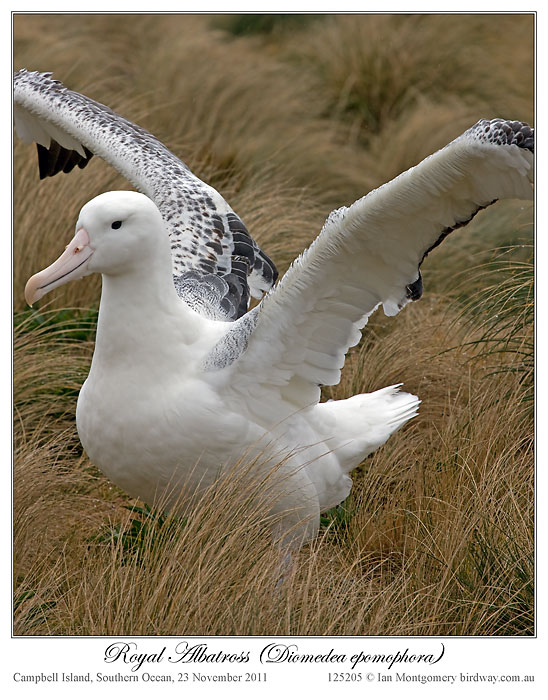
Southern Royal Albatross (Diomedea epomophora) by Ian 3
On Campbell Island, we had the opportunity to hike up path to a Southern Royal Albatross colony on a bleak, tussocky moorland. As you can see in the the third photo, things were fairly quiet when we got up there in the morning. They got busier in the afternoon when more birds arrived and some people saw greeting ceremonies, but by then, rather wet and cold, I had returned to the ship for a comforting coffee. There were strict rules about where we could leave the designated path and how close we could approach wildlife, but the albatross in the fourth photo stretching its wings flouted the rules and wandered, or blundered – they’re ungainly on land – right past me.
Southern Royal Albatross (Diomedea epomophora) by Ian 4
Albatrosses have deceptively gull-like proportions so it is a shock to realise, up-close, just how huge they are. The size record goes to the exulans race/species of the Wandering Albatross, but the Royals are not far behind and an apt comparison is with swans rather than other seabirds, ignoring length where swans have an unfair neck advantage. Southern Royal Albatrosses weight between 6.5 and 10.3kg/14.3 and 22.7lb while the heaviest flying bird, the Mute Swan, ranges between 9kg and 12kg/20 and 33lb. However Royal Albatrosses have a maximum wingspan of up to 3.5m/138in while Mute Swans range up to a mere 2.4m/94in. Just enormous in other words. The contrasting delicacy of the lacy pattern on the back is striking, and the fifth photo shows the tubular nostrils and the dark line along the mandible.
Southern Royal Albatross (Diomedea epomophora) by Ian 5
Happily, you don’t have to go Campbell Island to see these wonderful birds. Taiaroa Head, a mere 30km from the centre of Dunedin on the South Island of New Zealand, has the only mainland colony of albatrosses in the world. These are Northern Royal Albatrosses and, although I got there too late in the day to gain entry to the Royal Albatross Centre – I gave the local Yellow-eyed Penguins a higher priority – the one in the last photo flew right over me as I stood in the car park.
Northern Royal Albatross (Diomedea sanfordi) by Ian 6
Enjoy the Jubilee!
Ian
**************************************************
Ian Montgomery, Birdway Pty Ltd,
454 Forestry Road, Bluewater, Qld 4818
Tel 0411 602 737 ian@birdway.com.au
Check the latest website updates: http://www.birdway.com.au/#updates
**************************************************
Lee’s Addition:
Wow! Did you read the wingspan on those Albatrosses? 138 inches is 11 1/2 feet. That is amazing! I still just sit back in awe when I hear about these wonderfully created birds.
Guess I was too big a hurry to say I was finished. Realized that I forgot all 40 Order pages and the main Introductory Index pages. After updating almost 50 more pages, “I think” I am finished with the I.O.C. 3.1 Version update.
There was more that needed to be said, so, will do that now.
Now that the names are up to date for now, I am going to go back through each Family page and try to work on them more slowly. Hope to find more photographs for the species that are missing. Now that the “subspecies” are listed, photos for those need to be found. If you are a photographer of birds or know of any that would be willing to let their photos be used here, please contact me at: Lee@Leesbird.com. A link will be provided to your photo site or theirs in the sidebar under Photography and at the bottom of each Family page that uses a photo of yours. Or other arrangements could be made. Photography sites that list the bird’s names are the most useful. (Otherwise I have no clue as to what the bird is, especially ones from around the world.)
Also, there will other items added to the Family pages. Some general facts about the overall family will be added. Our Life List of All Birds Seen (*LLABS*) will be indicated by individual birds that we have seen. Will try to find a photo we took, besides the good ones from photographers that we use (see above).
I remember the days of old; I meditate on all Your works; I muse on the work of Your hands. (Psalms 143:5 NKJV)
Aren’t we thankful that when the LORD created the world and all that is in them, that he didn’t say, “Oops! I forgot…..?” We may make mistakes and miss a few items, but God is Perfect and nothing He does is ever a MISTAKE.
Well, I just updated the site to the newest version of the I.O.C. World Bird List – Version 3.1. It has been out for about a month, but I was busy and now finally have it finished. I have spent the last week updating almost 300 pages here. I am only one person and don’t have a staff (don’t I wish). All pages and indexes are up-to-date.
The IOC made a major update with this Version and I decided to make some changes also. I was trying to anticipate the changes coming with the Version 3, but still missed it. They added 145 extinct species of birds. There are also 20,989 subspecies added (had that right) to go with the 10,451 living species of birds in the world. They are in 40 Orders, 228 Families (plus 6 Incertae sedis), with 2257 Genera. (Now in June they are going to make more adjustments)
Have you ever questioned yourself why you do things? Working on these pages made me wonder, but I think it is still worth all the work.
Why? When I started this blog, I wanted to write about the Birds of the Bible and have been doing that since day one over four years ago. As time has progressed, this site has grown way beyond what I ever dreamed about. The Lord has given me ideas for articles, pages, references, etc. Fantastic photographers have given permission to use their photos and the whole world of birds has opened up to me. Ian let’s me use his newsletters (Bird of the Week) and he travels the world. Also ajmithra in India writes about birds there and other places. Most of all when the Lord created the birds way back in Genesis chapter 1
Then God said, “Let the waters abound with an abundance of living creatures, and let birds fly above the earth across the face of the firmament of the heavens.” So God created great sea creatures and every living thing that moves, with which the waters abounded, according to their kind, and every winged bird according to its kind. And God saw that it was good. And God blessed them, saying, “Be fruitful and multiply, and fill the waters in the seas, and let birds multiply on the earth.” So the evening and the morning were the fifth day. (Genesis 1:20-23 NKJV)
they did what He commanded them to do and now they are all over the world driving the people at IOC and other listing groups of ornithologists crazy trying to keep up with their names. Me? I am enjoying trying to find out about them and see them or pictures of them to go along with those name.
If you, my readers, never benefit from my efforts, I still am gaining knowledge of birds that I will never see in person but are so designed and created with such care that finding out about them increases my faith. While I am doing these pages and articles, my best is what I want to give my Savior.
That said, now that they are adding all these subspecies, here are some definitions of “subspecies.” They use terms like species, subspecies, monotypic, morph, etc.
From About.com Birding/Wild Birds
Definition:
(noun) A bird that is notably different from the expected characteristics of its species, but not sufficiently different to be independently classified as a unique species. Subspecies are often geographically determined, and differences such as size variations or plumage colorations are a common basis for subspecies distinctions.
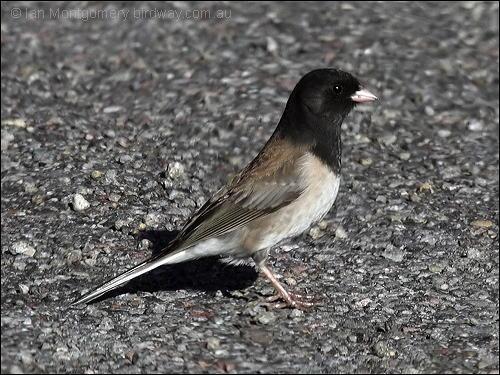
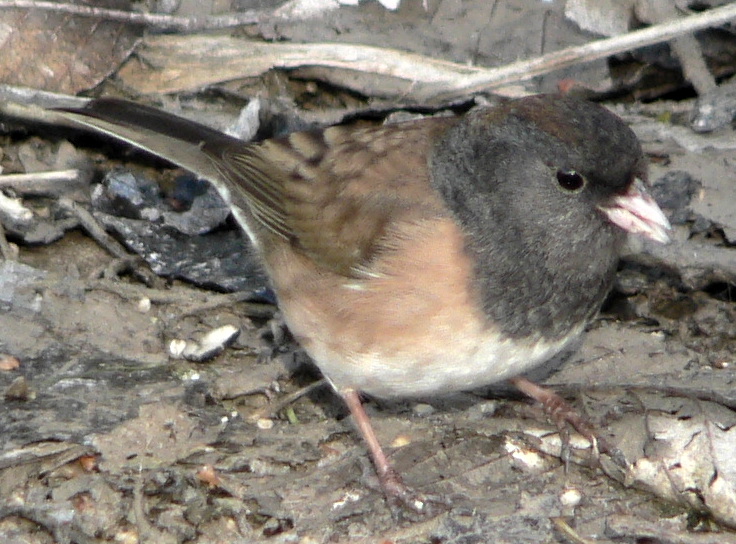
Not all bird species have distinct subspecies, and over time the classifications of different birds can change to alter subspecies into a lesser or greater number of divisions, or even to grant a subspecies distinction as a new bird species. Examples of common subspecies include the different geographic plumage variations of the dark-eyed junco, such as the eastern “slate-colored” junco and the western “Oregon” junco, as well as the southwestern subspecies of the lesser goldfinch, the “black-backed” lesser goldfinch.
While a subspecies can be noted on a birder’s life list, it does not count as an additional bird for a life list total unless the bird is reclassified as a distinct species. Many birders enjoy the extra challenge of seeing different subspecies, and comprehensive field guides will list common subspecies. These details also make a field guide more useful over time as bird classifications may change.
(adjective) Describes a species with only a single genetic or physical type and no officially recognized subspecies. While monotypic birds may still have subtle plumage or size variations, these differences are not sufficient to be distinguished as subspecies. Monotypic birds may still crossbreed with other species, though the hybrids are not independently recognized as a unique species or subspecies.
A taxonomic subdivision of a species consisting of an interbreeding, usually geographically isolated population of organisms.
subspecies
A subdivision of a species of organisms, usually based on geographic distribution. The subspecies name is written in lowercase italics following the species name. For example, Gorilla gorilla gorilla is the western lowland gorilla, and Gorilla gorilla graueri is the eastern lowland gorilla.
Species:A single distinct class of living creatures sharing specific DNA and physical features that differentiate them from other species. Species are uniform in appearance (unless other factors, described later, apply) and produce offspring with the same characteristics, appearance and DNA structure. An example of a species would be a Gouldian Finch.
Subspecies:A division within a species usually created by geographic isolation from the main (nominate) species. A population within a population (usually) sharing most of the same physical characteristics and DNA structure. A physically distinct sub-unit within an otherwise identical group of birds or animals. A subspecies can be though of as a “race” within a species. Most subspecies distinctions are visible. An example would be a (Southern race, smaller) European vs. a (larger, Northern race) Siberian Goldfinch. Other than the size, they are the same bird.






















 Lee's Birdwatching Adventures Plus