
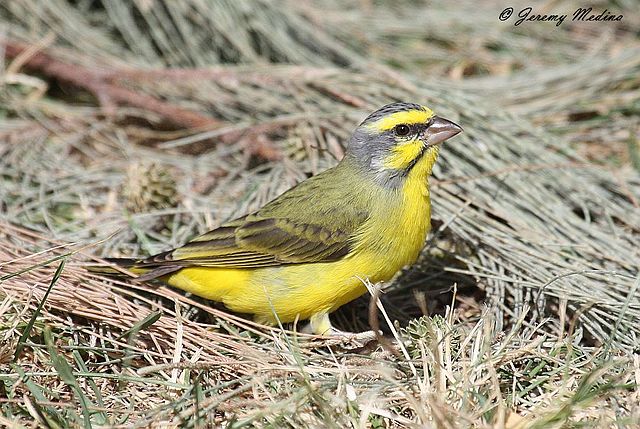
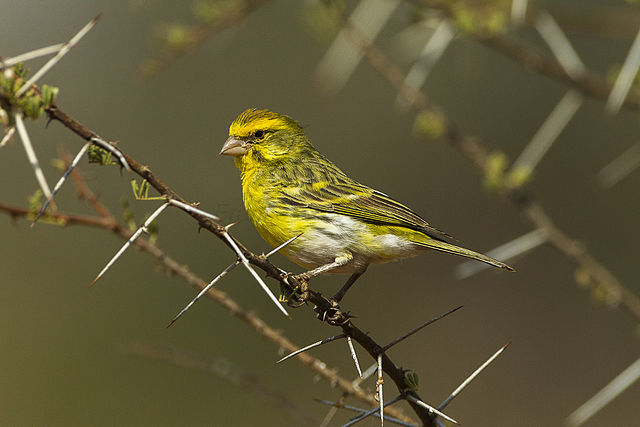
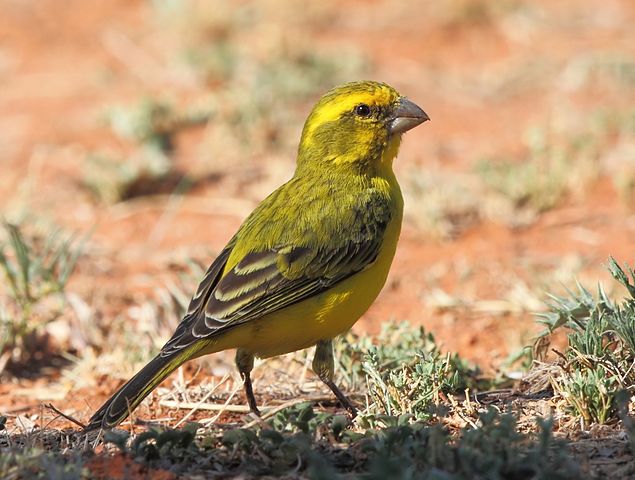
Yellow Canary (Crithagra flaviventris) Male ©WikiC
THE RESCUE OF THE CANARY BIRD
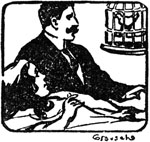
She Watched the Little Bird.
“I am going to tell you a really true story,” said daddy, “something which happened to-day. I was walking along a rather poor part of the city when I saw a number of children gathered in a group in a little side yard of a tenement house. The children were screaming to one boy: ‘Oh, catch him! Don’t let the awful cat get him!'”
“Oh, was it a bird?” asked Jack eagerly.
“Yes,” replied daddy; “it was a bird, but not just the usual kind of bird that is seen around city streets, for only the sparrows like the noise of a city. Most birds like the woods and the country, where they can have homes in the trees and can sing all day long.
“But this was a tame yellow canary who had flown out of an open window to pick up some goodies he saw on the ground, and a cat was after him.”
“Did they get him from the cat?” asked Evelyn eagerly, for she was devoted to animals and perhaps especially to birds.
“Yes,” answered daddy; “the little boy succeeded in rescuing him, but the poor canary had been so frightened that his little heart was beating, oh, so fast, and the children were afraid he was not going to live.
“They all followed the little boy who had caught the canary just in time into the tenement house. The cat had knocked several feathers from the bird’s tail.
“Another child told me the canary belonged to a little girl who lived in the tenement. He asked me to follow, too, for he said that the little girl had trouble with her back and had to lie flat all the time. She loved visitors, for so much of the time she was lonely. Her mother was poor and out all day sewing, so the little girl’s only companion was the canary, who would sing for hours and hours. He seemed to know he must keep her cheered up.
“So along I went too. We climbed some stairs until we came to a dingy room where on a cot by the window lay a little girl about eight years old. She had big dark eyes, and when I saw her her cheeks were bright red from all the excitement.
“All her friends had gathered around, each giving her a special description of how the bird had been rescued. She was smiling with joy and watching the bird, who was now busily engaged nibbling at a little piece of apple which had been given him. Before long he began to sing, oh, so joyously, for he knew he was once more back in his happy home, where he would take good care to stay in the future.
“I told the little girl of my Jack and Evelyn, and she said she wanted to see you both. Shall we all go to see her and her little bird some day?”
“We’d love to!” cried Jack and Evelyn delightedly.
Lee’s Addition:
The LORD is my rock and my fortress and my deliverer; My God, my strength, in whom I will trust; My shield and the horn of my salvation, my stronghold. (Psalms 18:2)
Another delightful story from Daddy’s book.
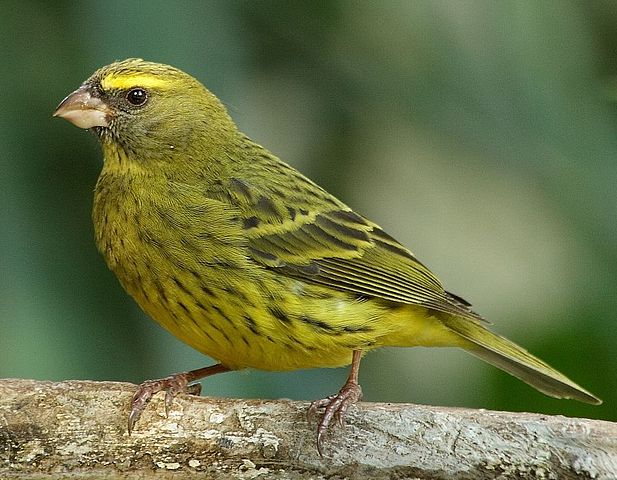
The Yellow Canary (Serinus flaviventris) is a small passerine bird in the finch family. It is a resident breeder in much of the western and central regions of southern Africa and has been introduced to Ascension and St Helena islands. They have been kept for pets for many years. They belong to the Fringillidae – Finches Family.
Its habitat is karoo and coastal or mountain valley scrub. It builds a compact cup nest in a scrub.
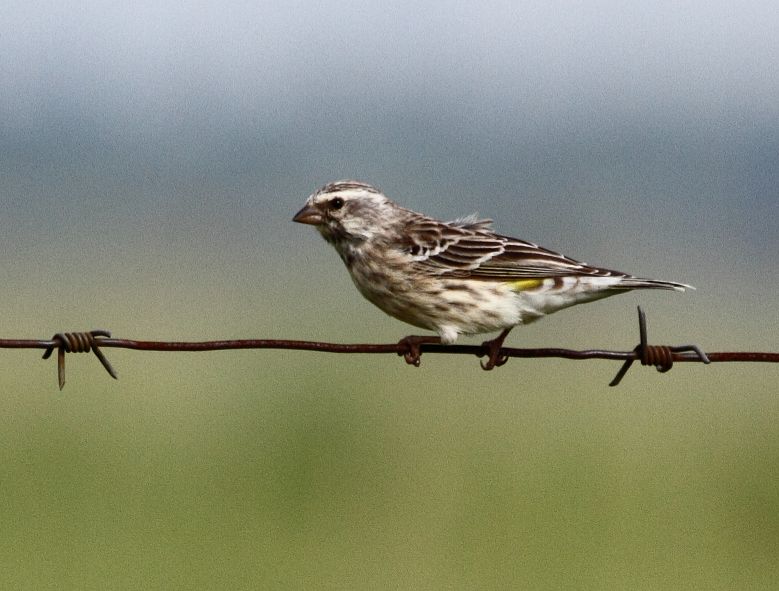
The Yellow Canary is typically 13 cm in length. The adult male color ranges from almost uniform yellow in the northwest of its range to streaked, olive backed birds in the southeast. The underparts, rump and tail sides are yellow. The female has grey-brown upperparts, black wings with yellow flight feathers, and a pale supercilium. The underparts are white with brown streaking. The juvenile resembles the female, but has heavier streaking.
The Yellow Canary is a common and gregarious seedeater. Its call is chissick or cheree, and the song is a warbled zee-zeree-chereeo.
Another Bird Tales
From
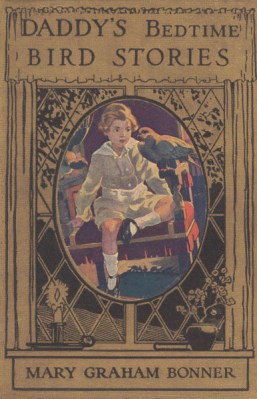
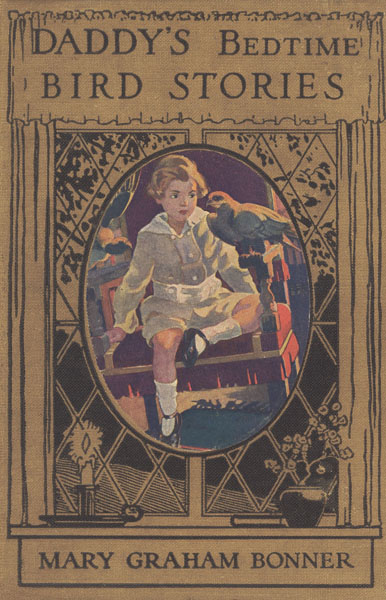
Daddy’s Bedtime Bird Stories – Gutenberg ebooks
By
Mary Graham Bonner
With four illustrations in color by
Florence Choate and Elizabeth Curtis
These stories first appeared in the American Press Association Service and the Western Newspaper Union.
Many of the sketches in this volume are the work of Rebecca McCann, creator of the “Cheerful Cherub,” etc.
*
Daddy’s Bedtime Bird Stories by Mary Graham Bonner – 1917
*
Links:

Bird Tales

Daddy’s Bedtime Bird Stories

Wordless Birds
*

Fringillidae – Finches Family
*

 Lee's Birdwatching Adventures Plus