Birds of the Bible – The Lord Provides For Them

Silver-eared Leiothrix (Leiothrix argentauris) by Ian

Silver-eared Leiothrix (Leiothrix argentauris) brightly colored-by Ian

O LORD, how many are Your works! In wisdom You have made them all; The earth is full of Your possessions. There is the sea, great and broad, In which are swarms without number, Animals both small and great. There the ships move along, And Leviathan, which You have formed to sport in it. They all wait for You To give them their food in due season. You give to them, they gather it up; You open Your hand, they are satisfied with good. (Psalms 104:24-28 NASB)

When you look at all that is around you, do you stand amazed at the Lord God’s Creative Hand or do you just think given enough time, this all came about? For me, I see an awesome Creator God that has wisdom and understanding that is way beyond my finite mind to comprehend. As I was praying and asking the Lord to help me do this article, I thought, “Lord you knew I was going to make this prayer this morning.” “You know what I’ll pray about tomorrow, and the next, and next year.” Whoa! I had to finish up my prayer and not get carried away. But, now, I had my idea for this blog today.

In Genesis 1 we learn that when the critters, birds, man and woman were created, they were vegetarians.

And God said, “See, I have given you every herb that yields seed which is on the face of all the earth, and every tree whose fruit yields seed; to you it shall be for food. Also, to every beast of the earth, to every bird of the air, and to everything that creeps on the earth, in which there is life, I have given every green herb for food”; and it was so. Then God saw everything that He had made, and indeed it was very good. So the evening and the morning were the sixth day. (Genesis 1:29-31 NKJV)

God knew that man was going to sin and that the he (man and woman) and all the critters, birds, fish, and the earth were going to be cursed. God knows the end from the beginning. “Before the mountains were brought forth, Or ever You had formed the earth and the world, Even from everlasting to everlasting, You are God.” (Psalms 90:2 NKJV) Just as He provide for man, that Jesus Christ would come to pay the price for our sins; He provided for the animals and birds so they could defend themselves from the cursed nature of other critters and birds.
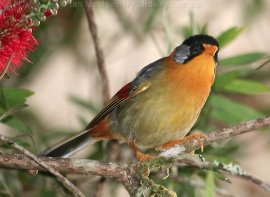
Silver-eared Leiothrix (Leiothrix argentauris) by Ian

Silver-eared Leiothrix blended in tree-by Ian

Watching birds, one of my favorite things to do, you can see God’s Protective Hand at work. The colors alone, give a clue. The male birds seem to be the most brightly colored, which helps the get a mate. Their mating helps preserve their species and the female, whose color is usually subtle, is protected as she sits on the nest. The bright colors of many birds, which I love to see, seem to blend right in with their surrounding. Again protecting them from predators.

God gave the birds a command to reproduce.  “And God blessed them, saying, “Be fruitful and multiply, and fill the waters in the seas, and let birds multiply on the earth.” (Genesis 1:22 NKJV) When they came off the Ark, He said to Noah, “Bring out with you every living thing of all flesh that is with you: birds and cattle and every creeping thing that creeps on the earth, so that they may abound on the earth, and be fruitful and multiply on the earth.” (Genesis 8:17 NKJV)

Steller's Sea Eagle (Haliaeetus pelagicus) by Lee at NA

Steller’s Sea Eagle (Haliaeetus pelagicus) by Lee at NA

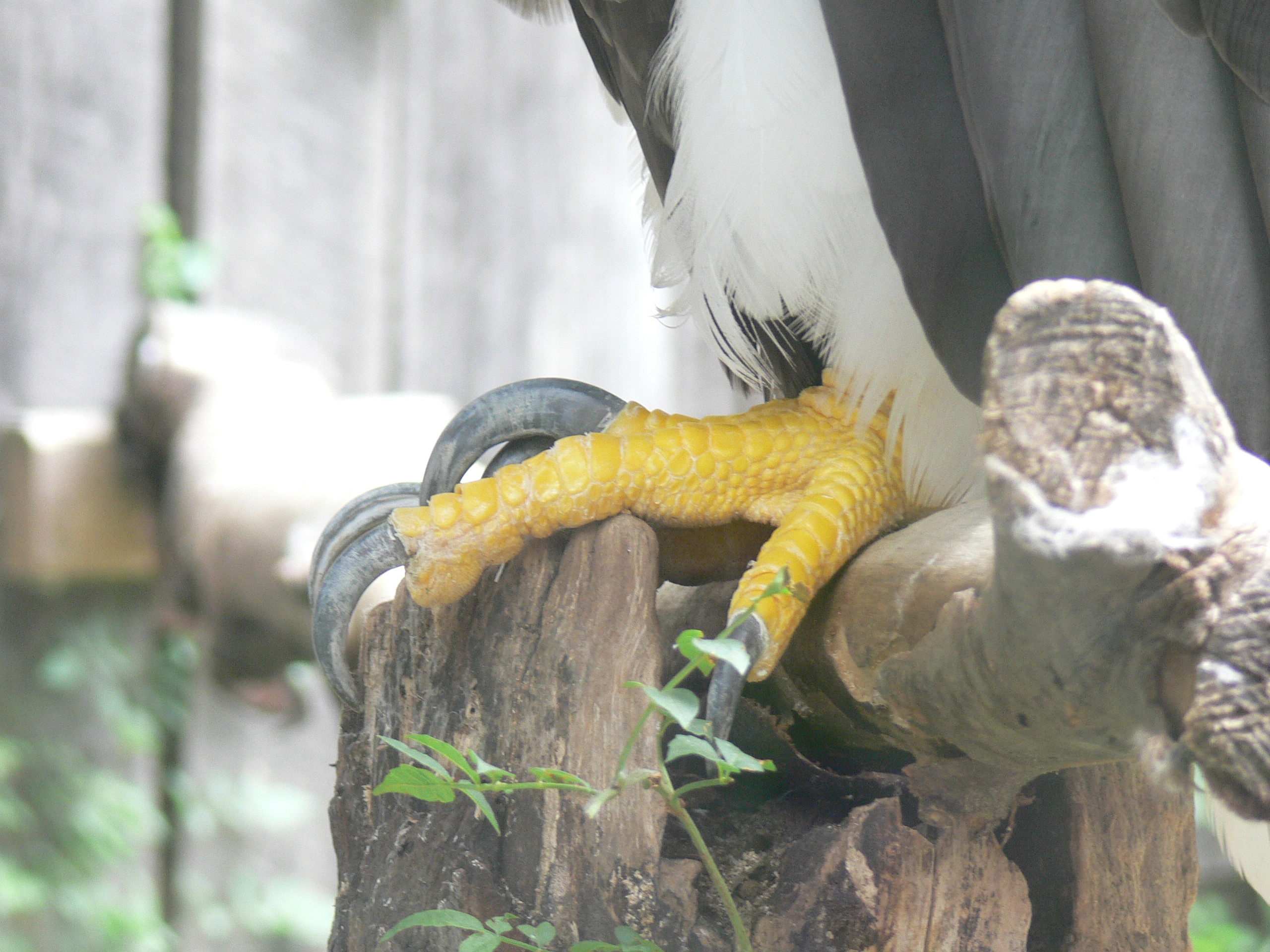
The predators!  Many of the plants before the Flood were large and thick. The beaks and claws were used to help them eat plants, now, those same beaks and claws help them catch prey. They were still provided for by God’s forethought even though that was not what the Creator wanted them to do. He knew the end from the beginning.

I could name trait after trait, where the Creator’s love, omniscience (all-knowing), omnipotence (all-powerful), and care is shown to critters and birds. Look and observe the birds and you will see that they had a Awesome Creator that knew the end from the beginning and has well provided for them.

He sends forth springs in the valleys; They flow between the mountains; They give drink to every beast of the field; The wild donkeys quench their thirst. Beside them the birds of the heavens dwell; They lift up their voices among the branches. He waters the mountains from His upper chambers; The earth is satisfied with the fruit of His works. He causes the grass to grow for the cattle, And vegetation for the labor of man, So that he may bring forth food from the earth, (Psalms 104:10-14 NASB)

What about us? Do we observe and realize the love, care, omniscience, and omnipotence in our (man’s) creation? How about your body, eyes, skin, internal organ, heart, mind? They were all fantastically created by a loving God. Yes, they are falling apart. Yes, they become corrupt. Yes, we die. That is because of the curse and the fall of man into sin.
But!

But God commendeth his love toward us, in that, while we were yet sinners, Christ died for us. (Romans 5:8 KJV)

Let me leave you with encouragement and thoughts that the Lord gave his disciples:

Therefore I say to you, do not worry about your life, what you will eat; nor about the body, what you will put on. Life is more than food, and the body is more than clothing. Consider the ravens, for they neither sow nor reap, which have neither storehouse nor barn; and God feeds them. Of how much more value are you than the birds? And which of you by worrying can add one cubit to his stature? If you then are not able to do the least, why are you anxious for the rest? Consider the lilies, how they grow: they neither toil nor spin; and yet I say to you, even Solomon in all his glory was not arrayed like one of these. If then God so clothes the grass, which today is in the field and tomorrow is thrown into the oven, how much more will He clothe you, O you of little faith? “And do not seek what you should eat or what you should drink, nor have an anxious mind. For all these things the nations of the world seek after, and your Father knows that you need these things. But seek the kingdom of God, and all these things shall be added to you. (Luke 12:22-31 NKJV)

The Wordless Birds
*

Updating Life List of All Birds We Have Seen

Golden-breasted Starling (Lamprotornis regius) at NA by Lee

Golden-breasted Starling (Lamprotornis regius) by Lee

I have been busy behind the scene working on the “Life List of All Birds We Have Seen” page. It is a work in progress. Decided to list all the birds we have seen in person, whether they were in the wild, seen at zoos or in an aviary.

When the Lord created them, He declared them very good. So why should we not have pleasure in keeping track of them, whether they are free or confined. Many in aviaries at zoos or the National Aviary are being very well taken care of and provided for. Many are being bred to preserve their species.

Praise the LORD! I will praise the LORD with my whole heart, …. The works of the LORD are great, Studied by all who have pleasure in them. His work is honorable and glorious, And His righteousness endures forever. He has made His wonderful works to be remembered; The LORD is gracious and full of compassion. (Psalms 111:1-4 NKJV)

I have put them in taxonomic order and used the I.O.C. list of names. (2.5 Version). Searching through old photos and current ones, I am trying to find as many pictures of the birds we have seen as possible. Some of the photos are what I would call a “proof shot,” which means, it’s not great, but you can tell which bird it is. Some are from scanned photos and our first digital cameras. But all links to photos on the page were taken by either Dan or I.

Demoiselle Crane (Anthropoides virgo) at MetroZoo 1989-Photo

I also contacted the Miami Metro Zoo, which had the fabulous Wings of Asia aviary before Hurricane Andrew blew it away. (Rebuilt in 2003) We had an annual pass back then and visited it quite often. That was about the time I really became a birdwatcher. They sent me a list of the birds that were in the aviary just before the hurricane. I am using those birds also on my list. I only have a few photos from there because most were taken on slides which were lost.

Anyway, the page will be updated quite frequently as photos are found and linked to the page. Hope you enjoy them and that you keep better list of the birds you have seen than I did.

See: “Life List of All Birds We Have Seen

Birds – The Engineers..

Birds – The Engineers.. ~ by a j mithra

Birds are capable of grand engineering feats. But are they engineers?  Not in the way you might think. Just as birds know how to fly, they know how to build a nest without instructions or apprenticeship. It’s a matter of instinct. Birds craft their nests without consciously thinking about it. How then did some species of birds develop such well-engineered, elaborate nests?

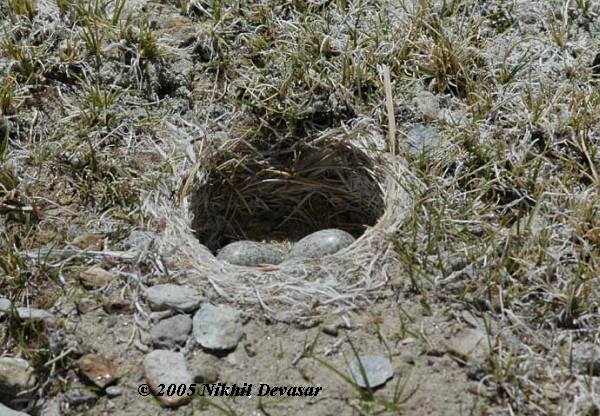
Horned Lark (Eremophila alpestris) Nest w/eggs by Nikhil Devasar

Horned Lark (Eremophila alpestris) Nest w/eggs by Nikhil Devasar

Horned Larks nests showed a significant northern bias in orientation angle and were 49% shaded in the early afternoon, the hottest part of the day. A northern nest orientation ensures maximal shading by the grass tuft to the south, may protect nests from cool evening winds, and provides increased daytime ventilation of the nest through exposure to prevailing winds. In addition, shade may also help conceal nests from predators.

  • From where did these birds learn to choose the location to build their nests?
  • Have we ever thought about the direction in which we need to have the front door of our house?
  • Is our choice based on location or direction of the house?

When JESUS becomes our direction, HE gives the best location..

I am the door: by me if any man enter in, he shall be saved, and shall go in and out, and find pasture. (John 10:9)

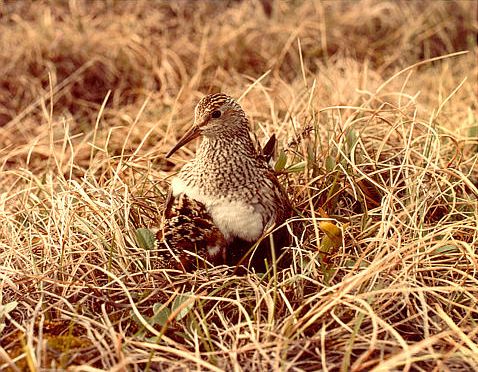
Pectoral Sandpiper (Calidris melanotos) ©WikiC

Pectoral Sandpiper (Calidris melanotos) ©WikiC

Pectoral Sandpipers nest on the arctic tundra, often near water. The nest is lined with grass, moss and lichens. They do not use lining materials according to local availability. Instead, relative use was correlated with a material’s insulative quality when wet and they therefore use lining materials appropriate to minimizing heat loss given their damp breeding environment.

And he shall be like a tree planted by the rivers of water, that bringeth forth his fruit in his season; his leaf also shall not wither; and whatsoever he doeth shall prosper. (Psalm 1:3)

Blue Tit (Parus caeruleus) by Robert Scanlon

Blue Tit (Parus caeruleus) by Robert Scanlon

Female Blue Tits gather lavender, yarrow, curry, mint and other scented plants for their nests shortly after laying eggs, and continue to do so until the chicks leave home. They are real botanists and do a great job exploiting their environment to protect their chicks. The birds make a pot-pourri of 10 aromatic plants from the 250 species in their habitat. Many of the chemicals in these plants ward off bacteria,
viruses, parasites, fungi and insects.

Our nest is covered by the blood of JESUS and no harm shall enter…

And the blood shall be to you for a token upon the houses where ye are: and when I see the blood, I will pass over you, and the plague shall not be upon you to destroy you, when I smite the land of Egypt. (Exodus 12:13)

Common Waxbill (Estrilda astrild) by Daves BirdingPix

Common Waxbill (Estrilda astrild) by Daves BirdingPix

Common Waxbills are small African finches select carnivore scat as a material to include in, on, and around their nests to reduce predation risk…

A South American Ovenbird may take months to fashion one nest from clay or mud mixed with bits of straw, hair, and fibers. The tropical sun bakes the walls brick-hard.

Bald Eagles, which use sticks, some two inches thick and several feet long, to make nests sturdy enough to support a human adult.

Chimney Swift using saliva as glue to help support its nest.


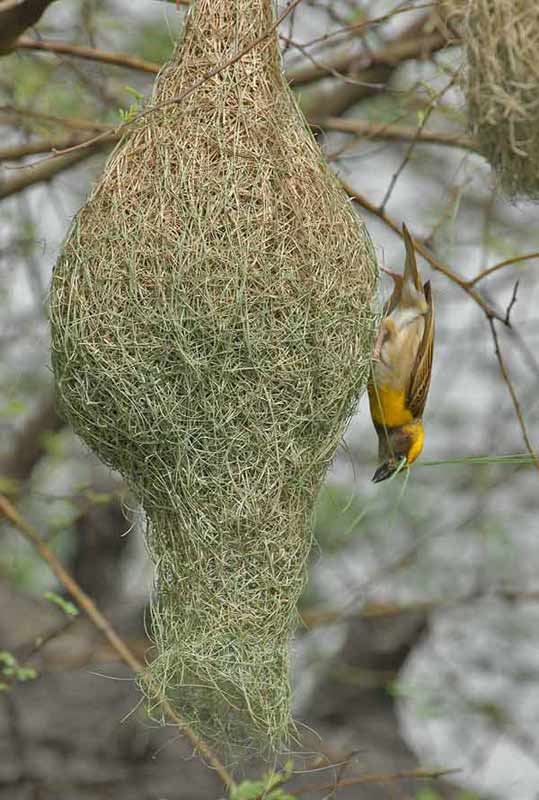
Baya Weaver (Ploceus philippinus) by Nikhil Devasar

Baya Weaver (Ploceus philippinus) by Nikhil Devasar

Baya Weaver nests in colonies of up to 20-30 pairs, usually in trees near freshwater and open ground. Their nests hang from a branch and look like an upside-down flask. A long tube leads to a side entrance,  making it difficult even for snakes to enter the nest. Nests are made entirely out of strips of grass
that the birds collect by cutting a notch in some tall grass, then stripping off a 30-60 cm long piece. A newly-made nest is green with fresh grass and turns brown as the grass dries. A bird may make up to 500 trips to complete a nest.

  • GOD has given us a home and a family with a purpose….
  • Most of us are trying hard to be like others and to live like others…
  • HE loves us as we are so; let us live the way HE wants us to live…

Sparrows never try to live like Eagles. Do they? If we are a sparrow, so be it and if we are an Eagle, so be it. After all, a sparrow cannot live like an Eagle and an Eagle cannot live like a Sparrow…

I will make a man more precious than fine gold; even a man than the golden wedge of Ophir. (Isaiah 13:12)

Bird nests vary from a simple accumulation of materials on the ground to elaborate refuges in or on secluded and elevated substrates. Nest construction and placement are correlated with flight ability. Some birds create a simple depression in the ground to harbor their incubating eggs. The progression of nest complexity moves from cryptic ground nests to simple elevated nests. Birds which construct elevated nests in a bush or tree or on a cliff or rock ledge tend to be better fliers than simple ground nesters.

  • You may be wondering why GOD has placed you as a ground nester while you desire to be an elevated nester…
  • You may be wondering why you have not got a place you feel that you deserve…
  • May be GOD feels that you would get hurt if you are an elevated nester..
  • Or maybe HE feels that you are not best equipped to be in a higher place…

Humble yourselves therefore under the mighty hand of God, that he may exalt you in due time: (1Peter 5:6)

  • GOD had HIS nest in heaven and because HE loved us so much,
  • HE stirred up HIS nest and wandered without a nest to be crucified for our sins…
  • So that HE may nest in us…
  • HE needs a nest that is why HE is knocking at the door of your heart….
  • Do you have a place for HIM to nest?

Please do not forget that HE is building an eternal nest for us live with HIM forever and ever.

Behold, I stand at the door, and knock: if any man hear my voice, and open the door, I will come in to him, and will sup with him, and he with me. (Revelation 3:2)

Have a blessed day!

Your’s in YESHUA,
a j mithra

Please visit us at: Crosstree


See:
Gospel Message

Wordless Birds

Birds of the Bible – Nests

*

Interesting Things – Most Interesting Sounds Never Heard

Northern Lights - ©WikiC

Northern Lights - ©WikiC

The Most Interesting Sounds You’ve Never Heard – from Creation Moments

The clouds poured out water: the skies sent out a sound: thine arrows also went abroad. (Psalm 77:17)

Northern Lights ©WikiC

Northern Lights ©WikiC

We are surrounded by sounds, some of which can be louder than an airliner taking off. Yet, we never hear these sounds. It’s called infrasound. It’s real sound that can be recorded if you have the right equipment.

Infrasound waves are below 20 hertz, the lowest frequency we can hear. Because the sound waves are long, they can travel hundreds or even thousands of miles. Volcanic eruptions regularly generate infrasound and so does the wind. But, perhaps most interestingly, those beautiful Northern Lights that often color the night sky also generate infrasound. The sound is produced when the incoming solar particles push the air outward. While we are not able to hear infrasound, it does influence us. Researchers in England placed an infrasound generator in a concert hall and, during the performance, infrasound was added at selected points. After the concert, the audience was asked about their emotions during certain passages of music, or if they had had experienced any strange feelings during the concert. Researchers concluded that infrasound intensified whatever emotional state the music had produced in people. So, if you have ever watched the Northern Lights and thought you were almost hearing something, it was likely the infrasound you were sensing.

Northern Lights at Fort McMurray©WikiC

Northern Lights at Fort McMurray©WikiC

The more we learn about the creation God has given us, the more we find to marvel at how excellent is His workmanship.

Prayer:
Father, You have been so generous to us, not only in the creation You have given us, but also in Your love in Christ.

Notes:
Science News, 1/10: 2004, pp. 26-28, Kate Ramsayer, “Infrasonic Symphony.”

*

Birds of the Bible – Eye Hath Seen

For since the beginning of the world men have not heard, nor perceived by the ear, neither hath the eye seen, O God, beside thee, what he hath prepared for him that waiteth for him. Thou meetest him that rejoiceth and worketh righteousness, those that remember thee in thy ways: behold, thou art wroth; for we have sinned: in those is continuance, and we shall be saved. (Isaiah 64:4-5 KJV)

Wood Duck by Dan at Lake Hollingsworth

Wood Duck by Dan at Lake Hollingsworth

When I think of the verses above and the next verse, I think of the neat birds that the Lord has created. Even though they are under the curse, some of them have fantastic colors and markings. Their sounds are so sweet (well, most of them). I imagine the Lord with the most beautiful paintbrush. What must heaven look like when many of the things we experience here are so awesome? Once the curse is removed, what will things look like then?

But as it is written, Eye hath not seen, nor ear heard, neither have entered into the heart of man, the things which God hath prepared for them that love him. (1 Corinthians 2:9 KJV)

The photos below are just of birds and it was difficult to narrow the selection, but what of all the beautiful flowers, sunsets, sunrises, scenery, and on and on. What must heaven be like? Like many of you, I am looking forward to arriving and seeing things that I can’t even imagine as the verses say.

It is not automatic to go there. A person needs to accept the Lord Jesus Christ as their personal Saviour. Please see either or all of the following:

The Gospel Message, or the Wordless Birds

(A little short this week as we are just arriving home after a two week vacation – blogs about the trip to follow later. )

I will let the Lord’s Creative Hand reveal what we see here and it is fantastic.

*

This slideshow requires JavaScript.

*

Thanks to all the great photographers who have given permission to use their photos.

*

Love and Sorrow

Many of my friends have sent me the photos of the Swallow that was hit by a car and then how her mate reacted. I found this YouTube by kirchiman1000 of that email and decided to post it. It shows the feelings and concern that birds have for each other.

The post of Skippy’s birthday a few days ago also shows how the death of their mate affects them. When the Lord created the creatures, he put the ability to love in them. We should learn from them.

But ask the beasts, and they will teach you; the birds of the heavens, and they will tell you; (Job 12:7 ESV)

As the Father hath loved me, so have I loved you: continue ye in my love. If ye keep my commandments, ye shall abide in my love; even as I have kept my Father’s commandments, and abide in his love. These things have I spoken unto you, that my joy might remain in you, and that your joy might be full. This is my commandment, That ye love one another, as I have loved you. Greater love hath no man than this, that a man lay down his life for his friends… These things I command you, that ye love one another. (John 15:9-13, 17  KJV)

He that loveth not knoweth not God; for God is love. (1 John 4:8 KJV)

Pied Kingfisher – Concentrated Diver

Pied Kingfisher (Ceryle rudis) by Peter Ericsson

Pied Kingfisher (Ceryle rudis) by Peter Ericsson

While having the privilege of obtaining some photos for future blogs from Peter Ericsson’s Galleries, I obtained a few photos of the Pied Kingfisher. I thought this Kingfisher was very pretty. Then I found this amazing video from BBC Worldwide and decided to share these. Another reason, my attempts to photograph our Belted Kingfishers is never very successful. Thankfully Peter and the videographers had better success.

When the Lord created the birds, He gave them so many amazing abilities. The way the Kingfisher keeps his head so steady is absolutely fantastic.

O the depth of the riches both of the wisdom and knowledge of God! how unsearchable are his judgments, and his ways past finding out! For who hath known the mind of the Lord? or who hath been his counsellor? (Romans 11:33-34 KJV)

The Pied Kingfisher is about 7 – 10 in or 17-25 cm long with a white with a black mask, a white supercilium and black breast bands. The female has only one breast band. The crest is neat and the upperparts are barred in black. There are several subspecies. It is common throughout sub-Saharan Africa and southern Asia from Turkey to India to China. It is resident, and most birds do not migrate, other than short-distance seasonal movements. In India it is distributed mainly on the plains. It is thought to be the world’s 3rd most common kingfisher and a noisy bird.


Fish is its main diet, though it will eat other aquatic invertebrates. It usually hunts by hovering over the water to detect prey and diving vertically down bill-first to capture fish. When not foraging, they have a straight rapid flight and have been observed flying at nearly 32 mph.

Pied Kingfisher from BBC Worldwide – Shows this diving ability

In the beginning God created the heavens and the earth. The earth was without form, and void; and darkness was on the face of the deep. And the Spirit of God was hovering over the face of the waters. (Genesis 1:1-2 NKJV)

During breeding season (February to April), they make its nest in a hole excavated in a vertical mud bank about five feet above water. The nest tunnel is 4 to 5 feet long and ends in a chamber. Several birds may nest in the same vicinity. The usual clutch is 3-6 white eggs. The pied kingfisher sometimes reproduces co-operatively, with young non-breeding birds from an earlier brood assisting parents (helpers) or even unrelated older birds.

And Jesus said to him, “Foxes have holes and birds of the air have nests, but the Son of Man has nowhere to lay His head. (Matthew 8:20 NKJV)

Kingfishers “are monogamous, teritorial, and sometimes colonial.”  Courtship displays are noisy and the displays are in duet as they raise their wings or spiral in flight. Recent suggestion is that the Pied Kingfisher and the American green kingfishers are derived from an Old World species (kind), with the Pied Kingfisher or its ancestor losing the metallic colouration afterwards. The Alcedinidae Family is where the Kingfishers and Kookaburras are found. At present there are 95 of them. They belong to the Coraciiformes Order. The Order includes Rollers, Ground Rollers, Kingfishers, Todies, Motmots, and Bee-eaters.

Pied Piper up close by IndiaVideo.org

Which doeth great things past finding out; yea, and wonders without number. (Job 9:10 KJV)

Peter Ericsson is in Thailand and is a Christian photographer. His two sites are Peter Ericsson’s Photo Galleries and his blog Thaibirder . Please visit his sites for some fantastic photagraphy.

Information taken from Wikipedia,  Complete Birds of the World, and Bird

*

White-eyes – Zosteropidae Family

Silvereye (Zosterops lateralis) by Ian

Silvereye (Zosterops lateralis) by Ian

I find the White-eyes fascinating little birds that have such a neat visible eye. The Lord has created another bird kind that has been obeying the command that it was given.

So God created great sea creatures and every living thing that moves, with which the waters abounded, according to their kind, and every winged bird according to its kind. And God saw that it was good. And God blessed them, saying, “Be fruitful and multiply, and fill the waters in the seas, and let birds multiply on the earth.” (Genesis 1:21-22 NKJV)

Cape White-eye (Zosterops pallidus) by Ian

Cape White-eye (Zosterops pallidus) by Ian

The white-eyes are small passerine birds native to tropical, subtropical and temperate Sub-Saharan Africa, southern and eastern Asia, and Australasia. White-eyes inhabit most tropical islands in the Indian Ocean, the western Pacific Ocean, and the Gulf of Guinea. Discounting some widespread members of the genus Zosterops, most species are endemic to single islands or archipelagos. The Silvereye, Zosterops lateralis, naturally colonised New Zealand, where it is known as the “Wax-eye” or Tauhau (“stranger”), from 1855. The Silvereye has also been introduced to Hawaii as well as the Society Islands in French Polynesia.

White-eyes are mostly of undistinguished appearance, the plumage being generally greenish olive above, and pale grey below. Some species have a white or bright yellow throat, breast or lower parts, and several have buff flanks. As their common name implies, many species have a conspicuous ring of tiny white feathers around their eyes. The scientific name of the group also reflects this latter feature, being derived from the Ancient Greek for “girdle-eye”. They have rounded wings and strong legs. Like many other nectivorous birds, they have slender, pointed bills, and brush-tipped tongues. The size ranges up to 15 cm (6 in.) in length.

Matthew 6:26 says, “…yet your heavenly Father feeds them.” He has made a special tongue for them to accomplish this feat.

(YouTube by Ichiro0402Nakano)

All the species of white-eyes are sociable, forming large flocks which only separate on the approach of the breeding season. They build tree nests and lay 2-4 unspotted pale blue eggs. Though mainly insectivorous, they eat nectar and fruits of various kinds. The Silvereye can be a problem in Australian vineyards, through piercing the grape allowing infection or insect damage to follow.

The White-eyes were in the Timaliidae (Babblers) Family but now are in the Zosteropidae (White-eyes) Family. (They are  constantly shuffling the families around and it is hard to maintain the web pages.) At the present time the Yuhinas and Babblers are not in with them. One thing that has kept this busy is that the White-eyes have been diversifying with rapid speciation.

“…the scientists suggest, white-eyes form new species rapidly because of their sociability, ability to survive in a variety of habitats, and a short time between generations relative to other birds. Some white-eye species may also have minimized further dispersal and gene flow by becoming sedentary over the course of evolution, similar to historically dispersive human populations that ‘settled down,’ the researchers said. “Our results indicate that high rates of diversification may have as much to do with a species’ ‘personality’ as they have to do with more classical geographic or geological drivers of ‘speciation,’ Filardi said.” (From National Geographic)

According to National Geographic’s Complete Birds of the World, the Silver-eye has migrated across 1,250 miles of open sea from between southeast Australia to Tasmania, New Zealand. That is quite a feat for birds that are only 3-6 inches long. Again, God has created much ability in these little birds.

Behold, the eye of the LORD is on those who fear Him, On those who hope in His mercy, (Psalms 33:18 NKJV)

Below is a video by Keith Blomerley of a Cape White-eye.

Birds of the World – Zosteropidae Family

*

Louisiana Weeps….

Louisiana Weeps…  – Video by a j mithra

With all the oil that is leaking into the Gulf of Mexico, at this point, Louisiana is taking a direct hit. a j mithra, who lives in India and has seen the destruction of their birds has made the following video. He told me he wept while making the video. Since he is one of our writers, I am posting it here also.

It is hard to watch not only the birds, but all of the wildlife and the people who are being harmed by this oil spill. Our hearts and prayers go out to those whose lives are being so greatly affected. Unfortunately, we are all under the curse and this is just one more example of it. One this is certain, this oil spill did not catch God by surprise.

For I reckon that the sufferings of this present time are not worthy to be compared with the glory which shall be revealed in us. For the earnest expectation of the creature waiteth for the manifestation of the sons of God. For the creature was made subject to vanity, not willingly, but by reason of him who hath subjected the same in hope, Because the creature itself also shall be delivered from the bondage of corruption into the glorious liberty of the children of God. For we know that the whole creation groaneth and travaileth in pain together until now. And not only they, but ourselves also, which have the firstfruits of the Spirit, even we ourselves groan within ourselves, waiting for the adoption, to wit, the redemption of our body. (Romans 8:18-23 KJV)

*

Interesting Things – Birds With a Memory to Envy

Birds With a Memory to Envy

Who provideth for the raven his food? when his young ones cry unto God, they wander for lack of meat. (Job 38:41)

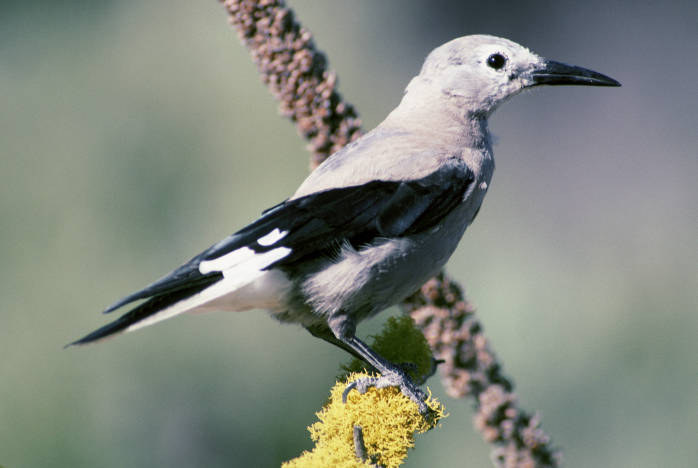
Clark's Nutcracker (Nucifraga columbiana) ©USFWS

Clark's Nutcracker (Nucifraga columbiana) ©USFWS

The shy bird, called Clark’s nutcracker, collects food during the growing season and stores it for the cold winter months. In one year, a bird will store between 22,000 and 33,000 seeds in as many as 2,500 locations, which can be more than ten miles apart. But does the little bird remember where he put all those seeds?

Biologists tracked the activity of Clark’s nutcrackers in the San Francisco Peaks in northern Arizona. A small army of researchers tracked the birds’ seed gathering and storing activities. One of the first things they discovered was that the birds quickly figured out that they were being observed. Some refused to store food when researchers were watching them. Others faked storing seeds when they were watched. Back in the lab, researchers studied the storing activity of Eurasian nutcrackers. After the birds stored seeds in a large sand floor, the birds were removed. Then the seeds they stored were dug up. When the birds were allowed to return, they quickly discovered that their seeds had been stolen, so they refused to store any more seeds. In the end, researchers concluded that the nutcrackers recover as many as two-thirds of their stored seeds within 13 months.

The remarkable memory of these little birds is their gift from God that enables them to be fed all year around.

Prayer: Father, I thank You because You are gracious and generous, not just to the birds, but also to me. Amen.

From Creation Moments©2010 – References: Science News, 2/14: 2004, pp. 103-105, Susan Milius, “Where’d I Put That?”


The Clarke’s and Eurasian Nutcrackers are part of the Corvidae Family of Crows, Jays, and Allies. The Passeriformes Order they are in has at present 123 Families (IOC 2.4).

Wordless Birds

*

Interesting Things – Birds Making Music?

Do Birds Truly Make Music?

The flowers appear on the earth; the time of singing has come, and the voice of the turtledove is heard in our land. (Song of Solomon 2:12)

The Bible speaks of bird calls as songs, as most of us do. However, evolutionary theory has led some scientists to say that we are merely assigning human meanings to the calls of birds. They say that the bird calls have nothing to do with real music.

Common Starling (Sturnus vulgaris) by Quy Tran

Common Starling (Sturnus vulgaris) by Quy Tran

Ornithologists have known for some time that bird songs use the same musical scales as our music. Decades ago it was noted that some of Beethoven’s work could be heard from the European blackbird. The music was the same as the opening rondo of Beethoven’s “Violin Concert in D, Opus 61.” Since these birds pass their songs from generation to generation, Beethoven could have gotten the lilting music from the forefathers of today’s European blackbird! The songs of some species, like the song sparrow, follow the form of a sonata, beginning with a strong theme, then the theme is musically played with, and for a finish, the original theme is then repeated.

Song Sparrows song by Chris Parrish (xeno.canto.org)

Mozart had a starling as a pet. Once, having heard Mozart play his “Piano Concerto in C Major,” the starling not only imitated it, but changed the sharps to flats! Mozart exclaimed, “That was beautiful!” When the starling died, Mozart held an elaborate funeral for it. Eight days later he wrote “A Musical Joke,” which contains the same elaborate structure found in starling song.

A Musical Joke by Mozart

Do birds make true music, as the Bible says? Contrary to what some evolutionists say, Beethoven and Mozart certainly thought they did.

Prayer: Lord, I thank You for the gift of music, and I await the music of heaven. Amen.

From (Creation Moments©2010) References: Science News, 4/15/00, pp. 252-254, “Music without Borders.”


Snowflake and the Eye

Snowflake and the Eye by Ian Juby

Ian Juby has made another “Rant.”  This one is about evolutionist’s claim about how the eye is poorly designed and that there is no intelligent designer that made it. He does these spoofs because of some of the unintelligent remarks made by evolutionists.

He, like those of us here, believe that we have a very Intelligent Designer called the Creator. We believe the Lord Jesus is this creator. The birds we write about sure enjoy their Intelligently Designed eyes.

and to make all see what is the fellowship of the mystery, which from the beginning of the ages has been hidden in God who created all things through Jesus Christ; (Ephesians 3:9 NKJV)

Below is his “rant” and we have many of Ian Juby’s videos in the Complete Creation by Ian Juby in our Plus Section under the Creation Topics