Bird Nests are Important — the Bible Says So

Dr. James J. S. Johnson

BIRD NESTS ARE IMPORTANT: THE BIBLE SAYS SO

And Jesus said unto him, Foxes have holes, and birds of the air have nests; but the Son of man hath not where to lay his head.  (Luke 9:58)
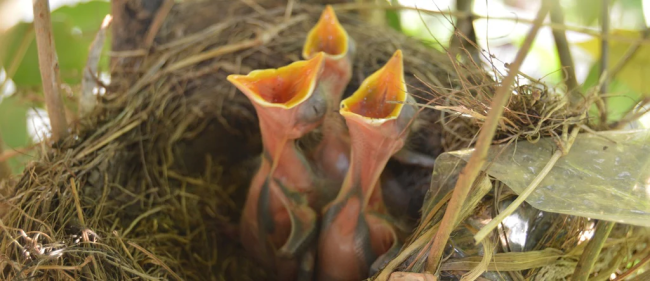
Hungry nestlings! (WhirlyBird photo credit)

NEST – this simple word “nest” represents an enormously important part of a bird’s life.  

Do you recall the first times you ever saw a bird nest, close up? Did you realize, then, that the nest was “home” to the birds who resided therein?

A baby bird’s beginning is experienced inside a nest.  From embryonic egg to hatchling, from hatchling to fledgling, a baby bird’s life adventures are “hatched” inside a nest of some kind.  Consequently, nests are the childhood homes to young nestling birds, plus parent birds repeat their multi-generational nest life as they reproduce and nurture their own next generation of their kind.

For most birds, springtime means mating, and mating time means nesting.  As soon as nesting begins in earnest, everything changes.  The earth becomes quieter, the sight of a bird [displaying to attract a prospective mate] rarer.  Despite the seeming tranquility, there’s much ado and excitement among the birds.  The joy of expressing the springtime, of finding or reclaiming a mate, has been exchanged for the silence and secrecy of very private moments as birds begin the work of creating their homes. 

[Quoting Sharon A. Cohen, BIRD NESTS (Harper Collins, 1993), page 7.]
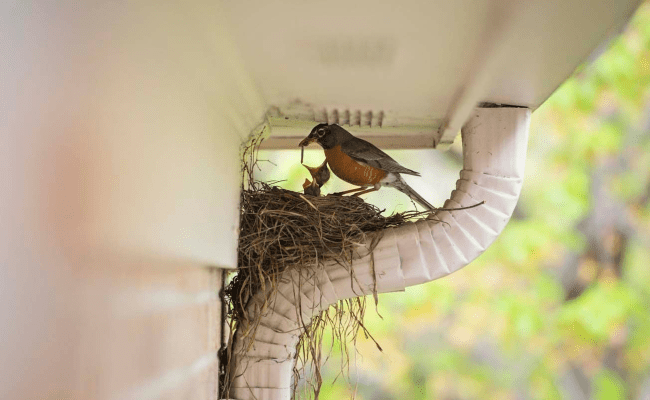
GUTTER NEST! (Bob Vila photo credit)

And what a variety of nests there are, because God has programmed different birds to build and indwell different types of nests. 

Some nests are mere scrapes upon a strategic patch of ground.  Other nests are burrowed underground.  Many are designed to be camouflaged or otherwise hidden.  Some nests are tree-nestled demitasses.  Some nests are holes on the sides fo trees or cacti.  Some nests are mostly reshaped mud.  Some nests are located on shorelines of freshwater, brackish water, or oceanic seashores. Some nests are in rocks, often at high altitudes. 

Many bird nests go unnoticed by human eyes, yet our Heavenly Father always notices and cares about bird nests, everywhere and at all times.

Are not two sparrows sold for a farthing? And one of them shall not fall on the ground without your Father.  (Matthew 10:29)

The diversity of avian nesting habits displays God’s love for variety, as one would expect, since we see countless proofs of God’s love of variety in how animals (including birds of all kinds) are fruitful, multiply, and fill niches all over the earth. [See JJSJ, “Valuing God’s Variety”, posted at www.icr.org/article/valuing-gods-variety  —  see also JJSJ, “God Fitted Habitats for Biodiversity”, posted at www.icr.org/article/god-fitted-habitats-for-biodiversity .]
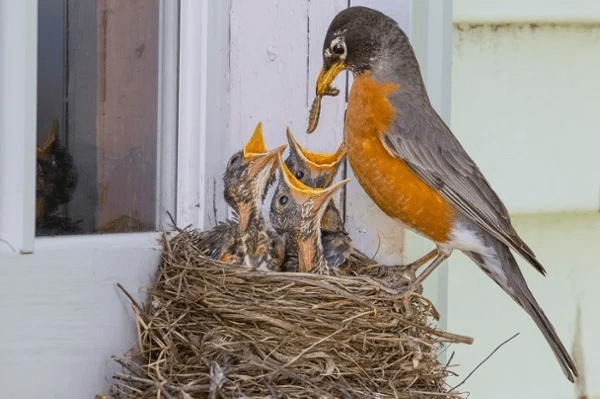
ROBIN NEST (Bird Barrier photo credit)

Accordingly, expect to find variety in bird nests.

A hummingbird hovers over a spider’s web, spending several seconds latching onto a thread of silk [to be incorporated as stabilizing material for the hummer’s coin-sized nest].  A woodpecker suspends his tree-drumming and instead works on excavating a nest hole with his mate.  A shorebird slinks into a quiet area unnoticed and lays her single egg on [a strategically selected patch of] bare sand.  In the privacy of their own world[s], often far beyond human ken, birds settle down to build their nests and breed young.  After mating takes place, attracting attention is no longer a priority.  Instead it is protecting the nest and incubating eggs that matter.  All living beings are driven to reproduce, and most lay eggs.  What makes birds different form other egg-laying creatures is that the embryo inside each egg is as warm-blooded as a human, and like a human, requires the warmth provided by its parent, or by an adequate substitute, to develop and to thrive.  Because it is so fragile, the egg must be coddled in a secure place until its occupant is ready to leave and face the rigors of the outside world.  Encased in its [calcium carbonate-structured] shell, the tiny chick’s only hope is that its parents [or foster-parents] do know what is best.  The nest the adult birds provide furnishes the warmth and protection necessary for the chicks’ survival.

[Quoting Sharon A. Cohen, BIRD NESTS (Harper Collins, 1993), pages 7-8.]

Nest are so important – because God made them to have value  —  that we should expect them to be mentioned within the HOLY BIBLE’s pages. 

Sure enough, the holy Scriptures refer to bird nests, repeatedly.  A few such examples follow.

Before reviewing those examples, however, it is worth noticing that the usual Hebrew noun translated “nest” is qên, which first appears in Genesis 6:14 (referring to “homes” aboard Noah’s Ark), where the King James Version of the English Bible translates it as “rooms”.  Yet, even in that Ark housing context, a qên was one of many temporal “homes” (i.e., onboard chambers, like “cabins” or “staterooms” within an ocean-faring cruise ship), used for security and protection from hostile external conditions.  Based upon etymologically related Hebrew words it appears that the underlying connotation is the idea of specifically claimed property (i.e., acquired and possessed as “private” property) that belongs to a specific individual, or to a specific group (such as a specific family).

OSPREYS NESTING
(photo credit: Massachusetts Wildlife)
  1. Location, location, location —  where you nest matters! 

Where a bird nest is positioned is important.  Maybe the best place for a nest—such as an Osprey nest—is high upon a relatively inaccessible rocky clifftop, or within the higher branches of a tall tree.  [See Donald Stokes & Lillian Stokes, A GUIDE TO BIRD BEHAVIOR, Volume III (Little Brown & Co., 1989), page 163.]

And he looked on the Kenites, and took up his parable, and said, ‘Strong is thy dwelling-place, and thou puttest [i.e., you position] thy nest in a rock.’  (Numbers 24:21, with “nest” [qên] as noun)

And for many large birds of prey, such as eagles, nesting in high places is the way to go.  (Perhaps such birds feel “high and mighty”!)

Thy terribleness hath deceived thee, and the pride of thine heart, O thou that dwellest in the clefts of the rock, that holdest the height of the hill: though thou shouldest make thy nest as high as the eagle, I will bring thee down from thence, saith the Lord. (Jeremiah 49:16, with “nest” [qên] as noun)

Though thou exalt thyself as the eagle, and though thou set thy nest among the stars, thence will I bring thee down, saith the Lord.  (Obadiah 1:4)

Woe to him that covets an evil covetousness to his house, that he may set his nest on high, that he may be delivered from the power of evil!   (Habakkuk 2:9, with “nest” [qên] as noun)

No need for humans to feel “high and mighty” – God resists the proud but he upholds the humble-hearted.  (And pride routinely “goeth” before a fall.)

2. Multi-generational reproductive success is priority!

Birds of prey include hawks, eagles, owls, and more. Yet birds themselves are often prey to predators of many kinds, including humans who eat birds, both domesticated and wild—such as chicken, turkey, goose, and the eggs fo many kinds of birds.  But if one generation of predators greedily consumes all of a prey population, the next generation of those predators would be deprived of a food source, which would be harmful to both the predator population and the prey population.  Accordingly, it is good for a generation of predators to only eat a limited amount of a prey population, so that future generations of both predators and prey can benefit (form continued reproductive success of the prey population.  That stewardship principle—applying restraint in lieu of greedy wastefulness—is what Moses commanded the Israelites as a conservation law for their future entry into and settlement in the Promised Land of Canaan.

If a bird’s nest chance to be before thee in the way in any tree, or on the ground, whether they be young ones, or eggs, and the mother sitting upon the young, or upon the eggs, thou shalt not take the mother with the young; but thou shalt in any wise let the mother go, and take the young to thee; that it may be well with thee, and that thou mayest prolong days.  (Deuteronomy 22:6-7, with “nest” [qên] as noun)

3. Nests are where good parenting is needed!

How eagle parents treat their young has been a subject of some confusion over the  years, due to a less-than-clear-and-accurate translation of Deuteronomy 32:11.  That confusion has already been addressed in “Clarifying Confusion about Eagles’ Wings”, posted at  https://leesbird.com/2022/09/27/clarifying-confusion-about-eagles-wings/   —   so that discussion will not be repeated here.  Suffice it to say, here, that eagle parents care for their young!  Like many—but not all—animal parents, eagle parents go to great efforts to raise their nestling children, training them for life as fledglings.

As an eagle, he [i.e., God, in relation to His people Israel] stirs up his [i.e., God’s] nest, he {i.e., God] flutters over his [i.e., God’s] young, he [I.e., God] spreads abroad his [i.e., God’s] wings, he [i.e., God] taketh them, he [i.e., God] bears them [i.e., the Israelites as God’s people] on his [i.e., God’s] wings…. (Deuteronomy 32:11, literal translation, with editorial clarifications, with “nest” [qên] as a metaphoric noun)

This is comparable to how the Lord Jesus Christ compared His willingness to protect Jews to a mother hen’s protectiveness, as demonstrated in her welcoming and refuge-providing wingspread, noted in Matthew 23:37 and also in Luke 13:34.

4. Nests should be places of domestic security: “home sweet home”.

Then I said, I shall die in my nest, and I shall multiply my days as the sand.  (Job 29:18, with “nest” [qên] as noun)

The patriarch Job, unto his “friendly” counsellors, once lamented his former life of blessing, before his torturous trials were suddenly dumped upon his head. Job related how he expected to live a long life of uninterrupted blessing, ultimately dying at peace in his own “nest” (i.e., “home sweet home”).  But, God had other plans—ultimately better (albeit bumpier) plans for Job’s earthly pilgrimage.

5. The ability, of birds to make nests, is God-given, i.e., God-programmed.

Doth the eagle mount up at thy command, and make her nest on high?  (Job 39:27, with “nest” [qên] as noun)

The eagle has designed (i.e., pre-programmed) abilities and inclinations to make its nest in high places, and to mount up into the air suing thermal air currents.  The eagle did not invent these designed traits – God designed the eagle’s physical traits and pre-programmed abilities, including the know-how (and the how-to) needed for successfully building eyries atop high montane places or in trees. [For more on this Scripture about eagle behavior, see “JOB Chapter 39:  God’s Wisdom and Providence, Exhibited in Wildlife Pair””, posted at  ttps://rockdoveblog.wordpress.com/?s=Job+39%3A27 .]

6. Nests are for raising children, i.e., the next generation.

Yea, the sparrow hath found a house, and the swallow a nest for herself, where she may lay her young, even thine altars, O Lord of hosts, my King, and my God.  (Psalm 84:3, with “nest” [qên] as noun)

Notice that the sparrow’s “house” is parallel in meaning to the “nest’ of the swallow.  In other words, a “nest” is a “house” for dwelling in, and especially for raising young in.

7. Particular types of nests are selected according who will be living therein.

Where the birds make their nests: as for the stork, the fir trees are her house.  (Psalm 104:17, with “nest” [qânan] as verb)

In the above-quoted psalm we are reminded that storks are known to make their homes within the branches of fir trees.  (Storks are also known as predictable migrants—see Jeremiah 8:7, described in “A Lesson from the Stork”, posted at www.icr.org/article/lesson-from-stork .)

8. Wandering from the security of the nest can lead to many dangers.

As a bird that wanders from her nest, so is a man that wanders from his place.  (Proverbs 27:8, with “nest” [qên] as noun)

For it shall be, that, as a wandering bird cast out of the nest, so the daughters of Moab shall be at the fords of Arnon.  (Isaiah 16:2, with “nest” [qên] as noun)

One of the advantages of many bird nests is camouflage—being hidden form the sight of hungry predators.  There is a security that comes with staying inside one’s proper home.  Not that any home (or nest) is “bulletproof” from danger, but there are often many more dangers lurking about, the farther that one wanders away from home. (The same is true for young who are expelled from home.)  Consequently, the high mortality rate is why birds routinely try to raise more hatchlings than themselves.  In other words, two parent birds need to strive for replacing themselves with more than just two children, in order to mitigate the risks that their progeny will become prey (literally “dead meat”) before they progeny can successfully reproduce the next generation. 

[The overall concept of multi-generational replacement, as a matter of population biology, is discussed in “Post-Flood Repopulation:  From 8 to 8,000,000,000!” posted at  www.icr.org/article/post-flood-repopulation-from-8-8000000000 .]

9. Bird eggs are a valuable source of good (i.e., nutritionally rich) food.

And my hand hath found as a nest the riches of the people: and as one gathers eggs that are left, have I gathered all the earth; and there was none that moved the wing, or opened the mouth, or peeped.  (Isaiah 10:14, with “nest” [qên] as noun)

Isaiah stated the obvious—eggs are valuable; in fact, they are like a store of “riches”, nutritionally speaking.  This nutrition fact concurs with the mention of eggs as a “good” food, in contrast to bad food.  See Luke 11:11-13, where giving eggs to eat is recognized (by Christ Himself, the Creator of all food) as “good gifts to your children”.   

10. Places are recognized as “wild places”, if dominated by many predators.

There shall the great owl make her nest, and lay, and hatch, and gather under her shadow; there shall the vultures also be gathered, everyone with her mate. (Isaiah 34:15, with “nest” [qânan] as verb)

The context of this somber prophecy, of Isaiah, is God judging (i.e., punishing) the Edomites, because of the Edomites’ wicked mistreatment of Israelites (see Isaiah 34:6-8), with the resultant desolation of the Edomites’ land—which punitive desolation to include Edomite lands becoming overtaken by birds of prey (se Isaiah 34:10-16).  Thus, if Edomite lands are, in the prophesied future, dominated by the nests of predatory animals—including predatory birds—such lands are to be recognized as “wild places” (wildernesses), not fit for human habitation.

11. Flexibility increases opportunities to “fit” and “fill” different situations

O ye that dwell in Moab, leave the cities, and dwell in the rock, and be like the dove that makes her nest in the sides of the hole’s mouth.  (Jeremiah 48:28, with “nest” [qânan] as verb)

Doves, which include pigeons, are famous for adjusting themselves to the most diverse of habitats.  Years ago, this writer (with family) was exploring an underground “lava tube” cave at Craters of the Moon park, in Idaho.  Inside this most inhospitable venue, perched within a crack in the cavernous ceiling, there was a nest with two pigeons therein!  Doves can live successfully almost anywhere – they are peaceful, yet flexible and opportunistic.  

12. Tree branches are often a hospitable home for nesting birds.

All the fowls of heaven made their nests in his boughs, and under his branches did all the beasts of the field bring forth their young, and under his shadow dwelt all great nations. (Ezekiel 31:6, with “nest” [qânan] as verb)

The tree that thou sawest, which grew, and was strong, whose height reached unto the heaven, and the sight thereof to all the earth, whose leaves were fair, and the fruit thereof much, and in it was meat for all; under which the beasts of the field dwelt, and upon whose branches the fowls of the heaven had their habitation. (Daniel 4:20-21)

Even in Nebuchadnezzar’s dream he recognized that tree branches (a/k/a boughs) are good sites for bird nests!

Saving the best for last: Christ prepared for bird homes via nesting habitats and nesting skills.

And Jesus saith unto him, The foxes have holes, and the birds of the air have nests; but the Son of man hath not where to lay his head.  (Matthew 8:20, with “nests” [κατασκηνωσεις] as noun)

And Jesus said unto him, Foxes have holes, and birds of the air have nests; but the Son of man hath not where to lay his head.  (Luke 9:58, with “nest” [κατασκηνωσεις] as noun)

Behold the kindness of our Lord Jesus Christ:  He did not insist on having a “home” when He came to Earth to be our Savior.  However, as our kind Creator He even prepared fitting homes fo His animal creatures, such as foxes and “birds of the air”.

Speaking of “home”, it is the very Creator-Redeemer, our Lord Jesus Christ, Who is our true home.

Accordingly, settling (domesticating) specific niches in the earth—even migratory stopover homes—and utilizing home bases for family life activities is needful to fill the multitude of Earth’s multifarious habitats. To achieve this goal, God has providentially equipped creatures with physical bodies (with helpful anatomies and physiologies) and programmed bio-informational instructions (coding and equipping for habitat-interactive behaviors) that are fitted to the dynamic challenges of physical environments (and biotic communities) all over the globe. As earthbound pilgrims, we pass through this mortal life (Hebrews 11:131 Peter 2:11), interfacing with an all-too-often hostile culture (Hebrews 11:36-38). We long for a truly secure home—where we really belong.

But, as Christians, what is our true home? It is not residential real estate housing (Philippians 3:20Hebrews 11:8-14). Our true homes are not even the earthly bodies that we temporally inhabit, although they are the “tents” we know best (2 Corinthians 5:1-42 Peter 1:13). For Christians, ultimately, our real eternal home is God Himself (Psalm 90:12 Corinthians 5:6John 14:2-6). As our Creator, He started us. As our Redeemer, we finish with Him. What a homecoming we wait for!

[Quoting from “Why We Want to Go Home”, posted at www.icr.org/article/why-we-want-go-home .]
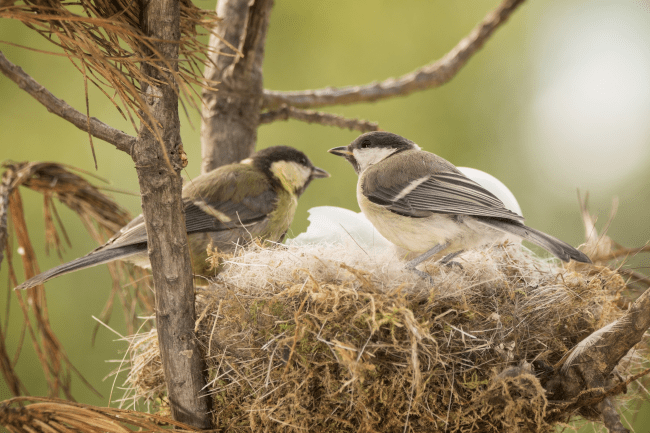
“HOME SWEET HOME” (The Spruce photo credit)

Maybe there are more examples, of bird nests being mentioned in Scripture.  But, at least, the examples listed above show that bird nests are important, so important (to God) that they merit repeated mention, in the only book that God Himself wrote.
So, Who Coos From The Rooftop?

Dr. James J. S. Johnson

So, who coos from the rooftop?

Like a crane or a swallow, so did I chatter; I did mourn as a dove; mine eyes fail with looking upward; O LORD, I am oppressed — undertake for me. 

(Isaiah 38:14)

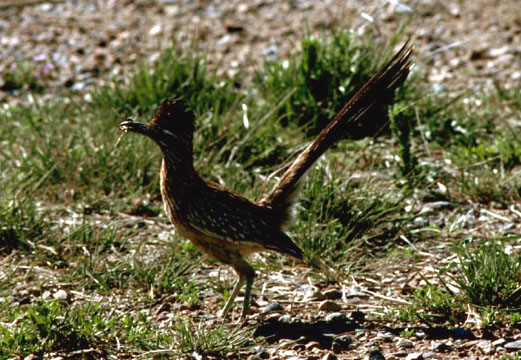
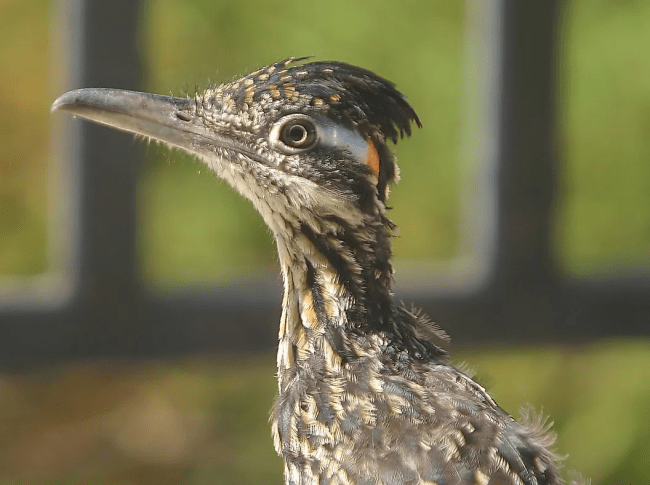
On Tuesday afternoon, earlier this week, after commuting home from work, I parked my van in front of my house, preparing to enter my home at the end of a tumultuous day.  But, as I walked from the driveway toward my front door, I heard a strange-sounding bird, emitting a repetition of low-moaning-like noises, like a somewhat-sick dove might sound as it tried to “coo” (which is why some doves are called “mourning doves”).  As I looked above, from where the sounds were originating, I saw an odd bird, much bigger than a dove, perched atop the roof of my house – it was a Greater Roadrunner!

Isaiah the prophet knew that doves can make moaning noises, as if mourning. But other birds can make similar noises, too.

ROADRUNNER Gary Stolz / USFWS (public domain) photo credit

After gazing up at the Roadrunner, who ignored me, I went inside and quickly fetched my handiest bird-book, and soon noticed the following information on the book’s page regarding the Greater Roadrunners (Geococcyx californianus):

“Voice: Six to eight low, dove-like coo’s, descending in pitch.”

[Peterson Field Guides, noted below]

[Quoting Roger Tory Peterson, A FIELD GUIDE TO WESTERN BIRDS (Boston, MA: Houghton Mifflin / PETERSON FIELD GUIDES, 3rd edition, 1990), page 212.]

Bingo! What a perfect description of what I had been hearing near my front door. 

ROADRUNNER / WorldAtlas.com photo credit

Then my imagination got to thinking.  Imagine a rat, or a snake, that hears that cooing on the ground, behind one of the thick bushes.  What if that hungry rat, or snake, wrongly guessed that the low-moaning cooing noises were clues of a nearby mourning dove nest, where tasty dove eggs (or dove hatchlings) might be located?  If any such rat, or snake, made such a mistaken guess —  OOPS!  Its last thought might be that a hungry roadrunner can sound like a dove!

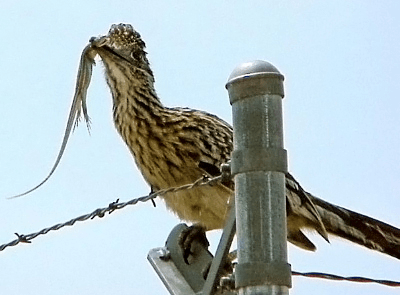
Such a mistake could be fatal, of course, because roadrunners often eat snakes and small rodents, as well as small lizards, etc.

ROADRUNNER with lizard / U.S. Army (public domain) photo credit

Ironically, mourning doves often frequent the bushes next to my house; sometimes they perch atop the rooftop.  That means our roadrunners sometimes “shadow” the meanderings of our mourning doves. 

Someone once said that “curiosity killed the cat” —  well, sometimes curiosity might kill a rat.

Serpents and Doves

Author’s note: if you’re terrified of snakes, don’t scroll past the first four paragraphs!

Matthew 10:16 “Behold, I send you forth as sheep in the midst of wolves: be ye therefore wise as serpents, and harmless as doves.”

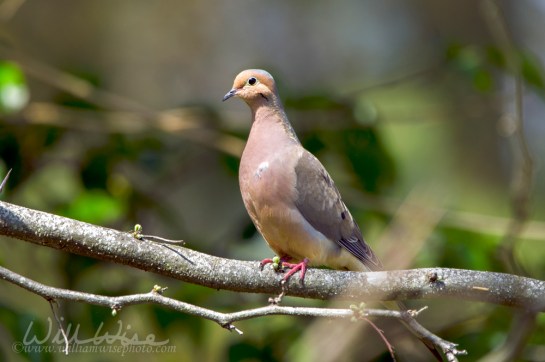
Mourning Dove. Walton County, Georgia. March 24, 2017. ©www.williamwisephoto.com.

Jesus threw an interesting paradox before us when he preached, “Be wise as serpents, and harmless as doves.” The outcome of combining these two critters can be quite perilous… primarily for the dove! Snakes are often found raiding birds’ nests, seeking to devour eggs and chicks. So why this conflicting counsel from our Lord?

A.B. Bruce writes, “The serpent is the emblem of cunning, the dove of simplicity. No creatures can be more unlike; yet Jesus requires of His disciples to be at once serpents in cautiousness, and doves in simplicity of aim and purity of heart. These qualities are not easy to combine; yet the combination is not impossible.”

Christians must have serpent-like wisdom and shrewdness in order to make a stand for righteousness in the arena of worldly politics and social unrest; yet have dove-like care and compassion to peacefully present the gospel and welcome the sin-suffering into the flock of God.

The apostle Paul was wise-as-a-serpent when utilizing his status as a Roman citizen to escape being mauled by a crowd and unlawfully flogged by the local police. Yet, his dove nature remained on top as he stood for Christ while on trial, even though it may not have been advantageous to his personal outcome. And it may have been a prudent idea for Peter to distance himself from a leader that was arrested for insurrection, but the serpent devoured the dove as he publicly declared thrice, “I know not the man.”

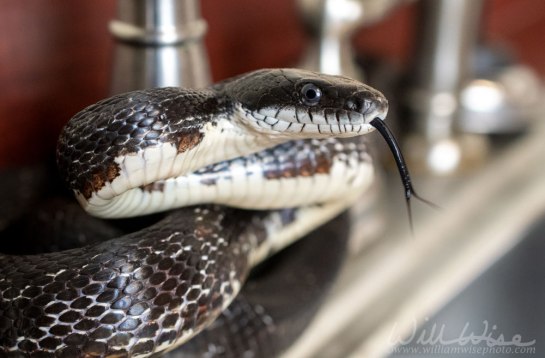
Eastern Ratsnake coiled in a kitchen sink. Pantherophis alleghaniensis is a common snake found in the eastern United States. Walton County, Georgia. June 30, 2020. ©www.williamwisephoto.com.

Losing the Balance…

I was a bit saddened this past week to watch events unfold in our small town. Citizens from our city, as well as agitators from out-of-town, gathered to condemn our public safety officers and demand the defunding of the police department. But that is not what saddened me, for peaceful protests are the American way.

Another group of citizens – many from the local churches – also gathered to show support for our people in uniform. Here was the perfect Christian balance: the “dove nature” desired peace and unity in our community; and the “wise-as-serpents nature” was making a stand for righteousness in the political arena. But as passions rose, the serpent began to swallow the dove…

One gentleman who identified himself as local Christian minister, had his microphone snatched away by a protester. In frustration, the minister shoved the protester to the ground. Of course, the media was there to photograph the incident and title it, “Preacher Assaults Protester.” Sadly, the serpent had swallowed the dove when the Christian man lost his temper.

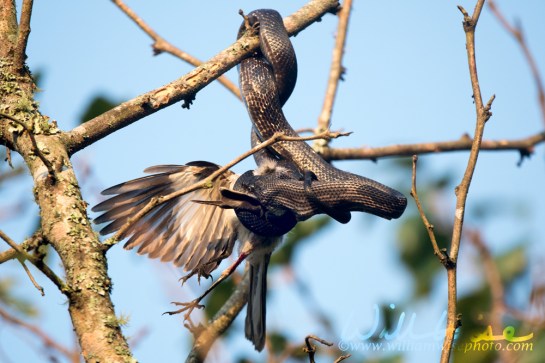
SORRY FOR THE GRAPHIC CONTENT, BUT IT EXEMPLIFIES THE DAMAGE DONE WHEN THE SERPENT OUTWITS THE DOVE IN OUR CHRISTIAN CHARACTER. Eastern Ratsnake devouring a Mockingbird; Walton County, Georgia. August 13, 2019. ©www.williamwisephoto.com.

Let us at least be doves…

A.B. Bruce continues, “Happy are they who can be both serpent and dove; but if we cannot, let us at least be doves. The dove must come before the serpent in our esteem, and in the development of our character. If we invert the order, the dove will be devoured by the serpent: the cause of truth and righteousness will be betrayed out of a base regard to self-preservation and worldly advantage.”

The recent social and political issues are causing a rise among many. Passions are brewing and blood is even boiling. Yet as Christians, we must remember to balance our serpent-like shrewdness while engaged in this arena, with our dove-like nature to win the lost to Christ. For what does it profit if we win the worldly battles, but lose many souls? If we can’t balance the serpent/dove natures, let us at least be doves.


Hi, I’m wildlife photographer and nature writer William Wise. I was saved under a campus ministry while studying wildlife biology at the University of Georgia. My love of the outdoors quickly turned into a love for the Creator and His works. I’m currently an animal shelter director and live in Athens, Georgia with my wife and two teenage daughters, who are all also actively involved in ministry. Creation Speaks is my teaching ministry that glorifies our Creator and teaches the truth of creation.  — “What a wildly wonderful world, God! You made it all, with Wisdom at Your side, made earth overflow with your wonderful creations.” Psalms 104, The Message.

Jesus And Birds – His Baptism

https://youtu.be/CthtFenrXC4&rel=0

“Then cometh Jesus from Galilee to Jordan unto John, to be baptized of him. But John forbad him, saying, I have need to be baptized of thee, and comest thou to me? And Jesus answering said unto him, Suffer it to be so now: for thus it becometh us to fulfil all righteousness. Then he suffered him. And Jesus, when he was baptized, went up straightway out of the water: and, lo, the heavens were opened unto him, and he saw the Spirit of God descending like a dove, and lighting upon him: And lo a voice from heaven, saying, This is my beloved Son, in whom I am well pleased.” (Matthew 3:13-17 KJV)

White Dove – Transparent Background PD

Matt. 3:1617. In the process of His baptism, Jesus went up . . . out of the water, the prepositions suggesting that He was completely in the water and came up out from it, again indicating immersion. The descending of the Spirit of God fulfilled the predicted sign to John in order to indicate the true Messiah (cf. John 1:33Is. 11:2). The dove was a symbol of innocence and purity (cf. 10:16) and served as an ideal symbolic representation of the Holy Spirit. The voice from heaven is that of the Father (see also 17:5John 12:28 where He speaks at the Transfiguration and just prior to the Crucifixion), giving His verbal approval to the ministry of His beloved Son. There can be no doubt that all three persons of the Trinity are actively involved here as distinct persons of the Godhead. The Father speaks, the Spirit descends, and the Son is baptized. (King James Study Bible Notes)

Matt. 3:16 Spirit of God. The Holy Spirit came upon Jesus not to overcome sin (for he was sinless), but to equip him (see note on Jdg 3:10) for his work as the divine-human Messiah. (Case for Christ Study Bible)

Matt. 3:16 the Spirit of God descending: This was God’s official recognition of Jesus as the Messiah. (NKJV Study Bible)

https://youtu.be/M-vuMGzMI_U&rel=0

Here are the other three passages from the Gospel writers:

“And it came to pass in those days, that Jesus came from Nazareth of Galilee, and was baptized of John in Jordan. And straightway coming up out of the water, he saw the heavens opened, and the Spirit like a dove descending upon him: And there came a voice from heaven, saying, Thou art my beloved Son, in whom I am well pleased.” (Mark 1:9-11 KJV)

Dove PD By Malone

“Now when all the people were baptized, it came to pass, that Jesus also being baptized, and praying, the heaven was opened, And the Holy Ghost descended in a bodily shape like a dove upon him, and a voice came from heaven, which said, Thou art my beloved Son; in thee I am well pleased.” (Luke 3:21-22 KJV)

White Dove – Transparent Background PD

“And John bare record, saying, I saw the Spirit descending from heaven like a dove, and it abode upon him. And I knew him not: but he that sent me to baptize with water, the same said unto me, Upon whom thou shalt see the Spirit descending, and remaining on him, the same is he which baptizeth with the Holy Ghost. And I saw, and bare record that this is the Son of God.” (John 1:32-34 KJV)

Dove Landing PD

John 1:34 I saw. John gives his final, definitive answer to the Pharisees who were challenging his right to baptize in water. God Himself had sent him to do so (John 1:33), so that when Jesus also would come for baptism (Luke 3:21-22) to “fulfil all righteousness” (Matthew 3:15), God could identify Him by sending the Holy Spirit upon Him in the form of a dove (John 1:32-33), in order that “He should be made manifest to Israel” (John 1:31). (New Defender’s Study Bible Notes)

I trust you are enjoying and learning from these post of Jesus and the Birds. Stay Tuned for More. (I’m just letting the Word speak for itself.)


See:


Birds Are Wonderful: D, E, and F !

BIRDS  ARE  WONDERFUL  . . .  D,  E,  and  F !

Dr. James J. S. Johnson

Jesus said: “Therefore I say to you, do not worry about your life, what you will eat or what you will drink . . . Is not life more than food, and the body more than clothing? Look at the birds of the air, . . . your heavenly Father feeds them. Are you not of more value than they?”   (Matthew 6:25-26)

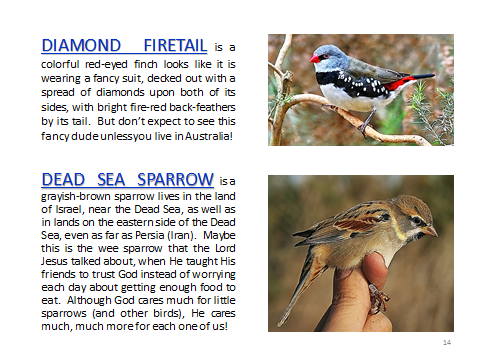
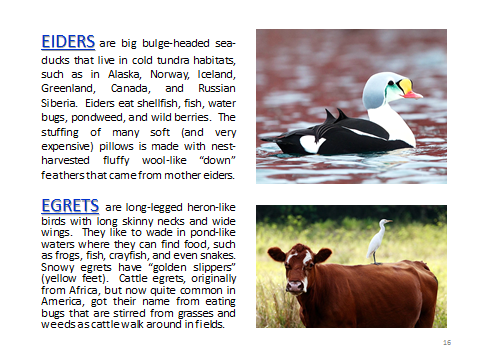
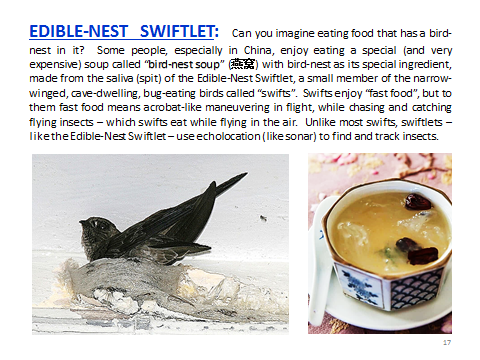
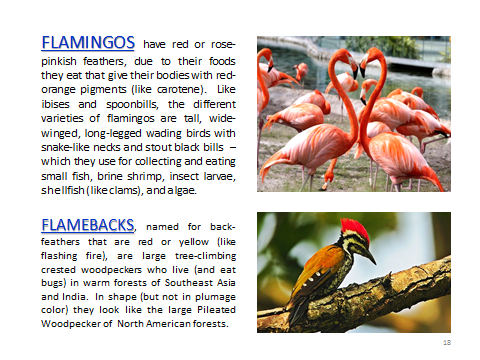
For ushering in the year of our Lord 2020,  below follows the second advance installment of alphabet-illustrating birds of the world, as part of this new series (“Birds Are Wonderful  —  and Some Are a Little Weird*).  The letter D is illustrated by Diamond Firetail, Dead Sea Sparrow, and Doves.  The letter E  illustrated by Eiders, Egrets, and Edible-Nest Swiftlet.  The letter F illustrated by Flamingos, Flamebacks, and Frogmouths.

“D” BIRDS:   Diamond Firetail, Dead Sea Sparrow, and Doves.

BAW-DiamondFiretail-DeadSeaSparrow

BAW-Doves

“E” BIRDS:  Eiders, Egrets, and Edible-Nest Swiftlet.

BAW-Eiders-Egrets

BAW-EdibleNestSwiftlet

“F” BIRDS:  Flamingos, Flamebacks, and Frogmouths. 

BAW-Flamingo-Flameback

BAW-Frogmouths

Birds are truly wonderful — and some, like Edible-Nest Swiftlets and Frogmouths, are a little bit weird!  (Stay tuned for more, D.v.)


* Quoting from “Birds Are Wonderful, and Some Are a Little Weird”, (c) AD2019 James J. S. Johnson   [used here by permission].

Frogmouth-tawny


Reflecting on Floodwaters (and a Dove): How Do We “Return”?

Returning Earthly Lives to Normalcy, After the Flood:

Yet Whereunto (and How) Do We Return our Souls?

Dr. James J. S. Johnson

Ark-with-returning-Dove.olive-HoshanaRabbah

ARK ON WAVES, with returning dove   (credit: public domain / Hoshanah Rabbah)

But the dove [Hebrew: yônah] found no rest for the sole of her foot, and she returned [a form of the verb shûb] unto him [i.e., Noah] into the Ark, for the waters were on the face of the whole earth; then he [i.e., Noah] put forth his hand, and took her [i.e., the female dove], and pulled her unto himself, unto the Ark.  And he waited yet other 7 days; and again he [i.e., Noah] sent forth the dove from the Ark; and the dove came back [a form of the verb shûb] unto him at evening; and, lo! — an olive leaf, plucked off, was in her [i.e., the female dove’s] mouth!  — so that Noah knew the waters were abated from upon the earth.  And he waited yet other 7 days; and sent forth the dove, who returned [a form of the verb shûb] not again unto him anymore.  (Genesis 8:9-12)

Hurricane Harvey and Hurricane Irma, in recent weeks, both visited the southeastern United States (as well as some Caribbean islands nearby) with powerful devastation. Thereafter those hurricanes left flooding and turmoil in their wakes.  The need for restoration and a return to normalcy will continue.

Yet imagine how much more devastation faced the human race when only 8 humans were alive, who themselves, for more than a year, had just survived the only worldwide Flood that ever was – or ever will be. What an aftermath!  And what a need for ecological restoration, to say the least!

In fact, that is part of what we read about within the 8th chapter of Genesis.

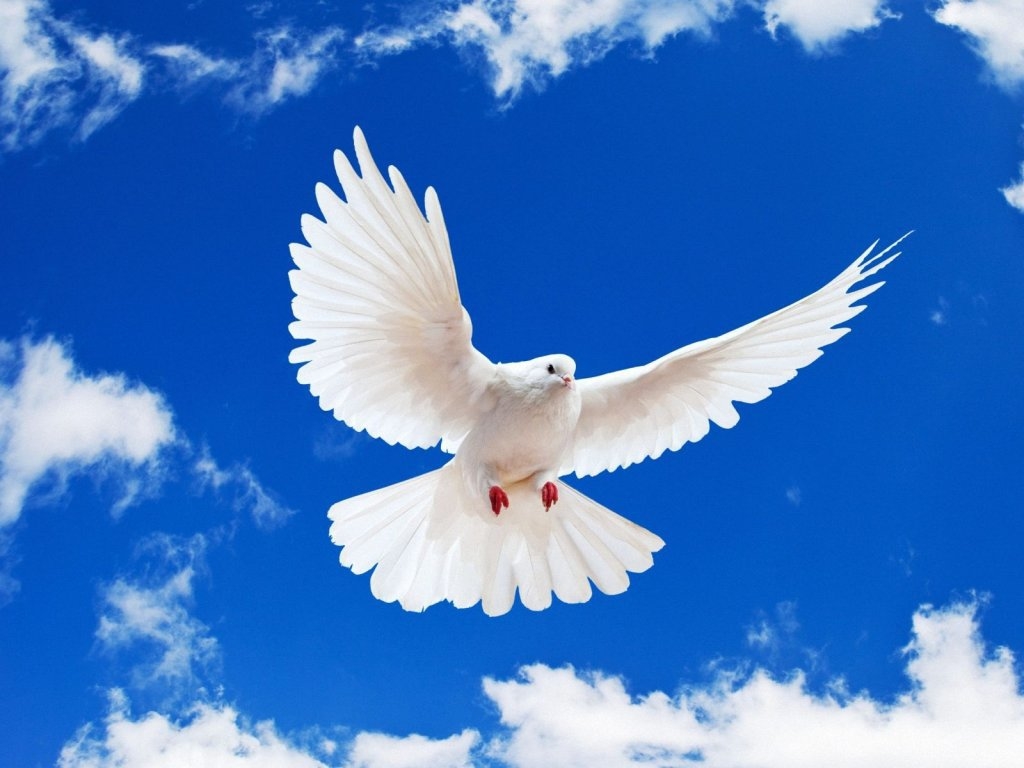
White-Dove-flying.background-clouds

DOVE (credit: Fanpop Wallpaper)

Furthermore, what an amazing report of scientific research is reported in Genesis chapter 8 – Noah used a dove to take, in effect, an ecological snapshot of the Flood’s aftermath, so that Noah could observe – with the help of a dove (who served his need for information, like a passenger pigeon) – when Earth was drained sufficiently to permit recovered/sprouted olive trees to produce some pluckable leaves, an early sign that Earth was regaining a vegetated condition.

Noah-dove-raven-Ark

DOVE RETURNS TO NOAH   (image credit: Pinterest)

Thus Noah, as the greatest empirical scientist then alive (not to mention the greatest zookeeper to ever live!), concluded that the Flood’s wake was subsided sufficiently to permit the first stages of ecological recovery. Meanwhile, Noah (and his family, as well as the other Ark-borne animals) remained aboard the Ark, until God Himself instructed Noah that it was safe for their disembarkation (Genesis 8:15-19).

White-Dove.Journal-of-Consumer-Research

WHITE DOVE   (photo

credit; Journal of Consumer Research)

Much more has been said, and should be said, about Noah’s disembarkation after the Flood. (For example, consider the entire book by Britain’s premier historian, Dr. Bill Cooper, titled AFTER THE FLOOD.)

But for now, however, consider just one Hebrew word, the simple verb shûb. It basically means to “return”, to “come back”.  In Genesis 8:9-12 the dove twice returned, after which she did not return on the third occasion.  What a simple action verb, yet how mighty its meaning in Scripture!  Two other usages of this action verb will be noted, below, to illustrate the importance of this simple verb, the root form of which is only 3 letters in Hebrew (shûb).

In Psalm 23:3 we read that the LORD “restores my soul”  —  literally, God “returns” my soul, because of His shepherdly care for me.  Because God created me, as a unique human (Psalm 102:18), my being began with and by His divine command, so He is the author of my creaturely existence.

However, as a sinner, I have strayed from God my Creator (Isaiah 53:6a), so I cannot belong to Him, so how can I be successfully returned unto Him?  Lamentably, as a sinner, I cannot accomplish a satisfactory solution to my personal predicament – my problem of sin-caused alienation (Isaiah 59:2 & 64:6; Romans 3:23).

Wonderfully, however, without compromising His holiness and justice, God has provided a redemptive solution to my sin problem, the gift of substitutionary atonement (John 3:14-16). Christ has voluntarily and magnanimously accepted the punishment due for my sin (and for all of Adam’s race), to justify the gifted exchange of Christ’s own perfect righteousness (Romans 6:23), generously producing the marvelous result that I can be justified and forgiven (because His blood on the cross paid my sin-debt), so long as I happily accept that redemptive gift by believing that God has chosen to give me that redemption (Ephesians 1:3-14; John 14:6)!

What a privilege to be one of the “sheep” of God’s flock (see Psalm 100).  In John chapter 10, we read that Jesus is the Good Shepherd (John 10:11-14), Who knows and cares for His sheep, and Who gives unto us, His “sheep”, everlasting life, as a gracious and redemptive gift of His love (John 10:16-18 & 10:26-28).

In other words, like an errant sheep (Isaiah 53:6), I have (as has every human sinner) wandered away from God, yet God has redemptively sought and retrieved me (Luke 15:4-7) as if I was a sheep separated from 99 other sheep, and Christ deemed me valuable enough to find and to fetch, and to safely secure me within His flock!

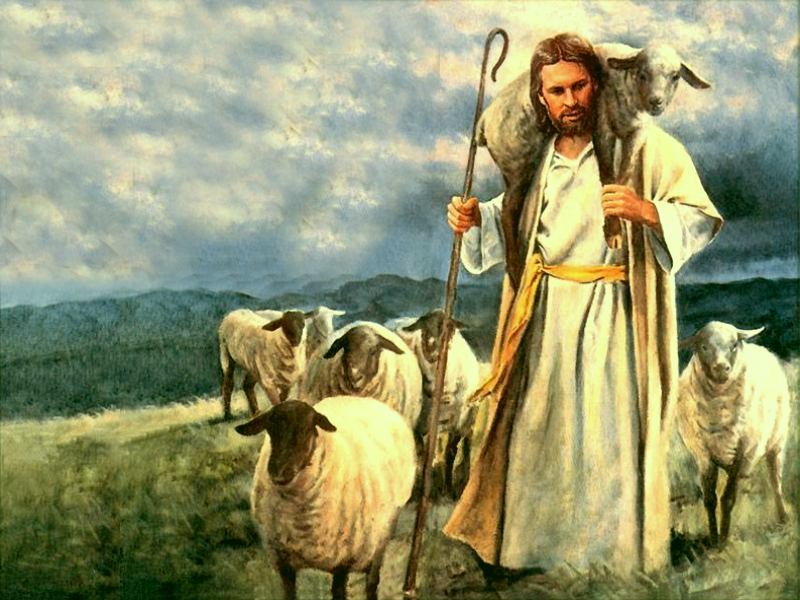
Jesus-Shepherd-with-sheep.watercolor

JESUS THE GOOD SHEPHERD  (image credit: Pinterest)

But notice that the gift of redemption in Christ is not automatically applied to the eternal destinies of every human being – there is a choice to be made, a choice with moral (and everlasting) accountability – the choice must be willingly made, to accept (rather than to decline accepting) Christ as one’s personal Redeemer. No one is forcefully drafted into Heaven against his or her will – there are no “robots” in Heaven!

It is “whosoever will” who enters Heaven by God’s grace in Christ, so no truth-opposing (and thus Christ-rejecting) unbelievers enter the ultimate Haven of rest. And that requirement of believing acceptance of God’s grace, a/k/a saving faith, is the choice that is needed, in order to benefit eternally form Christ’s substitutionary death and resurrection (John 1:12 & 3:14-18).

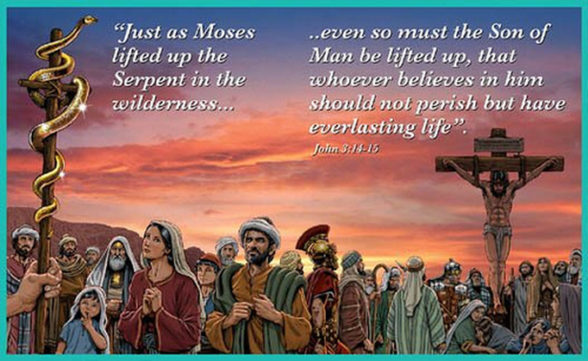
This crucial need to consciously and voluntarily accept, by belief (what is sometimes called a “love of the truth”), God’s promised gift of salvation in Christ, is consistently taught throughout the Holy Bible. Just as the serpent-bitten Israelites needed to believe God’s promise about the only sufficient remedy for deadly snakebites, we must believe God’s promise that looking to the once-for-all crucified Christ is the only sufficient remedy for our own sin problem (John 3:14-16, in light of Numbers 21:7-9).

John3.14-15-picture

JOHN 3:14-15 with NUMBERS 21:4-9   (image credit: Godisrevealed.com blog)

That requires us, as individuals, to personally believe the truth of God’s promise of saving grace in Christ (Ephesians 2:8-9; Romans 3:22-26 & 4:20-25 & 10:13).

Notice that this kind of belief is not the same thing as promising to serve God (or “to follow Jesus”), because real saving belief involves expecting God to give us something, freely and graciously, apart from anything we do (or promise to do) for God.

Oddly, this is hard for many to accept —  the idea that eternal life in Christ really is free is rejected by many, despite the Bible’s clear teaching that salvation in Christ is a GIFT (Romans 6:23).   No one merited the right to be conceived in the womb, or to be born.  Yet it is undeniable that our creaturely lives are gifts we did not earn (or work for) — obviously God made us, or else we would not exist!  So, since our very lives are unmerited gifts from God, to us, why should we have difficulty with the idea that God gives us forgiveness and salvation in Christ, as an unmerited gift that we neither earn nor work for?

Thus, it is simply believing God’s Word (like a trusting toddler would believe a loving parent), —  specifically, believing the promises in God’s Word regarding the Lord Jesus Christ as the unique Messianic Savior (1st Corinthians 15:3-4),  — that constitutes saving faith (Ephesians 2:8-9; John 1:12 & 3:14-16).  It is that all-important belief that God uses to return our souls unto Himself, the psalmist (David) says in the 19th Psalm:

The law of the Lord is perfect, converting [a form of the Hebrew verb shûbּ  —  literally “returning”] the soul; the testimony of the Lord is sure, making wise the simple. (Psalm 19:7)

And it is God Himself Who is our ultimate and only “haven of rest”, our souls’ true “home”.  (See “Why We Want to Go Home”, posted at http://www.icr.org/article/why-we-want-go-home .)    In other words, although some would say that “home (on Earth) is where you hang your hat”, our eternal home is where we belong forever – with God Himself (and with His forever family), thanks to our Lord Jesus Christ (Hebrews 13:20-21)!


Lee’s Seven Word Sunday – 6/18/17

***

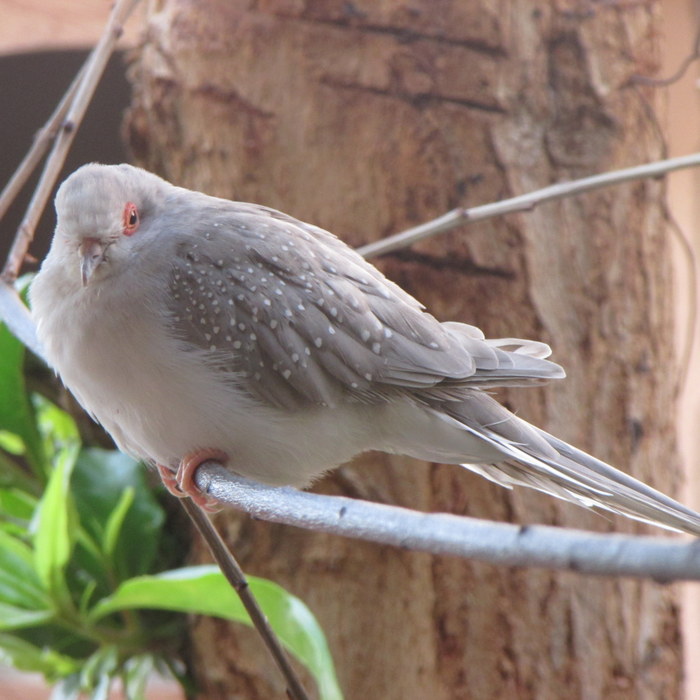
Silver Diamond Dove Female ©MediaCache

WINGS OF A DOVE

COVERED WITH SILVER

***


“Though ye have lien among the pots, yet shall ye be as the wings of a dove covered with silver, and her feathers with yellow gold.”  (Psalm 68:13)

Silver Diamond Dove Female ©MediaCache

*

More Daily Devotionals

*

Lee’s Six Word Saturday – 10/15/16

***

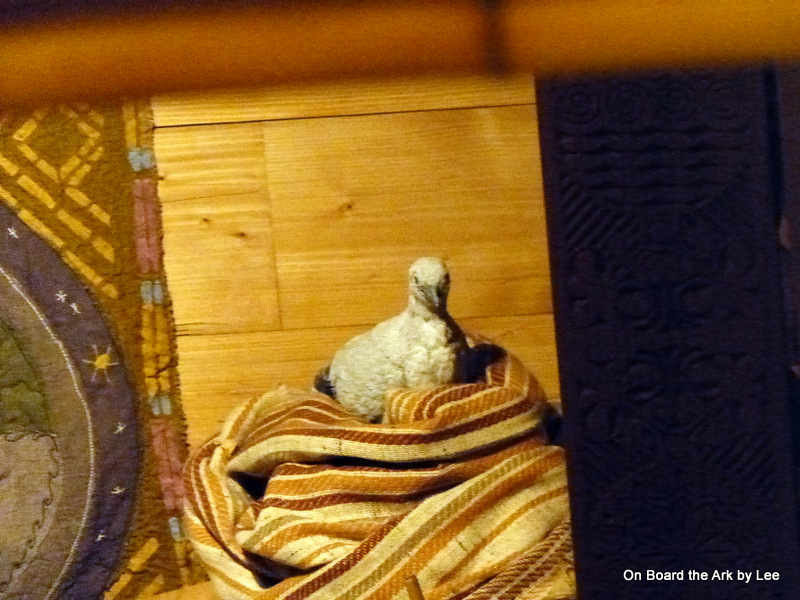
Dove resting on board the Ark

BUT THE DOVE FOUND NO REST

***


But the dove found no rest for the sole of her foot, and she returned unto him into the ark, for the waters were on the face of the whole earth: then he put forth his hand, and took her, and pulled her in unto him into the ark.” (Genesis 8:9 KJV)

Dove resting on board the Ark Encounter by Lee

*

More Daily Devotionals

*

Lee’s Six Word Saturday – 9/24/16

***

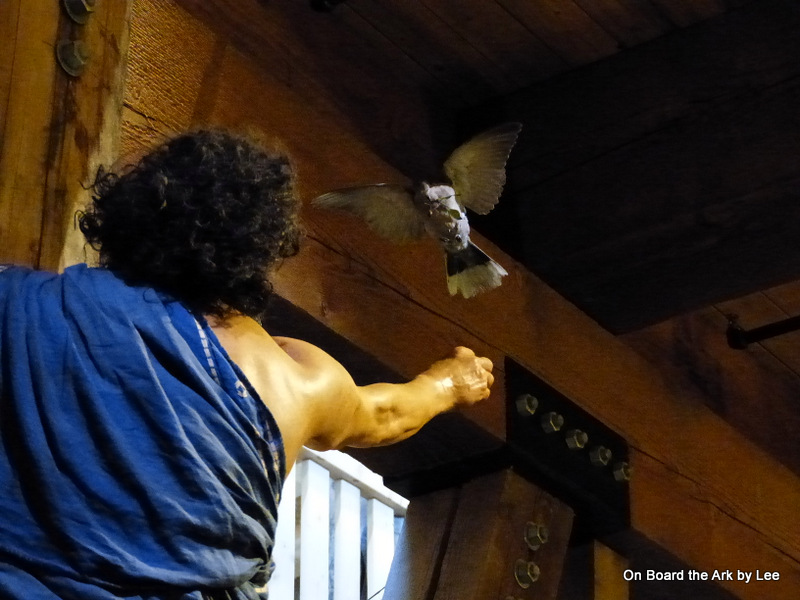
Noah taking the Dove Back on board. the Ark

THEN HE PUT FORTH HIS HAND

***


“But the dove found no rest for the sole of her foot, and she returned unto him into the ark, for the waters were on the face of the whole earth: then he put forth his hand, and took her, and pulled her in unto him into the ark.” (Genesis 8:9 KJV)

Noah taking the Dove Back on board the Ark Encounter by Lee

*

More Daily Devotionals

*

Lee’s Two Word Tuesday – 8/23/16

***

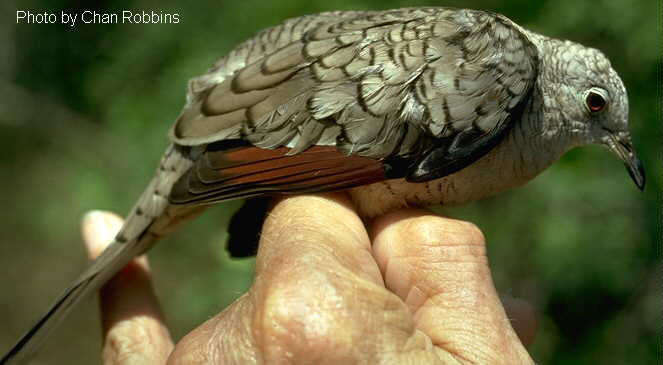
Inca Dove ©WikiC

Inca Dove ©WikiC

THE DOVE

***


“But the dove found no rest for the sole of her foot, and she returned unto him into the ark, for the waters were on the face of the whole earth: then he put forth his hand, and took her, and pulled her in unto him into the ark. (Genesis 8:9 KJV)

Inca Dove ©WikiC Chan Robbins

*

More Daily Devotionals

*

Lee’s Four Word Thursday – 2/18/16

***

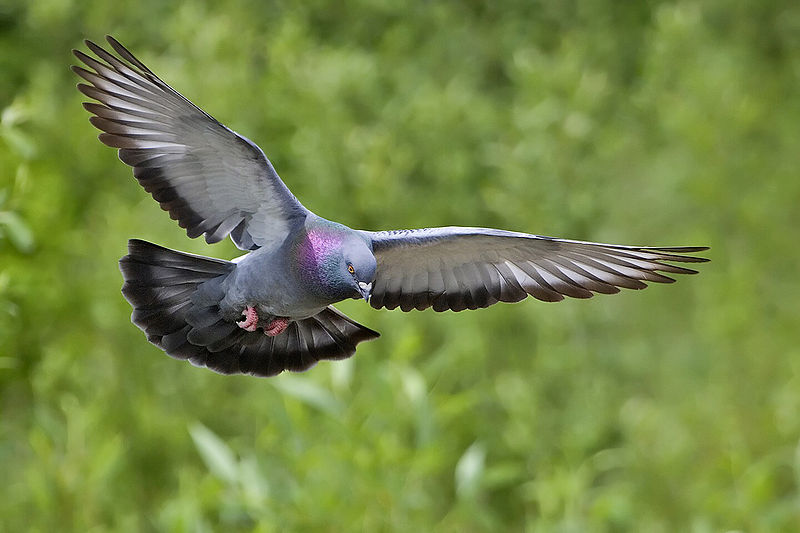
Rock Dove (Columba livia) ©WikiC

WINGS LIKE A DOVE!

***


And I said, Oh that I had wings like a dove! for then would I fly away, and be at rest. (Psalms 55:6 KJV)

Rock Dove (Columba livia) ©WikiC

*

P. S.  Sandra took me up on my challenge and today she posted Four-Word Thursday – Lee’s Challenge. She started the challenge and now she is challenged. :)

More Daily Devotionals

*

Ian’s Bird of the Week – Diamond Dove

Before I get to the Diamond Dove, I have an appeal to any members who have been on the Bird of the Week list since 2003 and who have kept copies of the postings. It’s a long shot I know, but I lost the text of some of the early ones in a hard disk crash and I’ve nearly finished compiling the first volume covering 2002 to 2009 of the ebook Diary of a Bird Photographer. I have all the photos but not the descriptions of: Red-capped Plover 9 March 2003, Bank Myna 1 June 2003, Spinifex Pigeon 2 July 2003, Leaden Flycatcher 29 July 2003, Australian Pelican 7 July 2003 and Noisy Pitta 15 February 2004. If you have them, I’d be very grateful if you’d let me have the text by email and the first six respondents who can provide each of the missing ones will get a free copy of the ebook when it’s published.

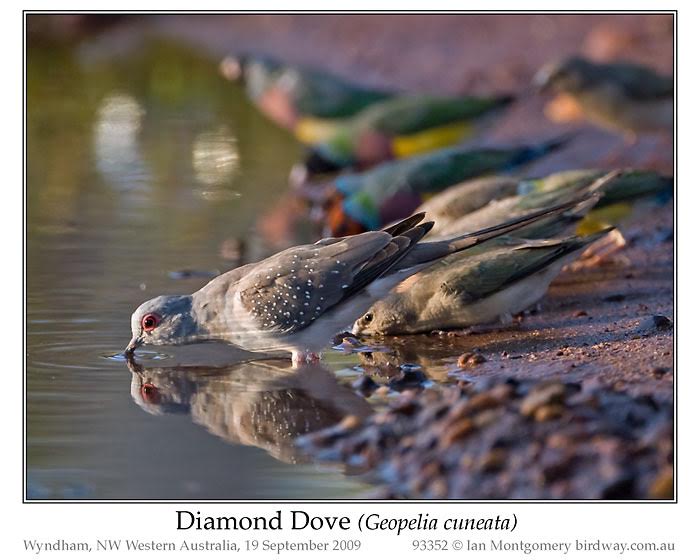
Diamond Dove (Geopelia cuneata) by Ian 1Back to the Diamond Dove. Having cut the recent camping trip short, I didn’t come back with the anticipated collection of photos of dry country birds, but here is one such species from earlier trips as compensation. This delightful, tiny dove is found in arid country throughout mainland Australia. It depends on the availability of water and moves long distances in time of drought. It’s comparable in length to its close relative the Peaceful Dove (both about 19-24cm/7.5-9.5in) but has a relatively much longer tail and smaller body. So it tips the scales at a mere 28-43g/1-1.5 compared with 41-66g/1.5-2.3 for the Peaceful Dove.

Diamond Dove (Geopelia cuneata) by Ian

You can see how small it is in the second photo where it is drinking with finches just after dawn – being a late riser I can’t help boasting when I get up early. There are two points of interest in this photo. The finches in question are Gouldian – there had to be a good reason for me to get up in the dark at 5:30am in Kununurra and drive 100km to Wyndham. There are more photos of the Gouldians here. The other point is that the dove is demonstrating the drinking skill of members of the Pigeon and Dove family, the Columbidae. They drink by sucking and swallowing and don’t have to first sip and then tip their heads back like almost all other birds do. Apparently, they can drink six times faster in this way, maybe a useful survival strategy in a very vulnerable situation. Incidentally, I also photographed drinking Crested Dove at the same spot 15 minutes later, by which time the finches had left.

Diamond Dove (Geopelia cuneata) by Ian

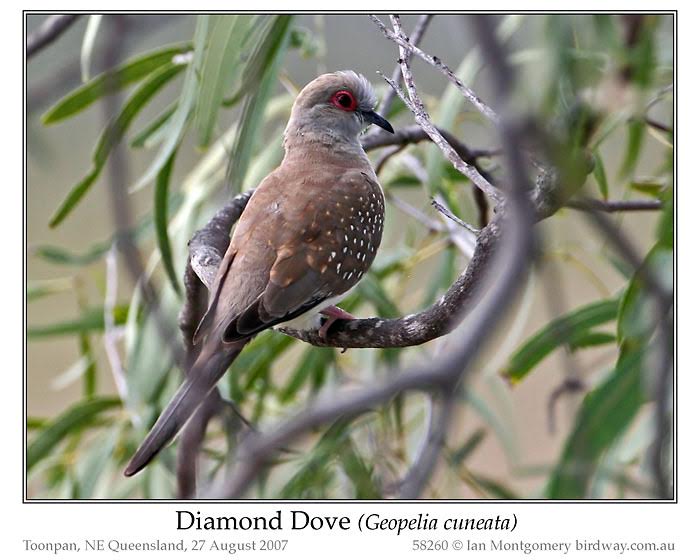
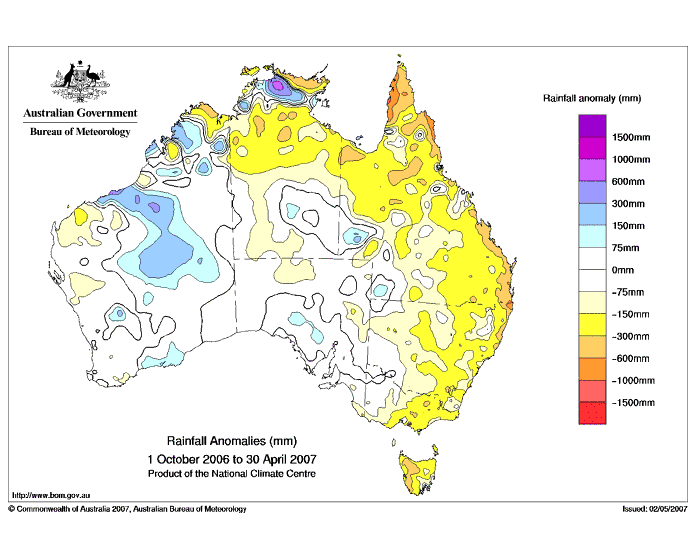
Diamond Doves have strikingly red eye-rings, quite unlike the blue-grey ones of Peaceful Doves, and small white spots on the wing coverts which give them their common name. The eye-rings are red in adults, and although those of males are supposed to be larger and brighter than those of females, and females are supposed to have browner plumage, I can’t find any consistent differences. The one in the third photo has a brownish wash on the wings and a very striking eye-ring, which would make it trans-gender according to those criteria. That photo was taken just south of Townsville. 2007 was a very dry year in eastern Australia (see below) and at such times, Diamond Doves may show up quite close to the coast.

Diamond Dove (Geopelia cuneata) by Ian
The bird in the fourth photo is a juvenile and has not yet developed the red eye-ring and red legs of the adult. The barring on the head and breast reveals its close relationship to the Peaceful Dove, but note that it has the diagnostic white spots of the Diamond Dove on the wing coverts.

Diamond Dove (Geopelia cuneata) by Ian

Regarding the Scientific name, Geopelia means ‘ground dove’ in Greek and refers to the feeding habits of member of this genus. Diamond Doves feed predominantly on grass seeds and usually very small ones at that. The specific name cuneata means ‘wedge-shaped’, coming from the Latin cuneus meaning a ‘wedge’. I suppose it must refer to the pointed tail, but it isn’t what I usually think of as a wedge-shaped tail, compared with the wedge-tailed eagle and shearwater.

Diamond Dove (Geopelia cuneata) by Ian

“cuneiform ground dove”

Needless to say, I couldn’t resist Googling deeper into the related word ‘cuneiform’, which refers to the wedge-shaped characters used mainly on clay tablets in ancient Mesopotamia and Persia. This led me to the website of the Pennsylvanian Museum which gives you the opportunity to write your initials as a monogram ‘like a Babylonian’. The above image shows the result for ‘DOVE’, clearly not just any dove of course but a cuneiform ground dove.

Greetings
Ian

**************************************************
Ian Montgomery, Birdway Pty Ltd,
454 Forestry Road, Bluewater, Qld 4818
Tel 0411 602 737 ian@birdway.com.au
Bird Photos http://www.birdway.com.au/
Where to Find Birds in Northern Queensland: iTunesGoogle Play Kobo Books
Recorder Society http://www.nqrs.org.au


Lee’s Addition:

Behold, I send you forth as sheep in the midst of wolves: be ye therefore wise as serpents, and harmless as doves. (Matthew 10:16 KJV)

These doves are quite small in comparison to other members of the Columbidae family. During our trip we saw the Western (Blue) Crowned and Victoria Crowned Pigeons, which are some of the larger members of the family.

The way they drink, by sucking is very interesting. I am sure the Lord had a reason for creating them this way. May have to research that some day.

*