Ian’s Bird of the Week – Fiordland Penguin

Fiordland Penguin (Eudyptes pachyrhynchus) by IanIan’s Bird of the Week – Fiordland Penguin ~ Ian Montgomery

Newsletter – 9-5-14

I was talking with a friend the other day about visiting New Zealand and my experience with photographing Fiordland Penguin in Milford Sound, so here it is as bird of the week and a change from Where to Find Birds in Northern Queensland. It was my main reason for visiting Milford Sound, better known perhaps for its spectacular scenery and natural beauty, but if you go looking for wildlife then you find yourself in wonderful places anyway.

I camped the previous night in my rented campervan at Cascade Creek in Fiordland National Park, the nearest camping site to Milford Sound. It’s still a fair drive, so atypically I got up before dawn when the temperature was 3ºC to get to the sound early enough to get on the first tourist boat, as I’d been told that this provided the best chance of seeing the penguins. The boat I went on was one of the smaller ones so there were only a dozen or so passengers. I had a chat with the crew as departed and they were optimistic about finding the penguins.

Fiordland Penguin (Eudyptes pachyrhynchus) by Ian

Within ten minutes of leaving, they had located a nesting pair on the rocky shore. Very obligingly, they reversed the boat to what seemed perilously close to the rocks so that I could get some photos. The first photo shows one of them near the entrance to its nesting burrow, while the second is its mate wandering over the rocks closer to us.

Fiordland Penguin (Eudyptes pachyrhynchus) by Ian

I was very glad I’d make the early start, as we didn’t see many more penguins, though we did come across the party in the third photo about 20 minutes later. The bird in the foreground with the pale cheeks is a juvenile. An easier place to see them is Taronga Zoo in Sydney where their glass-sided tank provides great views of them at their best: they’re much more elegant gliding effortlessly through the water than hobbling around on rocks.
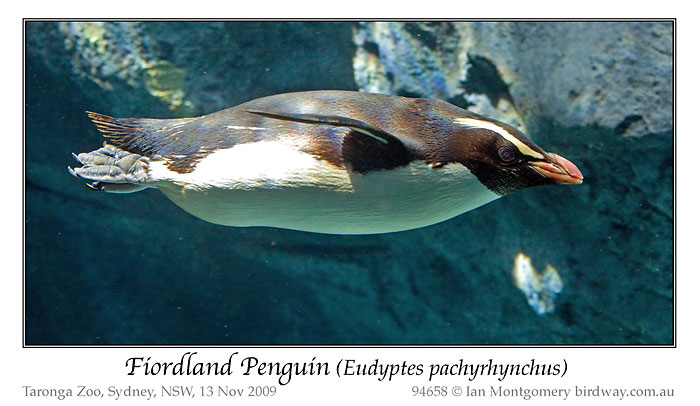
Fiordland Penguin (Eudyptes pachyrhynchus) by Ian

The wild population is estimated at about 3000 pairs and has suffered from predation by introduced mammals and the native Weka  which has been introduced to some islands where the penguins breed. I did see Wekas at Milford Sound, but I don’t know whether they are a problem there. The Fiordland Penguin is closely related to the Snares and Southern Rockhopper Penguins.
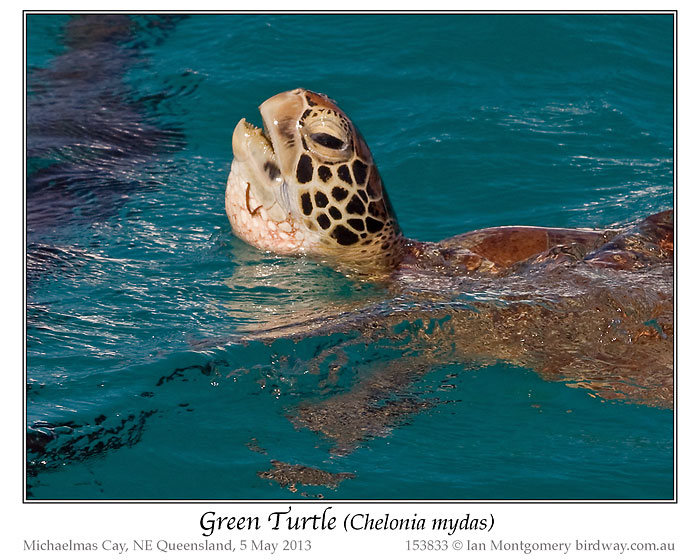
Green Turtle (Chelonia mydas) by Ian

While on the subject of animals that are expert swimmers and clumsy on land, I’ve just completed a new gallery of turtles and their relatives on the website. It contains a rather motley collection that I’ve stumbled across when birding, including the marine Green Turtle, above, four Australian and an American freshwater species, a South African and an Asian tortoise. This Green Turtle was grazing on the mooring cable, visible on the right, on a visit Michaelmas Cay off Cairns last year with my sister Gillian from Ireland. I’m going on a visit to Ireland in ten days time. Next week I’ll tell you more about my plans and some of the birds that I hope to bring your way.

Greetings
Ian

**************************************************
Ian Montgomery, Birdway Pty Ltd,
454 Forestry Road, Bluewater, Qld 4818
Tel 0411 602 737 ian@birdway.com.au
Bird Photos http://www.birdway.com.au/
Recorder Society http://www.nqrs.org.au


Lee’s Addition:

The birds of the air, And the fish of the sea That pass through the paths of the seas. O LORD, our Lord, How excellent is Your name in all the earth! (Psalms 8:8-9 NKJV)

What an interesting bird to switch to. The Fiordland Penguins are neat looking with that eyebrow stripe and those feathers at the end of it. Penguins definitely “pass through the paths of the seas.” Also, did you notice he was out there in 3C, that is 37.4F for us North Americans. (Brrr!)

Penguins are members of the Spheniscidae – Penguins Family which has 18 members. Ian has photos of half of the Penguin Family on his Birdway site. The Fiordlands are “medium-sized, yellow-crested, black-and-white penguins, growing to approximately 60 cm (24 in) long and weighing on average 3.7 kg (8.2 lbs), with a weight range of 2 to 5.95 kg (4.4 to 13.1 lb). It has dark, bluish-grey upperparts with a darker head, and white underparts. It has a broad, yellow eyebrow-stripe which extends over the eye and drops down the neck. Most birds have three to six whitish stripes on the face.” (Wikipedia)

*

Ian’s Bird of the Week

Penguin Family at Birdway

Spheniscidae – Penguins Family

*


Ian’s Bird of the Week – Great Frigatebird

Great Frigatebird (Fregata minor) Male by Ian

Ian’s Bird of the Week – Great Frigatebird ~ by Ian Montgomery

Newsletter – 8/28/14

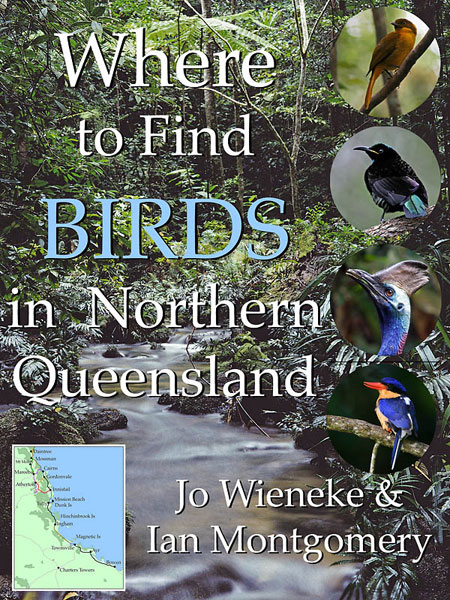
This week’s good news is that the ebook Where to Find Birds in Northern Queensland is now available on the iTunes store (in 51 countries). So if you have an iPhone, iPad, iPod Touch or Mac (running OS X Maverick) this is for you! Here is the link: https://itunes.apple.com/au/book/where-to-find-birds-in-northern/id912789825?mt=11&uo=4. To make a connection with this week’s bird, the Great Frigatebird, here is a screen shot from iBooks to show you what you can expect. All the text items highlighted in purple and links to either other places in the book – typically places, birds or lists – or external websites. The images are the same size as the ones that are included in the bird of the week, so if you double-click, or double-tap, on them, you can enlarge them to full size.

Great Frigatebird (Fregata minor) by Ian

If you think about birds in northern Queensland, perhaps iconic rainforest species like the Cassowary or Victoria’s Riflebird come to mind. Fair enough, but there is much more to this region than rainforest, important though that is.The area also has wonderful wetlands, tropical savannah forest, mountain ranges, dry country habitats and, last but not least, the coast with its Barrier Reef, beaches, mangroves, mudflats, continental islands and coral cays. So it should be no surprise that over 400 species of birds occur here and you need a reference devoted to the region to do it justice. I’ve chosen a dramatic seabird to make the point.

The term ‘frigate’ was first applied in the 17th century to warships built for speed and manoeuvrability and frigates were often used by pirates to attach merchant shipping. Frigatebirds, also called Man o’ War Birds, got their name for their piratical habitats of harrying other seabirds like boobies and tropicbirds to make them drop their prey. In fact, studies have shown that piracy accounts for perhaps only 20% of their food, and they are expert fishers as well. They fish by snatching prey, such as squid and young turtles, from the surface of the sea or in flight, in the case of their favourite prey, flying fish.

Great Frigatebird (Fregata minor) Female by Ian

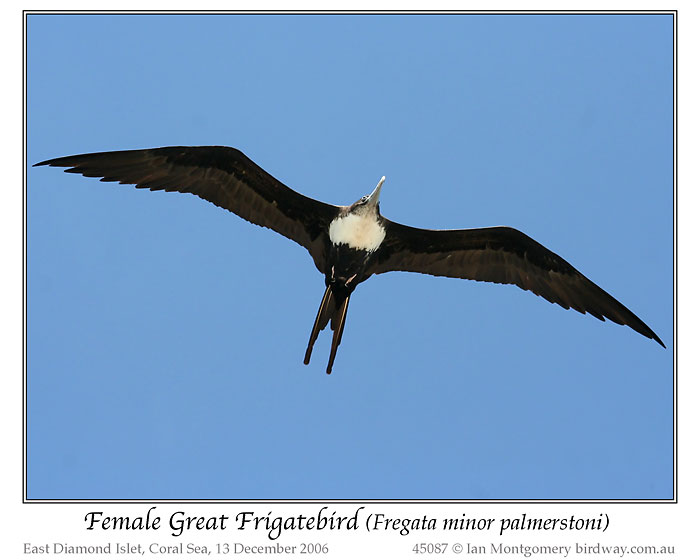
Despite their naval name, frigatebirds are wonderfully adapted for flying and are poor swimmers to the extent that they are reluctant to land on water, as they can take off only in strong winds and their plumage is not waterproof. They have very light bones making up only 5% of the body, huge pectoral muscles, enormous wing area, long forked tails for rudders and streamlined bodies with small heads. Despite their size, they are very light, soar effortlessly in good winds and are very acrobatic. Female Great Frigatebirds, larger than males, are about 1m/40in long, have a wingspan to 2.3m/90in but weight only 1.2-1.6kg/2.6-3.5lb.

Great Frigatebird (Fregata minor palmerstoni) Female by Ian

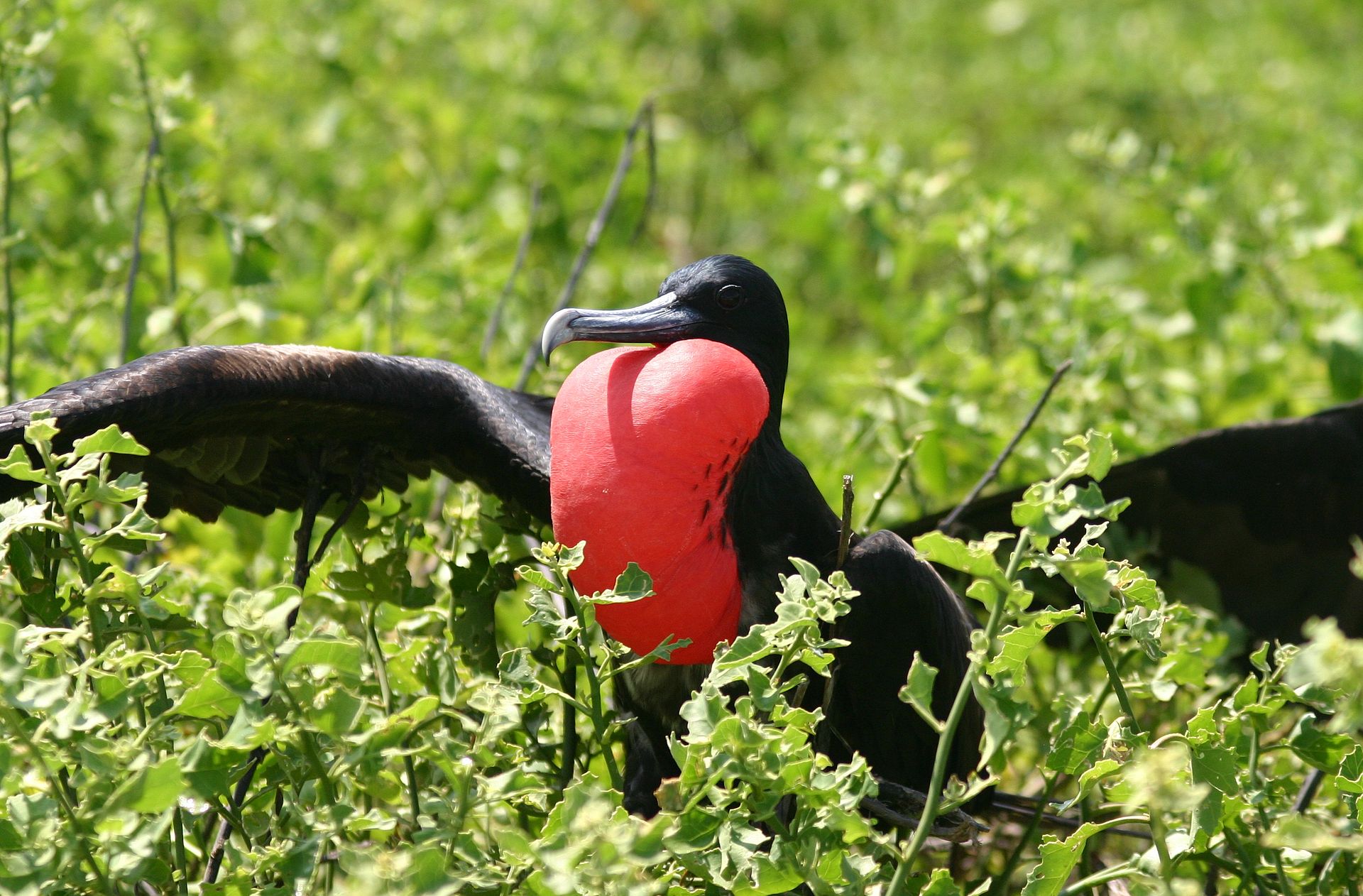
The male Great Frigatebird, first photo, is the only all-black frigatebird occurring in Australia – the other all-black males are the Magnificent Frigatebird of Atlantic Ocean and the eastern Pacific and the Ascencion Frigatebird of the east Atlantic. Frigatebirds are unusual among seabirds in drinking freshwater if they can get it, and this male is drinking at the mouth of freshwater stream on Christmas island by snatching a beak-full of water in flight. Frigatebirds also bathe in flight by splashing into the surface of the water and flying off. You can also see its red gular pouch. This is inflated to enormous size to impress females during courtship. I haven’t got a photo of displaying Great Frigatebird, but you can see a Magnificent Frigatebird doing so here: Magnificent_Frigatebird.

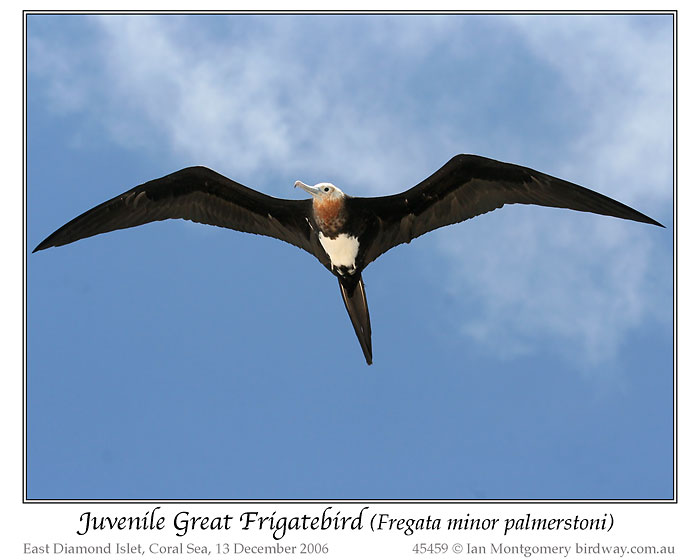
Great Frigatebird (Fregata minor palmerstoni) Juvenile by Ian

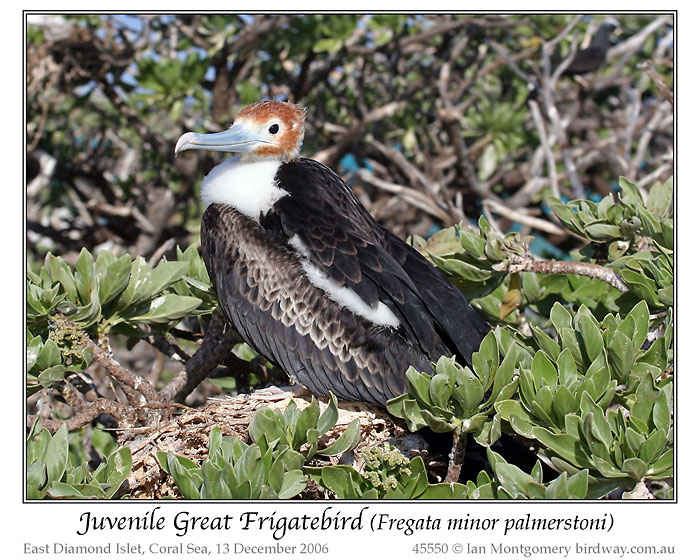
Female Great Frigatebirds have white breasts and care needs to be taken in distinguishing them from other female and juvenile frigatebirds – Lesser Frigatebirds of both sexes have white ‘spurs’ in the axil of the underwing, and Christmas Island Frigatebirds of both sexes, have white bellies. Birds in Indian Ocean waters in Australia belong to the nominate race minor, distinguished by the females having pink eye-rings, second photo. Birds in the Pacific belong to palmerstoni and usually have blue eye-rings, third photo, though doubt exists as to the validity of the races and the reliability of the fieldmarks.

Great Frigatebird (Fregata minor palmerstoni) Juvenile by IanBecause of their need for consistent winds, frigatebirds are restricted to tropical waters where they can rely on the trade winds. Adults are sedentary and remain close to their roosting sites and breeding colonies, mostly on small isolated islands. Non-breeding birds and immature birds are pelagic and move over huge distances. Trade winds are unusual in that they form cumulus clouds and hence thermals over water both by day and night, and frigatebirds make great use of these to soar as high as the cloud base and will fly at night if conditions are right. Pelagic frigatebirds use the front of storms to move around and can cope with high winds very well. This is why they appear in coastal areas after cyclones and are supposed to be called ‘rain-brothers’ by Australian aborigines, though I haven’t been able to verify this.

Great Frigatebird (Fregata minor palmerstoni) Juvenile by IanThe range of the Great Frigatebird includes the tropical Pacific, southern tropical Indian and western Atlantic Oceans. In Australia it breeds colonially on islands along the outer Great Barrier Reef, in the Coral Sea and on Christmas and Cocos (Keeling) Islands in the Indian Ocean, usually in mangroves. The juvenile in photos five and six was photographed on East Diamond Islet, about 600km east of Cairns http://www.satelliteviews.net/cgi-bin/w.cgi?c=cr&UF=34304&UN=456541&DG=ISL. Breeding birds form pair bonds and both parents share in the incubation and feeding of the young. The young develop very slowly. This is thought to adapt them to periods of starvation when the adults have trouble finding food, and remain under parental care for many months.

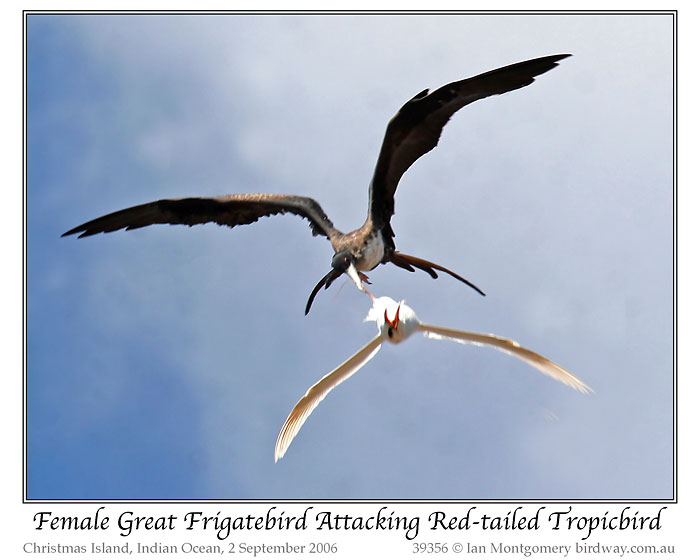
Great Frigatebird (Fregata minor) Female attacking Red-tailed Tropicbird by IanThe last photo shows a hapless Red-tailed Tropicbird near Christmas Island being harried by a female Great Frigatebird who has grabbed it by the tail-streamers. Frigatebirds hang out near seabird colonies waiting for birds carrying prey or with full crops returning to feed their young. It’s hard enough work being a parent without having to put up with this!

Greetings
Ian

**************************************************
Ian Montgomery, Birdway Pty Ltd,
454 Forestry Road, Bluewater, Qld 4818
Tel 0411 602 737 ian@birdway.com.au
Bird Photos http://www.birdway.com.au/
Recorder Society http://www.nqrs.org.au


Great Frigatebird (Fregata minor) Male Displaying ©WikiC

Great Frigatebird (Fregata minor) Male Displaying ©WikiC

Lee’s Addition:

but those who trust in the LORD will renew their strength; they will soar on wings like eagles; they will run and not grow weary; they will walk and not faint. (Isaiah 40:31 HCSB)

Thanks again, Ian, for introducing us to another interesting bird. We have seen the Magnificent Frigatebirds here in Florida, but these Great ones are also amazing. That fact about only 5% of their weight being the bone structure is another fantastic design from their Creator.

Frigatebirds belong to the Fregatidae – Frigatebirds Family which only has five species in it.

*
Ian’s Bird of the Week

Ian’s Bird of the Week – Lesser Frigatebird

Fregatidae – Frigatebirds Family

Great Frigatebird – Wikipedia

*


Ian’s Bird of the Week – Pale-headed Rosella

Pale-headed Rosella (Platycercus adscitus) by Ian

Pale-headed Rosella (Platycercus adscitus) by Ian

Ian’s Bird of the Week – Pale-headed Rosella ~ by Ian Montgomery

Newsletter – 8/24/14

The bird of the week is the Pale-headed Rosella, which I’ll get to in a second, but this is a Special Edition as Where to Find Birds in Northern Queensland is at last being published. That is to say, it has been published on Google Play but not yet on the Apple iBook store. That will take a little longer as there are bureaucratic obstacles to be over come. These involve registering Birdway Pty Ltd with the US Inland Revenue and then Apple confirming the registration with the IRS. The first part was easy but the second seems harder as it takes a while for the registration to soak through and finally emerge in the IRS online databases. Anyway, I’ll let you know, loudly, when that happens. In the meantime, you can find it on Google at https://play.google.com/store/books/details?id=CblRBAAAQBAJ.

Where To Find Birds in Northern Queensland by Ian

Where To Find Birds in Northern Queensland

End of commercial!

The Pale-headed Rosella, is the widespread and familiar Rosella of Queensland, though it range does extend as far as northern New South Wales. There, and in southeastern Queensland, its range overlaps with the closely related Eastern Rosella and they sometimes interbreed.

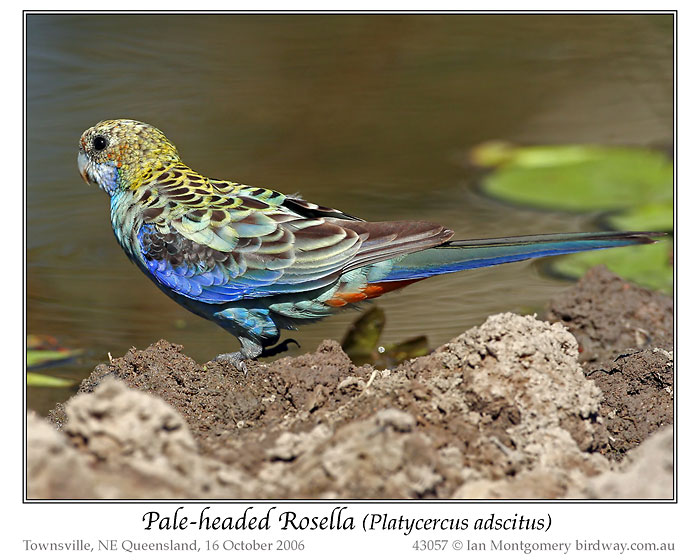
The ones in the first two photos were taken outside my house. The first bird is feeding on the seeds of weeds, plenty of those here, and the second is feeding on the fruit of wild passionfruit, another weed, also called stinking passionfruit (Passiflora foetida) as the foliage emits a strong odour when crushed. They’re lovely birds, rather unobtrusive though their soft twittering calls reveal their presence, and I’ll always get pleasure from seeing them. They’re usually in pairs of family parties. The plumage is variable: the bird in the first photo has a much intense blue breast than the second one, but the field guides are tight-lipped about whether the plumage of the sexes differs.

Pale-headed Rosella (Platycercus adscitus) by Ian

Pale-headed Rosella (Platycercus adscitus) by Ian

They’re more forthcoming about the plumage of juveniles, as these often show traces of red or darker feathers on the head, like the one coming down for a drink in the third photo.

Pale-headed Rosella (Platycercus adscitus) by Ian

Pale-headed Rosella (Platycercus adscitus) by Ian

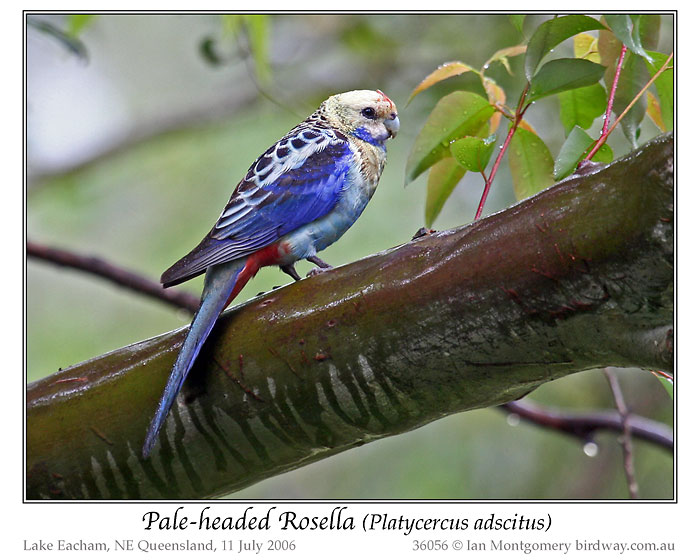
There are two races of the Pale-headed Rosella, a northern paler one on Cape York and south to about Cairns, and a southern darker one south of Townsville with a 300km/200mile band of intergrading between Cairns and Townsville. Originally these were described as two different species, the northern one being the Blue-cheeked Rosella, Platycercus adscitus, the southern one the Pale-headed Rosella, P. palliceps. When they were lumped together, the earlier name adscitus took priority, so the northern race is the nominate one and the southern darker one is race palliceps – unfortunately, given that it is the more intensely coloured. Adscitus means ‘approved’ or ‘accepted’, though exactly what was approved or accepted, I don’t know.

Pale-headed Rosella (Platycercus adscitus) by Ian

Pale-headed Rosella (Platycercus adscitus) by Ian

The Townsville birds in the first three photos belong to palliceps. The two, photographed together at Lake Eacham southwest of Cairns, are much closer the nominate race. The yellow is much paler overall, particularly on the back and the upper breast is mainly pale yellow, rather than blue, but there is a blue patch on the lower cheek. The bird in the fifth photo has clear traces of red on the forehead and is a juvenile; the one in the fourth photo has pinkish traces and may be a young bird too.

Pale-headed Rosella (Platycercus adscitus) by Ian

Pale-headed Rosella (Platycercus adscitus) by Ian

The taxonomy of Rosellas in general has been controversial and is still unsettled. Some authorities maintain that the Pale-headed, the Eastern Rosella and the Northern Rosella all belong to a single species even though they look quite different. Whatever, they’re lovely birds, and the good news is that the Pale-headed Rosella has benefitted from European settlement and the clearing of dense forests – they prefer more open areas.

Links:
Pale-headed Rosella 
Eastern Rosella 
Northern Rosella 

Greetings
Ian

**************************************************
Ian Montgomery, Birdway Pty Ltd,
454 Forestry Road, Bluewater, Qld 4818
Tel 0411 602 737 ian@birdway.com.au
Bird Photos http://www.birdway.com.au/
Recorder Society http://www.nqrs.org.au


Lee’s Addition:

Oh that my words were now written! oh that they were printed in a book! (Job 19:23 KJV)

I have fought a good fight, I have finished my course, I have kept the faith: (2 Timothy 4:7 KJV)

Glad they finally have their book published. I know that Ian has been working on this for some time. It is always a great feeling when a project is completed.

Also, the Pale-headed Rosella is a beautiful bird. Another great creation from their Creator. I especially like that first photo.

Rosellas are members of the Psittacidae – Parrots Family. You can see Ian’s photos of this family by clicking here.

See:

*

Ian’s Bird of the Week – Masked Woodswallow

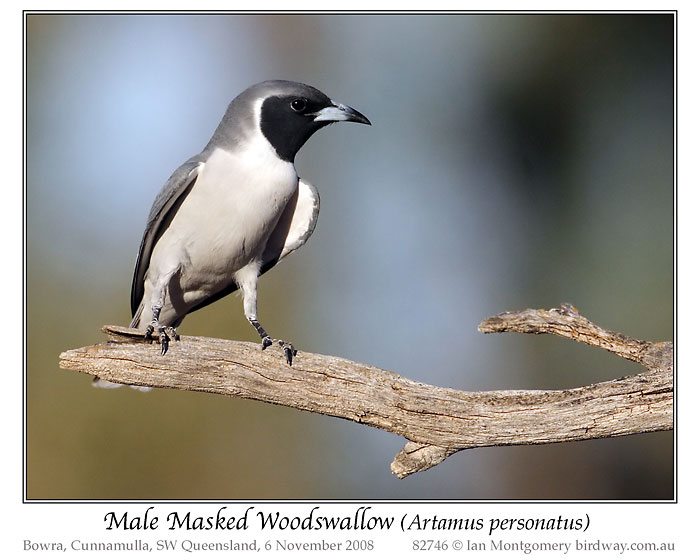
Masked Woodswallow (Artamus personatus) by Ian

Ian’s Bird of the Week – Masked Woodswallow ~ by Ian Montgomery

Newsletter – 8/14/14

When I was taking location photos along the inland route to Paluma several weeks ago, I came across a mixed flock of a couple of hundred Masked and White-browed Woodswallows. The White-browed featured as bird of the week in 2005, but the Masked hasn’t so here it is. The males in particular, first photo, are very elegant with a sharply defined, very black mask, soft grey back, almost white underparts and a white crescent between the mask and the back of the head.

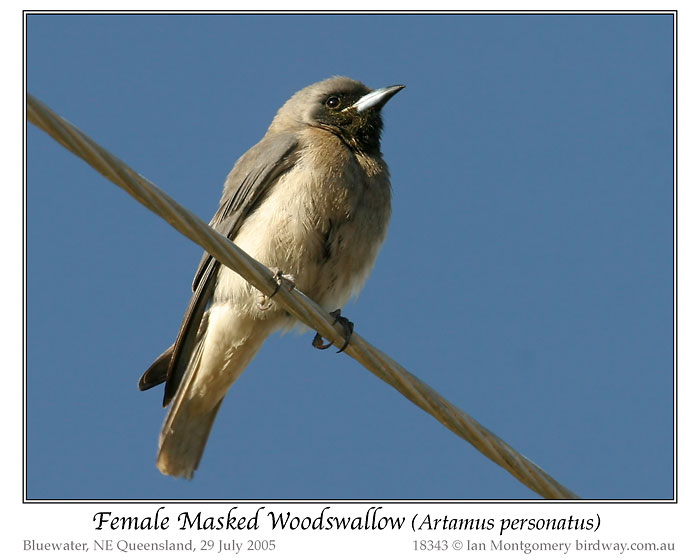
The females, second photo, are similar to the males with less contrasting plumage, only a subtle crescent, and a buff wash to the upper breast. The yellow specks on the mask and breast of this female are pollen – these primarily insectivorous birds also feed on nectar, particularly in northern Australia in winter.

Masked Woodswallow (Artamus personatus) by Ian
The female in the second photo and the juvenile in the third photo were in a mixed flock of Masked and White-browed that spent a week or so feeding on the locally common Fern-leaved Grevillea near where I live in 2005. The juveniles are similar to the females, but with browner plumage with pale spots and streaks.

Masked Woodswallow (Artamus personatus) by Ian

The ‘swallow’ part of the name comes from their buoyant, gliding flight and not because they are related to real swallows (family Hirundinidae). Rather, they are related to the Australian Magpie, Butcherbirds and Currawongs, usually combined in the one family, the Artamidae. There is an obvious similarity to the Magpie and Butcherbirds in their general form and bi-coloured bills and they are also quite aggressive, Woodswallows being quick to mob raptors in flight. The ‘personatus’ part of the scientific name comes from the Latin persona, meaning mask, a derivation that amused me when I though of show business ‘personalities’.

The White-browed and Masked Woodswallows are very closely related species, even though their respective plumages are quite distinct. They are both very nomadic and occur throughout mainland Australia, though not Tasmania. They often occur together in large mixed flocks. In eastern Australia, the White-browed predominates; in Western Australia, the Masked is more numerous and may occur alone. The two species will even nest together in small mixed colonies and occasionally interbreed.

Links:
Artamidae
Masked Woodswallow
White-browed Woodswallow

Greetings
Ian

**************************************************
Ian Montgomery, Birdway Pty Ltd,
454 Forestry Road, Bluewater, Qld 4818
Tel 0411 602 737 ian@birdway.com.au
Bird Photos http://www.birdway.com.au/
Recorder Society http://www.nqrs.org.au


Lee’s Addition:

“Even the stork in the heavens Knows her appointed times; And the turtledove, the swift, and the swallow Observe the time of their coming. But My people do not know the judgment of the LORD. (Jeremiah 8:7 NKJV)

What a neat looking bird. I especially like the clean line around his “mask”. We have seen Woodswallows in a zoo, but not this kind and not in the wild. That last photo is a super photo. Thanks, Ian, for sharing with us.

Swallows and Woodswallows are in two different families. Woodswallows are in the Artamidae – Woodswallows Family while the Hirundinidae Family has the Swallows and Martins.

Here is a photo of  White-breasted Woodswallows that we saw at Zoo Miami:

White-breasted Woodswallow (Artamus leucorynchus amydrus) by Lee ZM

White-breasted Woodswallow (Artamus leucorynchus amydrus) by Lee ZM

*

Ian’s Bird of the Week – Australian King Parrot

Ian’s Bird of the Week – Australian King Parrot ~ Ian Montgomery

Newsletter – 7-31-14

Mea culpa again for the long delay since the last bird of the week. The good news is that, apart from dotting a few i’s, my current obsession Where to Find Birds in Northern Queensland is finished, so with luck you may get more frequent BotWs in the future. Here is an attractive and surprising omission from the BotW series, the Australian King Parrot. It’s one of the most spectacular Australian parrots and deserves the ‘King’ moniker. The French call it la Perruche royale.

King Parrot by Ian

King Parrot by Ian


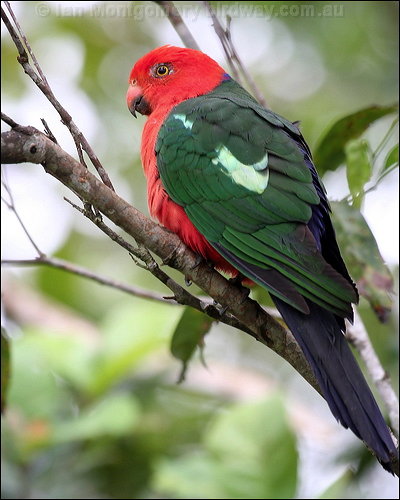
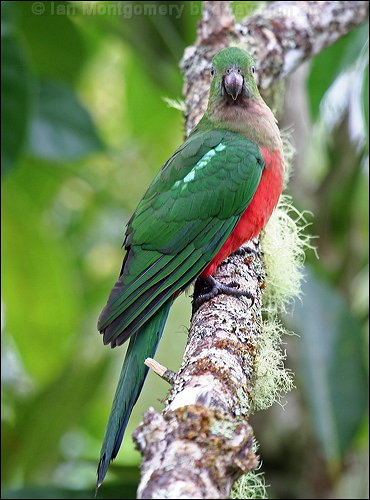
It’s quite common along the eastern seaboard of Australia, with a preference for fairly dense coastal and highland forests including rainforest. That can make it hard to see but it’s quite vocal and the whistling call of the males is a very characteristic sound of eastern forest. It responds readily to being fed and can get quite tame. The one in the first photo was taken at O’Reilly’s in Lamington National Park, where the birds will perch on arms and shoulders and pose happily for photos. The males are distinguished from the females by the brilliant scarlet of the breast extending onto the head and having a conspicuou peppermint green blaze on the wings.


Australian King Parrot (Alisterus scapularis) Male by Ian

Australian King Parrot (Alisterus scapularis) Male by Ian

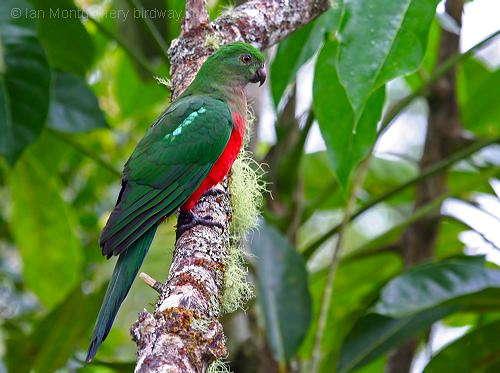
The females are gorgeous too with scarlet lower breast and belly, green heads and pinkish necks. The one in the second photo was busy exploring hollows in trees, but it was hard to imagine that she was contemplating nesting in May. Both sexes have blue backs, third photo, but this is usually hidden by the folded wings. The wing blaze may be missing or inconspicuous in females.


Australian King Parrot (Alisterus scapularis) Female WikiC

Australian King Parrot (Alisterus scapularis) Female WikiC

It’s usually just called the King Parrot in Australia and I used to wonder vaguely about the ‘Australian’ qualification. The reason for it is that is a Papuan one in New Guinea and a Moluccan one in western New Guinea and the islands of eastern Indonesia. Both these are rather similar to the Australian one, but smaller and differ mainly in the colour or lack of the blaze on the wings, and the amount of blue in the plumage.

Australian King Parrot (Alisterus scapularis) Male Closeup by Ian

Australian King Parrot (Alisterus scapularis) Male Closeup by Ian


There are two races of the Australian species. The larger nominate race occurs along most of the east coast, while the smaller race minor (obviously) occurs in northeastern Queensland. The literature doesn’t say much about minor except that it’s smaller, and there’s disagreement in the field guides about how far south it occurs: choose between Cardwell, Townsville and Mackay. I suspect Townsville is correct as there a big gap between the Paluma Range population and the Eungella/Clark Range one near Mackay. Anyway, the male in photo 4 and the female in photo 5 were photographed on the Atherton Tableland and are certainly minor.

Australian King Parrot (Alisterus scapularis) by Ian

Australian King Parrot (Alisterus scapularis) by Ian

It seemed to me from the photos that I took there that the northern males had brighter and more extensive blue hind collars and the females had brighter wing-blazes than southern birds. My sample size was small, but it might be an interesting project to check out whether these differences are consistent and to establish the exact geographical ranges of the subspecies. In northeastern Queensland it is mainly a highland species, with some movement to the lowlands in winter and I have seen them very occasionally near where I live.

Links:
Australian King-Parrot (I should have put hyphens in the photo captions)
Red-winged Parrot

Anyway, back to dotting i’s. The next stage in the book is to check out publishing via Apple iBooks, Google Play, etc. That’s something I know nothing about, so it will be interesting to find out how it’s done.

Greetings

Ian
**************************************************
Ian Montgomery, Birdway Pty Ltd,
454 Forestry Road, Bluewater, Qld 4818
Tel 0411 602 737 ian@birdway.com.au
Bird Photos http://www.birdway.com.au/
Recorder Society http://www.nqrs.org.au


Lee’s Addition:

Now unto the King eternal, immortal, invisible, the only wise God, be honour and glory for ever and ever. Amen. (1 Timothy 1:17 KJV)

What beautifully created Parrots! They are just fantastic. Also, I was beginning to worry about Ian. It has been over a month since his last newsletter, Plum-headed Finches.

These parrots are members of the Psittacidae – Parrots Family. There are approximately 365 members, depending on whose list. The greatest diversity of parrots is in South America and Australasia.

Checkout all of Ian’s Parrot photos (around 50 species)

King Parrot at Wikipedia

Psittacidae – Parrots Family

*

Ian’s Bird of the Week – Plum-headed Finches

Plum-headed Finch (Neochmia modesta) by Ian

Ian’s Bird of the Week – Plum-headed Finches ~ by Ian Montgomery

Newsletter – 6-28-14

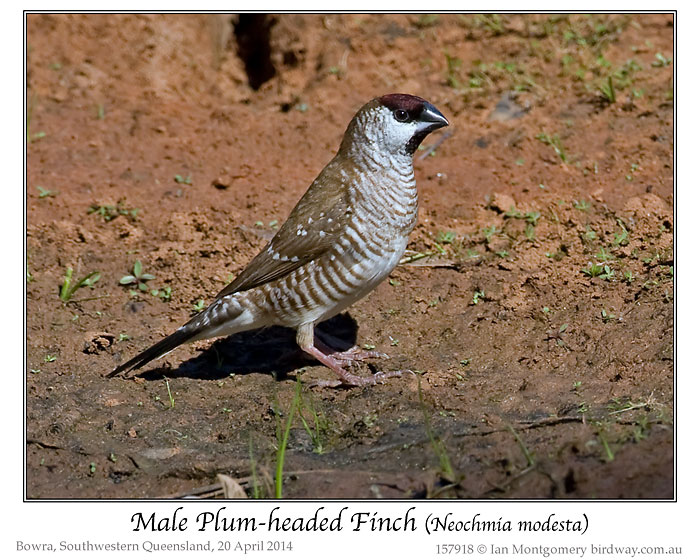
Bird of the week numbering has been a bit wonky lately, two #502s, no #503 to compensate, and two #504s and the one previous to this, Halls Babbler was #506 and should have been #507. Hopefully, we are back on track now with #508, the Plum-headed Finch. One of my favourite methods of bird photography is to relax by a water-hole in a comfortable camping chair and see what comes along. I did this at Bowra in April, and was treated to several pairs of Plum-headed Finches, presumably breeding as a result of rain several weeks earlier.

The ‘plum’ bit refers to the gorgeous cap, dark and extensive in the male, above, or paler and less extensive in the female, which has consequently space for a white eye-stripe. Males have black chins, females white ones. The specific modesta presumably refers to the understated colours, but I think the barred breast and flanks make them look very smart, and it’s always a pleasure to see them.

Plum-headed Finch (Neochmia modesta) by Ian Fem

The genus Neochmia contains only three other species, all of them Australian: Star, Red-browed and Crimson Finches, and none barred, so the Plum-headed looks quite distinctive. In the past it has been placed in its own genus, but mitochondrial studies show that it’s quite closely related to both the Star and Red-browed Finches. lum-headed Finch (Neochmia modesta) by Ian males

They have quite a widespread distribution in Queensland and New South Wales, but mainly inland and rather patchy. With an average length of 11cm/4.3in, they’re quite small. They’re popular as cage birds and used to be trapped a lot, but have been protected since 1972. Plum-headed Finch (Neochmia modesta) by Ian male

The bird in the fourth photo was photographed in the light of the setting sun, hence the lovely glow. I’ve been on the road for a few days taking (almost) the last location photos for Where to Find Birds in Northeastern Queensland so I’ll keep this short. One more day trip along the inland route to Paluma, and that’s it.

Links to the other members of the tribe:

Red-browed Finch
Crimson Finch
Star Finch

Best wishes

Ian

**************************************************

Ian Montgomery, Birdway Pty Ltd,
454 Forestry Road, Bluewater, Qld 4818
Tel 0411 602 737 ian@birdway.com.au
Bird Photos http://www.birdway.com.au/
Recorder Society http://www.nqrs.org.au


Lee’s Addition:

Also, to every beast of the earth, to every bird of the air, and to everything that creeps on the earth, in which there is life, I have given every green herb for food”; and it was so. (Genesis 1:30 NKJV)

What a neat looking Finch, Ian. Thanks again for sharing with us. Plum-headed Finches belong to the Estrildidae – Waxbills, Munias & Allies Family which has 141 species.

*

Ian’s Finches:

Other Links:

*

Ian’s Bird of the Week – Hall’s Babbler

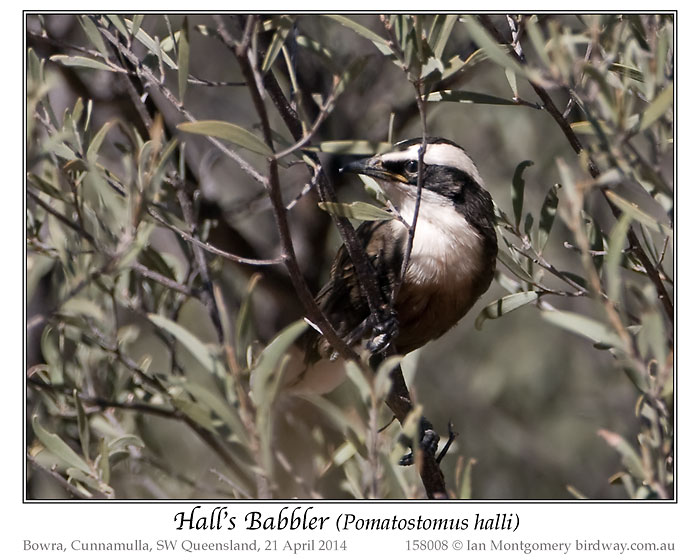
Hall's Babbler (Pomatostomus halli) by IanHere is another of the Bowra specialties, Hall’s Babbler, which has a restricted range in dry scrubland in western Queensland north to about Winton and northwestern New South Wales south to about Brewarrina.

If you think it looks just like a White-browed Babbler, you won’t be surprised to hear that it was overlooked as a separate species until 1963 and was first described in 1964. It was named after Harold Hall who funded five controversial bird collecting Australian expeditions in the 1960s and the species was detected, and presumably ‘collected’, on the first of these. It’s larger than the White-browed, 23-25cm/9-10 in length versus 18-22cm/7-9in, is darker overall, has a shorter white bib abruptly shading into the dark belly and a much wider eyebrow. DNA studies suggest that it’s actually more closely related to the Grey-crowned Babbler. It’s voice is described pithily by Pizzey and Knight as ‘squeaky chatterings … lacks “yahoo” of Grey-crowned and madder staccato outbursts of White-browed’. Babblers are clearly birds of great character.

Hall's Babbler (Pomatostomus halli) by Ian

It’s quite common at Bowra in suitable habitat, mainly mulga scrub, and on this occasion we found a party of about 20. Like all Australasian babblers, they’re very social and move erratically through the scrub bouncing along the ground and up into bushes like tennis balls. They’re delightful to watch, and infuriating to photograph as the tangled, twiggy mulga plays havoc with automatic focus – no time for manual – and they keep ducking out of sight. You can be lucky and get ones, like the bird in the second photo, that hesitate briefly, between bounces, in the open to look for food. There had been some good rain a couple of months before our visit, and the birds had been breeding – the one in the third photo with the yellow gape is a juvenile.

Hall's Babbler (Pomatostomus halli) by Ian

Bowra is unusual in that it’s in a relatively small area where the ranges of all four Australian babblers overlap. The other restricted range species, the Chestnut-crowned is at the northern end of its range and also fairly easy to find, while the widespread more northern species, the Grey-crowned, meets the mainly southern White-browed.

I’ve had several emails recently from prominent birders commenting on the excellence of the digital version of Pizzey and Knight. Things they like particularly are the combination of both illustrations and photos (including over 1200 of mine), the great library of bird calls by Fred Van Gessel, portability (phone, tablet and PC), comprehensiveness – all of the more than 900 species recorded in Australia and its territories and ease of generating bird lists by location. The good news is that the price has been reduced to $49.95 and it comes in iPhone/iPad, Android and Windows versions. Go here http://www.gibbonmm.com.au for more information, product tours and links to the appropriate stores, and here http://www.birdway.com.au/meropidae/rainbowbeeeater/source/rainbow_bee_eater_15231.htm to see the photo of the Rainbow Bee-eater below.

Hall's Babbler (Pomatostomus halli) by Ian

My apologies for the delay since the last bird of the week. I’m having a major drive to finish Where to Find Birds in Northeastern Queensland and other things are getting pushed temporarily into the background.

Greetings
Ian

**************************************************
Ian Montgomery, Birdway Pty Ltd,
454 Forestry Road, Bluewater, Qld 4818
Tel 0411 602 737 ian@birdway.com.au
Bird Photos http://www.birdway.com.au/
Recorder Society http://www.nqrs.org.au


Lee’s Addition:

But shun profane and idle babblings, for they will increase to more ungodliness. (2 Timothy 2:16 NKJV)

Here is what a Hall’s Babbler sounds like:

Thanks again Ian for sharing another interesting bird from your part of the world.

Our Hall’s Babbler is a member of the Pomatostomidae – Australasian Babblers Family. There are only five species in the family.

*

Hall’s Babbler – Wikipedia

Ian’s Bird of the Week

Pomatostomidae – Australasian Babblers Family

*
Ian’s Bird of the Week – Chestnut-breasted Quail-thrush

Ian’s Bird of the Week – Chestnut-breasted Quail-thrush ~ by Ian Montgomery

Newsletter – 5/21/14

One of the specialties at Bowra is the Chestnut-breasted Quail-thrush a mainly terrestrial inhabitant of stony areas with scrubby bushes, particular mulga, in dry, but not desert, parts of western Queensland and NSW with a widely-separated population in Western Australia. It has suffered in eastern Australia from habitat clearance, but can usually be found at Bowra in an area called the Stony Ridge on the road that runs west of the homestead. This location, incidentally is also good for another specialty, Hall’s Babbler.

Chestnut-breasted Quail-thrush (Cinclosoma castaneothorax)  by Ian

Quail-thrushes are shy and either sit tight and flush suddenly with a quail-like whirring of their wings or run for cover. The Chestnut-breasted usually runs, but this time we unwittingly encircled this male bird which took refuge in a dead tree, the first time I’ve seen any quail-thrush do so. It looked confused rather than alarmed and wandered for a long time from branch to branch providing unusually good opportunities for photography until it hopped down onto the ground and ran away. On this occasion we saw only the brightly coloured male; females have more subdued colours, brown replacing the all the black plumage except the spotty wing coverts and rely on camouflage to escape detection when nesting on the ground. Quail-thrushes feed on both insects and seeds and there are an Australasian taxon with about four species in Australia and one in New Guinea.

Chestnut Quail-thrush by Ian

Chestnut Quail-thrush by Ian

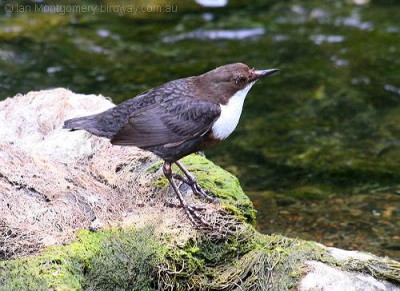
Quail-thrushes presumably get the quail part of their name from their terrestrial habits and whirring flight and the thrush part from their body shape. Cinclosoma is bird-taxonomy-speak for thrush in a confused sort of way. Confused because the Latin cinclus means thrush but derives from the Greek Kinklos a waterside bird of unknown type mentioned by Aristotle and others and though to be either an Old World Wagtail or a wader. To add to the confusion, Cinclidae refers to the Dipper family, not the thrushes, with Cinclus cinclus being the Eurasian White-breasted Dipper.


White-throated Dipper (Cinclus cinclus) by Ian

White-throated Dipper (Cinclus cinclus) by Ian


The confusion continues with actual taxonomy. The western race of the Chestnut-breasted is sometimes (IOC) treated as a separate species, the Western Quail-thrush. Meanwhile the geographically intermediate and closely-related Cinnamon Quail-thrush of central Australia desert country is sometimes split in two as well, with the Nullabor race being treated as a separate species, though it has also been lumped with the Chestnut-breasted. If that’s not enough, Birdlife International puts the Quail-thrushes in a family of their own, the Cinclosomatidae, while Birdlife Australia and the IOC lump with the Whipbirds and called them Psophodidae. (Birdlife International use to lump them and call them the Eupetidae.) I though you’d like to know! Let’s just enjoy the photos:

Greetings
Ian
**************************************************
Ian Montgomery, Birdway Pty Ltd,
454 Forestry Road, Bluewater, Qld 4818
Tel 0411 602 737 ian@birdway.com.au
Bird Photos http://www.birdway.com.au/
Recorder Society http://www.nqrs.org.au


Lee’s Addition:

The people asked, and He brought quail, And satisfied them with the bread of heaven. (Psa 105:40)

Thanks, Ian, for introducing us to another interesting bird. Your timing is perfect, as I am away from my computer for a few days.

Ian’s Bird of the Week
Odontophoridae – New World Quail Family

*

Ian’s Bird of the Week – Black-breasted Buzzard

Black-breasted Buzzard (Hamirostra melanosternon) by Ian

Ian’s Bird of the Week – Black-breasted Buzzard ~ by Ian Montgomery

Newsletter ~ 5/8/14

I went to Bowra Station near Cunnamulla, SW Queensland, to meet some birding pals from Victoria for Easter. Cunnamulla is almost exactly half-way between Bluewater and Melbourne by the shortest inland route (2,532km Bluewater-Melbourne CBD) and Bowra is an AWC reserve, famous for its dry country birds and wildlife. I returned with an intractable bout of flu which has left me horizontal for 2 weeks, but I am now much better and able to tackle long-neglected tasks like the Bird of the Week. So, here is something worth waiting for, one of the less-well known endemic Australian raptors, the Black-breasted Buzzard.

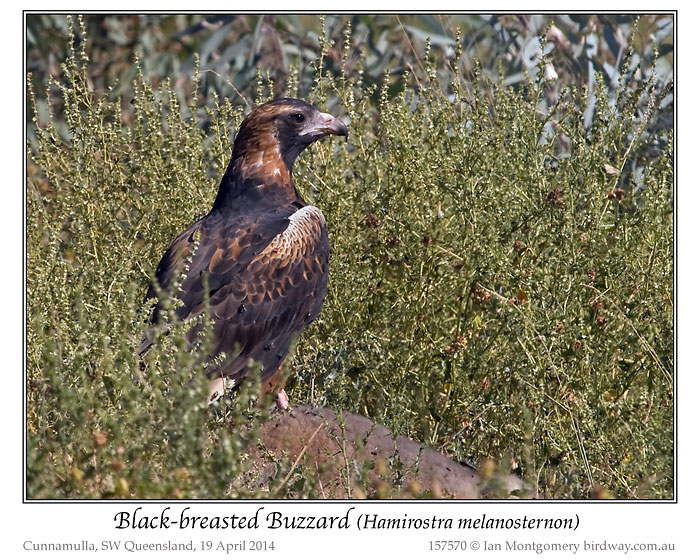
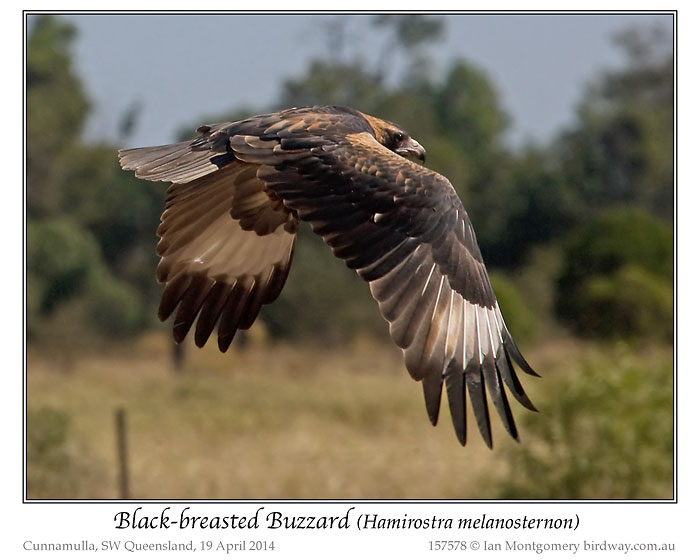
At the end of the drive from Bluewater to Bowra, I saw this raptor perched on road-kill – the euphemism used here for run-over native wildlife – near the entrance to Bowra, thought ‘that’s not a Black Kite’, turned the car round and picked up my camera to take the first photos of the trip. Reluctant to leave lunch behind, it tolerated my approach for about 30 seconds before flying away into the afternoon sunshine, second photo. In both photos, you can see the long, hooked bill that gives it its generic name (hamus is the Latin for hook), reddish crown and nape and the beginnings of it eponymous black-breast. In flight, you can see the characteristic white wing patches on the middle of the first six primary flight feathers, probably its best field mark and the complete absence of barring on the wing and tail feathers.

Black-breasted Buzzard (Hamirostra melanosternon) by Ian

This was the first time I’d seen a Black-breasted Buzzard either close up or perched. Mostly, one sees them singly and infrequently in flight soaring in the open skies of the drier parts of Australia. They’re common enough to have an official status of ‘Least Concern’ but uncommon enough to give me a thrill each time I see one. Apart from concerns of rarity, they’re impressive birds in their own right, being, I have just discovered, the third largest Australian raptor with a wingspan to 1.5m/5ft and an expert at soaring.

Two days later, we stopped for lunch at this dam at the far end of the property, about 15km/10 miles away from the entrance. A Black-breasted Buzzard soared high above us and then came round and flew overhead for a closer look, fourth photo. Comparing the pattern of wear on the flight feathers, indicates that this was the same individual. In this photo, the black breast of the adult bird is obvious as are the rusty flanks. Apart from dark blotches on the wing linings, the lack of barring is also apparent.

Black-breasted Buzzard (Hamirostra melanosternon) by Ian

Black-breasted Buzzards are known to feed on carrion and live prey, but their speciality is the eggs of large ground-nesting birds such as Brolgas, Bustards and even Emus. The latter have tough eggs which even that hooked beak would have trouble penetrating so, amazingly, these birds use stones to break them, dropping them from either a standing position or in flight. Though they are thought to belong to a rather ancient Australasian lineage of raptors this use of tools elevates them globally to the top of the class, sharing this position with the Egyptian Vulture which also throws stones at eggs. The Black-breasted Buzzard is the sole member of its genus (monotypic) and its closest relative is though to be the Square-tailed Kite, another monotypic, uncommon Australian endemic with dubious, gastronomic tastes, in its case nestlings. This ancient lineage is thought include a third Australian endemic, the Red Goshawk, and several New Guinea species including the long-tailed buzzards and perhaps the New Guinea Harpy Eagle. This just goes to show how indiscriminately common names like buzzards, goshawks, kites and eagles are applied to raptors.

Black-breasted Buzzard (Hamirostra melanosternon) juvenile by Ian

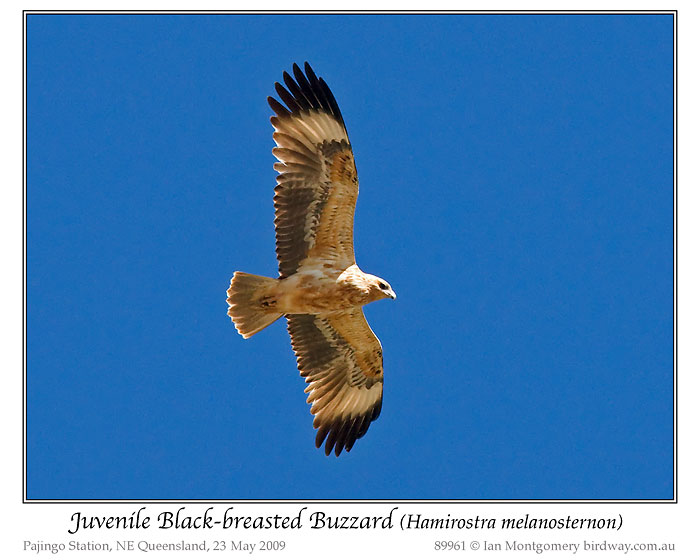
The last photo shows a juvenile Black-breasted Buzzard photographed at a joint pre-merger Birds Australia and Townsville BOCA outing to a dry country station called Pajingo, south of Charters Towers in 2009. As you can see the juvenile lacks the black breast of the adult, though pale patch on the wing is very similar. At the time, we unanimously agreed that this was a pale morph Little Eagle. I posted it at such on the Birdway website and it wasn’t until last year that the error was brought to my attention. This is what Steve Debus, one of the Australian experts on raptors said: “the image shows virtually no typical light-morph Little Eagle characters, such as the pale ‘M’, or the barring on flight feathers (including primary ‘fingers’) and tail, feathered legs etc.” and other points made were the long, slender bill of the Black-breasted Buzzard and the ‘chunkier’ head of the Little Eagle. Good to know.

Best wishes
Ian

**************************************************
Ian Montgomery, Birdway Pty Ltd,
454 Forestry Road, Bluewater, Qld 4818
Tel 0411 602 737 ian@birdway.com.au
Bird Photos http://www.birdway.com.au/
Recorder Society http://www.nqrs.org.au


Lee’s Addition:

But these you shall not eat: the eagle, the vulture, the buzzard, (Deuteronomy 14:12 NKJV)

What a neat bird, but I agree with the verse. Don’t think I would care to eat a buzzard, especially after it eats “road-kill”  The colors on this Buzzard are really neat and would help it stay disguised until it is too late for its prey.

The Black-breasted Buzzard is a member of the Accipitridae – Kites, Hawks & Eagles Family.  Out of the 256 species in the family, 28 of them are Buzzards.

I just realized that I have not had any articles in the Birds of the Bible for Buzzards. Will have to make a page for them. Stay tuned.

See:

*


Ian’s Bird of the Week – Greater Sand Plover

Looking South from Croquette Point by Ian

Ian’s Bird of the Week – Greater Sand Plover ~ by Ian Montgomery

Newsletter ~ 4/14/14

As I mentioned in the last email, I took advantage of a spell of reasonable weather to make a trip to Cairns to take location photos for Where to Find Birds in Northeast Queensland. On the way back, I visited Coquette Point near to check it out as it is listed in the book as a good spot for both mangrove birds and waders. Coquette Point and Flying Fish Point are the charmingly named headlands on the southern and northern banks of the mouth of the Johnstone River on which Innisfail, 100 km south of Cairns, is situated.

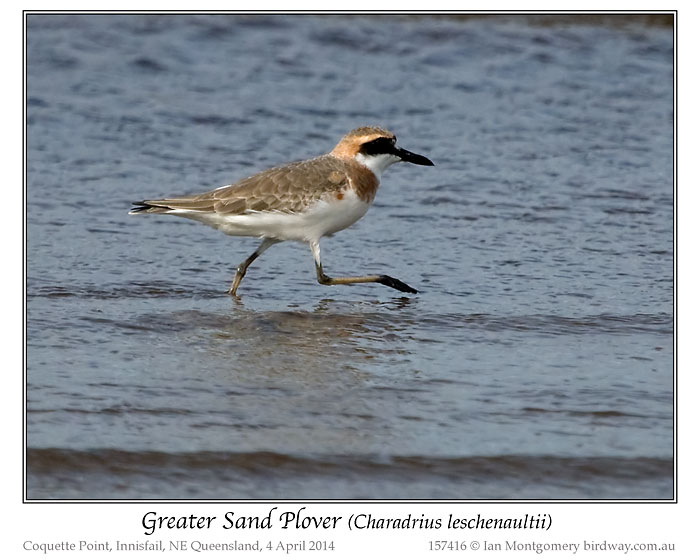
Although it mightn’t live up to the dream of an idyllic tropical paradise – I’m still itching from some sandfly bites and there have been recent sightings of Saltwater Crocodiles in the neighbourhood – it did indeed turn out to be good for birds. As well as a pair of Beach Stone-Curlews in the mangroves, there were several pairs of Greater Sand Plovers feeding in the shallows. At this time of the year, many waders are migrating back to their breeding grounds in the northern hemisphere and it is a good time to look for ones in breeding plumage, such as the one in the first photo.

Greater Sand Plover (Charadrius leschenaultii) by Ian

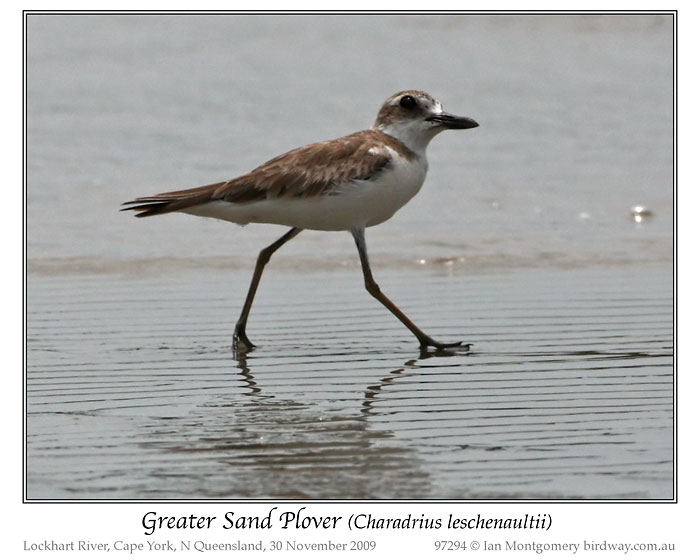
In non-breeding plumage most waders are, frankly, drab and often difficult to identify. Here is a Greater Sand Plover in non-breeding plumage on Cape York. This particular individual shows the characteristic long legs and large bill that distinguish it from the very similar Lesser or Mongolian Sand Plover, but Sand Plovers are quite variable in both size and bill length and I’m not always certain of identification, even with the aid of photos.

Greater Sand Plover (Charadrius leschenaultii) by Ian

Here, to illustrate the point, is a pair at Coquette Point. The bird in non-breeding plumage looks smaller than its companion, has the slightly hunched posture of the Lesser Sand Plover but its large bill, and guilt by association, would indicate a Greater.

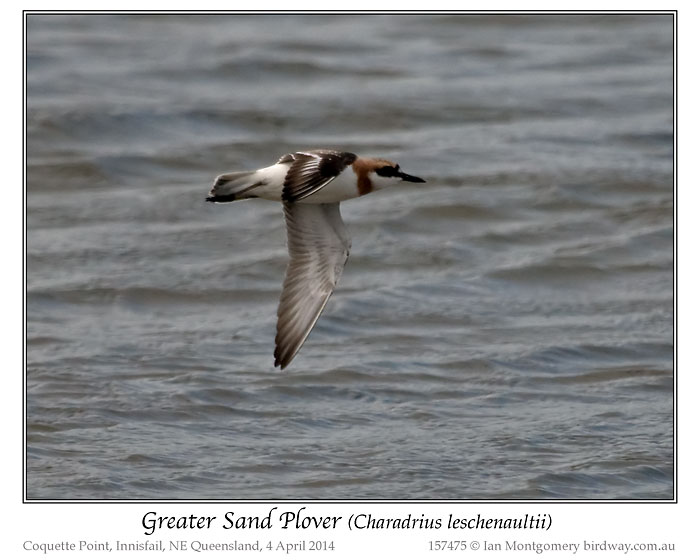
Greater Sand Plover (Charadrius leschenaultii) by Ian

Finally, to complete the series, here is one of the Coquette Point birds in flight. The birds wintering in Australia belong to the nominate race leschenaultii and nest in Southern Siberia, Western China and Southern Mongolia. Their movements are not well understood but it is thought that they migrate non-stop, so this at least is one species of wader that doesn’t have to rely on the fast-disappearing mudflats of the Yellow Sea for refuelling stopovers.

Greater Sand Plover (Charadrius leschenaultii) by Ian 4

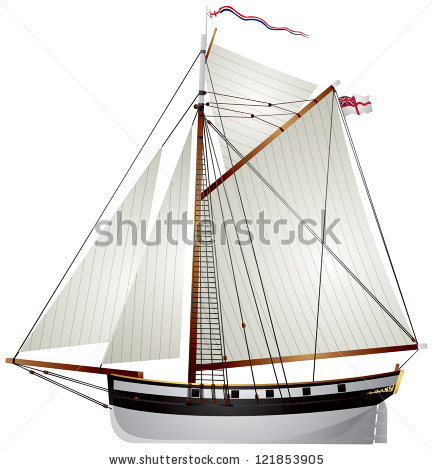
I’d always vaguely assumed that the person who named Flying Fish Point did so because he or she had seen Flying Fish there, but Coquette Point aroused my curiosity as there seemed nothing flirtatious about it. With the help of Google, I found out that George Dalrymple, one of the explorers in this part of the world was sent by the Queensland Government in 1873 to explore the inlets and rivers between Cardwell and Cooktown. His boats were two cutters, the Flying Fish and the Coquette and one of his companion policemen was Robert Johnstone. In Dalrymple’s report to Parliament he said “I therefore considered that I was justified in naming the river after Mr Johnstone, a gentleman who has become identified with discovery and enterprise on the north east coast and who first brought to light the real character and value of this fine river, and it’s rich agricultural land…”. This, incidentally, is what 19th Century cutters looked like.

Ancient British Navy Gun Cutter from Ian

Ancient British Navy Gun Cutter from Ian

Which, of course, begs the question of why a Queensland boat would be called Coquette. The only clue I could find was that the first Royal Navy ship called Coquette was a 28 gun one captured off the French in 1783 and put into service. After that the name ‘Coquette’ was used repeatedly for a series of smaller ships.

Greetings
Ian

**************************************************
Ian Montgomery, Birdway Pty Ltd,
454 Forestry Road, Bluewater, Qld 4818
Tel 0411 602 737 ian@birdway.com.au
Bird Photos http://www.birdway.com.au/
Recorder Society http://www.nqrs.org.au


Lee’s Addition:

Even the stork in the heavens knows her times, and the turtledove, swallow, and crane keep the time of their coming, but my people know not the rules of the LORD. (Jer 8:7 ESV)

Thanks again, Ian, for sharing another interesting bird. I find it interesting that his birds are migrating, but for the opposite reason ours are migrating. Cold is coming on down there and our are heading home because it is getting warmer. Either way, the birds are on the “move.”

Plovers are members of the Charadriidae – Plovers Family.

*
More:

Ian’s Bird of the Week

Charadriidae – Plovers Family

*
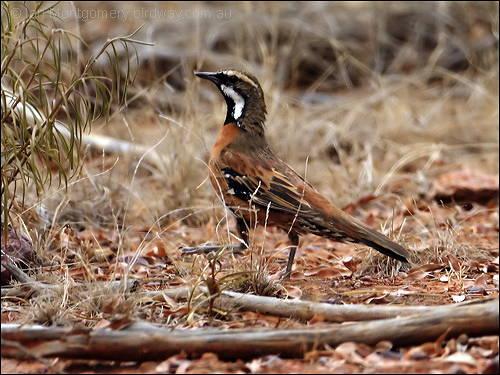
Ian’s Bird of the Week – Black-winged Stilt

White-headed Stilt (Himantopus leucocephalus) by Ian

Ian’s Bird of the Week – Black-winged Stilt ~ by Ian Montgomery

Newsletter ~ 3/30/14

*
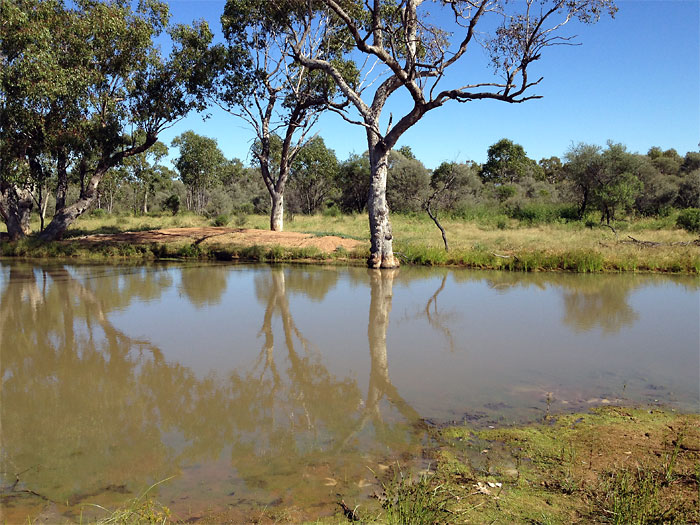
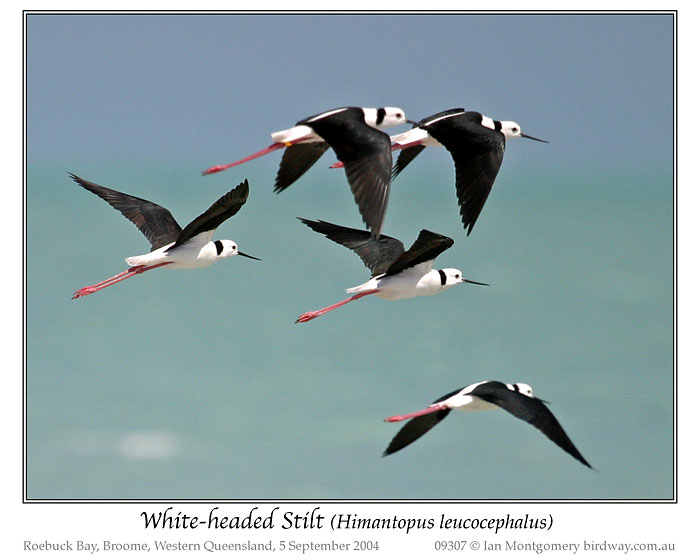
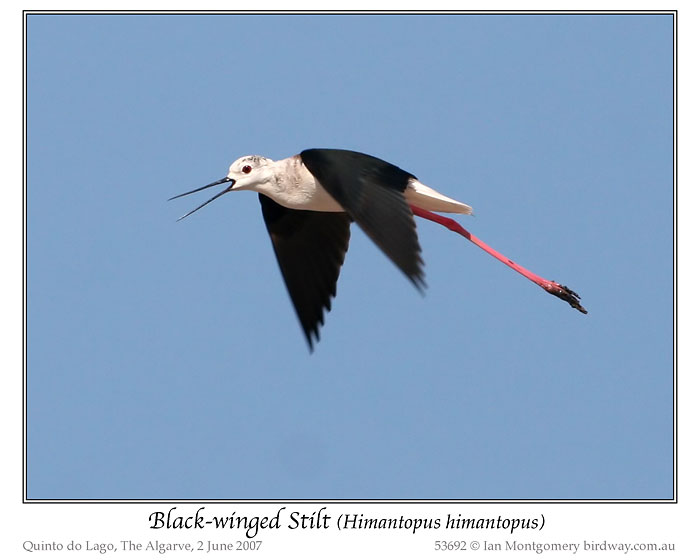
A few weeks ago, I included a photo of the Black Stilt of New Zealand in a piece on Black-fronted Tern, so I was surprised to find out that no other stilt has ever featured as bird of the week. That’s a serious omission given the spectacular appearance of all the members of this family, the Avocets and Stilts, Recurvirostridae, so here are three variants of the almost global Black-winged Stilt, starting with the one we get in Australasia, often called the White-headed Stilt.

There is disagreement over whether the various version of the Black-winged Stilt are species or merely sub-species. Some taxonomists, none naturally from New Zealand, have even dared to suggest that the Black Stilt is a mere subspecies too, as it sometimes hybridises with the White-headed which colonised New Zealand in the 19th century. The tendency now is to settle on four closely related species, the Black Stilt (Himantopus novaezelandiae) the nominate Eurasian and African Black-winged (H. himantopus), the Australasian White-headed (H. leucocephalus) the American (North and South) Black-necked (H. mexicanus). As we’ll see shortly, the English names are almost as confusing as the taxonomy as they all have black wings, two have white faces and two have black necks.

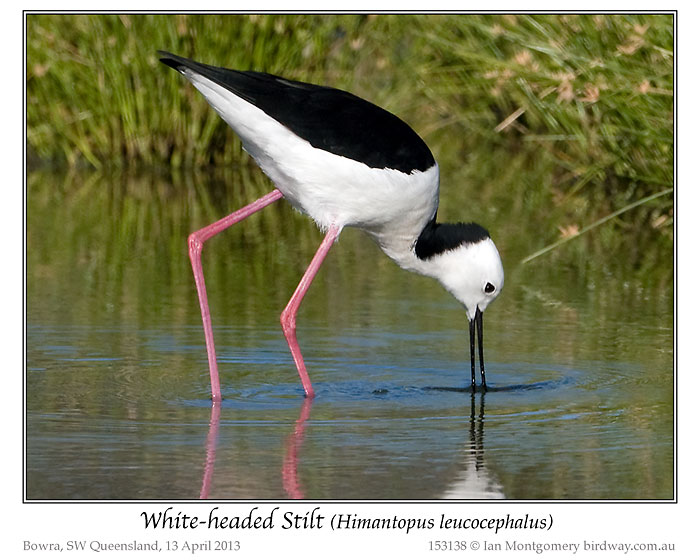
White-headed Stilt (Himantopus leucocephalus) by Ian

As a teenager in Ireland in the 1960s, browsing my Peterson Field Guide to the Birds of Britain and Europe – which I have in front of me at the moment – birds like Avocets and Stilts seemed unbelievably exotic. The iconic Pied Avocet was, and still is, the poster child of the Royal Society for the Protection of Birds following its successful reestablishment as a breeding species in Britain. I saw Pied Avocets in the RSPB Reserve at Minsmere in Suffolk in 1965 and American Avocets in Wyoming in 1970, but it wasn’t until I arrived in Sydney in 1971 that I saw my first Stilt and was amazed to find how widespread and abundant the White-headed is. Almost too much, as these are noisy birds and almost as much of a nuisance as Common Redshanks are in Ireland when you’re trying to stalk shy waders.

Black-winged Stilt (Himantopus himantopus) by Ian

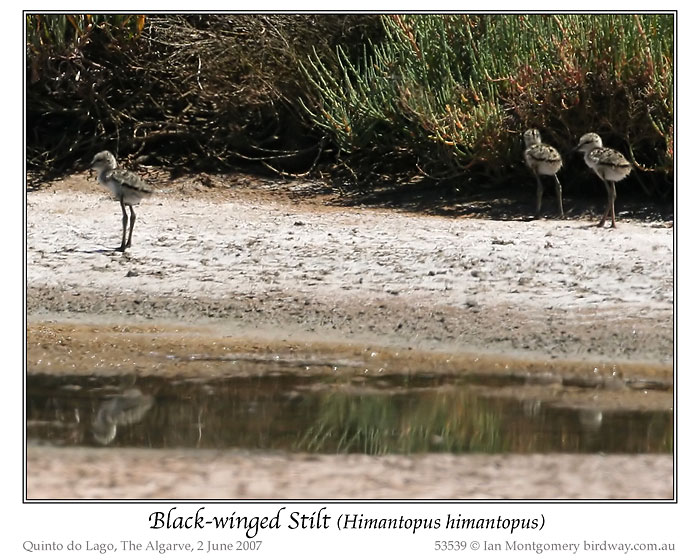
I eventually encountered the nominate Black-winged in Zimbabwe in 1992 and again in Portugal in 2007. The female (very little black on the head) one in the third photo is being very vocal and making it quite clear that I am very unwelcome. This time at least she had very good reason for being aggressive as it had four newly-hatched chicks close by, wandering around looking rather bewildered, fourth photo (the fourth chick was farther to the left). Male nominate race birds have more but varying degrees of black on the head and neck, adding to the general confusion.

Black-winged Stilt (Himantopus himantopus) by Ian

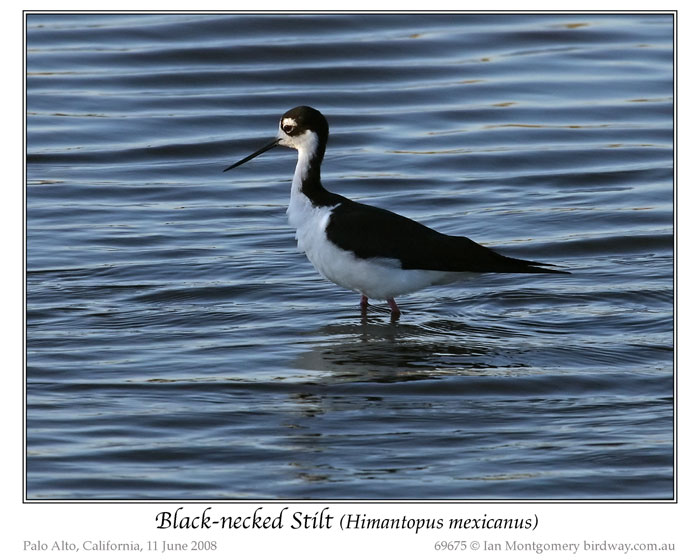
Finally, fifth photo, here is the American version, the Black-necked. It has a black cap joined fore and aft by a curved band through the eye leaving a white spot above the eye, creating a bullseye effect. It’s showing us why stilts have such long legs and that needle-sharp bill is perfect for delicately snatching small items of prey from the surface of the water.

Black-necked Stilt (Himantopus mexicanus mexicanus) by Ian

There are photos of all the Stilts and Avocet, except the poorly known Andean Avocet, here: http://www.birdway.com.au/recurvirostridae/index.htm.

This is a slightly hurried bird of the week, as I’m leaving for Cairns later today. We’ve had a late end to the wet season after a dry false alarm earlier in the month and I want to take more location photos for the book Where to find Birds in Northeast Queensland now that the weather has improved.

Greetings
Ian

**************************************************
Ian Montgomery, Birdway Pty Ltd,
454 Forestry Road, Bluewater, Qld 4818
Tel 0411 602 737 ian@birdway.com.au
Bird Photos http://www.birdway.com.au/
Recorder Society http://www.nqrs.org.au


Lee’s Addition:

And God said, Let the waters bring forth abundantly and swarm with living creatures, and let birds fly over the earth in the open expanse of the heavens. (Genesis 1:20 AMP)

All three of these “black-winged” Stilts are very pretty. I like the clean lines on them. Thanks, Ian, for sharing these with us.

Our American Black-necked Stilt, which I have had the privilege of seeing several times, has a neat white eye-brow. You can tell they all belong to the same family – the Recurvirostridae – Stilts, Avocets. This family has 10 in it and Ian has 8 species photographed on his site.

I am still amazed at the variety of birds the Lord has created.

*

Ian’s Recurvirostridae – Stilts, Avocets Family

Recurvirostridae – Stilts, Avocets Family

Recurvirostridae – Wikipedia (They show only 9, but the White-backed Stilt is now a species)

*


Ian’s Bird of the Week – Coal Tit

Coal Tit (Periparus ater hibernicus) (Irish) by Ian


Ian’s Bird of the Week – Coal Tit ~ Ian Montgomery

Newsletter ~ 3/17/14

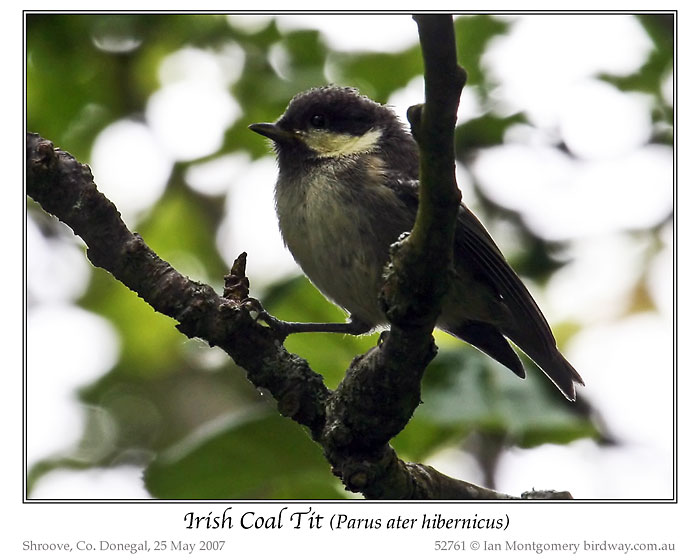
Here is a St Patrick’s Day special: one of only four avian species that are deemed to have Irish races, the Coal Tit. The Irish race, Parus ater hibernicus, has yellower cheeks and underparts and more cinammon flanks than its British counterpart britannicus.

The other three Irish sub-species are the Irish Dipper (darker breast), the Irish Jay (darker overall) and the Irish Red Grouse (paler overall). Because of sea-level fluctuations with ice ages, Ireland has been isolated from Britain for a mere 8,000 years. The current distances vary from a mere 19km/12 miles between Scotland and Co. Antrim to about 100km/60 miles between Ireland and Wales (Pembrokeshire to Co. Wexford and Holyhead to Dublin). so only the most sedentary or least adventurous species have any to chance of diverging.

Coal Tit (Periparus ater hibernicus) (Irish) by IanThe first photo shows an adult bird, while the second one is a juvenile with drabber colours and juvenile Coal Tits tend to have yellower cheeks anyway. Incidentally, there are 21 subspecies of Coal Tit currently recognised, from the Irish one in the west to Taiwanese and Japanese ones in the east. Some authorities dispute the validity of these subspecies because of local variation.

Interestingly the birds in Northeastern Ireland show more in common with Scottish birds, and some would argue that Scottish Coal Tits are different from English ones. We could be getting onto politically thin ice here so, given the unifying spirit of St Patrick’s Day, I don’t think we’ll pursue this topic :-)

Happy St Patrick’s Day!
Ian

**************************************************
Ian Montgomery, Birdway Pty Ltd,
454 Forestry Road, Bluewater, Qld 4818
Tel 0411 602 737 ian@birdway.com.au
Bird Photos http://www.birdway.com.au/
Recorder Society http://www.nqrs.org.au


Lee’s Addition:

It is the smallest of all seeds, but when it has grown it is larger than all the garden plants and becomes a tree, so that the birds of the air come and make nests in its branches.” (Matthew 13:32 ESV)

A pleasant surprise getting a St Patrick’s Day bird to enjoy. The Coal Tits belong to the Paridae – Tits, Chickadees Family. I am more familiar with the Chickadees, but it is easy to see the family resemblance.

The Coal Tit (Periparus ater) is a passerine bird in the tit family Paridae. It is a widespread and common resident breeder throughout temperate to subtropical Eurasia and northern Africa. The Black-crested Tit is now usually included in this species. (Wikipedia)

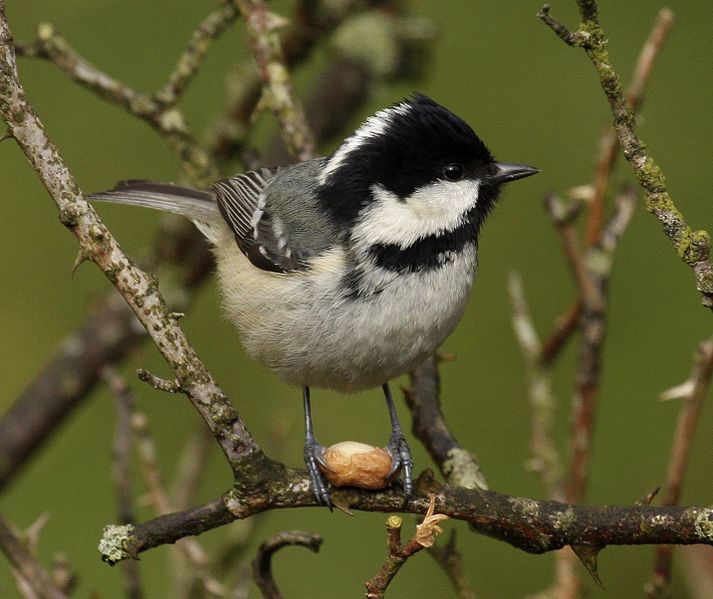
Here is a photo of the main Coal Tit species.

Coal Tit (Periparus ater) ©WikiC

Coal Tit (Periparus ater) ©WikiC

*
See:


*