Ian’s Bird of the Week – Collared Kingfisher

Ian’s Bird of the Week – Collared Kingfisher ~ by Ian Montgomery

Newsletter ~ 12-30-14

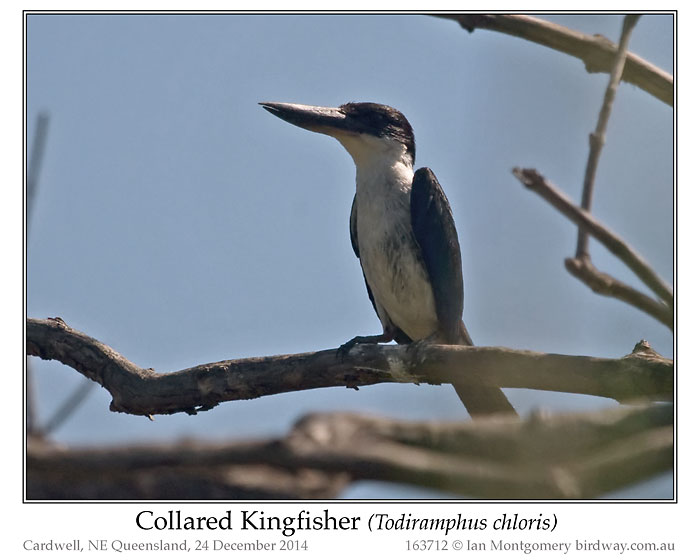
The first photo shows a present from Santa that I want to share, taken late in the afternoon on Christmas Day: a Collared Kingfisher This species is the only one of the ten Kingfishers and Kookaburras normally found in Australia that hasn’t featured as bird of the week. It’s a close relative of the Sacred Kingfisher, but larger with a much heavier bill. In Australia it is almost exclusively a dweller of mangroves and feeds mainly on crustaceans such as crabs with a carapace width up to 2cm: hence the shell-crunching beak, it’s best field mark.

Common Kingfisher (Alcedo atthis) by Ian

Because of its preference for mangroves and because it’s not very common, I’ve found it a difficult species to photograph in Australia. Often the only access to mangroves is on boardwalks, so you can’t get close to anything that’s not close to the boardwalk and, even if you can, you usually can’t get an uninterrupted view in the dense vegetation. In fact, the only tolerable Australian photo that I had was one I took in Darwin in 2004 where there is a walking track into mangroves from Tiger Brennan Drive.
 

Common Kingfisher (Alcedo atthis) by IanWhen I pass through Cardwell travelling north towards Innisfail and Cairns, I always stop there as it’s a lovely place where the highway runs along the beach front with views of Hinchinbrook Island and a convenient 90 minutes from home. There’s a rest area at the southern end of town close to a patch of mangroves that regularly produces interesting birds. It was badly damaged by cyclone Yasi four years ago, but is now recovering and the path through the mangroves from the rest area to Port Hinchinbrook has been restored.

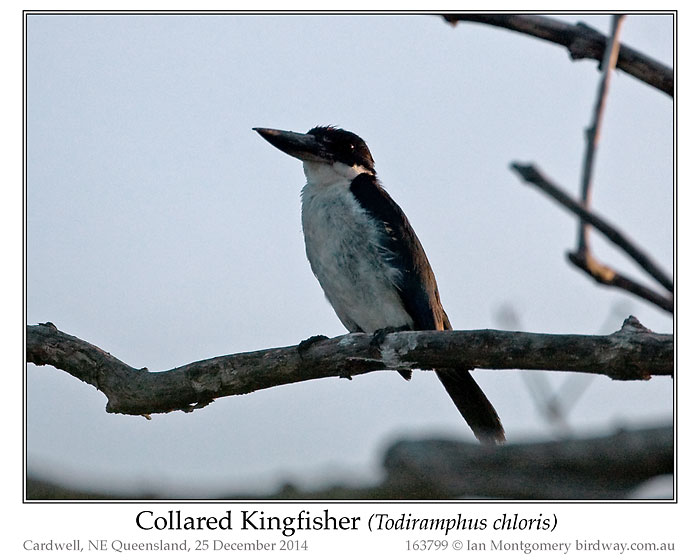
In early November, I saw a Collared Kingfisher perched in the open on a dead mangrove near the rest area; it was low tide and the bird was presumably looking for dinner on the mudflat. I didn’t get a photo of it – camera malfunction – but looked again on Christmas Eve on the way north and heard and then found one on a different perch in the middle of the mangroves. I got only the quick, back-lit, get-it-before-it-flies-away shot, second photo, before it did exactly that and I didn’t see it again.
Common Kingfisher (Alcedo atthis) by Ian

I returned home on Christmas Day and had another look, as the tide was going out and I hope that this would attract the bird into a more open position for a late feed. Just before I was about to give up, I heard the bird calling and found it perched near the beach. I got some distant shots, but when I approached it it flew over my head and returned to exactly the same back-lit spot where it had been on Christmas Eve. If you compare photos two and three, you can see from the guano stains on the branch that it is only a couple of centimetres apart on the two occasions. Clearly a bird of habits. This time, it tolerated my approach, and allowed me to leave the path, squelch through the mangroves and get around behind it where I took the first photo. Austral
Common Kingfisher (Alcedo atthis) by Ian

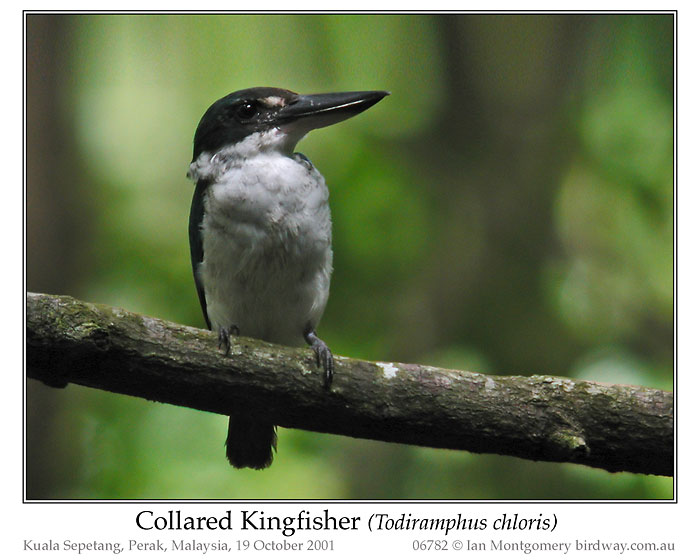
I’ve qualified some comments with ‘in Australia’. This species also ranges quite widely through Asia, and in some places it is found in many other habitats including suburban gardens and forested areas along rivers. I had no trouble photographing three in the space of week in Singapore and Malaysia, fourth photo, in 2001. These Asian birds belong to different races from the Australian ones and their taxonomy is very confused, with about 50 subspecies being currently recognized. The Malaysian and Australian races have white underparts but some others, particular those in the Pacific Islands east of New Guinea are quite buff, and some taxonomists think they should be transferred to the Sacred Kingfisher. The calls vary by location too. In Australia the usual contact call is a distinctive two note ‘kek KEK’, with the emphasis on the second one.

I hope Santa brought you what you wanted too.
Happy New Year!

Ian

**************************************************
Ian Montgomery, Birdway Pty Ltd,
454 Forestry Road, Bluewater, Qld 4818
Tel 0411 602 737 ian@birdway.com.au
Bird Photos http://www.birdway.com.au/


Lee’s Addition:

“And Jesus, walking by the sea of Galilee, saw two brethren, Simon called Peter, and Andrew his brother, casting a net into the sea: for they were fishers. And he saith unto them, Follow me, and I will make you fishers of men. And they straightway left their nets, and followed him.” (Matthew 4:18-20 KJV)

It is always enjoyable to happen upon a bird that is not always easy to find. Of course, when you bring out a camera, you never know if they will stay long enough to get a photo or not. Personally, for me, they seem to scatter. I am glad Ian was able to capture this beautiful Kingfisher’s photo.

You can see Ian’s Kingfisher photos here:

Collared Kingfisher

Sacred Kingfisher

Whole Kingfisher Family

and also enjoy many of his adventures here:

Ian’s Bird of the Week

Kingfishers – Alcedinidae – Whole Family

*
Ian’s Bird of the Week – Christmas Island White-eye

Christmas Island White-eye (Zosterops natalis) by Ian

Ian’s Bird of the World – Christmas Island White-eye ~ by Ian Montgomery

Newsletter ~ 12/23/14

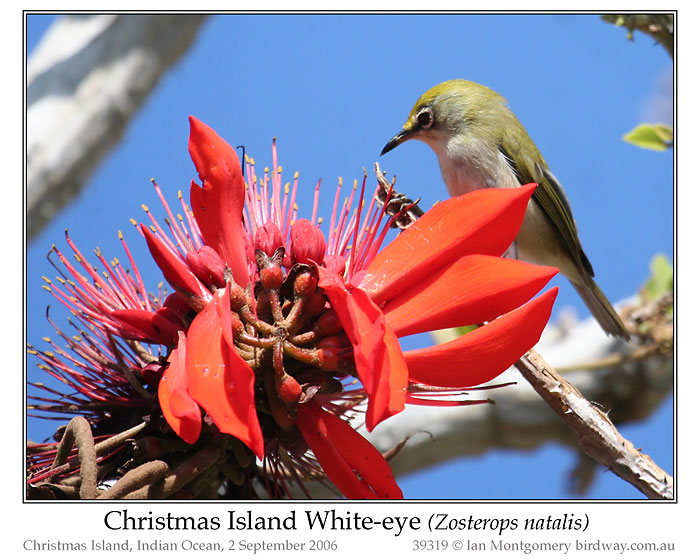
Here is a Christmas Island endemic to celebrate the festive season appropriately. It’s not the most spectacular bird but all the other birds with ‘Christmas’ in the name that I’ve photographed have already featured as bird of the week.
Happily, it’s quite partial to posing beside spectacular flowers, first and third photos and its endemic status gives it special significance. The first two photos were taken at the Christmas Island Resort on the eastern side of the island, – that’s Christmas Island in the Indian Ocean, not Christmas Island (Kirimati part of Kiribati) in the Pacific. The resort used to be a casino for Indonesian high-rollers, opened by an enterprising entrepreneur in 1993 following the closure in 1981 of the three licensed Indonesian casinos in Jakarta, a mere one hour away by private jet. It closed in 1998, a victim of the Asian financial crisis and was empty when we visited it in 2006. It has recently reopened as an ordinary resort, promoting more socially acceptable activities such as honeymoons and bird watching.

The White-eye is quite abundant on the island. The third photo was taken in the grounds of Government House, where the Governor used to live. It was also empty in 2006, the Administrator choosing to live in more democratic surroundings. Government House is just across the bay from Flying Fish Cove and it is good for bird watching. If I were Administrator, I would prefer to live there. There is supposed to be a small population persisting in the Cocos (Keeling) Islands, introduced between 1885 and 1900, but there is disagreement between Handbook of Birds of the World and BirdLife International as to where it survives (Horsburgh Island or around the settlement on West Island, respectively).

Anyway, below is my best wishes for Christmas and New Year. I’m avoiding ‘Merry’ as it suggests drunkeness and ‘Prosperous’  as it seems a bit greedy, so interpret the message how it accords best with you.

I think the bird on the left is a Grey Heron as it has a crest and the one on the right a White Stork  a well-loved bird in Strasbourg. We did go looking for them in a park in early October where they occur, but they had already left for the winter and we had to wait until we got to the Pyrenees before we caught up with any:

Greetings
Ian
**************************************************
Ian Montgomery, Birdway Pty Ltd,
454 Forestry Road, Bluewater, Qld 4818
Tel 0411 602 737 ian@birdway.com.au
Bird Photos http://www.birdway.com.au/
Where to Find Birds in Northern QueenslandiTunesGoogle Play Kobo Books
Recorder Society http://www.nqrs.org.au

Lee’s Addition:

“But as it is written, Eye hath not seen, nor ear heard, neither have entered into the heart of man, the things which God hath prepared for them that love him. (1 Corinthians 2:9 KJV)

This was a pleasant surprise article from Ian. Wasn’t expecting one so soon. How appropriate though. I especially love that first picture.

White-eyes are members of the Zosteropidae – White-eyes Family. There are 128 species that make up the family, of which 96 are White-eyes.

*

*

Ian’s Bird of the Week – Squatter Pigeon

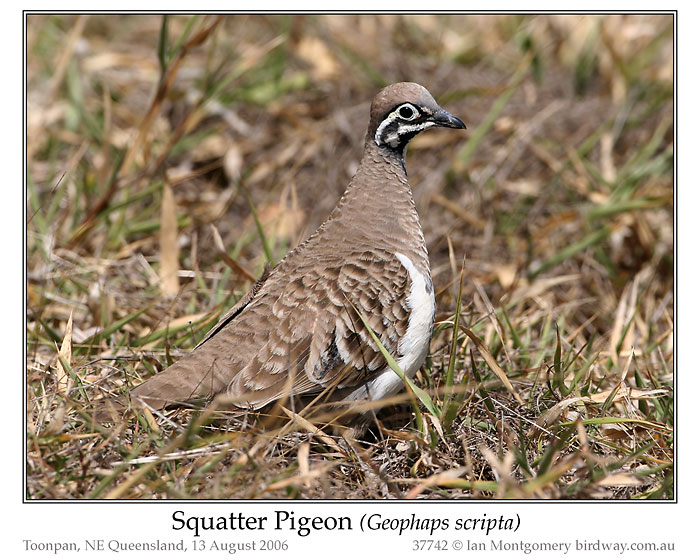
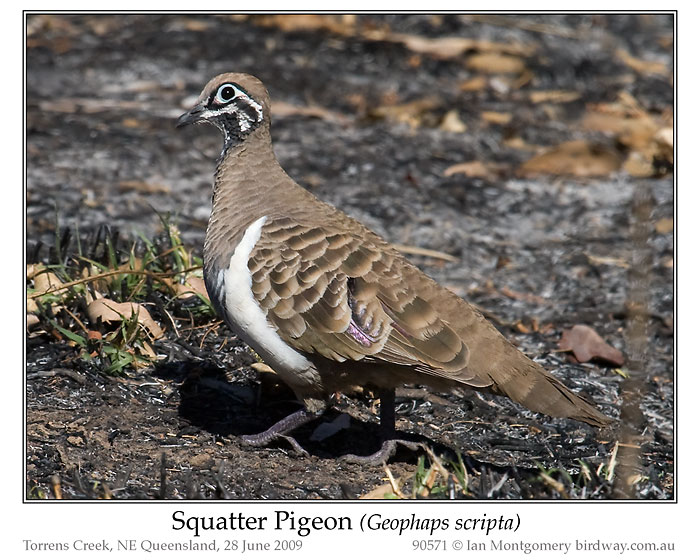
Squatter Pigeon (Geophaps scripta) by Ian

Ian’s Bird of the Week – Squatter Pigeon

~ by Ian Montgomery

Newsletter – 12-18-14

The series of raptors from Europe is perhaps a hard act to follow, so here is something quite different from much closer to (my) home: the Squatter Pigeon,an attractive ground pigeon not uncommon in the drier areas of northern Queensland. Its range used to extend to northern New South Wales, but it is very rare or extinct there and has declined in southern areas of Queensland. The reasons for its decline are not clear but is thought to be due to grazing pressure and perhaps predation by foxes and feral cats.

Toonpan, a short drive south of Townsville on the Flinders Highway is a good spot for this species. When Ross River Dam was built, part of the highway between Toonpan and Townsville was flooded and a new highway was built on higher ground. The old highway still exists and is a quiet roadway through grassland, popular with birders. The habitat in the second photo – taken from the ebook Where to Find Birds in North Queensland – may look uninspiring, but can be very productive often producing other such specialties such as Australian Bustard, various finches including Black-throated and, in winter on powerlines, Red-backed Kingfishers.

Mt Elliot from Old Flinders Highway, Toonpan, by IanIt’s not clear where the name Squatter Pigeon came from, presumably either from its habit of crouching and freezing when disturbed or because of its association with the cattle stations, the original occupants of which were called squatters. It was originally named by the Dutch zoologist Temminck in 1821 and he seemed very taken with it. Like Bonelli in the previous Bird of the Week, he published in French, calling it the Colombe marquetée and describing how each patch of white on the face was framed with black, producing an effect like ‘a sort of marquetry. He gave it the scientific name Geophaps scripta, meaning ‘ground pigeon with writing’, ‘phaps’ being the Greek for pigeon. Temminck, incidentally, named many species of animals and various others were named in his honour, such a Temminck’s Stint.

Squatter Pigeon (Geophaps scripta) by Ian

Sometimes you can see the iridescent feathers on the wing, third photo, a display feature shared with other ground pigeons notably the Bronzewings These feathers are usually hidden in Squatter Pigeons except in display and flight. The body shape is broken up by the white stripe between the breast and the wings, and the black and white facial markings disguise the head and make the eye less conspicuous. Squatter Pigeons nest in a scrape on the ground, so camouflage is important and it is easy to appreciate that a motionless bird crouching on the ground would be quite hard to spot.

Squatter Pigeon (Geophaps scripta) by Ian

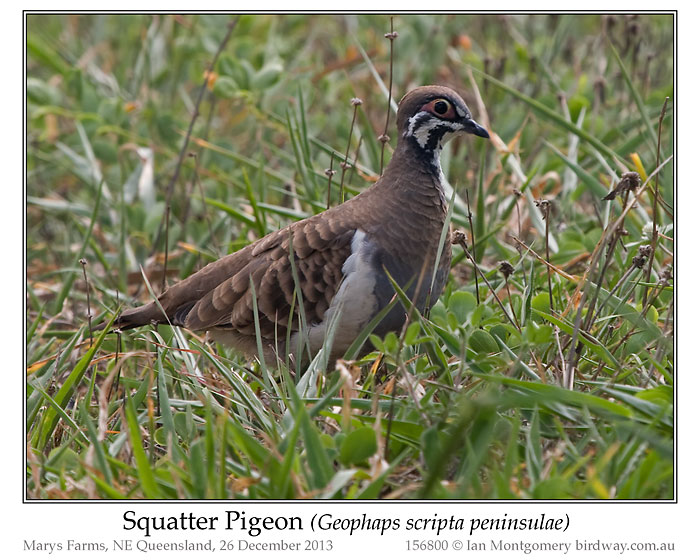
If you look carefully at both bare facial skin of both the Toonpan bird and the one in the third photo taken much farther west along the Flinders Highway, you’ll see the the skin is mainly pale blue around the eye with some pink at the edges in front and behind the eye. Two races of Squatter Pigeon have been described, with the nominate southern race having completely blue facial skin – fourth photo near Carnarvon Gorge – and a Cape York race peninsulae having reddish facial skin. The two races are not geographically well-defined and there is a broad band of intergradation with mixed blue and pink in the Townsville area.

Squatter Pigeon (Geophaps scripta) by Ian

Photos five and six show examples of the Cape York race. Both Marys Farms and the Mitchell River catchment are in the Mount Carbine district south of Cape York proper. The bird in the last photo is perched fairly high in a tree, just to prove that it will sometimes take refuge in trees.

Squatter Pigeon (Geophaps scripta) by Ian

It is the blue-faced southern race that has declined most and is regarded as ‘vulnerable’. The Cape York race and the hybrids in the Townsville district are still reasonably common. The Partridge Pigeon, G. smithii, replaces it in northwestern Australia. It also has races with different coloured faces, red in the Top End of the Northern Territory and yellow in the Kimberley district of northern Western Australia. It has also declined. Although I have seen it in Kakadu National Park I haven’t yet photographed it.

Greetings
Ian

**************************************************
Ian Montgomery, Birdway Pty Ltd,
454 Forestry Road, Bluewater, Qld 4818
Tel 0411 602 737 ian@birdway.com.au
Bird Photos http://www.birdway.com.au/
Recorder Society http://www.nqrs.org.au


Lee’s Addition:

“Behold, I send you forth as sheep in the midst of wolves: be ye therefore wise as serpents, and harmless as doves. (Matthew 10:16 KJV)

I like the markings on their faces. They are interesting, yet, it doesn’t keep them from being camouflaged.

The Squatter Pigeons belong to the Columbidae – Pigeons, Doves Family. (Only bird named Squatter in IOC 4.4 list)

“The Squatter Pigeon (southern) is a medium-sized, ground-dwelling pigeon that measures approximately 30 cm in length and weighs about 190-250 g. The adults are predominantly grey-brown, but have black and white stripes on the face and throat, blue-grey skin around the eyes, dark-brown (and some patches of iridescent green or violet) on the upper surfaces of the wings, blue-grey on the lower breast and belly, white on the lower region, flanks of the belly and extending onto the under surfaces of the wings, and a blackish-brown band along the trailing edge of the tail. They have black bills, dark-brown irises, and dull-purple legs and feet. The sexes are similar in appearance (Higgins & Davies 1996).

Juvenile Squatter Pigeons (southern) can be distinguished from the adults by their duller colouring, the patchy, less distinctive appearance of their black and white facial stripes, and the paler colouring (buff to pale-yellow) of the facial skin (Higgins & Davies 1996).

The southern and northern subspecies of the Squatter Pigeon are virtually identical except the southern subspecies tends to be slightly larger in the body, and the skin around the eyes is predominantly blue-grey compared to yellowy-orange to orange-red in the northern subspecies (Crome 1976b; Ford 1986; Higgins & Davies 1996; Squatter Pigeon Workshop 2011).” (from Australian Government)

*

Found a YouTube of Squatter Pigeons

*

Bird of the Week – Bonelli’s Eagle

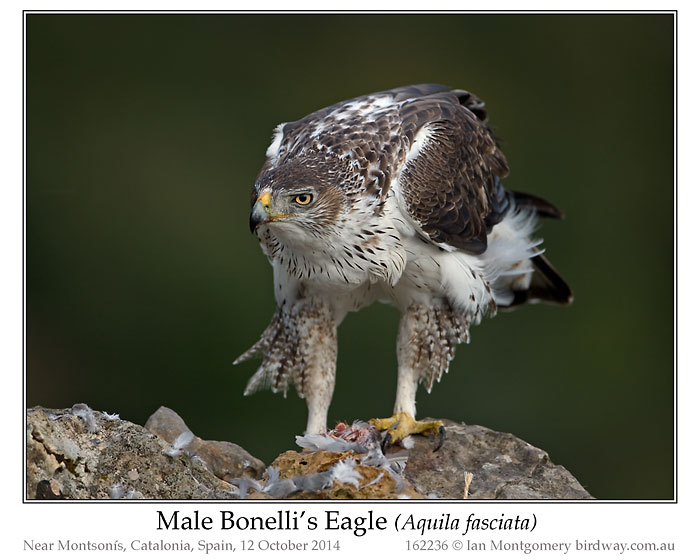
Bonelli's Eagle (Aquila fasciata) by Ian

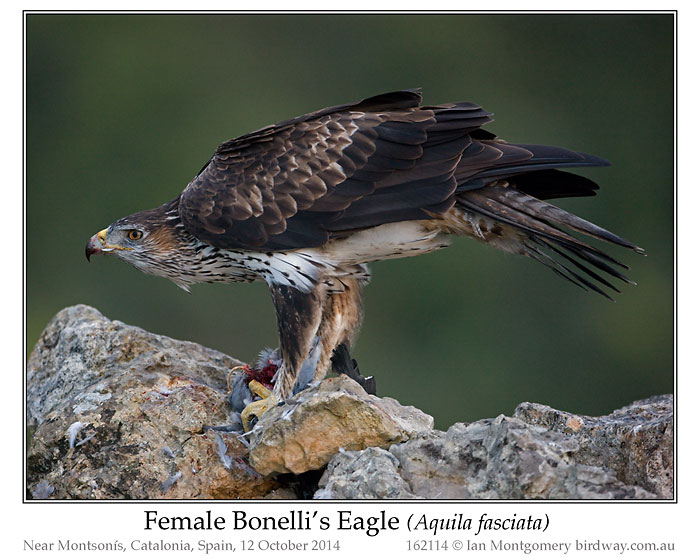
This is the last in this series of raptor photos from the Pyrenees: Bonelli’s Eagle taken at another feeding station managed by Birding in Spain. Like last week’s Northern Goshawk feral pigeons from a local council culling programme are used to attract the eagles. It’s brown and white plumage reminded me rather of the similarly sized Osprey particular that of the male, first photo, which is paler than the female. In size it has a length of up to 73cm/28in, a wingspan to 180cm/71in and weights up to 2.4kg/5.3lbs. That makes it much smaller than most of the other Aquila eagles, such as the Golden and Wedge-tailed but larger than the Little Eagle of Australia.

View From The Hide in Spain by Ian

View From The Hide in Spain by Ian

There the resemblance to ospreys ends, as Bonelli’s Eagle is found in hilly or mountainous country in warm regions and eats mammals and birds – in Spain it eats mainly rabbits and partridges. The second photo shows the view from the hide. The stone wall on the left is where the food is tied in place, as is done with the goshawks to prevent them from carrying the food away. The bird arrived quite promptly after set up: you can see in the first photo that the reflection of the sun in its eye is just above the horizon.

Bonelli's Eagle (Aquila fasciata) by Ian

The third photo is another one of the male with the remains of a pigeon. On the back just below the neck a white spot is visible – this is a diagnostic feature of adult Bonelli’s Eagles and fairly conspicuous in flight though the birds arrived and departed so quickly from the rocky ridge in front of the hide that I didn’t get any decent flight shots.

Bonelli's Eagle (Aquila fasciata) by Ian

They were fast eaters too. The fourth photo was taken 25 minutes after the third: very little of the pigeon remains and the crop of the bird is quite full. The adult goshawk also took about half an hour to demolish a pigeon, but the immature goshawk took the best part of two hours and remained long after the adult had left. Despatching prey at speed would appear to be a skill that takes raptors a bit of practice. Both these photos show the feathered legs or ‘boots’, characteristic of ‘true’ eagles. They’re not exclusive to eagles though. The goshawks had impressive trousers too as do some falcons such as the Brown Falcon of Australia.

Bonelli's Eagle (Aquila fasciata) by Ian

Once fed, the male seemed more aware of what was going on around it and in the fifth photo is peering at the hide, presumably in response to the sound of the camera shutter.

Meanwhile, the female, sixth and seventh photos, was getting stuck into the other pigeon. She was a fine-looking bird too, larger than the male, with hazel eyes and identifiable by much stronger streaks on the breast. The female had much darker trousers, seventh photo, but I don’t know whether that’s generally the case or peculiar to this bird.

Bonelli's Eagle (Aquila fasciata) by Ian Female

Bonelli’s Eagle is widely but sparsely distributed through southern Europe, northern Africa, parts of the Middle East, South and Southeastern Asia as far east as Timor. The European population is about 900 pairs, of which about 700 are in Spain. They are sedentary, keeping to their large home ranges throughout the year. Satellite tracking in Spain has shown an average home range of 200sq km/77sq miles with a core range of about 45sq km/17 sq miles.

Bonelli's Eagle (Aquila fasciata) by Ian Female

The generic name ‘fasciata’ comes from the Latin fascia meaning stripe, band or sash. It’s usually used in birds to refer to horizontal bands or barring but maybe Veillot, the taxonomist responsible, was referring to the barring on the ‘trousers’ rather than the streaks on the breast. Veillot, Jean Pierre that is, was an important French avian taxonomist, 1748-1831, who extended the three-level Linnaean classification of order-genus-species into order-tribe-family-genus-species in his Analyse d’une nouvelle Ornithologie Elémentaire (1816). Franco Andrea Bonelli was, unsurprisingly, an Italian ornithologist 1784-1830 and discovered both this eagle and Bonelli’s Warbler in 1815. He worked at the Natural History Museum in Paris 1810-11 before returning to Italy to take up the position of Professor of Zoology at the University of Turin. Interestingly, he published his main works in French.

What would we do without Wikipedia?
Greetings
Ian

**************************************************
Ian Montgomery, Birdway Pty Ltd,
454 Forestry Road, Bluewater, Qld 4818
Tel 0411 602 737 ian@birdway.com.au
Bird Photos http://www.birdway.com.au/
Recorder Society http://www.nqrs.org.au


Lee’s Addition:

They are passed away as the swift ships: as the eagle that hasteth to the prey. (Job 9:26 KJV)

Their horses also are swifter than the leopards, and are more fierce than the evening wolves: and their horsemen shall spread themselves, and their horsemen shall come from far; they shall fly as the eagle that hasteth to eat. (Habakkuk 1:8 KJV)

What an amazing set of photos of this magnificent Eagle. Thanks again, Ian, for sharing these fantastic glimpses of the Bonelli’s Eagle. Pretty fast eaters, it appears.

This Eagle is a member of the Accipitridae – Kites, Hawks and Eagles Family and a Bird of the Bible also. Eagles are mentioned over thirty times in the Bible, plus they are included in the various “birds of prey” verses.

*

Ian’s Bird of the Week

Ian’s Eagle Family pages

Accipitridae – Kites, Hawks and Eagles Family

Birds of the Bible – Eagle

*

Ian’s Bird of the Week – Northern Goshawk

Northern Goshawk (Accipiter gentilis) by IanIan’s Bird of the Week – Northern Goshawk  by Ian Montgomery

Newsletter ~ 11/17/14

I got so absorbed in recounting my experiences in Catalonia, that I forgot to mention that I’ve been home in North Queensland for several weeks.

The piece about the effects of diclofenac prompted some interesting responses. It was pointed out that it causes kidney not liver failure in vultures, my apologies, and that a safe and effective substitute in both humans and livestock is the anti-inflammatory meloxicam. It’s sold here as Mobic, which I take sometimes when I wayward spinal disc misbehaves. I also received a link to this article by the Vulture Conservation Foundation which has managed to get the EU to do an investigation into the effects of diclofenac: http://www.4vultures.org/our-work/campaigning-to-ban-diclofenac-in-europe/.

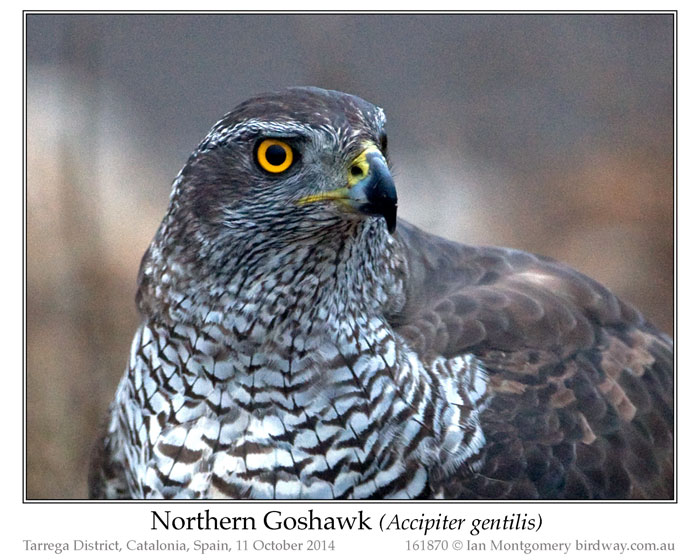
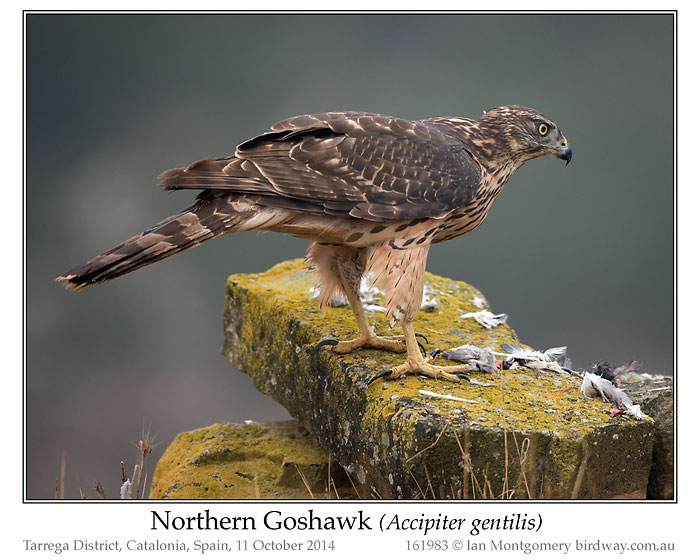
On the second day of our stay in raptor country in the Pyrenees with Birding in Spain we – my sister Gillian joined me for this one – were taken by Steve West to a hide at a Northern Goshawk feeding station before sunrise – goshawks are earlier risers than I am normally and are shy. Here the goshawks are fed regularly on chicken carcasses and fresh pigeon, the product of a culling programme by the local council. It was a misty, chilly, gloomy morning – sunrise was the time of day rather than an event – and the first bird to arrive, the adult female in photos 1 and 2, was barely visible. The second photo was taken at 1/3 of a second exposure at 1600 ISO and my tripod, inconvenient for travel, proved its worth yet again.

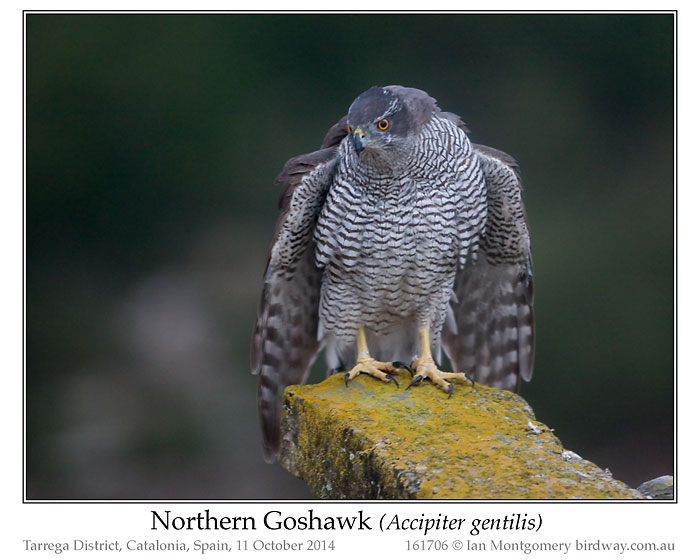
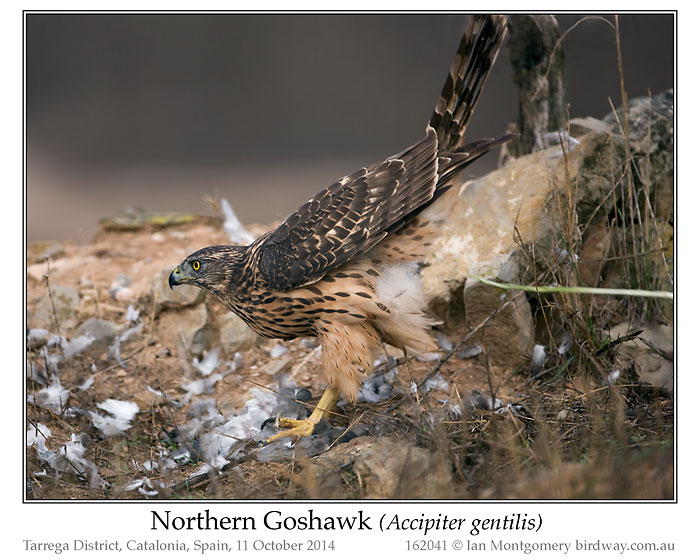
Adult females are more strongly barred and much larger than males (to protect succulent-looking nestlings). This one is partially spreading its wings and tail near the food in a posture that looks like a rudimentary ‘mantling’ display. This is usually used by hawks as a threat display to discourage other ones from interfering with their prey. In this case, I suspect it was signalling the presence of food to the juvenile goshawk, third photo, who appeared shortly afterwards. First year juvenile Northern Goshawks are brown with buff, almost cinnamon underparts and are streaked rather than barred. Similar juvenile plumages occur in other close relatives in the Accipiter genus such as the Brown Goshawk (A. fasciatus) and Collared Sparrowhawk (A. cirrocephalus), both common in Australia; see http://www.birdway.com.au/accipitridae/brown_goshawk/source/brown_goshawk_32464.htm and http://www.birdway.com.au/accipitridae/collared_sparrowhawk/source/collared_sparrowhawk_62859.htm for examples of their juvenile plumage. Note, incidentally the ‘beetle-brow’ characteristic also of the Brown Goshawk that gives the larger goshawks their fierce expression.

Northern Goshawk (Accipiter gentilis) by IanThe adult female moved aside and let the juvenile have the pigeon prey and the juvenile then adopted the possessive mantling display with spread wings and tail and fluffed-out feathers of the mantle, just below the neck.

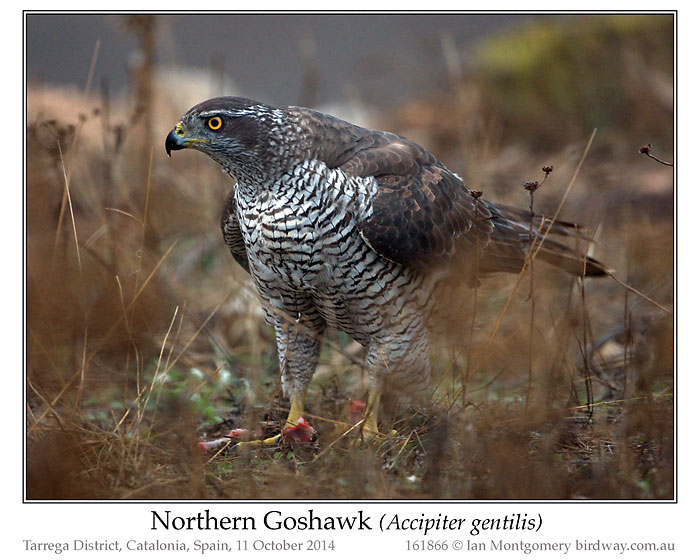
Mother, I presume, tackled a piece of chicken carcass and carried it down onto the ground closer to the hide, but partially obscured by dried grass and other vegetation.

Northern Goshawk (Accipiter gentilis) by IanThe sixth photo shows the juvenile somewhat later with the remains of the pigeon. This was a very large bird too, as you can perhaps judge from its appearance, so I concluded that it was female too. ‘Huge’ is perhaps a better description, as the Northern Goshawk is easily the world’s largest of the nearly 50 or so species of Accipiter – (typical hawks comprising larger goshawks and smaller sparrowhawks, though ‘hawk’ is also used in North America to name other raptors such as those in the genus Buteo aka ‘Buzzard’ in British English). The female is up to 65cm/26in in length with a wingspan of up to 120cm/47in and a weight of up to 2.0kg/4.5lb, comparable in size with many Buzzards. All the Accipiter hawks tackle relatively large prey, mainly birds and some mammals. They hunt by surprise and pursuit and have rounded wings, long tails and fast reflexes for great manoeuvrability in forests. I suspect that Linnaeus used the specific moniker ‘gentilis’ in the sense of ‘noble’ rather than ‘gentle’. ‘Goshawk’ comes from the Old English ‘göshafoc’ meaning goose hawk, no mere chicken hawk.

Northern Goshawk (Accipiter gentilis) by IanThis was another species that had aroused my interest in my field guide as an Irish teenager, and hadn’t seen before this trip. It’s a very rare vagrant in Ireland and was then only an occasional breeder in Britain though widespread if uncommon elsewhere in temperate regions of the Northern Hemisphere. Since then it has become re-established in Britain with a breeding population of 300-400 pairs.

Northern Goshawk (Accipiter gentilis) by IanBoth birds lightened their load, as many raptors do, before taking flight, as the juvenile is doing in the seventh photo. There’s a photo on the website of the female doing the same thing: http://www.birdway.com.au/accipitridae/northern_goshawk/source/northern_goshawk_161882.htm. Even nobles have to perform basic functions: don’t stand behind or below a well-fed raptor :-).

Greetings
Ian

**************************************************
Ian Montgomery, Birdway Pty Ltd,
454 Forestry Road, Bluewater, Qld 4818
Tel 0411 602 737 ian@birdway.com.au
Bird Photos http://www.birdway.com.au/
Recorder Society http://www.nqrs.org.au


Lee’s Addition:

“And these you shall regard as an abomination among the birds; they shall not be eaten, they are an abomination: the eagle, the vulture, the buzzard, the kite, and the falcon after its kind; every raven after its kind, the ostrich, the short-eared owl, the sea gull, and the hawk after its kind; (Leviticus 11:13-16 NKJV)

What a beautiful family of birds. Ian always has such great photos and adventures to share with us. Thanks, Ian.

*

Ian’s Bird of the Week

Birds of the Bible – Peregrine Falcon and Goshawk

Ian’s Accipitridae Family

Accipitridae – Kites, Hawks and Eagles

*

Ian’s Bird of the Week – Lammergeier (Missió Complerta!)

Bearded Vulture (Gypaetus barbatus) or Lammergeier by Ian

Newsletter ~ 11/7/14

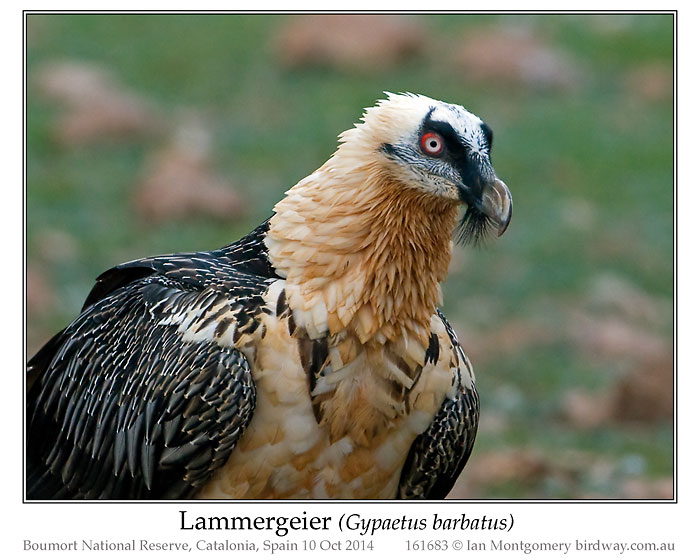
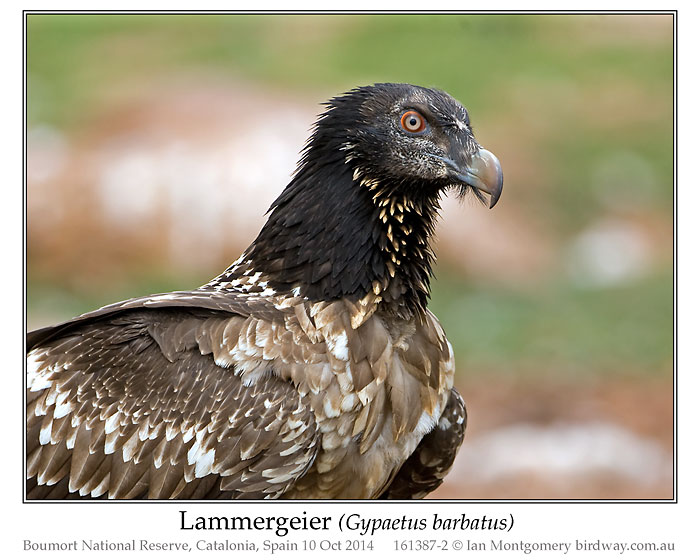
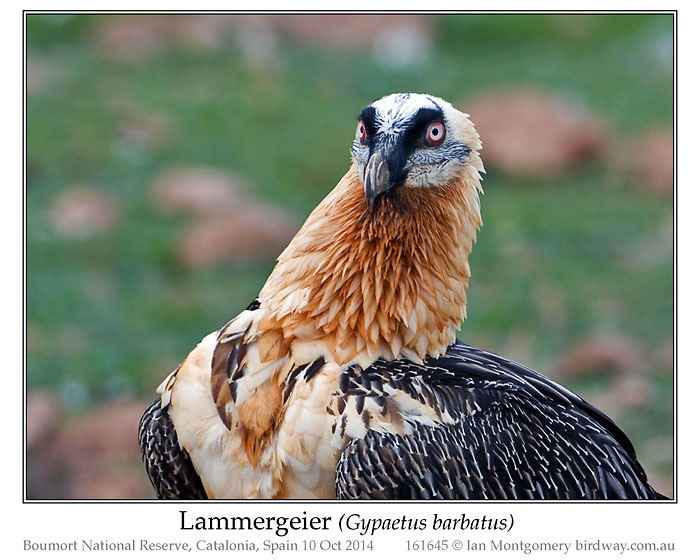
Now, at last, here is the one that I wanted to photograph above all else when in the Pyrenees: the Lammergeier, or Bearded Vulture.

As with other species that have featured in the bird of the week such as the Black Woodpecker and Cream-coloured Courser, my interest or perhaps obsession was stimulated by my Petersen et al. Field Guide to the Birds of Britain and Europe in the early 1960s. Unlike the woodpecker and the coursers, the European vultures were represented not on the coloured plates but in monochrome drawings. If anything, that made them more mysterious and elusive though two of them came spectacularly to life in 1963 when I saw Griffon and Egyptian Vultures during a family holiday in the Pyrenees. The Lammergeier, the mythical bone-breaker seemed destined to remain just that, as I knew it was very rare in Europe, extinct in the Alps, and found only over the highest mountain ranges. Even the name seemed straight out of Wagner’s Ring Cycle along with the Valkyries.

Bearded Vulture (Gypaetus barbatus) or Lammergeier by Ian

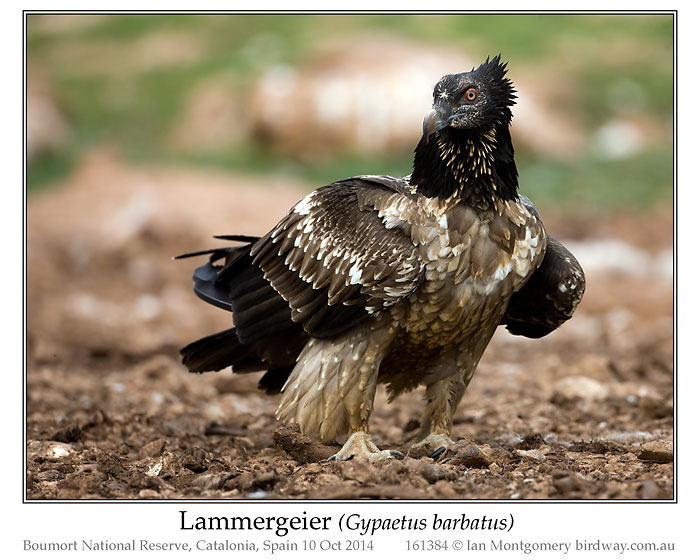
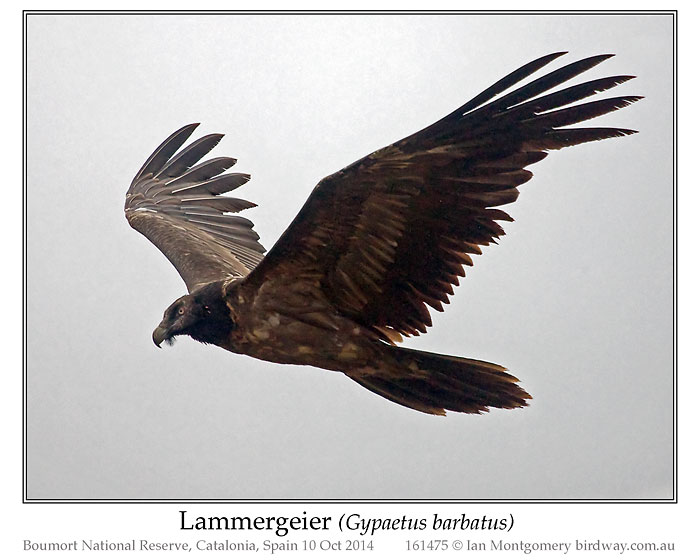
I had been warned by the reserve rangers that the Lammergeiers would appear, if at all, in the afternoon after the Griffons had had their fill and I also knew that they were shy, would initially cruise over the area without landing and could easily be put off by the movement of a large telephoto lens. So the suspense was great, and it was a thrill when the first immature bird landed some distance away just before midday. They kept on the fringes and it wasn’t until about 2:30pm they came close enough for decent photos. The bird in the second and third photo is an older immature bird – they take six or seven years to mature – and the feathers of the breast and legs are getting paler. It also has the red eye-ring of the adult.

Bearded Vulture (Gypaetus barbatus) or Lammergeier by Ian

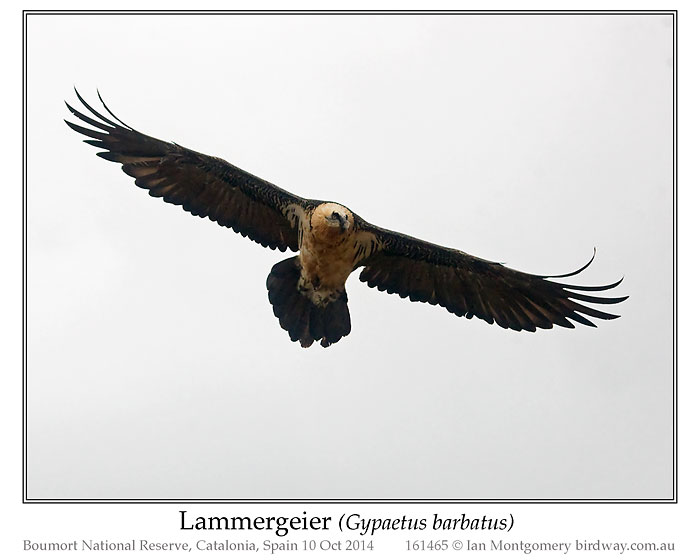
In flight, fourth photo, they look quite different to other vultures with their back-swept rather pointed wings and long paddle-shaped tail. The thick plumage on the crown and neck sets them apart from typical vultures too, and when perched they hold their bodies in a horizontal eagle-like stance, presumably to keep their tails off the ground.

Bearded Vulture (Gypaetus barbatus) or Lammergeier by Ian

Their shape plus the whitish head of the adult is quite distinctive so it was an exciting moment when I saw the first one soaring in the distance over the mountain range that overlooked the feeding station. Much later, they started checking out the feeding area without landing. I was too wary of alerting them by movement so I took the fourth photo of an adult in flight much later.

Bearded Vulture (Gypaetus barbatus) or Lammergeier by Ian

Eventually, just before 3pm, the first adult landed, though like the juveniles, the adults stayed on the fringes as well and it wasn’t until 4:30pm that they came closer pick over the remains of the food carcasses and the real photography began.

Bearded Vulture (Gypaetus barbatus) or Lammergeier by Ian

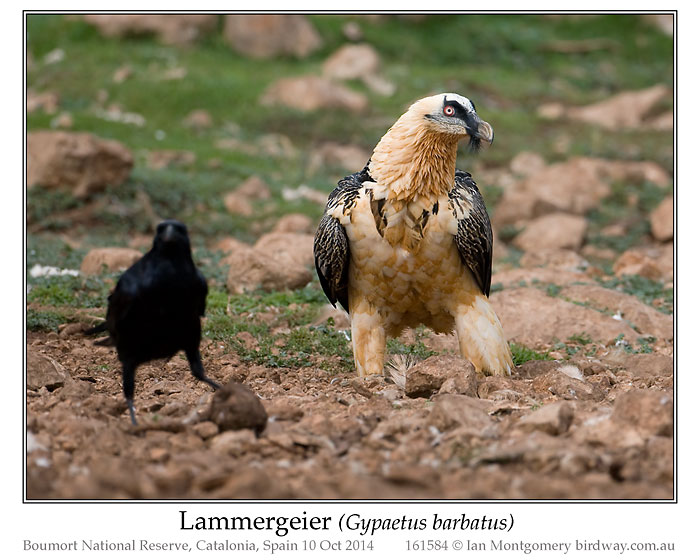
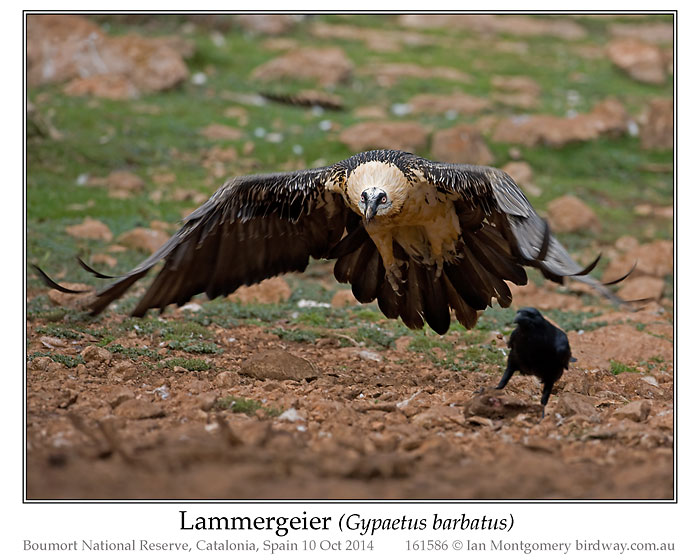
The black bird on the left of the fifth photo is a Common Raven and it seems to be imitating the stance of the larger bird and saying ‘I’m a champion too’. It’s much closer to the camera which makes it look larger than it actually is. Thirteen seconds later the Lammergeier took flight right over the Raven’s head – it had to duck – as if to say ‘we’ll see who’s boss’, and the relative proportions are more obvious. The wing-span – to 280cm/110in – is similar to that of Griffon and Cinereous Vultures, but the tail makes it much longer – to 125cm/49in. Females are heavier than males, to 7kg/15lb, but both sexes are lighter than the other vultures.

Bearded Vulture (Gypaetus barbatus) or Lammergeier by Ian

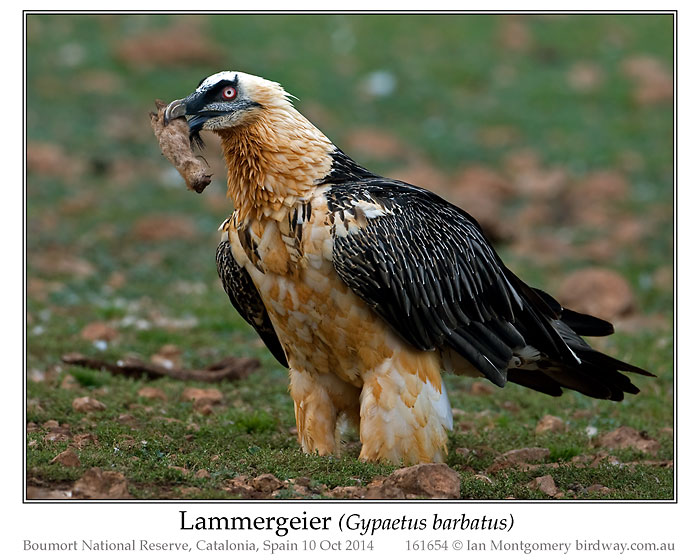
The Lammergeiers wait until the others have finished because their food of choice is bones and bone marrow. In fact these make up 85% of the diet making them unique among birds and probably also vertebrates. The one in the sixth photo has found the favourite morsel, the digits of a cloven-hoof herbivore such as sheep and goats. Smaller bones ones are swallowed whole, larger ones – up to 4kg in weight – are dropped onto regularly used rocky areas called ossuaries to smash the bones. The usual pattern of the birds here was to scout around for suitable food, carry it off and then return perhaps 20 minutes later. They’re called ‘quebrando huesos’ (breaking bones) in Spanish. They’ll also take live prey such as tortoises, which get the same treatment. Legend has it that the Greek playwright Aeschylus was killed around 456 BC by an eagle – clearly a Lammergeier – dropping a tortoise on his bald head, mistaking it for a rock.

Bearded Vulture (Gypaetus barbatus) or Lammergeier by Ian

Conservation efforts have seen the Pyrenean population grow from 75 pairs in 1993 to 125 pairs in 2008 and the species has been successfully re-introduced to the Alps. It also occurs in eastern Africa, South Africa and Central Asia. Estimates of the global population range from 2000 to 10,000 individuals. Until recently, it was not considered globally threatened until recent declines outside Europe and it is now classified as near threatened. The greatest concern is the veterinary use of the anti-inflammatory and pain-killing drug Diclosfenac. Highly toxic to vultures, causing liver failure, it has been solely responsible for the 99% decline in vulture populations in India, where it is now banned.

Horrifyingly, this drug has recently been approved for veterinary use in Spain and Italy. This insanity jeopardises the wonderful conservation efforts being carried out. BirdLife International has rallied to the cause, see http://www.birdlife.org/worldwide/news/vultures-africa-and-europe-could-face-extinction-within-our-lifetime-warn, and funds are being raised here https://www.justgiving.com/stop-vulture-poisoning-now/.

Bearded Vulture (Gypaetus barbatus) or Lammergeier by Ian

I’m going to donate. If we think that because there are no vultures in Australia, it’s someone else’s problem, it’s not unfortunately quite so simple. There is recent evidence that Diclosfenac is toxic to Aquila eagles too. That includes the Wedge-tailed Eagle and this drug is approved for veterinary use here (e.g. ‘Voltaren’ for horses) and widely prescribed for human use. Studies have shown that it increases the risk of strokes in humans http://www.abc.net.au/news/2010-09-14/study-links-voltaren-to-strokes/2260424. Photographing Lammergeiers is a personal missió complerta (Catalan for misión completa). A much more important mission accomplished will be the global banning of this completely unnecessary and dangerous drug – there are safe alternatives.

Greetings
Ian

**************************************************
Ian Montgomery, Birdway Pty Ltd,
454 Forestry Road, Bluewater, Qld 4818
Tel 0411 602 737 ian@birdway.com.au
Bird Photos http://www.birdway.com.au/
Where to Find Birds in Northern Queensland: iTunes; Google Play Kobo Books
Recorder Society http://www.nqrs.org.au


Lee’s Addition:

“But these you shall not eat: the eagle, the vulture, the buzzard, (Deu 14:12 NKJV)
“And the vulture, and the kite after his kind; (Lev 11:14 KJV)

Wow! What great photos of the Bearded Vulture/a.k.a. Lammergeier. Ian uses the one name, but I.O.C. uses the Bearded names. What ever you call it, it is a neat looking bird, especially being a vulture.

This bird is one of the Birds of the Bible and we have written about them before, but Ian’s photos, will help visualize it it even more.

“The Lammergeier, the mythical bone-breaker” listed by Ian reminded me of this article: Birds of the Bible – Name Study ~ Ossifrage that uses the term “bone-breaker”

*

*

Ian’s Bird of the Week – Cinerous/Eurasian Vulture

Ian’s Bird of the Week – Cinereous/Eurasian Vulture ~ by Ian Montgomery

Newsletter ~ 10-28-14

This is 2 of 3 in a series on Eurasian vultures photographed during my recent spell in a bird hide at a vulture feeding station in Boumort National Reserve in the Pyrenees in Catalonia not far southwest of Andorra. The first of the series was on the Griffon Vulture (see http://www.birdway.com.au/accipitridae/griffon_vulture/index.htm where I’ve put a dozen photos), this one is on the second species in the feeding order, the Cinereous or Eurasian Black Vulture. Here, incidentally, is the view taken from the hide – with my phone! – shortly after the rangers had left and the first one hundred or so Griffons, and a few Common Ravens, were in the process of arriving.

From Blind at Boumort National Reserve by Ian

From Blind at Boumort National Reserve by Ian

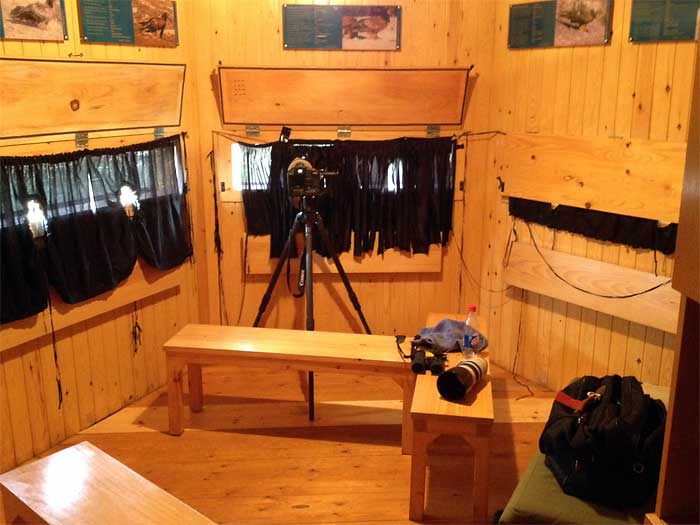
Because of the wide-angled nature of phone cameras, the vultures appeared in real-life to be much closer, close enough for one bird to almost fill the frame of a full-size (35mm sensor) DSLR with a 500mm lens. The second photo shows the luxurious and well-appointed hide (I mentioned the toilet last week) with my camera and 500mm lens set up on my tripod and my binoculars and smaller 100-400mm lens at the ready. I was on my own for the whole day, so I could move freely between the three viewing openings. The one in the middle overlooked the feeding site (above), the one on the left was good for photographing landing vultures using the 100-400mm lens, while the one on the right overlooked a pond, used by the vultures on a hot day. It was cool and overcast when I was there and rained a bit, so the only vulture I saw at the pond was a Griffon having a drink.

Blind at Boumort National Reserve by Ian

Blind at Boumort National Reserve by Ian

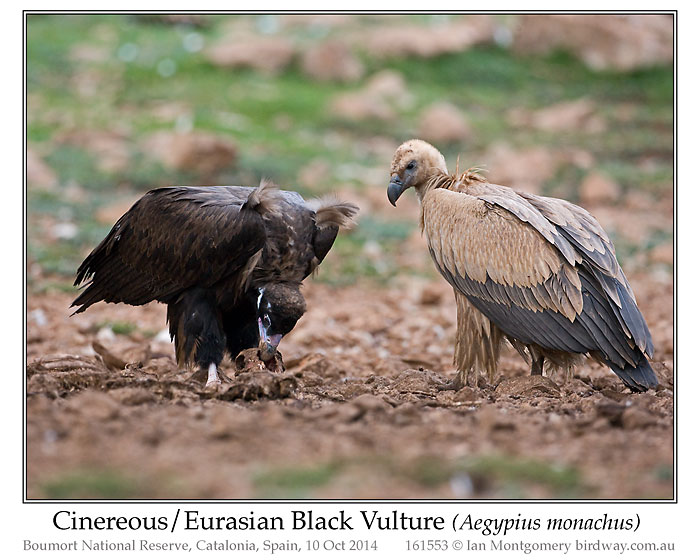
It’s impossible to travel lightly with good gear for wildlife photography – the tripod along required taking a larger suitcase than both I and airlines prefer – but on that day in the hide and on an earlier occasion when I was photographing Crab Plovers in Dubai, I was really glad to have to have brought the necessary stuff with me. Anyway, back to the Cinereous Vulture. In the days when birders weren’t inter-continental travellers, it was called the Black Vulture until it was realised that this risked confusion with the completely unrelated Black Vulture of Central and South America and the ‘Eurasian’ label was applied. Now BirdLIfe International call it the Cinereous Vulture, ‘cinereous’ meaning ‘ashy’, like the adult in the third photo, which certainly looks as it has been rummaging around in the remains of a camp fire.

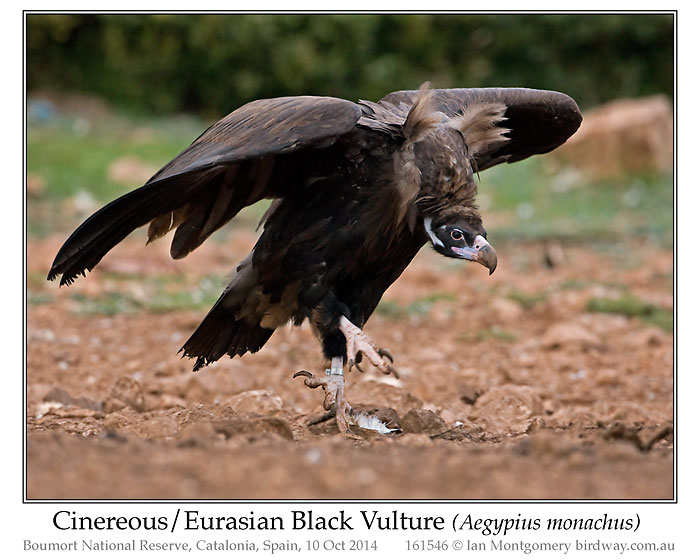
Cinereous Vulture (Aegypius monachus) by IanThis bird shows the typical vulture ruff, with the cowl-like adornment characteristic of this species. The specific name monachus means ‘hooded’ but the common name Hooded Vulture is already used for another somewhat similar, sub-Saharan species, Necrosyrtes monachus. Juvenile birds are much darker, dark chocolate really, like the slightly scruffy one in the fourth photo. Some field guides say that juvenile birds have pink facial skin – like this one – but I couldn’t find a clear correlation between age and skin colour: some adults had mainly blue, others more pink skin, which made me wonder whether it was influenced by gender. All the Cinereous Vultures here had metallic identifying rings/bands and some, particularly juveniles had coloured bands as well. This is because the species has recently been re-introduced to this area from central Spain, is now breeding and the population is being studied thoroughly.

Cinereous Vulture (Aegypius monachus) by IanThe Cinereous Vultures took their time and started arrived at the feeding site about an hour after the Griffons. As you can guess from the relative amounts of plumage on the heads and necks of the two species, they have quite different feeding habits. Griffons clearly don’t mind getting up to their elbows in it, so to speak, but the Cinereous Vultures prefer to wait until the dirty work has been done and then pick up their favourite morsels. Their reluctance to get involved in the initial scrum has nothing to do with size or dominance, the Cinereous Vultures are as large or larger than the Griffons and are quite dominant. The bird in the fifth photo has a feeding juvenile Griffon it its sights and is advancing threateningly in a manner that was wonderful to watch, head down, wings spread and ruff and cowl feathers erect with a bouncing walk. The result was something like the witches from Macbeth combined with the loping gait of a kangaroo.

Cinereous Vulture (Aegypius monachus) by IanIt might look funny to us, but it was very effective and the Griffons, unamused, backed off, like the frustrated-looking one in the sixth photo. Cinereous Vultures have strong bills and can tackle, tendons, muscles and, by the look of the one in this photo, skulls. Maybe cervelles are on the menu. (I once understood cervelles d’agneau on a Parisian menu to be something to do with lamb and was slightly taken aback when brains, rather than a chop, appeared in front of me.)

Cinereous Vulture (Aegypius monachus) by IanThe Cinereous Vultures were the least volatile of the three species and once having landed, hung around for hours. I didn’t get photos of any in flight, but I didn’t find them easy to separate from the Griffons in flight as they’re silhouettes are rather similar. The Griffons kept landing and talking off and were better targets and more numerous. In total, there may have been 10-20 Cinereous Vultures. Their reintroduction here is part of a more general EU conservation and anti-poisoning program that has seen the population in Spain recover from 290 pairs in 1984 to perhaps 2500 now and they have been reintroduced into southern France. The conservation news isn’t all good, though to say the least, and I’ll return to this topic in the third in this series.

Cinereous Vulture (Aegypius monachus) by IanPart of the research effort at Boumort is the study of the movements of these vultures. Adults are thought to be mainly sedentary in Europe, though partially migratory in Asia, where it also occurs. Some banded Spanish birds have turned up in sub-Saharan Africa. Some birds have been fitted with GPS units, and you can see one, complete with solar cell on the back of the juvenile in the last photo.

I mentioned the unrelated Black Vulture of the Americas, one of the New World Vultures. These include the Turkey Vulture, familiar in North America, the Condors and a couple of other species places in a separate family, the Cathartidae http://www.birdway.com.au/cathartidae/index.htm. In fact Birdlife International put them in their own order, the Cathartiformes, indicating that they arose completely independently. The Old World Vultures, on the other hand, are close related to hawks, eagles, etc. and are placed in the same family Acciptridae in the order Acciptriformes. I must admit I was struck by the eagle-like facial appearance of these birds and it appears that the Old World Vultures have developed twice within the Acciptridae. Most belong to a group of typical Old World vultures that includes the Griffon and the Cinereous. Three, however, form a separate group placed taxonomically near the Serpent Eagles. One of these is the subject of the next edition. The vultures kept me waiting in suspense for crowning moment, and I’m trying to make you share the anticipation: I have something really special for the next bird of the week!

Greetings
Ian

**************************************************
Ian Montgomery, Birdway Pty Ltd,
454 Forestry Road, Bluewater, Qld 4818
Tel 0411 602 737 ian@birdway.com.au
Bird Photos http://www.birdway.com.au/
Where to Find Birds in Northern Queensland: iTunes; Google Play
Recorder Society http://www.nqrs.org.au


Lee’s Addition:

But these are the ones that you shall not eat: the eagle, the bearded vulture, the black vulture, (Deuteronomy 14:12 ESV)

And when birds of prey came down on the carcasses, Abram drove them away. (Genesis 15:11 ESV)

What a blind! When Ian go out photographing, he goes all the way. I always enjoy his adventures. Vultures are a favorite of mine, but the Lord created them and gave them a job to do. What would the world look like if they didn’t come down and clear up carcasses.

Again, these Vultures are members of the Accipitridae – Kites, Hawks and Eagles Family. I like that fifth photo with that pose of his. Especially with Halloween just around the corner.

See Ian’s 1st article from Boumort National Reserve

Ian’s Bird of the Week

Accipitridae Family – Birdway (Ian’s site)

Cathartidae Family – Birdway (Ian’s site)

Accipitridae – Kites, Hawks and Eagles

Cathartidae – New World Vultures

*

(Edited)

Ian’s Bird of the Week – Griffon Vulture

Boumort National Reserve

Boumort National Reserve

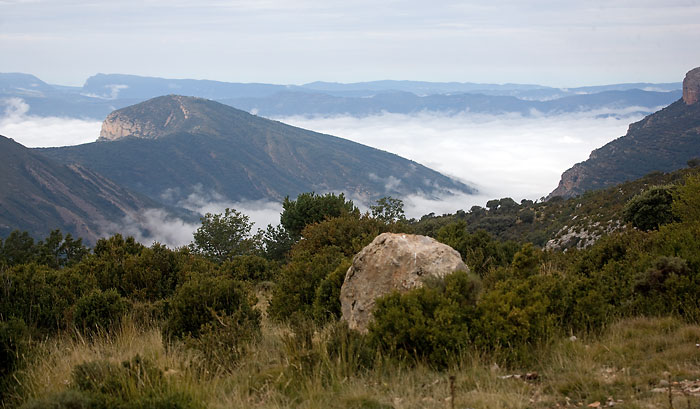
The first photo shows part of Boumort National Reserve in the foothills of the Pyrenees in Catalonia about 40km southwest of Andorra. A reserve since 1991, It has an area of 13,000 hectares and is of special importance as one of the only places in Europe where all four European species of vultures breed. Three occur naturally, while the fourth, the Eurasian Black or Cinereous Vulture has been reintroduced, after becoming extinct in the Pyrenees in recent decades. I made arrangements to visit it through Steve West of Birding in Spain, including getting the necessary permit to photograph these birds, accommodation and transport.

As part of the conservation effort, the vultures are fed three times a week and I was taken to the feeding site by two rangers who had collected carcasses and meat off-cuts from farmers in the vicinity. The site is equipped with a spacious and comfortable hide, complete with toilet, and I was left there alone for the day after they had spread out the meat and carcasses in front of the hide. When we arrived there were already between one and two hundred vultures, almost all Griffons, soaring high above. I had been briefed beforehand that the first arrivals would be Griffons, with Eurasian Blacks arriving later in the morning when the crowds thinned, while the iconic Lammergeier could be expected, probably, in small numbers in the middle of the afternoon. The fourth species, the Egyptian Vulture is a summer visitor and had already departed for Africa.

Griffon Vulture (Gyps fulvus) by Ian

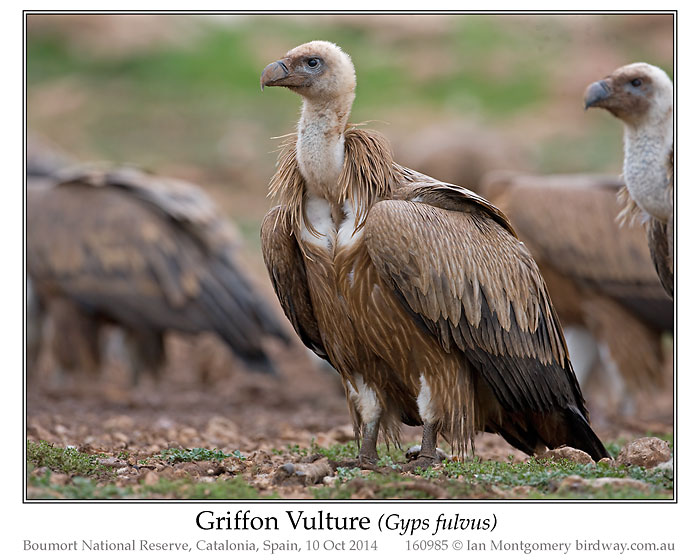
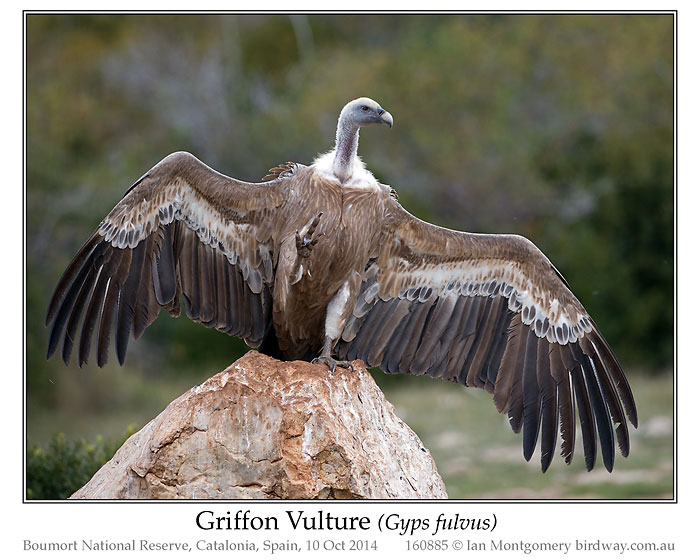
Sure enough, as soon as the rangers left, large numbers of Griffons glided in and squabbled noisily over the food. Griffons feed mainly on muscles and viscera and attacked the carcasses and pieces of meat with great gusto. The bird in the second photo showing its skill at balancing on a rock on one foot and waving the other is an adult, recognisable by its white ruff, horn-coloured bill and pale wing coverts. The one in the third photo is a juvenile, with grey bill, coffee-coloured ruff and darker wings. Juveniles generally had a covering of short plumage on the head and neck, while the adults often had relatively bare necks.

The breeding range of the Griffon Vulture extends from Portugal in the west to northeastern India and southwestern Kazakhstan in the east. Spain is its main stronghold in the west with about 8,000 pairs and the species is not considered under threat.

Griffon Vulture (Gyps fulvus) by Ian

These birds are huge and it was wonderful to observe them up close. The black bird in the fourth photo sneaking a mouthful from under the watchful eye of a Griffon is a Common Raven. This is the largest passerine in the world, with a length of up to 67cm/26in and wingspan of up to 130cm/51in, larger than a Common Buzzard, but completely dwarfed by the vulture. Griffons are up to 110cm/43in in length, with a wingspan of up to 280cm/110in and weighting up to 11kg/24lbs.

Griffon Vulture (Gyps fulvus) by Ian

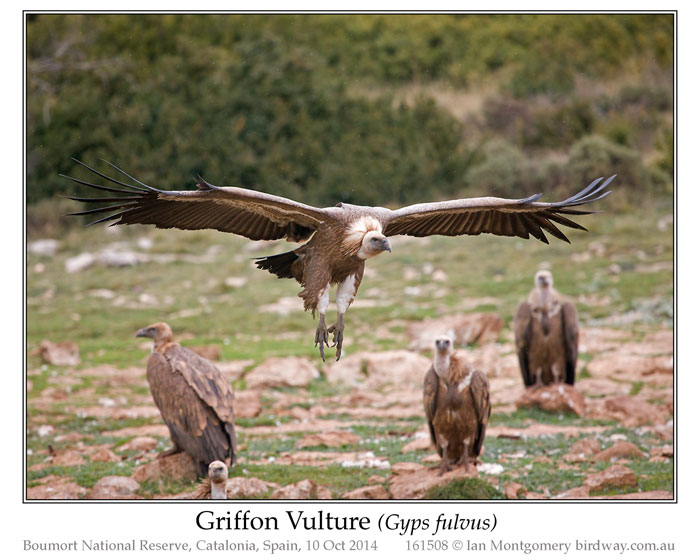
In the air, they glide effortlessly and powerfully and the enormous wings make the body appear quite small by comparison. They come into land looking like parachutists under square canopies but with the ponderous, unwavering stability of a large aircraft like a B747 or an A380. Look how elegantly and precisely the toes are arranged with all the poise of an Olympic diver, fifth photo.

Griffon Vulture (Gyps fulvus) by Ian

It really was an extraordinary experience watching the spectacle of these amazing birds, even if their table manners left much to be desired. The large amount of food disappeared at a great rate and the crowds started to disperse, leaving the scene, one hoped, for the later, rarer and more picky species. To be continued…

Greetings
Ian


Lee’s Addition:

Another neat adventure for Ian. Not sure I would want to be left all day by myself. Then again, Ian, is quite an adventurous birdwatcher and photographer. Patience is something he definitely has.

Thanks again, Ian, for sharing your adventure. I have a feeling you will soon tell us about some of those other Vultures that came to feed.

“There is a path which no fowl knoweth, and which the vulture’s eye hath not seen: (Job 28:7 KJV)

The Griffon Vulture is a Bird of the Bible as Vultures are mentioned. One version of the Bible lists a Griffon.

“Of birds these are they which you must not eat, and which are to be avoided by you: The eagle, and the griffon, and the osprey.” (Leviticus 11:13 DRB)

*

*


Ian’s Bird of the Week – Greater Flamingo

PHO-Phof Greater Flamingo (Phoenicopterus roseus) by Ian

Ian’s Bird of the Week – Greater Flamingo ~ by Ian Montgomery

Newsletter ~ 10-9-14

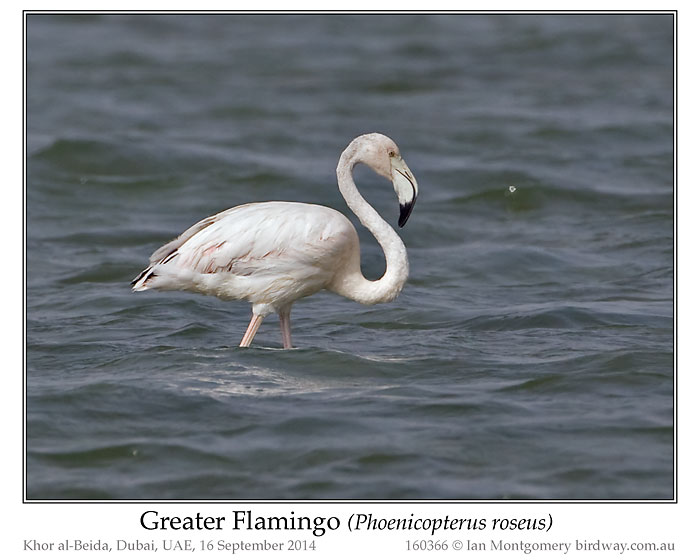
Here’s another species from Dubai, the Greater Flamingo. It’s well-known there, occurs in the Ra’s al-Khor wildlife sanctuary near the centre of town and is suitably iconic for a place where flamboyance is preferred to subtlety :-). We didn’t go to this sanctuary but found about 50 Flamingos feeding in the shallows near one of the Crab Plover sites that we checked at Khor al-Beida north of the city.

This spot was right beside a Sheik’s well guarded palace. Tommy warned that using a large telephoto lens there could attract unwelcome attention from the guards, so these photos were taken through the window of his 4WD. The birds in the first and second photos are adults with the pink colour of the legs and bill and the red plumage in the wings well-developed.

Greater Flamingo (Phoenicopterus roseus) by IanThe bird in the third photo is an older juvenile. The bill is still grey, the legs are just beginning to show a pink flush and there is little red showing in the wings. The full adult plumage is acquired after about three years.

Greater Flamingo (Phoenicopterus roseus) by Ian
Flamingos are a taxonomically isolated group with 6 species in a single family – Phoneicopteridae – in their own order the Phoenicopteriformes. Four of the species occur in South and Central America, with 2 Old World Species The Greater and Lesser Flamingos. The Greater Flamingo occurs in Africa, the Middle East, southern Europe and in Asia as far east as India. There is one Australian record from the Cocos (Keeling) Islands in 1988, so it has the honour of being on the Australian list.

Greetings from Strasbourg where we are having a pleasant few days in this lovely city staying with Gillian daughter Jeannine and her husband Carlos. Tomorrow we go to Barcelona by TGV en route to a couple of birding spots in the foothills of the Pyrenees where I hope to get some raptor photos to share with you. THE target species is the Bearded Vulture or Lammergeier, so I need your spiritual support and enthusiasm!

Ian


Lee’s Addition:

Now out of the ground the LORD God had formed every beast of the field and every bird of the heavens and brought them to the man to see what he would call them. And whatever the man called every living creature, that was its name. (Genesis 2:19 ESV)

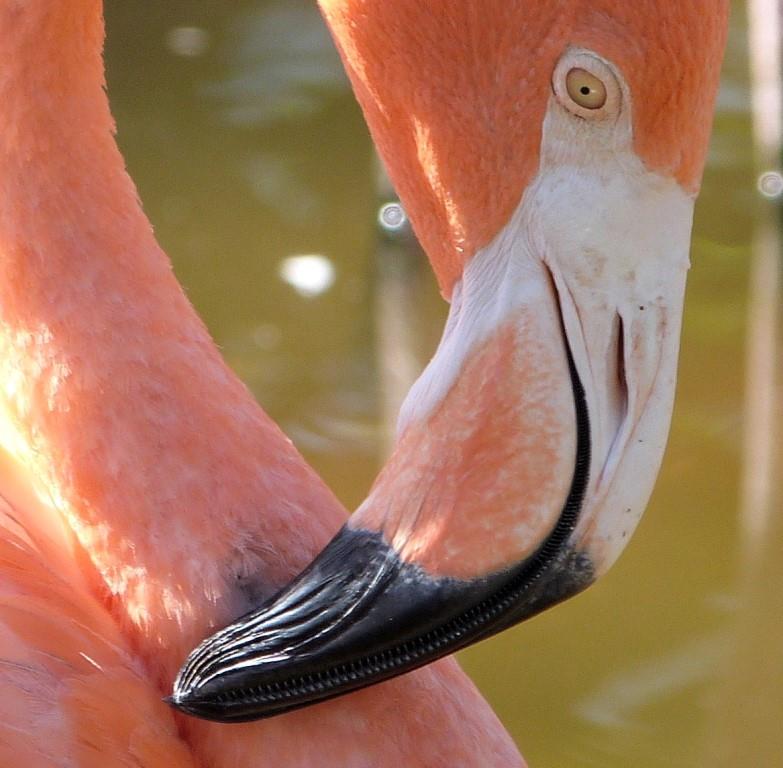
Love those Flamingo, no matter what kind. There is just something about that beak and the pose they portray. Thanks again, Ian, for sharing your latest find among the avian in Dubai.

American Flamingo Beak cropped

American Flamingo Beak by Lee

Of the Flaming Family on Ian’s Birdway site, this must have been his first Flamingo. At least that is all he shows for the Phoenicopteridae Family.
*

Ian’s Birds of the Week

Ian’s Phoneicopteridae Family

Flamingos – Phoenicopteridae Family

*
Ian’s Bird of the Week – Cream-coloured Courser

Ian’s Bird of the Week – Cream-coloured Courser ~ by Ian Montgomery

Newsletter – 9/27/14

A couple of weeks ago, I said that my two target birds in Dubai were Crab Plover – which featured last week – and Cream-coloured Courser. The latter had aroused my curiosity 50 years ago when I saw it on this page of the Field Guide to Birds of Britain and Europe. Tommy Pedersen (http://www.uaebirding.com) had said that the Coursers were “possible”, so there were no guarantees.

Cream-colored Courser (Cursorius cursor) by Ian

Cream-colored Courser (Cursorius cursor) by Ian

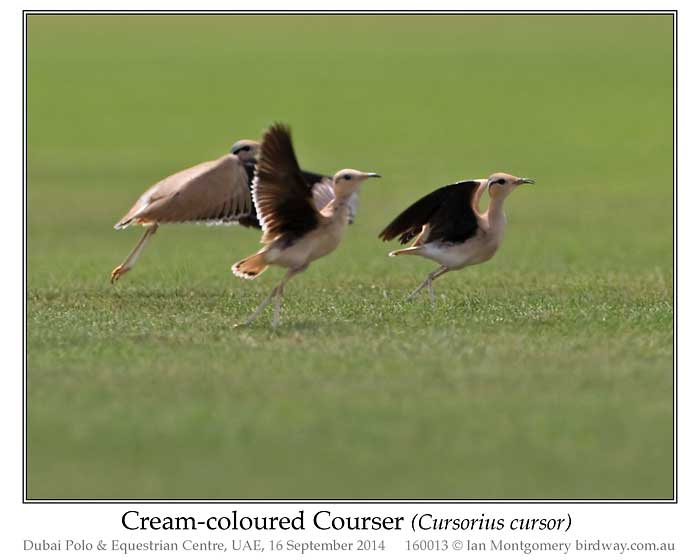
When we set off with Tommy, we had a few hours to fill in before the tide was optimal for the Crab Plovers, so we went first to the Dubai Polo and Equestrian Centre, then to the Al Asifa Endurance Stables to look for the Coursers. They were present at both, with over 30 at the Polo Centre and another 16 at the Stables. In fact, the first photo I took in Dubai was of a very distant Courser.

Cream-colored Courser (Cursorius cursor) by Ian

They were worth waiting 50 years for, and I think the illustration in the field guide didn’t do them justice. They’re called Coursers because they run rather than fly, second photo, the name being derived from the Latin verb currere, to run, and the generic name Cursorius means runner. The ‘sport’ of coursing – chasing hares, etc., on horse-back is derived from the same source, so there was a delightful irony in finding them at the two main equestrian locations in Dubai.​

Cream-colored Courser (Cursorius cursor) by Ian

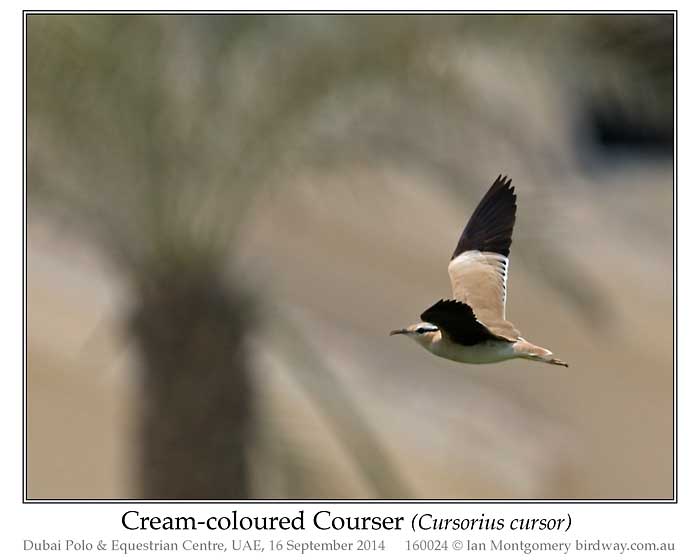
When pressed they do take flight, third photo. In doing so, they show their striking dark wing tips and underwings and reveal similarity to pratincoles, the other members of the family Glareolidae. There is a photo of an Australian Pratincole in flight here if you want to compare them. The three taking off in the third photo seemed to be a family party as the bird in the centre is immature with patchy brown markings on the neck and only very pale stripes through the eye.

Cream-colored Courser (Cursorius cursor) by Ian

​Their preferred habitat is desert and semi-desert with or without sparse vegetation. Their breeding range includes much of North Africa and the Middle East. Many North African birds migrate across the Sahari to winter in the southern Sahara and at least part of the Middle East population migrates to Pakistan and NW India. They feed on insects and other invertebrates on the ground and will take locusts in flight. I couldn’t help but be struck by their resemblance both in colour and habitat to the Inland Dotterel of central Australia.

Cream-colored Courser (Cursorius cursor) by Ian

As promised a couple of weeks ago, I’ve started putting together a page on electronic books to provide assistance in choosing among different platforms. So far, I’ve finished the General Introduction. I still need to add more details on the actual process of purchasing ebooks from different vendors​ and I’ll let you know when that is available.

I’m still in Ireland. So far, I’ve been mainly catching up with family and friends. Next Tuesday we are going looking for Red Kites in Avoca, Co. Wicklow, so keep your fingers crossed for some photos! The Red Kite is one of the more successful Irish raptor reintroduction programs and there are now breeding populations in both the Republic, mainly Co. Wicklow south of Dublin, and in Co. Down in Northern Ireland. I do have a photo of one taken in Spain – but it would be good to get some genuine Irish ones, the real McCoy.

Greetings
Ian


Lee’s Addition:

He asked for water, she gave milk; She brought out cream in a lordly bowl. (Judges 5:25 NKJV)
He will not see the streams, The rivers flowing with honey and cream. (Job 20:17 NKJV)
When my steps were bathed with cream, And the rock poured out rivers of oil for me! (Job 29:6 NKJV)

Wow! I really like that color. It seems so rich. There are such neat birds in the Glareolidae family anyway. That last photo of the bird in flight looks like the Lord dipped its wings in paint. I am glad Ian was able to get these new photos and shared them with us.

Coloured or Colored? Again we have a difference in spelling. Ian uses one naming authority and here we use the I.O.C.’s naming. Same bird, same scientific name – Cursorius cursor. And the same beautiful bird from its Creator.

*
Ian’s Bird of the Week

Ian’s Glareolidae Family

Glareolidae – Coursers, Pratincoles

*
Ian’s Bird of the Week – Crab Plover

Crab-plover (Dromas ardeola) by Ian

Ian’s Bird of the Week – Crab Plover ~ by Ian Montgomery

Newsletter – 9-22-14

Well your spiritual energy and goodwill did it again, helped physically, admittedly, by the excellent local bird guide Tommy Pedersen, a Dubai-based pilot from Norway who takes visitors birding in his spare time.

There had been some doubt as to whether he’d be free to help us, as he was just returning from a trip to Milan. I cc’d the last bird of the week to him and got a delightful reply just as I was packing in Bluewater on Monday morning:

So, I arrived in Dubai at 5:00 am, checked into my hotel at 7:00 am and at 11:00 am Tommy arrived, collected me and Madeleine – who’d just arrived from Hamburg – in his large and comfortable 4WD and off we went. The tide wasn’t quite right for the Crab Plovers so we did a few other things first – more about those in the next bird of the week – eventually ending up at the coastal sand and mudflats of Khor al-Beida, north of Dubai city. Here, there were about 40 Crab Plovers moving through the shallows on an in-coming tide.

Crab-plover (Dromas ardeola) by Ian

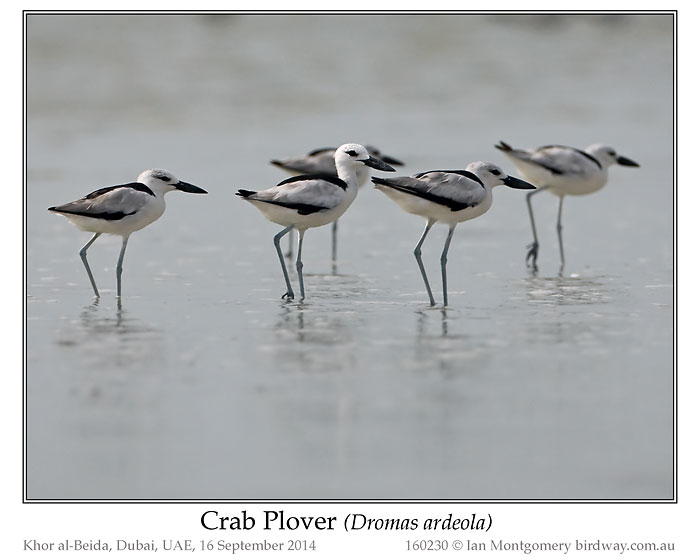
​I did a gradual, crouching trudge across the mudflat in 42º heat to try to get as close as possible to them. They let me get closer than I had expected, photos one and two, before eventually taking flight, third photo. As you can see they are very striking birds and the name ‘Plover’ doesn’t quite do them justice, either in appearance or taxonomically. Apart from the heavy dagger-shaped bill, they are more like avocets and similar in size with a length 40 cm/16 in. The bill resembles that of a Beach Stone-curlew, presumably a case of convergent evolution reflecting their crustacean diet.

Crab-plover (Dromas ardeola) by Ian

The fourth photos shows a close-up of one of the birds in flight. You can see that it is moulting heavily with many of the flight feathers missing in mid-replacement. This seemed to be the case with all of them, and a reluctance to fly may have had more to do with my close approach than my crouching/stalking skills.

Crab-plover (Dromas ardeola) by Ian

Taxonomically, the species show no very close affinities with other waders so the Crab Plover is the sole member​ of its own family (‘monotypic’), the Dromadidae. This is placed in the order Charadriiformes – Plovers & Allies – sitting between the Oystercatchers (Haemopodidae) and the Avocets & Stilts (Recurvirostridae). I feign indifference to making additions to my life list, but adding and photographing a whole new family is a different matter. The last time that happened to me was three years ago with Diving-Petrels on the Sub-antarctic trip.​

I arrived in Ireland yesterday and am spending a relaxing and enjoyable time with family. Yesterday evening I went blackberry picking with my sister along a country lane near where she lives in Clogherhead, Co. Louth. That was admirable therapy for the future-shock resulting from the glittering excesses of downtown Dubai.

Greetings
Ian


Lee’s Addition:

If thou wouldest seek unto God betimes, and make thy supplication to the Almighty; (Job 8:5 KJV)

And ye shall seek me, and find me, when ye shall search for me with all your heart. (Jeremiah 29:13 KJV)

We love to seek out new species, to us at least. I am glad that Ian was able to find his Plover that was on his list. I guess we will have to wait until next week to see if he found his Cream-coloured Courser that he was also searching for. See last week’s Bird of the Week.

Ian sure gets about in his search for avian encounters. But what a beauty he found this time to share with us. I am glad Ian shares his photos with us. The Lord sure has created some neat birds. I like the clean look of these Crab-plovers all dressed in white and black. (The IOC list them as Crab-plovers. No matter what you call them, they are the Dromas ardeola.)

Seeking the Lord should always be our number one priority.

*

Ian’s Bird of the Week

Ian’s Dromadidae – Plovers Family

Dromadidae – Crab-plover Family – Here

*

Ian’s Stamp of the Week – Antipodean Albatross

Ian’s Stamp of the Week – Antipodean Albatrosses ~ by Ian Montgomery

Newsletter – 9/13/14

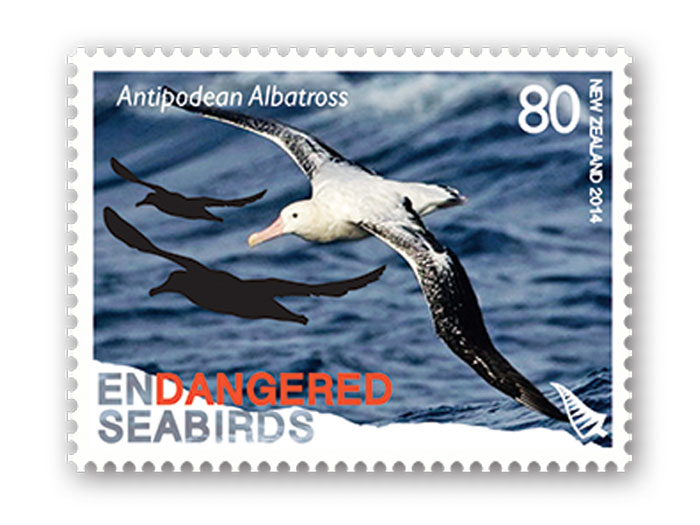
The reference to Stamp of the Week in the subject line isn’t a typo: I’m celebrating the issue of a stamp set by New Zealand Post on 3 September which includes a photo of mine in the design of one of the stamps.

Antipodean Albatross (Diomedea antipodensis) Stamp by Ian

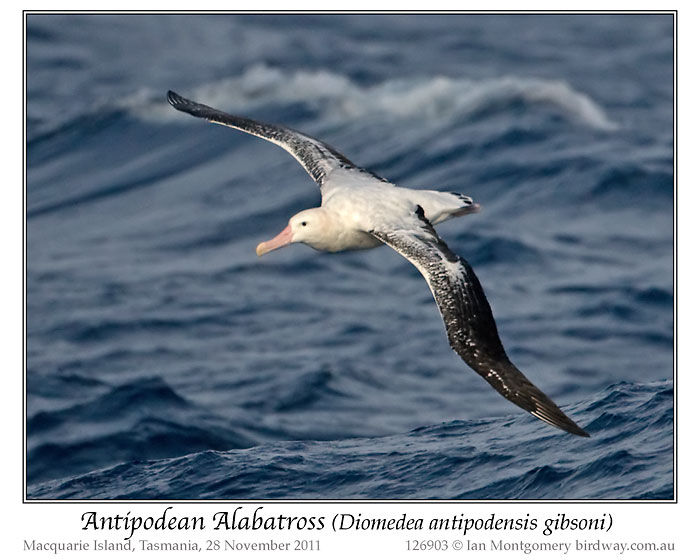
Here is the original photo, taken north of Macquarie Island when we were returning to Hobart at the end of a Subantarctic Islands trip in November 2011 that started in Dunedin. This was the same trip on which I photographed the Fiordland Penguins that featured as last week’s bird.

Antipodean Albatross (Diomedea antipodensis gibsoni ) by Ian

If you’re not familiar with Antipodean Albatrosses and think it looks like a Wandering Albatross, you may be relieved to hear that it’s all a matter of taxonomy and reflects the recent split of the Wandering Albatross into four species, one of which is the Antipodean. In fact this same taxon, for want of a better word, was bird of the week in November 2006 as Wandering Albatross after I’d photographed some on a pelagic trip off Wollongong south of Sydney. If we follow this split, and BirdLife Australia does, then most of the erstwhile Wandering Albatrosses in Australian waters are Antipodean and breed on the islands south of New Zealand, mainly Antipodes Island, Campbell Island and Adams Island in the Auckland Islands.

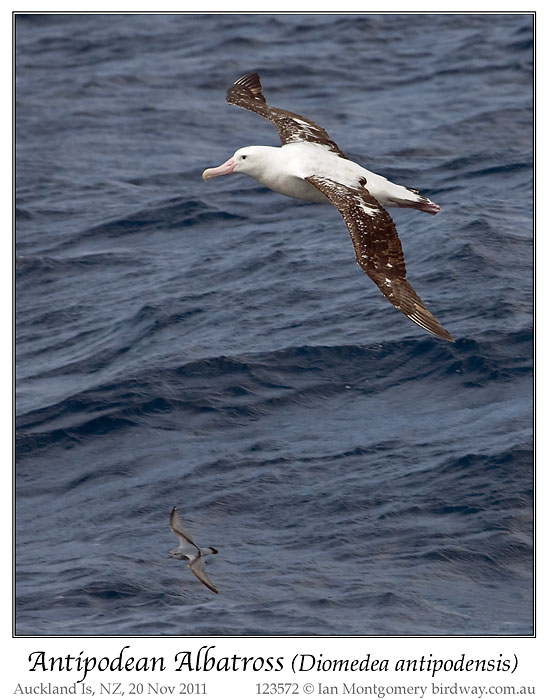
Antipodean Albatross (Diomedea antipodensis) by Ian

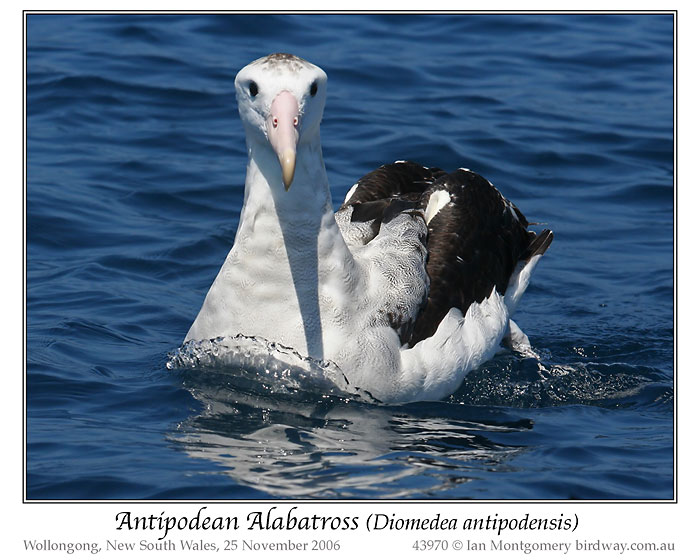
The Antipodean is one of the smaller of the Wandering Albatross group but they are still enormous: up to 117cm/46in in length with a wing span to 3.3m/11ft and weighing up to 8.6kg/19lbs. Look carefully at the second Albatross photo and you’ll see a grey and black Broad-billed Prion completely dwarfed by the Antipodean Albatross. The prion is about 30cm/12in in length with a wingspan of 60cm/2ft. You can get an impression of the size in the third photo taken on that Wollongong trip – look at the bow wave!

ntipodean Albatross (Diomedea antipodensis) by Ian

The Antipodean Albatross itself comes in two varieties, the nominate Antipodean which breeds on Antipodes and Campbell Island and ‘Gibson’s Albatross’ which breeds in the Auckland Islands Group. The various Wandering Albatross species all look rather similar and are difficult to identify in the field. They vary in size and they differ in the rate and extent of development of white plumage in adult birds – juveniles are mainly brown. The ones in the first two photos are very white and are probably older males of the race gibsoni. The bird swimming in the third photo shows less development of white plumage – not the darkish cap and the dark vermiculations on the neck, breast and shoulder and may be a younger male or female and could be either nominate Antipodes or Gibson’s: all too hard.

Antipodean Albatross (Diomedea antipodensis) Stamp by Ian

Antipodean Albatross (Diomedea antipodensis) Stamp by Ian

Here is the complete set of stamps. New Zealand Post wanted to pay me to use the albatross photo, but I so like the idea of having one of mine used in a stamp that they agreed to send me first day covers and a presentation pack instead and that arrived yesterday. Antipodean Albatrosses rate as Vulnerable/Endangered because of their few nesting sites and long-line fishing which leads to the death of adult birds as by-catch. The total population is perhaps 16,000 pairs but there is hope that the population has stabilised after significant declines at the end of the 20th century.

Anyway, I’m off to Dublin via Dubai on Monday to visit family and friends. I’m spending 3 nights in Dubai having found it, to my complete astonishment, ranked as #75 in a book on the top 100 places in the world to go birding. Because of its location at the tip of the Arabian Peninsula, it’s an important staging post for birds migrating from Asia to Africa in the northern spring and autumn migrations (i.e. now). I have two target species: the Crab Plover and the Cream-coloured Courser. The first because it’s an unusual and beautiful black and white wader in a family all to itself and the unusual looking and named Courser – a member of the Pratincole family – because it caught my eye in my Field Guide to the Birds of Britain in Europe when I was a teenager in Ireland half a century ago, below. So, I need your spiritual energy and goodwill to help me. You haven’t failed me in the past!

This was supposed to be a short bird of the week as I really should be packing but I almost forgot to mention that Where to Find Birds in Northern Queensland is now available through Kobo Books. I really like the Kobo ebook reader: I have it on both my Mac computer and my iPad/iPhone but Kobo reader software is also for Android tablets and phones, Blackberries and Windows computers and phone. A friend of mine has expressed concern over the complexity of ebook software/apps, devices/computers and methods of purchase/download etc. so I’m preparing a page to add to the existing one on publications on the website: http://www.birdway.com.au/publications.htm which already has links to Apple, Google Play and Kobo Books and a little bit about the differences. Something to do on the plane.

Greetings

Ian

**************************************************
Ian Montgomery, Birdway Pty Ltd,
454 Forestry Road, Bluewater, Qld 4818
Tel 0411 602 737 ian@birdway.com.au
Bird Photos http://www.birdway.com.au/

Recorder Society http://www.nqrs.org.au


Lee’s Addition:

Behold, My servant will prosper, He will be high and lifted up and greatly exalted. (Isaiah 52:13 NASB)

Wow! Our Ian is famous. That is quite an honor! I was thinking of Ian as well as the Albatrosses when I picked the verse.

The Albatrosses are a members of the Diomedeidae – Albatrosses Family. There are 21 species in the family. (From CreationWiki) “Albatrosses have very long wings and large bodies. Their bills are hooked and they possess separate raised tubular nostrils. Their bodies range from sizes between 76 and 122 centimeters long (2.5 to 4 feet); and their wingspan ranges from 3 to 6 meters across(9.8 to 19.7 feet). The wings are usually darkly colored on the upper side and are pale colors or white on the underside. Albatross wings allow it to take advantage of the abundant winds across the surface of the sea. The birds make use of the fact that friction with the sea slows some of the wind down so that right above the surface of the water, the wind is relatively weak and slow. Then, as the bird climbs up from the surface, the speed and strength of the wind increases as well (around 50 feet or 15 meters above the surface of the water the albatrosses will reach their full flight speed).

Albatrosses’ wings are designed for a specified type of gliding. Being very long and somewhat thin in width, the wings are used best in the albatrosses’ cycle of flight. This cycle allows the bird to move great distances without once flapping it wings. What a great Creator!

*

Antipodean Albatross – Ian’s

Ian’s Diomedeidae Family

Albatross – CreationWiki

Diomedeidae – Albatrosses Family

Ian’s Pratincole Family. 

*