“Then the king commanded to call the magicians, and the astrologers, and the sorcerers, and the Chaldeans, for to shew the king his dreams. So they came and stood before the king.” (Daniel 2:2 KJV)
“Them hath he filled with wisdom of heart, to work all manner of work, of the engraver, and of the cunning workman, and of the embroiderer, in blue, and in purple, in scarlet, and in fine linen, and of the weaver, even of them that do any work, and of those that devise cunning work.” (Exodus 35:35 KJV)
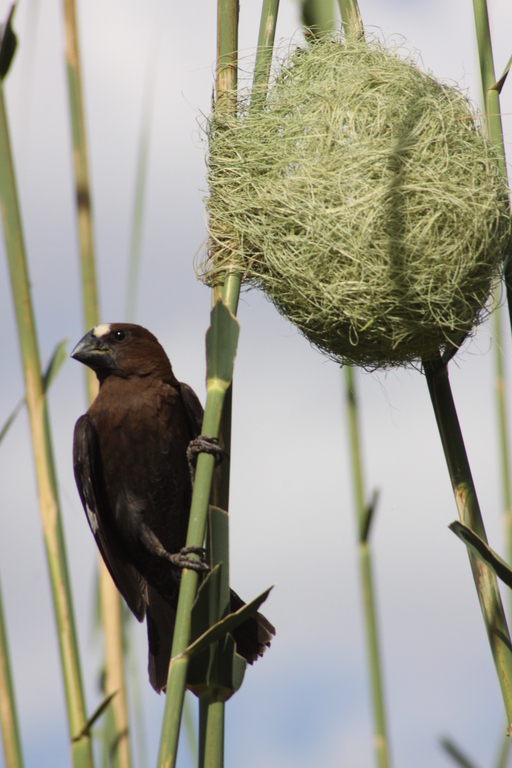
Thick-billed Weaver (Amblyospiza albifrons) – male with nest
“And the angel of the LORD appeared unto him in a flame of fire out of the midst of a bush: and he looked, and, behold, the bush burned with fire, and the bush was not consumed.” (Exodus 3:2 KJV)
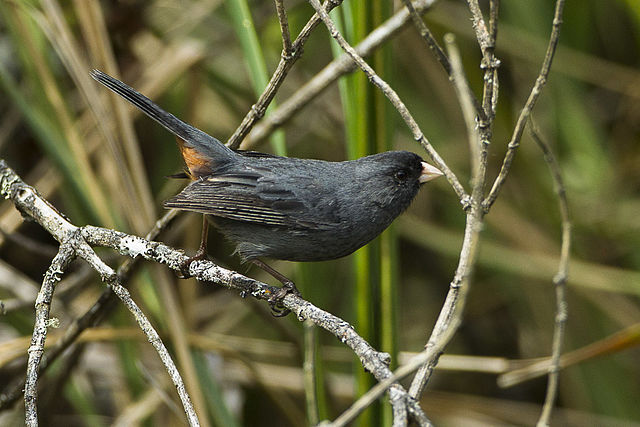
We have arrived at the last the Thraupidae family of Tanagers and close family relatives. We begin with the Cuban Bullfinch (Melopyrrha nigra) is a songbird species of the monotypic genus Melopyrrha. Sometimes classified in the bunting and American sparrow family (Emberizidae), more recent studies have shown it to be part of the tanager family (Thraupidae). Therein, it belongs to the lineage of tholospizan “finches”, which also includes the famous Darwin’s finches. They are found in the Cayman Islands, there only on Grand Cayman, and Cuba. Its natural habitats are subtropical or tropical moist lowland forests, subtropical or tropical moist montane forests, and heavily degraded former forest.
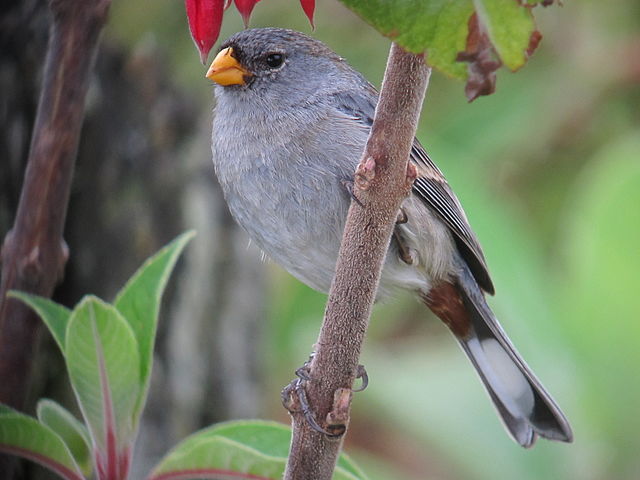
The next two genera, Dolospingus, found in Brazil, Colombia, and Venezuela. Its natural habitat is subtropical or tropical dry shrubland, and Catamenia also from South America, are Seedeaters.
Yellow-faced Grassquit (Tiaris olivaceus) by Kent Nickell
Six Grassquits, from Tiaris and Loxipasser genera are from Central and South America. The Yellow-faced Grassquits are interesting because “During courtship, the male vibrates his wings as he sings his subdued song, sitting only 1–2 in (2.5–5.1 cm) away so the female can properly hear him. The roughly globular nest, built by the female, is made of grass and weed stems compacted into a thick mass, and lined with pieces of grass inflorescences and bast fibre. It has a side entrance and is placed usually less than 30 cm (12 in) above the ground, often among grass or weeds on a road or river embankment.” (Wikipedia) Grassquits are known for making covered nests.
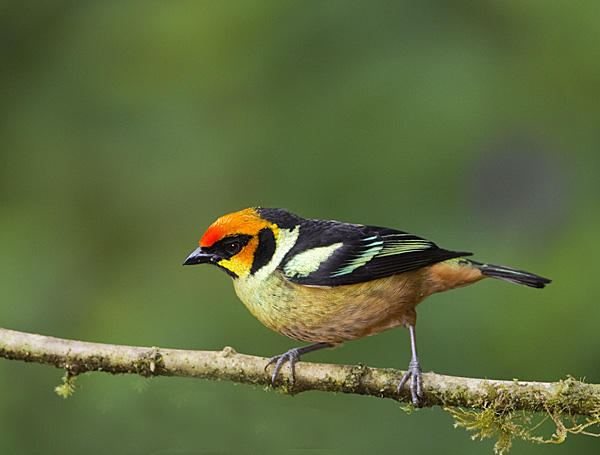
Most of the rest of the family are similar in that just a few birds are in each genus. The the Bullfinches, Loxigilla; Ground Finches, Geospiza; Cactus Finches, Geospiza; Tree Finches, Camarhynchus; Warbler-Finches, Certhidea; and then five Tanagers in three genera.
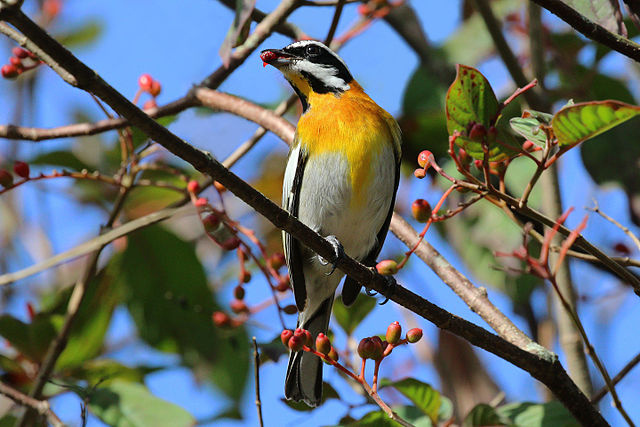
There are four “Spindalis is a genus consisting of four non-migratory bird species. The genus is considered endemic to the Greater Antilles; a population on Cozumel Island, off the Yucatán Peninsula’s east coast, is part of that island’s West Indian fauna. Spindalis males are characterized by bright plumage while females are duller and have a different coloration. (Wikipedia) As usual, this helps hide her while sitting on the nest. Also shows the Lord’s concern for all of His Creation.
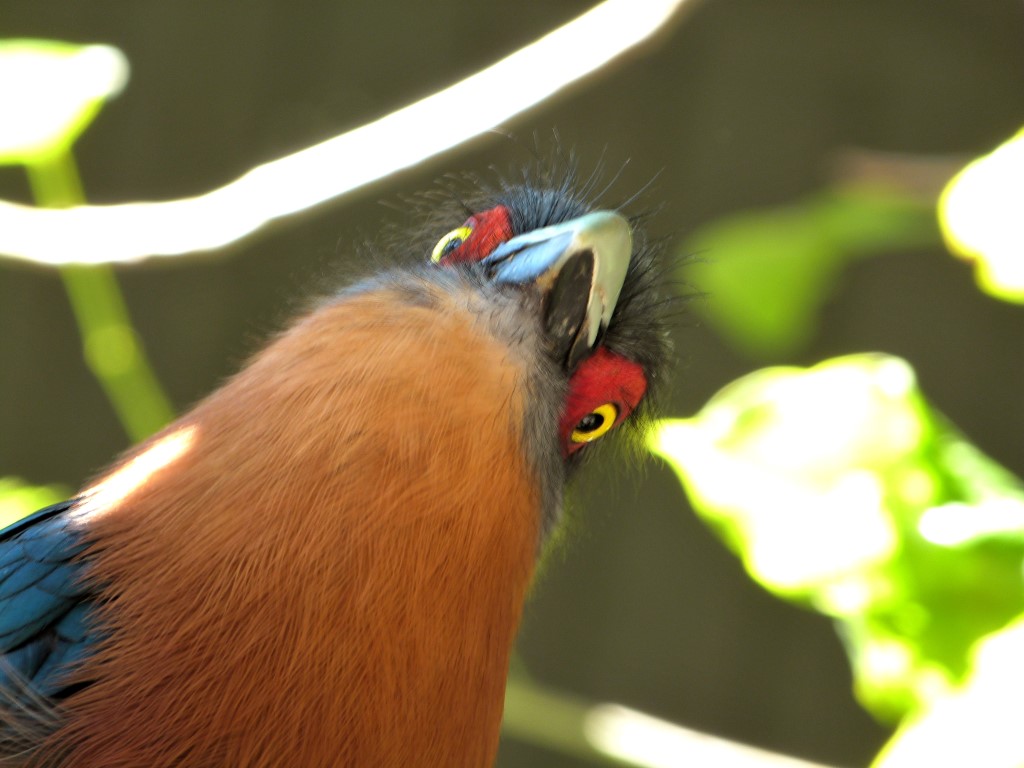
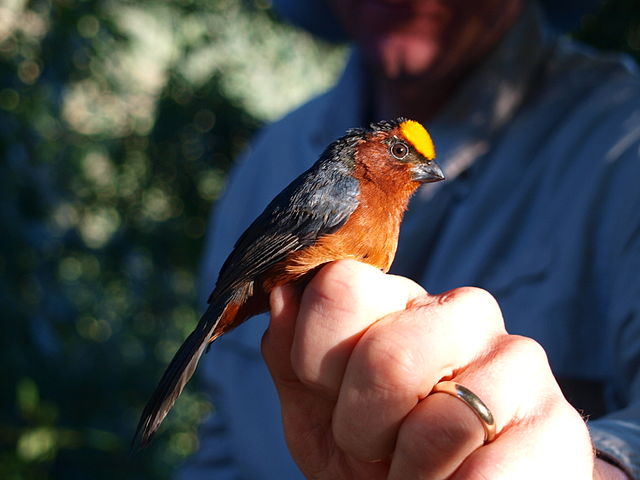
The next to last bird in the Thraupidae Family is an very interesting bird and I’ll let Wikipedia give the details. “The plushcap is one of the most distinctive of all Neotropical passerines in terms of both its appearance and behavior. The plushcap (Catamblyrhynchus diadema) was in its own family until recently when it was grouped with the tanagers. It is very distinct both physically and in terms of behavior. The bill is broad and black. The body is a chestnut color with a bright golden-yellow forecrown. The forecrown is made up of stiff feathers. It has been speculated that these short, dense feathers are less susceptible to feather wear and more resistant to moisture than typical feathers. This may be an adaptation for its specialized feeding mode [sounds like Wisdom from their Creator], in which it probes into dense whorls of bamboo for its prey items (Hilty et al. 1979). Juveniles are just duller versions of their parents. They are found at high elevations from northern Venezuela south to Argentina, including the coastal mountains of Venezuela and the Andes of Colombia, Ecuador, Peru, Bolivia, and extreme northwestern Argentina. They live in montane forests and secondary forests near bamboo. They forage for insects inside the bamboo. They will eat small insects, berries, and small plant matter. The overall length averages 14 cm (5.5 in) and weigh averages 14.1 grams (0.5 oz).”
“The bird is very distinct and is not confused with many other birds. It stands out from the other tanagers, only possibly being confused with the golden-crowned tanager despite the golden-crowned tanager being blue. The species is found in Argentina, Bolivia, Colombia, Ecuador, Peru, and Venezuela. Its natural habitat is humid montane forests and it is always found in close association with Chusquea bamboo. It is typically found at an elevation 1,800 to 3,500 m.”
This slideshow requires JavaScript.
But none of these things move me, neither count I my life dear unto myself, so that I might finish my course with joy, and the ministry, which I have received of the Lord Jesus, to testify the gospel of the grace of God. (Acts 20:24 KJV)
“And wheresoever the children of men dwell, the beasts of the field and the fowls of the heaven hath he given into thine hand, and hath made thee ruler over them all. Thou art this head of gold. (Daniel 2:38 KJV)
“Now the men did diligently observe whether any thing would come from him, and did hastily catch it: and they said, Thy brother Benhadad. Then he said, Go ye, bring him. Then Benhadad came forth to him; and he caused him to come up into the chariot. (1 Kings 20:33 KJV)








 Lee's Birdwatching Adventures Plus