“looking carefully lest anyone fall short of the grace of God; lest any root of bitterness springing up cause trouble, and by this many become defiled;” (Hebrews 12:15 NKJV)
“Now these things, brethren, I have figuratively transferred to myself and Apollos for your sakes, that you may learn in us not to think beyond what is written, that none of you may be puffed up on behalf of one against the other.” (1 Corinthians 4:6 NKJV)
“For from you sounded out the word of the Lord not only in Macedonia and Achaia, but also in every place your faith to God-ward is spread abroad; so that we need not to speak any thing.” (1 Thessalonians 1:8 KJV)
“For man also knoweth not his time: as the fishes that are taken in an evil net, and as the birds that are caught in the snare; so are the sons of men snared in an evil time, when it falleth suddenly upon them.” (Ecclesiastes 9:12 KJV)
“And he saw them toiling in rowing; for the wind was contrary unto them: and about the fourth watch of the night he cometh unto them, walking upon the sea, and would have passed by them.” (Mark 6:48 KJV)
“And God said, Let the waters bring forth abundantly the moving creature that hath life, and fowl that may fly above the earth in the open firmament of heaven.” (Genesis 1:20 KJV)
Our new Order, the Procellariiformes has four Families. Today, the Oceanitidae – Austral Storm Petrels and the Diomedeidae – Albatrosses are presented. There are 30 species in these two families. The next two families have a combined 117 members so we will be in this Procellariiformes Order for several weeks.
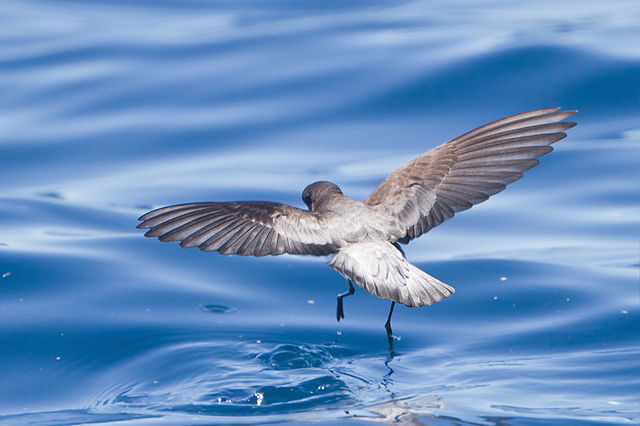
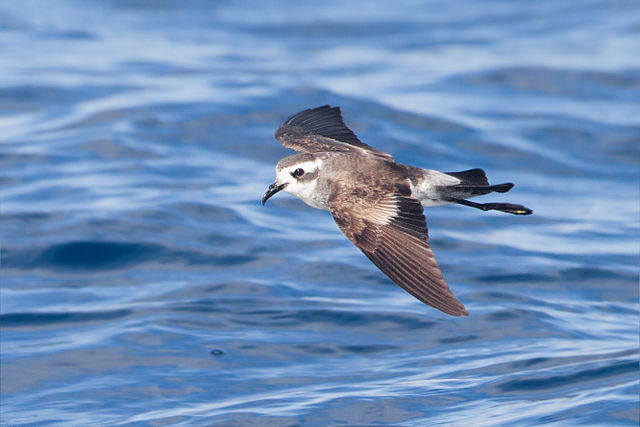
Austral storm petrels, or southern storm petrels, are seabirds in the family Oceanitidae, part of the order Procellariiformes. These smallest of seabirds feed on planktonic crustaceans and small fish picked from the surface, typically while hovering. Their flight is fluttering and sometimes bat-like.
Austral storm petrels have a cosmopolitan distribution, being found in all oceans, although only Wilson’s storm-petrels are found in the northern hemisphere. They are almost all strictly pelagic, coming to land only when breeding.
Austral Storm Petrels are the smallest of all the seabirds, ranging in size from 15–26 cm in length. There are two body shapes in the family; the austral storm petrels have short wings, square tails, elongated skulls, and long legs. The legs of all storm petrels are proportionally longer than those of other Procellariiformes, but they are very weak and unable to support the bird’s weight for more than a few steps.
Like many seabirds, storm petrels will associate with other species of seabird and marine mammal species in order to help obtain food. It is theorized that they benefit from the actions of diving predators such as seals and penguins which push prey up towards the surface while hunting, allowing the surface feeding storm petrels to reach them.
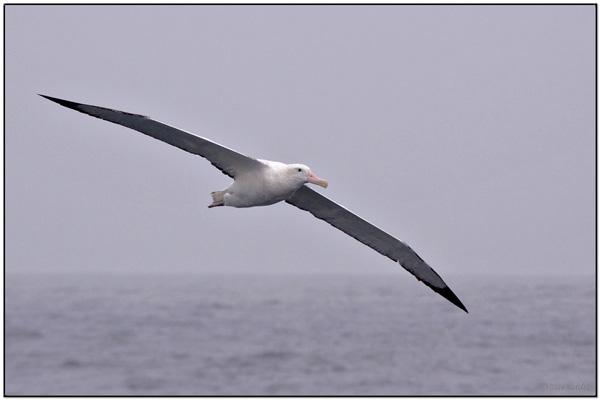
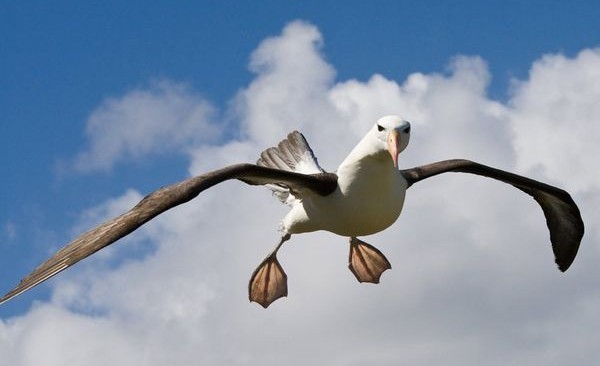
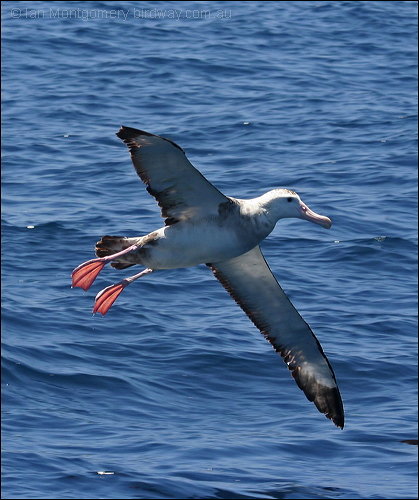
Albatrosses, of the biological family Diomedeidae, are large seabirds allied to the procellariids, storm petrels and diving petrels in the order Procellariiformes (the tubenoses). They range widely in the Southern Ocean and the North Pacific. They are absent from the North Atlantic, although fossil remains show they once occurred there and occasional vagrants are found. Albatrosses are among the largest of flying birds, and the great albatrosses (genus Diomedea) have the largest wingspans of any extant birds, reaching up to 3.7 metres (12 feet). The albatrosses are usually regarded as falling into four genera, but there is disagreement over the number of species.
Albatrosses are highly efficient in the air, using dynamic soaring and slope soaring to cover great distances with little exertion. They feed on squid, fish and krill by either scavenging, surface seizing or diving. Albatrosses are colonial, nesting for the most part on remote oceanic islands, often with several species nesting together. Pair bonds between males and females form over several years, with the use of “ritualised dances”, and will last for the life of the pair. A breeding season can take over a year from laying to fledging, with a single egg laid in each breeding attempt. A Laysan albatross, named Wisdom, on Midway Island is recognised as the oldest wild bird in the world; she was first banded in 1956 by Chandler Robbins.
[Information from Wikipedia, with editing]
This slideshow requires JavaScript.
*
“As birds flying, so will the LORD of hosts defend Jerusalem; defending also he will deliver it; and passing over he will preserve it.” (Isaiah 31:5 KJV)
“I Am Determined to Live for the King” ~ Three-Plus-One Quartet – Faith Baptist
“And said, O my God, I am ashamed and blush to lift up my face to thee, my God: for our iniquities are increased over our head, and our trespass is grown up unto the heavens.” (Ezra 9:6 KJV)



 Lee's Birdwatching Adventures Plus