Ian’s Bird of the Week – Campbell/Black-browed Albatross

Campbell Albatross (Thalassarche impavida) by Ian

Campbell Albatross (Thalassarche (melanophris impavida) by Ian 1

Another belated bird of the week, so this time you get two species, or maybe only one as we’ll see shortly. Welcome, in a nutshell, to the glory of Albatrosses and the nightmare of bird taxonomy, where I’ve been lately trying to help sort out the final bird list for the digital Pizzey and Knight.

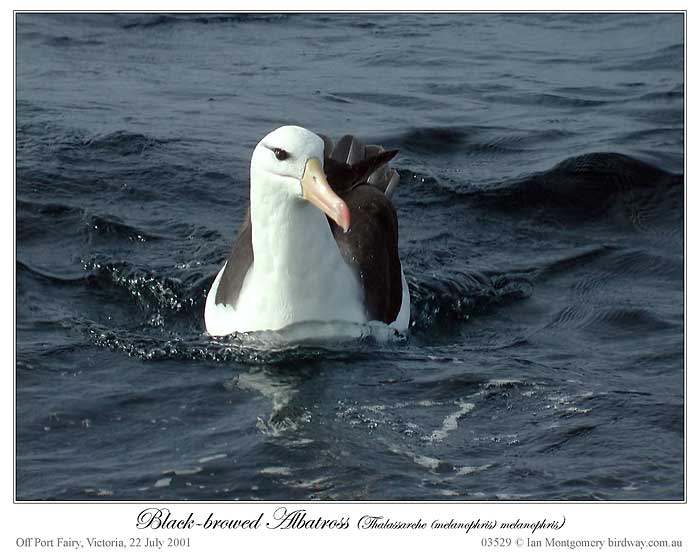
Let’s start by comparing the bird in photo #1 with the one in #2, taken within 6 minutes of each another on a pelagic bird-watching trip from Port Fairy in southern Victoria on 22 July 2001. In those days, when life was simple, we called them both Black-browed Albatrosses. I mention the date as only 5 days later a paper was accepted for publication by the Journal of Molecular Biology which supported the splitting of this species into at least two, the Black-browed Albatross (Thalassarche melanophris) which nests in the South Atlantic and Indian Oceans and the Campbell Albatross (Thalassarche impavida), endemic to Campbell Island south of New Zealand.
Black-browed Albatross (Thalassarche melanophris) by Ian 2

Black-browed Albatross (Thalassarche melanophris) by Ian 2

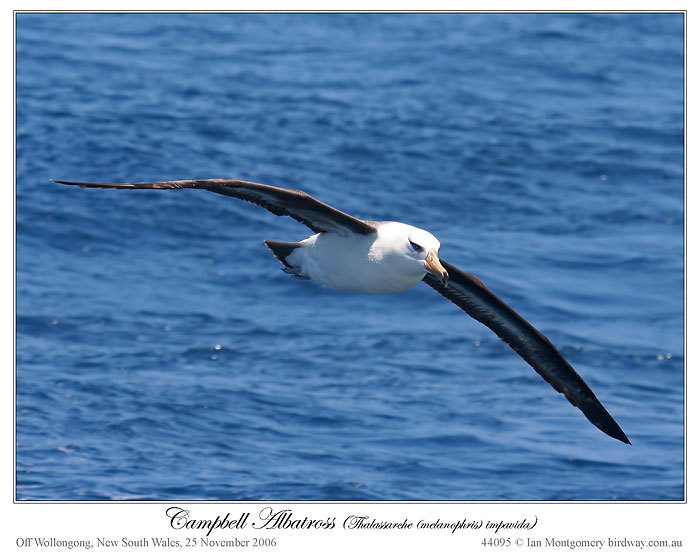
Definitely a spot the difference puzzle and by now you have found the two features visible in birds not in flight: the adult Campbell Island Albatross has a more strongly marked brow, which makes it look crosser, and a pale iris, which, I think, makes it look slightly manic like the Blue-winged Kookaburra. The underwing patterns are different too. The Campbell is much darker with only a faint central band of white as in photo #3, taken off Wollongong in New South Wales.

Campbell Albatross  (Thalassarche (melanophris impavida) by Ian 3

Campbell Albatross (Thalassarche (melanophris impavida) by Ian 3

At even a short distance, the colour of the iris is hard to see, so the underwing pattern is a better field mark for birds in flight, as in the sub-adult Campbell Albatross in photo #4.
Campbell Albatross (Thalassarche (melanophris impavida) by Ian 4

Campbell Albatross (Thalassarche (melanophris impavida) by Ian 4

Campbell T. impavida if you follow Birdlife International. The different spellings melanophris and melanophrys aren’t typos. Temminck originally spelt it with an ‘i’ but the taxonomists Jouanin and Mougin, Latin scholars obviously, though Temminck couldn’t spell and it should be a ‘y’ and that has been adopted by Birdlife International. C&B uphold the rule that says the original spelling should stand, and stick to the ‘i’.

Welcome to the nit-picking world of bird taxonomy. Does it matter? It does if you want to know how many birds are on your list and it matters if you are a conservationist. Governments are much more willing to provide funds and resources to protect threatened species that they are for sub-species and many of the Albatross types, or taxons, are threatened by long-line fishing. Linnaeus set out in the 18th Century to impose order on a chaotic scientific world with his binomial naming scheme, long before Darwin’s Origin of Species. It’s probably just as well he’s not around to see the result.

Back at the website, I’ve recently finished reformatting the galleries with improved layout, easier navigation and larger photos. I started the process in May 2010 and said then that it would take a long time (over 1,300 galleries) and it’s good to put it behind me. To celebrate, I’m joining the local Birds Australia (BANQ) in Daintree next weekend and then going to Cape York to chase a few species missing from the wanted list for the digital Pizzey and Knight (Trumpet Manucode, Tropical Scrubwren, White-lined and Green-backed Honeyeater). Wish me luck as I’d love to produce the Manucode, one of the 4 species of bird of paradise found in Australia, as a bird of the week. The Daintree weekend includes one or two boat trips on the Daintree River and birding walks, so join us if you can. All are welcome, so check out the details on the BANQ website http://www.birdsaustralianq.org/#Coming .

Best wishes
Ian


Ian Montgomery, Birdway Pty Ltd,
454 Forestry Road, Bluewater, Qld 4818
Phone: 0411 602 737 +61-411 602 737
Preferred Email: ian@birdway.com.au
Website: http://birdway.com.au


Lee’s Addition:

Whew! Okay, Ian, I think I followed all of that! As I have been saying, this naming and re-naming, splitting and glumping can get confusing. I still contend that Adam had it a whole lot easier. I have been going through those changes when the IOC World Bird List comes about about every 3 months. Keep up the good work, Ian. No matter what you call them, those are fantastic photos of the Albatrosses.

After checking out Ian’s Albatrosses, the look up the whole family, Diomedeidae-Albatrosses, here.

And God said, “Let the waters swarm with swarms of living creatures, and let birds fly above the earth across the expanse of the heavens.”
(Genesis 1:20 ESV)

*

Ian’s Bird of the Week – Double-eyed Fig-Parrot

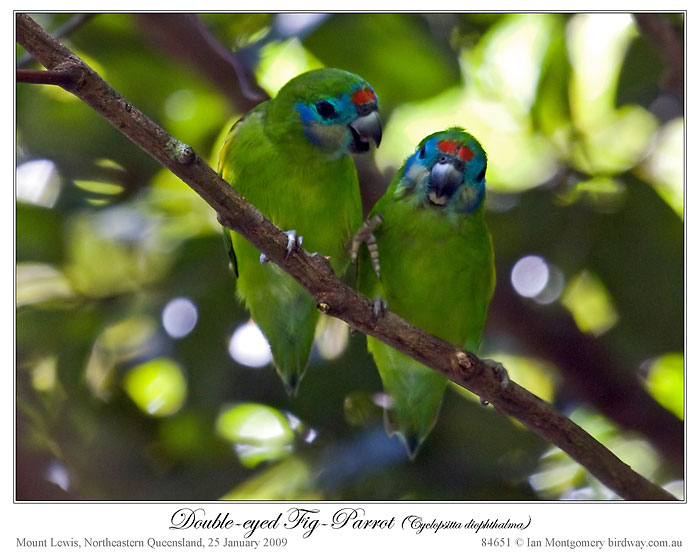
Double-eyed Fig Parrot (Cyclopsitta diophthalma macleayana) by Ian

Double-eyed Fig Parrot (Cyclopsitta diophthalma macleayana) by Ian

I wonder why miniature things are so endearing. Describing something as ‘the smallest’ immediately attracts attention, so here is the smallest parrot in Australia – with one of the longest and strangest names – the Double-eyed Fig-Parrot. Strictly speaking the Cape York race of this species (marshalli) is the smallest with a length of 13cm/5in – shorter than a house sparrow. More accessible and nearly as small (14cm) is the race found in northeastern Queensland (macleayana), quite common around Cairns and on the Atherton Tableland, where the first photo was taken.

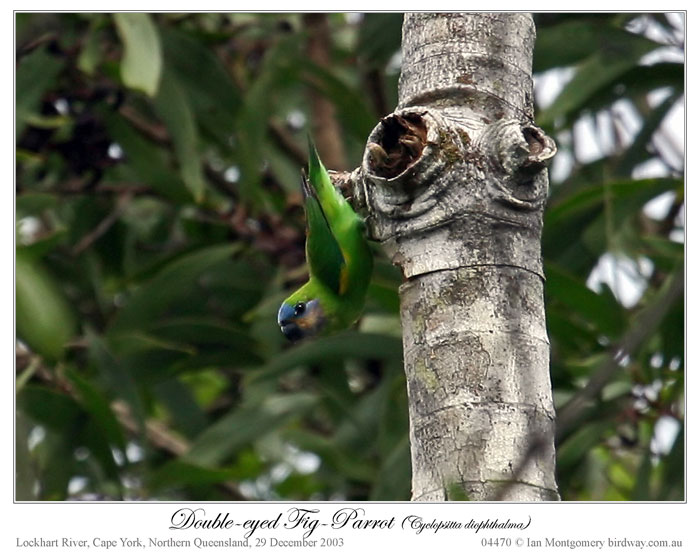
Double-eyed Fig Parrot (Cyclopsitta diophthalma macleayana) by Ian

Double-eyed Fig Parrot (Cyclopsitta diophthalma macleayana) by Ian

The races and genders are distinguishable by different facial patterns. This is a male macleayana and has a red forehead and cheek separated by a sky-blue patch and an indigo fringe to the red cheek patch. The second photo is also a male macleayana but nearly hidden in the foliage; this is typical and these birds can be hard to see as they creep around mouse-like through fruiting trees in rainforest.

Double-eyed Fig Parrot (Cyclopsitta diophthalma macleayana) by Ian

Double-eyed Fig Parrot (Cyclopsitta diophthalma macleayana) by Ian

The female and juvenile macleayana are similar to the male but lacks the red cheek patch, as in the two birds in the third photo.

The fourth photo shows a female of the Cape York race, marshalli, with no red at all. I lack a photo of the male marshalli but it is rather similar to the male macleayana except that the red forehead and cheek patches are contiguous.

Double-eyed Fig Parrot (Cyclopsitta diophthalma marshalli) by Ian

Double-eyed Fig Parrot (Cyclopsitta diophthalma marshalli) by Ian

The third and remaining Australian race, coxeni, is the largest (16cm) and rarest – classified as endangered – and occurs in a few river valleys between Maryborough in southeast Queensland and the Macleay River in northern New South Wales. Both sexes apparently have mainly blue foreheads and small reddish cheek patches.

These three races were originally treated as separate species and known as Macleay’s or Red-browed, Coxen’s or Blue-browed and Marshall’s Fig-Parrots. Later they and five races in Papua New Guinea were lumped into a single species and acquired the common name of the nominate Double-eyed Fig-Parrot of PNG (Cyclopsitta diophthalma diophthalma). This has a dark spot near each eye, giving it its double-eyed appearance, but the name is not descriptive of the races that lack the dark spot, i.e. the three Australian races. Oh well, they got the fig bit right.

Best wishes
Ian

Ian Montgomery, Birdway Pty Ltd,
454 Forestry Road, Bluewater, Qld 4818
Phone: 0411 602 737 +61-411 602 737
Preferred Email: ian@birdway.com.au
Website: http://birdway.com.au


Lee’s Addition:
Those cute little Fig Parrots are in the Parrots – Psittacidae Family of the Psittaciformes Order which not only includes Parrot family, but also the New Zealand Parrots and Cockatoos.

He will bless those who fear the LORD, Both small and great. (Psalms 115:13 NKJV)

*

Birdwatching at Circle B Bar Reserve – 7/22/11

Where the birds make their nests: as for the stork, the fir trees are her house. (Psalms 104:17 KJV)

I was making a video of a Tricoloered Heron out at Circle B  when I caught this interesting sight. I zoomed out to get a view of the pond and as I zoomed back in on the bird, he and I both were surprised to see what was heading toward us. The Heron decided to get his feet out of the water, go stand on a rock, and I decided to stop the video when the alligator started out of the water in my direction.

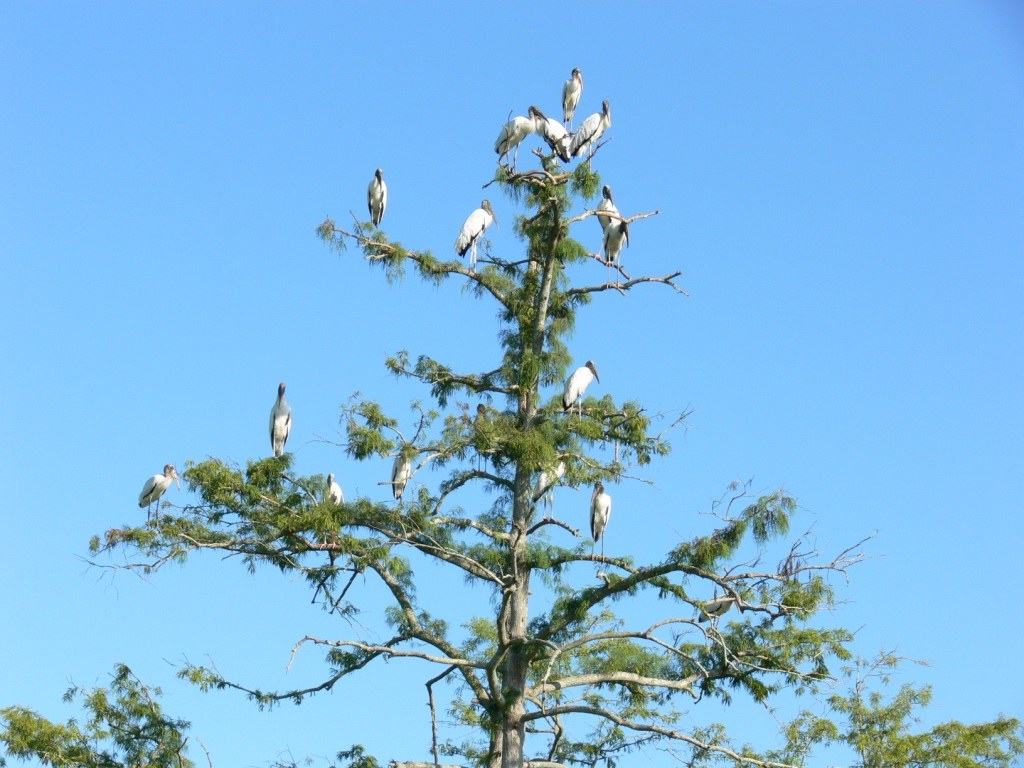
Wood Stork Tree at Circle B - 7-22-11

Wood Stork Tree at Circle B - 7-22-11 by Lee

Where the birds make their nests: as for the stork, the fir trees are her house. (Psalms 104:17 KJV)

Circle B Bar Reserve is always fun to bird watch. You never know what might be there. We had been somewhat disappointed in the number of birds and were heading back when I spotted the Heron. The most numerous birds out there were all the Wood Storks up in the trees. We still managed to see 21 birds on a clear, 79 degree morning. Here is a list of the birds spotted or heard.

Black-bellied Whistling Ducks – 9
Great Egrets – 25+
Cattle Egrets – 5
Tricolored Heron – 3
Great Blue Herons – 3
Limpkin – 1
Double-crested Cormorants – 5
Anhingas – 2
Wood Storks – 100+
Moorhens -15+
Red-shouldered Hawk – 1
Black Vultures and Turkey Vultures, mixed – 50+
Mourning Doves – 2
Red-bellied Woodpecker – 1
Red-headed Woodpecker – 1
Boat-tailed Grackles – 10
Common Grackles – 5
Blue Jays 2
Uncertain Wren – heard -1
Cardinal – 2

Black-bellied Whistling Duck in Tree at Circle B by Lee

Black-bellied Whistling Duck in Tree at Circle B by Lee

When we left there, we decided to check out Saddle Creek Park since we already had our cameras and binoculars. We got there around 9:40 and it was already 86 degrees by then. Seventeen species of birds decided to let us count them. Most of the birds were the same kind we had seen at the Circle B, but we did pick up some White Ibises, a Fish Crow, Little Blue Heron and Tufted Titmouse.

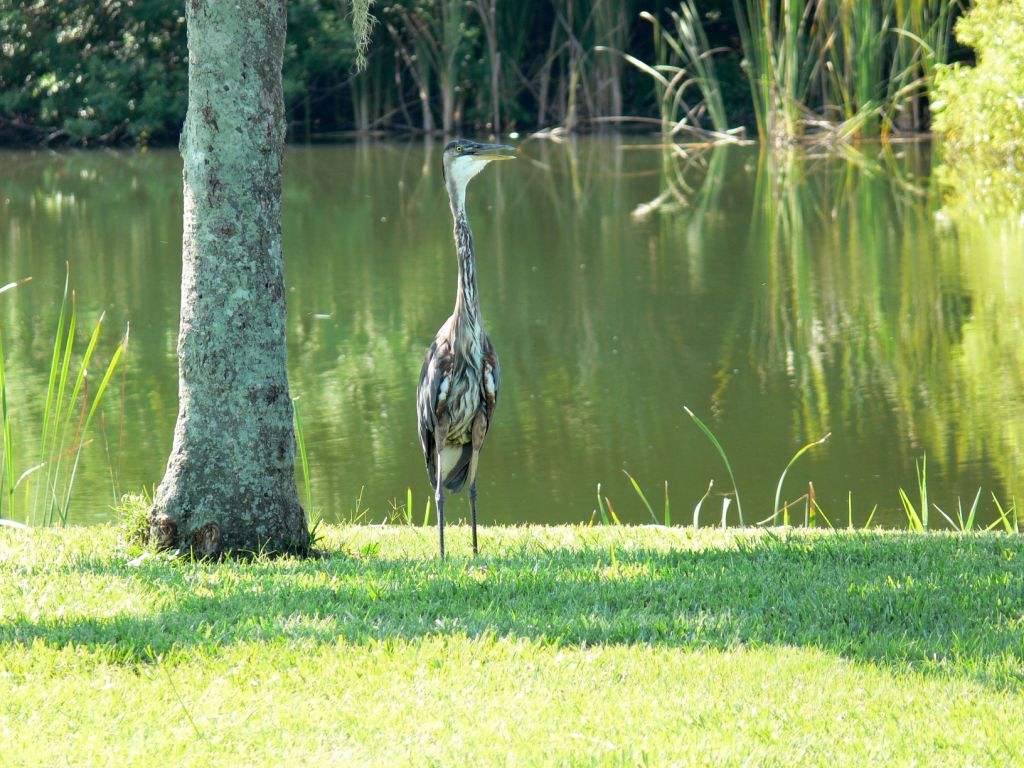
Great Blue Heron Juvenile at Saddle Creek by Lee

Great Blue Heron Juvenile at Saddle Creek by Lee

That list was (in the order they were spotted); Cattle Egrets, Blue Jays, Boat-tailed Grackles, Anhinga-female, Moorhens, Great Egret, Fish Crow, Common Grackles, Great Blue Herons, White Ibises, Tricolored Heron, Great Blue Heron-juvenile, Ospreys, Little Blue Heron, Anhinga, Double-crested Cormorants, Black Vultures and the Tufted Titmouse.

Always enjoy watching God’s Creation even when they are the same ones we see often. Then again, we have lots of human friends that we enjoy visiting with over and over also.

*

Ian’s Bird of the Week – Tiger Shrike

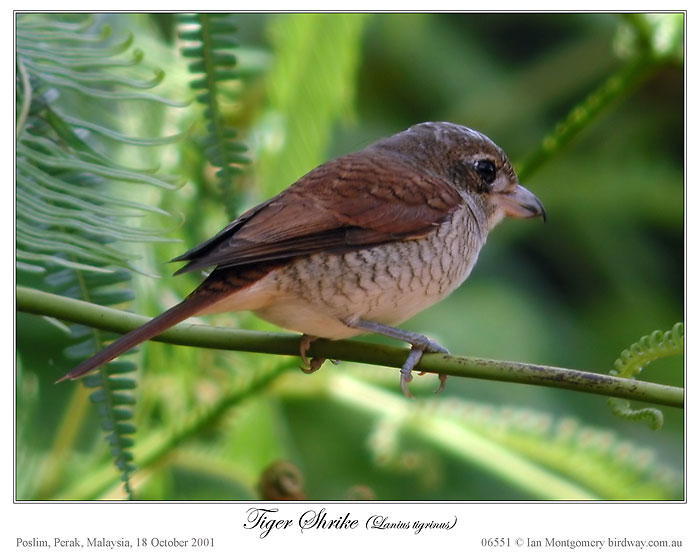
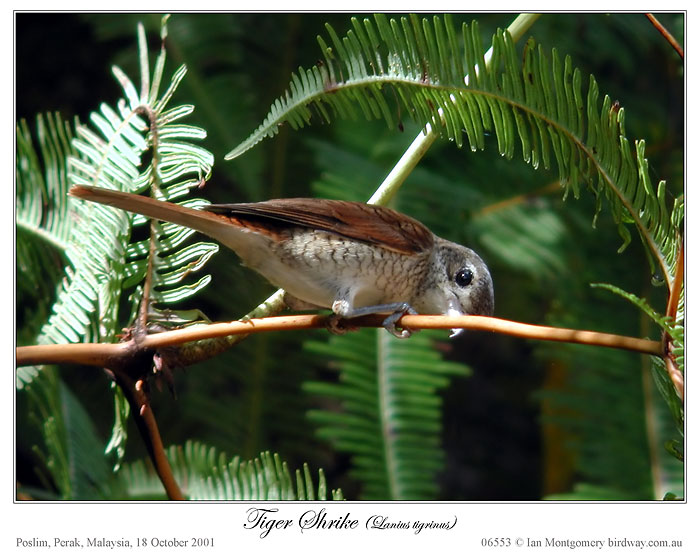
Tiger Shrike (Lanius tigrinus) by Ian

Tiger Shrike (Lanius tigrinus) by Ian

Newsletter – 7/21/11

The common names of many Australian birds reflect their apparent similarity to European birds, even if they are not closely related, for example Robins, Wrens of various sorts (Fairywrens, Scrubwrens) and Treecreepers. Some names are hybrid, such as Cuckoo-shrike, Shrike-thrush and Shrike-tit, meaning ‘looking like something between the two types’. That’s fine for Europeans and well-travelled birders who know what theses things look like, but some, particularly real shrikes, are almost complete unknown in Australia and the use of these names as qualifiers is of questionable value for the locals. So, I though it might be interesting to have a look at a real shrike and throw some light on the use of its name in Australian birds.

Shrikes, family Laniidae 33 species, are widespread through Eurasia and Africa; a couple of species occur in North America but they are unknown in South America. Two Asian Shrikes, the Tiger and the Brown , have made it to the Australian list as rare vagrants to Christmas Island, though the first Australian record of a Tiger Shrike was a road-killed one found near the port of Fremantle in Western Australia, raising the possibility of being ship-assisted (a black mark for a ‘real’ vagrant). The bird in the these two photographs was photographed in Malaysia.

Tiger Shrike (Lanius tigrinus) by Ian

Tiger Shrike (Lanius tigrinus) by Ian

You’ll notice the hooked bill, characteristic of all Shrikes, and an adaption to their predatory way of life. Shrikes capture both invertebrates and – unusually for song-birds – small vertebrates up to the size of small mammals and birds by waiting on a conspicuous perch for something to come within striking distance. They often store their prey on shrubs or impale them on thorns. Shrikes are small for raptors: the Tiger Shrike is 18cm/7in in length and the larger ones such as the Great Grey/Northern and Long-tailed reach only 26cm/10in and 28cm/11in, and a lot of that is tail.

So, for Australian bird names, read ‘hook-billed’ for ‘shrike’. The resemblance is mainly physical: Cuckoo-shrikes and Shrike-thrushes forage for insects and other invertebrates in the foliage of trees and the bills of Shrike-tits are adapted to prising open the bark of trees in search of invertebrates. For behavioural similarities, the also hook-billed Butcherbirds fit the bill, pun unintended but appropriate, as they also prey on small vertebrates and use bushes as larders. It’s a wonder that they didn’t get called Magpie-shrikes. Now, ‘magpie’, there’s another over-used name . . .

Best wishes
Ian


Ian Montgomery, Birdway Pty Ltd,
454 Forestry Road, Bluewater, Qld 4818
Phone: 0411 602 737 +61-411 602 737
Preferred Email: ian@birdway.com.au
Website: http://birdway.com.au


Lee’s Addition:

Another nice lesson from Ian about the birds of Australia and beyond. Also, more neat photos, this time of the Tiger Shrike. Thanks again, Ian, for helping us see and know about your birds “down under.” As he said, the Tiger Shrike is part of the Laniidae Family of the Passeriformes Order.

And some fell among thorns, and the thorns grew up, and choked it, and it yielded no fruit. (Mark 4:7 KJV)

Ian’s Bird of the Week – Little Grassbird

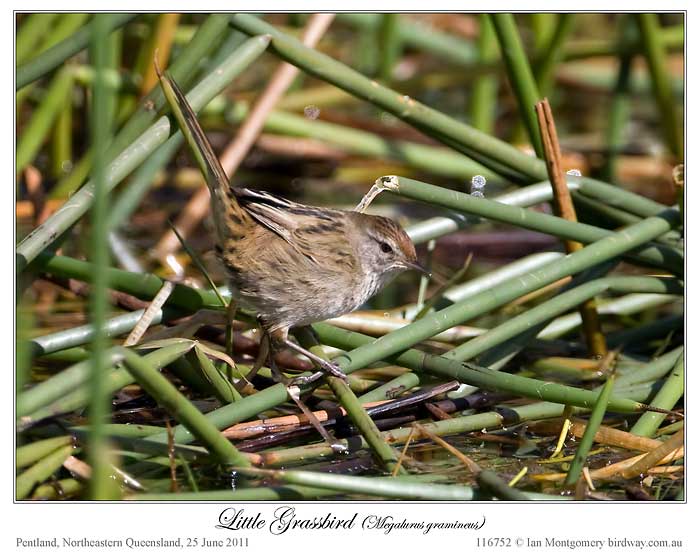
Little Grassbird (Megalurus gramineus) by Ian

Little Grassbird (Megalurus gramineus) by Ian

Ian’s Bird of the Week – Little Grassbird ~ by Ian Montgomery

Newsletter – 7/3/2011

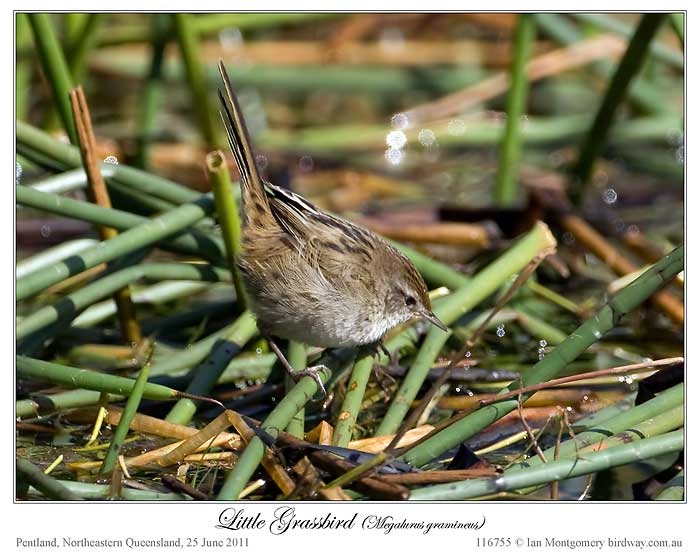
As well as the Baillon’s Crake, Pentland Dam produced another skulker, the Little Grassbird uncommon in North Queensland and usually heard rather seen – it has a distinctive, mournful three-note whistle.

I had prior warning, thank you again Len and Chris, so when a small dark bird – darker than another skulker present in the wetland, the Australian Reed-Warbler – appeared briefly, I got the camera ready in case it reappeared. It did eventually, and I got couple of quick shots before it disappeared for good.
Little Grassbird (Megalurus gramineus) by Ian

Little Grassbird (Megalurus gramineus) by Ian

The Little Grassbird is distributed quite widely in Australia, mainly in the eastern half of the mainland and Tasmania, though it does occur also in southern Western Australia and patchily through the Northern Territory as far as Kununurra across the border in northern Western Australia. Despite the name ‘Grassbird’, it occurs mainly in dense wetlands, though its only close Australian relative, the Tawny Grassbird http://www.birdway.com.au/sylviidae/tawny_grassbird/index.htm , is more flexible in its habitats.

Conventionally, the Grassbirds have been regarded as one of the Old World Warblers, family Sylviidae http://www.birdway.com.au/sylviidae/index.htm , though most bird taxonomists now accept that this family is a rather heterogeneous collection. Christidis & Boles, 2008, split it into a number of separate families and put the Grassbirds in a new one, the Megaluridae that also includes the Australian Songlarks and the Spinifexbird, while the Reed-Warblers also got their own family, the Acrocephalidae http://www.birdway.com.au/sylviidae/australian_reed_warbler/index.htm .
Best wishes
Ian


Ian Montgomery, Birdway Pty Ltd,
454 Forestry Road, Bluewater, Qld 4818
Phone: 0411 602 737 +61-411 602 737
Preferred Email: ian@birdway.com.au
Website: http://birdway.com.au


Lee’s Addition:

Ian just keeps coming up with his neat birds of the week. I am thankful that Ian lets me reproduce his newsletter on the blog. The birds he is exposing us to are fantastic and trust you enjoy them as much as I do. Many of his birds are from there in Australia and most of us will never get to travel to Australia to see those birds. So, continue to read his reports and do visit <a href=”http://birdway.com.au“>his website, Birdway, to see his many magnificent photos. Also look at the Birds of the Week here.

He causeth the grass to grow for the cattle, and herb for the service of man: that he may bring forth food out of the earth; (Psalms 104:14 KJV)

The Little Grassbird is in the Locustellidae Family.

See Ian’s other Birds of the Week

*

Ian’s Bird of the Week – Baillon’s Crake

Baillon's Crake (Porzana pusilla) by Ian

Baillon's Crake (Porzana pusilla) by Ian

Ian’s Bird of the Week – Baillon’s Crake ~ by Ian Montgomery

Newsletter – 6/27/11

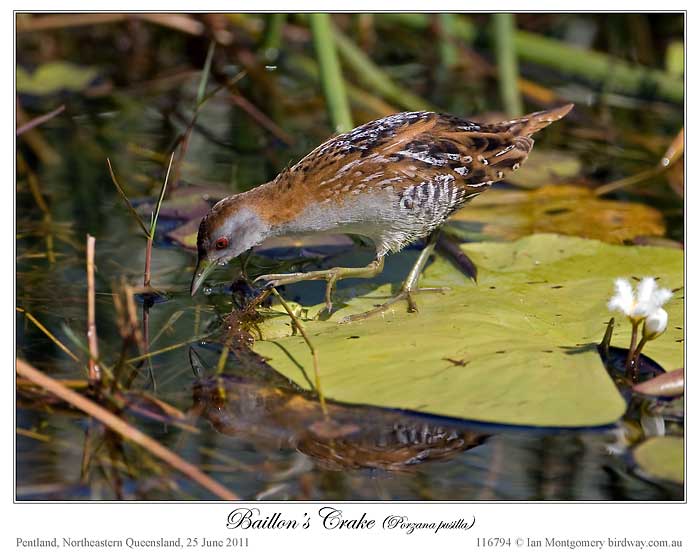
My apologies for a belated bird of the week. This week’s bird is the subject of some excitement at the moment in local birding circles with the reporting of unusual numbers of Baillon’s Crake (thank you Len and Chris!) at a small wetland at Pentland about 240km southwest of Townsville. So, I and some friends spent the weekend there. to have a look for this elusive species, uncommon in this part of the country.

Baillon’s, with a length of 15-18cm/6-7in is the smallest member of its family (Rallidae) found in Australia and not much larger than a house sparrow. Members of this species are particularly secretive even by crake standards usually preferring to skulk in reed beds and other aquatic vegetation, but sometimes venture out into the open in dull weather to feed though rarely as freely in sunshine as the ones at Pentland, as in the first photo. This bird is probably a female as HBW (Handbook of Birds of the World, which like many ‘handbooks’ needs a crane to lift it) reports that females have a rufous patch behind the eye.
Baillon's Crake (Porzana pusilla) by Ian

Baillon's Crake (Porzana pusilla) by Ian

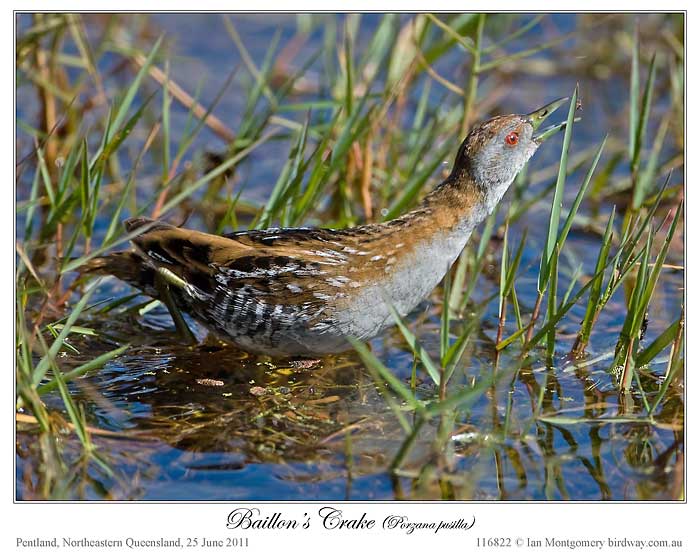
By that criterion, the bird on the lily pad in the second photo is a male with a completely grey cheek. It is also showing the long, rather jacana-like toes that enable it to walk over aquatic vegetation, both floating and submerged, though they will swim if necessary. They seemed reluctant to fly, but would do so to chase other birds that appeared to be encroaching on their patch.

Baillon's Crake (Porzana pusilla) by Ian

Baillon's Crake (Porzana pusilla) by Ian

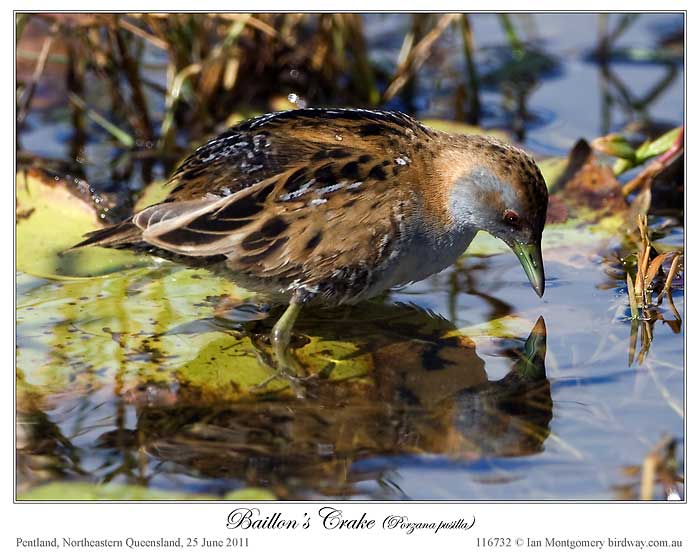
The third photo shows a bird snatching an invertebrate, maybe a small spider, off a blade of grass and stretching out its neck to full extent to do so. They would also pluck prey from under the surface and I watched one that appeared to be eating a mollusc. The fourth photo shows one peering intently at the water but its debatable whether it’s looking for dinner or, Narcissus-like, admiring its reflection (even if it is a female) while its lily pad sinks unnoticed below the surface – Baillon’s Crakes weigh about 35 g, a little over an ounce.

Baillon's Crake (Porzana pusilla) by Ian

Baillon's Crake (Porzana pusilla) by Ian

I think the bird in the fifth photo is a juvenile. The iris is brownish rather than red, the legs and bill are browner than in the adults and the underparts are buffish white, rather than grey.

Baillon's Crake (Porzana pusilla) by Ian

Baillon's Crake (Porzana pusilla) by Ian

Although Crakes in general appear reluctant to fly, they can do so well and over long distances, probably at night. They move around according to the availability of water (the wetland at Pentland sometimes dries out completely) and there is some evidence that Baillon’s Crakes move north in winter in Australia. It also has a wide distribution throughout Eurasia and Africa and a summer visitor in Europe. A separate race is found in New Zealand, it has been recorded on Macquarie Island, and a closely related species, now extinct, used to occur on Laysan Island between Midway Islands and Hawaii.

Incidentally, the smallest member of the family is the Inaccessible Rail found on Inaccessible Island in the Tristan Da Cunha Group with a length of 13-15.5 cm. Furthermore it the smallest flightless bird in the world, but, not having therefore to worry about its waistline, it is, at 40 g, heaver than Baillon’s Crake.
Best wishes,
Ian


Ian Montgomery, Birdway Pty Ltd,
454 Forestry Road, Bluewater, Qld 4818
Phone: 0411 602 737 +61-411 602 737
Preferred Email: ian@birdway.com.au
Website: http://birdway.com.au


Lee’s Addition:

Baillons are part of the Rails, Crakes & Coots – Rallidae Family of the Gruiformes Order. The Crake is in the same family as our Purple Gallinules, Common Gallinules or Moorhens and the American Coots we see often. We have Rails (Black, Clapper, King, Virginia, and Yellow) and the Sora here in Florida, but I never seem to spot them. The birds here are much larger than Ian just described. Would love to see one of them.

The most typical family members occupy dense vegetation in damp environments near lakes, swamps, or rivers. Reed beds are a particularly favoured habitat. They are omnivorous, and those that migrate do so at night: most nest in dense vegetation. In general, they are shy and secretive birds, and are difficult to observe.

Most species walk and run vigorously on strong legs, and have long toes which are well adapted to soft, uneven surfaces. They tend to have short, rounded wings and although they are generally weak fliers, they are, nevertheless, capable of covering long distances.

Can the papyrus grow up without a marsh? Can the reeds flourish without water? While it is yet green and not cut down, It withers before any other plant. So are the paths of all who forget God; (Job 8:11-13a NKJV)

See more of Ian’s Bird of the Week articles.
Family #46 – Rallidae

*

Ian’s Bird of the Week – White-headed Pigeon

White-headed Pigeon (Columba leucomela) by Ian

White-headed Pigeon (Columba leucomela) by Ian

Ian’s Bird of the Week – White-headed Pigeon ~ by Ian Montgomery

Newsletter – 6/15/11

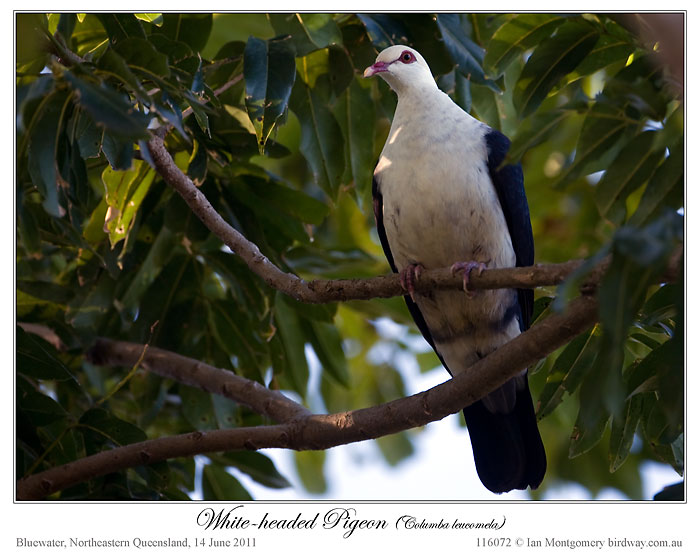
I’ve been preoccupied recently preparing photos for the digital publication that I first mentioned two weeks ago, so I haven’t taken many photos and hadn’t decided on this week’s bird when I took a break yesterday to put out the garbage. On the way back from the front gate, I spotted an adult male White-headed Pigeon feeding on the fruit of a boxwood shrub and took the long way round to the house to get my camera. The adult White-headed Pigeon was on my wanted list for the digital publication and hasn’t featured as a bird of the week, so two problems were solved simultaneously by just taking out the garbage. There’s a lesson there somewhere, I’m unsure what, but I do recall another occasion when I photographed Red-tailed Black-Cockatoos on a trip to the garbage dump: http://www.birdway.com.au/cacatuinae/red_tailed_black_cockatoo/source/redtailblackcockatoo02242.htm .

White-headed Pigeon (Columba leucomela) by Ian

White-headed Pigeon (Columba leucomela) by Ian

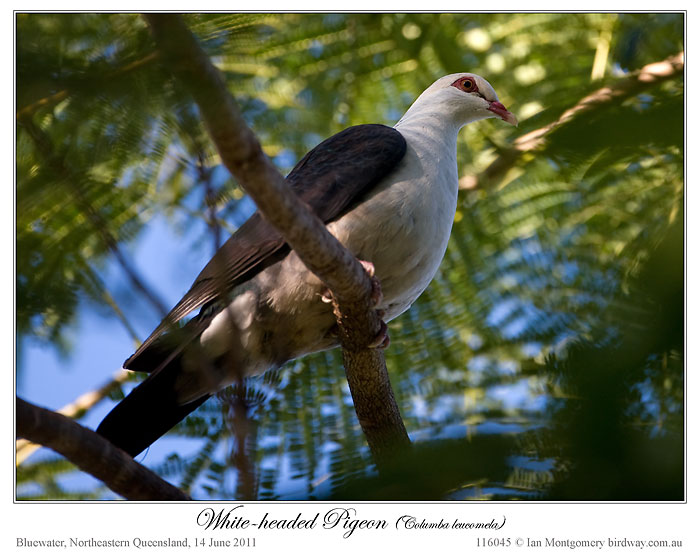
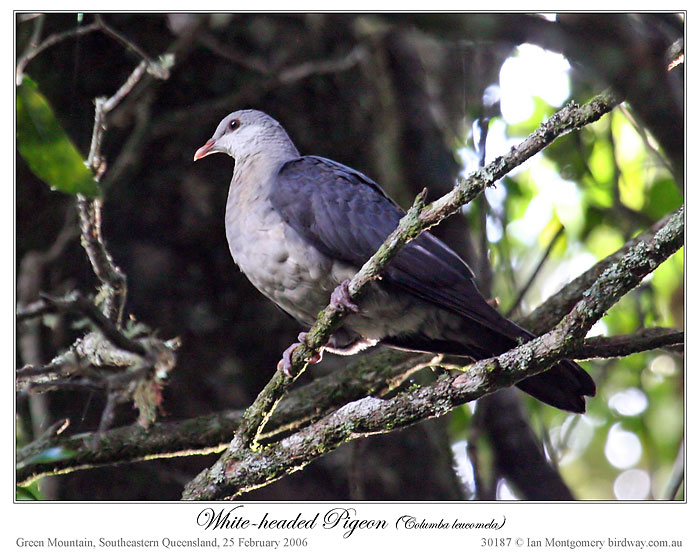
I disturbed him from the boxwood, but he flew up into a poinciana tree near the house (first photo) before retreating into the thicker foliage of what I think is an African mahogany (second photo), where he remained for ages.

White-headed Pigeons are large (to 41cm/16in in length) and rather splendid with their red and white faces and slightly iridescent bluish grey wing feathers. Here in North Queensland, they occur usually only in highland rainforest, and this is the first one that I’ve seen here near the coast, though farther south in southern Queensland and northern New South Wales (their stronghold) they do occur in coastal areas. The range from Cooktown in the north to about Bermagui on the south coast of NSW but, like other fruit-eating pigeons, they are fairly nomadic and sometimes occur in eastern Victoria. So, I don’t know whether this one is yet another refugee from cyclone Yasi or has just wandered down from the Paluma Range looking for food, as other birds do in winter.

White-headed Pigeon (Columba leucomela) by Ian

White-headed Pigeon (Columba leucomela) by Ian

The third photo is an immature bird that I photographed some years ago in rainforest near O’Reilly’s Lodge in Lamington National Park in southeastern Queensland near the border with NSW. Immature birds have greyish, rather than white heads and breasts and a dark cap. Females are intermediate in colour between the juveniles and the adult male and also have the whitish cheek visible on the juvenile.

On a completely different subject have a look at this youtube video  if you want to see the piece that the recorder group to which I belong entered in the Recorder Romp competition organised recently by the ABC.

Best wishes
Ian


Ian Montgomery, Birdway Pty Ltd,
454 Forestry Road, Bluewater, Qld 4818
Phone: 0411 602 737 +61-411 602 737
Preferred Email: ian@birdway.com.au
Website: http://birdway.com.au


Lee’s Addition:

Behold, thou art fair, my love; behold, thou art fair; thou hast doves’ eyes. (Song of Solomon 1:15 KJV)

Doves are in the Columbidae Family of the Columbiformes Order.

*

Ian’s Bird of the Week – Red-billed Tropicbird

Red-billed Tropicbird (Phaethon aethereus) by Ian Montgomery

Red-billed Tropicbird (Phaethon aethereus) by Ian Montgomery

Ian’s Bird of the Week – Red-billed Tropicbird ~ by Ian Montgomery

Newsletter – 6/6/11

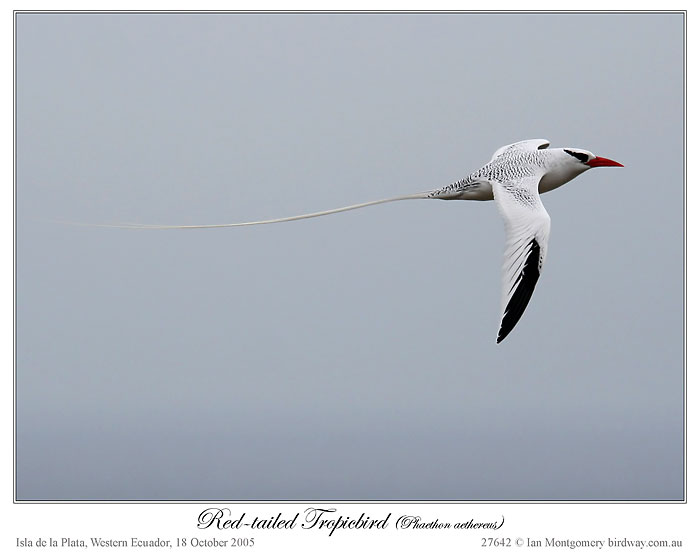
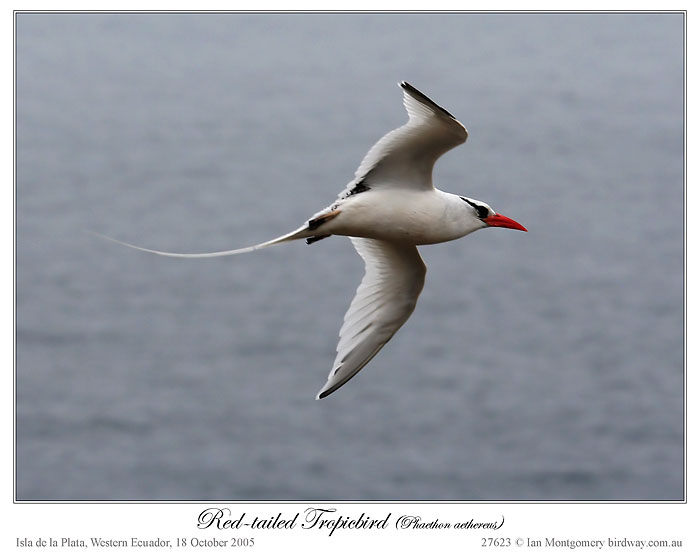
Last November a Red-billed Tropicbird was recorded on Lord Howe Island (http://aussiebirding.wildiaries.com/species/23736). This is the first Australian record and it is a long way from its closest breeding colonies in the Galapagos. I photographed this species in 2005 at another Ecuadorean site, Isla de la Plata (‘Silver Island’) so I thought I’d share it with you as Tropicbirds are among my favourite birds. Lord Howe Island, incidentally, has breeding Red-tailed Tropicbirds (http://www.birdway.com.au/phaethontidae/red_tailed_tropicbird/index.htm). Isla de la Plata is often called the poor man’s Galapagos as it’s a mere 40km from the Ecuadorean coast as can be visited on a day trip for about $40 and has some of the Galapagos specialties such as the Blue-footed Booby (http://www.birdway.com.au/sulidae/blue_footed_booby/index.htm).

Red-billed Tropicbird by Ian Montgomery

Red-billed Tropicbird (Phaethon aethereus) by Ian Montgomery

The Red-billed Tropicbird is easily distinguished from the closely related Red-tailed by its white tail streamers and black barring on the back and wings (first photo). It is the largest of the three species with a body length of about 50cm/20in, tail streamers of at least another 50cm/20in and a wingspan of about 1metre/40in. The two tail streamer feathers are longer in the male and used in aerial display and may also be used as a rudder in flight. They are fragile, often broken (second photo) and are replaced continually.

The courtship display of the Red-billed Tropicbird starts with a number of birds flying around near the colony which is usually on a rocky cliff. A pair of birds may then separate from the flock and start synchronised aerobatics, as in the third photo. This time I’ve embedded the photos in the body of the email; if this causes any problems, eg with older email programs that don’t support HTML, just let me know ian@birdway.com.au and I’ll revert to attaching them.
Red-billed Tropicbird (Phaethon aethereus) by Ian Montgomery

Red-billed Tropicbird by Ian Montgomery

This display may lead to a choice of nest site (from the air). Tropicbirds have webbed feet and weak legs and can move only with difficulty on land, so the choice of inaccessible cliff sites is supposed to offer protection from terrestrial predators and allow easy take off.

They feed by diving for prey, often flying fish and squid, as do gannets and boobies and, like them, have air sacs in the head and neck to absorb the impact of hitting the water. The tropical waters in which they feed have low prey densities so they travel far and when not breeding lead a pelagic existence. They aren’t closely related to gannet and boobies; DNA studies suggest that they have no close relatives and Christidis and Boles (2008) place the three members of the Tropicbird family, the Phaethontidae, in their own order, the Phaethontiformes. The third and smallest species is the White-tailed Tropicbird, best known in Australia as the apricot-coloured morph found on Christmas Island and known locally as the Golden Bosunbird (http://www.birdway.com.au/phaethontidae/white_tailed_tropicbird/index.htm).
I’ve had an encouraging response to last week’s request for photos of Australian birds that I can’t supply, with about 60 species of the wanted list being offered. There are still 200 to go, so have a look at the update wanted list to see if you can help.
On the website, I recently changed my policy of not including captive birds under any circumstances and have added photos of a Malleefowl (http://www.birdway.com.au/megapodiidae/malleefowl/index.htm) and Little Penguins (http://www.birdway.com.au/spheniscidae/little_penguin/index.htm)  in tolerably natural-looking sets.
Best wishes,
Ian

Ian Montgomery, Birdway Pty Ltd,
454 Forestry Road, Bluewater, Qld 4818
Phone: 0411 602 737 +61-411 602 737
Preferred Email: ian@birdway.com.au
Website: http://birdway.com.au

Lee’s Addition:

Ian made some interesting observations about the Tropicbirds:

  • Have webbed feet
  • Have weak legs
  • Can move only with difficulty on land
  • The choice of inaccessible cliff sites is supposed to offer protection from terrestrial predators and allow easy take off.
  • When diving for prey air sacs in the head and neck absorb the impact of hitting the water.

Looks like these features add up to a neatly created design to provide for and protect the tropicbirds.

Then God said, “Let the waters abound with an abundance of living creatures, and let birds fly above the earth across the face of the firmament of the heavens. (Gen 1:20)

The Tropicbirds are in the Phaethontidae – Tropicbirds Family. There are only three species in the family and they are the only family in the Phaethontiformes Order.

More of Ian’s Birds of the Week – Click Here

*

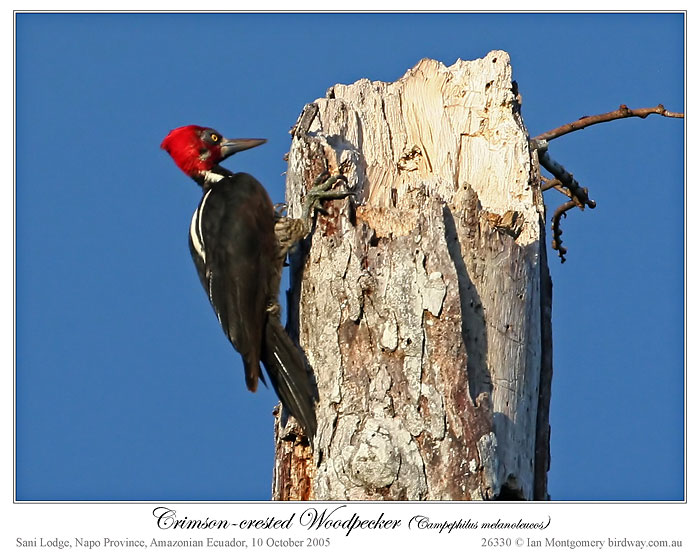
Ian’s Bird of the Week – Crimson-crested Woodpecker

Crimson-crested Woodpecker (Campephilus melanoleucos) by Ian

Crimson-crested Woodpecker (Campephilus melanoleucos) by Ian

Ian’s Bird of the Week – Crimson-crested Woodpecker ~ by Ian Montgomery

Newsletter – 5/29/11

Those of you who have been on the list for a few years might remember from earlier posts that I’ve led a woodpecker-deprived existence, having lived first in Ireland and since then in Australia. Woody Woodpecker captured my imagination at an early age and I’ve been fascinated with woodpeckers ever since.

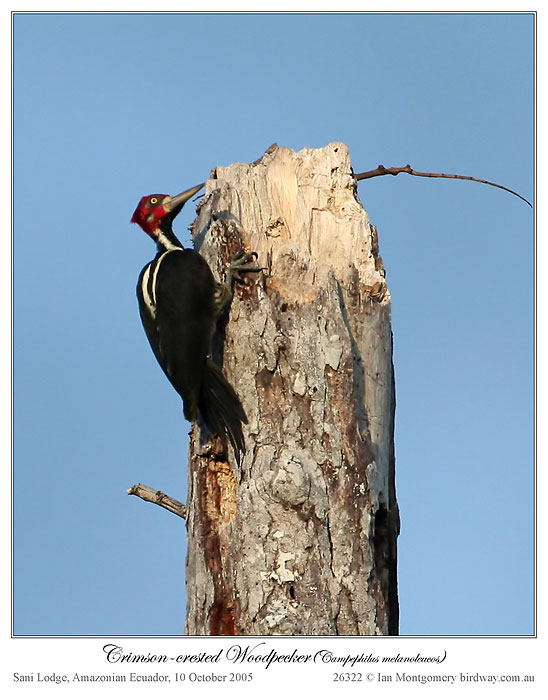
I was updating the woodpecker galleries on the website http://www.birdway.com.au/picidae/index.htm and this one made me laugh, so I though I’d share it with you. In the first photo it looks as if it’s staring in guilty shock at the tree and saying “Whoops! (or something stronger) Did I do that?” The second photo follows the same theme with a puzzled “Where did that tree go?” If you can think of better captions, please share them with me at ian@birdway.com.au and I’ll publish the best one next week.

Crimson-crested Woodpecker (Campephilus melanoleucos) by Ian

Crimson-crested Woodpecker (Campephilus melanoleucos) by Ian

The Crimson-crested Woodpecker (Campephilus melanoleucos) is 36cm/14in in length and a close relative of the larger (at least 48cm/19in) and legendary, maybe-extinct-maybe-not Ivory-billed Woodpecker of the southern USA (Campephilus principalis) about which there was so much excitement in 2004-5. The Crimson-crested is happily quite common with a wide range in northern South America. Campephilus incidentally means ‘grub loving’ as this group of woodpeckers finds the larvae of wood-boring beetles to their liking.

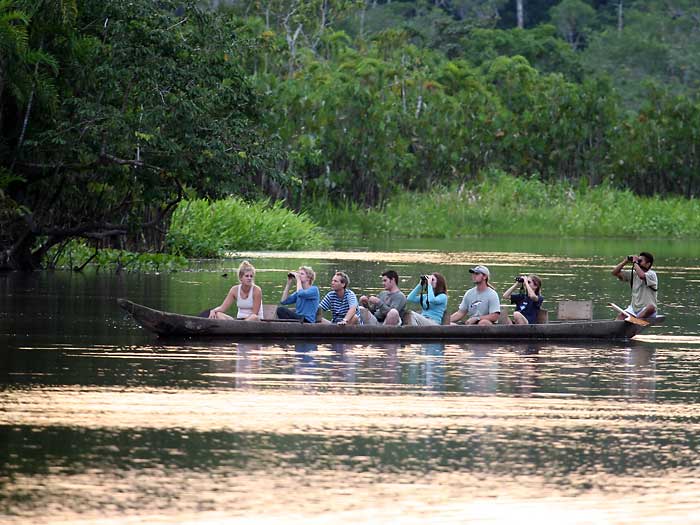
I photographed this Crimson-crested Woodpecker in 2005 from the dug-out canoe in the third photo, when staying at a lodge called Sani on the Rio Napo, a tributary of the Amazon, in eastern Ecuador. The lodge was on an oxbow lake away from the main river and the canoes, being very quiet, were ideal for bird watching though using a heavy (and expensive) 500mm lens in the canoe took some practice, not to mention recklessness.

Crimson-crested Woodpecker (Campephilus melanoleucos) by Ian Sani Canoe

Crimson-crested Woodpecker from Sani on the Rio Napo Canoe by Ian

Ireland happily is no longer a woodpecker-free zone as the Greater-spotted Woodpecker is in the process of colonising the country, after a big increase in the population in Britain, with successful breeding being report in Co. Down since 2005, Co. Wicklow since 2009 and Co. Wexford since 2010. See http://wlx.bright-server.com/do/ecco.py/view_item?listid=1&listcatid=1075&listitemid=8021&live=0 . We might have to wait a bit longer, though, for any Asian woodpeckers to come island-hopping across the Wallace line to Australia and eucalyptus mightn’t suit them.

I’ve started suppling photos of Australian birds to Guy Gibbon for a multimedia version of Pizzey and Knight for PCs and mobiles and I’ve also been given the task of sourcing photos that I can’t supply (both species and plumages). If you are interested, or know anyone who might be, I’d like to hear from you ian@birdway.com.au . Have a look at this News item on the website http://www.birdway.com.au/#aus_photos which has a link to the list of initially required species http://www.birdway.com.au/pdfs/wanted_species.pdf and links to similar publications by Guy covering British-Irish and Southern African birds.

Best wishes
Ian

Ian Montgomery, Birdway Pty Ltd,
454 Forestry Road, Bluewater, Qld 4818
Phone: 0411 602 737 +61-411 602 737
Preferred Email: ian@birdway.com.au
Website: http://birdway.com.au


Lee’s Addition:

Woody Woodpecker was also a favorite of mine. Here in the U. S., we have the Pileated Woodpecker (Dryocopus pileatus),  which seems to be quite similar to this Crimson-crested. Pileated adults are (40 to 49 centimetres (16 to 19 in) long; 250 to 350 grams (8.8 to 12 oz) mass) are mainly black with a red crest and a white line down the sides of the throat. That compares to the 36cm/14in of the Crimson-crested.  Apparently the Pileated is larger and in a different genus. There are 225 woodpeckers world-wide. The Piciformes Order has not only Woodpeckers – Picidae Family, but also eight other families.

The trees of the LORD are full of sap; the cedars of Lebanon, which he hath planted; Where the birds make their nests: as for the stork, the fir trees are her house. (Psalms 104:16-17 KJV)

*
Birdwatching at Lowry Park Zoo – May 2011

Great Argus (Argusianus argus argus) (Great Malay Argus P) by Lee at LPZ

Great Argus (Argusianus argus argus) (Great Malay Argus Pheasant) by Lee at LPZ

Dan and I were able check out the birds again at the Lowry Park Zoo in Tampa, FL last Friday. We went to a few of the aviaries we haven’t been in for awhile. We went to the Sulawesi Aviary and saw the Magpie Goose, Masked Lapwing, Great Malay Argus Pheasant , Victorian Crowned Pigeon (SSP), Mandarin Duck, Sulawesi Tarictic (Temminck’s) Hornbill, Demoiselle Crane, Great Malay Argus, Javan Pond Heron and the (Green-naped) Pheasant Pigeon, with the Bar-headed Goose just outside.

Sulawesi Hornbill (Penelopides exarhatus) by Lee LPZ

Sulawesi Hornbill (Penelopides exarhatus) by Lee LPZ

From there we stopped by Lorikeet Landing to see many Lorikeets being feed by visitors. There the Green-naped, Swainson’s, Weber’s and Rainbow Lorikeets carry on with lots of noisy calls (all of these are subspecies of the Rainbow).

Lorikeet being feed by youngster at Lowry Pk Zoo

Lorikeet being feed by youngster at Lowry Pk Zoo

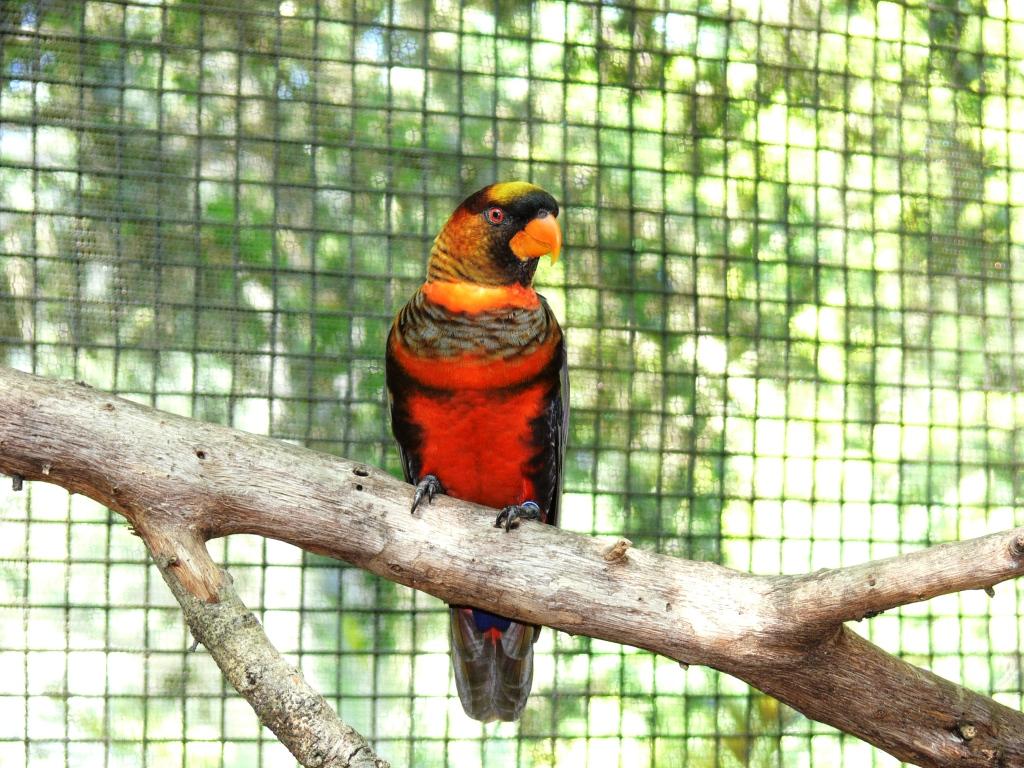
They also have Dusky Lory, Violet-crested Turaco, and Green-winged Teals.

Dusky Lory (Pseudeos fuscata) by Lee at LPZoo

Dusky Lory (Pseudeos fuscata) by Lee at LPZoo

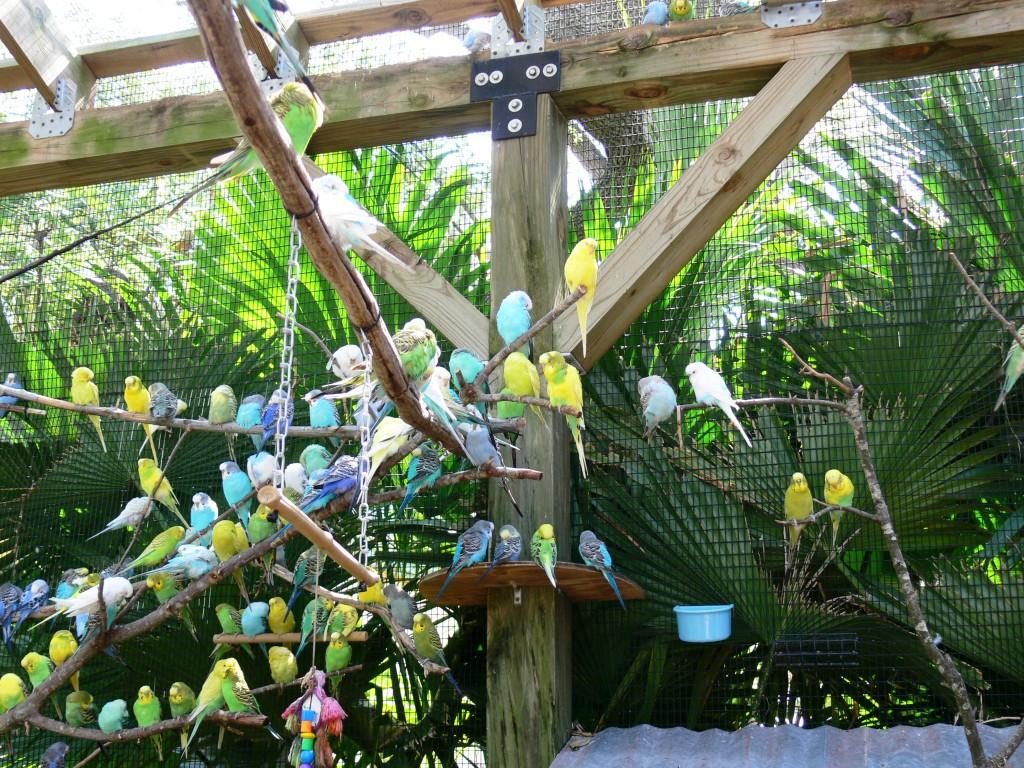
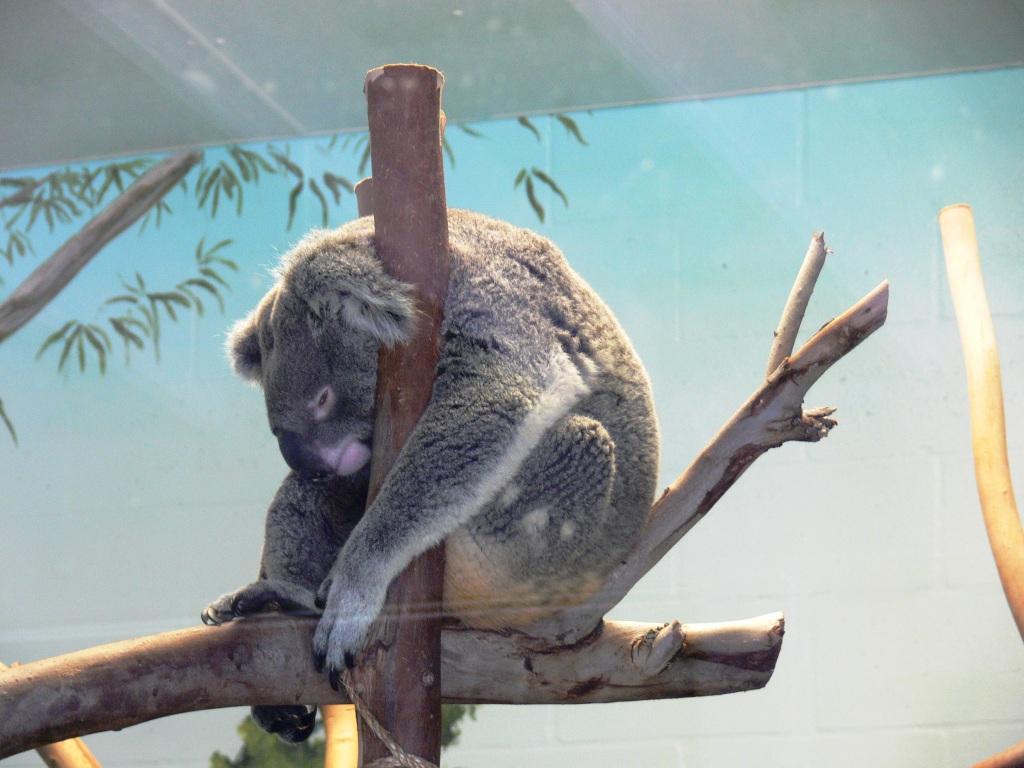
The Wallaroo Station (Australian) greets you with the Palm Cockatoo, Silky, Australorp and Buff Orphington Chickens. Then just inside you can view the sleepy Koala (whoops, that not a bird, but it was in a tree) and the Emu. The Malayan Flying Fox exhibit had those bats, plus the Magpie Goose, Rosy Starlings, Long-billed Corella (new for me), and Red-tailed Black Cockatoo. The Bali Myna was busy singing and showing off for its mate and then we entered the Budgerigar Aviary. Wow! They were everywhere.

Budgerigar (Melopsittacus undulatus) by Lee LPZ

Budgerigar (Melopsittacus undulatus) by Lee LPZ

We saw more, but will save that for another article. It was enjoyable as usual as we watched the Lord’s Creative Hand through these fantastic birds.

The works of the LORD are great, sought out of all them that have pleasure therein. His work is honourable and glorious: and his righteousness endureth for ever. (Psalms 111:2-3 KJV)

I have also been updating some more of the photos for:
Life List of All Birds We Have Seen

Koala by Lee LPZ

Koala by Lee LPZ

*

Ian’s Bird of the Week – Masked Booby

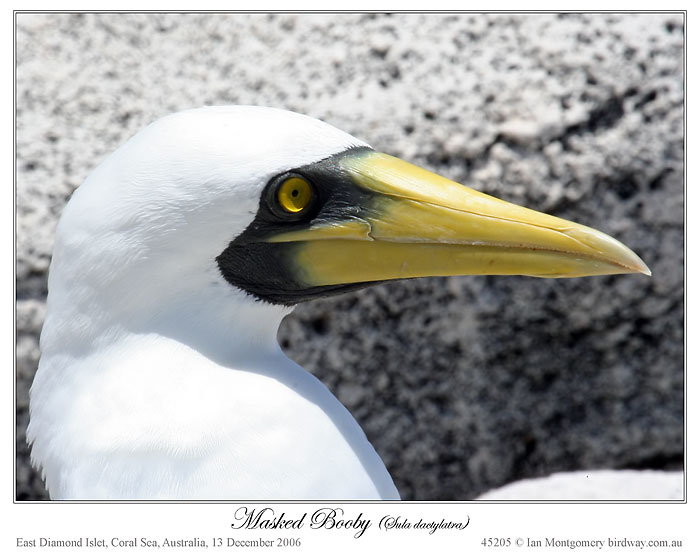
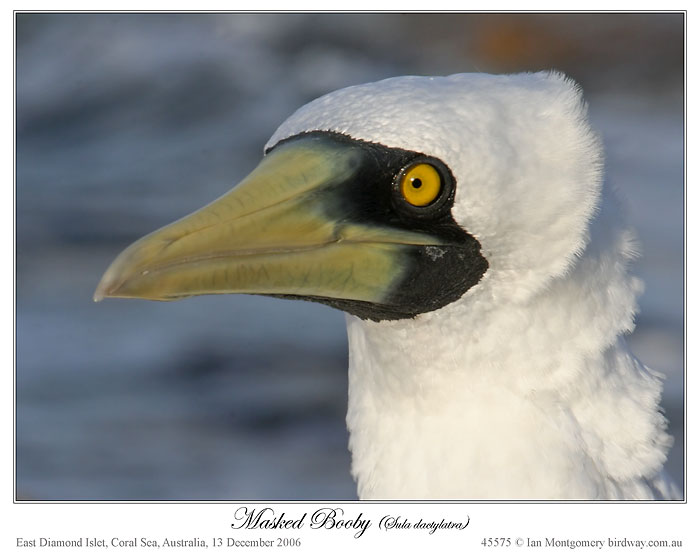
Masked Booby (Sula dactylatra) by Ian

Masked Booby (Sula dactylatra) by Ian

Ian’s Bird of the Week – Masked Booby ~ by Ian Montgomery

Newsletter – 5/20/11

We got a good view of a female Lesser Frigatebird at Lucinda on Wednesday when we did our regular wader count so I considered this species for bird of the week, forgetting that it had featured in March. So here is another spectacular seabird instead: the Masked Booby.

Masked Booby (Sula dactylatra) by Ian

Masked Booby (Sula dactylatra) by Ian

The first photo shows a portrait of a male bird, distinguishable from the female by its yellow bill. That of the female, second photo, has a greenish tinge to it. As you can see from these photos, Boobies are very approachable and the name comes from the Spanish ‘bobo’ meaning clown or fool as sailors found the birds easy to catch.

Masked Booby (Sula dactylatra) by Ian

Masked Booby (Sula dactylatra) by Ian

The difference between the sexes is subtle though the female is larger and they are easier to tell apart when seen together, like the pair in the third photo on a beach. Boobies and Gannets are very social and have sophisticated behaviours for display, territorial disputes and fishing so the ‘bobo’ label was a bit hasty.

Masked Booby (Sula dactylatra) by Ian

Masked Booby (Sula dactylatra) by Ian

All these photos were taken at East Diamond Islet, a remote cay on the eastern edge of the Barrier Reef in the Coral Sea Islands Territory, within Australia’s territorial boundaries but outside Queensland. This cay is typical of Masked Booby colonies, far offshore in tropical or sub-tropical waters, and the birds fish in deep water and are not normally seen close to the coast. The range of the Masked Booby is right around the globe and in Australasia there are colonies in northern Western Australia, northeastern Queensland, Lord Howe and Norfolk Islands and the New Zealand Kermadec Islands. The birds at the last three sites have black rather than yellow eyes and belong to a different race. Another race in the eastern Pacific with orange bills has recently been split off as a separate species the Nazca Booby.

Masked Booby (Sula dactylatra) by Ian

Masked Booby (Sula dactylatra) by Ian

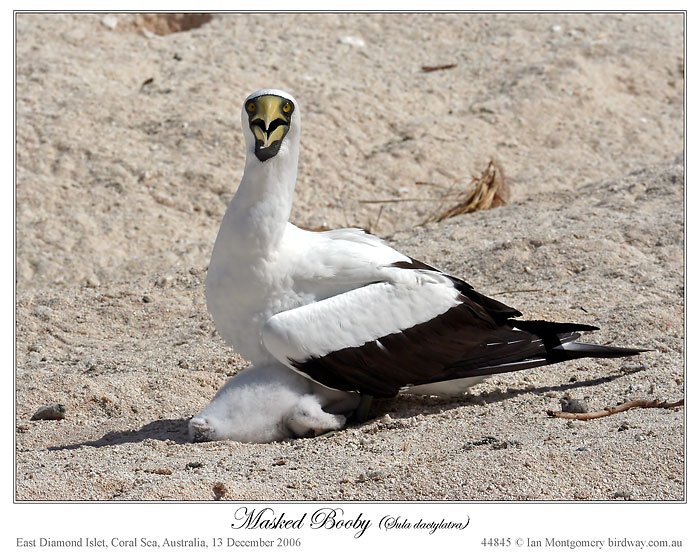
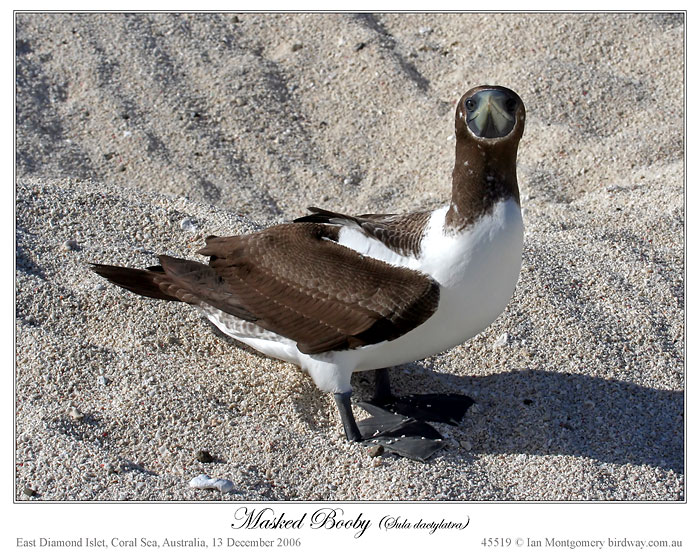
Masked Boobies nest both on rocky cliffs and flat areas and the female in the fourth photo is sheltering a nestling and simultaneously expressing a verbal protest at being photographed. They usually lay two eggs, but the second is only an insurance policy and the first nestling to hatch will kill its sibling if it also hatches. Juvenile birds, fifth photo, look quite similar to the closely related Brown Booby but are distinguishable by having a complete white collar which in front forms a white rather than brown upper breast.

Masked Booby (Sula dactylatra) by Ian

Masked Booby (Sula dactylatra) by Ian

The sixth photo is of a male in flight and shows the black tail that distinguishes it from the white phase of the Red-footed Booby. Like all the gannets and other boobies, the Masked feeds by spectacular plunge-dives for fish, all members of the family have air sacs off the bronchi to absorb the impact – the original airbags. The Masked is the largest of the boobies (to 86cm/34in with a wing-span of 1.7m/5.5ft) and its maximum dive has been estimated at 100m/330ft though it’s smaller than the gannets. Gannets can reach 10m/33ft depth just from the dive and then swim down to 20-25m and usually take the target fish on the way back up.

Links:
Wednesday’s female Lesser Frigatebird
Nazca Booby
Brown Booby
Red-footed Booby

Here are a couple of points from earlier postings. Last week I had an email from Brett who reported the northern race of the Eastern Yellow Robin at St George’s Basin, 200km south of Sydney and well south of the documented range to the Hunter Valley. He – brett@brettdaviswebsitedesign.com.au – would be interested to hear from others who have recorded it south of its supposed range. A month ago (Yellow White-eye) I inquired about a plant with large fruits and pink flowers. The plant in question is calotrope (Calotropis procera) – thank you to the respondents – an introduced weed, but popular with native birds such as this Red-headed Honeyeater in Broome.

Best wishes,
Ian


Ian Montgomery, Birdway Pty Ltd,
454 Forestry Road, Bluewater, Qld 4818
Phone: 0411 602 737 +61-411 602 737
Preferred Email: ian@birdway.com.au
Website: http://birdway.com.au


Lee’s Addition:

The Sulidae – Gannets, Boobies Family has 10 species. The three Gannets are the Northern, Cape, and Australian. The seven Boobies are the Blue-footed and Red-footed, Peruvian, Nazca, Brown and the Masked Booby which Ian just wrote about. This family is part of the Suliformes Order which also includes the Frigatebirds, Cormorants, shags and the Anhingas, darters families.

Talking about the young one and the nest of the ground reminds me of:

If you come across a bird’s nest in any tree or on the ground, with young ones or eggs and the mother sitting on the young or on the eggs, you shall not take the mother with the young. (Deuteronomy 22:6 ESV)

Introducing New Videographers

Black-eared Shrike-babbler (Pteruthius melanotis) by Khong T Khoon

Black-eared Shrike-babbler (Pteruthius melanotis) by Khong T Khoon

From time to time we are blessed to receive the permission to use material from Photographers and/or Videographers. Recently, Khong Tuck Khoon gave his permission to use his videos and photographs. Khong is known as “wondersf” on YouTube and has over 800 video on his Birds of Malaysia channel.

Khong T Khoon’s  video of a Silver-breasted Broadbill (Serilophus lunatus)

Khong also has his regular website, Malaysian Birds, which has “Birds photos, Bird lists, Bird Calls & tips on birding in Malaysia.” There he has over 7,000 photos of birds from Malaysia. He has them listed from A to Z and by 57 Families. He is from Penang, Malaysia and is retired.

One of the interesting parts of his site is about the Nesting Birds stories he shows with photos. I really enjoyed the story of the Flameback and the Coppersmith, though part of the ending was sad.

Also, prior to “wondersf” giving his permission, “redshouldervids” gave us the honor of using his videos also. Both have been added to the sidebar, but I had failed to introduce Derek.

Long-eared Owl (Asio otus) by Derek

Long-eared Owl (Asio otus) by Derek or “redshouldervid”

Derek’s YouTube Channel is called “Birds, Other Wildlife and The World Around Us“, or “redshouldervids’s Channel“. Derek lives in Winchester, Hampshire, United Kingdom and is retired. Apparently he also spends his free time out videoing birds and other things.

Here is his video of a Singing Western Meadowlark.

Thanks to both of you for letting your photos and videos being made available for our readers to enjoy your views through your lens. Please visit their sites for many more delights.

If you would like to allow permission to use your handiwork and be added to our photographers and videographers, leave a comment or write us at: Lee@leesbird.com

*