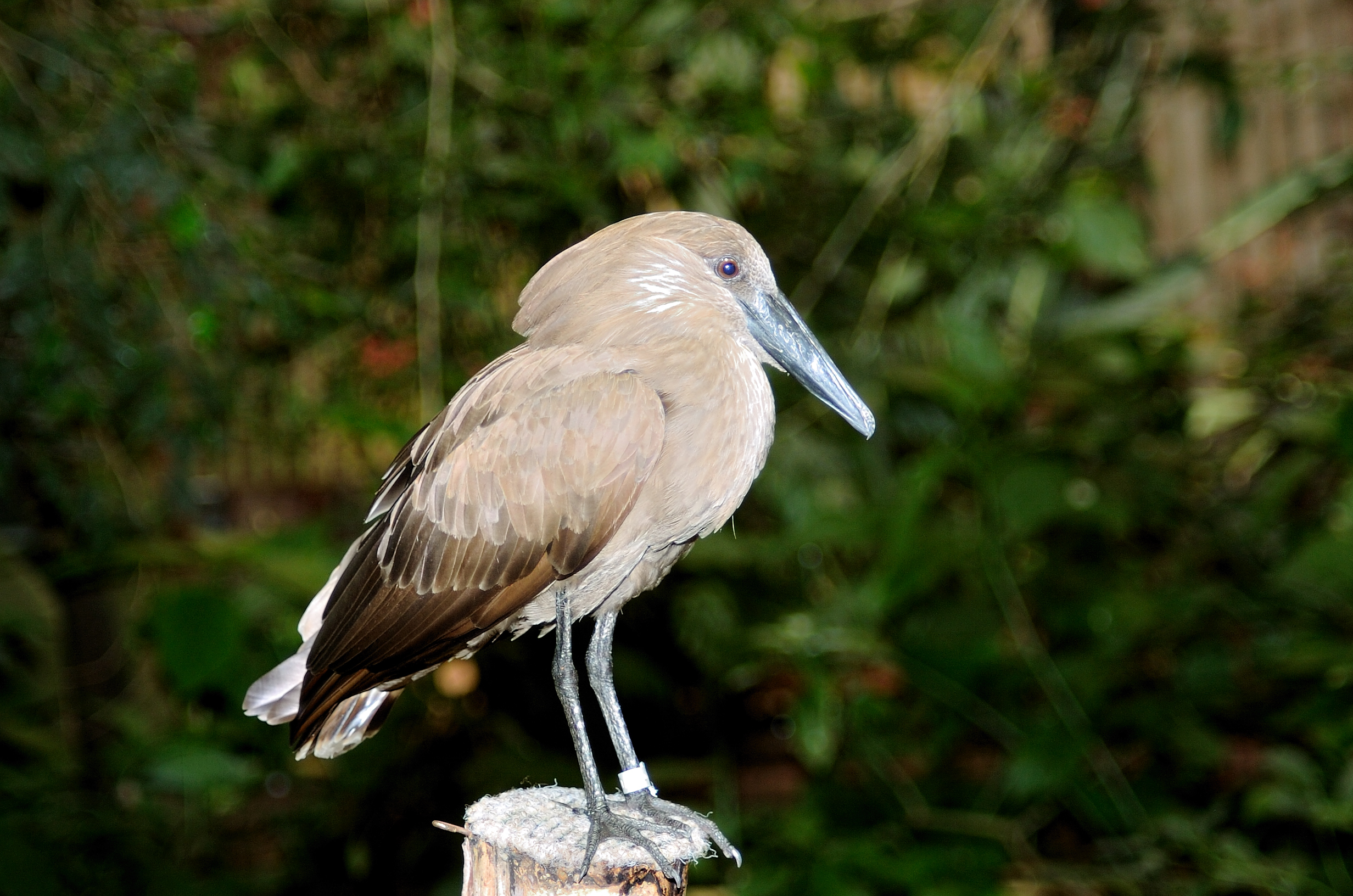
Hamerkop (Scopus umbretta) at National Aviary by Dan
I am like a pelican of the wilderness; I am like an owl of the desert. (Psalms 102:6 NKJV)
Previously, it was mentioned that some bird families have already been featured on the Sunday Inspirations. The next family includes the Herons and Bitterns. It is the Ardeidae, and it was covered in these two articles written in 2014:
Today we will finish up the Pelicaniformes Order, which included the Ibises and Spoonbills [Threskiornithidae], the Herons and Bitterns [Ardeidae], and now today with; the Hamerkop (1) with only one species in the Scopidae family, the Shoebill (1) in the Balaenicipitidae Family, and the Pelicans (8) in the Pelecanidae Family.
[Because this is being scheduled in advance, Lord willing, my back surgery will be performed on this Tuesday, the 20th. Your prayers will be greatly welcome. It will be a 4-5 hour surgery. I think.]
Hamerkop (Scopus umbretta) by Africaddict
The Hamerkop, have been a favorite of mine ever since we saw our first one at the National Aviary in Pittsburg, PA. When its head feathers are out, the head looks like a hammer. They also seemed rather tame walking around in the aviary.
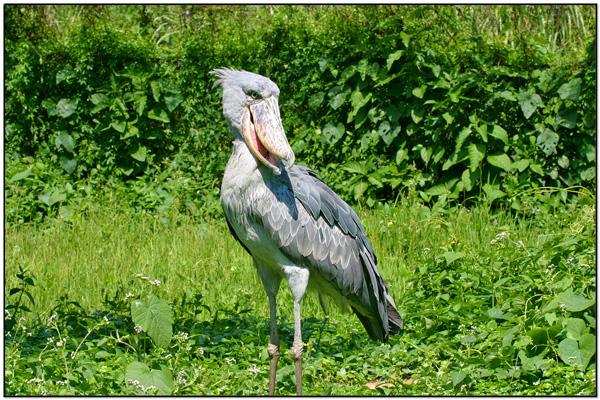
Shoebill (Balaeniceps rex) by Daves BirdingPix
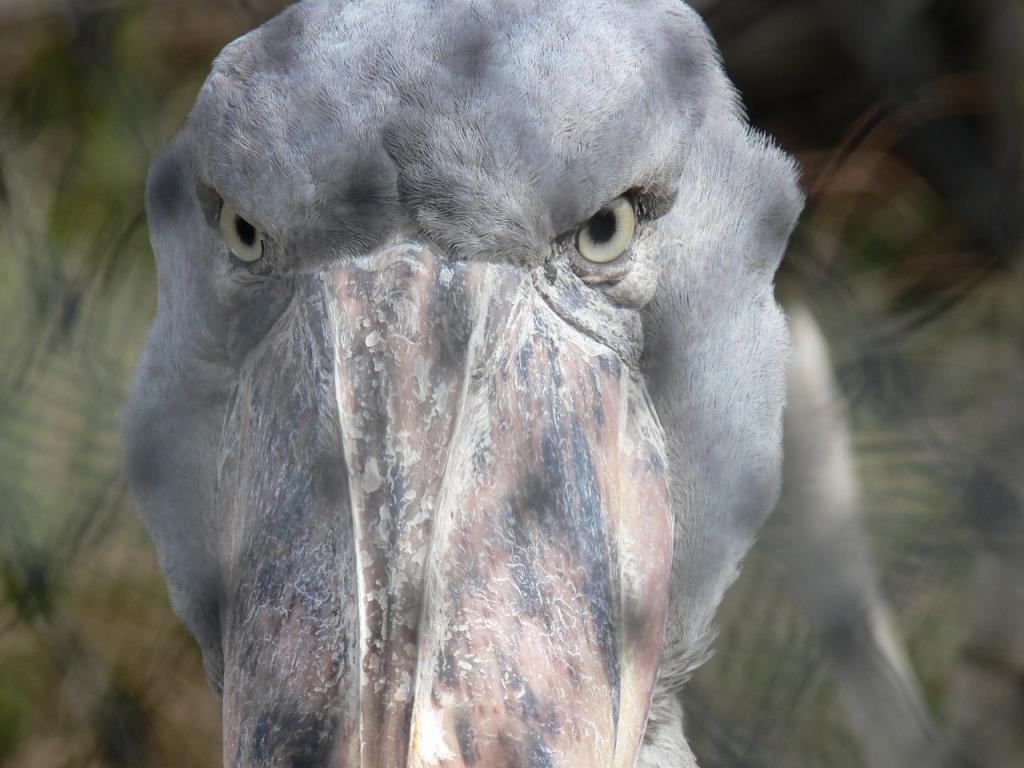
The Shoebill is another favorite. We have these at the Lowry Park Zoo, in Tampa. I keep trying to get a decent photo, but I have to shoot through a fence. Though, the fence is nice to have between us. He is a nice bird, but that look can be intimidating. :) Here is a close-up taken through the fence.
Shoebill by Lee – Closeup
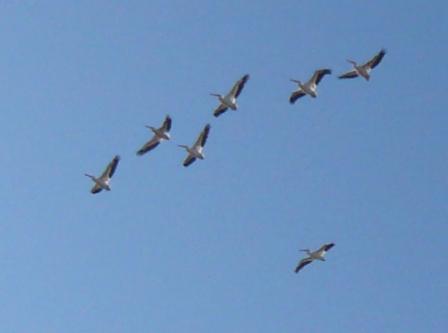
Living in Florida, we all see Pelicans quite frequently, even inland. The White Pelicans land at many of our lakes, and several years ago, over 5,000 landed at Circle B Reserve in Lakeland, Florida, for a month or so. I’ve shown this video before but thought it fit here again. I was so excited by all of them arriving to land just behind where Dan and I were standing. My utter amazement shows. [along with poor English]
“Therefore I say to you, do not worry about your life, what you will eat or what you will drink; nor about your body, what you will put on. Is not life more than food and the body more than clothing? Look at the birds of the air, for they neither sow nor reap nor gather into barns; yet your heavenly Father feeds them. Are you not of more value than they?” (Matthew 6:25-26 NKJV)
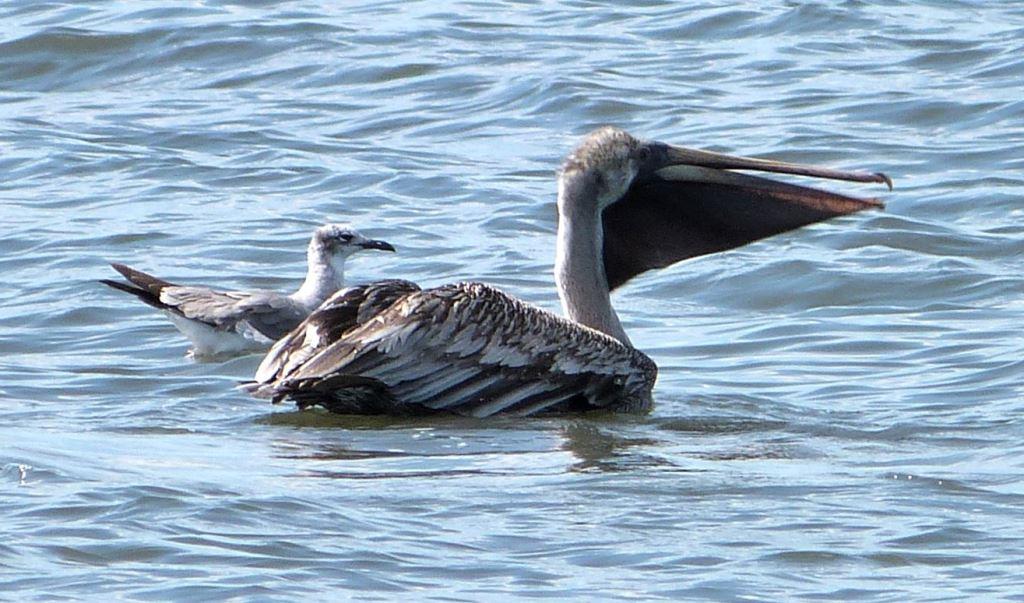
Brown Pelican with fish and Laughing Gull
Pelicans are a genus of large water birds that makes up the family Pelecanidae. They are characterised by a long beak and a large throat pouch used for catching prey and draining water from the scooped up contents before swallowing. They have predominantly pale plumage, the exceptions being the brown and Peruvian pelicans. The bills, pouches and bare facial skin of all species become brightly coloured before the breeding season. The eight living pelican species have a patchy global distribution, ranging latitudinally from the tropics to the temperate zone, though they are absent from interior South America as well as from polar regions and the open ocean.
White Pelicans by Lee over Circle B Reserve
Pelicans frequent inland and coastal waters where they feed principally on fish, catching them at or near the water surface. They are gregarious birds, travelling in flocks, hunting cooperatively and breeding colonially. Four white-plumaged species tend to nest on the ground, and four brown or grey-plumaged species nest mainly in trees
This slideshow requires JavaScript.
“God is my strength and power: and he maketh my way perfect. He maketh my feet like hinds’ feet: and setteth me upon my high places.
(2 Samuel 22:33-34 KJV)”
“Her Nazarites were purer than snow, they were whiter than milk, they were more ruddy in body than rubies, their polishing was of sapphire:” (Lamentations 4:7 KJV)
“For they covered the face of the whole earth, so that the land was darkened; and they did eat every herb of the land, and all the fruit of the trees which the hail had left: and there remained not any green thing in the trees, or in the herbs of the field, through all the land of Egypt.” (Exodus 10:15)
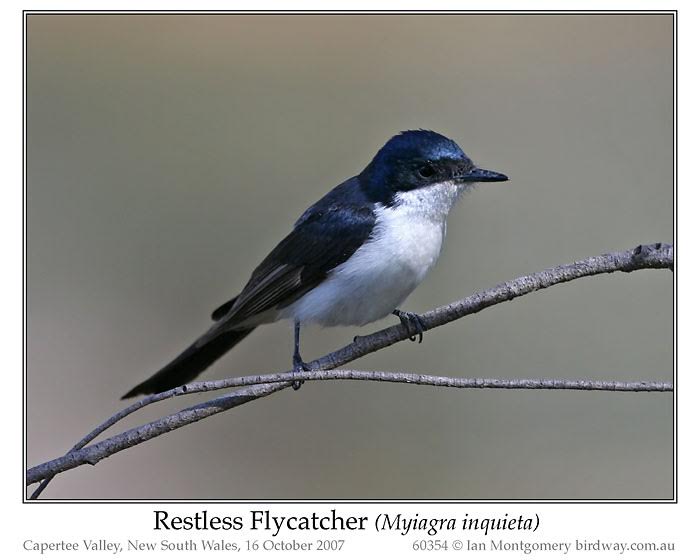
Bird of the Moment ~ Restless Flycatcher ~ by Ian Montgomery
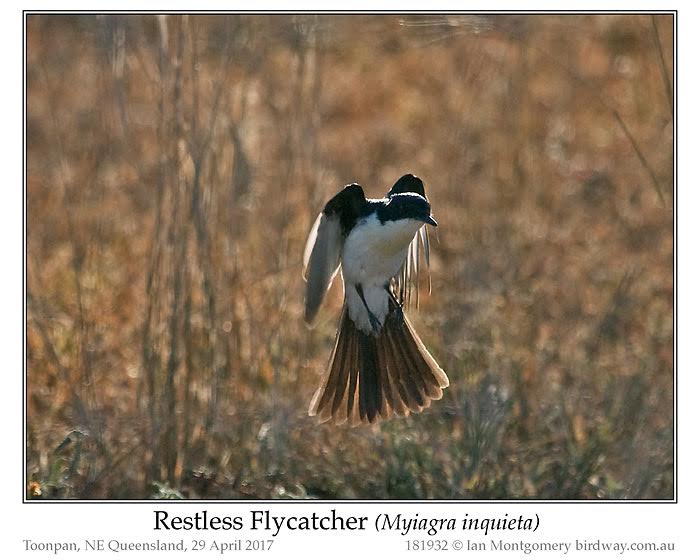
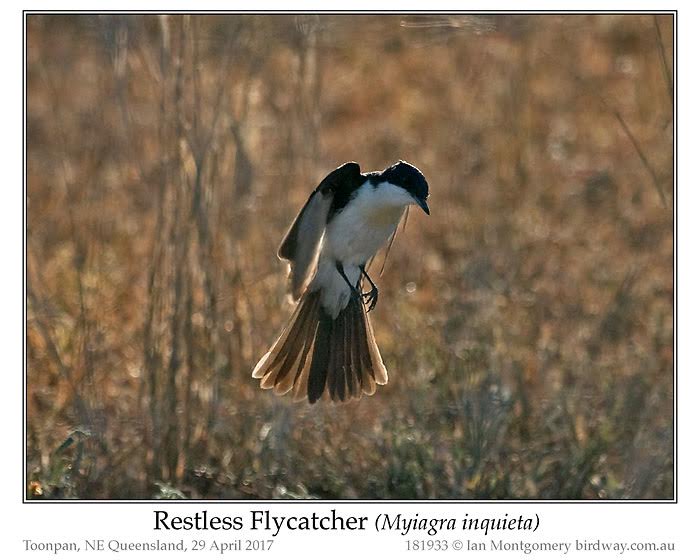
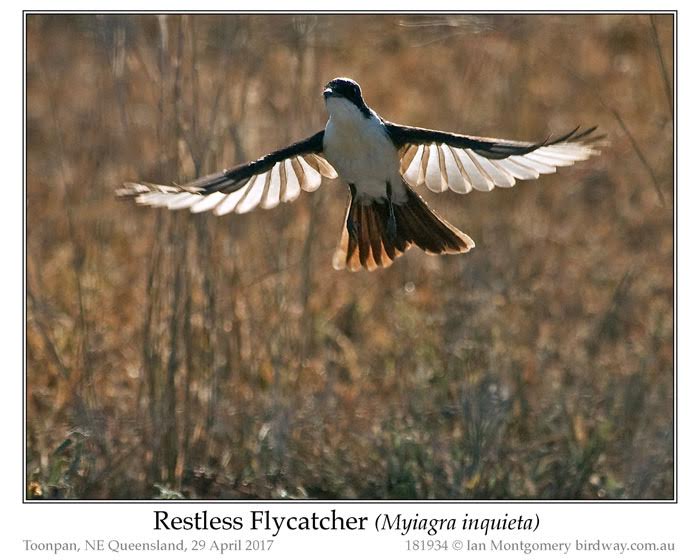
Some weeks ago I went to Toonpan a dry pasture area outside Townsville which is good for dry country birds such as Bustards and often produces unusual birds. There were a couple of Restless Flycatchers there hawking for insects and I found out later that this species has never featured as bird of the moment, an omission we’ll rectify now.
They are dapper birds, smart in their glossy black and white plumage and long tail. They bare a superficial resemblance to the similarly sized Willie Wagtail, but the species is a member of the Monarch Flycatcher family rather than the Fantails. The nominate larger type inquieta breeds in eastern, southern and southwestern Australia, but not in Tasmania or eastern Western Australia (the Nullabor). The smaller type nana occurs in northern Australia from northwestern Queensland through the Top End of the Northern Territory to northeastern Western Australia.
Taxonomists disagree as to whether these types should be treated as conspecific or separate species. I’m treating them as separate ones here, so ‘Restless Flycatcher’ refers to the southern one, and ‘Paperbark Flycatcher’ to the northern one. Both are mainly sedentary, but there is some northward movement of the Restless Flycatcher in winter here in northeastern Queensland it is a winter visitor.
Restless Flycatchers have a characteristic hovering flight when hawking for insects and this one at Toonpan was doing just this between me and the afternoon sun in the second, third and fourth photos. There were all taken within an elapsed time of one second and in the third one, it is turning away from whatever attracted its attention in the first two. When hawking like this, they make ‘grinding, churring sounds’ (to quote Pizzey and Knight) which are supposed to disturb insects into flight. For this reason, the species is sometimes called the Scissors Grinder.
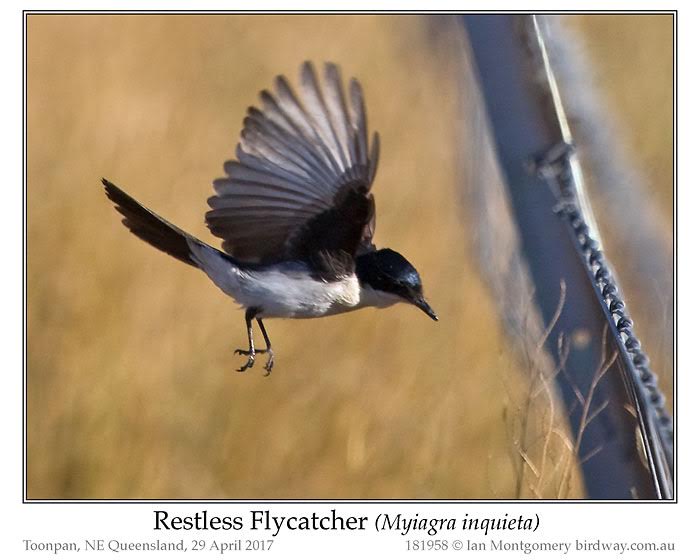
The fifth photo shows one of the two birds checking out the vegetation along a barbed wire fence. It’s not, as it might appear, flying towards the fence. Rather it had been perched on the fence seconds before and is making its way down the side of it.
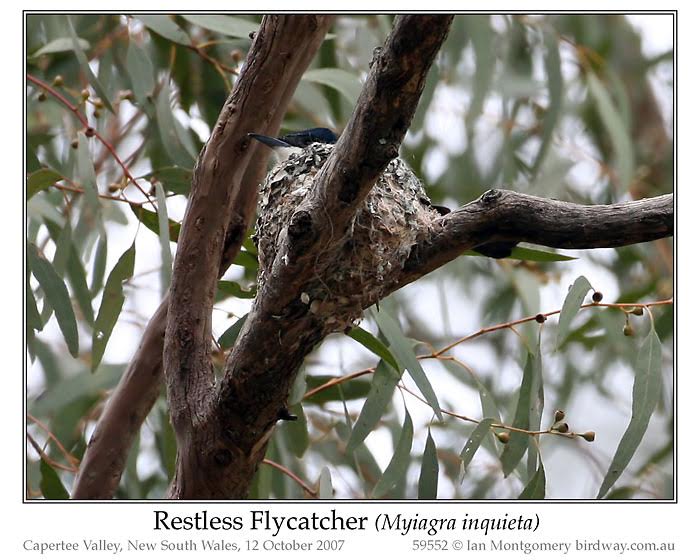
The Restless Flycatcher builds a beautiful nest of grass, bark and spiders’ webs on a horizontal branch, sixth photo with a usual clutch size of three. The nest is typically decorated or maybe camouflaged with lichen. In this photo, you can see the broad, flat bill characteristic of Monarch Flycatchers.
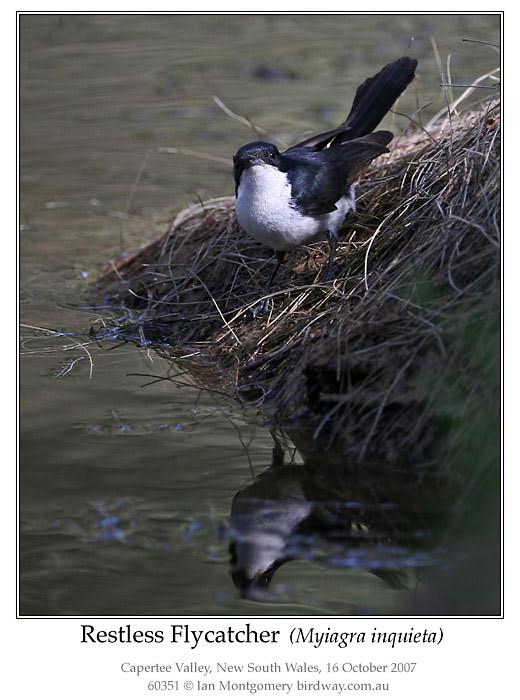
Restless Flycatchers are usually found near water. The one in the seventh photo is having a drink from a river.
Here is the Paperbark Flycatcher, eight photo. The best way I know to separate it from the Restless Flycatcher is by range, though the Paperbark is smaller (17-19cm versus 19-22cm) and supposed to be glossier and have a darker back. The calls are supposed to be slightly different, though they sound much the same to me.
The Paperbark Flycatcher also builds a cup-shaped nest on a horizontal branch, ninth photo, but the sources I have don’t mention bark as building material, or lichen as a decoration. As with the Restless Flycatcher, both genders share in nest-building, incubation and rearing of the chicks.
If we treat Restless and Paperbark as separate species, then the Restless is an Australian endemic, The Paperbark isn’t as it also occurs in southern New Guinea on both sides of the Indonesian-PNG border.
Greetings,
Ian
Lee’s Addition:
“And my people shall dwell in a peaceable habitation, and in sure dwellings, and in quiet resting places;” (Isaiah 32:18 KJV)
What interesting Flycatchers Ian has introduced us to. His “Moment” seems to get longer each time. Maybe one day, Ian may get back to his “Bird of the Week.” :)
Keep up the good work, Ian. We enjoy your birds whenever they fly our way.
“That saith, I will build me a wide house and large chambers, and cut it out windows; and it is ceiled with cedar, and painted withvermilion.” (Jeremiah 22:14)
“And the weight of the golden earrings that he requested was a thousand and seven hundred shekels of gold; beside ornaments, and collars, and purpleraimentthat was on the kings of Midian, and beside the chains that were about their camels’ necks. (Judges 8:26)
“And if ye walk contrary unto me, and will not hearken unto me; I will bring seven times more plagues upon you according to your sins.” (Leviticus 26:21 KJV)
“and for a long time birds and hedgehogs, and ibises and ravens shall dwell in it: and the measuring line of desolation shall be cast over it, and satyrs shall dwell in it. (Isaiah 34:11 Brenton)”
The family Threskiornithidae includes 34 species of large wading birds. The family has been traditionally classified into two subfamilies, the ibises and the spoonbills; however recent genetic studies are casting doubt on the arrangement and revealing the spoonbills to be nested within the ibises.
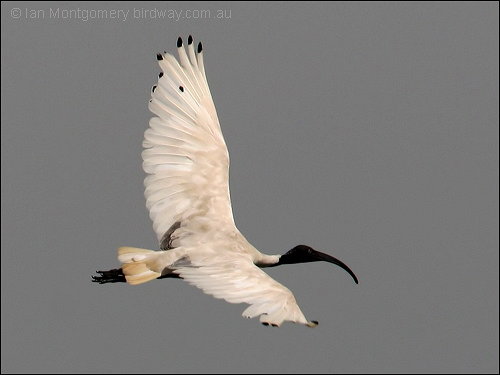
Australian White Ibis (Threskiornis molucca) by Ian
Members of the family have long, broad wings with 11 primary feathers and about 20 secondaries. They are strong fliers and, rather surprisingly, given their size and weight, very capable soarers. The body tends to be elongated, the neck more so, with rather long legs. The bill is also long, decurved in the case of the ibises, straight and distinctively flattened in the spoonbills. They are large birds, but mid-sized by the standards of their order, ranging from the dwarf olive ibis (Bostrychia bocagei), at 45 cm (18 in) and 450 g (0.99 lb), to the giant ibis (Thaumatibis gigantea), at 100 cm (39 in) and 4.2 kg (9.3 lb).
They are distributed almost worldwide, being found near almost any area of standing or slow-flowing fresh or brackish water. Ibises are also found in drier areas, including landfills.
All ibises are diurnal; spending the day feeding on a wide range of invertebrates and small vertebrates: ibises by probing in soft earth or mud, spoonbills by swinging the bill from side to side in shallow water. At night, they roost in trees near water. They are gregarious, feeding, roosting, and flying together, often in formation.
African Sacred Ibis (Threskiornis aethiopicus) by Lee at LPZoo
Threskiornis is a genus of ibises, wading birds of the family Threskiornithidae. They occur in the warmer parts of the Old World in southern Asia, nest in a tree or bush and lay two to four eggs. They occur in marshy wetlands and feed on various fish, frogs, crustaceans and insects. The species in this genus are the; African sacred ibis, T. aethiopicus, Malagasy sacred ibis, T. bernieri, Reunion ibis T. solitarius (extinct), Black-headed ibis, T. melanocephalus, Australian white ibis, T. moluccus, Solomons white ibis, T. m. pygmaeus, and theStraw-necked ibis, T. spinicollis.
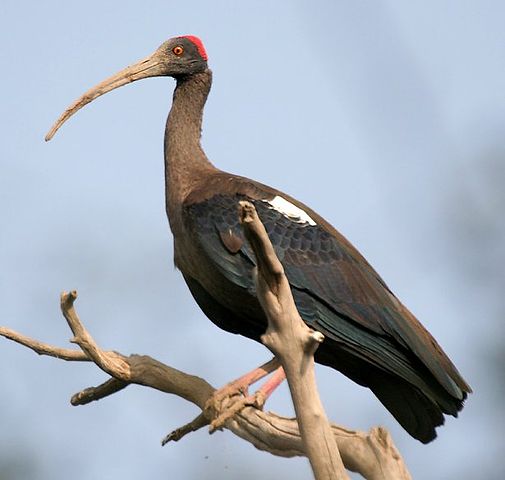
The bird genus Pseudibis consists of two South-East Asian species in the ibis subfamily, Threskiornithinae. The giant ibis is also sometimes placed in this genus. Red-naped Ibis, Pseudibis papillosa andWhite-shouldered Ibis, Pseudibis davisoni. The white-shouldered ibis is critically endangered.
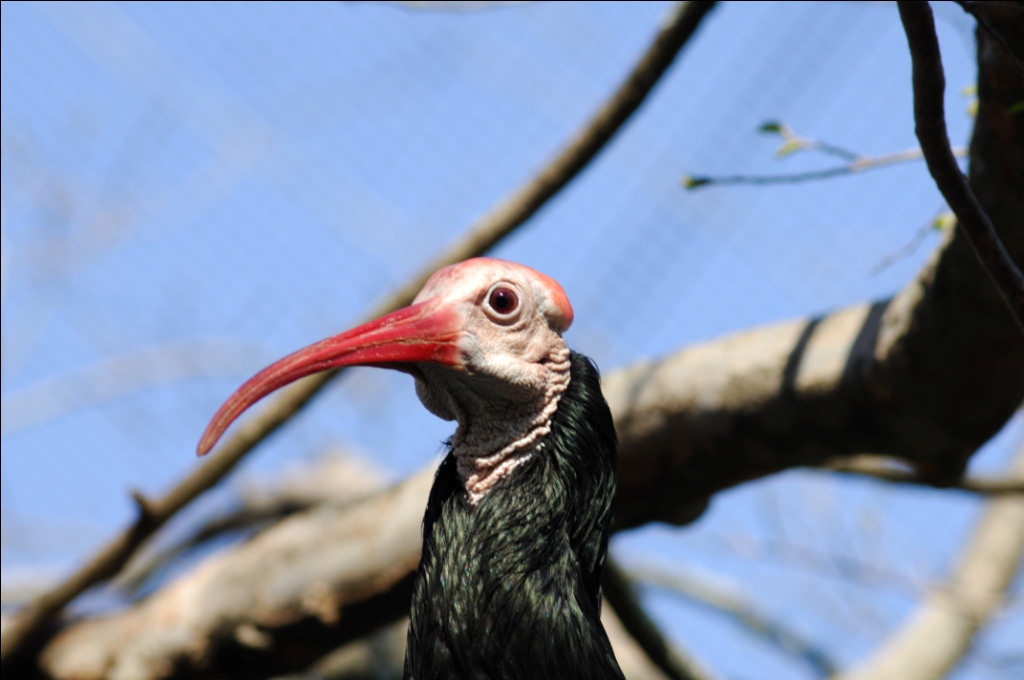
Southern Bald Ibis (Geronticus calvus) by Dan at Lowry Park Zoo
The small bird genus Geronticus belongs to the ibis subfamily (Threskiornithinae). Its name is derived from the Greek gérontos (γέρωντος, “old man”) in reference to the bald head of these dark-plumaged birds; in English, they are called bald ibises.
Geronticus contains two living species. The northern bald ibis (G. eremita) has a neck crest of elongated feathers. It is a Critically Endangered species found around the Mediterranean. Its range had expanded after the last glacial period to the Alps of Germany and even a bit further north, but it was rendered extinct there mainly due to habitat destruction and unsustainable hunting. The southern bald ibis (G. calvus) with a red crown patch but no crest is classified as Vulnerable and is found in subtropical southern Africa.
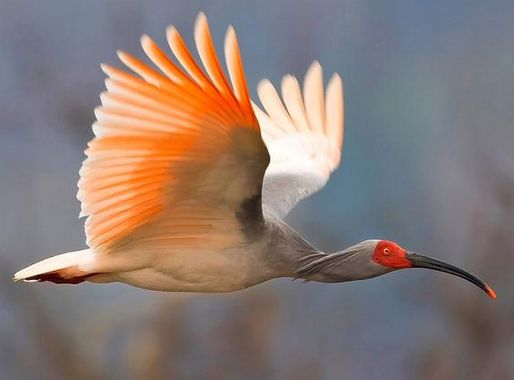
Nipponia– The crested ibis (Nipponia nippon), also known as the Japanese crested ibis or toki (トキ?), variously written in kanji as 朱鷺, 鴇, 鵇 or 鴾, and written in hanzi as 朱䴉 or 朱鷺, is a large (up to 78.5 cm (30.9 in) long), white-plumaged ibis of pine forests. Its head is partially bare, showing red skin, and it has a dense crest of white plumes on the nape. This species is the only member of the genus Nipponia.
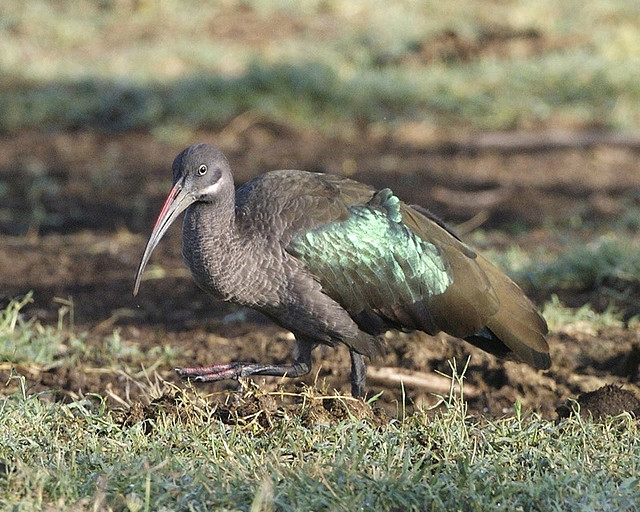
Bostrychia is a genus of ibises in the family Threskiornithidae. Member species are found in many countries throughout Africa.
It contains the following five species:Wattled ibis (Bostrychia carunculata), Hadada ibis (Bostrychia hagedash), Olive ibis (Bostrychia olivacea), São Tomé ibis (Bostrychia bocagei), Spot-breasted ibis (Bostrychia rara)
Buff-necked Ibis (Theristicus caudatus) by Dario Sanches
Theristicus is a genus of birds in the family Threskiornithidae. They are found in open, grassy habitats in South America. All have a long, decurved dark bill, relatively short reddish legs that do not extend beyond the tail in flight (unlike e.g. Eudocimus and Plegadis), and at least the back is grey. They are the Plumbeous ibis, Theristicus caerulescens, Buff-necked ibis, Theristicus caudatus, Black-faced ibis, Theristicus melanopis, Andean ibis, Theristicus branickii,
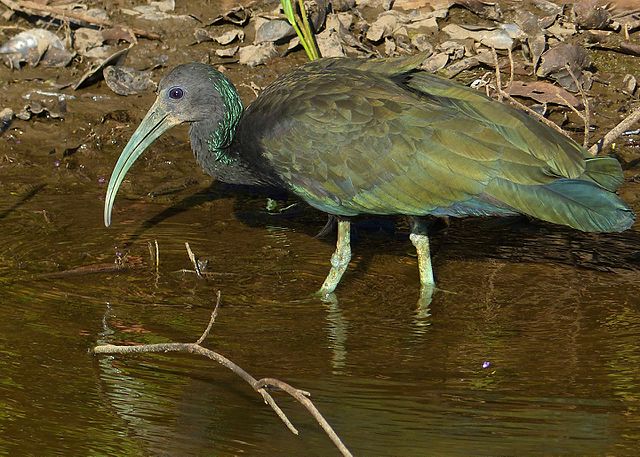
Mesembrinibis– The green ibis (Mesembrinibis cayennensis), also known as the Cayenne ibis, is a wading bird in the ibis family Threskiornithidae. It is the only member of the genus Mesembrinibis.
This is a resident breeder from Honduras through Nicaragua, Costa Rica and western Panama, and South America to northern Argentina. It undertakes some local seasonal movements in the dry season.
Bare-faced Ibis (Phimosus infuscatus) by Robert Scanlon
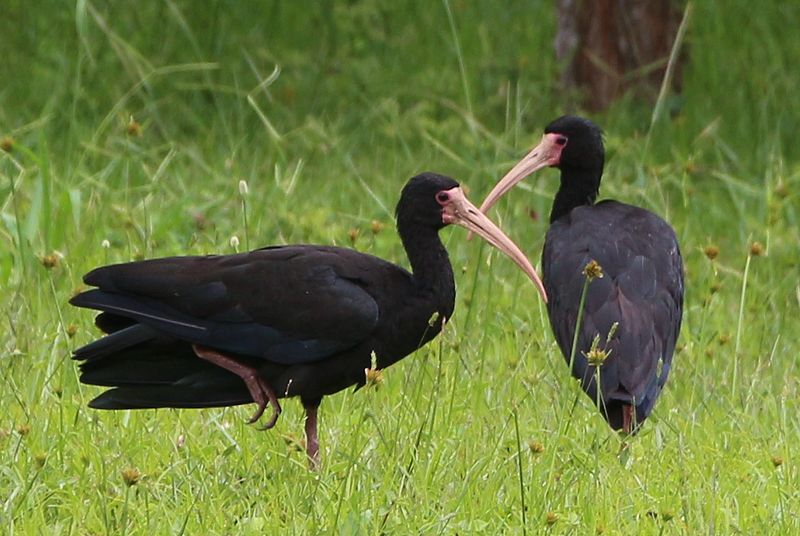
Phimosus – The bare-faced ibis (Phimosus infuscatus), also known as the whispering ibis, is a species of bird in the family Threskiornithidae, in the monotypic genus Phimosus.
It is found in Argentina, Bolivia, Brazil, Colombia, Ecuador, Guyana, Paraguay, Suriname, Uruguay, and Venezuela. Its natural habitat is swamps. The Bare-faced Ibis is either dark brown or a blackish color. It is called the Bare-faced Ibis because it does not have any feathers on its face. It has a long Decurved bill that’s pinkish to reddish brown. The skin on its face is usually a reddish color and it also has long orangely colored beak with pink legs. The total length of the ibis ranges between 45 and 50 cm.
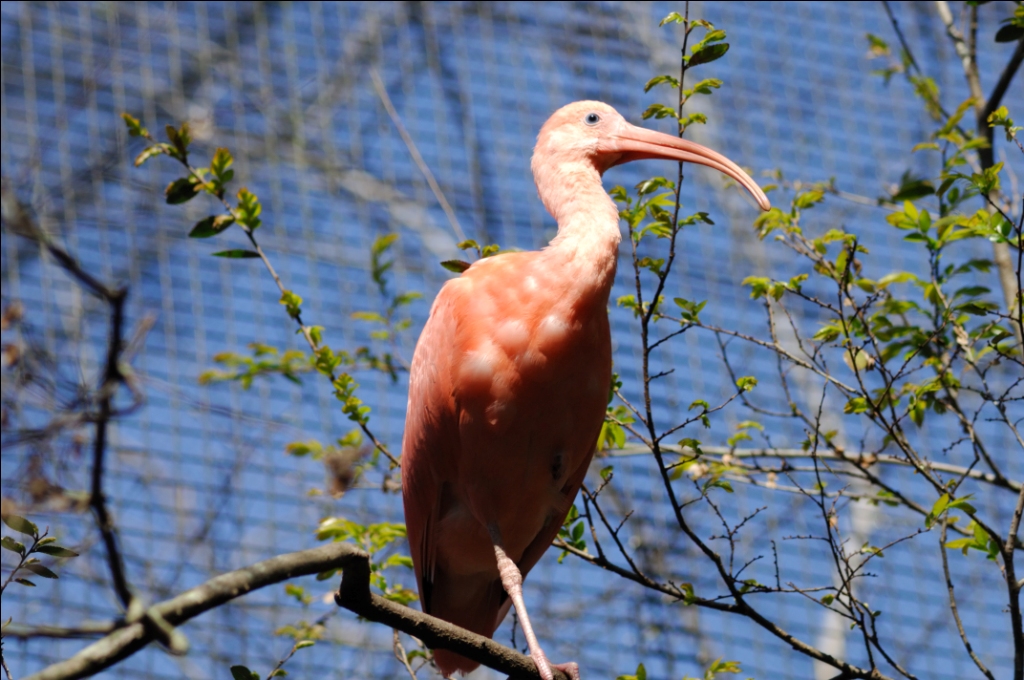
Scarlet Ibis (Eudocimus ruber) by Dan at LPZoo
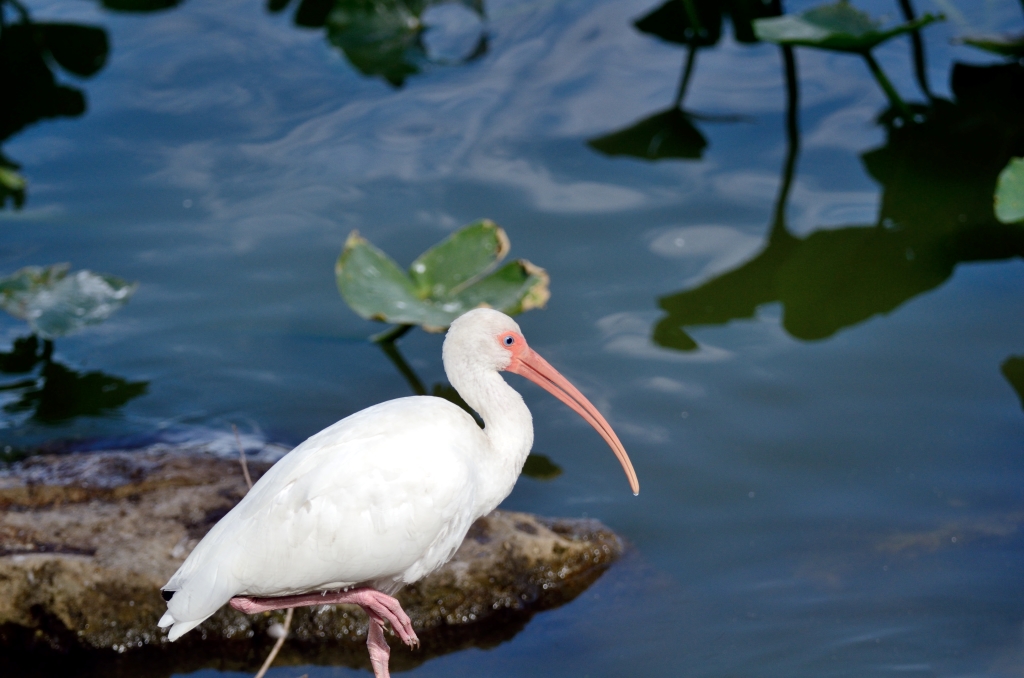
Eudocimus is a genus of ibises, wading birds of the family Threskiornithidae. They occur in the warmer parts of the New World with representatives from the southern United States south through Central America, the West Indies, and South America.
There are just two species in this genus, American White Ibis (Eudocimus albus) and Scarlet Ibis (Eudocimus ruber)
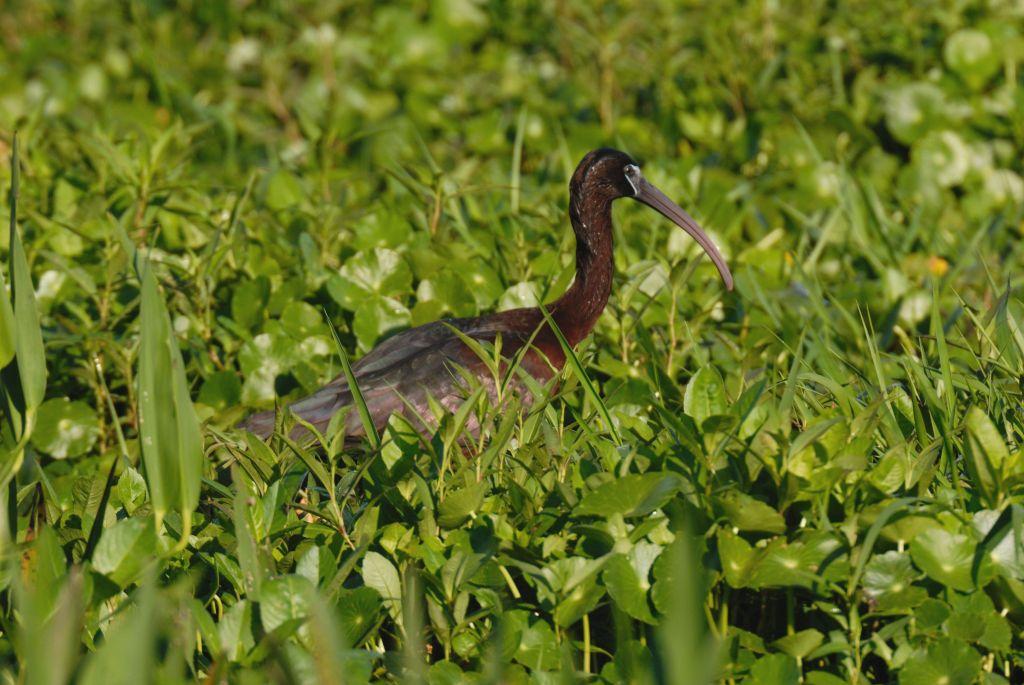
Glossy Ibis (Plegadis falcinellus) by Dan’s Pix
Plegadis is a bird genus in the family Threskiornithidae. The genus name derives from Ancient Greek plegados, “sickle”, referring to the distinctive shape of the bill. Member species are found on every continent except Antarctica as well as a number of islands. The glossy ibis is easily the most widespread of the three species. Plegadis contains the following three species: Glossy Ibis, Plegadis falcinellus, , White-faced Ibis, Plegadis chihi, Puna Ibis, Plegadis ridgwayi.
Lophotibis– The Madagascan ibis (Lophotibis cristata), also known as the Madagascar crested ibis, white-winged ibis or crested wood ibis, is a medium-sized (approximately 50 cm long), brown-plumaged ibis. It has bare red orbital skin, yellow bill, red legs, white wings and its head is partially bare with a dense crest of green or gloss blue and white plumes on the nape. The Madagascan Ibis is the only member of the genus Lophotibis.
Roseate Spoonbill at Flamingo Gardens by Lee
Platalea– Spoonbills are a group of large, long-legged wading birds in the family Threskiornithidae, which also includes the ibises. The genus name platalea derives from Latin and means “broad”, referring to the distinctive shape of the bill. Six species are recognised, all either placed in a single genus or three genera. They are most closely related to the Old World ibises; Eurasian Spoonbill Platalea leucorodia, Black-faced Spoonbill Platalea minor, African Spoonbill Platalea alba, Royal Spoonbill Platalea regia, Yellow-billed Spoonbill Platalea flavipes, and our local Roseate Spoonbill Platalea ajaja.
All spoonbills have large, flat, spatulate bills and feed by wading through shallow water, sweeping the partly opened bill from side to side. The moment any small aquatic creature touches the inside of the bill—an insect, crustacean, or tiny fish—it is snapped shut. Spoonbills generally prefer fresh water to salt but are found in both environments. They need to feed many hours each day.
“And having an high priest over the house of God; Let us draw near with a true heart in full assurance of faith, having our hearts sprinkled from an evil conscience, and our bodies washed with pure water. Let us hold fast the profession of our faith without wavering; (for he is faithful that promised;)” (Hebrews 10:21-23 KJV)
“On the mountain height of Israel will I plant it, that it may bring forth boughs and bear fruit and be a noble cedar, and under it shall dwell all birds of every feather; in the shade of its branches they shall nestle and find rest.” (Ezekiel 17:23 AMP)
Painted Stork (Mycteria leucocephala) by Lee at Zoo Miami 2014










 Lee's Birdwatching Adventures Plus