Friend Downy – The Woodpeckers

Downy Woodpecker (Picoides pubescens) Brevard Zoo by Dan

Downy Woodpecker (Picoides pubescens) Brevard Zoo by Dan

VI

FRIEND DOWNY

No better little bird comes to our orchards than our friend the downy woodpecker. He is the smallest and one of the most sociable of our woodpeckers,—a little, spotted, black-and-white fellow, precisely like his larger cousin the hairy, except in having the outer tail-feathers barred instead of plain. Nearly everything that can be said of one is equally true of the other on a smaller scale. They look alike, they act alike, and their nests and eggs are alike in everything but size.

Downy is the most industrious of birds. He is seldom idle and never in mischief. As he does not fear men, but likes to live in orchards and in the neighborhood of fields, he is a good friend to us. On the farm he installs himself as Inspector of Apple-trees. It is an old and an honorable profession among birds. The pay is small, consisting only of what can be picked up, but, as cultivated trees are so infested with insects that food is always plentiful, and as they have usually a dead branch suitable to nest in, Downy asks no more. Summer and winter he works on our orchards. At sunrise he begins, and he patrols the branches till sunset. He taps on the trunks to see whether he can hear any rascally borers inside. He inspects every tree carefully in a thorough and systematic way, beginning low down and following up with a peek into every crevice and a tap upon every spot that looks suspicious. If he sees anything which ought not to be there, he removes it at once.

Downy

Downy

A moth had laid her eggs in a crack in the bark, expecting to hatch out a fine brood of caterpillars: but Downy ate them all, thus saving a whole branch from being overrun with caterpillars and left fruitless, leafless, and dying. A beetle had just deposited her eggs here. Downy saw her, and took not only the eggs but the beetle herself. Those eggs would have hatched into boring larvæ, which would have girdled and killed some of the branches, or have burrowed under the bark, causing it to fall off, or have bored into the wood and, perhaps, have killed the tree.

Nor is the full-grown borer exempt. Downy hears him, pecks a few strokes, and harpoons him with unerring aim. When Downy has made an arrest in this way, the prisoner does not escape from the police. Here is a colony of ants, running up the tree in one line and down in another, touching each other with their feelers as they pass. A feast for our friend! He takes both columns, and leaves none to tell the tale. This is a good deed, too, since ants are of no benefit to fruit-trees and are very fond of the dead-ripe fruit.

And Downy is never too busy to listen for borers. They are fine plump morsels much to his taste, not so sour as ants, nor so hard-shelled as beetles, nor so insipid as insects’ eggs. A good borer is his preferred dainty. The work he does in catching borers is of incalculable benefit, for no other bird can take his place. The warblers, the vireos, and some other birds in summer, the chickadees and nuthatches all the year round, are helping to eat up the eggs and insects that lie near the surface, but the only birds equipped for digging deep under the bark and dragging forth the refractory grubs are the woodpeckers.

So Downy works at his self-appointed task in our orchards summer and winter, as regular as a policeman on his beat. But he is much more than a policeman, for he acts as judge, jury, jailer, and jail. All the evidence he asks against any insect is to find him loafing about the premises. “I swallow him first and find out afterwards whether he was guilty,” says Downy with a wink and a nod.

Most birds do not stay all the year, in the North, at least, and most, in return for their labors in the spring, demand some portion of the fruit or grain of midsummer and autumn. Not so Downy. His services are entirely gratuitous; he works twice as long as most others. He spends the year with us, no winter ever too severe for him, no summer too hot; and he never taxes the orchard, nor takes tribute from the berry patch. Only a quarter of his food is vegetable, the rest being made up of injurious insects; and the vegetable portion consists entirely of wild fruits and weed-seeds, nothing that man eats or uses. Downy feeds on the wild dogwood berries, a few pokeberries, the fruit of the woodbine, and the seeds of the poison-ivy,—whatever scanty and rather inferior fare is to be had at Nature’s fall and winter table.

If in the cold winter weather we will take pains to hang out a bone with some meat on it, raw or cooked, or a piece of suet, taking care that it is not salted,—for few wild birds except the crossbills can eat salted food,—we may see how he appreciates our thoughtfulness. Shall we grudge him a bone from our own abundance, or neglect to fasten it firmly out of reach of the cat and dog? If his cousin the hairy and his neighbor the chickadee come and eat with him, bid them a hearty welcome. The feast is spread for all the birds that help men, and friend Downy shall be their host.


Lee’s Addition:
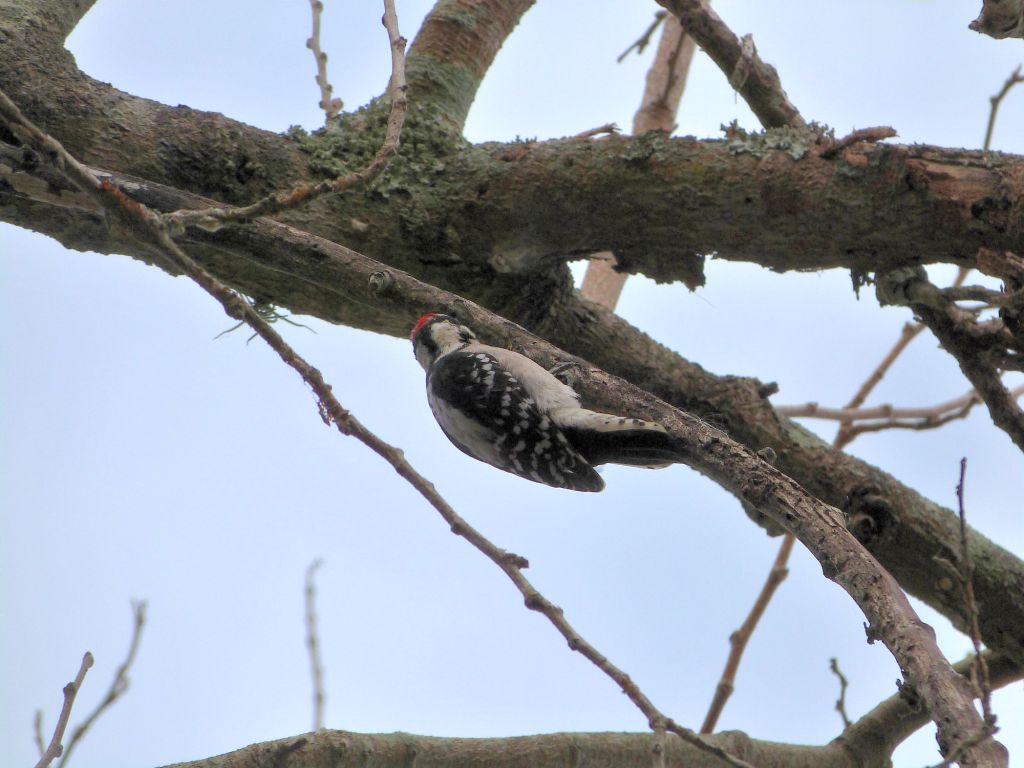
Downy Woodpecker by Lee Lake Parker Park

Downy Woodpecker by Lee Lake Parker Park

He will bless them that fear the LORD, both small and great. (Psalms 115:13 KJV)

This is Chapter VI from The Woodpeckers book. Our writer, Fannie Hardy Eckstorm, wrote this in 1901. There are 16 chapters, plus the Forward, which are about the Woodpecker Family here in America. All the chapters can be found on The Woodpeckers page. I added photos to help enhance the article. In 1901, photography was not like today.

Woodpeckers belong to the Picidae – Woodpeckers Family.

*
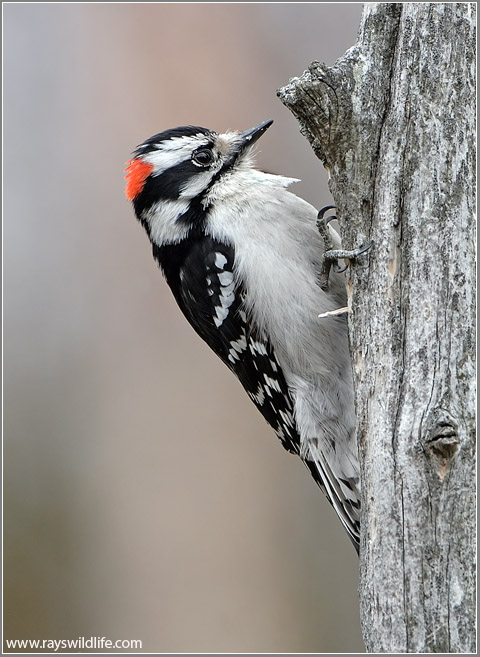
Downy Woodpecker (Picoides pubescens) by Raymond Barlow

Downy Woodpecker (Picoides pubescens) by Raymond Barlow

We have another neat creation from the Lord. I always enjoy watching this little Woodpecker checking out the trees nearby.

Adult Downy Woodpeckers are the smallest of North America’s woodpeckers but there are many smaller species elsewhere, especially the piculets. The total length of the species ranges from 5.5 to 7.1 in (14 to 18 cm) and the wingspan from 9.8 to 12 in (25 to 31 cm).

The Downy Woodpecker is mainly black on the upperparts and wings, with a white back, throat and belly and white spotting on the wings. There is a white bar above the eye and one below. They have a black tail with white outer feathers barred with black. Adult males have a red patch on the back of the head whereas juvenile birds display a red cap.

Hairy Woodpecker (Picoides villosus) by Daves BirdingPix

Hairy Woodpecker (Picoides villosus) by Daves BirdingPix

The Downy Woodpecker is virtually identical in plumage pattern to the much larger Hairy Woodpecker, but it can be distinguished from the Hairy by the presence of black spots on its white tail feathers and the length of its bill. The Downy Woodpecker’s bill is shorter than its head, whereas the Hairy Woodpecker’s bill is approximately equal to head length.

The Downy Woodpecker gives a number of vocalizations, including a short pik call. Like other woodpeckers, it also produces a drumming sound with its beak as it pecks into trees. Compared to other North American species its drums are slow. (Wikipedia with editing and sounds from xeno-canto)

Drumming

pik and rattle call

*

Ochre-collared Piculet (Picumnus temminckii) by Dario Sanches

Ochre-collared Piculet (Picumnus temminckii) by Dario Sanches

See:

*

How The Woodpecker Courts His Mate – The Woodpeckers

Downy Woodpecker (Picoides pubescens) Brevard Zoo by Dan

Downy Woodpecker (Picoides pubescens) Brevard Zoo by Dan

III

HOW THE WOODPECKER COURTS HIS MATE

Other birds woo their mates with songs, but the woodpecker has no voice for singing. He cannot pour out his soul in melody and tell his love his devotion in music. How do songless birds express their emotions? Some by grotesque actions and oglings, as the horned owl, and some by frantic dances, as the sharp-tailed grouse, woo and win their mates; but the amorous woodpecker, not excepting the flickers, which also woo by gestures, whacks a piece of seasoned timber, and rattles off interminable messages according to the signal code set down for woodpeckers’ love affairs. He is the only instrumental performer among the birds; for the ruffed grouse, though he drums, has no drum.

There is no cheerier spring sound, in our belated Northern season, than the quick, melodious rappings of the sapsucker from some dead ash limb high above the meadow. It is the best performance of its kind: he knows the capabilities of his instrument, and gets out of it all the music there is in it. Most if not all woodpeckers drum occasionally, but drumming is the special accomplishment of the sapsucker. He is easily first. In Maine, where they are abundant, they make the woods in springtime resound with their continual rapping.

Early in April, before the trees are green with leaf, or the willows have lost their silky plumpness, when the early round-leafed yellow violet is cuddling among the brown, dead leaves, I hear the yellow-bellied sapsucker along the borders of the trout stream that winds down between the mountains. The dead branch of an elm-tree is his favorite perch, and there, elevated high above all the lower growth, he sits rolling forth a flood of sound like the tremolo of a great organ. Now he plays staccato,—detached, clear notes; and now, accelerating his time, he dashes through a few bars of impetuous hammerings. The woods re-echo with it; the mountains give it faintly back. Beneath him the ruffed grouse paces back and forth on his favorite mossy log before he raises the palpitating whirr of his drumming. A chickadee digging in a rotten limb pauses to spit out a mouthful of punky wood and the brown Vanessa, edged with yellow, first butterfly of the season, flutters by on rustling wings. So spring arrives in Maine, ushered in by the reveille of the sapsucker.

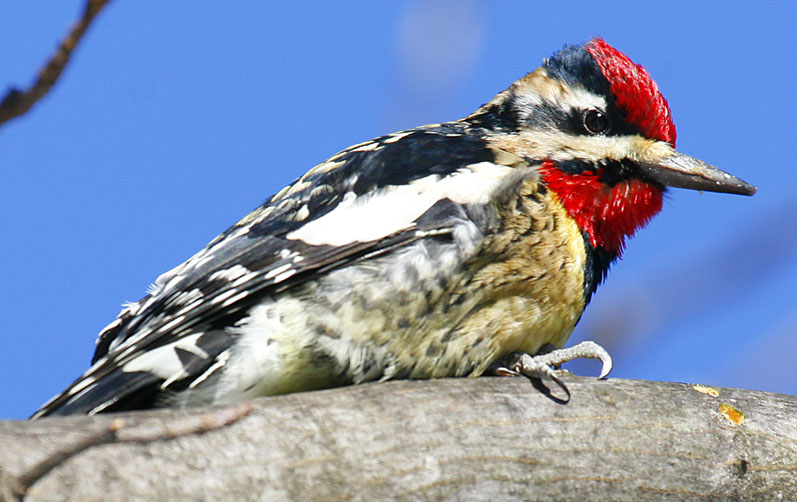
Yellow-bellied Sapsucker (Sphyrapicus varius) ©WikiC

Yellow-bellied Sapsucker (Sphyrapicus varius) ©WikiC

Yellow-bellied Sapsucker Drumming

So ambitious is the sapsucker of the excellence of his performance that no instrument but the best will satisfy him. He is always experimenting, and will change his anvil for another as soon as he discovers one of superior resonance. They say he tries the tin pails of the maple-sugar makers to see if these will not give him a clearer note; that he drums on tin roofs and waterspouts till he loosens the solder and they come tumbling down. But usually he finds nothing so near his liking as a hard-wood branch, dead and barkless, the drier, the harder, the thinner, the finer grained, so much the better for his uses.

Deficient as they are in voice, the woodpeckers do not lack a musical ear. Mr. Burroughs tells us that a downy woodpecker of his acquaintance used to change his key by tapping on a knot an inch or two from his usual drumming place, thereby obtaining a higher note. Alternating between the two places, he gave to his music the charm of greater variety. The woodpeckers very quickly discover the superior conductivity of metals. In parts of the country where woodpeckers are more abundant than good drumming trees, a tin roof proves an almost irresistible attraction. A lightning-rod will sometimes draw them farther than it would an electric bolt; and a telegraph pole, with its tinkling glasses and ringing wires, gives them great satisfaction. If men did not put their singing poles in such public places, their music would be much more popular with the woodpeckers; but even now the birds often venture on the dangerous pastime and hammer you out a concord of sweet sounds from the mellow wood-notes, the clear peal of the glass, and the ringing overtones of the wires.

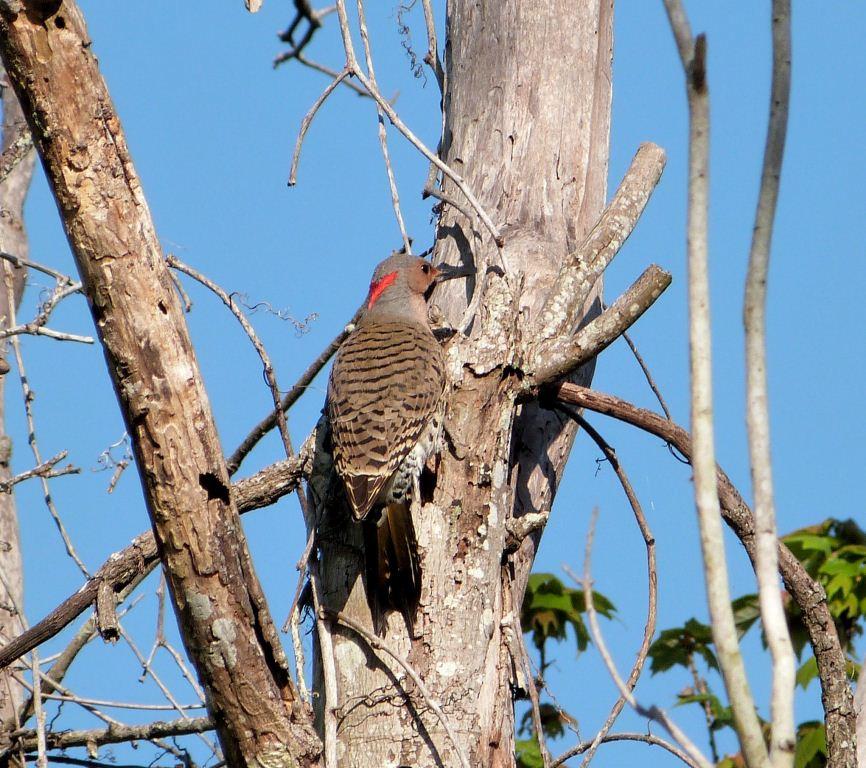
Northern Flicker cropped by Lee at S. Lk Howard Ntr Pk

Northern Flicker by Lee (cropped)

Northern Flicker calling and drumming

The flicker often telegraphs his love by tapping either on a forest tree or on some loose board of a barn or outhouse; but he has other ways of courting his lady. On fine spring mornings, late in April, I have seen them on a horizontal bough, the lady sitting quietly while her lover tried to win her approval by strange antics. Quite often there are two males displaying their charms in open rivalry, but once I saw them when the field was clear.

If fine clothes made a gentleman, this brave wooer would have been first in all the land: for his golden wings and tail showed their glittering under side as he spread them; his scarlet headdress glowed like fire; his rump was radiantly white, not to speak of the jetty black of his other ornaments and the beautiful ground-colors of his body. He danced before his lady, showing her all these beauties, and perhaps boasting a little of his own good looks, though she was no less beautiful. He spread his wings and tail for her inspection; he bowed, to show his red crescent; he bridled, he stepped forward and back and sidewise with deep bows to his mistress, coaxing her with the mellowest and most enticing co-wee-tucks, which no doubt in his language meant “Oh, promise me,” laughing now and then his jovial wick-a-wick-a-wick-a-wick-a, either in glee or nervousness. It was all so very silly—and so very nice! I wonder how it all came out. Did she promise him? Or did she find a livelier suitor?


Lee’s Addition:

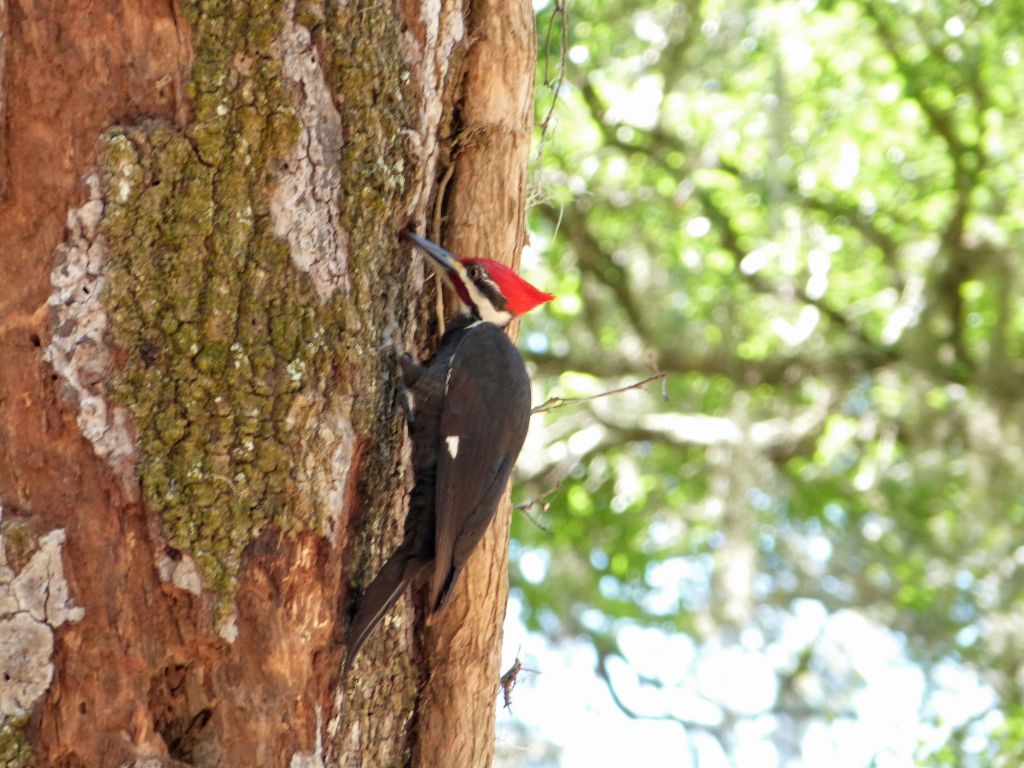
Pileated Woodpecker by Lee at Circle B

Pileated Woodpecker by Lee at Circle B

And God blessed them, saying, “Be fruitful and multiply and fill the waters in the seas, and let birds multiply on the earth.” (Genesis 1:22 ESV)

This is Chapter III from The Woodpeckers book. Our writer, Fannie Hardy Eckstorm, wrote this in 1901. There are 16 chapters, plus the Forward, which are about the Woodpecker Family here in America. All the chapters can be found on The Woodpeckers page. I added photos to help enhance the article. In 1901, photography was not like today.

Woodpeckers belong to the Picidae – Woodpeckers Family.

Members of Picidae are typically monogamous. A pair will work together to help build the nest, incubate the eggs and raise their altricial young. However, in most species the male does most of the nest excavation and takes the night shift while incubating the eggs. A nest will usually consist of 2–5 round white eggs. Since these birds are cavity nesters, their eggs do not need to be camouflaged and the white color helps the parents to see them in dim light. The eggs are incubated for about 11–14 days before the chicks are born. It takes about 18–30 days before the young are ready to leave the nest. (Wikipedia with editing)

See:

Picidae – Woodpeckers Family

The Woodpeckers by Fannie Hardy Eckstorm

Gospel Message

*

How To Know A Woodpecker – The Woodpeckers

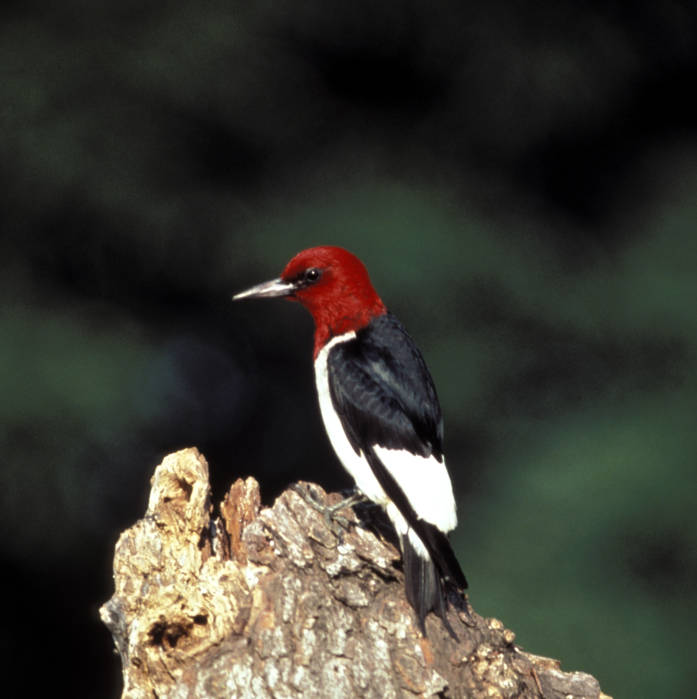
Red-headed Woodpecker (Melanerpes erythrocephalus) ©USFWS

Red-headed Woodpecker (Melanerpes erythrocephalus) ©USFWS


Chapter I

HOW TO KNOW A WOODPECKER

The woodpecker is the easiest of all birds to recognize. Even if entirely new to you, you may readily decide whether a bird is a woodpecker or not.

The woodpecker is always striking and is often gay in color. He is usually noisy, and his note is clear and characteristic. His shape and habits are peculiar, so that whenever you see a bird clinging to the side of a tree “as if he had been thrown at it and stuck,” you may safely call him a woodpecker. Not that all birds which cling to the bark of trees are woodpeckers,—for the chickadees, the crested titmice, the nuthatches, the brown creepers, and a few others like the kinglets and some wrens and wood-warblers more or less habitually climb up and down the tree-trunks; but these do it with a pretty grace wholly unlike the woodpecker’s awkward, cling-fast way of holding on. As the largest of these is smaller than the smallest woodpecker, and as none of them (excepting only the tiny kinglets) ever shows the patch of yellow or scarlet which always marks the head of the male woodpecker, and which sometimes adorns his mate, there is no danger of making mistakes.

Blue Nuthatch (Sitta azurea) by Ian

Blue Nuthatch (Sitta azurea) by Ian

The nuthatches are the only birds likely to be confused with woodpeckers, and these have the peculiar habit of traveling down a tree-trunk with their heads pointing to the ground. A woodpecker never does this; he may move down the trunk of the tree he is working on, but he will do it by hopping backward. A still surer sign of the woodpecker is the way he sits upon his tail, using it to brace him. No other birds except the chimney swift and the little brown creeper ever do this. A sure mark, also, is his feet, which have two toes turned forward and two turned backward. We find this arrangement in no other North American birds except the cuckoos and our one native parroquet. However, there is one small group of woodpeckers which have but three toes, and these are the only North American land-birds that do not have four well-developed toes.

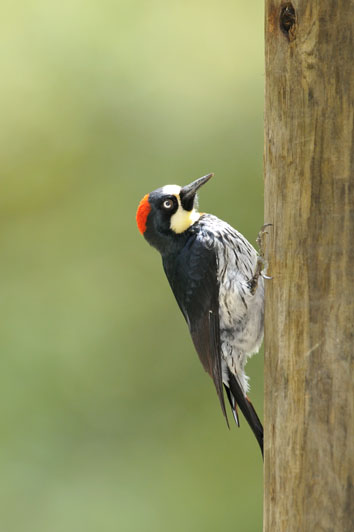
Acorn Woodpecker (Melanerpes formicivorus) by Reinier Munguia

Acorn Woodpecker (Melanerpes formicivorus) by Reinier Munguia

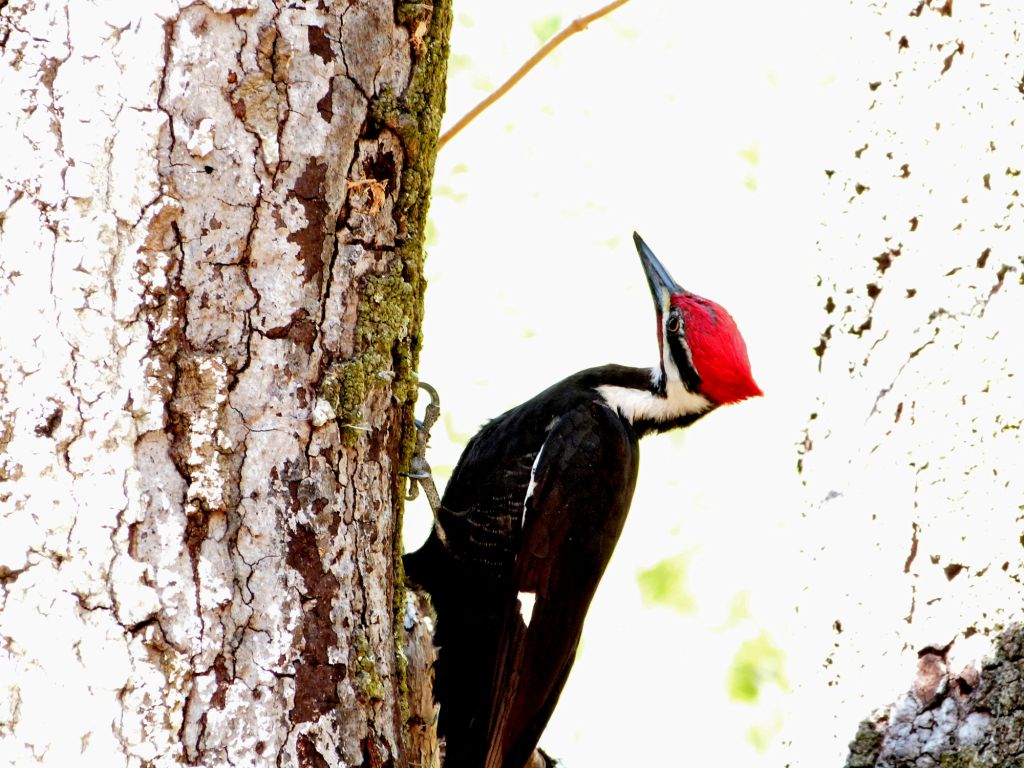
In coloration the woodpeckers show a strong family likeness. Except in some young birds, the color is always brilliant and often is gaudy. Usually it shows much clear black and white, with dashes of scarlet or yellow about the head. Sometimes the colors are “solid,” as in the red-headed woodpecker; sometimes they lie in close bars, as in the red-bellied species; sometimes in spots and stripes, as in the downy and hairy; but there is always a contrast, never any blending of hues. The red or yellow is laid on in well-defined patches—square, oblong, or crescentic—upon the crown, the nape, the jaws, or the throat; or else in stripes or streaks down the sides of the head and neck, as in the logcock, or pileated woodpecker.

Pileated Woodpecker by Lee

Pileated Woodpecker by Lee

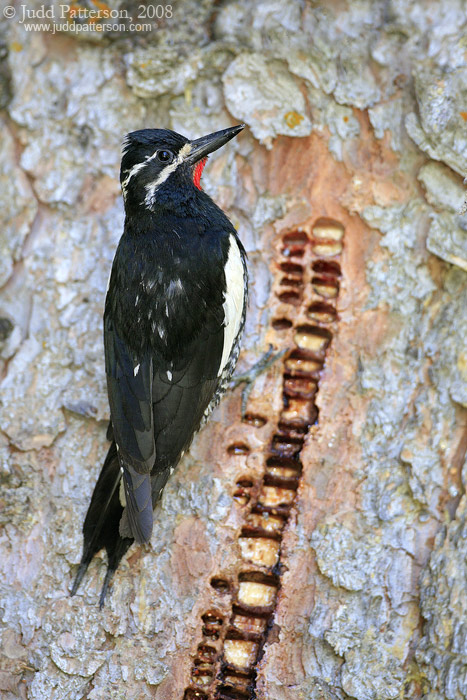
There is no rule about the color markings of the sexes, as in some families of birds. Usually the female lacks all the bright markings of the male; sometimes, as in the logcock, she has them but in more restricted areas; sometimes, as in the flickers, she has all but one of the male’s color patches; and in a few species, as the red-headed and Lewis’s woodpeckers, the two sexes are precisely alike in color. In the black-breasted woodpecker, sometimes called Williamson’s sapsucker, the male and female are so totally different that they were long described and named as different birds. It sometimes happens that a young female will show the color marks of the male, but will retain them only the first year.

Williamson's Sapsucker (Sphyrapicus thyroideus) by Judd Patterson

Williamson’s Sapsucker (Sphyrapicus thyroideus) by Judd Patterson

Though the woodpeckers cling to the trunks of trees, they are not exclusively climbing birds. Some kinds, like the flickers, are quite as frequently found on the ground, wading in the grass like meadowlarks. Often we may frighten them from the tangled vines of the frost grape and the branches of wild cherry trees, or from clumps of poison-ivy, whither they come to eat the fruit. The red-headed woodpecker is fond of sitting on fence posts and telegraph poles; and both he and the flicker frequently alight on the roofs of barns and houses and go pecking and pattering over the shingles. The sapsuckers and several other kinds will perch on dead limbs, like a flycatcher, on the watch for insects; the flickers, and more rarely other kinds, will sit crosswise of a limb instead of crouching lengthwise of it, as is the custom with woodpeckers.

Northern Flicker (Colaptes auratus) Red-shafted ©WikiC

Northern Flicker (Colaptes auratus) Red-shafted ©WikiC

All these points you will soon learn. You will become familiar with the form, the flight, and the calls of the different woodpeckers; you will learn not only to know them by name, but to understand their characters; they will become your acquaintances, and later on your friends.

This heavy bird, with straight, chisel bill and sharp-pointed tail-feathers; with his short legs and wide, flapping wings, his unmusical but not disagreeable voice, and his heavy, undulating, business-like flight, is distinctly bourgeois, the type of a bird devoted to business and enjoying it. No other bird has so much work to do all the year round, and none performs his task with more energy and sense. The woodpecker makes no aristocratic pretensions, puts on none of the coy graces and affectations of the professional singer; even his gay clothes fit him less jauntily than they would another bird. He is artisan to the backbone,—a plain, hard-working, useful citizen, spending his life in hammering holes in anything that appears to need a hole in it. Yet he is neither morose nor unsocial. There is a vein of humor in him, a large reserve of mirth and jollity. We see little of it except in the spring, and then for a time all the laughter in him bubbles up; he becomes uproarious in his glee, and the melody which he cannot vent in song he works out in the channels of his trade, filling the woodland with loud and harmonious rappings. Above all other birds he is the friend of man, and deserves to have the freedom of the fields.


Lee’s Addition:

Red-bellied Woodpecker (Melanerpes carolinus) by J Fenton

Red-bellied Woodpecker (Melanerpes carolinus) by J Fenton

For by him were all things created, that are in heaven, and that are in earth, visible and invisible, whether they be thrones, or dominions, or principalities, or powers: all things were created by him, and for him: (Colossians 1:16 KJV)

This is Chapter I from The Woodpeckers book. Our writer, Fannie Hardy Eckstorm, wrote this in 1901. There are 16 chapters, plus the Forward, which are about the Woodpecker Family here in America. All the chapters can be found on The Woodpeckers page. I added photos to help enhance the article. In 1901, photography was not like today.

Woodpeckers belong to the Picidae – Woodpeckers Family.

“Most species possess predominantly white, black, brown, green, and red plumage, although many piculets show a certain amount of grey and olive green. In woodpeckers, many species exhibit patches of red and yellow on their heads and bellies, and these bright areas are important in signaling. The dark areas of plumage are often iridescent. Although the sexes of Picidae species tend to look alike, many woodpecker species have more prominent red or yellow head markings in males than in females.”

“Members of the family Picidae have strong bills for drilling and drumming on trees and long sticky tongues for extracting food. Woodpecker bills are typically longer, sharper and stronger than the bills of piculets and wrynecks; however their morphology is very similar. The bill’s chisel-like tip is kept sharp by the pecking action in birds that regularly use it on wood. Species of woodpecker and flicker that use their bills in soil or for probing as opposed to regular hammering tend to have longer and more decurved bills. Due to their smaller bill size, many piculets and wrynecks will forage in decaying wood more often than woodpeckers. The long sticky tongues, which possess bristles, aid these birds in grabbing and extracting insects deep within a hole of a tree. It had been reported that the tongue was used to spear grubs, but more detailed studies published in 2004 have shown that the tongue instead wraps around the prey before being pulled out.”

“Woodpeckers, piculets and wrynecks all possess zygodactyl feet. Zygodactyl feet consist of four toes, the first (hallux) and the fourth facing backward and the second and third facing forward. This foot arrangement is good for grasping the limbs and trunks of trees. Members of this family can walk vertically up a tree trunk, which is beneficial for activities such as foraging for food or nest excavation. In addition to the strong claws and feet, woodpeckers have short strong legs. This is typical of birds that regularly forage on trunks. The tails of all woodpeckers except the piculets and wrynecks are stiffened, and when the bird perches on vertical surfaces, the tail and feet work together to support it.” (Wikipedia)

See:

Picidae – Woodpeckers Family

The Woodpeckers by Fannie Hardy Eckstorm

Falling Plates

*

Riddlers – The Woodpeckers

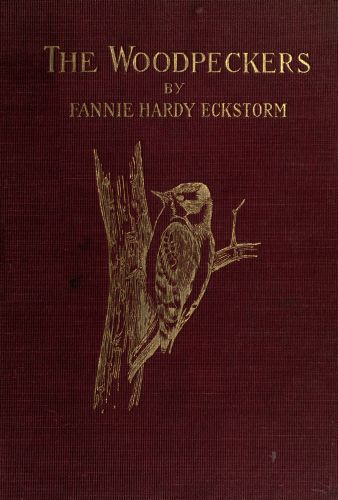
The Woodpeckers by Fannie Hardy Eckstorm - coverThe Woodpeckers, by Fannie Hardy Eckstorm

A Project Gutenberg EBook

*

THE WOODPECKERS

BY

FANNIE HARDY ECKSTORM

WITH ILLUSTRATIONS

The Woodpeckers by Fannie Hardy Eckstorm

BOSTON AND NEW YORK
HOUGHTON, MIFFLIN AND COMPANY
The Riverside Press, Cambridge
1901

Title: The Woodpeckers

Author: Fannie Hardy Eckstorm

Release Date: January 25, 2011 [EBook #35062]

*** START OF THIS PROJECT GUTENBERG EBOOK THE WOODPECKERS ***

(This eBook is for the use of anyone anywhere at no cost and with almost no restrictions whatsoever. You may copy it, give it away or re-use it under the terms of the Project Gutenberg License included with this eBook or online at www.gutenberg.org)

COPYRIGHT, 1900, BY FANNIE HARDY ECKSTORM

ALL RIGHTS RESERVED

To

MY FATHER
MR. MANLY HARDY
A Lifelong Naturalist


THE WOODPECKERS


FOREWORD: THE RIDDLERS


_
Long ago in Greece, the legend runs, a terrible monster called the Sphinx used to waylay travelers to ask them riddles: whoever could not answer these she killed, but the man who did answer them killed her and made an end of her riddling.

To-day there is no Sphinx to fear, yet the world is full of unguessed riddles. No thoughtful man can go far afield but some bird or flower or stone bars his way with a question demanding an answer; and though many men have been diligently spelling out the answers for many years, and we for the most part must study the answers they have proved, and must reply in their words, yet those shrewd old riddlers, the birds and flowers and bees, are always ready for a new victim, putting their heads together over some new enigma (mystery) to bar the road to knowledge till that, too, shall be answered; so that other men’s learning does not always suffice. So much of a man’s pleasure in life, so much of his power, depends on his ability to silence these persistent questioners, that this little book was written with the hope of making clearer the kind of questions Nature asks, and the way to get correct answers.

This is purposely a little book, dealing only with a single group of birds, treating particularly only some of the commoner species of that group, taking up only a few of the problems that present themselves to the naturalist for solution, and aiming rather to make the reader acquainted with the birds than learned about them.

The woodpeckers were selected in preference to any other family because they are patient under observation, easily identified, resident in all parts of the country both in summer and in winter, and because more than any other birds they leave behind them records of their work which may be studied after the birds have flown.

The book provides ample means for identifying every species and subspecies of woodpecker known in North America, though only five of the commonest and most interesting species have been selected for special study. At least three of these five should be found in almost every part of the country. The Californian woodpecker is never seen in the East, nor the red-headed in the far West, but the downy and the hairy are resident nearly everywhere, and some species of the flickers and sapsuckers, if not always the ones chosen for special notice, are visitors in most localities.

Look for the woodpeckers in orchards and along the edges of thickets, among tangles of wild grapes and in patches of low, wild berries, upon which they often feed, among dead trees and in the track of forest fires. Wherever there are boring larvæ, beetles, ants, grasshoppers, the fruit of poison-ivy, dogwood, june-berry, wild cherry or wild grapes, woodpeckers may be confidently looked for if there are any in the neighborhood.

Be patient, persistent, wide-awake, sure that you see what you think you see, careful to remember what you have seen, studious to compare your observations, and keen to hear the questions propounded you. If you do this seven years and a day, you will earn the name of Naturalist; and if you travel the road of the naturalist with curious patience, you may some day become as famous a riddle-reader as was that OEdipus, the king of Thebes, who slew the Sphinx.


Downy Woodpecker (Picoides pubescens) by Raymond Barlow

Downy Woodpecker (Picoides pubescens) by Raymond Barlow

Lee’s Addition:

This is the beginning of a series from The Woodpeckers book. Our writer, Fannie Hardy Eckstorm, wrote this in 1901. There are 16 chapters, plus this Forward, which are about the Woodpecker Family here in America. All the chapters can be found on The Woodpeckers page.

Woodpeckers belong to the Picidae – Woodpeckers Family.

Here are the upcoming chapter titles:

CHAP. PAGE
 Foreword: the Riddlers  
I.  How to know a Woodpecker  
II.  How the Woodpecker catches a Grub  
III.  How the Woodpecker courts his Mate  
IV.  How the Woodpecker makes a House  
V.  How a Flicker feeds her Young  
VI.  Friend Downy  
VII.  Persona non Grata. (Yellow-bellied Sapsucker)  
VIII.  El Carpintero. (Californian Woodpecker)  
IX.  A Red-headed Cousin. (Red-headed Woodpecker)  
X.  A Study of Acquired Habits  
XI.  The Woodpecker’s Tools: His Bill  
XII.  The Woodpecker’s Tools: His Foot  
XIII.  The Woodpecker’s Tools: His Tail  
XIV.  The Woodpecker’s Tools: His Tongue  
XV.  How each Woodpecker is fitted for his own Kind of Life  
XVI.  The Argument from Design  

APPENDIX

A. Key to the Woodpeckers of North America

B. Descriptions of the Woodpeckers of North America

C. Explanation of Terms

*

I trust you will enjoy reading about these fantastic birds and how the Lord has created them to be able to carry out their task.

See:

The Woodpeckers by Fannie Hardy Eckstorm

Wordless Birds

*

Woodpeckers – The Core Species..

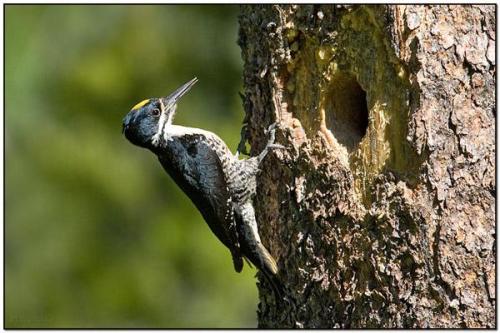
Black-backed Woodpecker (Picoides arcticus) by Daves BirdingPix

Black-backed Woodpecker (Picoides arcticus) by Daves BirdingPix

Woodpeckers – The Core Species.. ~ by ajmithra

Woodpeckers are often termed “core species”
because their presence
is a fundamental requirement to the existence of a wide range of other birds.
Woodpeckers drill new nest holes each year,
and thus many old nest cavities
are available for a entire suite
of hole-nesting species.
Many smaller species
of North American swallow
are dependent on woodpecker holes,
as are virtually all the small owls,
various bluebirds,
and a huge array of small birds like
wrens and chickadees
that use them advantageously.
Isaac dug wells
And the others took it..
He didn’t grumble
but, dug more wells..
And God blessed him even
In times of famine..

Do all things without murmurings and disputings: That ye may be blameless and harmless, the sons of God, without rebuke, in the midst of a crooked and perverse nation, among whom ye shine as lights in the world; (Philippians 12:14,15)

Yours in YESHUA,
a j mithra

Please visit us at:

*

Woodpeckers belong to the Picidae – Woodpeckers.

*

The Disobedient Woodpecker

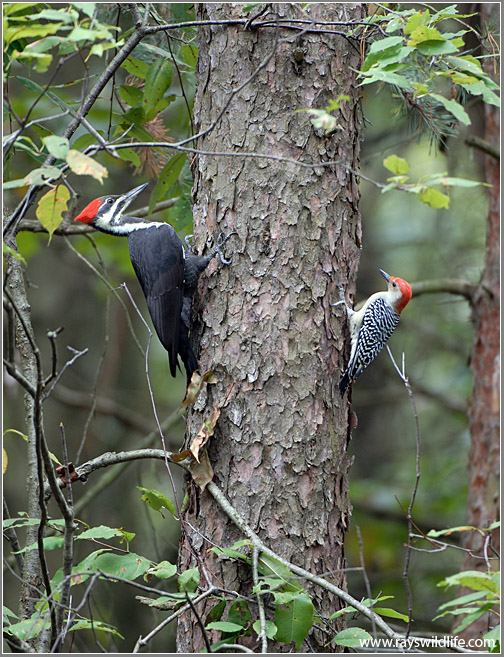
Pileated and Red-bellied Woodpecker on same tree by Ray

Pileated and Red-bellied Woodpecker on same tree by Ray

The Disobedient Woodpecker ~ from The Curious Book of Birds

THE DISOBEDIENT WOODPECKER

Cur Book of Birds letter-lONG, long ago, at the beginning of things, they say that the Lord made the world smooth and round like an apple. There were no hills nor mountains: nor were there any hollows or valleys to hold the seas and rivers, fountains and pools, which the world of men would need. It must, indeed, have been a stupid and ugly earth in those days, with no chance for swimming or sailing, rowing or fishing. But as yet there was no one to think anything about it, no one who would long to swim, sail, row, and fish. For this was long before men were created.

The Lord looked about Him at the flocks of newly made birds, who were preening their wings and wondering at their own bright feathers, and said to Himself,—

“I will make these pretty creatures useful, from the very beginning, so that in after time men shall love them dearly. Come, my birds,” He cried, “come hither to me, and with the beaks which I have given you hollow me out here, and here, and here, basins for the lakes and pools which I intend to fill with water for men and for you, their friends. Come, little brothers, busy yourselves as you would wish to be happy hereafter.”

Then there was a twittering and fluttering as the good birds set to work with a will, singing happily over the work which their dear Lord had given them to do. They pecked and they pecked with their sharp little bills; they scratched and they scratched with their sharp little claws, till in the proper places they had hollowed out great basins and valleys and long river beds, and little holes in the ground.

Then the Lord sent great rains upon the earth until the hollows which the birds had made were filled with water, and so became rivers and lakes, little brooks and fountains, just as we see them to-day. Now it was a beautiful, beautiful world, and the good birds sang happily and rejoiced in the work which they had helped, and in the sparkling water which was sweet to their taste.

All were happy except one. The Woodpecker had taken no part with the other busy birds. She was a lazy, disobedient creature, and when she heard the Lord’s commands she had only said, “Tut tut!” and sat still on the branch where she had perched, preening her pretty feathers and admiring her silver stockings. “You can toil if you want to,” she said to the other birds who wondered at her, “but I shall do no such dirty work. My clothes are too fine.”

Now when the world was quite finished and the beautiful water sparkled and glinted here and there, cool and refreshing, the Lord called the birds to Him and thanked them for their help, praising them for their industry and zeal. But to the Woodpecker He said,—

“As for you, O Woodpecker, I observe that your feathers are unruffled by work and that there is no spot of soil upon your beak and claws. How did you manage to keep so neat?”

The Woodpecker looked sulky and stood upon one leg.

“It is a good thing to be neat,” said the Lord, “but not if it comes from shirking a duty. It is good to be dainty, but not from laziness. Have you not worked with your brothers as I commanded you?”

“It was such very dirty work,” piped the Woodpecker crossly; “I was afraid of spoiling my pretty bright coat and my silver shining hose.”

“Oh, vain and lazy bird!” said the Lord sadly. “Have you nothing to do but show off your fine clothes and give yourself airs? You are no more beautiful than many of your brothers, yet they all obeyed me willingly. Look at the snow-white Dove, and the gorgeous Bird of Paradise, and the pretty Grosbeak. They have worked nobly, yet their plumage is not injured. I fear that you must be punished for your disobedience, little Woodpecker. Henceforth you shall wear stockings of sooty black instead of the shining silver ones of which you are so proud. You who were too fine to dig in the earth shall ever be pecking at dusty wood. And as you declined to help in building the water-basins of the world, so you shall never sip from them when you are thirsty. Never shall you thrust beak into lake or river, little rippling brook or cool, sweet fountain. Raindrops falling scantily from the leaves shall be your drink, and your voice shall be heard only when other creatures are hiding themselves from the approaching storm.”

It was a sad punishment for the Woodpecker, but she certainly deserved it. Ever since that time, whenever we hear a little tap-tapping in the tree city, we know that it is the poor Woodpecker digging at the dusty wood, as the Lord said she should do. And when we spy her, a dusty little body with black stockings, clinging upright to the tree trunk, we see that she is creeping, climbing, looking up eagerly toward the sky, longing for the rain to fall into her thirsty beak. She is always hoping for the storm to come, and plaintively pipes, “Plui-plui! Rain, O Rain!” until the drops begin to patter on the leaves.


Rufous-bellied Woodpecker (Dendrocopos hyperythrus) by Nikhil Devasar

Rufous-bellied Woodpecker (Dendrocopos hyperythrus) by Nikhil Devasar

Lee’s Addition:

Children, obey your parents in the Lord: for this is right. Honour thy father and mother; (which is the first commandment with promise;) That it may be well with thee, and thou mayest live long on the earth. (Ephesians 6:1-3 KJV)
Children, obey your parents in all things: for this is well pleasing unto the Lord. (Colossians 3:20 KJV)

Apparently the Woodpecker had not learned to obey. I trust you are obeying your parents. You are also to honor or give respect to your father and mother.

Now don’t think unkindly about the real Woodpeckers, because of course this is only a story. I think Woodpeckers are really neat birds and the Lord has provided them with just the right beak so it can make holes for a nest and for digging out worms.

Links:


  Picidae – Woodpeckers Family


Painted Bunting (Passerina ciris) ©©Flickr


  Bird Tales


Curious Book of Birds - Cover


  The Curious Book of Birds


Spanish Sparrow (Passer Hispaniolensis) female ©WikiC


  Wordless Birds


*

Ian’s Bird of the Week – Black Woodpecker

Black Woodpecker (Dryocopus martius) by Ian 1

Black Woodpecker (Dryocopus martius) by Ian 1

Ian’s Bird of the Week – Black Woodpecker ~ by Ian Montgomery

Newsletter – 6/26/12

I said last week that my main target in Finland the Black Woodpecker was another story. It’s a story that started 50 years ago when I started bird watching in Ireland as a teenager and received, as a Christmas present in 1962, the classic Guy Mountfort Field Guide to the Birds of Britain and Europe. It had, for its time, superb colour plates of all the European bird species by Roger Peterson. Some of these birds were to this Irish teenager unbelievably exotic and, living on a woodpecker-free island, I was struck by the woodpecker page in general and the huge Black Woodpecker in particular (I still have the field guide):

The concept of a bucket list (things to do before you ‘kick the bucket’) hadn’t been articulated then, but the Black Woodpecker went straight onto mine. So, when the only route that Qantas could offer me a few months ago for a frequent-flyer ticket in the general direction of Ireland was on Finnair via Helsinki, I immediately thought ‘Black Woodpecker’ (and ‘owls’, another great page in the field guide).

In fact finding birds such as woodpeckers and owls in the endless forests of Finland proved very difficult, so eventually I went out with an excellent Finnature guide, Antti (Finnish for Andrew) and a delightful English birding couple in the Kuusamo region. It was a very bad year for owls (owl years are very dependent on cycles in the vole population) but Antti did eventually find us a distant Pygmy Owl and, last bird of all, showed us the nesting site of a pair of Black Woodpeckers.

Black Woodpecker (Dryocopus martius) by Ian 2

Black Woodpecker (Dryocopus martius) by Ian 2

We were treated to a view of the male – the female lacks the red crown, having on a small red patch on the back of the head – arriving to feed the young, but there then followed a long period without any activity and, as it was time to return to the hotel for breakfast, I returned later on my own so that I could photograph them at my leisure. Again, the male arrived (second photo) and three hungry chicks appeared at the nest entrance. The male then fed them, presumably by regurgitation – third photo – as he didn’t appear to be carrying any food when he arrived.

Black Woodpecker (Dryocopus martius) by Ian 3

Black Woodpecker (Dryocopus martius) by Ian 3

At 45-50cm/18-20in in length, these are crow-sized birds are the largest Eurasian Woodpecker and comparable in size to the related Pileated Woodpecker of North America. Their white bill is 5cm/2in in length and an impressive implement. They usually dig a new nest hollow each year, but Antti told us that this pair had used the same one for two years running. The Black Woodpecker is quite widespread in mature forest in Eurasia and is expanding its range.

Black Woodpecker (Dryocopus martius) by Ian 4

Black Woodpecker (Dryocopus martius) by Ian 4

After feeding the young, the male left the nest for several minutes and then returned and entered the hollow. Nothing further happened for over half an hour until the female, who had been in the nest all along, emerged and flew off (fourth photo). The nest was in a tree on a quiet road outside a house, so I was able to watch it in comfort from my rental car (fifth photo), the red arrow indicating the location of the nest.

Black Woodpecker (Dryocopus martius) by Ian 5

Black Woodpecker (Dryocopus martius) by Ian 5

So, my visit to Finland reached a satisfactory conclusion and the Black Woodpecker lived up to expectations. Three days later I flew to Dublin, where I am now to join the rest of the family and await the arrival of the first member of the next generation. My niece went into hospital yesterday and the arrival of the baby, ten days overdue, is anticipated either tonight or tomorrow.

Best wishes,

Ian
**************************************************
Ian Montgomery, Birdway Pty Ltd,
454 Forestry Road, Bluewater, Qld 4818
Tel 0411 602 737 ian@birdway.com.au
Check the latest website updates:
http://www.birdway.com.au/#updates
**************************************************


Lee’s Addition:

The trees of the LORD are full of sap; the cedars of Lebanon, which he hath planted; Where the birds make their nests: as for the stork, the fir trees are her house. (Psalms 104:16-17 KJV)

Congratulations on a new generation beginning. Also obtaining another of your bucket list birds. What a neat bird. That camera lens is something else!

Thanks again, Ian, for sharing your birdwatching photography with us. We await your next adventure in to the domain of the birds.

The Woodpeckers are in the Picidae – Woodpeckers Family of the Piciformes Order. Check out Ian’s many Woodpecker photos.

*

Birds Vol 1 #2 – The Red-headed Woodpecker

Red-headed Woodpecker (Melanerpes erythrocephalus) - Birds Illustrated

Red-headed Woodpecker (Melanerpes erythrocephalus) – Birds Illustrated

Birds Illustrated by Color Photography – Revisited

Vol 1. February, 1897 No. 2

*

THE RED HEADED WOODPECKER.

imgpERHAPS no bird in North America is more universally known than the Red Headed Woodpecker. He is found in all parts of the United States and is sometimes called, for short, by the significant name of Red Head. His tri-colored plumage, red, white and black, glossed with steel blue, is so striking and characteristic, and his predatory habits in the orchards and cornfields, and fondness for hovering along the fences, so very notorious, that almost every child is acquainted with the Red Headed Woodpecker. In the immediate neighborhood of large cities, where the old timber is chiefly cut down, he is not so frequently found. Wherever there is a deadening, however, you will find him, and in the dead tops and limbs of high trees he makes his home. Towards the mountains, particularly in the vicinity of creeks and rivers, these birds are extremely numerous, especially in the latter end of summer. It is interesting to hear them rattling on the dead leaves of trees or see them on the roadside fences, where they flit from stake to stake. We remember a tremendous and quite alarming and afterwards ludicrous rattling by one of them on some loose tin roofing on a neighbor’s house. This occurred so often that the owner, to secure peace, had the roof repaired.

They love the wild cherries, the earliest and sweetest apples, for, as is said of him, “he is so excellent a connoisseur in fruit, that whenever an apple or pear is found broached by him, it is sure to be among the ripest and best flavored. When alarmed he seizes a capital one by striking his open bill into it, and bears it off to the woods.” He eats the rich, succulent, milky young corn with voracity. He is of a gay and frolicsome disposition, and half a dozen of the fraternity are frequently seen diving and vociferating around the high dead limbs of some large trees, pursuing and playing with each other, and amusing the passerby with their gambols. He is a comical fellow, too, prying around at you from the bole of a tree or from his nesting hole therein.

Though a lover of fruit, he does more good than injury. Insects are his natural food, and form at least two thirds of his subsistence. He devours the destructive insects that penetrate the bark and body of a tree to deposit their eggs and larvae.

About the middle of May, he begins to construct his nest, which is formed in the body of large limbs of trees, taking in no material but smoothing it within to the proper shape and size. The female lays six eggs, of a pure white. The young appear about the first of June. About the middle of September the Red Heads begin to migrate to warmer climates, travelling at night time in an irregular way like a disbanded army and stopping for rest and food through the day.

The black snake is the deadly foe of the Red Head, frequently entering his nest, feeding upon the young, and remaining for days in possession.

“The eager school-boy, after hazarding his neck to reach the Woodpecker’s hole, at the triumphant moment when he thinks the nestlings his own, strips his arm, launches it down into the cavity, and grasping what he conceives to be the callow young, starts with horror at the sight of a hideous snake, almost drops from his giddy pinnacle, and retreats down the tree with terror and precipitation.”

Red-headed Woodpecker (Melanerpes erythrocephalus) ©USFWS

Red-headed Woodpecker (Melanerpes erythrocephalus) ©USFWS


THE DRUMMER BIRD

My dear girls and boys:

The man who told me to keep still and look pleasant while he took my picture said I might write you a letter to send with it. You say I always keep on the other side of the tree from you. That is because someone has told you that I spoil trees, and I am afraid that you will want to punish me for it. I do not spoil trees. The trees like to have me come to visit them, for I eat the insects that are killing them. Shall I tell you how I do this?

I cling to the tree with my strong claws so sharply hooked. The pointed feathers of my tail are stiff enough to help hold me against the bark. Then my breast bone is quite flat, so that I may press close to the tree. When I am all ready you hear my r-r-rap—just like a rattle. My head goes as quickly as if it were moved by a spring. Such a strong, sharp bill makes the chips fly! The tiny tunnel I dig just reaches the insect.

Then I thrust out my long tongue. It has a sharp, horny tip, and has barbs on it too. Very tiny insects stick to a liquid like glue that covers my tongue. I suppose I must tell you that I like a taste of the ripest fruit and grain. Don’t you think I earn a little when I work so hard keeping the trees healthy?

I must tell you about the deep tunnel my mate and I cut out of a tree. It is just wide enough for us to slip into. It is not straight down, but bent, so that the rain cannot get to the bottom. There we make a nest of little chips for our five white eggs.

I should like to tell you one of the stories that some boys and girls tell about my red head. You will find it on another page of the book. Now I must fly away to peck for more bugs.

Your loving friend,
Woodpecker.

Red-headed Woodpecker (Melanerpes erythrocephalus) by Daves BirdingPix

Red-headed Woodpecker (Melanerpes erythrocephalus) by Daves BirdingPix


Lee’s Addition:

If a bird’s nest happens to be before you along the way, in any tree or on the ground, with young ones or eggs, with the mother sitting on the young or on the eggs, you shall not take the mother with the young; (Deuteronomy 22:6 NKJV)

Not much to add to this one. The writer has told much about this Woodpecker. They are part of the Picadae Family in the Piciformes Order. Most woodpeckers are heard before they are found. They are either making their calls or you can hear them chipping away at the trees or “metal.”

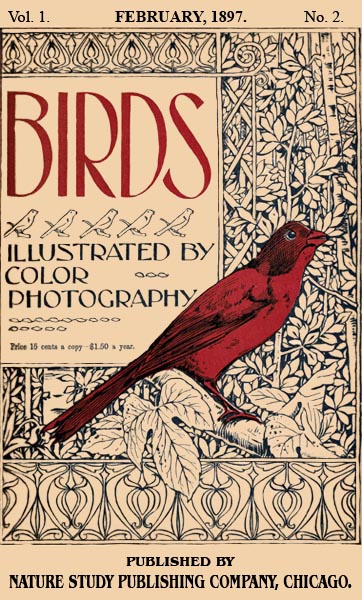
Birds Illustrated by Color Photograhy Vol 1 February 1897 No 2 - Cover

Birds Illustrated by Color Photograhy Vol 1 February 1897 No 2 – Cover

Birds Illustrated by Color Photography – Revisited – Introduction

The above article is the first article in the monthly serial for February 1897 “designed to promote Knowledge of Bird-Live.” These include Color Photography, as they call them, today they are drawings. There are at least three Volumes that have been digitized by Project Gutenberg.

To see the whole series of – Birds Illustrated by Color Photography – Revisited

* (Information from Wikipedia and other internet sources)

Next Article – Mexican Mot Mot

Previous Article – The Swallow-Tailed Indian Roller

ABC’s of the Gospel

Links:

Red-headed Woodpecker – Wikipedia

Here are some more ads from the Birds Illustrated:

Birds Illustrated Ad - Feb

Birds Illustrated Ad – Feb

Ian’s Bird of the Week – Crimson-crested Woodpecker

Crimson-crested Woodpecker (Campephilus melanoleucos) by Ian

Crimson-crested Woodpecker (Campephilus melanoleucos) by Ian

Ian’s Bird of the Week – Crimson-crested Woodpecker ~ by Ian Montgomery

Newsletter – 5/29/11

Those of you who have been on the list for a few years might remember from earlier posts that I’ve led a woodpecker-deprived existence, having lived first in Ireland and since then in Australia. Woody Woodpecker captured my imagination at an early age and I’ve been fascinated with woodpeckers ever since.

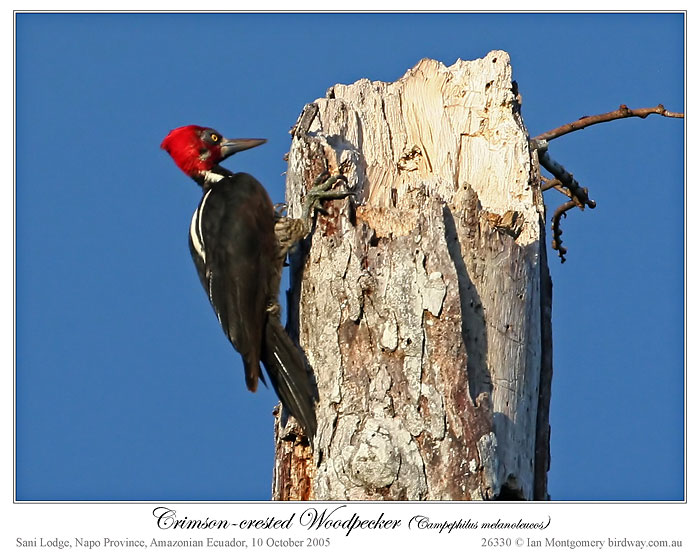
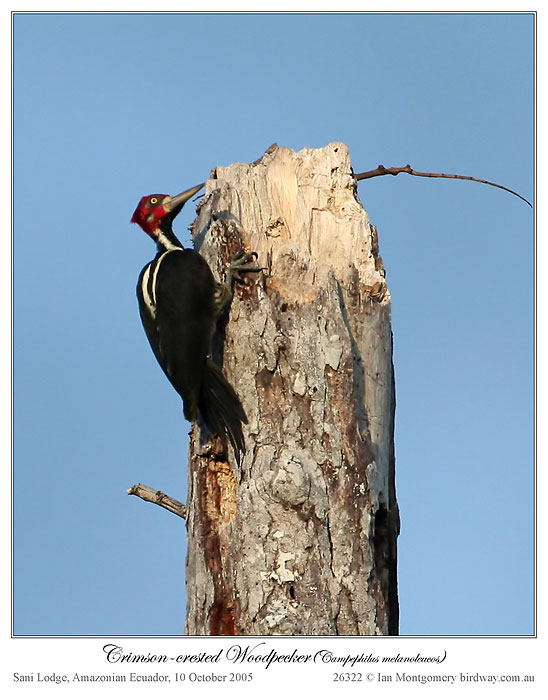
I was updating the woodpecker galleries on the website http://www.birdway.com.au/picidae/index.htm and this one made me laugh, so I though I’d share it with you. In the first photo it looks as if it’s staring in guilty shock at the tree and saying “Whoops! (or something stronger) Did I do that?” The second photo follows the same theme with a puzzled “Where did that tree go?” If you can think of better captions, please share them with me at ian@birdway.com.au and I’ll publish the best one next week.

Crimson-crested Woodpecker (Campephilus melanoleucos) by Ian

Crimson-crested Woodpecker (Campephilus melanoleucos) by Ian

The Crimson-crested Woodpecker (Campephilus melanoleucos) is 36cm/14in in length and a close relative of the larger (at least 48cm/19in) and legendary, maybe-extinct-maybe-not Ivory-billed Woodpecker of the southern USA (Campephilus principalis) about which there was so much excitement in 2004-5. The Crimson-crested is happily quite common with a wide range in northern South America. Campephilus incidentally means ‘grub loving’ as this group of woodpeckers finds the larvae of wood-boring beetles to their liking.

I photographed this Crimson-crested Woodpecker in 2005 from the dug-out canoe in the third photo, when staying at a lodge called Sani on the Rio Napo, a tributary of the Amazon, in eastern Ecuador. The lodge was on an oxbow lake away from the main river and the canoes, being very quiet, were ideal for bird watching though using a heavy (and expensive) 500mm lens in the canoe took some practice, not to mention recklessness.

Crimson-crested Woodpecker (Campephilus melanoleucos) by Ian Sani Canoe

Crimson-crested Woodpecker from Sani on the Rio Napo Canoe by Ian

Ireland happily is no longer a woodpecker-free zone as the Greater-spotted Woodpecker is in the process of colonising the country, after a big increase in the population in Britain, with successful breeding being report in Co. Down since 2005, Co. Wicklow since 2009 and Co. Wexford since 2010. See http://wlx.bright-server.com/do/ecco.py/view_item?listid=1&listcatid=1075&listitemid=8021&live=0 . We might have to wait a bit longer, though, for any Asian woodpeckers to come island-hopping across the Wallace line to Australia and eucalyptus mightn’t suit them.

I’ve started suppling photos of Australian birds to Guy Gibbon for a multimedia version of Pizzey and Knight for PCs and mobiles and I’ve also been given the task of sourcing photos that I can’t supply (both species and plumages). If you are interested, or know anyone who might be, I’d like to hear from you ian@birdway.com.au . Have a look at this News item on the website http://www.birdway.com.au/#aus_photos which has a link to the list of initially required species http://www.birdway.com.au/pdfs/wanted_species.pdf and links to similar publications by Guy covering British-Irish and Southern African birds.

Best wishes
Ian

Ian Montgomery, Birdway Pty Ltd,
454 Forestry Road, Bluewater, Qld 4818
Phone: 0411 602 737 +61-411 602 737
Preferred Email: ian@birdway.com.au
Website: http://birdway.com.au


Lee’s Addition:

Woody Woodpecker was also a favorite of mine. Here in the U. S., we have the Pileated Woodpecker (Dryocopus pileatus),  which seems to be quite similar to this Crimson-crested. Pileated adults are (40 to 49 centimetres (16 to 19 in) long; 250 to 350 grams (8.8 to 12 oz) mass) are mainly black with a red crest and a white line down the sides of the throat. That compares to the 36cm/14in of the Crimson-crested.  Apparently the Pileated is larger and in a different genus. There are 225 woodpeckers world-wide. The Piciformes Order has not only Woodpeckers – Picidae Family, but also eight other families.

The trees of the LORD are full of sap; the cedars of Lebanon, which he hath planted; Where the birds make their nests: as for the stork, the fir trees are her house. (Psalms 104:16-17 KJV)

*

When I Consider! – Woodpecker

Rufous-bellied Woodpecker (Dendrocopos hyperythrus) by Nikhil Devasar

Rufous-bellied Woodpecker (Dendrocopos hyperythrus) by Nikhil Devasar

When I Consider!

When I Consider!

Evidence From Biology

Consider the probability of all of the following characteristics evolving simultaneously into an effectively functioning system in the woodpecker:

1. Its beak is connected to its skull with a resilient shock-absorbing tissue that is not found in any other bird.

2. The beak is much harder than the beaks of other birds, enabling it to bang away a hundred times a minute without hurting itself.

3. The tongue is barbed in most of the 200+ species and is about four times longer than the beak. In certain species the tongue wraps around the back of the bird’s skull, enabling it to reach deep into tree trunks and remove insects.

4. A sticky coating on some woodpecker tongues helps them grab insects.

5. Its tail feathers are constructed so that they are stiff enough to help brace against trees as it climbs.

6. Its keen senses of smell and hearing help detect insects crawling around under the bark of the trees.

7. It short legs and powerful claws are uniquely designed to help it climb tree trunks.

The engineering behind such a technological wonder as the woodpecker boggles our minds. Try to imagine the obstacles the first bird, which was trying to turn into a woodpecker, would have had to overcome!

The eyes of all wait upon thee; and thou givest them their meat in due season. Thou openest thine hand, and satisfiest the desire of every living thing. The LORD is righteous in all his ways, and holy in all his works. (Psalms 145:15-17 KJV)

From A Closer Look at the Evidence by Kleiss, November 6.


“The woodpeckers, piculets and wrynecks are a family, Picidae, of near-passerine birds. Members of this family are found worldwide, except for Australia and New Zealand, Madagascar, and the extreme polar regions. Most species live in forests or woodland habitats, although a few species are known to live in treeless areas such as rocky hillsides and deserts.

The Picidae are just one of the eight living families in the order Piciformes. Members of the order Piciformes, such as the jacamars, puffbirds, barbets, (also Asian and African barbets), toucans and honeyguides, have traditionally been thought to be very closely related to the woodpeckers, piculets and wrynecks. More recently, DNA sequence analyzes have confirmed this view.[1]”

“Members of the family Picidae have strong bills for drilling and drumming on trees and long sticky tongues for extracting food.[2] Woodpecker bills are typically longer, sharper and stronger than the bills of piculets and wrynecks; however their morphology is very similar. The bill’s chisel-like tip is kept sharp by the pecking action in birds that regularly use it on wood. Species of woodpecker and flicker that use their bills in soil or for probing as opposed to regular hammering tend to have longer and more decurved bills. Due to their smaller bill size, many piculets and wrynecks will forage in decaying wood more often than woodpeckers. The long sticky tongues, which possess bristles, aid these birds in grabbing and extracting insects deep within a hole of a tree. It had been reported that the tongue was used to spear grubs, but more detailed studies published in 2004 have shown that the tongue instead wraps around the prey before being pulled out.[3]

Acorn Woodpecker (Melanerpes formicivorus) by Reinier Munguia

Acorn Woodpecker (Melanerpes formicivorus) by Reinier Munguia

“The diet of woodpeckers consists mainly of insects and their grubs taken from living and dead trees, and other arthropods, along with fruit from live trees, nuts and sap both from live trees. Their role ecologically is thereby keeping trees healthy by keeping them from suffering mass infestations.The family is noted for its ability to acquire wood-boring grubs using their bills for hammering, but overall the family is characterized by its dietary flexibility, with many species being both highly omnivorous and opportunistic. The insect prey most commonly taken are insects found inside tree trunks, whether they are alive or rotten wood and in crevices in bark on trees. These include beetles and their grubs, ants, termites, spiders,and caterpillars. These may be obtained either by gleaning or more famously by excavating wood. Having hammered a hole into the wood the prey is excavated by a long barbed tongue. The ability to excavate allows woodpeckers to obtain tree sap, an important source of food for some species. Most famously the sapsuckers, (genus Sphyrapicus ) feed in this fashion, but the technique is not restricted to these and others such as the Acorn Woodpecker also feed in this way. It was once thought that the technique was restricted to the New World, but Old World species such as the Arabian Woodpecker and Great Spotted Woodpecker also feed in this way.[2]”Wikipedia

See Also:
When I Consider! – Woodpecker and Bones

When I Consider! – Woodpecker and Bones

When I Consider!

When I Consider!

“Evidence from Biology”

“In His Word, God tells us that He cares for His creatures. One can observe repeated examples of this in nature. Every creature on Earth has been programmed to take care of itself. An example is the female Red-Cockaded Woodpecker, which changes her diet to include more calcium at egg-laying time. Scientist have found that the woodpecker starts gathering, storing, and eating bone fragments a few days before laying her eggs. Bones contain an extremely high concentration of calcium, which is needed for the shells of the woodpecker’s eggs. After her eggs are laid and her body requires less calcium, the woodpecker shows little interest in pieces of bone.

Red-cockaded Woodpecker (Picoides borealis) by Daves BirdingPix

Red-cockaded Woodpecker (Picoides borealis) by Daves BirdingPix

Where did this instinct to eat bones originate? How does the woodpecker know when she can stop eating bone fragments? Would this process have taken place before the Fall, when the world was a perfect paradise? No one knows, but it is apparent that this instinct had to be programmed into the woodpecker for it to survive in the current fallen world. What a leap of faith to believe that the woodpecker’s ability to meet her need for increased calcium just “evolved” by chance!

Letting God Create Your Day, Vol.3, p.22″

Look at the birds of the air, for they neither sow nor reap nor gather into barns; yet your heavenly Father feeds them. Are you not of more value than they? (Matthew 6:26 NKJV)

A Closer Look at the Evidence, Aug 5, by Richard and Tina Kleiss


An excerpt from U.S. Fish & Wildlife Service, “Red-cockaded Woodpecker Picoides borealis

“Red-cockaded woodpeckers rarely come to the ground. They even bathe in water-filled depressions on tree limbs. Recent research notes that female red-cockaded woodpeckers search for bone bits on the forest floor and stuff them in tree crevices. Zoologists say it is the first known instance of a bird hoarding something for its mineral, rather than caloric, content. Calcium-rich bone is not rare, but the birds probably seek it to ensure stronger eggshells. They stash it in a tree so they won’t have to eat on the ground where they are vulnerable to predators.”