***
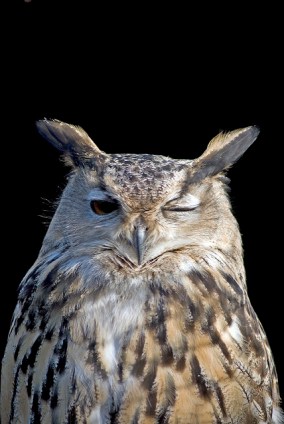
WINK
***
“Let not them that are mine enemies wrongfully rejoice over me: neither let them wink with the eye that hate me without a cause.” (Psalm 35:19)
Owl Winking ©Flickr Darren D
*
*
“Let not them that are mine enemies wrongfully rejoice over me: neither let them wink with the eye that hate me without a cause.” (Psalm 35:19)
Owl Winking ©Flickr Darren D
*
*
Balancing High Risks: Mountain Climbing and the First Amendment
By James J. S. Johnson
When an American astronaut reverently quotes from Psalm 24, and is promptly faulted by a critic—for “violating” the so-called “separation of church and state”(1)—it is time to learn a lesson about balance, from the agility of mountain goats, adroitly ambulating alpine ascents of the Rocky Mountains.

Indeed, mountain goats provide creation science “gems”, plus a picture of how we need balance in the political arena, where Christians are routinely shoved—and told to shut up, to avoid “offending” non-Christians. (Of course, it is offensive to Christians when they are told to “shut up”, but since when did unbelieving critics care about “offending” Christians?)
Why are mountain goats a picture of this problem? Because safely balancing a mountain goat’s body, on steep alpine slopes—and safely balancing individuals’ civil liberties (such as an astronaut’s religious freedom and free speech rights)—are both examples of high-stakes balancing acts. To appreciate this comparison (in this introductory review of the U.S. Constitution’s First Amendment), mountain goats must be matched to their intended natural habitat, just as the U.S. Constitution’s First Amendment must be matched to its intended political context.
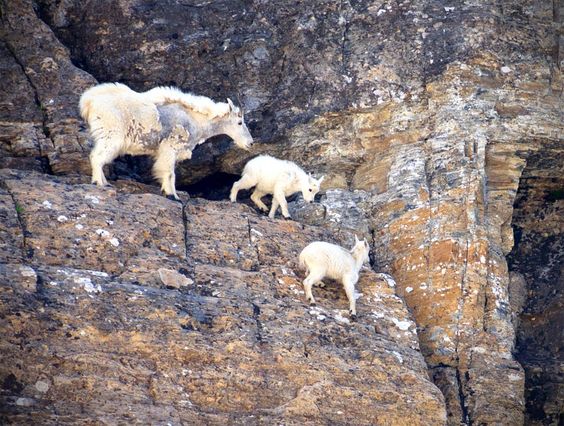
Consider, first, the agility of a mountain goat (Oreamnos americanus), the sure-hoofed bovid that habituates the heights of North America’s Rocky Mountains and Cascade Range.(2)
“For those of us who admit to some fear of heights, the Mountain Goat is an animal to be admired … This shaggy animal, its back hunched in a manner somewhat suggestive of a Bison, is a master at negotiating the steepest of precipices. Mountain Goats are truly alpine creatures. They commonly rest on high-elevation snowfields and find most of their food among the plants of alpine meadows. Their hooves are structured to [optimize] balance and grip; the outer hoof is strongly reinforced and the bottom is lined with rubbery material, making the whole structure rather like a good hiking boot. These animals nonchalantly cross dizzying ledges, sometimes even at a trot.”(3)
In fact, the high-altitude dexterity of the mountain goat is so phenomenal that it routinely spends most of its time on precipitous terrain steeper than a 40o angle, and sometimes at pitches steeper than 60o!, especially during winter.(4)
Furthermore, the leg bones of the mountain goat are engineered to maximize a functional mix of precision balancing (such as perching all four hooves on a small spot), front-forward pulling power, propulsion leverage and maneuverability (for running and jumping), and stability (due to a low center of gravity) against tipping over.(4)
“A mountain goat climbs with three-point suspension. … Lifting one limb at a time [it] frequently pauses to assess the situation, tests the footing, and if needed turns back and selects a different route. Slow, sure consistency allows life on rock steeper than the angle of repose. Because they are most likely the ones to find themselves in a tight spot, kids do most of the go-for-broke climbing. Although a kid might take four or five missteps per year, it salvages the situation almost every time.”(4)

Mountain Goat Kids Juming ©TMLee
Thus, the mountain goats are aptly designed for moving on rocky slopes. Mountain goats are instinctively careful, and they apply their characteristic agility, as they test their environment. (Indeed, when predatory cougars try to attack them, the God-given instinct of mountain goats to flee, successfully, is often implemented by their agility and speed in and up these jagged rocky slopes and precipices!)

But without the right physical traits for maintaining balance on rugged rocks—traits which God installed on Day 6 of Creation Week—mountain goats could not thrive, as they do, upon the harsh talus slopes and felsenmeer of their high-elevation habitat.
“The [mountain goat hoofprint] track’s squarish imprint is created by the hoof’s spreading tips. The sides of the toes consist of hard keratin, like that of a horse hoof. Each foot’s two wraparound toenails are used to catch and hold on to cracks and tiny knobs. … The front edge of the hoof tapers to a point, which digs into dirt or packed snow when [it] is going uphill. In contrast to a horse’s concave hoof, which causes the animal to walk on the rim of its toenail, a [mountain] goat’s hoof has a flexible central pad that protrudes beyond the nail. The pad’s rough texture provides [skid-resistant] friction on smooth rock or ice yet is pliant enough to impress itself into irregularities on a stone. Four hooves X 2 toes per hoof = 8 gripping soles per animal. As [mountain] goats descend a slope the toes spread widely, adjusting tension to fine-tune the grip. … This feature makes them more likely to catch onto something. It also divides the downward force of the weight on the hoof so that some of the animal’s total weight is directed sideways. Because there is less net force on each downward [pressure] line, the foot is less likely to slide. Think of it as the fanning out of downward forces over numerous points of friction.”(4)
In a word, BALANCE. God purposefully designed high-elevation mountain goats for balance, because living life among high alpine rocks is a high-risk lifestyle.

Yet the same is equally true to balancing religious liberty rights (and responsibilities) in American society. Legitimate needs of both “church” and “state” are deliberately balanced with the God-given personal liberty rights of individuals. Like a mountain goat perched atop a precarious precipice, safeguarding those God-given religious freedoms is no lackadaisical endeavor. The securing of those fundamental freedoms was not (and is not) easily obtained, nor is it easy to maintain those freedoms amidst the ubiquitously power-greedy politics of both “church” and “state”.(5)
In a word, the U.S. Constitution’s First Amendment is purposefully designed for BALANCE.
“Congress shall make no law respecting an establishment of religion, or prohibiting the free exercise thereof…”. (5)
It is to this legal text that the “separation of church and state” concept is frequently attached. However, not all opinions are equal, regarding what that phrase of 16 words (in the First Amendment) mean. Why? Because, as a matter of honesty and valid interpretation, the real meaning of any message must be matched to the message-composer’s intent.(6)
Thus, the only legitimate understanding of the First Amendment’s meaning is the understanding that matches the meaning assigned to it by the (human) source of its words.(5),(6),(7)

Yet, as a text drafted by statesmen of the late 1700s (principally by James Madison, who condensed an earlier version by George Mason), the authorial intent balanced a rejection of government-“established” church organizations, with affirmation of peaceful expression of individual religious beliefs and moral values.(6)
In other words, the First Amendment anticipated that Christians may freely express their religious viewpoints, at the personal level—yet Congress shall not officially endorse (“establish”) any specific ecclesiastical organizations, such as Baptists or Presbyterians or Anglicans or Methodists. This balancing of freedom and order—free exercise of religion, without any federal sponsorship of a particular religious denomination or hierarchy—fits the overall checks-and-balances equilibrium designed in 1791.(6)
“The real object of the First Amendment was not to countenance, much less to advance, Mohammedanism, or Judaism, or infidelity, by prostrating Christianity; but to exclude all rivalry among Christian sects, and to prevent any national establishment which should give to a [religious] hierarchy the exclusive patronage of the national government.”(8)
To put it mildly, this political balancing act is neither easily obtained nor easily maintained. But this balance was carefully planned for–intended—by America’s founding fathers. Yet now the phrase “separation of church and state” is used to force-fit an off-balanced understanding of the First Amendment. How did that happen?
In short, the constitutional jurisprudence of America became “evolutionized”, during the late 1800s, upsetting the proper balance between religious liberty and governmental interference.(5),(6),(7),(8),(9)
“Twentieth-century jurisprudence is based on a Darwinian world view. Life [supposedly] evolves, men [supposedly] evolve, society [supposedly] evolves, and therefore laws and constitutions [supposedly] evolve. According to the Darwinian principle, the Constitution’s meaning evolves and changes with time. … [Thus modern judges, implementing evolutionary humanism as jurists, my disagree about what a law “now means”] — But neither the majority nor the minority [of such evolutionary law judges] deny the basic evolutionary interpretation. They merely question at which stage of the evolutionary scale we are! This is not the way the founding fathers viewed constitutional interpretation. They saw the Constitution as the supreme law, and also as a covenant or contract. The Constitution like all legal documents was viewed as a fixed document, to be interpreted according to its plain meaning. And if its meaning was ambiguous as applied to a specific situation, it was to be interpreted according to the intent of those who wrote it, signed it, and ratified it. James Madison expressed this view when he wrote, ‘(If) the sense in which the Constitution was accepted and ratified by the Nation … be not the guide in expounding it, there can be no security for a faithful exercise of its powers’.”(9)
How evolutionary thinking infected American law will be reviewed, God willing, in a sequel to this introductory article.(10) Meanwhile, don’t believe it when someone tells you that the First Amendment “prohibits” an individual astronaut from reverently reading his Bible in space—or from sharing that personal fact via Facebook.(1)
And, as you appreciate the originally intended balance, designed in the First Amendment, don’t forget to thank God—for how He equipped agile mountain goats, to inhabit some of the most precarious places in the Rocky Mountains, as He exhibits (and we enjoy learning about) His creative glory and bioengineering genius.(2)
(1) On April 3rd of AD2016, via Facebook, U.S. astronaut Jeff Williams said: “We finally have a quiet Sunday and I’m reading, ‘The Earth is the LORD’s and all that fills it’ in Psalm 24 and viewing this sight [referring to photographs of Earth, seen from the International Space Station]. No matter how long you’re here [in space], the grandeur strikes and the wonder never fades.” To this posting a God-hating protest retorted, on Col. Jeff Williams’ Facebook page: “Jeff Williams could you please leave your personal religious views out of your public posts. You are a government employee. In America we have a separation of church and state. Don’t use your publicly funded position to promote personal views. Teachers shouldn’t and neither should astronauts. I enjoy the photos from space. I have followed astronauts photos for over two years without religious bias in the captions. Your post elevates (no pun intended) man’s divisiveness on Earth to Space. Please keep it private and keep posting these wonderful scientific pictures without the religious OPINIONS.”
(2) The rope-like “backbone” ridge chain of North America’s West is called the Western Cordillera. Included in its geographic system are the Rocky Mountains and the Cascade Range, the primary high-elevation range of most North American mountain goats. George Constanz, Ice, Fire, and Nutcrackers: A Rocky Mountain Ecology (Salt Lake City: University of Utah Press, 2014), page 215.
(3) John Kricher, A Field Guide to Rocky Mountain and Southwest Forests (Boston: Houghton Mifflin, 1998), pages 235-236. As illustrated in Job 39:1, Israel’s mountain goat is named for how this bearded climber masters its rocky alpine habitat: ya‘alê-sâla‘ literally means “ascender of cliff-rock”. See also Psalm 104:18a.
(4) Constanz, Rocky Mountain Ecology, pages 224-226, with quotes frompages 225-226.
(5) U.S. Constitution, First Amendment (Free Exercise and Establishment clauses), ratified 1791. The vast majority of the world’s nations prohibit the “free exercise” for religious liberty, either by establishing a specific religion to the prejudice of others, or by persecuting theistic religions in general. The most thorough historical analysis of the First Amendment is provided in Rector, etc., of Holy Trinity Church v. United States, 143 U.S. 457, 12 S.Ct. 511 (1892), by Justice David Josiah Brewer. To bypass the jurisprudential relevance, of the Holy Trinity Church ruling, is to demonstrate careless misunderstanding of what the First Amendment was originally designed (and originally used) to accomplish. The balancing of civil government powers, ordained by God’s delegation, with jurisdictional limits to facilitate religious freedom, accords with relevant Scriptures, e.g., Matthew 22:21; Romans 13:1-4; Daniel 2:21 & 4:25—and with Israel’s separation of religious offices (tribe of Levi) from the monarchy (tribe of Judah).
(6) George Mason’s religious liberty tenet, which he had drafted (12 years earlier) for the Virginia Declaration of Rights, became the precursor for Virginia’s proposal (to Congress) to approve a religious freedom amendment for the “new” Constitution: “That Religion or the Duty which we owe to our Creator, and the manner of discharging it, can be directed only by Reason and Conviction, not by Force or violence, and therefore all men have an equal, natural, and unalienable Right to the free Exercise of Religion according to the Dictates of Conscience, and that no particular religious Sect or Society of Christians ought to be favored or established by Law in preference to others.” Notably, the entire Bill of Rights (i.e., Amendments 1 through 10) limited federal government powers. Ironically, most of the Constitution’s later amendments have expanded those powers. John Eidsmoe, Institute on the Constitution: A Study on Christianity and the Law of the Land (Marlborough, NH: Plymouth Rock Foundation, 1995), pages 71-73. See also John Eidsmoe, Christianity and the Constitution: The Faith of our Founding Fathers (Grand Rapids: Baker Books, 1987), pages 77-178, especially pages 93-112. Ironically, Thomas Jefferson (author of the phrase “separation of church and state”) was undeniably absent—in France!—during the Constitution’s drafting and early ratification (which processes prompted the Bill of Rights amendments), so his opinion of the First Amendment’s “intent” is interpretatively irrelevant.
(7) Importantly, the First Amendment’s meaning is contextually blended to the axiological fabric of the Declaration of Independence (referring to our “Creator”, “Nature’s God”, “the Supreme Judge of the world”, and “Divine Providence”), and to the Christian worldview evidenced by the U.S. Constitution’s Article VII (which refers to Jesus Christ as “our Lord”).
(8) Eidsmoe, Institute on the Constitution, page 76, quoting Justice Joseph Story, Commentaries on the Constitution of the United States (Boston: Hilliard, Gray & Co., 1833), vol. II, page 593.
(9) John Eidsmoe, Christianity and the Constitution: The Faith of our Founding Fathers (Grand Rapids: Baker Books, 1987), pages 391-392, quoting James Madison.
(10) The evolutionary mantra-phrase, “natural selection”, promotes animistic powers to inanimate elements of “nature”, not dissimilar from the polytheistic nature-worship of the ancient pagans. See, e.g., James J. S. Johnson, “Norse and Germanic Mythology”, Chapter 14 in World Religions and Cults, Volume 2 (Green Leaf: Master Books, 2016, edited by Bodie Hodge & Roger Patterson), especially at pages 271-272 & 287-288. See also, accord, James J. S. Johnson, “How Can a Mechanical ‘Cardinal’ Make ‘Selections’?“. For a thorough analysis of this “bait-and-switch” tricky-terminology problem (of “science” falsely so-called), see generally Randy J. Guliuzza’s “Darwin’s Sacred Imposter: Natural Selection’s Idolatrous Trap“, Acts & Facts, 40(11):12-15 (November 2011).

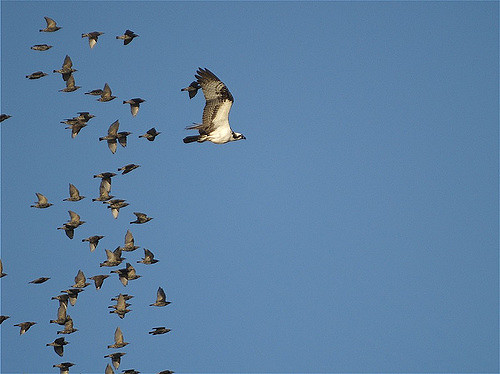
“He shall fly away as a dream, and shall not be found: yea, he shall be chased away as a vision of the night.” (Job 20:8)
Western Osprey Being Chased Away ©Flickr John Dunstan
*
*

“And they of Beth-Shemesh were reaping their wheat harvest in the valley: and they lifted up their eyes, and saw the ark, and rejoiced to see it.” (1st Samuel 6:13)
Flock of Birds In The Valley – Bird Garden in Ninh Binh ©Crossingtravel
*
*
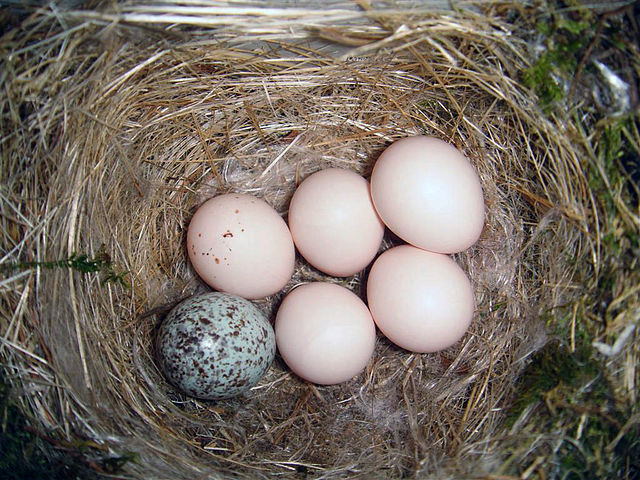
“And they said, “If ye send away the ark of the God of Israel, send it not empty; but in any wise return Him a trespass offering: then ye shall be healed, and it shall be known to you why His hand is not removed from you.” (1st Samuel 6:3)
Brown-headed Cowbird (Molothrus ater) Egg in Eastern Phoebe Nest ©WikiC
*
*
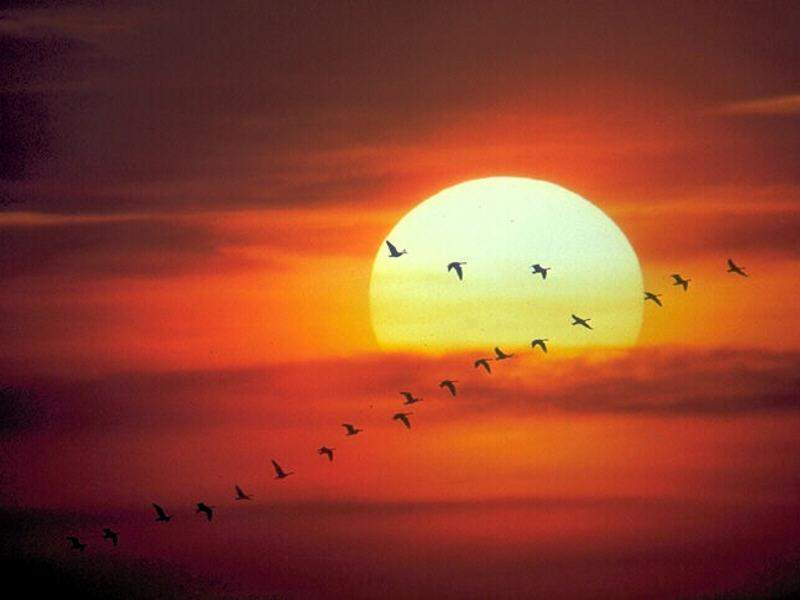
“And when they arose early on the morrow morning, behold, Dagon was fallen upon his face to the ground before the ark of the Lord; and the head of Dagon and both the palms of his hands were cut off upon the threshold; only the stump of Dagon was left to him. (1st Samuel 5:4)
Geese Flying Early in the Morning ©©
*
*
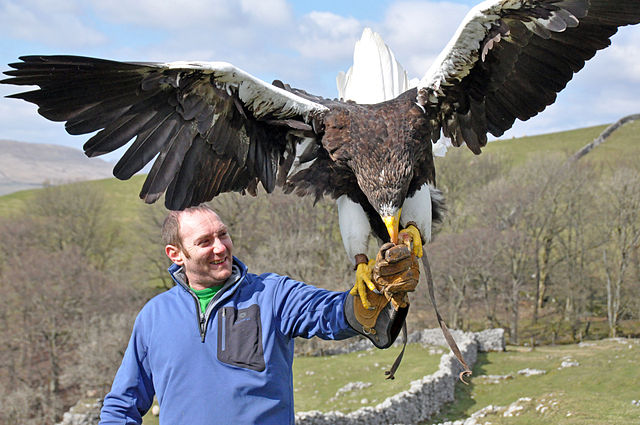
“With a strong hand, and with a stretched out arm: for his mercy endureth for ever.” (Psalms 136:12 KJV)
Steller’s Sea Eagle (Haliaeetus pelagicus) with Man ©WikiC
*

“And thou shalt teach them ordinances and laws, and shalt shew them the way wherein they must walk, and the work that they must do.” (Exodus 18:20)
Walking Chicks ©GettyImages
*
*
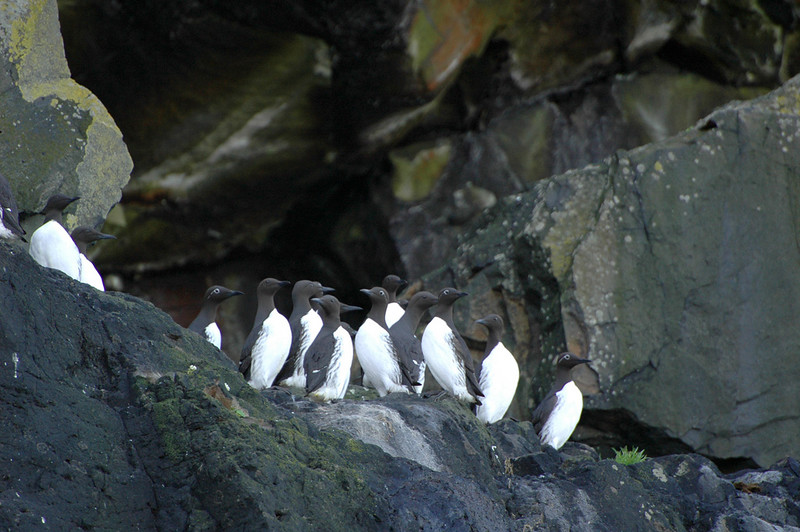
“The pride of thine heart hath deceived thee, thou who dwellest in the clefts of the rock, whose habitation is high; that saith in his heart, Who shall bring me down to the ground?” (Obadiah 1:3)
Black Guillemot (Cepphus grylle) by Bob-Nan
*
*

“ If thieves came to thee, if robbers by night, (how art thou cut off!) would they not have stolen till they had enough? If the grape-gatherers came to thee, would they not leave some grapes?“ (Obadiah 1:5)
White-fronted Amazon (Amazona albifrons) named Eugy, Eating Grapes ©WikiC
*
*
By James J. S. Johnson
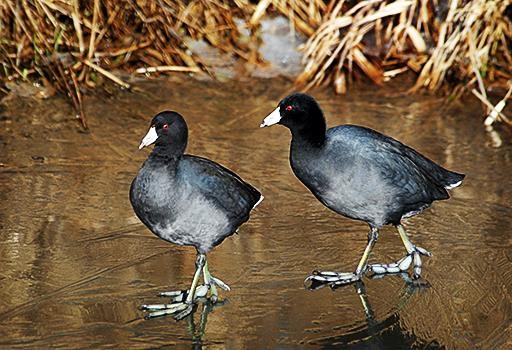
Coots on Ice ©FWS
For Thou hast delivered my soul from death; wilt not Thou deliver my feet from falling, that I may walk before God in the light of the living? Psalm 56:13
As the following study of the American Coot shows (which begins our review of birds having names that begin with “C”), God has employed creatively clever bioengineering into the form and function of American Coot feet. How much moreso, as creatures made in His image, should we appreciate His design-and-construction engineering genius, as it is displayed in our own feet and toes!
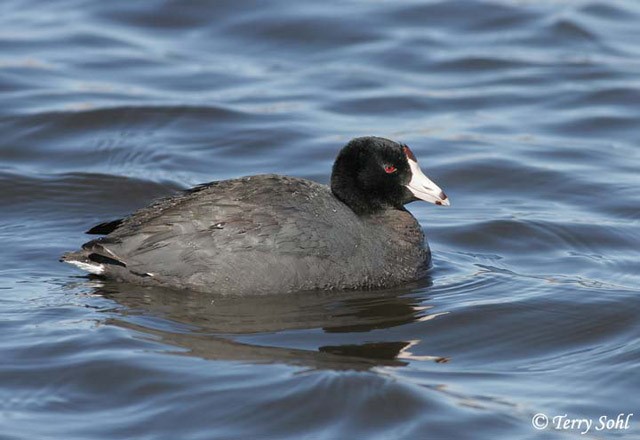
rican Coot (Fulica americana) © SDbirds-Terry Sohl
American Coot (Fulica americana)
As noted in the preceding “Part 1” of this series [see ], “C” is for as Cardinal, Chicken [regarding which fowl, see Flag That Bird – Part 1 ], Coot, Cormorant, Chicken, Coot, Chickadee, Caracara, Crane, Cuckoo, Curlew, and Corvid (including Crow and Chough) — plus many other birds with names that begin with the letter C!
In this “Part 2” review of “C” birds, however, the red-eyed American Coot (a/k/a marsh hen, mud hen, water hen, and poule d’eau, i.e., “water chicken”), as well as the crow-like birds that we collectively label as Corvids, will be featured.
Because the American Coot is a wetland “rail” (i.e., classified with the mostly-wetland-or-forest-associated birds, such as gallinules and crakes, that are “ground-living” – as opposed to dwelling in trees), it is often seen and appreciated by birdwatchers (like Chaplain Bob Webel, of St. Petersburg, and his wife, Marcia) who live at the vegetated edge of a freshwater lake or pond, or by brackish estuarial marshland or swampland.
“AMERICAN COOT (12 in. [or larger, with their plumage being mostly black or dark grey, depending upon lighting, and with white under-coverts and secondary wing feather-tips]) nests in marsh vegetation, but often winters in open water. It is the only ducklike bird with a chalky white bill [and that bill is triangular in shape, somewhat like that of a chicken’s beak]. When disturbed it either dives or skits over the water [like flapping, fluttering hovercraft!] with feet and wings. The closely related Common Moorhen (or Florida Gallinule, 10½ in. [what ornithologist Lee Dusing has nicknamed the “candy-corn bird”]) has a red bill and forehead and a white stripe under the wing. Both pump the neck when swimming.”
[Quoting Herbert S. Zim & Ira N. Gabrielson, Birds, A Guide to Familiar American Birds (New York, NY: Golden Press, 1987 rev. ed.), page 34.] As the youtube video-clip (below) shows, American Coots can skim and scoot across the surface of a lake or pond, flapping just over the water surface, when they want to move quickly.
Unlike ducks, however, the coot has no webbed feet.
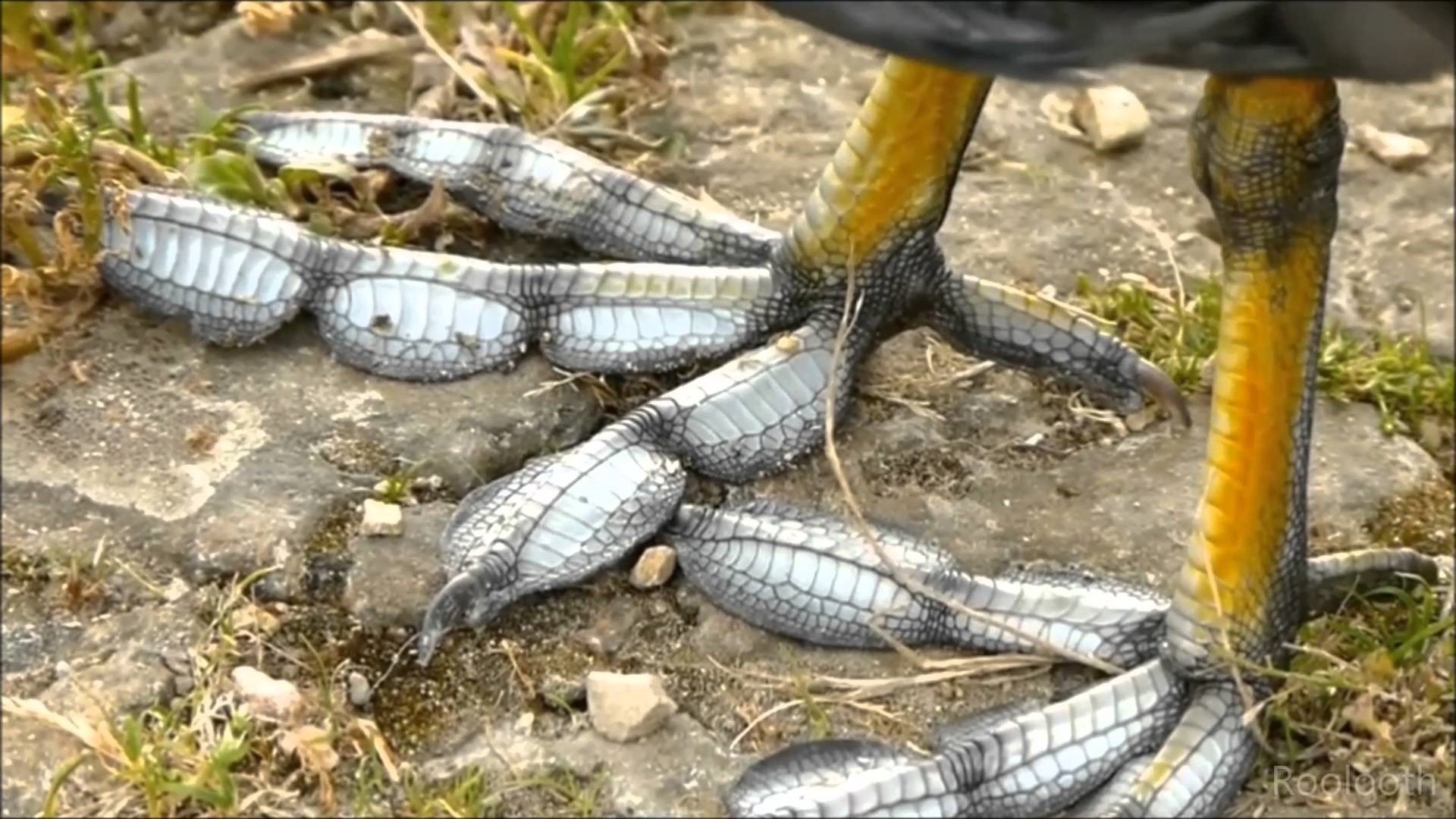
American Coot, showing off its cushion-padded toes ©i.ytimg
American Coot, showing off its cushion-padded toes
Rather, coots have long toes that sport broad lobes of skin, designed for kicking through the water, almost like synchronized mini-paddles. These conspicuously broad foot-lobes fold backward, when a coot walks on dry land, so the foot-lobes don’t interfere with the ground surface contact – yet the foot-lobes can be used to partially support the weight of the coot (by spreading body weight over a larger surface area, like snow-shoes) when the “mud hen” travels across mucky mud (or even on thin ice!).
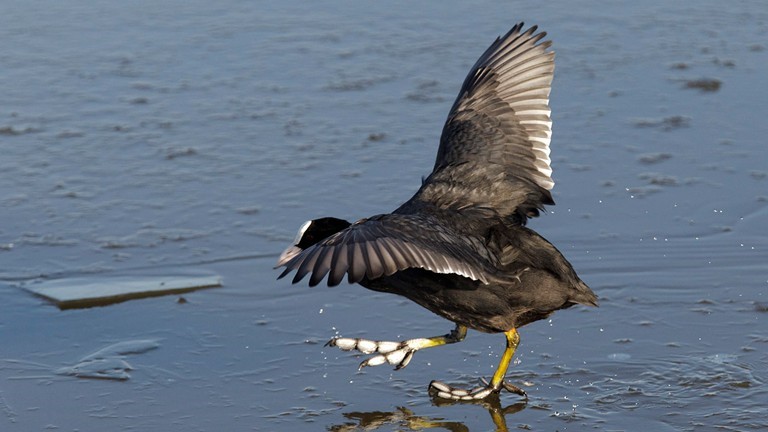
American Coot on Ice ©Graham Catley
American Coot on ice!
In other words, God designed coot feet to fit the wet habitats that they fill.
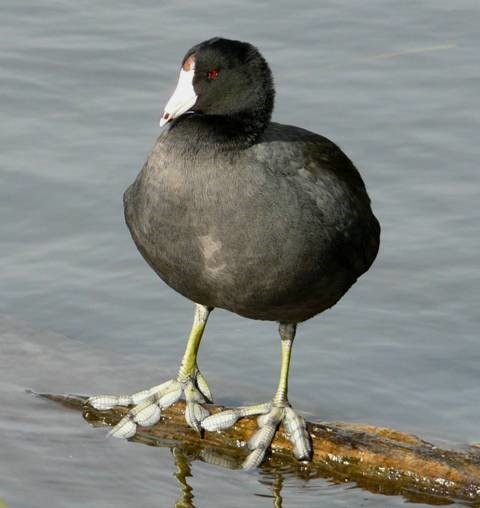
American Coot standing, showing broad-lobed toes ©Johnrakestraw
American Coot standing, showing broad-lobed toes
Coots are gregarious, “socializing” with themselves and with other waterfowl. IN particular, coots are share space, as they “fill” a wetland or aquatic habitat. Families of coots — or even larger groups of coots — often mixed with other waterfowl (like ducks) may compose a “raft” of hundreds or even thousands! [See, accord, American Coot entry at CORNELL LAB OF ORNITHOLOGY, “All About Birds”, with Herbert K. Job, BIRDS OF AMERICA (Doubleday, 1936), pages 214-215, both cited within Steve Bryant, “American Coot”, in OUTDOOR ALABAMA.

American Coot flock “rafting” ©ARKive-Jack Dermid
American Coot flock “rafting”
For a video clip featuring American Coots in action (in Florida), sometimes interacting quite boisterously, see https://www.youtube.com/watch?v=J5dPaWH785w . (Notice: this youtube footage also includes brief footage of a few other birds, so don’t be surprised when the first bird shown is a Florida Gallinule!)

American Coot ©OutdoorAlabamea-Terry Hartley
American Coot in water
It is interesting to note that the American Coot has a migratory range that covers almost all of North America, from Panama (in the south) through the more temperate zones of Canada (in the north). As is often the case, a helpful range map has been prepared by Terry Sohl, Research Physical Scientist with the U.S. Geological Survey, frequently publishing on topics of land usage, ecology, cartography, climatology, and geography, including biogeography. As Terry Sohl’s range map shows, this wetland bird is a permanent resident of America’s West and Southwest (west of the Mississippi River), a breeding resident of America’s northern prairie states, a nonbreeding resident of America’s Southeast and East Coast states, and a migrant in some parts of Appalachian Mountain range zones. [NOTE: the above-referenced Terry Sohl range map is not shown here, because Mr. Sohl, as a self-described “hardcore atheist”, does not want his maps associated with a Christian blogsite.]

American Coot, with young, eating aquatic plant ©Oiseaux-Tom Grey
American Coot, with young, eating aquatic plant.
So what do American Coots like to eat?
Mostly duckweeds and other wetland emergent plants (especially seeds and roots), lacustrine algae, small mollusks (like snails), little fish, tadpoles, and wee crustaceans, as well as a mix of aquatic bugs. [See, accord, Herbert S. Zim & Ira N. Gabrielson, Birds, A Guide to Familiar American Birds (New York, NY: Golden Press, 1987 rev. ed.), pages 134-135.]

American Coot ©iytimg
But American Coots are not the only common bird dominated by black plumage. Consider the common crow, or the raven — both of which belong to another group of “C birds”: CORVIDS, an amazingly intelligent group of crow-like songbirds, including the likes of crows, ravens, jackdaws, rooks, choughs, jays, treepies, magpies, and nutcrackers.
For a few examples, consider that Lars Jonsson’s BIRDS OF EUROPE (Princeton University Press, 1993), pages 487-495, includes the following corvids of Europe: Siberian Jay, Eurasian Jay, Spotted Nutcracker, Eurasian Magpie, Azure-winged Magpie, Alpine Chough, Red-billed Chough, Jackdaw, Common Raven, Brown-necked Raven, Fan-tailed Raven Carrion Crow, Hooded Crow, and Rook.
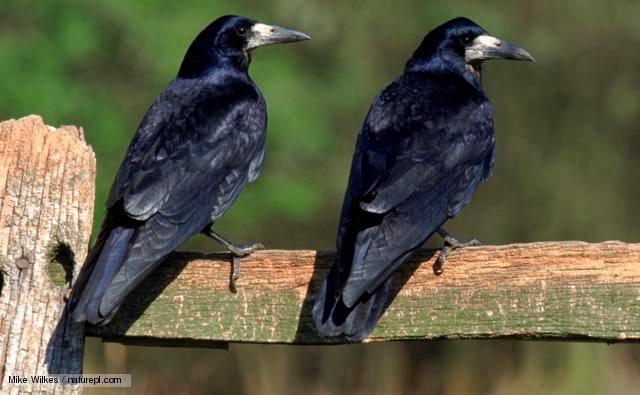
Rook (Corvus frugilegus) ©BBCI Mike Wilkes
Rook (Corvus frugilegus) pair, perching on wooden fence
In North America we can expect to find corvids quite terrific, ranging from the Atlantic to the Pacific: American crow, Northwestern Crow, Common Raven (including the subspecies “Western Raven”), Green Jay, Blue Jay, Steller’s jay, various scrub jays, Grey Jay, Black-billed Magpie, Yellow-billed Magpie, Yucatan Jay, Pinyon Jay, Clark’s Nutcracker, and more!

Raven ©Corvidresearch
For general information on corvids, see ornithologist Lee Dusing’s insightful birdwatching articles: “Corvidae — Crows, Jay”, listing more corvids that you or I will ever witness in this lifetime! — as well as Lee’s “Birds of the Bible – Raven I”, Lee’s “Birds of the Bible – Raven II”, and Lee’s “Birds of the Bible – Raven III”.

Corvid Chart – Differences Between Types of Corvids ©Autodidactintheattic
For some world history-linked appreciation of corvids (such as ravens, jackdaws, and magpies), see also 5 of my earlier articles:
“A Diet of Jackdaws and Ravens” [posted at https://leesbird.com/2015/09/16/a-diet-of-jackdaws-and-ravens/ ]; and
“Northern Raven and Peregrine Falcon: Two Birds Supporting the Manx Coat of Arms”; and
“Steller’s Jay: A Lesson in Choosing What is Valuable”; and
Flag That Bird Part 5, featuring the Australian Magpie; and
“Providential Planting: The Pinyon Jay”, CREATION EX NIHILO, 19(3):24-25, summer AD1997.
Of course, many books could be — and, in fact, have been — written about corvid birds. But this article is already long enough.
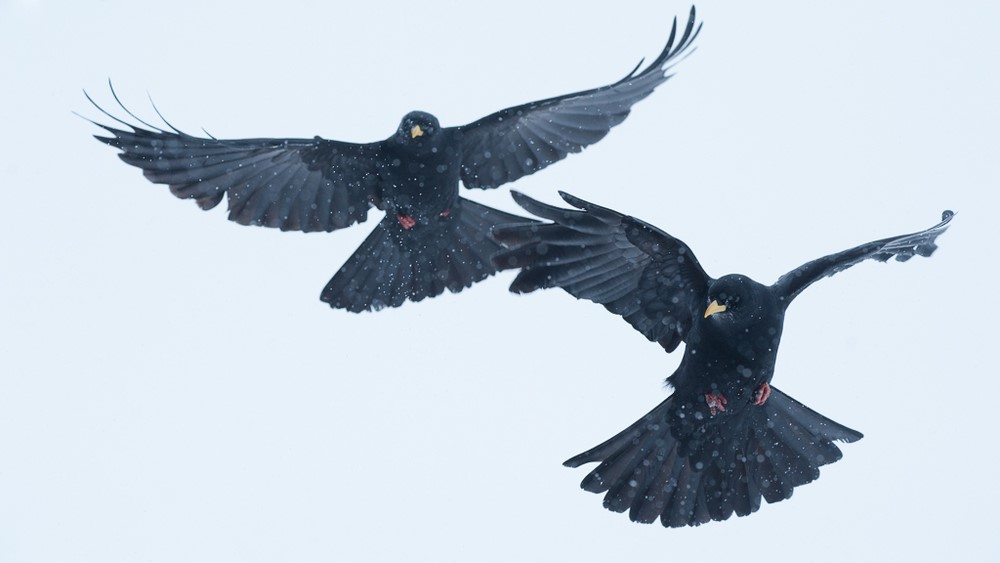
Alpine Chough ©Static1-Philip Braude
Alpine Chough, in snowy French Alps
So, God willing, the next contribution to this alphabetic series will be some “D“ birds – such as Dippers, Doves, and Ducks (including Dabblers and Divers). So stay tuned! ><> JJSJ
*
Lee’s Addition:
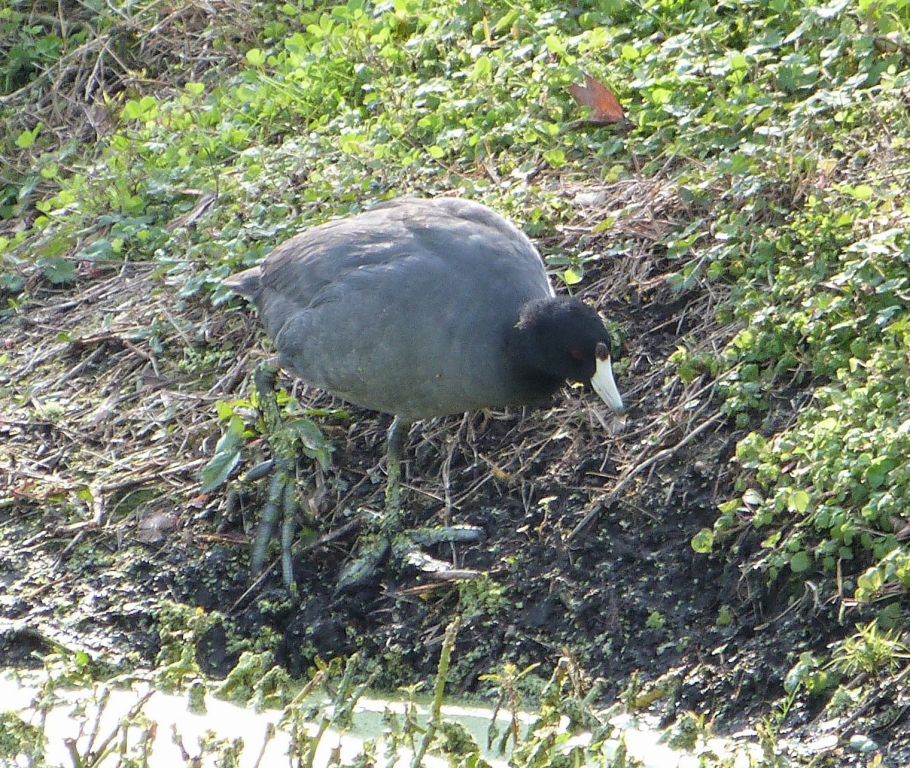
American Coot showing feet by Lee Lake Parker
Like Dr. Jim’s article above, I have also been fascinated by the feet of the American Coot. See Birdwatching Term – Lobed Feet and Birdwatching – American Coot where I have a video of one walking down to the shore. He almost steps on his own feet.
*

“And it was so, that, after they had carried it about, the hand of the Lord was against the city with a very great destruction: and He smote the men of the city, both small and great, and they had hemorrhoids in their secret parts.” (1st Samuel 5:9)
Red-winged Blackbird Mobbing ©AllAboutBirds
*
*
 Lee's Birdwatching Adventures Plus