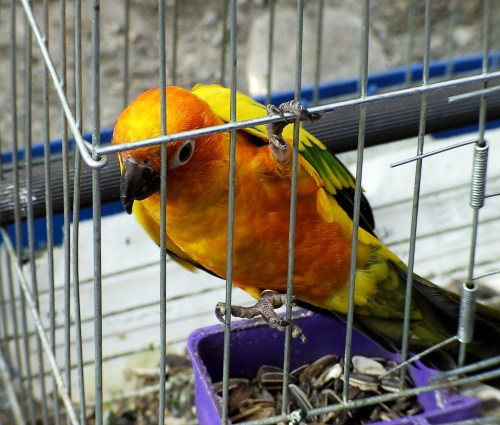
Bird in Cage ©WikiC
THE CAPTIVE’S ESCAPE.
(RELOCATED – CLICK HERE)

Red-necked Grebe (Podiceps grisegena) young on her wing ©USFWS
The LORD recompense thy work, and a full reward be given thee of the LORD God of Israel, under whose wings thou art come to trust. (Ruth 2:12 KJV)
While searching for “wing” or “wings” in my e-Sword, I discovered this really great verse. Let’s dig into it.
Searching further using “under” and “wing” here are a few more verses that sort of relate to the verse above:
Keep me as the apple of the eye, hide me under the shadow of thy wings, (Psalms 17:8 KJV)
How excellent is thy lovingkindness, O God! therefore the children of men put their trust under the shadow of thy wings. (Psalms 36:7 KJV)
He shall cover thee with his feathers, and under his wings shalt thou trust: his truth shall be thy shield and buckler. (Psalms 91:4 KJV)
Matthew 23:37 and Luke 13:34 mention being gathered under the wing, but they were not willing. Also, in Birds of the Bible – Under His Wing we covered. no pun intended, how birds protect their young under their wings and how God protects us. But the verse above seem to imply our trust.
What is being trusted? Boaz is implying that Ruth is trusting in the “LORD God of Israel.” She is from another country, another culture and religious way of life, but has turned her trust over to the LORD. That is something I did personally way back in 1960. I put my trust in the Lord to be my personal Savior. It was the best decision of my life.

Storks Shadowing Baby in Lakeland by Dan
In the Psalms verses, we can know that the Lord keeps His Eye on His own and we should desire to be the “apple of the eye.” Notice in the other verses that while we are under the wings we are trusting. Who? The Lord or LORD. Why do we trust? Wow! Look around at all the Lord has done just in creation and care of the birds. How about our care? We know through promises all through the Word of God that He cares for us. We know He doesn’t lie or do things for our harm. We also know that He is just and will give judgment when needed. We could go on and on, but you can also see that the Lord Jesus Christ is “trustworthy.”

Baby Chick Peeping Out From Under His Mom’s Wing – ©©
We know the birds trust their parents to protect them while they are under their wings. Should we not trust the Savior while we are under His wings?
Here is a quote from the Believer’s Bible Commentary:
“2:4-12 When Boaz arrived from Bethlehem, he asked the identity of the young woman. Learning that she was Naomi’s daughter-in-law, he cordially invited her to continue gleaning in his fields and to share the water provided for his workers. In praising her for the loyal and selfless step that she had taken, Boaz concluded with a little prayer for her:
The LORD repay your work, and a full reward be given you by the LORD God of Israel, under whose wings you have come for refuge (v. 12).
Leon Morris comments:
In due course, the prayer was answered through him who uttered it. He recognizes the religious aspect of Ruth’s change of country by saying that she has come to trust (AV) under Yahweh’s wings. The imagery is probably that of a tiny bird struggling under the wings of a foster-mother. It gives a vivid picture of trust and security. . . .
From J. Vernon McGee:
“She had come to trust the Lord God. This is the reason she had left the land of Moab and made that radical decision. She had said that the God of Naomi would be her God. She had turned from idolatry to the living and true God. This woman has come to trust God; she was one of His children. Therefore this is the wonderful testimony that she had there in the land of Israel. And Boaz says, “May a full reward be given to you. May you be recompensed for this decision.”
From Matthew Henry:
“(5.) He (Boaz) prayed for her (Ruth_2:12): The Lord recompense thy work. Her strong affection to the commonwealth of Israel, to which she was by birth an alien, was such a work of the divine grace in her as would certainly be crowned with a full reward by him under whose wings she had come to trust. Note, Those that by faith come under the wings of the divine grace, and have a full complacency and confidence in that grace, may be sure of a full recompense of reward for their so doing. From this expression, the Jews describe a proselyte to be one that is gathered under the wings of the divine majesty.”
From John Gill’s Exposition:
“under whose wings thou art come to trust; whom she professed to be her God, and whom she determined to serve and worship; whose grace and favour she expected, and to whose care and protection she committed herself: the allusion is either to fowls, which cover their young with their wings, and thereby keep them warm and comfortable, and shelter and protect them, see Psa_36:7 or to the wings of the cherubim overshadowing the mercy seat, Exo_25:20 and the phrase is now adopted by the Jews to express proselytism; and so the Targum here,”thou art come to be proselyted, and to be hid under the wings of the Shechinah of his glory,”or his glorious Shechinah.”
My all time favorite photo showing this:
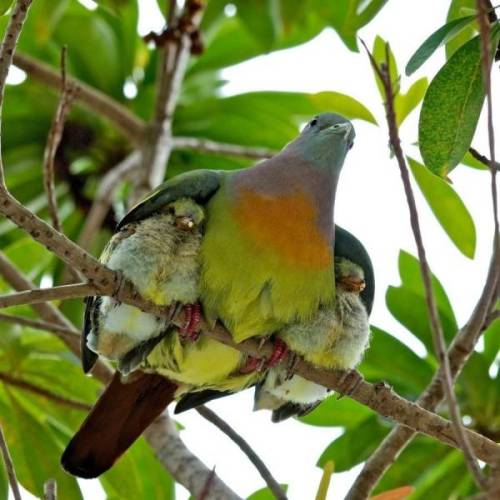
Under His Wings – by Ric Seet
Other Articles to check out:
*
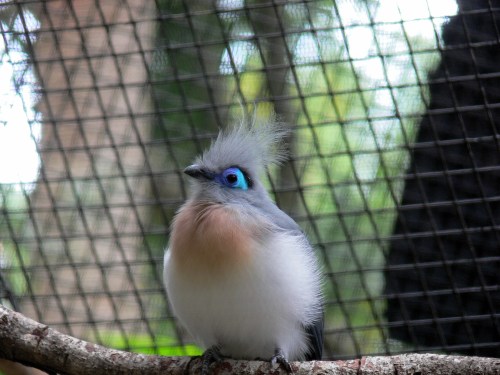
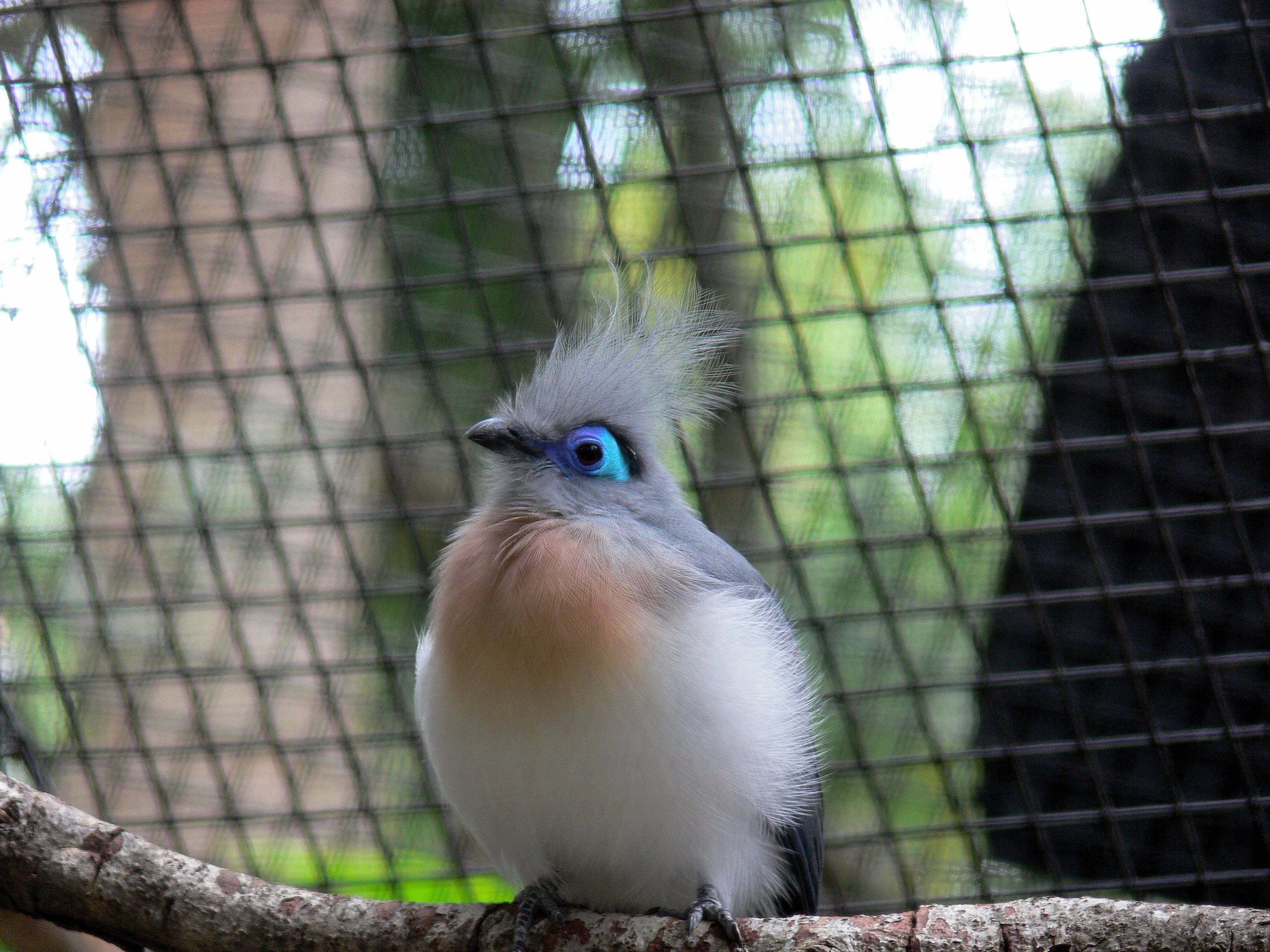
Crested Coua (Coua cristata) by Lee Lowry Park Zoo
And the owl, and the night hawk, and the cuckow, and the hawk after his kind, (Leviticus 11:16 KJV)
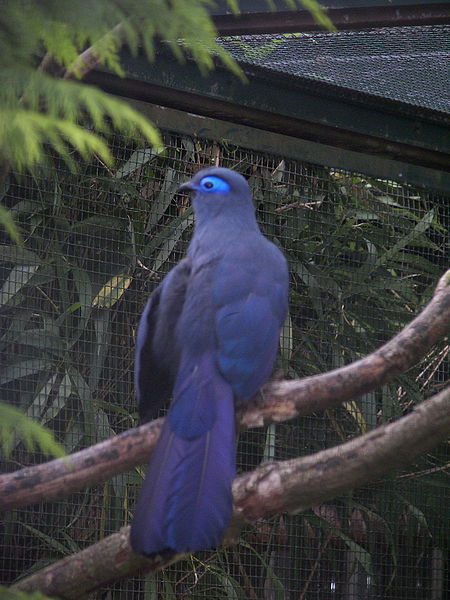
What an interesting Family to which the Cuckoo belongs. Having posted Ian’s Bird of the Week – Little Bronze Cuckoo yesterday, I worked on the Cuckoo – Cuculidae Family to find some more photos. There are a few missing photos, but some of them are of endangered or rarely seen birds. There are some interesting species and some beautiful one also. The Coua genus have the most beautiful eyes. They remind me of the Egyptian Eyes on statues and paintings. We get to see the Crested Coua every time we go over to the Lowry Park Zoo in Tampa. We have to photograph through the mesh, but this one of my better attempts. (See Above) Click through these links and you will see some of the Lord’s Creative Hand at work.
Crested Coua (Coua cristata) by Lee at LowryPkZoo – *LLABS*
Verreaux’s Coua (Coua verreauxi) IBC
Blue Coua (Coua caerulea) ©WikiC
Red-capped Coua (Coua ruficeps) IBC
Red-fronted Coua (Coua reynaudii) IBC
Coquerel’s Coua (Coua coquereli) IBC
Running Coua (Coua cursor) IBC
Giant Coua (Coua gigas) WikiC
Red-breasted Coua (Coua serriana) IBC
Aren’t they amazing? Wow! At least I think they are.
In Birds of the Bible – Cuckoo II it was explained how Leviticus 11:16 and Deuteronomy 14:15 uses Cuckow, Cuckoo, Sea-gull, Sea-hawk in the different versions. I have since added several more Bible Translations to my e-Sword program, so lets see if anything new shows up. The “cuckow” is in the AKJV, “sea gull” in the AMP, the “coockowe” in the Bishops, CJB calls it the “seagull”, Geneva has “seameaw”, the Tyndale calls it a “cocow” and UKJV the “cuckoo.” Seems that it is still split between the same birds. Thus they get to be one of our Birds of the Bible to study.
As mentioned before, it gives us a chance to learn about the many birds that we are blessed with and a reason to concentrate on this family. Notice that both references mention after their kind:
And the owl, and the night hawk, and the cuckow, and the hawk after his kind, (Deuteronomy 14:15 KJV)
The whole family of the Cuculidae includes not only the Cuckoo, but also the Ani, Roadrunner, Ground, Bronze, Coucal, Coua, Malkoha, Koel, Bronze Cuckoo, Long-tailed Cuckoo, Hawk-Cuckoo, Drongo-Cuckoo, and Lizard Cuckoos. Most in America are familiar with the Roadrunner if by no other way than by Wile E Coyote who is always chasing the Roadrunner in the Looney Tune Cartoons.

Wile E Coyote – Looney Tunes ”©WikiC

Roadrunner – Looney Tunes ”©WikiC
Here is a real Roadrunner:
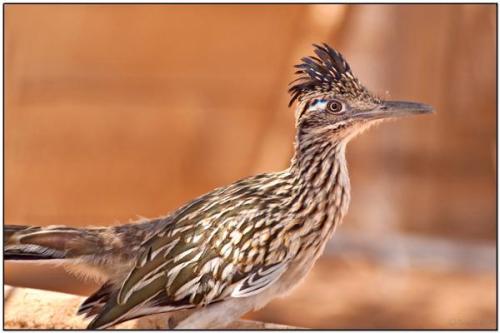
Greater Roadrunner (Geococcyx californianus) by Daves BirdingPix
Notice the Eyes even on a Roadrunner. Roadrunners are fast-running birds that have long tails and a crests. The birds are found in southwestern United States and Mexico. They range from 18-22 in. (46-56 cm) from the beak to the tail. Speeds of up to 20 miles per hour (32 km/h) have been reported. They can fly, but prefer to sprint instead.
More about this family later. Thought you might enjoy seeing some more of our Birds of the Bible that are here to enjoy and be blessed by from the Hand of the Lord.
See also:
*

Green-headed Tanager (Tangara seledon) by Dario Sanches
I deleted this info because it was out of date and causing 404 errors. See
for most upto date links.
O LORD, our Lord, How excellent is Your name in all the earth, Who have set Your glory above the heavens! … When I consider Your heavens, the work of Your fingers, The moon and the stars, which You have ordained, What is man that You are mindful of him, And the son of man that You visit him? For You have made him a little lower than the angels, And You have crowned him with glory and honor. You have made him to have dominion over the works of Your hands; You have put all things under his feet, All sheep and oxen— Even the beasts of the field, The birds of the air, And the fish of the sea That pass through the paths of the seas. O LORD, our Lord, How excellent is Your name in all the earth! (Psalms 8:1-9 NKJV)
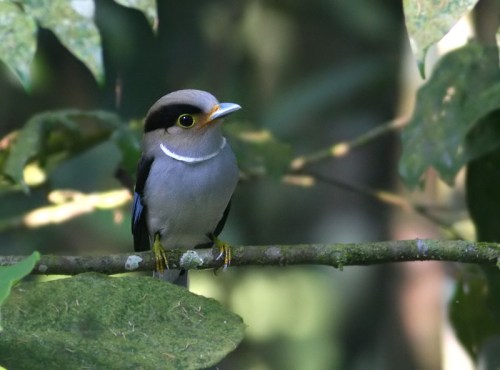
Silver-breasted Broadbill (Serilophus lunatus) by Peter Ericsson
See:
*
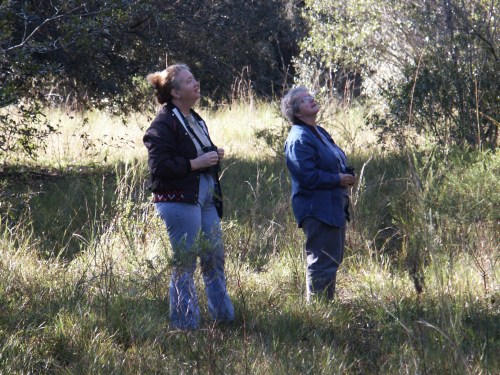
Marian (Naturalist at Avon Park Range) and Lee 2004
I beseech you therefore, brethren, by the mercies of God, that you present your bodies a living sacrifice, holy, acceptable to God, which is your reasonable service. And do not be conformed to this world, but be transformed by the renewing of your mind, that you may prove what is that good and acceptable and perfect will of God. (Romans 12:1-2 NKJV)
Well here we are at the end of 2012 and the beginning of 2013. Wow! What a fast year, now we get to renew ourselves and start afresh with a new list of birds for the year.
What will it be? The first one you sight. Will it be an old familiar friend or something new to you? Let us know what you see. Please leave a comment and tell us your first bird of 2013. You might even tell us your last bird of 2012. As I write this, it is only 9:00 am on Dec 31st, but some of you around the world are all ready celebrating the new year.
When you leave your bird sighted, tell us at least where you are, even if it is only your country. If you don’t see Comments on the page, click the Leave a Comment at the end of the article and it will take you to the full article.
I am excited to read about your first (and last) birds from around the world. I will post mine as soon as I spot them in the morning.
*
The WordPress.com stats helper monkeys prepared a 2012 annual report for this blog. (Lee’s Birdwatching Adventures Plus)

Here’s an excerpt:
About 55,000 tourists visit Liechtenstein every year. This blog was viewed about 380,000 times in 2012. If it were Liechtenstein, it would take about 7 years for that many people to see it. Your blog had more visits than a small country in Europe!
Click here to see the complete report.
Wow! Thank you all for coming to visit the blog this year!
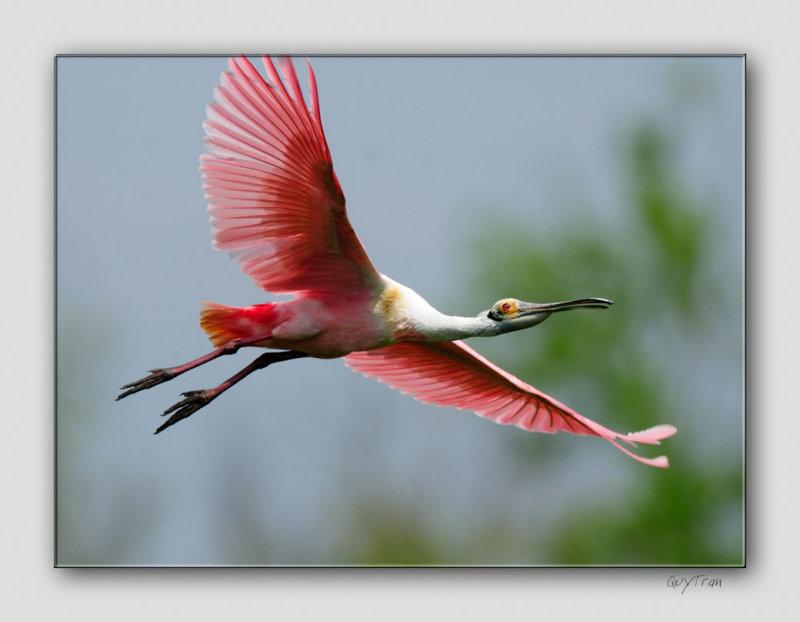
Roseate Spoonbill (Platalea ajaja) by Quy Tran
The Roseate Spoonbill is a member of the Threskiornithidae – Ibises, Spoonbills Family. We see them quite often in this area, especially in the Fall and Winter time. I am always thrilled when we come upon them in our birdwatching adventures. Their cousins, Ibises, are a Bird of the Bible.
Then God said, “Let the waters abound with an abundance of living creatures, and let birds fly above the earth across the face of the firmament of the heavens.” So God created great sea creatures and every living thing that moves, with which the waters abounded, according to their kind, and every winged bird according to its kind. And God saw that it was good. And God blessed them, saying, “Be fruitful and multiply, and fill the waters in the seas, and let birds multiply on the earth.” So the evening and the morning were the fifth day. (Genesis 1:20-23 NKJV)
Since the Lord created all the birds, this is one of His neater creations, at least in my opinion. Their spoon-shaped bill is sort of unique to the birds. There are actually five other Spoonbills besides the Roseate.
The Roseate Spoonbill is 28–34 in (71–86 cm) long, with a 47–52 in (120–133 cm) wingspan and a weigh 2.6–4.0 lb (1.2–1.8 kg). The legs, bill, neck and spatulate bill all appear elongated. Adults have a bare greenish head (“golden buff” when breeding) and a white neck, back, and breast (with a tuft of pink feathers in the center when breeding), and are otherwise a deep pink. The bill is grey. There is no significant sexual dimorphism.
Like the American Flamingo, their pink color is diet-derived, consisting of the carotenoid pigment canthaxanthin. Another carotenoid, astaxanthin, can also be found deposited in flight and body feathers. The colors can range from pale pink to bright magenta, depending on age and location. Captive Spoonbill are fed their normal diets, plus some include juices made from carrots.
Unlike herons, spoonbills fly with their necks outstretched. They alternate groups of stiff, shallow wingbeats with glides.
Spoonbills feeding in a pond by the school. Cloudy day. Not the best, but you can see their eating behavior. Taken by me.
This species feeds in shallow fresh or coastal waters by swinging its bill from side to side as it steadily walks through the water, often in groups. The spoon-shaped bill allows it to sift easily through mud. It feeds on crustaceans, aquatic insects, frogs, newts and very small fish ignored by larger waders. In the United States a popular place to observe Roseate Spoonbills is “Ding” Darling National Wildlife Refuge in Florida. (Also at Circle B Bar Reserve as you can see by the list below of some of my sighting on e-Bird) Roseate Spoonbills must compete for food with Snowy Egrets, Great Egrets, Tricolored Herons, and American White Pelicans.
We came upon a group of them roosting at Ding” Darling National Wildlife Refuge. It was the first time I had seen that many in one place and so close to us.

Roseate Spoonbills at Ding Darling NWR – Dan at work.
The Roseate Spoonbill nests in shrubs or trees, often mangroves, laying 2 to 5 eggs, which are whitish with brown markings. Immature birds have white, feathered heads, and the pink of the plumage is paler. The bill is yellowish or pinkish.
Here is one I caught in a tree at Circle B Bar Reserve:
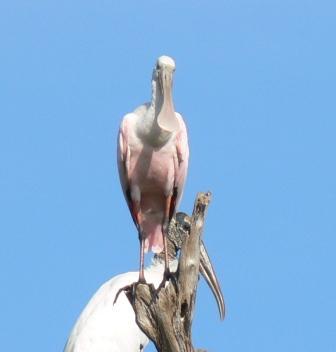
Roseate Spoonbill and Wood Stork by Lee
What prompted writing about one of the bird friends I always enjoy seeing, is an article about the Roseate Spoonbill in one of my latest additions of BirdWatching. It’s a great magazine and I am not condemning it. I am used to “reading around the evolutionary influences” in articles about birds. But I was offended by this remark, “It’s hard not to look at the Roseate Spoonbill in the Everglades and think, ‘What happened here:’ Amid the herons and cormorants, the spoonbill seems like an evolutionary hiccup, a failed experiment.”
One, the Roseate Spoonbill is far from an “evolutionary hiccup!” It hasn’t evolved, it was created by a loving all knowing Creator, that knew exactly what He was doing. Two, it definitely was not a “failed experiment.” The way the bill is designed and the sensitivity of its touch is amazing. The Lord promised to provide for all His creatures as well as His own people. Nor are we “hiccups.” We are all created by him, but there are differences and varieties in the birds just as there is in our talents and abilities.
I know all the birds of the mountains, And the wild beasts of the field are Mine. (Psalms 50:11 NKJV)
Look at the birds of the air, for they neither sow nor reap nor gather into barns; yet your heavenly Father feeds them. Are you not of more value than they? (Matthew 6:26 NKJV)
All the birds of the heavens made their nests in its boughs; Under its branches all the beasts of the field brought forth their young; And in its shadow all great nations made their home. (Ezekiel 31:6 NKJV)
(Wikipedia and other internet resources consulted)
See:
Birds of the Bible – Isaiah 34:11
Birds of the World – Threskiornithidae – Ibises, Spoonbills
| Location | Date | ||
| 1 | Roseate Spoonbill | Corpus Christi | 8-Nov-01 |
| 2 | Roseate Spoonbill | Circle B Bar Reserve | 9-Feb-07 |
| 3 | Roseate Spoonbill | Viera Wetlands | 20-Nov-07 |
| 4 | Roseate Spoonbill | Merritt Island NWR–Black Point Wildlife Dr. | 22-Nov-07 |
| 5 | Roseate Spoonbill | Circle B Bar Reserve | 10-May-08 |
| 6 | Roseate Spoonbill | Lake John Rookery | 15-May-08 |
| 7 | Roseate Spoonbill | J. N. Ding Darling NWR | 15-Jul-08 |
| 8 | Roseate Spoonbill | Circle B Bar Reserve | 1-Nov-08 |
| 9 | Roseate Spoonbill 6 | Circle B Bar Reserve | 28-Nov-08 |
| 10 | Roseate Spoonbill 16 | Merritt Island NWR–Black Point Wildlife Dr. | 20-Jan-09 |
| 11 | Roseate Spoonbill 3 | Circle B Bar Reserve | 24-Feb-09 |
| 12 | Roseate Spoonbill 4 | Circle B Bar Reserve | 10-Mar-09 |
| 13 | Roseate Spoonbill 15 | Circle B Bar Reserve | 24-Oct-09 |
| 14 | Roseate Spoonbill 15 | Circle B Bar Reserve | 23-Dec-09 |
| 15 | Roseate Spoonbill 5 | Hillsborough | 4-Feb-10 |
| 16 | Roseate Spoonbill 1 | MacDill AFB | 31-Jan-11 |
| 17 | Roseate Spoonbill 1 | Lake Parker Park | 7-Jan-12 |
| 18 | Roseate Spoonbill 3 | Circle B Bar Reserve | 16-Jan-12 |
| 19 | Roseate Spoonbill 2 | Picnic Island Beach | 24-Jan-12 |
| 20 | Roseate Spoonbill 1 | Lake Hollingsworth | 26-Jan-12 |
| 21 | Roseate Spoonbill 3 | MacDill AFB | 16-Aug-12 |
| 22 | Roseate Spoonbill 3 | Circle B Bar Reserve | 10-Nov-12 |
*
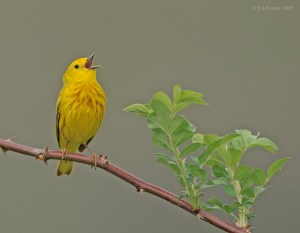
American Yellow Warbler (Dendroica aestiva) singing by J Fenton
My lips shall greatly rejoice when I sing unto thee; and my soul, which thou hast redeemed. (Psalms 71:23 KJV)
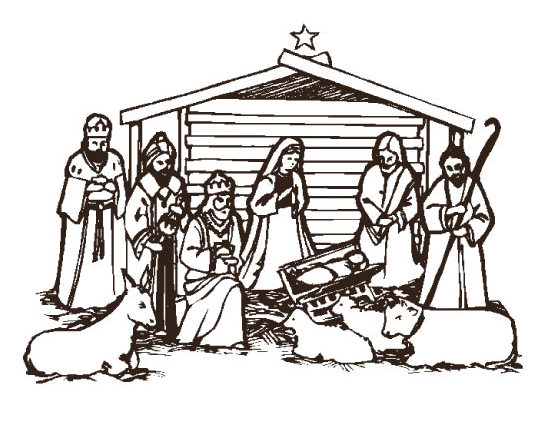
Birds in Christmas Hymns
Words by Henry J. van Dyke, 1907. Van Dyke wrote this hymn while staying at the home of Harry A. Garfield at Williams College, Massachusetts. It was first published in the Presbyterian Hymnal in 1911. It also appeared in the Poems of Henry van Dyke, 1911. Van Dyke wrote:
“These verses are simple expressions of common Christian feelings and desires in this present time—hymns of today that may be sung together by people who know the thought of the age, and are not afraid that any truth of science will destroy religion, or any revolution on earth overthrow the kingdom of heaven. Therefore this is a hymn of trust and joy and hope.”
Music: Hymn to Joy, from the 9th Symphony of Ludwig van Beethoven; adapted by Edward Hodges, 1824
Joyful, Joyful, We Adore Thee
Joyful, joyful, we adore Thee, God of glory, Lord of love;
Hearts unfold like flowers before Thee, opening to the sun above.
Melt the clouds of sin and sadness; drive the dark of doubt away;
Giver of immortal gladness, fill us with the light of day!
All Thy works with joy surround Thee, earth and heaven reflect Thy rays,
Stars and angels sing around Thee, center of unbroken praise.
Field and forest, vale and mountain, flowery meadow, flashing sea,
Singing bird and flowing fountain call us to rejoice in Thee.
Thou art giving and forgiving, ever blessing, ever blessed,
Wellspring of the joy of living, ocean depth of happy rest!
Thou our Father, Christ our brother, all who live in love are Thine;
Teach us how to love each other, lift us to the joy divine.
Mortals, join the happy chorus, which the morning stars began;
Father love is reigning o’er us, brother love binds man to man.
Ever singing, march we onward, victors in the midst of strife,
Joyful music leads us sunward in the triumph song of life.
*
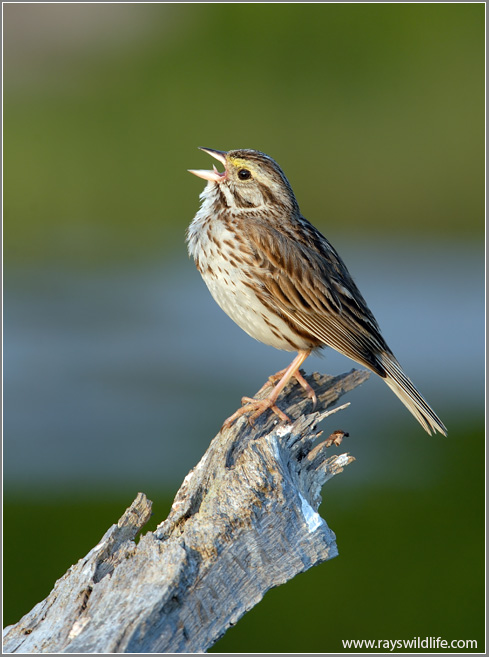
Savannah Sparrow singing by Ray
More Birds in Hymns
See ~ Christmas Gospel Presentation
Most information from The Cyber Hymnal – Joyful, Joyful, We Adore Thee
*

Red-eyed Vireo (Vireo olivaceus) ©WikiC in nest
Who, being in the form of God, thought it not robbery to be equal with God: But made himself of no reputation, and took upon him the form of a servant, and was made in the likeness of men: (Philippians 2:6-7 KJV)
Words by Emily E. Elliott, 1864. This hymn was first used at St. Mark’s Church in Brighton, England, where Elliott’s father was rector. In 1870, it was published in the Church Missionary Juvenile Instructor, which Elliott edited.
Music: Margaret, Timothy R. Matthews, 1876
Birds in Christmas Hymns
Thou Didst Leave Thy Throne
Thou didst leave Thy throne and Thy kingly crown,
When Thou camest to earth for me;
But in Bethlehem’s home was there found no room
For Thy holy nativity.
Refrain
O come to my heart, Lord Jesus,
There is room in my heart for Thee.
Heaven’s arches rang when the angels sang,
Proclaiming Thy royal degree;
But of lowly birth didst Thou come to earth,
And in great humility.
Refrain
O come to my heart, Lord Jesus,
There is room in my heart for Thee.
The foxes found rest, and the birds their nest
In the shade of the forest tree;
But Thy couch was the sod, O Thou Son of God,
In the deserts of Galilee.
Refrain
O come to my heart, Lord Jesus,
There is room in my heart for Thee.
Thou camest, O Lord, with the living Word,
That should set Thy people free;
But with mocking scorn and with crown of thorn,
They bore Thee to Calvary.
Refrain
O come to my heart, Lord Jesus,
There is room in my heart for Thee.
When the heavens shall ring, and the angels sing,
At Thy coming to victory,
Let Thy voice call me home,
Saying Yet there is room,
There is room at My side for thee.
My heart shall rejoice, Lord Jesus,
When Thou comest and callest for me.
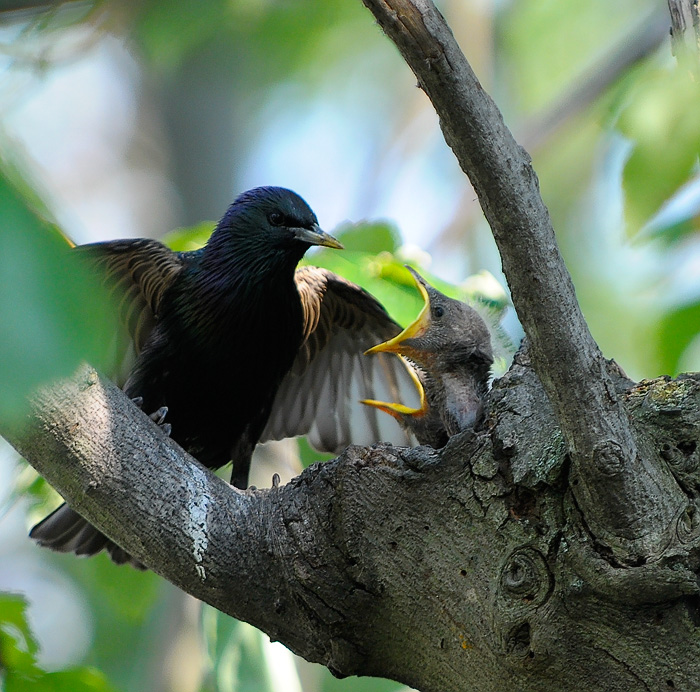
Protection and feeding at the nest by Anthony
Emily E. Elliott (1836-1897) – Emily’s father was Edward Bishop Elliott, Rector of St. Mark’s Church in Brighton, and her aunt was hymnist Charlotte Elliott. For six years, Emily served as editor of The Church Missionary Juvenile Instructor.
Timothy R. Matthews (1826-1910) – Son of the rector of Colmworth, Matthews attended the Bedford Grammar School and Gonville and Caius College, Cambridge (MusB 1853). Ordained the same year, he became private tutor to the family of Rev. Lord Wriothesley Russell, a canon of St. George’s Chapel, Windsor Castle, where he studied under the organist, George Elvey, subsequently a lifelong friend.
Matthews served as Curate (1853-1859) and Curate-in-Charge (1859-1869) of St. Mary’s Church, Nottingham. During this time he founded Nottingham’s Working Men’s Institute. In 1869, he became Rector at North Coates, Lincolnshire. He retired in 1907 to live with his eldest son at Tetney vicarage.
Matthews edited the North Coates Supplemental Tune Book and The Village Organist. He composed Morning and Evening Services, chants and responses, and earned a reputation for simple but effective hymn tunes, writing over 100. William Howard requested six tunes from him for a children’s hymnal, and Matthews completed them within a day. Matthews also composed a Christmas carol and a few songs. His sons Norton and Arthur Percy were also known as hymn tune composers.
*
More Birds in Hymns
See ~ Wordless Birds
Most information from The Cyber Hymnal – Thou Didst Leave Thy Throne
*
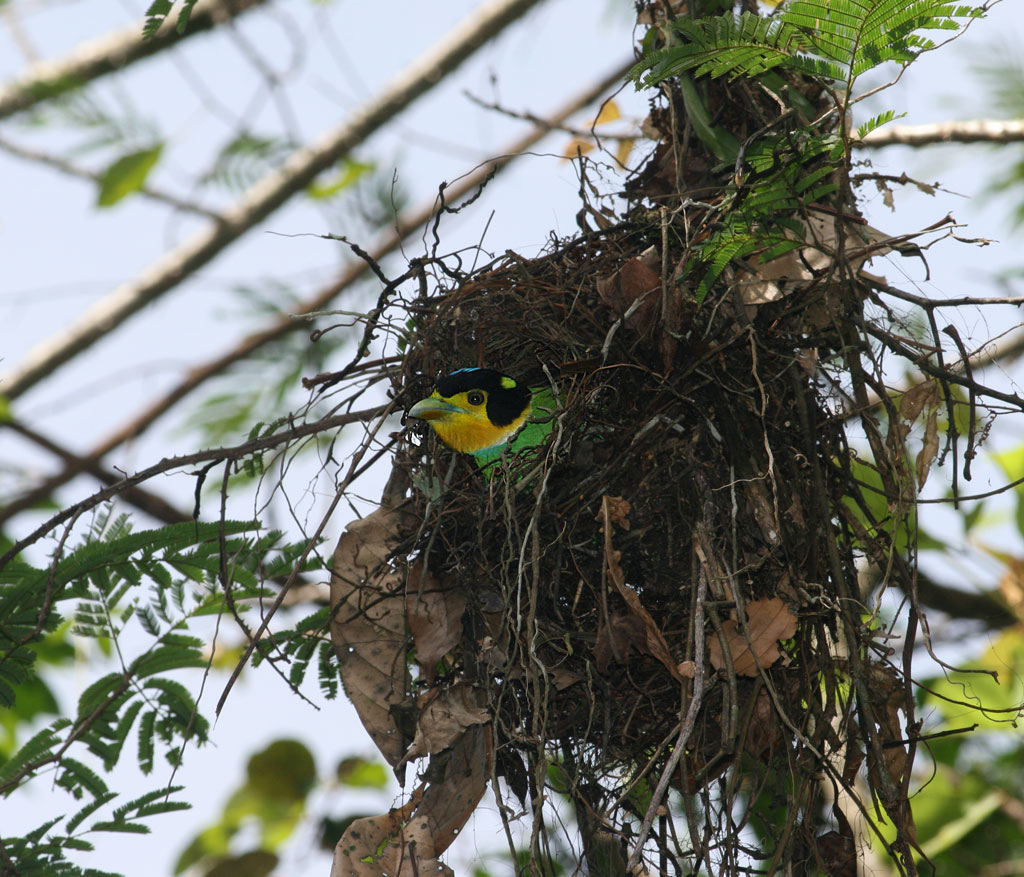
Long-tailed Broadbill (Psarisomus dalhousiae) in nest by Peter Ericsson
And when they were come into the house, they saw the young child with Mary his mother, and fell down, and worshipped him: and when they had opened their treasures, they presented unto him gifts; gold, and frankincense, and myrrh. (Matthew 2:11 KJV)
Words by May R. Smith (1842-1927).
Music: St. Petersburg, attributed to Dmitri S. Bortniansky (1751-1825), 1825
Birds in Christmas Hymns
The Day The Christ-Child’s Tender Eyes
The day the Christ-child’s tender eyes
Unveiled their beauty on the earth,
God lit a new star in the skies
To flash the message of His birth;
And wise men read the glowing sign,
And came to greet the Child divine.
Low kneeling in the stable’s gloom,
Their precious treasures they unrolled;
The place was rich with sweet perfume;
Upon the floor lay gifts of gold.
And thus adoring they did bring
To Christ the earliest offering.
I think no nimbus wreathed the head
Of the young King so rudely throned;
The quilt of hay beneath Him spread
The sleepy kine beside Him owned;
And here and there in the torn thatch
The sky thrust in a starry patch.
Oh, when was new-born monarch shrined
Within such canopy as this?
The birds have cradles feather lined;
And for their new babes princesses
Have sheets of lace without a flaw,
His pillow was a wisp of straw!
He chose this way, it may have been,
That those poor mothers, everywhere,
Whose babies in the world’s great inn
Find scanty cradle-room and fare,
As did the Babe of Bethlehem,
May find somewhat to comfort them.

Mute Swan on Nest at Lake Morton by Dan
May Riley Smith (1842-1927) – Smith attended the Tracey Female Institute in Rochester, and the Collegiate Institute in Brockport, New York. She married Albert Smith of Springfield, Illinois, in 1869; they were living in New York state in 1910. Her works include:
The Gift of Gentians, 1882
The Inn of Rest, 1888
Sometime and Other Poems, 1892
Dmitri S. Bortniansky (1751-1825) – Bortniansky’s musical career began in the church choir. As a young man, he studied with Baldassare Galuppi (il Buranello) in St. Petersburg. In 1769, Bortniansky followed Galuppi to Italy (with the help of a stipend from Russian Empress Catherine) to work in opera. His productions included Creonte (1776), Alcide (1778), and Quinto Fabio (1778). After returning to Russia, he became master of the court choir in St. Petersburg. In 1796, he was appointed director of the czar’s court chapel and a councilor of state. In addition to his other duties, he composed liturgical music, and wrote operas with French texts: La fête du seigneur (1786), Le faucon (1786), and Le fils-rival (1787). After his death, his work spread to Prussia, where his music appeared in Altpreußische Agende (Old Prussian Agenda) in 1829. His tune St. Petersburg/Wells is a traditional closing piece for the Großer Zapfenstreich (ceremonial tattoo) in German military music.
*
More Birds in Hymns
See ~ Wordless Birds
Most information from The Cyber Hymnal – The Day The Christ-Child’s Tender Eyes
*
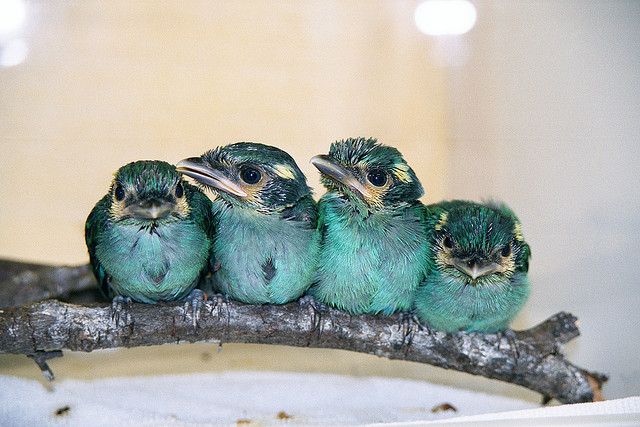
Long-tailed Broadbill (Psarisomus dalhousiae) babies ©©coracii
Rejoice in the Lord always. Again I will say, rejoice! (Philippians 4:4 NKJV)
Birds in Christmas Hymns
Words by Bernhardt S. Ingemann (1789-1862), 1840 (Julen har bragt velsignet bud); translated from Danish to English by Cecil Cowdrey.
Music: Christmas Brings Joy, Christoph E. Weyse (1774-1842), 1841
Christmas Brings Joy To Every Heart
Christmas brings joy to every heart,
Sets old and young rejoicing,
What angels sang once to all on earth,
Oh, hear the children voicing.
Bright is the tree with lights aglow,
Like birds that perch together,
The child that holdeth Christmas dear
Shall keep these joys forever.
Joy comes to the all the world today,
To halls and cottage hasting,
Come, sparrow and dove, from roof tree tall,
And share our Christmas feasting.
Dance, little child, on mother’s knee,
The lovely day is dawning,
The road to paradise is found
The blessèd Christmas morning.
Once to this earth our Savior came,
An infant poor and lowly,
To open for us those gardens fair
Where dwell His angels holy.
Christmas joy He bringeth us,
The Christ child King of heaven,
“To every little child,” He saith,
“Shall angel wings be given.”
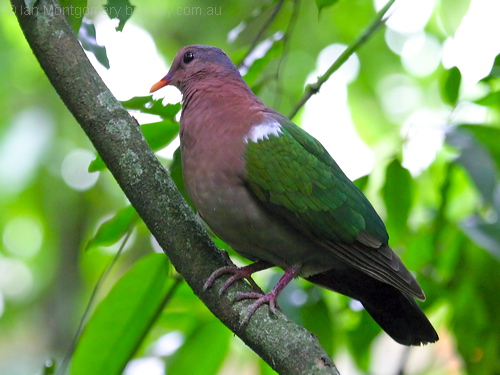
Emerald Dove by Birdway
Most information from The Cyber Hymnal
See ~ Christmas Gospel Presentation
More ~ Birds in Hymns
*

White-browed Conebill (Conirostrum ferrugineiventre) ©WikiC
Glory to God in the highest, and on earth peace, good will toward men. (Luke 2:14 KJV)
Words & Music by William H. Havergal (1793-1870), alt.
Birds in Christmas Hymns
The Worcester Christmas Carol
How grand and how bright
That wonderful night,
When angels to Bethlehem came!
They burst forth like fires,
They struck their gold lyres,
And mingled their song with the flame.
The shepherds were mazed,
The pretty lambs gazed
At darkness thus turned into light:
No voice was there heard
From man, beast or bird,
So sudden and solemn the sight.
And then, when the sound reechoed around,
The hills and the dales all awoke:
The moon and the stars
Stopped their fiery cars,
And listened while Gabriel spoke:
I bring you, said he,
From the glorious Three,
Good tidings to gladden mankind;
The Savior is born,
But He lies forlorn
In a manger, as soon you will find.
At mention of this,
(The source of all bliss,)
The angels sang loudly and long;
The soared to the sky,
Beyond mortal eye,
But left us the words of their song:
All glory to God,
Who laid by His rod,
To smile on the world through His Son:
And peace be on earth,
For this wonderful birth
Wonderful conquests has won;
And good will to man,
Though his life’s a span,
And his thoughts so evil and wrong;
Then pray, Christians, pray;
But let Christmas day
Have your sweetest and holiest song.
Here are Havergal’s original lyrics for stanzas where, due to irregularities in meter, they do not fully fit the music:
I bring you, said he,
From the glorious Three,
Good tidings to gladden mankind;
The Savior is born,
But He lies all forlorn
In a manger, as soon you will find.
…
All glory to God,
Who laid by His rod,
To smile on the world through His Son:
And peace be on earth,
For this wonderful birth
Most wonderful conquests has won;
And good will to man,
Though his life’s but a span,
And his thoughts so evil and wrong;
Then pray, Christians, pray;
But let Christmas day
Have your sweetest and holiest song.
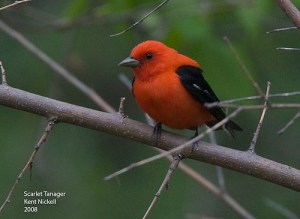
Scarlet Tanager (Piranga olivacea) by Kent Nickell
William H. Havergal (1793-1870) – The epitaph on Havergal’s white marble tomb reads:
The Rev. William Henry Havergal, M.S.,
Vicar of Shareshill and Hon. Canon of Worcester Cathedral.
Died at Leamington, 19th April 1870, aged 77.
Curate 7, and Rector 13 years, of this parish, 1822 to 1843.
A faithful minister in the Lord (Eph. Vi. 21).
Havergal was educated at Merchant Taylors School St. Edmund’s Hall, Oxford (BA 1815, MA 1819). He was ordained a deacon in 1816, and priest in 1817. He held three rectorships: Astley, Worcestershire (1829); St. Nicholas, Worcester (1842); and Shareshill, near Wolverhamptom (1860). Hymnist Frances Havergal was his daughter.
*
More Birds in Hymns
See ~ Wordless Birds
Most information from The Cyber Hymnal – The Worcester Christmas Carol
*
 Lee's Birdwatching Adventures Plus