Bible Birds – Cranes I

Sarus Crane (Grus antigone) by Lee at Wings of Asia

Sarus Crane (Grus antigone) by Lee at Wings of Asia

The 15 species of Cranes worldwide are: Black Crowned, Black-necked, Brolga, Demoiselle, Eurasian, Grey Crowned, Hooded, Red-Crowned, Sandhill, Sarus(tallest flying bird-6’ tall), Siberian, Wattled, White-naped, and the Whooping Crane (tallest N. American flying bird-5’ tall). The Cranes belong to the Gruidae – Cranes Family.

Cranes are tall birds from 3 to 6 feet tall, with wingspans over 6 feet. The tallest Crane is the Sarus and the shortest is the Demoiselle. They fly with their neck straight out and their long legs trailing. They chatter and call when flying. We have plenty of Sandhill Cranes here in Central Florida walking around the neighborhoods. They seem pretty tame sometimes and will eat out of your hand. They were bringing a small flock of Whooping Cranes to Florida every fall that followed an Ultra Light Aircraft from Wisconsin. We have a few non-migratory Whooping Cranes in the area that I have seen in a cow field off US 27.

Sandhill Cranes and Babies in yard

Sandhill Cranes and Babies in yard

There are only two verses in the Bible that mention the Crane.

Cranes migrate by following known paths taught them by their parents, or substitutes. Migrating birds know when and where to go and when to come. When God created them, He put that information in them.

Like a crane or a swallow, so did I chatter: I did mourn as a dove: mine eyes fail with looking upward: O LORD, I am oppressed; undertake for me. (Isaiah 38:14 KJV)

“So did I chatter – … The idea here is doubtless that of pain that was expressed in sounds resembling that made by birds – a broken, unmeaning unintelligible sighing; or quick breathing, and moaning. ” Barnes Commentary

Yea, the stork in the heaven knoweth her appointed times; and the turtle and the crane and the swallow observe the time of their coming; but my people know not the judgment of the LORD. (Jeremiah 8:7 KJV)

“The instinct of the migratory birds leads them with unfailing regularity to return every spring from their winter abodes in summer climes (Song of Solomon 2:12); but God’s people will not return to Him even when the winter of His wrath is past, and He invites them back to the spring of His favor.” Jameison, Faussett, and Brown Commentary

As you watch the following video notice that the two Bible verses are being demonstrated. Notice the chattering as they fly about and also that they are heading out for their migration to warmer climates. Migration means travel to another area. Usually here in America, the birds go south in the winter and then return north in the spring as it warms back up. This is God’s way of protecting birds that cannot survive in the cold.

Sandhill Cranes(grey) at the Plate River and some Whooping Cranes (white)

See:

On Our Main Site See:

*

Updated the Bible Birds – Crane Page

Sandhill Cranes and Babies in yard

Sandhill Cranes and Babies in yard

Cranes know when it’s time to move south for winter. And robins, warblers, and bluebirds know when it’s time to come back again. But my people? My people know nothing, not the first thing of GOD and his rule. (Jeremiah 8:7 MSG)

The Crane page of the Bible Birds has been updated. I added a Gallery of most of the Cranes and some other information. Cranes are interesting and we get to see them quite often. We have two that walk through the yard almost daily. They are Sandhill Cranes. When they have young, they have been known to parade them through the yard to “show them off.”

The tallest Crane I have seen were the two Sarus Cranes which we encountered at the Wings of Asia Aviary at Zoo Miami. They came strolling down the walkway in the aviary right past me. I am only 4′ 10″ and they are 5′ 6″. Needless to say, I had to look up to them. I also gave them some space.

Isn’t the Creator fantastic in the variety of critters, especially the birds, that He has made and for us to enjoy.

Sarus Crane (Grus antigone) by Lee at Wings of Asia

Sarus Crane (Grus antigone) by Lee at Wings of Asia

Wordless Book

*

Birds of the Bible – Trusting Under The Wing

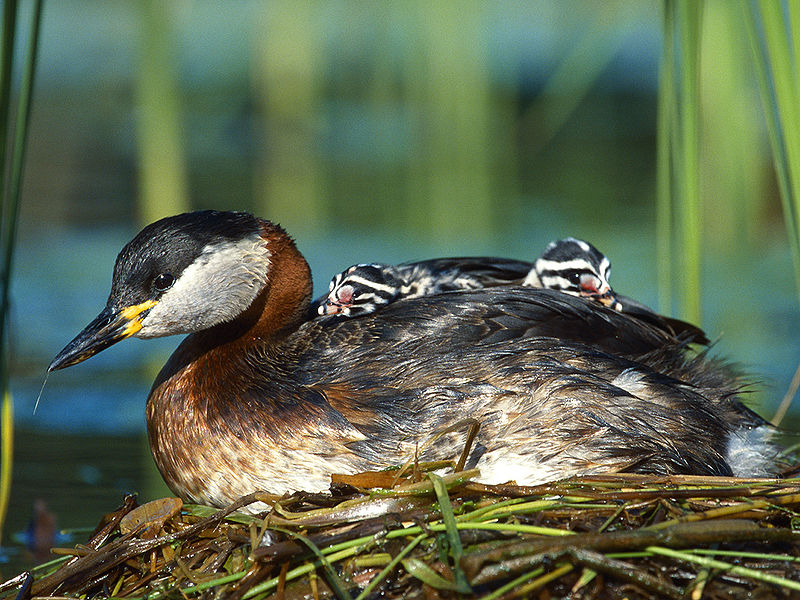
Red-necked Grebe (Podiceps grisegena) young on her wing ©USFWS

Red-necked Grebe (Podiceps grisegena) young on her wing ©USFWS

The LORD recompense thy work, and a full reward be given thee of the LORD God of Israel, under whose wings thou art come to trust. (Ruth 2:12 KJV)

While searching for “wing” or “wings” in my e-Sword, I discovered this really great verse. Let’s dig into it.

Searching further using “under” and “wing” here are a few more verses that sort of relate to the verse above:

Keep me as the apple of the eye, hide me under the shadow of thy wings, (Psalms 17:8 KJV)

How excellent is thy lovingkindness, O God! therefore the children of men put their trust under the shadow of thy wings. (Psalms 36:7 KJV)

He shall cover thee with his feathers, and under his wings shalt thou trust: his truth shall be thy shield and buckler. (Psalms 91:4 KJV)

Matthew 23:37 and Luke 13:34 mention being gathered under the wing, but they were not willing. Also, in  we covered. no pun intended, how birds protect their young under their wings and how God protects us. But the verse above seem to imply our trust.

What is being trusted? Boaz is implying that Ruth is trusting in the “LORD God of Israel.” She is from another country, another culture and religious way of life, but has turned her trust over to the LORD. That is something I did personally way back in 1960. I put my trust in the Lord to be my personal Savior. It was the best decision of my life.

Storks Shadowing Baby in Lakeland by Dan

Storks Shadowing Baby in Lakeland by Dan

In the Psalms verses, we can know that the Lord keeps His Eye on His own and we should desire to be the “apple of the eye.” Notice in the other verses that while we are under the wings we are trusting. Who? The Lord or LORD. Why do we trust? Wow! Look around at all the Lord has done just in creation and care of the birds. How about our care? We know through promises all through the Word of God that He cares for us. We know He doesn’t lie or do things for our harm. We also know that He is just and will give judgment when needed.  We could go on and on, but you can also see that the Lord Jesus Christ is “trustworthy.”

Baby Chick Peeping Out From Under His Mom's Wing - ©©

Baby Chick Peeping Out From Under His Mom’s Wing – ©©

We know the birds trust their parents to protect them while they are under their wings. Should we not trust the Savior while we are under His wings?

Here is a quote from the Believer’s Bible Commentary:

“2:4-12 When Boaz arrived from Bethlehem, he asked the identity of the young woman. Learning that she was Naomi’s daughter-in-law, he cordially invited her to continue gleaning in his fields and to share the water provided for his workers. In praising her for the loyal and selfless step that she had taken, Boaz concluded with a little prayer for her:
The LORD repay your work, and a full reward be given you by the LORD God of Israel, under whose wings you have come for refuge (v. 12).
Leon Morris comments:

In due course, the prayer was answered through him who uttered it. He recognizes the religious aspect of Ruth’s change of country by saying that she has come to trust (AV) under Yahweh’s wings. The imagery is probably that of a tiny bird struggling under the wings of a foster-mother. It gives a vivid picture of trust and security. . . .

From J. Vernon McGee:

“She had come to trust the Lord God. This is the reason she had left the land of Moab and made that radical decision. She had said that the God of Naomi would be her God. She had turned from idolatry to the living and true God. This woman has come to trust God; she was one of His children. Therefore this is the wonderful testimony that she had there in the land of Israel. And Boaz says, “May a full reward be given to you. May you be recompensed for this decision.”

From Matthew Henry:

“(5.) He (Boaz) prayed for her (Ruth_2:12): The Lord recompense thy work. Her strong affection to the commonwealth of Israel, to which she was by birth an alien, was such a work of the divine grace in her as would certainly be crowned with a full reward by him under whose wings she had come to trust. Note, Those that by faith come under the wings of the divine grace, and have a full complacency and confidence in that grace, may be sure of a full recompense of reward for their so doing. From this expression, the Jews describe a proselyte to be one that is gathered under the wings of the divine majesty.”

From John Gill’s Exposition:

“under whose wings thou art come to trust; whom she professed to be her God, and whom she determined to serve and worship; whose grace and favour she expected, and to whose care and protection she committed herself: the allusion is either to fowls, which cover their young with their wings, and thereby keep them warm and comfortable, and shelter and protect them, see Psa_36:7 or to the wings of the cherubim overshadowing the mercy seat, Exo_25:20 and the phrase is now adopted by the Jews to express proselytism; and so the Targum here,”thou art come to be proselyted, and to be hid under the wings of the Shechinah of his glory,”or his glorious Shechinah.”

My all time favorite photo showing this:

Under His Wings - (Dove - photographer unknown)

Under His Wings – by Ric Seet

Other Articles to check out:

*

Bible Birds – Eyes and Birds

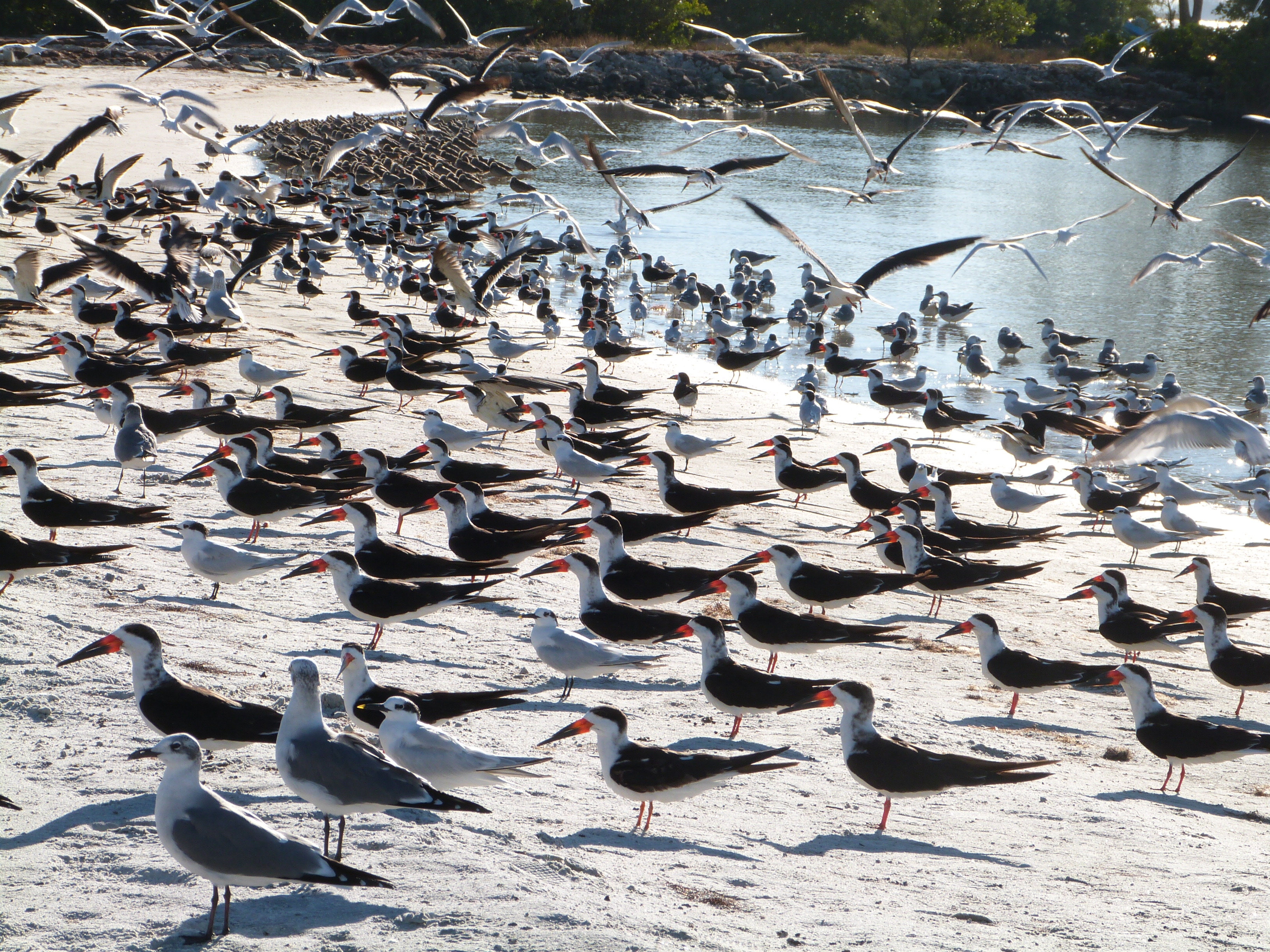
Birds on Shore of Tampa Bay

Birds on Shore of Tampa Bay – 11/23/12 by Lee

As many of you know I have just gone through eye surgery this last Thursday. (Prayer for Eye Surgery) Today, Monday, I am getting clearer vision daily, but my activities are still limited. I was able to attend church last evening and even went out afterwards with our friends. The Doctor said it was “his easiest surgery of the day and every thing went just like it should.” (I was his last patient) also told me I was his “best patient of the day.” When he walk out I told the nurses that were with me that he probably tell all his patients that. They told me that they had never heard him say that to anyone.

I told you all of that to thank you for your prayers for my Doctor and for my nervousness. Both were answered mightily. The Lord helped direct his hand and since I had to be awake, helped me stay still. They can’t put you out because you must have your eyes open. My eye was numbed, but I saw part of what was going on.

Well, guess where my mind went yesterday? I started wondering how many times “eye” and some “bird” showed up in the same verse. With enlarged type, my search found around 20 verses. Some of my upcoming Bible Bird blogs will investigate these verses. Have you ever searched your Bible to find out about a certain word or words? There are over 600 verses which have “Eye” in it. I enjoy using my “e-Sword” search and compare modes. Makes for some interesting topics to study from God’s Word.

In fact, some articles that have already been written on the main blog. (These are just a few of them)

Birds of the Bible – Vulture Eyesight – Job 28:7

When I Consider! – Turkey Vulture – Job 28:7

Birds of the Bible – Hawks – Job 28:7 and 39:26-30

Birds of the Bible – God’s Providence To His Creatures

The eyes of all wait upon thee; and thou givest them their meat in due season. (Psalms 145:15 KJV)

Birds of the Bible – Eagles and Riches 

Wilt thou set thine eyes upon that which is not? for riches certainly make themselves wings; they fly away as an eagle toward heaven. (Proverbs 23:5 KJV)

There are more and will be covered later.

Keep me as the apple of the eye, hide me under the shadow of thy wings, (Psalms 17:8 KJV)

Interesting verses, but not directly related to birds:

He that planted the ear, shall he not hear? he that formed the eye, shall he not see? (Psalms 94:9 KJV) (Our Creator)

The hearing ear, and the seeing eye, the LORD hath made even both of them. (Proverbs 20:12 KJV)

Open thou mine eyes, that I may behold wondrous things out of thy law. (Psalms 119:18 KJV)

I will instruct thee and teach thee in the way which thou shalt go: I will guide thee with mine eye. (Psalms 32:8 KJV) (How?)

Again, thank you for your prayers. I still have several weeks of recovery ahead of me, so please remember me in your prayers as you think about it. Prayer is felt when it is being answered.

*

Birds of the Bible – Loading the Ark

Snowy Egret - Wind Blown at Ft DeSoto 11-22-12 Thanksgiving

Snowy Egret – Wind Blown at Ft DeSoto 11-22-12 Thanksgiving

Dan and I just got back from a trip to Tampa for just 2 nights for the Thanksgiving holiday. My brother had a knee replacement on Wednesday (he’s doing fine), so we tied visiting him and doing some birdwatching in that area. Do you know how much we carried with us for just three days? Of course we carried our binoculars, cameras, tripod, laptop, plus clothes. Plus…

I also am starting my reading cycle through the Bible again and just read about Noah and the Ark. Because the earth had become so corrupt and violent, God said He was going to  destroy man, beast, creeping things and birds.

So the LORD said, “I will destroy man whom I have created from the face of the earth, both man and beast, creeping thing and birds of the air, for I am sorry that I have made them.” But Noah found grace in the eyes of the LORD. This is the genealogy of Noah. Noah was a just man, perfect in his generations. Noah walked with God. (Genesis 6:7-9 NKJV)

And God said to Noah, “The end of all flesh has come before Me, for the earth is filled with violence through them; and behold, I will destroy them with the earth. (Genesis 6:13 NKJV)

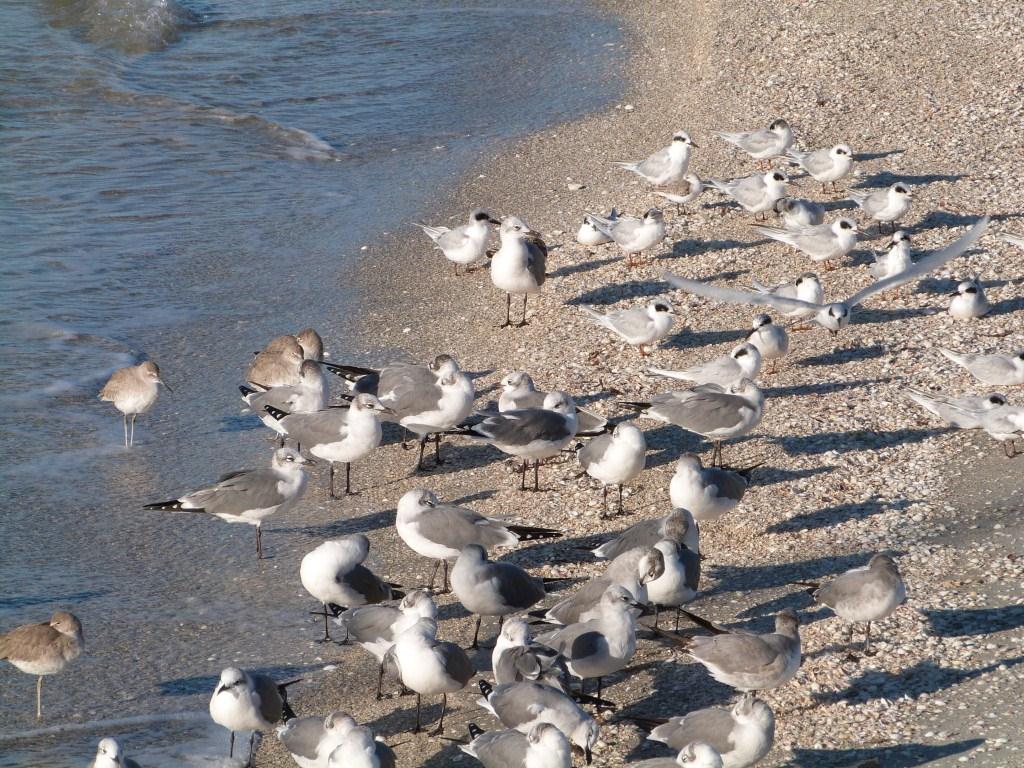
Willit - Laughing Gull - Forster's Tern at Ft DeSoto 11-22-12 Thanksgiving

Willit – Laughing Gull – Forster’s Tern at Ft DeSoto 11-22-12 Thanksgiving

Most of us know this history in the Word. Through Genesis 6, the Ark is built and Noah keeps trying to tell others to repent, but eventually the time comes and it is time to “Load the Ark.”

And of every living thing of all flesh you shall bring two of every sort into the ark, to keep them alive with you; they shall be male and female. Of the birds after their kind, of animals after their kind, and of every creeping thing of the earth after its kind, two of every kind will come to you to keep them alive. And you shall take for yourself of all food that is eaten, and you shall gather it to yourself; and it shall be food for you and for them.” Thus Noah did; according to all that God commanded him, so he did. (Genesis 6:19-22 NKJV)

Noah didn’t need to worry about taking cameras and laptops, but they had a whole lot more to get loaded on the Ark. We have all taken trips and know how long it takes to get everything in the car or van. Can you imagine when the LORD finally said that it was time to “start loading.” Noah and his family had been preparing and gathering the food, water, and supplies. If I read the first few verses of Genesis 7 correctly, they had a week (seven days) to put that in and the animals and birds. Those came to Noah, but they still had to arrange them into the different places on board the Ark. Whew! Some of us have enough trouble just loading the trunk.

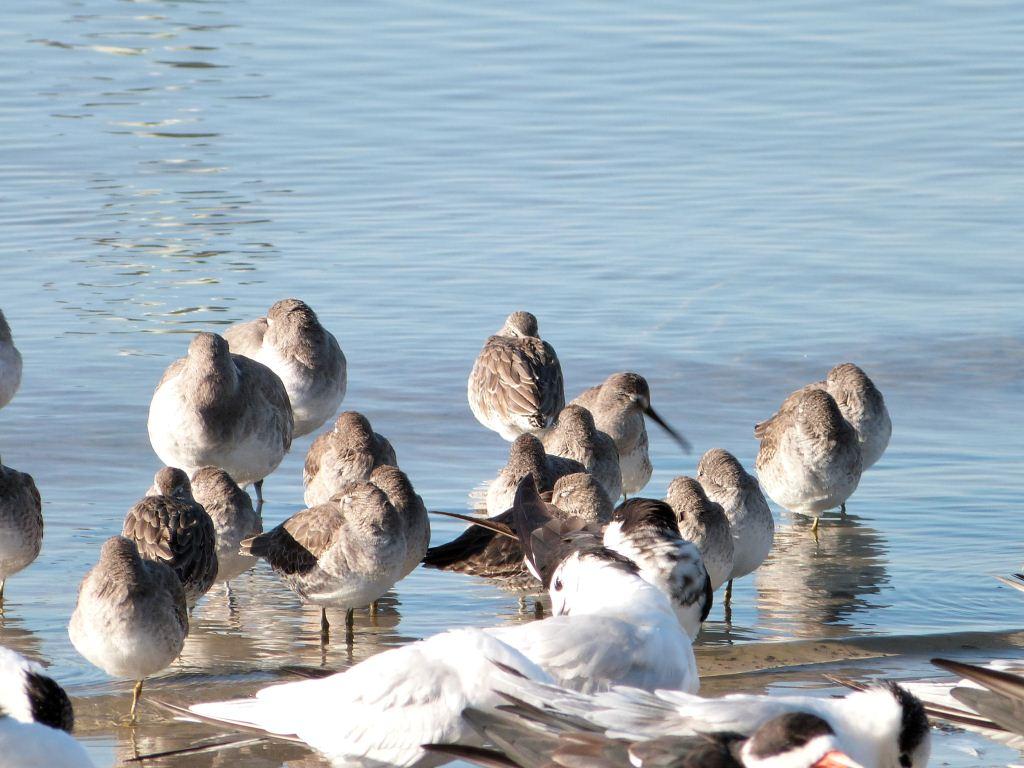
Shorebirds at MacDill AFB shore 11-23-12

Many believe the Critters rested most of the time while on board.

I am thankful that Noah and his family lived righteously and that they found grace. If not, I wouldn’t be writing this blog, nor would I be enjoying all the things the Lord created, especially the birds I love to write about.

Praise the Lord!

*

Other Birds of the Bible articles about this:

The Lord Provides For Them

Seven By Seven

God’s Commands and Promises To Them – Part I

Leaving the Ark

*

Birds of the Bible – Shelter in the Storm

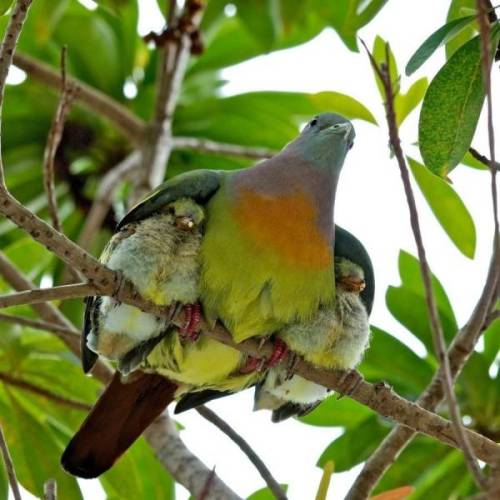
Under His Wings - ( Male Pink-necked Green Pigeon by Rik Seet)

Under His Wings – ( Male Pink-necked Green Pigeon by Rik Seet)

Be merciful to me, O God, be merciful to me! For my soul trusts in You; And in the shadow of Your wings I will make my refuge, Until these calamities have passed by. (Psalms 57:1 NKJV)

In our devotions this morning, we read Psalm 57. The first verse caught my attention because of the shelter from the wings of a bird. Also, I just received again the above picture in an e-mail. Only about the 30th time I have received it. Apparently it is as precious to others as it is to me.

With the Hurricane – Superstorm Sandy just passing by the last few days, this is a good time to remember to put and keep our trust in the Lord.

The beginning of that verse has this title attached: “To the Chief Musician. Set to “Do Not Destroy.” a Michtam of David When He Fled from Saul into the Cave.” David was trying to hide from Saul, just as those up north have been trying to hide from that storm.

“David took refuge under the shelter of God’s wings. He stood “steadfast,” a term indicating firmness, certainty, and determination (v.7). His faith was not blown about by the wind. He clung tenaciously to God. That is why today’s psalm spends more time on the character off God than on the writer’s circumstances.’ (Today in the Word, Day 16, Psalms)

My heart is steadfast, O God, my heart is steadfast; I will sing and give praise. (Psalms 57:7 NKJV)

Another quote, “the prayer (vv 1-4) emphasizes God’s character. He is merciful, protecting, caring, just, and faithful. The enemy may be “ravenous beasts,” but the psalmist can hide beneath His wings as a chick hides beneath a mother bird.”

Be merciful to me, O God, be merciful to me! For my soul trusts in You; And in the shadow of Your wings I will make my refuge, Until these calamities have passed by. I will cry out to God Most High, To God who performs all things for me. He shall send from heaven and save me; He reproaches the one who would swallow me up. Selah. God shall send forth His mercy and His truth. My soul is among lions; I lie among the sons of men Who are set on fire, Whose teeth are spears and arrows, And their tongue a sharp sword.  (Psalms 57:1-4 NKJV)

Great Crested Grebe (Podiceps cristatus) babies ©WikiC (Lukasz_Lukasik)

Great Crested Grebe (Podiceps cristatus) babies ©WikiC (Lukasz_Lukasik)

Verses 5 and 11 “focuses our attention on God’s chief attribute–His glory and worthiness to be worshiped”

Be exalted, O God, above the heavens; Let Your glory be above all the earth. (Psalms 57:5 NKJV)

Our prayers and thoughts are with those going through this storm. We have been there in the midst of hurricanes before (Andrew, Charlie, Jean, Frances and those that passed near) and we know it is hard, but there is always a peace that only the Lord can give to get you through. Look to Him.

Wordless Birds

Birds of the Bible

*

Birds of the Bible – The Common Ostrich


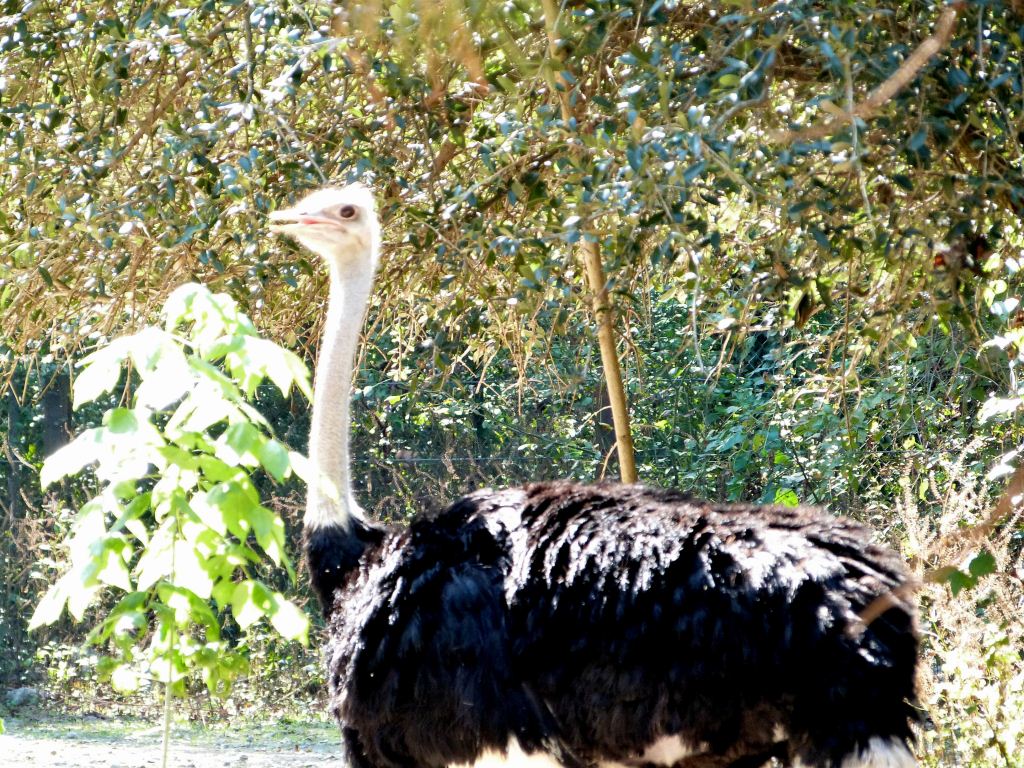
Common Ostrich (Struthio camelus) at Riverbanks Zoo SC by Lee

Common Ostrich (Struthio camelus) at Riverbanks Zoo SC by Lee

Dan and I just recently were on vacation and stopped by the Riverbanks Zoo and Gardens in Columbia, SC. I have see Ostriches before, but it has been awhile. We see the Emus at Zoo Tampa often, but they are not nearly as tall as the Ostrich. I had forgotten that the Lord had created such a huge bird.

The wings of the ostrich wave proudly, But are her wings and pinions like the kindly stork’s? For she leaves her eggs on the ground, And warms them in the dust; She forgets that a foot may crush them, Or that a wild beast may break them. She treats her young harshly, as though they were not hers; Her labor is in vain, without concern, Because God deprived her of wisdom, And did not endow her with understanding. When she lifts herself on high, She scorns the horse and its rider. (Job 39:13-18 NKJV)

The Ostrich does belong to the Struthionidae Family. Currently there are two; the Common Ostrich (Struthio camelus) and the Somali Ostrich (Struthio molybdophanes). The one we saw was the Common. The Ostrich is the largest bird in the world! They are omnivorous flightless birds but make up for their inability to fly with the powerful legs they possess. These birds were built for speed. That is why the reference to the horse and rider. Ostriches can give a horse competition for at least a burst of speed.

Common Ostrich (Struthio camelus) Foot at Riverbanks Zoo SC by Lee

Common Ostrich (Struthio camelus) Foot back at Riverbanks Zoo SC by Lee

“Ostriches usually weigh from 140–320 lb (63 to 145 kilograms), Ostriches of the East African race (S. c. massaicus) averaged 250 lb (115 kg) in males and 220 lb (100 kg) in females, while the nominate subspecies was found to average 240 lb (111 kg) in unsexed adults. At sexual maturity (two to four years), male ostriches can be from 6 ft 11 in to 9 ft 2 in (2.1 to 2.8 m) in height, while female ostriches range from 5 ft 7 in to 6 ft 7 in (1.7 to 2 m) tall. New chicks are fawn with dark brown spots. During the first year of life, chicks grow about 10 in (25 cm) per month. At one year of age, ostriches weigh around 100 lb (45 kilograms). Their lifespan is up to 40 or 45 years.” (Wikipedia with editing)

Common Ostrich (Struthio camelus) Foot at Riverbanks Zoo SC by Lee

Common Ostrich (Struthio camelus) Foot front at Riverbanks Zoo SC by Lee

I am not sure how tall these were, but they had to be close to 8 feet. As I was observing them, I was trying to remember all that the verses said about them. That is one reason I took pictures of their feet. I knew that their feet and legs helped  them run, but also that those same feet were a danger to their young ones. They do have big feet and with an interesting shape as you can see from the photos.

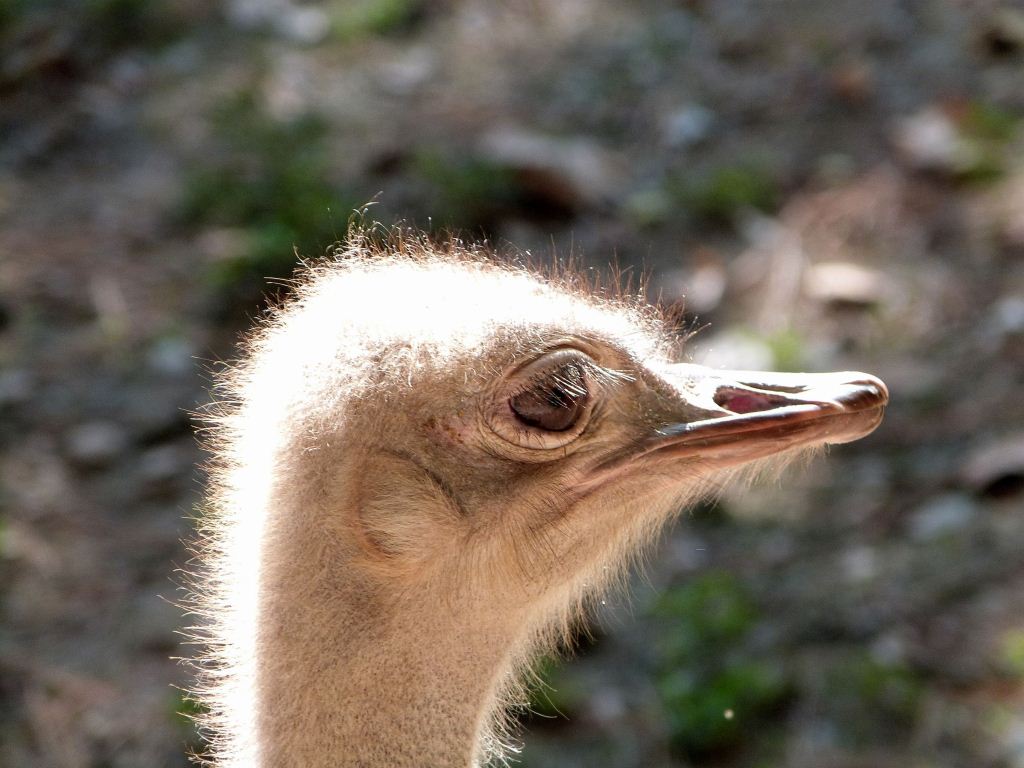
If you notice the size of their head to their body, maybe that is how the Lord “did not endow her with understanding.” The head is interesting though because they are one of the few birds that have eyelashes. They have acute eyesight and hearing, the long neck and legs keep their head up to 9 ft (2.8 m) above the ground, and their eyes are said to be the largest of any land vertebrate – 2.0 in (50 mm) in diameter; they can therefore perceive predators at a great distance. The eyes are shaded from sun light falling from above. However, the head and bill are relatively small for the birds’ huge size”

Common Ostrich (Struthio camelus) Head at Riverbanks Zoo SC by Lee

Common Ostrich (Struthio camelus) Head at Riverbanks Zoo SC by Lee

Oh, sing to the LORD a new song! Sing to the LORD, all the earth. Sing to the LORD, bless His name; Proclaim the good news of His salvation from day to day. Declare His glory among the nations, His wonders among all peoples. For the LORD is great and greatly to be praised; He is to be feared above all gods. (Psalms 96:1-4 NKJV)

Links:

Birds of the Bible – Ostrich

Bible Birds – Ostrich

Struthionidae – Ostriches

Ostrich – Creation Wiki

Ostrich – Wikipedia

Ostrich – The Largest Bird with the Biggest Eyes

*

Birds of the Bible – Smith’s Sparrow

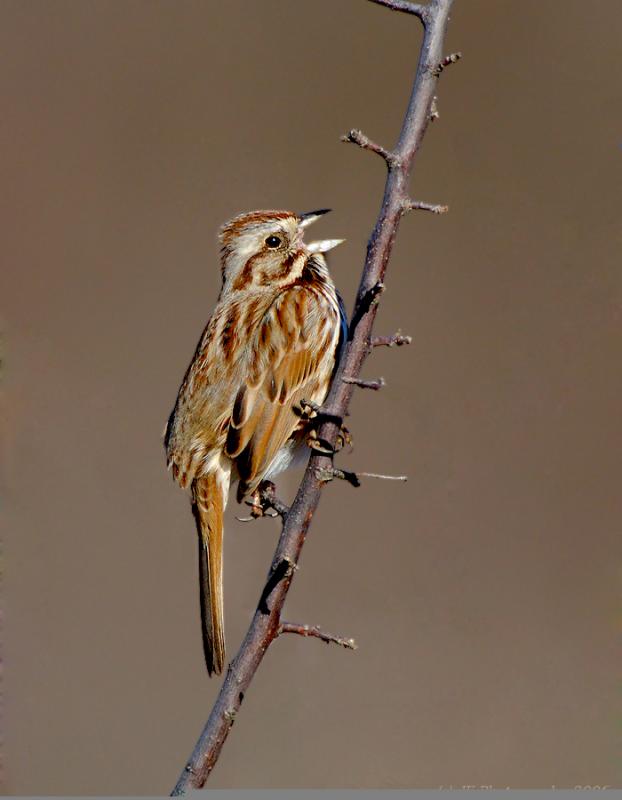
Song Sparrow (Melospiza melodia) by J Fenton

Song Sparrow (Melospiza melodia) by J Fenton

While looking up the word “birds” in the Dictionary section of my e-Sword program, there is an “i” symbol that shows on the tab of the name of a dictionary. That “i” indicates that there is information about your search word. The Smith’s Bible Dictionary had an “i” so I investigated it. This is what I saw:

Birds
        Birds. See Sparrow.

So when I went there, this interesting definition of “sparrow” was found and I wanted to share it with you.

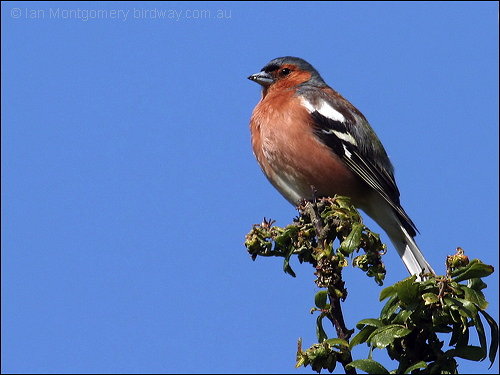
Eurasian Chaffinch (Fringilla coelebs) by Ian

Eurasian Chaffinch (Fringilla coelebs) by Ian

Sparrow

Sparrow. (Hebrew, tzippor, from a root signifying to “chirp” or “twitter”, which appears to be a phonetic representation of the call-note of any passerine (sparrow-like) bird). This Hebrew word occurs upwards of forty times in the Old Testament. In all passages, except two, it is rendered by the Authorized Version indifferently as “bird” or “fowl,” and denotes any small bird, both of the sparrow-like species and such as the starling, chaffinch, greenfinch, linnet, goldfinch, corn-bunting, pipits, blackbird, song-thrush, etc. In Psalm 84:3, and Psalm 102:7, it is rendered “sparrow.”

Corn Bunting (Emberiza calandra) ©WikiC

Corn Bunting (Emberiza calandra) ©WikiC

Yea, the sparrow hath found an house, and the swallow a nest for herself, where she may lay her young, even thine altars, O LORD of hosts, my King, and my God. (Psalms 84:3 KJV)

I watch, and am as a sparrow alone upon the house top. (Psalms 102:7 KJV)

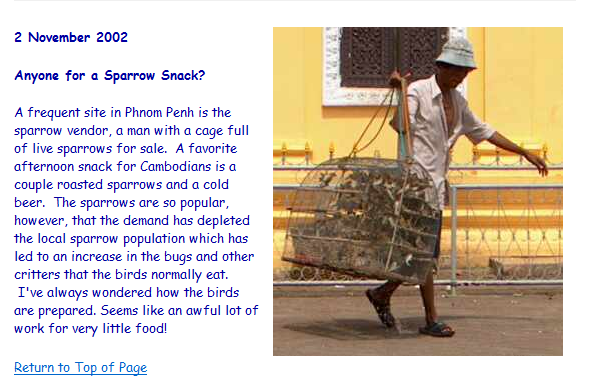
Anyone for a Sparrow Snack?

The Greek, stauthion, (Authorized Version, “sparrow”), occurs twice in the New Testament, Matthew 10:29; Luke 12:6-7. (The birds above mentioned are found in great numbers in Palestine, and are of very little value, selling for the merest trifle, and are, thus, strikingly used by our Saviour, Matthew 10:20, as an illustration of our Father’s care for his children. — Editor).

Are not two sparrows sold for a farthing? and one of them shall not fall on the ground without your Father. (Matthew 10:29 KJV)

Are not five sparrows sold for two farthings, and not one of them is forgotten before God? But even the very hairs of your head are all numbered. Fear not therefore: ye are of more value than many sparrows. (Luke 12:6-7 KJV)

Blue Rock Thrush (Monticola solitarius) by Nikhil Devasar

Blue Rock Thrush (Monticola solitarius) by Nikhil Devasar

The blue thrush, (Petrocossyphus cyaneus), is probably the bird to which the psalmist alludes in Psa_102:7, as “the sparrow that sitteth alone upon the house-top.” It is a solitary bird, eschewing the society of its own species, and rarely more than a pair are seen together. The English tree-sparrow, (Passer montanus), is also very common, and may be seen in numbers on Mount Olivet, and also about the sacred enclosure of the mosque of Omar. This is, perhaps, the exact species referred to in Psalm 84:3.

Yea, the sparrow hath found an house, and the swallow a nest for herself, where she may lay her young, even thine altars, O LORD of hosts, my King, and my God. (Psalms 84:3 KJV)

House Sparrows visiting National Aviary Parrot Show by Lee

House Sparrows visiting NA Parrot Show Outside

Dr. Thompson, in speaking of the great numbers of the house-sparrows and field-sparrows in troublesome and impertinent generation, and nestle just where you do not want them. “They stop your stove — and water-pipes with their rubbish, build in the windows and under the beams of the roof, and would stuff your hat full of stubble in half a day, if they found it hanging in a place to suit them.”

(I added the verses to make it easier and also the “blue thrush, (Petrocossyphus cyaneus)” could not be found. Photos also inserted.)

The Blue Rock Thrush (Monticola solitarius) is a species of chat. This thrush-like Old World flycatcher was formerly placed in the family Turdidae. It is now found in the Muscicapidae family.

Sparrows are found in two families today. The Family – Emberizidae – Buntings, New World Sparrows & Allies and the Family – Passeridae – Old World Sparrows, Snowfinches.

*

Smith’s Bible Dictionary, originally named A Dictionary of the Bible, was a 19th century Bible dictionary containing upwards of four thousand entries that became named after its editor, William Smith. Its popularity was such that condensed dictionaries appropriated the title, “Smith’s Bible Dictionary”.

The original dictionary was published as a three volume set in 1863, in London and Boston, USA. This first edition was followed in 1893 by an expanded four volume version which was published in the United States as A dictionary of the Bible comprising its antiquities, biography, geography, and natural history, edited by Smith and J. M. Fuller.

The original publications are now in the public domain; some derivative, commercial versions are still in copyright.

*

Bible Birds – Sparrows I

Russet Sparrow (Passer rutilans) by Nikhil Devasar

Russet Sparrow (Passer rutilans) by Nikhil Devasar

In the Bible, the Sparrows are mentioned in 7 verses. Check out these from the NKJV:

Even the sparrow has found a home, And the swallow a nest for herself, Where she may lay her young— Even Your altars, O LORD of hosts, My King and my God. (Psalms 84:3 NKJV)

I lie awake, And am like a sparrow alone on the housetop. (Psalms 102:7 NKJV)

Like a flitting sparrow, like a flying swallow, So a curse without cause shall not alight. (Proverbs 26:2 NKJV)

Are not two sparrows sold for a copper coin? And not one of them falls to the ground apart from your Father’s will. (Matthew 10:29 NKJV)

Do not fear therefore; you are of more value than many sparrows. (Matthew 10:31 NKJV)

Are not five sparrows sold for two copper coins? And not one of them is forgotten before God. (Luke 12:6 NKJV)

But the very hairs of your head are all numbered. Do not fear therefore; you are of more value than many sparrows. (Luke 12:7 NKJV)

Sparrows are not always thought of very highly. Many people think they are just “little brown birds” and are of no use. But is that what the Scriptures says in those verses? No.

What can you learn from those verses?

The sparrow has found a ____________

The sparrow is found on the __________________

How does the sparrow fly? (see Proverbs 26:2) _______________

Who is aware of or allows a sparrow to fall to the ground? ______________

Are sparrows forgotten by God? ______________

How many sparrows were sold for one copper coin? ________

For two copper coins? ___________

Who is more valuable, you or a sparrow? _____________

We will talk more about Sparrows in the next Bible Birds – Sparrows II. For now, here are a few pictures of different Sparrows around the world.

This slideshow requires JavaScript.

*

Bible Birds – Sparrows

Wordless Birds

*

Bible Birds – Dove, Turtledove and Pigeon’s Introduction

Common Pigeon -aka Rock(Columba livia) by Daves BirdingPix

Common Pigeon -aka Rock(Columba livia) by Daves BirdingPix

Bible Birds – Dove, Turtledove and Pigeon’s Introduction

Doves are in the Columbidae Family of the Columbiformes Order

They are walking birds, feeding both on the ground and in trees; bill slender, grooved, nostrils opening in a fleshy membrane; tail variable, short and square, or long and pointed; feet stout, often reddish. Color usually grayish brown. Call-notes a characteristic cooing.

Sound from xeno-canto.

Mourning Dove (Zenaida macroura) 2 Neal Addy Gallery

Mourning Dove (Zenaida macroura) 2 Neal Addy Gallery

Family Columbidae includes some 310 species. In general the terms “dove” and “pigeon” are used somewhat interchangeably. In ornithological practice, there is a tendency for “dove” to be used for smaller species and “pigeon” for larger ones, but this is in no way consistently applied, and historically the common names for these birds involve a great deal of variation between the terms “dove” and “pigeon.” This family occurs worldwide, but the greatest variety is in Indomalaya and Australasia. Young doves and pigeons are called “squabs.”

Pigeons and doves are stout-bodied birds with short necks, and have short slender bills with a fleshy cere. The species commonly referred to just as “pigeon” is the Feral Rock Pigeon, common in many cities.

Doves and pigeons build relatively flimsy nests from sticks and other debris, which may be placed in trees, on ledges or on the ground, depending on species. They lay one or two eggs, and both parents care for the young, which leave the nest after 7 to 28 days. Doves feed on seeds, fruit and plants. Unlike most other birds, the doves and pigeons produce “crop milk”, which is secreted by a sloughing of fluid-filled cells from the lining of the crop. Both parents produce this highly nutritious substance to feed to the young.

Victoria Crowned Pigeon (Goura victoria) by Lee at Zoo Miami

Victoria Crowned Pigeon (Goura victoria) by Lee at Zoo Miami

Pigeons and doves exhibit considerable variations in size. The largest species is the crowned pigeon of New Guinea, which is nearly turkey-sized, at a weight of 4.4-8.8 lb (2-4 kg) The smallest is the New World ground-dove of the genus Columbina, which is the same size as a House Sparrow and weighs as little as 22 g. With a total length of more than 19 in (50 cm) and weight of almost 2 lb (1 kg), the largest arboreal species is the Marquesan Imperial Pigeon, while the Dwarf Fruit Dove, which may measure as little as 5.1 in (13 cm), has a marginally smaller total length than any other species from this family. Smaller species tend to be known as doves, while larger species as pigeons.

Overall, the Columbidae tend to have short bills and legs, and small heads on large compact bodies. They have a habit of head bobbing was shown to be due to their natural desire to keep their vision constant. The wings are large and have low wing loadings; pigeons have strong wing muscles (wing muscles comprise 31–44% of their body weight) and are amongst the strongest fliers of all birds. They are also highly maneuverable in flight.

Superb Fruit Dove (Ptilinopus superbus) by Ian

Superb Fruit Dove (Ptilinopus superbus) by Ian

The plumage (feathers and colors) of the family is variable. Granivorous (seed eater) species tend to have dull plumage, with a few exceptions, whereas the frugivorous (fruit eater) species have brightly-coloured plumage. The Ptilinopus fruit doves are some of the brightest coloured pigeons, with the three endemic species of Fiji and the Indian Ocean Alectroenas being amongst the brightest coloured. In addition to bright colours pigeons may sport crests or other ornamentation.

Seeds and fruit form the major component of the diet of pigeons and doves. In fact, the family can be divided into the seed-eating or granivorous species (subfamily Columbinae) and the fruit-eating or frugivorous species (the other four subfamilies). The granivorous typically feed on seed found on the ground, whereas the species that feed on fruit and mast tend to feed in trees.

Now when the days of her purification according to the law of Moses were completed, they brought Him to Jerusalem to present Him to the Lord (as it is written in the law of the Lord, “EVERY MALE WHO OPENS THE WOMB SHALL BE CALLED HOLY TO THE LORD” ), and to offer a sacrifice according to what is said in the law of the Lord, “A PAIR OF TURTLEDOVES OR TWO YOUNG PIGEONS.” (Luke 2:22-24 NKJV)

In the Bible (Old Testament), doves or young pigeons were acceptable burnt offerings for those who couldn’t afford a more expensive animal. In the book of Genesis, Noah sent out a dove after the great flood in order to determine how far the floodwaters had receded. Dove is also a term of endearment in the Song of Songs and elsewhere.

When He had been baptized, Jesus came up immediately from the water; and behold, the heavens were opened to Him, and He saw the Spirit of God descending like a dove and alighting upon Him. (Matthew 3:16 NKJV)

Jesus’ parents sacrificed doves on his behalf after his circumcision (Luke 2:24). Later the Holy Spirit descended upon Jesus at his baptism like a dove (Matthew 3:16), and subsequently, the “peace dove” became a common Christian symbol of the Holy Spirit.

(Information from Wikipedia and other internet sources.)

See:

Bible Birds

Bible Birds – Doves and Pigeons

Columbidae Family

Wordless Birds

*

King of the Birds

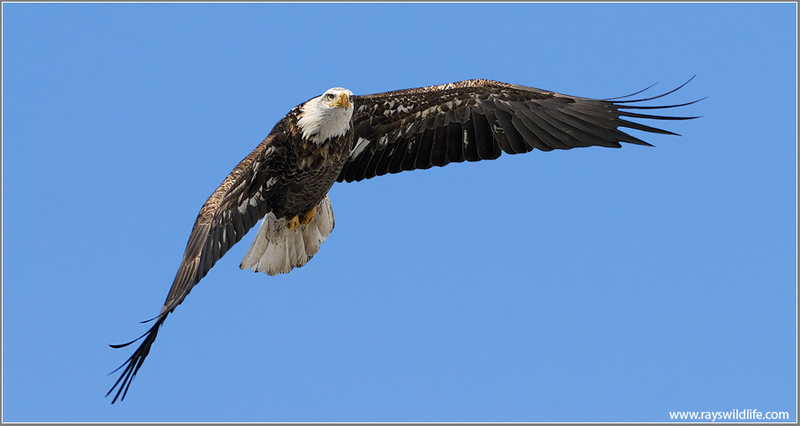
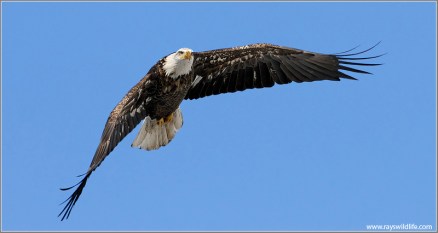
Bald Eagle (Haliaeetus leucocephalus) by Ray

Bald Eagle (Haliaeetus leucocephalus) by Ray

King of the Birds ~ from The Curious Book of Birds

KING OF THE BIRDS

Cur Book of Birds letter-oNCE upon a time, when the world was very new and when the birds had just learned from Mother Magpie how to build their nests, some one said, “We ought to have a king. Oh, we need a king of the birds very much!”

For you see, already in the Garden of Birds trouble had begun. There were disputes every morning as to which was the earliest bird who was entitled to the worm. There were quarrels over the best places for nest-building and over the fattest bug or beetle; and there was no one to settle these difficulties. Moreover, the robber birds were growing too bold, and there was no one to rule and punish them. There was no doubt about it; the birds needed a king to keep them in order and peace.

So the whisper went about, “We must have a king. Whom shall we choose for our king?”

They decided to hold a great meeting for the election. And because the especial talent of a bird is for flying, they agreed that the bird who could fly highest up into the blue sky, straight toward the sun, should be their king, king of all the feathered tribes of the air.

Therefore, after breakfast one beautiful morning, the birds met in the garden to choose their king. All the birds were there, from the largest to the smallest, chirping, twittering, singing on every bush and tree and bit of dry grass, till the noise was almost as great as nowadays at an election of two-legged folk without feathers. They swooped down in great clouds, till the sky was black with them, and they were dotted on the grass like punctuation marks on a green page. There were so many that not even wise Mother Magpie or old Master Owl could count them, and they all talked at the same time, like ladies at an afternoon tea, which was very confusing.

Little Robin Redbreast was there, hopping about and saying pleasant things to every one, for he was a great favorite. Gorgeous Goldfinch was there, in fine feather; and little Blackbird, who was then as white as snow. There were the proud Peacock and the silly Ostrich, the awkward Penguin and the Dodo, whom no man living has ever seen. Likewise there were the Jubjub Bird and the Dinky Bird, and many other curious varieties that one never finds described in the wise Bird Books,—which is very strange, and sad, too, I think. Yes, all the birds were there for the choosing of their king, both the birds who could fly, and those who could not. (But for what were they given wings, if not to fly? How silly an Ostrich must feel!)

Now the Eagle expected to be king. He felt sure that he could fly higher than any one else. He sat apart on a tall pine tree, looking very dignified and noble, as a future king should look. And the birds glanced at one another, nodded their heads, and whispered, “He is sure to be elected king. He can fly straight up toward the sun without winking, and his great wings are so strong, so strong! He never grows tired. He is sure to be king.”

Thus they whispered among themselves, and the Eagle heard them, and was pleased. But the little brown Wren heard also, and he was not pleased. The absurd little bird! He wanted to be king himself, although he was one of the tiniest birds there, who could never be a protector to the others, nor stop trouble when it began. No, indeed! Fancy him stepping as a peacemaker between a robber Hawk and a bloody Falcon. It was they who would make pieces of him. But he was a conceited little creature, and saw no reason why he should not make a noble sovereign.

Cobb's Wren (Troglodytes cobbi) ©WikiC

Cobb’s Wren (Troglodytes cobbi) ©WikiC

“I am cleverer than the Eagle,” he said to himself, “though he is so much bigger. I will be king in spite of him. Ha-ha! We shall see what we shall see!” For the Wren had a great idea in his wee little head—an idea bigger than the head itself, if you can explain how that could be. He ruffled up his feathers to make himself as huge as possible, and hopped over to the branch where the Eagle was sitting.

“Well, Eagle,” said the Wren pompously, “I suppose you expect to be king, eh?”

The Eagle stared hard at him with his great bright eyes. “Well, if I do, what of that?” he said. “Who will dispute me?”

“I shall,” said the Wren, bobbing his little brown head and wriggling his tail saucily.

“You!” said the Eagle. “Do you expect to fly higher than I?”

“Yes,” chirped the Wren, “I do. Yes, I do, do, do!”

“Ho!” said the Eagle scornfully. “I am big and strong and brave. I can fly higher than the clouds. You, poor little thing, are no bigger than a bean. You will be out of breath before we have gone twice this tree’s height.”

“Little as I am, I can mount higher than you,” said the Wren.

“What will you wager, Wren?” asked the Eagle. “What will you give me if I win?”

“If you win you will be king,” said the Wren. “But beside that, if you win I will give you my fat little body to eat for your breakfast. But if I win, Sir, I shall be king, and you must promise never, never, never, to hurt me or any of my people.”

“Very well. I promise,” said the Eagle haughtily. “Come now, it is time for the trial, you poor little foolish creature.”

The birds were flapping their wings and singing eagerly, “Let us begin—begin. We want to see who is to be king. Come, birds, to the trial. Who can fly the highest? Come!”

Then the Eagle spread his great wings and mounted leisurely into the air, straight toward the noonday sun. And after him rose a number of other birds who wanted to be king,—the wicked Hawk, the bold Albatross, and the Skylark singing his wonderful song. The long-legged Stork started also, but that was only for a joke. “Fancy me for a king!” he cried, and he laughed so that he had to come down again in a minute. But the Wren was nowhere to be seen. The truth was, he had hopped ever so lightly upon the Eagle’s head, where he sat like a tiny crest. But the Eagle did not know he was there.

Black-browed Albatross (Thalassarche melanophris) by Bob-Nan

Black-browed Albatross (Thalassarche melanophris) by Bob-Nan

Soon the Hawk and the Albatross and even the brave little Skylark fell behind, and the Eagle began to chuckle to himself at his easy victory. “Where are you, poor little Wren?” he cried very loudly, for he fancied that the tiny bird must be left far, far below.

“Here I am, here I am, away up above you, Master Eagle!” piped the Wren in a weak little voice. And the Eagle fancied the Wren was so far up in the air that even his sharp eyes could not spy the tiny creature. “Dear me!” said he to himself. “How extraordinary that he has passed me.” So he redoubled his speed and flew on, higher, higher.

Presently he called out again in a tremendous voice, “Well, where are you now? Where are you now, poor little Wren?”

Once more he heard the tiny shrill voice from somewhere above piping, “Here I am, here I am, nearer the sun than you, Master Eagle. Will you give up now?”

Of course the Eagle would not give up yet. He flew on, higher and higher, till the garden and its flock of patient birds waiting for their king grew dim and blurry below. And at last even the mighty wings of the Eagle were weary, for he was far above the clouds. “Surely,” he thought, “now the Wren is left miles behind.” He gave a scream of triumph and cried, “Where are you now, poor little Wren? Can you hear me at all, down below there?”

But what was his amazement to hear the same little voice above his head shrilling, “Here I am, here I am, Sir Eagle. Look up and see me, look!” And there, sure enough, he was fluttering above the Eagle’s head. “And now, since I have mounted so much higher than you, will you agree that I have won?”

“Yes, you have won, little Wren. Let us descend together, for I am weary enough,” cried the Eagle, much mortified; and down he swooped, on heavy, discouraged wings.

“Yes, let us descend together,” murmured the Wren, once more perching comfortably on the Eagle’s head. And so down he rode on this convenient elevator, which was the first one invented in this world.

When the Eagle nearly reached the ground, the other birds set up a cry of greeting.

“Hail, King Eagle!” they sang. “How high you flew! How near the sun! Did he not scorch your Majesty’s feathers? Hail, mighty king!” and they made a deafening chorus. But the Eagle stopped them.

“The Wren is your king, not I,” he said. “He mounted higher than I did.”

“The Wren? Ha-ha! The Wren! We can’t believe that The Wren flew higher than you? No, no!” they all shouted. But just then the Eagle lighted on a tree, and from the top of his head hopped the little Wren, cocking his head and ruffling himself proudly.

“Yes, I mounted higher than he,” he cried, “for I was perched on his head all the while, ha-ha! And now, therefore, I am king, small though I be.”

Now the Eagle was very angry when he saw the trick that had been played upon him, and he swooped upon the sly Wren to punish him. But the Wren screamed, “Remember, remember your promise never to injure me or mine!” Then the Eagle stopped, for he was a noble bird and never forgot a promise. He folded his wings and turned away in disgust.

“Be king, then, O cheat and trickster!” he said.

“Cheat and trickster!” echoed the other birds. “We will have no such fellow for our king. Cheat and trickster he is, and he shall be punished. You shall be king, brave Eagle, for without your strength he could never have flown so high. It is you whom we want for our protector and lawmaker, not this sly fellow no bigger than a bean.”

So the Eagle became their king, after all; and a noble bird he is, as you must understand, or he would never have been chosen to guard our nation’s coat of arms. And besides this you may see his picture on many a banner and crest and coin of gold or silver, so famous has he become.

But the Wren was to be punished. And while the birds were trying to decide what should be done with him, they put him in prison in a mouse-hole and set Master Owl to guard the door. Now while the judges were putting their heads together the lazy Owl fell fast asleep, and out of prison stole the little Wren and was far away before any one could catch him. So he was never punished after all, as he richly deserved to be.

The birds were so angry with old Master Owl for his carelessness that he has never since dared to show his face abroad in daytime, but hides away in his hollow tree. And only at night he wanders alone in the woods, sorry and ashamed.


Lee’s Addition:

No one who trusts in you will be disappointed. But disappointment will come to those who try to deceive others. They will get nothing. (Psalms 25:3 ERV)

We are not supposed to cheat or deceive others.

The wise accept instruction, but fools argue and bring trouble on themselves. Honest people can always feel secure, but lying cheaters will be caught. (Proverbs 10:8-9 ERV)

(Photos added by me.)

Links:

Bald Eagle (Haliaeetus leucocephalus) by Quy Tran


  Accipitridae – Family (Kites, Hawks & Eagles) Family


Painted Bunting (Passerina ciris) ©©Flickr


  Bird Tales


Curious Book of Birds - Cover


  The Curious Book of Birds


Spanish Sparrow (Passer Hispaniolensis) female ©WikiC


  Wordless Birds


*

Mother Magpie’s Kindergarten

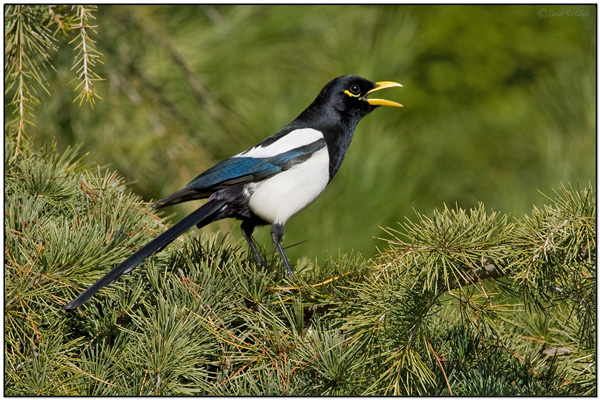
Yellow-billed Magpie (Pica nuttalli) by Daves BirdingPix

Yellow-billed Magpie (Pica nuttalli) by Daves BirdingPix

Mother Magpie’s Kindergarten ~ from The Curious Book of Birds

MOTHER MAGPIE’S KINDERGARTEN

Cur Book of Birds letter-dID you ever notice how different are the nests which the birds build in springtime, in tree or bush or sandy bank or hidden in the grass? Some are wonderfully wrought, pretty little homes for birdikins. But others are clumsy, and carelessly fastened to the bough, most unsafe cradles for the feathered baby on the treetop. Sometimes after a heavy wind you find on the ground under the nest poor little broken eggs which rolled out and lost their chance of turning into birds with safe, safe wings of their own. Now such sad things as this happen because in their youth the lazy father and mother birds did not learn their lesson when Mother Magpie had her class in nest-making. The clumsiest nest of all is that which the Wood-Pigeon tries to build. Indeed, it is not a nest at all, only the beginning of one. And there is an old story about this, which I shall tell you.

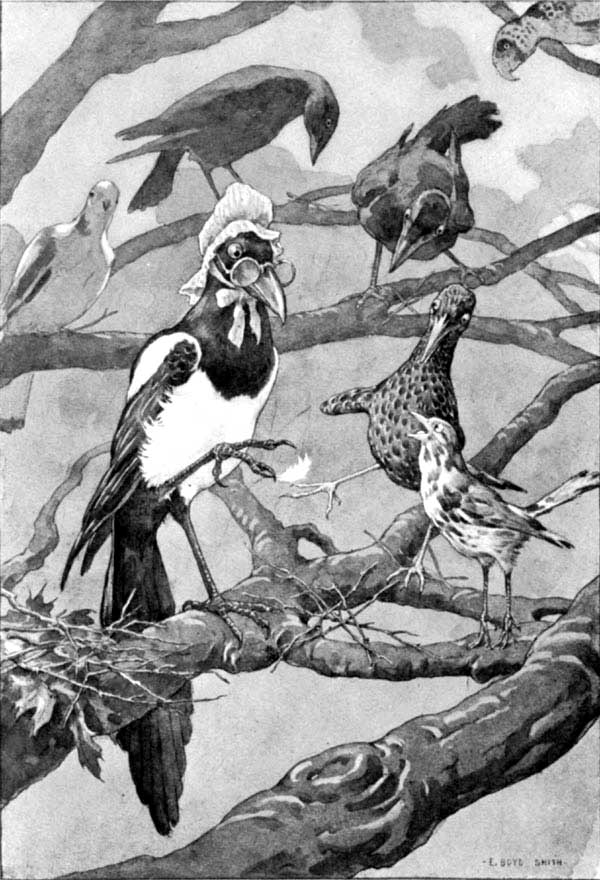
In the early springtime of the world, when birds were first made, none of them—except Mother Magpie—knew how to build a nest. In that lovely garden where they lived the birds went fluttering about trying their new wings, so interested in this wonderful game of flying that they forgot all about preparing a home for the baby birds who were to come. When the time came to lay their eggs the parents knew not what to do. There was no place safe from the four-legged creatures who cannot fly, and they began to twitter helplessly: “Oh, how I wish I had a nice warm nest for my eggs!” “Oh, what shall we do for a home?” “Dear me! I don’t know anything about housekeeping.” And the poor silly things ruffled up their feathers and looked miserable as only a little bird can look when it is unhappy.

All except Mother Magpie! She was not the best—oh, no!—but she was the cleverest and wisest of all the birds; it seemed as if she knew everything that a bird could know. Already she had found out a way, and was busily building a famous nest for herself. She was indeed a clever bird! She gathered turf and sticks, and with clay bound them firmly together in a stout elm tree. About her house she built a fence of thorns to keep away the burglar birds who had already begun mischief among their peaceful neighbors. Thus she had a snug and cosy dwelling finished before the others even suspected what she was doing. She popped into her new house and sat there comfortably, peering out through the window-slits with her sharp little eyes. And she saw the other birds hopping about and twittering helplessly.

“What silly birds they are!” she croaked. “Ha, ha! What would they not give for a nest like mine!”

But presently a sharp-eyed Sparrow spied Mother Magpie sitting in her nest.

“Oho! Look there!” he cried. “Mother Magpie has found a way. Let us ask her to teach us.”

Then all the other birds chirped eagerly, “Yes, yes! Let us ask her to teach us!”

So, in a great company, they came fluttering, hopping, twittering up to the elm tree where Mother Magpie nestled comfortably in her new house.

“O wise Mother Magpie, dear Mother Magpie,” they cried, “teach us how to build our nests like yours, for it is growing night, and we are tired and sleepy.”

The Magpie said she would teach them if they would be a patient, diligent, obedient class of little birds. And they all promised that they would.

She made them perch about her in a great circle, some on the lower branches of the trees, some on the bushes, and some on the ground among the grass and flowers. And where each bird perched, there it was to build its nest. Then Mother Magpie found clay and bits of twigs and moss and grass—everything a bird could need to build a nest; and there is scarcely anything you can think of which some bird would not find very useful. When these things were all piled up before her she told every bird to do just as she did. It was like a great big kindergarten of birds playing at a new building game, with Mother Magpie for the teacher.

She began to show them how to weave the bits of things together into nests, as they should be made. And some of the birds, who were attentive and careful, soon saw how it was done, and started nice homes for themselves. You have seen what wonderful swinging baskets the Oriole makes for his baby-cradle? Well, it was the Magpie who taught him how, and he was the prize pupil, to be sure. But some of the birds were not like him, nor like the patient little Wren. Some of them were lazy and stupid and envious of Mother Magpie’s cosy nest, which was already finished, while theirs was yet to do.

As Mother Magpie worked, showing them how, it seemed so very simple that they were ashamed not to have discovered it for themselves. So, as she went on bit by bit, the silly things pretended that they had known all about it from the first—which was very unpleasant for their teacher.

Mother Magpie took two sticks in her beak and began like this: “First of all, my friends, you must lay two sticks crosswise for a foundation, thus,” and she placed them carefully on the branch before her.

“Oh yes, oh yes!” croaked old Daddy Crow, interrupting her rudely. “I thought that was the way to begin.”

Mother Magpie snapped her eyes at him and went on, “Next you must lay a feather on a bit of moss, to start the walls.”

Western Jackdaw (Coloeus monedula) ©WikiC

Western Jackdaw (Coloeus monedula) ©WikiC

“Certainly, of course,” screamed the Jackdaw. “I knew that came next. That is what I told the Parrot but a moment since.”

Mother Magpie looked at him impatiently, but she did not say anything. “Then, my friends, you must place on your foundation moss, hair, feathers, sticks, and grass—whatever you choose for your house. You must place them like this.”

“Yes, yes,” cried the Starling, “sticks and grass, every one knows how to do that! Of course, of course! Tell us something new.”

"Next you must lay a feather"

“Next you must lay a feather”

Now Mother Magpie was very angry, but she kept on with her lesson in spite of these rude and silly interruptions. She turned toward the Wood-Pigeon, who was a rattle-pated young thing, and who was not having any success with the sticks which she was trying to place.

“Here, Wood-Pigeon,” said Mother Magpie, “you must place those sticks through and across, criss-cross, criss-cross, so.”

“Criss-cross, criss-cross, so,” interrupted the Wood-Pigeon. “I know. That will do-o-o, that will do-o-o!”

Mother Magpie hopped up and down on one leg, so angry she could hardly croak.

“You silly Pigeon,” she sputtered, “not so. You are spoiling your nest. Place the sticks so!”

“I know, I know! That will do-o-o, that will do-o-o!” cooed the Wood-Pigeon obstinately in her soft, foolish little voice, without paying the least attention to Mother Magpie’s directions.

Common Wood Pigeon (Columba palumbus) with newly hatched young ©WikiC

Common Wood Pigeon (Columba palumbus) with newly hatched young ©WikiC

“We all know that—anything more?” chirped the chorus of birds, trying to conceal how anxious they were to know what came next, for the nests were only half finished.

But Mother Magpie was thoroughly disgusted, and refused to go on with the lesson which had been so rudely interrupted by her pupils.

“You are all so wise, friends,” she said, “that surely you do not need any help from me. You say you know all about it,—then go on and finish your nests by yourselves. Much luck may you have!” And away she flew to her own cosy nest in the elm tree, where she was soon fast asleep, forgetting all about the matter.

But oh! What a pickle the other birds were in! The lesson was but half finished, and most of them had not the slightest idea what to do next. That is why to this day many of the birds have never learned to build a perfect nest. Some do better than others, but none build like Mother Magpie.

But the Wood-Pigeon was in the worst case of them all. For she had only the foundation laid criss-cross as the Magpie had shown her. And so, if you find in the woods the most shiftless, silly kind of nest that you can imagine—just a platform of sticks laid flat across a branch, with no railing to keep the eggs from rolling out, no roof to keep the rain from soaking in—when you see that foolishness, you will know that it is the nest of little Mistress Wood-Pigeon, who was too stupid to learn the lesson which Mother Magpie was ready to teach.

And the queerest part of all is that the birds blamed the Magpie for the whole matter, and have never liked her since. But, as you may have found out for yourselves, that is often the fate of wise folk who make discoveries or who do things better than others.


Lee’s Addition:

Let the wise hear and increase in learning, and the one who understands obtain guidance, (Proverbs 1:5 ESV)

(Photos added by me.)

Links:

Black-billed Magpie (Pica hudsonia) ©USFWS


  Corvidae – Crows, Jays, Ravens Family


Painted Bunting (Passerina ciris) ©©Flickr


  Bird Tales


Curious Book of Birds - Cover


  The Curious Book of Birds


Spanish Sparrow (Passer Hispaniolensis) female ©WikiC


  Wordless Birds


*