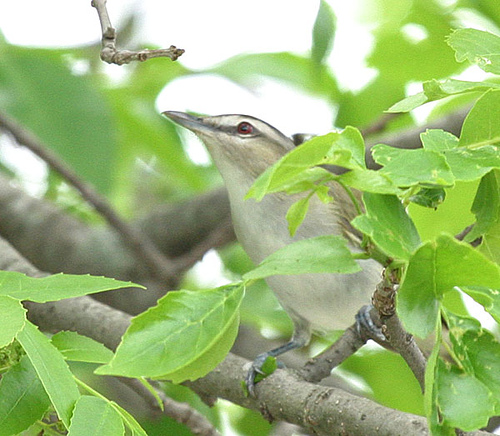
The Red-eyed Vireo – The Persistent Singer…

Red-eyed Vireo (Vireo olivaceus) by Kent Nickell

Red-eyed Vireo (Vireo olivaceus) by Kent Nickell

The Red-eyed Vireo – The Persistent Singer… ~ by a j mithra

The Red-eyed Vireo, Vireo olivaceus, is a small American songbird, 13–14 cm (5.1-5.5 in) in length. It is somewhat warbler-like but not closely related to the New World warblers (Parulidae).

The Red-eyed Vireo is a Neotropical migrant that makes its way from its home in Central and South America to the deciduous woodlands of North America to select a territory, win a mate and raise its young.

Throughout the eastern United States, Red-eyed Vireos are common in deciduous woodlands. However in Washington they are largely confined to stream and lakeside woodlands and cottonwood stands.

  • These small birds migrate long distances to win a mate and raise their younger ones..
  • Though they are birds, they still take so much effort to raise a family..

God has created us in His own image, its good, but, how much effort do we take to win a mate and raise a family?

Isaac was meditating when his father’s servant Eliezer was returning with a bride for Isaac as per Abraham’s instructions….

Now Isaac had come from Beer Lahai Roi, for he was living in the Negev.
He went out to the field one evening to meditate,and as he looked up, he saw camels approaching.
Rebekah also looked up and saw Isaac. She got down from her camel and asked the servant, “Who is that man in the field coming to meet us?”
“He is my master,” the servant answered. So she took her veil and covered herself.
Then the servant told Isaac all he had done. Isaac brought her into the tent of his mother Sarah, and he married Rebekah. So she became his wife, and he loved her; and Isaac was comforted after his mother’s death. (Genesis 24:62-66)

How many men meditate on the word of God before they get married?

  • Is it because of lack of meditation on the word that marriages are not successful these days?
  • Recent study shows that the rate of divorce is much more than marriages…
  • Is it because of we lack the fear of the Lord?

God holds marriage in high esteem that is the reason He calls Himself as the bridegroom and the church as His bride..

  • How much does the church honor the relationship of a husband and wife?

So the LORD God caused the man to fall into a deep sleep; and while he was sleeping, he took one of the man’s ribs[a] and then closed up the place with flesh.
Then the LORD God made a woman from the rib he had taken out of the man, and he brought her to the man.
The man said, “This is now bone of my bones and flesh of my flesh; she shall be called ‘woman,’ for she was taken out of man.”
That is why a man leaves his father and mother and is united to his wife, and they become one flesh. (Genesis 2:21-24)

Red-eyed vireo is difficult to see because it forages high in the canopy, picking food from the undersides of foliage, hopping or hovering in the leaves. It is an arboreal bird of the canopy, where it is very active although rather heavy in its movements, maintaining a horizontal posture.

Red-eyed Vireo (Vireo olivaceus) by Kent Nickell

Red-eyed Vireo (Vireo olivaceus) by Kent Nickell

This species migrates over long distances, and mostly at night. Red-eyed Vireo is relatively heavy when moving over short distances, but it can be very active too. Its flight is altogether performed in a gliding manner, and when it is engaged in pursuit of a rival or an enemy, it passes through the woods with remarkable swiftness. The small territory of this species consists of a cylinder extending from the forest canopy to the low understory.

Red-eyed Vireos can also be difficult to see because they forage high in the canopy, where they pick food from the undersides of foliage, hopping about or hovering in the leaves.

During courtship and nesting seasons, their prominent, repeated calls readily reveal their presence.

  • No one can see us when we hide under the shadow of its wings…
  • But they can hear us worship His holy name..
  • Well, do we really worship Him all the days of our lives?

The purpose of God creating us is not fulfilled unless we worship Him. After all, God created us to put us in satan’s place to worship Him and Him alone..

  • If we don’t worship now, the stones will…

And he answered and said unto them, I tell you that, if these should hold their peace, the stones would immediately cry out. (Luke 19:40)
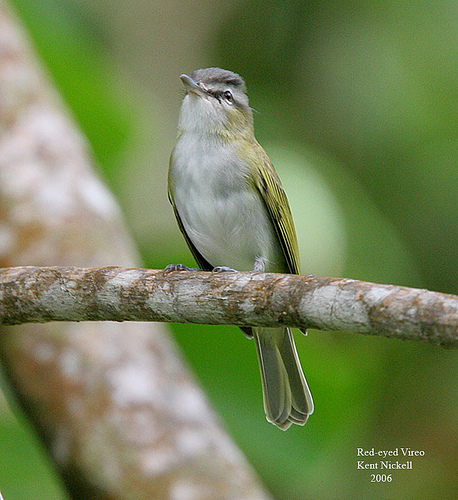
Red-eyed Vireo (Vireo olivaceus) by Kent Nickell

Red-eyed Vireo (Vireo olivaceus) by Kent Nickell

These birds are important to maintaining the health of our forests. They consume large quantities of insects and caterpillars harmful to tree foliage. It is an effective predator on gypsy moths, fall webworms, tree hoppers, scale insects and others.

  • The way we live is important in maintaining the health of our fellow being…
  • These birds consume large quantities of harmful insects….
  • God expects our prayerful presence to consume the evil works of satan among our family and friends….

Job prayed for his friends amidst disaster and God blessed him double fold….

  • Do we pray for our friends like Job?

And the LORD turned the captivity of Job, when he prayed for his friends: also the LORD gave Job twice as much as he had before. (Job 42:10)

Red-eyed Vireos glean insects from tree foliage, favoring caterpillars and aphids and sometimes hovering while foraging. In some tropical regions, they are commonly seen to attend mixed-species feeding flocks, moving through the forest higher up in the trees than the bulk of such flocks.

They also eat berries, especially before migration, and in the winter quarters, where trees bearing popular fruit like Tamanqueiro (Alchornea glandulosa) or Gumbo-limbo (Bursera simaruba) will even attract them to parks and gardens. Fruit are typically not picked up from a hover, but the birds often quite acrobatically reach for them, even hanging upside down.

Although animal food makes up 85 percent of its summer diet, the Red-eyed Vireo may be completely frugivorous (fruit-eating) during the winter and late summer. In summer, Red-eyed Vireos feed mostly on adult insects and larvae, especially caterpillars.

During the courtship, male performs displays, flicking on its legs, with fluffy feathers and fan-shaped tail.
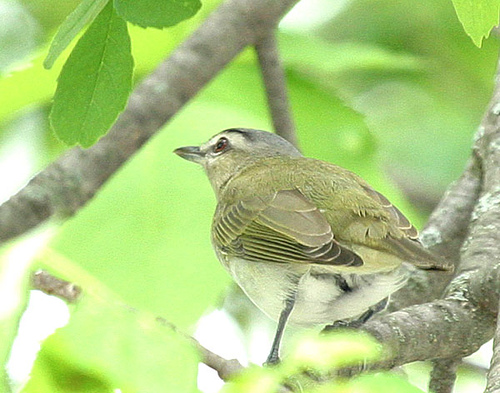
Red-eyed Vireo (Vireo olivaceus) by Kent Nickell

Red-eyed Vireo (Vireo olivaceus) by Kent Nickell

During incubation, the male sings faster, 50/60 phrases a minute. When it stops, female comes off the nest and it feeds her, or they feed together. They are monogamous. Which means, the female birds is willing to even starve and will not leave its nest until the male bird stops singing..

Do we wait to know God’s will in our lives or do we wait for God’s direction in our lives or do we set about doing what we wish to do?

  • God became a signpost on the cross of Calvary to show us where to go..
  • Are we willing to look up to the cross for direction?

Come, ye children, hearken unto me: I will teach you the fear of the LORD. (Psalm 34:11)

Red-eyed Vireo is highly territorial on breeding areas, and it’s very noisy. When it’s wintering in South America, it does not sing.

The breeding habitat is open wooded, deciduous and mixed deciduous forest areas across Canada and the eastern and northwestern United States.

These birds migrate to South America, where they spend the winter. The Latin American population occur in virtually any wooded habitat in their range. Most of these are residents, but the populations breeding in the far southern part of this species’ range (e.g. most of its range in Argentina, Uruguay, Paraguay and Bolivia) migrate north as far as Central America.

This vireo is one of the more frequent American passerine vagrants to western Europe, with more than one hundred records, mainly in Ireland and Great Britain.

In northern Ohio, it seems to return to breed at about the same time as one century ago; intriguingly, it might actually leave for winter quarters one or two weeks earlier at present than it did in the past..

Red-eyed Vireo (Vireo olivaceus) ©WikiC in nest

Red-eyed Vireo (Vireo olivaceus) ©WikiC in nest

Nest is built 1, 5 to 20 metres above the ground. Female builds the nest in five days, without assistance from the male. Nest is made of vine-bark strips, grass, needles and twigs. The outer parts are firmly attached to the twigs, the fibres being warped around them in various directions. The lining is beautifully disposed. It consists of fibrous roots, grasses, and sometimes the hair of grey squirrel and raccoon. It is covered on the outside with wasp’s nest paper, and spider webbing. It is a typical vireo nest, suspended by its rim from a horizontally forked twig, or the corner of a tree trunk, and two radiating branches.

Female lays 3 to 4 eggs. Incubation lasts about 11 to 14 days only by female. Both parents feed the young during 10 to 12 days when they are in the nest. Female and perhaps male, continue to feed them for up to two weeks after they leave the nest.

Most likely call to be heard is a nasal, querulous “tshay” or “chway”, although migrants are usually silent.

(Red-eyed Vireo (Vireo olivaceus) song-by xeno-canto)

Calls include a nasal whining “quee”.

(Red-eyed Vireo subspecies chivi – from xeno-canto.)

Video of a Red-eyed Vireo singing by Robert Schaefer

Persistent song, sung all day, a variable series of deliberate, short phrases.

During courtship and nesting seasons, their repeated calls reveal their presence.

Their persistent song is legendary. It is repeated as often as 40 times a minute, all through the day..

Red-eyed Vireos were once considered one of the three most abundant birds of the forests of Eastern North America.

Their persistent song is legendary. A single individual was once heard to sing 22,197 songs during a single day (Lawrence 1953).

  • How long and how much do we sing for the Lord?
  • David sang praises to the Lord at all times and that was the reason God loved him so much..
  • David sang new songs like these birds that may be another reason for the favours that he won from God..

If these 13 to 14 cm long birds can sing up to 22,197 songs in about ten hours which comes to roughly about 2200 songs per hour which in turn comes to about 37 songs per minute, how much we should sing?

O sing unto the LORD a new song: sing unto the LORD, all the earth (Psalm 96:1)

This verse was written for God’s own people, but, sadly this bird has taken the cue and we have chosen to shut our mouth rather than to shout to the King…

Come let us sing to win favour from THE KING…

Have a blessed day!

Your’s in YESHUA,

a j mithra please visit us at:

Crosstree

ajmithra21


Lee’s Addition:
Thanks, aj. I enjoyed putting the photos and sound in this one. They are in this area, but I have not seen one yet.

Also, when a j sent in his draft, he included a note to me that I thought was worth placing here. He has been adding great articles for a year now, so this is sort of a “mile-stone article” for him. From the e-mail:

“Hello Sister.Lee,
Its been a great learning experience and a great honor to serve the Lord  though your website.. I am thrilled when I turned back and looked at how God has been so full of mercy and an inspiration which He gives us often through Birds.. Its been a year since you published my first article on 4th March 2010.. I just want to say a BIG THANK YOU for letting me be a part of this great site..
Thank you once again..
Regards and prayers to you and yours,
aj mithra”

The Red-eyed Vireo is in the Vireonidae, Vireos and Greenlets Family and is a Passerine or perching bird. There are 63 members in the family.

*

Formed By Him – Rock Birds and The Rock – II

Water Splashing on Rocks - Point Lobos State Reserve by Daves BP

Water Splashing on Rocks – Point Lobos State Reserve by Daves BP

Therefore whosoever heareth these sayings of mine, and doeth them, I will liken him unto a wise man, which built his house upon a rock: (Matthew 7:24 KJV)

“Rock Birds” Part II.  See Formed By Him – Rock Birds and The Rock – I to see the first 25 birds with “Rock” in their names.

When the Lord created the world and all that is therein, He created the rocks and hills and the birds that He created were well adapted to live in those places. Birdwatchers through the years have observed them in this habitat of rocks, stones, cliffs, and other high rocky places. Just as Adam named the first birds, ornithologists (bird people) are still naming birds.

Searching through the latest IOC 2.7 List of Birds, I found 50 birds with “Rock” in their names. Searching the Bible for the word “Rock”, I found around 130 verses referring to a “rock” or “The Rock.” Here is a blend of the birds and some of the Scriptures verses that show the mighty Hand of God at work and the neat “Rock Birds” Formed by Him.

Here is the list of the last 25 birds with “Rock” in their name in taxonomic order with a few words about them :

O come, let us sing unto the LORD: let us make a joyful noise to the rock of our salvation. (Psalms 95:1 KJV)

Rockrunner (Achaetops pycnopygius) – The Rockrunner is a monogamous bird which means that the bird finds and breeds with one partner for the rest of its life. The bird lays between 2 to 3 eggs and they are coloured red.

The nest is built high up in the tree canopy and is protected from predators by branches and the dense green foliage.

Rock-loving Cisticola (Cisticola emini) ©©algaedoc

Rock-loving Cisticola (Cisticola emini) – It is usually associated with rocky wooded terrain with interspersed patchy grass tussocks. Forages in rocks or rank vegetation for insects. Split from the Lazy Cisticola.

Rock Wren (Salpinctes obsoletus) by Daves BirdingPix

Rock Wren (Salpinctes obsoletus) – Their breeding habitat is dry rocky locations, including canyons, from southwestern Canada south to Costa Rica. This bird builds a cup nest in a crevice or cavity, usually among rocks.

These birds are permanent residents in the south of their range, but northern populations migrate to warmer areas from the central United States and southwest Canada southwards. They are occasional vagrants in the eastern United States.

These birds actively hunt on the ground, around and under objects, probing with their bill as their extraction tool. They mainly eat insects and spiders. Neat Video This bird’s song is a trill, becoming more varied during the nesting season.

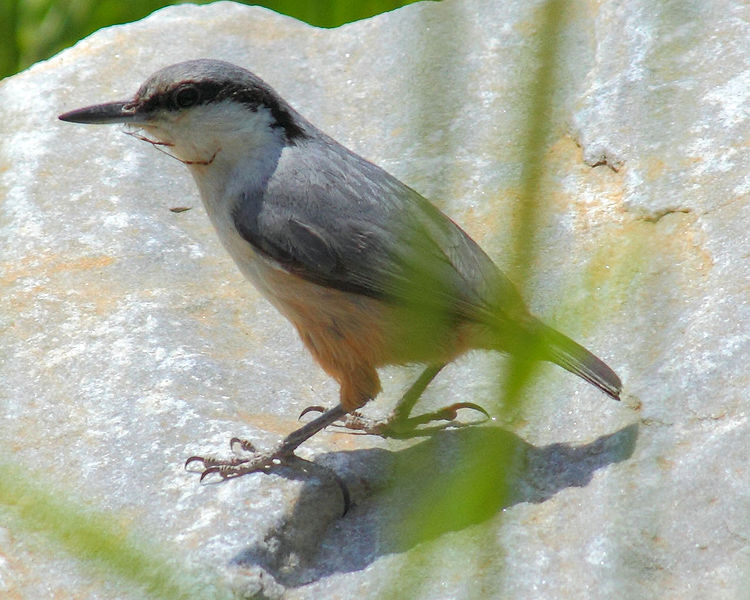
Western Rock Nuthatch (Sitta neumayer) ©WikiC

Western Rock Nuthatch (Sitta neumayer) – Video – The Western Rock Nuthatch is a bird associated with habitats with bare rocks, especially in mountainous areas. Those at the highest altitudes may move lower down in winter.

It feeds on insects and spiders in summer, supplemented with seeds and snails in winter. It feeds on the ground, and will wedge larger items in rock crevies while it hammers them open with its strong bill. It will also flycatch.

This territorial species builds a flask-shaped nest from mud, dung and hair or feathers in a rock crevice, cave, or under an overhang on a rock face. Decorative items may be pushed into crevices and cracks near the entrance to the nest. The nest is lined with softer materials and the entrance is sealed with mud. 4-10 eggs are laid, and are white speckled with yellow.

Eastern Rock Nuthatch (Sitta tephronota) – Video

In God is my salvation and my glory: the rock of my strength, and my refuge, is in God. (Psalms 62:7 KJV)

Brown Rock Chat (Cercomela fusca) – Video – Habitat: Rocky hills, ravines, ruins of ancient tombs and forts, and in suburban compounds, occasionally visiting inhabited homes or nesting in rafters.

Brown-tailed Rock Chat (Cercomela scotocerca) – Photo – A seriously undistinguished little bird that only a birder or ornithologist would bother looking for! It’s main distinguishing feature is its brown-ness and it’s distinguished from the similar Red-tailed Chat by the fact that it’s well, browner. It’s fairly uncommon and prefers rocky bush country. It’s range extends down as far as Samburu, but the best place we’ve found to see it is near Lake Baringo where it can usually be found at the base of the basalt cliffs just West of the lake. Even there it can be difficult to spot since it blends in well against the rocks and dust, especially in the dry season when evrything looks (wait for it) brown. (Kenya Birds)

Sombre Rock Chat (Cercomela dubia) – Video

Cape Rock Thrush (Monticola rupestris) ©WikiC

Cape Rock Thrush (Monticola rupestris) ©WikiC

Cape Rock Thrush (Monticola rupestris) – The rock-thrushes, Monticola, are a genus of chats, medium-sized mostly insectivorous or omnivorous songbirds. All are Old World birds associated with mountainous regions.

Sentinel Rock Thrush (Monticola explorator) – Same as above – Video by Keith
Short-toed Rock Thrush (Monticola brevipes) – Same as above – It is found in Angola, Botswana, Namibia, and South Africa. Its natural habitat is subtropical or tropical dry shrubland.

He brought me up also out of an horrible pit, out of the miry clay, and set my feet upon a rock, and established my goings. (Psalms 40:2 KJV)

Miombo Rock Thrush (Monticola angolensis) – Same as above
Rufous-tailed Rock Thrush (Monticola saxatilis) (Common) – Same as above
Little Rock Thrush (Monticola rufocinereus) – Same as above – It is found in rocky areas with some trees, and sometimes near settlements.[2][3] At 15 to 16 centimetres (5.9 to 6.3 in) this is the smallest of the rock thrushes.

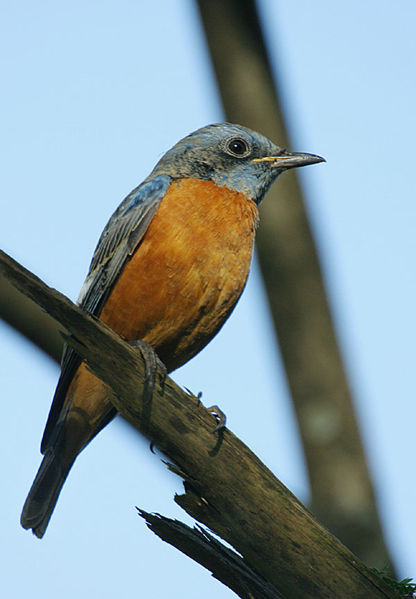
Blue Rock Thrush (Monticola solitarius) by Nikhil Devasar

Blue Rock Thrush (Monticola solitarius) – Same as above – Blue Rock Thrush breeds in open mountainous areas, usually higher than the breeding zone of the related Rufous-tailed Rock Thrush. It nests in rock cavities and walls, and usually lays 3-5 eggs. An omnivore, the Blue Rock Thrush eats a wide variety of insects and small reptiles in addition to berries and seeds.

This is a starling-sized bird, 21–23 cm in length with a long slim bill. The summer male is unmistakable, with all blue-grey plumage apart from its darker wings. Females and immatures are much less striking, with dark brown upperparts, and paler brown scaly underparts. Both sexes lack the reddish outer tail feathers of Rock Thrush. The male Blue Rock Thrush sings a clear, melodious call that is similar to, but louder than the call of the Rock Thrush.

The Blue Rock Thrush is Malta’s national bird and is shown on the Lm 1 coins that was part of the previous currency of the country.

Chestnut-bellied Rock Thrush (Monticola rufiventris) – Same as above – It is found in Bangladesh, Bhutan, China, India, Laos, Myanmar, Nepal, Pakistan, Thailand, and Vietnam. Its natural habitat is temperate forests.
Blue-capped Rock Thrush (Monticola cinclorhynchus) – Same as above  Video – This thrush-like Old World flycatcher breeds in the foothills of the Himalayas and winters in the hill forests of southern India.

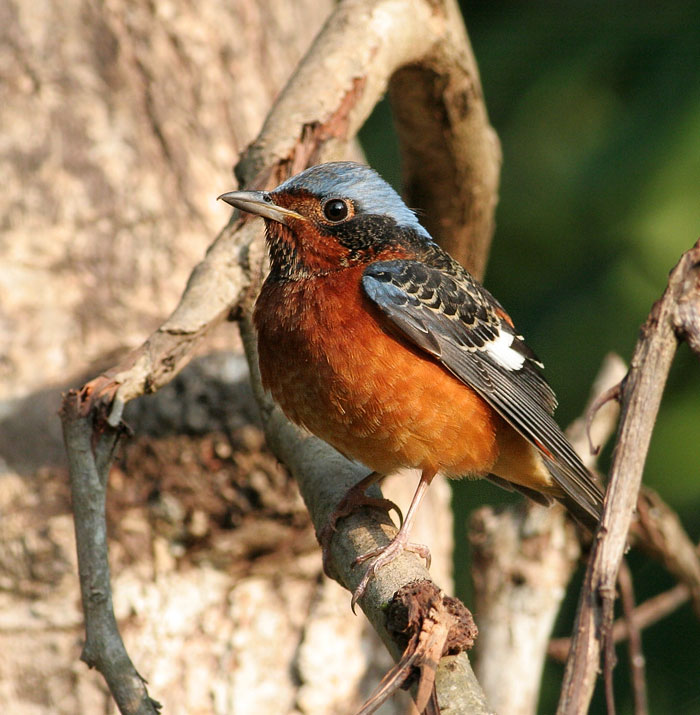
White-throated Rock Thrush by Peter Ericsson

White-throated Rock Thrush by Peter Ericsson

White-throated Rock Thrush (Monticola gularis) – Same as above – It is found in Cambodia, China, Hong Kong, Japan, North Korea, South Korea, Laos, Malaysia, Myanmar, Russia, Singapore, Thailand, and Vietnam. Its natural habitat is temperate forests.
Littoral Rock Thrush (Monticola imerina) – Same as above – Its natural habitats are dry savanna and subtropical or tropical dry shrubland.
Forest Rock Thrush (Monticola sharpei) – Same as above – It is endemic to Madagascar.

And they remembered that God was their rock, and the high God their redeemer. (Psalms 78:35 KJV)

Rockefeller’s Sunbird (Cinnyris rockefelleri) – It is found in Democratic Republic of the Congo, possibly Burundi, and possibly Rwanda. Its natural habitats are subtropical or tropical moist montanes and subtropical or tropical high-altitude shrubland. It is threatened by habitat loss.
Pale Rockfinch (Carpospiza brachydactyla) – Photo
Rock Sparrow (Petronia petronia) – This sparrow breeds on barren rocky hills from the Iberian peninsula and western north Africa across southern Europe and through central Asia. It is largely resident in the west of its range, but Asian birds migrate to more southerly areas, or move down the mountains.

As it is written, Behold, I lay in Sion a stumblingstone and rock of offence: and whosoever believeth on him shall not be ashamed. (Romans 9:33 KJV)

Rock Firefinch (Lagonosticta sanguinodorsalis) – Photo – It is commonly found in bushy and rocky outcrops on the Jos Plateau, Nigeria and inselbergs to the north and east. It probably feeds on grass seeds.
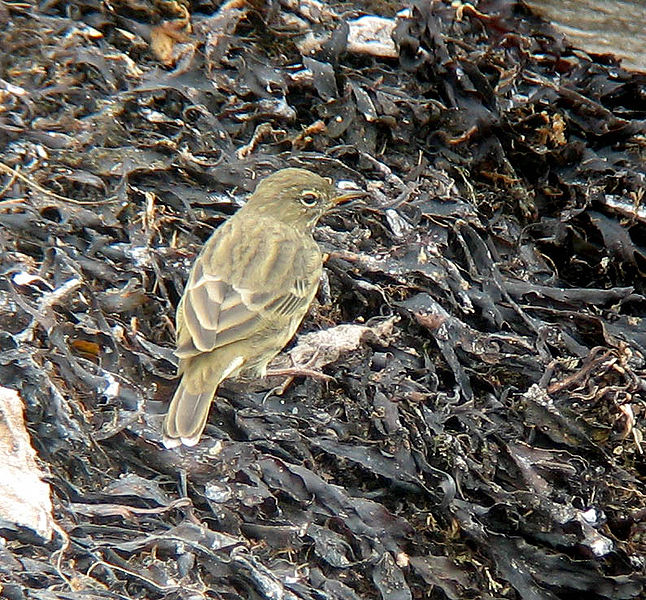
Eurasian Rock Pipit (Anthus petrosus) – a small passerine bird species which breeds on rocky coasts of western Europe northwards from Brittany. Rock Pipits tend to be found along rocky coasts, whereas Water Pipits favour damp grassland.


African Rock Pipit
(Anthus crenatus) – The Yellow-tufted Pipit, also known as the African Rock Pipit, is a species of bird in the Motacillidae family. It is found in Lesotho and South Africa. Its natural habitat is subtropical or tropical high-altitude grassland.

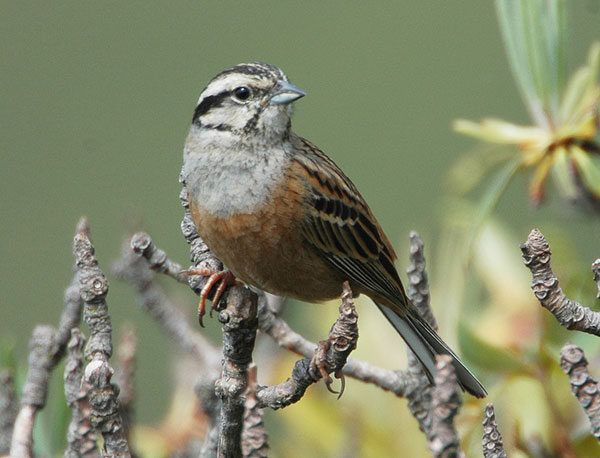
Rock Bunting (Emberiza cia) by Nikhil Devasar

Rock Bunting (Emberiza cia) – Photo – Rock Bunting breeds in open dry rocky mountainous areas. It lays 3-5 greyish eggs in a lined nest on the ground or occasionally in a low bush. Its natural food consists of insects when feeding young, and otherwise seeds.

Doth the eagle mount up at thy command, and make her nest on high? She dwelleth and abideth on the rock, upon the crag of the rock, and the strong place. (Job 39:27-28 KJV)

For thou art my rock and my fortress; therefore for thy name’s sake lead me, and guide me. (Psalms 31:3 KJV)

There are many more verses that mention “The Rock” and there are also many more birds that live and eat in rocky places. They may not have “rock” in their name, but they were all created by The Rock, Jesus Christ.

And to make all men see what is the fellowship of the mystery, which from the beginning of the world hath been hid in God, who created all things by Jesus Christ: (Ephesians 3:9 KJV)

And did all drink the same spiritual drink: for they drank of that spiritual Rock that followed them: and that Rock was Christ. (1 Corinthians 10:4 KJV)

Information mostly from Wikipedia, but other internet sources quoted also. Names according to the IOC 2.7 version.

We trust you know The Rock as your Saviour.

Wordless Birds

Gospel Message

To see more Formed By Him blogs

*

Formed By Him – Rock Birds and The Rock – I

Waves on Rocks - Point Lobos State Reserve by Daves BP

Waves on Rocks – Point Lobos State Reserve by Daves BP

The LORD is my rock, and my fortress, and my deliverer; my God, my strength, in whom I will trust; my buckler, and the horn of my salvation, and my high tower. (Psalms 18:2 KJV)

When the Lord created the world and all that is therein, He created the rocks and hills and the birds that He created were well adapted to live in those places. Birdwatchers through the years have observed them in this habitat of rocks, stones, cliffs, and other high rocky places. Just as Adam named the first birds, ornithologists (bird people) are still naming birds.

Searching through the latest IOC 2.7 List of Birds, I found 50 birds with “Rock” in their names. Searching the Bible for the word “Rock”, I found around 130 verses referring to a “rock” or “The Rock.” Here is a blend of the birds and some of the Scriptures verses that show the mighty Hand of God at work and the neat “Rock Birds” Formed by Him.

Here is a list of the first 25 birds with “Rock” in their name in taxonomic order with a few words about them :

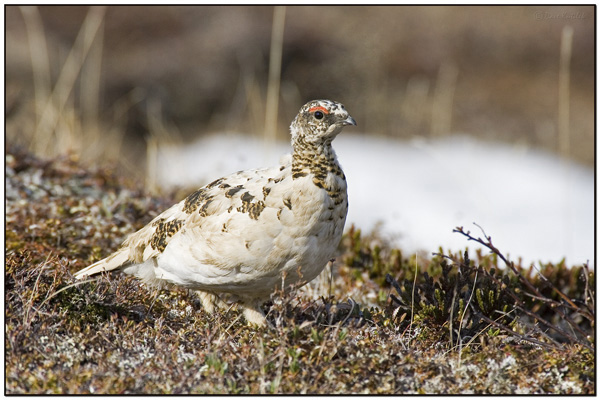
Rock Ptarmigan (Lagopus muta) by Daves BirdingPix

Rock Ptarmigan (Lagopus muta) by Daves BirdingPix

Rock Ptarmigan (Lagopus muta) – It is a sedentary species which breeds across arctic and subarctic Eurasia and North America (including Greenland) on rocky mountainsides and tundra.
Rock Partridge (Alectoris graeca)©AGrosset  – This is a resident breeder in dry, open and often hilly country. It nests in a scantily lined ground scrape laying 5-21 eggs. The Rock Partridge takes a wide variety of seeds and some insect food.

The LORD liveth; and blessed be my rock; and let the God of my salvation be exalted. (Psalms 18:46 KJV)

strong>Rock Bush Quail (Perdicula argoondah)© – is a species of quail found in parts of peninsular India.  They are found in small coveys and are often detected only suddenly, when they burst out into flight en masse from under vegetation.

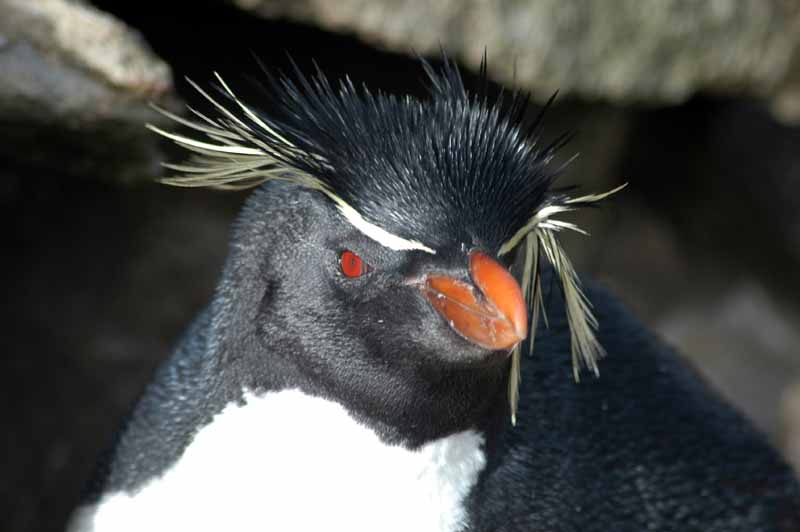
Southern Rockhopper Penguin (Eudyptes chrysocome) by Bob-Nan

Southern (Western) Rockhopper Penguin (Eudyptes chrysocome) by Dave’sBirdingPix- Their common name refers to the fact that, unlike many other penguins which get around obstacles by sliding on their bellies or by awkward climbing using their flipper-like wings as aid, Rockhoppers will try to jump over boulders and across cracks. This behaviour is by no means unique to this species however – at least the other “crested” penguins of the genus Eudyptes hop around rocks too. But the Rockhopper’s congeners occur on remote islands in the New Zealand region, whereas the rockhopper penguins are found in places that were visited by explorers and whalers since the Early Modern era. Hence, it is this particular species in which this behavior was first noted.
Northern Rockhopper Penguin (Eudyptes moseleyi)© – Same as above

Rock Shag (Phalacrocorax magellanicus) by Daves BirdingPix

Rock Shag (Phalacrocorax magellanicus) by Daves BirdingPix

Rock Shag (Phalacrocorax magellanicus) – The Rock Shag usually nests on ledges on steep, bare, rocky cliffs. It normally lays 3 eggs, though nests of from 2 to 5 eggs have been seen. Nesting colonies range is size from 5 pairs to nearly 400.

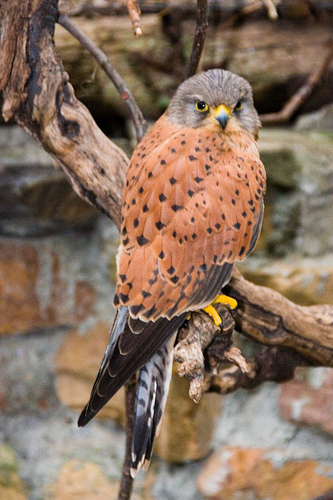
Rock Kestrel (Falco rupicolus) ©©SteveCrane

Rock Kestrel (Falco rupicolus) – It does not require woodland to be present as long as there are alternate perching and nesting sites like rocks or buildings. It will thrive in treeless steppe where there are abundant herbaceous plants and shrubs to support a population of prey animals.

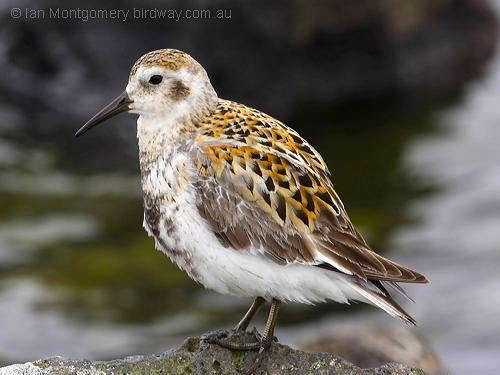
Rock Sandpiper (Calidris ptilocnemis) by Ian

Rock Sandpiper (Calidris ptilocnemis) – They nest on the ground either elevated on rocks or in lower damp location. The males makes several scrapes; the female choose one and lays 4 eggs. Both the male and female take the responsibility for incubation. Birds migrate south to rocky ice-free Pacific coasts in winter.

Now Rizpah the daughter of Aiah took sackcloth and spread it for herself on the rock, from the beginning of harvest until the late rains poured on them from heaven. And she did not allow the birds of the air to rest on them by day nor the beasts of the field by night. (2 Samuel 21:10 NKJV)

Rock Pratincole (Glareola nuchalis) – This species shows a preference for exposed emergent rocks in large rivers and streams, sometimes also frequenting mud and sandbars by lagoons. Eggs are laid directly into shallow depressions, cracks, and on the flat tops of bare rocks surrounded by deep and sometimes fast-flowing water, or on rock ledges and under overhangings. Most nests are found within a metre or two of the water level. (Bird Life)

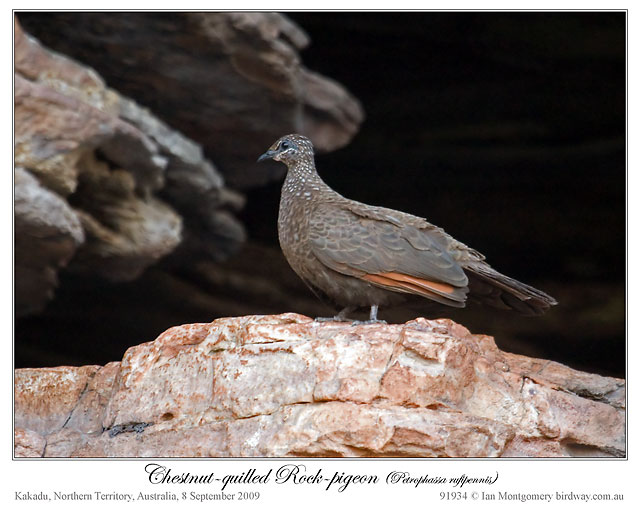
Chestnut-quilled Rock Pigeon (Petrophassa rufipennis) by Ian

Chestnut-quilled Rock Pigeon (Petrophassa rufipennis)by Ian  – found in deep sandstone gorges, rocky gullies & cliffs in the area from the Katherine Gorge to Oenpelli in the Northern Territory of Australia. – See Ian’s Bird of the Week
White-quilled Rock Pigeon (Petrophassa albipennis)by Ian  – Found only among the cliffs, gorges & boulder strewn sloped regions of the Kimberley Division of Western Australia & adjacent Northern Territory east to the Flora River & Stokes Range.

Rock Parrot (Neophema petrophila) by Ian

Rock Parrot (Neophema petrophila) by Ian- Rocky islands and coastal dune areas are the preferred habitats for this species, which is found from Robe, South Australia westwards across coastal South and Western Australia to Shark Bay.

New Zealand Rockwren (Xenicus gilviventris) ©WikiC

New Zealand Rockwren (Xenicus gilviventris) by KentNickell – it is a poor flier, rarely flying more than two metres off the ground or for distances or more than 30 m. It is highly terrestrial, feeding in low scrub and open scree and rockfalls in alpine areas. 

There is none holy as the LORD: for there is none beside thee: neither is there any rock like our God. (1 Samuel 2:2 KJV)

Rock Earthcreeper (Ochetorhynchus andaecola)© – It is found in Argentina, Bolivia, and Chile. Its natural habitats are subtropical or tropical high-altitude shrubland and subtropical or tropical high-altitude grassland.

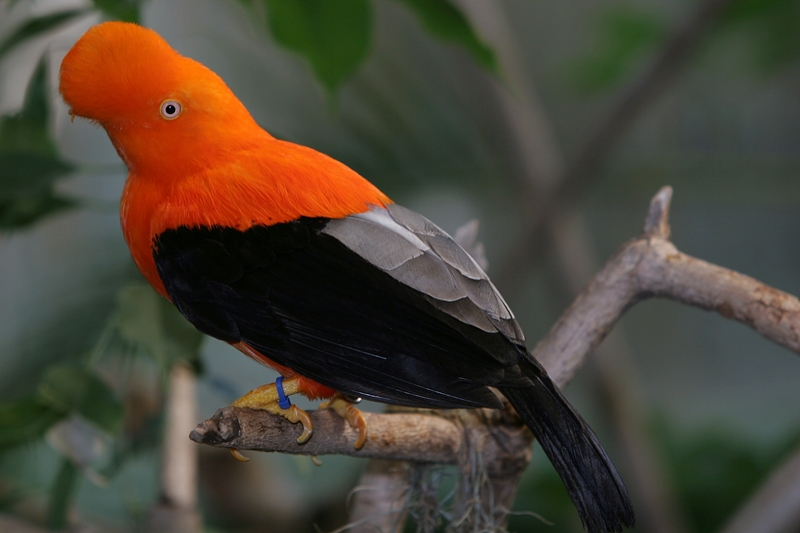
Andean Cock-of-the-rock (Rupicola peruvianus) by SanDiegoZoo

Guianan Cock-of-the-rock (Rupicola rupicola)©©lolodoc – They are found in tropical and subtropical rainforests close to rocky areas, where they build their nests.
Andean Cock-of-the-rock (Rupicola peruvianus) by SanDiegoZoo – Same as above

Rockwarbler (Origma solitaria)by Ian- Nest©©nimpitja – The Rockwarbler is 14 cm in length. It is usually seen hopping erratically over rocks whilst flicking its tail. Its preferred habitat is woodlands with sandstone or limestone. Its distribution is central eastern New South Wales.

The LORD liveth; and blessed be my rock; and let the God of my salvation be exalted. (Psalms 18:46 KJV)

White-necked Rockfowl (Picathartes gymnocephalus)© – They have unfeathered heads, and feed on insects and invertebrates picked from damp rocky areas. Both species are totally non-migratory, being dependent on a specialised rocky jungle habitat. White-necked, also known as the White-necked Picathartes, is found in rocky forest areas at higher altitudes from Sierra Leone to Ghana. It has grey upperparts, white underparts and a yellow head with a black patch on each side.
Grey-necked Rockfowl (Picathartes oreas)© – Same as above, plus, It nests in caves and on rock cliffs and needs specific habitat requirements, such as overhanging rock for protection from the elements and often it needs a seasonal river below to protect from predators.

Cape Rockjumper (Chaetops frenatus) ©WikiC

Cape Rockjumper (Chaetops frenatus)©WikiC – These are small birds with mostly brown and red plumage. Both species have long, white tipped black tails, black throats, broad white submoustachial lines, rufous or orange bellies and rumps and grey and black patterned backs and wings.[1] The iris is red and the bills and legs are black. Their wings are very small and they do not fly very often. They spend most of their lives running and jumping among rocks and grasses while hunting insects. A range of insects are taken, including caterpillars, moths, grasshoppers, beetles and flies. In addition to insects other prey include lizards and geckos, amphibians, scorpions, annelid worms and spiders.
Drakensberg Rockjumper (Chaetops aurantius)©WikiC – Same as above

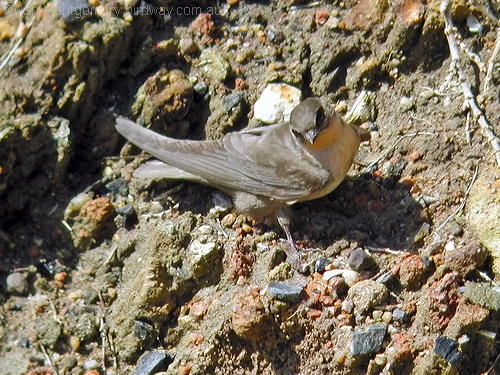
Rock Martin (Ptyonoprogne fuligula) by Ian

Rock Martin (Ptyonoprogne fuligula)by Ian  – The Rock Martin (Ptyonoprogne fuligula) is a small passerine bird in the swallow family that is resident in Africa, and in southwestern Asia east to Pakistan. It breeds mainly in the mountains, but also at lower altitudes, especially in rocky areas and around towns, and, unlike most swallows, it is often found far from water. It is 12–15 cm (4.7–5.9 in) long, with mainly brown plumage, paler-toned on the upper breast and underwing coverts, and with white “windows” on the spread tail in flight. The sexes are similar in appearance, but juveniles have pale fringes to the upperparts and flight feathers. The northern subspecies are smaller, paler, and whiter-throated than southern African forms, and are sometimes split as a separate species, the “Pale Crag Martin”. The Rock Martin hunts along cliff faces for flying insects using a slow flight with much gliding. Its call is a soft twitter.

This martin builds a deep bowl nest on a sheltered horizontal surface, or a neat quarter-sphere against a vertical rock face or wall. The nest is constructed with mud pellets and lined with grass or feathers, and may be built on natural sites under cliff overhangs or on man-made structures such as buildings, dam walls, culverts and bridges. It is often reused for subsequent broods or in later years. This species is a solitary breeder, and is not gregarious, but small groups may breed close together in suitable locations. The two or three eggs of a typical clutch are white with brown and grey blotches, and are incubated by both adults for 16–19 days prior to hatching. Both parents then feed the chicks. Fledging takes another 22–24 days, but the young birds will return to the nest to roost for a few days after the first flight.

From the end of the earth will I cry unto thee, when my heart is overwhelmed: lead me to the rock that is higher than I. (Psalms 61:2 KJV)

The article is quite long so I am breaking it into two Parts. To see the second half – CLICK HERE

Information mostly from Wikipedia, but other internet sources quoted also.

Birdwatching and Still Updating

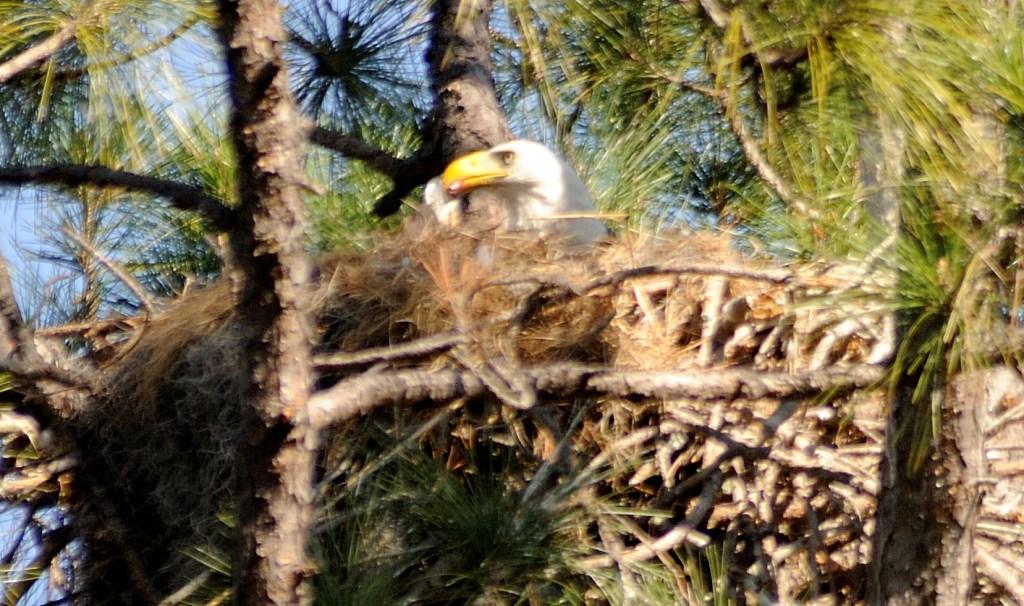
Eagle in nest feeding eaglets by Dan

Nest at South Lake Howard Park 2 years ago.

But they that wait upon the LORD shall renew their strength; they shall mount up with wings as eagles; they shall run, and not be weary; and they shall walk, and not faint. (Isaiah 40:31 KJV)

On the way to town today, we stopped by the South Lake Howard Nature Park again for just a few minutes. (15) It was a beautiful day. Surprised how few in number the birds were, but the variety of birds wasn’t bad. In the 15 minutes we were able to see the following:

Osprey, Little Blue Heron, Great Egret, 6  White Ibises flying by, Common Moorhens, Boat-tailed Grackles, Quakers (Monk Parakeets – they have a big nest there), Blue Jay, 3 Mockingbirds, Northern Cardinal, Palm Warblers and a black and light colored Warbler-not a Black-and-White though, Mr and Mrs Wood Duck swimming by, and up on the tower both Mr and Mrs Bald Eagle were perched. (They have a nest in the park) and a White Ibis on the ground walking around with the reddest legs and beak I have ever seen. Spring is definitely in the air here in Central Florida. Oh, yes, there was a nice sized alligator sunning on the bank. No camera with us unfortunately.

Also, I am still kicking up dust behind the scenes on updating the Birds of the World pages. It was a busy week-end and I didn’t get much done on it. See – Updating the Birds of the World Again 2/24/11 .

I am working on the Herons and have finished these Families since the last update:

As I have been working on the pages, I have been adding new photos of some of the missing birds. It is taking longer, but hope to make more species viewable.

Update – 3/17/11:

See – Birdwatching and Still Kicking Up Dust
*

The Apostlebird – The ground dwellers…


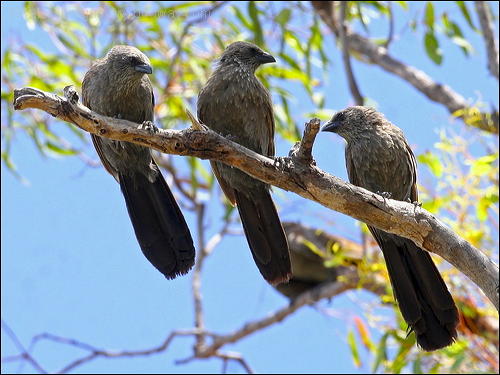
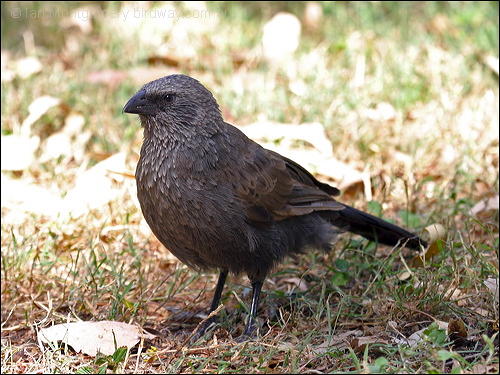
Apostlebird (Struthidea cinerea) by Ian

Apostlebird (Struthidea cinerea) by Ian

The Apostlebird – The ground dwellers…  ~ by a j mithra

The Apostlebird (Struthidea cinerea), also known as the Grey Jumper, is a quick-moving, gray or black bird about 13 inches (33 centimetres) long. It is a native to Australia where it roams woodlands, eating insects and seeds at, or near, ground level.

Apostlebirds often travel in groups of about 12; for this reason they were named after the Biblical apostles, the twelve chief followers of Jesus Christ. In fact, the species travel in family groups of between 6 and 20, which may coalesce with other family groups into large feeding flocks of over 40.

Their gregarious nature and harsh scolding/grating calls have led to a plethora of colloquial names. They can be known locally as Lousy Jacks (due to heavy louse infestations), Happy Jacks, happy Families and CWA Birds. The latter name is mildly derogatory, referring to the supposed resemblance of Apostlebird’s constant chatter, to a Country Women’s Association meeting.

Apostlebird (Struthidea cinerea) by Ian

Apostlebird (Struthidea cinerea) by Ian

Grey Jumper is an alternate name. The Apostlebird is highly gregarious and garrulous, occurring in small, sedentary, co-operatively breeding groups throughout the year. Apostlebirds sometimes occur in larger congregations during the non-breeding season at abundant sources of food; they are seldom seen singly or in twos. In winter, after the breeding season, these groups may combine in larger flocks of up to 50 or 100 birds.

  • Jesus said that He will be there, where two or three have gathered in His name…
  • We call ourselves as apostles of Christ Jesus, but, do we congregate in large numbers?
  • Most families have more than three members, but do they congregate?
  • How many families go to church together as a family?
  • How many families have family prayer, where every member of the family is present?

These birds don’t go to church, but they are called Apostle birds..

Others call us as Christians, which means “Christ in us”, but, they seldom call us as apostles, why?

And if one prevail against him, two shall withstand him; and a threefold cord is not quickly broken. (Ecclesiastes 4:12)

These birds seem to have read this verse from the Bible..

A family group will hold a territory of 15 to 30 hectares defending it against other groups. Family groups roost clustered closely together in a row on a branch.

Apostlebirds are usually active and conspicuous, seldom silent, and usually bold and tame..

These birds are bold and tame as well…

These birds seem to have taken this character from the Bible…

Behold, I send you forth as sheep in the midst of wolves: be ye therefore wise as serpents, and harmless as doves. (Matthew 10:16)

The groups often move quickly along the ground as the birds forage for seeds and insects picking up items from the ground and not probing and digging as other ground foragers do. Adopts a predominantly terrestrial lifestyle walking with long strides and often running or hopping. Group members maintain a stream of twittering and chatter among themselves while foraging.

Feeding on the word of God should be considered as having a grand feast with our family and not to be considered as a ritual…

  • How often do we discuss about our worldly affairs over every meal on the dining table!
  • How often do we meditate and discuss on the word of God as a family?
  • We eat, but, never seem to exercise.. Isn’t it?

Then they that feared the LORD spake often one to another: and the LORD hearkened, and heard it, and a book of remembrance was written before him for them that feared the LORD, and that thought upon his name. (Malachi 3:16)

The species spends most time on the ground, but when disturbed, birds fly low to cover, often giving noisy, harsh scolding calls, with wing-beats that are broken by short glides with upswept wing-tips.

They often leap from branch to branch with their tails cocked and partly spread, often making long glides (of up to 50 metres) from a perch to the ground, or from tree to tree.

When on the ground, Apostlebirds walk and run strongly, with a steady gait, walking quickly with the tail swaying from side to side, just above the ground, but with no forward jerking of head (unlike the White-winged Chough), and run in short, quick bursts; they sometimes also hop, with tails flicked upwards, and then slowly subsiding; hops can be as long as twice the length of the bird.


Apostlebird (Struthidea cinerea) by Ian

Apostlebird (Struthidea cinerea) by Ian

Foraging is almost always on the ground, where they mainly take insects and seeds, using their bill to scratch at the ground and among litter, though they also occasionally forage in trees and shrubs.

When Jesus was on this earth, His ministry was always on the ground level..

  • He made sure that He brought people down to the ground level before dealing with them.
  • Remember Zacchaeus had to come down from the sycamore tree before he had an encounter with God…
  • Though Manna and Quails came from above, the Israelites had to gather them from the ground..

Jesus our manna too came from above so that we may meet Him on earth..

  • Where are we right now?
  • Are trying to meet God from our high position?
  • Those who humble are the ones who win favour from God..
  • God humbled Him to the ground level and expects the same from us…

Humble yourselves in the sight of the Lord, and he shall lift you up. (James 4:10)

They are often seen preening each other.

  • We loved to be preened in the radiance of public flattery as told in Mathew 23:7-17.
  • But God’s expectations on preening among the church is quite different…

Be kind to one another, tenderhearted, forgiving one another, as God in Christ forgave you. (Ephesians 4:32)

Inhabits open, fairly dry country never far from water which they visit several times a day in warm weather.

  • God is there to fill our cup when it is dry..

These birds have to frequent water bodies during warm weather, but, Our Lord is able fills us wherever we are..

  • But, it depends on how much we thirst for the Living water…

Our God is faithful to fill us, well, are we willing to be drenched by THE LIVING WATER?

For I will pour water upon him that is thirsty, and floods upon the dry ground: I will pour my spirit upon thy seed, and my blessing upon thine offspring: (Isaiah 44:3)

Groups are seen in open forest, woodland, river margins and roadside tree belts. Distributed through central Queensland, New South Wales and in south-east South Australia..

Their distinctive mud nests often indicate presence in an area. Apostlebirds build a medium-sized bowl-shaped mud nest.

  • Our homes should act as an indicator of the presence of God for the people living around us..
  • If Jesus becomes the door of our house, all those who enter our home would leave our home as a changed person..

I am the door: by me if any man enter in, he shall be saved, and shall go in and out, and find pasture. (John 10:9)

Apostlebirds can sometimes tolerate high levels of habitat degradation, as groups have been recorded in highly degraded woodlands with a high proportion of exotic plants in the ground layer, heavy grazing pressure, no tree regeneration and no understorey; and they can persist in small patches of remnant vegetation of just a few hectares in extent, though these may need to be near other, larger patches of suitable habitat.


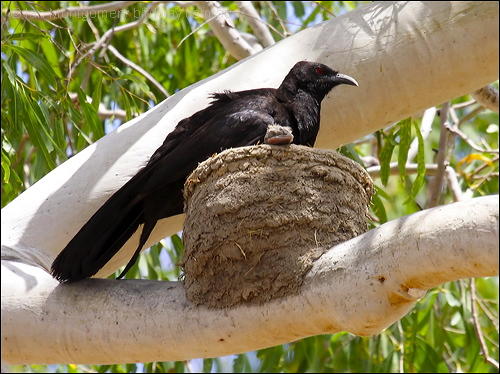
White-winged Chough (Corcorax melanoramphos) in mud nest by Ian

White-winged Chough (Corcorax melanoramphos) in mud nest by Ian

Breeding season is from August to December. The nest is a deep cup-shaped structure made of grasses held together with mud or sometimes manure in a tree fork up to seven or eight meters above the ground. Three to five pale blue-white eggs sparsely splotched with brown and lavender shades are laid measuring 22 mm x 29 mm. They are tapered oval in shape They build substantially larger nests, weighing up to five pounds, located as much as fifty feet above the ground. But even these scaled-up versions of the adobe cup with their inch-thick walls are manufactured with the same jiggled-mud strategy that seems to be universal among birds that build with wet earth. But then vibration is a key feature in the insertion of twigs and grasses into conventional nests, so this may be a bit of behavioral recycling.

Apostlebirds are a communal species with each family group generally containing only one breeding pair, the rest being their helper offspring. All family members help construct a mud nest, and share in incubation of the eggs. Once the eggs are hatched, all members of the family group also help feed the chicks and keep the nest clean.

  • We have a God who has shed His precious blood to cleanse our nest…
  • Well, we are not ordinary people; we are God’s nest…
  • That is the reason God wants to dwell is us..

God has taught these bird to build their nest with mud high above on tree forks..

Jesus too chose to dwell in a nest made of mud that was the reason He chose you and me?

Know ye not that ye are the temple of God, and that the Spirit of God dwelleth in you? (1 Corinthians 3:16)

Have a blessed day!

Your’s in YESHUA,
a j mithra

Please visit us at:
Crosstree

ajmithra21


Lee’s Addition:

To see a j mithra’s other articles – Click Here

Thanks, a j, for another interesting article and a thanks to Ian Montgomery, one of  our great photographers for the permission to use his photos.

The Apostlebird (Struthidea cinerea) is in the Corcoracidae – Australian Mudnesters Family of the Passeriformes Order. There are two subspecies; the cinerea and dalyi. The other Mudnester is the White-winged Chough (Corcorax melanoramphos) which also has two subspecies.

Video links to Apostlebirds:

A group of birds foraging and calling.

A close-up of an Apostlebird

*

Updating The Birds of the World Again 2/24/11

Lesser Rhea (Rhea pennata tarapacensis) (Darwin's) Chicks©Arthur Grosset

Lesser Rhea (Rhea pennata tarapacensis) (Darwin’s) Chicks©Arthur Grosset

The I.O.C. has updated to Version 2.7, but they are also getting ready to release a whole new format in Version 3.0. They placed the Ver. 2.7 in a draft which includes the Subspecies. After experimenting with several different ways to present the list, I have made my choice. This means that I have been busy behind the scene working on this website. (Lee’s Birdwatching Adventures Plus)

So far I have updated the following Families:
Tinamous – Tinamidae
Ostriches – Struthionidae
Rheas – Rheidae
Cassowaries – Casuariidae
Emu – Dromaiidae

The I.O.C. is now the I.O.U. “Our goal on behalf of the International Ornithologist’s Union, formerly International Ornithological Congress (IOC), is to facilitate worldwide communication in ornithology and conservation through the consistent use of English names linked to current species taxonomy. The English names follow explicit guidelines for spelling and construction that increase clarity of application. To this end we provide a complete list of the extant bird species of the world.”

IOC World Bird List – Subspecies (Draft 1)

Supplementing the release of version 2.7 of the IOC World Bird List is a preview of our draft listing of the subspecies of the world’s birds along with the authors and dates attributed to their nomenclature.  This working draft will provide the taxonomic foundation for version 3.0.

The above quotes are from the IOC World Bird List website. Since they are making a major revision, I decided to get started on updating to match their way of listing birds. I have been using the IOC lists of World Birds since starting the Birds of the World section.

There are 233 Families of birds, which means I have 233 pages of data to update. So, I have 5 down and 228 to go. For now the indexes to the families will not change, but a few birds may not be correct until I finish. Try not to be too upset about the dust flying around as the changes are being made. Trust the 3.0 Version is close to what I am doing.

The main difference is that before only the bird was named, such as: (All photos by Bob-Nan)

Common Ostrich (Struthio camelus)
Somali Ostrich (Struthio molybdophanes)

Now it is:

Struthio   ———- This is the Genus
Common Ostrich (Struthio camelus) ————– This is the Species
____ (Struthio camelus syriacus)  ——- This is the Subspecies
____ (Struthio camelus camelus)  ——- This is the Subspecies
____ (Struthio camelus massaicus) ——- This is the Subspecies
____ (Struthio camelus australis)  ——- This is the Subspecies
Somali Ostrich (Struthio molybdophanes) ————– This is the Species

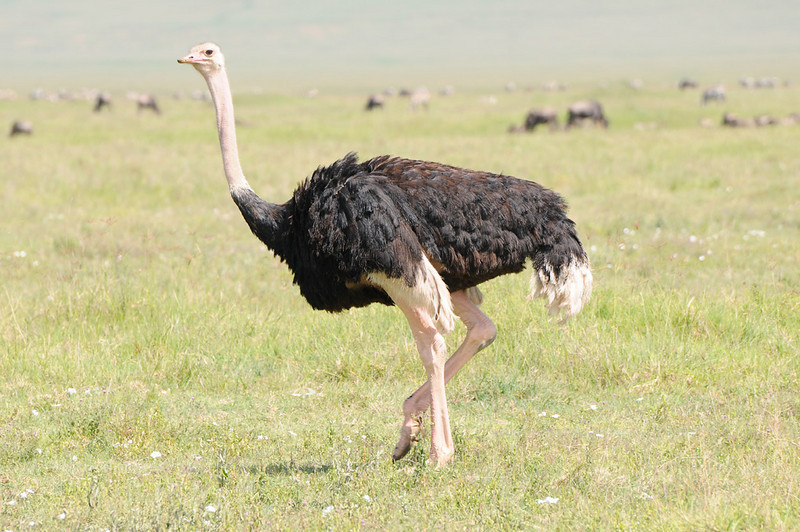
Common Ostrich (Struthio camelus massaicus) by Bob-Nan

Common Ostrich (Struthio camelus massaicus) by Bob-Nan

I trust this helps explain the new layout for the list of world birds. It’s time for me to start kicking up some more dust as I continue with the changes. I am going straight down the list of families – Family Index. Keep checking back to see how far I have gotten. Updating all the links to the pictures and videos is the most time consuming.

It is worth it though to help you see the fantastic birds the Lord has created around this world. I personally have great pleasure working on this because I get to see so many birds that I will never personally view. Thanks to the many photographers and videographers, those that have given us permission, the ones who allow their photos to used in ©© (Creative Commons), ©WikiC (Wikipedea Commons), and others in public domain.

And out of the ground the LORD God formed every beast of the field, and every fowl of the air; and brought them unto Adam to see what he would call them: and whatsoever Adam called every living creature, that was the name thereof. (Genesis 2:19 KJV)

Remember his marvellous works that he hath done; his wonders, and the judgments of his mouth; (Psalms 105:5 KJV)

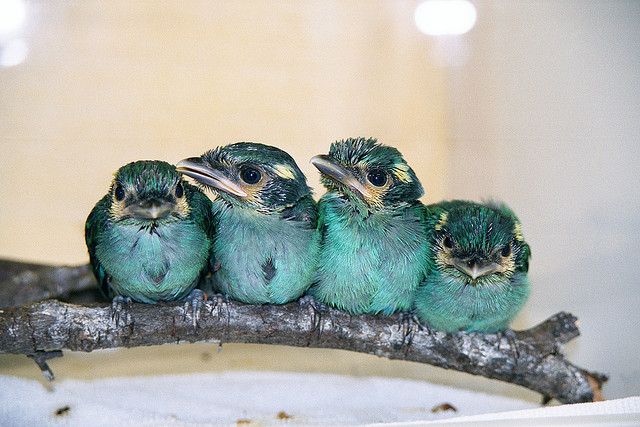
Long-tailed Broadbill (Psarisomus dalhousiae) babies ©©coracii

Long-tailed Broadbill (Psarisomus dalhousiae) babies ©©coracii

That they may see, and know, and consider, and understand together, that the hand of the LORD hath done this, and the Holy One of Israel hath created it. (Isaiah 41:20 KJV)

Let them praise the name of the LORD: for he commanded, and they were created. (Psalms 148:5 KJV)

Updated – See:

3/1/11 – Birdwatching and Still Updating

3/17/11 – Birdwatching and Still Kicking Up Dust

*

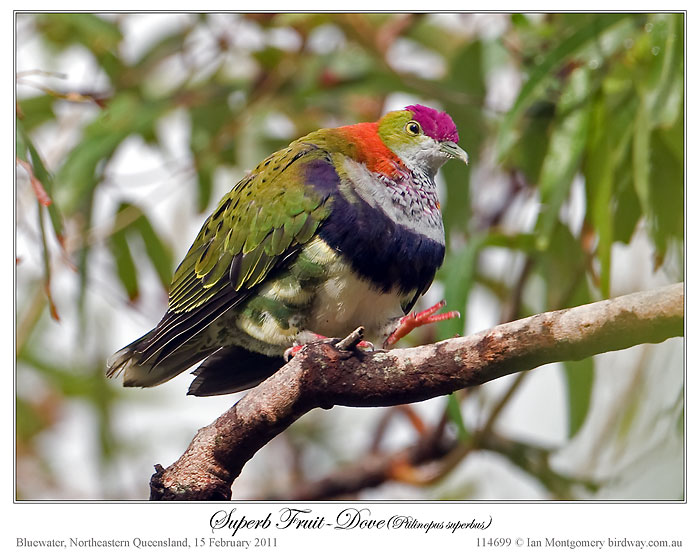
Birds in Hymns – The Garden of My Heart

Superb Fruit Dove (Ptilinopus superbus) by Ian

Superb Fruit Dove (Ptilinopus superbus) by Ian

Therefore they shall come and sing in the height of Zion, and shall flow together to the goodness of the LORD, for wheat, and for wine, and for oil, and for the young of the flock and of the herd: and their soul shall be as a watered garden; and they shall not sorrow any more at all. (Jeremiah 31:12 KJV)

Words & Music: Hal­dor Lil­le­nas, 1919

The Garden of My Heart


There’s a sacred and hallowed retreat,
Where my soul finds a fellowship sweet,
Where the Lord of my life I may meet,
In the garden of my heart.

Refrain

In the cool of the day He walks with me,
In the rose bordered way He talks with me;
In love’s holy union,
And sacred communion,
In the garden of my heart.

There is naught can disturb or molest,
There my spirit finds comfort and rest,
And my soul is no longer distressed
In the garden of my heart.

Refrain

Shut away from earth’s strife and its din,
And protected from soul staining sin,
For my Savior is dwelling within,
In the garden of my heart.

Refrain

There the dove of sweet peace always sings,
And my faith ever trustingly clings;
And the chime of sweet happiness rings
In the garden of my heart.

Refrain

*****

See more Birds in Hymns

*

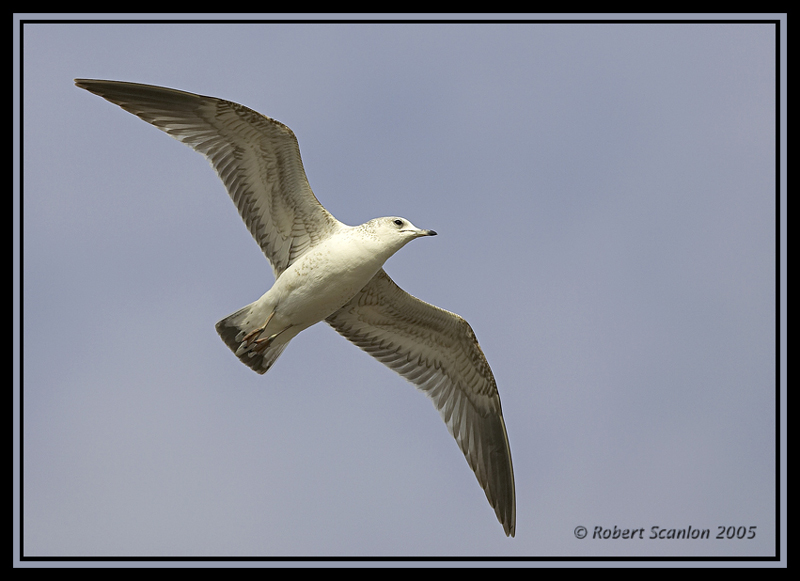
Birds in Hymns – The Fish in Wave, The Bird on Wing

Common Gull (Larus canus) by Robert Scanlon

Common Gull (Larus canus) by Robert Scanlon

And God said, Let the waters bring forth abundantly the moving creature that hath life, and fowl that may fly above the earth in the open firmament of heaven. (Genesis 1:20 KJV)

Words: Charles Cof­fin, Par­is Bre­vi­a­ry, 1736 (Iis­dem cre­a­ti fluc­ti­bus); trans­lat­ed from La­tin to Eng­lish by John Chand­ler and the com­pil­ers of Hymns An­cient and Mo­dern.

Music: St. Fla­vi­an, Day’s Psal­ter, 1563

The Fish in Wave, The Bird on Wing


The fish in wave, the bird on wing,
God bade the waters bear;
Each for our mortal body’s food
His gracious hands prepare.

But other food, of richer cost,
The immortal spirit needs;
By faith it lives on every word
That from His mouth proceeds.

Faith springing from the blood of Christ,
Has flowed o’er every land;
And sinners through the vanquished world
Bow down to its command.

Its light the joy of Heav’n reveals
To hearts made pure within;
And bids them seek by worthy deeds
Eternal crowns to win.

By faith the saints of old were strong
The lion’s wrath to tame;
By faith they spurned the tyrant’s threats,
And scorned the raging flame.

Lord, grant that we the path may tread
Whereon its light doth shine;
And gather, as we onward go,
The fruits of love divine.

O praise the Father; praise the Son,
On Whose most precious blood
Rests all our faith; and praise to Him
Who with Them both is God.

Most information from The Cyber Hymnal

Another great hymn from the past.

*****

See more Birds in Hymns

*

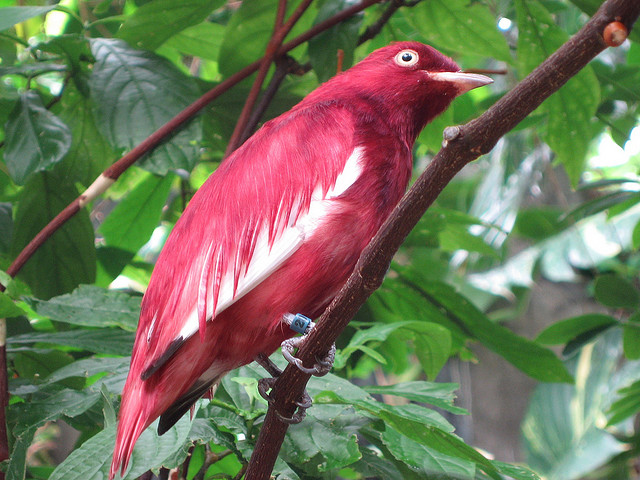
The Pompadour Cotinga – Concealed Incubators…

Pompadour Cotinga (Xipholena punicea) ©© Miami_Metrozoo male

Pompadour Cotinga (Xipholena punicea) ©© Miami_Metrozoo male

The Pompadour Cotinga – Concealed incubators… ~ by a j mithra

The Pompadour Cotingas are South American birds from the Cotingidae family. They are found in Brazil, Columbia, French Guiana, Guyana, Peru, Suriname, and Venezuela.

They reside in elevations to 1300 m which occur throughout Amazonia. The primary range extends from Columbia eastward to French Guiana and south to north-west Brazil. It is found in the canopy of humid forest and seems to be more numerous in areas of sandy soil forest.


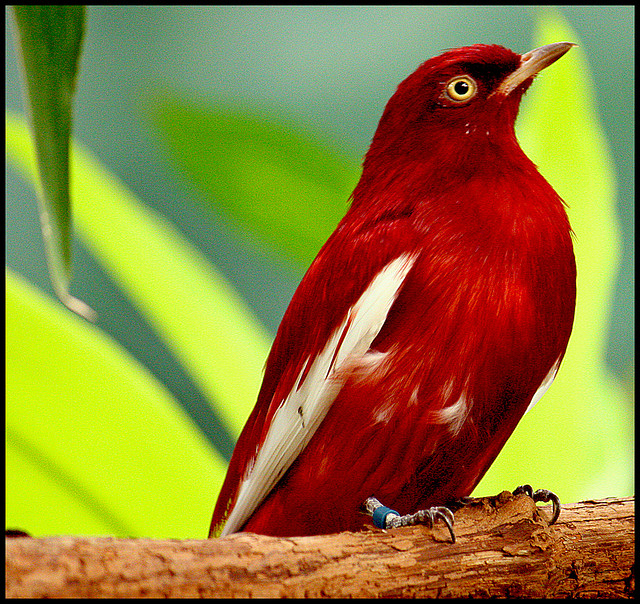
Pompadour Cotinga (Xipholena punicea) ©©beautifulcataya Flickr

Pompadour Cotinga (Xipholena punicea) ©©beautifulcataya Flickr

Sand is used most often as a symbol of countless multitudes; especially of the children of Israel and of God’s thoughts on us and also of the wisdom and understanding that God gave King Solomon..

  • Is that the reason why these beautiful birds are more numerous in areas of sandy soil forest?
  • They know that Their creator is so mindful of them…

How precious also are thy thoughts unto me, O God! how great is the sum of them! If I should count them, they are more in number than the sand: when I awake, I am still with thee. (Psalm 139:17, 18)

During breeding season males gather to perform a ritualized flight display to attract a female. Two or three males will chase each other around a group of tree tops, keeping above the trees so that their white wings flashing against the dark foliage are visible for a great distance. The males are relatively easy to see even at a distance with their white wings flashing as they fly from tree to tree. Females sometimes join mixed canopy flocks but males appear to be more solitary…


Pompadour Cotinga (Xipholena punicea) female by AGrosset

Pompadour Cotinga (Xipholena punicea) female by AGrosset

It is not uncommon for the clutch to contain a single egg. The eggs are a greenish gray with drab spotting. Frail open nests of curly wood tendrils completely conceal the female while she incubates. Little is known about their breeding habits because it occurs high up in the forest canopy.

  • God closed the door of the Ark and concealed Noah his family and the wildlife as well..
  • God’s plan in our lives are planned high above in the heavens where no one can see..
  • His ways are not our ways and our ways are not His..

Please read through Isaiah 39 and you will learn how King Hezekiah brought curse over his family when he showed off all his treasure to the envoys of Babylon so as to win favour from them..

  • Do not show off God’s blessings over your life to the others to win favour but just conceal yourself like these birds..
  • God has concealed us in His palm so wait until He shows us off to the world..

Humble yourselves therefore under the mighty hand of God, that he may exalt you in due time: (I Peter 5:6)

The bride, the Church, needs to completely conceal itself while it incubates God’s will…

But you, when you pray, enter into your closet, and when you have shut your door, pray to your Father which is in secret; and your Father which sees in secret shall reward you openly. (Mathew 6:6)

A considerable number of these birds are remarkable for the extraordinarily abnormal form of some of their wing-quills, and occasionally of their wing-coverts – a feature in the former case observable also among the Pipridae, and, where existing, generally confined to the male bird.


Pompadour Cotinga (Xipholena punicea) ©©holyknight33 Flickr

Pompadour Cotinga (Xipholena punicea) ©©holyknight33 Flickr

Many of them also are brilliantly coloured, and at least one, today known as the Pompadour Cotinga (Xipholena punicea) but known as the Pompadour Chatterer in the 19th Century (and had a latin name of Xipholena pompadora at that time) was given its 19th Century name by Edwards (Gleanings, ii. p. 275, pl. 341) after the celebrated Madame de Pompadour, to whom these birds and other birds were sent, when the ship that bore them from Cayenne fell a prize to a British cruiser.

The Pompadour Cotinga is of a hue scarcely to be seen in any other bird. The coloration of the Cotingas is from true pigmentation, not the more common prismatic feather structure. The males are a glistening wine red color with white flight feathers narrowly tipped in black. The elongated and stiff greater wing coverts are wine red with white shafts partly covering the flight feathers. The females are mainly gray and paler below. The throat and belly are grayish white, with the wings and tail dusky. Greater wing coverts and inner flight feathers are broadly edged in white. The juveniles are like the female but with dark eyes.

With glistening wine red color with white flight feathers, reminds us of the wine soaked garment of our Lord isn’t it?

My beloved is white and ruddy, the chiefest among ten thousand. (Song of Solomon 5:10)

  • About 2000 years back He came to redeem us and was battered and bruised made it look like His garment was soaked in wine…
  • This time around He is going to come again to turn His garment into red..
  • Not with His blood though…

Who is this that cometh from Edom, with dyed garments from Bozrah? this that is glorious in his apparel, travelling in the greatness of his strength? I that speak in righteousness, mighty to save.
Wherefore art thou red in thine apparel, and thy garments like him that treadeth in the winefat?
I have trodden the winepress alone; and of the people there was none with me: for I will tread them in mine anger, and trample them in my fury; and their blood shall be sprinkled upon my garments, and I will stain all my raiment
For the day of vengeance is in mine heart, and the year of my redeemed is come. (Isaiah 63:1-4)

Are we ready to meet the King?

Have a blessed day!

Your’s in YESHUA,
a j mithra

Please visit us at:
Crosstree

ajmithra21

Formed By Him – Broadbills

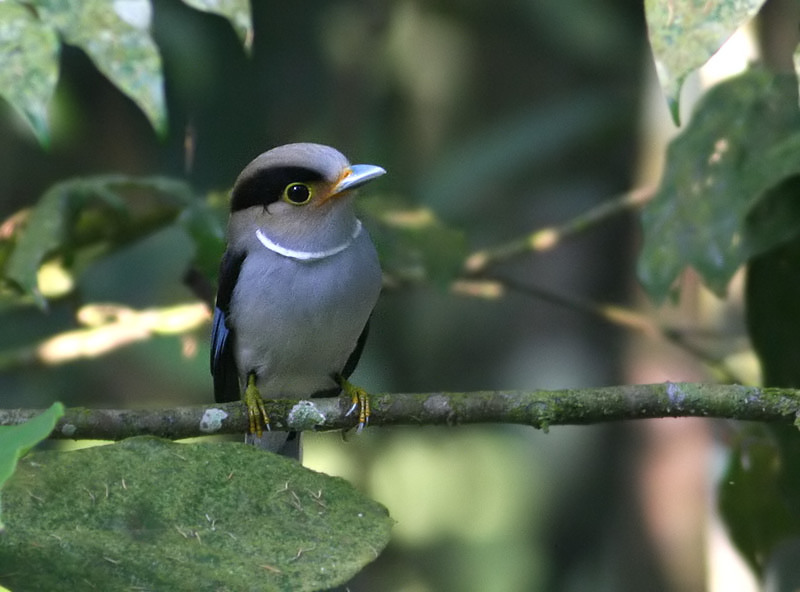
Silver-breasted Broadbill (Serilophus lunatus) by Peter Ericsson

Silver-breasted Broadbill (Serilophus lunatus) by Peter Ericsson

“What are some of God’s favorite object lessons? Certainly His creation is one. A God who can call something into existence which didn’t exist before can do anything. “Lift up your eyes on high, and behold who hath created these things” (Isaiah 40:26).” (Quote from Days of Praise-2-18-2011)

The Broadbills are another of those creations of the Lord. These pretty little birds caught my eye while doing an article. I trust you will find them as interesting as I do. Formed by Him they cannot be anything but amazing. What a great Creator God we have.

The broadbills are a family of small passerine birds, Eurylaimidae. The Smithornis and Pseudocalyptomena species occur in sub-Saharan Africa; the rest extend from the eastern Himalayas to Sumatra and Borneo. The family possibly also includes the Sapayoa from the Neotropics and the asities from Madagascar.

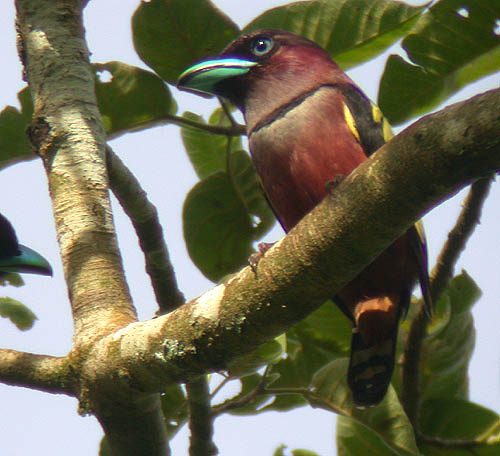
Banded Broadbill (Eurylaimus javanicus) by Peter Ericsson

Banded Broadbill (Eurylaimus javanicus) by Peter Ericsson

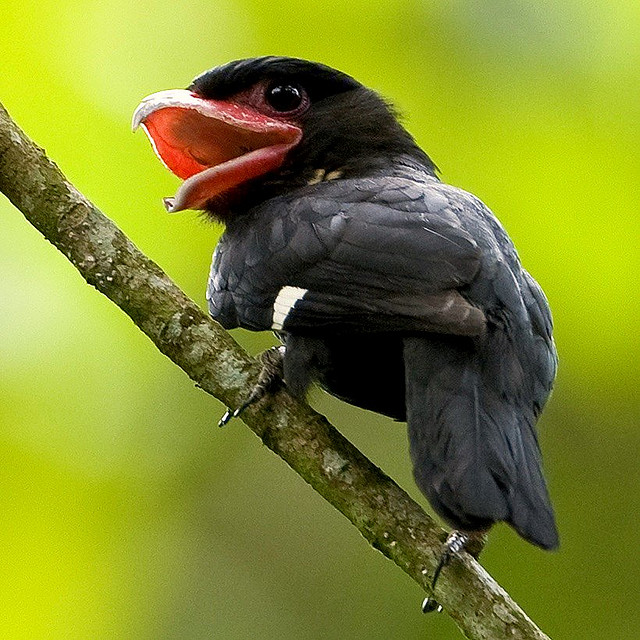
Many of the broadbills are brightly colored birds. They range from 4.5 to 11.25 inches (13 to 28 centimeters) in length, and live in the dense canopies of wet forests, allowing them to hide despite their brightly coloured plumage. The plumage of the three African broadbills in the genus Smithornis is in contrast dull and streaked. The bills, which give the family their common name, are broad, flat and hooked and relatively large eyes. Even though many are brightly colored, the Lord has designed them to blend in with their surroundings beautifully.

The broadbills are for the most part insectivorous and carnivorous. Prey taken include insects, spiders, centipedes and millipedes, as well as lizards and tree frogs. Prey is obtained by sallying from a perch to snatch it in flight, and gleaning the prey off leaves and branches while flying. Some species may take some fruit (figs being their favorite), but only the green broadbills of the genus Calyptomena and the African Green Broadbill are primarily frugivores (which also take some insects as well).

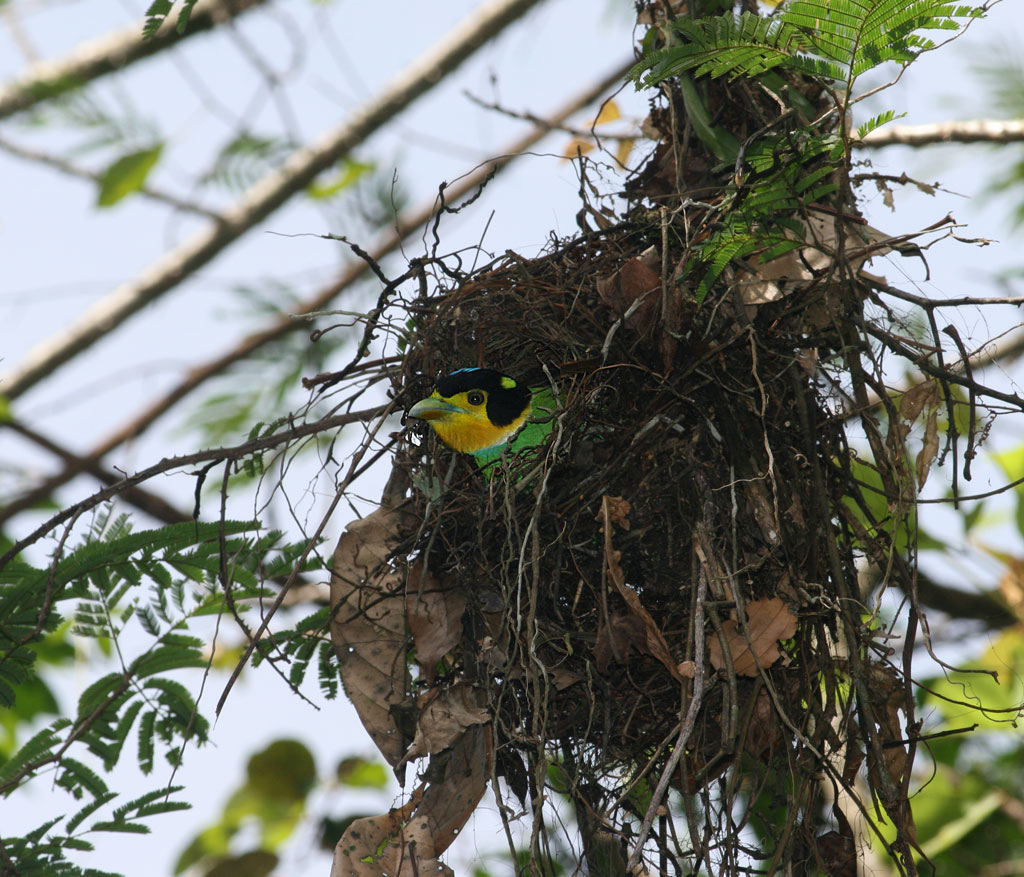
They are generally gregarious, with many species moving about in flocks of about 20 individuals. Broadbills attach their purse-shaped nests to suspended vines, and leave a tail of fibres hanging below it. This gives the nest the appearance of being random debris caught in the tree, an effect further enhanced by the birds covering the nest with lichen and spider webs.

Long-tailed Broadbill (Psarisomus dalhousiae) in nest by Peter Ericsson

Long-tailed Broadbill (Psarisomus dalhousiae) in nest by Peter Ericsson

Most Broadbills are monogamous, some have quite a courtship dispay and typically she lays two to three eggs. Both participate in nest building and in some species they have “helpers” with the young. Here are some of those verses:

Mostly active early and late in the day, otherwise they are sedentary and perched with their neck pulled in, disguised in the foliage.

Maybe the Lord would like us to look at the broad bills of the Broadbill and be reminded of Scripture. Broad or broader is mentioned over 30 times throughout the Bible.

Dusky Broadbill (Corydon sumatranus) ©©Mike

Dusky Broadbill (Corydon sumatranus) ©©Mike

David repeated in Psalm 18:19 what had been written in 2 Samuel:

He also brought me out into a broad place; He delivered me because He delighted in me. (Psalms 18:19 NKJV)
He also brought me out into a broad place; He delivered me because He delighted in me. “The LORD rewarded me according to my righteousness; According to the cleanness of my hands He has recompensed me. For I have kept the ways of the LORD, And have not wickedly departed from my God. For all His judgments were before me; And as for His statutes, I did not depart from them. (2 Samuel 22:20-23 NKJV)

Let those who fear the LORD now say, “His mercy endures forever.” I called on the LORD in distress; The LORD answered me and set me in a broad place. The LORD is on my side; I will not fear. What can man do to me? (Psalms 118:4-6 NKJV)

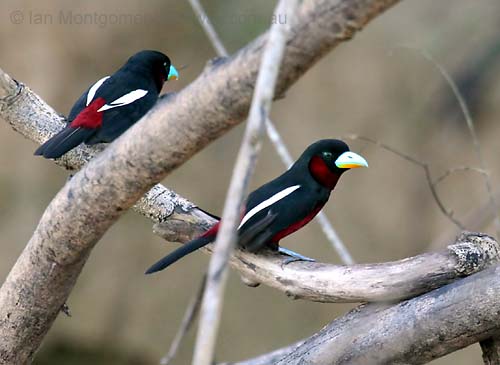
Black-and-red Broadbill (Cymbirhynchus macrorhynchos) by Ian

Black-and-red Broadbill (Cymbirhynchus macrorhynchos) by Ian

The wicked wait for me to destroy me, But I will consider Your testimonies. I have seen the consummation of all perfection, But Your commandment is exceedingly broad. Oh, how I love Your law! It is my meditation all the day. (Psalms 119:95-97 NKJV)

But there the glorious LORD will be unto us a place of broad rivers and streams; wherein shall go no galley with oars, neither shall gallant ship pass thereby. (Isaiah 33:21 KJV)

Long-tailed Broadbill (Psarisomus dalhousiae) babies ©©coracii

Long-tailed Broadbill (Psarisomus dalhousiae) babies ©©coracii

Enter by the narrow gate; for wide is the gate and broad is the way that leads to destruction, and there are many who go in by it. Because narrow is the gate and difficult is the way which leads to life, and there are few who find it. (Matthew 7:13-14 NKJV)

Can you search out the deep things of God? Can you find out the limits of the Almighty? They are higher than heaven– what can you do? Deeper than Sheol– what can you know? Their measure is longer than the earth And broader than the sea. (Job 11:7-9 NKJV)

Green Broadbill (Calyptomena viridis) by Peter Ericsson

Green Broadbill (Calyptomena viridis) by Peter Ericsson

The Broadbills are in the Eurylaimidae Family and has 20 members at present. The Eurylaimidae-Broadbills are in the Passeriformes or Perching Bird Order.

Sources from Wikipedia, Complete Birds of the World, Days of Praise and others.

This slideshow requires JavaScript.

*
To see more Formed By Him Articles

*
(Common) Pauraque – Big Mouth…

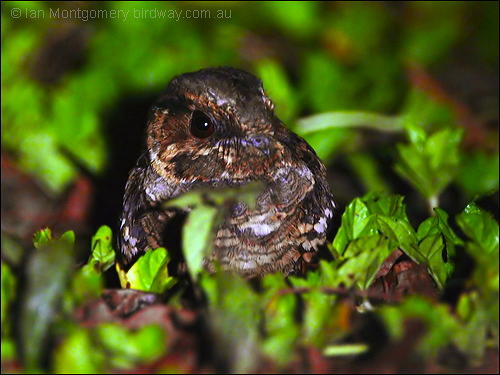
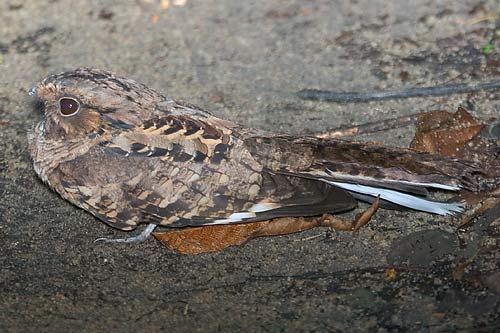
Pauraque (Nyctidromus albicollis) by Ian

Pauraque (Nyctidromus albicollis) by Ian

Pauraque – Big Mouth… ~ by a j mithra

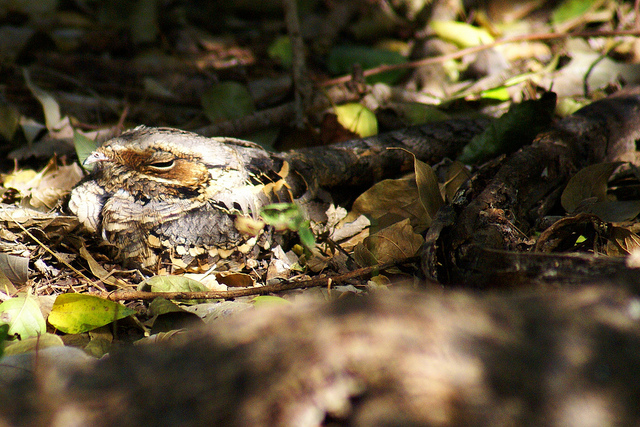
Pauraque is a medium nightjar with dark-streaked, mottled gray upperparts, white throat, black chin, rufous face, pale gray-brown underparts. Wings have brown and black bars, white band at base of primaries visible in flight. The gray tail is long, with dark edges and white patches.

Pauraque is a resident from extreme southern Texas to the American tropics; frequents semi-open scrub country with thickets and woodland clearings. Central Americans know the “white-necked night-runner” as “Don Pucuyo” or “Cabellero de la Noche” (“Gentleman of the Night”)—names reflecting its association with love and presumed amorous influence over young women.

The common name for the order and family (Caprimulgidae) in Europe and Asia it is the Goatsucker. This name is ancient and recalls a myth that these birds came down and fed at night by sucking the milk from goats.

In hot weather, they often open their mouths wide and vibrate the throat area, a behavior known as gular-fluttering. Like panting, it’s a thermoregulation behavior that helps to cool the body by increasing the rate of evaporation through the mouth..

The Bible says,

I [am] the LORD thy God, which brought thee out of the land of Egypt: open thy mouth wide, and I will fill it. (Psalm 81:10)

There is a saying in one of the south Indian states, Tamil Nadu, which says, “A child who can mouth will survive..” meaning, a child who can orate is able to survive better than the others…


Pauraque (Nyctidromus albicollis) ©Flickr

Pauraque (Nyctidromus albicollis) ©Flickr

The survival of these birds depends on how well they thermo regulate to cool their body..

  • Our survival as a child of God depends on how wide we open our mouth in the presence of God..

Remember the Bible says so much about how to use our mouth and when to use it and how powerful our mouth can be…

Death and life are in the power of the tongue: and they that love it shall eat the fruit thereof. (Psalm 18:21)

In general it prefers mixed habitat which offers densely vegetated hiding places – ideally forest – for the day, as well as open landscape – perhaps even rivers or wetlands – to hunt at night.

The Pauraques are strange birds with huge mouths that feed on the wing by opening their mouths and scooping in flying insects. It has rictal bristles, which are modified feathers resembling stiff hairs alongside its mouth. Highly tactile and controlled by specialized muscles, they are thought to aid in night feeding, and protect the bird’s eyes from flailing insect legs and wings.

Like its relatives, it feeds on insects caught in flight, usually by fly catching from a low perch, but also by foraging over open ground. These birds open their mouth wide even during their flight in the darkness of the night.

Are we willing to learn a lesson from these birds?

  • Why not for a change, open our mouth wide during our darkest times?
  • As these birds open their mouth wide, God fills them with insects…
  • How wonderful is the creation of our Lord!


Pauraque (Nyctidromus albicollis) ©Flickr

Pauraque (Nyctidromus albicollis) ©Flickr

How much care He has taken to create this unique bird! He has created specialized muscles for night feeding and rectal bristles alongside its mouth so that the insects does not get into its eyes..

  • When God takes so much care for a small little bird, will He not meet all our needs?

If we were like these birds, we would’ve surely questioned God about why He created those bristles alongside our mouth. Who knows we may have had a plastic surgery to look better…  We fail to understand why God had created us in a particular shape, size and colour..

Our God is so particular that, even though He created us in His own image, He had taken so much care to create us in a unique way, so that no one on the face of this earth would resemble us..

So let us all unite with King David and say,

I will praise you; for I am fearfully and wonderfully made: marvelous are your works; and that my soul knows right well. (Psalm 139:14)

The genus and species names reflect the Pauraque’s appearance and behavior.

  • Nyctidromus means “night-runner,” in reference to the bird’s nocturnal, low-to-the-ground foraging.
  • The species name, albicollis, describes the white, bib-like splotch on the pauraque’s throat.

Although the legs of a Pauraque are so small as to be nearly impossible to see under normal conditions, the pauraque can leap half a meter off the ground to catch low-flying insects, and has been observed running on the ground during foraging.

Pauraque (Nyctidromus albicollis) by ©AGrosset

Pauraque (Nyctidromus albicollis) by ©AGrosset

With a small pair of legs these birds can leap half a meter…

Though Hind’s feet is weaker than a horse’s feet, God says that He will give us the hind’s feet to lift us high..

He makes my feet like hinds’ feet, and sets me on my high places. (Psalm 18:33)

He does not set strong horse’s feet on high but the weak hind’s feet..

Thank God if you feel that you are weak..

Shall horses run upon the rock?….. (Amos 6:12)

The male Pauraque’s song is very variable, but includes a whistled weeeow wheeooo, (“who-r-you”), soft puk puk and a whip given in the courtship flight as he flutters around the female. Her call is a rapid succession of whip sounds. If disturbed, it will sometimes run rather than fly, and it frequently rests on roads and tracks.

  • Where do we run when we are disturbed?

These birds runs and rests on roads and tracks..

  • Don’t we see a secret in its character?
  • When disturbed let us run to the road to rest…

Road?

Yea, JESUS is the road, I mean THE WAY, where there is rest and relief…

The name of the LORD is a strong tower: the righteous runneth into it, and is safe. (Proverbs 18:10)

Have a blessed day!

Your’s in YESHUA,
a j mithra

Please visit us at:
Crosstree

ajmithra21


Lee’s Addition:

YouTube Video by baco1970

The Pauraque is one of the 93 species in the Caprimulgidae – Nightjars Family. The Caprimulgidaes are one of four families in the Caprimulgiformes Order.

Other articles from this family include:
Futuristic Whip-poor-wills by a j mithra
Birds of the Bible – Nighthawk
Scripture Alphabet of Animals: The Night-Hawk

*
Birdwatching at the Lowry Park Zoo 2/15/11

African Jacana (Actophilornis africanus) by Lee

African Jacana (Actophilornis africanus) by Lee

What a busy couple of weeks. Between health, doctors, funerals, ladies retreats, church, birdwatching, nutty weather, etc., we finally got a chance to get over to the Lowry Park Zoo again yesterday. On the way to Tampa we spotted Ospreys, Boat-tailed Grackles, House Sparrows, Great Egret, 24 Pigeons (Common Pigeons) and Turkey Vultures. On the way home we added two Bald Eagles, a Snowy Egret and some Black Vultures.

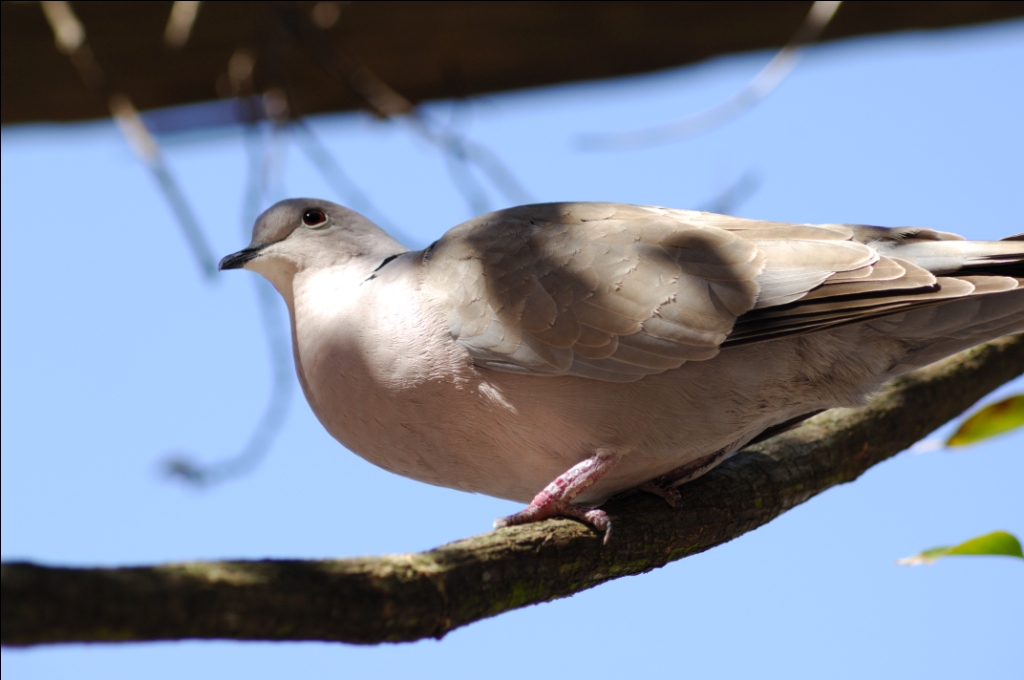
Eurasian Collared Dove (Streptopelia decaocto) by Dan

Eurasian Collared Dove (Streptopelia decaocto) by Dan

Loose birds hanging around the Zoo were American White Ibises, Great Egret, Eurasian Collared Dove, 10 Fish Crows, Mockingbird and some more Sparrows. Gulls and Vultures flying around also.

Because my legs were acting up again, we only did the Aviary just inside the gate. That is all I needed anyway, because when I left almost 2 hours later and having walked very little, I had had a ball. The birds were calm and didn’t mind us photographing them. Watched two  Southern Bald Ibises mate twice. Maybe spring is on the way.

Buff-banded Rail (Gallirallus philippensis) by Dan

Buff-banded Rail (Gallirallus philippensis) by Dan

As you enter the Aviary, there are a few birds behind a wire and in very dim light. I keep trying to get a decent photo, but the obstacle makes it very difficult. They had the Silver-beaked Tanager,  Blue-grey Tanager and Metallic Starling in that enclosure today.

For by him were all things created, that are in heaven, and that are in earth, visible and invisible, whether they be thrones, or dominions, or principalities, or powers: all things were created by him, and for him: And he is before all things, and by him all things consist. (Colossians 1:16-17 KJV)

Here is a list of the birds seen in the Aviary: (35)

Helmeted Guineafowl (Numida meleagris) and another
White-faced Whistling Duck (Dendrocygna viduata)
Cape Teal (Anas capensis)
Chiloe Wigeon (Anas sibilatrix)
Cinnamon Teal (Anas cyanoptera)
Mandarin Duck (Aix galericulata)
Ruddy Duck (Oxyura jamaicensis)
Wood Duck (Aix sponsa)
African Openbill (Anastomus lamelligerus)
African Sacred Ibis (Threskiornis aethiopicus)
African Spoonbill (Platalea alba)
Scarlet Ibis (Eudocimus ruber)
Southern Bald Ibis (Geronticus calvus)
Boat-billed Heron (Cochlearius cochlearius)
Red-legged Seriema (Cariama cristata)
Sunbittern (Eurypyga helias)
Buff-banded Rail (Gallirallus philippensis)
African Jacana (Actophilornis africanus)
Pied Imperial Pigeon (Ducula bicolor)
Blue-throated Macaw (Ara glaucogularis)
Scarlet Macaw (Ara macao)
Violet Turaco (Musophaga violacea)
Crested Coua (Coua cristata)
Blue-bellied Roller (Coracias cyanogaster)
Blue-breasted Kingfisher (Halcyon malimbica)
White-throated Kingfisher (Halcyon smyrnensis)
Blue-crowned Motmot (Momotus coeruliceps)
Von der Decken’s Hornbill (Tockus deckeni)
Toco Toucan (Ramphastos toco)
Bearded Barbet (Lybius dubius)
Magpie Shrike (Urolestes melanoleucus)
Raggiana Bird-of-paradise (Paradisaea raggiana)
Metallic Starling (Aplonis metallica)
Crested Oropendola (Psarocolius decumanus)
Blue-grey Tanager (Thraupis episcopus)
Silver-beaked Tanager (Ramphocelus carbo)

Outside Aviary: (13)

American White Ibis (Eudocimus albus)
Snowy Egret (Egretta thula)
Western Great Egret (Ardea alba)
Turkey Vulture (Cathartes aura)
Black Vulture (Coragyps atratus)
Western Osprey (Pandion haliaetus)
Bald Eagle (Haliaeetus leucocephalus)
Common Pigeon (Columba livia)
Eurasian Collared Dove (Streptopelia decaocto)
Fish Crow (Corvus ossifragus)
Northern Mockingbird (Mimus polyglottos)
House Sparrow (Passer domesticus)
Boat-tailed Grackle (Quiscalus major)

All photos taken 2/15/11.

*

This slideshow requires JavaScript.

*