Washington, D.C.’s Official Bird: Trouble at Home

Washington, D.C.’s Official Bird:  Trouble at the Home Front

Dr. James J. S. Johnson

veery-thrush-nest-with-cowbird-eggs

AND IF A HOUSE BE DIVIDED AGAINST ITSELF, THAT HOUSE CANNOT STAND. MARK 3:25 

The District of Columbia’s official bird’s population faces precarious peril, nowadays, and there seems to be a “homeland security” problem. But how is that? And what is the official bird of Washington, D.C., anyway?  It’s not the Bald Eagle – that’s America’s national bird. Washington, D.C. has its own official bird.(1)

flag-WashingtonDC.blue-sky-background     GW-family.coat-of-arms

Flag of Washington, D.C., based on George Washington’s family coat-of-arms

The typical birdwatcher is well aware of his or her state’s official bird.

So if you were born in Maryland, your official state bird is the Baltimore Oriole.(2) [Regarding the Baltimore Oriole, see my “Appreciating Baltimore Orioles and my First Bird Book”, later condensed as “Attracted to Genesis by Magnets and a Bird Book”, Acts & Facts, 44(8):19 (August 2015.]

Like typical politicians of Foggy Bottom, D.C.’s official bird is an omnivore willing to consume most of whatever is available, whether that be bugs (including their larvae), snails, salamanders, or fruits (especially those having more lipids).

Yet, also like Washington politicians, this bird is itself targeted by many predators. The adults (of D.C.’s official bird) are themselves sometimes eaten by owls and hawks that frequent deciduous wet woods.  Also, this bird’s young (i.e., eggs and hatchlings) are preyed upon by several larger birds (such as corvids, icterids, owls, and accipiter hawks), a few mammals (such as house cats, raccoons, weasels, squirrels, and chipmunks), and even some snakes.(3)

So what is the official bird of the District of Columbia? (With a name like “Columbia” you must expect it to be a dove, since “Columbia” is a form of the Latin word for “dove”.) Or you might expect, based upon the official coat-of-arms fo the George Washington family, that D.C.’s bird would be a raven.  For many years the District of Columbia had no official bird of its own.  In fact, until D.C. was granted a limited form of “home rule” (starting in AD1967), by Congress, D.C. didn’t have jurisdictional authority to designate an official bird for its domain.(1)

SONY DSC

Wood Thrush  (Hylocichla mustelina) ©Nhptv.org

Nevertheless, among Washingtonian birders, many unofficially adopted the Wood Thrush (Hylocichla mustelina), a rather inconspicuous passerine who vocalizes flute-like notes, brown above and mottled brown-on-white below, as D.C.’s special bird. One illustration of this came shortly after World War II, when the D.C. Audubon Society (now called the “Audubon Naturalist Society”) was incorporated; its new monthly journal was called The Wood Thrush.(1)

Finally, in January of AD1967, D.C. Commissioners (armed with new powers delegated to them by Congress) took official action, and decreed that the Wood Thrush was D.C. official home-rule bird. Then came the question:  how many Wood Thrush residents actually lived inside D.C.’s boundaries?  This question was not (and is not) easy to answer, with accuracy, because bird surveys often involve bird counters (driving cars) who pull off the road, onto the shoulder, to observe birds in wooded areas next to roads.  But D.C. has very few such shoulders (on the wood-edge roads), so mobile bird counters are handicapped from using their usual observation habits.  So the real numbers of their questionable population are estimated more by guesswork than by direct observation.

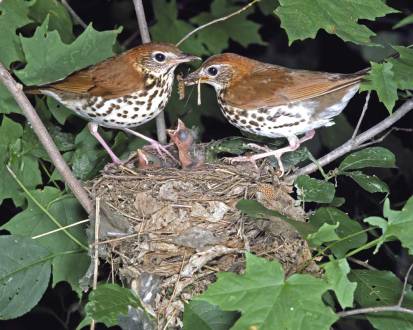
WoodThrush.nest-life-pic-AudubonSociety

Wood Thrush family at mealtime ©Audubon

Although often hidden from curious human eyes, at least the flute-like notes of these birds can often be heard in D.C.’s Rock Creek Park (a national park since AD1890!), a well-wooded deciduous forest of the nation’s capital.(1) In more ways than one, the Wood Thrush is not “out of the woods”.  In fact, its population stability is threatened by woodland habitat loss, as remaining wet woods inexorably yield to more and more “creeping” urban and suburban development.

Yet probably worse, however, the Wood Thrush population suffers from brood parasitism by Brown-headed Cowbirds – “home invaders” that intrude via false pretenses – as the brown-headed “foster children” greedily consume food intended for the nest’s “rightful heirs”, displacing the thrush nest’s rightful nestlings in the process:  “The wood thrush mistakenly protects these [home invader] eggs and feeds the [soon-hatched] cowbird young – who are larger and more aggressive, frequently causing wood thrush hatchlings to starve.”(4)

Once again, one finds a comparison with Washington’s federal politics – a failure of homeland security, a fundamental defalcation in defensive gatekeeping.(5) It’s “like déjà vu all over again”.  Maybe the precarious population of D.C.’s official bird should remind us to protect our own homes better. ><> JJSJ

References

  1. Steve Dryden, “You Might Never See D.C.’s Official Bird, But Hearing It Could Be Just Enough”, Chesapeake Bay Journal, 26(4):32-33 (June 2016).
  2. For more on the Baltimore Oriole, see my “Appreciating Baltimore Orioles and my First Bird Book”, later condensed as “Attracted to Genesis by Magnets and a Bird Book”, Acts & Facts, 44(8):19 (August 2015).
  3. See Roger Tory Peterson, Eastern Birds – A Completely New Guide to All the Birds of Eastern and Central North America, 4th ed. (Houghton Mifflin, 1980), pages 222-223 & map M273; James Coe, Eastern Birds (Golden Press, 1994), pages 114-115; Donald W. Stokes & Lillian Q. Stokes, Stokes Field Guide to Birds – Eastern Region (Little Brown & Company, 1996), page 339.
  4. Dryden, in Chesapeake Bay Journal, supra, at page 33.
  5. Regarding brood parasitism (by Brown-headed Cowbirds, African Honeyguides, Common Cuckoos, and others), see also James J. S. Johnson, “Teach Your Children the Right Passwords!”.  The phrase “keepers at home”, in the Greek text of Titus 2:5, refers to gatekeeping security, i.e., guarding the family’s home-life from dangers, not janitorial housekeeping.  (Of course, this is not to suggest that family members themselves never present dangers to a divided household – see, e.g., Micah 7:5-6; Matthew 10:35-36; Mark 3:25; Luke 11:52-53.)

*

Trinidad Tanagers Contradict Competition “Law” Proposed by Darwinists

Speckled Tanager (Tangara mexicana) ©WikiC

Speckled Tanager (Tangara mexicana) ©WikiC

Trinidad Tanagers Contradict Cutthroat Competition “Law” Proposed by Darwinists

CAN TWO WALK TOGETHER, EXCEPT THEY BE AGREED?  (AMOS 3:3)

“Survival of the fittest” has been a dominating tenet of Darwinian evolution for more than 150 years now. But a trio of colorful birds, living on islands off Venezuela’s coast, provides debunking evidence that, as Dr. Steve Austin would say, Darwin was wrong, when he alleged that do-or-die competition was the fundamental force that shapes nature. So how do these birds dispute Darwin? By eating!

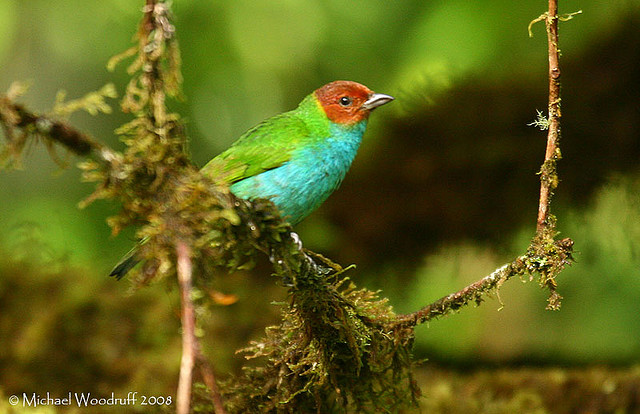
PAS-Thra Bay-headed Tanager (Tangara gyrola) by Michael Woodruff 2

Bay-headed Tanager (Tangara gyrola) by Michael Woodruff

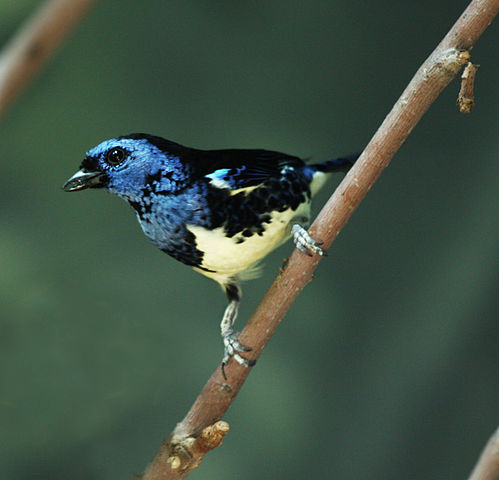
Three varieties of Trinidad tanagers share bugs on the same trees as they silently undermine the “natural selection” myth’s survivalism principle. Without wasteful confrontations over limited food resources, found on the same trees that each of these birds forage upon: (1) speckled tanagers pick off bugs from tree leaves, (2) bay-headed tanagers prefer to eat bugs from under large branches, and (3) turquoise tanagers snap up bugs from twigs.1

Admitting that adversarial competition was lacking, these evolutionist scientists reported the following:  “In the 1960s, two ecologists made careful [empirical] studies on the island of Trinidad of the niches of eight coexisting species of tanager–brightly colored songbirds of the New World tropics. Of the eight species, three, the speckled (Tangara guttata), the bay-headed (T. gyrola), and the turquoise tanager (T. mexicana), were extremely closely related.  They all belonged to the same genus, lived in the same trees and bushes, and fed on insects and fruit. This suggests little in the way of division of resources, for all three species seemed to be using the same ones.  More detailed field observations, though, showed up the niche differences, as is clearly demonstrated by considering one aspect of the pattern of resource division.  In hunting for small insect prey in vegetation, the speckled tanager almost exclusively searches the leaves themselves.  It clings to them upside down, picking off insects, or it walks along small twigs, picking off insects from the leaves above it.  The other two species only rarely feed like this.  Instead, both obtain most of their insect prey form the undersides of branches.  The bay-headed species does this mainly on quite substantial branches, hopping along and leaning over each side alternately to reach under it for insects.  The turquoise tanager, in contrast, almost always takes insects from fine twigs, usually those less than half an inch in diameter.  It also has a predilection for the insects found on dead twigs, which are usually untouched by the other two species.  These detailed observations show that insect food resources and specific feeding areas on the island of Trinidad are neatly split even between very closely related birds.” [Quoting from Whitfield, Moore, & Cox, THE ATLAS OF THE LIVING WORLD  — see endnote #1 below.]

In other words, illustrating what ecologists call noncompetitive niche positioning, this tanager trio avoids antagonistic competition.1 To appreciate how this peaceful prey sharing upsets the presumptions of Charles Darwin, Thomas Huxley, and their modern ilk, it’s helpful to review why Darwin’s ideas were welcomed so fervently by academics who scoffed at Genesis.

Turquoise Tanager (Tangara mexicana) ©WikiC

Turquoise Tanager (Tangara mexicana) ©WikiC

Generations before Darwin’s “natural selection” theory first became popular, deists (people who essentially believed in a God yet rejected the Bible) like Charles Lyell and James Hutton, effectively laid the groundwork for the acceptance of evolution’s survivalism themes.  (Neither deists nor Darwinists anchor their research on Scripture, yet they also oppose each other.)

Both deists and Darwinists have misreported living conditions on Earth, yet they do so in opposite ways. Deists err on the “see no evil” extreme, underestimating the terrible fallenness of creation.2 Darwinists, however, overemphasize “conquer or be conquered” survivalism—even nominating death as nature’s hero and means of “progress”, instead of recognizing death as the terrible “last enemy” to be destroyed.3 Both extremes misrepresent nature as they actively oppose and/or passively ignore the facts of Scripture.   Unsurprisingly, the true portrayal of nature’s condition is found in holy Scripture, starting in Genesis, a Mosaic book that Christ Himself endorsed as authoritative (John 5:44-47).

The deists’ approach produces worthwhile observations of natural beauty, orderliness, and efficiency but then fails to account for how Earth “groans” after Eden.2  What about birds that peck other birds to death, while fighting over food and territory?  That’s not beautiful!  In the first half of the 1800s, deism failed to explain such ugly forms of competition, so many academics sought a humanistic theory that explained Earth’s uglier features—disease, deprivation, dying—without resorting to God’s revealed answers in Genesis.

Enter Charles Darwin’s magic mechanism of “natural selection”!—an animistic theory invented to substitute for God role as Creator.  This now-popular form of quasi-polytheistic animism often uses the alias “survival of the fittest.”

Darwin and his followers imagined the global ecosystem as a closed “fight-to-the-death” arena, swarming with vicious creatures scrapping for limited resources.  In a one-sum game (“red in tooth and claw,”4 adopting a phrase from Tennyson to fit Darwin’s theory), gain by one competitor meant loss to another.  This selfish competition was quickly heralded as “nature’s law”, so explaining wildlife interactions soon required interpretations based on that brutal assumption.2

But real-world data routinely refuse to fit the evolutionary paradigm. Yet like today, the  embarrassing and uncooperative facts were routinely dismissed and ignored during the 1800s and 1900s.5

Embarrassing Darwin’s theory, even moreso than a lack of wasteful competition, is the prevalent reality of mutual aid, also called mutualistic symbiosis, where different life forms help each other, such as algae and fungus coexisting as lichen or bees pollinating the flowers from which they harvest nectar. Like noncompetitive eco-niche positioning,1 mutual aid doesn’t harmonize with Darwin’s antagonistic competition “song,” so mutual reciprocity (and self-sacrificing altruism) displays are also censured from or marginalized by academics who are gatekeepers of science education curricula.6

Consequently, field studies are often skewed by researchers who quickly jump to conclusions that endorse antagonistic survivalism—as if “natural law” always requires adversarial competition.

Even today, modern Darwinians (both atheistic and theistic), lauding mystical “natural selection”, trumpet creation’s fallenness as Earth’s foremost feature — all the while discarding or disparaging or detouring the historical documentation that God has provided in Genesis regarding what triggered Earth’s undeniable fallenness.

Meanwhile, creatures like tree-snacking Trinidad tanagers make a mockery of Darwinian dogma, as they peaceably share food.

References

  1. Philip Whitfield, Peter D. Moore, & Barry Cox, The Atlas of the Living World (Boston: Houghton Mifflin, 1989), pages 100-101 (quotation taken from page 100; picture portraying non-competitive eco-niche positioning on page 101).
  2. Deists believe in an intelligent Creator God, so they expect Him to make a “perfect” creation. However, because they dismiss the Bible, they imaginatively philosophize about what they think a perfect God would do with His creation—as they self-confidently assume that they know how a perfect God would think and act. Accordingly, deists are quick to recognize God’s caring handiwork in nature; they see orderliness, logic, beauty, and many good things — but they totally miss God’s wisdom as it is displayed in allowing Adam’s choice to trigger the earth’s present “groaning”, which is a temporary condition that (due to redemption in Christ) will be succeeded by a better-than-the-originally-perfect situation (that then needed no redemptive restoration by Christ). See James J. S. Johnson, Misreading Earth’s Groanings: Why Evolutionists and Intelligent Design Proponents Fail Ecology 101. Acts & Facts. 39 (8): 8-9 (August 2010).
  3. 1 Corinthians 15:26.
  4. Darwinists hijacked this phrase from Lord Alfred Tennyson, In Memoriam A. H. H., Canto 56 (1849).
  5. James J. S. Johnson, Jeff Tomkins, & Brian Thomas. 2009. Dinosaur DNA Research: Is the Tale Wagging the Evidence? Acts & Facts, 38 (10): 4-6 (October 2009); James J. S. Johnson, Cherry Picking the Data Is the Pits, Acts & Facts, 44 (7): 19 (July 2015).
  6. Gary Parker, 1978. Nature’s Challenge to Evolutionary Theory, Acts & Facts, 7 (10), July 1978; James J. S. Johnson, “Providential Planting: The Pinyon Jay”, Creation Ex Nihilo. 19 (3): 24-25 (1997); Steve Austin, Grand Canyon: Monument to Catastrophe. Santee, CA: Institute for Creation Research, 1994), pages 156-159.

Dr. James J. S. Johnson formerly taught ornithology/ avian conservation, as well as courses in  ecology, limnology, and bioscience, for Dallas Christian College, and continues to be a “serious birder”.  A condensed version of this creation science article appears as James J. S. Johnson, Tree-Snacking Tanagers Undermine Darwin, Acts & Facts, 45 (6):21 (June 2016).

*

Lee’s Four Word Thursday – 6/23/16

***

Marvelous Spatuletail (Loddigesia mirabilis) ©©Dubi Shapiro

BEAUTIFUL AND GLORIOUS

***


“In that day the Branch of the LORD shall be beautiful and glorious; And the fruit of the earth shall be excellent and appealing For those of Israel who have escaped.” (Isaiah 4:2 NKJV)

Marvelous Spatuletail (Loddigesia mirabilis) ©©Dubi Shapiro

Sorry about mixing up yesterday’s devotional. Since I (Lee) put the 4 word one up by mistake, today we are putting up the 3 word one. (My husband, Dan, has been sick and we put him in the hospital yesterday.) Mistakes happen. This was not Jim Johnson’s fault .

*

More Daily Devotionals

*

“D” is for Ducks, Dabblers and Divers: “D” Birds, Part 1

“D” is for Ducks, Dabblers and Divers:  “D” Birds”,  Part  1

James J. S. Johnson

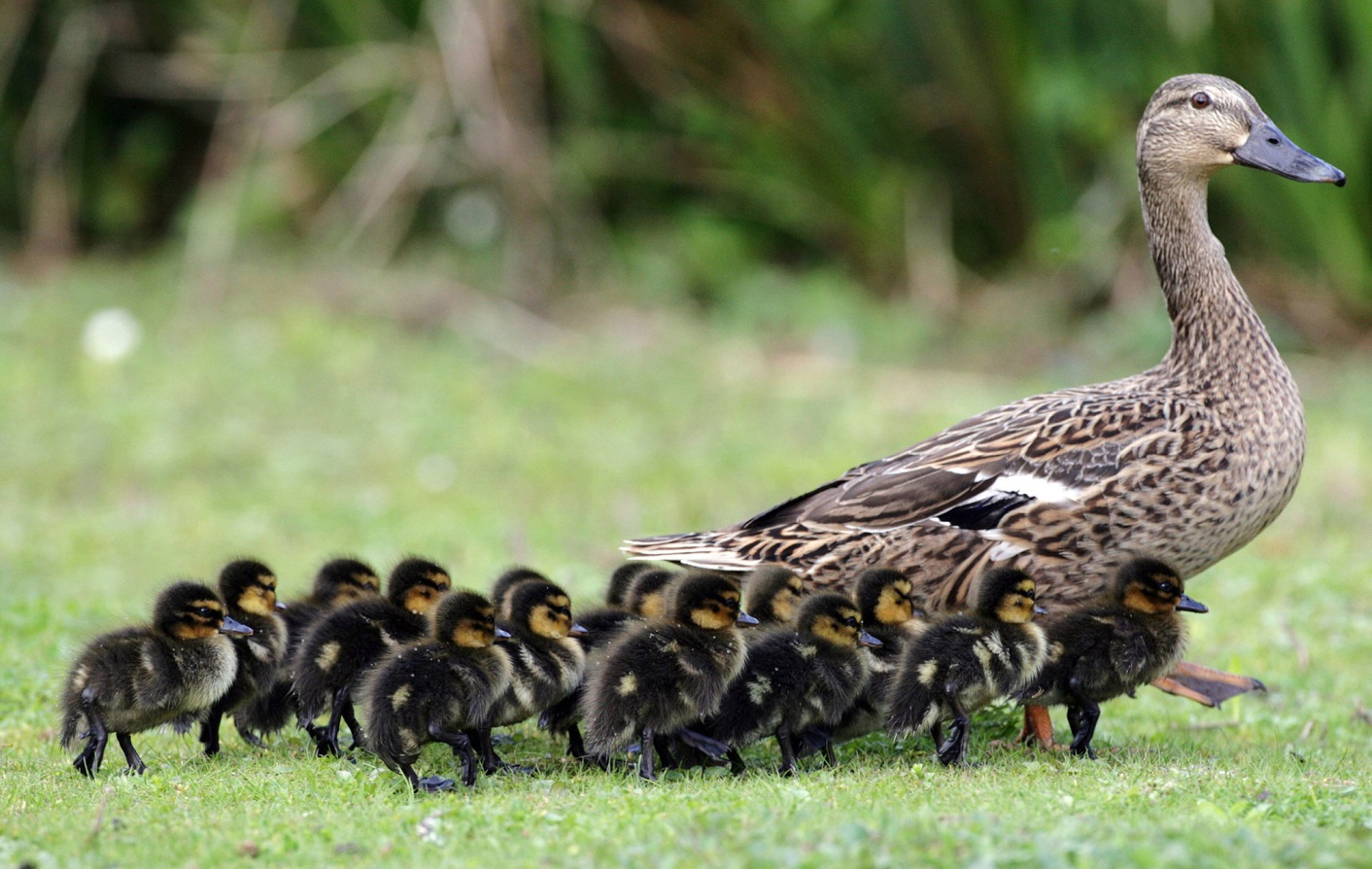
Mallard-mam-with-ducklings

Mallard (Anas platyrhynchos) Mother & ucklings ©Fair Use Credit – Backyardduck

 “Be ye followers of me, even as I also am of Christ.” (1st CORINTHIANS 11:1)

“Not as though I had already attained, either were already perfect: but I follow after, if that I may apprehend that for which also I am apprehended of Christ Jesus.” (PHILIPPIANS 3:12)

D” is for as Doves, Dippers, and Ducks (some being dabblers, some being divers)  —  plus other birds with names that begin with the letter D.

Regarding doves, see, e.g., Lee’s Birdwatching “Bible Birds:  Doves and Pigeons” and “Bible Birds: Doves and Pigeons” plus “Columbidae: Pigeons, Doves”, etc.; regarding dippers, see, e.g., my “European Dipper, Norway’s National Bird”.

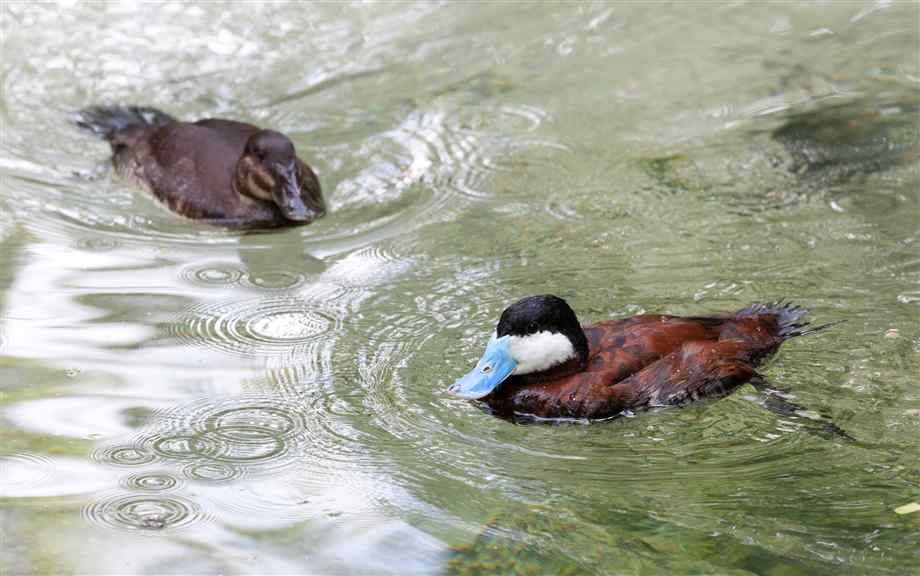
RuddyDuck.male-and-female

Ruddy Duck (Oxyura jamaicensis): male (R) & female (L) ©Fair Use Credit – Northrup

This present study will focus on ducksOf the birds we call “ducks” there are two major categories, “divers” (which use their broad feet to propel themselves underwater) and “dabblers” (which typically tip forward to submerge their heads into the water), and these categories are due to those respective ducks’ eating habits (as will be explained below).  Of course, to confuse matters a bit, ducks that dive for their food sometimes dabble too!

NorthernShoveler.male-and-female

Northern Shoveler (Anas clypeata): male (R) & female (L) ©Fair Use Credit

But first, because this blogpost-article calmly continues an alphabet-based series on birds, it will look at Psalm 119:25-32, before providing an introduction to 4 types of birds that start with the letter “D”, In particular, those four “D” birds are various DUCKS, both “divers”, the Lesser Scaup (Aythya affinis),  —  and “dabblers”, the American Wigeon (Anas americana) and the Northern Shoveler (Anas clypeata). Also, some mention will be given to “stiff-tailed divers” (e.g., Ruddy Duck) and “sea ducks” that dive (e.g., eiders, mergansers, oldsquaw, etc.).

=======

THE ALPHABET HELPS TO TEACH US ABOUT GOD’S TRUTH

As noted in three earlier articles on “alphabet birds”, i.e., on “A birds”, on “B birds” and “C birds” – using the alphabet, to organize a sequence of information, has Biblical precedent. The perfect example is the “acrostic” pattern of Psalm 119, the longest psalm (having 176 verses!), which psalm has 22 sections (comprised of 8 verses per section), representing the 22 letters of the Hebrew alphabet. (Compare that to English, which has 26 alphabet letters, and to Norwegian, which has 29 alphabet letters.)

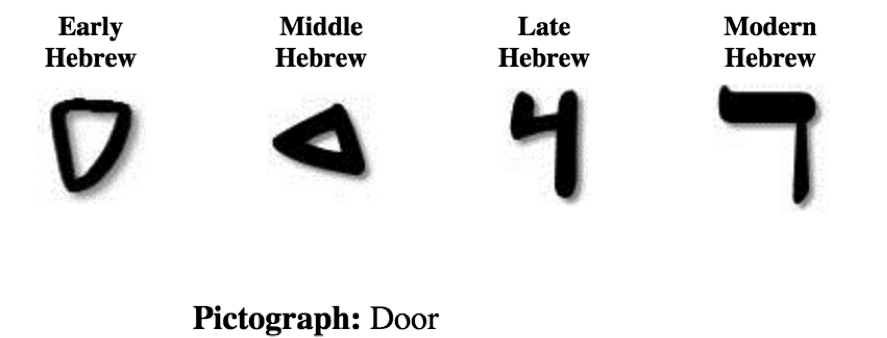
The sentences in each section start with the same Hebrew letter, so Verses 1-8 start with ALEPH, Verses 9-16 start with BETH, Verse 17-24 start with GIMEL, and so forth.  In this serial study’s lesson, the fourth octet of verses in Psalm 119 (i.e., Psalm 119:25-32), each sentence starts with DALETH, the Hebrew consonant equivalent to the English “D”.

DALETH.Hebrew-letter-pictograph-door

DALETH.Hebrew-letter-pictograph-door  Fair Use image credit:

The noun based upon this letter is DELETH, which is routinely translated as a “door” (or “gate”) in the Old Testament (see YOUNG’S ANALYTICAL CONCORDANCE, Index-Lexicon to the Old Testament, page 14, column 1.)   Doors are very important.  In fact, JESUS Himself is the “door” to eternal life (compare John 10:7-9 with John 14:6 & Matthew 7:13-14).  Some of the earliest “doors” of the ancient Hebrews were tent-flaps, hanging animal skins that covered an opening in a tent.  This type of “door” appears to be illustrated by the hanging tent-flap (or “gate”) in the Mosaic Law’s blueprint for the Tabernacle (see Exodus 27:16).  To enter into the Tabernacle the hanging tent-flap “door” needed to be pulled back.  (The action of pulling also appears in what may be etymologically related Hebrew words: “bucket” [deli/dali in Isaiah 40:15 & Numbers 24:7] and “draw” [dalah in Exodus 2:16 & Exodus 2:19].)

But it is the usage of the doorway that is of amazing importance to the Christian, because doors provide ingress (entering) and egress (exiting).

Although space here prohibits a detailed analysis, it seems that the Scripture’s usage of DALETH emphasizes more the process of exiting through a doorway, i.e., moving from where one is already, out into something farther, toward a destination.

So, because DALETH is the fourth letter in the Hebrew alphabet, each verse (in Psalm 119:25-32) literally starts with that letter as the first letter in the first word (although the first Hebrew word may be differently placed in the English translation’s sentence):

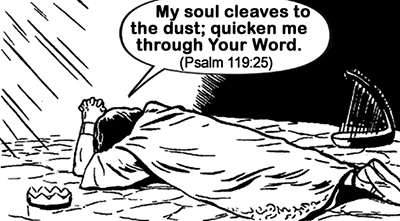
25 Cleaves [dâbqâh] my soul unto the dust; quicken Thou me according to Thy Word.

26 My ways [derek] have I documented, and Thou heard me; teach me Thy statutes.

27 The way [derek] of Thy precepts make me to understand, so shall I talk of Thy wondrous works.

28 Melts [dâlpâh] my soul, for heaviness; strengthen Thou me according unto Thy Word.

29 The way [derek] of falsity remove from me, and grant me Thy law graciously.

30 The way [derek] of truth have I chosen; Thy judgments have I laid before me.

31 I have stuck [dâbaqtî] unto Thy testimonies: O Lord, put me not to shame.

32 The way [derek] of Thy commandments will I run, when Thou shalt enlarge my heart.

Psalm119.25-cartoon-pic

Fair Use image Credit: http://markmcmillion.com/wp-content/uploads/2016/02/quicken-me-flat.jpg

As noted before, Psalm 119 is all about God’s revelation of truth – especially truth about Himself – to mankind (in a comprehensive “A to Z” panorama).  The most important revelation of truth that God has given to us, and the most authoritative form of truth we have, is the Holy Bible – the Scriptures.  Accordingly, Psalm 119 is dominated by references to the Scriptures, using terms like “the law of the LORD” (and “Thy Word”, “Thy commandments”, “Thy testimonies”, “Thy statutes”, “Thy judgments”, etc.).  In Psalm 119:9-16 these terms are used, to denote God’s revealed truth to mankind: “Thy Word” (3x), “Thy commandments”, “Thy statutes”, ”Thy precepts”, Thy “judgments”, and “Thy testimonies”.
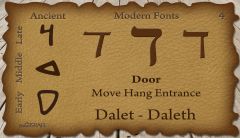
DALETH.flashcard.letters

Fair Use image credit: http://fce-study.netdna-ssl.com/images/upload-flashcards/back/7/3/58537864_m.jpg

Notice how the Hebrew noun derek appears frequently in this section of Psalm 119 – because when you take a “door” of providential opportunity, to walk life’s journey according to God’s directions, you travel a pathway that leads to your God-designed destiny. Accordingly, the Hebrew letter DALETH refers to a “door” (or doorway, such as a tent-flap), which leads to a destination, after a “journey” (derek – see Genesis 24:21, Joshua 9:11, 1st Kings 19:4 & 19:7, etc.), such as where one is supposed to arrive after traveling a “highway” (derek – see Deuteronomy 2:27).

Accordingly, Psalm 119:25-32 illustrates how God’s Word serves as a “doorway” of opportunity (which requires us to leave our self-anchored selves and our humanistic self-confidences), to facilitate our passage into the spiritual journey that God has providentially predestined for us (Ephesians 2:8-10).

In Verse 25 (of Psalm 119), King David recognizes that his soul’s natural inclination, as a sinner, is to live an earthly life that tends and trends toward “dust” – a sad reminder that we are tragically dead in Adam (Genesis 3:19; Romans 5:12-21). Yet happily, by God’s gracious providence in Christ, God’s Word can reverse the death-sentence and provided David (and us) with life, because the Scripture is the written Word of God that tells us of the living Word of God, JESUS, through Whom we can have life (John 10:10 & 14:6).  In other words, we use God’s written Word to leave our sinful selves, to obtain redemption in Christ, and thereby we leave our mortality for life eternal (1st Corinthians chapter 15).

In Verse 26, the psalmist reports his own “ways” to God, i.e., David was truthful in measuring his own life – this honesty pleases God, Who defines and gives truth (John 14:6 & John 17:17), and it is being truthful with God that keeps open the “door” of access to His forgiveness and cleansing (1st John 1:9).

In Verse 27, the psalmist meditates on God’s Word. This reverent Bible study is the “way” to understanding God’s precepts – it is the “way” to find real knowledge and understanding.  As we soak in the holy Scriptures (which is our true “daily bread” – Matthew 4:4), we leave the finiteness and fallibility of our own minds and memories, to access God’s mind, God’s meanings, God’s morals.

In Verse 28, the psalmist acknowledges that his own soul is weak, losing strength in sorrows. However, thankfully, that sad situation is overcome by the strengthening that God’s Word provides to the reverent and trusting worshipper of God.  This means leaving our own self-sufficiency to appropriate God’s ever-sufficient grace (2nd Corinthians 12:9) – and that is only accomplishes as we apply God’s Word to our own human weakness.

In Verse 29, the psalmist recognizes that he cannot access God’s kindness if he allows the way of falsity to distract him form God’s law.  In other words, the books of Moses – which will one day judge us (see John 5:44-47) – are our foundation for understanding life (and death, and God, and ourselves, etc., etc.), so we must avoid all false distractions that would pull us away (sidetrack, derail, etc.) from that truth.

In Verse 30, the psalmist recognizes that choosing the faithful path is a choice; having made that choice life becomes many opportunities, moment by moment, to apply that choice to the decisions of life. This is the Bible-based spiritual journey – and it is this kind of “walking by faith” that pleases God (see Romans chapter 4 & Hebrews chapter 11).

Verse 31 contrast with Psalm 119:25, where the verb “cleave” was used in a negative way. In Verse 31 David is “cleaving” to God’s testimonies (which hare found in God’s Word); the result is that David will not be ashamed of how his life-journey ends, so long as he is “cleaving” to God’s testimonies along the way (Romans 8:28).

Verse 32, likewise, portrays the psalmist’s movement toward God’s Word. David is now running to God’s commandments, away from the curse of sin-and-death he alludes to in Verse 25 – because David knows that God’s Word enlarges David’s heart – and thus his (redeemed) life.

In sum, Scripture-based living is the way to leave your selfish “self” behind, as you take your godly (i.e., redeemed-in-Christ – Philippians 1:21) “self” closer to God (and toward what He wants for your life)!

Thus we see the theme, woven throughout the octet of DALETH verses (Psalm 119:25-32), that we are designed to rely upon the truth and values of the holy Scriptures, as we journey through life, as if God’s Word was our “door” of opportunity (as it informs us of the living “Door”, the Lord Jesus Christ –  compare John 10:7-9 & John 14:6), to leave our selfish selves – and through which we journey toward God, Who Himself is our ultimate home and destination (Psalm 90:1 and 2nd Corinthians 5:1-6.) – see “Why We Want to Go Home” [posted at http://www.icr.org/article/why-we-want-go-home/ ].

========

Now back to the ducks. First, let’s consider some “dabbling” ducks, starting with one whose unusually broad shovel-shaped bill gives it its name.
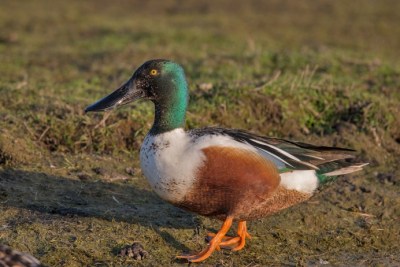
Northern Shoveler (Anas clypeata): male ©WikiC

Northern Shoveler (Anas clypeata): male ©WikiC

*
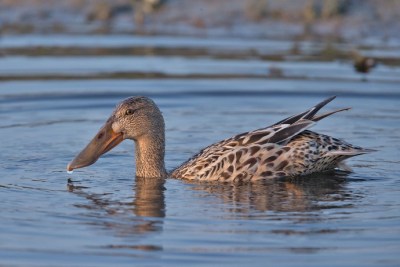
Northern Shoveler (Anas clypeata): female ©WikiC

Northern Shoveler (Anas clypeata): female ©WikiC

The Northern Shoveler is a dabbler, ranging much of the Northern Hemisphere.  Its habits are described by ornithologist Steve Madge:  “Sociable duck of shallow freshwater lakes [including “prairie potholes”] and marshes.  Usually found in pairs or small parties, but large concentrations form at migratory stop-over waters [such as Hagerman National Wildlife Refuge in north-central Texas]. Indirectly mixes with other dabbling ducks [such as Mallard, Green-winged Teal, Northern Pintail, and American Wigeon], but generally keeps apart in discrete gatherings. … Nests on ground among waterside vegetation, often several nests in close proximity.  Feeds by dabbling and sifting in shallow water, swinging bill from side to side over surface, often immersing head and neck and sometimes up-ending; feeds chiefly while swimming, but also while wading.  Loafing birds gather on banks and shores close to feeding waters.  Swims buoyantly, with rear end high and fore parts low, the heavy bill often touching surface of water.  Walks awkwardly.  Flight fast and agile, rising suddenly from surface with whirring wings.  Most populations highly migratory, arriving on breeding grounds from mid March onwards and departing again in August.”  [Quoting Steve Madge & Hilary Burn, WATERFOWL:  AN IDENTIFICATION GUIDE TO THE DUCKS, GEESE AND SWANS OF THE WORLD (Houghton Mifflin, 1988), page 236.]

NorthernShoveler-male-closeup

Northern Shoveler (male closeup) ©WikiC

The male shoveler has an iridescent green head (like a Mallard), rusty sides (like a Ruddy Duck), a white breast, and a shovel-like (or spoon-like) bill. These ducks feed mostly “by filtering tiny aquatic insects and plants from the water’s surface with its bill.”  [Quoting Stan Tekiela, BIRDS OF TEXAS FIELD GUIDE (Adventure Publications, 2004), page 332-333.
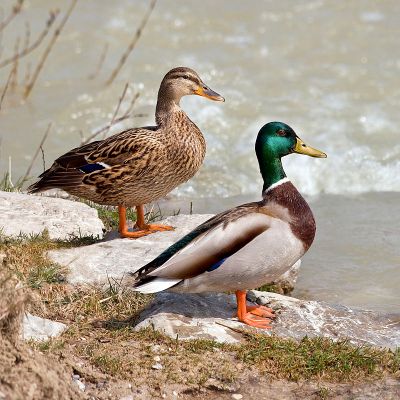
Mallard.male-and-female-shore

Mallard (Anas platyrhynchos): male (R) & female (L)

https://en.wikipedia.org/wiki/Mallard#/media/File:Anas_platyrhynchos_male_female_quadrat.jpg

The Mallard (alias “Greenhead”) is another dabbling duck, the most common duck in the world!  (Oops!  — once, at a Tampa church, I erred and said it was the most common “bird” in the world – but I meant to say it was the most common “duck” in the world.)  The Mallard has been reported repeatedly — on www.leesbird.com — so it will not receive detailed treatment here.  (See, e.g., ornithologist Lee Dusing’s “The Mallard Duck: Birds, Volume 2, #1” [at https://leesbird.com/2012/07/16/birds-vol-2-1-the-mallard-duck/ ], as well as  my “Pondside Birdwatching in Florida, from Chaplain Bob’s Backyard, Part 1” [at https://leesbird.com/2015/02/18/pond-side-birdwatching-in-florida-i/ ].  See also, e.g., the report on mallards within my “Birdwatching in Iceland” [at https://leesbird.com/2014/12/08/birdwatching-in-iceland-part-i/ ] and also within my “Bird Brains: Amazing Evidence of God’s Genius” [at https://leesbird.com/2013/03/07/48484/ ].)

AmericanWigeon.male

American Wigeon (Anas Americana): male

Fair Use photo credit: https://en.wikipedia.org/wiki/American_wigeon#/media/File:Anas_americana_-_drake.jpg
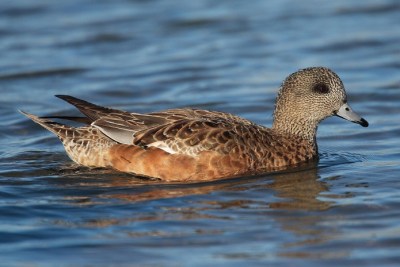
AmericanWigeon.female 

American Wigeon (Anas Americana): female

Fair Use photo credit: https://en.wikipedia.org/wiki/American_wigeon#/media/File:Anas-americana-004.jpg

The American Wigeon (also spelled “widgeon”, alias “Baldpate”) is another dabbling duck.  This wigeon resembles its Eurasian cousin (Eurasian Wigeon) except the American Wigeon has a curved green side-stripe on its head – unlike the rut-colored head of the Eurasian variety.  (Both have a white “racing stripe” from the bill’s top past the pate.)

American Wigeons are plentiful in America’s Great West; they are also growing numerically East of the Mississippi River. Winter grain fields and saltmarsh habitats serve as homes for this migratory duck. When wigeon flocks fly they do so noisily, bunched together, with obvious agility.  For repeated years this writer observed wigeon flocks sharing a Denton County (Texas) pond with mallards and lesser scaups, during the winter.  Generally speaking, he mallards grouped together, the wigeons grouped together, and the scaups grouped together.

========

Now let’s consider some “diving” ducks, sometimes called scaups or pochards.  Despite having the overall outward morphology of dabbling ducks, these diving ducks have some anatomical traits (e.g., trachea structure) differing from those of the dabbling ducks, as well as some noticeable distinctions in their genetics (e.g., mitochondrial BNA cytochrome b and NADH dehydrogenase subunit 2 sequence).

LesserScaup.male

Lesser Scaup (Aythya affinis):  male (L)

Fair Use photo credit: https://en.wikipedia.org/wiki/Lesser_scaup#/media/File:Lesser_scaup_-_Aythya_affinis.jpg
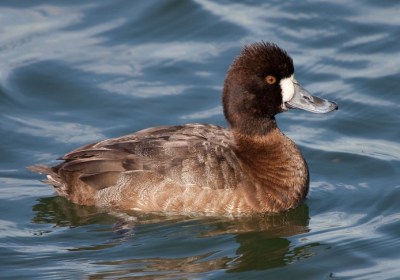
LesserScaup.female

Lesser Scaup (Aythya affinis):  female

Fair Use photo credit https://en.wikipedia.org/wiki/Lesser_scaup#/media/File:Aythya_affinis.JPG

The Lesser Scaup (a/k/a “Little Bluebill”) is a diving duck.  This scaup is differentiated from the Greater Scaup in a previous report, “Pondside Birdwatching in Florida, from Chaplain Bob’s Backyard, Part 2” [at https://leesbird.com/2015/03/02/pond-side-birdwatching-in-florida-2-2/ ], q.v. – noting its gregarious nature, range, and other habits.

The typical habitat preferred by Lesser Scaup ducks is described by Steve Madge: “Breeds by freshwater ponds and lakes in open country, especially prairie marshes [i.e., prairie potholes].  In winter on lowland lakes, coastal lagoons, and estuaries and sheltered coastal bays, but chiefly in latter haunts after cold weather has frozen freshwater lakes.”  [Quoting Steve Madge & Hilary Burn, WATERFOWL:  AN IDENTIFICATION GUIDE TO THE DUCKS, GEESE AND SWANS OF THE WORLD (Houghton Mifflin, 1988), page 258.]
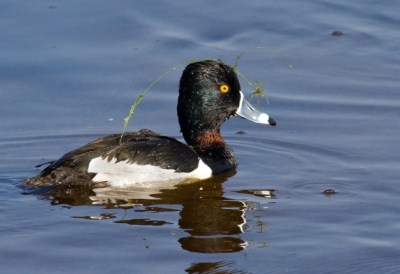
RingneckedDuck.male

Ring-necked Duck (Aythya collaris):  male

http://www.audubon.org/sites/default/files/styles/hero_cover_bird_page/public/Ringnecked_Duck_%20mark%20eden_FL_2011_KK_GBBC.jpg?itok=Qf8g5Vvu (Fair Use photo credit)
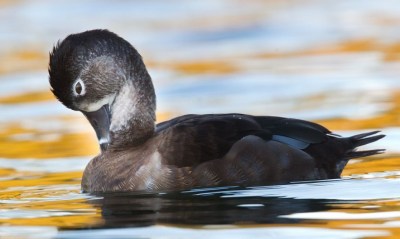
RingneckedDuck.female

Ring-necked Duck (Aythya collaris):  female

https://en.wikipedia.org/wiki/Ring-necked_duck#/media/File:Ring-necked_Duck1.jpg (Fair Use photo credit)

The Ring-necked Duck is a diving duck, usually migratory in its range.  (However, as the range map below shows, there are some areas in America’s West where the Ring-necked Duck resides year-round.).
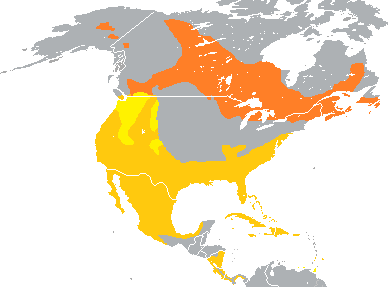
RingneckedDuck.range-map

Ring-necked Duck range

map credit: https://en.wikipedia.org/wiki/Ring-necked_duck#/media/File:Aythya_collaris_range_map.png

[Orange = breeding range;   yellow = year-round range;   mustard = wintering range]

The male’s cinnamon-hued collar “ring” is often not visible, due to lighting and angle of observation – but it’s there, somewhere! One good place for viewing Ring-necked Ducks (as well as Ruddy Ducks) is Lake Morton (in Polk, Florida), the place where I first saw that particular duck in the wild — see Lee Dusing’s “Fantastic Weekend” [at https://leesbird.com/2014/11/10/fantastic-week-end/ ].

Ironically, the white stripe-like band on its dark bill is usually observable, on both the male and female, so this duck is sometimes called the “Ring-billed Duck”. [See Stan Tekiela, BIRDS OF TEXAS FIELD GUIDE (Adventure Publications, 2004), page 64-65 & 202-203.  For photographs of the Ring-necked Duck, both male and female, taken by Lee Dusing at Lake Morton, see her report titled “Birdwatching at Lake Morton 11/22/13” [at https://leesbird.com/2013/11/22/birdwatching-at-lake-morton-112213/ ].

Ornithologist Steve Madge describes the Ring-necked Duck’s phenology-keyed habitat preferences: “Breeds in freshwater lakes and ponds in open lowland country, often by quite small pools in marshes. In winter, in larger freshwater lakes and locally on tidal bays and coastal brackish lagoons.” [Quoting Steve Madge & Hilary Burn, WATERFOWL: AN IDENTIFICATION GUIDE TO THE DUCKS, GEESE AND SWANS OF THE WORLD (Houghton Mifflin, 1988), page 250.]

RUddyDuck.both-FederalDuckStamp-pic

Ruddy Duck (Oxyura jamaicensis): male (L) & female (R)

Fair Use image credit (Jennifer Miller, Federal Duck Stamp competition winner for AD2014-AD2015): http://media.jsonline.com/images/39528847_Ruddy%20ducks%20by%20Jennifer%20Miller%202015-‘16%20Federal%20Duck%20Stamp%20winner%20.jpg

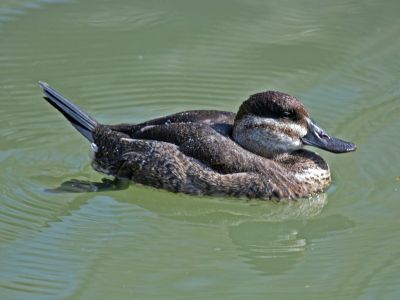
The Ruddy Duck exemplifies a type of duck called a “stiff-tailed diver”.  Like other “stiff-tailed” ducks, the Ruddy Duck has lengthy and stiff tail feathers, which stick up prominently when the duck is resting (somewhat like the upturned tail that wrens sport).  These ducks prefer to dive in freshwater, such as freshwater ponds or lakes.

Like other diving ducks their legs are located near the back of their bodies (with large paddle-like feet), equipping them for propelled paddling under water, as they dive for food. Underwater propulsion depends upon such legs and feet, but this anatomy is not inefficient for walking on land, so Ruddy Ducks tend to minimize their time doing “shore duty”.
RuddyDuck.female

Ruddy Duck (Oxyura jamaicensis) female, displaying “stiff tail”

Fair Use photo credit: https://en.wikipedia.org/wiki/Ruddy_duck#/media/File:Ruddy_Duck_(Oxyura_jamaicensis)_RWD3.jpg

The range of the Ruddy Duck is almost all of the “lower 48” of the United States, wherever they can find available marshy ponds or lakes, especially places having fairly dense vegetation along the shoreline – optimal for their preferred diet: aquatic plant seeds and roots, as well as aquatic insects and crustaceans.

Sea ducks” – such as mergansers, oldsquaw (a/k/a “long-tailed duck”), bufflehead, goldeneyes, and eiders – will be examined (hopefully, D.v.) in later articles of this series – because this article, albeit “ducky”, is already long enough.

Oldsquaw.male-afloat

Oldsquaw (Clangula hyemalis)  male

Fair use photo credit: https://en.wikipedia.org/wiki/Long-tailed_duck#/media/File:Long-tailed-duck.jpg

God willing, the next contribution to this alphabetic series will be some more “D“ birds – perhaps a couple of these: Dippers, Doves, Dunlin, Dickcissel, Dusky Flycatcher, Downy Woodpecker, or the “snowbird” known nowadays as the Dark-eyed Junco!  (Meanwhile, use God’s Word as you out into life, daily, with its opportunities to follow Christ!)
Ducks.Belarus-postage-stamps-sheet

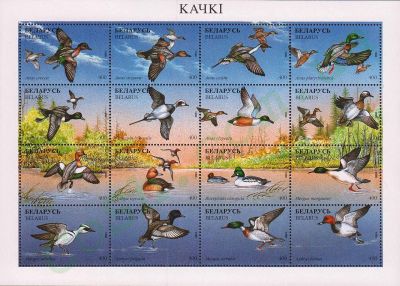
[Public Domain images:  Belarus postage stamps]

So stay tuned!   ><> JJSJ
Lee’s Three Word Wednesday – 6/22/16

***

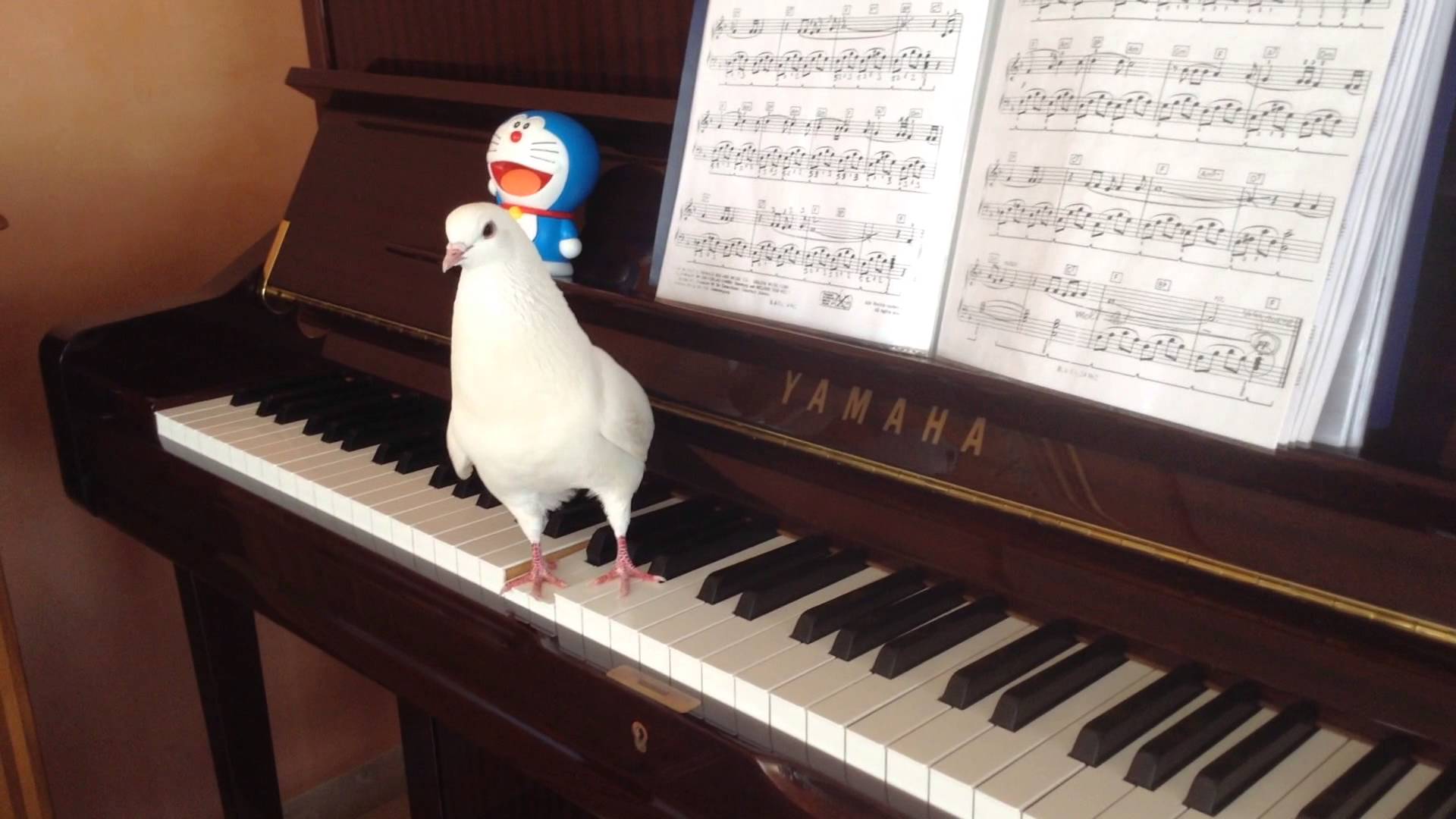
Pigeon on Keyboard ©©

Pigeon on Keyboard ©©

ALL KINDS OF MUSIC

***


“that at the time you hear the sound of the horn, flute, harp, lyre, and psaltery, in symphony with all kinds of music, you shall fall down and worship the gold image that King Nebuchadnezzar has set up;” (Daniel 3:5 NKJV)

Pigeon on Keyboard ©©Playing on YouTube

*

More Daily Devotionals

*

Lee’s Two Word Tuesday – 6/21/16

***

Skimmers - Gulls - Terns resting at the shore MacDill by Lee

AT REST

***


“I Nebuchadnezzar was at rest in mine house, and flourishing in my palace:” (Daniel 4:4 KJV)

Skimmers – Gulls – Terns resting at the shore MacDill by Lee

*

More Daily Devotionals

*

Be Thankful for Pollinators!

Be Thankful for Pollinators!

Dr. James J. S. Johnson

Purple-throated Hummingbird (Carib) ©WikiC

Purple-throated Hummingbird (Carib) ©WikiC

Behold the fowls of the air: for they sow not, neither do they reap, nor gather into barns; yet your heavenly Father feedeth them. Are ye not much better than they? (Matthew 6:26)

Imagine the mathematics of a nectarivorous hummingbirds’ metabolism, as it busily accumulates food energy form flower nectar, as it visits one flower after another. The flowers are benefiting the high-energy hummingbird – yet the hummingbird itself, by pollinating one flower from another, is also benefiting the flowers, helping them to successfully reproduce. There is a balance in all of this.

“The rate at which such a flower supplies its nectar has to be carefully controlled [i.e., fine-tuned by God]. If the plant is miserly and produces very little [nectar], a bird [such as a hummingbird] will not find it worthwhile calling.  If it is too generous, then the bird might be so satisfied after its visit that it will not hurry to seek more nectar elsewhere and so fail to deliver the pollen swiftly.  Many [flowering] plants have arrived [i.e., have been made by God to arrive] at such a perfect compromise [i.e., mutualistic equilibrium] between these two extremes that the hummingbirds pollinating them are compelled to keep continuously active, rushing from one flower to another, getting just enough each time to fuel their high-energy flying equipment with just sufficient calories left over to make the trip [metabolically] profitable.  At night, when they cannot see to fly and the flowers have closed, the birds have no alternative but to shut down all their systems [“torpor”], lower their body temperature and, in effect, hibernate until dawn.”  [Quoting David Attenborough, THE PRIVATE LIFE OF PLANTS (Princeton University Press1995), page 119.]

Firey-throated and Volcano Hummingbird ©Raymond Barlow

Firey-throated and Volcano Hummingbird ©Raymond Barlow

In a recent article of the CHESAPEAKE BAY JOURNAL, wildlife biologist Kathy Reshetiloff stresses the importance of animals that pollinate plants:  “Pollinators are nearly as important as sunlight, soil and water to the reproductive success of more than 75 percent of the world’s flowering plants.  They are crucial to the production of most fruits, nuts and berries that people and wildlife depend on.  More than 150 food crops in the United States depend on pollinators, including blueberries, apples, oranges, squash, tomatoes and almonds.  Worldwide, there are more than 100,000 different animal species that pollinate plants.  Insects [like bees] are the most common pollinators, but as many as 1,500 species of vertebrates [like bats] also help pollinate plants.”(1)

And truly, the role of pollinators is critically valuable for flowering plants to successfully produce the next generation.

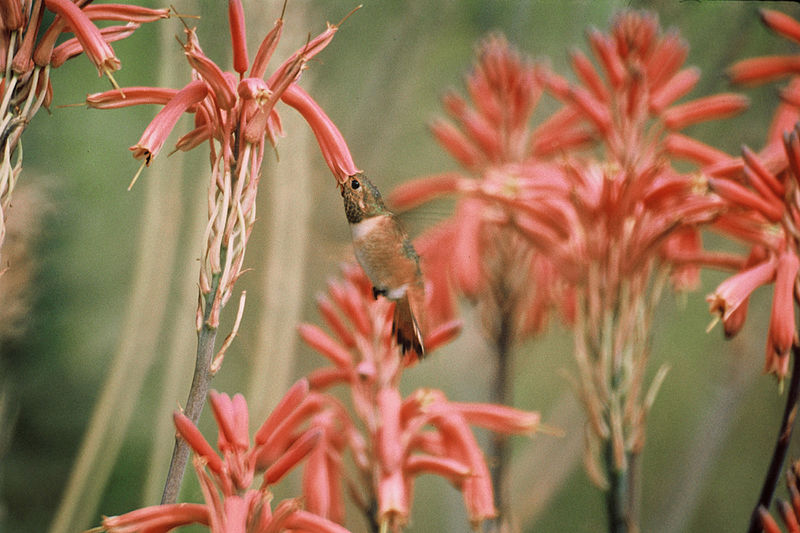
Allen's Hummingbird (Selasphorus sasin) at flower ©WikiC

Allen’s Hummingbird (Selasphorus sasin) at flower ©WikiC

Yet not all pollinators serve the same flowering plants, so pollination is another one of the countless examples of God’s variety. “Different types and colors of flowers attract specific pollinators.  Hummingbirds are attracted to scarlet, orange, red or white tubular-shaped flowers with no distinct odors.  Bats are attracted to dull white, green or purple flowers that emit strong, musty odors at night.  Bees are attracted to bright white, yellow or blue flowers[,] and flowers with contrasting ultraviolet patterns that have fresh, mild or pleasant odors.  Flies are attracted to green, white or cream flowers with little odor[,] or dark brown or purple flowers that have putrid odors.  Butterflies are attracted to bright red and purple flowers with a faint but fresh odor. …  Beetles are attracted to white or green flowers with odors ranging from none to strongly fruity or foul.” [Quoting biologist Kathy Reshetiloff.(1)]  In other words, the “courier service” of pollination may be provided by bugs, bats, birds, or other beasts.(1),(2)

But what is “pollination” and how does it facilitate reproduction of flowering plants? “Pollination occurs when pollen grains [male gamete-bearing particles] from a flower’s male parts (anther) are moved to the female part (stigma) of the same species.  Once on the stigma the pollen grain grows [i.e., extends] a tube that runs down the style of the [plant’s] ovary, where fertilization [i.e., joining of male and female gametes] occurs, producing [fertilized] seeds.  Most plants depend on pollinators to move the pollen from one flower to the next, while others [i.e., other types of plants] rely on wind or water to move pollen.” [Quoting biologist Kathy Reshetiloff.(1),(3)]

Bee - On a Flower ©WikiC

Bee – On a Flower ©WikiC

All of this is wonderful information, but the obvious question remains – how does that fascinating process – that occurs daily around the world – fit the journal article’s title, “If You Like Plants, Bee Grateful for Pollinators This Month”?  The information surely proves that we should appreciate the genius of the pollination process, as well as the variety of details that accompany it in its multitudinous applications, — but word “thankful” presumes that someone is due our gratitude, i.e., that we should express our appreciation for pollination to that someone who deserves to be thanked for arranging pollination to work, worldwide, as it does.

Yet Kathy Reshetiloff’s CHESAPEAKE BAY JOURNAL article never mentions who should receive our thanksgiving, for the many magnificent and beneficial services that these pollinators provide.  But are we really expected to “thank” the pollinators themselves – the hummingbirds, bats, bees, and beetles?  (Doing that would be like ancient polytheism, although the pagan animism mythology of today’s anti-creationists usually goes by the Darwinist mantra “natural selection”.)

Obviously, we should be thankful for pollinators – especially if we like to eat on a regular basis!  But the One Who is rightly due our gratitude should be rightly identified.  Accordingly, there is “something wrong” with the “picture” portrayed in the above-quoted CHESAPEAKE BAY JOURNAL article, because something most important is missing – in fact, it is the Someone Who is not mentioned, but Who should be: God, the author and sustainer of all pollination arrangements.

It is God Who feeds the birds (Matthew 6:26) —  sometimes using the pollination process to do so,  —  and it is that same God Who feeds us, both physically and spiritually (Acts 14:17; Matthew 4:4).

><> JJSJ

References

  1. Kathy Reshetiloff, “If You Like Plants, Bee Grateful for Pollinators This Month”, Chesapeake Bay Journal, 26(4):40 (June 2016).
  2. “Most insects have a highly developed sense of smell, so they can be attracted by perfume. Many also have excellent vision. Their eyes, however, are very different from ours, being made up of a mosaic of several hundred tiny elements. Each of these receives a narrow beam of light and registers no more of it than its intensity, but all together they produce a complete if somewhat granular picture. And there is a further difference – in the perception of colour. At the red end of the spectrum, the insect eye is not as sensitive as ours. Most insects are unable to distinguish between red and black as we can. At the other end [of the spectrum], the blue end, they are very much more sensitive than we are and can detect ultra-violet colours that are totally invisible to us.” [Quoting David Attenborough, THE PRIVATE LIFE OF PLANTS (Princeton University Press, 1995), page 98.] Besides bugs, other pollinators include mammals, especially bats, — yet pollination is performed even by pygmy possums, lemurs, rock mice, and shrews [Attenborough, pages 121-124], and birds, such as hummingbirds, sunbirds, and honey-eaters [Attenborough, pages 114-121], and even reptiles, such as gecko lizards [Attenborough, pages 112-113].
  3. “Wind is a very efficient transporter. It can take the tiny dray grains as high as 19,000 feet and carry them for three thousand miles or so away from their [plant] parents.” [Quoting David Attenborough, THE PRIVATE LIFE OF PLANTS (Princeton University Press, 1995), page 98.]

*

Orni-theology

James J. S. Johnson

*

Lee’s One Word Monday – 6/20/15

***

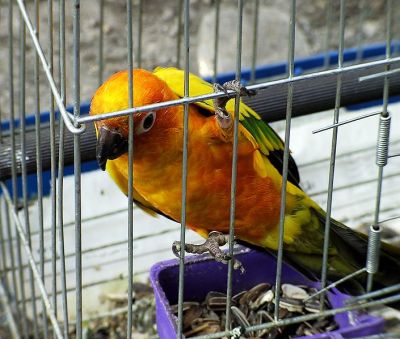
Sun Parakeet (Aratinga solstitialis) In a Cage - Pet ©WikiC

PRISONER

***


“I therefore, the prisoner of the Lord, beseech you that ye walk worthy of the vocation wherewith ye are called,”  (Ephesians 4:1)

Sun Parakeet (Aratinga solstitialis) In a Cage – Pet ©WikiC

*

More Daily Devotionals

*

Lee’s Seven Word Sunday – 6/19/15

***

Gila Woodpecker (Melanerpes uropygialis) Desert Mus-Tucson

FOR A SHELTER 

FROM STORM AND RAIN

***


“And there will be a tabernacle for shade in the daytime from the heat, for a place of refuge, and for a shelter from storm and rain.” (Isaiah 4:6 NKJV)

Gila Woodpecker (Melanerpes uropygialis) Desert Museum-Tucson

*

More Daily Devotionals

*

Sunday Inspiration – Thraupidae – Tanagers and Allies I

Chestnut-headed Tanager (Pyrrhocoma ruficeps) ©WikiC

Chestnut-headed Tanager (Pyrrhocoma ruficeps) ©WikiC

“For ye shall go out with joy, and be led forth with peace: the mountains and the hills shall break forth before you into singing, and all the trees of the field shall clap their hands.” (Isaiah 55:12 KJV)

Our journey through the Song Bird Order, known as the Passeriformes Order, has been ongoing for many Sundays. There are 131 Families within this Order, and we are now down to three families to go. The Traupidae Family which we are starting today, has 375 species. Guess what? We will not be covering them all today. The last four Sundays was used to show you the Emberizidae family of 181 species. I trust you enjoyed having that family split up into “bite-size” articles. The same will be true with this family of beautiful Tanagers and allies created by their Creator.

If you are fairly new to seeing these Sunday Inspirations, the slide shows have the birds arranged in taxonomy order. So, there really is a reason for the way they are presented in the slides.

White-lined Tanager (Tachyphonus rufus) Female ©WikiC

White-lined Tanager (Tachyphonus rufus) Female ©WikiC

“The family has an American distribution. The Thraupidae are the second-largest family of birds and represent about 4% of all avian species and 12% of the Neotropical birds. Traditionally, about 240 species of tanagers were described, but the taxonomic treatment of this family’s members is currently in a state of flux.” (Wikipedia)

Red-crested Cardinal (Paroaria coronata) ©WikiC

Red-crested Cardinal (Paroaria coronata) ©WikiC

“Tanagers are small to medium-sized birds. The shortest-bodied species, the white-eared conebill, is 9 cm (3.5 in) long and weighs 7 grams, barely smaller than the short-billed honeycreeper. The longest, the magpie tanager is 28 cm (11 in) and weighs 76 grams (0.168 pounds). The heaviest is the white-capped tanager which weighs 114 grams (0.251 pounds) and measures about 24 cm (9.4 in). Both sexes are usually the same size and weight. Tanagers are often brightly colored, but some species are black and white. Birds in their first year are often duller or a different color altogether. Males are typically more brightly colored than females. Most tanagers have short, rounded wings. The shape of the bill seems to be linked to the species’ foraging habits.”(Wikipedia)

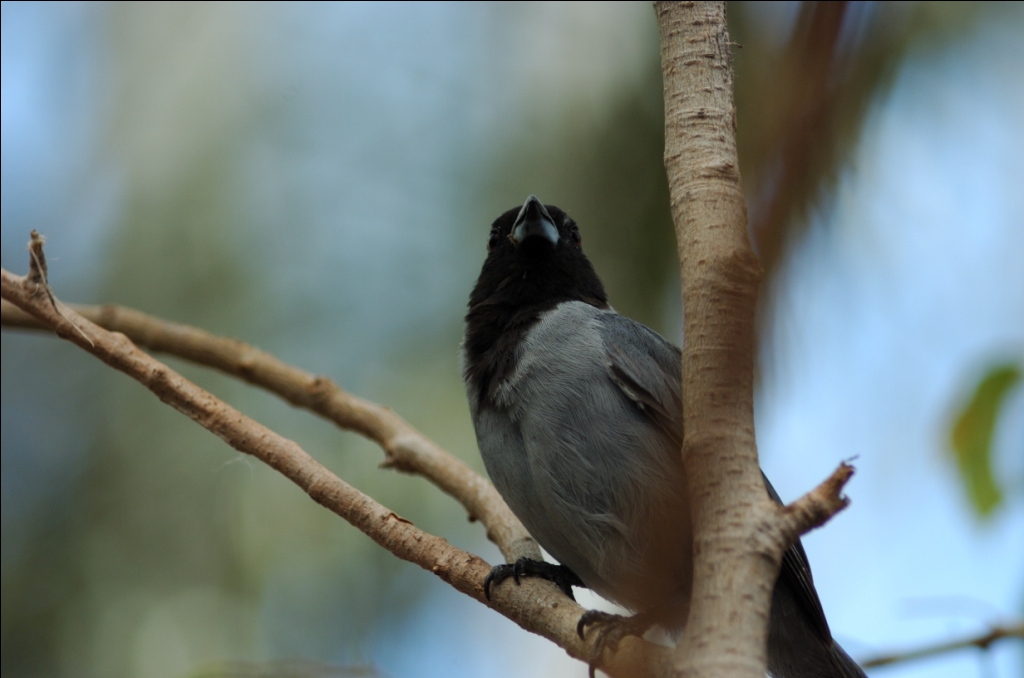
Black-faced Tanager (Schistochlamys melanopis) at National Aviary by Dan

Black-faced Tanager (Schistochlamys melanopis) at National Aviary by Dan

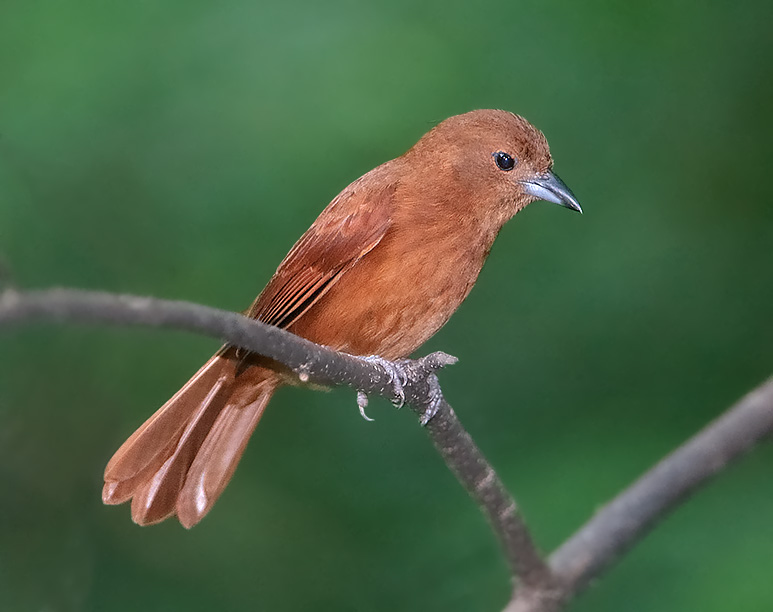
The Brown Tanager (Orchesticus abeillei) starts us off, followed by six Cardinals in the Paroaria genus. Various Tanagers from Schistochlamys, Cissopis, Conothraupis, Lamprospiza, Compsothraupis, Sericossypha, Nemosia, Creurgops, Mitrospingus and Orthogonys. (22 birds)

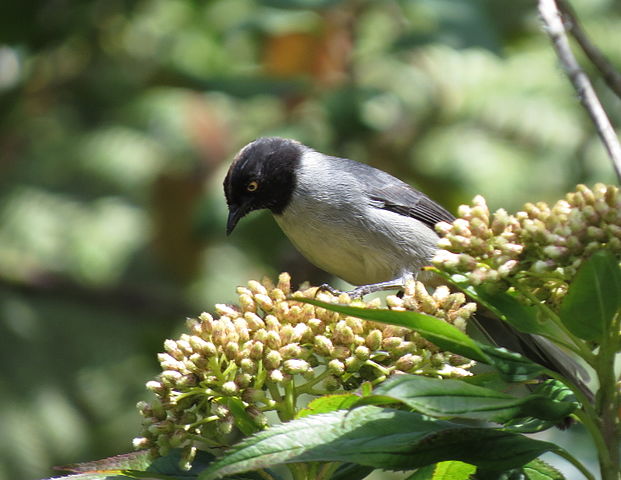
Black-headed Hemispingus (Hemispingus verticalis) ©WikiC

Black-headed Hemispingus (Hemispingus verticalis) ©WikiC

Next will be 15 Hemispingus, all in the Hemispingus genus. Hemispingus is a genus of warbler-like tanagers. They are found in highland forest in South America, especially in the Andes.

Fulvous-headed Tanager (Thlypopsis fulviceps) ©WikiC

Fulvous-headed Tanager (Thlypopsis fulviceps) ©WikiC

We will conclude with 20 or so more Tanagers from eight various genera. As you watch the slide show, you will see how the Lord enjoyed giving a great variety of color and patterns for these avian singers.

“Let them praise the name of the LORD: for he commanded, and they were created.” (Psalms 148:5 KJV)

This slideshow requires JavaScript.

Deck thyself now with majesty and excellency; and array thyself with glory and beauty. (Job 40:10 KJV)

“My Jesus I Love Thee” ~ Faith Baptist Orchestra

*

Sunday Inspirations

Traupidae Family – Tanagers and Allies

Family: Building a Home God’s Way

*


Lee’s Six Word Saturday – 6/18/15

***

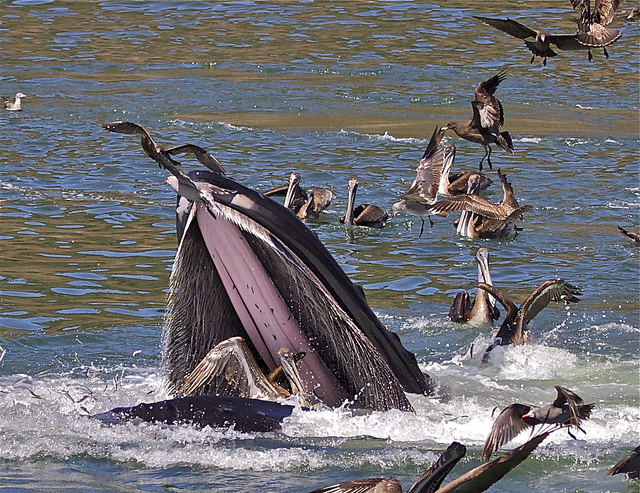
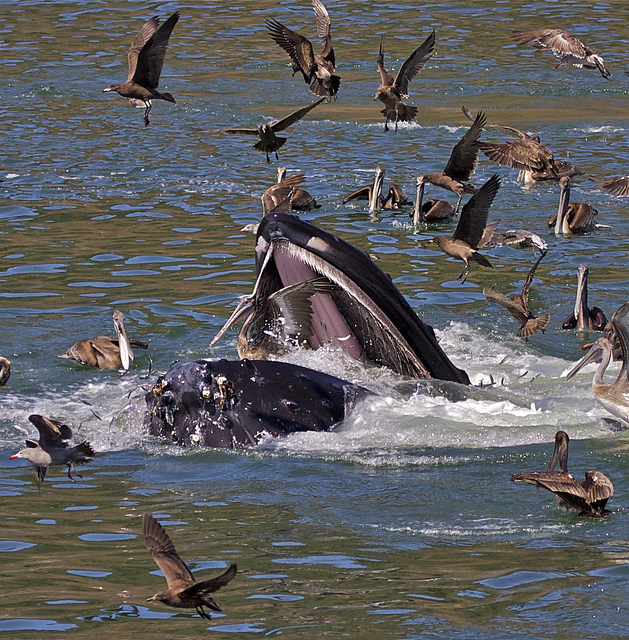
Brown Pelican (Pelecanus occidentalis) Yes Pelican Made It Out ©Flickr Teddy Llovet

LORD HAD PREPARED A GREAT FISH

***


“Now the LORD had prepared a great fish to swallow up Jonah. And Jonah was in the belly of the fish three days and three nights.” (Jonah 1:17 KJV)

Brown Pelican (Pelecanus occidentalis) Yes Pelican Made It Out ©Flickr Teddy Llovet

*

More Daily Devotionals

Brown Pelican (Pelecanus occidentalis) Yes Pelican Made It Out ©Flickr Teddy Llovet

Brown Pelican (Pelecanus occidentalis) Yes Pelican Made It Out ©Flickr Teddy Llovet

*

Lee’s Five Word Friday – 6/17/15

***

Costa's Hummingbird in Arizona by Lee

GIVE HIM WATER TO DRINK

***


“If thine enemy be hungry, give him bread to eat; and if he be thirsty, give him water to drink:” (Proverbs 25:21 KJV)

Costa’s Hummingbird in Arizona by Lee

*

More Daily Devotionals

*