Ian’s Bird of the Week – Barred Honeyeater

Mont Koghi, New Caledonia by Ian

I’m currently working my way through the Honeyeater galleries on the website and on Saturday I’m giving a talk on the birds of New Caledonia to BirdLife Townsville, so here is New Caledonian endemic the Barred Honeyeater. it is confined the main island of Grande Terre, where it is reasonably common in woodland areas, particular in hilly country, e.g. Mont Koghi just outside Noumea.

It seemed to like perching high up in trees, like this one at Riviere Bleue, and at the time we had bigger distractions at hand (such as the Kagu) so we left it to its own devices.

Barred Honeyeater (Glycifohia undulata) by Ian

On our second visit to Mont Koghi (in search of the Horned Parakeet) we came across this one perched more obligingly at eye level in some flowering ginger. While we were photographing it, a member of the staff at the nearby inn, came galloping along to tell us that a Horned Parakeet had arrived, and the poor honeyeater was abandoned unceremoniously.

Barred Honeyeater (Glycifohia undulata) by Ian

From its shape and general appearance it’s clearly a Honeyeater, but the wavy barred plumage is unlike any Australian Honeyeater and gives it its specific name undulata. Not surprisingly, it has no close relatives in Australia, though it was plonked in the same genus as the New Holland and White-cheeked Honeyeaters (Phylidonyris) until someone decided to look at its genes a bit more closely and removed it and its only close relative the Vanuatu Honeyeater (G. notabilis) to their own genus.
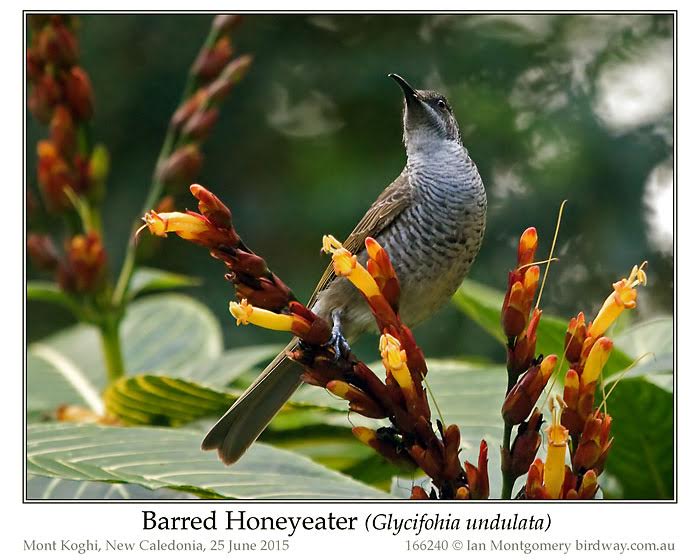
Barred Honeyeater (Glycifohia undulata) by Ian

New Caledonia has some strikingly unusual birds – which is why we were there in the first place – but this familiar but different theme was much more often the case with a broad spectrum from very similar (same species but usually a different race) through somewhat different (common genus, different species) and very different (separate genera) to the Kagu which is in a family of its own and an in order with no other Australasian representatives. I found this very interesting and this is why the theme of my talk at 2:00pm on Saturday afternoon is “New Caledonian Birds: from strangely familiar to very strange”. You can find out about the activities of Birdlife Townsville here http://www.birdlifetownsville.org.au/2016_Calendar.html and details of the location here http://www.birdlifetownsville.org.au/Activities.html.

Work on converting the website to make it ‘mobile friendly’ continues and I’m in the middle of the Honeyeaters With photos of 76 species – and therefore 76 galleries – this is easily the largest family in the website – the ducks and their relatives come second with 64 species. So, I regard it as something of a watershed and look forward to having the Honeyeaters behind me and tell myself that it will all be downhill from then on!

If you’re a local or in the Townsville area, I hope to see you on Saturday.
Ian

**************************************************
Ian Montgomery, Birdway Pty Ltd,
454 Forestry Road, Bluewater, Qld 4818
Tel 0411 602 737 ian@birdway.com.au
Bird Photos http://www.birdway.com.au/
Recorder Society http://www.nqrs.org.au


Lee’s Addition:

The rainbow shall be in the cloud, and I will look on it to remember the everlasting covenant between God and every living creature of all flesh that is on the earth.” (Genesis 9:16 NKJV)

Beautiful rainbow photo and the of course the Barred Honeyeater is pretty. I noticed that in each photo the bird has his eye on Ian. Thanks, Ian, for sharing another of your adventures into the world of avian wonders.

*

Ian’s Bird of the Week articles

Ian’s Birdway

Honeyeaters – Meliphagidae

Wordless Birds

*


Lee’s Three Word Wednesday – 2/10/16

***

Great-tailed Grackle (Quiscalus mexicanus) by Kent Nickell


STAND GAZING UP

***


“who also said, “Men of Galilee, why do you stand gazing up into heaven? This same Jesus, who was taken up from you into heaven, will so come in like manner as you saw Him go into heaven.” (Acts 1:11 NKJV)

Great-tailed Grackle (Quiscalus mexicanus) by Kent Nickell

*

Sandra’s New Kooky Challenge

*

Lee’s Two Word Tuesday – 2/9/16

***

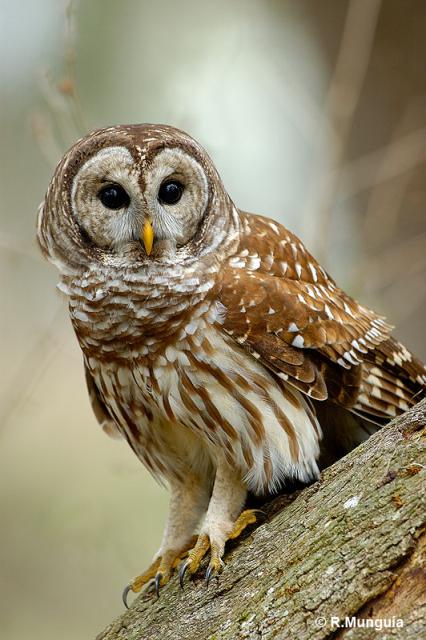
Northern Barred Owl (Strix varia) Reinier Munguia


GET WISDOM

***


Get wisdom! Get understanding! Do not forget, nor turn away from the words of my mouth. (Proverbs 4:5 NKJV)

Wisdom is the principal thing; therefore get wisdom: and with all thy getting get understanding. (Proverbs 4:7 KJV)

How much better is it to get wisdom than gold! and to get understanding rather to be chosen than silver! (Proverbs 16:16 KJV)

Northern Barred Owl (Strix varia) Reinier Munguia

*

Sandra’s New Kooky Challenge

*

Birds of the Bible – Foundation #4 – Updated

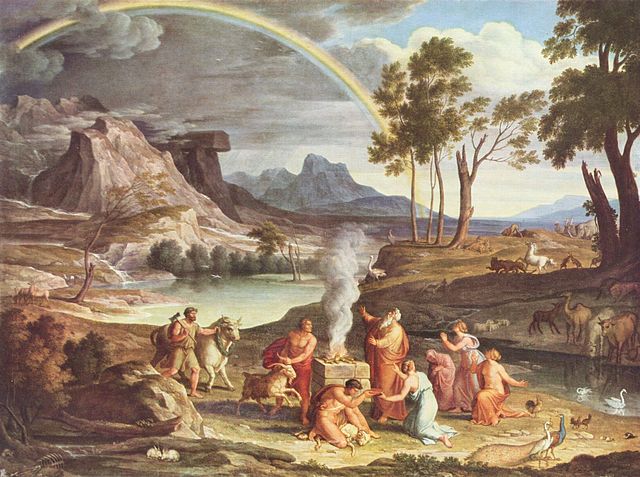
Landscape with Noah’s Thank Offering (painting circa 1803 by Joseph Anton Koch)

We will continue on with the Birds of the Bible – Foundation series.

If you have not read the previous blogs:
Foundation #1 – Updated, – Foundation #2 – UpdatedFoundation #3 – Updated

The last article in this series left the world, Noah, his family, the animals, birds and creeping things in a rough situation. All the world was violently rearranged by the global flood and all air-breathing creation was dead, except for those on board the Ark.

Which sometime were disobedient, when once the longsuffering of God waited in the days of Noah, while the ark was a preparing, wherein few, that is, eight souls were saved by water. (1 Peter 3:20)

But first must he (Christ-the Creator) suffer many things, and be rejected of this generation. And as it was in the days of Noah, so shall it be also in the days of the Son of man. They did eat, they drank, they married wives, they were given in marriage, until the day that Noah entered into the ark, and the flood came, and destroyed them all. (Luke 17:25-27)

Just as those who were saved by being in the Ark, so are we by putting our trust in the Lord Jesus Christ. “For there is one God, and one mediator between God and men, the man Christ Jesus;” (1 Timothy 2:5)

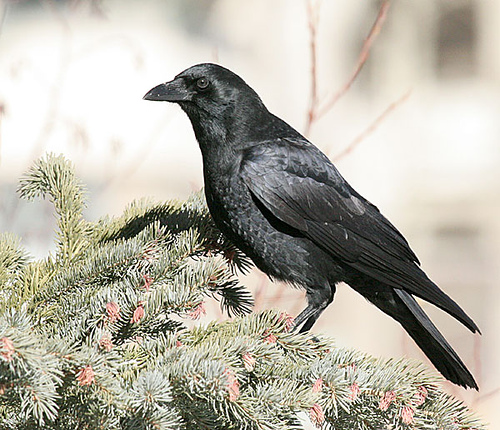
Northern Raven (Corvus corax) by Kent Nickell

Northern Raven (Corvus corax) by Kent Nickell

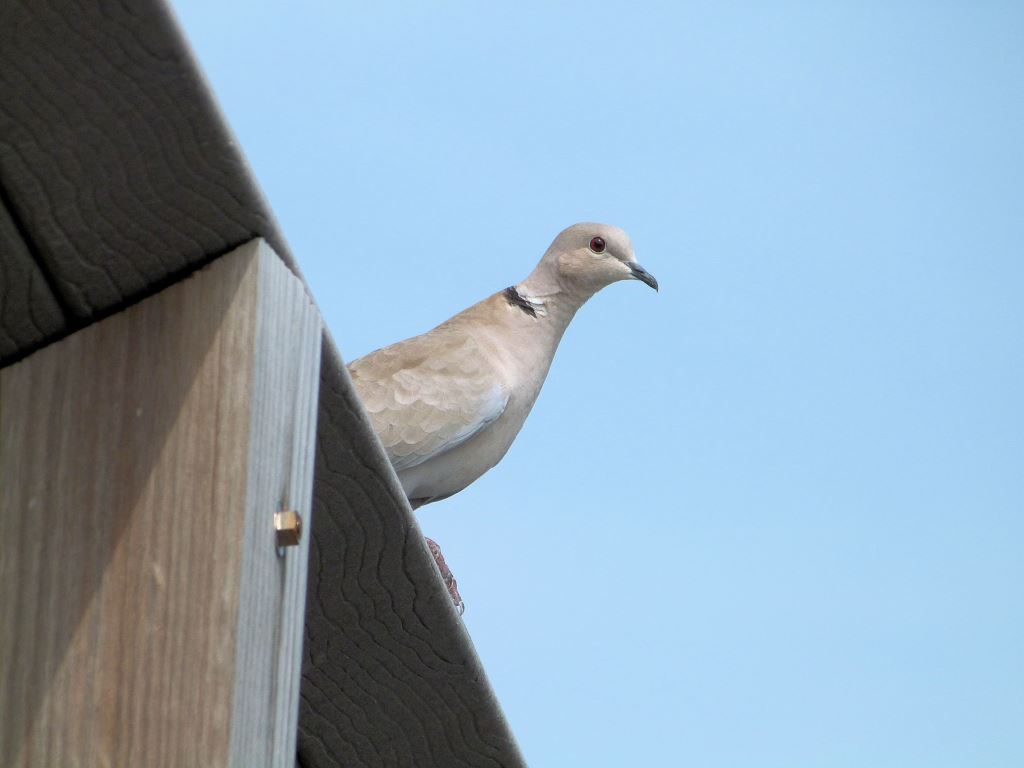
Finally, (Noah and all were in the Ark for over a year.) Noah opened the window in the ark and sent forth a raven. The raven which flew back and forth to the ark until the land was dried up. Noah, then sent out the Dove (female) to see if the ground was off the ground. Doves are ground feeders and also like to put their nests on the ground many times. She found no resting place for her feet and so Noah put out his hand and brought her back inside. Noah waited 7 more days and sent the dove out again and this time she came back with an olive leaf. This let Noah know that the waters were receding. When he released her again 7 more days later, the dove did not return. “The surface of the ground was dry.” (Genesis 8:7-12)

Eurasian Collared Dove (Streptopelia decaocto) by Lee at Honeymoon Is SP

Eurasian Collared Dove (Streptopelia decaocto) by Lee at Honeymoon Is SP

After 7 more days: “God spoke to Noah, saying,”

“Go out of the ark, you and your wife, and your sons and your sons’ wives with you. Bring out with you every living thing of all flesh that is with you: birds and cattle and every creeping thing that creeps on the earth, so that they may abound on the earth, and be fruitful and multiply on the earth.” So Noah went out, and his sons and his wife and his sons’ wives with him. Every animal, every creeping thing, every bird, and whatever creeps on the earth, according to their families, went out of the ark. Then Noah built an altar to the LORD, and took of every clean animal and of every clean bird, and offered burnt offerings on the altar. And the LORD smelled a soothing aroma. Then the LORD said in His heart, “I will never again curse the ground for man’s sake, although the imagination of man’s heart is evil from his youth; nor will I again destroy every living thing as I have done. “While the earth remains, Seedtime and harvest, Cold and heat, Winter and summer, And day and night Shall not cease.” (Genesis 8:16-22 NKJV)

That is a tremendous promise and in Genesis 9, God blesses Noah and his sons and then makes some statements:

  • Be fruitful and multiply, and fill the earth
  • Fear of you and the dread of you shall be on every beast, bird, all that move on the earth, all fish of the sea. Are given into your hand
  • Every moving thing that lives shall be food. (Man is no longer just a vegetarian)
  • You shall not eat flesh with its life, that is, its blood
  • Whoever sheds man’s blood, By man his blood shall be shed; For in the image of God He made man.
  • God makes a covenant with man and every living creature

Genesis 9:11-17 NKJV
(11)  Thus I establish My covenant with you: Never again shall all flesh be cut off by the waters of the flood; never again shall there be a flood to destroy the earth.”
(12)  And God said: “This is the sign of the covenant which I make between Me and you, and every living creature that is with you, for perpetual generations:
(13)  I set My rainbow in the cloud, and it shall be for the sign of the covenant between Me and the earth.
(14)  It shall be, when I bring a cloud over the earth, that the rainbow shall be seen in the cloud;
(15)  and I will remember My covenant which is between Me and you and every living creature of all flesh; the waters shall never again become a flood to destroy all flesh.
(16)  The rainbow shall be in the cloud, and I will look on it to remember the everlasting covenant between God and every living creature of all flesh that is on the earth.”
(17)  And God said to Noah, “This is the sign of the covenant which I have established between Me and all flesh that is on the earth.”

Rainbow by Mike Bader

Rainbow by Mike Bader

What a tremendous promise! Even though man and critters are still cursed, God will never bring another global flood.

As for the birds and other critters, we find from God’s Word that there are changes for them. They now can become food for man and other critters, they now have a fear and dread of man who has dominion over them, they now become eaters of others. They are still to reproduce and spread out and fill the earth, they are promised never to be totally destroyed again by a global flood, etc. Somewhere between the Fall in the garden of Eden and this, the nature of birds and critters is drastically changed from what God originally created them to be. All because of SIN.

We will continue to Birds of the Bible – Foundation #5 soon.

Some links to some informative articles about the flood:

*

Sharing the Gospel

Lee’s One Word Monday – 2/8/16

***

CONSIDER

***


Consider the ravens, for they neither sow nor reap, which have neither storehouse nor barn; and God feeds them. Of how much more value are you than the birds? (Luke 12:24 NKJV)

Little Raven (Corvus mellori) Juvenile Calling to be fed the grub its mother just caught ©WikiC

*

Sandra’s New Kooky Challenge

*

Lee’s Seven Word Sunday – 2/7/16

***

Brown-headed Barbet (Psilopogon zeylanica) by Nikhil Devasar


STRENGTHEN YOUR TIRED HANDS

AND WEAKENED KNEES

***


Therefore strengthen your tired hands and weakened knees, and make straight paths for your feet, …(Hebrews 12:12-13a HCSB)

Brown-headed Barbet (Psilopogon zeylanica) by Nikhil Devasar

*

Sandra’s New Kooky Challenge

*

Sunday Inspiration – Waxbills and Allies I

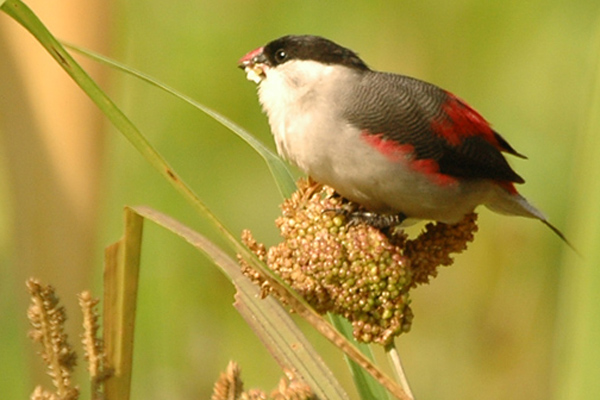
Black-crowned Waxbill (Estrilda nonnula) ©WikiC

Black-crowned Waxbill (Estrilda nonnula) ©WikiC

The works of the LORD are great, sought out of all them that have pleasure therein. (Psalms 111:2 KJV)

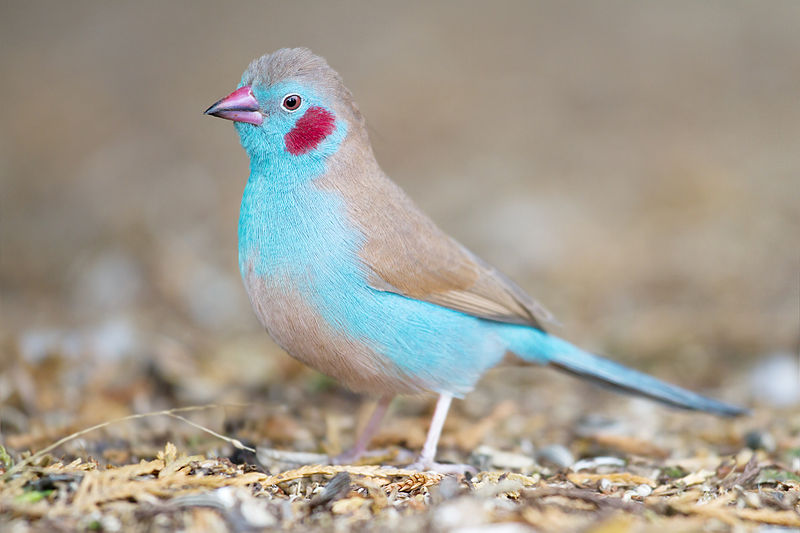
This Sunday, the Lord has created some very beautiful birds after their kind. The Lord’s Creative Hand and Colors is very obvious. This is the Estrildidae Family which includes 141 species. Their names are numerous; they are the Antpecker, Nigrita, Oliveback, Pytillia, Finch, Twinspot, Crimsonwing, Seedcracker, Bluebill, Firefinch, Waxbill, Cordon-bleu, Grenadier, Avadavat and Quailfinch. I started to do them all, but there were too many photos. The last 70+ birds in the family will be in Part II.

The estrildid finches are small passerine birds of the Old World tropics and Australasia. They can be classified as the family Estrildidae (weaver-finch), or as a subfamily within the family Passeridae, which strictly defined comprises the Old World sparrows. Most are sensitive to cold and require warm, usually tropical, habitats, although a few have adapted to the cooler climates of southern Australia.

Red-cheeked Cordon-bleu (Uraeginthus bengalus) ©WikiC

Red-cheeked Cordon-bleu (Uraeginthus bengalus) ©WikiC

They are gregarious and often colonial seed-eaters with short, thick, but pointed bills. They are all similar in structure and habits, but vary widely in plumage colours and patterns.

All the estrildids build large, domed nests and lay 5–10 white eggs. Many species build roost nests. Some of the fire-finches and pytilias are hosts to the brood-parasitic indigobirds and whydahs, respectively.

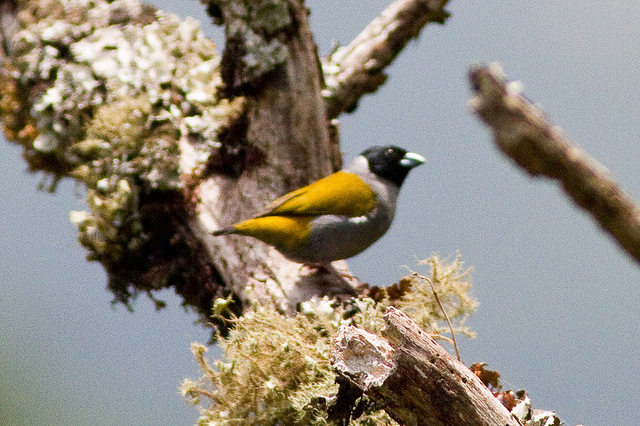
Shelley's Oliveback (Nesocharis shelleyi) ©Ron Knight

Shelley’s Oliveback (Nesocharis shelleyi) ©Ron Knight

The smallest species of the family is the Shelley’s Oliveback (Nesocharis shelleyi) at a mere 3.3 in (8.3 centimetres), although the lightest species is the Black-rumped Waxbill (Estrilda troglodytes) at 0.21 oz (6 g). The largest species is the Java Sparrow (Padda oryzivora), at 6.7 in (17 cm) and 0.88 oz (25 g). (Wikipedia with editing)

This slideshow requires JavaScript.

“Declare His glory among the nations, His marvelous works among all the peoples.” (Psalms 96:3 AMP)

*


“My Jesus I Love Thee” ~ by Meagan Fee at Faith Baptist

*

More Sunday Inspirations

Estrildidae – Waxbills, Munias and allies

Assurance: The Certainty of Salvation

*

Lee’s Six Word Saturday – 2/6/16

***

LET BIRDS MULTIPLY ON THE EARTH

***


And God blessed them, saying, “Be fruitful and multiply, and fill the waters in the seas, and let birds multiply on the earth.” (Genesis 1:22 NKJV)

American Robin – YouTube by Rebecca Petty

*

Sandra’s New Kooky Challenge

*

Lee’s Five Word Friday – 2/5/16

***

Black-capped Petrel (Pterodroma hasitata) ©WikiC


THE BIRDS OF THE AIR

***


The birds of the air, And the fish of the sea That pass through the paths of the seas. O LORD, our Lord, How excellent is Your name in all the earth! (Psalms 8:8-9 NKJV)

Black-capped Petrel (Pterodroma hasitata) ©WikiC

*

Sandra’s New Kooky Challenge

*

Birds of the Bible – Thrush Songs

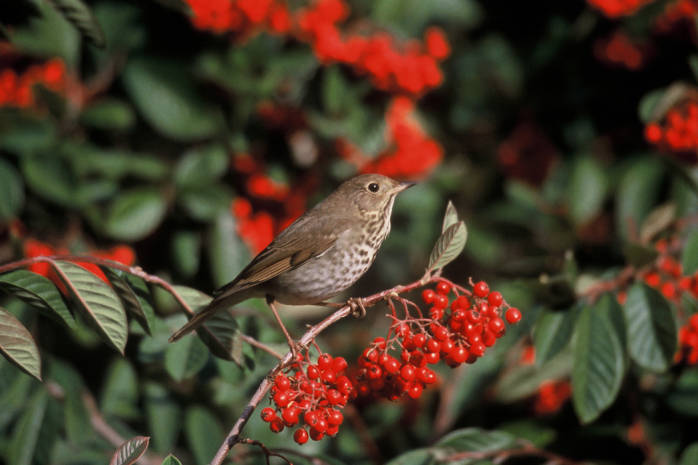
Hermit Thrush (Catharus guttatus) ©USFWS

Hermit Thrush (Catharus guttatus) ©USFWS

Even the stork in the sky Knows her seasons; And the turtledove and the swift and the thrush Observe the time of their migration; But My people do not know The ordinance of the LORD. (Jeremiah 8:7 NASB)

Discovered a very nice YouTube Channel, and thought you might enjoy watching and listening to three Thrushes. They are from the Turdidae Family. The Channel belongs to Lang Elliott’s Nature Channel. These songs are blessings from their Creator who put songs in their heart for us to enjoy.

Thrushes are plump, soft-plumaged, small to medium-sized birds, inhabiting wooded areas, and often feed on the ground. The smallest thrush may be the forest rock thrush, at 21 g (0.74 oz) and 14.5 cm (5.7 in). However, the shortwings, which have ambiguous alliances with both thrushes and Old World flycatchers, can be even smaller. The lesser shortwing averages 12 cm (4.7 in). The largest thrush is the blue whistling thrush, at 178 g (6.3 oz) and 33 cm (13 in). The great thrush is similar in length, but less heavily built. Most species are grey or brown in colour, often with speckled underparts.

The LORD is my strength and my shield; My heart trusted in Him, and I am helped; Therefore my heart greatly rejoices, And with my song I will praise Him. (Psalms 28:7 NKJV)

They are insectivorous, but most species also eat worms, land snails, and fruit. Many species are permanently resident in warm climates, while others migrate to higher latitudes during summer, often over considerable distances.

I will sing to the LORD, Because He has dealt bountifully with me. (Psalms 13:6 NKJV)

Thrushes build cup-shaped nests, sometimes lining them with mud. They lay two to five speckled eggs, sometimes laying two or more clutches per year. Both parents help in raising the young.

The LORD is my strength and my shield; My heart trusted in Him, and I am helped; Therefore my heart greatly rejoices, And with my song I will praise Him. (Psalms 28:7 NKJV)

The songs of some species, including members of the genera Catharus, Myadestes, Sialia and Turdus, are considered to be among the most beautiful in the avian world. (Wikipedia with editing)

*

*

Wordless Birds

Lee’s Four Word Thursday – 2/4/16

***


GIVE ME TO DRINK

***


There cometh a woman of Samaria to draw water: Jesus saith unto her, Give me to drink. (John 4:7 KJV)

Jesus answered and said unto her, If thou knewest the gift of God, and who it is that saith to thee, Give me to drink; thou wouldest have asked of him, and he would have given thee living water. (John 4:10 KJV)

Lilian’s Lovebird (Agapornis lilianae) by Africaddict

*

Sandra’s New Kooky Challenge

*

Lee’s Three Word Wednesday – 2/3/16

***

Chinstrap Penguin direct look by Dave

WEAR A SMILE

***


If I say, ‘I will forget my complaint, I will put off my sad face and wear a smile,’ (Job 9:27 NKJV)

Chinstrap Penguin direct look by Dave

*

Sandra’s New Kooky Challenge

*