***
WASH YOUR FEET,
AND REST YOURSELVES
***
“Let a little water, I pray you, be fetched, and wash your feet, and rest yourselves under the tree:” (Genesis 18:4 KJV)
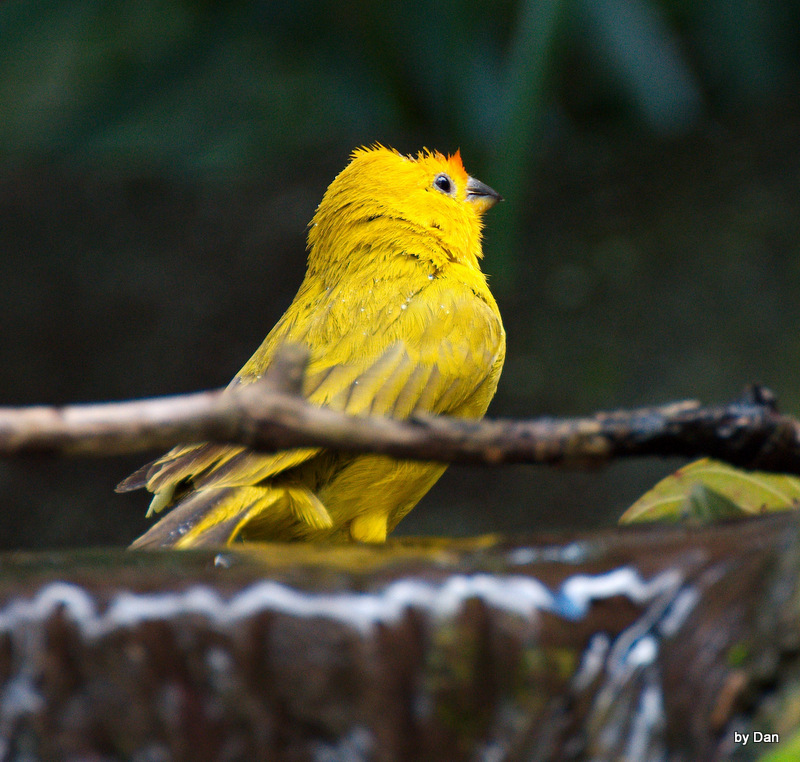
Saffron Finch Zoo Miami by Dan (Cropped by Lee)
*
“Let a little water, I pray you, be fetched, and wash your feet, and rest yourselves under the tree:” (Genesis 18:4 KJV)
Saffron Finch Zoo Miami by Dan (Cropped by Lee)
*
Common Icterid, with Uncommon Beauty
Dr. James J. S. Johnson
Deck thyself now with majesty and excellency; and array thyself with glory and beauty. (Job 40:10).

One of the most spectacular icterids, known for its iridescent shine, is the Common Grackle. As I observed years ago, it is a sobering thought to realize that God could have – if He had chosen to – made me (or you) a grackle! [See “Of Grackles and Gratitude”]
One birdwatcher in Maryland describes the Common Grackle as follows:
The common grackle (Quiscalus quiscula) is a widespread, common bird in the eastern United States. Bigger than most other blackbirds [and robins], it stretches to about 12 inches from its long, tapered tail to its bill. The black beak is prominent, more long than heavy. Grackles stand on tall, stout black legs. They prefer to forage on the ground but they will perch precariously if necessary to reach food. The diet of the common grackle centers on grain, especially corn [i.e., maize]. Common grackles will descend upon a corn field from the moment it’s planted until it’s harvested. Walking boldly behind planting equipment [!], they peck at newly sown seeds or unearthed grubs. As the corn begins to tassel, they tear at maturing ears to eat growing cobs. After the harvest, they descend [in a mob] like a dark cloud, eating any remaining kernels. Common grackles do millions of dollars of damage [“robbing” cornfields] annually. … Though they prefer grains, grackles readily eat thistle, suet or sunflower seeds. If those foods are not available, grackles will eat just about anything else on hand, including insects, frogs, mice, worms, other birds and even fish. (Grackles wade into shallow water to nab schooling minnows.) Discarded garbage [including fast-food litter] is another food source for these omnivores.
[Quoting Mike Burke, “Grackles’ Aggressive Behavior Not Helping its Survival – A Lesson?”, in CHESAPEAKE BAY JOURNAL, 27(3):39 (May 2017).
Ranging from the Midwest to the Eastern coastlands of America (plus some summer breeding ranges northward into central Canada), with most of their wintering range limited to the lands from the East Coast to the sates that straddle the Mississippi River Valley, the Common Grackle is known throughout most of America’s Lower 48 states.
But the Common Grackle’s iridescent plumage is its most conspicuous glory:
Common grackles display an odd geographic variation in color. Those south and east of the Appalachian Mountains [i.e., the so-called “Purple Grackle” variety] have an iridescent purple-blue head, purple belly, and blue-green tail. Those north and west of the Eastern continental divide [i.e., the so-called “Bronze Grackle” variety of New England and west of the Appalachians] have blue-green heads and brassy bronze bodies. From afar, all of the birds look black, but at closer distances the iridescent head is easily distinguishable from the glossy body. Of course, there are exceptions, but generally the grackles in the Chesapeake [Bay] watershed have purple-blue heads.
[Quoting again from Mike Burke, “Grackles’ Aggressive Behavior Not Helping its Survival – A Lesson?”, in CHESAPEAKE BAY JOURNAL, 27(3):39 (May 2017). Of course, these grackles are similar to the Boat-tailed Grackles that I’ve observed in Florida, and the Great-tailed Grackles that dominate Texas, but the tails of Common Grackles are not as conspicuously lengthy as those of its cousins in Florida and Texas.

Like most grackles, the Common Grackle is noisy, gregarious (often congregating on power lines, or in trees near shopping centers), and confident (strutting about in parking lots, hunting for edibles discarded by humans). Grackles are routinely bold, sometimes to the point of being aggressive.
But is this temperament-like habit a guarantee of the Common Grackle’s success? Apparently not, according to the Breeding Bird Survey.
The North American Breeding Bird Survey is a joint venture of the U.S. Geological Survey and the Canadian Wildlife Service, for monitoring avian populations, provided time-indexed data that is relied upon for bird conservation policy and programs. Because these voracious blackbirds are an expensive nuisance to crop farmers, their recent population decline is unlikely to evoke lamentations by crop farmers.
Common grackles are in serious decline. Although they seem to be expanding farther westward and they are still [very much] abundant, the population has fallen nearly 60 percent since 1966, according to the [often-relied-upon] Breeding Bird Survey. Ornithologists are thus far stumped about why the bird’s abundance has fallen so significantly.
[Quoting again from Mike Burke, “Grackles’ Aggressive Behavior Not Helping its Survival – A Lesson?”, in CHESAPEAKE BAY JOURNAL, 27(3):39 (May 2017).
Could it be habitat loss? Of course, the Eastern half of the United States continues to convert its croplands to urban and suburban development — the farmlands of America continue to disappear all too quickly (and the Common Grackle’s “robberies” are not the main cause!). The cornfields that I knew as a boy (and sometimes worked in), growing up in different parts of Maryland, have substituted housing complexes and shopping centers for what were cornfields (and other crop fields). If the habitat shrinks, and the readily available food supply shrink, is it any wonder that the population shrinks too?
Another possibility should be considered, too, the empirical science may be less than accurate – i.e., it may be that the grackle population measurements are not as reliable as the “authoritative” data that they are advertised to be. To illustrate this possibility, consider how the Atlantic Sturgeon was lamented for years – by Chesapeake Bay bioscientists who opined that it was nearly extirpated, only to be embarrassed to learn that they were looking for the anadromous fish at the wrong season of the year, phenologically speaking, and the fish was actually thriving in some of the Chesapeake Bay’s tributary waters! [For details on that empirical science foible, see “Anadromous Fish ‘that Swam with Dinosaurs’ Neither Extinct Nor Extirpated,” Creation Research Society Quarterly, 51 (3): 207-208 (winter 2015).]
But to close on a simpler note: the Common Grackle may be common in many parts of America, yet its beautiful shimmering and glossy iridescent colors are anything but common. Only God’s artistry could design and build a blackbird that reflects sunlight with such majestic magnificence.
FAIR USE PHOTO CREDITS:
Bill Hubick, Maryland: Common Grackle (bold pose & hungry pose)
Jason Major, Rhode Island: Common Grackle perching (bronze variety)
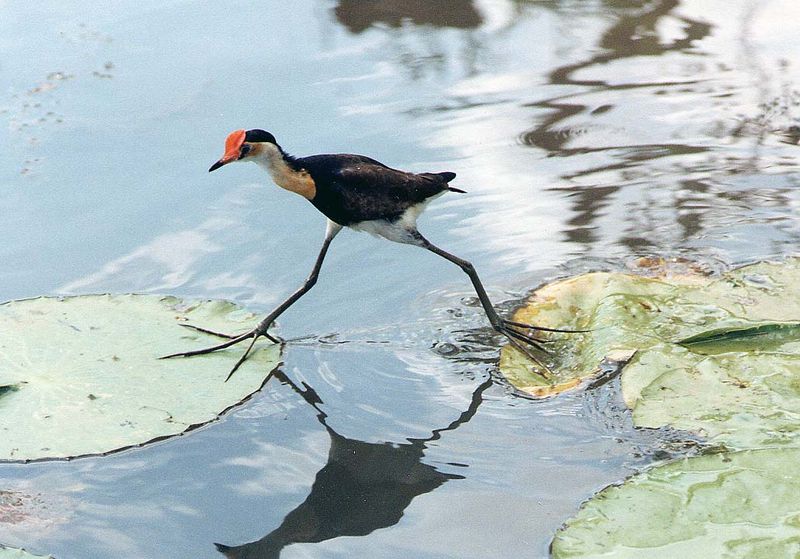
“The steps of a good man are ordered by the LORD: and he delighteth in his way.” (Psalms 37:23 KJV)
Comb-crested Jacana (Irediparra gallinacea) on Pads ©Wiki
*
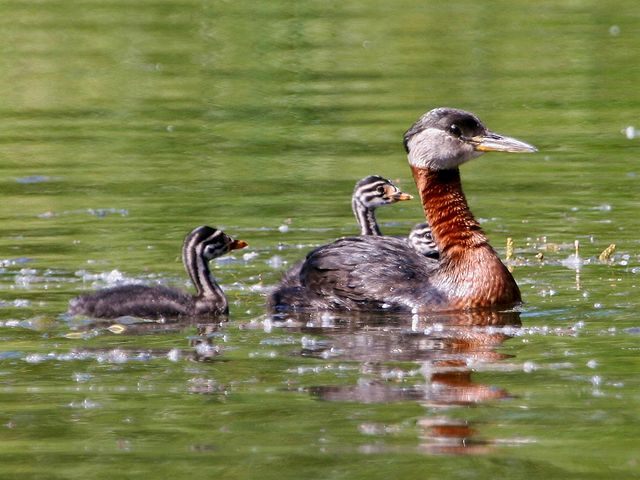
“And I will bring the blind by a way that they knew not; I will lead them in paths that they have not known: I will make darkness light before them, and crooked things straight. These things will I do unto them, and not forsake them.” (Isaiah 42:16 KJV)
Red-necked Grebe (Podiceps grisegena) with young ©WikiC
*

“Give us help from trouble: for vain is the help of man.” (Psalms 60:11 KJV)
Great Crested Grebe (Podiceps cristatus) with young ©WikiC
*
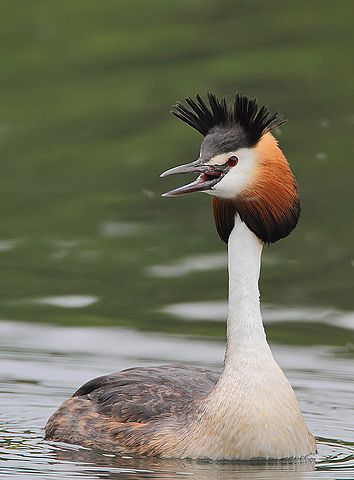
“Lift not up your horn on high: speak not with a stiff neck.” (Psalms 75:5 KJV)
Great Crested Grebe (Podiceps cristatus) ©WikiC
*
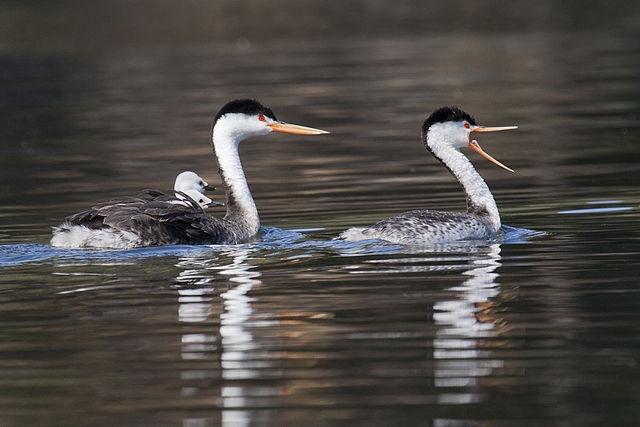
“And He sent them out to announce and preach the kingdom of God and to bring healing.
(Luke 9:2 AMP)
Clark’s Grebe (Aechmophorus clarkii) with chicks ©WikiC
*
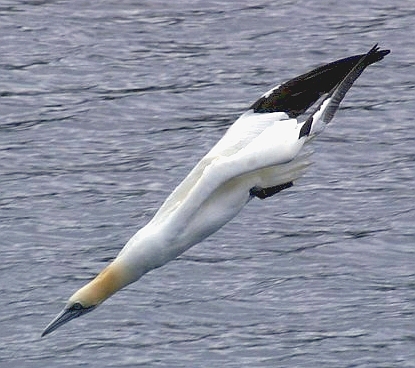
“Lead me, O LORD, in thy righteousness because of mine enemies; make thy way straight before my face.” (Psalms 5:8 KJV)
Northern Gannet (Morus bassanus) ©WikiC
*

Pied-Billed Grebe at Lake Hollingsworth, Lakeland, FL by Dan
“The works of the LORD are great, sought out of all them that have pleasure therein.” (Psalms 111:2 KJV)
Our inspirations today come from the Podicipedidae Family, which is the only family in the Podicipediformes Order. All 23 species are called a Grebe. [This is a switch from many families.] Within the family there six genera: Tachybaptus (6), Podilymbus (2), Rollandia (2), Poliocephalus (2), Podiceps (9) and the Aechmophorus (2). Of these species, three have become extinct; the Alaotra Grebe, Atitlan Grebe, and the Colombian Grebe. “Grebes are a widely distributed order of freshwater diving birds, some of which visit the sea when migrating and in winter.”
As I start this article, we have only seen about three or four of these family members. The most popular in this area is the Pied-billed Grebe (Podilymbus podiceps). All About Birds had these two “Cool Facts“:
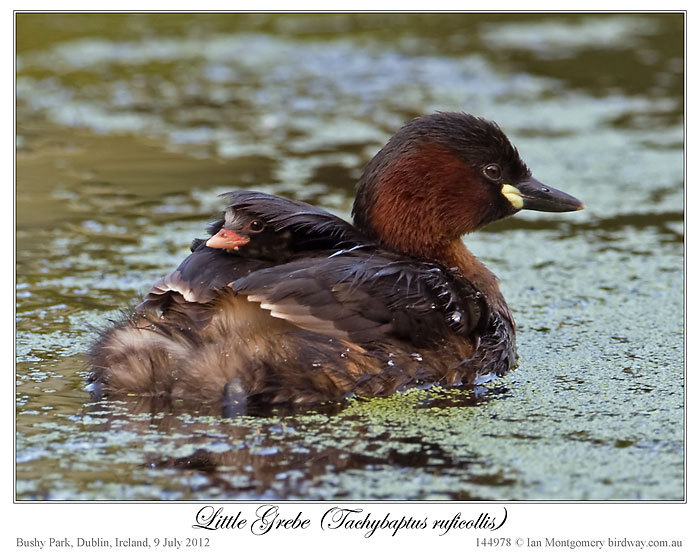
Little Grebe (Tachybaptus ruficollis) by Ian 4
Grebes are small to medium-large in size, have lobed toes, and are excellent swimmers and divers. Although they can run for a short distance, they are prone to falling over, since they have their feet placed far back on the body. Bills vary from short and thick to long and pointed, depending on the diet, which ranges from fish to freshwater insects and crustaceans. The feet are always large, with broad lobes on the toes and small webs connecting the front three toes. The hind toe also has a small lobe. Recent experimental work has shown that these lobes work like the hydrofoil blades of a propeller.
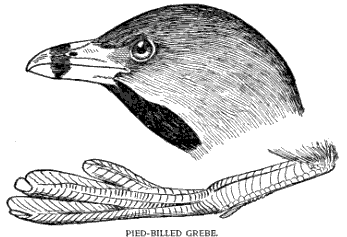
Pied-billed Grebe
Grebes have narrow wings, and some species are reluctant to fly; indeed, two South American species are completely flightless. They respond to danger by diving rather than flying, and are in any case much less wary than ducks. Extant species range in size from the least grebe, at 120 grams (4.3 oz) and 23.5 cm (9.3 inches), to the great grebe, at 1.7 kg (3.8 lbs) and 71 cm (28 inches).

Western Grebe (Aechmophorus occidentalis) With Foot sticking out ©WikiC
The North American and Eurasian species are all, of necessity, migratory over much or all of their ranges, and those species that winter at sea are also seen regularly in flight. Even the small freshwater pied-billed grebe of North America has occurred as a transatlantic vagrant to Europe on more than 30 occasions.

Australasian Grebe (Tachybaptus novaehollandiae) with babies ©WikiC
Tachybaptus is a genus of small members of the grebe family birds. The genus name is from Ancient Greek takhus “fast” and bapto “to sink under”. It has representatives over much of the world, including the tropics.
Alaotra Grebe (Tachybaptus rufolavatus), Little Grebe (Tachybaptus ruficollis), Tricolored Grebe (Tachybaptus tricolor), Australasian Grebe (Tachybaptus novaehollandiae), Madagascan Grebe (Tachybaptus pelzelnii), Least Grebe (Tachybaptus dominicus)
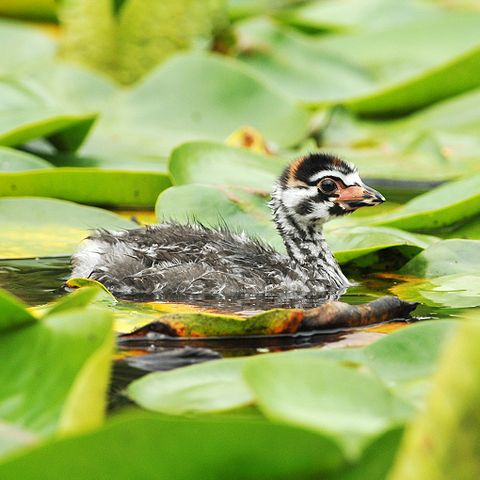
Pied-billed Grebe (Podilymbus podiceps) chick ©WikiC
is a genus of birds in the Podicipedidae family, containing the extinct Atitlán grebe (Podilymbus gigas) and the pied-billed grebe (Podilymbus podiceps).The genus name is derived from Latin Podilymbus, a contraction of podicipes (“feet at the buttocks”, from podici-, “rump-” + pes, “foot”)—the origin of the name of the grebe order—and Ancient Greek kolymbos, “diver”.
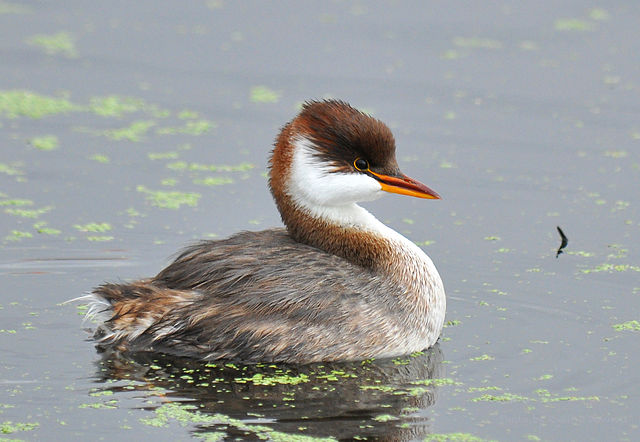
Titicaca Grebe (Rollandia microptera) ©WikiC
Rollandia is a small genus of birds in the grebe family. Its two members are found in South America. They are: White-tufted Grebe (Rollandia rolland) and Titicaca Grebe (Rollandia microptera).
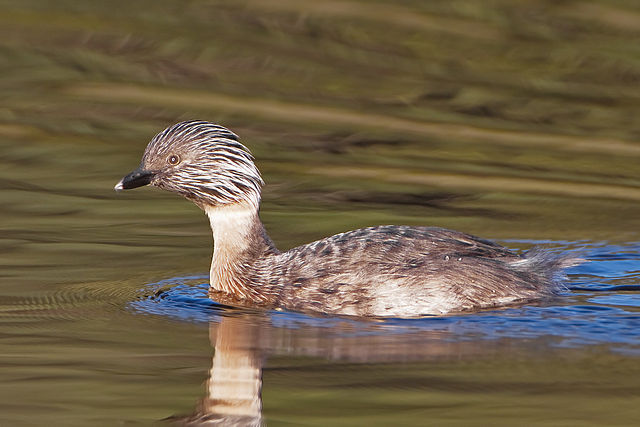
Hoary-headed Grebe (Poliocephalus poliocephalus) ©WikiC
Poliocephalus is a small genus of birds in the grebe family. Its two members are found in Australia and New Zealand. They are: Hoary-headed Grebe (Poliocephalus poliocephalus) and New Zealand Grebe (Poliocephalus rufopectus).
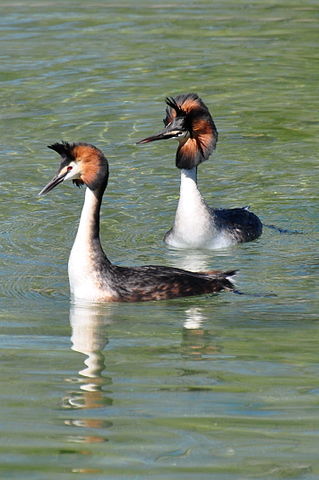
Great Crested Grebe (Podiceps cristatus) With partner ©WikiC
Podiceps is a genus of birds in the grebe family. The genus name comes from Latin podicis, “vent” and pes, “foot”, and is a reference to the placement of a grebe’s legs towards the rear of its body. It has representatives breeding in Europe, Asia, North, and South America. Most northern hemisphere species migrate in winter to the coast or warmer climates.
Great Grebe (Podiceps major), Red-necked Grebe (Podiceps grisegena), Great Crested Grebe (Podiceps cristatus), Horned Grebe (Podiceps auritus), Black-necked Grebe (Podiceps nigricollis), Colombian Grebe (Podiceps andinus), Silvery Grebe (Podiceps occipitalis), Junin Grebe (Podiceps taczanowskii) and Hooded Grebe (Podiceps gallardoi).
Clark’s Grebe (Aechmophorus clarkii) with chicks ©WikiC
Aechmophorus is a genus of birds in the grebe family. It has two living representatives breeding in western North America; the Western Grebe (Aechmophorus occidentalis) and Clark’s Grebe (Aechmophorus clarkii).
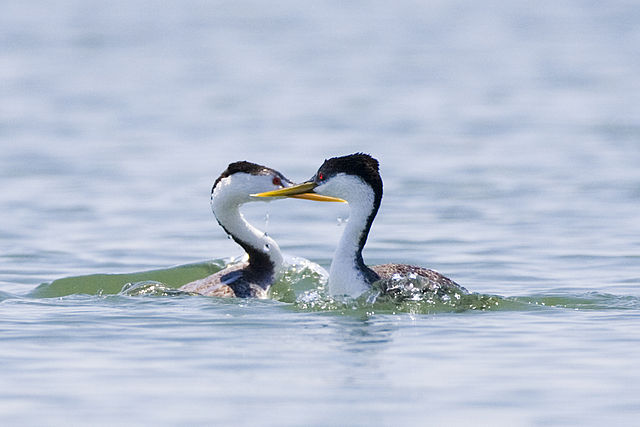
Clark’s Grebe (L) and a Western Grebe (R) collide ©WikiC
The western grebe has a straight bill with a dull green-yellow color as opposed to the Clark’s grebe, which has a slightly upturned, bright orange-yellow bill. In both species the male has a longer and deeper bill than that of the female, making it a distinguishing feature. All species of grebes display the pattern of lobed feet. A tough skin surrounds each toe separately, providing more surface area for effective swimming. This form increases the power of propulsion per stroke and reduces drag when the bird is recovering.
Western and Clark’s grebes take part in a courtship display known as mate feeding. This occurs regularly between a mated pair during the period prior to hatching of nestlings. In both species mate feeding appears to peak shortly before egg laying and involves the male providing large quantities of food to the begging female. Pairs will also engage in a spectacular display, by rearing up and “rushing” across the surface of the water side by side, making a loud pattering sound with their feet.
“He hath made his wonderful works to be remembered: the LORD is gracious and full of compassion.” (Psalms 111:4 KJV)
“He is God” ~ by 3 Plus 1 Quartet, Faith Baptist
*

“The LORD hath done great things for us; whereof we are glad.” (Psalms 126:3 KJV)
Double-barred Finch (Taeniopygia bichenovii) ©WikiC
*

“He that goeth forth and weepeth, bearing precious seed, shall doubtless come again with rejoicing, bringing his sheaves with him.” (Psalms 126:6 KJV)
Birds in Wheat Field ©WikiC
*
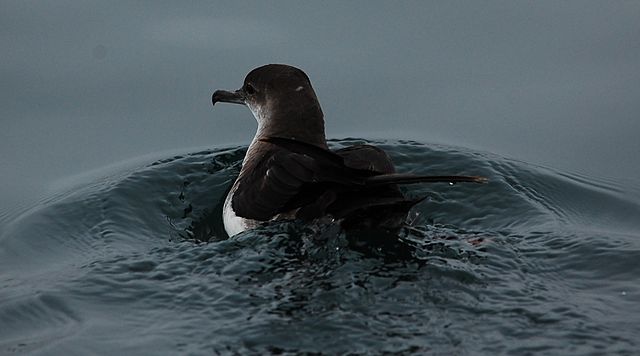
“He shall send from heaven, and save me from the reproach of him that would swallow me up. Selah. God shall send forth his mercy and his truth.” (Psalms 57:3 KJV)
Black-vented Shearwater (Puffinus opisthomelas) ©WikiC
*
 Lee's Birdwatching Adventures Plus