Be Thankful for Pollinators!

Be Thankful for Pollinators!

Dr. James J. S. Johnson

Purple-throated Hummingbird (Carib) ©WikiC

Purple-throated Hummingbird (Carib) ©WikiC

Behold the fowls of the air: for they sow not, neither do they reap, nor gather into barns; yet your heavenly Father feedeth them. Are ye not much better than they? (Matthew 6:26)

Imagine the mathematics of a nectarivorous hummingbirds’ metabolism, as it busily accumulates food energy form flower nectar, as it visits one flower after another. The flowers are benefiting the high-energy hummingbird – yet the hummingbird itself, by pollinating one flower from another, is also benefiting the flowers, helping them to successfully reproduce. There is a balance in all of this.

“The rate at which such a flower supplies its nectar has to be carefully controlled [i.e., fine-tuned by God]. If the plant is miserly and produces very little [nectar], a bird [such as a hummingbird] will not find it worthwhile calling.  If it is too generous, then the bird might be so satisfied after its visit that it will not hurry to seek more nectar elsewhere and so fail to deliver the pollen swiftly.  Many [flowering] plants have arrived [i.e., have been made by God to arrive] at such a perfect compromise [i.e., mutualistic equilibrium] between these two extremes that the hummingbirds pollinating them are compelled to keep continuously active, rushing from one flower to another, getting just enough each time to fuel their high-energy flying equipment with just sufficient calories left over to make the trip [metabolically] profitable.  At night, when they cannot see to fly and the flowers have closed, the birds have no alternative but to shut down all their systems [“torpor”], lower their body temperature and, in effect, hibernate until dawn.”  [Quoting David Attenborough, THE PRIVATE LIFE OF PLANTS (Princeton University Press1995), page 119.]

Firey-throated and Volcano Hummingbird ©Raymond Barlow

Firey-throated and Volcano Hummingbird ©Raymond Barlow

In a recent article of the CHESAPEAKE BAY JOURNAL, wildlife biologist Kathy Reshetiloff stresses the importance of animals that pollinate plants:  “Pollinators are nearly as important as sunlight, soil and water to the reproductive success of more than 75 percent of the world’s flowering plants.  They are crucial to the production of most fruits, nuts and berries that people and wildlife depend on.  More than 150 food crops in the United States depend on pollinators, including blueberries, apples, oranges, squash, tomatoes and almonds.  Worldwide, there are more than 100,000 different animal species that pollinate plants.  Insects [like bees] are the most common pollinators, but as many as 1,500 species of vertebrates [like bats] also help pollinate plants.”(1)

And truly, the role of pollinators is critically valuable for flowering plants to successfully produce the next generation.

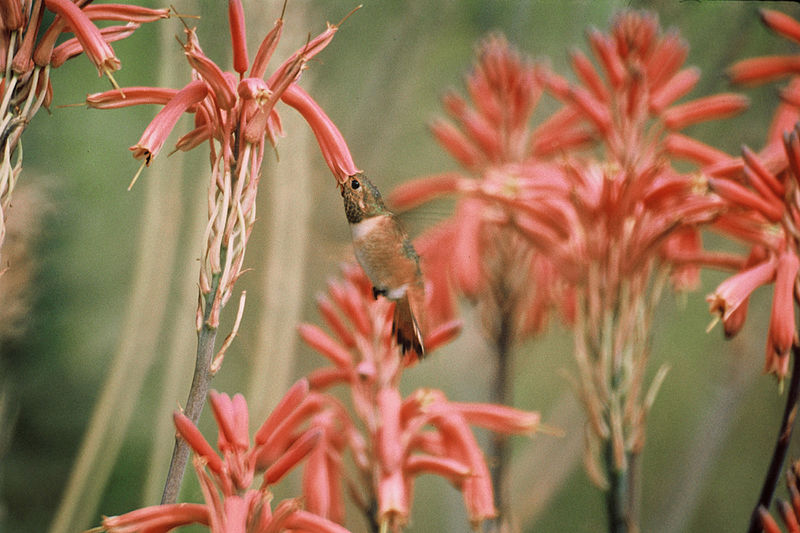
Allen's Hummingbird (Selasphorus sasin) at flower ©WikiC

Allen’s Hummingbird (Selasphorus sasin) at flower ©WikiC

Yet not all pollinators serve the same flowering plants, so pollination is another one of the countless examples of God’s variety. “Different types and colors of flowers attract specific pollinators.  Hummingbirds are attracted to scarlet, orange, red or white tubular-shaped flowers with no distinct odors.  Bats are attracted to dull white, green or purple flowers that emit strong, musty odors at night.  Bees are attracted to bright white, yellow or blue flowers[,] and flowers with contrasting ultraviolet patterns that have fresh, mild or pleasant odors.  Flies are attracted to green, white or cream flowers with little odor[,] or dark brown or purple flowers that have putrid odors.  Butterflies are attracted to bright red and purple flowers with a faint but fresh odor. …  Beetles are attracted to white or green flowers with odors ranging from none to strongly fruity or foul.” [Quoting biologist Kathy Reshetiloff.(1)]  In other words, the “courier service” of pollination may be provided by bugs, bats, birds, or other beasts.(1),(2)

But what is “pollination” and how does it facilitate reproduction of flowering plants? “Pollination occurs when pollen grains [male gamete-bearing particles] from a flower’s male parts (anther) are moved to the female part (stigma) of the same species.  Once on the stigma the pollen grain grows [i.e., extends] a tube that runs down the style of the [plant’s] ovary, where fertilization [i.e., joining of male and female gametes] occurs, producing [fertilized] seeds.  Most plants depend on pollinators to move the pollen from one flower to the next, while others [i.e., other types of plants] rely on wind or water to move pollen.” [Quoting biologist Kathy Reshetiloff.(1),(3)]

Bee - On a Flower ©WikiC

Bee – On a Flower ©WikiC

All of this is wonderful information, but the obvious question remains – how does that fascinating process – that occurs daily around the world – fit the journal article’s title, “If You Like Plants, Bee Grateful for Pollinators This Month”?  The information surely proves that we should appreciate the genius of the pollination process, as well as the variety of details that accompany it in its multitudinous applications, — but word “thankful” presumes that someone is due our gratitude, i.e., that we should express our appreciation for pollination to that someone who deserves to be thanked for arranging pollination to work, worldwide, as it does.

Yet Kathy Reshetiloff’s CHESAPEAKE BAY JOURNAL article never mentions who should receive our thanksgiving, for the many magnificent and beneficial services that these pollinators provide.  But are we really expected to “thank” the pollinators themselves – the hummingbirds, bats, bees, and beetles?  (Doing that would be like ancient polytheism, although the pagan animism mythology of today’s anti-creationists usually goes by the Darwinist mantra “natural selection”.)

Obviously, we should be thankful for pollinators – especially if we like to eat on a regular basis!  But the One Who is rightly due our gratitude should be rightly identified.  Accordingly, there is “something wrong” with the “picture” portrayed in the above-quoted CHESAPEAKE BAY JOURNAL article, because something most important is missing – in fact, it is the Someone Who is not mentioned, but Who should be: God, the author and sustainer of all pollination arrangements.

It is God Who feeds the birds (Matthew 6:26) —  sometimes using the pollination process to do so,  —  and it is that same God Who feeds us, both physically and spiritually (Acts 14:17; Matthew 4:4).

><> JJSJ

References

  1. Kathy Reshetiloff, “If You Like Plants, Bee Grateful for Pollinators This Month”, Chesapeake Bay Journal, 26(4):40 (June 2016).
  2. “Most insects have a highly developed sense of smell, so they can be attracted by perfume. Many also have excellent vision. Their eyes, however, are very different from ours, being made up of a mosaic of several hundred tiny elements. Each of these receives a narrow beam of light and registers no more of it than its intensity, but all together they produce a complete if somewhat granular picture. And there is a further difference – in the perception of colour. At the red end of the spectrum, the insect eye is not as sensitive as ours. Most insects are unable to distinguish between red and black as we can. At the other end [of the spectrum], the blue end, they are very much more sensitive than we are and can detect ultra-violet colours that are totally invisible to us.” [Quoting David Attenborough, THE PRIVATE LIFE OF PLANTS (Princeton University Press, 1995), page 98.] Besides bugs, other pollinators include mammals, especially bats, — yet pollination is performed even by pygmy possums, lemurs, rock mice, and shrews [Attenborough, pages 121-124], and birds, such as hummingbirds, sunbirds, and honey-eaters [Attenborough, pages 114-121], and even reptiles, such as gecko lizards [Attenborough, pages 112-113].
  3. “Wind is a very efficient transporter. It can take the tiny dray grains as high as 19,000 feet and carry them for three thousand miles or so away from their [plant] parents.” [Quoting David Attenborough, THE PRIVATE LIFE OF PLANTS (Princeton University Press, 1995), page 98.]

*

Orni-theology

James J. S. Johnson

*

“C” is for Coot and Corvids: “C” Birds”, Part 2

“C”  is  for  Coot  and  Corvids:   “C”  Birds”,  Part  2

By James J. S. Johnson

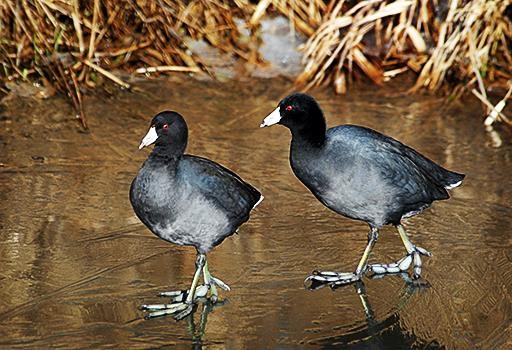
Coots on Ice ©FWS

Coots on Ice ©FWS

 For Thou hast delivered my soul from death; wilt not Thou deliver my feet from falling, that I may walk before God in the light of the living?  Psalm 56:13

As the following study of the American Coot shows (which begins our review of birds having names that begin with “C”), God has employed creatively clever bioengineering into the form and function of American Coot feet.  How much moreso, as creatures made in His image, should we appreciate His design-and-construction engineering genius, as it is displayed in our own feet and toes!

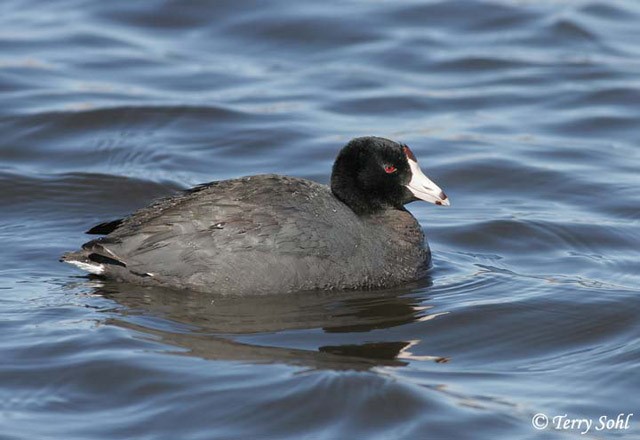
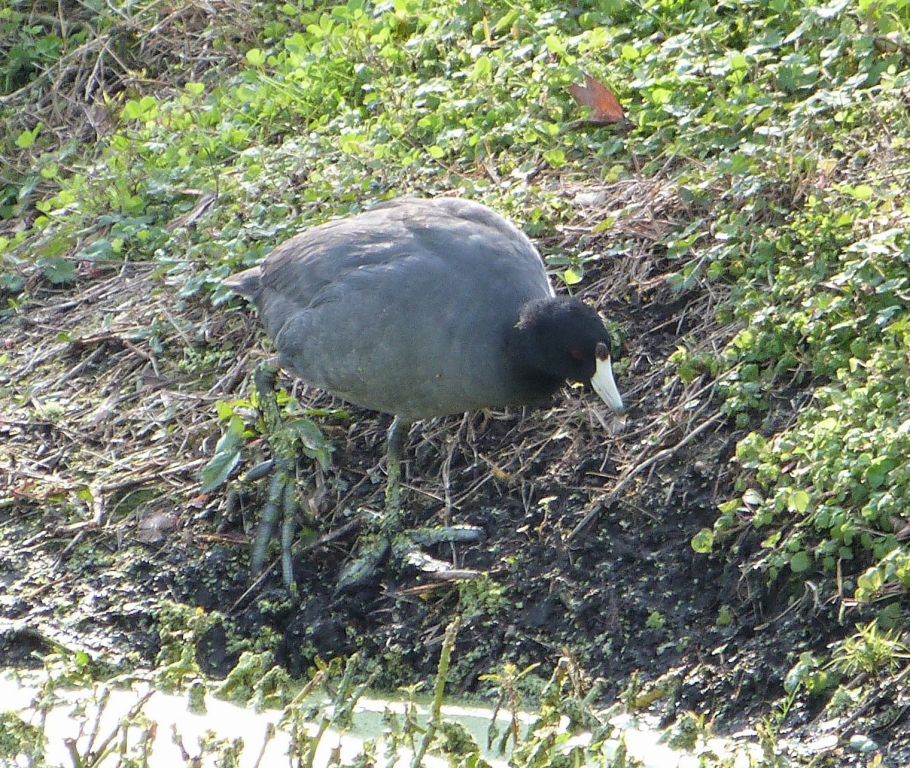
rican Coot (Fulica americana) © SDbirds-Terry Sohl

rican Coot (Fulica americana) © SDbirds-Terry Sohl

American Coot (Fulica americana)

As noted in the preceding “Part 1” of this series [see ], “C” is for as Cardinal, Chicken [regarding which fowl, see Flag That Bird – Part 1 ], Coot, Cormorant, Chicken, Coot, Chickadee, Caracara, Crane, Cuckoo, Curlew, and Corvid (including Crow and Chough) — plus many other birds with names that begin with the letter C!

In this “Part 2” review of “C” birds, however, the red-eyed American Coot (a/k/a marsh hen, mud hen, water hen, and poule d’eau, i.e., “water chicken”), as well as the crow-like birds that we collectively label as Corvids, will be featured.

Because the American Coot is a wetland “rail” (i.e., classified with the mostly-wetland-or-forest-associated birds, such as gallinules and crakes, that are “ground-living” – as opposed to dwelling in trees), it is often seen and appreciated by birdwatchers (like Chaplain Bob Webel, of St. Petersburg, and his wife, Marcia) who live at the vegetated edge of a freshwater lake or pond, or by brackish estuarial marshland or swampland.

AMERICAN COOT (12 in. [or larger, with their plumage being mostly black or dark grey, depending upon lighting, and with white under-coverts and secondary wing feather-tips]) nests in marsh vegetation, but often winters in open water.  It is the only ducklike bird with a chalky white bill [and that bill is triangular in shape, somewhat like that of a chicken’s beak].  When disturbed it either dives or skits over the water [like flapping, fluttering hovercraft!] with feet and wings.  The closely related Common Moorhen (or Florida Gallinule, 10½ in. [what ornithologist Lee Dusing has nicknamed the “candy-corn bird”]) has a red bill and forehead and a white stripe under the wing.  Both pump the neck when swimming.”

[Quoting Herbert S. Zim & Ira N. Gabrielson, Birds, A Guide to Familiar American Birds (New York, NY: Golden Press, 1987 rev. ed.), page 34.]   As the youtube video-clip (below) shows, American Coots can skim and scoot across the surface of a lake or pond, flapping just over the water surface, when they want to move quickly.

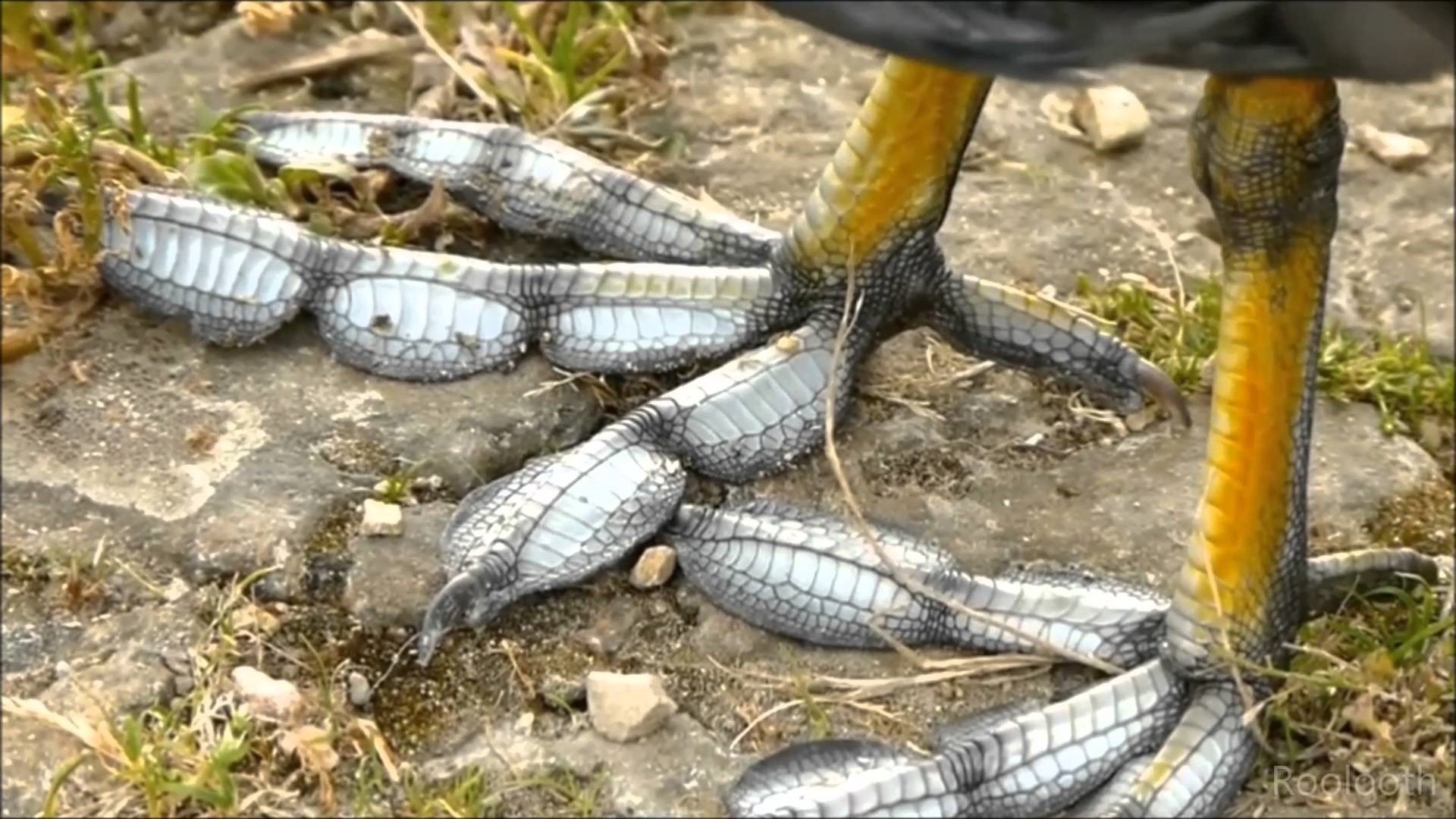
Unlike ducks, however, the coot has no webbed feet.

American Coot, showing off its cushion-padded toes

American Coot, showing off its cushion-padded toes ©i.ytimg

American Coot, showing off its cushion-padded toes

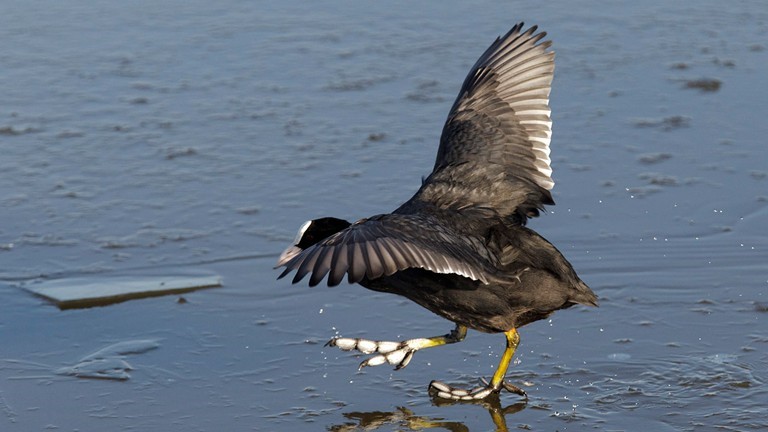
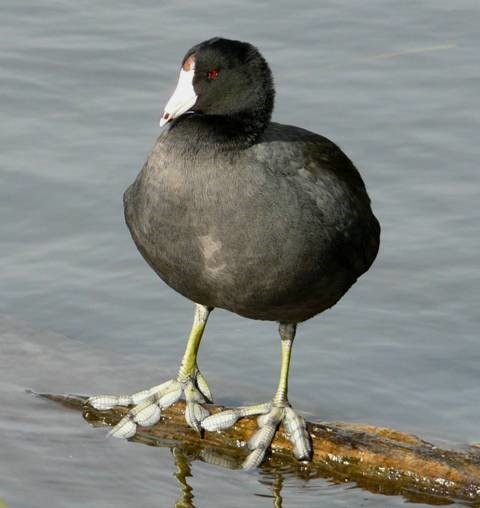
Rather, coots have long toes that sport broad lobes of skin, designed for kicking through the water, almost like synchronized mini-paddles.  These conspicuously broad foot-lobes fold backward, when a coot walks on dry land, so the foot-lobes don’t interfere with the ground surface contact – yet the foot-lobes can be used to partially support the weight of the coot (by spreading body weight over a larger surface area, like snow-shoes) when the “mud hen” travels across mucky mud (or even on thin ice!).

American Coot on Ice ©Graham Catley

American Coot on Ice ©Graham Catley

American Coot on ice!

In other words, God designed coot feet to fit the wet habitats that they fill.

American Coot standing, showing broad-lobed toes ©Johnrakestraw

American Coot standing, showing broad-lobed toes ©Johnrakestraw

American Coot standing, showing broad-lobed toes

Coots are gregarious, “socializing” with themselves and with other waterfowl.  IN particular, coots are share space, as they “fill” a wetland or aquatic habitat.  Families of coots — or even larger groups of coots — often mixed with other waterfowl (like ducks) may compose a “raft” of hundreds or even thousands!  [See, accord, American Coot entry at CORNELL LAB OF ORNITHOLOGY, “All About Birds”, with Herbert K. Job, BIRDS OF AMERICA (Doubleday, 1936), pages 214-215, both cited within Steve Bryant, “American Coot”, in OUTDOOR ALABAMA.

American Coot flock “rafting” (©Jack Dermid)

American Coot flock “rafting” ©ARKive-Jack Dermid

American Coot  flock “rafting”

For a video clip featuring American Coots in action (in Florida), sometimes interacting quite boisterously, see https://www.youtube.com/watch?v=J5dPaWH785w .  (Notice:  this youtube footage also includes brief footage of a few other birds, so don’t be surprised when the first bird shown is a Florida Gallinule!)

American Coot  in water

It is interesting to note that the American Coot has a migratory range that covers almost all of North America, from Panama (in the south) through the more temperate zones of Canada (in the north).  As is often the case, a helpful range map has been prepared by Terry Sohl, Research Physical Scientist with the U.S. Geological Survey, frequently publishing on topics of land usage, ecology, cartography, climatology, and geography, including biogeography.  As Terry Sohl’s range map shows, this wetland bird is a permanent resident of America’s West and Southwest (west of the Mississippi River), a breeding resident of America’s northern prairie states, a nonbreeding resident of America’s Southeast and East Coast states, and a migrant in some parts of Appalachian Mountain range zones.  [NOTE: the above-referenced Terry Sohl range map is not shown here, because Mr. Sohl, as a self-described “hardcore atheist”, does not want his maps associated with a Christian blogsite.]

American Coot, with young, eating aquatic plant ©Oiseaux-Tom Grey

American Coot, with young, eating aquatic plant ©Oiseaux-Tom Grey

American Coot, with young, eating aquatic plant.

So what do American Coots like to eat?

Mostly duckweeds and other wetland emergent plants (especially seeds and roots), lacustrine algae, small mollusks (like snails), little fish, tadpoles, and wee crustaceans, as well as a mix of aquatic bugs.  [See, accord, Herbert S. Zim & Ira N. Gabrielson, Birds, A Guide to Familiar American Birds (New York, NY: Golden Press, 1987 rev. ed.), pages 134-135.]

American Coot ©iytimg

American Coot ©iytimg

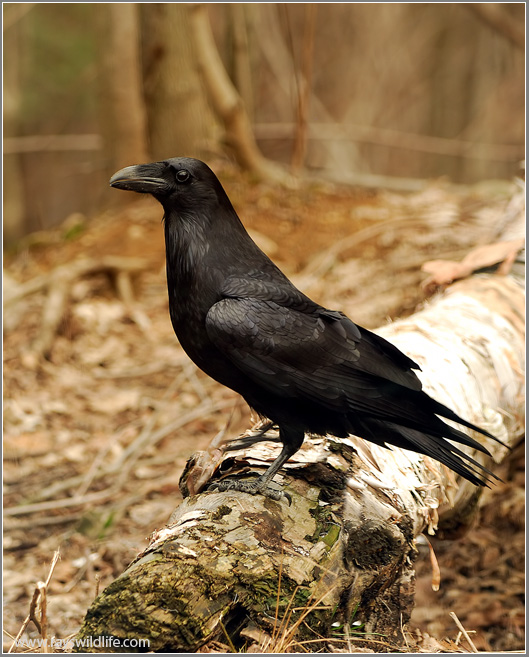
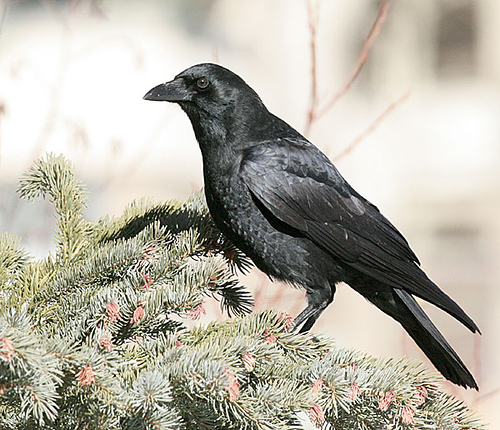
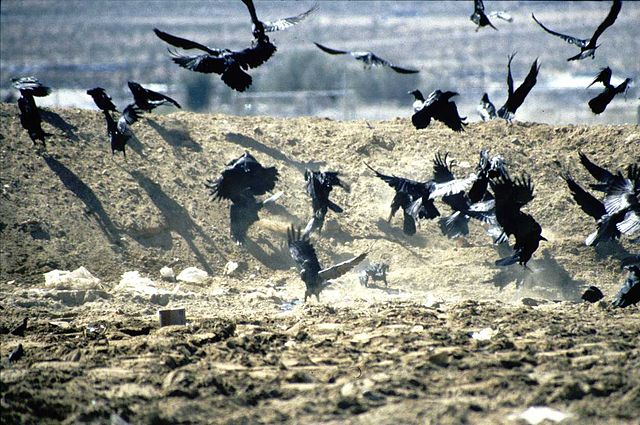
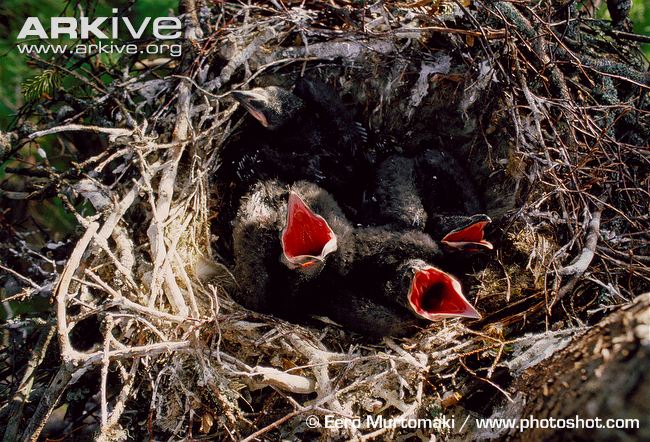
But American Coots are not the only common bird dominated by black plumage. Consider the common crow, or the raven  —  both of which belong to another group of “C birds”:  CORVIDS, an amazingly intelligent group of crow-like songbirds, including the likes of crows, ravens, jackdaws, rooks, choughs, jays, treepies, magpies, and nutcrackers.

For  a few examples, consider that Lars Jonsson’s BIRDS OF EUROPE (Princeton University Press, 1993), pages 487-495, includes the following corvids of Europe:  Siberian Jay, Eurasian Jay, Spotted Nutcracker, Eurasian Magpie, Azure-winged Magpie, Alpine Chough, Red-billed Chough, Jackdaw, Common Raven, Brown-necked Raven, Fan-tailed Raven Carrion Crow, Hooded Crow, and Rook.

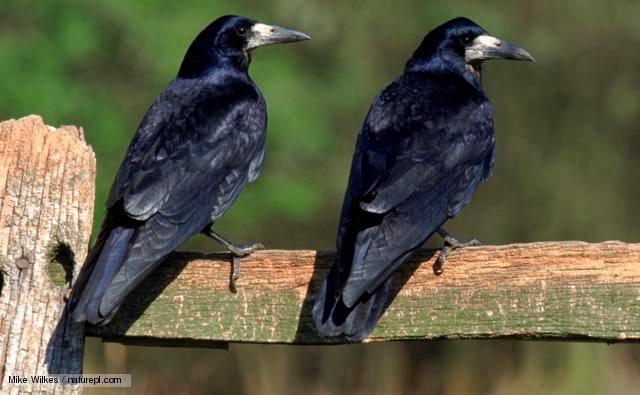
Rook (Corvus frugilegus) pair perching on wooden fence ©BBCI Mike Wilkes

Rook (Corvus frugilegus) ©BBCI Mike Wilkes

Rook (Corvus frugilegus) pair, perching on wooden fence

In North America we can expect to find corvids quite terrific, ranging from the Atlantic to the Pacific:  American crow, Northwestern Crow, Common Raven (including the subspecies “Western Raven”), Green Jay, Blue Jay, Steller’s jay, various scrub jays, Grey Jay, Black-billed Magpie, Yellow-billed Magpie, Yucatan Jay, Pinyon Jay, Clark’s Nutcracker, and more!

For general information on corvids, see ornithologist Lee Dusing’s insightful birdwatching articles: “Corvidae — Crows, Jay”, listing more corvids that you or I will ever witness in this lifetime!  —  as well as Lee’s Birds of the Bible – Raven I, Lee’s Birds of the Bible – Raven II, and Lee’s  Birds of the Bible – Raven III.

Corvid Chart - Differences Between Types of Corvids ©Autodidactintheattic

Corvid Chart – Differences Between Types of Corvids ©Autodidactintheattic

For some world history-linked appreciation of corvids (such as ravens, jackdaws, and magpies), see also 5 of my earlier articles:

A Diet of Jackdaws and Ravens” [posted at https://leesbird.com/2015/09/16/a-diet-of-jackdaws-and-ravens/ ]; and

Northern Raven and Peregrine Falcon: Two Birds Supporting the Manx Coat of Arms; and

Steller’s Jay:  A Lesson in Choosing What is Valuable; and

Flag That Bird Part 5, featuring the Australian Magpie; and

Providential Planting:  The Pinyon Jay”, CREATION EX NIHILO, 19(3):24-25, summer AD1997.

Of course, many books could be  —  and, in fact, have been  —  written about  corvid birds.  But this article is already long enough.

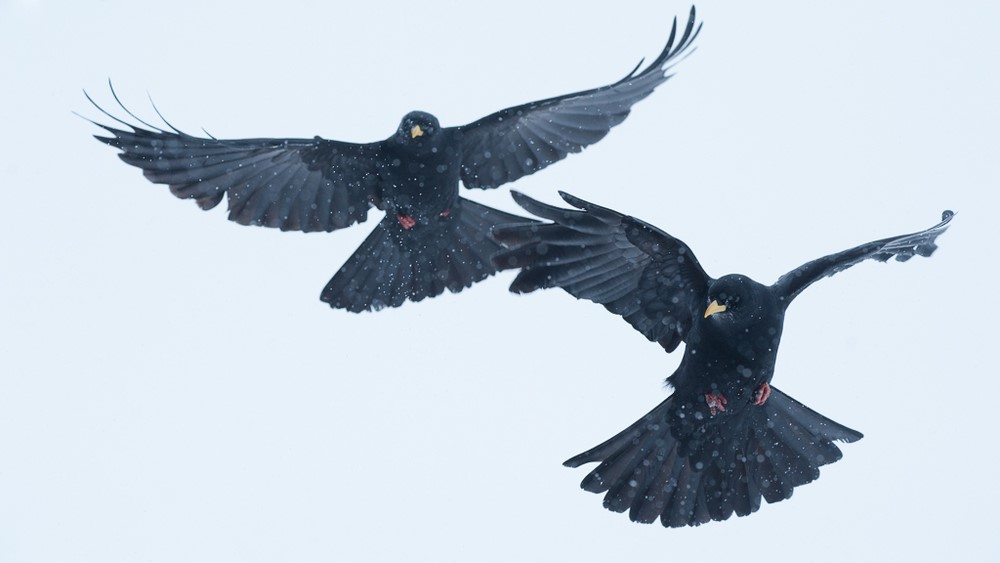
Alpine Chough, in snowy French Alps ©Static1-Philip Braude

Alpine Chough  ©Static1-Philip Braude

Alpine Chough, in snowy French Alps

So, God willing, the next contribution to this alphabetic series will be some “D“ birds – such as Dippers, Doves, and Ducks (including Dabblers and Divers).  So stay tuned!    ><> JJSJ

*


Lee’s Addition:

American Coot showing feet by Lee LPkr

American Coot showing feet by Lee Lake Parker

Like Dr. Jim’s article above, I have also been fascinated by the feet of the American Coot. See Birdwatching Term – Lobed Feet and  Birdwatching – American Coot where I have a video of one walking down to the shore. He almost steps on his own feet.

*

“C” is for Cardinal and Cormorant: “C” Birds, Part 1

“C” is for Cardinal and Cormorant: “C” Birds, Part 1

By James J. S. Johnson

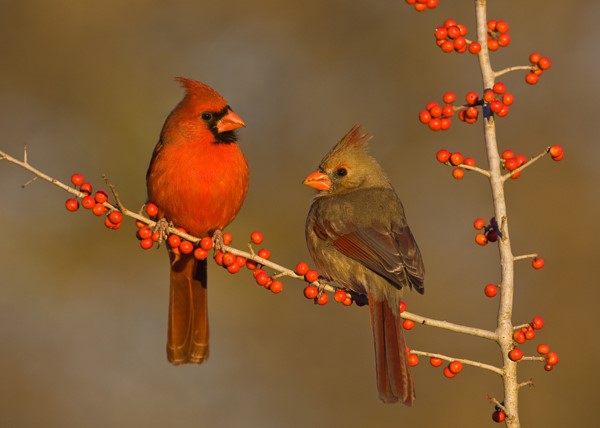
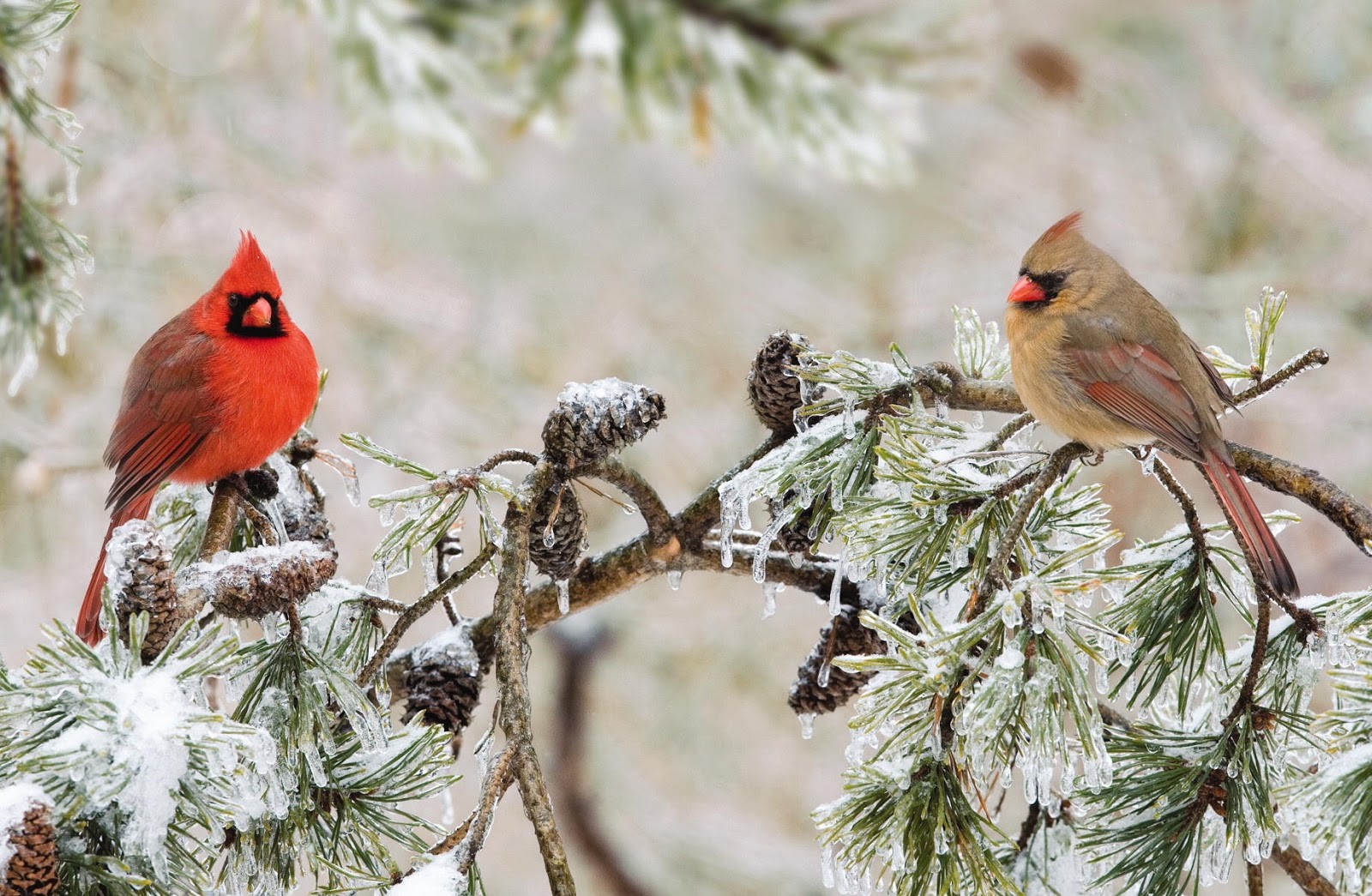
Northern Cardinal M-F ©Billraker

Northern Cardinal M-F ©Billraker

Northern Cardinal (Cardinalis cardinalis) male & female

C” is for as Cardinal, Chicken, Coot, Cormorant, Chicken, Coot, Chickadee, Caracara, Crane, Cuckoo, Curlew, and Corvid (including Crow) — plus many other birds with names that begin with the letter C !

This blogpost-article calmly continues an alphabet-based series on birds, starting with a quick introduction to 4 types of birds that start with the letter “C”   –    followed by a few observations of alphabetic patterns in Scripture (exhibited by Psalm 119:17-24)   –   then followed by specific information on Cardinals, Cormorant, and Cranes..  In particular, this article will feature the Northern Cardinal, also known as the Redbird (Cardinalis cardinalis), and the Double-crested Cormorant (Phalacrocorax auritus).

Northern Cardinal M-F ©BackyardBirdLover

Northern Cardinal M-F ©BackyardBirdLover

DC Cormoraant w fish

Double-crested Cormorant with Fish ©R. Curtis

THE ALPHABET HELPS TO TEACH US ABOUT GOD’S TRUTH

As noted in the earlier article on “A birds” – titled “A” is for Avocet, Albatross: “A” Birds, Part 1” and “A” is for Accipiter and Alcid: “A” Bird, Part 2” “B” is for Bluebird and Bittern: “B” Birds, Part 1” and “B” is for Bluebird and Bittern: “B” Birds, Part 2” – using the alphabet, to organize a sequence of information, has Biblical precedent.  The perfect example is the “acrostic” pattern of Psalm 119, the longest psalm (having 176 verses!), which has 22 sections (comprised of 8 verses per section), representing the 22 letters of the Hebrew alphabet. (Compare that to English, which has 26 alphabet letters, and Norwegian, which has 29 alphabet letters.)

The sentences in each section start with the same Hebrew  letter, so Verses 1-8 start with ALEPH, Verses 9-16 start with BETH, Verse 17-24 start with GIMEL, and so forth.  In this serial study’s lesson, the third octet of verses in Psalm 119 (i.e., Psalm 119:17-24), each sentence starts with GIMEL, the Hebrew consonant equivalent to the English “G”.

GIMEL ©I.Ytimg

GIMEL ©I.Ytimg

So, because GIMEL is the third letter in the Hebrew alphabet, each verse (in Psalm 119:7-24) literally starts with that letter as the first letter in the first word (although the first Hebrew word may be differently placed in the English translation’s sentence):

17Transact/bear up [gemōl] with thy servant, that I may live, and keep Thy word.

18 Roll back Thou [gal] mine eyes, that I may behold wondrous things out of Thy law.

19 A stranger [gêr], I am, in the earth; hide not Thy commandments from me.

20 Has been broken [gârsâh], my soul, for the longing that it hath unto Thy judgments at all times.

21 Thou hast rebuked [gâ‘artâ] the proud, who are cursed, who do err from Thy commandments.

22 Roll back [gal], from me, reproach and contempt, for I have kept Thy testimonies.

23 Also [gam], princes did sit and speak against me, but Thy servant did meditate in Thy statutes.

24 Also [gam], Thy testimonies are my delight and my counselors.

Open Bible with Pen for Studying ©WikiC

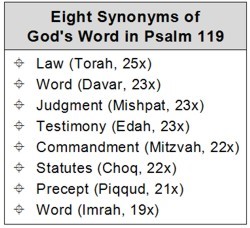
As noted before, Psalm 119 is all about God’s revelation of truth – especially truth about Himself – to mankind (in a comprehensive “A to Z” panorama).  The most important revelation of truth that God has given to us, and the most authoritative form of truth we have, is the Holy Bible – the Scriptures.  Accordingly, Psalm 119 is dominated by references to the Scriptures, using terms like “the law of the LORD” (and “Thy Word”, “Thy commandments”, “Thy testimonies”, “Thy statutes”, “Thy judgments”, etc.).  In Psalm 119:9-16 these terms are used, to denote God’s revealed truth to mankind: “Thy Word” (3x), “Thy commandments”, “Thy statutes”, ”Thy precepts”, Thy “judgments”, and “Thy testimonies”.

Journeying with God's Word ©slideplayer_com

Journeying with God’s Word ©slideplayer_com

The Hebrew letter GIMEL means “camel” (primarily as a vehicle for transport, such as for travel, i.e., bearing a rider and/or providing a transfer, from one place to another – so a secondary connotation is that which results from a transfer, such as the outcome of a transaction or some kind of personal dealings.  Accordingly, Psalm 119:17-24 illustrates how God’s Word is the facilitating vehicle that carries God’s servant unto God’s intended outcomes in life (and to God Himself), somewhat like the way that John the Baptist (who wore camel-hair garments) pointed people to the Lord Jesus Christ, informationally conveying them to Jesus as the true Lamb of God Who came to remove our sin (John 1:29).

In Verse 17 (of Psalm 119), God’s Word is recognized as facilitating the psalmist’s goals of living and keeping God’s Word (Psalm 119:105 & 119:129).

In Verse 18, the psalmist recognizes that God Himself must enable our “eyes” to see, with comprehension, the truths that are contained within God’s Word – because different parts of God’s Word are required in order to provide enlightenment about the meaning and value of other parts of God’s Word (1st Corinthians 2:13; John 17:17).

In Verse 19, the psalmist understands that, in this earthly life, he sojourns as a pilgrim-like stranger “passing through”, so He needs to use God’s Word as the authority for what to do during this journey (as the psalmist treks through a strange land where he does not permanently belong), because this temporal world and its institutions are not the ultimate affiliation or fealty that defines the psalmist’s allegiance or belonging (Philippians 3:20).

In Verse 20, the psalmist’s soul is broken in its effort to be attached to God’s great doings, yet only God’s Word can equip us for appreciating and comprehending God’s providential program and judgments in the world.

In Verse 21, the psalmist reflects on how God rebukes the proud, who are cursed by and for their refusal to respect God’s Word – in effect, God has provided His Word in such a way that it delivers judgments for rejecting its truth (Romans 1:18-28).

In Verse 22, the psalmist appreciates his need for God to secure his ability to keep and care for God’s testimonies, and it is the Scriptures that enable us to break out of the world’s opposition, so that a worthwhile life of honoring God (and His Word) can be accomplished (Psalm 1:1-3; Psalm 101:3).

Verse 23, extends the thought of the previous verse, using political powerfully foes as examples of how the psalmist needs protection from the world’s opposition, and how immersing one’s thoughts and attitudes with Scripture’s truth is the proper “logistic” for avoiding failure amidst such opposition (Joshua 1:7-9).

Verse 24, likewise, extends the thought of the previous verse, noting that meditating upon God’s Word is the best counsel for living.  In other words, living life according to God’s Word is like taking a reliable camel ride that transmits us unto a desirable destination – the journey is a good ride and the outcome is a happy ending.  In sum, Scripture-facilitated living is the best way to go through life!

Camel Riders ©Travelnt.com

Camel Riders ©Travelnt.com

Thus we see the theme, woven throughout the octet of GIMEL verses (Psalm 119:17-24), that we are designed to rely upon the truth and values of the holy Scriptures, as we journey through life, as if God’s Word was a transportation vehicle (or camel) that bears us up and delivers us to a good and proper outcome in life. Ultimately, of course, God’s Word transports, in our thinking unto God Himself, Who is our ultimate destination, our everlasting Home – see “Why We Want to Go Home”, as we learn from Psalm 90:1 and 2nd Corinthians 5:1-6.

ethiorthodoxyouth.files.wordpress.com-bible

Bible ©Ethiorthodoxyouth

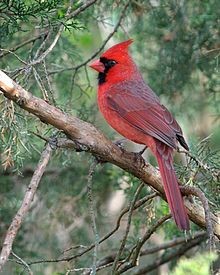
Now back to the “C” birds, beginning with cardinals.  These birds are visually distinctive, the male of which is almost entirely crimson-red, accented by a black “face-mask” contrasting with a thick reddish bill.

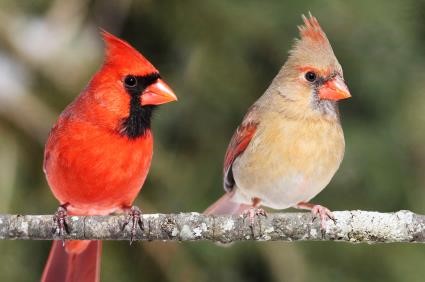
“The [male] cardinal (7¾ in. [in length]) is the only eastern red bird with a crest.  The heavy red bill, with black at its base, is a good field [identification] mark.  The light brown [sometimes tinted a golden mustard shade of tan] female has the [red-tinged] crest and red bill, but little red on the body [with most of her red feathers highlighting her wings and tail plumage].  Young [cardinals] have dusky bills.  Cardinals are common in shrubbery, hedgerows, and wood margins [i.e., forest edges].  In recent years [as of AD1987] the cardinal has gradually spread [its residential range] northward.  The [somewhat similar-looking] Pyrrhuloxia (7½ in.) of the Southwest [a/k/a “desert cardinal”] is mostly gray with red face, crest, breast, and tail, and the general cardinal shape [and is also distinguishable by its golden-yellow bill].”

[Quoting Herbert S. Zim & Ira N. Gabrielson, Birds, A Guide to Familiar American Birds (New York, NY: Golden Press, 1987 rev. ed.), page 104.]

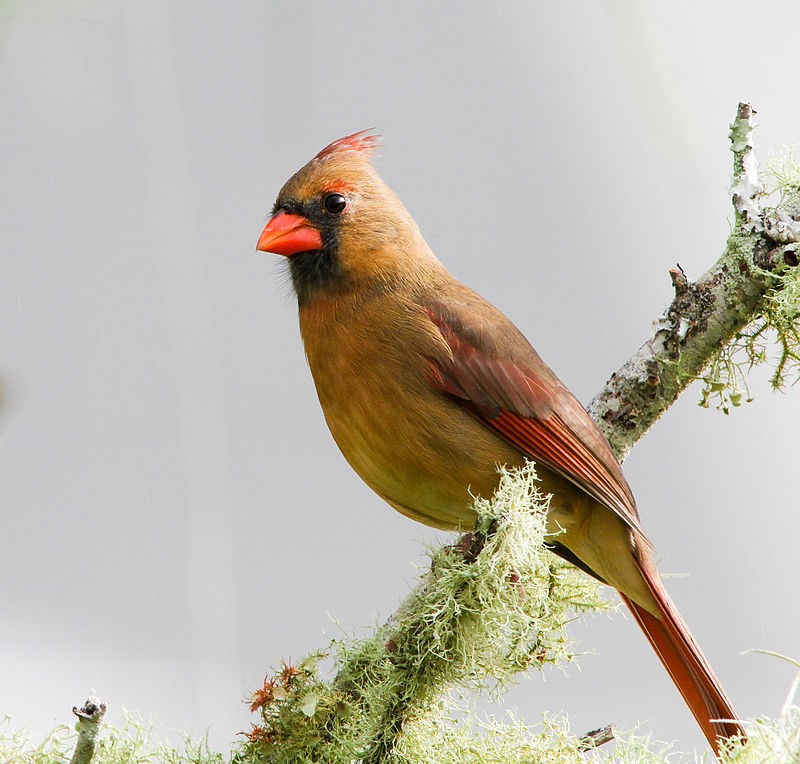
Northern Cardinal Male ©WikiC

Northern Cardinal Male ©WikiC

Northern Cardinal Female ©WikiC

Northern Cardinal Female ©WikiC

In particular, this article looks at the Northern Cardinal, which was previously known as the Virginia Cardinal (Cardinalis virginianus), a fitting name for the state bird of Virginia.  (In fact, the Redbird is also the official state bird of North Carolina, Illinois, Indiana, Kentucky, Ohio, and West Virginia – making the redbird the official bird of 7 states, more than any other American bird.)

Cardinal Country Stamps

[government-issues postage stamp images are public domain]

The cardinal is also appreciated outside of America, as is demonstrated by postage stamps of other countries, such as Belize (f/k/a British Honduras), Bermuda, and Mexico.

In a previous article, about a year ago (March 12th of AD2015), an artificial “cardinal” was featured, in  lesson about what it means to make “selections”   —   see “How Can a Mechanical ‘Cardinal’ Make ‘Selections’?.  As that article demonstrated, the notion of so-called “natural selection” is an example of bait-and-switch terminology, serving as a cloak for science fiction (1st Timothy 6:20).

Now, however, a few real facts  —  about real cardinals  —  will be reviewed.

The Northern Cardinal (Cardinalis cardinalis) is widely spread, range-wise, across most of North America, covering the eastern half of America, into Texas, plus most of Mexico.  As a Terry Sohl range map (not shown) indicates, the Northern Cardinal is a permanent resident in the wide range cardinals inhabits, so green fields during spring and summer, as well as snow-covered fields (during winter), seasonally serve as a contrasting backdrop for the bright red hue of male cardinals.  Earth-toned females too are often seen, year-round, where they live.  [NOTE: the above-referenced Terry Sohl range map is not shown here, because Mr. Sohl, as a self-described “hardcore atheist”, does not want his maps associated with a Christian blogsite.]

“The Cardinal is a favorite bird of many people and it’s easy to see why.  The brilliant scarlet plumage of the male and the subtle [earth-tone] shades of the female, combined with their clear melodic song, make them enjoyable to watch in any season.”

[Quoting Donald Stokes & Lillian Stokes, A Guide to Bird Behavior, Volume II (Boston: Little, Brown & Company, 1983), page 247.]

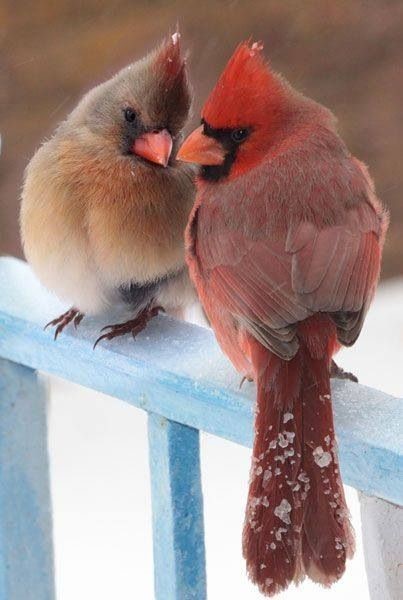
Northern Cardinal Pair ©Media-cache

Northern Cardinal Pair ©Media-cache

Northern Cardinal Pair ©Photoshelter

Northern Cardinal Pair ©Photoshelter

So what do Northern Cardinals like to eat?  Mostly seeds (including grains, such as corn, oats, and sunflower seeds) and fruits (especially berries). The seeds of what humans call “weeds” are a delightful contribution to a cardinal’s diet. Also, cardinals will eat many kinds of insects, such as beetles, grasshoppers, and cicada “locusts”.  Even snails are sometimes eaten by redbirds.

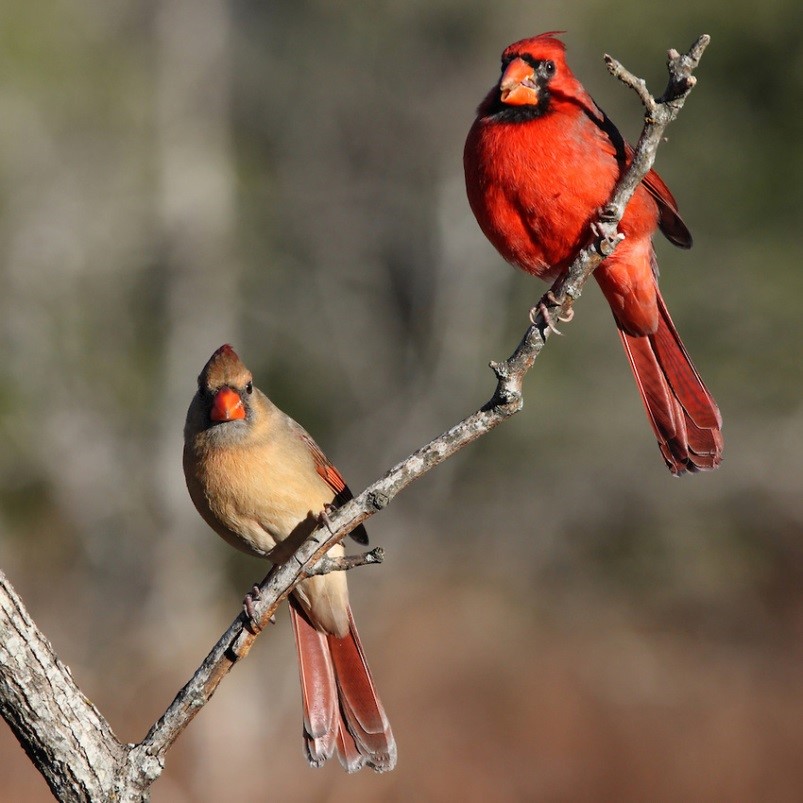
Northern Cardinal Pair ©Firstlighttours

Northern Cardinal Pair ©Firstlighttours

Northern Cardinal Pair ©Wunderground

Northern Cardinal Pair ©Wunderground

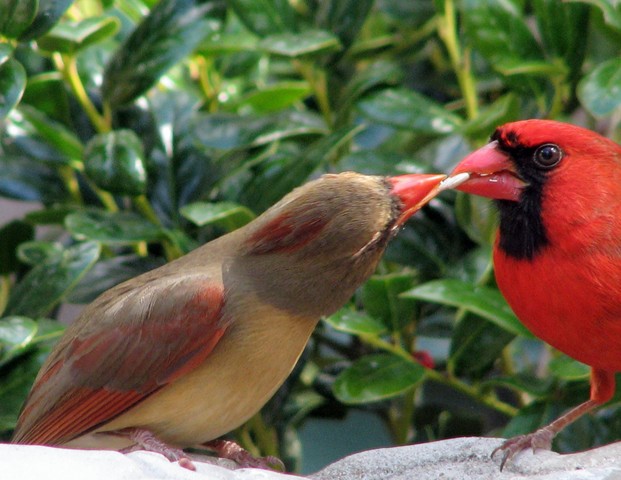
Socially speaking, cardinals are monogamous – they mate for life, living together year-round.

“At your [bird] feeder you may see mate-feeding, a highlight of the relationship between the pair.  In this the male picks up a bit of food, hops over to the female, and the two momentarily touch beaks as she takes the food.  If you have a pair mate-feeding at your feeder, they are likely to nest in the area.  The nest is not hard to find …and once you know where it is, you will be able to watch mate-feeding continue at the nest through the incubation phase.”

[Quoting Donald Stokes & Lillian Stokes, A Guide to Bird Behavior, Volume II (Boston: Little, Brown & Company, 1983), page 247.]

Sometimes they sing together, as they prepare for life in a new nest!  The male finds and delivers ingredients for the new nest; the female does most of the nest assembly work.  Most incubation of their eggs is done by the mother cardinal, yet sometimes the father will incubate the eggs while Mama takes an off-the-nest break.

“Male and female Cardinals sing equally well, a fact not generally known by those used to the widespread assumption that only male birds sing.  Song is an important coordinating behavior in the life of the Cardinal.  Cardinal song consists of many different phrases.  In countersinging, one bird will sing one phrase several times and then the other will match it.  Then the leader will sing a new phrase and the other will again match it.  This type of countersinging that involves copying phrases functions to synchronize and unify members of a pair; and when given between males, helps settle territorial disputes.”

[Quoting Donald Stokes & Lillian Stokes, A Guide to Bird Behavior, Volume II (Boston: Little, Brown & Company, 1983), page 247.]

Northern_cardinal M-F in winter storm ©

Northern_cardinal M-F in winter storm ©

Now for another “C bird”:  Cormorants, a group of coast-water birds, typically black (or greyish-black), and known for catching and eating fish – and sometimes even for being trained by innovative humans, to catch fish for human masters!

Chinese man with 2 cormorant trained to catch and deliver fish

[ see also youtube of Cormorant Fishing in China,

For general information on cormorants, see ornithologist Lee Dusing’s insightful birdwatching articles: “Birds of the Bible — Cormorants”, as well as Birds of the Bible – Cormorant, as well as Birds of the Bible – Cormorant II.

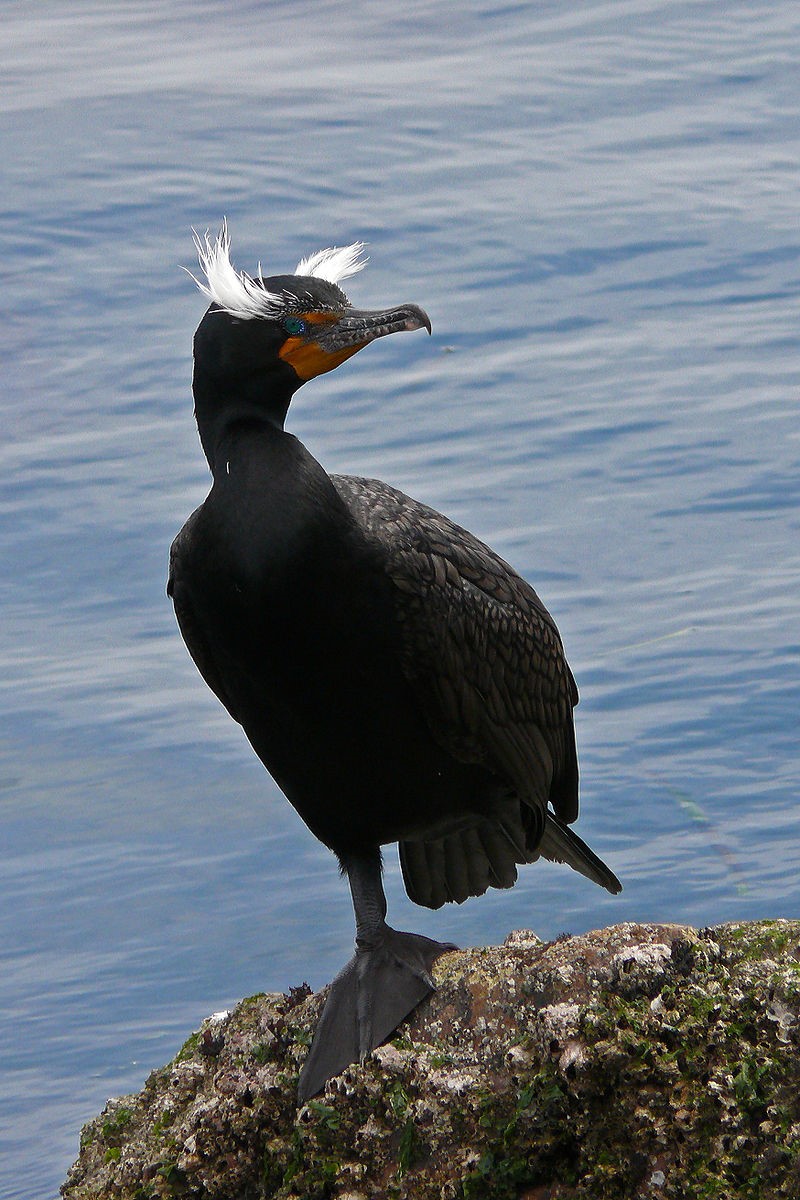
Double-crested Cormorants are sometimes called “white-crested cormorants”, due to the white plumage they acquire during breeding season (see below).

Double-crested Cormorant ©WikiC

Double-crested Cormorant – During Breeding Season ©WikiC

As Lee Dusing has already observed, cormorants and shags are really part of the same avian kind, some of which have crests and some of which don’t   —  so, does that mean the latter category of cormorants are “crestfallen”? :)

Cormorants are social creatures – they congregate together.  Regarding the Double-crested Cormorant in particular, see the group photo (from Danspix), shown below  —  perhaps it was a family reunion?

Cormorants (and “shags”) are variously distributed, around the world, yet their ranges usually concentrate at or near coastal seawaters, or sometimes near freshwater habitats such as ponds, lakes, and rivers). They usually fly close to the water’s surface, using steady wingbeats.  After plunging (diving) into seawater, while fishing, they protect their feathers by spreading out their wings, while resting, to accelerate air-drying.  In this article, however, the piscivorous “family” of cormorants is represented by the Double-crested Cormorant (Phalacrocorax auritus).  Besdies fish, cormorants eat amphibians and crustaceans, underwater.  A mated pair work together to build their nest, incubate eggs, and raise their hatching young. [See Oliver L. Austin, Jr. & Arthur Singer, Families of Birds (Racine, Western Publishing Company, 1971), page 31.]

The Double-crested Cormorant (Phalacrocorax auritus) is widely spread, range-wise, across North America.  As a Terry Sohl range map (not shown) indicates, the Double-crested Cormorant is a migratory bird, so its range differs depending upon the season of the year.  [NOTE: the above-referenced Terry Sohl range map is not shown here, because Mr. Sohl, as a self-described “hardcore atheist”, does not want his range maps associated with a Christian blogsite.]

Of course, other birds (such as the American Coot!) have names that start with “C” – but this article is already long enough.  God willing, the next contribution to this alphabetic series will be some more “C“ birds – perhaps a couple of these: Chicken, Coot, Chickadee, Caracara, Crane, Cuckoo, Curlew, or Corvids (including Crow)!  So stay tuned!    ><> JJSJ

*

“B” is for Bluebird and Bittern: “B” Birds, Part 1

“A” is for Avocet, Albatross: “A” Birds, Part 1

“A” is for Accipiter and Alcid: “A” Birds, Part 2

*

“B” is for Bobwhite and Buteo: “B” Birds, Part 2

“B” is for Bobwhite and Buteo: “B” Birds, Part  2

James J. S. Johnson

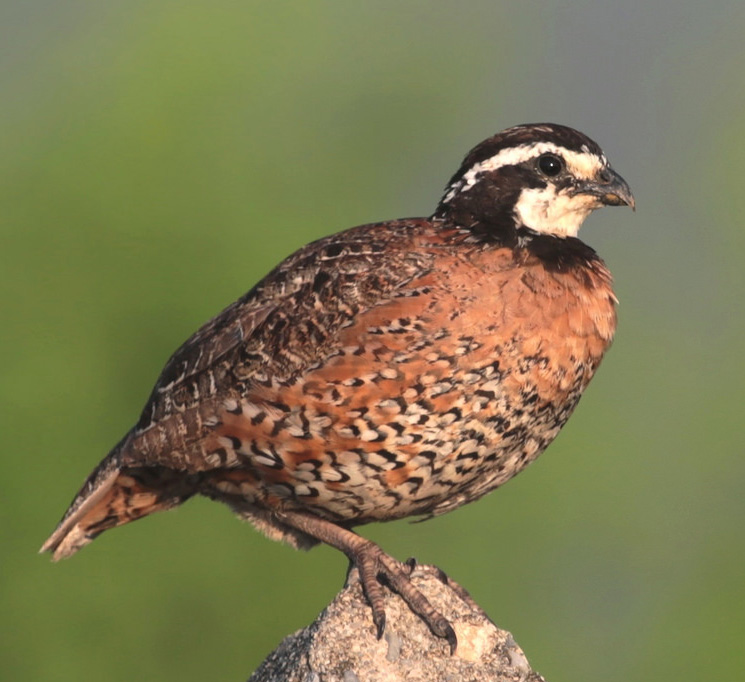
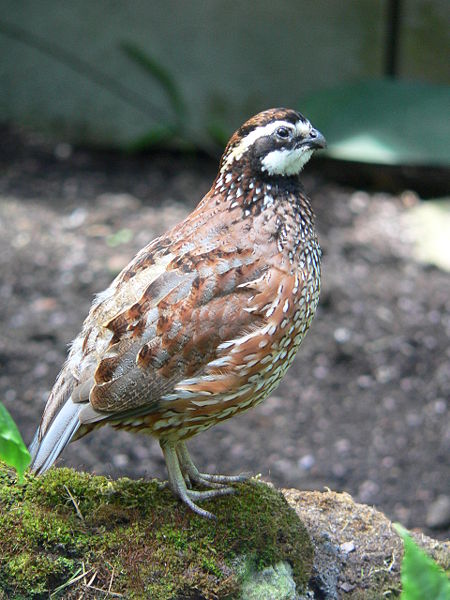
Northern Bobwhite (Colinus virginianus) ©StateSymbols

Northern Bobwhite (Colinus virginianus) ©StateSymbols

BOBWHITE QUAIL (Colinus virginianus)

In this series the “B” birds began (in Part 1) with Bluebird and Bittern. 

In this Part 2 the “B” birds will continue with Bobwhite Quail and Buteo Hawks.

Now for Bobwhite, i.e., the Bobwhite Quail — and the relevance of 1st Samuel 26:20 will be noted below.

Bobwhite is the name of a bird belonging to the New World quail family.  Other members of that quail family include the Yucatan (Black-throated) Bobwhite, the Crested Bobwhite, and the Spot-bellied Bobwhite.

Northern Bobwhite

The Bobwhite Quail (Colinus virginianus), a/k/a Northern Bobwhite and Virginia Quail, is a “New World quail”, meaning that it belongs to the group of pheasant/grouse/partridge/quail-like ground-fowl that habituate parts of North America.  In particular, the Northern Bobwhite is the only small native galliform (i.e., chicken-like ground-fowl) in the eastern region of North America.

The name “bobwhite” is supposed to represent this quail’s terse two-syllable whistle-call.  The Bobwhite’s call has a lower (and slower) first syllable, followed by a sharply projected (and quicker) “whhht”.  One variety of the Northern Bobwhite, known for habituating Virginia, was formerly called the “Virginia Partridge” (e.g., by ornithologist John James Audubon) – that local variety now being called Colinus virginianus virginianus (identified by Linnaeus in AD1758).

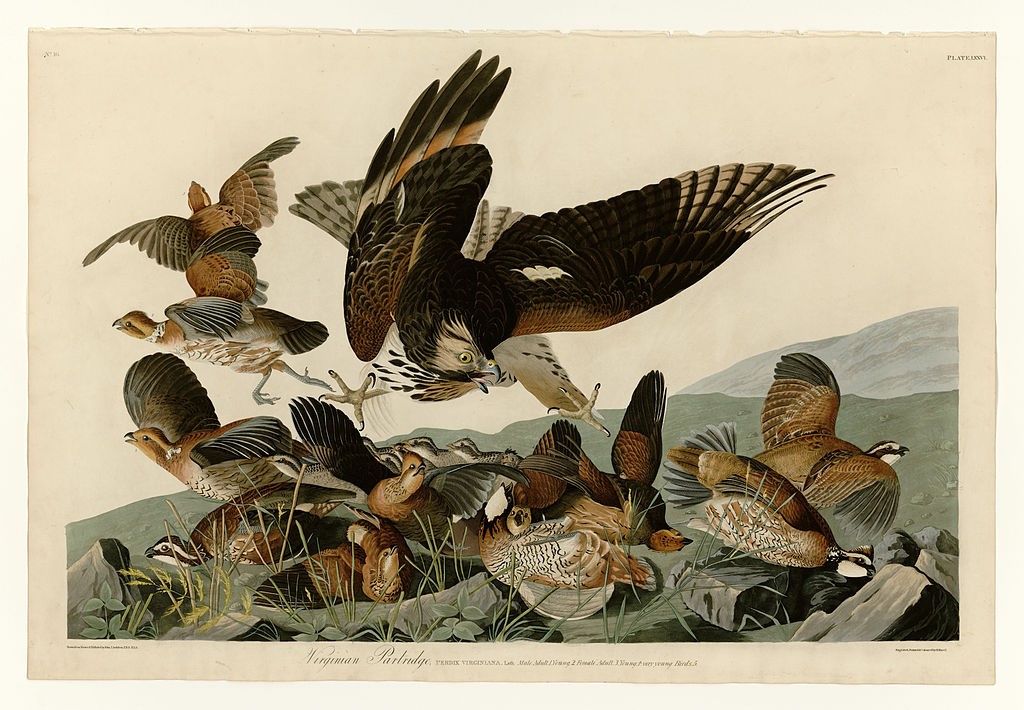
Virginia Partridge (under attack by diving hawk) depicted by John James Audubon (Public Domain)

Virginia Partridge (under attack by diving hawk) depicted by John James Audubon (Public Domain)

Bobwhite Quail, a/k/a Virginia Quail (and a/k/a Northern Bobwhite), are quail.  Accordingly, it is unsurprising to learn that they hybridize with other quail – reports indicate successful hybridizations with Blue Quail (Coturnix adansonii), Gambel’s Quail (Callipepla gambelii), California Quail (Callipepla californica), and Mountain Quail (Oreortyx pictus).

The ground-fowl lifestyle of this grouse-like ground-fowl is comparable to the Rock Partridge (Alectoris graeca) of which Israel’s king David once wrote:

Now therefore, let not my blood fall to the earth before the face of the Lord: for the king of Israel is come out to seek a flea, as when one doth hunt a partridge in the mountains.  (1st Samuel 26:20).

(See “Rock Partridges: Lessons about Hunting and Hatching”, citing 1st Samuel 26:20).

Now for the last category of “B” birds, the Buteo hawks. 

So what are the most prominent characteristics of buteo hawks?  Describing the birds of prey we call Buteo Hawks (a/k/a “buzzard hawks”), Roger Tory Peterson says:  “Large, thick-set hawks, with broad wings and wide, rounded tails.  Buteos habitually soar high in wide circles”, taking advantage of thermal air currents to lift their heavy bodies. [See Roger Tory Peterson, A FIELD GUIDE TO WESTERN BIRDS (Houghton Mifflin, 3rd ed., 1990), page 174.]  The different sexes often look similar, yet the female buteo is typically larger than her male counterpart.

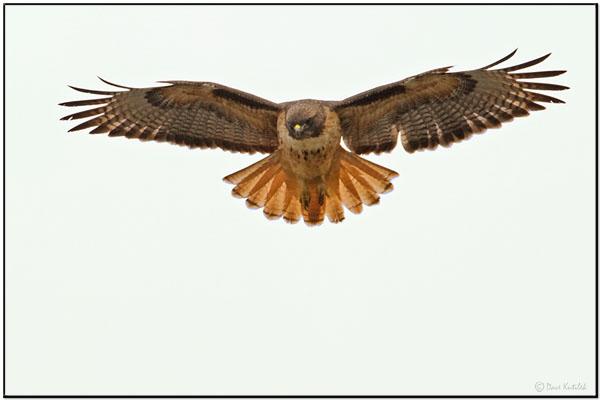
Red-tailed Hawk (Buteo jamaicensis) by Daves BirdingPix

Red-tailed Hawk (Buteo jamaicensis) by Daves BirdingPix

Buteo hawks, as a category or raptors, are routinely contrasted with the Accipiter hawks (a/k/a “bird hawks”) that were described in the previous article on A” birds (see “A” for Accipiter and Alcid: “A” Birds, Part 2, featuring Cooper’s hawk as the representative accipiter).  Hawk-like raptor birds include kites, falcons (including kestrels), harriers, eagles, Old World buzzards, vultures, osprey, and the exotic Secretary Bird.

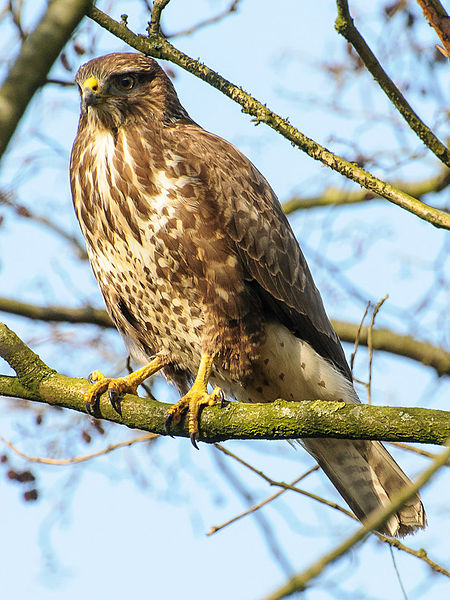
Common Buzzard (Buteo buteo) ©WikiC

Common Buzzard (Buteo buteo) ©WikiC

Common Buzzard (Buteo buteo, of Eurasia)

The paradigmatic buteo, in Europe, would be the Common Buzzard (Buteo buteo).  However, that hawk has non-artificial range in the Western Hemisphere, so the Common Buzzard is not “common” to American birders.  Besides the Common Buzzard, there are many buteo hawks around the world, such as the Ferruginous Hawk (Buteo regalis), Grey Hawk (Buteo plagiatus), Swainson’s Hawk (Buteo swainsoni), Eastern Buzzard (Buteo japonicas), Himalayan Buzzard (Buteo burmanicus), Cape Verde Buzzard (Buteo bannermani), Short-tailed Hawk (Buteo brachyurus), and many more. For this article, however, to represent the entire group of buteos, one buteo will be reviewed, the Red-tailed Hawk (Buteo jamaicensis) of North America.

RED-TAILED HAWK  (Buteo jamaicensis).

Red-tailed Hawk (Buteo jamaicensis) ©WikiC

Red-tailed Hawk (Buteo jamaicensis) ©WikiC

The Red-Tailed Hawk (Buteo jamaicensis) is described by ornithologist Mary Taylor Gray as follows: “The most abundant, widespread, and familiar hawk of he West, the Red-tailed Hawk resides year-round in Colorado [and elsewhere].  Adult birds are readily identified by their rusty-red tail[s].  Dark bars along the undersides of the leading edge of the outstretched wings, near the shoulder, are also characteristic.  We often see redtails perched on power [utility] poles or soaring in the air on broad wings, carving slow, wide arcs.  The redtail’s dramatic call fits its image as a western icon.  The down-slurred scream—Keeeer!—is often heard as a background sound in movies and television shows.”  [Quoting Mary Taylor Gray, THE GUIDE TO COLORADO BIRDS (Englewood, Colorado: Westcliffe Publishers, 1998), page 66.]

Gray’s observation – that the Red-tailed Hawk is the common buteo of America’s Great West – is illustrated by my own birding experience, even 20 years ago! – having seen redtails during AD1996 in places as divergent as Montana (eastern side of Glacier National Park, July 2nd AD1996) and South Texas (Rockport-Fulton shoreline, Aransas Bay region, March 10th AD1996).

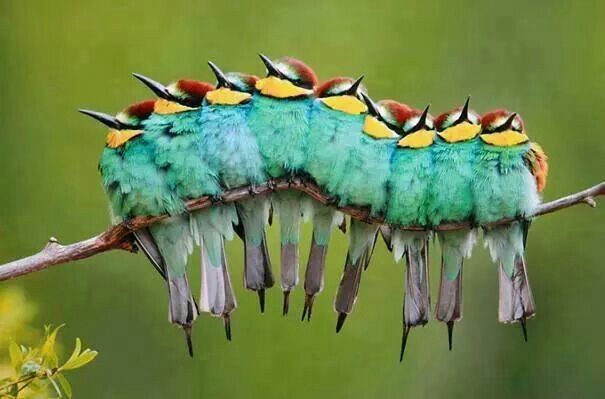
Bee-eaters From Pinterest

Bee-eaters From Pinterest

Of course, other “B” birds (such as the colorful and gregarious bee-eaters, shown above – photograph taken from Lee Dusing’s “Fellowship”,  exhibit our alphabet’s second letter – but this article is already long enough.  God willing, the next contribution to this alphabetic series will be some “C“ birds – such as Cardinal, Chicken, Coot, Cormorant, Chickadee, Caracara, Crane, Cuckoo, Curlew, and Corvid (including Crow)!  So stay tuned!    > JJSJ

*

“B” is for Bluebird and Bittern: “B” Birds, Part 1

“A” is for Avocet, Albatross: “A” Birds, Part 1

“A” is for Accipiter and Alcid: “A” Birds, Part 2

*


“B” is for Bluebird and Bittern: “B” Birds, Part 1

“B” is for Bluebird and Bittern: “B” Birds, Part 1

James J. S. Johnson

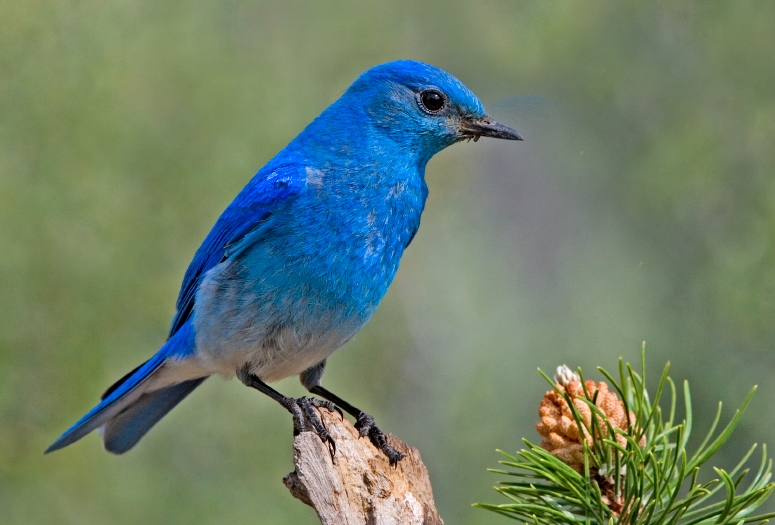
Mountain Bluebird (Sialia currucoides) ©Elaine R Wilson WikiC

“B” is for Bluebird, Bittern, Bobwhite Quail, and Buteo hawks (which include Old World “buzzards”, a/k/a “buzzard hawks”) – plus Buffleheads, Babblers, Barbets, Becards, Bowerbirds, Bulbuls, Bullfinches, Berrypeckers, Brushturkeys, Birds-of-paradise, Bushshrikes, Bustards, Bushtits, Broadbills, Boobies, Bee-eaters, Buttonquail, Buntings (including Painted Bunting, Indigo Bunting, Snow Bunting, Lark Bunting, Lazuli Bunting, etc.), and various Blackbirds (including Bobolink and Brewer’s Blackbird, all of which blackbirds this series will treat as “icterids”), and a few other birds.

This blogpost-article calmly continues an alphabet-based series on birds, starting with a quick introduction to 4 types of birds that start with the letter “B”   –    followed by a few observations of alphabetic patterns in Scripture (exhibited by Psalm 119:9-16)   –   then followed by specific information on Bluebirds, Bitterns, Bobwhite Quail, and Buteo hawks.  In particular, this article will feature the Mountain Bluebird (Sialis currucoides) as a representative bluebird; the American Bittern (Botaurus lentiginosus) as a representative bittern; the Bobwhite Quail (Colinus virginianus); and the Red-tailed Hawk (Buteo jamaicensis) as a representative buteo hawk.

In this Part 1, of the “B” birds, the Bluebird and Bittern are reviewed.  (Part 2, God willing, will continue with Bobwhite and Buteo.)

THE ALPHABET HELPS TO TEACH US ABOUT GOD’S TRUTH

As noted in the earlier article on “A birds” – titled “A” is for Avocet, Albatross, Accipiter, and Alcid” [posted at leesbird.com ,  Deo volente] – using the alphabet, to organize a sequence of information, has Biblical precedent.  The perfect example is the “acrostic” pattern of Psalm 119, the longest psalm (having 176 verses!), which has 22 sections (comprised of 8 verses per section), representing the 22 letters of the Hebrew alphabet. (Compare that to English, which has 26 alphabet letters, and Norwegian, which has 29 alphabet letters.)

The sentences in each section start with the same Hebrew  letter, so Verses 1-8 start with ALEPH, Verses 9-16 start with BETH, Verse 17-24 start with GIMEL, and so forth.  Here are the second 8 verses in Psalm 119, each sentence of which starts with BETH  [a consonant like our “B”, whenever it does to immediately follow a vowel sound, otherwise its consonantal sound is like our “V”, where it is sometimes transliterated as “bh”].

So, because BETH is the second letter in the Hebrew alphabet, each verse (in Psalm 119:9-16) literally starts with that letter as the first letter in the first word (although the first Hebrew word may be differently placed in the English translation’s sentence):

With-what [bammeh] shall a young man cleanse his way? — by taking heed thereto according to Thy Word.

10 In-all [becâl] my heart have I sought thee; O, let me not wander from Thy commandments.

11 In-my-heart [belibbî] Thy Word have I hid, that I might not sin against thee.

12 Blessed [berûk] art Thou, O Lord; teach me Thy statutes.

13 In-my-lips [bisephâtêi] have I declared all the judgments of Thy mouth.

14 In-the-way [bederek] of Thy testimonies I have rejoiced, as much as in all riches.

15 In-Thy-precepts [bephiqqūdekâ] I will meditate, and have respect unto thy ways.

16 In-Thy-statutes [bechūqqōtkâ] I will delight myself; I will not forget Thy Word.


Bible Open to Psalm 119 ©Flickr Jason2917

Bible Open to Psalm 119 ©Flickr Jason2917

As noted before, Psalm 119 is all about God’s revelation of truth – especially truth about Himself – to mankind (in a comprehensive “A to Z” panorama).  The most important revelation of truth that God has given to us, and the most authoritative form of truth we have, is the Holy Bible – the Scriptures.  Accordingly, Psalm 119 is dominated by references to the Scriptures, using terms like “the law of the LORD” (and “Thy Word”, “Thy commandments”, “Thy testimonies”, “Thy statutes”, “Thy judgments”, etc.).  In Psalm 119:9-16 these terms are used, to denote God’s revealed truth to mankind: “Thy Word” (3x), “Thy commandments”, “Thy statutes”, ”Thy precepts”, Thy “judgments”, and “Thy testimonies”.

The Hebrew letter BETH means “house” (primarily as a building, such as a physical home, yet secondarily as a household, i.e., that family who lives within a house).  Accordingly, we see in Psalm 119:9-16 that God’s Word is the protective framework within which we should live our lives.  In particular, it is within God’s Word where we clean ourselves (verse 9); it is God’s Word wherefrom we should not wander (verse 10); it is in God’s Word, better than any physical shelter, wherein we take refuge from sin (verse 11); it is in God’s laws that we need to live and learn in (verse 12); because our lips are like the “gates” of our lives, it is God’s judgments that outline the gatekeeping boundaries for “where” we live our lives (verse 13); it is God’s testimonies, of which the Scripture is the great treasure-room, that we should rejoice in (verse 14); and better, than any mansion’s relaxing reading-room is God’s Word, with its laws as a restorative “room” for delightfully meditating “in” (verses 15 & 16).

Thus we see the theme, woven throughout the octet of BETH verses (Psalm 119:9-16), that we are designed to live in God’s truth (which we know best form God’s written Word), as if it was a “house”.  In other words, God’s truth should dwell in us (Psalm 119:11), just as we should dwell in God’s truth (John 4:21-24 & 14:17; 2nd John 1:2).  This complements the prior octet – the ALEPH verses (Psalm 119:1-8), which emphasized that God’s truth is mighty (Hebrews 4:12) as a powerful “ox”.

Ultimately, of course, God’s Word draws us (through the Lord Jesus Christ – see John 14:2-6) unto God Himself, Who should be our everlasting Home – see “Why We Want to Go Home”, as we learn from Psalm 90:1 and 2nd Corinthians 5:1-6.

Open Bible with Pen for Studying ©WikiC

Now back to the “B” birds, beginning with bluebirds.

In a previous article, late last year, the Bluebird was featured, after it was observed during a trip to attend a Christmas lutefisk banquet   —   see “Bluebirds of Happiness, Plus Enjoying a Lutefisk Banquet”.

Since attention has, thus, already been given to the Eastern Bluebird (with brief mention of how to distinguish it from the similar-yet-not-identical-looking Western Bluebird), this review will feature the Mountain Bluebird, a bluebird often seen in the forests and fields of Colorado, as well as in other parts of America’s Rocky Mountains.

Mountain Bluebird (Sialia currucoides) by Daves BirdingPix

Mountain Bluebird (Sialia currucoides) by Daves BirdingPix

The male of the Mountain Bluebird (Sialia currucides), unlike the Eastern Bluebird and the Western Bluebird, has feathers of bright blue (peacock-to-turquoise blue) above and light-blue-fading-to-white beneath.  The female has less conspicuous coloring; her plumage is a blend of blue and Confederate grey (sometimes with brownish-grey blended in), atop, with a whitish underside. This bluebird ranges almost entirely in and west of the Rocky Mountains. [See Roger Tory Peterson, A FIELD GUIDE TO WESTERN BIRDS (Houghton Mifflin, 3rd ed., 1990), pages 278-279 & Map 303.  See also Tom J. Ulrich, BIRDS OF THE NORTHERN ROCKIES (Missoula: Mountain Press Publishing, 1994), pages 122-123; Mary Taylor Gray, WATCHABLE BIRDS OF THE ROCKY MOUNTAINS (Missoula: Mountain Press Publishing, 1992), page 138-139.]

Mountain Bluebird, male (R) & female (L) ©Mickey Barnes / from Birds & Blooms

Mountain Bluebird, male (R) & female (L) ©Mickey Barnes / from Birds & Blooms

Says ornithologist Mary Taylor Gray, “As soon as the young [Mountain Bluebirds] are able to leave the nest, [they] flock together and head for the high mountains, fluttering in waves of blue up mountain slopes and onto the alpine tundra.  Mountain bluebirds differ from other bluebirds by their preference for more open habitat.  Mountain blue birds nest in holes in trees or other structures, using either natural cavities or nests excavated by woodpeckers.  Removal of dead timber in forests and replacement of wood fence posts with metal has reduced the nesting sites for [these] bluebirds, who must compete with other bird species—sparrows, flickers, starlings—for nest cavities. …  Primarily an insect-eater, the mountain bluebird may launch suddenly from its perch to pluck a flying insect from the air, or hunt by watching for prey on the ground as it flies, hovering when it spots something, then dropping down to grab a meal.”  [Quoting Gray, WATCHABLE BIRDS OF THE ROCKY MOUNTAINS, page 138.]

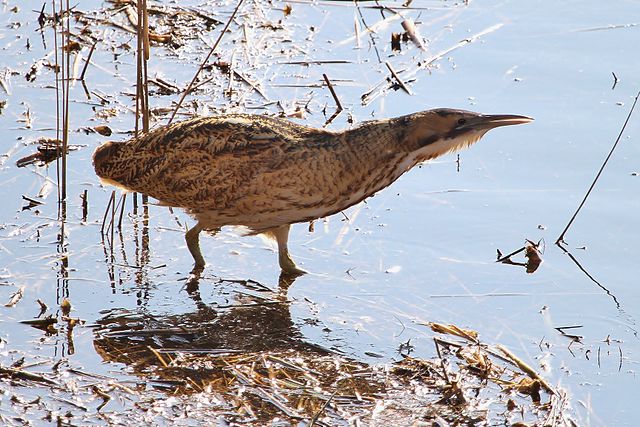
Now for another “B bird:  Bitterns, a group of mostly piscivorous (fish-eating) heron-like wading birds of wetland habitats.

Eurasian Bittern (Botaurus stellaris, a/k/a Great Bittern) ©WikiC

Eurasian Bittern (Botaurus stellaris, a/k/a Great Bittern) ©WikiC

For general information on bitterns, see ornithologist Lee Dusing’s insightful birdwatching articles:  “Bird of the Bible – Bittern” —  and “Birds of the Bible – Bitterns II”.  Regarding the American Bittern in particular, see Lee’s “Birds of the Bible – American Bittern”, including close-up photographs of the American Bittern, taken by Lee at the Circle B Bar Ranch Reserve (n/k/a Circle B Bar Reserve), an amazing venue for birdwatching in Lakeland, Florida.  To learn about this birding resource, see Southwest Florida Water Management  District’s website.

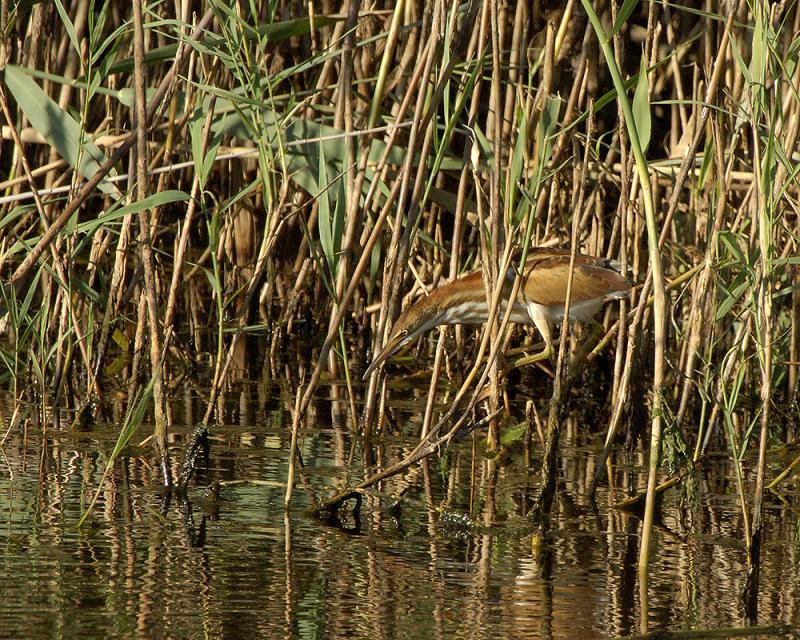
Least Bittern (Ixobrychus exilis) by Jim Fenton

Least Bittern (Ixobrychus exilis) by Jim Fenton / from Leesbird.com

There are several bitterns – such as the Least Bittern shown above, as well as the Little Bittern (Ixobrychus minutus), Eurasian Bittern (Botaurus stellaris), Australasian Bittern (Botaurus poiciloptilus), Yellow Bittern (Ixobrychus sinensis), Black-backed Bittern (Ixobrychus dubius), Cinnamon Bittern (Ixobrychus cinnamomeus), and others.  In this article, however, this “family” of wetland waders will be represented by the American Bittern (Botaurus lentiginosus).

In addition to what Lee Dusing has already reported (see links shown above) the American Bittern (Botaurus lentiginosus) has been the subject of many (other) ornithological studies.

The American Bittern (Botaurus lentiginosus) is widely spread, range-wise, across North America.  As a Terry Sohl range map (not shown) indicates, the American Bittern is a migratory bird, so its range differs depending upon the season of the year.  [NOTE: the above-referenced Terry Sohl range map is not shown here, because Mr. Sohl, as a self-described “hardcore atheist”, does not want his range maps associated with a Christian blogsite.]

So watch carefully, in wetland habitats, for bitterns – but you are more likely to hear one!

Meanwhile, in Part 2 of (of the “B” birds), God willing, the Bobwhite and Buteo hawks will be reviewed.  Thereafter, D.v., this alphabetic series will continue with some “C“ birds – such as Cardinal, Chicken, Coot, Cormorant, Chickadee, Caracara, Crane, Cuckoo, Curlew, and Corvid (including Crow)!  So stay tuned!

<> JJSJ

*

“A” is for Avocet, Albatross: “A” Birds, Part 1

“A” is for Accipiter and Alcid: “A” Bird, Part 2

“A” is for Accipiter and Alcid: “A” Birds, Part 2

“A” is for Accipiter and Alcid:  “A” Birds, Part 2

Dr. James J. S. Johnson

There is a way that seems right to a man, but its end is the way of death. (Proverbs 14:12)

(Patience!  The relevance of this verse will be noted near the end of this article.)

As noted in Part 1 (of the “A” Birds review), “A” is for Avocets, Albatrosses, Accipiters, and Alcids (including Auklets and the Atlantic Puffin), — plus Antbirds and a few other birds omitted here.   This study now continues (after having reviewed Avocets and Albatrosses) with 2 categories of birds that start with the letter “A, Accipiters and Alcids.

SHARP-SHINNED HAWK (Accipiter striatus)

What are some of the accipiters hawks, also called “bird hawks”? 

One example of an accipiter is the Northern Goshawk (Accipiter gentilis), depicted below.

Northern Goshawk - Juvenile (brown) adults (grey)

Northern Goshawk (Accipiter gentilis) ©WikiC

Northern Goshawk (Accipiter gentilis) ©WikiC

[Northern Goshawk: juvenile (brown) & adults (grey)]

Accipiter” is an avian category term used for grouping similar bird-eating  hawks, the so-called “bird hawks” (many of these slim raptors are known as sparrow-hawks or goshawks), such as Northern Goshawk (Accipiter gentilis), Cooper’s Hawk (Accipiter cooperii), and Sharp-shinned Hawk (Accipiter striatus).

Regarding accipiter hawks, the eminent ornithologist Roger Tory Peterson says: “Long-tailed woodland raptors with rounded wings [and long tails, which they use a rudders for steering quick turns], adapted [i.e., designed by God] for hunting among the trees.  Typical flight consists of several quick beats and a glide … [chiefly eating] birds, [plus] some small mammals.” [Quoting Roger Tory Peterson, A Field Guide to Western Birds (Houghton Mifflin, 1990, 3rd edition; maps by Virginia Marie Peterson), page 172.]   Regarding the difference between the slim hawks grouped as “accipiters” and the larger high-soaring hawks called “buteos”, see Lee’s “Birds of the Bible: Hawks .

For specific information about Northern Goshawk (Accipiter gentilis), which appears on the flag of the Azores, see Flag that Bird! (Part 1)”.

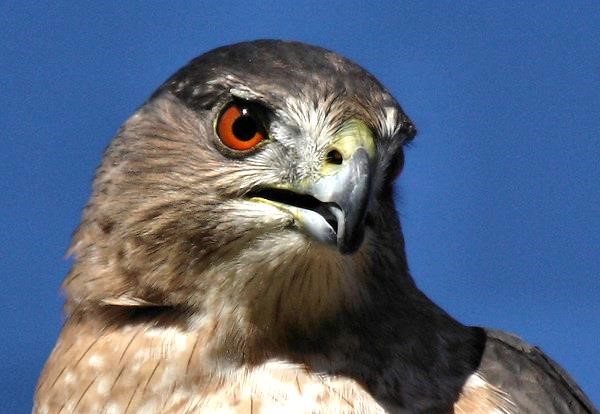
Now for a representative of the accipiter hawks, the Cooper’s Hawk.

Cooper's Hawk (female) mug shot

[COOPER’S HAWK (female): “mug shot”]

For another “in-your-face” close-up view of a Cooper’s Hawk, showing the detail of its beak (profile view), see “Cooper’s Hawk” .

As shown in a Terry Sohl range map [which was deleted from this blog, at Terry Sohl’s insistence — because, being an atheist, he hated to see his map being used on a blog that honors God as the Creator], the permanent (i.e., year-round) range of the Cooper’s Hawk covers almost all America’s “lower 48” states, except that accipiter only stays for breeding in the northernmost states (Maine, New Hampshire, Vermont, most of New York, much of Michigan, northern Wisconsin,  most of Minnesota, North and South Dakota, Montana, some of northern Wyoming, the Idaho Panhandle, and northern Washington).  [NOTE: the above-referenced Terry Sohl range map is not shown here, because Mr. Sohl, as a self-described “hardcore atheist”, does not want his maps associated with a Christian blogsite.]

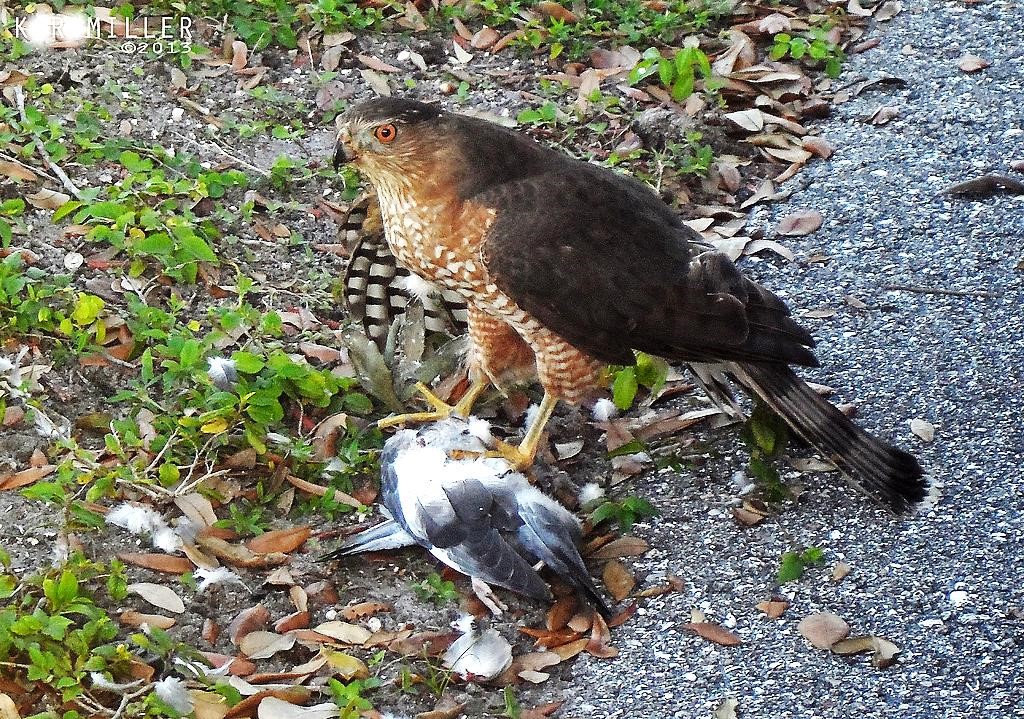
Cooper’s Hawks are stereotypical “bird hawks” (formerly called “chicken hawks” in some rural areas).  These aerial raptors rely upon surprise — mostly hunting, ambushing, snatching, and then eating, small and medium-sized birds, such as picids (woodpeckers, flickers, and sapsuckers), smaller corvids (jays), icterids (blackbirds, grackles, and orioles), galliforms (wildfowl such as quail, domestic chickens, grouse, bobwhites, pheasants, and Mexico’s wood partridges), columbids (doves, including pigeons), cuculids (cuckoos, roadrunners, anis), thrushes, (including robins), warblers, starlings, etc.  Supplementing their bird diet, Cooper’s Hawks (especially those in America’s West) are also known to capture and eat small rodents (squirrels, chipmunks, and mice), lagomorphs (rabbits and hares), and even bats.

Accipiters and Alcids - Cooper's Hawk with caught bird

The Cooper’s Hawk (Accipiter cooperii) can live as long as 20 years, although its lifestyle usually shortens that lifespan – chest puncture impact/trauma injuries, occurring during a chase, are observed on carcasses of many of these accipiters.

Disappointingly, despite its noble name, is not named for England’s eminent scholar Dr. Bill Cooper.  (Actually, the hawk’s association with the name “Cooper” refers to an American naturalist named William Cooper, who lived in the late AD1700s and early AD1800s – some of his work was used by ornithologists John James Audubon, Charles Lucien Bonaparte, and others).  Regardless, it is worth noting, here, that Dr. Bill Cooper does allude to trained “hawks” as they (and pigeons) were used in festive pageantries during the falconry-adorned Dark Ages, when Great Britain suffered being deprived of Scripture accessibility, prior to the Protestant Reformation dawning under the helpful ministries of Dr. John Wycliffe,  Lollards, and William Tyndale.  [See William R. Cooper’s annotated translation of THE CHRONICLE OF THE EARLY BRITONS: Brut y Bryttaniait, (AD2002), at page 52, posted CLICK HERE 

Ironically, Cooper Hawk female adults are larger than their male counterparts.  Consequently, Cooper Hawk males demonstrate respect (seen in submissive body language) when approaching females.  However, communications are primarily a matter of vocalizations (with the male having a higher-pitched voice!), rather than body language, because the usual habitat of Cooper Hawks is visually crowded by trees and dense vegetation, so body gestures may not be practical for communicating except at short distances.

But now we turn, briefly, to introduce some seabirds called “alcids”.


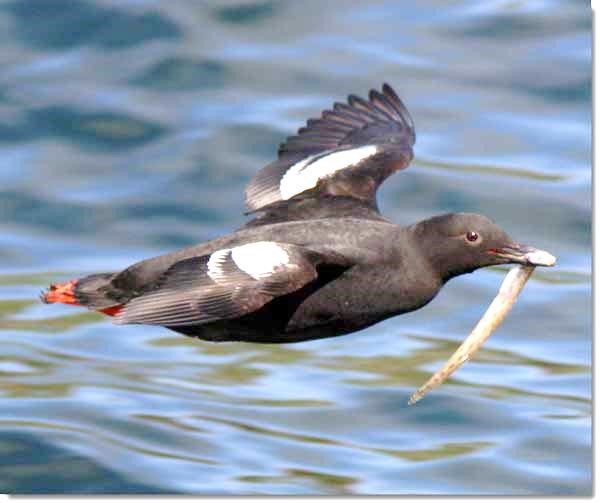
Black Guillemot (Cepphus grylle) ©FLickr Ray Morris

Pigeon Guillemot (Cepphus columba) ©USFWS

Pigeon Guillemot (Cepphus columba)

[guillemots: approaching beach for landing (T); carrying caught fish (B)]

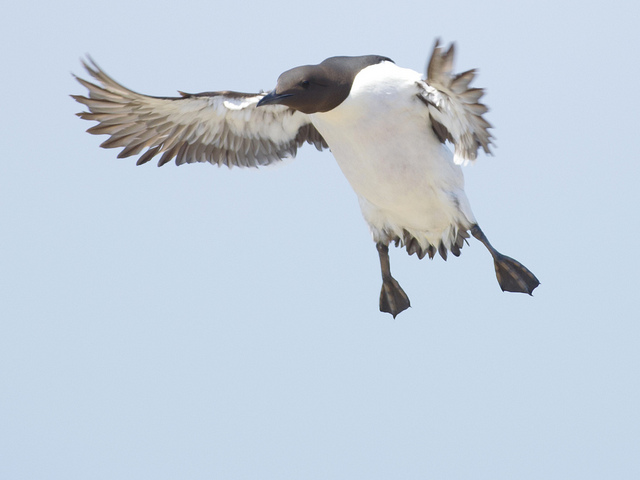
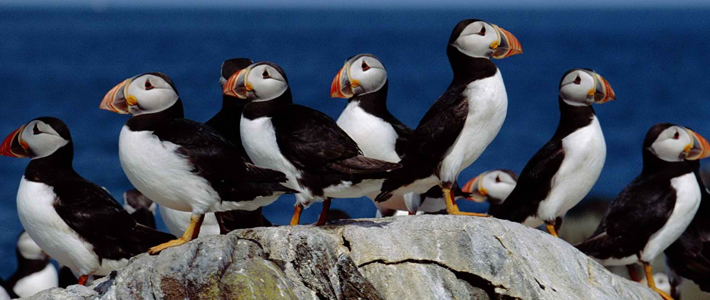
Alcid” is an avian category term (previously called “auks”) used to denote another group of similar birds, i.e., the auk-like bird group that includes puffins (like the Atlantic Puffin, Tufted Puffin, and Horned Puffin); auklets (like Least Auklet and Cassin’s Auklet); murres (like Common Murre and Thick-billed Murre); murrelets (like Xantus’s Murrelet, Ancient Murrelet, Marbled Murrelet, and Guadalupe Murrelet); guillemots (like Common Guillemot and Black Guillemot); the Razorbill auk (2/3 of whom breed in Iceland); the high-arctic-island-dwelling Little Auk (a/k/a Dovekie), and the now-extinct Great Auk.

Alcids spend much time at sea, hunting seafood (usually small fish, though sometimes shrimp or other miniature sea creatures, such as baby squid), but they breed on coastal land (often in the crevices of or atop shoreline cliffs that are  not easily accessed by terrestrial predators) in fairly dense breeding colonies.   [E.g., for movie footage of a Canadian guillemot colony, to see the video posted CLICK HERE.

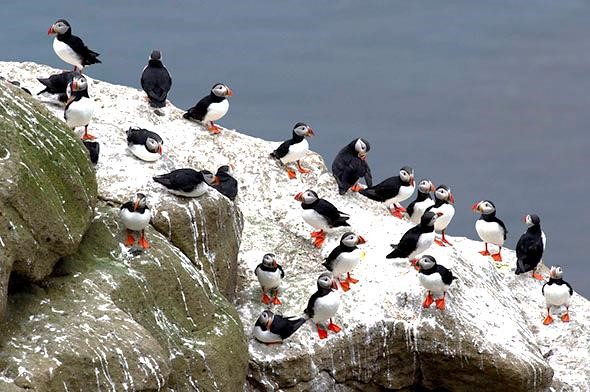
Atlantic Puffin Colony on Farne Islands, near England's Northumberland Coast

Atlantic Puffin colony on Farne Islands, near England’s Northumberland coast

For a listing of about 2 dozen alcids, with photographs (and some video footage), see Lee’s “Alcidae – Auks”.

Regarding alcids (a/k/a “auks”), the eminent ornithologist Roger Tory Peterson says: “The northern [hemisphere’s] counterparts of the [similarly piscivorous divers, yet much larger] penguins, but auks fly [in the air, as well as underwater], beating their small narrow wings in a whit, often veering.  They have short necks and pointed, stubby, or deep and laterally compressed bills.  Auks swim and dive expertly.  Most [alcid] species nest on sea cliffs in crowded colonies … [habitually eating] fish, crustaceans, [and sometimes a few] mollusks.” [Quoting Roger Tory Peterson, A Field Guide to Western Birds (Houghton Mifflin, 1990, 3rd edition; maps by Virginia Marie Peterson), page 32.]

Puffins

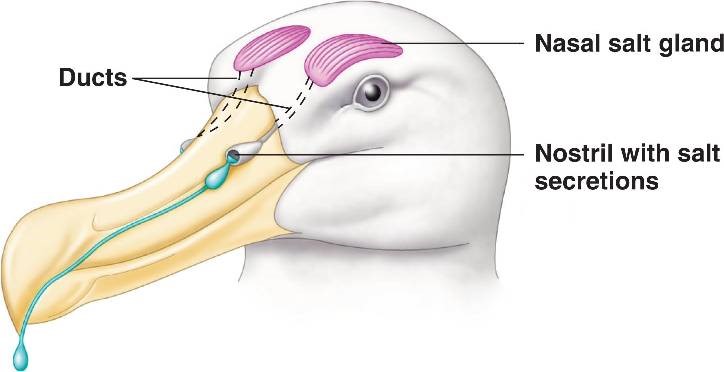
Alcids have mostly black-and-white plumage, so they look superficially like miniature penguins.  Alcids have short wings, so their wing-flapping must be quick and intense — in order to succeed is getting and staying aloft.  Yet their flying prowess enables their populations to eat, successfully, as they propel their streamlined bodies down through the air, diving into the seawater (with powerful wingbeats propelling and “paddling” them underwater) toward their prey, which usually is some kind of fish (such as herring, sprats, and capelin).  These seabirds get their needed water by drinking ocean-water; their highly efficient salt glands (located inside their nostrils) facilitate desalination of ocean-water, supplemented by salt-removing kidney excretions.

Nasal Salt Gland ©Niceweb

Later, in this article, one alcids will receive special attention, the Atlantic Puffin (Fratercula arctica), who (like other alcids) ranges the North Atlantic’s northern latitudes.  (The Xantus’s Murrelet will be featured later, D.v., because birds with names starting with “X” are few and far between!)

Now for another “A” bird, an alcid of Viking seawaters, Atlantic Puffin.

 atlantic-puffin2-710x300

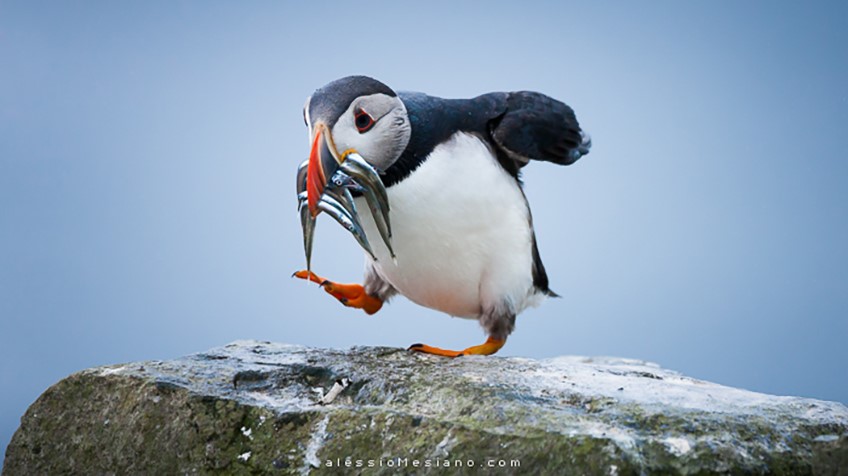
Atlantic Puffins, as “pursuit-divers”, love to eat fish. Puffins thrive on ocean-caught herring, sand-eel, capelin, sprats, and small gadids (such as hake, whiting, and shore rockling), although they actually eat their catch on land.  Puffin chicks are mostly fed sand-eels.  Yet observations of puffin stomach contents, presumably done when puffins were dead ( J ), show that their fish diets are supplemented by small shellfish, mollusks, and marine annelid worms (a/k/a “bristle worms”), especially if the birds were last eating in coastal seawaters.

Atlantic Puffin with fish

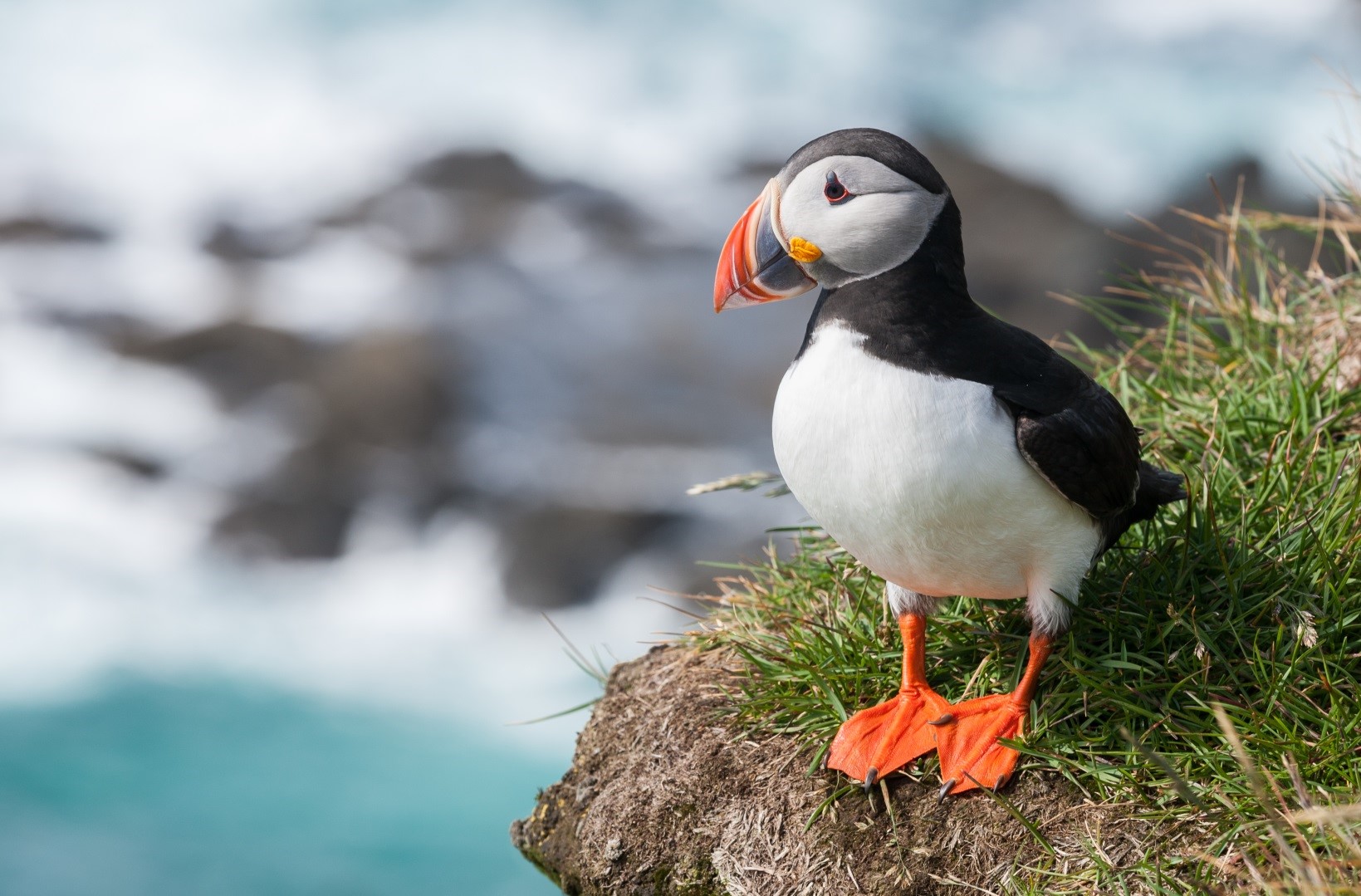
The Atlantic Puffin (Fratercula arctica), as noted above, is one of many Northern Hemisphere alcids.  The arctic/subarctic seawaters and coastlands of the northern Pacific Ocean host the Horned Puffin and the Tufted Puffin, but only the Atlantic Puffin is found in the arctic/subarctic waters of the North Atlantic Ocean and its coastlands.  The primary range of the Atlantic Puffin is in the waters between and alongside northeastern North America, southern Greenland, Iceland, all of the British Isles, Scandinavian coasts (excluding Baltic Sea coasts), northwestern Russia, Svalbard, and other islands of the Arctic Ocean.

Specifically, the Atlantic Puffin has an extended range that includes the coastlands once visited by Norse Vikings, focusing mostly on the frigid North’s coastlines, yet (due to migration) stretching farther south than most would expect of this alcid, as geographer Mia Bennett insightfully observes:

The Farne Islands, England lie at 55 degrees N. Off the coast of Northumberland, they’re not too far from Newcastle, England and Edinburgh, Scotland. I took a boat trip out to the islands a few weeks ago and saw thousands of puffins. The black and white birds were diving, bobbing, and flying with fish in their beaks.

Puffins are usually associated with the Arctic, so I was surprised to see them in the country I’ve called home for the past ten months. Even though I wasn’t really that far north – still eleven degrees south of the Arctic Circle – the presence of puffins made me feel closer to the Arctic than I have since I was in Trømsø in January.

Atlantic Puffin Range Map - accompanying Mia Bennett's Article

[Atlantic Puffin range map accompanying Mia Bennett’s article]

A map of the global puffin habitat reveals that the species generally breeds in places we call the Arctic, but also places we wouldn’t, namely the British Isles, Normandy and Brittany, and Canada’s Maritime Provinces. Puffins fly as far south as Morocco, providing a link between ecosystems in Africa and the Arctic.

The map of the puffin habitat bears an odd resemblance to that of the Viking raids:

Viking range map accompanying Mia Bennett’s article

[Viking range map accompanying Mia Bennett’s article]

Visualizing the extent of the puffin habitat and the Viking raids helps us to reconceptualize what the Arctic means and to understand its place in relation to the rest of the world. The region can be defined beyond a strict adherence to lines of latitude like the Arctic Circle. In their own ways, puffins, and the Vikings before them, help link the circumpolar north into more southern-lying lands like Spain and Morocco. The flight of the puffin, which winters south of the Arctic, reminds me of the fish protein commodity chain that begins up in the Lofoten Islands, Norway, where I saw Lithuanian fishermen hanging cod to dry. The protein powder made from ground up fish heads would be sent on to Nigeria – yet another North-South chain, this time to do with goods rather than animals or people.

As for the UK, a lot more connects the country to the Arctic than puffins. Klaus Dodds, a geography professor and Arctic specialist at Royal Holloway, and Duncan Depledge, his doctoral student and a researcher at the Royal United Services Institute for Defence and Security Studies  (RUSI), outline what they see as the country’s priorities in a RUSI report. They write, “The UK has a 400-year-old relationship with the Arctic, created and consolidated by exploration, science, security, resources, commerce and the popular imagination.” The near hero-worship of explorers like Robert F. Scott and television shows like BBC’s Frozen Planet attest to the continuing prominence of the Arctic in British popular culture, even if Westminster isn’t paying the High North (or even the north of England, for that matter) too much heed.

[Quoting Mia M. Bennett, “As the Puffin Flies: The U.K. and the Arctic” (emphasis added)]  Bennett’s allusion to Captain Robert Scott is a good reminder of the quixotic quandaries (and deadly dangers) that can go with idolizing evolutionists and their animistic “natural selection” mythologies.

Explorers Robert Scott and others

How so?  Robert Scott and others learned the hard way – the cold reality – that trying to prove the Bible wrong about origins, while trying to backdate “proof” for Darwin’s speculations, paves a miserable path to self-destruction.

“There is a way that seems right to a man, but its end is the way of death.” (Proverbs 14:12)

(See “Penguin Eggs to Die for”.)  What a quixotic quest that Antarctic expedition was – futilely trying to prove that Darwin’s “natural selection” theory was right, and that the Holy Bible was wrong.  What a tragic folly it was.

Even today there are similar enterprises, albeit less exotic, following fables and materialistic myths (see 1st Timothy 6:20) – rather than embracing the “inconvenient” truth that Genesis reports the facts!

For a recent example, exhibiting editorial resistance to admitting that Darwin’s “natural selection” theory is pseudo-scientific “emperor’s new clothes” sophistry,  —  compare “Mislabeling Crabs and Creationists”, as published ultra vires in Creation Research Society Quarterly, 52(2):50 (fall 2015) (displaying unauthorized censorship, ironically exemplifying my article’s caveat that some professing creationists have compromised with Darwinian concepts/terminology, and are doing so surreptitiously), — with my authorized version, “Charading Crabs and Creationists”, posted at Bibleworld Adventures, posted at http://bibleworldadventures.com/2015/10/23/mislabeling-crabs-and-creationists/  (10-23-AD2015).   Using unfair surprise and the equivalent of editorial forgery, the CRSQ version replaced the critical phrase “natural selection” with “descent-with-modification”, without any advance notice to me, the author (much less getting any pre-publication authorization from me, for that meaning-quashing edit), of CRSQ‘s decision to insert such terminology transmogrification.  In essence, the unauthorized editing, in the CRSQ version (that removed my phrase “natural selection” and replaced it by the inapposite term “descent-with-modification”), showcases the very problem of underhanded/undercover defense of “natural selection” sophistry.  [For more on this topic, see the comments regarding Dr. Randy Guliuzza within “A Bohemian Goose and Saxon Swan”, posted at https://leesbird.com/2014/12/10/a-bohemian-goose-and-a-saxon-swan/  .]

Now, back to the puffins:  why do so many people love to see Atlantic Puffins?

Atlantic Puffin with mouth open

Perhaps because the Atlantic Puffin is one of the most cute and colorful alcids — if not also goofy-looking (in a clownish way) — of the North Atlantic latitudes.

With a face like that, surely the Atlantic Puffin has won many a beauty contest!

Of course, other birds have names that start with “A” – but readers can only read for so long, and this article is already long enough!

Meanwhile, God willing, the next study in this alphabetic series (to be delivered in parts) will be about some “B” birds – such as Bee-eaters, Bittern, Bluebird, Bunting, and Buteos.  So stay tuned!         ><>   JJSJ        profjjsj@verizon.net

Atlantic Puffin on the march

Atlantic Puffin at the shore

“A” is for Avocet, Albatross: “A” Birds, Part 1

Birds of the Bible: Hawks

Flag that Bird! (Part 1)

Alcidae – Auks

Penguin Eggs to Die for

*

“A” is for Avocet and Albatross: “A” Birds, Part 1

“A” is for Avocet and Albatross: “A” Birds, Part 1

James J. S. Johnson

American Avocet (Recurvirostra americana) by Jim Fenton

American Avocet (Recurvirostra americana) by Jim Fenton

“A” is for Avocets, Albatrosses, Accipiters, and Alcids (including Auklets and the Atlantic Puffin), — plus Antbirds and a few other birds omitted here. This study now bravely begins an alphabet-based series on birds, starting with a quick introduction to 4 types of birds that start with the letter “A”   –    followed by a few observations of alphabetic patterns in Scripture (exhibited initially by Psalm 119:1-8)   –   then followed by specific information on avocets, albatrosses, accipiters, and alcids. Due to the length of this review, the “A” birds (just mentioned) will be considered in two parts: Part 1, Avocets and Albatrosses, — and Part 2 (in the near future, God willing), Accipiter hawks and Alcids.

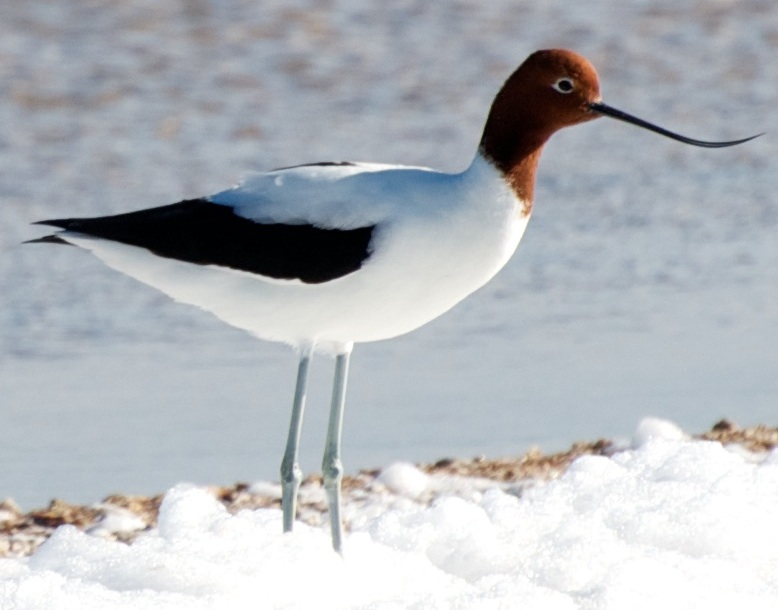
Red-necked Avocets ©WikiC

Red-necked Avocet at shore ©WikiC

Avocets” are shorebirds, known for wading into the salty or brackish tidewaters, on skinny stilt-like legs, picking at food with thin upward-curving (the opposite of “decurved”) bills.  Avocets include American Avocet (Recurvirostra americana), Pied Avocet (Recurvirostra avosetta), Red-necked Avocet (Recurvirostra novaehollandiae), and Andean Avocet (Recurvirostra andina).

Avocets are often grouped with other shorebirds that have similar morphology (shape), who occupy similar eco-niches (similar ecological contexts) and have somewhat similar eating habits – the fancy word for that category of shorebirds is “Recurvirostrids” – a group that includes avocets and stilts.  (For a listing on these shorebirds, with photographs, see Lee’s “Recurvirostridae: Stilts, Avocets

Later, in this article, one avocet will receive special attention, the American Avocet (Recurvirostra americana).

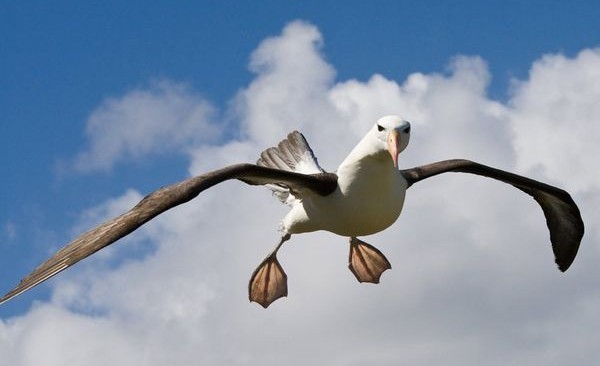
Black-browed Albatross launching into flight from the sea

Black-browed Albatross launching into flight from the sea

[Black-browed Albatross, launching into flight from the sea]

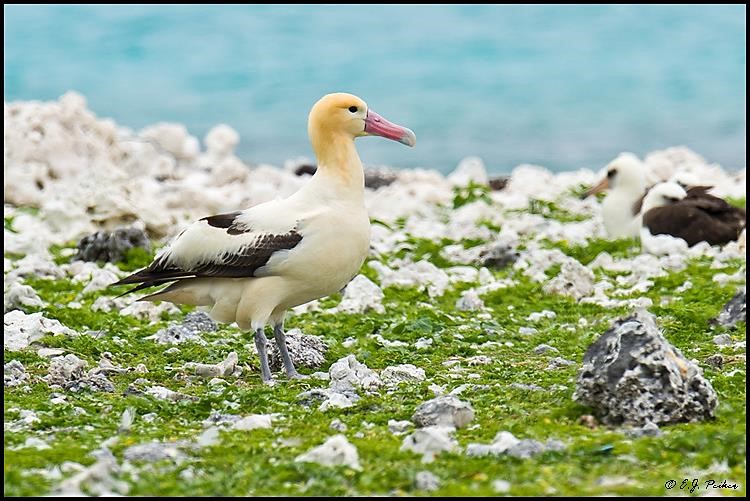
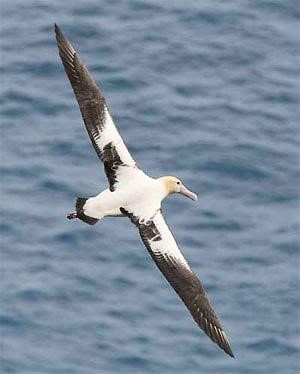
Albatross” is a large tube-nosed seabird type  –  sometimes called “gooney birds” — typically ranging over open-ocean waters, that includes about 20 different species, such as Snowy Albatross (Diomedea exulans, a/k/a Wandering Albatross or White-winged Albatross), Black-footed Albatross (Phoebastria nigripes), Light-mantled Albatross (Phoebetria palpebrata, a/k/a Grey-mantled Albatross), the Atlantic Yellow-nosed Albatross (Thalassarche chlororhynchos), Laysan Albatross (Phoebastria immutabilis), Steller’s Albatross (Phoebastria albatrus, a/k/a Short-tailed Albatross, known for eating juvenile squid), etc.

Regarding albatrosses as a “family” group, with photographs of more than 20 species of albatrosses, see Lee’s “Diomedeidae: Albatrosses.  “Gooney birds” are obviously designed by flying over oceans.  However, on land they can ambulate as they need to, although they may appear “goofy” on shore, as they appear to hobble (or waddle) along, upon their large webbed feet. Yet they live for many decades (e.g., up to 60 years!), unless their natural lives are cut short by a predator.

http://siliconvalley.corriere.it/files/2015/12/black-browed-albatross-flying.jpg

Albatross (Diomedea) ©Unknown from Siliconvalley

*

Albatross Study from Ian Montgomery

Albatross Study from Ian Montgomery

For examples of albatross studies, provided by Australian ornithologist Ian Montgomery, see “Ian’s Bird of the Week: Royal Albatross”,  —  and “Ian’s Stamp of the Week: Antipodean Albatross”,   —  and “Ian’s Bird of the Week: Light-mantled Albatross”,  — and “Ian’s Bird of the Week: Campbell / Black-browed AlbatrossLater, in this article, one albatross will receive special attention, Steller’s Albatross (Phoebastria albatrus).

ALPHABETS CAN BE HELPFUL FOR ACROSTIC-BASED LISTINGS

Using an alphabet, to organize a sequence of information, has Biblical precedent.  The perfect example is the “acrostic” pattern of Psalm 119, the longest psalm (having 176 verses!), which has 22 sections (comprised of 8 verses per section), representing the 22 letters of the Hebrew alphabet. (Compare that to English, which has 26 alphabet letters, and Norwegian, which has 29 alphabet letters.)

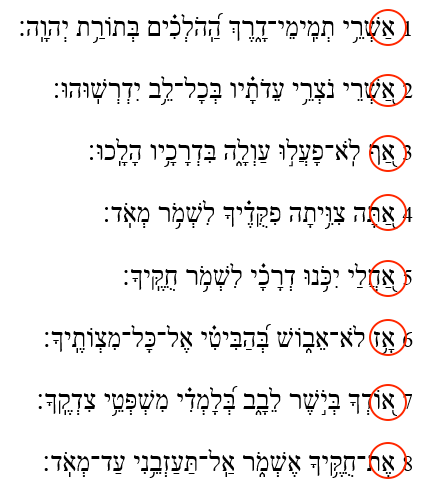
The sentences in each section start with the same Hebrew  letter, so Verses 1-8 start with ALEPH, Verses 9-16 start with BETH, Verse 17-24 start with GIMEL, and so forth.  Here are the first 8 verses in Psalm 119, each sentence of which starts with ALEPH  [an inaudible guttural consonant, usually transliterated into English as an apostrophe that looks like a backwards C = ’ , i.e., like a closed single-quotation mark].  ALEPH is the first letter in the Hebrew alphabet, so each verse literally starts with that letter as the first letter in the first word (although the first Hebrew word may be differently placed in the English translation’s sentence):

Alphabet in Hebrew of Psalm 119

Blessed [’asherê] are the undefiled in the way, who walk in the law of the Lord.

Blessed [’asherê] are they that keep His testimonies, and that seek Him with the whole heart.

Yea [’aph], they also do no iniquity: they walk in His ways.

Thou [’atah] hast commanded us to keep Thy precepts diligently.

O-that [’aḥalai] my ways were directed to keep Thy statutes!

Then [’az] shall I not be ashamed, when I have respect unto all Thy commandments.

I-will-praise-thee [’ôdekâ] with uprightness of heart, when I shall have learned Thy righteous judgments.

Thy-statutes [’et-uqqekâ] I will keep; O forsake me not utterly.

Interestingly, Verses 1-3 are narrated in the third person (referring to God as “He”, “Him”, etc.), but Verses 4-8 are addressed to God (“Thou”, “Thy”, “Thee”) in the second person.  Certainly the psalmist appreciates God’s truth as He has  kindly and authoritatively provided it unto His favorite creature, Adam’s race!

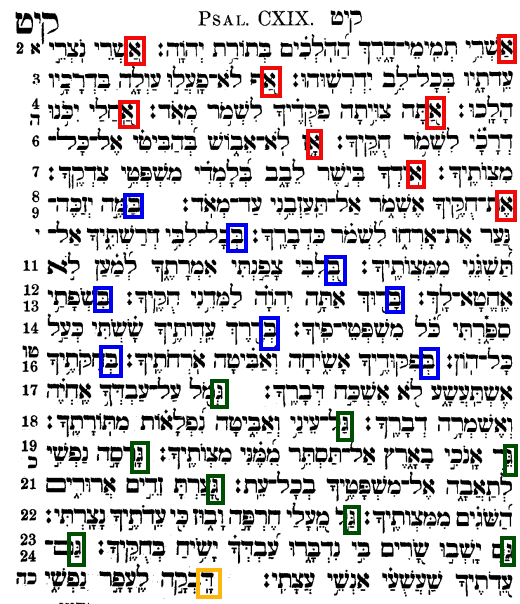
Most English Bibles show how the Hebrew alphabet is used to divide Psalm 119 into those 22 sections, although it requires looking at the Hebrew text to see how this was actually done.  Psalm 119 is not the only acrostic psalm – there are others (see Psalms 9, 10, 25, 34, 37, 111, 112, 145).  In fact, there is a hidden-in-plain-view message in Psalm 145, which deliberately omits the Hebrew letter nûn (that matches our “N”), but that unusual usage of an intentionally incomplete acrostic must wait another day to be explained.

“In the common form of acrostic found in Old Testament Poetry, each line or stanza begins with a letter of the Hebrew alphabet, in order. This literary form may have been intended as an aid to memory, but more likely it was a poetic way of saying that a total coverage of the subject was being offered — as we would say, ‘from A to Z.’ Acrostics occur in Psalms 111 and 112, where each letter begins a line; in Psalms 25, 34, and 145, where each letter begins a half-verse; in Psalm 37, Proverbs 31:10-31, and Lamentations 1, 2, and 4, where each letter begins a whole verse; and in Lamentations 3, where each letter begins three verses. Psalm 119 is the most elaborate demonstration of the acrostic method where, in each section of eight verses, the same opening letter is used, and the twenty-two sections of the psalm move through the Hebrew alphabet, letter after letter.” [Quoting J. Alec Motyer, “Acrostic”, in The New International Dictionary of the Bible (Zondervan, 1987), page 12.]

Hebrew Alphabet Acrostic of Psalm 119 ©Zondervan

Hebrew Alphabet Acrostic of Psalm 119 ©Zondervan

Psalm 119 is all about God’s revelation of truth – especially truth about Himself – to mankind (in a comprehensive “A to Z” panorama).  The most important revelation of truth that God has given to us, and the most authoritative form of truth we have, is the Holy Bible – the Scriptures.  (In fact, it appears that Scripture is referred to 176 times within Psalm 119, since 6 verses twice allude to Scriptures.)  Accordingly, Psalm 119 is dominated by references to the Scriptures – using terms like “the law of the LORD”, “Thy Word”, “Thy commandments”, “Thy testimonies”, “Thy statutes”, “Thy judgments”, etc.

Psalm 119 Study Photo

Psalm 119 Study Photo

Of the 176 verses in Psalm 119 there appear to be only 6 verses (actually, there are only 5 exceptions) that omit a direct reference to the Scriptures:   Verses 3, 37, 90, 91, 122, and 132.  Yet, even so, each (of those “exceptions”) refers to some form of God’s general or special revelation:  “His ways” and “Thy way” (in Verses 3 & 37, yet God’s ways are only known to us by His creation, His Word, His incarnation, and His providences, all of which are forms of God revealing truth to us); “Thy faithfulness” (in Verse 90, yet God’s faithfulness is only known to us by His creation, His Word, His incarnation, and His providences, all of which are forms of God revealing truth to us); “Thy ordinances” (in Verse 91, is not really an exception, because it translates for mishpat, a Hebrew noun repeatedly translated as “judgment(s)”, elsewhere in Psalm 119); “surety” (in Verse 122, is the Hebrew verb ‘arōbh, functioning as a noun, yet the concept of God as our “surety” is comparable to His “faithfulness”, noted in Verse 90); and “Thy name” (shemekâ, in Verse 132, which divine name itself reveals God’s character (in the Old Testament Hebrew name for God) as the eternal Being, YHWH, as is emphasized in Exodus 3:14 and further in John 8:58).

Regarding God’s name, the incarnation has revealed God to us as Emmanuel (“God with us”), the Lord Jesus Christ (Philippians 2:9-11).  Accordingly, by His name as the incarnate God (i.e., Jesus the Christ), God’s name is necessarily implied even by how we count time on Earth, every time we refer to what year it is, — because the years are denominated as “B.C.” (“before Christ”) and “A.D.” (“anno Domini= “year of our Lord [Jesus Christ]”), ubiquitously reminding us that God has revealed Himself, on Earth, via Christ’s incarnation and earthly ministry!).

Eight Synonyms of Gods Word in Psalm 119

Dusty Bible

In short, Psalm 119 teaches that God reveals truth, and we should expect that we learn 97% of it from the Holy Bible!  (Romans chapter 1 emphasizes that we are taught, by the physical creation, about God’s majestic power and glorious wisdom, and that the message of God’s creation is so strong that to ignore it is to do so “without excuse”.)  Also, since the Hebrew letter ALEPH is derived from the Hebrew word for “ox” (which exemplifies might), it is noteworthy that the first 8 verses of Psalm 119 emphasize who powerfully God’s Word strengthens us for holy living (see Hebrews 4:12).

Now back to the “A” birds (Part 1), Avocets and Albatrosses.

American Avocet - Family group visiting lentic shore

American Avocet – Family group visiting lentic shore

The American Avocet (Recurvirostra americana), like many shorebirds, thrives upon the available edibles on beaches swept back-and-forth by coastal tidewaters.  This dignified shorebird, with its long skinny bill, long skinny legs, and its cinnamon-to-salmon summer plumage (on its head and neck), has already been described by ornithologist Lee Dusing – see “Birds, Volume 2, #1: The American Avocet.

The breeding range of the American Avocet includes most of the states in the western half of America’s “lower 48” states, plus some of western inland Canada (southern Alberta and Saskatchewan, and part of Manitoba), with the breeding range situated mostly in Montana, North and South Dakota, Nebraska, Wyoming, Colorado, southern Idaho, western Oregon, northern Utah, New Mexico, far western Oklahoma, and the Texas Panhandle.  Some breeding avocets have also been sighted in Minnesota.

Avocets migrate south for the winter, either to Florida or to Mexico.  Their migratory passage travels occur in between their wintering and breeding ranges, covering large parts of Texas, Arizona, California, Nevada, Utah, and Idaho.

Avocets, being shorebirds, like to eat fish that venture close enough to the shoreline to get caught in the quick bill of an avocet.

Do not think that avocets are merely passive, waiting for food to swim or drift by where they stand, in the shallow water of a pond or lake.

Avocets poke their long stick-like bills into the water, then flex their bills back and forth in the water, stirring the water so that nearby creatures – such as water bugs and crustaceans – are agitated into motion that reveals their presence.   Seeing such creatures reactively move, avocets use their long bills to clamp down on an entrée, such as a small fish!

Avocets also enjoy eating aquatic plants (especially their nutritious seeds) that emerge above the shoreline’s water surface.

American Avocet

American Avocet “Gone fishin” – photo by Ron Dudley

Now for another “A” bird:  the Albatross, specifically Steller’s Albatross, a shorebird that has been listed as “endangered” since AD2000.

The Steller’s Albatross (Phoebastria albatrus, a/k/a Short-tailed Albatross, formerly known taxonomically as Diomeda albatrus) is an North Pacific Ocean-ranging albatross.  This albatross was originally named for the 18th century (AD) German naturalist Georg Steller, for whom the Steller’s Jay is also named.  Georg Steller is likewise the namesake of Steller’s Eider and Steller’s Sea Eagle (and even of two pinniped marine mammals, the Steller’s Sea Lion and the now-extinct Steller’s Sea Cow).  Regarding Georg Steller’s scientific career and “stellar” accomplishments (pardon the pun), see Steller’s Jay: A Lesson in Choosing What Is Valuable.

Steller’s Albatross ©U.S. Fish & Wildlife Service

The U.S. Fish & Wildlife Service describes the Steller’s Albatross as follows:

“With a wingspan of over 2 meters (over 7 feet), the short-tailed albatross is the largest seabird in the North Pacific. Its long, narrow wings are adapted to soaring low over the ocean. It is best distinguished from other albatrosses by its large, bubblegum-pink bill. Young birds also have the large pink bill, but their feathers are dark chocolate brown, gradually turning white as the bird ages. Adults have an entirely white back, white or light gold head and back of neck, and black and white wings. …

Historically, millions of short-tailed albatrosses bred in the western North Pacific on several islands south of the main islands of Japan. Only two breeding colonies remain active today: Torishima Island and Minami-kojima Island, Japan. In addition, a single nest was recently found on Yomejima Island of the Ogasawara Island group in Japan. Single nests also occasionally occur on Midway Island, HI. Short-tailed albatrosses forage widely across the temperate and subarctic North Pacific, and can be seen in the Gulf of Alaska, along the Aleutian Islands, and in the Bering Sea. The world population is currently estimated to be about 1200 birds and is increasing. …

Like many seabirds, short-tailed albatrosses are slow to reproduce and are long-lived, with some known to be over 40 years old. They begin breeding at about 7 or 8 years, and mate for life. Short-tailed albatrosses nest on sloping grassy terraces on two rugged, isolated, windswept islands in Japan. Pairs lay a single egg each year in October or November. Eggs hatch in late December through early January. Chicks remain near the nest for about 5 months, fledging in June. After breeding, short-tailed albatrosses move to feeding areas in the North Pacific. When feeding, albatrosses alight on the ocean surface and seize their prey, including squid, fish, and shrimp.”

[Quoting USF&W, “Short-tailed Albatross (Phoebastria albatrus)”, February 2001 pamphlet, page 1 of 2.]

Steller’s Albatross 2©U.S. Fish & Wildlife Service
Steller’s Albatross 3©U.S. Fish & Wildlife Service
Short-tailed Albatross Map

The Steller’s Albatross, under the name Short-tailed Albatross, has been officially listed as “endangered” (under the Endangered Species Act of 1973) throughout its North Pacific range, as promulgated in 65 F.R. 46643 (Volume 65 of the Federal Register, page 46643-46654, issued 31 July 2000), in conjunction with implementing aspects of the wildlife protection treaty called “CITES” (Convention on International Trade in Endangered Species of Wild Fauna and Flora).

This means that the Steller’s Albatross, and products of its body parts, may not be freely traded (i.e., apart from an appropriate governmental license), regardless of whether they were “taken” from the wild in America — or “taken” from the wild in any other country that is a ratifying signatory of the CITES treaty (which prohibits the trafficking of endangered species and products produced therefrom).

So, if anyone offers to sell you a fancy hat, adorned with Steller’s Albatross feathers – and claims that the bird was obtained outside the United States, don’t buy it!   (It’s contraband, unpermitted possession of which is a federal crime!)

Ironically, as a result of an earlier “administrative error”, this albatross was officially listed as “endangered” throughout its range “except in the United States”! — Way to go, bureaucrats!

At this point we will break our review of the above-mentioned “A” birds.  In “Part 2” of these “A birds” we will review Accipiter hawks and Alcids, God willing!

<> JJSJ

*

“A” is for Accipiter and Alcid: “A” Bird, Part 2

Diomedeidae: Albatrosses

Ian’s Bird of the Week: Royal Albatross

Ian’s Stamp of the Week: Antipodean Albatross

Ian’s Bird of the Week: Light-mantled Albatross

Ian’s Bird of the Week: Campbell / Black-browed Albatross.

Steller’s Jay: A Lesson in Choosing What Is Valuable

Recurvirostridae: Stilts, Avocets

*

Arctic Terns Set Mileage Records As Frequent Fliers

Artic Terns 1
ARCTIC   TERNS   SET   MILEAGE   RECORDS   AS   FREQUENT   FLIERS

Dr. James J. S. Johnson

For  the  kingdom  of  heaven  is  as  a  man  travelling  into  a  far country… (Matthew  25:14a)

Arctic Terns (Sterna paradisaea), which weigh only about a quarter-pound,  are the ultimate example of global migrants, accomplishing the longest-known migrations, every year, from near  the top of the world to near the bottom, then vice versa.  In fact, some Arctic Terns fly >50,000 miles in their pole-to-pole-and-then-back-again migration!  (And, if an Artic Tern lives 30 years, as some do, that could mean about 1½ million miles on his or her lifetime “odometer”, which is comparable to 3 round trips to the moon (i.e., that’s like 3 times, to the moon and back again)!

Imagine how inconvenient it would be for a bird to arrive at the South Pole during May or June, when the weather is freezing cold and food is scarce. Or imagine a similar scenario at the North Pole during November or December, when the weather there is harshest. Thankfully, arctic terns follow the opposite schedule, synchronizing with temperature and seasonal food availability.

Why? These birds are purposefully preprogrammed to operate by these schedules; God fitted them to do so. This programming is critical for these migratory birds to travel over the Atlantic Ocean from the Arctic to the Antarctic, and vice versa, every year. At more than 40,000 miles round trip, they are the ultimate frequent fliers! A recent study pointed out:

The study of long-distance migration provides insights into the habits and performance of organisms at the limit of their physical abilities.

The Arctic tern Sterna paradisaea is the epitome of such behavior; despite its small size (<125 g), banding recoveries and at-sea surveys suggest that its annual migration from boreal and high Arctic breeding grounds to the Southern Ocean may be the longest seasonal movement of any animal. Our tracking of 11 Arctic terns fitted with miniature (1.4-g) geolocators revealed that these birds do indeed travel huge distances (more than 80,000 km [>50,000 miles] annually for some individuals).…

Arctic terns clearly target regions of high marine productivity both as stopover and wintering areas, and exploit prevailing global wind systems to reduce flight costs on long-distance commutes.

Ecologically speaking, it’s all a demonstration of “survival of the fitted”. Arctic terns, like all birds, survive because they are divinely fitted to survive all of the interactive factors in their diverse and geographically extensive environments.

Providentially, the arctic terns select season-synched flight times that repeatedly avoid the harsh winter months at both the North and South Poles. Likewise, the terns select flight plans that take advantage of global wind patterns and incorporate helpful stopovers for rest and refueling.

Timing factors are interactive throughout this cyclical migration: the seasonal weather cycle, wind patterns influenced by daily rotation of the earth, food availability influenced by annual seasons, and the reproductive cycle of the terns themselves.

In all of this, providential programming is both complicated and critical!

[Quoting James J. S. Johnson, “Survival of the Fitted: God’s Providential Programming”, Acts & Facts, 39 (10): 17-18 (October 2010), quoting Carsten Egevang, et al., “Tracking of Arctic terns Sterna paradisaea reveals longest animal migration”, in Proceedings of the National Academy of Sciences, 107(5): 2078-2081 (2010).  See also Greenland Institute of Natural Resources, “The Longest Animal Migration in the World Revealed” (press release, n.d.), quoting Carsten Egevang —  and “The Arctic Tern Migration Project” website — showing “the impressive journey of the Arctic tern from the breeding grounds in Greenland to Antarctica and back in this Google Earth Tour combining maps, animations and photos”.]

Artic Tern near Iceberg

Fair Use photo credit:

Arctic Terns are circumpolar, i.e., their range largely covers the polar regions.  Its “normal” turfs include its breeding grounds, spread variously over Arctic lands (like Iceland and Greenland), as well as the sub-Arctic parts of Eurasia (such as Schleswig-Holstein, Germany) and North America, —  plus its migratory “timeshare” stopover lodgings,  — plus its Antarctica wintering grounds (such as Wilkes Land), including “down under” islands near Antarctica, such as Weddell Sea islands or New Zealand’s South Island.

Thus, the historic fame of Thingvellir, Iceland not only derives from hosting the annual Althing events (ever since Viking times), but also from hosting the critical-habitat nesting activities of breeding Arctic Terns!

Unsurprisingly, these noble and courageous seabirds have been celebrated by postage artists and philatelists alike in Nordic countries (and quasi-autonomous jurisdictions), such as the Åland, the Færoe Islands, Finland, Iceland, Sweden   —   as well as in Canada  —  and in other countries (or quasi-countries, like the Isle of Man) that appreciate either the Arctic or Antarctic activities of this globe-flier.

Stamp 1 Stamp 2 Stamp 3

Stamp 4 Stamp 5


Yet even the ever-traveling Arctic Terns have their share of enemies – such as predatory Arctic Foxes who are happy to raid Arctic Tern nests, if they can.  But, Arctic Terns won’t tolerate such predatory thefts without a fight – the Arctic Tern colony defenders will challenge (“mob”) such foxes!         ><> JJSJ


Picture1

Fair Use photo credit: 

Artic Fox and Artic Tern b©Arkive

Fair Use photo credit: 

*

Orni-theology

James J. S. Johnson

Arctic Tern Family – Laridae

*


Birds of the Bible – Parable of the Nest

Brown-headed Cowbird (Molothrus ater) Egg in Eastern Phoebe Nest ©WikiC

Brown-headed Cowbird (Molothrus ater) Egg in Eastern Phoebe Nest ©WikiC

Recently, I have been taking some on-line courses through the School of Biblical Apologetics with the Institute for Creation Research. Some of the lessons have been about how the Lord used parables to teach many lessons. Jesses seemed to use some of them like object lessons, where you use something currently in sight. So, here is my attempt to use a parable with birds as the object.

When you observe a bird’s nest with eggs in it and they all look alike, do you assume they are all from the same bird parents? In the picture above, it is obvious that there is a “false member of the family” in the nests.

Sometimes, they really do look the same, but there is a “Brood parasite” in among them. They look so similar that you hardly notice them. Therefore the parents accept them, sit on them, and all is well for a while.

Reed Warbler eggs with Cuckoo Egg in them ©WikiC

Reed Warbler eggs with Cuckoo Egg in them ©WikiC

But, when the eggs begin to hatch, several things can happen:

Sometimes, while the chick is in the egg, it hears its adopted parents and will actually make sounds like these parents. Therefore the parents feed them, just like its own.

Sometimes, they are so determined, that they actually shove the hosts eggs or the nestlings out of the nest.

Click to see photo of chick pushing egg out of nest.

When they do begin to grow, they become much larger than the adopted parents.

A Shiny Cowbird (Molothrus bonariensis) chick being fed by a Rufous-collared Sparrow (Zonotrichia Capensis)

A Shiny Cowbird (Molothrus bonariensis) chick being fed by a Rufous-collared Sparrow (Zonotrichia Capensis)

Sometimes they really grow.

Common Cuckoo (Cuculus canorus) being raised by a Reed Warbler©WikiC

Common Cuckoo (Cuculus canorus) being raised by a Reed Warbler©WikiC

Now for an application:

“But there were also false prophets among the people, even as there will be false teachers among you, who will secretly bring in destructive heresies, even denying the Lord who bought them, and bring on themselves swift destruction. And many will follow their destructive ways, because of whom the way of truth will be blasphemed.” (2 Peter 2:1-2 NKJV) (emphasis mine)

Some deny the Creation and the Creator of Genesis. Yet, they “accept” the other parts of the Bible. Many other truths of God’s Word are also changed or watered-down to fit the needs of the false teachers.

Those of us who are Christians, should be on our guard for false believers, who may learn to “talk the talk” and may “sound like us,” but they are actually bending or perverting the truth.

“These were more fair-minded than those in Thessalonica, in that they received the word with all readiness, and searched the Scriptures daily to find out whether these things were so. ” (Acts 17:11 NKJV)

“These six things the LORD hates, Yes, seven are an abomination to Him: A proud look, A lying tongue, Hands that shed innocent blood, A heart that devises wicked plans, Feet that are swift in running to evil, A false witness who speaks lies, And one who sows discord among brethren.…” (Proverbs 6:16-19 NKJV)

“Because narrow is the gate and difficult is the way which leads to life, and there are few who find it. “Beware of false prophets, who come to you in sheep’s clothing, but inwardly they are ravenous wolves.” (Matthew 7:14-15 NKJV)

“For false christs and false prophets will rise and show signs and wonders to deceive, if possible, even the elect.” (Mark 13:22 NKJV)

Let God’s Word speak for itself. The answers are in the Word of God, if one just searches for these truths.

“The fear of the LORD is the beginning of knowledge, But fools despise wisdom and instruction.” (Proverbs 1:7 NKJV)

“Cease listening to instruction, my son, And you will stray from the words of knowledge.” (Proverbs 19:27 NKJV)

(Bolding for emphasis on verses is mine)

*

Birds of the Bible

Brood Parasite – Wikipedia

Is There a God?

*

Cattle Egrets, Cattle, and Other Herbivore Neighbors

Cattle Egret In Breeding Plumage by Dan

Cattle Egret In Breeding Plumage by Dan

Cattle Egrets, Cattle, and Other Herbivore Neighbors

~ by James J. S. Johnson

For this, Thou shalt not commit adultery, Thou shalt not kill, Thou shalt not steal, Thou shalt not bear false witness, Thou shalt not covet; and if there be any other commandment, it is briefly comprehended in this saying, namely, Thou shalt love thy neighbor as thyself. (Romans 13:9)

Being a good neighbor is a standard to live by. And good neighbors help one another. As Romans 13:9 indicates, it’s a norm for how to treat one’s neighbors.

To some extent, this type of “win-win” situation sometimes occurs in nature, as is often (though not always) illustrated by the relationships of some birds — the best examples are Cattle Egrets with domestic Cattle, as well as with other large mammal herbivores (such as bison, water buffalo, bison, horses, zebras, giraffes, antelope, etc.), as the large mammals graze in tall grasses where bothersome insects and parasitic ticks abound.

Cattle Egret picks bugs off face of bovine “neighbor” (cow)

It should be no surprise that Cattle Egrets associate with cattle, picking (at and eating) bugs that pester those noble (and vulnerable) bovines.

The term used by ecologists, for this “win-win” relationship, is mutualistic symbiosis. In other words, they help each other as good neighbors should!

When cattle egrets tag along with cattle, whose quadrupedal movement through pastures (or non-agricultural grasslands) stir up insects or all kinds, the cattle egrets opportunistically snap up the dislodged bugs. Likewise, Cattle Egrets are not shy about perching atop cattle, to eat whatever insects or ticks (or insect larvae) may be trespassing on beleaguered bovine bodies.

The benefit to the birds is obvious – convenient meals, either on the bovine skin or in the stirred grasses that bovine feet brush against (causing bugs in the grass to show themselves as moving targets as they flee the bovine hooves). Yet the benefit inures to the cattle, too, because they have no hands to dislodge the pestering bugs (many of which are noxious parasites) off their backs – or to shoo away bugs that initially flit about near their feet, perhaps soon to light upon the bovine’s legs or back, to do what many bugs do – such as blood-sucking fleas or ticks or mosquitoes. The bugs really bug the bovines! – some are annoying parasites! – so the insectivorous habits of the bug-munching birds are a welcome-relief-providing blessing to the cattle.

Actually, the Cattle Egret is an African emigrant – Cattle Egrets migrated from Africa to South American almost a century ago. (See range map showing migration.) Migrating northward, Cattle Egrets quickly colonized the southern regions of North America too.

[Fair Use image credit: https://upload.wikimedia.org/wikipedia/commons/thumb/9/92/Cattle_egret_spread.svg/2000px-Cattle_egret_spread.svg.png ]
A few examples are given below, using a “photo-journalism” approach – the pictures tell it all, or at least tell a lot!

Click on a photo to see the Gallery.

CATTLE EGRET (Bubulcus ibis), of North and South America, most of Africa, and parts of southern Asia and coastal Australia .

More examples could be given – but this is enough to illustrate the trend!

Cattle Egret in breeding plumage – that’s a wrap! ©pinimg.com

Cattle Egret in breeding plumage – that’s a wrap! ©pinimg.com

(Surely God smiled, when He thought that one up!)

><> JJSJ

*

*

Northern Raven and Peregrine Falcon: Two Birds Supporting the Manx Coat of Arms

Northern Raven and Peregrine Falcon:

Two Birds Supporting the Manx Coat of Arms

 James J. S. Johnson

He giveth to the beast his food, and to the young ravens which cry.  (Psalm 147:9)

Dearly beloved, I beseech you as strangers and pilgrims, abstain from fleshly lusts, which war against the soul.  (1st Peter 2:11)

https://kitundu.files.wordpress.com/2011/05/raven_rt.jpg

Raven and Peregrine Falcon in flight ©kitundu.wordpress

The Isle of Man has a strange and providential history, a mix of ravenous opportunists and hardy pilgrims, amidst the furious storms of the Irish Sea, weathering conflicts of Romans, Celts, and Nordic Vikings – all but concealing God’s clever and caring hand as He reaches the world with the Word of His Son.

Interestingly, the Isle of Man connects two aggressive birds together, the Peregrine Falcon and the Raven (often.   [See illustration below, by G. E. Lodge & H. Grönvold, in H. Eliot Howard’s TERRITORY IN BIRD LIFE (E. P. Dutton & Company, 1920), page 216.]

Territory in Bird Life - by G E Lodge - H Gronvold

Soon we shall see how that is. Let us begin by considering the Common Raven (a/k/a Northern Raven), which may be “common” but nonetheless is an amazing bird, worldwide.

The black Raven (Corvus corax – often called the “Common Raven” or “Northern Raven“, to distinguish it from other very similar, yet recognizably variant, ravens, such as the Thick-billed Raven, Chihuahuan Raven, Fan-tailed Raven, Brown-necked Raven, Chough, and Jackdaw – regarding which, see A Diet of Jackdaws and Ravens, like our English word “ravenous” (see Isaiah 46:11; Ezekiel 39:4), denotes aggressive hunger and resourceful hunting, reminding us of rough-and-ready opportunists, a fitting emblem displayed on some of the Viking ship sails (and pennant banners) of old.

Peregrine Falcon On The Edge by Ray

What of the grey-hued Peregrine Falcon (Falco peregrinus)?  Likewise, the word “peregrine” refers to a land-wanderer, a sojourner, a stranger-passing-through, an especially fitting label for Christians who daily experience the rough-and-tumble challenges of “pilgrim” life (Genesis 47:9; Exodus 6:4), on this presently fallen Earth, as we await our ultimate destiny that befits our heavenly citizenship (Philippians 3:20; Hebrews 11:13).  Before finishing that thought, however, let us consider these two stalwart birds, the Raven and the Peregrine Falcon – and their connection to the ISLE OF MAN, a quasi-autonomous territory of the British Commonwealth.

In particular, behold the official Manx Coat of Arms – notice the two birds supporting the Manx Coast of Arms, a stark Raven and an equally stern Peregrine Falcon.  Why do these birds so aptly match the Isle of Man?
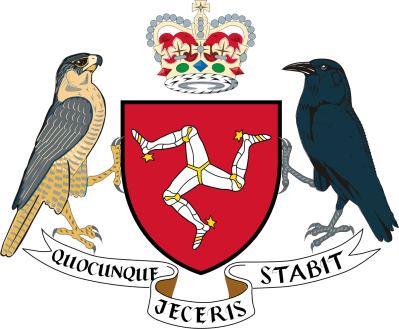
Manx Coat of Arms of the Isle of Man ©WikiC

Manx Coat of Arms of the Isle of Man ©WikiC

Before appreciating some details about these two noble birds, the Raven and the Peregrine Falcon, it might help to gain a glimpse of the turbulent times that the Isle of Man has seen, centuries ago, when Vikings sailed the Irish Sea (and many seas beyond!) – and used the Isle of man as a staging ground for their naval adventures.

One illustration involves the tourney on the high seas, in AD1156, between a Norse-Manx Viking king, named Somerled (an ancestor of Dr. Bill Cooper), and his arch-foe, Godred.

“Godred … [alarmed that Somerled’s son was installed as ruler of the Isle of Man] hurriedly got ready a fleet and sailed north against the forces of Somerled. It was high time for Somerled to do something about Godred [so Somerled] collected a large fleet of eighty [80!] longships and sailed out to confront his enemy. The story that follows incites our admiration for the impressive seamanship of both kings, and the seaworthiness of their ships. The battle took place at night, in the dead of winter, in the open ocean somewhere off the coasts of Islay, on the 5-6 of January 1156. How they managed to manoeuvre under oars (no sails were used during battle), in darkness, in wild winter seas, without most of their ships colliding or foundering, was a miracle. It must have been a titanic struggle and the Chronicle of Man describes the terrible slaughter which ensued. By dawn both sides were exhausted, neither having won, so they agreed to make peace and divided up the sea kingdom between them, in a rather awkward division. Godred retained [the Isle of] Man and the islands to the north of the Ardnamurchan peninsula [of Scotland], while Somerled kept all the islands to the south including Kintyre, which was still class as an island [it being largely coastland].” (Quoting from Kathleen MacPhee’s Somerled, Hammer of the Norse (Glascow: Neil Wilson Publishing, 2004), pages 80-82, as quoted within “DNA says Manx King, Somerled, the Celebrated Founding Father of Scottish Clans, had a “Norse” Patrilinear Ancestry !”, posted at Somerled Family History.

In short, Viking sea battles were not an adventure for the faint of heart.  But, one might wonder:  who cares today about such people nowadays?

In other words:  why would we care about some Viking king (of the Isle of Man), who lived and adventured some 800 or 900 years ago?  Has that Norse-Manx Viking’s life impacted your life or mine, at all, in any kind of meaningful way?

The answer, if you read or speak English, is both simple and surprising:  as a direct ancestor of the King James who sponsored the Holy Bible in English translation, King Somerled’s biogenetic footprint has impacted our world–to God’s glory and our benefit–in a permanent and indispensable way.

Consider the following descent from King Somerled and Queen Ragnhild. Then try to imagine the big-picture providence of God, interacting through space and time … producing uncountable effects from the resultant galaxies of Great Commission “destiny dominoes”, all around the world, especially from AD1066 to AD1611 and beyond.…

P1 Somerled & wife Ragnhild begat Angus Somerledsson (F1);

F1 Angus Somerledsson & wife Ragnhild of the Isles begat James (F2);

F2 James & wife (whose name is lost) begat Jean (F3);

F3 Jean & husband Alexander 4th High Steward begat James 5th High Steward (F4);

F4 James 5th High Steward & wife Cecilia begat Walter 6th High Steward (F5);

F5 Walter 6th High Steward & wife Marjorie begat Scotland’s king Robert II (F6);

F6 Robert II & first wife Elizabeth Mure begat John l/k/a Scotland’s king Robert III (F7);

F7 Robert III & wife Annabella Drummond begat Scotland’s king James I (F8);

F8 James I & wife Joan Beaufort8 begat Scotland’s king James II (F9);

F9 James II & wife Mary of Gueldres begat Scotland’s king James III (F10);

F10 James III & wife Margaret of Denmark begat Scotland’s king James IV (F11);

F11 James IV & wife Margaret Tudor begat Scotland’s king James V (F12);

F12 James V & wife Mary of Guise begat Scottish queen Mary Queen of Scots (F13);

F13 Mary Queen of Scots & Lord Darnley begat James VI (F14, of the “King James” Bible)!

Thus, the “King James” of Great Britain (simultaneously “James VI” as Scotland’s king, and “James I” as England’s king), who authorized what became famous as the “King James Bible”, was an F14 descendant of Viking King Somerled and his wife, Queen Ragnhild. (This impacts the whole world!)

  •    The Holy Bible is the most-published and most-sold book of all time, with more than 6,000,000,000 copies (excluding mere portions, which in aggregate would further increase the statistics).
  •    Of the 6 billion copies of the Holy Bible [more than 2 billion of which were distributed by the GIDEONS INTERNATIONAL, as of AD2015!], the most-published and most-sold version of the Bible is the English translation known as the “King James Bible” (a/k/a “King James Version” and the “Authorized Version”).
  •    The largest amount of Bible-based missionary work, missionary literature, and Biblical education around the world, since the time of Christ, has been provided in English (e.g., from British missionaries, American missionaries, etc.)….”   [Quoting from “To Globally Sow His Word, Did God Use Vikings?”.]

In other words, Somerled’s family lineage was indispensable, 14 generations after, for the procreative arrival – in God’s providence – of the man whom history knows as KING JAMES of the King James Bible!

How many lives do you know, personally, who have been blessed by the English translation of the Holy Bible that we today call the King James Bible?  As you think of the answer to that question, consider also that God providentially protected the life of Norse-Manx Viking, named Somerled, in order that there would be – half a millennium later – a baby boy born in Edinburgh, Scotland (in a room that my wife and I visited, during AD2002), who would grow up – by God’s grace – to be King James VI (of Scotland) and also King James I (of England)!


Now back to the birds, starting with the Northern Raven.

Northern Raven (Corvus corax) by Kent Nickell

Northern/Common Raven (Corvus corax) by Kent Nickell

COMMON  RAVEN  a/k/a  NORTHERN RAVEN  (Corvus corax).

Ravens are repeatedly mentioned in Scripture; they are even mentioned once by Jesus Himself (Luke 12:24).  What a beautiful bird, the Raven! – its monochrome plumage is iridescent black, appearing as glossy bluish-purple when sunlight reflects off the feathers (see Song of Solomon 5:11).  Its omnivorous appetite matches its name:  ravens are ravenous (Job 38:41; Proverbs 30:17)!   Ravens eat small mammals, carrion (with its associated maggots and carrion beetles), small invertebrates (including roadkill invertebrates, such as dead grasshoppers and other bugs), amphibians, reptiles, bird eggs, human garbage (especially food with fat in it), —  as well as plant food (such as agricultural grains) — whatever!  Ravens are also infamous as “kleptoparasites” (prey thieves), i.e., they steal food from other carnivorous/omnivorous predators, such as grey wolf-kills in winter. Garbage dumps and landfills are special attractions — raven smörgåsbords!
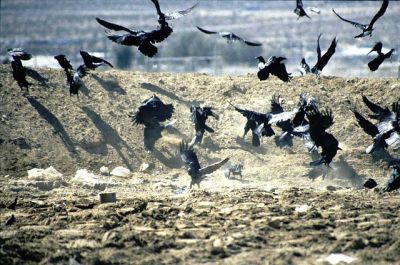
Common Ravens Feeding At Landfill ©WikiC

Common Ravens Feeding At Landfill ©WikiC

The historic role of a raven who survived the worldwide Flood with Noah’s family is recounted in Scripture (see Genesis 8:7).  Ravens, ironically, were directed by God to feed the prophet Elijah (compare 1st Kings 17:4-6 with Luke 12:24).

The name “Common Raven” is not an exaggeration, because ravens  are known to live in virtually all of the Northern Hemisphere (see range map below).
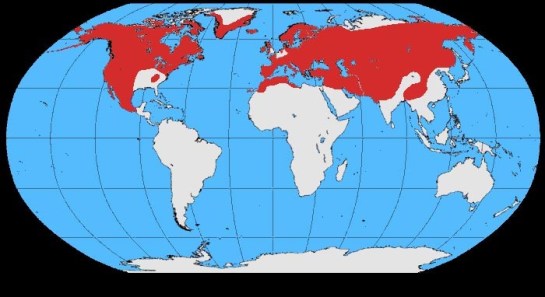
Corvus_corax_map ©WikiC

The Raven is a corvid – a term that simply means “crow-like” – like its close cousins:  rooks, jays, carrion crows (and other crows), choughs, jackdaws, etc.  [See generally Lee Dusing’s “Crows, Jays, Ravens – Corvidae Family”.]

Ravens are well known for various behavior habits, including their harsh crow-like vocalizations (Job 38:41).
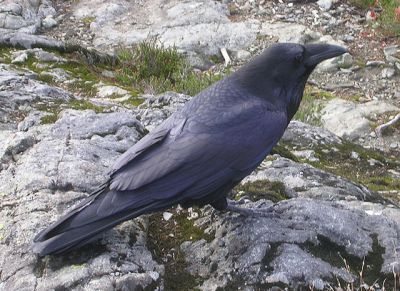
Common Raven at Cypress Provincial Park, British Columbia ©WikiC

Common Raven at Cypress Provincial Park, British Columbia ©WikiC

The Common Raven (Northern Raven) appears in various localized “subspecies”, based upon geographically localized population forms:  (1) the paradigmatic European Raven (Corvus corax corax), ranging over and beyond continental Europe; (2) the Icelandic-Faeroese Raven (Corvus corax varius), somewhat smaller and less glossy than the European Raven; (3) the Southwest Asia Raven (Corvus corax subcorax), ranging from Greece to India, and parts of western China; (4) the North Africa Raven (Corvus corax tingitanus), ranging in North Africa and the Canary Islands, with the Canary Islands variety being somewhat browner in color; (5) the Himalayan Raven (Corvus corax tibetanus), the largest and glossiest subspecies, ranging in Tibet and other regions of the Himalayan Mountains; (6) the Northeastern Asia Raven (Corvus corax kamtschaticus), thicker-billed than the European Raven, ranging from northeastern Asia into the Baikal region; (7) North American Raven (Corvus corax principalis, a/k/a “Northern Raven” — which is confusing because both the species and this subspecies are known as “Northern Raven”), close cousins to those of Europe, according to mitochondrial DNA studies, these corvids range all over North America and Greenland, having the thickest bill of any Common Raven subspecies; (8) the Western Raven (Corvus corax  sinuatus), ranging in south-central America and Mesoamerica.   The term “Northern Raven” is better used for the species (i.e., the “Common Raven”) that encompasses all of these subspecies, because all of these subspecies reside in the Northern Hemisphere  —  so they are all “Northern” Ravens.

Also, it is worth mentioning that a football-playing variant (of “Ravens”) is famous in Maryland (on the East Coast of America), the “Baltimore Ravens” (see picture below  —  yet please notice that the Baltimore Ravens are not the kind of ravens who are mentioned in Luke 21:24 – see Hidden Assumptions Play ‘Hide Seek’ !

Baltimore Ravens - Bleacherreport

Regarding Ravens, the husband-wife ornithologist team of Donald and Lillian Stokes have observed their wariness of humans:

“The raven is … extremely wary of humans, spotting you form almost as far as half a mile away as you approach a nest, and then flying up and calling at your approach. … [so] studying ravens is best done through a scope or powerful binoculars….”  [Quoting from Donald Stokes & Lillian Stokes, GUIDE TO BIRD BEHAVIOR, Volume 3 (Little, Brown & Company, 1989), page 299.]
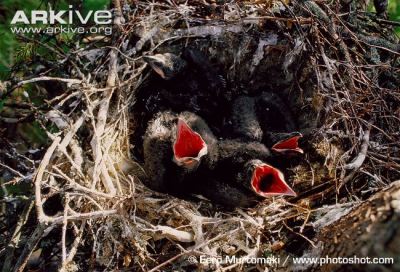
ravens_2

Raven Chicks

Raven Chicks

Ravens build a nest for their young, as most birds do.  The behavior of the parent birds gives a clue as to when their eggs are being incubated, in expectation of hatching, according to the observations of the Stokes duo:

“One clue to incubation’s having started is seeing only one raven soaring above the nest.  That would generally be the male since the incubating female spends most of her time on the eggs.  During incubation, the male brings food to the female and gives it to her at the nest or nearby.  When the female is about to receive the food she may flutter her wings close to her body and give the Kra-kra-call.  … When the male is not actively hunting for food for himself or the female, he is usually perched near the nest on a dead branch or ledge. The female occasionally leaves he nest, at which time the male may come to the nest, but he does not actually incubate the eggs.”  [Quoting from Stokes & Stokes, GUIDE TO BIRD BEHAVIOR, Volume 3, page 307.]

The nestling phase in the Raven family’s life cycle has been observed, with one activity making it easier to recognize where a raven nest is raising young:

“The young hatch over a period of a day or two.  The female eats the shells [a good source of calcium!] and broods the young for about two and a half weeks.  During this time the male does most of the feeding; after that, both parents participate in feeding the young.  During the first weeks of intensive brooding, when the female takes periodic leaves, the male stays near or on the nest until she returns.  The parents at first bring small food items for the young, picking the items apart before offering them to the young.  Later in the nestling phase larger food items are left at the nest and the young pull them apart to eat.  The parents may also come to the nest with water in their crops, which is then fed to the young.  On cold days the young are buried in the nest lining for warmth; on hot days the female may wet her underfeathers and cover the young to give them relief from the heat.  The young lift their tails as they defecate over the rim of the nest [there being no in-house plumbing accommodations!].  The nest rim or cliff ledge can have large white stains resulting from this behavior; the stains may help you locate the nest.  The young may fledge over a period of days.”  [Quoting from Stokes & Stokes, GUIDE TO BIRD BEHAVIOR, Volume 3, page 308.]]
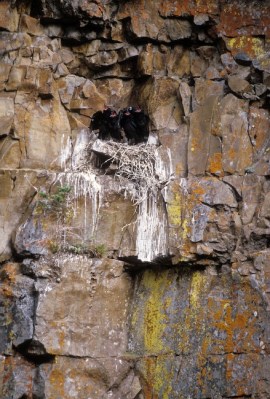
But now let us consider the other bird supporting the Manx coat-of-arms, the Peregrine Falcon.

Peregrine Falcon (Falco peregrinus) by Ray

Peregrine Falcon (Falco peregrinus) by Ray

PEREGRINE  FALCON  (Falco peregrinus).

The Peregrine Falcon (also called the “Peregrine”) is dominated by bluish-grey plumage, with a pale underside (barred white), and a slate-black head.  Its eyes are large, for hunting prey, and its pale-yellow beak is strong, with a shape convenient for its carnivorous lifestyle – so it can tear into its diet of

True to its name (“peregrine” meaning “wanderer”, “sojourner”, one that goes through/throughout the land), the Peregrine’s range is worldwide [see range map below: yellow = summer breeding migrant range; green = year-round breeding; indigo blue = winter migrant range; Carolina blue = migrant passage range].
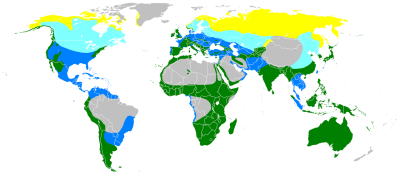
Peregrine Falcon Map ©WikiC

Peregrine Falcon Map ©WikiC

The Peregrine Falcon appears in about 20 various localized “subspecies”, based upon geographically localized population forms [see range map below, showing subspecies].
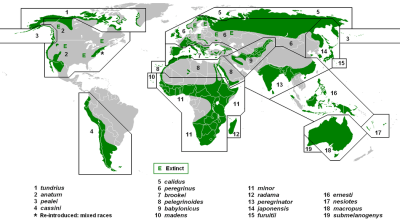
Breeding ranges of the subspecies of Peregrine Falcons ©WikiC

Breeding ranges of the subspecies of Peregrine Falcons ©WikiC

Six of those Peregrine subspecies are:  (1) the paradigmatic Eurasian Peregrine Falcon (Falco peregrinus peregrinus), ranging throughout all of Europe, except for its Mediterranean Sea coastlands and the Iberian Peninsula, extending eastward through Siberia, except not its Arctic Ocean coastlands; (2) the once-endangered Arctic Peregrine Falcon (Falco peregrinus tundris), ranging in the tundras of northern Alaska, northern Canada, and Greenland; (3) the once-endangered American Peregrine Falcon (Falco peregrinus anatum, a/k/a “Duck Hawk”), ranging throughout all of North America, except the Arctic coastlands habituated by its Arctic cousin – although its main population clustering is in the Rocky Mountains regions.  (However, Peregrine Falcons are making a “comeback” outside the Rockies, including revived populations in municipalities where they often prey on urban pigeons.)  The Mediterranean Sea coastlands, as well as all of Spain and Portugal, are habituated by the Mediterranean Peregrine Falcon (Falco peregrinus brookei).  The endangered close cousin of the Peregrine, in America, is the Northern Aplomado Falcon (Falco femoralis septentrionalis).

Peregrine Falcon in Flight by Ray

Peregrine Falcon in Flight by Ray

The Peregrine Falcon typically lives in coastal lands, river valleys, and in mountain ranges – yet urban skyscrapers are deemed montane “cliffs” for these birds of prey, so don’t be shocked when you see a falcon “dive-bomb” (and kill, in midair) a pigeon, in the air between city office buildings or high-rise apartments.

Fair Use image credit peregrinefalcon

The typical nesting behavior of American Peregrine Falcons has been described as  “… on cliff ledges [near to] open habitats from tundra, savanna [grassland], and seacoasts to high mountains, on which the falcon makes a well-formed scrape in piled debris …  [sometimes using] abandoned tree nests or cavities  … [or, in urban contexts] on ledges of tall buildings and bridges”.  [Quoting Paul R. Ehrlich, David S. Dobkin, & Darryl Wheye, BIRDS IN JEOPARDY (Stanford University Press, 1992), page 48.]

Peregrine Falcon by ©©Weebly Uploads

Peregrine Falcon by ©©Weebly Uploads

The American Peregrine Falcon’s diet is quite a mixed bag:  “Birds, particularly doves and [other] pigeons, but also waterfowl [especially ducks], shorebirds, and passerines [i.e., perching songbirds, such as European Starlings] … [chasing and catching] prey in midair, dropping on flying birds from above and killing them in flight with a blow from their feet…. [sometimes involving speeds of] 60 miles per hour, in a [closed-wings] stoop on prey it can reach speeds exceeding 200 miles per hour”.  [Again quoting Ehrlich, Dobkin, & Wheye, BIRDS IN JEOPARDY, at page 48.]

In cities a Peregrine’s diet might consist 80% of mourning doves and pigeons.  Other avian fare (i.e., birds eaten as prey) include icterids (such as grackles and other blackbirds), thrushes (such as American robins), swifts, and other corvids (such as crows).  However, when available, Peregrines will also eat small rodents, such as mice, rats, voles, squirrels – or other small mammals such as shrews or rabbits (or sometimes even bats, at night!).
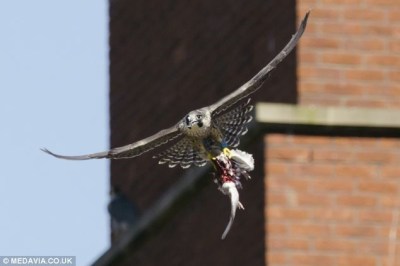
Peregrine Falcon (with doomed Pigeon in the falcon’s talons) ©DailyMail

Peregrine Falcon (with doomed Pigeon in the falcon’s talons)

The flying abilities of Peregrine Falcons are almost legendary – they fly “with shallow elastic wingbeats in which [wing] tips [are] very springy (characteristic of the larger falcons)”.  [Quoting Lars Jonsson, BIRDS OF EUROPE (Princeton University Press, 1992; translated by David Christie), page 160.]

And true to their name, they wander – they range to wherever they need to go.

Peregrine Falcoln ©Images Inc

Peregrine Falcoln ©Images Inc

Lessons for the Journey, as We “Hike” on our Earthly Pilgrimage

So, as “pilgrims” awaiting our future citizenship, in the Kingdom that is not yet here (Philippians 3:20) how should we approach our sometimes-stormy future – which mixes furies, frustrations, and failings with hopes, helps, and hallelujahs?

Thy statutes have been my songs in the house of my pilgrimage. (Psalm 119:54)

In other words, Jesus put a song in my heart!

Stormy weather or calm, I can be (and should be) at least as brave as a Manx Viking rowing in a rainstorm, tossed up and down, from side to side, in the cold salt-spray of the Irish Sea.
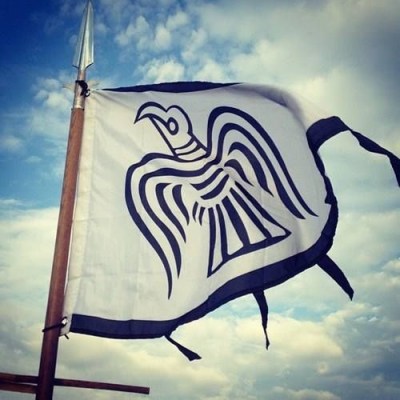
Pennant ©Pinimg.Com
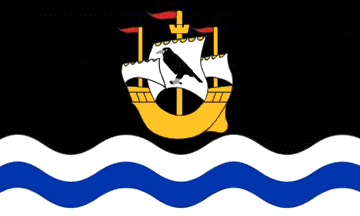
Pennant ©Pinimg.Com

Mainsail ©crwflags.com

Mainsail ©crwflags.com

Just as the resilient and resourceful Nordic seamen of old, including ancient Norse-Manx Vikings (and their biogenetic progeny, including sjøfolk that sail the Seven Seas today) strove to stay afloat  — till they rhed their destined safe-haven — let us “labor at the oars” of (this) life, until God brings us securely Home (see  http://www.icr.org/article/why-we-want-go-home  ).

It is good to keep in mind that God Himself is our only real Home.  Meanwhile, He can guide and keep us, on the stormy seas of this temporal life, until it’s “our turn” to enter into His holy and happy presence, with everlasting joy.    ><> JJSJ

*

*

Lord’s Avian Wonders – Little Blue Heron – Searching

Little Blue Heron searching at S Lk Howard Park crop

Recently we were on our way home from shopping and stopped in the little park at the south side of Lake Howard. All we had with us were our phones. Not much was going on, but one Little Blue Heron was searching for his lunch. It was interesting watching him move his head from side to side. Not sure if the bird was looking around the plants or just trying to see better. It was an overcast day. Our special Avian Wonder this time from the creator is this Little Blue Heron.

The “Little Blues,” as I many times refer to them, are another favorite of mine to watch here in central Florida. This one just seemed so intent on what he was doing, that it reminded me of the verse about the lady who was diligently searching for a coin. How diligently do we search God’s Word?

Either what woman having ten pieces of silver, if she lose one piece, doth not light a candle, and sweep the house, and seek diligently till she find it? (Luke 15:8 KJV)

And you will seek Me and find Me, when you search for Me with all your heart. (Jeremiah 29:13 NKJV)

Little Blue Heron with catch at S. Lake Howard Park

Little Blue Heron with catch at S. Lake Howard Park

Bad photo, but you can see the results of one of his searches.

The Little Blue Heron “stalks its prey methodically in shallow water, often running as it does so. It eats fish, frogs, crustaceans, small rodents and insects.” (Wikipedia)

Find out more about them at:

Is There A God?

*