Ian’s Bird of the Week – Cinerous/Eurasian Vulture

Ian’s Bird of the Week – Cinereous/Eurasian Vulture ~ by Ian Montgomery

Newsletter ~ 10-28-14

This is 2 of 3 in a series on Eurasian vultures photographed during my recent spell in a bird hide at a vulture feeding station in Boumort National Reserve in the Pyrenees in Catalonia not far southwest of Andorra. The first of the series was on the Griffon Vulture (see http://www.birdway.com.au/accipitridae/griffon_vulture/index.htm where I’ve put a dozen photos), this one is on the second species in the feeding order, the Cinereous or Eurasian Black Vulture. Here, incidentally, is the view taken from the hide – with my phone! – shortly after the rangers had left and the first one hundred or so Griffons, and a few Common Ravens, were in the process of arriving.

From Blind at Boumort National Reserve by Ian

From Blind at Boumort National Reserve by Ian

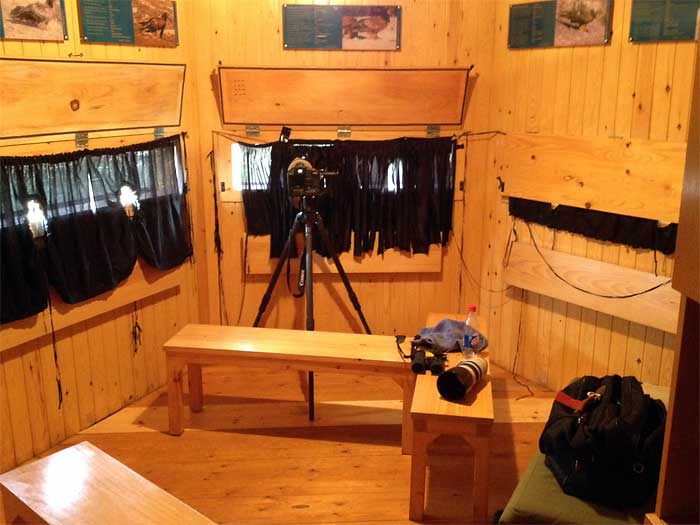
Because of the wide-angled nature of phone cameras, the vultures appeared in real-life to be much closer, close enough for one bird to almost fill the frame of a full-size (35mm sensor) DSLR with a 500mm lens. The second photo shows the luxurious and well-appointed hide (I mentioned the toilet last week) with my camera and 500mm lens set up on my tripod and my binoculars and smaller 100-400mm lens at the ready. I was on my own for the whole day, so I could move freely between the three viewing openings. The one in the middle overlooked the feeding site (above), the one on the left was good for photographing landing vultures using the 100-400mm lens, while the one on the right overlooked a pond, used by the vultures on a hot day. It was cool and overcast when I was there and rained a bit, so the only vulture I saw at the pond was a Griffon having a drink.
Blind at Boumort National Reserve by Ian

Blind at Boumort National Reserve by Ian

It’s impossible to travel lightly with good gear for wildlife photography – the tripod along required taking a larger suitcase than both I and airlines prefer – but on that day in the hide and on an earlier occasion when I was photographing Crab Plovers in Dubai, I was really glad to have to have brought the necessary stuff with me. Anyway, back to the Cinereous Vulture. In the days when birders weren’t inter-continental travellers, it was called the Black Vulture until it was realised that this risked confusion with the completely unrelated Black Vulture of Central and South America and the ‘Eurasian’ label was applied. Now BirdLIfe International call it the Cinereous Vulture, ‘cinereous’ meaning ‘ashy’, like the adult in the third photo, which certainly looks as it has been rummaging around in the remains of a camp fire.

Cinereous Vulture (Aegypius monachus) by IanThis bird shows the typical vulture ruff, with the cowl-like adornment characteristic of this species. The specific name monachus means ‘hooded’ but the common name Hooded Vulture is already used for another somewhat similar, sub-Saharan species, Necrosyrtes monachus. Juvenile birds are much darker, dark chocolate really, like the slightly scruffy one in the fourth photo. Some field guides say that juvenile birds have pink facial skin – like this one – but I couldn’t find a clear correlation between age and skin colour: some adults had mainly blue, others more pink skin, which made me wonder whether it was influenced by gender. All the Cinereous Vultures here had metallic identifying rings/bands and some, particularly juveniles had coloured bands as well. This is because the species has recently been re-introduced to this area from central Spain, is now breeding and the population is being studied thoroughly.

Cinereous Vulture (Aegypius monachus) by IanThe Cinereous Vultures took their time and started arrived at the feeding site about an hour after the Griffons. As you can guess from the relative amounts of plumage on the heads and necks of the two species, they have quite different feeding habits. Griffons clearly don’t mind getting up to their elbows in it, so to speak, but the Cinereous Vultures prefer to wait until the dirty work has been done and then pick up their favourite morsels. Their reluctance to get involved in the initial scrum has nothing to do with size or dominance, the Cinereous Vultures are as large or larger than the Griffons and are quite dominant. The bird in the fifth photo has a feeding juvenile Griffon it its sights and is advancing threateningly in a manner that was wonderful to watch, head down, wings spread and ruff and cowl feathers erect with a bouncing walk. The result was something like the witches from Macbeth combined with the loping gait of a kangaroo.
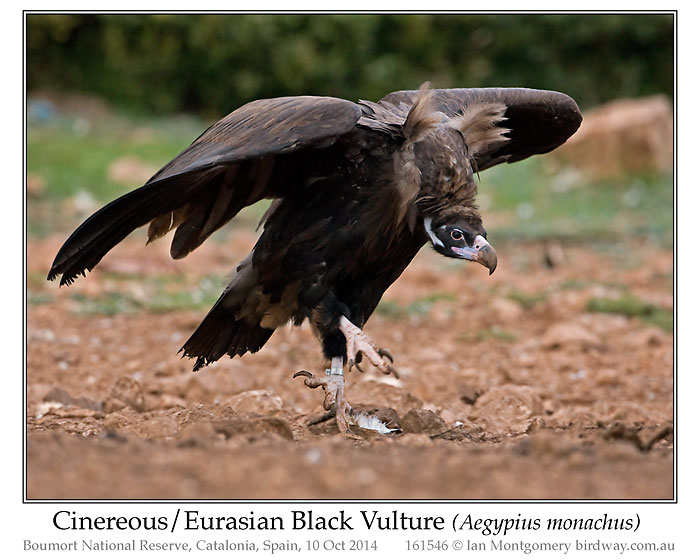
Cinereous Vulture (Aegypius monachus) by IanIt might look funny to us, but it was very effective and the Griffons, unamused, backed off, like the frustrated-looking one in the sixth photo. Cinereous Vultures have strong bills and can tackle, tendons, muscles and, by the look of the one in this photo, skulls. Maybe cervelles are on the menu. (I once understood cervelles d’agneau on a Parisian menu to be something to do with lamb and was slightly taken aback when brains, rather than a chop, appeared in front of me.)
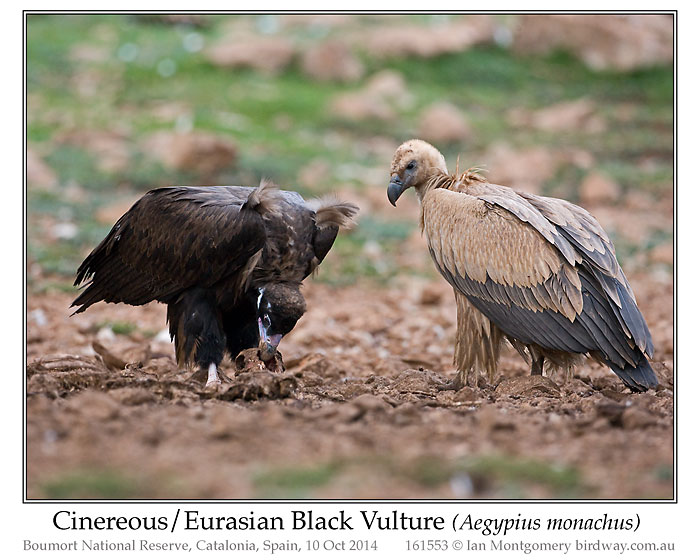
Cinereous Vulture (Aegypius monachus) by IanThe Cinereous Vultures were the least volatile of the three species and once having landed, hung around for hours. I didn’t get photos of any in flight, but I didn’t find them easy to separate from the Griffons in flight as they’re silhouettes are rather similar. The Griffons kept landing and talking off and were better targets and more numerous. In total, there may have been 10-20 Cinereous Vultures. Their reintroduction here is part of a more general EU conservation and anti-poisoning program that has seen the population in Spain recover from 290 pairs in 1984 to perhaps 2500 now and they have been reintroduced into southern France. The conservation news isn’t all good, though to say the least, and I’ll return to this topic in the third in this series.

Cinereous Vulture (Aegypius monachus) by IanPart of the research effort at Boumort is the study of the movements of these vultures. Adults are thought to be mainly sedentary in Europe, though partially migratory in Asia, where it also occurs. Some banded Spanish birds have turned up in sub-Saharan Africa. Some birds have been fitted with GPS units, and you can see one, complete with solar cell on the back of the juvenile in the last photo.

I mentioned the unrelated Black Vulture of the Americas, one of the New World Vultures. These include the Turkey Vulture, familiar in North America, the Condors and a couple of other species places in a separate family, the Cathartidae http://www.birdway.com.au/cathartidae/index.htm. In fact Birdlife International put them in their own order, the Cathartiformes, indicating that they arose completely independently. The Old World Vultures, on the other hand, are close related to hawks, eagles, etc. and are placed in the same family Acciptridae in the order Acciptriformes. I must admit I was struck by the eagle-like facial appearance of these birds and it appears that the Old World Vultures have developed twice within the Acciptridae. Most belong to a group of typical Old World vultures that includes the Griffon and the Cinereous. Three, however, form a separate group placed taxonomically near the Serpent Eagles. One of these is the subject of the next edition. The vultures kept me waiting in suspense for crowning moment, and I’m trying to make you share the anticipation: I have something really special for the next bird of the week!

Greetings
Ian

**************************************************
Ian Montgomery, Birdway Pty Ltd,
454 Forestry Road, Bluewater, Qld 4818
Tel 0411 602 737 ian@birdway.com.au
Bird Photos http://www.birdway.com.au/
Where to Find Birds in Northern Queensland: iTunes; Google Play
Recorder Society http://www.nqrs.org.au


Lee’s Addition:

But these are the ones that you shall not eat: the eagle, the bearded vulture, the black vulture, (Deuteronomy 14:12 ESV)

And when birds of prey came down on the carcasses, Abram drove them away. (Genesis 15:11 ESV)

What a blind! When Ian go out photographing, he goes all the way. I always enjoy his adventures. Vultures are a favorite of mine, but the Lord created them and gave them a job to do. What would the world look like if they didn’t come down and clear up carcasses.

Again, these Vultures are members of the Accipitridae – Kites, Hawks and Eagles Family. I like that fifth photo with that pose of his. Especially with Halloween just around the corner.

See Ian’s 1st article from Boumort National Reserve

Ian’s Bird of the Week

Accipitridae Family – Birdway (Ian’s site)

Cathartidae Family – Birdway (Ian’s site)

Accipitridae – Kites, Hawks and Eagles

Cathartidae – New World Vultures

*
(Edited)

Sunday Inspiration – Hawks

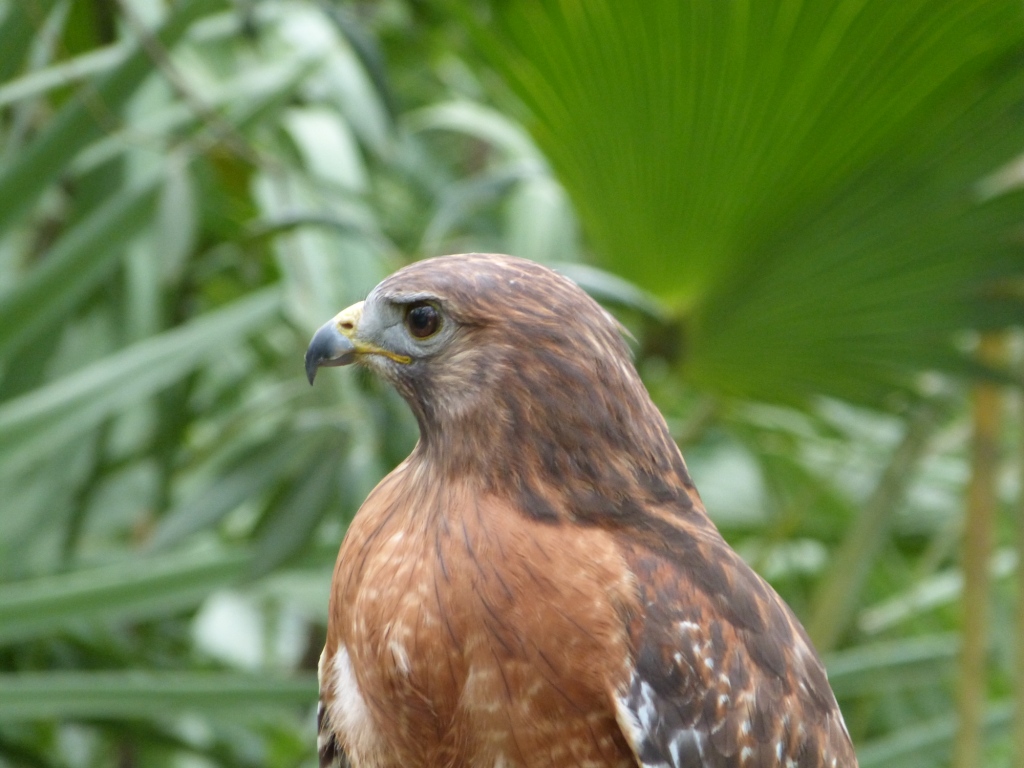
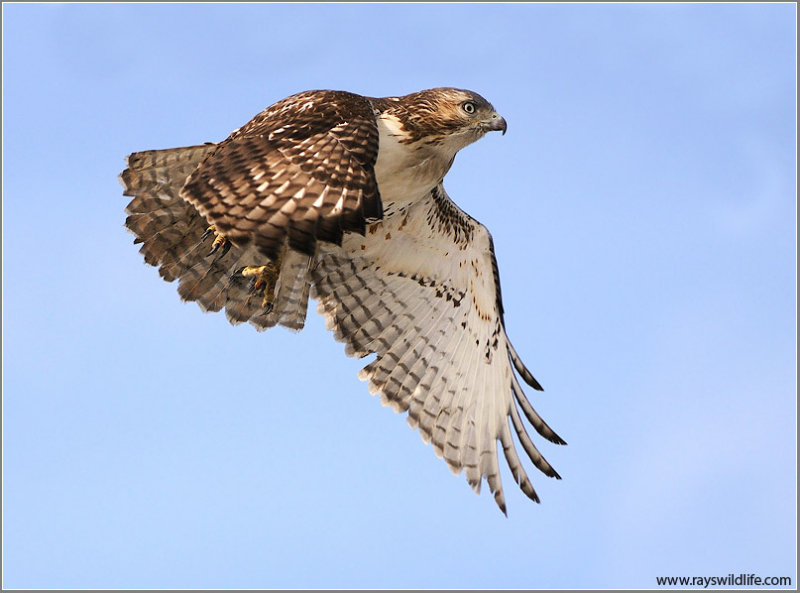
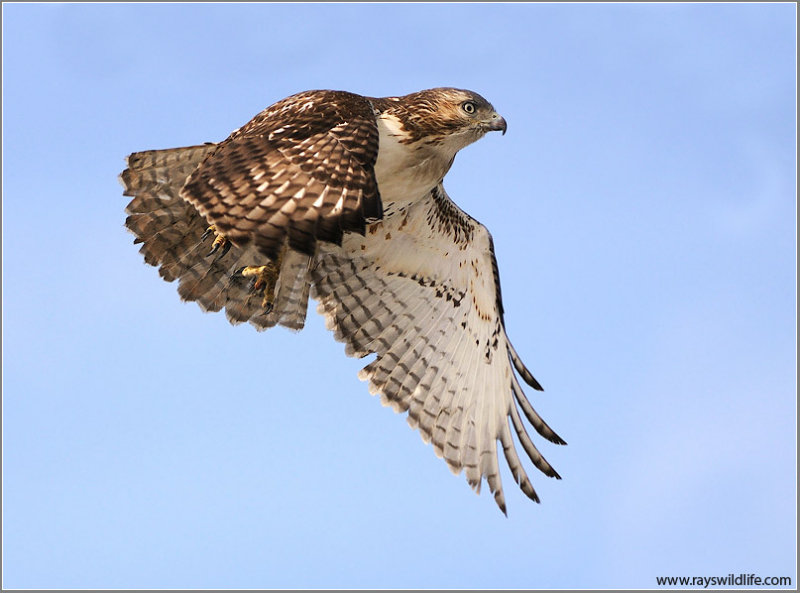
Red-tailed Hawk (Buteo jamaicensis) by Raymond Barlow

Red-tailed Hawk (Buteo jamaicensis) by Raymond Barlow

Does the hawk fly by your wisdom, And spread its wings toward the south? (Job 39:26 NKJV)

Hawks are members of the Accipitridae Family which includes the Hawks, Kites, Eagles, Vultures, plus Buzzards and other Birds of Prey. There are 256 species in the family. There are 3 or 4 references to hawks and their kinds in the Bible. Therefore they are also a Bird of the Bird.

Even though they catch live animals and are considered a bird of prey, they are beautiful creations from our Creator. Until the curse they would have been vegetarian like all the rest of creation. Unfortunately, sin entered, and now some look down on hawks, but even in that, the Lord provided for them to have the capability to catch prey as they do today.

Enjoy viewing these beautiful birds from their creator, the Lord Jesus Christ.
*

This slideshow requires JavaScript.

Does the hawk fly by your wisdom, And spread its wings toward the south? (Job 39:26 NKJV)

“I Will Pilot Thee” ~ by Dr. Richard Gregory

*

Sunday Inspirations

Birds of the Bible

Accipitridae – Kites, Hawks & Eagles Family

Hope for Hard Times

*

Birds of the Bible – Maturing Eagle

Bald Eagle (Haliaeetus leucocephalus) Jax Zoo by Lee

Bald Eagle (Haliaeetus leucocephalus) Maturing at Jax Zoo by Lee

Bless the LORD, O my soul: and all that is within me, bless his holy name. Bless the LORD, O my soul, and forget not all his benefits: Who forgiveth all thine iniquities; who healeth all thy diseases; Who redeemeth thy life from destruction; who crowneth thee with lovingkindness and tender mercies; Who satisfieth thy mouth with good things; so that thy youth is renewed like the eagle’s. (Psalms 103:1-5 KJV)

Last week at the Jacksonville Zoo, we saw this “rag-tag” Eagle. We found out that he is around five years old and has been going through his transition. They said that in the last two weeks he has really started to change. As you may know, Bald Eagles get their “bald” head when they mature. I have seen Eagles with an all black heads and the all white heads, but never in the process of maturing. I am glad that we were able to see him in this stage of his life.

Now for a much better photo by Dan:

Bald Eagle maturing at Jax Zoo by Dan

Bald Eagle maturing at Jax Zoo by Dan

Actually, it may be a “she.” I forgot to ask. Both male and females get the “bald” head after about five years of so.

The above verse, “so that thy youth is renewed like the eagle’s.” reminds of the Lord’s watch-care of the birds, but more importantly, over us. When I see this eagle, it reminds me of times when we mature as Christians. Sometimes we seem a little “rag-tag” in our development, but as we keep our eyes on the Lord, He helps us mature as we should.

Black-crowned Night Heron (Nycticorax nycticorax) Jax Zoo by Lee

Black-crowned Night Heron (Nycticorax nycticorax) Jax Zoo by Lee

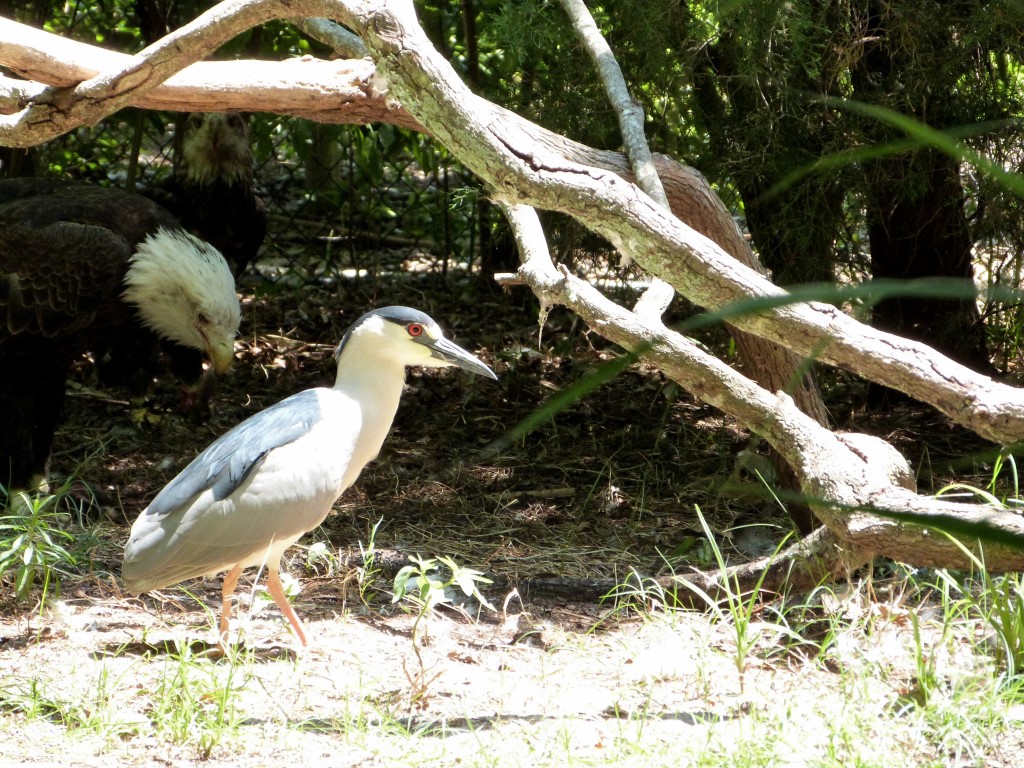
Here are some of the photos we took of the two eagles and a friendly Black-crowned Night-heron that was keeping them company. The Heron was wild and flew out later. These two Eagles were injured and can never return to the wild.

*

Also:

Changed From the Inside Out

*


Birds of the Bible – Buzzards

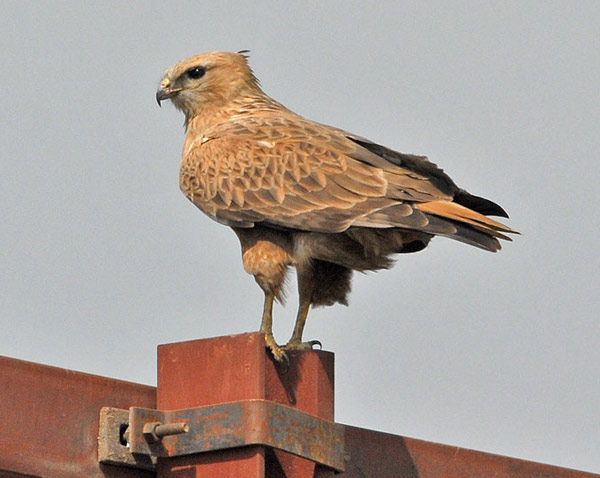
Long-legged Buzzard (Buteo rufinus) by Nikhil Devasar

Long-legged Buzzard (Buteo rufinus) by Nikhil Devasar

But these you shall not eat: the eagle, the vulture, the buzzard, (Deuteronomy 14:12 NKJV)

In Birds of the Bible – How Many Are There? II, the buzzard was mentioned. Also last week, Ian did an article on the Black-breasted Buzzard. Since realizing that this bird, the Buzzard, had not been added to the Birds of the Bible pages, I added a Buzzard and this is the first article about our forgotten avian bird.

Aren’t we glad that the Lord does not forget His Creation?

Look at the birds of the air, for they neither sow nor reap nor gather into barns; yet your heavenly Father feeds them. Are you not of more value than they? (Matthew 6:26 NKJV)

Buzzards belong to the  Accipitridae – Kites, Hawks & Eagles Family and has 28 species in this family with “Buzzard” in their name. Members of this family are known as “Birds of Prey” or “raptors” by many.

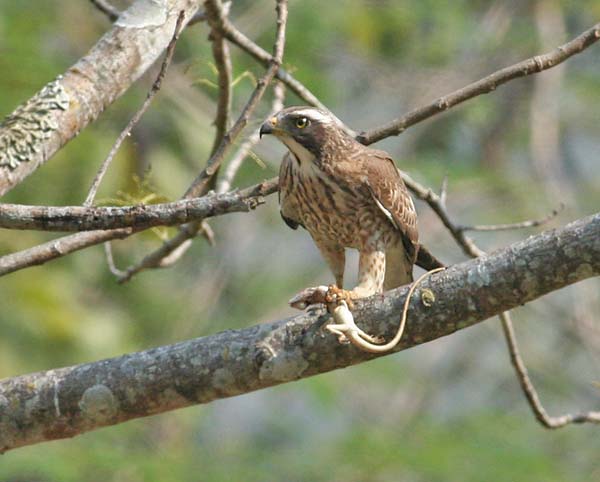
Grey-faced Buzzard (Butastur indicus) by Peter Ericsson

Grey-faced Buzzard (Butastur indicus) by Peter Ericsson

From Britannica “True buzzards, or buteos, constitute the subfamily Buteoninae of the family Accipitridae. When in flight, they can usually be distinguished from other birds of prey by their broad wings and expansive rounded tails. They fly with slow heavy wing beats and soar gracefully. The plumage of most species is essentially dark brown above and white or mottled brown below, and the tail and underside of the wings usually are barred. There is much variability of pigmentation, however, even between individuals of a single species. Buzzards customarily prey on insects and small mammals and only occasionally attack birds. The nest, in a tree or on a cliff, is substantial, built of sticks and lined with softer materials. The two to five whitish eggs are blotched with brown.”

One of several medium-sized, wide-ranging raptors with a robust body and broad wings. In particular, those in the genus Buteo. In the Old World, members of this genus are named as “buzzards”, but “hawk” is more common in North America.

In Europe, the Common Buzzard, Buteo buteo, where Buzzard is often used as a synonym. The Common Buzzard is the most known buzzard in the Old World.

In the New World Buzzard can mean:

  • A vulture, particularly the American Black Vulture and Turkey Vulture, or as a general term for vultures.
  • In parts of the United States where they are considered pest, particularly in rural areas, a derogatory term for certain birds of prey, such as the Chickenhawk (a common colloquial name referring to either the Cooper’s Hawk, the Sharp-shinned Hawk or the Red-tailed Hawk), or the Duck hawk (known elsewhere as the Peregrine Falcon).

Quotes from Britannica and Wikipedia with editing.

Another Bible verse with “buzzard” is in Leviticus:

And these you shall regard as an abomination among the birds; they shall not be eaten, they are an abomination: the eagle, the vulture, the buzzard, (Leviticus 11:13 NKJV)

Both verses, Leviticus 11:13 and Deuteronomy 14:12 are listed in the birds not to be eaten by the Israelites. Considering what they eat, I am in no hurry to eat them either.


See:

*

Birdwatching Adventure – Scrub Jays II

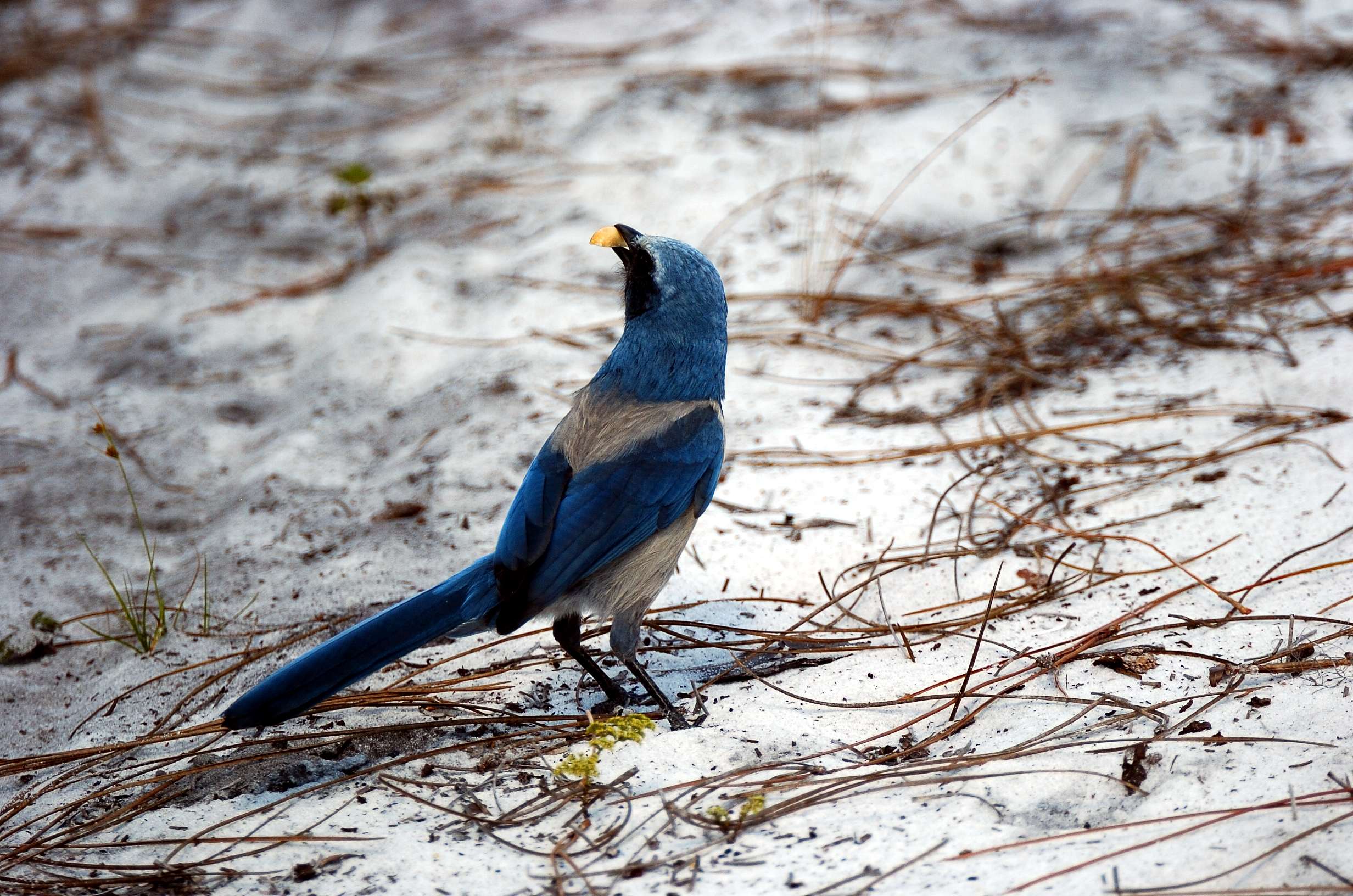
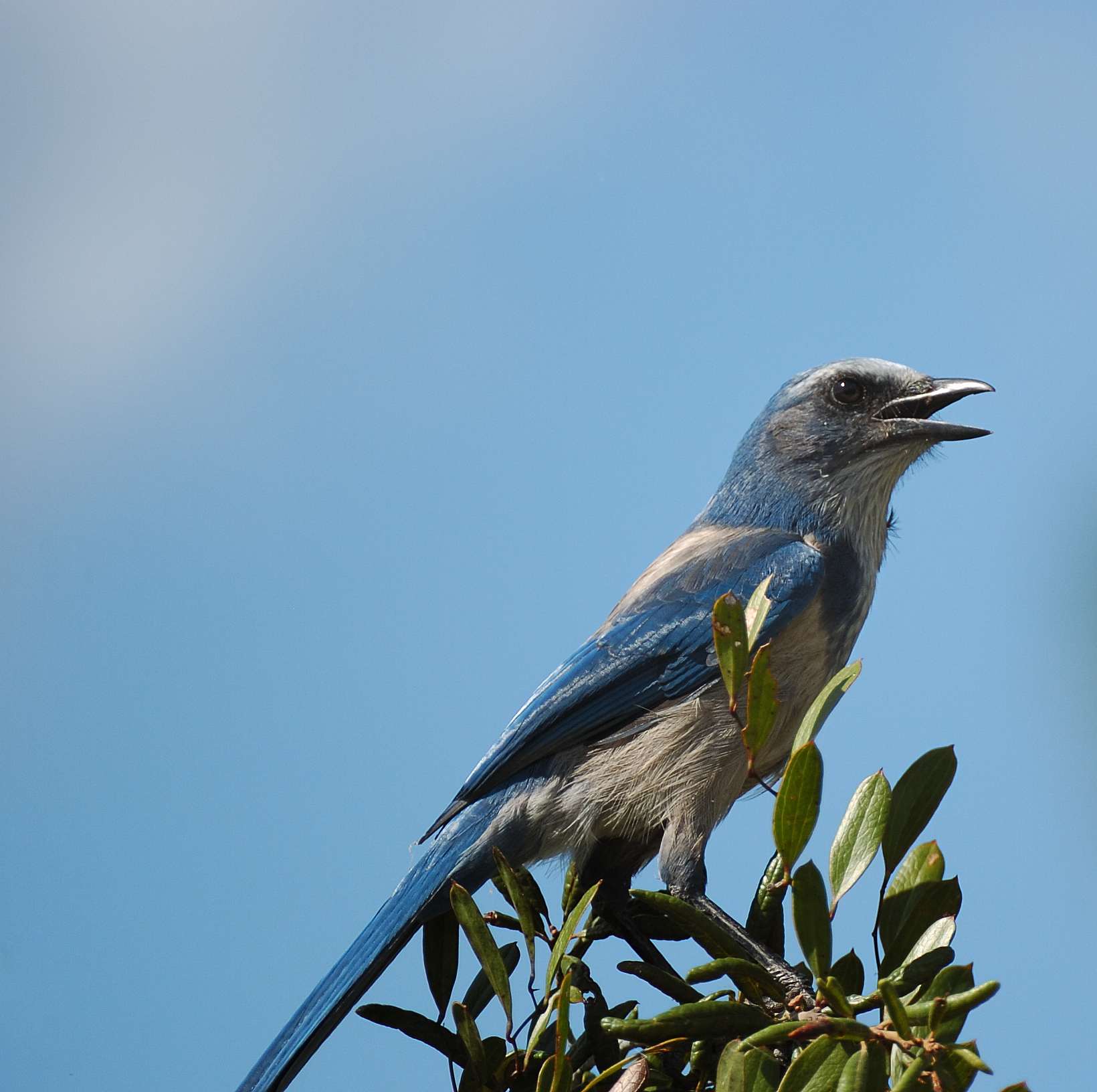
Florida Scrub Jay (Aphelocoma coerulescens)  by Dan

Florida Scrub Jay (Aphelocoma coerulescens) by Dan

Then God said, “Let the waters abound with an abundance of living creatures, and let birds fly above the earth across the face of the firmament of the heavens.” (Genesis 1:20 NKJV)

Now for the good photos from our visit to see the Florida Scrub Jays. Dan shared these that he took.

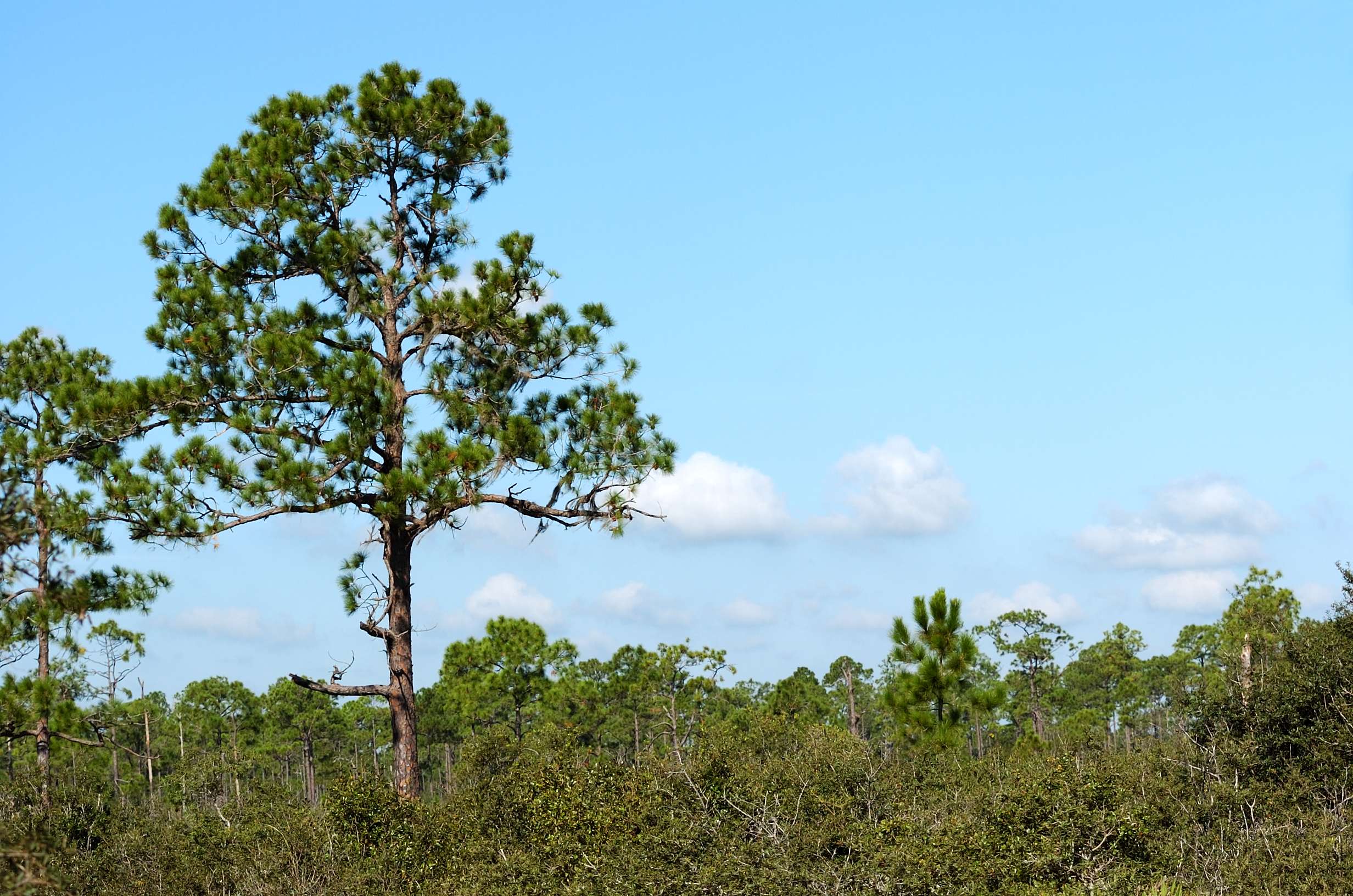
Here is an idea of the “scrub” habitat that the Florida Scrub Jays prefer. They do not like too many trees where Hawks, Eagles or other Birds of Prey can attack them.

Habitat at Lake June-in-Winter SP by Dan

Scrub Habitat at Lake June-in-Winter SP by Dan

They greeted us from a distance at first.

Florida Scrub Jay (Aphelocoma coerulescens) by Dan

Florida Scrub Jay (Aphelocoma coerulescens) by Dan

Then they were more friendly when enticed.

Florida Scrub Jay (Aphelocoma coerulescens) by Dan

Florida Scrub Jay (Aphelocoma coerulescens) by Dan

They are such pretty birds. I sure am glad the Lord has given us so many varieties of avian friends to enjoy.

Florida Scrub Jay (Aphelocoma coerulescens) by Dan

Florida Scrub Jay (Aphelocoma coerulescens) by Dan

Here is another photo from the state parks habitat:

Habitat at State Park by Dan

Habitat at State Park by Dan

These two last photos were his that he photographed through the open window of the Red-Shouldered Hawk at Highlands Hammock State Park. Remember, mine was through plastic.

Red-shouldered Hawk (Buteo lineatus) Highlands Hammock SPk by Dan

Red-shouldered Hawk (Buteo lineatus) Highlands Hammock SPk by Dan

“Does the hawk fly by your wisdom, And spread its wings toward the south? (Job 39:26 NKJV)

Red-shouldered Hawk (Buteo lineatus) Highlands Hammock SPk by Dan

Red-shouldered Hawk (Buteo lineatus) Highlands Hammock SPk by Dan

Trust you have enjoyed seeing these fantastic birds.

*

*

Ian’s Bird of the Week – Swamp Harrier

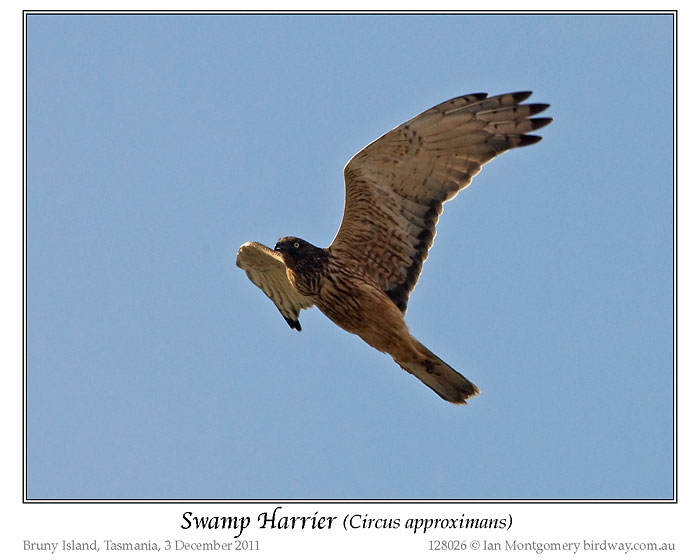
Swamp Harrier (Circus approximans) by Ian

Ian’s Bird of the Week – Swamp Harrier by Ian Montgomery

Newsletter – 9-2-13

Recently I was having trouble finding a reasonable photo of a Swamp Harrier for Where to Find Birds in Northeastern Queensland, when I remembered an encounter that I had with this one on a beach on Bruny Island in Southeastern Tasmania in late 2011. At the time, I was on the return leg of the trip to the Sub-Antarctic Islands via New Zealand and the Harrier photos got neglected in the excitement of posting penguin, petrel, prion and parakeet photos (not to mention albatrosses but they spoil the alliteration).

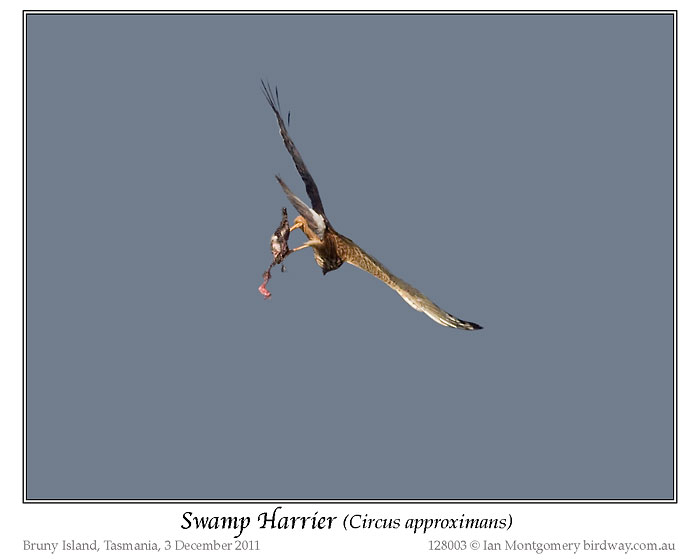
The encounter was the enactment of a minor natural tragedy that was sad to observe, and that may be a subconscious reason for the neglect. I’d actually photographed the bird first photo two minutes earlier struggling to fly into the teeth of a southerly gale and carrying an item of prey, that I couldn’t identify. The Harrier dropped it, back off to leeward and made another unsuccessful attempt to fly up-wind by flying low over the sea on the other side of me.

Swamp Harrier (Circus approximans) by Ian

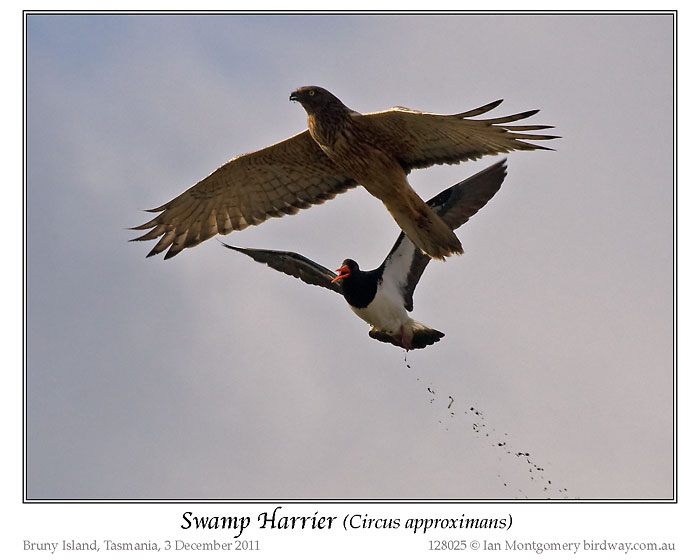
This attempt failed too, and the bird came back for another try flying more or less overhead. At that point, it was attacked by a very distraught-looking Pied Oystercatcher looking for all the world as if it was on a retaliatory bombing raid. The Oystercatcher made a couple of passes at the Harrier, which eventually gave up the struggle and flew inland across the prevailing wind. I could only assume that the item of prey was the Oystercatcher’s chick and the field guide confirmed that these look like plover chicks, camouflaged speckled brown with white bellies. Predation is a natural part of life, but it was sad that the chick died for no purpose.

Swamp Harrier (Circus approximans) by Ian

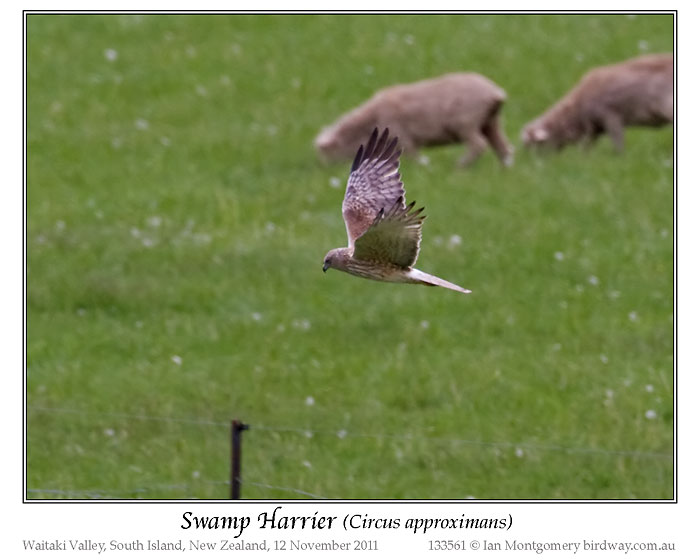
I’ve found Harriers difficult to photograph as they’re shy and normally keep their distance in flight. They are also terrestrial in their lifestyle, inhabiting tree-less plains and wetlands, hunting close to the ground and nesting and perching on the ground, usually invisible or nearly so in grass or reeds. They hunt by flying low over the land or water – quartering – and dropping suddenly to seize surprised prey (sorry, I’ve done it again) such as birds, small mammals and frogs in their long-legged talons. When quartering, they alternate between flapping their wings and gliding with the wings held in a characteristic V, like the bird in the fourth photo in an otherwise tranquil pastoral scene in New Zealand.

Swamp Harrier (Circus approximans) by Ian

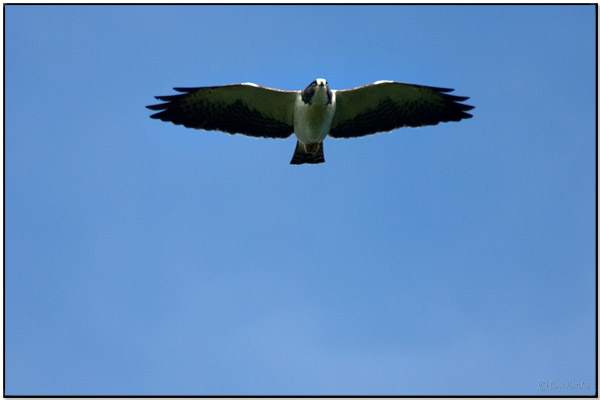
Adult Swamp Harriers are brownish and streaked, with white rumps. Older males have greyish wings and grey tails, unmarked except for a sub-terminal band. Females are more rufous and have barred tails and both the Bruny Island and New Zealand birds are, I think, males. Juvenile Swamp Harriers look quite different and are rufous brown overall with pale rufous rather than white rumps, like the one in the fifth photo.

Swamp Harrier (Circus approximans) by Ian

In Australia, Swamp Harriers nest mainly in the south, including Tasmania and migrate north in winter – in North Queensland, we see them only in the winter months. In New Zealand they make local movements across Cook Strait and they turn up on various islands including Lord Howe and Norfolk. Raptors are poorly represented in New Zealand and the Swamp Harrier is the large bird of the prey, being the only breeding member of the Accipiter family (hawks, eagles, etc.), with the rarer New Zealand Falcon being the only breeding falcon. Swamp Harriers also breed in Melanesia and Polynesia as far east as Tonga. It has close relatives in Eurasia comprising the Eastern, Western, African and Madagascar Marsh Harriers.

Best wishes
Ian

**************************************************
Ian Montgomery, Birdway Pty Ltd,
454 Forestry Road, Bluewater, Qld 4818
Tel 0411 602 737 ian@birdway.com.au
Bird Photos http://www.birdway.com.au/
Recorder Society http://www.nqrs.org.au


Lee’s Addition:

And when the birds of prey swooped down upon the carcasses, Abram drove them away. (Genesis 15:11 AMP)

In this case, the Oystercatcher “drove them away.” You have to admit, that Oystercatcher looks right angry.

The Swamp Harrier is a member of the Accipitridae – Kites, Hawks & Eagles Family. There are 256 species, of which, 17 are Harriers or Harrier-hawks.

Ian already gave quite a bit of information about this beautiful bird. The diet of the Swamp Harrier is mainly ground birds and waterbirds, rabbits and other small mammals, reptiles, frogs and fish. During the Winter months harriers feed to a large extent on carrion, including roadkill.

This species nests on the ground, often in swamps, on a mound in reeds or other dense vegetation. The clutch size may range from 2 to 7, but is usually 3 or 4. The incubation period is about 33 days, with chicks fledging about 45 days after hatching. (Wikipedia)

See also:

Swamp Harrier – Wingspan

Swamp Harrier – Wikipedia

Ian’s Accipitridae Family Photos

Accipitridae – Kites, Hawks & Eagles Family

Ian’s Bird of the Week – Spotted Harrier

*

Birds of the Bible – Hawks and Wisdom

Short-tailed Hawk (Buteo brachyurus) by Daves BirdingPix

Short-tailed Hawk (Buteo brachyurus) by Daves BirdingPix

Is it by your wisdom [Job] that the hawk soars and stretches her wings toward the south [as winter approaches]? (Job 39:26 AMP)

In the Birds of the Bible – Hawk Migration, written in 2008, this verse was introduced. Job was being addressed and the questions started coming:

THEN THE Lord answered Job out of the whirlwind and said, Who is this that darkens counsel by words without knowledge? [Job 35:16.] Gird up now your loins like a man, and I will demand of you, and you declare to Me. (Job 38:1-3 AMP)

Questions of Where…?; Who…?; When…?; Have you commanded…, explored…, entered…?; Can you …?; Do you…? etc. These question run all through Job 38 and 39. That is where we find our question about the hawk.

Sharp-shinned Hawk (Accipiter striatus) ©USFWS

Sharp-shinned Hawk (Accipiter striatus) ©USFWS

Commentary Quotes on Job 39:26 (From my e-Sword)

Barnes – “Doth the hawk fly by thy wisdom – The appeal here is to the hawk, because it is among the most rapid of the birds in its flight. The particuIar thing specified is its flying, and it is supposed that there was something special in that which distinguished it from other birds. Whether it was in regard to its speed, to its manner of flying, or to its habits of flying at periodical seasons, may indeed be made a matter of inquiry, but it is clear that the particular thing in this bird which was adapted to draw the attention, and which evinced especially the wisdom of God, was connected with its flight. The word here rendered “hawk,” (נץ nêts) is probably generic, and includes the various species of the falcon or hawk tribe, as the jet-falcon, the goshawk, the sparrow, hawk, the lanner, the saker, the hobby, the kestril, and the merlin. Not less than one hundred and fifty species of the hawk, it is said, have been described, but of these many are little known, and many of them differ from others only by very slight distinctions.

They are birds of prey, and, as many of them are endowed with remarkable docility, they are trained for the diversions of falconry – which has been quite a science among sportsmen. The falcon, or hawk, is often distinguished for fleetness. One, belonging to a Duke of Cleves, flew out of Westphalia into Prussia in one day; and in the county of Norfolk (England) one was known to make a flight of nearly thirty miles in an hour. A falcon which belonged to Henry IV. of France, having escaped from Fontainebleau, was found twenty-four hours after in Malta, the space traversed being not less than one thousand three hundred and fifty miles; being a velocity of about fifty-seven miles an hour, on the supposition that the bird was on the wing the whole time. It is this remarkable velocity which is here appealed to as a proof of the divine wisdom. God asks Job whether he could have formed these birds for their rapid flight. The wisdom and skill which has done this is evidently far above any that is possessed by man.

And stretch her wings toward the south – Referring to the fact that the bird is migratory at certain seasons of the year. It is not here merely the rapidity of its flight which is referred to, but that remarkable instinct which leads the feathered tribes to seek more congenial climates at the approach of winter. In no way is this to be accounted for, except by the fact that God has so appointed it. This great law of the winged tribes is one of the clearest proofs of divine wisdom and agency.”

Grey Goshawk ( novaehollandiae) by Ian 1

Grey Goshawk ( novaehollandiae) by Ian

Pulpit Commentary – ” Doth the hawk fly (or, soar) by thy wisdom? The hawk”s strength of wing is extraordinary, and one of the greatest of natural marvels. Can Job claim to have contrived it? Many as have been the attempts made, human ingenuity has not yet devised anything that can fly. And stretch her wings toward the south? Migrate, i.e. , when winter approaches, to the warmer southern regions. Few things in nature are more remarkable than the instinct of migratory birds.

Red Sholdered Hawk by Ray

Red Sholdered Hawk by Ray

Matthew Henry – “All these beautiful references to the works of nature, should teach us a right view of the riches of the wisdom of Him who made and sustains all things. The want of right views concerning the wisdom of God, which is ever present in all things, led Job to think and speak unworthily of Providence.

Harris's Hawk at NA by Lee

Harris’s Hawk at National Aviary by Lee

Wesley – Fly – So strongly, constantly, unweariedly, and swiftly. South – At the approach of winter, when wild hawks fly into warmer countries, as being impatient of cold. The birds of the air are proofs of the wonderful providence of God, as well as the beasts of the earth. God instances in two stately ones.

Red-shouldered Hawk (Buteo lineatus) Brevard Zoo by Lee

Red-shouldered Hawk (Buteo lineatus) Brevard Zoo by Lee

Lange – “… If even the book of nature transcends our ability to decipher it fully, how much more incomprehensible and mysterious will the book of Holy Scripture be for us.—von Gerlach: The fundamental thought of these representations which God here puts forth is that only He who can create and govern all things, who superintends everything and adjusts all things in their relation to each other, can also comprehend the connection of human destinies. Inasmuch however as feeble short-sighted man cannot understand and fathom the created things which are daily surrounding him, how can he assume to himself any part of God’s agency in administering the universe?”

Red-tailed Hawk by Ray

Red-tailed Hawk by Ray

Believers Bible Commentary – “39:26-30 Did Job give wisdom to the hawk to migrate south? And was he the one who taught the eagle to fly, to nest on the high rocky crag, to spy out carrion from a great distance, and to train its young ones to find their food?”

Red-backed Hawk - Argentina

Red-backed Hawk – Argentina

Biblical Illustrator – “The higher teaching of Nature The intent of all these beautiful references to the works of Nature is to teach us, from the wisdom, skill, and curious designs discoverable in the formation and the instincts of various birds and beasts, to impress ourselves with a worthy notion of the “riches of the wisdom” of Him that made and sustaineth all things. These impressions we are to carry with us when we consider the dealings of God in the way of Providence, and in His ordering of all events, as the great Governor of the universe. Can we suppose that there is anything wrong here, or without the design of the most consummate wisdom, when He has put forth so much of His skill and contrivance in the formation and ordering of these inferior animals? May He not be trusted to do all things well, concerning the destiny of man, the greatest of His works? In this higher economy, are we to suppose there is less wisdom and design to be manifested, than in this, which displays itself so visibly in these inferior works of His hand? Thus would our blessed Lord increase the confidence of His disciples in His providential care of them, by observing, “Are not two sparrows sold for a farthing, and not one of them falleth to the ground without your Father?” “Fear not,” “are ye not much better than they?—of more value than many sparrows.” It was the want of such due impressions concerning the designing wisdom of God, ever present, and ever operating in all things, that had led Job to think and speak unworthily of that dispensation of Providence under which he now lived, as being altogether arbitrary, discovering no design and discriminating wisdom, nor manifesting the righteous Governor of all things….”

If any of you lack wisdom, let him ask of God, that giveth to all men liberally, and upbraideth not; and it shall be given him. (James 1:5 KJV)

My the Lord continue his blessings as we observe His Wisdom through the birdwatching of His Hawks.

See also:

*

Birds Of The Bible – Swallow-tailed Kites

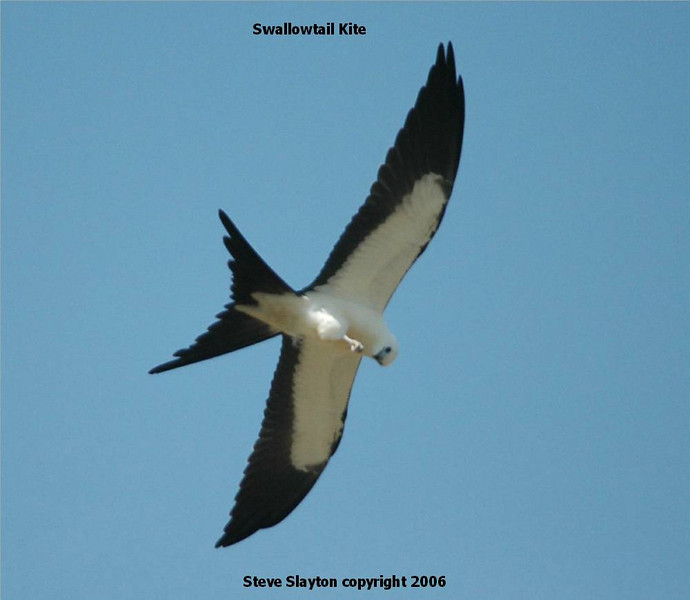
Swallow-tailed Kite by S Slayton

Swallow-tailed Kite by S Slayton

and the red kite, the falcon, and the kite in their kinds, (Deuteronomy 14:13 NASB)

In the Birds of the Bible – Hidden Covenant Part 3, I mistakenly placed this photo of a Swallow-tailed Kite instead of a Swallow. I have since fixed my mistake. A J was talking about the Swallows observing the time of their coming and he used Jeremiah 8:7.

Even the stork in the heavens Knows her appointed times; And the turtledove, the swift, and the swallow Observe the time of their coming. But My people do not know the judgment of the LORD. (Jeremiah 8:7 NKJV)

The reason I mixed them up is because right now, in this area, the Swallow-tailed Kites are being spotted. I have seen a single one three times and just the other day, Dan and I had two of them skim over the top of trees, right in front of us. They have been in the area for a month or so, and soon they will move on again. They “Observe the time of their coming.” Thus the mistake on my part.

They may be one of the Birds of Prey, but they were beautifully created by the Lord. They are so graceful and enjoyable to watch. I am always amazed at the Creator’s use of such variety in the birds and in all the other neat things around us.

Who is like You, O LORD, among the gods? Who is like You, glorious in holiness, Fearful in praises, doing wonders? (Exodus 15:11 NKJV)

According to the Audubon WatchList, “Two subspecies found in the Americas. Northern subspecies (Elanoides forficatus forficatus) breeds in small sections of seven southeastern U.S. states and in southern Mexico. Members of this group migrate to South America in the late summer. Southern subspecies (Elanoides forficatus yetapa) found through much of South America. The estimated U.S. population of approximately 10,000 birds now breeds in fragmented populations from South Carolina south to Florida and west to Louisiana/Texas border with largest known populations in northern Florida. Formerly bred north to Minnesota and west through Texas to Mexico. Significant populations remain in Florida and along the Pascagoula River in Mississippi.”

I really enjoy seeing these Kites because you just have to be looking in the right direction at the right time. Every time they have been spotted by us, they just sort of “appear” over the tops of the trees. They skim so low, that when they come over you, you either see them or you don’t.

Kites are of course one of our Birds of the Bible – (Glede and Kites). They are mentioned twice in Scripture in the list of “unclean” birds in Leviticus 11:14 and Deuteronomy 14:13. Each time “after its kind” is given. So, our Swallow-tailed Kite is one of those kinds and would like to introduce you to this amazing bird that is so neat to watch flying. When they spread that tail of theirs, it is just super neat.

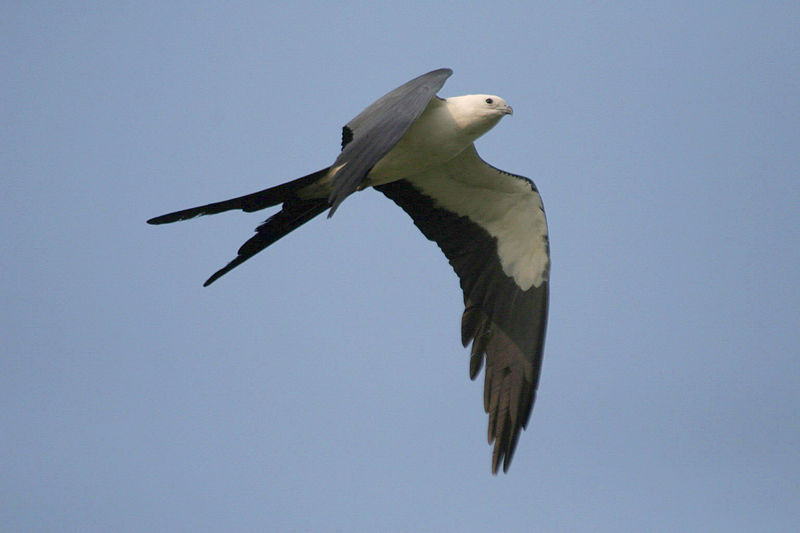
Swallow-tailed Kite (Elanoides forficatus) ©Wikipedia

Swallow-tailed Kite (Elanoides forficatus) ©Wikipedia

(Sounds from xeno-canto)

The Swallow-tailed Kite is a member of the Accipitridae Family (Kites, Hawks & Eagles) Family in the Order Accipitriformes. They are considered Abundance Common according the Thayer Birding software.

They are 24 inches (60 cm) with a very long black forked tail, white head, chest, belly and leading portion of underwing. Their flight feathers are black and their back is also black.

They are a medium-sized, graceful, long-winged, long-tailed hawk with pointed wings, a short, dark, hooked bill. The males and females are similar.

Adults have a long, deeply forked tail. white head, neck, chest, underwing coverts, belly, and undertail coverts, a slate gray back and upperwings, black tail and flight feathers. Whereas the immature is duller than adult with fine streaks on head and breast and has a shorter, less deeply-forked tail than adult.

Thayer also says of their habitat and behavior – ” Wet open woodlands, bottomlands, wooded river swamps, marshes, wetlands, and along rivers, ponds and lakes. Agile and graceful in flight. Eats in flight by bending head and neck under body to eat prey held in talon. Will drink in flight, much like a swallow. Gregarious. Will sweep low over open fields and grasslands to catch food or soar very high for flying insects.”

Swallow-tailed Kite (Elanoides forficatus) by Africaddict

Swallow-tailed Kite (Elanoides forficatus) by Africaddict

The Swallow-tails like to breed in “Lowland forest, especially swampy areas extending into open woodland. 1 brood. Mating system is monogamous. Displays are In flight: easy sailing, curving chase often over water. On perch: mutual approach on horizontal limb, face-off, female quickly turns or backs under limb. They also do courtship feeding.

The nest is usually in treetop concealed by thick foliage and they place it on a foundation of preceding year’s nest. It consist of sticks, twigs, moss, pine needles, leaves, lichen. Lined with fine materials, few feathers. Both sexes help with nest construction.

The eggs are white, marked with browns, occasionally lavender, often concentrated at end. 1.8” (47 mm). Both sexes incubate.  with Incubation taking 28 days. Development is semialtricial (immobile, downy, eyes open, fed). Young are able to fly after 36-42 days. Both sexes tend young.

The spend their winters from Colombia and Venezuela S. Marsh drainage, deforestation, and shooting are responsible for reduction in population and range.

Miscellaneous notes; Occasionally nest in loose colonies of a few pairs. Bathe and drink by skimming water surface like swallow. Occasionally soar at great heights. Up to 200 pieces used in nest, carried individually, may require up to 800 miles of flight. Formerly known as American Swallow-tailed Kite; changed by AOU in 1996.

From Thayer Birding Software, The Birder’s Handbook, Wikipedia, and other internet sources.

See also:

*

Ian’s Bird of the Week – Letter-winged Kite

Letter-winged Kite (Elanus scriptus) by Ian 1

Letter-winged Kite (Elanus scriptus) by Ian 1

Ian’s Bird of the Week – Letter-winged Kite ~ by Ian Montgomery

Newsletter ~ 4/18/13

For all you patient bird of the week recipients, here is I hope a bird worth waiting for, the Letter-winged Kite, star attraction on the recent trip along the Birdsville Track in Northwestern South Australia.

The Letter-winged Kite saga that had its resolution here started in the 1970s when I was living in Surry Hills in inner city Sydney. One evening, I was walking around to the local pub, the Cricketers Arms, on Fitzroy Street a block away from busy South Dowling Street when I found a pair of Letter-winged Kites, unfazed by the traffic, landing in a small tree on the pavement. The L-shaped markings under the wing were clearly visible, so there was no doubt about the identification – I was going to the pub, not tottering home afterwards – no matter how unlikely the location for this species, usually more at home in the semi-desert of Central Australia.

I supposed at the time that they were escaped birds. I found out only later that not only are these Kites nocturnal, but that they spread far and wide in search of food from their usual, arid, home following the population crash that follows plagues of their main prey, the Long-haired Rat. Come to think of it, the rather arid open spaces of Moore Park lie on the other side of South Dowling Street, and I’m sure there are plenty of ordinary rats in Surry Hills.

Letter-winged Kite (Elanus scriptus) by Ian 2

Letter-winged Kite (Elanus scriptus) by Ian 2

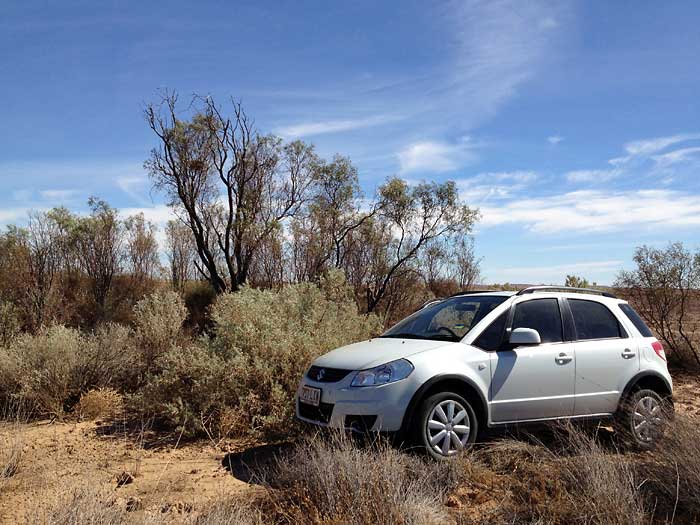
Ordinary people drive the 500km of dirt road that constitutes the legendary Birdsville Track from Birdsville in Southwestern Queensland to Marree in Northeastern South Australia (and the parallel Strzelecki Track) for the experience. Birders do it to search for elusive dry country birds, particularly the Letter-winged Kite and the Grey Falcon and both of these were top of my wanted list on this trip. Letter-winged Kites roost in trees by day, so I searched the few trees – nearly all in creek beds – along the Birdsville Track until, 252km south of Birdsville I spotted a couple of suspects, screeched to a halt in a cloud of dusk and approached them in the car. Birders have 4WD vehicles, such as my modest Suzuki SZ4, mainly so that they can use them as mobile bird hides as most birds are more tolerant of vehicles than pedestrians.

Letter-winged Kite (Elanus scriptus) by Ian 3

Letter-winged Kite (Elanus scriptus) by Ian 3

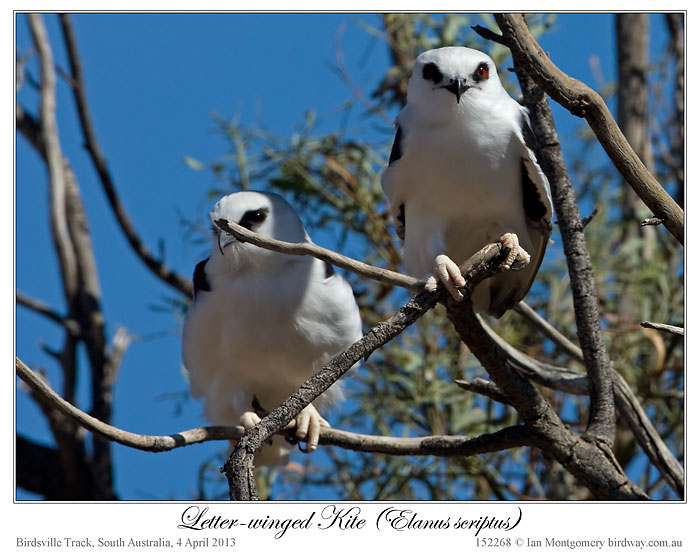
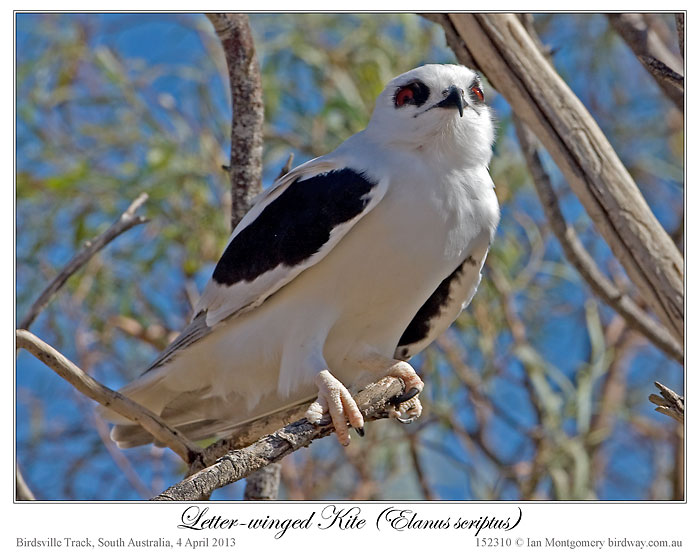
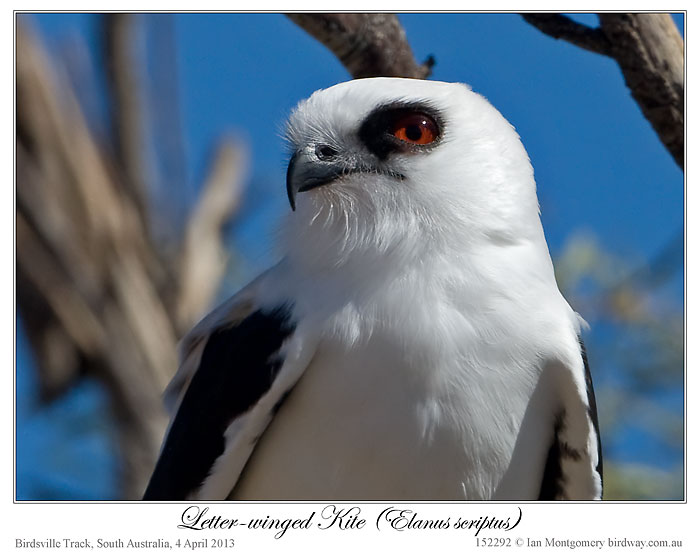
Letter-winged Kites indeed they were, but the tree was a tangle of branches and the sun was shining from behind the tree. The birds, however, seemed as unfazed by the traffic (relatively speaking) as the ones in Fitzroy Street, and let me approach to take the first photo (good lighting angle, bad branches), second photo (bad angle, good branches). Then they waited while I changed the lens from the 100-400mm to the 500mm and, eventually, looked on tolerantly while I got out of the car and did a relative close-up (third photo) and a portrait (fourth photo).

Letter-winged Kite (Elanus scriptus) by Ian 4

Letter-winged Kite (Elanus scriptus) by Ian 4

I then walked away to take a photo of the tree, the birds and a nest (I don’t know whether it was theirs) and turned around to find that they had silently vanished. If it hadn’t been for the photos definitely still on the SD card, the event might have all have been a fantasy. So I made do with a photo of the tree, the nest and the mobile bird hide, below.

 Letter-winged Kite (Elanus scriptus) by Ian 5

Letter-winged Kite (Elanus scriptus) by Ian 5

The Strzelecki Track is actually supposed to be better for Letter-winged Kites than the Birdsville, but, having found these birds, we decided to change our return travel plans from Plan B1 to Plan B2, skip the Strzelecki (similar landscape, worse road), spend a few days in the Flinders Ranges and drive home via Broken Hill, Bourke and Bowra (B2), instead of Birdsville, Bedourie and Boulia (B1).

Best wishes
Ian

**************************************************
Ian Montgomery, Birdway Pty Ltd,
454 Forestry Road, Bluewater, Qld 4818
Tel 0411 602 737 ian@birdway.com.au
Check the latest website updates:
http://www.birdway.com.au/#updates


Lee’s Addition:

And the glede, and the kite, and the vulture after his kind, (Deuteronomy 14:13 KJV)

What an awesome bird. They are beautiful. Thanks, Ian, for sharing another of your birdwatching adventures with us. His photography is fabulous also. I love that close-up in #4. Wow!

The Letter-winged Kite (Elanus scriptus) is a small, rare and irruptive Australian raptor with a core range in central Australia. The adult is a small and graceful, predominantly pale grey and white, raptor with black shoulders and red eyes. It is similar in appearance to the Black-shouldered Kite except for a very distinctive black underwing pattern of a shallow ‘M’ shape, seen when in flight. Roosting during the day in well-foliaged trees and hunting at night, it is the world’s only fully nocturnal raptor. Like all the elanid kites, it is a specialist predator of rodents, which it hunts by hovering in mid-air above grasslands and fields. (Wikipedia)

They belong to the Accipitridae Family . Check out all Ian’s Family Photos and then see the complete Accipitridae – Kites, Hawks and Eagles family list here.

See Also:

Ian’s Bird of the Week

White-tailed Kite ~ 1-7-11

Whistling Kite ~ 5-31-10

Birds of the Bible – Glede and Kites

*
Ian’s Bird of the Week – European Honey Buzzard

Ian’s Bird of the Week – European Honey Buzzard ~ by Ian Montgomery

Newsletter – 10-14-12

I had a welcome email a couple of weeks ago pointing out an identification error on the Birdway website, thank you Tom of Luxembourg, pointing out that the photos I’d taken of a Buzzard in Alderney in the Channel Islands in 2005 was not a mere Common Buzzard but a much more interesting juvenile European Honey Buzzard. By way of excuses, they do look rather similar and at the time I had Common Buzzards on the brain as I had just been trying unsuccessfully to photograph Common Buzzards in Ireland.

Honey Buzzards are very rare nesting birds in Britain (30-50 pairs) but reasonably common in continental Europe. They are summer visitors, wintering in sub-Saharan Africa and often seen on passage and I was in Alderney in September, a good site for migrating birds including raptors. Both species have very variable plumage, but the Honey Buzzard is slightly larger, longer-necked, longer-tailed and has a slim neck and holds it head forward giving the bird a more cuckoo-like silhouette. It also supposed to hold its wings differently when gliding, second photo, but the subtlety of soaring on ‘smoothly down-curved flattish wings lacking an obvious bend at the carpal joints’ rather evades me.

They get their name from their preferred food, the larvae of bees and (mainly) wasps though they eat a more varied diet when these are not available. The specific name apivorus means ‘bee-eating’ – more accurate than ‘honey’ – and has the same Latin roots as the ‘vore’ part of carnivore and the ‘api’ part of apiarist. The generic Pernis comes from the Greek for ‘hawk’, but taxonomists are not too neurotic about combining different languages.

I saw very few raptors in Finland this year, but I did see several Honey Buzzards including this distant, slightly moth-eaten adult in the third photo. At least I identified this one correctly, though I was unjustifiably pleased in thinking I’d photographed a new species.

Back home in North Queensland, I’m working on the final revisions to the photographs for the digital version of the Pizzey and Knight Field Guide to the Birds of Australia which should be published soon – you may have seen the full page advertisement for it from Gibbon Multimedia Australia http://www.gibbonmm.com.au in the September issue of Birdlife Australia. I’ve recently received the mobile version of the equivalent South African product Roberts VII Multimedia Birds of Southern Africa http://www.sabirding.co.za. It’s a splendid product, a veritable encylopaedia, brilliantly organised and available across many platforms (iPad, iPhone, Android, Windows) so don’t go to Southern Africa without it. It augurs very well for the Australian product, but naturally I keep you posted on its progress.

Best wishes

Ian

******************************
********************
Ian Montgomery, Birdway Pty Ltd,
454 Forestry Road, Bluewater, Qld 4818
Tel 0411 602 737 ian@birdway.com.au
Check the latest website updates:
http://www.birdway.com.au/#updates


Lee’s Addition:

After some time, when he returned to get her, he turned aside to see the carcass of the lion. And behold, a swarm of bees and honey were in the carcass of the lion. (Jdg 14:8)

Thanks, Ian, for the correction. Most of us have not seen either bird, so were upset by correction. It is also good to know that even you, whom I consider an expert, makes mistakes. Makes us feel better.

That aside, that is an neat looking bird. I like the third photo showing up under its wings. These Buzzards are part of the Accipitridae – Kites, Hawks and Eagles Family. There are six Honey Buzzards; the European, plus the Long-tailed, Black, Crested, Barred and Philippine.

See Ian’s Buzzards at his:

Accipitridae Family

European Honey Buzzard

Oriental Honey Buzzard

Also:

Accipitridae – Kites, Hawks and Eagles Family

European Honey Buzzard – Wikipedia

*