Birds of the Bible – Non-Protected Nest

When birds have babies, they do all they can to protect them from predators. The birds spend time building and then filling their nest with eggs. The nest is protected almost constantly from the time the bird lays the eggs until the fledglings depart. That is normal behavior and the video below of the Fieldfare shows one way they do it. The video is by BBC Worldwide.

And my hand hath found as a nest the riches of the people: and as one gathereth eggs that are left, have I gathered all the earth; and there was none that moved the wing, or opened the mouth, or peeped. (Isaiah 10:14 KJV)

In the verse above, the nest has not been protected, nor has a wing been flapped to chase the aggressor away, nor did they open their mouth in peeps or chirping alarm calls. If the nest is abandoned; whether by desertion, having been chased off, or other reason, it is easy to take the eggs or chicks.

This verse is found in the book  of Isaiah and is referring to the King of Assyria. The kings pride, arrogant heart, and boastful look in his eyes cause him to state:

For he says: By the strength of my hand I have done it, and by my wisdom, for I have understanding; I remove the boundaries of peoples, and plunder their treasures; like a bull I bring down those who sit on thrones. My hand has found like a nest the wealth of the peoples; and as one gathers eggs that have been forsaken, so I have gathered all the earth; and there was none that moved a wing or opened the mouth or chirped. (Isaiah 10:13-14 ESV)
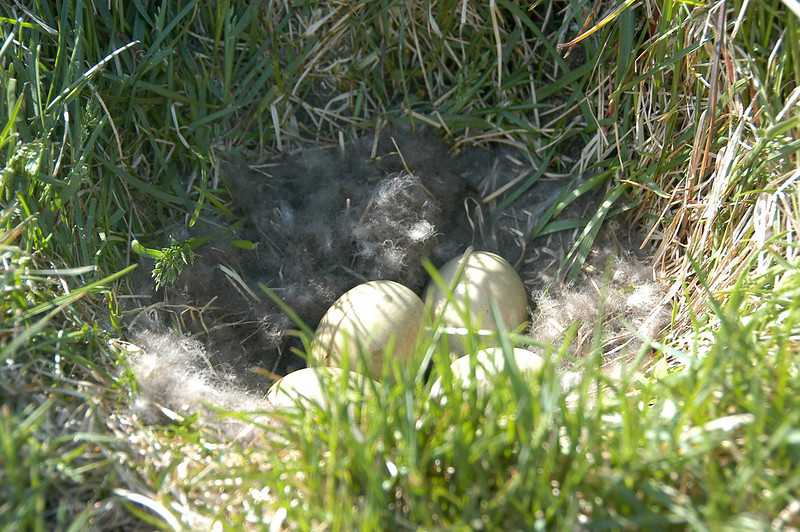
Common Eider (Somateria mollissima) nest by Bob-Nan

Common Eider (Somateria mollissima) nest by Bob-Nan

I like what Albert Barnes Notes On The Bible says,
“Isa 10:14
And my hand hath found, as a nest
– By a beautiful and striking figure here, the Assyrian monarch is represented as describing the ease with which he had subdued kingdoms, and rifled them of their treasures. No resistance had been offered. He had taken them with as little opposition as a rustic takes possession of a nest, with its eggs or young, when the parent bird is away.
Eggs that are left – That is, eggs that are left of the parent bird; when the bird from fright, or any other cause, has gone, and when no resistance is offered.
Have I gathered all the earth – That is, I have subdued and plundered it. This shows the height of his self-confidence and his arrogant assumptions.
That moved the wing – Keeping up the figure of the nest. There was none that offered resistance; as an angry bird does when her nest is about to be robbed.
Or opened the mouth – To make a noise in alarm. The dread of him produced perfect silence and submission.
Or peeped – Or that chirped – the noise made by young birds; the note at Isa_8:19. The idea is, that such was the dread of his name and power that there was universal silence. None dared to resist the terror of his arms.”

Shall the axe boast over him who hews with it, or the saw magnify itself against him who wields it? As if a rod should wield him who lifts it, or as if a staff should lift him who is not wood! (Isaiah 10:15 ESV)

Living Application Study Bible – “The ax – How absurd is it, for thee, who art but an instrument in God’s hand, to blaspheme thy Lord and master, who has as great power over thee, as a man hath over the ax wherewith he heweth?”
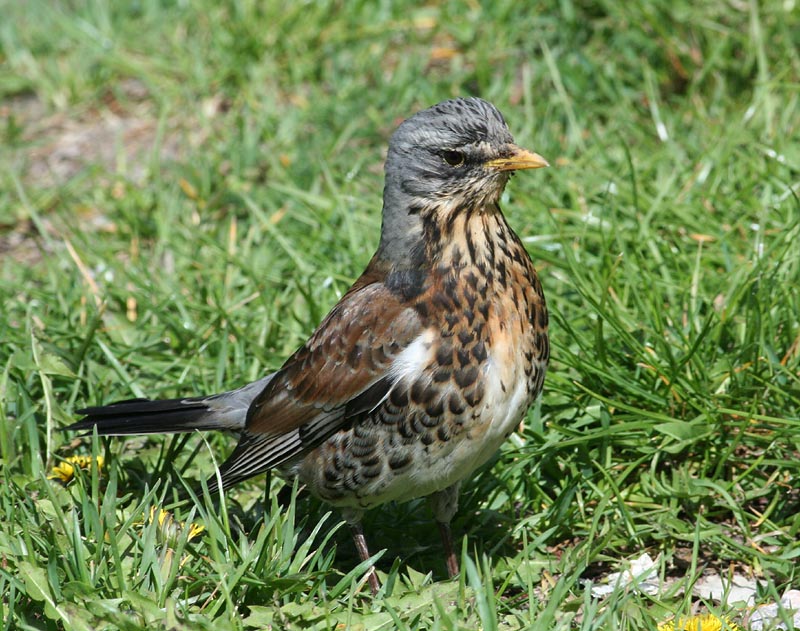
Fieldfare (Turdus pilaris) by Peter Ericsson

Fieldfare (Turdus pilaris) by Peter Ericsson

Gill’s Exposition – “Shall the axe boast itself against him that heweth therewith?…. Hitherto are the words of the Assyrian monarch; and here begin the words of the prophet, rebuking him for his pride, and deriding his vain boasting, in attributing that to himself, to his wisdom and power, who was but an instrument, which belonged to God, the sole Governor and wise orderer of all things; which was all one as if an axe should ascribe the cutting down of trees to itself, and insist on it that the man that cut with it had no share in the action, nor was it to be ascribed to him; than which nothing is more absurd. The sense is, that the king of Assyria, in taking cities, and conquering kingdoms, and adding them to his own, was only an instrument in the hand of God, like an axe in the hand of one that hews down trees; and therefore it was vain and ridiculous to take that to himself which belonged to the Lord, on whom he depended as an instrument, as to motion, operation, and effect; from whom he had all power to act, all fitness for it, and efficacy in it, as the axe has from the person that makes and uses it, or any other instrument”

It is interesting to try to find out what is behind the verses we read about the birds in the Bible. God uses many illustrations of things around us to teach us His Truth. In these verses, self-pride, arrogance and denying Who is in control of our lives.

Hear ye, and give ear; be not proud: for the LORD hath spoken. (Jeremiah 13:15 KJV)
Wordless Birds
*

The Bird With The Broken Wing

Our soul is escaped as a bird out of the snare of the fowlers: the snare is broken, and we are escaped. (Psalms 124:7 KJV)

Words: He­ze­ki­ah But­ter­worth (1839-1905).

Music: Dan­i­el B. Town­er, 1919

The Bird With The Broken Wing

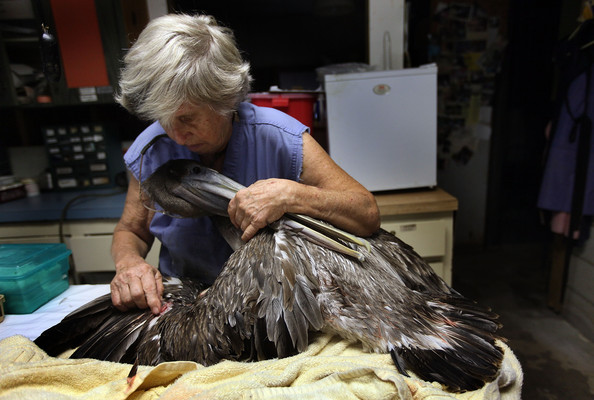
Broken Wing of Pelican-Florida Keys Wild Bird Rehab Center

Broken Wing of Pelican-Florida Keys Wild Bird Rehab Center

I walked in the woodland meadows,
Where sweet the thrushes sing,
And found on a bed of mosses,
A bird with a broken wing;
I healed its wing, and each morning
It sang its old sweet strain,
But the bird with the broken pinion,
Never soared as high again,
Never soared as high again.

I found a young life broken
By sin’s seductive art,
And, touched with a Christlike pity,
I took him to my heart;
He lived with a nobler purpose,
And struggled not in vain,
But the life that sin had stricken,
Never soared as high again,
Never soared as high again.

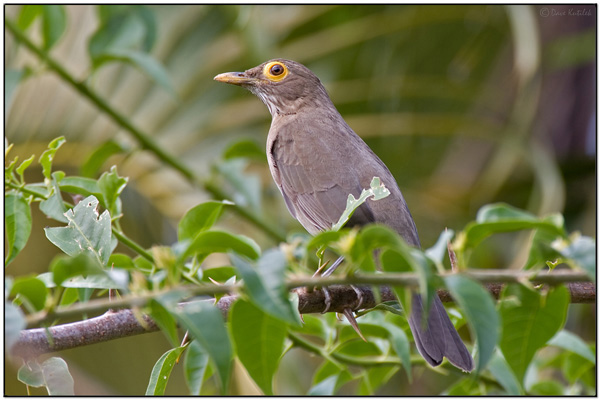
Bare-eyed Thrush (Turdus tephronotus) by Daves BirdingPix

Bare-eyed Thrush (Turdus tephronotus) by Daves BirdingPix

But the bird with the broken pinion
Kept another from the snare,
The life that sin had stricken,
Raised another from despair;
Each loss has its own compensation,
There’s healing for each pain,
But the bird with the broken pinion
Never soared as high again,
Never soared as high again.


Now I rejoice, not that you were made sorry, but that your sorrow led to repentance. For you were made sorry in a godly manner, that you might suffer loss from us in nothing. For godly sorrow produces repentance leading to salvation, not to be regretted; but the sorrow of the world produces death.
(2 Corinthians 7:9-10 NKJV)

This hymn reminds me of a story I have heard numerous times about the effects of sin in our lives. We may repent, but the scars are still there. I found a copy, it’s a little long, but I hope you’ll read it.

“That was a significant, story of the man who gave his little son a hammer and some nails, and told him that whenever he did anything that was wrong he might drive one of the nails into the barn door. The boy was honest and diligent too, and in a few days he came to his father saying that the last nail was in its place well driven down. ” And now,” said the father, “whenever you do any specially good deed, you may draw out one of the nails.” This pleased the son. He was as diligent in goodness now as he had been in badness before. He carried his little sister over the rough places, and then went and drew a nail. He sawed some wood for a poor widow and drew another nail. He ran on willing errands for his mother that he might have a chance to draw more nails. In a few days the last one was removed, and he came with pride to tell his father.

“What, all drawn so soon?” said the father.

” Every one,” responded the son.

” Let us go and see,” said the father.

” Come, then,” said the son, and he led the way. ” See, see,” said the eager boy, ” there is not a nail left in the door, and I assure you that I did something good for every nail I drew.”

” I am glad, my dear son,” said the father, ” that the task of removing them is so quickly done, but then,” continued he sadly, ” don’t you see how you have marred and injured the door? The nails are gone, but the scars remain.” (A. J. Paterson)

The Gospel Message

*

Birds in Hymns – Like A Bird To Thee

…In the LORD put I my trust: how say ye to my soul, Flee as a bird to your mountain? (Psalms 11:1 KJV)

Words & Music: W. How­ard Doane (1832-1915)

Like A Bird To Thee

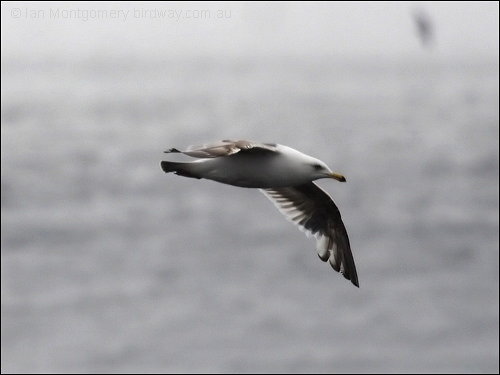
Slaty-backed Gull (Larus schistisagus) by Ian

Slaty-backed Gull (Larus schistisagus) by Ian

Savior, like a bird to Thee,
Weary and wounded my soul would flee;
O let me fold my wings and rest
Peacefully, trustingly, on Thy breast.

Refrain

Like a bird let me fly to Thee,
In Thine arms kindly shelter me;
Then my soul no more shall roam
Far, far away from home.

Savior, Thou my grief hast borne,
Thou hast a balm for the hearts that mourn;
One gentle word, and I shall rest
Hopefully, lovingly, on Thy breast.

Refrain

Like a bird let me fly to Thee,
In Thine arms kindly shelter me;
Then my soul no more shall roam
Far, far away from home.

Slender-billed Gull (Chroicocephalus genei) by Nikhil Devasar

Slender-billed Gull (Chroicocephalus genei) by Nikhil Devasar

I was lost till found by Thee;
Thine, blessèd Savior, the glory be;
Gladly I fold my wings and rest,
Lovingly, tenderly, on Thy breast.

Refrain

Like a bird let me fly to Thee,
In Thine arms kindly shelter me;
Then my soul no more shall roam
Far, far away from home.


What a great hymn. As you read or sing the words, think about the words. What a comfort and rest we receive as we settle down, rest and lean on our Loving Savior.

Most information from The Cyber Hymnal

See ~ Wordless Birds

More ~ Birds in Hymns

*

The Black Skimmer – The Graceful Flier…

The Black Skimmer – The Graceful Flier… ~ by a j mithra

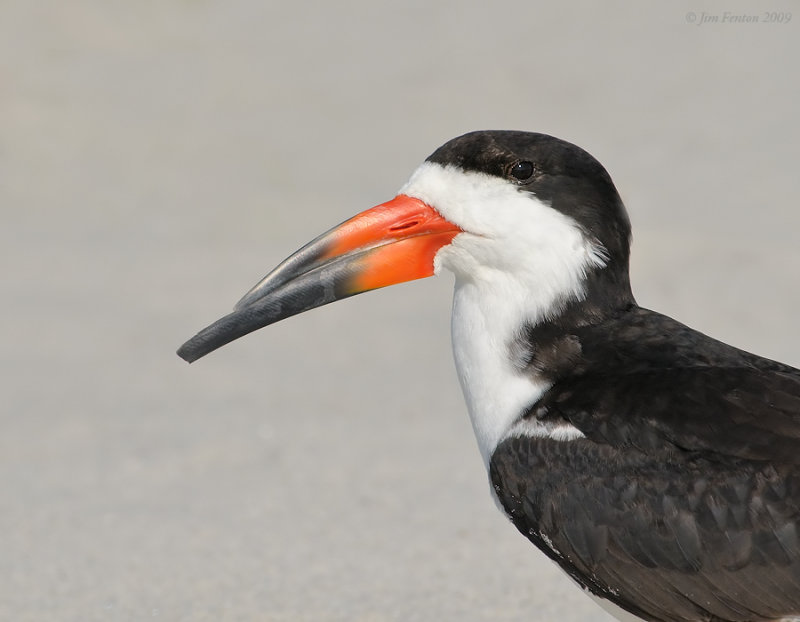
Black Skimmer (Rynchops niger) by J Fenton

Black Skimmer (Rynchops niger) by J Fenton

The Black Skimmer, Rynchops niger, is a tern-like seabird, one of three very similar birds species in the skimmer family. It breeds in North and South America.

Northern populations winter in the warmer waters of the Caribbean and the tropical and subtropical Pacific coasts, but the South American races make only shorter movements in response to annual floods which extend their feeding areas in the river shallows.

The Black Skimmer breeds in loose groups and its referred habitats include sandy or gravelly bars and beaches, shallow bays, estuaries, and salt marsh pools. The remarkable bill of the Black Skimmer sets it apart from all other American birds.

The Black Skimmer is the only American representative of the skimmer family. The other two, rather similar, species are the African Skimmer and the Indian Skimmer (by Nikhil). All use the same unusual feeding method.

Black Skimmer (Rynchops niger) by Quy Tran

Black Skimmer (Rynchops niger) by Quy Tran

The Black Skimmer is the only bird species in the United States that has a larger lower mandible than upper mandible. The large red and black bill is knife-thin and the lower mandible is longer than the upper. The bird drags the lower bill through the water as it flies along, hoping to catch small fish. At hatching, the two mandibles are equal in length, but by fledging at four weeks, the lower mandible is already nearly 1 cm longer than the upper. Its use of touch to catch fish lets it be successful in low light or darkness.

Do you feel that your looks are not as good as the others? Do you feel that God could have created you a bit taller or fairer?

  • God has never done a mistake, but still, we had crucified Him…
  • If Joseph had not landed into the prison, he would not have become The Prime Minister of Egypt…
  • If Naaman had not suffered from leprosy, He would not have known the real God…
  • If Zachcheaus had benn born tall, He too wouldn’t have know God…
  • God has a purpose in the way He had created us…

If these birds had equal mandible, they would’ve perished, for they would not have known how to fish…

You are unique and God did not create any one like you and He is faithful to finish the work He had started in you…

Being confident of this very thing, that he which hath begun a good work in you will perform it until the day of Jesus Christ: (Philippians 1:6)

Black Skimmer (Rynchops niger) by AestheticPhotos

Black Skimmer (Rynchops niger) by AestheticPhotos

Skimmers have a light graceful flight, with steady beats of their long wings. They feed usually in large flocks, flying low over the water surface with the lower mandible skimming the water (in order of importance) for small fish, insects, crustaceans and molluscs caught by touch by day or especially at night. They spend much time loafing gregariously on sandbars in the rivers, coasts and lagoons they frequent. Although the Black Skimmer is active throughout the day, it is largely crepuscular (active in the dawn and dusk) and even nocturnal….

These birds seem to know that fish come to the surface of the water in large numbers during night…

That is the reason, they leave alone their younger ones at night, and forage during the night, flying low, skimming the water with their lower mandibles..

It is good to start the day reading the word of God.. But, how many of us read the Bible before going to bed? Do we carry the lamp during the day, or during the night? When darkness surrounds you and you have lost your way. Just read the Bible..

Thy word is a lamp unto my feet, and a light unto my path. (Psalm 119:105)

Do you know that night prayers are more powerful? That is the reason God asks us to watch and pray…

Jesus Himself had set an example of praying all through the night before He chose His twelve disciples….

And it came to pass in those days, that he went out into a mountain to pray, and continued all night in prayer to God. And when it was day, he called unto him his disciples: and of them he chose twelve, whom also he named apostles; (Luke 6:12,13)

Black Skimmer (Rynchops niger) by Ian

Black Skimmer (Rynchops niger) by Ian

Are you in the midst of decision making, which you think may change your life? Just do what Jesus did…

Pray all night, without ceasing…

Have a blessed day!

Your’s in YESHUA,
a j mithra

Please visit us at: Crosstree


Lee’s Addition:

The Skimmers are in the Laridae Family of Gulls, Terns & Skimmers. They are part of the Charadriiformes Order.

When you watch skimmers, it is neat to watch the trail or path they leave in the water. That brings to mind several passages about paths:

Thus saith the LORD, which maketh a way in the sea, and a path in the mighty waters; (Isaiah 43:16 KJV)
Thou wilt shew me the path of life: in thy presence is fulness of joy; at thy right hand there are pleasures for evermore. (Psalms 16:11 KJV)
Teach me thy way, O LORD, and lead me in a plain path, because of mine enemies. (Psalms 27:11 KJV)
Make me to go in the path of thy commandments; for therein do I delight. (Psalms 119:35 KJV)
Thy word is a lamp unto my feet, and a light unto my path. (Psalms 119:105 KJV)
Enter not into the path of the wicked, and go not in the way of evil men. (Proverbs 4:14 KJV)
Ponder the path of thy feet, and let all thy ways be established. (Proverbs 4:26 KJV)

Keith made a video of a Black Skimmer flying about and dipping its beak. Its head pulls downward as it grabs a fish.

*

Birds of the Bible – Purifying Bird

Below is an interesting passage of Scripture.

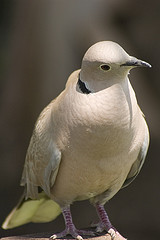
Eurasian-collared Dove in Israel

Eurasian-collared Dove in Israel

The LORD spoke to Moses, saying, “This shall be the law of the leprous person for the day of his cleansing. He shall be brought to the priest, and the priest shall go out of the camp, and the priest shall look. Then, if the case of leprous disease is healed in the leprous person, the priest shall command them to take for him who is to be cleansed two live clean birds and cedarwood and scarlet yarn and hyssop. And the priest shall command them to kill one of the birds in an earthenware vessel over fresh water. He shall take the live bird with the cedarwood and the scarlet yarn and the hyssop, and dip them and the live bird in the blood of the bird that was killed over the fresh water. And he shall sprinkle it seven times on him who is to be cleansed of the leprous disease. Then he shall pronounce him clean and shall let the living bird go into the open field. (Leviticus 14:1-7 ESV)

It seems that when a person was declared clean from their leprosy, that a purification needed to be performed. The same was true for the house. They gathered two birds and then the priest would kill one bird, but the second was set free after he took “the cedarwood and the hyssop and the scarlet yarn, along with the live bird, and dip them in the blood of the bird that was killed and in the fresh water and sprinkle the house seven times.” The live bird was then taken out side the city and turned loose.

When you first read that passage, you wonder what it is all about. The live bird being turned loose with blood on it? Some of the commentators have helped explain the significance of this. Here are some of their thoughts:

House Sparrow (Passer domesticus) Female by Nikhil

Matthew Henry – Lev 14:1-9  – The priests could not cleanse the lepers; but when the Lord removed the plague, various rules were to be observed in admitting them again to the ordinances of God, and the society of his people. They represent many duties and exercises of truly repenting sinners, and the duties of ministers respecting them. If we apply this to the spiritual leprosy of sin, it intimates that when we withdraw from those who walk disorderly, we must not count them as enemies, but admonish them as brethren. And also that when God by his grace has brought to repentance, they ought with tenderness and joy, and sincere affection, to be received again. Care should always be taken that sinners may not be encouraged, nor penitents discouraged. If it were found that the leprosy was healed, the priest must declare it with the particular solemnities here described. The two birds, one killed, and the other dipped in the blood of the bird that was killed, and then let loose, may signify Christ shedding his blood for sinners, and rising and ascending into heaven. The priest having pronounced the leper clean from the disease, he must make himself clean from all remains of it. Thus those who have comfort of the remission of their sins, must with care and caution cleanse themselves from sins; for every one that has this hope in him, will be concerned to purify himself.

Gill – “and shall let the living bird loose into the open field; as a token of the freedom of the leper, and that he was at liberty to go where he pleased: the Misnic doctors say, when he came to let go the living bird, he did not turn its face neither to the sea, nor to the city, nor to the wilderness, as it is said, “but he shall let go the living bird out of the city into the open field”, as in Lev. 14:53;… this may be a figure of the resurrection of Christ from the dead, and of his justification upon it, as the head and representative of his people, and of their free and full discharge from guilt, condemnation, and death, through him, and of his and their being received up into heaven, and whither their hearts should be directed, in affection and thankfulness for their great deliverance and salvation; see 1Timothy 3:16. ”

Hill Pigeon (Columba rupestris) by Nikhil Devasar

Clarke – “Shall let the living bird loose – The Jews teach that wild birds were employed on this occasion, no tame or domestic animal was used. Mr. Ainsworth piously conjectures that the living and dead birds were intended to represent the death and resurrection of Christ, by which an atonement was made to purify the soul from its spiritual leprosy. The bird let loose bears a near analogy to the scapegoat. See Leviticus 16.”

They all seem to see the cleansing as not only for the current situation, by also, representing the future sacrifice of Christ for our sins and the cleansing (forgiveness of sin) that comes from His shed blood. I praise the Lord that He has given His life for us and that we no longer have to go through sacrifices like they did prior to Christ. I am sure the animals and birds also feel blessed.

Consequently, he is able to save to the uttermost those who draw near to God through him, since he always lives to make intercession for them. For it was indeed fitting that we should have such a high priest, holy, innocent, unstained, separated from sinners, and exalted above the heavens. He has no need, like those high priests, to offer sacrifices daily, first for his own sins and then for those of the people, since he did this once for all when he offered up himself. For the law appoints men in their weakness as high priests, but the word of the oath, which came later than the law, appoints a Son who has been made perfect forever. (Hebrews 7:25-28 ESV)

The Gospel Message

See more Birds of the Bible

*

Birds of the Bible – Raven II

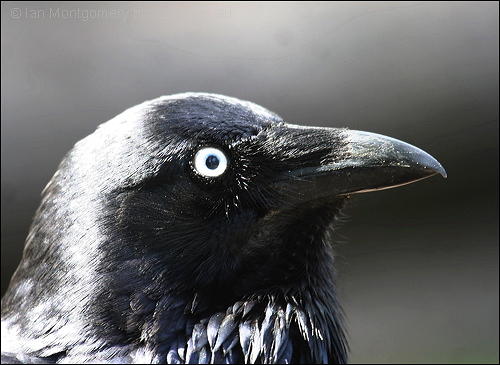
Northern Raven (Corvus corax) by Ray

Northern Raven (Corvus corax) by Ray

The first Birds of the Bible – Raven article covered many aspects of the Raven. It was written in February of 2008 when I first started writing about the Birds of the Bible. There is always more to learn about birds or the Lord for that matter. We never “arrive” in our learning.

Some verses about the Raven that are interesting have to do with the Lord or God providing for them.

Who provideth for the raven his food? when his young ones cry unto God, they wander for lack of meat. (Job 38:41 KJV)

He giveth to the beast his food, and to the young ravens which cry. (Psalms 147:9 KJV)

Consider the ravens: for they neither sow nor reap; which neither have storehouse nor barn; and God feedeth them: how much more are ye better than the fowls? (Luke 12:24 KJV)

With all the providing by the LORD God for the Raven, He (LORD God) then uses the Ravens to feed Elijah during a drought. Elijah was told to go to the brook Cherith and there he would be fed. Notice that the ravens came twice a day and brought “bread and flesh.”

Get thee hence, and turn thee eastward, and hide thyself by the brook Cherith, that is before Jordan. And it shall be, that thou shalt drink of the brook; and I have commanded the ravens to feed thee there. So he went and did according unto the word of the LORD: for he went and dwelt by the brook Cherith, that is before Jordan. And the ravens brought him bread and flesh in the morning, and bread and flesh in the evening; and he drank of the brook. (1 Kings 17:3-6 KJV)

Australian Raven (Corvus coronoides) by Ian

Australian Raven (Corvus coronoides) by Ian

Here are some interesting remarks from commentators about this:
Wesley – 1Ki 17:4,6 “God is said to command both brute creatures, and senseless things; when he causeth them to do the things which he intends to effect by them. The ravens – Which he chuseth for this work; to shew his care and power in providing for the prophet by those creatures, which are noted for their greediness, that by this strange experiment he might be taught to trust God in those many and great difficulties to which he was to be exposed. God could have sent angels to minister to him. But he chose winged messengers of another kind to shew he can serve his own purposes as effectually, by the meanest creatures as by the mightiest. Ravens neglect their own young, and do not feed them: yet when God pleaseth, they shall feed his prophet.”
“And flesh – Not raw, but boiled by the ministry of some angel or man, and left in some place ’till the ravens came for it: in all which, there is nothing incredible, considering the power and providence of God.”

K&D – “Through this miracle, which unbelievers reject, because they do not acknowledge a living God, by whom, as the Creator and Lord of all creatures, even the voracious ravens are made subservient to His plans of salvation, Elijah was not only cut off from (interaction) with men, who might have betrayed his place of abode to the king, but was mightily strengthened himself, through the confidence inspired in the almighty assistance of his God, for his approaching contests with the worshippers of idols, and for the privations and sufferings which awaited him in the fulfilment of his vocation.”


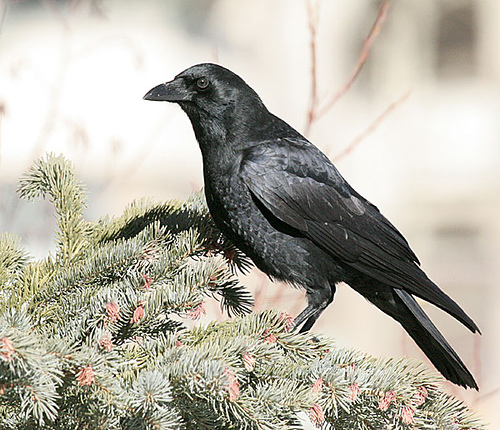
Common Raven (Corvus corax) by Kent Nickell

Matthew Henry – “Elijah was commanded to hide himself. If Providence calls us to solitude and retirement, it becomes us to go: when we cannot be useful, we must be patient; and when we cannot work for God, we must sit still quietly for him. The ravens were appointed to bring him meat, and did so. Let those who have but from hand to mouth, learn to live upon Providence, and trust it for the bread of the day, in the day. God could have sent angels to minister to him; but he chose to show that he can serve his own purposes by the meanest creatures, as effectually as by the mightiest. Elijah seems to have continued thus above a year. The natural supply of water, which came by common providence, failed; but the miraculous supply of food, made sure to him by promise, failed not. If the heavens fail, the earth fails of course; such are all our creature-comforts: we lose them when we most need them, like brooks in summer. But there is a river which makes glad the city of God, that never runs dry, a well of water that springs up to eternal life. Lord, give us that living water!”

Gill – “…it seems better to interpret them of ravens, as we do, these creatures delighting to be in solitary places, in valleys, and by brooks; nor need it be any objection that they were unclean creatures by the law, since Elijah did not feed upon them, but was fed by them; and supposing any uncleanness by touch, the ceremonial law might be dispensed with in an extraordinary case, as it sometimes was; though it is very remarkable that such creatures should be employed in this way, which are birds of prey, seize on anything they can, live on carrion, and neglect their own young, and yet feed a prophet of the Lord; which shows the power and providence of God in it.”

Elijah and the ravens help illustrate the following verse:

But seek ye first the kingdom of God, and his righteousness; and all these things shall be added unto you. (Matthew 6:33 KJV)

Birds of the Bible – Cranes II

Sandhill Crane (Grus canadensis) with 2 juveniles by Lee

Sandhill Crane (Grus canadensis) at Lake Ashton by Lee

Last evening we were with our friends at Lake Ashton in Winter Haven, FL and they gave us a tour of the wildlife there. This time of the year there are numerous Sandhill Crane families around. We saw several young Sandhills as we were being shown around. We took some photos and also got video of two adult Sandhill Cranes giving a duet. Thought that sounded like a good topic for this weeks Birds of the Bible.

The crane is mentioned twice in the Bible and one has to do its migration.

Yea, the stork in the heaven knoweth her appointed times; and the turtle and the crane and the swallow observe the time of their coming; but my people know not the judgment of the LORD. (Jeremiah 8:7 KJV)

The second mention of the Crane has to do with its voice.

Like a crane or a swallow, so did I chatter: I did mourn as a dove: mine eyes fail with looking upward: O LORD, I am oppressed; undertake for me. (Isaiah 38:14 KJV)

As you will see and hear by the video I took of the two cranes doing their duet, you can hear a bit of “chatter.”

We are lucky here in Central Florida to see the Sandhill Cranes quite frequently and occasionally a Whooping Crane.

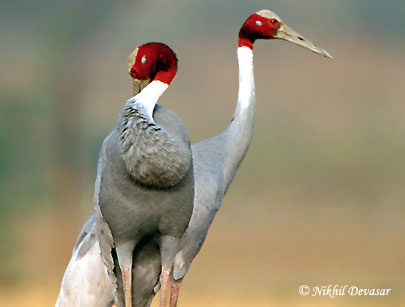
Sarus Crane (Grus antigone) by Nikhil Devasar

Sarus Crane (Grus antigone) by Nikhil Devasar

Around the world there are 15 crane species in the Gruidae Family of the order Gruiformes. The cranes are the Grey Crowned, Black Crowned, Demoiselle, Blue, Wattled, Siberian, Sandhill, Sarus, Brolga, White-naped, Common, Hooded, Whooping, Black-necked, and Red-crowned.

Cranes are large, long-legged and long-necked birds  Unlike the similar-looking but unrelated herons, cranes fly with necks outstretched, not pulled back. Cranes live on all continents except Antarctica and South America.

They are opportunistic feeders that change their diet according to the season and their own nutrient requirements. They eat a range of items from suitably sized small rodents, fish, amphibians, and insects, to grain, berries, and plants.

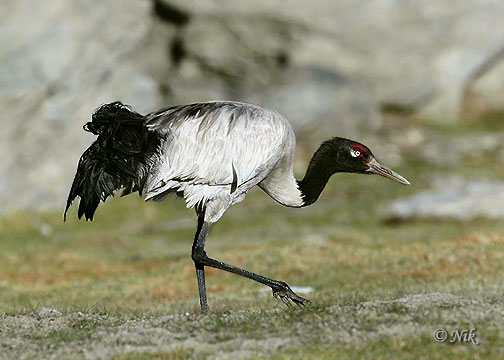
Black-necked Crane (Grus nigricollis) by Nikhil Devasar

Black-necked Crane (Grus nigricollis) by Nikhil Devasar

Most have elaborate and noisy courting displays or “dances”. While folklore often states that cranes mate for life, recent scientific research indicates that these birds do change mates over the course of their lifetimes (Hayes 2005), which may last several decades. Cranes construct platform nests in shallow water, and typically lay two eggs at a time. Both parents help to rear the young, which remain with them until the next breeding season.

Some species and populations of cranes migrate over long distances; others do not migrate at all. Cranes are gregarious, forming large flocks where their numbers are sufficient.

See:

Birds of the Bible – Cranes
Birds of the Bible – Cranes I
Birds of the Bible – Demoiselle Crane
Wordless Birds

*


Birds of the Bible – Names of Birds II

White-tailed Hawk (Buteo albicaudatus) by Daves BirdingPix

White-tailed Hawk (Buteo albicaudatus) by Daves BirdingPix

In the first Names of Birds, I covered the English names of birds. This time the scientific names are going to be looked at, especially the second one. (The first part of the scientific name is the bird’s genus or group) “Birds normally have a scientific name and a common name. The scientific name is usually Latin-bases and is agreed upon by biologists across the world. The common name will vary by region, culture, and language.” (birding.com) No matter what the bird is called in different countries or by different ornithology groups, the scientific name refers to one specific bird. Birds do migrate many miles and spend time in many countries. This naming system helps keep from having the same bird counted numerous times in lists.

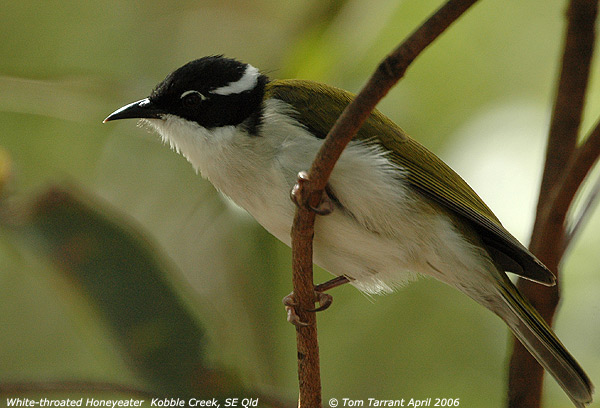
As I have worked with the list of the Birds of the World, I have observed similarities in the naming of the birds. For instance, “alba” is the second part of all of these birds–Western Great Egret, White Cockatoo, Sanderling, White Tern, White Wagtail, African Spoonbill, Phoenix Petrel, Western Barn Owl. Could you figure out what color they all are?

White-throated Honeyeater (Melithreptus albogularis) by Tom Tarrant

White-throated Honeyeater (Melithreptus albogularis) by Tom Tarrant

How about “albicauda“–White-tailed Shrike-Tyrant, White-tailed Blue Flycatcher, White-tailed Lark, White-tailed Hawk? Or “albogularis“–White-throated Jacamar, Rufous-banded Honeyeater, White-throated Pewee, White-throated Canary, White-throated Laughingthrush, White-throated Screech Owl, White-throated Honeyeater, White-throated Francolin, White-throated Caracara, White-throated Treerunner, White-spotted Fantail, White-throated Seedeater, White-throated Kingbird, White-chested White-eye? That last group was not all “white-throated,” in name, but they have white throats.

We know that Adam named the birds and other critters as the Scripture tells us:

Out of the ground the LORD God formed every beast of the field and every bird of the air, and brought them to Adam to see what he would call them. And whatever Adam called each living creature, that was its name. So Adam gave names to all cattle, to the birds of the air, and to every beast of the field. But for Adam there was not found a helper comparable to him. (Genesis 2:19-20 NKJV)

Blue-throated Bee-eater (Merops viridis) by Ray

Blue-throated Bee-eater (Merops viridis) by Ray

Did Adam use scientific names? I doubt it. Adam didn’t have to go though all this. Today the ornithologist (those who study birds) use this method of naming along with a common name in whatever language they speak.

Thought you might find it interesting to see some of the species’ second scientific names:
Colors:
albus/alba, white; cf albino, ater/atra, matt black, brachy-, short (Greek), brunne-, brown, caeruleus, blue, canus, grey, chloro-, green or yellow (Greek), cinerea-, grey or ash-coloured; cf cinders, crocus, cyan, blue, erythro-, red (Greek), flava, yellow, fuscus/fusca, dusky, guttatus, speckled or spotted, haema-, blood-red (Greek); cf haemoglobin, leuco-, white (Greek), lineatus, lined or striped, livia, blue-grey, longi-, long, luteus/lutea, yellow, major, greater, mega-, great (Greek), melas, black (Greek); cf melanistic, minor, lesser, niger/nigra, glossy black; cf negro, punctatus, spotted; cf punctuation, pusilla, tiny, rosea, rosy, ruber, red, rufus/rufa, red, striatus/striata, striped, versicolor, many-collored, varied, viridis, green, albogularis – White-throated
Countries:
abyssinicus, africana, americana, angolensis, antarctica,
Characteristics:
cauda, tail, –cephalus, head (Greek), –ceps, capped, headed, cilla, tail, collis, neck,  cristatus, crested, dactyl, finger or toe (Greek), frons, front, i.e. forehead, –gularis, throat, –ops, eye, –opsis, face, ptera, wing (Greek), –rhynchos, bill (Greek), –rostris, bill, torquatus, collared

Names are important and have meaning. Christ was named long before He was born. It was foretold.

Now all this was done, that it might be fulfilled which was spoken of the Lord by the prophet, saying, Behold, a virgin shall be with child, and shall bring forth a son, and they shall call his name Emmanuel, which being interpreted is, God with us. (Matthew 1:22-23 KJV)
After this manner therefore pray ye: Our Father which art in heaven, Hallowed be thy name.  (Matthew 6:9 KJV)
And in his name shall the Gentiles trust. (Matthew 12:21 KJV)
And Jesus came and spake unto them, saying, All power is given unto me in heaven and in earth. Go ye therefore, and teach all nations, baptizing them in the name of the Father, and of the Son, and of the Holy Ghost: Teaching them to observe all things whatsoever I have commanded you: and, lo, I am with you alway, even unto the end of the world. Amen.
(Matthew 28:18-20 KJV)

(Some information from Scientific bird names explained)

Birds of the Bible – The Bat?

And the stork, the heron after her kind, and the lapwing, and the bat. All fowls that creep, going upon all four, shall be an abomination unto you. (Leviticus 11:19-20 KJV) and
And the stork, and the heron after her kind, and the lapwing, and the bat. (Deuteronomy 14:18 KJV)

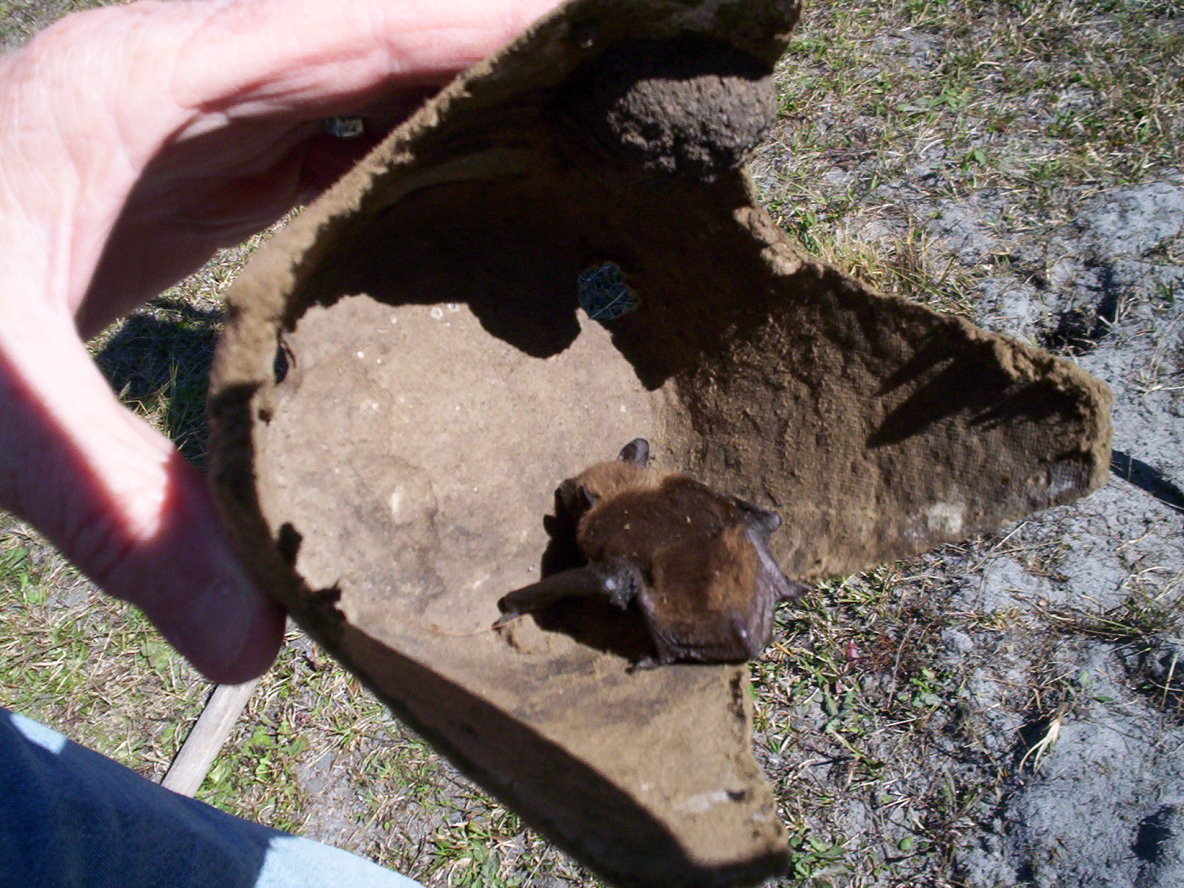
Townsends Big-eared Bat from Wikipedia

These verses show up at the end of the list of “unclean birds.” I have heard people say or write that since the Bat is not a bird, that make the Scriptures incorrect and not true. Let’s look at this a little closer. For one thing, the following verses go on to mention “fowls that go upon all fours” and other critters that are not birds. “Fowl” in the Bible refers to being covered with wings and that includes birds, bats, insects, and others that fly.

Here is what some of the commentators say about these verses.

Gill – “and the bat; a little bird which flies in the night, Aben Ezra says; Kimchi (s) describes it a mouse with wings, which flies in the night, and we sometimes call it the “flitter mouse”; it is a creature between a fowl and a beast; and, as Aristotle says (t), it partakes of both, and is of neither; and it is the only fowl, as Pliny (u) observes, that has teeth and teats, that brings forth animals, and nourishes them with milk. It is a creature so very disagreeable, that one would think almost there was no need of a law to forbid the eating of it; and yet it is said by some to be eatable, and to be eaten, as Strabo (w) affirms, yea, to be delicious food. It is asserted (x), that there is a sort of them in the east, larger than ordinary, and is salted and eaten–that there are bats in China as large as pullets, and are as delicate eating.”

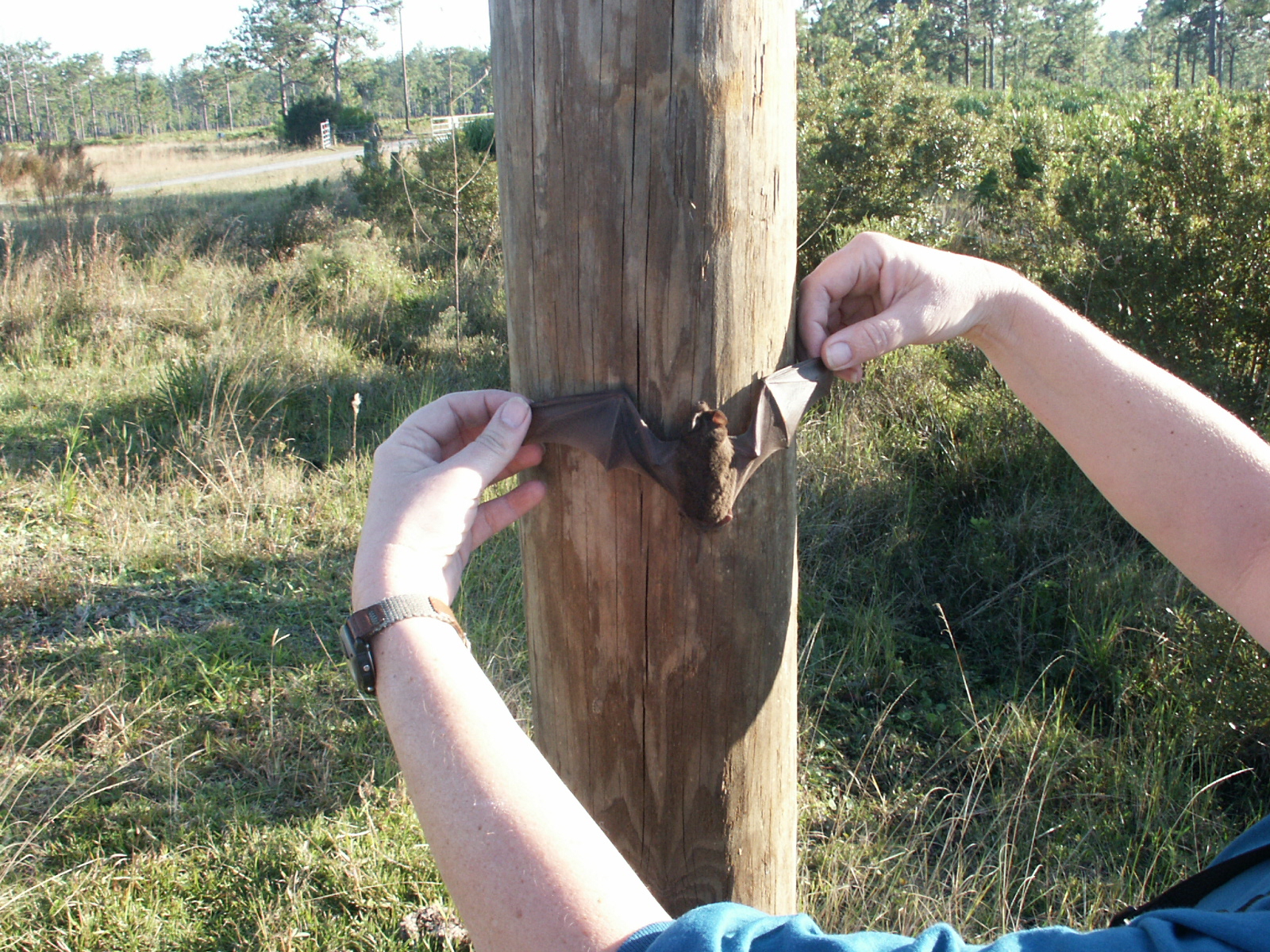
Dan holding a bat at Avon Park AF Range

Clarke – “The bat – עטלף  atalleph, so called, according to Parkhurst, from עט  at, to fly, and עלף  alaph, darkness or obscurity, because it flies about in the dusk of the evening, and in the night: so the Septuagint νυκτερις, from νυξ, the night; and the Vulgate vespertilio, from vesper, the evening. This being a sort of monster partaking of the nature of both a bird and beast, it might well be classed among unclean animals, or animals the use of which in food should be avoided.” “Lev 11:20  All fowls that creep – Such as the bat, already mentioned, which has claws attached to its leathern wings, and which serve in place of feet to crawl by, the feet and legs not being distinct; but this may also include all the different kinds of insects, with the exceptions in the following verse.”
JFB – “the bat — the great or Ternat bat, known in the East, noted for its voracity and filthiness.” Lev 11:20  All fowls that creep, etc. — By “fowls” here are to be understood all creatures with wings and “going upon all fours,” not a restriction to animals which have exactly four feet, because many “creeping things” have more than that number. The prohibition is regarded generally as extending to insects, reptiles, and worms.”

Here are some interesting facts about the bat (not a bird) from Wikipedia:

1) Bats are flying mammals in the order Chiroptera (pronounced /kaɪˈrɒptərə/). The forelimbs of bats are webbed and developed as wings, making them the only mammals naturally capable of true and sustained flight. By contrast, other mammals said to fly, such as flying squirrels, gliding possums and colugos, glide rather than fly, and only for short distances. Bats do not flap their entire forelimbs, as birds do, but instead flap their spread out digits, which are very long and covered with a thin membrane or patagium. Chiroptera comes from two Greek words, cheir (χείρ) “hand” and pteron (πτερόν) “wing.”

Fruit Bat at Avon Park AF Range

2) There are about 1,100 bat species worldwide. About seventy percent of bats are insectivores. Most of the rest are frugivores, or fruit eaters. A few species feed from animals other than insects. Bats are present throughout most of the world and perform vital ecological roles such as pollinating flowers and dispersing fruit seeds. Many tropical plants depend entirely on bats for the distribution of their seeds.
3) Bats range in size from Kitti’s Hog-nosed Bat measuring 29–33 mm (1.14–1.30 in) in length and 2 g (0.07 oz) in mass,[4] to the Giant Golden-crowned Flying-fox, which has a wing span of 1.5 m (4 ft 11 in) and weighs approximately 1.2 kg (3 lb).
4) Bat echolocation is a perceptual system where ultrasonic sounds are emitted specifically to produce echoes. By comparing the outgoing pulse with the returning echoes the brain and auditory nervous system can produce detailed images of the bat’s surroundings. This allows bats to detect, localize and even classify their prey in complete darkness. At 130 decibels in intensity, bat calls are some of the most intense airborne animal sounds.
5) The finger bones of bats are much more flexible than those of other mammals. One reason is that the cartilage in their fingers lacks calcium and other minerals nearer the tips, increasing their ability to bend without splintering. The cross-section of the finger bone is also flattened compared to the circular cross section that human finger bones have, and is very flexible. The skin on their wing membranes has more elasticity and so can stretch much more than other mammals. The wings of bats are much thinner than those of birds, so bats can manoeuvre more quickly and more accurately than birds. It is also delicate, ripping easily. However the tissue of the bat’s membrane is able to regrow, such that small tears can heal quickly.
6) The teeth of microbats resemble insectivorans. They are very sharp to bite through the hardened armor of insects or the skin of fruit.
7) Mammals have one-way valves in veins to prevent the blood from flowing backwards, but bats also have one-way valves in arteries.
8) One species of bat has the longest tongue of any mammal relative to its body size. This is beneficial to them in terms of pollination and feeding their long narrow tongues can reach deep into the long cup shape of some flowers. When their tongue retracts, it coils up inside their rib cage.

God has graciously created the Bat to fulfill its role in doing His will. He has given it exactly what it needs. To some, it may seem a contradiction, but to those of us who believe in creation, there is no conflict.

Below is something we read recently from Comments on Here and Hereafter by Bob Jones, Sr., p. 79-80.

“The animals and fowls decided to have a battle, so the story goes. The animals lined up one one side and the fowls on the other. In the crowd was a little bat. The animals came upon the bat, and he dropped his wings, showed his teeth and said, ‘I am an animal.’ the fowls came upon the bat. He stretched his wings and said, ‘I am a fowl.’ I have known people like the bat. Whatever crowd they are in, that is what they are. They are like the chameleon. They are colored by their surroundings. God’s people, instead of being affected by their surroundings, should affect their surroundings. A good, consecrated Christian who will be faithful to his trust will have some influence upon his environment.”

Birds of the Bible – Hair Like Eagles’ Feathers

That very hour the word was fulfilled concerning Nebuchadnezzar; he was driven from men and ate grass like oxen; his body was wet with the dew of heaven till his hair had grown like eagles’ feathers and his nails like birds’ claws. (Daniel 4:33 NKJV)

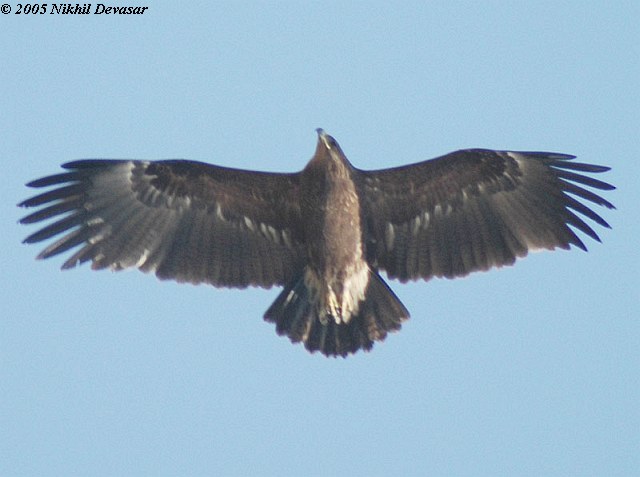
Greater Spotted Eagle (Aquila clanga) by Nikhil

Greater Spotted Eagle (Aquila clanga) by Nikhil

I have wanted to include this verse in a Birds of the Bible article, but just never got to it. Last night our pastor mentioned this verse again in his message and I decided to use it for this weeks blog. Plus, Dan is teaching the Book of Daniel in our Sunday School class.

Many times the birds mentioned in the Bible are listed as “clean or unclean” or as an “object lesson” to teach some truth. This time the mention of Eagle feathers and birds’ claws are used as a description of a man’s appearance and there is a lesson to be learned here.

So, who was this man? It is actually a very important king, King Nebuchadnezzar of Babylon. The information about the King is found throughout the book of Daniel. To make the story short, the king had a dream and wanted an interpretation of that dream. Not only did he want his dreams interpreted, but he wanted the interpreter to tell him what the dream was about. The wise men and others told the king that was impossible, so the king commanded to kill them. Daniel prayed to God that He would reveal the dream and it’s interpretation to him so he could tell it to the King. God answered that prayer and Daniel was able to reveal it to King Nebuchadnezzar.

Long nails like a bird's claws

Long nails like a bird’s claws

King Nebuchadnezzar was the first world ruler and God had given the king great power. Later on, the king’s pride takes over and he thinks he has made this kingdom and does not give God the credit. He even has a great statue made of himself and demands that all fall down and worship him.

Back to making this short. In Daniel chapter 4 the king has another dream and Daniel (Belteshazzar) prays for revelation and again interprets the dream. Daniel 4:9 to 4:18 tells the dream. (Birds are mentions several times in it.) Then Daniel interprets the dream in Daniel 4:19-33. Basically, the Most High is going to let the king learn humility and get rid of the pride that he has.

The king spoke, saying, “Is not this great Babylon, that I have built for a royal dwelling by my mighty power and for the honor of my majesty? (Daniel 4:30 NKJV)

For seven years will his kingdom be departed from him. He will be out in the field, “eating grass like oxen” and “until you know that the Most High rules in the kingdom of men, and gives it to whomever He chooses.” It is during this time that his hair will grow like “eagles’ feathers and his nails like birds’ claws.”

Did King Nebuchadnezzar learn his lesson?

And at the end of the time I, Nebuchadnezzar, lifted my eyes to heaven, and my understanding returned to me; and I blessed the Most High and praised and honored Him who lives forever: For His dominion is an everlasting dominion, And His kingdom is from generation to generation. All the inhabitants of the earth are reputed as nothing; He does according to His will in the army of heaven And among the inhabitants of the earth. No one can restrain His hand Or say to Him, “What have You done?” At the same time my reason returned to me, and for the glory of my kingdom, my honor and splendor returned to me. My counselors and nobles resorted to me, I was restored to my kingdom, and excellent majesty was added to me. Now I, Nebuchadnezzar, praise and extol and honor the King of heaven, all of whose works are truth, and His ways justice. And those who walk in pride He is able to put down. (Daniel 4:34-37 NKJV)

Birds of the Bible – Uniquely Created – Tools

Many birds have built in “tools” such as the way their beaks are designed or their feet, or wings, etc. Some use things as tools as shown below in the articles and the video.

How Nature Works: White-winged Crossbill Feeding Technique from CornellLab of Ornithology. (Last statement gives credit to evolution, but we believe they were uniquely created with this ability by the Lord.)

Rooks Reveal Remarkable Tool Use It appears that Rooks (Crow related) have been given intelligence by their Creator to figure out how to use things as tools.

Also, New Caledonian Crows themselves are able to use tools.

The list goes on and on of the uniquely created ways birds use their built in or external “tools.” “The Tool-Using Bird” (Vulture) and “Animals That Make and Use Tools” by Creation Moments.

What kind of tools (gifts) has the Lord given you to use. Are you using them in the way that He intended for you to use them.

Having then gifts differing according to the grace that is given to us, let us use them: if prophecy, let us prophesy in proportion to our faith; (Romans 12:6 NKJV)

As each one has received a gift, minister it to one another, as good stewards of the manifold grace of God. (1 Peter 4:10 NKJV)

Interesting Articles and Videos:
Adaptation and ecology: the marvelous fit of organisms to their environment” by Dr. Gary Parker

Woodpecker Finch using a stick as a tool. YouTube by firpeace

Animals Using Tools YouTube by ronesh (Bird Fishing)

*

Birds of the Bible – Uniquely Created Sound

When the Lord created the birds, He gave each a unique design which includes not only their appearance, but also the sounds they make. Below is an interesting video about the sounds of the different birds. It is a little lengthy (9 min.) but well worth watching.

The Language of Birds by LabofOrnithology

The flowers appear on the earth; the time of the singing of birds is come, and the voice of the turtle is heard in our land; (Song of Solomon 2:12 KJV)

Each of the bird’s songs and sounds help them to communicate with one another, and with other species. Many times one bird, like a Blue Jay, will sound an alarm that warns all of the birds of an impending danger. Lots of birds singing is a sign that all is well in that area.

Just as the Lord uniquely gave each bird a separate song or sound, the Lord has given each of us in the church separate unique abilities and talents. One may be the preacher, one the song leader, teachers, choir or orchestra members, sound and video workers, baby sitters, ushers, etc. We all are different, but when all of those abilities are brought together, like all of those birds in the rain forest that make beautiful music together, we worship and serve the Lord jointly.

Thy hands have made me and fashioned me: give me understanding, that I may learn thy commandments. (Psalms 119:73 KJV)

Now therefore ye are no more strangers and foreigners, but fellowcitizens with the saints, and of the household of God; And are built upon the foundation of the apostles and prophets, Jesus Christ himself being the chief corner stone; In whom all the building fitly framed together groweth unto an holy temple in the Lord: In whom ye also are builded together for an habitation of God through the Spirit. (Ephesians 2:19-22 KJV)

*