Ian’s Bird of the Week – Yellow Wattlebird

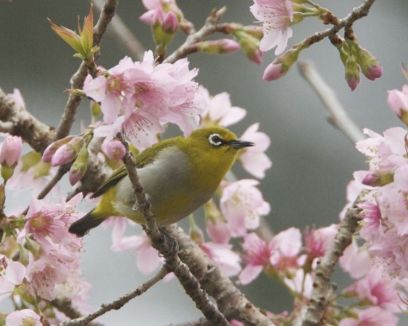
Yellow Wattlebird (Anthochaera paradoxa) by Ian 1

Yellow Wattlebird (Anthochaera paradoxa) by Ian 1

Ian’s Bird of the Week – Yellow Wattlebird ~ by Ian Montgomery

Newsletter ~ 1/31/13

I was going to use some recent photos of the Little Wattlebird as the bird of the week, but then I found that no Wattlebird has featured as BotW so we may as well start with the most spectacular, the Yellow Wattlebird, endemic to Tasmania where it replaces the Red Wattlebird of southern mainland Australia.

Not only is it the largest of the 4 species of Wattlebird but with a length of 37-45cm/14-18in it is the largest member of the Honeyeater family (Meliphagidae) easily out-classing the largest Friarbird the Helmeted (32-37cm). It also has much longer wattles than it cousin the Red Wattlebird. (Neither the Little nor the closely-related Western Wattlebird have wattles.)

Yellow Wattlebird (Anthochaera paradoxa) by Ian 2

Yellow Wattlebird (Anthochaera paradoxa) by Ian 2

It is reasonably common in its native Tasmania, except along the west coast, and also occurs on King Island in Bass Strait. It feeds mainly on nectar but will also take insects and feed on fruit in orchards. The bird in the third photo is probing under bark for insects or grubs.

Yellow Wattlebird (Anthochaera paradoxa) by Ian 3

Yellow Wattlebird (Anthochaera paradoxa) by Ian 3

All the wattlebirds are very noisy and the Yellow is no exception. Pizzey and Knight describe its call as ‘harsh, gurgling, guttural like coughing/vomiting’ and you can’t get much less flattering than that. Some non-birding friends of mine called Wattlebirds near their holiday cottage ‘Yobbo-birds’ (either Red or Little), which appealed to me and, given that two of the species don’t have wattles, seems to me a much better name. So, herewith the Yellow Yobbobird

Best wishes

Ian
**************************************************
Ian Montgomery, Birdway Pty Ltd,
454 Forestry Road, Bluewater, Qld 4818
Tel 0411 602 737 ian@birdway.com.au
Check the latest website updates:
http://www.birdway.com.au/#updates


Lee’s Addition:

I know all the birds of the mountains, And the wild beasts of the field are Mine. (Psalms 50:11 NKJV)

What an interesting looking bird. I love those wattles hanging down. Wonder if they get in the way or he swings them to attract a mate? When you check out Ian’s Meliphagidae family page you will see that he has really been busy photographing those in that family. He has at least 70 birds listed. Wow! At present there are 184 species and he has 70 of them.

See:

More of Ian’s Bird of the Week Newsletters

Meliphagidae – Honeyeaters  – Here

*

Birds of the Bible – Name Study – Swamphen or Waterhen

Purple Gallinule by Lee at Lake Hollingsworth by Lee

Purple Gallinule by Lee at Lake Hollingsworth by Lee

And the swan, and the bittern, and the porphyrion. (Leviticus 11:18 DRB)

And the swan, and the pelican, and the gier eagle, (Leviticus 11:18 KJV)

the white owl, the jackdaw, and the carrion vulture; (Leviticus 11:18)

et cygnum, et onocrotalum, et porphyrionem, (Leviticus 11:18 clVulgate)

A quote from the article mentioned in Birds of the Bible – Names of Birds Study Introduction from Kosher Animals – Birds about the “porphyrion”:

“An additional complexity arises from the fact that the porphyrion has not yet been identified, and classical Greek literature merely identifies a number of species that are not the porphyrion, including the peacock, grouse, and robin, and implies that the porphyrion is the cousin of the kingfisher; from these meagre clarifications, the porphyrion can only be identified as anything from the Lilac-breasted Roller, Indian Roller, or Northern Carmine Bee-eater, to the flamingo.”

This caused studying to find out more about this. Working so much with the names of birds of the world that I list, a search of that database came up with these Latin named birds with similar spelling and the Waterhen listed in some Bible translations, so it is listed also.:

Purple Swamphen (Porphyrio porphyrio)
African Swamphen (Porphyrio madagascariensis)
White Swamphen (Porphyrio albus) † Extinct
Mohoau (Porphyrio mantelli) † Extinct
Takahe (Porphyrio hochstetteri)
Allen’s Gallinule (Porphyrio alleni)
Purple Gallinule (Porphyrio martinicus)
Azure Gallinule (Porphyrio flavirostris)

Purple-throated Cotinga (Porphyrolaema porphyrolaema)  ©Cincinnati Zoo
Blue Finch (Porphyrospiza caerulescens) Wikipedia

White-breasted Waterhen (Amaurornis phoenicurus)

Interesting. The Cotinga and the Finch, I believe could be eliminated as birds not on the unclean list. The birds left are all part of the Rails, Crakes and Coots-Rallidae Family. Also looking back over previous posts, the Water-hen was written about in Birds of the Bible – Water-hen or Water hen. Some insight was discovered in that article.

Which bird is intended by the Bible? I have no definite answer. But, for the sake of learning more about birds, let’s look at the ones left on the list above. Notice that “purple” does show up in most of these birds.
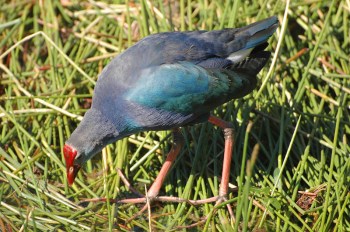
Purple Swamphen (Porphyrio porphyrio) by Bob-Nan

Purple Swamphen (Porphyrio porphyrio) by Bob-Nan

The Purple Swamphen (Porphyrio porphyrio), also known as the Pūkeko, African Purple Swamphen, Purple Moorhen, Purple Gallinule or Purple Coot, is a large bird in the family Rallidae (rails). From its name in French, talève sultane, it is also known as the Sultana Bird. This chicken-sized bird, with its huge feet, bright plumage and red bill and frontal shield is easily-recognisable in its native range. It should not be confused with the American Purple Gallinule, Porphyrio martinica.

There are 13 or more subspecies of the Purple Swamphen (depending on the authority) which differ mainly in plumage colour.
The species makes loud, quick, bleating and hooting calls, which are hardly bird-like in tone. It is particularly noisy during the breeding season. Despite being clumsy in flight it can fly long distances, and it is a good swimmer, especially for a bird without webbed feet.

The Purple Swamphen is occasionally recorded as an escape from captivity in Britain and elsewhere. An introduced population exists in Florida, though state wildlife biologists are trying to eradicate the birds.

The Purple Swamphen was introduced to North America in the late 1990s due to avicultural escapes in the Pembroke Pines, Florida area. The birds multiplied and can now be found in many areas of southern Florida. Ornithological authorities consider it likely that the swamphen will become an established part of Florida’s avifauna.

The Florida birds are mostly or entirely of the gray-headed race poliocephalus, native to the area around the Caspian Sea.

The most common call from the Florida birds is a loud, high-pitched “creek,” often doubled.

**********

White Swamphen (Lord Howe) (Porphyrio albus) † Extinct ©WikiC

White Swamphen (Lord Howe) (Porphyrio albus) † Extinct ©WikiC

The Lord Howe Swamphen or White Gallinule, Porphyrio albus, was a large bird in the family Rallidae endemic to Lord Howe Island, Australia. It was similar to the Purple Swamphen, but with shorter and more robust legs and toes. Its plumage was white, sometimes with a few blue feathers, and it was probably flightless, like its other close relative the Takahe. Similar, entirely blue birds were also described, but it is not clear if they belong to this species or are simply Purple Swamphens (which can also be found on the island). The feathers on the two extant skins are white.

This bird was first described by John White in his Journal of a Voyage to New South Wales (1790), which also contained an illustration. It was not uncommon when the bird was first described, but was soon hunted to extinction by whalers and sailors.
There are two skins of the bird in existence, one in the collection of the World Museum in Liverpool and the other in the Naturhistorisches Museum Wien in Vienna. There are also several paintings, and some subfossil bones.
************
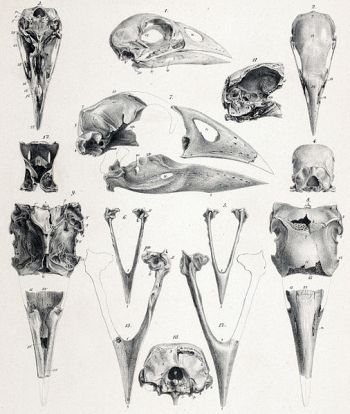
Mohoau (Porphyrio mantelli) † Extinct (North Island Takahē) ©WikiC

Mohoau (Porphyrio mantelli) † Extinct (North Island Takahē) ©WikiC

The North Island Takahē or Mōho, or Mohoau (Porphyrio mantelli) is an extinct rail that was found in the North Island of New Zealand. This flightless species is known from subfossils from a number of archeological sites and from one possible 1894 record (Phillipps, 1959). It appeared to have been even larger than the South Island Takahē and, if it did survive until the 1890s, would have been the largest rail in historic times. The decline of the species has generally been attributed to the increasing incursion of forest into the alpine grasslands through the Holocene, although hunting by the Māori also played a major role.

Traditionally the North Island Takahē was considered conspecific with the threatened South Island Takahe P. hochstetteri. Trewick (1996) presented evidence that the two taxa were independently derived from flying ancestors, so proved to be separate species.
*************************
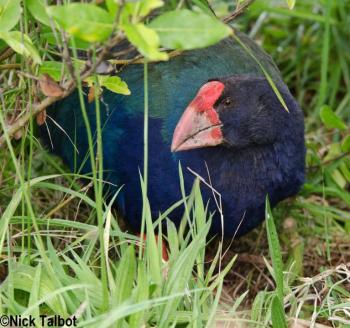
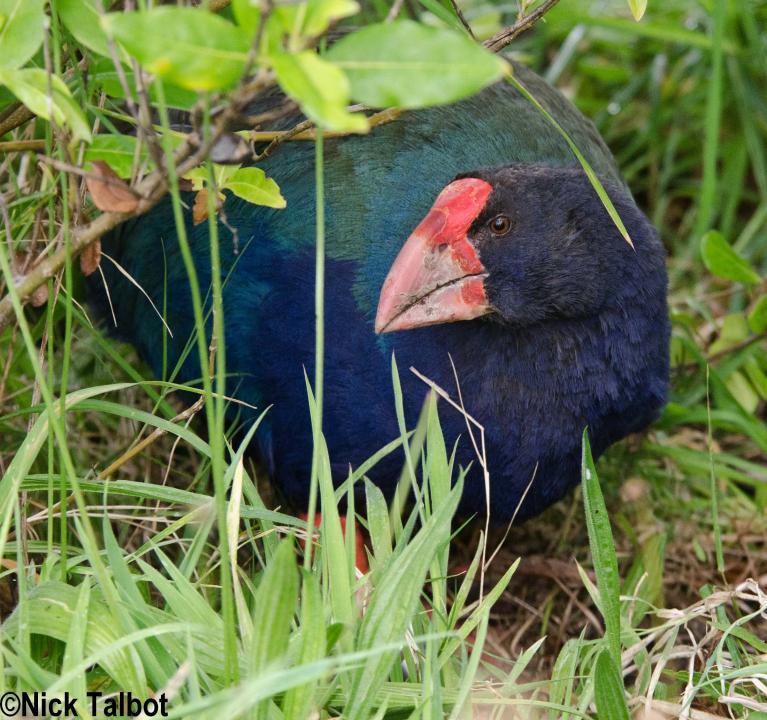
Takahe (Porphyrio hochstetteri) by Nick Talbot

Takahe (Porphyrio hochstetteri) by Nick Talbot

The Takahē (Porphyrio hochstetteri) or South Island Takahē (Porphyrio hochstetteri) is a flightless bird indigenous to New Zealand and belonging to the rail family. It was thought to be extinct after the last four known specimens were taken in 1898. However, after a carefully planned search effort the bird was rediscovered by Geoffrey Orbell near Lake Te Anau in the Murchison Mountains, South Island, on 20 November 1948.

The Takahē is the largest living member of the Rallidae family. Its overall length averages 63 cm (24.8 in) and its average weight is about 2.7 kg (6 lbs) in males and 2.3 kg (5 lb) in females, ranging from 1.8-4.2 kg (4-9.2 lbs).  The standing height is around 50 cm (20 in). It is a stocky bird, with reduced wings, strong legs and a massive bill.

The adult Takahē is mainly purple-blue in colour, with a greenish back and inner wings. It has a red frontal shield and red-based pink bill. The legs are pink. This is a noisy species with a loud clowp call. Contact call is easely confused with that of the Weka (Gallirallus australis), but is generally more resonant and deeper.
***********
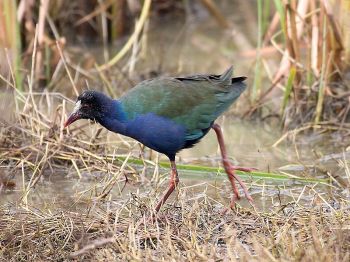
Allen's Gallinule (Porphyrio alleni) ©WikiC

Allen’s Gallinule (Porphyrio alleni) ©WikiC

The Allen’s Gallinule (Porphyrio alleni), formerly known as the Lesser Gallinule is a small waterbird of the family Rallidae. Its former binomial name is Porphyrula alleni.
Its breeding habitat is marshes and lakes in sub-Saharan Africa. They build a floating nest in marshes and swamps, laying 2-5 eggs. This species is partially migratory, undertaking seasonal movements.
Remarkably, this apparently weakly flying bird is not only the only species with a purely sub-Saharan African range to have reached Great Britain, but has done so twice. It has also occurred as a vagrant in several other European countries.

They are similar in size to the only slightly larger Water Rail. The Allen’s Gallinule has a short red bill, greenish back and purple upperparts. They have red legs with long toes, and a short tail which is white with a dark central bar underneath. Breeding males have a blue frontal shield, which is green in the female. Immature Allen’s Gallinules are sandy brown with a buff undertail. The downy chicks are black, as with all rails.
These birds probe with their bill in mud or shallow water, also picking up food by sight. They mainly eat insects and aquatic animals. They nod their heads as they swim.

Allen’s Gallinules are very secretive in the breeding season, particularly in the dense swamps they favour, and are mostly heard rather than seen. They are then rather noisy birds, with a sharp nasal pruk call. They can be easier to see on migration or when wintering.

This bird is named after British naval officer Rear-Admiral William Allen (1770-1843).

******************
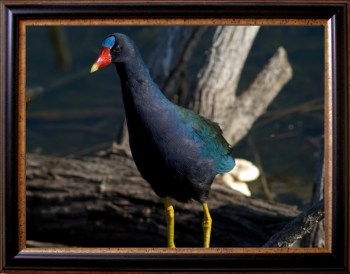
Framed Purple Gallinule by Dan

Framed Purple Gallinule by Dan

The (American) Purple Gallinule (Porphyrio martinicus) is a “swamp hen” in the rail family Rallidae. This is a medium-sized rail, measuring 26–37 cm (10–15 in) in length, spanning 50–61 cm (20–24 in) across the wings and weighing 141–305 g (5.0–10.8 oz). Males, averaging 257 g (9.1 oz) in mass, are slightly larger than females, at 215 g (7.6 oz) on average. The adult Purple gallinule has big yellow feet, purple-blue plumage with a green back, and red and yellow bill. It has a pale blue forehead shield and white undertail. Darkness or low light can dim the bright purple-blue plumage of the adult to make them look dusky or brownish, although the forehead shield color differentiates them from similar species such as Common Gallinules.

Juveniles are brown overall with a brownish olive back. These gallinules will fly short distances with dangling legs. Their breeding habitat is warm swamps and marshes in southeastern states of the United States and the tropical regions of Central America, the Caribbean and northern South America. This species is resident in southern Florida and the tropics, but most American birds are migratory, wintering south to Argentina. The nest is a floating structure in a marsh. Five to ten eggs are laid. Their coloration is buff with brown spots.

The diet of these rails is omnivorous, being known to include a wide variety of plant and animal matter, including seeds, leaves and fruits of both aquatic and terrestrial plants, as well as insects, frogs, snails, spiders, earthworms and fish. They have also been known to eat the eggs and young of other birds.

This species is a very rare vagrant to western Europe and southwestern Africa. There is a similar species in southern Europe, the Purple Swamphen, Porphyrio porphyrio, but that bird is much larger.

This species is sometimes referred to by the alternative name, Yellow-legged Gallinule.
***********
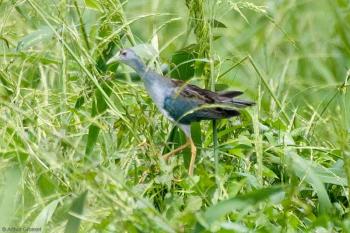
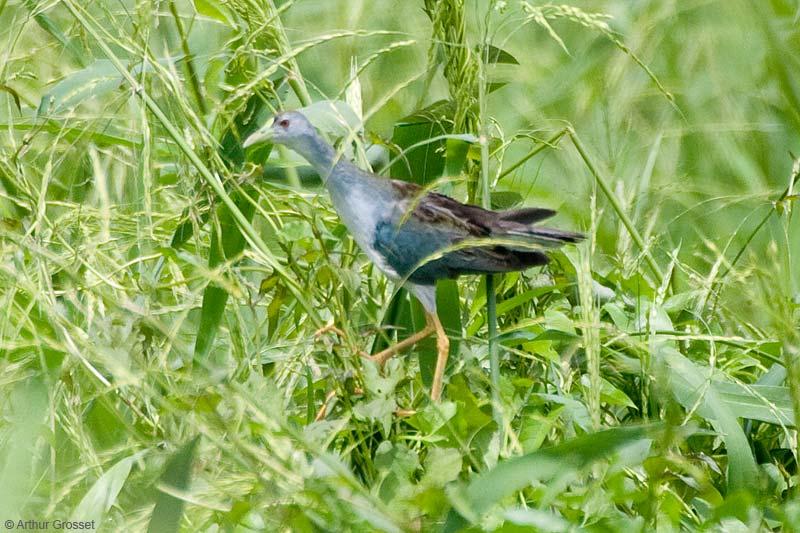
Azure Gallinule (Porphyrio flavirostris) ©Arthur Grosset

Azure Gallinule (Porphyrio flavirostris) ©Arthur Grosset

The Azure Gallinule (Porphyrio flavirostris) is a species of bird in the Rallidae family. It is found in Argentina, Bolivia, Brazil, Colombia, Ecuador, French Guiana, Guyana, Paraguay, Peru, Suriname, Trinidad and Tobago, the United States, and Venezuela.

The bill and frontal shield is a pale greenish-yellow.The wing coverts are greenish-blue while the back and tail are browner. The throat and underparts are white while the legs are yellow.

It is found in freshwater marshes where there is floating vegetation and this includes marshy edges of rivers and lakes. Nest is an open cup of leaves concealed in dense marsh vegetation. Clutch size is 4-5 eggs, incubated by both parents. Diet consists of invertebrates, insects and seeds taken from water and vegetation. Climbs in reed stems to bend them over water to pick up food.
***************
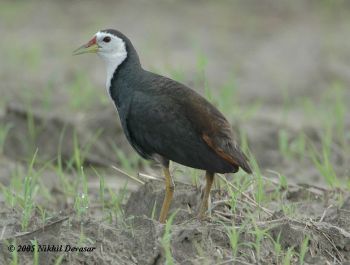
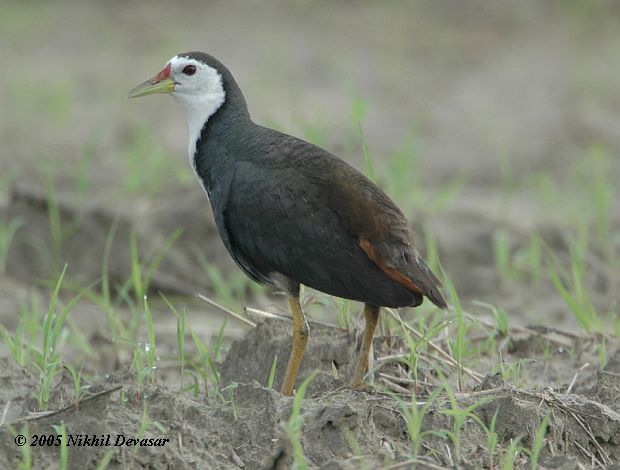
White-breasted Waterhen (Amaurornis phoenicurus) by Nikhil Devasar

White-breasted Waterhen (Amaurornis phoenicurus) by Nikhil Devasar

The White-breasted Waterhen (Amaurornis phoenicurus) is a waterbird of the rail and crake family Rallidae that is widely distributed across Southeast Asia and the Indian Subcontinent. They are dark slaty birds with a clean white face, breast and belly. They are somewhat bolder than most other rails and are often seen stepping slowly with their tail cocked upright in open marshes or even drains near busy roads. They are largely crepuscular in activity and during the breeding season, just after the first rains, make loud and repetitive croaking calls.

Adult White-breasted Waterhens have mainly dark grey upperparts and flanks, and a white face, neck and breast. The lower belly and undertail are cinnamon coloured. The body is flattened laterally to allow easier passage through the reeds or undergrowth. They have long toes, a short tail and a yellow bill and legs. Sexes are similar but females measure slightly smaller. Immature birds are much duller versions of the adults. The downy chicks are black, as with all rails.

************

The other reference to the Porphyrion is found in Deuteronomy 14:16 with that list of unclean birds. Again, the translations give a wide variation in which bird is meant. Swan, owl, water-hen,

The little owl and the great owl and the water-hen; (Deuteronomy 14:16 BBE)

the little owl and the great owl, the water hen (Deuteronomy 14:16 NRSVA)

and G2532 heronG2064.1 and G2532 swanG2945.2 and G2532 ibisG2395.1 (Deuteronomy 14:16 ABP+)

The little owl, the great owl, the horned owl, (Deuteronomy 14:16 AMP)

The litle Owle, the great Owle, nor the Redshanke. (Deuteronomy 14:16 Bishops)

Neither the litle owle, nor the great owle, nor the redshanke, (Deuteronomy 14:16 Geneva)

and the heron, and the swan, and the stork, (Deuteronomy 14:16 Brenton)

herodium ac cygnum, et ibin, (Deuteronomy 14:16 clVulgate) (Cygnus is the Latin word for swan, the romanized form of the ancient Greek κύκνος (kyknos) “swan”.)
the little owl, and the eared owl, and the barn owl, (Deuteronomy 14:16 LITV-TSP)

The little owl, and the great owl, and the swan, (Deuteronomy 14:16 KJV)

(H853) The little owl,H3563 and the great owl,H3244 and the swan,H8580 (Deuteronomy 14:16 KJV+)

the little H3563b owl H3563b, the N1great H3244 owl H3244, the white H8580 owl H8580, (Deuteronomy 14:16 NASB+) (This translation of H8580 amazes me. They translate it white owl yet here is what it says in H8580)

H8580 (Strong’s LXX)
תּנשׁמת
tanshemeth
tan-sheh’-meth
From H5395; properly a hard breather, that is, the name of two unclean creatures, a lizard and a bird (both perhaps from changing color through their irascibility), probably the tree toad and the water hen: – mole, swan.

_____

But, if you look at some of the others:

H8580 (Brown-Driver-Briggs)
תּנשׁמת
tanshemeth
BDB Definition:
1) an unclean animal of some kind
1a) an unclean bird
1a1) perhaps the ibis, water-hen, species of owl, barn owl
1b) an unclean lizard
1b1) perhaps the chameleon
1c) perhaps an extinct lizard or bird, exact meaning unknown
Part of Speech: noun feminine
A Related Word by BDB/Strong’s Number: from H5395
Same Word by TWOT Number: 1433b

_____

H8580 (This is a combo of many BTSCTVM+)

– Original: תּנשׁמת
– Transliteration: Tanshemeth
– Phonetic: tan-sheh’-meth
– Definition:
1. an unclean animal of some kind
a. an unclean bird
1. perhaps the ibis, water-hen, species of owl, barn owl
b. an unclean lizard
1. perhaps the chameleon
c. perhaps an extinct lizard or bird, exact meaning unknown
– Origin: from H5395
– TWOT entry: 1433b
– Part(s) of speech: Noun Feminine

– Strong’s: From H5395; properly a hard breather that is the name of two unclean creatures a lizard and a bird (both perhaps from changing color through their irascibility) probably the tree toad and the water hen: – mole swan.
Total KJV Occurrences: 3
• mole, 1
Lev_11:30

• swan, 2
Lev_11:18; Deu_14:16

_____

Well, I don’t know about you, but I still don’t have a definite answer. Though, isn’t it enjoyable to study God’s Word. Like it was posted before, what ever bird it was is not as important as the obedience that was involved. They knew which birds they were not to eat and they were expected to obey. Today, when we read the Bible, we come across clear commands and we are expected to obey. (Bonus – I was birdwatching in Scripture)

And Samuel said, Hath the LORD as great delight in burnt offerings and sacrifices, as in obeying the voice of the LORD? Behold, to obey is better than sacrifice, and to hearken than the fat of rams. (1 Samuel 15:22 KJV)

Know ye not, that to whom ye yield yourselves servants to obey, his servants ye are to whom ye obey; whether of sin unto death, or of obedience unto righteousness? (Romans 6:16 KJV)

**********

See also:

Birds of the Bible

Birds of the Bible – Water-hen

Birds of the Bible – Swans

Birds of the World – Rallidae – Rails, Crakes & Coots

List of animals in the Bible – Wikipedia

Porphyrion (Greek Mythology) – Wikipedia

(Information from Wikipedia and other internet sources, plus the e-Sword program)

*

Ian’s Bird of the Week – Channel-billed Cuckoo

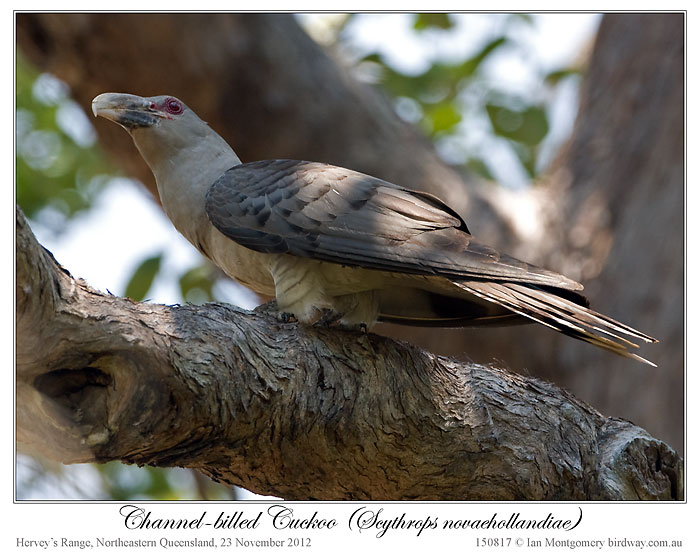
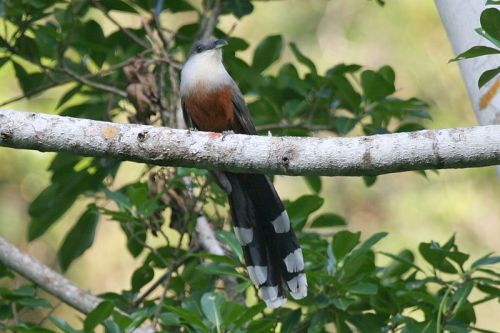
Channel-billed Cuckoo (Scythrops novaehollandiae) by Ian

Channel-billed Cuckoo (Scythrops novaehollandiae) by Ian 1

Ian’s Bird of the Week – Channel-billed Cuckoo ~ by Ian Montgomery

Newsletter ~ 1-21-13

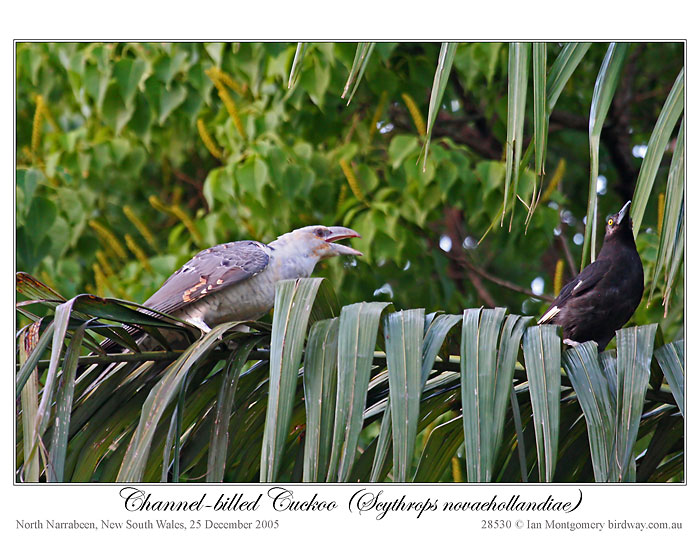
Last week, sorry fortnight, we had the Little Bronze-Cuckoo, the smallest Australian Cuckoo. Here is the Channel-billed Cuckoo, the largest parasitic cuckoo in Australia, and the world for that matter, with a length to 65cm/26in and a weight exceeding 900g/2lbs. (Coucals, such as the Pheasant Coucal , to 75cm, are larger and are now included in the Cuckoo family, but are not parasitic.)

The bird in the first photo is an adult, distinguishable by the grey back (no buff patches) and the red eye and facial skin. The genus name Scythrops means ‘angry eye’ in Greek. The second photo shows a juvenile and you can see the buff patches on the wing, head and throat, though the grey facial skin looks as if it is beginning to acquire the red colour of the adult. This photo was taken in April when the birds would about to migrate to New Guinea.

Channel-billed Cuckoo (Scythrops novaehollandiae) by Ian

Channel-billed Cuckoo (Scythrops novaehollandiae) by Ian 2

Channel-billed Cuckoos lay their large eggs in the nests of Currawongs, Crows, Ravens, Magpies and even Sparrowhawks. The third photo, which appeared as the bird of the week in 2005, shows a very demanding chick with a very nerve-wracked looking foster parent Pied Currawong in the Sydney Metropolitan Area. The adult Cuckoos may break the eggs of the host bird but the chicks do not usually evict the eggs or chicks. Instead they out-compete them for food.

Channel-billed Cuckoo (Scythrops novaehollandiae) by Ian

Channel-billed Cuckoo (Scythrops novaehollandiae) by Ian 3

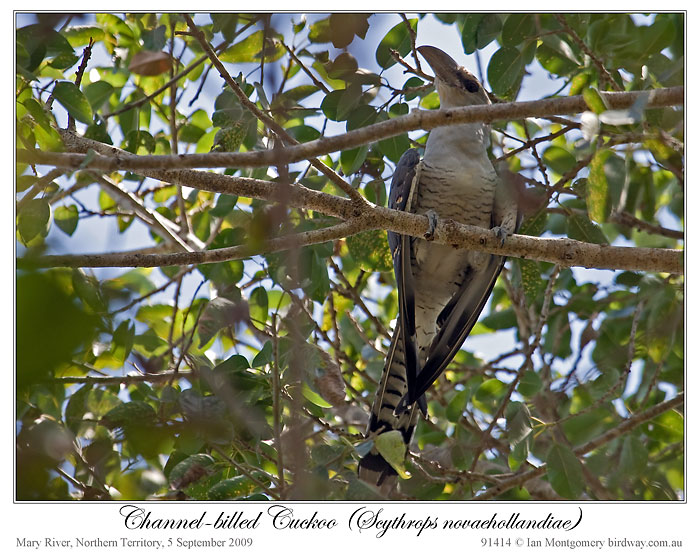
Channel-bills are mainly migratory, though some are though to remain in the Northern Territory throughout the winter. The juvenile in the fourth photo was being fed by Torresian Crow foster parents in the Top End in early September, so it would have hatched in July.

Channel-billed Cuckoo (Scythrops novaehollandiae) by Ian

Channel-billed Cuckoo (Scythrops novaehollandiae) by Ian 4

Typically of Cuckoos, Channel-bills are quite shy and usually remain hidden in foliage but their loud trumpeting calls give them away. They do fly in the open, particular before dusk and look very striking – their long tails and long pointed wings look rather raptor-like, though the large bill doesn’t, and they are often likened to flying crosses.

Best wishes
Ian

**************************************************
Ian Montgomery, Birdway Pty Ltd,
454 Forestry Road, Bluewater, Qld 4818
Tel 0411 602 737 ian@birdway.com.au
Check the latest website updates:
http://www.birdway.com.au/#updates


Lee’s Addition:

And the owl, and the night hawk, and the cuckoo, and the hawk after his kind, (Deuteronomy 14:15 KJV)

The Cuckoos are in the Cucuilidae Family and are also one of the Birds of the Bible, listed in the Unclean Birds.


See:

Ian’s Cuckoos, Coucals & Allies

Cucuilidae – Cuckoo Family

Birds of the Bible – Cuckoo

*

Woodpeckers – The Core Species..

Black-backed Woodpecker (Picoides arcticus) by Daves BirdingPix

Black-backed Woodpecker (Picoides arcticus) by Daves BirdingPix

Woodpeckers – The Core Species.. ~ by ajmithra

Woodpeckers are often termed “core species”
because their presence
is a fundamental requirement to the existence of a wide range of other birds.
Woodpeckers drill new nest holes each year,
and thus many old nest cavities
are available for a entire suite
of hole-nesting species.
Many smaller species
of North American swallow
are dependent on woodpecker holes,
as are virtually all the small owls,
various bluebirds,
and a huge array of small birds like
wrens and chickadees
that use them advantageously.
Isaac dug wells
And the others took it..
He didn’t grumble
but, dug more wells..
And God blessed him even
In times of famine..

Do all things without murmurings and disputings: That ye may be blameless and harmless, the sons of God, without rebuke, in the midst of a crooked and perverse nation, among whom ye shine as lights in the world; (Philippians 12:14,15)

Yours in YESHUA,
a j mithra

Please visit us at:

*

Woodpeckers belong to the Picidae – Woodpeckers.

*

Birds of the Bible – Names of Birds Study – Preparation

Where do we start? (See the Introduction to this study) I personally just re-read the following articles:

I had forgotten that I have been so busy. This is being composed as I am doing my study and will describe my actions as I do them. My e-Sword program is running, plus I have the internet available. There are other great Bible programs out there, but e-Sword is easy to use and it’s free. I have purchased some various versions and commentaries to use with over the years. Also, if you go to the Links section of e-Sword, there you will find places for more additions to add to your e-Sword program. My favorite is Bible Support.

List of all my Bibles in e-Sword

List of all my Bibles in e-Sword

Needless to say, I don’t use them all, but like to have them for when I compare the different versions as you have read in other articles.

Menu Bar for e-Sword

Menu Bar for e-Sword

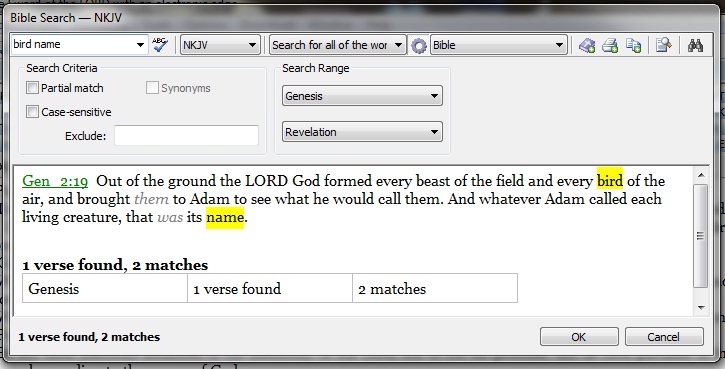
This is the best place to start. The menu bar has the Binoculars close to the center of the photo. (All true birdwatchers know what those are) When the Search (binocular) is pressed a dialog box pops up. I put in “bird name” and then pressed the “OK” button. Here is what comes up.

Bible Search - bird name

Bible Search – bird name

When I did that first with the KJV nothing came up because that verse uses “fowl” not “bird” so the NKJV was selected and this is the result. The first place where birds were named and by whom.

Out of the ground the LORD God formed every beast of the field and every bird of the air, and brought them to Adam to see what he would call them. And whatever Adam called each living creature, that was its name. (Genesis 2:19 NKJV)

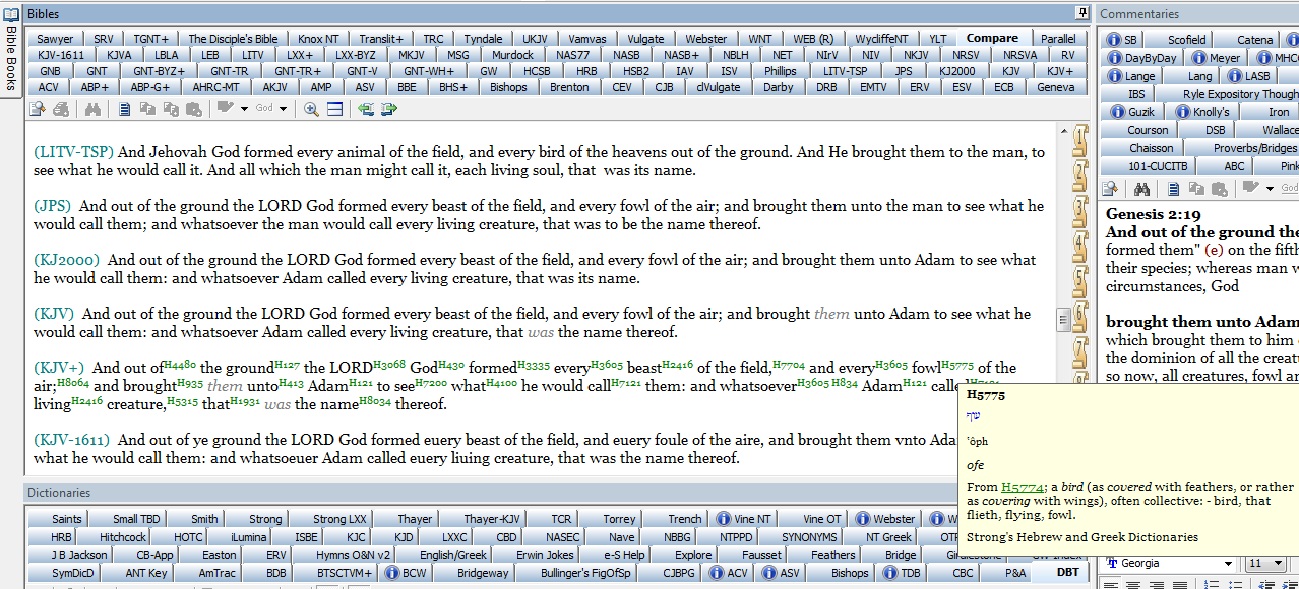
Using compare opens with all the different versions showing that verse. The KJV+ in the photo shows the Strong’s numbers and when the mouse is placed on the numbers a box appears. Now you can see the words in the original languages. If we are going to study about the different names for the clean and unclean birds and other birds throughout the Bible, this will be very handy. Whether you are studying about birds or whatever, this is very useful.

Compare of Genesis 2:19 with Hebrew 5775 for fowl open.

Compare of Genesis 2:19 with Hebrew 5775 for fowl open.

Okay for now. If you do not have a Bible program, try loading one and you can always use e-Sword. There are other Bible programs for the Tablets that will let you do searches also. I also have Study Bibles and my Bird Books handy. Get prepared and this will be continued. Don’t forget to ask for the Lord’s help.

In the mean time, my real binoculars are calling to me to aim them at some birds.

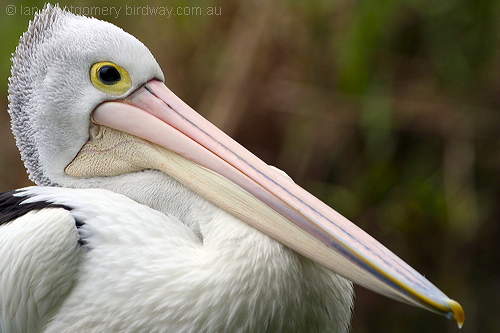
Australian Pelicans – The Corporate Feeders..

Australian Pelican (Pelecanus conspicillatus) by Ian at Birdway

Australian Pelican (Pelecanus conspicillatus) by Ian at Birdway

Australian Pelicans – The Corporate Feeders.. ~ by ajmithra

Australian Pelicans feed together in large numbers..
They herd fishes to shallow waters,
and surround them in decreasing circles..

  • This corporate fishing helps them gather more food..
  • Israelites gathered Manna together…

How many of us believe in Corporate feeding of the Word of God?

  • Corporate worship helped Jesophat overcome his enemies.
  • God descends when we congregate In His mighty name..
  • When God descends satan flees…

For where two or three are gathered together in my name, there am I in the midst of them. (Mathew 18:20)

Yours in YESHUA,
a j mithra

Please visit us at:

*

Pelicans belong to the Pelecanidae – Pelicans Family. They are also a Bird of the Bible.

*

Birds of the Bible – Names of Birds Study Introduction

Bald Eagle (Haliaeetus leucocephalus)  by AestheticPhotos

Bald Eagle (Haliaeetus leucocephalus) by AestheticPhotos

There have been several articles here about the Names of the Birds. See:

Now we are going to look at the Names of the Birds from another angle. I received this comment on the Clean vs Unclean blog.

Lee, my search on the topic of clean and unclean birds led met to a Wikipedia article and I discovered that when you look at the Hebrew words (found in the Masoretic text) for the names of various unclean birds, they sound like descriptions, ex. “bone breaker”, “plunger”, “one who darts”, and even “vomiting”. So perhaps the reason we don’t have “clear rules” listed (something I’ve wondered for a long time) is because the traits and characteristics were there all along, but not knowing Hebrew, we had no idea. Anyway, check it out   http://en.wikipedia.org/wiki/Kosher_animals#Birds

It is a very interesting article and will take some digging to discover some more insight into these birds and how they are named. If you have been following this blog, you know that it has been curious to me how the different versions of the Bible have given different names for the birds. Maybe we can solve some of those mysteries. It won’t be done in one article. That is for sure.

First let’s look at some highlights from the Wikipedia article (with editing).

*********************

Great Horned Owl - Lowry Pk Zoo by Lee

Great Horned Owl – Lowry Pk Zoo by Lee

Birds

In regard to birds, no general rule is given, and instead Leviticus 11:13-19 and Deuteronomy 14:11-18 explicitly list the prohibited birds: The masoretic text lists the birds as:

  • nesher
  • peres (bone breaker)
  • ozniyah (feminine form of oz, meaning strong)
  • ra’ah ([that which] darts, in the sense of rapid)
  • ayyah
  • oreb
  • bat yaanah (daughter of howling)
  • tahmas ([one who] scratches the face)
  • shahaf ([one which] atrophies)
  • netz
  • kos (cup)
  • shalak (plunger)
  • yanshuf (twilight)
  • tinshemet (blower/breather)
  • qa’at (vomiting)
  • racham (tenderness/affection)
  • hasidah (devoted)
  • anafah ([one which] sniffs sharply, in the sense of anger)
  • dukifat
  • atalef

The list in Deuteronomy has an additional bird, the dayyah, which seems to be a combination of da’ah and ayyah, and may be a scribal error; the Talmud regards it as a duplication of ayyah. This, and the other terms are vague and difficult to translate, but there are a few further descriptions, of some of these birds, elsewhere in the Bible:

  • The ayyah is mentioned again in the Book of Job, where it is used to describe a bird distinguished by its particularly good sight.
  • The bat yaanah is described by the Book of Isaiah as living in desolate places, and the Book of Micah states that it emits a mournful cry
  • The qa’at appears in the Book of Zephaniah, where it is portrayed as nesting on the columns of a ruined city; the Book of Isaiah identifies it as possessing a marshy and desolate kingdom.
  • The septuagint versions of the lists are more helpful, as in almost all cases the bird is clearly identifiable:
Chestnut-bellied Cuckoo (Coccyzus pluvialis) ©WikiC

Chestnut-bellied Cuckoo (Coccyzus pluvialis) ©WikiC

  • aeton (eagle)
  • grypa (ossifrage)
  • haliaetos (sea-eagle)
  • gyps (vulture)
  • ictinia (kite)
  • corax (raven)
  • stouthios (ostrich)
  • glaux (owl)
  • laros (gull)
  • hierax (hawk)
  • nycticorax (night raven)
  • cataractes (cormorant)
  • porphyrion (“purple [thing]”)
  • cycnos (swan)
  • ibis
  • pelican
  • charadrios (plover)
  • herodios (heron)
  • epops (hoopoe)
  • nycturia (bat)
  • meleagris (guineafowl)

Although the first ten of the birds identified by the Septuagint seem to fit the descriptions of the masoretic text, the ossifrage (Latin for bone breaker) being a good example, the correspondence is less clear for most of the remaining birds; it is also obvious that the list in Leviticus, or the list in Deuteronomy, or both, are in a different order in the Septuagint, compared to the masoretic text. Attempting to determine the correspondence is problematic; for example, the pelican may correspond to qa’at (vomiting), in reference to the pelican’s characteristic behaviour, but it may also correspond to kos (cup), as a reference to the pelican’s jaw pouch. An additional complexity arises from the fact that the porphyrion has not yet been identified, and classical Greek literature merely identifies a number of species that are not the porphyrion, including the peacock, grouse, and robin, and implies that the porphyrion is the cousin of the kingfisher; from these meagre clarifications, the porphyrion can only be identified as anything from the Lilac-breasted Roller, Indian Roller, or Northern Carmine Bee-eater, to the flamingo.

During the Middle Ages, classical descriptions of the hoopoe were mistaken for descriptions of the lapwing, on account of the lapwing’s prominent crest, and the hoopoe’s rarity in England, resulting in lapwing being listed in certain bible translations instead of hoopoe; similarly the sea eagle has historically been confused with the osprey, and translations have often used the latter bird in place of the former. Because strouthos (ostrich) was also used in Greek for the sparrow, a few translations have placed the sparrow among the list. In Arabic, the Egyptian Vulture is often referred to as rachami, and therefore a number of translations render racham as gier eagle, the old name for the Egyptian Vulture.

Variations arise when translations follow other ancient versions of the Bible, rather than the Septuagint, where they differ. Rather than vulture (gyps), the Vulgate has milvus, meaning Red Kite, which historically has been called the glede, on account of its gliding flight; similarly, the Syriac Peshitta has owl rather than ibis. Other variations arise from attempting to base translations primarily on the masoretic text; these translations generally interpret some of the more ambiguous birds as being various different kinds of vulture and owl. All of these variations mean that most translations arrive at a list of 20 birds from among the following (links are to articles already written here):

Lilac-breasted Roller (Coracias caudatus) by Bob-Nan

Lilac-breasted Roller (Coracias caudatus) by Bob-Nan

The fruit bat, a frugivorous vegetarian species of bat, eating some fruit

Despite being listed among the birds by the bible, bats are not birds, and are in fact mammals. Most of the remaining animals on the list are either birds of prey or birds living on water, and the majority of the latter in the list also eat fish or other seafood. The Septuagint’s version of the list comprehensively lists most of the birds of Canaan that fall into these categories. The conclusion of modern scholars is that, generally, ritually unclean birds were those clearly observed to eat other animals.

Although it does regard all birds of prey as being forbidden, the Talmud is uncertain of there being a general rule, and instead gives detailed descriptions of the features that distinguish a bird as being ritually clean. The Talmud argues that clean birds would have craws, an easily separated double-skin, and would eat food by placing it on the ground (rather than holding it on the ground) and tearing it with their bills before eating it; however, the Talmud also argues that only the birds in the biblical list are actually forbidden – these distinguishing features were only for cases when there was any uncertainty in the bird’s identity

Origin

The earliest rationalistic explanations of the laws against eating certain birds focused on symbolic interpretations; the first indication of this view can be found in the 1st century BC Letter of Aristeas, which argues that this prohibition is a lesson to teach justice, and is also about not injuring others. Such allegorical explanations were abandoned by most Jewish and Christian theologians after a few centuries, and later writers instead sought to find medical explanations for the rules; Nachmanides, for example, claimed that the black and thickened blood of birds of prey would cause psychological damage, making people much more inclined to cruelty.

However, other cultures treated the meat of certain carnivorous birds as having medical benefits, the Romans viewing Owl meat as being able to ease the pain of insect bites, for example; conversely, modern scientific studies have discovered very toxic birds such as the Pitohui, which are neither birds of prey nor water birds, and therefore the biblical regulations allow them to be eaten. Laws against eating any carnivorous birds also existed in Vedic India and Harran, and the Egyptian priests also refused to eat carnivorous birds.

Modern practical considerations

Due to the difficulty of identification, religious authorities have restricted consumption to specific birds for which Jews have passed down a tradition or permissibility from generation to generation. Birds for whom there has been a tradition of their being kosher include: the sparrow, pigeon, turtle dove, quail, the European and Middle Eastern partridges, the pheasant, ducks, geese, chickens, guineafowl among others. As a general principle, scavenging birds such as vultures and birds of prey such as hawks and eagles (which eat carrion when they find it) are not kosher. Turkey does not have a tradition, but because so many Orthodox Jews have come to eat it and it possesses the simanim (signs) required to render it a kosher bird, an exception is made, but with all other birds a Mesorah (tradition) is required.

Birds such as songbirds, which are consumed as delicacies in many societies, may be kosher in theory, but are not eaten in kosher homes as there is no tradition of them being eaten as such. Pigeons and doves are known to be kosher based on their permissible status as sacrificial offerings in the Temple. Likewise, though swans are kosher in theory if kosher-slaughtered, there is no Jewish tradition of eating them. (from Wikipedia)

***********

Second,  Study is not necessarily a weariness as Ecclesiastes 12:12 says,

And further, by these, my son, be admonished: of making many books there is no end; and much study is a weariness of the flesh. (KJV)

but we should study and even enjoy digging into God’s Word.

Study to shew thyself approved unto God, a workman that needeth not to be ashamed, rightly dividing the word of truth. (2 Timothy 2:15 KJV)

I am going to use my e-Sword program. If you have not used it, it is free and very useful. It has the KJV+ as part of it and it list the Greek and Hebrew words with their definitions. Will you join me in studying about the bird names in the languages of the Bible. Join me as we look at these words and compare them to the birds. Don’t let those weird-looking words scare you. You might find that learning to study about birds, might help you carry the method into studying more of God Word.

Look for future articles in this series.

P.S. A Lilac-breasted Roller is new to me. I can’t wait to find out the connection there.
*

Birds of the Bible

*

Updated the Bible Birds – Crane Page

Sandhill Cranes and Babies in yard

Sandhill Cranes and Babies in yard

Cranes know when it’s time to move south for winter. And robins, warblers, and bluebirds know when it’s time to come back again. But my people? My people know nothing, not the first thing of GOD and his rule. (Jeremiah 8:7 MSG)

The Crane page of the Bible Birds has been updated. I added a Gallery of most of the Cranes and some other information. Cranes are interesting and we get to see them quite often. We have two that walk through the yard almost daily. They are Sandhill Cranes. When they have young, they have been known to parade them through the yard to “show them off.”

The tallest Crane I have seen were the two Sarus Cranes which we encountered at the Wings of Asia Aviary at Zoo Miami. They came strolling down the walkway in the aviary right past me. I am only 4′ 10″ and they are 5′ 6″. Needless to say, I had to look up to them. I also gave them some space.

Isn’t the Creator fantastic in the variety of critters, especially the birds, that He has made and for us to enjoy.

Sarus Crane (Grus antigone) by Lee at Wings of Asia

Sarus Crane (Grus antigone) by Lee at Wings of Asia

Wordless Book

*

Absolutely Amazing Videos of Eagle Receiving A New Beak

How long will the land have grief, and the plants of all the land be dry? because of the sins of the people living in it, destruction has overtaken the beasts and the birds; because they said, God does not see our ways. (Jeremiah 12:4 BBE)

Because of someone shooting a Bald Eagle, which is against the law, this bird was seriously injured.

Below are two video explaining what happened to Beauty, the Bald Eagle, and how they came to make a new beak for her. Enjoy.

*

*

Eagles are one of the Birds of the Bible and are in the Accipitridae – Family (Kites, Hawks & Eagles)

*

Wordless Birds

*
Birds of the Bible – Trusting Under The Wing

Red-necked Grebe (Podiceps grisegena) young on her wing ©USFWS

Red-necked Grebe (Podiceps grisegena) young on her wing ©USFWS

The LORD recompense thy work, and a full reward be given thee of the LORD God of Israel, under whose wings thou art come to trust. (Ruth 2:12 KJV)

While searching for “wing” or “wings” in my e-Sword, I discovered this really great verse. Let’s dig into it.

Searching further using “under” and “wing” here are a few more verses that sort of relate to the verse above:

Keep me as the apple of the eye, hide me under the shadow of thy wings, (Psalms 17:8 KJV)

How excellent is thy lovingkindness, O God! therefore the children of men put their trust under the shadow of thy wings. (Psalms 36:7 KJV)

He shall cover thee with his feathers, and under his wings shalt thou trust: his truth shall be thy shield and buckler. (Psalms 91:4 KJV)

Matthew 23:37 and Luke 13:34 mention being gathered under the wing, but they were not willing. Also, in  we covered. no pun intended, how birds protect their young under their wings and how God protects us. But the verse above seem to imply our trust.

What is being trusted? Boaz is implying that Ruth is trusting in the “LORD God of Israel.” She is from another country, another culture and religious way of life, but has turned her trust over to the LORD. That is something I did personally way back in 1960. I put my trust in the Lord to be my personal Savior. It was the best decision of my life.

Storks Shadowing Baby in Lakeland by Dan

Storks Shadowing Baby in Lakeland by Dan

In the Psalms verses, we can know that the Lord keeps His Eye on His own and we should desire to be the “apple of the eye.” Notice in the other verses that while we are under the wings we are trusting. Who? The Lord or LORD. Why do we trust? Wow! Look around at all the Lord has done just in creation and care of the birds. How about our care? We know through promises all through the Word of God that He cares for us. We know He doesn’t lie or do things for our harm. We also know that He is just and will give judgment when needed.  We could go on and on, but you can also see that the Lord Jesus Christ is “trustworthy.”

Baby Chick Peeping Out From Under His Mom's Wing - ©©

Baby Chick Peeping Out From Under His Mom’s Wing – ©©

We know the birds trust their parents to protect them while they are under their wings. Should we not trust the Savior while we are under His wings?

Here is a quote from the Believer’s Bible Commentary:

“2:4-12 When Boaz arrived from Bethlehem, he asked the identity of the young woman. Learning that she was Naomi’s daughter-in-law, he cordially invited her to continue gleaning in his fields and to share the water provided for his workers. In praising her for the loyal and selfless step that she had taken, Boaz concluded with a little prayer for her:
The LORD repay your work, and a full reward be given you by the LORD God of Israel, under whose wings you have come for refuge (v. 12).
Leon Morris comments:

In due course, the prayer was answered through him who uttered it. He recognizes the religious aspect of Ruth’s change of country by saying that she has come to trust (AV) under Yahweh’s wings. The imagery is probably that of a tiny bird struggling under the wings of a foster-mother. It gives a vivid picture of trust and security. . . .

From J. Vernon McGee:

“She had come to trust the Lord God. This is the reason she had left the land of Moab and made that radical decision. She had said that the God of Naomi would be her God. She had turned from idolatry to the living and true God. This woman has come to trust God; she was one of His children. Therefore this is the wonderful testimony that she had there in the land of Israel. And Boaz says, “May a full reward be given to you. May you be recompensed for this decision.”

From Matthew Henry:

“(5.) He (Boaz) prayed for her (Ruth_2:12): The Lord recompense thy work. Her strong affection to the commonwealth of Israel, to which she was by birth an alien, was such a work of the divine grace in her as would certainly be crowned with a full reward by him under whose wings she had come to trust. Note, Those that by faith come under the wings of the divine grace, and have a full complacency and confidence in that grace, may be sure of a full recompense of reward for their so doing. From this expression, the Jews describe a proselyte to be one that is gathered under the wings of the divine majesty.”

From John Gill’s Exposition:

“under whose wings thou art come to trust; whom she professed to be her God, and whom she determined to serve and worship; whose grace and favour she expected, and to whose care and protection she committed herself: the allusion is either to fowls, which cover their young with their wings, and thereby keep them warm and comfortable, and shelter and protect them, see Psa_36:7 or to the wings of the cherubim overshadowing the mercy seat, Exo_25:20 and the phrase is now adopted by the Jews to express proselytism; and so the Targum here,”thou art come to be proselyted, and to be hid under the wings of the Shechinah of his glory,”or his glorious Shechinah.”

My all time favorite photo showing this:

Under His Wings - (Dove - photographer unknown)

Under His Wings – by Ric Seet

Other Articles to check out:

*
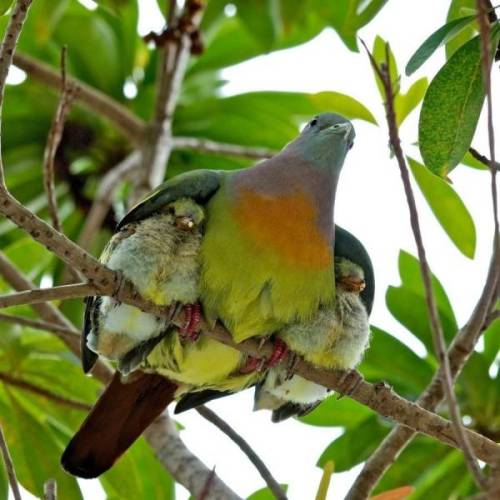
Oriental White-eye – The Grace Seeker..

Oriental White-eye (Zosterops palpebrosus) ©WikiC

Oriental White-eye (Zosterops palpebrosus) ©WikiC

Oriental White-eye – The Grace Seeker.. ~ by a j mithra

The Oriental White-eye (Zosterops palpebrosus) is a small passerine bird in the white-eye family.

It is a resident breeder in open woodland in tropical Asia, east from the Indian Subcontinent to Southeast Asia, extending to Indonesia and Malaysia. They forage in small groups, feeding on nectar and small insects.

They are easily identified by the distinctive white eye-ring and overall yellowish upperparts. Several populations of this widespread species are named subspecies and some have distinctive variations in the extent and shades of yellows in their plumage.

This bird is small (about 8–9 cm long) with yellowish olive upper parts, a white eye ring, yellow throat and vent. The belly is whitish grey but may have yellow in some subspecies. The sexes look similar.

If we are called Christians, we need to look like Christ..

  • But, do we look like Christ or do people see Christ in us and through us?

We have just stepped into a new year, where many of us would have taken resolutions to eat less, quit smoking, stop watching porn stuff and maybe a resolution to stop taking resolutions…

  • But have we ever taken a resolution to walk like Christ, to talk like Christ and be like Christ?

People around us are watching us and expecting us to show Christ. You know?

Now is the time to take a resolution to be like Christ isn’t it?

For as many of you as have been baptized into Christ have put on Christ. (Galatians 3:27)

Japanese White-eye (Zosterops japonicus) by W Kwong

Japanese White-eye (Zosterops japonicus) by W Kwong

The species is widespread and is part of a superspecies complex that includes Zosterops japonicus, Zosterops meyeni and possibly others. The species is found in a wide range of habitats from scrub to moist forest.

They sometimes occur on mangrove areas such as in the Karachi area. and on islands they may lead a more insectivorous life. They are somewhat rare only in the drier desert regions of western India. A feral population was detected in San Diego, California in the 1980’s and subsequently eradicated.

These white-eyes are sociable, forming flocks which only separate on the approach of the breeding season. They are highly arboreal and only rarely descend to the ground.

God too expects us to be highly arboreal (living in a tree)..

  • Adam tried to live on the tree of life but was chased away from God’s presence..
  • We have a tree, the CROSS TREE, where Christ – the Vine hung to make us more like Him..
  • Now is the time to check if we are Arboreal?

I am crucified with Christ: nevertheless I live; yet not I, but Christ lives in me: and the life which I now live in the flesh I live by the faith of the Son of God, who loved me, and gave himself for me. (Galatians 2:20)

The breeding season is February to September but April is the peak breeding season and the compact cup nest is a placed like a hammock on the fork of a branch. The nest is made of cobwebs, lichens and plant fibre.
The nest is built in about 4 days and the two pale blue eggs are laid within a couple of days of each other. The eggs hatch in about 10 days. Both sexes take care of brooding the chicks which fledge in about 10 days Though mainly insectivorous, the Oriental White-eye will also eat nectar and fruits of various kinds.

They call frequently as they forage and the usual contact call is a soft nasal cheer.

They pollinate flower when they visit them for flower insects (such asthrips) and possibly nectar that form their diet. The forehead is sometimes coloured by pollen leading to mistaken identifications.

  • Do we visit Rose of Sharon and the Lilly of the valley every day and help in pollination?
  • If yes, why is that people are not able to witness pollen grains (Word of God) on most of our foreheads?

Therefore shall you lay up these my words in your heart and in your soul, and bind them for a sign upon your hand, that they may be as frontlets between your eyes. (Deuteronomy 11:18)

When nesting, they may mob palm squirrels but being small birds they are usually on the defensive. Their predators include bats (esp. Megaderma lyra) and birds such as the White-throated Kingfisher. Like some other white-eyes, they sometimes steal nest material from the nests of other birds Cases of interspecific feeding have been noted with white-eyes feeding the chicks of a Paradise Flycatcher.

They have been observed bathing in dew accumulated on leaves.

  • Do we remember, Israelites collected manna covered with the morning dew?

Which means feasting of Manna at dawn increases His grace in our life isn’t it? His grace is like early morning dew, this is what the Bible says right?

  • Without His grace it is unlikely for us to survive..

It is of the LORD’S mercies that we are not consumed, because his compassions fail not. They are new every morning: great is thy faithfulness. (Lamentations 3:22-23)

Oriental White-eye (Zosterops palpebrosus) ©WikiC

Oriental White-eye (Zosterops palpebrosus) ©WikiC

Although not strong fliers, they are capable of dispersing in winds and storms to new areas including offshore islands. Though these birds are not strong fliers, they still are able to disperse in wind and storm..

  • When we are weak , we need to remember that God uses the weak and the weary..
  • When you face a storm is life, just think of these birds and disperse in the storm…
  • For God always makes us lie down in green pastures and leads us beside still waters..
  • What storm is for others will be still waters for you and me, cos our Lord is our good Shepherd!

Apostle Paul had a thorn in His flesh, you know what God said?

And he said unto me, My grace is sufficient for thee: for my strength is made perfect in weakness. Most gladly therefore will I rather glory in my infirmities, that the power of Christ may rest upon me (2 Corinthians 12:9)

Lets seek for His bountiful grace each dawn to fly high above troubled waters..

Have a grace filled day!

Yours in YESHUA,
a j mithra


Lee’s Addition:

Read more from a j mitha

The White-eyes are in the Zosteropidae – White-eyes Family.

*

Birds of the Bible – Cuckoo III

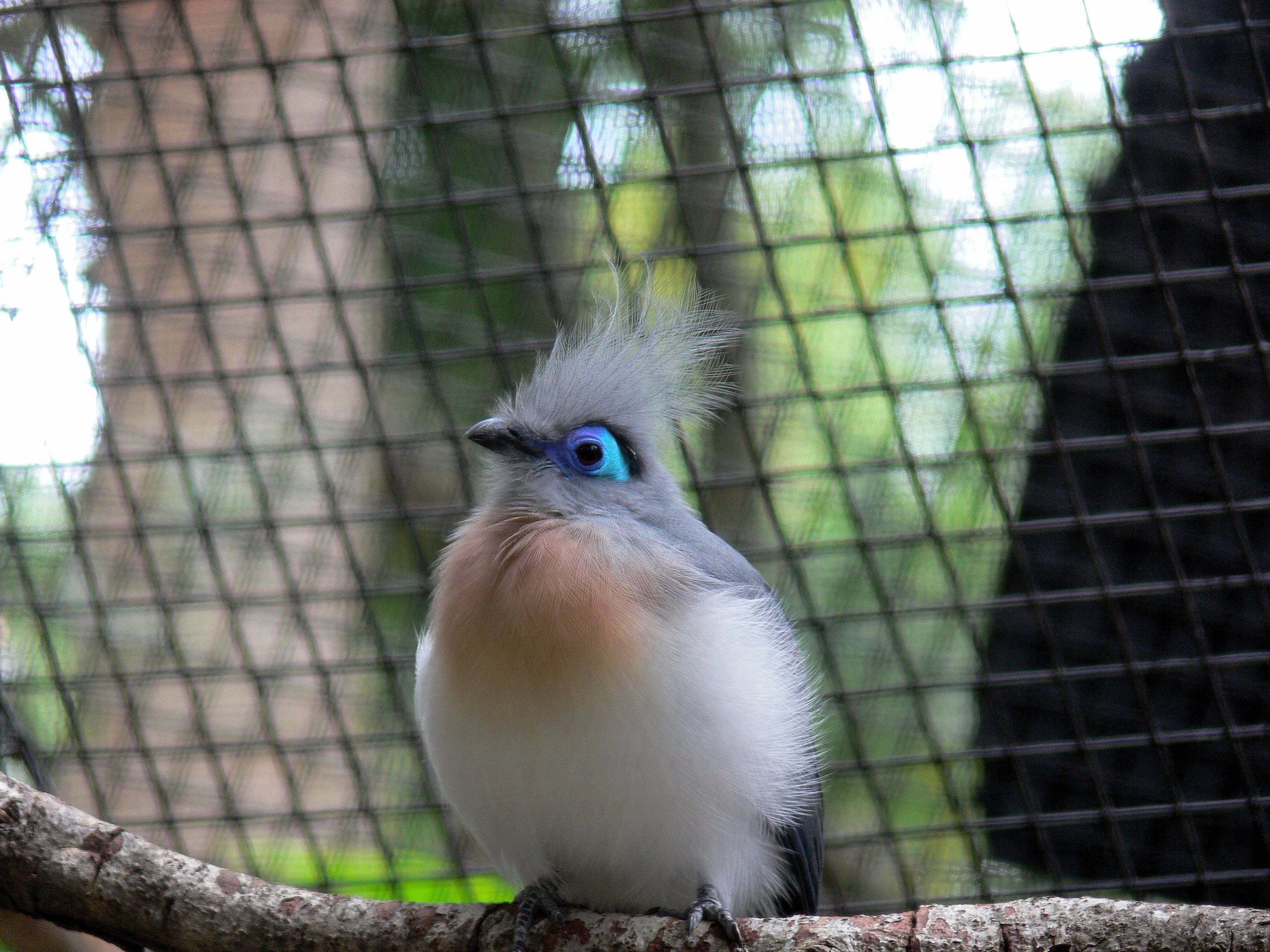
Crested Coua (Coua cristata) by Lee LPZ

Crested Coua (Coua cristata) by Lee Lowry Park Zoo

And the owl, and the night hawk, and the cuckow, and the hawk after his kind, (Leviticus 11:16 KJV)

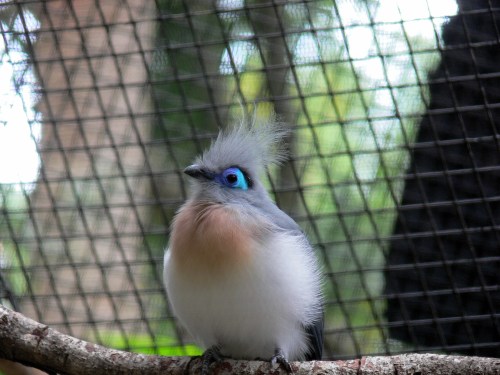
What an interesting Family to which the Cuckoo belongs. Having posted Ian’s Bird of the Week – Little Bronze Cuckoo yesterday, I worked on the Cuckoo – Cuculidae Family to find some more photos. There are a few missing photos, but some of them are of endangered or rarely seen birds. There are some interesting species and some beautiful one also. The Coua genus have the most beautiful eyes. They remind me of the Egyptian Eyes on statues and paintings. We get to see the Crested Coua every time we go over to the Lowry Park Zoo in Tampa. We have to photograph through the mesh, but this one of my better attempts. (See Above) Click through these links and you will see some of the Lord’s Creative Hand at work.

Crested Coua (Coua cristata) by Lee at LowryPkZoo – *LLABS*
Verreaux’s Coua (Coua verreauxi) IBC
Blue Coua (Coua caerulea) ©WikiC
Red-capped Coua (Coua ruficeps) IBC
Red-fronted Coua (Coua reynaudii) IBC
Coquerel’s Coua (Coua coquereli) IBC
Running Coua (Coua cursor) IBC
Giant Coua (Coua gigas) WikiC
Red-breasted Coua (Coua serriana) IBC

Aren’t they amazing? Wow! At least I think they are.

In Birds of the Bible – Cuckoo II it was explained how Leviticus 11:16 and Deuteronomy 14:15 uses Cuckow, Cuckoo, Sea-gull, Sea-hawk in the different versions. I have since added several more Bible Translations to my e-Sword program, so lets see if anything new shows up. The “cuckow” is in the AKJV, “sea gull” in the AMP, the “coockowe” in the Bishops, CJB calls it the “seagull”, Geneva has “seameaw”, the Tyndale calls it a “cocow” and UKJV the “cuckoo.” Seems that it is still split between the same birds. Thus they get to be one of our Birds of the Bible to study.

As mentioned before, it gives us a chance to learn about the many birds that we are blessed with and a reason to concentrate on this family. Notice that both references mention after their kind:

And the owl, and the night hawk, and the cuckow, and the hawk after his kind, (Deuteronomy 14:15 KJV)

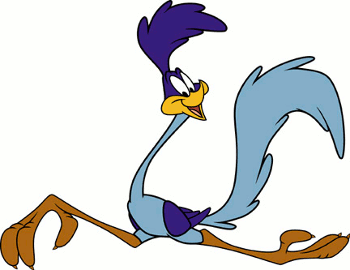
The whole family of the Cuculidae includes not only the Cuckoo, but also the Ani, Roadrunner, Ground, Bronze, Coucal, Coua, Malkoha, Koel, Bronze Cuckoo, Long-tailed Cuckoo, Hawk-Cuckoo, Drongo-Cuckoo, and Lizard Cuckoos. Most in America are familiar with the Roadrunner if by no other way than by Wile E Coyote who is always chasing the Roadrunner in the Looney Tune Cartoons.

Wile E Coyote  - Looney Tunes ”©WikiC

Wile E Coyote – Looney Tunes ”©WikiC

Roadrunner - Looney Tunes ”©WikiC

Roadrunner – Looney Tunes ”©WikiC

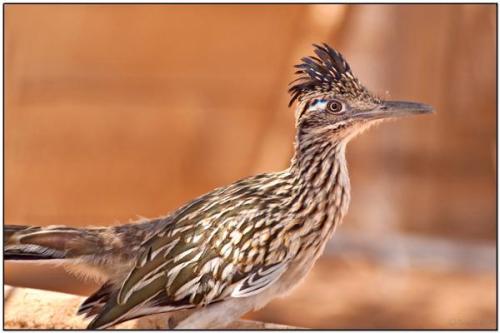
Here is a real Roadrunner:

Greater Roadrunner (Geococcyx californianus) by Daves BirdingPix

Greater Roadrunner (Geococcyx californianus) by Daves BirdingPix

Notice the Eyes even on a Roadrunner. Roadrunners are fast-running birds that have  long tails and a crests. The birds are found in southwestern United States and Mexico. They range from 18-22 in. (46-56 cm) from the beak to the tail. Speeds of up to 20 miles per hour (32 km/h) have been reported. They can fly, but prefer to sprint instead.

More about this family later. Thought you might enjoy seeing some more of our Birds of the Bible that are here to enjoy and be blessed by from the Hand of the Lord.

See also:

Sharing The Gospel

*