Turtle Doves Offered

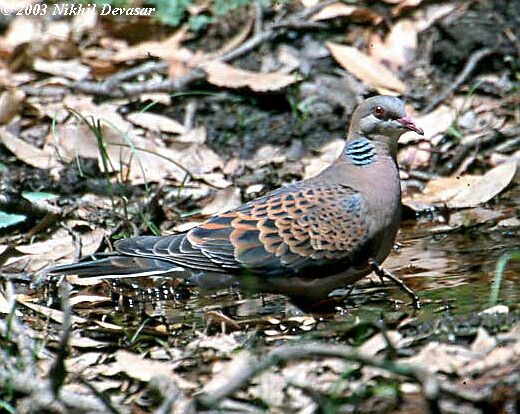
Oriental Turtle Dove (Streptopelia orientalis) by Nikhil Devasar

Oriental Turtle Dove (Streptopelia orientalis) by Nikhil Devasar

Luke 2:21-24 KJV
(21) And when eight days were accomplished for the circumcising of the child, his name was called JESUS, which was so named of the angel before he was conceived in the womb.
(22) And when the days of her purification according to the law of Moses were accomplished, they brought him to Jerusalem, to present him to the Lord;
(23) (As it is written in the law of the Lord, Every male that openeth the womb shall be called holy to the Lord;)
(24) And to offer a sacrifice according to that which is said in the law of the Lord, A pair of turtledoves, or two young pigeons.

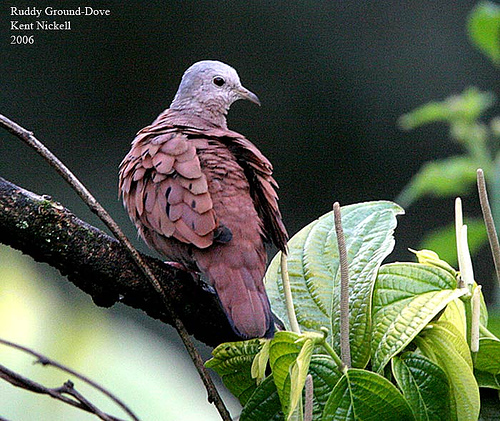
Ruddy Pigeon (Patagionenas subvinacea) by Kent Nickell

Ruddy Pigeon (Patagionenas subvinacea) by Kent Nickell

Holiday Spirit from Dawn’s Bloggy Blog

My friend, Dawn, who writes the Dawn’s Bloggy Blog, posted this and thought you might enjoy it. We met a few years ago at the Birding Festival in Titusville, FL. They travel in a motorhome and she never seems to run out of interesting adventures.

These are Cedar Waxwings drinking. A sparrow and an American Robin also show up.

If thine enemy be hungry, give him bread to eat; and if he be thirsty, give him water to drink: (Pro 25:21)

Jesus answered and said unto her, Whosoever drinketh of this water shall thirst again: But whosoever drinketh of the water that I shall give him shall never thirst; but the water that I shall give him shall be in him a well of water springing up into everlasting life. (Joh 4:13-14)

To learn more about Waxwings see:

Cedar Waxwing – by A. J. Mithra
Ian’s Bird of the Week – Cedar Waxwing
Bombycillidae – Waxwings

*

Some Christmas Birds

Christmas White-eye (Zosterops natalis) by Ian

Christmas White-eye (Zosterops natalis) by Ian

Luke 2:15-20 KJV

(15) And it came to pass, as the angels were gone away from them into heaven, the shepherds said one to another, Let us now go even unto Bethlehem, and see this thing which is come to pass, which the Lord hath made known unto us.

(16) And they came with haste, and found Mary, and Joseph, and the babe lying in a manger.

(17) And when they had seen it, they made known abroad the saying which was told them concerning this child.

(18) And all they that heard it wondered at those things which were told them by the shepherds.

(19) But Mary kept all these things, and pondered them in her heart.

(20) And the shepherds returned, glorifying and praising God for all the things that they had heard and seen, as it was told unto them.

Flag of Christmas Island

Flag of Christmas Island©WikiC

While searching to find birds to write about with a Christmas theme, I came across the Territory of Christmas Island which belongs to Australia. It is in the Indian Ocean and only has a population of 1,403 residents who live in a number of “settlement areas” on the northern tip of the island.

*

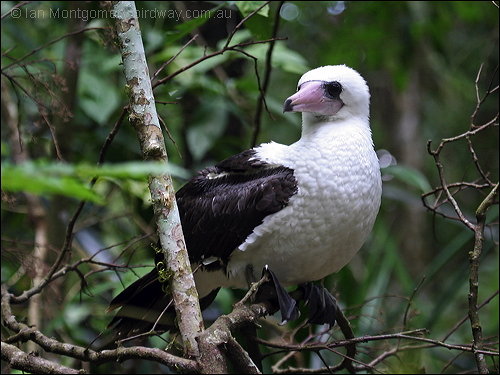
Abbott's Booby (Papasula abbotti) by Ian

Abbott's Booby (Papasula abbotti) by Ian

The island’s geographic isolation and history of minimal human disturbance has led to a high level of endemism (or state of being unique to a defined geographic location, such as an island, nation or other defined zone, or habitat type, and found only there) among its flora and fauna, which is of significant interest to scientists and naturalists. 63% of its 135 square kilometres (52 sq mi) is an Australian national park. There exist large areas of primary monsoonal forest.

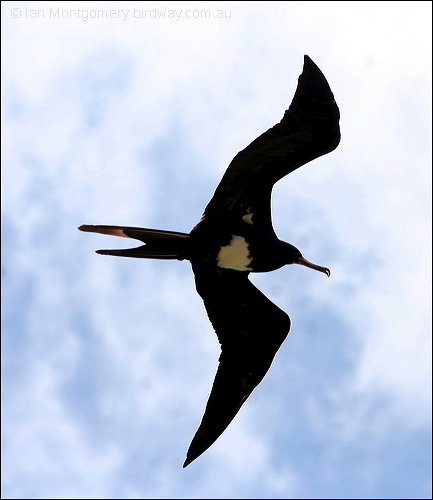
Christmas Frigatebird (Fregata andrewsi) by Ian

Christmas Frigatebird (Fregata andrewsi) by Ian

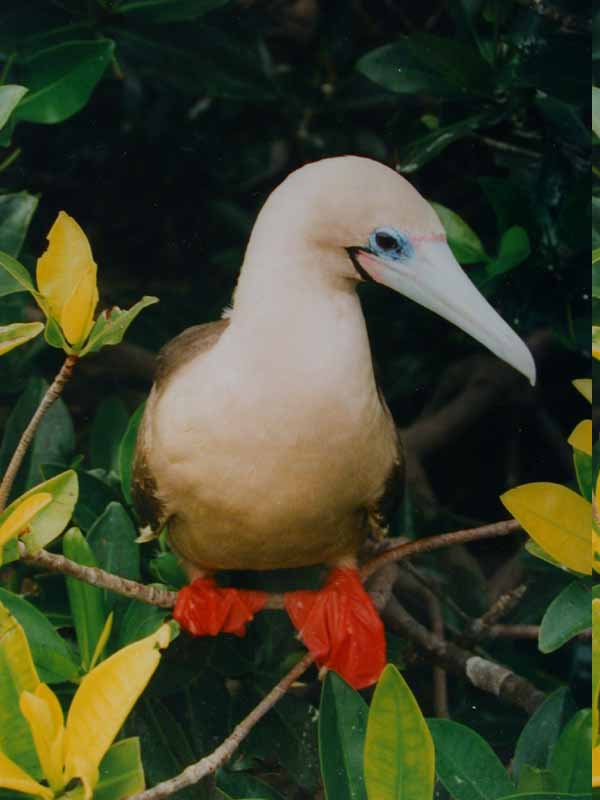
Christmas Island is a focal point for sea birds of various species. Eight species or subspecies of sea birds nest on the island. The most numerous is the Red-footed Booby that nests in colonies, in trees, on many parts of the shore terrace. The widespread Brown Booby nests on the ground near the edge of the seacliff and inland cliffs. Abbott’s Booby nests on tall emergent trees of the western, northern and southern plateau rainforest. The Christmas Island forest is the only nesting habitat of the Abbott’s Booby left in the world. The endemic Christmas Island Frigatebird (listed as endangered) has nesting areas on the north-eastern shore terraces and the more widespread Great Frigatebirds nest in semi-deciduous trees on the shore terrace with the greatest concentrations being in the North West and South Point areas. The Common Noddy and two species of bosuns or tropicbirds, with their brilliant gold or silver plumage and distinctive streamer tail feathers, also nest on the island.

Christmas Imperial Pigeon (Ducula whartoni) by Ian Montgomery

Christmas Imperial Pigeon (Ducula whartoni) by Ian Montgomery

Of the ten native land birds and shorebirds, seven are endemic species or subspecies. This includes the Christmas Island Thrush, and the Christmas Island Imperial Pigeon. Some 86 migrant bird species have been recorded as visitors to the Island.

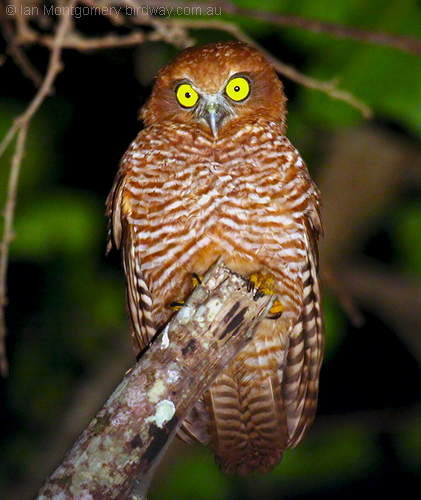
Christmas Boobook (Ninox natalis) by Ian

Christmas Boobook (Ninox natalis) by Ian

The list of birds from the I.O.C., which I use, lists five birds starting with Christmas. The Christmas Boobook (or Christmas Island Hawk-Owl), Christmas Frigatebird, Christmas Imperial Pigeon, Christmas Shearwater, and the Christmas White-eye.

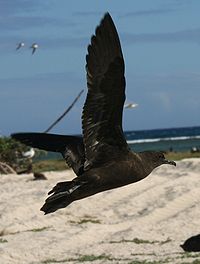
Christmas Shearwater (Puffinus nativitatis) ©WikiC

Christmas Shearwater (Puffinus nativitatis) ©WikiC


Red-footed Booby (Sula sula) by Bob-Nan

Red-footed Booby (Sula sula) by Bob-Nan

*

*


Some information from Wikipedia and other internet sources.

See Also:

Christmas Island – Wikipedia

*

Christmas is Coming!


Birth of Christ from an e-mail

Birth of Christ (from an e-mail-source unknown)

It’s December and time to celebrate Christmas again. Many will be busy getting wrapped up in the excitement of the “Holiday Season” while those of us here at our blog will be celebrating the real meaning of Christmas. We hope to have some articles that present “Christmas” as it should be, the birth of our Savior, the Lord Jesus Christ.

Luke Chapter 2 has one of the most known passages about the birth of Jesus Christ. I will post a part of it in different posts. Also other passages will be given this month that tell of His Birth.

Luke 2:1-14 KJV
(1)  And it came to pass in those days, that there went out a decree from Caesar Augustus, that all the world should be taxed.
(2)  (And this taxing was first made when Cyrenius was governor of Syria.)
(3)  And all went to be taxed, every one into his own city.
(4)  And Joseph also went up from Galilee, out of the city of Nazareth, into Judaea, unto the city of David, which is called Bethlehem; (because he was of the house and lineage of David:)
(5)  To be taxed with Mary his espoused wife, being great with child.
(6)  And so it was, that, while they were there, the days were accomplished that she should be delivered.
(7)  And she brought forth her firstborn son, and wrapped him in swaddling clothes, and laid him in a manger; because there was no room for them in the inn.
(8)  And there were in the same country shepherds abiding in the field, keeping watch over their flock by night.
(9)  And, lo, the angel of the Lord came upon them, and the glory of the Lord shone round about them: and they were sore afraid.
(10)  And the angel said unto them, Fear not: for, behold, I bring you good tidings of great joy, which shall be to all people.
(11)  For unto you is born this day in the city of David a Saviour, which is Christ the Lord.
(12)  And this shall be a sign unto you; Ye shall find the babe wrapped in swaddling clothes, lying in a manger.
(13)  And suddenly there was with the angel a multitude of the heavenly host praising God, and saying,
(14)  Glory to God in the highest, and on earth peace, good will toward men.

These are a review of post done in previous years and are worth re-reading.

Christmas Gospel Presentation produced by Sean Fielder and Pastor Jerry Smith
Birds of the Bible – Jerusalem and Bethlehem Area
Birds of the Bible – At the Manger
Birds in Hymns – Friendly Beasts
Birds in Hymns – Christmas Brings Joy To Every Heart
Christmas Birds – Red
Christmas Birds – Green
Christmas Birds – Red and Green
Christmas Birds – Ornaments
Merry Christmas 2009

Please watch the video of my pastor, Nathan Osborne, III, as he gave an excellent illustration about birds out in the cold and snow. It helps to explain the true meaning of Christmas. (Part of our Christmas cantata, “From the Manger to the Cross”)

Birds In Hymns – Whence Comes This Rush Of Wings?

White-tailed Tropicbird by Ian

White-tailed Tropicbird by Ian

Whence Comes This Rush Of Wings?

We…are come to worship Him. (Matthew 2:2)

Words: French car­ol from Bas-Quer­cy; trans­lat­or un­known. Ap­peared in Car­ols Old and Car­ols New, by Charles Lewis Hutch­ins (Bos­ton, Mass­a­chu­setts: Par­ish Choir, 1916), num­ber 460.

Music: Bas-Quercy

Whence Comes This Rush Of Wings?

Whence comes this rush of wings afar,
Following straight the Noël star?
Birds from the woods in wondrous flight,
Bethlehem seek this holy night.

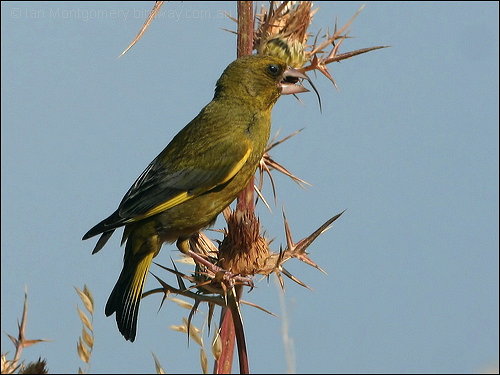
European Greenfinch (Carduelis chloris) by Ian

European Greenfinch (Carduelis chloris) by Ian

“Tell us, ye birds, why come ye here,
Into this stable, poor and drear?”
“Hast’ning we seek the newborn King,
And all our sweetest music bring.”

Hark how the greenfinch bears his part,
Philomel, too, with tender heart,
Chants from her leafy dark retreat,
Re, mi, fa, sol, in accents sweet.

Angels and shepherds, birds of the sky,
Come where the Son of God doth lie;
Christ on the earth with man doth dwell,
Join in the shout, “Noël, Noël!”

Most information from The Cyber Hymnal

See ~ Wordless Birds

More ~ Birds in Hymns

*

Ian’s Bird Of The Week – Chestnut-mandibled Toucan

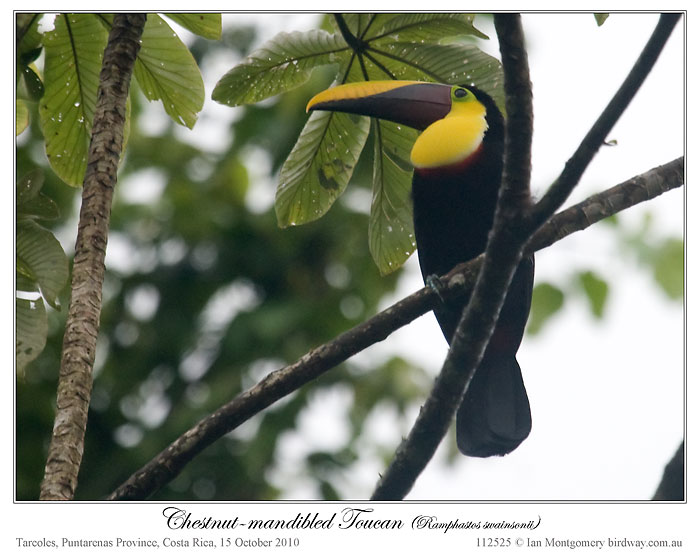
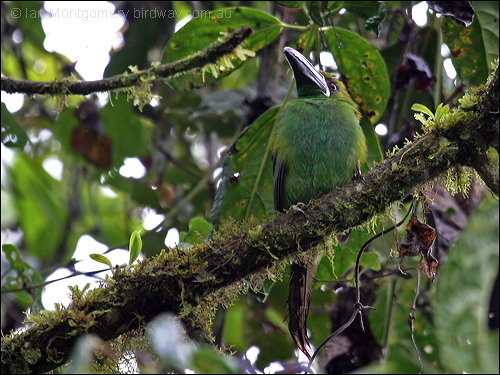
Chestnut-mandibled Toucan (Ramphastos swainsonii) by Ian

Chestnut-mandibled Toucan (Ramphastos swainsonii) by Ian

Ian’s Bird of the Week – Chestnut-mandibled Toucan ~ by Ian Montgomery

Newsletter – 12/09/10

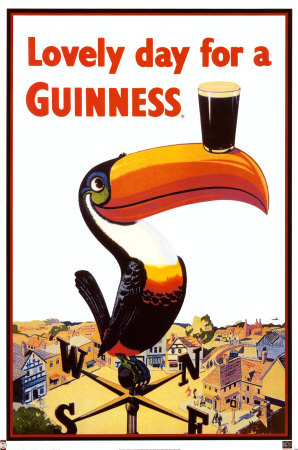
Guinness Toucan Poster from Ian

Guinness Toucan Poster from Ian

I think everybody, birders and non-birders, likes Toucans. They’re one of the iconic, almost cartoonish, animals that were introduced to as young children and I remember Toucans (and Gnus) featuring in posters for Guinness stout in Ireland in the 1950s. Their unbelievably large and colourful bills are so outlandish that it is a delightful shock to come across them in the flesh, particularly in the wild.

The Villa Lapas hotel where I stayed in the Pacific lowlands of Costa Rica had a rainforest canopy trail in its grounds and I checked it out one thundery and gloomy afternoon. The rain held off for most of the trek but, for the most part, the birds didn’t like the weather any more than I did and the light and the dense foliage made it hard to see much less photograph anything. However, repeated raucous calls led me to a pair of Chestnut-mandibled Toucans perched high in an unusually open tree. They proved to be very shy, fell silent as soon as I appeared and flew off into the forest giving me time to take only a few photos. With a length to 61cm/24in, the Chestnut-mandibled is the largest Toucan in Costa Rica. Its range includes most of Central America and Northern South America from Honduras to Ecuador.

Crimson-rumped Toucanet (Aulacorhynchus haematopygus) by Ian

Crimson-rumped Toucanet (Aulacorhynchus haematopygus) by Ian

Toucans use their large bills to collect fruit, but will also feed on nestlings. The structure of the bill is a honeycomb, so it quite light and not particularly strong. Its function has attracted a lot of speculation from reaching fruit, signalling and defence and the latest theory is that it is used as heat exchanger for cooling. The colours vary widely from species to species, supporting its use for species identification but they don’t vary either between the sexes or seasonally. There are about a dozen species of large toucan (genus Ramphastos) and the toucan family (Ramphastidae) includes smaller ones such as Mountain-Toucans (Andigena), Toucanets (Selenidera) and Araçaris (Peteroglossus). All of these are restricted to Central and South America but the related Barbets occur also in Africa and Eurasia. If you are interested in examples of these, have a look at: http://www.birdway.com.au/ramphastidae/index.htm.

Recent milestone on the website are totals of 5,600 photos and 1,300 species. Additions to the website since last week include more photos of American waders such as:

American Avocet

Black-necked Stilt

Willet

and Least Sandpiper

Best wishes,

Ian

Ian Montgomery, Birdway Pty Ltd,

454 Forestry Road, Bluewater, Qld 4818

Phone: +61-7 4751 3115

Preferred Email: ian@birdway.com.au

Website: http://birdway.com.au


Lee’s Addition:

Wow! What a milestone. Way to go Ian. Hope he doesn’t mind, but I inserted one of his photos of a toucanet. Check out Ian’s link above of the Ramphastidae Family.

Gracie the retired Chestnut-mandibled Toucan (Ramphastos swainsonii)

Gracie the retired Chestnut-mandibled Toucan (Ramphastos swainsonii)

We were able to meet and pet “Gracie” at the National Aviary in Pittsburgh, PA this summer. She is also a Chestnut-mandibled Toucan. Her beak as you can see is showing her age. She is retired now and is well cared for. Like Ian said, “I think everybody, birders and non-birders, likes Toucans.” I definitely think they are very neat.

Its leaves were beautiful and its fruit abundant, and in it was food for all. The beasts of the field found shade under it, and the birds of the heavens lived in its branches, and all flesh was fed from it. (Daniel 4:12 ESV)

The Toucans, as Ian said, are found in the Ramphastidae Family. At present, there are 47 species in the family. They are part of the Piciformes Order which contains the Woodpeckers and their allies.

(Editor’s note – not advocating or advertising Guinnes) *

Formed By Him – New Series

Thou art worthy, O Lord, to receive glory and honour and power: for thou hast created all things, and for thy pleasure they are and were created. Rev. 4:11 (Blue Jay by Dan)

Formed By Him

Now out of the ground the LORD God had formed every beast of the field and every bird of the heavens and brought them to the man to see what he would call them. And whatever the man called every living creature, that was its name. (Genesis 2:19 ESV)

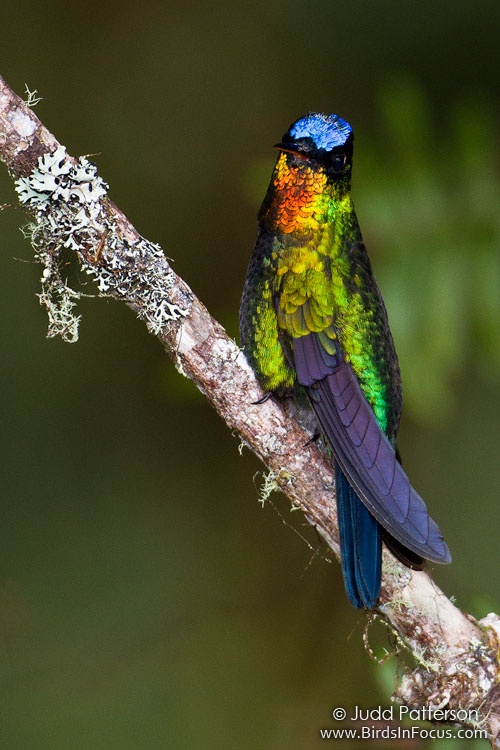
Fiery-throated Hummingbird by J Patterson

I have recently started a series of blog articles about different aspects of the Lord’s Creative Hand on the birds He has created. Some of the articles will be about a specific bird and some amazing characteristics or behavior it demonstrates. The different designs or colors of birds that have been painted with the Lord’s fantastic Paintbrush could be featured or whatever else that reveals God’s Design and His Intelligence in the creation of birds.

As I work on articles and am searching for photos of birds, other neat birds are discovered. With 10,000 plus birds flying around all over this world, the source for material should be way beyond us ever running out of things to write about. Hope you enjoy this new series, “Formed By Him.”

Thus says the LORD who made the earth, the LORD who formed it to establish it–the LORD is his name: (Jeremiah 33:2 ESV)

Red-cockaded Woodpeckers 2-day olds©USFWS

The following “Formed By Him” articles have already been published:
Sword-billed Hummingbird
Copper Birds
Bearded Barbet

Formed By Him – Bearded Barbet

Bearded Barbet (Lybius dubius) ©WikiC Head

Bearded Barbet (Lybius dubius) ©WikiC Head

I know all the birds of the hills, and all that moves in the field is mine. (Psalms 50:11 ESV)

Formed By Him – Bearded Barbet

The Bearded Barbet (Lybius dubius) is an African barbet of the western and central parts. Barbets and toucans are a group of near passerine birds with a worldwide tropical distribution. The Bearded Barbets get their name from the bristles which fringe their heavy bills. All the barbets get their name from the bristles or tufts of feathers. The Bearded Barbet has the greatest beard.

Bearded Barbet (Lybius dubius) ©WikiC

Bearded Barbet (Lybius dubius) ©WikiC

I gave my back to those who strike, and my cheeks to those who pull out the beard; I hid not my face from disgrace and spitting. (Isaiah 50:6 ESV)

The Bearded Barbet is a common resident breeder in tropical west Africa. It is an arboreal species of gardens and wooded country which eats fruit, although the young are fed also insects. It’s sharp beak, not as hard as a woodpecker’s, is not only used for eating but also for pounding in stumps or dead trees to make nests.The have tooth-like grooves in their beaks.

The courtship of tail-flicking, food offerings and some special sounds precede. It nests in the tree hole, laying 2 white eggs. The birds are incubated for 16 days and “helper” birds also share in the incubation and care of the young birds.

Bearded Barbet (Lybius dubius) ©© Passing food

Bearded Barbet (Lybius dubius) ©© Passing food

This is a conspicuous, large barbet at 10.2 in (26 cm). It is fairly plump (2.8-3.8 oz/80-108 gm), with a short neck, large head and a shortish tail. The adult has a black crown, back, tail and breast band. The throat and belly are red and there is a yellow eye patch. The rump is white. The massive bill is very thick and yellow, and the well developed clump or tuft of bristles at its base give the species its name. Sexes are similar in appearance. The call is a growling scrawk.

The Bearded Barbet is found in well-wooded areas with plentiful fig trees. It will enter gardens for fruit and also capture insect for their young. It forms social groups of 4-5 birds and pairs or groups roost together in a tree cavity. They are known to drink nearly every chance they get, usually from a tree crevice.

The Lord has formed these birds so that they have their needs provided for by His Creative Hand. The beak appears to help in the excavation for nests and eating figs and other fruits. Not exactly sure about the beard, but some times those face bristles help keep wood chips out of their eyes or nostrils. Couldn’t get a definitive answer to that part, though it is no mystery to its Creator.

There are other Bearded birds around the world and one is mentioned in the Bible. There is the Bearded Bellbird, Guan, Helmetcrest, Mountaineer, Reedling, Screech Owl, Scrub Robin, Tachuri, Vulture, Wood Partridge, and Woodpecker, Manakin, Thornbill, 3 Bee-eaters, Hermit.

Bearded Vulture (Gypaetus barbatus) ©WikiC

Bearded Vulture (Gypaetus barbatus) ©WikiC

But these are the ones that you shall not eat: the eagle, the bearded vulture, the black vulture, (Deuteronomy 14:12 ESV)

The Bearded Barbet is in the African Barbet – Lybiidae Family and are in the Piciformes Order which is the Woodpeckers and their Allies.

Info from various internet sources including, Wikipedia, St. Louis Zoo, and others.

Wordless Birds

Formed By Him – Copper Birds

Copper-rumped Hummingbird (Amazilia tobaci) by Ian

Copper-rumped Hummingbird (Amazilia tobaci) by Ian

While working on my photos again, came across several pictures of these Copper-rumped Hummingbirds. What a fantastic color they show. These copper colored birds are not the only ones with that hue. Searching through the Birds of the World, I found that there are Copper Pheasants and Sunbirds. Then there is a Coppersmith Barbet, Copper-tailed Starling and a Copper-throated Sunbird. Not to be left out, there are the Coppery birds. Coppery Emerald, Coppery Metaltail, Coppery-bellied Puffleg, Coppery-chested Jacamar, Coppery-headed Emerald and a Coppery-tailed Coucal.

Many birding and ornithology groups work hard to name birds so that those of us who birdwatch can try to put a name on the bird. Since all of these have a common color, “Copper”, it makes it easier to try to figure out what we are seeing. Of course, Adam was the first to start naming the newly created birds, but it still continues today.

Out of the ground the LORD God formed every beast of the field and every bird of the air, and brought them to Adam to see what he would call them. And whatever Adam called each living creature, that was its name. (Genesis 2:19 NKJV)

Copper metal is known by most and so is it’s color. It is a valuable metal for many uses and has been used in coins for thousands of years. In Deuteronomy 8:9 they were told “out of whose hills you can dig copper.” Job 28:2 says, “copper is smelted from ore.” Christ told the disciples to, “Provide neither gold nor silver nor copper in your money belts” and also reminded them that, “Are not two sparrows sold for a copper coin? And not one of them falls to the ground apart from your Father’s will.”

Maybe the Lord wants us to see the copper color and remember that He not only made the copper, but if He cares about a little sparrow, then His concern is great toward us also.

Hope you enjoy seeing these great “Copper Birds”.

That in the ages to come he might shew the exceeding riches of his grace in his kindness toward us through Christ Jesus. (Ephesians 2:7)

*

This slideshow requires JavaScript.

*

Birds in Hymns – O For A Closer Walk With God

Mourning Dove (Zenaida macroura) by Quy Tran

Mourning Dove (Zenaida macroura) by Quy Tran

… and they shall walk with me in white: for they are worthy. (Rev 3:4)

Author: William Cowper, 1731-1800
Musician: Old Irish Tune

O For A Closer Walk With God

O for a closer walk with God,
A calm and heav’nly frame,
A light to shine upon the road
That leads me to the Lamb!

Where is that blessedness I knew
When first I saw the Lord?
Where is the soulrefreshing view
Of Jesus and His Word?

Mourning Dove by Reinier

What peaceful hours I once enjoyed!
How sweet their mem’ry still!
But they have left an aching void
The world can never fill.

Return, O holy Dove! return,
Sweet messenger of rest!
I hate the sins that made Thee mourn,
And drove Thee from my breast.

The dearest idol I have known,
Whate’er that idol be,
Help me to tear it from Thy throne,
And worship only Thee.

So shall my walk be close with God,
Serene and calm my frame;
So purer light shall mark the road
That leads me to the Lamb.

___
May we all desire to walk closer to God.

Go near and hear all that the LORD our God will say and speak to us all that the LORD our God will speak to you, and we will hear and do it.’ (Deuteronomy 5:27 ESV)

For what great nation is there that has a god so near to it as the LORD our God is to us, whenever we call upon him? (Deuteronomy 4:7 ESV)

But for me it is good to be near God; I have made the Lord GOD my refuge, that I may tell of all your works. (Psalms 73:28 ESV)

Draw nigh to God, and he will draw nigh to you. Cleanse your hands, ye sinners; and purify your hearts, ye double minded.
(James 4:8 KJV)

Most information from The Cyber Hymnal

See ~ Wordless Birds

More ~ Birds in Hymns

*

Ian’s Bird of the Week – Slaty Flowerpiercers (and Hummingbirds)

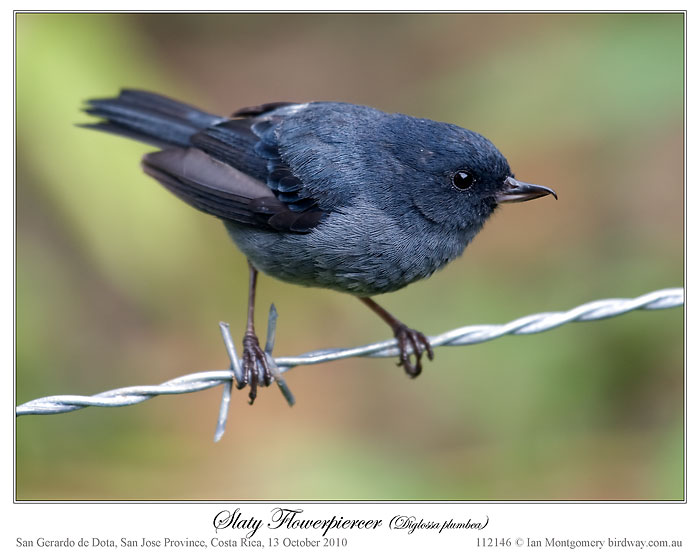
Slaty Flowerpiercer (Diglossa plumbea) by Ian

Slaty Flowerpiercer (Diglossa plumbea) by Ian

Ian’s Bird of the Week – Slaty Flowerpiercers (and Hummingbirds) ~ by Ian Montgomery

Newsletter ~ 12/02/10

Last week’s hummingbirds were popular so here, in a roundabout way, are some more. Flowers often have complex relationships with the animals (eg birds, moths) with which they interact and use them for pollination and distribution of seeds. Mutually beneficial (symbiotic) relationships may develop, such as exchange of nectar for pollination, that result in structural correspondences between species of flowers and animals, in particular the length of flower tubes and the length of the bills of hummingbirds and the probosces of months.

Slaty Flowerpiercer (Diglossa plumbea) by Ian

Slaty Flowerpiercer (Diglossa plumbea) by Ian

These relationships may exclude other species and this leads to cheating in various ways, either directly or indirectly. Flowerpiercers, such as the Slaty Flowerpiercer found in Costa Rica and named after the male of the species, first photo, cheat by using their specially adapted bills to bite through the flower tube to get at the nectar without helping with pollination. The female in the second photo shows how its done with the flower of a ginger plant.
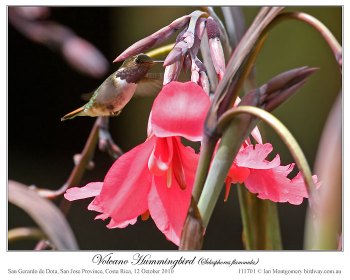
Volcano Hummingbird (Selasphorus flammula) by Ian

Volcano Hummingbird (Selasphorus flammula) by Ian

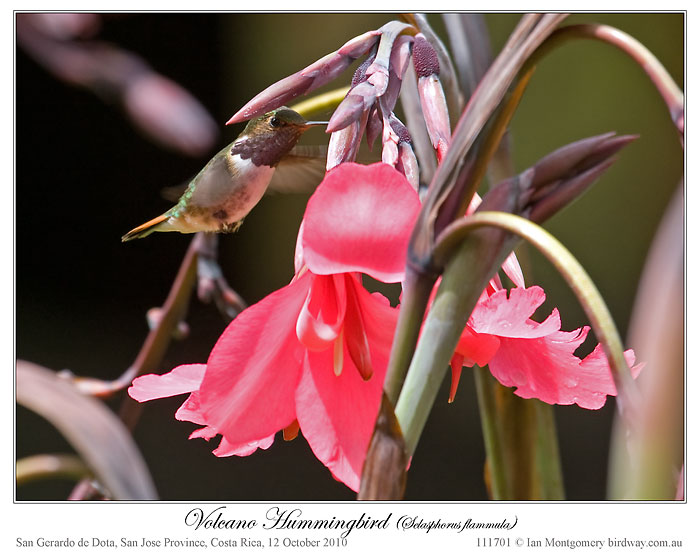
Some short-billed Hummingbirds do the same thing and stab the flower tube. Others, however, cheat indirectly and take advantage of the holes left by the flowerpiercers to sip the nectar. The tiny male Volcano Hummingbird (8cm/3.1in 2.5g) in the third photo is doing just that. Totally dwarfed by the ginger flower, it is hovering nearby and hasn’t had to land on the flower to stab it. The Volcano Hummingbird, incidentally, is a very close relative of the Scintillant Hummingbird of last week but has a violet rather than an orange gorget and is found, as its name suggests, at much higher altitudes. The vertical ranges of the two species just overlap at the 2,200m/7,200ft altitude of San Gerardo de Dota, the valley of the Quetzals.
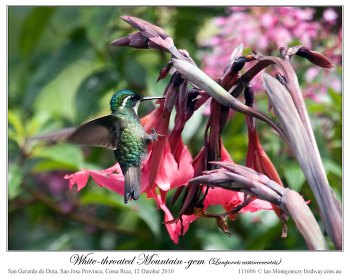
White-throated Mountaingem (Lampornis castaneoventris) by Ian

White-throated Mountaingem (Lampornis castaneoventris) by Ian

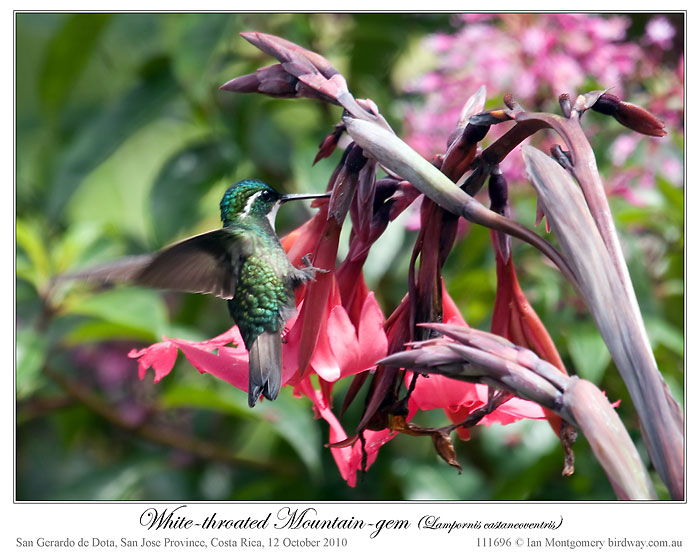
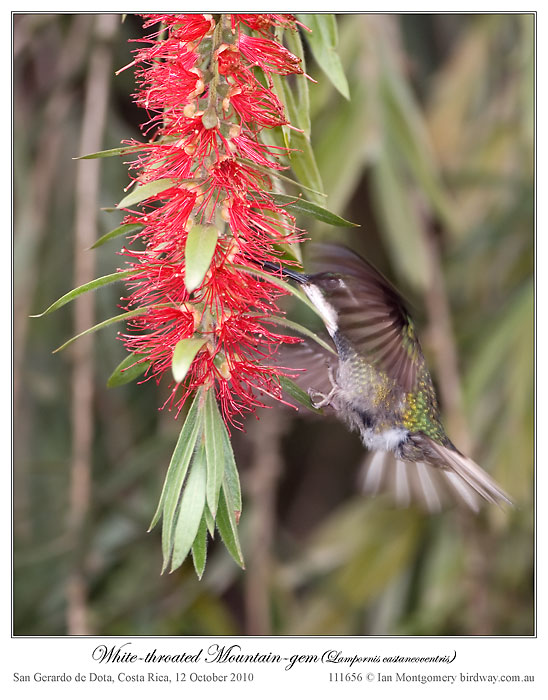
The much larger male White-throated Mountain-gem (11cm/4in 6.2g) in the fourth photo has actually landed on the ginger flower, so whether it has stabbed the flower or is also taking advantage of the Flowerpiercers isn’t obvious. They’re clearly versatile: the fifth photo shows another male feeding on an alien, almost petal-less, Bottlebrush in San Gerardo de Dota, the closest one is likely to get to an Australian Hummingbird!

White-throated Mountaingem (Lampornis castaneoventris) by Ian

White-throated Mountaingem (Lampornis castaneoventris) by Ian

Links:
Flowerpiercers (members of the Tanager family)
Volcano Hummingbird
White-throated Mountain-gem

On the website, I’m getting towards the end of adding Costa Rican birds and have added quite a variety. You might like to check out Recent Additions: http://www.birdway.com.au/index.htm#updates .

Best wishes,
Ian


Ian Montgomery, Birdway Pty Ltd,
454 Forestry Road, Bluewater, Qld 4818
Phone: +61-7 4751 3115
Preferred Email: ian@birdway.com.au
Website: http://birdway.com.au


Lee’s Addition:

Now, Ian, how did you know I was just reading about the Flowerpiercers this week? Thanks for the beautiful photos and article about these birds.

Could it be that the flowerpiercers are not cheating, but just doing as they were designed to do. By poking those holes they are not only getting a drink but allowing the little guys to have access also to a meal of nectar. Such forethought!

All things were made by him; and without him was not any thing made that was made. (John 1:3 KJV)

While working on the Hummingbird and the Tanager pages, the Flowerpiercer again caught my eye like the Sword-billed Hummingbird had from Michael Woodruff photos. If too many of the hummers had those long beaks, there would be a lot of sore necks. So by having the flowerpiercers pierce a hole nearer to the nectar, there are many hummers that get to have shorter beaks and less neck aches!

The common name refers to their habit of piercing the base of flowers to access nectar that otherwise would be out of reach. This is done with their highly modified bills, although this is greatly reduced in the Bluish Flowerpiercer, which has an almost “normal” bill. Most flowerpiercers are restricted to highlands, especially the Andes, in South America, but two species occur in Central America.

There are 18 flowerpiercers in the Diglossa genus in the Tanagers & Allies – Thraupidae Family of the Passeriformes Order.

*
Marvelous Spatuletail from Peru

Marvelous Spatuletail (Loddigesia mirabilis)©©

Marvelous Spatuletail (Loddigesia mirabilis)©©

“Peru’s Marvellous Hummingbird

(from Creation Moments)

In that day the LORD of hosts will be for a crown of glory and a diadem of beauty to the remnant of His people. (Isaiah 28:5)

In 1835, when scientists first saw Peru’s most unusual hummingbird, they were so overcome with its beauty that they gave it the name “Marvellous.” This little bird treats the eye to iridescent green, yellow, orange, and purple feathers. But its most unusual feature is its tail. While most birds have eight to twelve tail feathers, the Marvellous hummingbird has only four. Two of these are long, pointed, thorn-like feathers that don’t seem to help much in flying or landing. The other two feathers are truly marvellous. They are six inches long, three times the length of the bird’s two-inch body. On the end of these two long narrow feathers are large feather fans that nearly equal the surface area of its wings.

Marvelous Spatuletail (Loddigesia mirabilis) ©©

Marvelous Spatuletail (Loddigesia mirabilis) ©©

Astonishingly, the Marvelous hummingbird has complete control of these feathers. At rest, the bird perches with these two feathers hanging down an inch or so from its body, and then crossing them until they are horizontal. In flight and landing they provide remarkable maneuverability. During mating, the hummingbird moves them as semaphores. Interestingly enough, evolutionists admit that they are stumped as to why these unusual feathers should have evolved.

One look at our creation clearly shows that our Creator appreciates beauty. But even the beautiful Marvelous hummingbird is but a poor and cloudy hint of the beauty of our Creator Himself.

Prayer:
Dear Father, help me treat the beauty You have created as You would have me to do. Let me be filled with thanksgiving to You for it, and let it remind me that You are the source of all that is truly beautiful. In Jesus’ Name. Amen.
Notes:
Crawford H. Greenewalt. The Marvelous Hummingbird Rediscovered. National Geographic, Vol. 130, No. 1. P. 98-101.”

©Creation Moments 2010


Lee’s Addition:

The Marvellous Hummingbird is now the Marvelous Spatuletail (Loddigesia mirabilis). It is in the Hummingbird Family (Trochilidae) and is part of the Apodiformes Order.

Marvelous Spatuletail (Loddigesia mirabilis) ©WikiC-Gould_Troch._pl._161

Marvelous Spatuletail (Loddigesia mirabilis) ©WikiC-Gould_Troch._pl._161

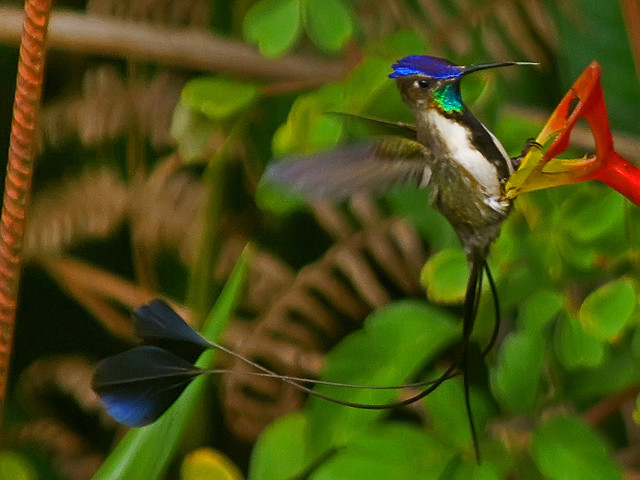
The Marvelous (also Marvellous) Spatuletail (hummingbird), Loddigesia mirabilis, is a medium-sized (up to 5.9 in/15 cm long) white, green and bronze hummingbird adorned with blue crest feathers, a brilliant turquoise gorget, and a black line on its white underparts. It is the only member of the monotypic genus Loddigesia.

A Peruvian endemic, this species is found in the forest edge of the Río Utcubamba region. It was first reported in 1835 by the bird collector Andrew Matthews for George Loddiges. The Marvellous Spatuletail is unique among birds, for it has just four feathers in its tail. Its most remarkable feature is the male’s two long racquet-shaped outer tail feathers that cross each other and end in large violet-blue discs or “spatules”. He can move them independently.

Information gathered from Creation Moments, Wikipedia, and YouTube.

Wordless Birds

*