DUCK, DUCK, GOOSE!
Dr. James J. S. Johnson
And God blessed them, saying, Be fruitful, and multiply, and fill the waters in the seas, and let fowl multiply in the earth. (Genesis 1:22)
Winter is a welcome season for many birdwatchers, especially those of us who live south enough to see wintering migrants, such as the “winter Texans” who congregate in the Lone Star State where I currently reside.

(Moreno/Hagerman NWR photo credit)
Of course, some regions see southbound flocks, in transient stop-over mode, as pass-through migrants who refuel and rest and then resume their southbound migrations. However, another variant of the north-south migratory cycle is the migratory pattern often seen in waterfowl demographics—where waterfowl from to-be-frozen lakes and ponds migrate to warm-water estuaries, such as the never-frozen water of the Chesapeake Bay. It is this latter category of winter migration, to avoid iced-over lakes and ponds (and rivers), that naturalist Kathy Reshetiloff (of the U.S. Fish & Wildlife Service) describes in her “Bay Naturalist” column:
Every fall, a great migration begins as thousands of ducks, geese and swans leave northern breeding grounds and begin to fly south for the winter. Waterfowl from the northernmost U.S. and Canada — even tundra swans and snow geese from the shores of the Arctic Ocean — seek the open water of the Chesapeake Bay, its rivers and wetlands for habitat and food critical to their survival. Roughly one-third of the waterfowl that winter along the Atlantic Coast do so on the [Chesapeake] Bay. Most people are familiar with mallard ducks and Canada geese but may not realize how many other seasonal visitors we get. Venture out this winter to a park along waterways or wetlands, or to a National Wildlife Refuge, and you’ll be surprised by the variety of waterfowl.
[ Quoting CHESAPEAKE BAY JOURNAL, 33(9):40 (December 2023), posted at www.BayJournal.com ]
(Pottsboro Chamber of Commerce photo credit)
So, what kinds of waterfowl are phenologically (and providentially) programmed, by the Lord Jesus Christ, to winter in ice-free estuaries like the Chesapeake Bay? “Duck, duck, goose!”—and swans, just to name the obvious.
For example, swans—being huge birds—are easy to observe if they are afloat in waters of an estuarial (or lacustrine) habitat that you may be visiting.

Swans are the largest waterfowl, and the tundra swans travel the farthest, more than 4,000 miles in some cases. They winter primarily on the Delmarva Peninsula and the estuarine edges of North Carolina. These large white birds are easily recognized by their black bills and straight or nearly straight necks. Tundra swans often form flocks on shallow ponds.
[ Quoting CHESAPEAKE BAY JOURNAL, 33(9):40 (December 2023), posted at www.BayJournal.com ]
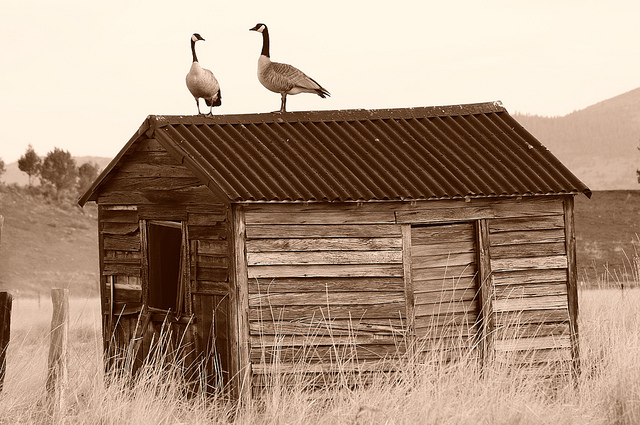
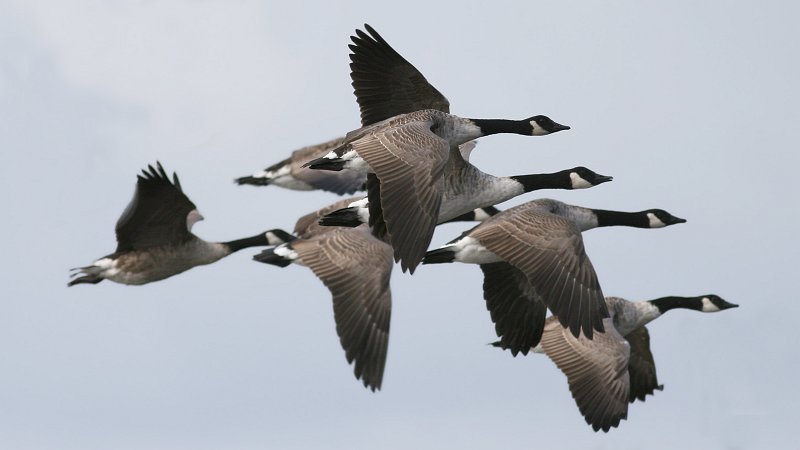
Next, consider the noisy geese that we see both inland, often on ponds or in nearby fields, and at coastal shorelines, such as Canada geese.

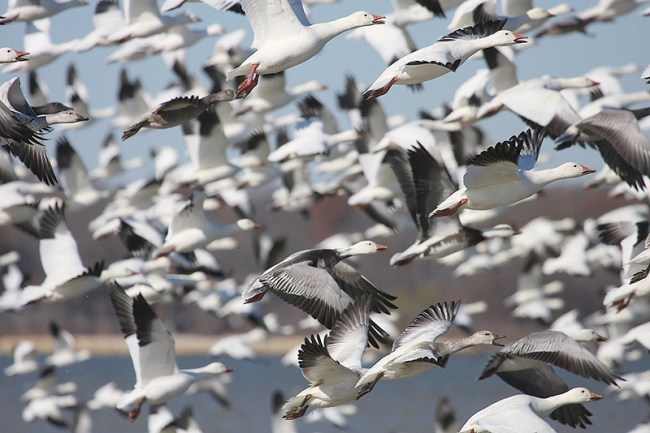
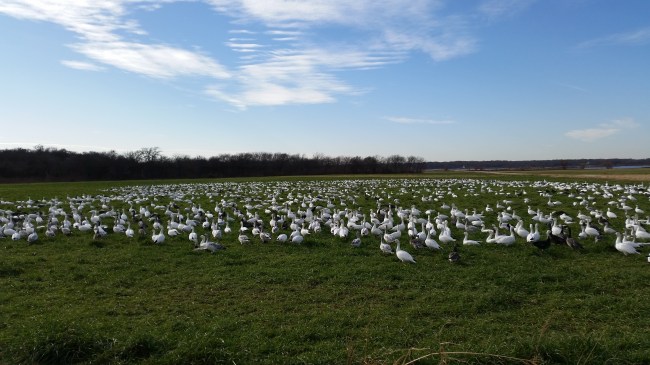
Constant honking signals the arrival of the familiar Canada goose, with its black and white head, brown back and pale breast. A favorite quarry of hunters and bird watchers, Canada geese feed in wetlands and farm fields. But keep your eye out for a lesser-known visitor, the snow goose — another guest from the far, far north, easily distinguished by its white body, black wingtips and pink feet and bills.
[ Quoting CHESAPEAKE BAY JOURNAL, 33(9):40 (December 2023), posted at www.BayJournal.com ]
But, of course, the waterfowl most likely to be seen, statistically speaking, are DUCKS—both dabbler ducks and diving ducks.
The greatest variety of waterfowl, by far, is seen in duck species, which fall into two broad categories based on their feeding method: dabbling or diving.
[ Quoting CHESAPEAKE BAY JOURNAL, 33(9):40 (December 2023), posted at www.BayJournal.com ]
What about dabbler ducks?

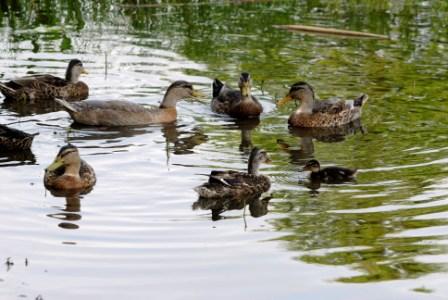
Dabbling ducks feed by straining food from the water’s surface or by submerging their heads while their tails remain out of the water. Male dabblers are usually brightly colored while females are drab. Plants make up most dabblers’ diets. Their method of taking flight is a sort of leap from the water’s surface. Look for them on rivers and close to shorelines. The most widely known dabbler duck is the mallard. The male has a dark green head while the female is dusky brown. Another dabbler species is the American black duck. Both male and female American black ducks look similar to mallard hens, only darker. Other dabblers include the American wigeon, green-winged teal, northern pintail (the male has long black tail feathers), and northern shoveler (named for its large, spatula-like bill).
[ Quoting CHESAPEAKE BAY JOURNAL, 33(9):40 (December 2023), posted at www.BayJournal.com ]
What about diving ducks?
Diving ducks have legs located near the rear of the body, which makes them more efficient swimmers and divers but not terribly graceful on terra firma [i.e., dry land]. Diving ducks pursue their food underwater, chasing fish and searching the bottom for small animals — or the roots and seeds of Bay grasses. They take flight by first running along the surface of the water. But the categorizing doesn’t stop there; diving ducks are further separated into bay, sea and river ducks.
[ Quoting CHESAPEAKE BAY JOURNAL, 33(9):40 (December 2023), posted at www.BayJournal.com ]
Of the Chesapeake Bay’s diving ducks, what about bay ducks?

Bay ducks feed in shallow water, foraging for plants and animals. Males have contrasting head and body colors while females are dark or brown. One of the most striking bay ducks is the canvasback, with its sloping black bill, red eyes and head, and white back. Canvasbacks congregate on the water in large flocks known as rafts. Other bay ducks include the greater and lesser scaups.
[ Quoting CHESAPEAKE BAY JOURNAL, 33(9):40 (December 2023), posted at www.BayJournal.com ]
Of the Chesapeake Bay’s diving ducks, what about sea ducks?

(Craig Lemon / N.J. Division of Fish &Wildlife photo credit)
Sea ducks are commonly found in deeper, open waters of the Bay, feeding on crabs, clams and barnacles. The so-called long-tailed duck sports contrasting brown and white colors and, you guessed it, long tail feathers. The small black and white bufflehead duck also gets its name from a prominent physical feature of the male: it’s outsized head. The male’s head has a very prominent wedge-shaped patch of white on the sides of its head. The three species of scoters — white-winged, surf and black — can be identified by their sloping foreheads.
[ Quoting CHESAPEAKE BAY JOURNAL, 33(9):40 (December 2023), posted at www.BayJournal.com ]
For more about the Bufflehead ducks, see “Bufflehead Duck, One of Diverse Ducks at Aransas Bay”, posted at https://leesbird.com/2018/01/26/bufflehead-duck-one-of-diverse-divers-at-aransas-bay/ .

Of the Chesapeake Bay area’s diving ducks, what about river ducks? River-waters are more turbulent adn fast-moving, compared to estuarial or lacustrine bodies of water, so it’s not surprising that some ducks prefer rivers and streams over bays and lakes, and vice versa.
(Maryland Biodiversity Project photo credit)
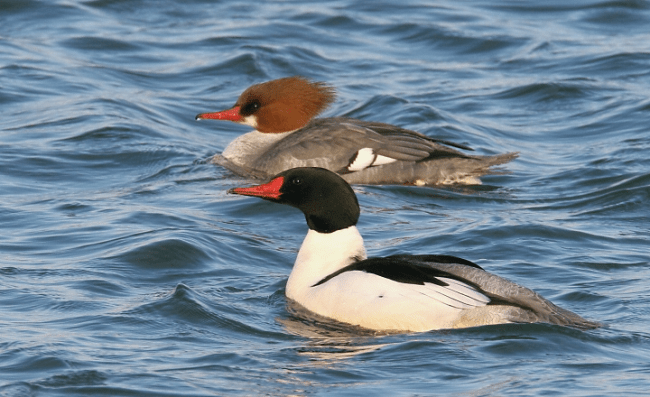
The three species of river ducks are all mergansers. Mergansers prey on fish caught in fresh and brackish water. They are identified by long thin serrated bills and crested heads. The red-breasted, hooded, and common merganser overwinter in the Chesapeake area.
There you have it, at least what to expect if you visit the Chesapeake Bay area during winter.
So, thanks to Kathy Reshetiloff, we have an introductory summary of the waterfowl that winters in the Chesapeake Bay area. Of course, if you live elsewhere—as I do—the populations of waterfowl, both winter visitors and year-round residents, will be different. However, a lot of the information will be relevant, overlapping other regions, because migratory waterfowl often have huge migratory ranges.
(Trent Ledbetter photo credit)
Meanwhile, whatever winter visitors you have, go see them while you can!
And don’t forget to thank the Lord Jesus Christ for making these beautiful flying creatures (on Day #4 of Creation Week); each and every one of them is a living exhibit of His wisdom, care, power, and glory!
><> jjsj


 Lee's Birdwatching Adventures Plus